The Futility of Standing Rock

american_progress
American Progress, an 1872 painting by John Gast, is an allegorical representation of the modernization of the new west. Here Columbia, a personification of the United States, leads civilization westward with American settlers. She then brings light from the East into the darkness of the West, stringing telegraph wire as she sweeps west; she holds a book that “represents learning and knowledge” as well. The different stages of economic activity of the pioneers are highlighted and, especially, the evolving forms of transportation.


Is Standing Rock the line in the sand where Americans demand a do-over? Does the heroic action of Natives suddenly provoke the nation to a change of heart?

I don’t think so.

Yes, there was a treaty with the Sioux in 1851. “The Treaty of Traverse des Sioux (10 Stat. 949) was a treaty signed on July 23, 1851, between the United States government and Sioux Indian bands in Minnesota Territory by which the Sioux ceded territory. The treaty was instigated by Alexander Ramsey, the first governor of Minnesota Territory, and Luke Lea, Commissioner of Indian Affairs in Washington, D.C. The United States wanted the treaty to gain control of agricultural lands for more settlers.”[1]
330px-sioux01
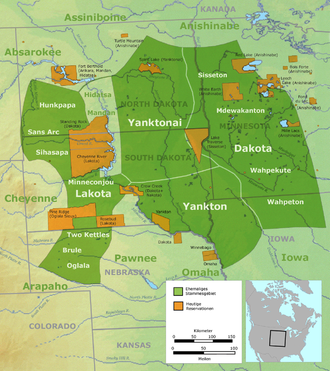
Location of Sioux tribes prior to 1770 (dark green) and their current reservations (orange) in the US

But that wasn’t the end of forced Sioux treaties. “The Treaty of Fort Laramie (also called the Sioux Treaty of 1868) was an agreement between the United States and the Oglala, Miniconjou, and Brulé bands of Lakota people, Yanktonai Dakota, and Arapaho Nation signed on April 29, 1868 at Fort Laramie in the Wyoming Territory, guaranteeing the Lakota ownership of the Black Hills, and further land and hunting rights in South Dakota, Wyoming, and Montana. The Powder River Country was to be henceforth closed to all whites.

“Repeated violations of the otherwise exclusive rights to the land by gold prospectors led to the Black Hills War. Migrant workers seeking gold had crossed the reservation borders, in violation of the treaty. Indians had assaulted these gold prospectors, in violation of the treaty, and war ensued. The U.S. government seized the Black Hills land in 1877.

450px-siouxreservationmap
Map of the 1868 Great Sioux Reservation, and the subsequent changes in reservation borders

“More than a century later, the Sioux nation won a victory in court. On June 30, 1980, in United States v. Sioux Nation of Indians, the United States Supreme Court upheld an award of $15.5 million for the market value of the land in 1877, along with 103 years’ worth of interest at 5 percent, for an additional $105 million. The Lakota Sioux, however, refused to accept payment and instead demanded the return of their territory from the United States.

“In more recent proceedings the U.S. Courts have seen that some of the monies associated with the claim have been expended and, as such, claim that the agreement is valid. In fact, several thousand tribal members have filed for and are awaiting for a final decision by the Court to decide to issue the resources to tribal members.”[2]

“In the summer of 2016, the Standing Rock Sioux Tribe began a protest against construction of the Dakota Access oil pipeline, also known as the Bakken pipeline, which, if completed, is designed to carry hydrofracked  crude oil from the Bakken oil fields of North Dakota to the oil storage and transfer hub of Patoka, Illinois. The pipeline travels only half a mile north of the Standing Rock Sioux reservation and is designed to pass underneath the Missouri River and upstream of the reservation, causing many concerns over the tribe’s drinking water safety, environmental protection, and harmful impacts on culture. The pipeline company claims that the pipeline will provide jobs, reduce American dependence on foreign oil and reduce the price of gas.”[3]

In the tradition of all ancient native people, the Standing Rock protesters’ view is broader and longer term than the typical white view. For ancient people, monetary gain has no standing compared to the value of drinkable water. Someday the pipeline will leak. Maybe not in our lifetime or even in our children’s lifetimes, but someday the pipeline will leak.

What then? The oil won’t just wash away in the next rain. It penetrates the soil where it continues to pollute for decades. Or longer.

There is no argument against this. The Sioux protest at Standing Rock is legitimate in its concern over the long term future of the water.

And what the hell difference does that make? When have the white invaders of North America (and South America, Central America, the Pacific Islands, etc.) ever considered the long term impact of their actions? Our ‘manifest destiny’ was to expand across the continent to ‘redeem’ and remake the land in the white vision of farms and villages. While not embraced by all political leaders of the 19th century, the concept of manifest destiny was widely held by whites and fit hand in glove with the view that we alone held special God-given virtues that granted us exclusive right to fulfill this destiny.[4]

It was our duty as whites to cleanse the lands of heathen beliefs and believers. It was our duty as whites to pursue progress even if it meant using slaves to do so. And so forth.

The reward for such noble efforts was to reap the bounty these lands had to offer. Gold and silver. Virgin timber. Animal skins and meat. Oil. The DAPL pipeline is more of the same. We found this oil and we need it.

A bigger issue looms behind this protest. If by some quirk the Sioux are the ultimate winners of this contest, think of what might happen next. If their treaties are to be honored, if their ancestral lands and holy places and burial grounds and natural resources are found to be theirs, what happens to all the white people who have bought those lands, built their houses, barns and fences, sent down roots for over four generations?

What happens with all the other Native tribes’ treaties that have similarly been ignored?

Are we ready to give up the majority of our homes, schools, cities, and workplaces in order to honor our treaties? Once we acknowledge the rights of the Sioux to determine the fate of the DAPL, we’re on a slippery slope toward that end. This is why you won’t see elected officials rushing to the side of the Standing Rock protesters. They’re sworn to uphold our laws. Our laws, not the long held beliefs of Natives.

We enforce our laws now just as always—by force. Our laws are part and parcel of manifest destiny. We made them to suit us, not the Natives. If we pick at one thread in our long history of occupation and oppression, the entire fabric of our way of life starts to unravel.

The law says protesters are occupying private land. The law says that Energy Transfer Partners, the Army Corps of Engineers, and others have met the legal (our law) requirements for building the pipeline. The law says that trespassers and obstructionists are subject to arrest for violating the law.

We want what we want. We want to drive our cars to the theater and grocery store. We want the internet, running water, and convenient heating and cooling. We’ve invented these things to further advance our well-being. To justify all that has come before including slavery and genocide, we can point to landing a man on the moon, modern medicine, and the microchip as a few examples of our superiority.

Our manifest destiny.

Even a win for the Standing Rock protest would not solve the bigger issue. Even if by some fiat the pipeline route is changed, or the oil piling up at the fracking sites is ultimately moved by truck or railcars, the bigger issue remains. We live on Native lands and harvest Native resources.

When the gold, silver, copper, rare earth, and every other microcosm of value have been mined, cut, harvested, and fished, then what? When the waters become too polluted to drink or feed our crops, then what? When the soil becomes too depleted and contaminated to grow our food, then what?
levcrpp1080012_1024_x_768
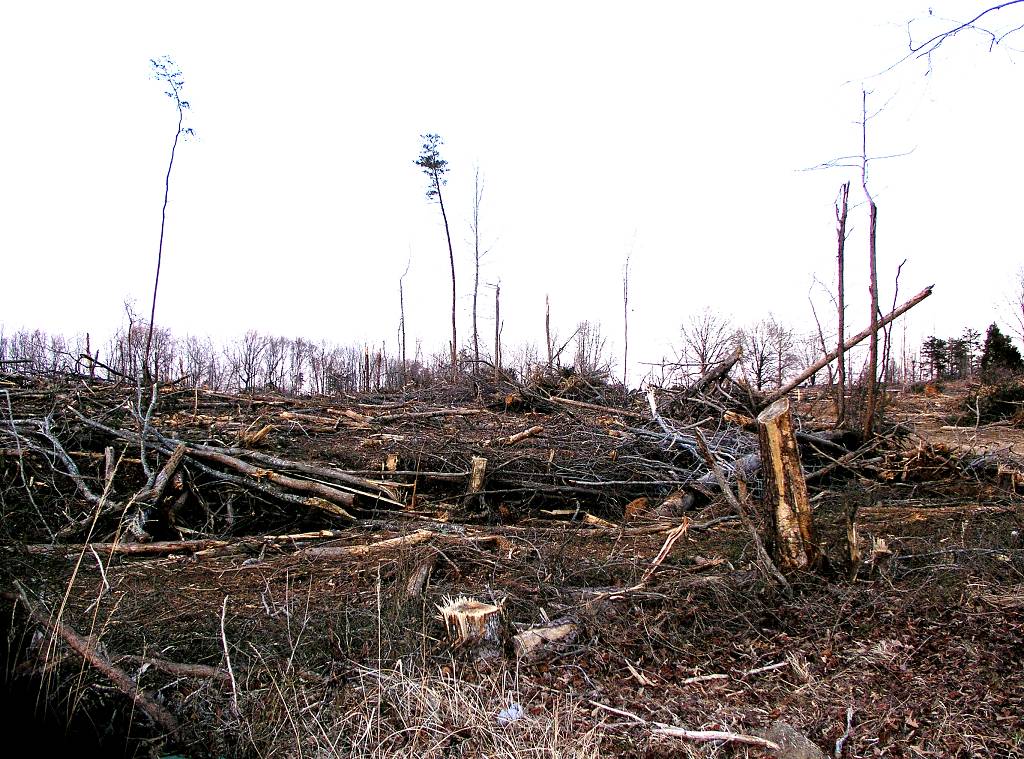
Deforestation is one of the main causes of climate change. It is the second largest anthropogenic source of carbon dioxide to the atmosphere, after fossil fuel combustion.

We’ve pretty much run out of new continents to exploit.

We already see the horizon. It is there in the wasteland of our industrial cities. It is there in the overflowing containment ponds leaking hazardous mining waste. It is there in the lost futures of whites who believed in their manifest destiny and now find themselves discarded as Destiny chooses robots instead of men to build cars.

Manifest destiny gave us this land. It gave us right to work laws that gutted the power of organized labor. It gave us multi-national corporations who have no allegiance except to money.

Manifest destiny still drives not only our national attitude about domestic affairs but our international policies as well. “The belief in an American mission to promote and defend democracy throughout the world, as expounded by Thomas Jefferson and his “Empire of Liberty” and Abraham Lincoln, was continued by Theodore Roosevelt and Woodrow Wilson. Under Harry Truman (and Douglas MacArthur) it was implemented in practice in the American rebuilding of Japan and Germany after World War II.

“George W. Bush in the 21st century applied it to the Middle East, in Afghanistan and Iraq. In proclaiming a mission to combat terror, Bush was continuing a long tradition of prophetic presidential action to be the beacon of freedom in the spirit of manifest destiny.”[5]

~~~

[1] https://en.wikipedia.org/wiki/Treaty_of_Traverse_des_Sioux

[2] https://en.wikipedia.org/wiki/Treaty_of_Fort_Laramie_(1868)

[3] https://en.wikipedia.org/wiki/Sioux

[4] https://en.wikipedia.org/wiki/Manifest_destiny

[5] https://en.wikipedia.org/wiki/Manifest_destiny

Light Being Human

gold-sunset

A vast plain stretched before me, fields of grasses amber in the dawn. The grasses bent with heavy heads, golden ripe, nodding in the gentle winds of daybreak. The man rose up out of the grasses. He rose up out of the grasses and looked at me. His eyes were tawny.

We stood at the gates of the city side by side. His hand held mine as we looked over the fields of grasses, bright yellow in the full light of midday. His hands held mine and melted into mine and we were one. We stood, looking out, one.

His thoughts hummed with familiar energy. I had always known him. His thoughts carried knowledge as old as my own, fit perfectly into the brain that lay within his skull, his skull of golden hair.

I knew his appetites, whether he had the sweetness of honey on his tongue, whether his belly was full with the meat of the field. He lay between my legs and filled my belly with the honey of his mouth and the meat of the field. His appetites were my appetites. We hungered together and satisfied each other. He was waiting for me even now, his eyes looking for me in the lands of the Earth.
~~~
Pre-order at half price before Nov 15 release date!
https://www.amazon.com/dp/B01LZO0X1Q
https://www.smashwords.com/books/view/669696

Smoke This!

Marijuana medical choice dilemma health care concept as a person standing in front of two paths with one offering traditional medicine and the other option with cannabis.

When considering the pros and cons of medical cannabis, voters benefit from knowing as many facts as possible. Most people are not aware that the human body manufactures chemicals identical to those found in the cannabis plant. This stunning nugget of information was discovered as recently as 1990.

Wikipedia: “The endocannabinoid system (ECS) is a group of endogenous cannabinoid receptors located in the mammalian brain and throughout the central and peripheral nervous systems, consisting of neuromodulatory lipids and their receptors. Known as ‘the body’s own cannabinoid system,’ the ECS is involved in a variety of physiological processes including…regulation of appetite, immune system functions and pain management…and are found in the brain and nervous system, as well as in peripheral organs and tissues.”[1]

Native to central Asian and the Indian subcontinent, the cannabis plant found in ancient literature and prehistoric burials served as medicine for seizures, pain, and other human ailments. Over time, three differing species have developed–sativaindica, and ruderalis— with the more psychoactive and medically useful plants diverging from a type containing less psychoactive agents—hemp–used for rope and textiles and farmed extensively through World War II.

At least 113 active cannabinoids have been identified in the plant, one of which—tetrahydrocannabinol (THC)—is the chemical cloned for medical use as the legal pharmaceutical drug Marinol. Many patients report better results from natural cannabis than with Marinol, perhaps due to the balancing effects of the plant’s other ingredients.

Another element of natural cannabis, cannabidiol (CBD), is highly effective in treating seizures and muscle spasms.[2] Families with children suffering seizures are pulling up stakes to move to states where their ailing child can access legal CBD oil. In natural proportions, all 113 active elements in cannabis balance each other in important ways that no synthetic isolated elements like Marinol could ever do.

Those advocating for more research and FDA approval before allowing medical use fail to acknowledge the fact that cannabis has been in the human pharmacopoeia for at least 5000 years. Compared to that, FDA approval means nothing. But aside from that, the fact is that drug companies are not going to invest the millions of dollars required to gain FDA approval of natural cannabis. They’d never recoup their investment on a plant that people can grow in their back yards. And they’ve started to understand that medical cannabis outshines many of their most profitable drugs both in effectiveness and in the absence of dangerous side effects. Drug companies are above all else profit-driven corporations.

It’s a little known fact that before the government will allow legal access to cannabis plant material for medical research, the researcher’s goal must be to find the harms that could be caused by the plant. If a researcher wants federal approval to research the potential medical benefits of natural cannabis, the request will be denied. These conditions are written into federal law.

Those in Arkansas voicing opposition to medical cannabis haven’t researched the issue with an open mind. They react based on old prejudices and discredited propaganda. There’s still the culture war specter haunting cannabis, that stinky weed that hippies used as part of their rebellion from the Establishment. It’s still a point of contention between parents and their teens in the ongoing generational battle over control.

Yet studies in states with legal medical cannabis have found reduced use of illegal drugs by teens and reduced rates of crime.  A multi-year study published by the journal Lancet Psychiatry found: “…When researchers looked at marijuana use over time in the 21 states where medical marijuana was legal by 2014, they found no change in marijuana use after a medical marijuana law was passed, compared with before. About 16 percent of teens said they had used marijuana in the past month before a law was passed, compared with 15 percent who said the same after a law was passed.”[3]

The fact is, the long anticipated ‘end of civilization as we know it if marijuana is legalized’ has simply failed to materialize.

A 2014 Texas study states: “Results did not indicate a crime exacerbating effect of MML on any of the Part I offenses. Alternatively, state MML may be correlated with a reduction in homicide and assault rates, net of other covariates. These findings run counter to arguments suggesting the legalization of marijuana for medical purposes poses a danger to public health in terms of exposure to violent crime and property crimes.”[4]

Researchers at the Norwegian School of Economics used FBI statistics “to investigate the effect of the legalization on two types of crime: theft and violence. In the study, they looked at the 18 states that had introduced such laws before 2012…The researchers found a clear decline in both theft and violent crime in the states that legalized marijuana and share a border with Mexico.”[5]

Arkansas’ governor and others who voice alarm about opioid addiction should think again about their opposition to medical cannabis. One notable result of medical cannabis laws is the reduction of prescription drug use. “Fewer people are using opioids in states that have legalized medical marijuana, according to a study published September 15 in the American Journal of Public Health that bolsters advocates’ claims that marijuana can substitute for more deadly drugs.”[6]

An extensive study by the RAND Corporation (2015) concluded that legal medical cannabis reduces opioid use: “The fact that opioid harms decline in response to medical marijuana dispensaries raises some interesting questions as to whether marijuana liberalization may be beneficial for public health. Marijuana is a far less addictive substance than opioids and the potential for overdosing is nearly zero.”[7]

On November 8, citizens of Arkansas have an opportunity to cast a vote for compassion and common sense in the Natural State by bringing back the right to use this natural medicine. In the process, they also have the opportunity to nudge this state a baby step closer to the vision and advantages enjoyed by citizens in 25 other states of this nation.


[1] https://en.wikipedia.org/wiki/Endocannabinoid_system

[2] https://en.wikipedia.org/wiki/Cannabidiol

[3] Quoted from http://www.ctvnews.ca/ctv-news-channel/medical-marijuana-laws-don-t-lead-to-increased-use-by-teens-large-u-s-study-1.2424012 ; Lancet study is at http://www.thelancet.com/pdfs/journals/lanpsy/PIIS2215-0366(15)00217-5.pdf

[4] http://journals.plos.org/plosone/article?id=10.1371/journal.pone.0092816

[5] http://sciencenordic.com/legalization-medical-marijuana-reduces-crime

[6] http://www.usnews.com/news/articles/2016-09-15/study-opioid-use-decreases-in-states-that-legalize-medical-marijuana

[7] https://www.rand.org/content/dam/rand/pubs/working_papers/WR1100/WR1130/RAND_WR1130.pdf


This Is For You, Donald

woman-slaps-man

I am so sick of this election campaign. Specifically Donald Trump. Throughout last night’s debate, I kept wishing Hillary would just walk over to that lying chump and slap his filthy mouth. What a jerk.

He respects women. *slap* Because all those nasty lying bitches out there telling the truth about what he did to them, touching without permission, treated like a sex object there for his taking, that was all just lies. *slap*

Because mean ole Hillary and her sleazy campaign set all that up, went out in the night and rounded up a bunch of random women who just happened to have documented prior contact with Trump which made them the perfect candidates for this massive con. Because if he loses this election, it will only be because everyone is so mean to him and he never did anything wrong. (whine whine) *slap slap*

Because the problem is Bill Clinton, because all those nice women accusing Bill are telling the truth. Worse, Hillary said bad things to them at the time. *slap*

Because it takes government and laws to decide what women can do inside their own bodies. *slap slap slap*

Trump’s words originate in the animal part of his brain, that ancient area where fear and hunger control behavior. It’s as if his frontal lobes are missing, you know, that part where analysis and rational thought processes occur. He was unable to outline any specific policies he plans to implement—because he doesn’t have any. His entire shtick is to pump up the fear and hatred rampant in his fan base.

And then once elected, you can hear between the lines—in what for him passes as thinking—that he’ll let Pence and Giuliani and Christie and the rest of his pathetic sycophants run the government.

That an educated, intelligent woman like Hillary Clinton would have to stand there and be repeatedly insulted by this ape infuriates me. His job in this debate was to answer the f***ing questions. He was supposed to demonstrate that he understands national policy issues and present his proposals—how, for example, would he identify and remove eleven million illegal immigrants and their four million children who have been legally born in this country?

He has no idea. It’s a sound bite, pandering to people afraid of people who are different.

How would he improve the situation in the Middle East? Do a Ted Cruz and ‘carpet bomb’ the region until the sand melted? No idea.

Trump knew just enough to look stupid, no doubt the result of exhaustive efforts by those few advisors who continue to believe Trump is worth saving. Our alliances with foreign nations aren’t one-sided deals, no matter how he and his followers manage to obfuscate the issue. I wanted Hillary to rebut his stupid claims, talk about how much we get from all our allies not only in trade and national defense but in outright payment for our goods and services. We haven’t become the most powerful nation in the world by making idiot choices in our foreign policy. And our alliances and foreign policies did not begin and end with Obama or his secretary of state.

Donald, get real. The war in Iraq was entirely on the Bush administration including the withdrawal that, you ignorantly complain, was Obama and Hillary opening the door to ISIS. *slap* The first Gulf war was also a Bush administration move, even though you’ve tried to say that if it had been done ‘right,’ we wouldn’t have had to go over there again.

Then there’s that horrible nasty NAFTA trade deal that Donald kept laying at the feet of Bill Clinton. Another huge lie. *slap slap* That deal started in 1991 when, again, a Bush administration held the reins of our national government. All the details had been worked out before Bill Clinton ever took office. Yes, he signed it into law in 1994, but it was done deal by then.

But you wouldn’t know the realities of foreign policy or anything else requiring thoughtful consideration because you were busy with your snout up some woman’s skirt.

And what about all that job loss you keep ranting about? Well, fact is, Donald, you conveniently ignore the reality about America’s lost labor force. It has little to do with trade deals and a lot to do with technology. Cars aren’t built by union men with high paying jobs because they’re now built by robots.

This is why education should be at the top of the list for anyone who really expects to improve opportunities for working Americans. Standing at an iron furnace is no longer required—computer-operated machines do that. Aging workers who lost jobs to advancing technology can be retrained but only if we invest as a nation in that retraining. Young people can be employed—if they’re computer literate or offered opportunities in technical training—just like Hillary talked about in between having to stand there listening to your ignorant drivel.

What manufacturing jobs remain have moved to Third World countries because corporations have pushed through laws that allow maximum profits and no accountability to their citizenship. They’ve gained legal permission not to pay taxes. Their allegiance is to their stockholders and CEOs. But this isn’t new, not a result of a Democratic administration or the single four-year term of a secretary of state. And I’m sorry, but did I hear you complain about these policies for the last forty years that you’ve taken full advantage of them?

This is a result of slow shifts in how products are made, the incorporation of digital technologies that increase productivity even as they make many old labor intensive jobs obsolete. This shift has been underway for fifty years or longer. It’s been at least since the 1970s that Americans were warned that a new service-based economy was on the horizon.

But Hillary was right not to get tangled up in rebutting his litany of lies. His followers wouldn’t believe anything she said even if they understood it. And Trump is not capable of learning. Anything.

Somewhere deep inside, Trump knows he’s a f***ing loser. That’s why he has to sneak up and cop a feel on women who wouldn’t give him the time of day if he asked. That’s why he can’t formulate a single specific policy plan for any of the issues he likes to rant about. That’s why he has to whine about rigged elections.

Little rich kid Trump never learned to take responsibility for anything—not his actions, not his business failures, not the miserable campaign he’s managed to run on the backs of a terrified and easily manipulated segment of the population. He never did the things he said he did to women—and it’s their fault for bringing it up.

Wait, what?

That he would deny the validity of the election out of his craven need to excuse his monumental failure not only as a candidate but as a human being is not just inexcusable. It’s treason.

And yes, I still want to slap him. Fortunately, I think the majority of American voters are about to do it for me.

CHROMA Excerpt

chroma-coverMuch of what I write is history. My blog posts are usually about current events or my publications about local history. This is different.

My new novel, Chroma, is history of an entirely different sort. Theoretical history firmly rooted in factual evidence of human evolution. It’s available in ebook format at half price now until November 15 release date.

They were aware of nothing. Not movement, even though they existed within a stream of photons traveling at the speed of light. Not thought, even though they contained among them all the knowledge that could be known.

They were One, Chroma.

A world of physical existence unfolded before them as they encountered a blue planet and its cycles of life, forms already ancient in their traditions of birth, life, and death. The Aspects of Chroma begin to question. How would it be to know embodiment? Could they learn the pleasure of food, of rest and procreation?

Among them, B4 Indigo—more precisely 493.883 Hertz in her spectral array between 420 and 450 nanometers of visible light—flourished into her own identity. Immediately resonating with her harmonic companion F369.994 Yellow and his fellow octaves of F sharp, B4 pursued a fateful agenda. What could be known? What could be changed?

Chroma: Light Being Human submerges readers in the intimate process of becoming human.

Excerpt:

Several entities manipulate dials and adjust various screens and mechanisms. The green glow of instrumentation reflects on their thin metallic arms and black sensory lens. Outside, visible through a wide expanse of glass that spreads above the console, the curve of the ship’s upper hull shines faintly silver as we pass a nearby sun, a reflection that repeats in luminous arcs along the huge outer ring as it revolves around the ship. Our vessel emits its own light, a faint glow of pink and yellow, pastel blue and green. The pale kaleidoscope of color changes as the ring rotates. A faint jingling sound emanates from the ring.

The crystal from which we flow stands in the midst of the upper deck, mounted at the heart of an elegant curving focular. The metal device reaches up to a clear dome in the ceiling, the portal through which our photons flow. At the heart of the focular, the tall crystal pulses with light. Each facet sparks with color, throwing my existence—the existence of us all—into the cabin.

You can’t imagine seeing all this at once. Without any understanding. I can’t imagine it either, not any more. It’s been too long. What’s left for me now, for any of us in Light, is the faint dying away of sound from a bell long after it’s been struck.

What lingers more clearly is the question ‘why’? I’ve come up with countless answers, but my cigarette has gone out. Its ashes and butt have already been incorporated into the cabin’s refuse bin. What can I say? I always want to smoke. It calms me.

~~~

We were so innocent then. None of us knew how long we’d been traveling or even that we were. I speak for us all because back then, we were One.

We’d been speeding through the soup of space-time. It could be said that we didn’t move at all, that we were in all places at once, and that would have been closer to the actual physics of the situation. We understood so little.

As if we understand now. Get that straight. I can look back now and say, oh, yeah, this and that. But we blew into this excruciating process without knowing anything. You’d think after all this time we’d have the answers. Everyone thinks we know everything. I’m telling this story because you need to understand—we don’t know.

At the time, we didn’t have human reference. Consider yourself lucky that I can use these terms. Otherwise, I’d have to present a symphony with flashing lights and you wouldn’t get it.

Please allow me to introduce us, the Aspects of Chroma. I’m of the electromagnetic range known as Indigo, and my frequency is of the musical tone B at the fourth octave of human perception, 493.883 Hertz. Call me B4. From me up the diatonic scale and across the visible spectrum are C Violet, D Red, E Orange, F Yellow, G Green, and A Blue, each like me with countless shades and sub-tones just as there are infinite fractions between the number one and the number two. These are my kinsmen and companions. Part of me, at least in the beginning.

Beginning? Again, that’s an amorphous concept. What we’ve learned so far is that our piercing column of white light, this stream of photons, originates somewhere past Sirius. The big star’s gravity bends our trajectory and slings us on a new path like a stone from a slingshot.

In the moment of our awakening, we existed as a refraction off the face of a doubly terminated clear quartz crystal, SiO4 tetrahedra. We broke into brilliant shapes of every color: red lines and blue spheres, violet spirals and yellow-orange loops, green and turquoise, russet and tan, swirling and sparkling, our voice a mighty chorus throbbing with the vibration of our existence.

This is the armchair quarterback version. Like I said, we didn’t know any of this. We just were. Ambulatory entities moved around us in a physical existence unlike ours. They could travel from place to place as discrete beings. Do things. Move things. I envied them.

Looking back, I’m amazed at how easy it was to take the next step. I can’t tell you when. We’re talking infinities of time, at least in human terms. And that’s how I’m trying to keep this, in human terms.

At a random moment, I the fourth octave of Indigo separated my wave of sound and light from the others. I clung to one of these ambulatory forms as it passed near the crystal. I had been part of the full sound of Chroma, a band of its electromagnetic spectra. Suddenly I wasn’t.

I admit it was a thrilling moment. That first taste of discrete existence riveted my attention. This physiognomy went places, did things. I went with it. Interacted. I became able to think and speak of things not previously known, concepts not known to us in One.

That was how it started.

~~~

I rode the Phiz, these gray physiognomies with their gleaming black eyes and dexterous fingers, around our contained metal vessel. On its shoulders, I dove deep into the belly of the ship where sleek engines chewed through harvested dark matter and thrust us ever onward. I swept along corridors to technical rooms where Phiz performed maintenance on each other and the ship’s devices. With the Phiz, I found that my suggestions resulted in certain responses so that when I wanted to see beyond a particular door, whichever Phiz I rode opened it. When I wanted to alter the direction of the ship so that it turned more toward the nearby nebulae or a particular galaxy, the Phiz manipulated the controls accordingly.

What pleasure I found in these interactions! The heady exercise of power, autonomy, control, adventure! The gratification of cause and effect, initiation and conclusion, hunger and satiety—I couldn’t get enough. How could one ever forget such things, once tasted?

My fellow Aspects twirled and tumbled in a constantly changing wash of rainbow hues and choirs of sound. Calculations of mathematics, rhymes of words and phrases, patterns of triangles, squares, octagons, words merging into other words that grew from combinations of letters, new meanings and ideas forming from old meanings and old ideas, scenes of color shifting constantly into different color—all of it poured out in a continuing stream, all of it made audible by the rush of sound, each tone carrying its own frequency and pitch, each color merging upward or downward into the next hue, each pitch sliding upward or downward through infinite frequencies.

Indigo posed our fateful question to the thought stream pulsing within our One: Could we have form as do the Phiz?

Immediately the texture of light in the room changed. Shades of color diminished until only the primary hue of each band remained. The wild disarray of sound subsided as sub-tones, flats and sharps and semi-notes aligned with their dominant pitches. One next to each other, each of the Aspects formed their primary hue of colored light in a single prismatic emission from the crystal face.

“What would you have us do, B Indigo?” asked D293.665 Red, surging in a beam of crimson. “Will it be pleasurable?”

“What will form accomplish?” A440 Blue said, his cobalt column intense. “I admit to some interest in your idea, but I have no data that support this proposal.”

“No data,” said the sphere of E329.628 Orange.

F369.994 Yellow rippled over the room, casting everything in golden brilliance. “A challenging proposal, my dear B4,” he said. “I’ve seen you coming this. I’ve felt your excitement. Why would you change us?”

Even separated from them as I had become in my questioning, I could not overcome the pull of our vibrational unity. But among them all, none had greater fundamental frequency with me than the energy of F369.994 and his fellow octaves of F sharp. For a moment, I couldn’t control my visceral response, an emission of sound that rang out beside his pitch in perfect intervals of fourths and fifths.

Such joy! Tremors of luxurious warmth swept along my wavelength. I wanted him always with me.

“Don’t spoil this, Yellow.” I wrested away, shivering in the rush of our harmonic joining. “Think of what I ask.”

His tone settled on one note. “Do you know what you ask?”

“Surely we have other purpose than endless play,” I said, resisting the urge to acknowledge his doubt. “What do we know of our beginning? Where are we going? What is our purpose? Is this all there is?”

None of them replied. Only the faintest choir of sound emanated from us.

“What of this adjacent plane, these physical constructs that force us from One into many, that contain us and attend us?” I said, swirling toward the crystal and the Phiz then laying my purple ribbon of light along the glass that separated our enclosed space from the streaming vista ahead. I couldn’t express, then or now, the swelling up I felt, the urgency pushing me. “What are the natures of the bodies we pass, these suns and novas, the congregates?”

The room remained abnormally silent with faint spikes of color flickering on the lustrous high ceiling.  I couldn’t blame them for their reaction. Part of me remained in sync with them, stunned at my rebellion.

“These are challenging observations, B4,” Blue intoned.

Green flourished in chartreuse, emerald, lime, as octaves of G echoed. “We could instruct the Phiz to such a task. I sense creative possibilities.”

“Yes, exactly,” I said, my Indigo family growing more intense. “How can we wait one more moment to explore?”

“Dearest B4, we have everything here,” Violet C murmured. “Existence in its purest form. We are One. Why would we want to disturb this with unknowns?”

“But we are no longer One…” I said.

“Theoretical questions, Violet,” F Yellow said. “Questioning within unity is not the same as chasing ideas on your own. What B4 proposes takes us outside anything we’ve known.”

“The risks of unknowns, statistically speaking…the odds are quite staggering that we would have any success in finding an equivalent amount of pleasure, if I respond to Red’s posed question,” Orange said. She calculated, sending up waves of mathematical images to the upper deck walls. “Drawing from Phiz data stores—they have no specific description of pleasure or any other subjective experience, but they do record a significant number of potentially damaging interactions between our containment here and various elements of the external environment. If we extrapolated that we, like the vessel around us, would also encounter a variety of similar interactions, we could assume that pleasure would not be the only feature of such a ‘physical’ experience.”

“A blind leap, it seems to me,” Blue said. “Why would we risk it? I believe Indigo’s ideas stem from disengagement from our union. We should be reminded—it’s been a long time since we acknowledged the primal energy of our source. A joining can’t be far off. Until the time when our One is reenergized, we should focus on discussion, perhaps expanding our theoretical analyses. We can generate ideas and experiences among us that are new and challenging—Orange alone has infinite sequences of formulae—without shifting the fundamental nature of our experience. We are, after all, physical in the sense that we exist in light and sound beyond the energy stream radiated at the grating. The possibilities…”

“And what of my offerings—spontaneous, organic…” Green said.

“Take my D,” Red said. “Tones seducing to the sharp, to the flat …”

The column of light swirled brighter. Choirs of sound pulsed the air and rose to the walls, to the high ceiling, until the shades of color painted the room in song. I saw their hesitation. I slipped away, allowing my bandwidth to drift into shadows. I don’t know what I expected. The old songs resonated through the conversation.

Whether my fellows agreed or not, whether Indigo might later suffer regret, I could not stop myself. I see now that my destiny would find outlet no matter what. Ironically, I understand it now in terms of the physical world. My fate advanced like a sudden rivulet of rainwater caught behind a clump of leaves and silt which pile up in a widening dam until, finding fresh course to its inevitable downhill destiny, the flood rushes around and through the obstacle.

~~~

Amazon purchase link, only $2.99!

Smashwords purchase link, only $2.99 — includes all formats