
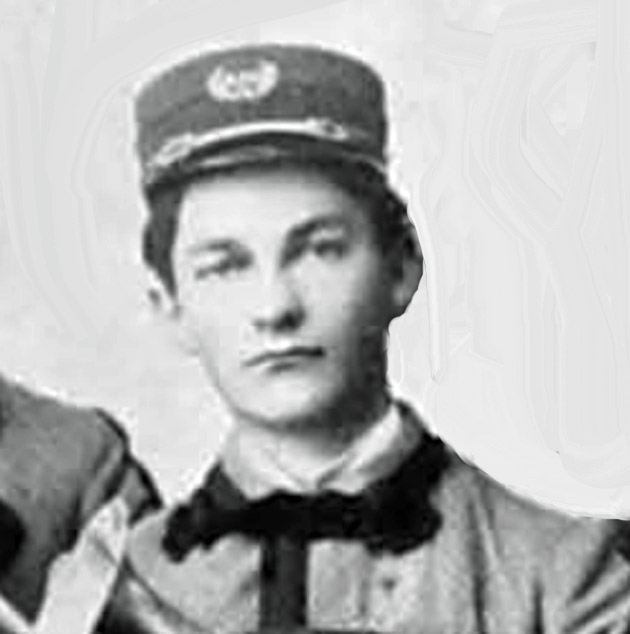
UA Cardinal Yearbook
The question of when and how Frank Barr picked up a cornet and learned to play remains unanswered in the mists of time. Yet at the age of eighteen as a student at the University of Arkansas in 1892, this young man not only played but would soon become the bandleader for the University Cadet Band. He would go on to direct the University band for twenty years as well as recruiting youth for “Barr’s Boys Band” through the 1930s. But these were not Frank Barr’s only contribution to the community of Fayetteville and the surrounding region.
Ambitious and hard-working, Barr seemed to be in many places at once. He ventured throughout the region helping local community bands develop. He traveled in an ever larger arena to establish a string of silent movie theaters, perhaps because at that point in the media, music was expected to be performed while the movie reels rolled. He also prevailed upon Fayetteville town fathers to support a community band, to serve in various settings. The Commercial League Band went on to please multiple regional audiences.
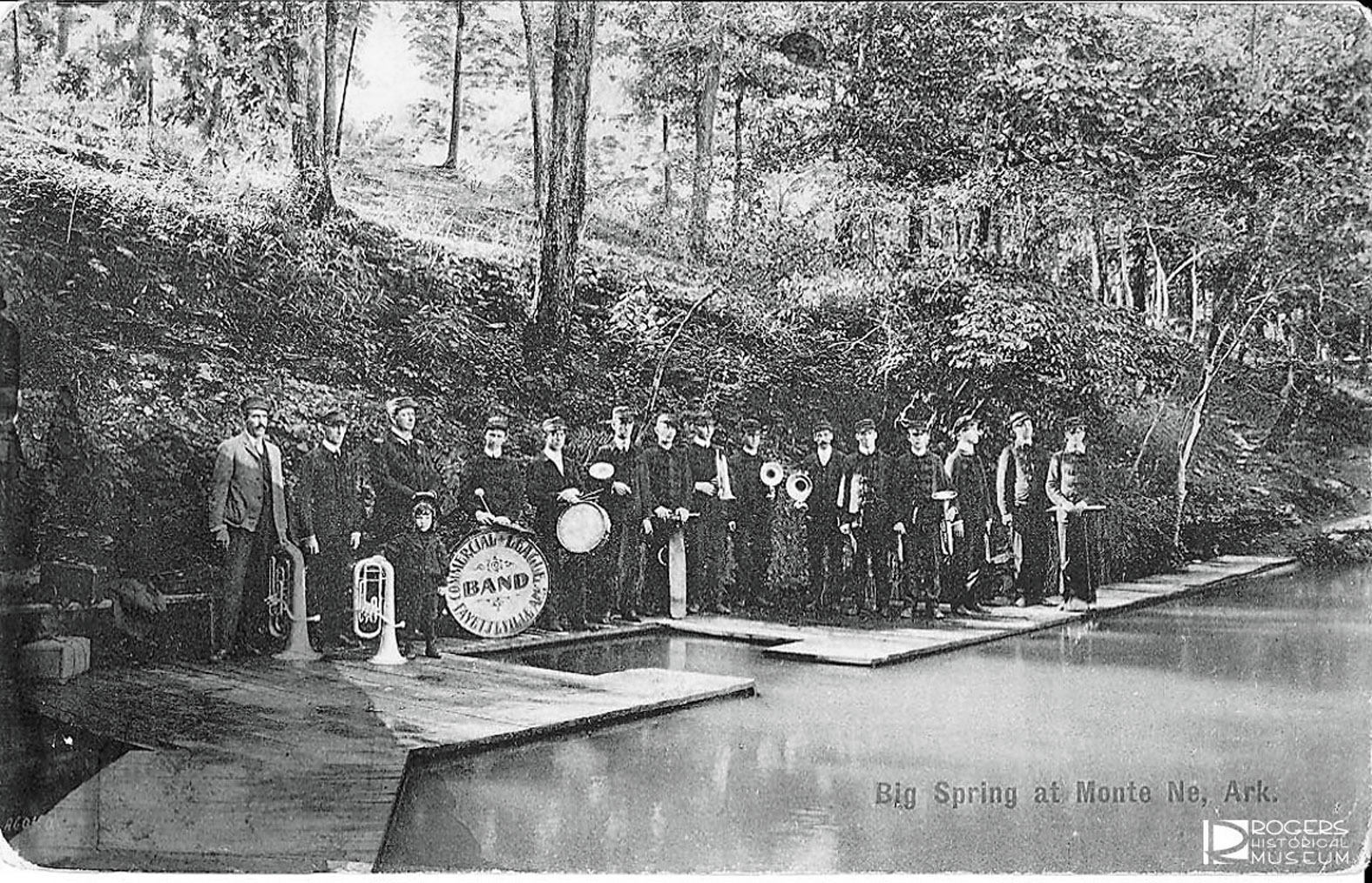
Above: At Monte Ne. Frank Barr third from left with his son Clinton standing in front of him. Monte Ne’s creator William “Coin” Harvey always ensured that his resort guests stayed entertained during their visit. Whether it was by going to plays, listening to music or attending dances, his guests were assured to have a good time while at Monte Ne. This 1910 photo of the Commercial League Band from Fayetteville shows the ensemble standing in uniform on the wooden walkway around the edge of Big Spring.
Barr’s work with the Commercial League Band expanded to include playing at the skating rink as well as dances, the park, and open air concerts on the Square. In 1909, Barr took over a fledgling silent picture project that had operated briefly at the Ozark Opera House. He began showing the films, first in an open air setting at the corner of West and Dickson, then within months at 17 N. Block which he named Lyric Theater. He soon built a new theater at the northwest corner of Block and Meadow, tailored to the needs of an audience with its sloped floor and state of the art ventilation.
Alongside his growing responsibilities to the University, the community, and his various pursuits in promoting music, Frank and his wife Annie suddenly found themselves confronted with unthinkable. Their only child Clinton developed a serious medical condition, an ailment of his lungs. In August 1912, Frank and wife Annie took Clinton to Mayo Clinic in Rochester, Minnesota where two operations were performed. Another operation was performed in early January 1913, and before the end of the month, Annie asked Frank to come to Rochester as Clinton would require yet another operation. By June 1913, the situation with Clinton Barr had not improved. In a telegram to close friend Al Rife, Frank Barr described what his family faced.
“Necessary for another operation, could not live without it. Operation not so serious as before, lungs in far worse condition than ever, the x-ray locating nest of pockets, some the size of walnuts. Don’t know when can get in hospital. Opening made by previous operation will assist in this operation.”

The complicated and amazing story of Frank Barr reveals a man of vision and formidable emotional strength as he managed to keep up with the many demands before him. He and Annie mortgaged their properties to pay for Clinton’s medical expenses. He poured his energy into his Boys Band, playing in local parades and providing music for the new Lyric Theater. First reported in August 1912 when they were praised for their performance at the A.H.T.A. (Anti-Horse Thief Association) picnic at Elkins, the Boys Band was soon in demand around the region. In June 1913, they traveled to St. Paul to play for a three-day reunion. “The reunion people can rest assured that they will be furnished with good music,” the paper reported. “And besides, it will be quite a novelty to hear the Kids play. They always make a big hit wherever they go, and it will be a big drawing card for the Reunion.” The band performed so nicely that fall at the Washington County Fair that they were invited to perform at the state fair at Hot Springs.
Barr’s life is a fascinating testament to one man’s love of music and for his family. Read the whole story in The Music Men of Turn-of-the Century Fayetteville, available at the Headquarters House offices of the Washington County Historical Society, or from Amazon.com
 denelecampbell