A Journey West, Part 3/5

T.SanLorenzo
San Lorenzo River

Part of my agenda for this trip to Santa Cruz and environs had to do with a novel I’m writing. I arrived with a list of locations to scout. Thanks to Ginny and Jeb’s patient chauffeuring and on other days my daughter’s use of a borrowed car, we managed to tour neighborhoods, the campus, the business districts, and the beach. I made copious notes.

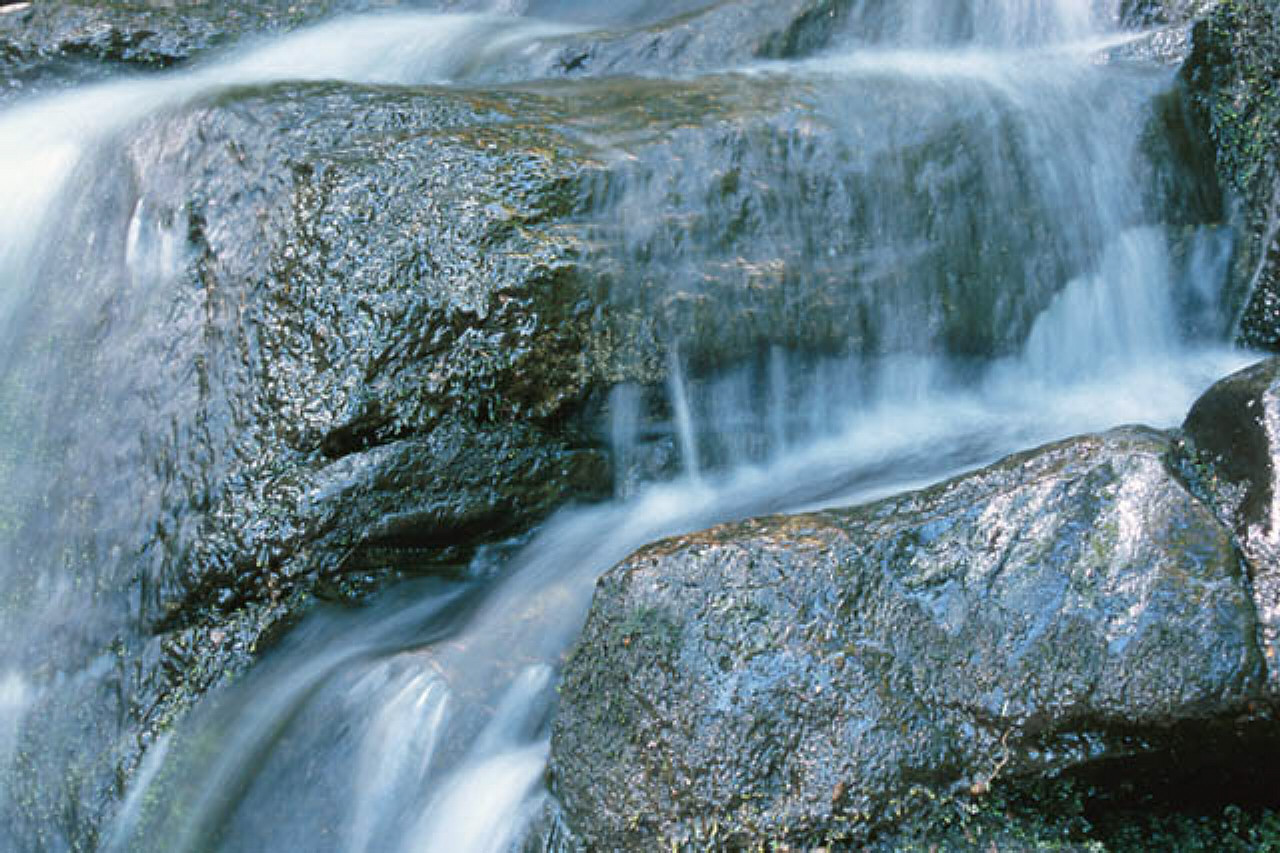
Questions arose. Why is the San Lorenzo River dry at the crossing of Highway 1 and full of water further downstream near the coast? Why is Fire Break Road shown on the map stretching from Empire Grade down to the backside of campus but doesn’t exist in the real world?

alemany
Alemany Farmers Market, Bernal Heights, San Francisco. First farmers market in California, established in 1943.

A flurry of investigation resulted in answers. The San Lorenzo is dry because of a two year drought, and the lower riverbed holds captured water because of a sand bar blocking the mouth where it drains into the Bay, creating what amounts to a long lake. No answer on the missing road.

california-san-francisco-fishermans-wharf-1
Fisherman’s Wharf area of San Francisco’s Embarcadero. Coit Tower on Telegraph Hill, on left. Courtesy http://www.planetware.com

We spent a day in San Francisco, tracking sites of my fictional events. The Alemany farmers market is surrounded by steep hillsides with rows and rows of colorful houses built literally wall to wall.

deste and me
Deste and I walk toward the point at Golden Gate

The Embarcadero  stretches along its long waterfront up to the Presidio—shops, wharfs, boats in sheltered marinas, mobs of tourists.

serpentine
Jeb and I ponder a large outcrop of serpentinite rock at the point. First pier of Golden Gate Bridge looms above. Photo courtesy Deste Campbell.

We walked along the old airplane landing strip, Crissy Field, and pondered the Civil War era red brick structures at Fort Point. Directly overhead, traffic thundered onto the Golden Gate Bridge. The narrow drive skirted a sharp embankment of crumbling pale green serpentinite that slopes down to sea level.

bunker
Standing on top of concrete bunker where guns were once mounted. Presidio, San Francisco. Photo courtesy Jeb Campbell

We drove up along the west-facing oceanfront cliffs of the Presidio where groves of redwoods shelter World War II artillery batteries. Ghosts of men in uniform seem to emerge from hovering redwood thickets. The urgent need to guard against invasion left its acrid residue in the air, in the massive concrete bunkers, along the pathways carved through the rugged terrain. What threats, real or imagined, kept these men awake at night, shivering in the cold coastal wind?

burmese
Burma Superstar, San Francisco

Lunch involved Ginny’s son Warren and his family at a hole-in-the-wall place on Clement Street serving Burmese food. After a wait on the sidewalk made friendly by a bench and hot tea, our party of eight was seated at a large round table.

How does one describe a Burmese feast? Savory catfish chowder, thick lentil/cabbage soup, lamb curry, coconut chicken rice noodle curry, tea leaf salad, crisp samusas—the large lazy susan kept turning as we sampled our way to gluttony.

Sated by our delicious meal, we said our goodbyes to Warren and his family. Our search for story settings then led south along the coast following the “Great Highway.” Densely populated streets disappeared behind us as the road merged with Highway 35. Soon our path became Skyline Boulevard as we neared Daly City. Our objective? The great and powerful magic spot at Mussel Beach, where the San Andreas Fault leaves land and enters the Pacific.
mussel rock
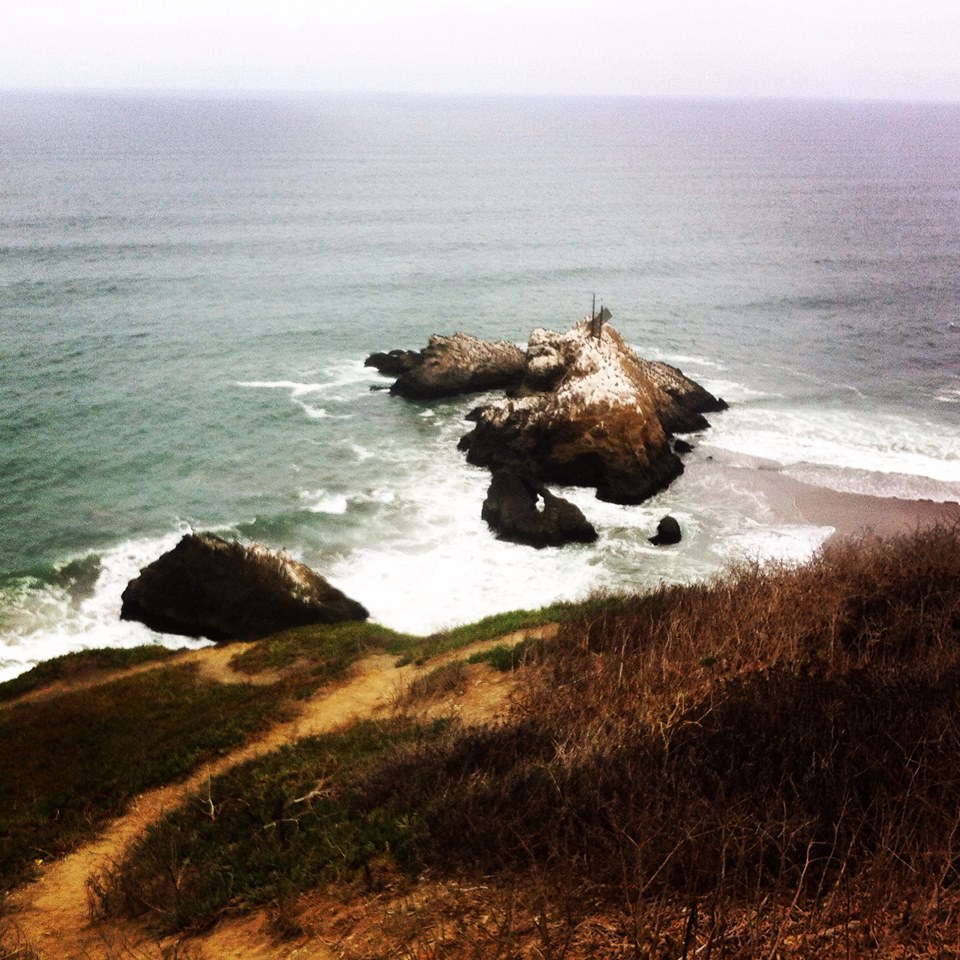
At Mussel Rock, looking north by northwest along the trajectory of the San Andreas Fault.

We missed the turn-off, assuming that such an important spot would be well marked. After doubling back, we found Mussel Beach disappointingly under-developed and lacking any signage that might describe the forces at work underfoot. The narrow shelf of land broke upward to the east with a steep eroding hillside and to the west down a sharp crumbling embankment to the turbulent surf below. Offshore, waves pounded the tilted outcrops of broken rock which continued the fault’s northward journey. The mostly paved ‘park’ area rolled and humped over conspicuously-disturbed ground. Multiple patches in the asphalt provided evidence of the fault line’s restless character.
houses at Mussel B
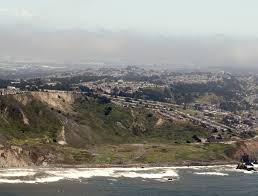
Mussel Rock shown with neighborhoods behind it. Rock outcrop from previous photo appears lower right.

Hovering above the precarious cliff faces and uneven terrain, housing developments cling to steep hillsides and beg the question of how anyone could in good conscience build houses literally on top of a major fault. The neighborhood centers on an elementary school and seems inhabited mostly by lower income residents. I took notes for my story as we rejoined Skyline Drive.
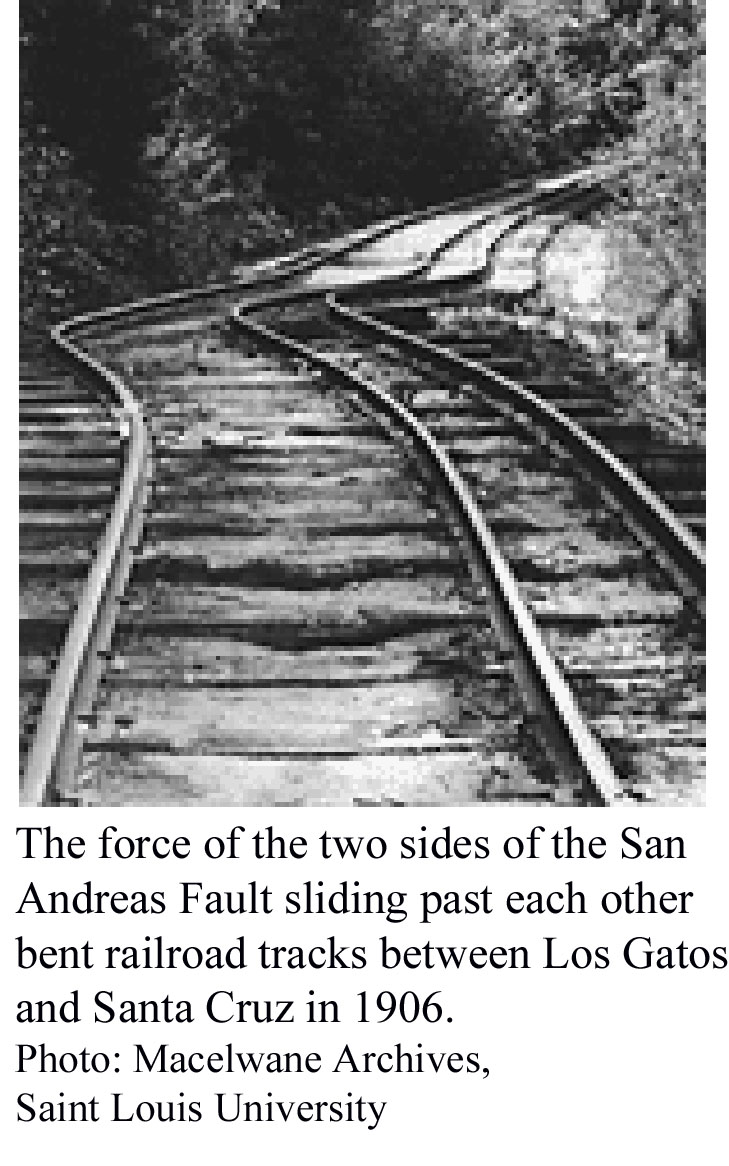
rr tracks Los Gatos copyThe drive back south along Highway 280 tracked the trajectory of the infamous fault. The miles-deep gash forms a valley between the Santa Cruz Mountains on the west and the less dramatic hills and rolling lands of the southern Bay communities of San Mateo, Redwood City, and Santa Clara. For part of the distance, San Andreas Lake glimmers in the day’s bright sunlight. Angling west onto Highway 85, and then Highway 17, we soon crossed over the fault itself at Los Gatos. The four-lane road jagged and bumped as it crossed the extended disturbance.

Then back to Santa Cruz. It struck me at this point that highways and landmarks tell only part of the story of what it means to be here. Less specific but more important is the feeling of the place. A unique scent permeates the air—pine, salt, kelp, eucalyptus. And something else I can’t name. It lingers in my clothing, on my skin.

The light is clean, thin, sharp. Fog rolls in and drapes over the roofs, hides the tree tops, waxes and wanes along the shore so that at one moment you see the lighthouse on the point, the next moment it disappears.

The whole place sits on an edge. The edge of the sea. The edge of light. The edge of visibility.

Here is the edge of North America, not part of the land mass that comprises the bulk of the continent but a sliver of earth’s crust emerging from the sea to shove eastward and cling to its reluctant partner continent. The energy of the rebel, the upstart, the adolescent swells from this nascent ground, lending its attitude to the human settlements that occupy it. From the shore eastward for a hundred miles, this new land presses its case, shoving up mountains and sliding along the tear called the San Andreas fault. Countless other faults branch off from it, all mute testimony to the mind-boggling forces at work on our planet.

You can’t live along the California coast and not feel the energy of this subterranean collision. What better place to set a novel that deals with the frontiers of human consciousness?


Indies and Reviews

Yosemite-Sam-warner-brothers-animation-30976315-800-766As an indie author, I’ve become increasingly uncomfortable with five-star ratings for books that suffer egregious errors in grammar, structure, and other basic elements of writing. I make no claim of perfection. Improvement is an ongoing process for any writer.

Back in the day, agents and publishers’ editors served as a crucial line of defense against not only incorrect spelling, but also horrific word choice, lousy sentence structure, and overall failures in form. But those defenses have been stripped away with self-publishing. In a perfect world, authors would be able to monitor their own works for possible shortcomings, but I’ll be the first to admit that this is a very difficult task.

The first thing that went out the window with the proliferation of unfiltered self-publishing was mainstream reviewers. And who wouldn’t run for the hills to escape this tidal wave of works containing every possible flaw? How could one ever know which book was worthy of price and time in a sea of astonishingly awful wordcraft?

Into this vacuum comes a growing thicket of independent bloggers and homespun reviewers. In most cases, the relative importance and authority of any given blogger/reviewer is judged solely by how many “likes” they have generated on their Facebook page. There is not, to my knowledge, any kind of accreditation. This is the Wild West of indie publishing and reviewing, and there’s no sheriff in town.

I confess I’ve also jumped on this boat out of the need to utilize whatever means are available to promote my works. I routinely “like” authors and books I’ve never read. I participate in contests that offer prizes in exchange for “likes.” This is so wrong! But to award more ethical “likes,” I’d spend all my time and money reading.

Before readers lose faith in self-published works, indie authors would be well served by any effort to upgrade not only the quality of writing, but also the integrity of reviews.

For example, here are a few common errors which should automatically disqualify a work from receiving a five-star rating:

  1. Point of view. Switching from one character to the next in hearing their thoughts or conversation is called “head jumping” and it’s highly unsettling and disruptive to the story. At the least, a character’s point of view should continue uninterrupted by another point of view until the end of a section designated by a mark of some kind.
  2. Modifiers should appear as close as possible to the word or phrase they are modifying. A common misuse of modifier placement is an opening phrase such as “As though rising from the sea, Margie saw Lance moving up from his bed…” Lance is the one rising from the sea. His name should immediately follow the phrase. A correct usage would be “As though rising from the sea, Lance’s form moved up from his bed…”
  3. Incorrect verb tense: “…she don’t want to date and don’t want to fall for no one else…” If a writer doesn’t have better command of language than this, they absolutely must not self-publish without spending money for a good editor.
  4. Incorrect punctuation. “It is” abbreviates to it’s. Designating an object possessed by “It” abbreviates to “Its.” But this is an anomaly within the use of an apostrophe, which is generally used to show possession. A dog belonging to Anne is Anne’s dog.

And I could go on. These mistakes and many more occur on page after page of self-published works. Yet these same works often sport five-star ratings because the blogger/reviewer became enamored of a character, or liked the suspense, or found the BDSM premise titillating. Unfortunately, many blogger/reviewers are not up to speed on the technical rules of language.

Correct language and story presentation is no secret. Countless webpages, books, and blogs recount the many ways a writer can go wrong. But learning is hard, especially for writers who blew though school without paying attention and doubly hard for those who grew up in households where improper language was the norm. Reading well-written prose is a good first step toward improvement.

Self-publishing holds such exciting promise—the author is finally able to present his/her creation directly to the reader without the “approval” of an agent or publisher. It’s thrilling to read stories from writers who never before might have been able to offer their ideas for public consumption. This new landscape nourishes literacy and intellectual questing, a much needed change in a culture too long slouching toward passive viewing.

Which makes it even more critical to do everything possible to ensure the success of self-publishing. Why not insist on the formation of an accrediting body which would establish fundamental guidelines for reviewers? A grading method could spell out specifics. No matter how great the story or charming the character, if there is rampant head-jumping and incessant incorrect grammar, the rating would be three stars at best.

Why not publicize accredited reviewers as the ones readers can trust for opinions about which books meet basic standards?

It’s time to hire a sheriff.

Oh, Writing

Performing Arts 0063Wake up. Shower. Dress. Computer—Pandora on New Age Electronic, email two accounts. Facebook sometimes, if I’m not deep in a project.  All that angst and friendly chatter impacts the story, the dialogue, the next scene that has penetrated my dreams, followed me to the toilet at one a.m., hovered around me until this moment.

This moment, when I start to write… Wait, make a cup of tea, get a glass of water. Eat a pear to stave off serious hunger, to buy at least an hour before I have to deal with food. Get the document open, remind myself of where I quit the day before, edit, equivocate, pep talk about how I’ll get there, how it will work out, how to let go and let the words flow.

Finally, the hunger becomes overpowering. It’s 9:30 a.m. I’ve barely geared up into the mind-frame of the story, what century I’m in, what character is speaking through my voice. I tear myself away to the kitchen for a bowl of granola, not in itself a major task, but then I’m reminded that I meant to do dishes yesterday, and the goldfish is swirling frantically in the tank, signaling in big gorps that it’s past feeding time.

And then there’s the guilt that comes in looking at cat food bowls now empty, cat water below their preferred level of freshness, dog food bowls also down to a few crunchies, and laundry wrinkling in the dryer. I should tend all these things, check the folder of bills due, write some checks, go to town for groceries.

NO! Carry bowl of granola to desk, sloshing milk on the floor (clean it up later) and get back into the story. The person. The scene. Belly shuts up loaded with granola and milk. I have maybe three hours now before my body makes other demands. Well, yes, I need to pee.

The hunger starts around eleven, but I sip the cold remnants in my tea cup and try to ignore the nagging voice in the back of my head. What will you have? Do you need to cook? What about grocery shopping? Finally angry with a hunger headache hovering in the top of my head, around 12:30 I peel myself away from the desk, the plot, the people, and try to find something to eat.

The kitchen is a wasteland. Oh, sometimes I’m very good and prepare a stew or chili or a pot of beans, anything that might work for several meals. I can eat stuff I’m tired of if I’m hungry enough. Open a can of blackeyed peas and have it with a bread and butter sandwich. Heat up the meager leftovers from last night’s supper, left in a thoughtful moment for this very purpose. I can no longer force myself to eat microwaved one-dollar frozen entrees, and peanut butter and honey on crackers is pretty much on its way out as well. Lunch, in other words, is hell.

But—I must eat, because I live inside a freaking biological entity that requires food. Once the belly is silenced, I’m back to the computer and this thing that drives me, this play of words, this world—multiple worlds—screaming for release from inside my head. More hours. My hips ache. My back aches. I want never to do anything but write, but the plants in my solar porch are shriveling. The floor begs for a broom. I have errands to run.

Cholesterol is gathering.

And phone calls, oh please God not the phone. Relatives, friends, whoever thinks it’s his or her duty to wish me a happy birthday, or Merry Christmas. Chat. Please take note. My happiest birthday truly would be a day left utterly and serenely alone, perhaps food served at my desk, the house cleaned while I don’t watch. Bills paid by magic, without me wrangling over every last dime, juggling which gets paid first, which waits until a bit more money finds its way into my accounts.

It would be dishonest of me not to say that I own two deeply mortgaged commercial rental properties, a total of sixteen units in one which are rehearsal studios for rock bands, and a total of ten units in the other which are low-cost entry level downtown business spots for fledgling entrepreneurs. These properties also have bills to pay and endless drama. Vacancies and eager new faces come and go. It’s a business. It’s how I pay my home mortgage, electric, and the numerous and sundry costs for existence in this world. Well, maybe not new clothes this year… I thank myself often for having the foresight oh so long ago to pursue these bits of real estate. Without it, I’d be working in some else’s employ into the dim days of my antiquity.

Never mind the dream that someday, with due diligence and supreme good fortune, this play with words might actually produce meaningful income. I can’t think about that. It’s too much to hope for, too out of the norm for all us who stumble along this writerly path.

So by four or perhaps five p.m. depending on the story, the people spilling onto the screen at the stroke of the keys, my creative juices finally dwindle to a drip and my writing day ends. In all, if I’m blessed with the least possible number of distractions, I’ve been able to write/plot/dream a total of eight hours. I collapse on the couch to watch mindless television, have a drink (or not) and deal with the last demon, that monolithic hurdle of What To Have For Dinner.

The body is relentless. As are the plants, cats, dog, goldfish gorping again at me from his tank, the dirt caked on my hapless Honda, the twigs and other debris littering my porch, the dust bunnies taunting me from the corners, the laundry still wrinkled in the dryer.The evening sinks into a war between my guilt for so many shortcomings and quickly jotted notes as one, perhaps another, plot point resolves itself in my subconscious.

The bed looks good, refuge, haven. But by the time I’ve wrestled my night’s sleep thru distant gangs of howling coyote, a relentless full moon, and the continuing bits of dialogue slipping in and out from wherever it lives, I’m ready to get up. It’s dawn. The story calls.