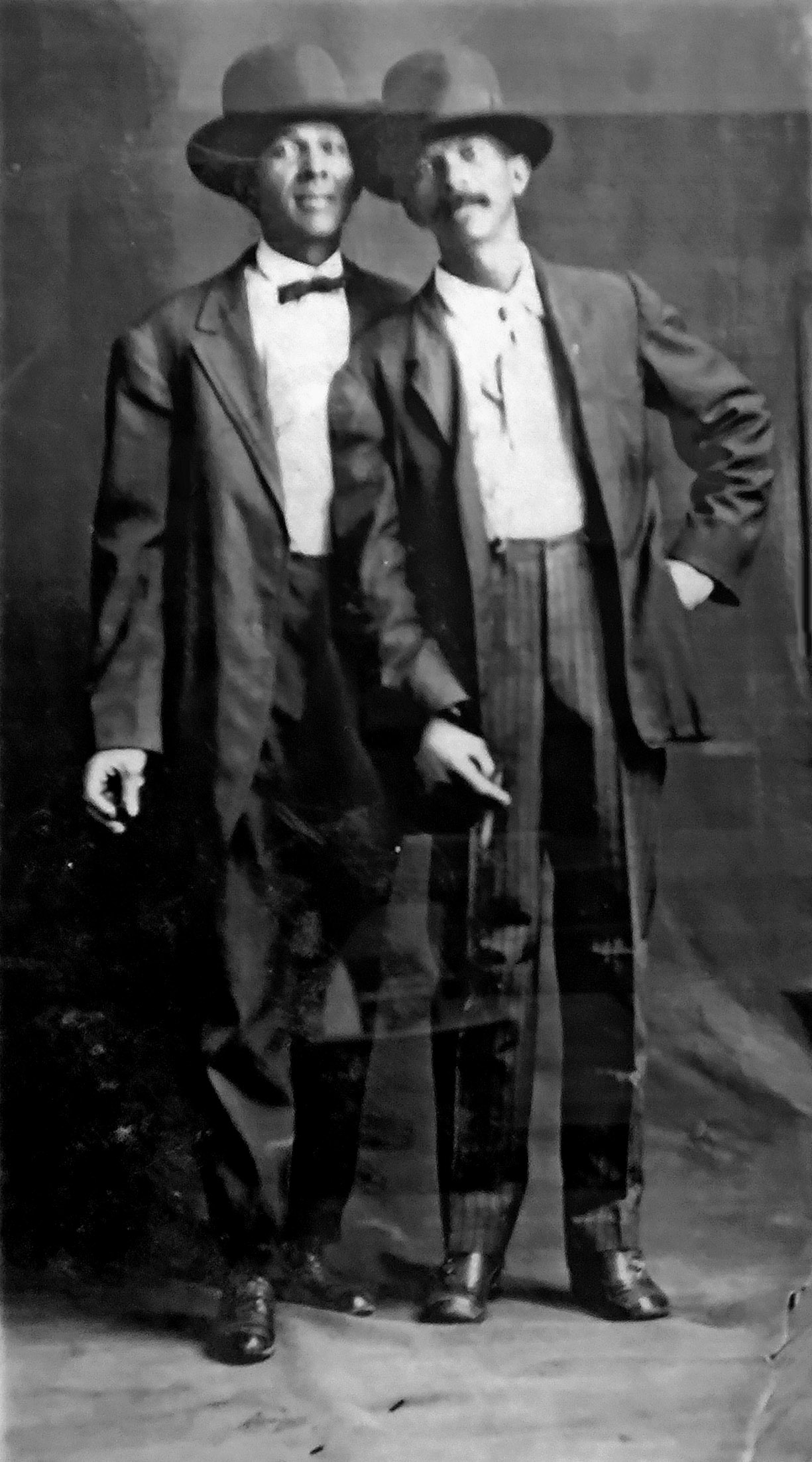
Fayetteville’s Black Diamond Orchestra

Believed to be a 1930s image of Embus Young and Odie Wright, this image hangs in the Fayetteville Public Library (Reference section) without attribution.

Jazz as a musical genre arose in the heart of Black America. Growing from so-called ‘plantation music,’ the style originally involved fiddle, five-string banjo, acoustic guitar, mandolin, upright bass and sometimes lap dulcimer.

“The music always had a strong ground beat, the rhythm of work, full of field hollers, forerunners of ‘the break,’ and insistent call and response patterns, blue notes, falsetto voices with melisma. …The plantation songs soon became drenched with the rhythms of the Southern churches, both offsprings of African drumming and went straight into Folk Blues and Country Music and Jazz…”[1]

Through touring vaudeville shows, widespread audiences came to love this exuberant musical style. And after Embus Young, a member of one of Fayetteville’s earliest Black families, performed with Al G. Field’s Minstrels, he spearheaded a local Black jazz group called the Black Diamond Orchestra. The group quickly came into wide demand, performing as early as 1903 at Monte Ne. Regular bookings continued through the 1920s and 1930s for all kinds of public and private events including sorority and fraternity dances at the University. Further commentary (1925) regarding benefit performances at the UA Peabody Hall and Leverett Elementary stated that “Colored programs are becoming quite the thing in Fayetteville, with an aroused interest in negro music and African folklore.”[2]   

This investigation of Fayetteville’s Black Diamond Orchestra portrays the group’s members and their local family histories as well as affiliated performers like the Jubilee Singers and Half Pint Thompson. The spotlight of fame shining on Fayetteville’s Black community brings to life a neglected part of local history, the concluding chapter of The Music Men of Turn-of-the-Century Fayetteville, available at the Washington County Historical Society and at Amazon.com

Unidentified dancers perform the Lindy Hop.

[1] “Plantation songs,” John P. Birchall Accessed Jun 1, 2022 @ https://www.themeister.co.uk/ dixie/plantation_songs. ‘Melisma’ is a musical style that allows several notes to be sung to one syllable of text.

[2] FDD Mar 26, 1925, p. 1.

Black Diamond Orchestra

The Black Diamond Orchestra first appeared in Fayetteville’s entertainment venues in 1903. They would continue to enjoy bookings in a wide variety of programs for the next thirty years, one of the longest running local talents in the town’s history. Even more remarkable, this entity rose from the depths of the “Holler,” otherwise known as Tin Cup, where the majority of Fayetteville’s Black population lived.

Engagements for the orchestra over the next several years included private parties and receptions as well as bookings by the Shamrock Club, White Chapel Club, and other civic and university entities. By 1911, the group had become a featured event at gatherings such as a Kappa Sigma fraternity dance and a celebration at Fern Dells, “the handsome country home of Mr. and Mrs. W. L. Stuckey on the occasion of the 20th anniversary of their marriage. Over 300 guests were “allowed perfect liberty of choice in the viands [and] left likewise free to choose the place he was to sit and partake of them while listening to the strains of the Black Diamond Orchestra … After the last guests had been served the orchestra was removed from the basement to the stair landing of the big hall where music was furnished throughout the evening and dancing was indulged in by the young and old…”

In September 1924, the University of Arkansas’ new radio station KFMQ featured the Black Diamonds asking listeners to send postcards if they heard the broadcast. “Weeks later, the Fayetteville Democrat reported that the station received postcards from listeners as far away as Canada, New Mexico, and Washington D.C.”

“Colored programs are becoming quite the thing in Fayetteville, with an aroused interest in negro music and African folk-lore. On Friday night a colored troop of entertainers including a local celebrity, E. Young, formerly end–man with Field’s Minstrels when that company had colored end-men, will give an entertainment at Peabody Hall, University of Arkansas, as joint colored church and white school benefit. The Leverett school PTA is sponsoring the event, featuring Black Diamond Orchestra.”

Much more about the celebrated Black Diamond Orchestra and its personnel in The Music Men of Turn-of-the-Century Fayetteville, available in paperback for $19.95.