Light Being Human

Goddess Ishtar (Inanna) on an Akkadian Empire seal, 2350–2150 BC. She is equipped with weapons on her back, has a horned helmet, and is trampling a lion held on a leash. https://en.wikipedia.org/wiki/Inanna

Despite the exquisite engineering that has brought us to our modern stage of humanity, we are—most of us, for the most part—still ruled by our animal brain. That doesn’t mean we don’t feel the pressure of our extraterrestrial part. To whatever extent our consciousness has been cut off from awareness of our genetic inheritance from our Sirius ancestors (or Pleiades, Orion’s Belt, etc., or perhaps all of these), the barrier to self-knowledge needs to be struck down so that we can see our true nature.

Admittedly, our ET brain has started to recognize itself. Perhaps there have been a few who have known over the millennia, but those were the exceptions often targeted for hostility by the rest of our herd. As our culture and technology advances, allowing us finally to know about DNA and gene manipulation as well as space travel, the possibilities of our origins have become more understandable. Of course there are some primitive tribes like the Dogon of West Africa who have not lost their awareness of ancestry from Sirius although in recent decades their primal knowledge has been polluted by the evangelizing of other religious beliefs.

Glimmers of our extraterrestrial/animal dualism leak into our consciousness in various ways, but only enough to cause suffering. Which is not how it was meant. There have been many times when one or more group of extraterrestrials tried to help us. We are, apparently, a project of theirs whose intervention has advanced our slow progress toward Homo sapiens. Interventions by these visitors have made our previous animal brain receptive to extraterrestrial consciousness. The evidence of these phases increasingly appears in the fossilized remains of a long list of human predecessors. The most recent in our great span of becoming: Homo habilis, Homo rudolfensis, Homo ergaster, Homo erectus, Homo antecessor, Homo heidelbergensis, Homo naledi, Homo neanderthalensis, Homo denisova, and currently Homo sapiens.

Anthropological models based on fossils from the human evolutionary tree. P.Plailly/E.Daynes/Science Photo Library. https://www.newscientist.com/definition/human-evolution/

Sumerians recorded what they could of this extraterrestrial history in their Enūma Eliš circa 3350 BC. All early human histories agree that gods came from the sky not only to shape the human being but also to share important knowledges including astrology, mathematics, writing and an alphabet, metallurgy, measurement of time, and much more.[1] Typical of our domineering animal brain, we have manipulated these teachings into power structures by which to control each other for our own advantages. Religious dogma commands we must rely on faith in a religion’s particular set of rules which denies us any chance to let our ET emerge.

Yet even without any awareness, that genetic force pushes us beyond norms to do things that defy explanation like creating music that expresses the conflict. Music, as vibration, is the natural medium of our extraterrestrial existence. The dichotomy between our ET and our animal form is unmistakable in songs like “Creep,” by Radiohead. Lyrics author Thom Yorke dismissed the song, remembering his depressed state of mind in the late 1980s while at college. He particularly didn’t like the lines, “What the hell am I doing here / I don’t belong here.” Bandmate Jonny Greenwood contributed the abrasive guitar hits that accompany the chorus where the lyrics break into “I’m a creep. I’m a weirdo.” Yorke said the guitar sound was as if the song was “slashing its wrists. Halfway through the song it suddenly starts killing itself off, which is the whole point of the song really. It’s a real self-destruct song, there’s a real self-destruction ethic in a lot of the things we do onstage.”[2]

Yorke singing the chorus of “Creep” https://www.youtube.com/watch?v=XFkzRNyygfk

Unlike the interpretations including that of Yorke himself, this song is largely not about a young male’s angst over a girl. That’s the surface meaning. Underneath, it’s about how we live with a level of grief over the loss of contact with our ET consciousness and don’t know how to understand that part of ourselves or what to do with it. For millennia, whatever knowledge might be understood innately has been funneled into religion, a terribly destructive force in the world.

The arts and sciences are often the fields pursued by those possessing the greatest amount of ET genes. Nicola Tesla, for example, suffered at the mercy of his inner ET when he pursued his experiments in electricity and many other scientific advances that wouldn’t be fully appreciated in his lifetime. “If you want to find the secrets of the universe,” he once said, “think in terms of energy, frequency and vibration.” He was ridiculed, shunned, and died penniless. Yet these fields are the very focus of present-day breakthrough research.

In September 2023, a video was produced on the subject of vibration and quantum physics:

“The Law of Vibration and Quantum Physics: A Dance of Energy and Matter” delves into the intrinsic connection between ancient wisdom and modern scientific discoveries. This video explores how everything in the universe, from our thoughts to the farthest star, operates on vibrational frequencies. By weaving insights from quantum physics with practical implications in health, relationships, and everyday life, the piece offers a compelling perspective on our interconnected reality and the profound influence of vibrational energies on our existence.”[3]

Albert Einstein reported that “If I were not a physicist, I would probably be a musician. I often think in music. I live my daydreams in music. I see my life in terms of music.”

Music is vibration.

In my book Chroma: Light Being Human, I made an attempt to imagine the process by which extraterrestrials gradually managed to create a place in our ape brains to receive their energy. I believe we are now in another genetic change period. The signs are here.

What if we knew that what has been called our ‘soul’ or ‘spirit’ is in fact an extraterrestrial presence, that we are an animal creature selectively bred over millennia to host the presence of a vibration that carries a consciousness from beyond this planet?

But then, isn’t that exactly what religion has sidetracked? Worldwide, all the early religions describe beings arriving from the sky, variously described as light or bright, riding in flying carriages that arrive in great noise or in fire-breathing dragons flying through the air and often portrayed with wings. The beings are said to have created us. They have taught us rules to live by, sometimes offering ET teachers who lived among us. Sadly, we’ve been led astray by priests who have misinterpreted everything out of denial, ignorance, or to justify their animal brain’s arrogance and hunger for power.

Our understanding has been complicated and delayed by the slow progress of science, progress which has been fought tooth and nail by religion. How could we have understood the method by which we evolved without understanding genetics? Or the nature of the universe? Our animal brains had no appreciation of machines or science. We saw magic and mysteries wrought by supernatural beings who flew down from ‘heaven.’  We offered sacrifices of our most valued possessions, our food, our wealth, our children, in order to appease these ‘gods.’ We fell in line before the priests who claimed to represent the gods. The history of our destructive religions is all too plain to see.

Now it’s time to grow up into our current times and scientific knowledge, and accept that ET is among us, that we are ET as much as ape.


Other artists performing “Creep”:

And many more.

[1] https://en.wikipedia.org/wiki/Sumer
[2] https://en.wikipedia.org/wiki/Creep_(Radiohead_song)

[3] https://www.youtube.com/watch?v=9hh8B7DoNeo

A Gathering of the Tribe

scan0083
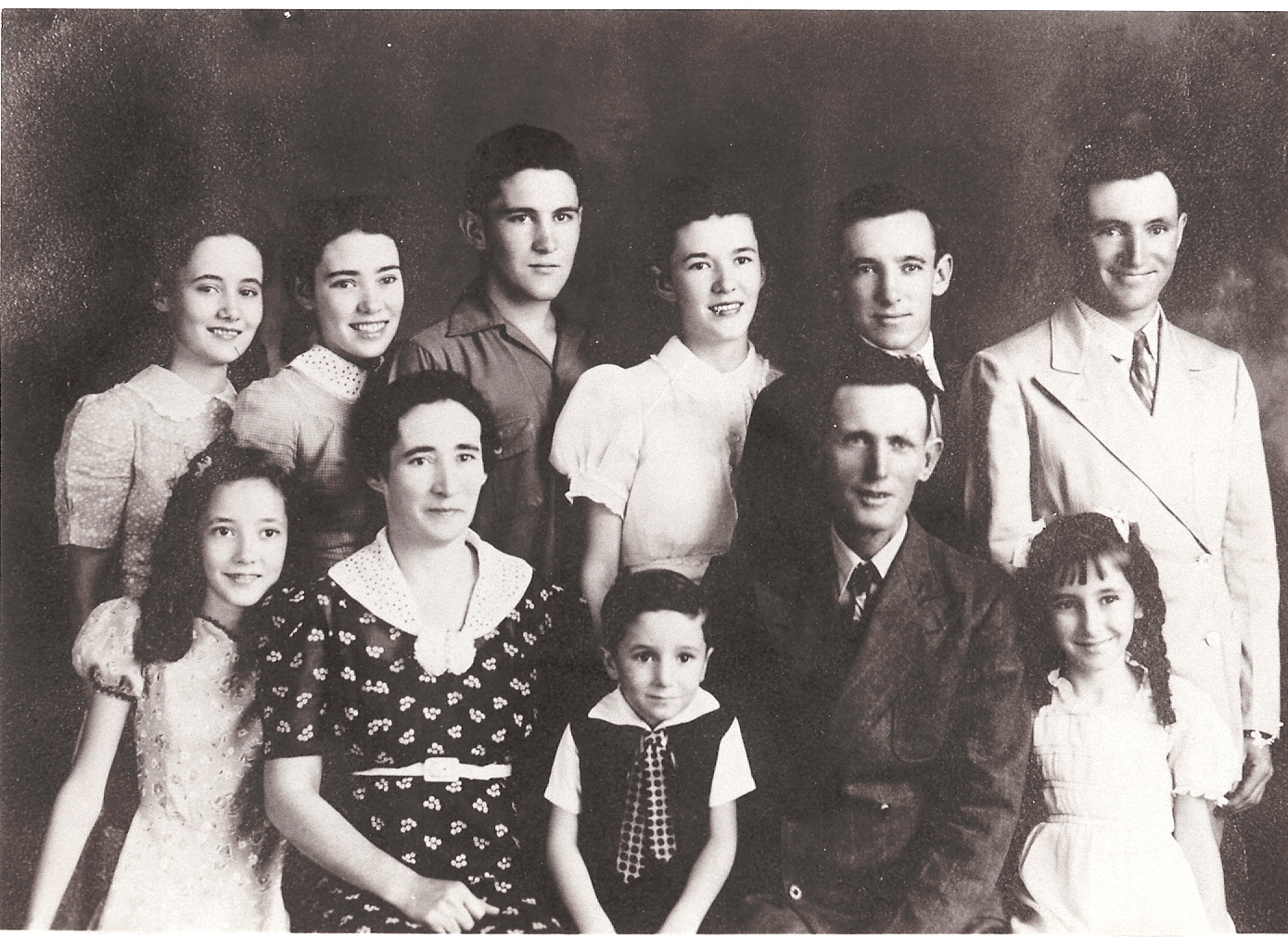
The Family of Sylvia and Tom. Left to right, front: Una, Sylvia, Thurston, Tom, and Sula. Back: Joy, Carmyn, Graydon, Tomazine, Douglas, and Durward.

Great strength comes from family tradition. I’ve seen it once again for myself, a gathering of elders I’ve known all my life. In the days and hours leading up to this October reunion, trepidation warred with exhilaration in the prospect of seeing my kin again. Three days past my last contact, I am only now able to let the anxiety fall away.

toma
Tomazine, oldest of the girls and third oldest of Sylvia’s children. Mother of seven who adopted four more orphaned children. Gardener, artist, advocate for common sense and women’s liberation.

Why anxiety? The clan was the community, at least for many of us older ones, and gathered each summer for a week of Rook tournaments, debates on myriad subjects, talent shows, and general mayhem. These people were my judges as well as my mentors, the audience for baby pranks and elementary accomplishments. Like my forty first cousins, of which I was the fifth oldest, I was subjected to quizzes and scrutiny on everything from the ruffles in my skirt to the cleverness of my retort.

A person would think that by the age of sixty-seven, I would have grown past the traumas and dramas of childhood. But no, like the genes we share, interactions with the pantheon of my mother’s family remain a strong influence. I should be glad of the genes—of my Grandmother Sylvia’s nine children, six remain among the living. The oldest recently celebrated her 96th birthday. The youngest, feted at this recent gathering for his 80th, remains—like all of them—in remarkably good health.

carm
My mother Carmyn, mother of five, gardener extraordinaire. College graduate, family historian. Early advocate for environmental protection and organic food.

Matriarch to her own tribe of five offspring, my mother was the middle child of nine born to an even sterner matriarch in Sylvia. Herself the oldest of nine, Sylvia followed a lineage of strong women who simultaneously chafed at the yoke of traditional wifedom while, at least in theory, subscribed to the religious role of subservient ‘helpmate.’ Sylvia’s mother Zeulia raised nine in a marriage with a man never far from his Bible but nonetheless willing to watch his aging wife wade out into mid-winter snow to gather firewood. Zeulia’s mother Armina enjoyed a few years of happy marriage to Jeptha Futrell and the arrival of two sons (one of whom, Junius Marion Futrell, became a governor of Arkansas) before losing Jeptha to pneumonia and remarrying during Arkansas’ devastating aftermath of the Civil War. Armina’s mother Frances Massey, as the fabled family account goes, grew up in the lap of southern luxury at her father’s plantation only to elope at age thirteen with the property’s caretaker Jimmy Eubanks. Their first child, born when she was fourteen, was said to have a head the size of a teacup and yet grew to robust male adulthood.

joy
Joy, fourth youngest, mother of four. College graduate, school teacher, gardener, comforting presence.

By the mid-1840s, Jimmy and Frances crossed the Mississippi River on a barge and set up housekeeping in the northeast wilds of the new state of Arkansas. Subsequent generations married and lived in similar barebones circumstances in the farmlands near Crowley’s Ridge. After the Civil War, some of the family settled in Texas, and by the time my mother was born in 1923, entire households pulled up stakes each season to pick cotton in Texas before returning to “God’s Country” for the winter.

At the time Sylvia gave birth to her first child, her mother Zeulia was still producing children of her own. Both generations lived together at times in dog-trot houses on Ozark dirt farms, scraping up a livelihood from gardens, milk cows, and free range chickens and hogs. Despite their often desperate economic conditions, the families pursued education. Of my cousins, several hold graduate degrees and many more undergraduate degrees, while others have become successful entrepreneurs, engineers, and educators.

una
Una, mother of eight and third youngest of Sylvia’s children. College graduate, world traveler, genealogical researcher, firecracker in general.

We are told that our genes carry not only the codes for our biology, but also the encoded experiences of our ancestors. I’m left to wonder if my tendencies toward worry derive at least in part from the epigenetic traces of the Civil War and the Great Depression. Is my desire for solitude and rural landscapes the result not only of my own life but even more from the generations of ancestry that found safety and sustenance in the land?

As far back as genealogical research has taken us, efforts largely spearheaded by one of my aunts, the family follows a long tradition of yeoman farmers. Perhaps we were serfs not too many centuries ago, tuned to the change of seasons and the requirement to please a rich master. Our histories find sparse mention of cities and their trappings. We care more about the weather than women’s clubs, more for landscapes than local politics. Yet we do care, passionately, about our freedoms and the direction of the nation despite the fact that we divide fairly evenly between conservative and liberal.

sula
Sula, second youngest and mother of four. Avid Razorback fan, gardener, loving wife. Current holder of the Rook championship trophy.

Of the forty cousins, only fourteen made an appearance at this gathering. Only six or seven lingered for more than one evening. My oldest, now turning forty, waded in and was welcomed as were a few other grandchildren. My mother and two of her five siblings live in this area. Three others, two from Texas and one from New Mexico, stayed for six days, variously taking naps, visiting graves and old homesteads, and arguing over Rook scores. Wrenched to see them come and equally wrenched to see them go, I have since stared out my office window to contemplate the emotions set in play by the event.

The cousins who did attend agreed not to let our next meetings occur only at funerals. Inevitably, the funerals will come, not just for our aunts and uncle, but for us. There’s the strange comfort of time and conversation with those we’ve known all our lives, even though as adults we have little in common, hardly know each other at all. There are our children, grandchildren, even great grandchildren of which we are barely cognizant, yet each of them remain connected in these threads that grow ever thinner as the generations expand.

Thus is the history of all man’s tribes.

thurston
Thurston, youngest of the clan. Father of five, loving husband, modern day farmer and Razorback fan.

As children, my cousins and I not only played together at the annual family reunions but also at reunions of Sylvia’s siblings. We learned the names and faces of great aunts and second cousins, many of them still firmly entrenched in the lands of northeast Arkansas. The rest of us have remained as near as northwest Arkansas or as far as Georgia, California, and all points in between. There’s a mathematical impossibility to any attempt to acquaint the offspring of the forty cousins, or even to gather the forty cousins in one place.

Whether knowledge of one’s ancestry holds any relevance may be debated from various points of view. Whether I want to have these ties or not, I can’t imagine life without them. The huge array of people linked to me through family offers an oddly reassuring backdrop to any of my peculiar interests and life patterns. I’m no longer a child intimidated by their observation or awed by their arguments. They care about me as I care about them, not because we’ve done anything in particular to earn the caring, but simply because we are connected by inheritance.

We’re still a tribe.