WHAT THEY FEAR

Upon reading stories about people serving forty (or more) years sentences in prison for the crime of selling marijuana, one is left with the uncomfortable feeling that something is missing from the picture. People who commit rape or murder serve less time.

What was/is so terrible about selling marijuana? Especially now that multitudes of people are making lots of money selling marijuana LEGALLY.[1]

At least in the 22 states that have legalized marijuana, shouldn’t all the previous such ‘crimes’ be dismissed and their ‘criminals’ be pardoned?[2]

Why is the boot of the government still on the necks of marijuana users and traffickers?

Historically, the first notable enthusiasm for marijuana prohibition came from law enforcement.[3], [4] It was no accident that the big push to criminalize marijuana came exactly at the moment alcohol prohibition ended. It gave fresh hope for employment to all the ‘revenuers’ who’d been busy tracking down and destroying bootleg stills. After Nixon declared a war on drugs, particularly marijuana, pot users became a nest on the ground for police looking to boost their arrest numbers, hence the money they could gain for the department. It didn’t hurt that arresting a pot head meant, in many places, police pocketing whatever money the hapless victim might have had in his pocket, even if it was his week’s pay meant to cover rent.

Seizure/forfeiture proceedings also led to police profiting from taking the car in which said culprit had been driving, or if at home, the house, land, equipment on the land, as well as jewelry and other valuables in the home which could be claimed as implements of a crime and therefore suitable for forfeiture to the state. The thing about seized assets is that the victim doesn’t have to be found guilty of a crime; the assets are guilty separately, and public defenders are not appointed to defend property. If the victim, now penniless, can scrape up enough money to defend his property, he might stand a chance of having it returned to him. But in many cases, his rights regarding his property are obscured in an Orwellian maze of legal procedures designed to profit the state and the arresting police department.[5]
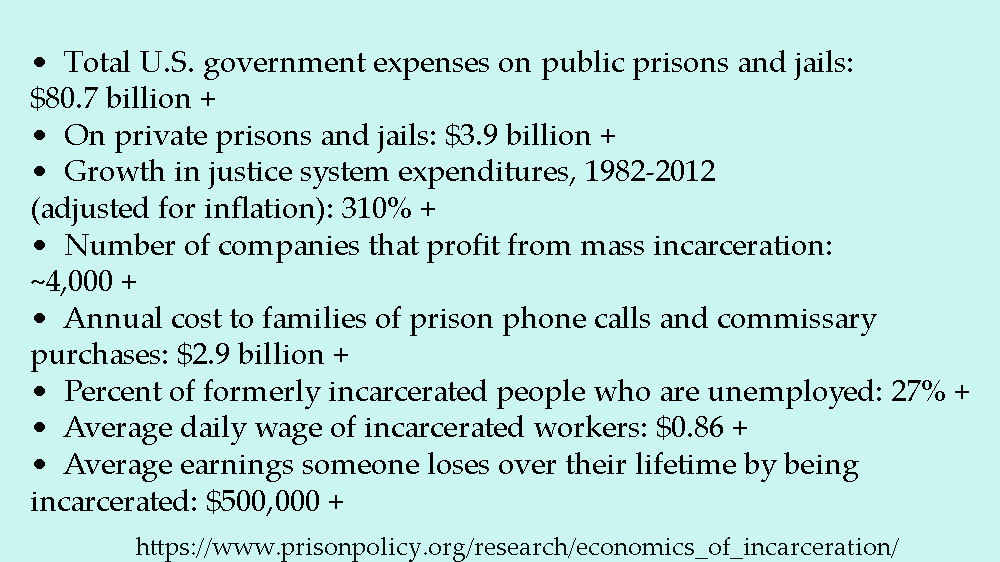
There has never been a calculation of the loss to individuals, families, and society resulting from these prohibition tactics—loss of employment, loss of opportunity to parent children and preserve home and wellbeing for a family (and the family’s subsequent need for welfare), disenfranchisement not only from citizenship, but also from community standing—a permanent blow against that person for getting high on marijuana instead of beer.

Jobs and money were not the only motivations for marijuana prohibition within the nation’s criminal justice system. Most state inmates are required to work at jobs within the prison system. In Arkansas, much of that labor was/is in prison farms which produce millions of dollars’ worth of crops which does not necessarily end up on prison cafeteria tables but rather is sold to profit the system.[6] Other types of prison jobs pay a minimal wages, which benefit whichever corporate employer is able to gain this work force. The growth of for-profit prisons has increased exponentially, with states giving up their prison industry for a package deal with the corporates. [7]

More to the point, the lingering extremism of marijuana prohibition has been a half-assed effort to stop the awakening of an entire generation. Amid the civil rights movement whereby former enslaved persons and their descendants might gain their rightful place in society and the growing outrage over the war in Vietnam, the Baby Boom generation came of age as if awakening from a 1950s dream where their parents and America were right in the world. Slowly, as the scales fell from their eyes, facilitated by the enlightening effects of marijuana, young people were shocked then horrified by the catalogue of wrongs unfolding on their television screens and in their city streets. Police were beating people over the head for protesting. Young men of the generation were dying by the thousands in an unwarranted ‘war’ no one authorized or understood.

Slowly, the awakening of the generation produced a new vision of a righteous society. Women’s rights, minority rights, gay rights, rights for the handicapped. Organic food and natural medicine including natural childbirth. Protection of the environment. Free sex for the pleasure of it now that women had gained the right to control their bodies. These were topics of conversation among the thousands of young people as they sat in circles passing a joint. Their awakening sent shock waves through the established culture as Boomers turned their backs on corporate jobs and material consumption to live in teepees and grow their own food (and marijuana), as they joined with minorities and war veterans to demand justice. More importantly, they didn’t keep quiet about their awakening, but took to the streets to force institutions like universities and government to hear the good news.[8]
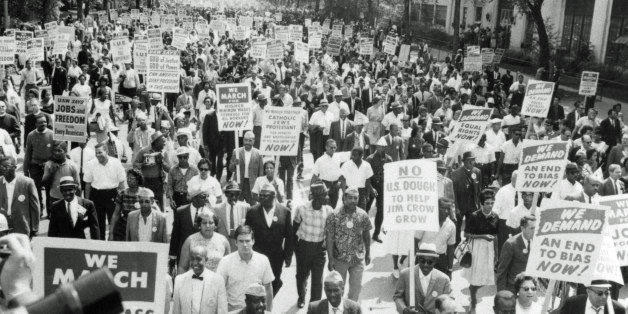
Therein lies the slavering hatred against pot dealers/traffickers/users that has permeated American culture in the ensuing 60 years. Not only did a generation of well-fed, highly educated 1950s youth turn their backs on all their parents and grandparents held dear, they had the gall to demand those folks accept revolutionary change. Perhaps most outrageous to the older generations was the embrace of alternative spiritual belief, practices like meditation and non-violence, or the growing movement toward no adherence to religion whatsoever.

This fight is far from ending. Presidents Nixon then Reagan came to power in a backlash against this revolution. Newt Gingrich and Rush Limbaugh recognized an opportunity to motivate their audiences through hateful rhetoric, forging a new kind of political mood that empowered religious extremists. Today, the rotten fruit of their blind self-aggrandizement is harvested almost daily in mass shootings and a population at war with itself as Republican powerbrokers use these differences like a cudgel to drive hysterical evangelical voters to the voting booth.

The misguided effort to put the genie back in the bottle has led and continues to lead to the legally-sanctioned crucifixion of entrepreneurs who dare to meet the market demand for marijuana. It is capitalism turned on its head. The cost of imprisonment in 2015 averaged an annual cost of $33,274 per inmate. Best estimates for the current marijuana prison population comes in around 40,000. A quick moment at the handy calculator shows that taxpayers of the United States are spending $1.33 billion dollars annually to punish the users and purveyors of this modest weed.[9]

Alongside the drug war and all its collateral damage has come the arming of local police forces with weapons of war and the glorification of guns. As citizen petitions slowly win some degree of sanity in nearly half our states, prisoners of this war still languish in prison cells.[10]

What ‘they’ fear is change. When will this tragedy of fear and loathing come to its rightful end?


[1] https://norml.org/laws/arkansas-penalties/

[2] https://www.usnews.com/news/best-states/articles/where-is-marijuana-legal-a-guide-to-marijuana-legalization

[3] https://www.cbp.gov/about/history/did-you-know/marijuana

[4] https://www.cbsnews.com/news/harry-anslinger-the-man-behind-the-marijuana-ban/The man behind the marijuana ban for all the wrong reasons” by Cydney Adams, November 17, 2016 / 5:45 PM / CBS News

If you look for the roots of America’s ban on cannabis, you’ll find nearly all roads lead to a man named Harry Anslinger. He was the first commissioner of the Federal Bureau of Narcotics, which laid the ground work for the modern-day DEA, and the first architect of the war on drugs.

Anslinger was appointed in 1930, just as the prohibition of alcohol was beginning to crumble (it was finally repealed in 1933), and remained in power for 32 years. Early on, he was on record essentially saying cannabis use was no big deal. He called the idea that it made people mad or violent an “absurd fallacy.”

But when Anslinger was put in charge of the FBN, he changed his position entirely.

“From the moment he took charge of the bureau, Harry was aware of the weakness of his new position. A war on narcotics alone — cocaine and heroin, outlawed in 1914 — wasn’t enough,” author Johann Hari wrote in his book, “Chasing the Scream: The First and Last Days of the War on Drugs.” “They were used only by a tiny minority, and you couldn’t keep an entire department alive on such small crumbs. He needed more.” 

Consequently, Anslinger made it his mission to rid the U.S. of all drugs — including cannabis. His influence played a major role in the introduction and passage of the Marijuana Tax Act of 1937, which outlawed possessing or selling pot.

Fueled by a handful of 1920s newspaper stories about crazed or violent episodes after marijuana use, Anslinger first claimed that the drug could cause psychosis and eventually insanity. In a radio address, he stated young people are “slaves to this narcotic, continuing addiction until they deteriorate mentally, become insane, turn to violent crime and murder.” 

In particular, he latched on to the story of a young man named Victor Licata, who had hacked his family to death with an ax, supposedly while high on cannabis. It was discovered many years later, however, that Licata had a history of mental illness in his family, and there was no proof he ever used the drug.

The problem was, there was little scientific evidence that supported Anslinger’s claims. He contacted 30 scientists, according to Hari, and 29 told him cannabis was not a dangerous drug. But it was the theory of the single expert who agreed with him that he presented to the public — cannabis was an evil that should be banned — and the press ran with this sensationalized version.

The second component to Anslinger’s strategy was racial. He claimed that black people and Latinos were the primary users of marijuana, and it made them forget their place in the fabric of American society. He even went so far as to argue that jazz musicians were creating “Satanic” music all thanks to the influence of pot. This obsession eventually led to a sort of witch hunt against the legendary singer Billie Holiday, who struggled with heroin addiction; she lost her license to perform in New York cabarets and continued to be dogged by law enforcement until her death.

“The insanity of the racism is a thing to behold when you go into his archives,” Hari told CBS News. “He claims that cannabis promotes interracial mixing, interracial relationships.”

The word “marijuana” itself was part of this approach. What was commonly known as  cannabis until the early 1900s was instead called marihuana, a Spanish word more likely to be associated with Mexicans.

“He was able to do this because he was tapping into very deep anxieties in the culture that were not to do with drugs — and attaching them to this drug,” Hari said. Essentially, in 1930s America, it wasn’t hard to use racist rhetoric to associate the supposed harms of cannabis with minorities and immigrants. 

So as the nationwide attitude towards cannabis began to fall in line with Anslinger’s, he testified before Congress in hearings for the Marijuana Tax Act. His testimony centered around the ideas he had been pushing all along — including a provocative letter from a local newspaper editor in Colorado, saying “I wish I could show you what a small marihuana cigaret can do to one of our degenerate Spanish-speaking residents.”

All these years later, many of the threads in Anslinger’s arguments are still present in the American conversation about legalizing marijuana. The act was passed in 1937, and the rest, they say, is history.

[5] It was not until the year 2000 that Arkansas instituted a system requiring police to record seizure of any asset including cash and vehicles, and establishing a method of tracking the distribution of those assets . See https://ij.org/report/policing-for-profit-3/?state=AR

[6] https://en.wikipedia.org/wiki/Prison_farm

[7] https://www.investopedia.com/articles/investing/062215/business-model-private-prisons.asp

[8] https://www.theatlantic.com/politics/archive/2020/06/todays-protest-movements-are-as-big-as-the-1960s/613207/

The Rage Unifying Boomers and Gen Z, By Ronald Brownstein, JUNE 18, 2020 The ATLANTIC

The 1960s have achieved almost mythic status as a hinge point in American history. Both those who welcomed and those who feared the convulsive changes the decade brought can agree on one thing: Socially, culturally, and politically, the nation was a very different place when the ’60s ended than when they began.

This could be another such moment.

The ’60s watershed moments—the civil-rights campaigns in Birmingham and Selma, Alabama; Martin Luther King Jr.’s March on Washington and the anti-war March on the Pentagon; the outpouring of demonstrations following the shootings at Kent State—can seem in retrospect like towering peaks of transformative activism far beyond any contemporary experience. But history may look back on this period as a comparable transition in the nation’s politics and culture, driven primarily by the largest generation of young Americans since the Baby Boomers who flooded the streets decades ago.

Enormous differences separate the two periods. But they may ultimately prove united by the magnitude of the change they impose.

The 1960s saw the emergence of social movements around civil rights, opposition to the Vietnam War, feminism, Mexican American activism, and environmentalism, as well as the first stirrings of gay rights. The past decade has seen youth-led movements around climate change, gun control, immigration, and inequities of gender (#MeToo) and race (Black Lives Matter).

Seen as one long wave of change, modern activism “has the sweep of the ’60s,” says Todd Gitlin, a historian (and veteran) of those protest movements and a sociologist at Columbia University. And just as the 1960s triggered big changes in American attitudes on issues from premarital sex to trust in authority, the past few years have also witnessed big shifts toward greater support for gay rightsmore agreement that human activities are causing climate change; and recognition that systemic racism remains embedded in American life, a consensus that has rapidly solidified since the death of George Floyd in Minneapolis. Young people have been at the forefront of each of these changes.

Today’s long wave of protest shares one other quality with its predecessor: It has changed popular culture and the contours of public opinion more quickly than it has public policy or the nation’s electoral landscape. Now, as then, an electoral system that favors older generations—through structural imbalances that favor rural states with older and less diverse voters—is responding slowly to calls for change from younger Americans.

And yet, just as with the Baby Boomers before them, Millennials, Gen Z, and the generation following them will eventually define the new American mainstream through their priorities and viewpoints, as over time they become a majority of the nation’s population. In that way, the huge number of people on the streets of America’s major cities this month may offer a preview of how profoundly these younger generations may reshape the country’s politics once they vote in numbers that more closely approximate their growing presence in the population overall. “This transition is inevitable,” says Ben Wessel, the executive director of NextGen America, a group that organizes young people for progressive causes. “The question is: How quickly is it going to get here?”

The differences between Baby Boomers and today’s young people are easy enough to see. Younger generations now are far more diverse: White people made up four-fifths of the Baby Boom (defined as those born between 1946 and 1964), but represent only three-fifths of Millennials (born 1981 through 1996) and only a little more than half of Gen Z (tentatively defined as those born from 1997 through 2014).Allen Matusow, the author of The Unraveling of America, a seminal history of the country during the 1960s, noted another key difference in an email: Back then, many of the protests grew out of an assumption of abundance after two decades of the nation’s post–World War II boom; young people today face more precarious prospects. While the white, college-attending component of the ’60s generation “assumed unending growth, abundant consumption, and good jobs when they were ready to take them,” young people now face “environmental degradation, rising sea level, [and] concentrations of wealth that threaten democracy,” among other challenges, said Matusow, who is also a fellow at the Baker Institute of Public Policy at Rice University. Put another way: One movement was a revolution of rising expectations; the other is a struggle to gain a foothold.

And while the great social movements of the 1960s and early 1970s had clearly identified leaders who became iconic figures—King and Malcolm X for civil rights; Abbie Hoffman, Jerry Rubin, and Tom Hayden for the anti-war and student movements; Cesar Chavez for farmworkers; Betty Friedan and Gloria Steinem for the feminist movement—today’s activism is largely leaderless, notes Kirsten John Foy, the founder of the Brooklyn-based activist group The Arc of Justice. Particularly within the Black Lives Matter network and the broader uprising against discriminatory policing, Foy says, “We have moved beyond this messianic notion of leadership, even in the black community. It has democratized the movement and it has reenergized the movement.”

In both decades, the fulcrum of change was the emergence of a vast new generation determined to question the rules and priorities that it inherited. Young people were hardly the only voices agitating for change during the 1960s, just as they are not the sole source of activism now. But in each case, the sheer bulk of the rising generation provided a critical mass for social movements.

At its peak in 1964, members of the Baby Boom represented 37 percent of America’s total population, according to Census figures provided by the demographer William Frey. Frey calculates that, at their peak in 2015, Millennials constituted a little less than one-fourth of the population. But Frey projects that, combined, Millennials and Gen Z will exceed two-fifths of the population from 2013 to 2035. They’ll fall only to slightly below that level through 2050. (Surprisingly, there were about 11 million more births during the Gen Z years than during the Millennial years.)

In the ’60s, the huge pool of baby boomers receptive to change provided the infantry for the succession of protest movements. “The rise of organized movements among previously marginalized groups was indeed contagious in these years,” wrote the historian James T. Patterson in Grand Expectations, his sweeping history of America in the first decades after World War II. The visibility and impact of the early movements—those in support of civil rights and against the war—encouraged the development of those that came later: for environmental protection and rights for women, Chicanos and farmworkers, and, finally, the gay community. Each helped clear the path for the next.

Although today’s social movements have largely been viewed as independent, even isolated, efforts, a similar progression is visible over roughly the past decade.

  • The Black Lives Matter movement coalesced in 2013 after George Zimmerman was acquitted for shooting the African American teenager Trayvon Martin, and the movement took a huge leap forward in public consciousness following the fatal police shooting of Michael Brown in Ferguson, Missouri, in 2014.
  • Young people brought to the country illegally by their parents—the so-called Dreamers—have kept up a steady drumbeat of protest throughout the decade to achieve, and then protect, their legal status.
  • The women’s marches against Donald Trump’s administration in January 2017 brought out massive crowds in cities across the country.
  • The #MeToo movement that grew rapidly in fall 2017 after exposés on the sexual-harassment and assault allegations against Harvey Weinstein and other powerful men has forced sweeping changes in Hollywood, the restaurant and fashion industries, and other institutions.
  • Students who survived the mass shooting at Marjory Stoneman Douglas High School in Parkland, Florida, organized mass marches for gun control in Washington, D.C., and hundreds of other cities in March 2018.
  • Protesters likewise turned out that June in Washington and cities across the country to oppose Trump’s family-separation policy at the southern border.

The massive nationwide demonstrations since Floyd’s death in Minneapolis have provided a kind of culmination for these disparate strands of activism. The protests have been notable for the racial diversity of their crowds. A poll released Thursday by the nonpartisan Kaiser Family Foundation found that while young people ages 18 to 29 account for 52 percent of all adults who have protested—more than double their share of the overall population—participants closely tracked the nation’s overall racial breakdown. “All of those things are coming together in this moment,” Foy, a Pentecostal reverend, told me. “You have not just black people on the streets … You have all of diverse America on the streets.”

Despite the legendary status of the ’60s demonstrations, recent protests have likely involved more people. King’s March on Washington attracted 200,000 to 300,000 people to the Lincoln Memorial in August 1963; the anti-war March on the Pentagon brought probably 50,000 to 100,000 people in October 1967. Although exact numbers aren’t available, millions of Americans may have participated in protests since Floyd’s death. In the Kaiser poll, 10 percent of American adults say they have joined in the demonstrations, a result that would translate to some 25 million people.

The women’s marches the day after Trump’s inauguration also brought out millions, but only for a single day. The ongoing Floyd protests may represent the most Americans who have protested in the streets on a sustained basis since the demonstrations that followed the killing of four anti-war protesters at Kent State University in May 1970, when about half the nation’s college campuses erupted in discontent.

Nor have the current protests shown any sign of flickering out. Foy’s group, for instance, is organizing motor caravans in 33 cities on Juneteenth to demand independent investigations into people who have died at the hands of law enforcement and call for sweeping reforms in police procedures. One distinctive element of the project is that the local groups will also be encouraging participants to register to vote.

That latter focus represents one of the biggest uncertainties about the current wave of protest. The ’60s movements were divided between those who wanted to influence elections and engage with elected leaders (an instinct strongest within much of the civil-rights movement’s leadership) and those who disdained traditional politics as unlikely to produce fundamental change (a tendency strongest in the initial years of the anti-war and student movements). “There were very few people who came out of the new left who were ready to plunge into electoral politics,” says Gitlin, who served as president of Students for a Democratic Society during the ’60s and later wrote a classic history of the period, Years of Hope, Days of Rage.

Reporters following the current protests have found no shortage of local activist leaders equally suspicious of mainstream electoral organizing. One of the pivotal questions of American politics over the next decade may be how quickly, if at all, the young people now protesting in the street develop electoral clout comparable to their numbers. While the Baby Boomers changed social attitudes and popular culture relatively quickly, they did not elect one of their own as president until Bill Clinton, in 1992. In fact, with only one four-year interruption (Jimmy Carter), Republican presidents who largely positioned themselves against the cultural changes that the ’60s unleashed occupied the White House from 1968 until Clinton’s victory.

While the ’60s movements contributed to important changes in law on issues from civil rights and voting rights to the environment and decriminalizing private sexual behavior, their supporters’ failure to win subsequent presidential elections is the reason why Gitlin summarized their impact this way: They were “a great political defeat and a great cultural success. That’s how we ended up with the left marching on the English department while the right took Washington.”

The next decade could produce a similarly bifurcated outcome for Millennials, Gen Z, and the even younger (and more diverse) cohort following them. Their preferences already dominate popular culture, and their tolerance of diversity has lit the path for broader changes in social attitudes, such as public support for gay marriage.

But their electoral impact remains less defined. There’s widespread agreement among activists and observers alike that the election of Trump—a candidate who overtly defined himself in opposition to racial and cultural change—has created a sense of embattlement that’s fueled the expanding protest. “We are seeing those accomplishments, the things that people died for, Martin Luther King and Malcolm X died for, literally being stripped from us,” Foy said.

But, despite their animosity toward Trump, only about half of eligible Millennials and Gen Zers voted in 2016. And while turnout among younger voters was much higher in 2018 than in the previous midterm election, in 2014, many surveys have found only modest enthusiasm among them for presumptive Democratic nominee Joe Biden. Significant numbers of younger voters say they are considering either voting for a third-party candidate or not voting at all.

The energy coursing through the current protests—as well as Trump’s decision to position himself against them—might offer Biden a new opportunity to engage younger voters who have been cool to him so far. The payoff would be enormous if he can: Frey calculates that Millennials and Gen Z will comprise almost exactly as large a share of eligible voters in November as Baby Boomers and their elders do now (just under two-fifths in each case). By 2024, that balance will tip toward the younger generations, and the gap will widen steadily after that.

“Millennials are a bridge between the white-baby-boom-dominated culture of the past and the diverse America that will define the nation in the 21st century,” Frey told me. “I think these protests, made up of multiethnic Millennials and Gen Zers, are the tipping point of this shift.”

While the past decade’s social movements focus on discrete issues, all of them, as Wessel notes, are drawing on “the same frustration: We have an unequal society that benefits the few—the old, the white—over the many: the young, people of color. That is the crux of all these conversations.” Trump’s political strategy relies on mobilizing the Americans on the winning side of that contrast. Like the Baby Boomers during the 1960s, the younger generations dissatisfied with those arrangements have demonstrated, year after year, that they can fill the streets in protest. Their next test is to do what the baby boom could not: tip the outcome of national elections while they are still young.

Ronald Brownstein is a senior editor at The Atlantic and a senior political analyst for CNN.

[9] https://www.lastprisonerproject.org/cannabis-prisoner-scale

[10] https://www.usatoday.com/in-depth/opinion/todaysdebate/2022/08/02/marijuana-40-years-edwin-rubis-legalize-cannabis/10100749002/
South County

1972. A Yankee learns the Ozarks way and lives to tell his tales. Now almost a native, Denny fondly reminisces about the people and places of his adopted home.

Denny Luke is an adventurer. During his years as a Navy man, he built hot rods with money he made with shipboard loansharking. He returned to his native Ohio where he soon tired of the mechanic’s life. Computers had just started to break the surface in 1966, the perfect attraction to a young man with a sharp mind and plenty of ambition.

Hot cars and Enduro motorcycle racing occupied Denny’s next few years as he helped usher in the computer age in Minneapolis. But another adventure awaited when in 1970 he fell in with a bunch of hippies. By 1972, he had found his way to the Ozarks.

An avid photographer and storyteller, Denny shares the adventures of his life as he recalls the outrageous backwoods tales and colorful characters who populate the southern fringe of Washington County in Northwest Arkansas.

Paperback, $9.95 Amazon

Aquarian Revolution

In the late 1990s, I pursued a project that called to me, which was to interview people of the 60s generation who lived in Northwest Arkansas. Many of these were immigrants to the area, the hippies, the drop-outs, the radicals. They came from New York, Detroit, Chicago, Los Angeles, New Orleans, and bought cheap Arkansas land where they could build lives with meaning. Some of the interviewees were locals, also of the Baby Boom generation who saw, rightly, that “the times, they were a changin’.”

What I found in common among those interviewed was a profound understanding that they and the rest of this cohort were responsible for what the future would become. Each acting passionately in his or her own way in arenas of personal interest, these people brought important changes to the region and the world. Whether protecting the environment, furthering the rights of women or racial minorities, or opening their hearts to so many other problems, these were the engines of social changes that are still being fought in our politics.

Often the topic of heated rhetoric and armchair analysis, those who went ‘back to the land’ are rarely heard in their own voice. Now documented in these breathtakingly honest, personal interviews, their stories reveal the guts, glory, and grief of the 1960s social revolution.

Paperback, $12.95, Amazon

Easy Gift Shopping!

Books are gifts that last forever, endlessly entertaining for the recipient you have in mind. For the old codger in your family, give him (or her) a rush back to their prime with any of these four affordable treasures!

Gas, Grass & Ass

Seeking a self-sustaining life outside the city and a new start for her marriage, this twenty-five-year old woman boldly embarked on proprietorship of a full-service gas station along a busy highway in rural Arkansas. Her hope to live and work at her own place of business soon encountered not only the end of her marriage but also the entrenched conservatism of the rural South. Joyful in recounting her experiences in an endlessly astonishing parade of human nature, Campbell’s stories portray a unique slice of American life at a pivotal time with the fall of Richard Nixon’s presidency and the end of the Vietnam War. Buoyed by a wellspring of support and companionship, Campbell struggles to hang on to her dream of independence. Get your copy now!

5 star review: “I enjoyed this true story about a determined young woman in the early 70’s owning and operating a small gas station on her own. Interesting “characters” who frequent the station and the dynamics of small town life. Takes you back in time !”

Aquarian Revolution

They were the hippies, the drop-outs, the radicals. They came from New York, Detroit, Chicago, Los Angeles, New Orleans, and bought cheap Arkansas land where they could build lives with meaning. Often the topic of heated rhetoric and armchair analysis, those who went ‘back to the land’ rarely speak in their own voice. Now documented in these personal interviews, their stories reveal the guts, glory, and grief of the 1960s social revolution. Buy it today!

“Denele Campbell’s informative ‘Aquarian Revolution: Back to the Land’ fills a much-needed niche in the history of the Counter-Culture movement. Unlike in more crowded Europe, America’s rural expanse offered an escape, a new beginning in the 1960s, from a social cancer spreading through the dominant culture. The dream of finding land to till and an alternative life style had been an American dream since its founding. America’s cities, mired in racism, sexism, poverty, and riots, seemed doomed. The ‘baby boomers’ sought escape by going to the land, many for the first time. Denele Campbell has carefully chronicled the personal stories of thirty-two pioneers who opted to create their utopian vision in the Ozarks. As such, their quest is at times fascinating, amusing, and often painful. Yet, it is a good read for those who lived through this era as well as today’s young.” —-T. Zane Reeves, Regents’ Professor Emeritus, University of New Mexico and author of Shoes along the Danube.

Ray: One Man’s Life

“I’ve had my jaw broke three times, my nose broke five times to the point that the VA had to do the operation they do to boxers. My hand’s been broke and on fire once, enough that the skin was gone clear back to my wrist. I’ve fell off buildings, ladders, and mountains. Somehow I survived all that craziness.”

How Ray Mooney survived the incredible journey of his life is indeed a question for the ages. Polio, combat assault jumps from helicopters in Vietnam, and three children by three different wives didn’t kill him. Neither did the flagrant murder of his father by his father’s latest wife. But the traumas changed him, as they would change any man.

Told in his own words, Ray’s life story rushes from one shocking experience to the next and brings him to the last days as he faces end stage lung disease. Turkey killer, outlaw, entrepreneur, and disabled vet, this boy from the horse farms and tobacco fields of Kentucky relates his adventures with wry wit and breathtaking honesty. Buy Ray’s story

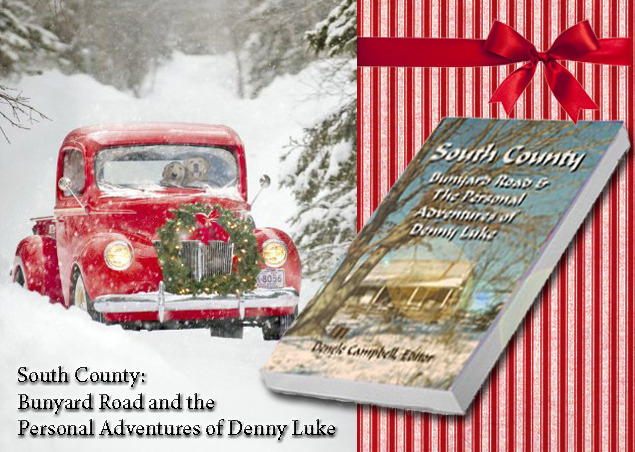
South County: Bunyard Road and the Personal Adventures of Denny Luke

1972. A Yankee learns the Ozarks way and lives to tell his tales. Now almost a native, Denny fondly reminisces about the people and places of his adopted home.

Denny Luke is an adventurer. During his years as a Navy man, he built hot rods with money he made with shipboard loansharking. He returned to his native Ohio where he soon tired of the mechanic’s life. Computers had just started to break the surface in 1966, the perfect attraction to a young man with a sharp mind and plenty of ambition.

Hot cars and Enduro racing occupied Denny’s next few years as he helped usher in the computer age in Minneapolis. But another adventure awaited when in 1970 he fell in with a bunch of hippies. By 1972, he had found his way to the Ozarks.

An avid photographer and storyteller, Denny shares the adventures of his life as he recalls the outrageous backwoods tales and colorful characters who populate the southern fringe of Washington County in Northwest Arkansas.

Buy South County!

Shop Denele Campbell’s author page for all her books. You don’t have to be a geezer to find something you can’t live without! Amazon.com

Talkin’ About My Generation

Last week a friend posted on his Facebook page a Boston Globe guest article by Bruce Cannon Gibney, author of a book released today, March 7. The article summarizes Mr. Gibney’s polemic entitled A Generation of Sociopaths: How The Baby Boomers Betrayed America.

Apparently failing at careers as a hedge fund manager and attorney, Mr. Gibney now claims to be an author. In choosing an inflammatory topic, perhaps he hopes to igniting interest and hence, sales.

I doubt he’ll gain either. The target of his scorn, the Boomer generation, are the primary buyers of books and there’s little chance they’ll spend money to hear his half-baked allegations.

Gibney, like my young friend who praised the article as “what he’d been waiting for,” has fallen for a half century of corporate propaganda meant to discredit Boomers.

In defense of my generation, here are a few rebuttals to his claims:

The author claims:

In 1971, Alan Shepard was playing golf on the moon. Today, America can’t put a man into orbit (or, allegedly, the Oval Office) without Russian assistance.

The truth is that Russian/American cooperation in space programs saves both nations money and furthers efforts to discover distant worlds, investigate dark matter, and watch for potentially deadly asteroids that may need to be diverted from direct impact. We are, after all, one planet facing a daunting universe. Space program advances not only include men and women living in space but also such amazing technological feats as the Hubble telescope.

The author states:

Improvidence is reflected in low levels of savings and high levels of bankruptcy. 

Assertions are free, so Gibney spends nothing but his credibility asserting that this state of affairs rests solely on some deficiency of the boomer generation and has nothing to do with old-money one-percenters and corporate profiteering over fifty years of gobbling up an increasing share of the economy.

Further, he states:

Interpersonal failures and unbridled hostility appeared in unusually high levels of divorce and crime from the 1970s to early 1990s. 

Hard to know how crime and divorce should be considered jointly, but here’s the thing about divorce. Until women gained better footing in the job market circa 1970s, divorce meant losing financial support. Women stayed with abusive husbands who, like Don Draper of “Mad Men,” caroused at their pleasure while the little woman stayed home to suck it up.

As far as rising crime rates, one only must look at the Nixon/Reagan drug war to figure out why the numbers went through the roof. Drug prohibition creates flourishing criminal markets and a marketplace that can only be policed by underworld gangs. It’s been 80+ years since alcohol prohibition, apparently too long for us to remember the lessons it taught us.

Gibney continues:

[Boomers] were the first generation to be raised permissively, the first reared on television and subject to its developmental harms, and the only living group raised in an era of seemingly effortless prosperity. 

Few of the Boomer generations escaped physical punishment by parents and teachers, so this idea of being raised ‘permissively’ is Gibney’s fantasy. We were also raised with regular schoolhouse drills to hide under our desks if nuclear war erupted. So much for the laissez-faire childhood the author imagines.

As far as ‘developmental harms’ caused by television, granted Boomers weren’t out in the fields each day hoeing cotton. But television made them more aware than any previous generation of the world around them—the plight of children starving in Africa, the devastation of the environment, and the butchery of war, a war that plucked brothers, lovers, and classmates up from whatever they were doing and dropped them into a fetid jungle with napalm and guerilla fighters. The world suddenly wasn’t what they’d been told, all those fairy tales about happy endings and the greatness of America. Watching their illusions die on television screens motivated Boomers to try to make America what the Founders had promised.

The author continues:

 In the 1970s, the older establishment had already begun bending to boomer power, though not always cravenly enough, a problem boomers resolved by becoming the establishment itself.

Patently absurd. The older generation never bent to boomer power. It bowed up as Boomers tried to stop the war, stop environmental destruction, and gain liberty and justice for minorities, disabled and women, not only beating demonstrators (and at Kent State killing  them), but more pervasively by sending them to jail. The drug war specifically targeted Boomers and provided a government tool to disenfranchise, bankrupt, and discredit an entire generation.

Gibney evidently has zero understanding how Boomers transformed from the materialism embedded in 50s upbringing to a New Age of awareness. Mind-altering drugs along with the events of the times fostered a change in consciousness. Boomers walked away from corporate jobs, fancy houses, and the latest fashion in shoes.

Nothing could have terrified the corporations more. Their entire marketplace was at risk of going bankrupt. Together with government already in bed with the military-industrial complex, corporate power brokers destroyed what they could of the Boomer generation’s credibility and co-opted the rest. By the end of the 70s, ‘hippie’ had become a dirty word.

So no, the “older establishment” did not bend. They came back with Reagan and it’s been a street fight ever since.

The author conveniently skips over the 80s when Reagan handed a death sentence to worker unions and then Geo W Bush followed on his heels, both the manifestation of corporate power and ‘older establishment” control. To claim that Clinton served the selfish Boomer agenda with disastrous results is simply making it up as you go along.

But hey, this guy has a book to sell.

Gibney tries to have it both ways as he explains that all the excesses, failures, and wrongheadedness currently facing the nation is a result of this sociopathic generation when in fact every possible side of politics and social attitudes can be found within this large population of people. To claim that despite the staggering diversity of the generation, they somehow all arrived at a more or less equal degree of selfishness and shortsightedness is clear evidence that Gibney has a theory in need of real facts.

He states, for example, that

The 1 percent is, by definition, just 1 percent, unable to dictate national policy on its own.

But that’s exactly what the one percent does with ownership of the jobs, real estate, and the wealth upon which the other 99% must depend for survival. It also owns the government, most assuredly since the SCOTUS decided that corporations had the same rights as real people.

In his desperation to bend reality to support his paper-thin thesis, Gibney states that

Reagan lowered taxes on income while raising them on capital gains (when boomers had salaries but not portfolios)

as if Reagan, hero of the aging Silent Majority, suddenly reversed his position and catered to the Boomers.

Then there’s Gibney’s outrageous claim that the increase of the national debt is due to Boomer extravagance while he ignores all the other factors that have created the debt, towering above all else the corporate exodus to third world countries for cheap labor and lack of environmental regulations.

The author states:

Finding decent growth requires stretching all the way back to the 1990s, and even so, the 1990s barely edged out 1970s’ squalor on a per capita GDP basis. Thanks to boomer policies, the new normal is 1.6 percent real growth, well below the 2.5 to 3.5 percent rates prevailing from the 1950s to the 1980s. For the young, the price will be incomes 30 percent to 50 percent lower than they could have been.

In truth, real growth has been dropping as the nation exploited the vast trove of natural resources gained when settlers killed off the native population. Within a relatively short time, the gold and silver was mined, most of the forests cut, and natural fisheries depleted. A modest growth spurt occurred with the development of technologies that produced food without armies of people hoeing crops or steel girders without men scorching their faces as they poured molten metal into molds. The downside was that with each wonderful technical advancement, people lost jobs. As more and more jobs fell to technology and cheap foreign labor overseas, more of the per capita GDP dropped.

The author’s whine is loud and long. ‘If only’ those self-indulgent shithead Boomers hadn’t been such sociopaths, incomes today for the ‘young’ would be 30 to 50% higher. I’m wondering what magical metric he used to arrive at these statistics.

Mr. Gibney’s vantage point is that of a disillusioned young man with enough anger to fuel him well into his 50s. I suggest he get out of his suit and out of the big city and wade around in the real world for a while where millions of Boomers go about their lives with dedication, caring, and enthusiasm. I could almost forgive him for this screed, considering that I know how hard it is to sell books. But I won’t. His immature ideas malign an entire generation without offering any rational solution for his litany of woes. Short of nuking the entire generation, I’m not clear on what Gibney wants to do about it. [I won’t be reading his book to find out.] At the least, his writing outlines a self-serving excuse for his failures.

One thing is certain. If it weren’t for the Boomers, he and his fellow millennials along with the rest of those younger folks looking to assign blame would live in a much more dismal, broken world.

First, We’re Democrats

peace-flag-at-antiwar-protest-P

An emerging narrative from Bernie supporters alleges that the Baby Boomer generation ‘shit all over’ the younger folks and now it’s time for us to step out of the way. The militant rhetoric evidently serves as a potent recruiting tool. Too bad it’s completely bogus.

Yes, there are some of the Sixties generation who tuned in, turned on, and then made a U-turn in the middle of Main Street to become some of the greediest, most soulless people on the planet. But a few rotten apples did not spoil the whole barrel. The rest of us accomplished amazing things for which we have yet to receive any credit.

To you newbies dissing the Boomers, shut the f*** up and think about this: that yoga meditation that you enjoy? We brought you that. Your baby delivered by a midwife? We gave you that. Those organic salad greens you just bought at your local supermarket? Yeah, us.

The reason you male members of the Bernie True Believers haven’t been drafted and sent to the Middle East with a rifle in your hand is that we forced an end to the draft. We were the generation that lost nearly sixty thousand of our brothers and lovers in Vietnam and spilled our own blood in the streets to make it stop.

You female members of the Bernie True Believers are empowered to be out there on the streets with your political action groups largely because we burned our bras and filled university and government buildings with our sit-ins demanding equal pay and equal rights. We didn’t settle for an apron and dust mop. We elbowed our way into the mainstream.

We pushed our reproductive agenda and got a Supreme Court ruling legalizing abortion. We celebrated our freedom to choose with new technology like birth control pills, so that whatever child was born was a wanted child. We pushed aside the obstetricians with their convenient forceps deliveries and anesthetized mothers and birthed our babies into darkened rooms where the fathers were part of the experience. You were floated in warm baths and held to our breasts in a revolution of childbirth every bit as radical as any Bernie slogan.

We demanded clean food free of pesticides and additives and organized our own food cooperatives. We trucked in hard-to-find organic produce and flour. Many of us went back to the land to raise organic beef and grow our own gardens where our children could eat fresh peas straight off the vine.

We cast aside centuries of misogynist religion to embrace the greater spiritual power of the Universe. Did you think your yoga studio appeared out of the Fifties like Athena sprang from the forehead of Zeus? No—we traveled to India. We read the books. We followed the gurus in order to reframe our embrace of the Divine.

We shared our dorm rooms, our jobs, and our farms with gay men and lesbians, strenghtened their public arrival with our acceptance in spite of the brutality that they encountered in the rest of society. We opened our homes to African Americans and other minorities and joined in their protests. We saw all people as our kinsmen.

We are the reason you can access acupuncture and Asian medicine, holistic practitioners, therapeutic massage, and the proliferation of alternative medicines that spread before you today like a feast-laden table. We sought out health in a world filled with sickness, in world where ‘medicine’ fulfilled all we knew about healing.

We took our children to protests, meetings, and hearings. You played outside in the sunshine while we stuffed envelopes and called friends. We changed the world without social media or computers.

We sacrificed days, weeks, even years of our lives in the fight to save our forests and oceans, our waterways and air from pollution. We fought for the whales and the wolves. We wrote letters, stood in cold wind and glaring sun with our signs, took up residence in trees. The environmental protection you may take for granted came about because of us.

We had help from older generations. Some of them fought to the end just like us. We’re still fighting. Many Baby Boomers are active in Bernie’s campaign.

Whatever disconnect exists between what the Boomers accomplished and the platform from which you launch your tirade is not because the Boomers failed. The disconnect derives from the same power brokers who manipulate every new generation into following certain paths. We called it The Man, The Machine. Their message? If you want the new car, the nice house, all the toys, then you’ll toe the line. Pass the drug tests. Conform.

The history of any war is written by the victors. In the still-simmering culture wars, the corporations want you to see us as the enemy. You have to dig deep to uncover the fullness of what I’ve said here in a few words. You want to change the world? Join the club.

Just keep in mind that because Bernie says all the right things doesn’t mean he’ll lead you to victory. Maybe you’ve never heard about our work for McGovern, walking door to door, keeping faith that we could usher in a New Age. In 1968, we never saw Daly’s henchmen coming or the disaster that would befall the Democrats as a result of that convention. We didn’t anticipate the backlash, all the haters and religionists ready to answer the clarion call of the corporate machine. We invested our future in the hope and change promised by Democrats and watched in horror as Richard Nixon won two terms.

Maybe you never understood what happened to our next great hope, Jimmy Carter. It’s instructive to review how he lost to Ronald Reagan:

  • Carter later wrote that the most intense and mounting opposition to his policies came from the liberal wing of the Democratic Party, which he attributed to Ted Kennedy’s ambition to replace him as president. Kennedy surprised his supporters by running a weak campaign, and Carter won most of the primaries and secured renomination. However, Kennedy had mobilized the liberal wing of the Democratic Party, which gave Carter weak support in the fall election. (Wiki)

Or the loss of Al Gore not because George W. Bush was such a stunning candidate, but because the Democratic left wing blindly flew to support Ralph Nader and his pie in the sky oblivious to the very real possibility that by splitting the progressive vote, a Republican would win. Perhaps some of this language will sound familiar to Bernie fans:

  • Nader’s campaign rejected both parties as institutions dominated by corporate interests, stating that Al Gore and George W. Bush were “Tweedledee and Tweedledum.” A long list of notable celebrities spoke [in his favor]. The campaign also had some prominent union help… (Wiki)

FYI, that could happen again. All the visceral emotion you’re feeling now about us, about Hillary as our ‘representative,’ you’re feeling that for more reasons than you may realize. For over two decades it’s been the Republican end game against a woman they’ve always known could be a successful president.

If their first-wave tactics work, you’ll bring Bernie a successful nomination. Then they’ll begin their second wave, this time against Bernie: Socialism. Higher Taxes. Universal Healthcare. Lions, tigers and bears, oh my! In November, a Republican candidate will win.

You may live in a bubble where pot is legal, polyamory is accepted, and social progress is a straight line from here to there, but you haven’t faced the reality that 70% of the population still identifies as Christian. A third of those folks are evangelical, meaning they will show up and they will vote no matter what you do. They are the active force behind the Republicans, agitated and directed by the corporate money masters.

Your disdain for the Baby Boomers is the result of their careful plan. You like Bernie? So do I. Want to make him president? Go for it. Just keep in mind that if Hillary wins the Democratic nomination, you’ll have a choice. If the Machine is successful, you’ll be so angry at the Boomer generation and Hillary in particular, you’ll not vote for anyone but Bernie.

By indulging your cleverly fomented rage and refusing to support a Democratic candidate other than Bernie, you will play right into the hands of the machine. Another Nixon-Reagan-Bush waits in the wings.

So cultivate your anger with knowledge. Wake up to the real history of the Boomer generation. We had big hopes too. But just because all our goals weren’t completely met doesn’t mean we’ve failed. We’ve moved the ball forward. We welcome you to the fight.

But don’t forget–we’re not the enemy.

Gift of the Season Day 6 — Price Markdown

Aquar Rev faded coverThey were the hippies, the drop-outs, the radicals. They came from New York, Detroit, Chicago, Los Angeles, New Orleans, and bought cheap Arkansas land where they could build lives with meaning. Often the topic of heated rhetoric and armchair analysis, those who went ‘back to the land’ rarely speak in their own voice. Now documented in these personal interviews, their stories reveal the guts, glory, and grief of the 1960s social revolution.

Previously listed at $15.95, now for a limited time the paperback is available for $11.95. A lasting gift! Amazon buy link

“Denele Campbell’s informative ‘Aquarian Revolution: Back to the Land’ fills a much-needed niche in the history of the Counter-Culture movement. Unlike in more crowded Europe, America’s rural expanse offered an escape, a new beginning in the 1960s, from a social cancer spreading through the dominant culture. The dream of finding land to till and an alternative life style had been an American dream since its founding. America’s cities, mired in racism, sexism, poverty, and riots, seemed doomed. The ‘baby boomers’ sought escape by going to the land, many for the first time. Denele Campbell has carefully chronicled the personal stories of thirty-two pioneers who opted to create their utopian vision in the Ozarks. As such, their quest is at times fascinating, amusing, and often painful. Yet, it is a good read for those who lived through this era as well as today’s young.” —-T. Zane Reeves, Regents’ Professor Emeritus, University of New Mexico and author of Shoes along the Danube.

Domes

zome is stretched dome
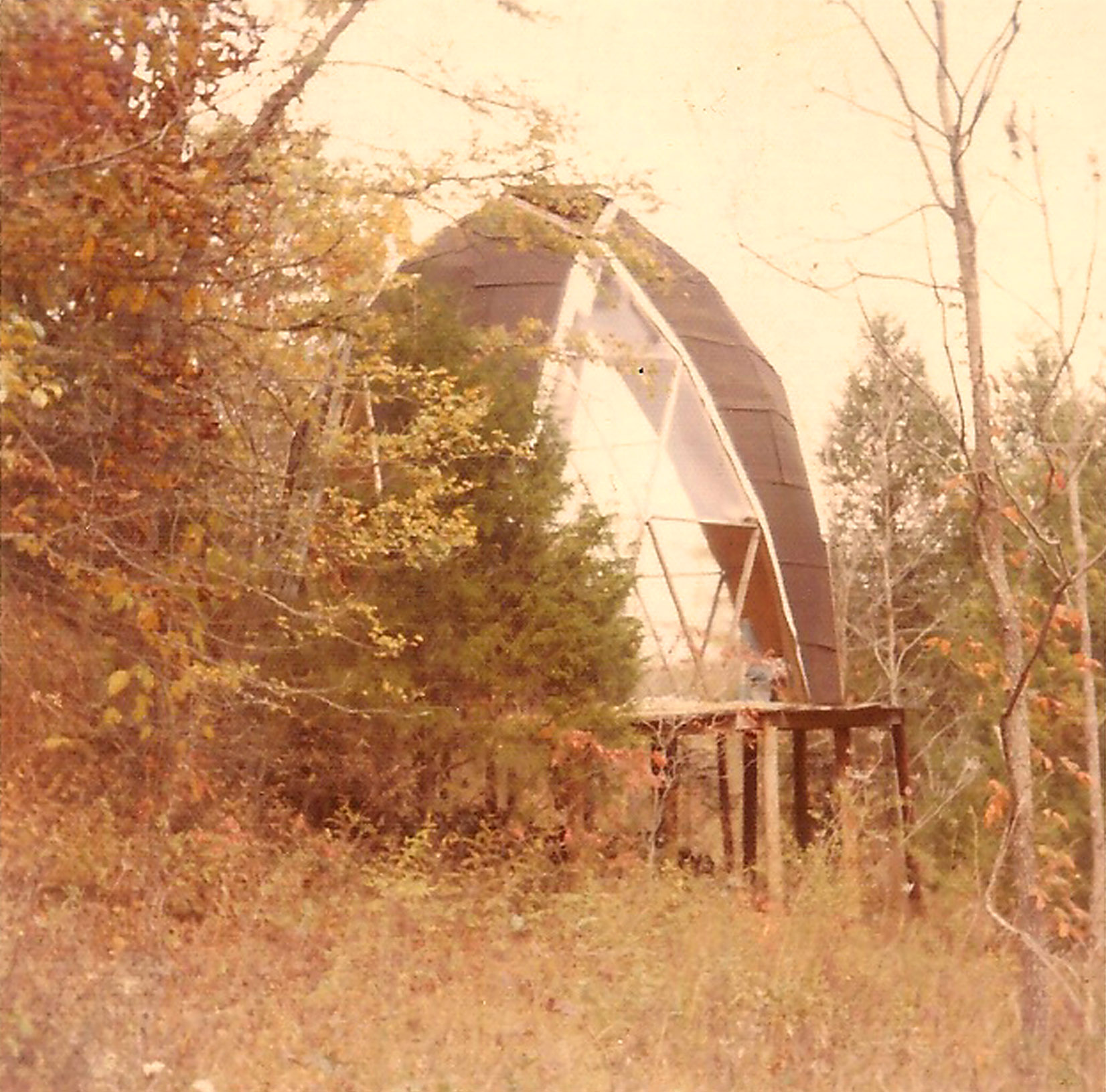
A ‘zome,’ a stretched dome. One of several domes constructed in South Washington County Arkansas at a rural intentional community.

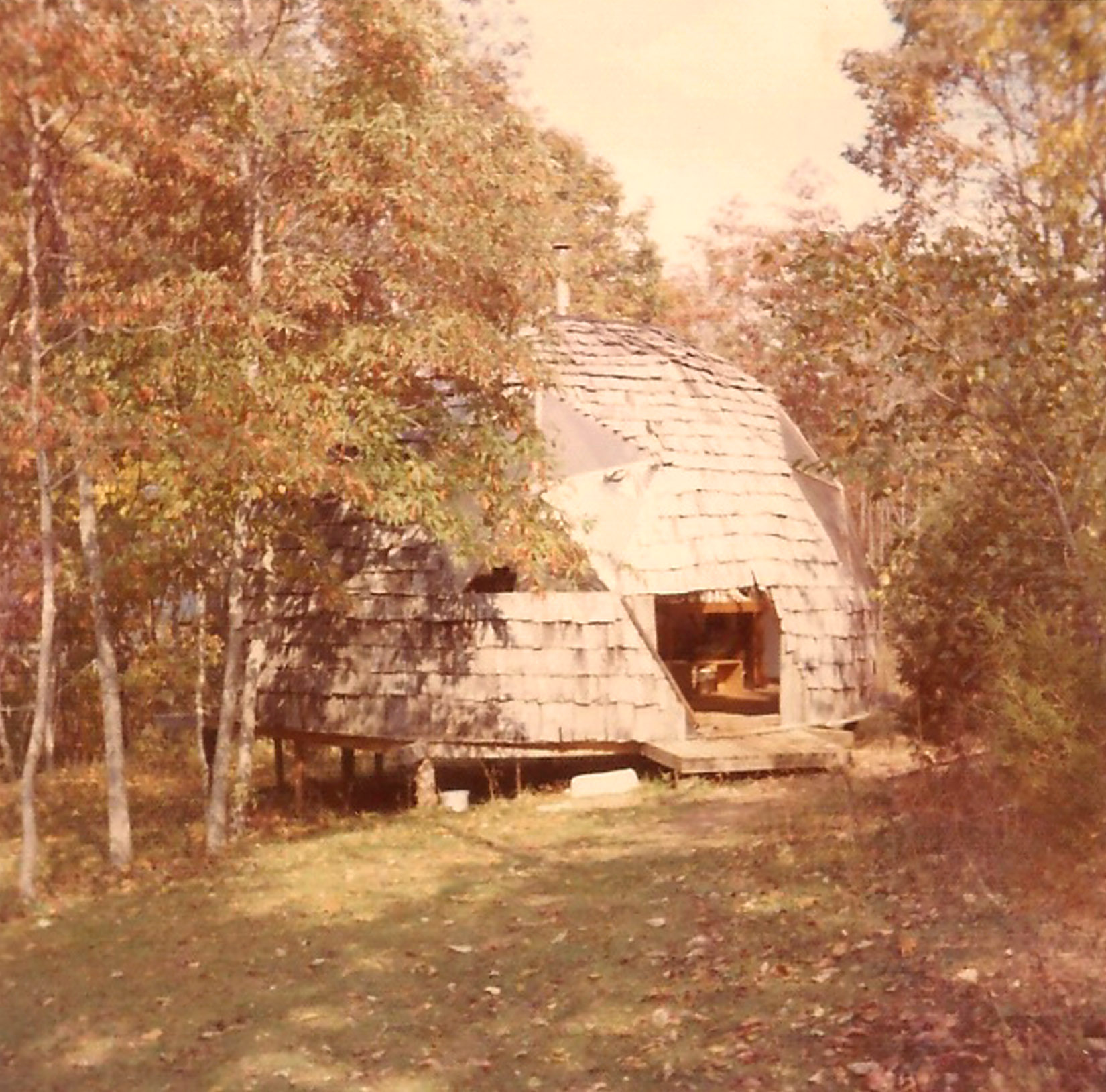
In the 1960s and into the early 1970s, geodesic dome structures cropped up around the world, including in Northwest Arkansas. Some lasted, many did not.

Based on the idea that what we see externally informs how we understand ourselves internally, domes epitomized a philosophical approach to human habitation.

dome1Traditional architecture with its multiple separate rooms leads to a segmented self view, according to this argument.  Rounded open space such as provided in a dome fosters a more holistic view of self and the world in general.

The dome concept was developed by Buckminster Fuller. Fuller discovered that if a spherical structure was created from triangles, it would have unparalleled strength.

3-8ths or half geodesicIn 1928, he wrote:

“These new homes are structured after the natural system of humans and trees with a central stem or backbone, from which all else is independently hung, utilizing gravity instead of opposing it. This results in a construction similar to an airplane, light, taut, and profoundly strong.”

looks like a zome
None of the eleven or more domes built at the intentional community have survived.

The sphere uses the “doing more with less” principle in that it encloses the largest volume of interior space with the least amount of surface area thus saving on materials and cost. Fuller reintroduced the idea that when the sphere’s diameter is doubled it will quadruple its square footage and produce eight times the volume.

Fuller worked towards the development of a Comprehensive Anticipatory Design Science which he defined as, “the effective application of the principles of science to the conscious design of our total environment in order to help make the Earth’s finite resources meet the needs of all humanity without disrupting the ecological processes of the planet.”[i]

eye doc dome
Optometrist office in Fayetteville, newly built in 1970s.

Domes were built not only by idealistic hippies pursuing an improved state of consciousness but also ended up in use at commercial locations. A enhanced dome built to house an optometry practice in Fayetteville, Arkansas remains in good condition.

Newman's dome homeOne of the surviving residential domes in the area includes bump-outs and other additions that make for a more family-friendly features. This one includes a basement and a rear deck.

Other commercial uses included the Southern Energy Fast Oxide Reactor (SEFOR) built in south Washington County near Stricker. SEFOR operated from 1969 to 1972, when the original program was completed as planned. It was privately operated by General Electric and funded by the United States government through the Southwest Atomic Energy Associates, a nonprofit consortium formed by 17 power companies of the Southwest Power Pool and European nuclear agencies.

Southern Energy Fast Oxide Reactor, Stricker, '78 (SEFOR)The facility was then acquired by the University of Arkansas in hopes that it could be used as a research facility. However that never happened and the university has been paying $50,000 in maintenance fees yearly since. SEFOR is still considered contaminated and the University continues to seek federal funds to clean up the site.

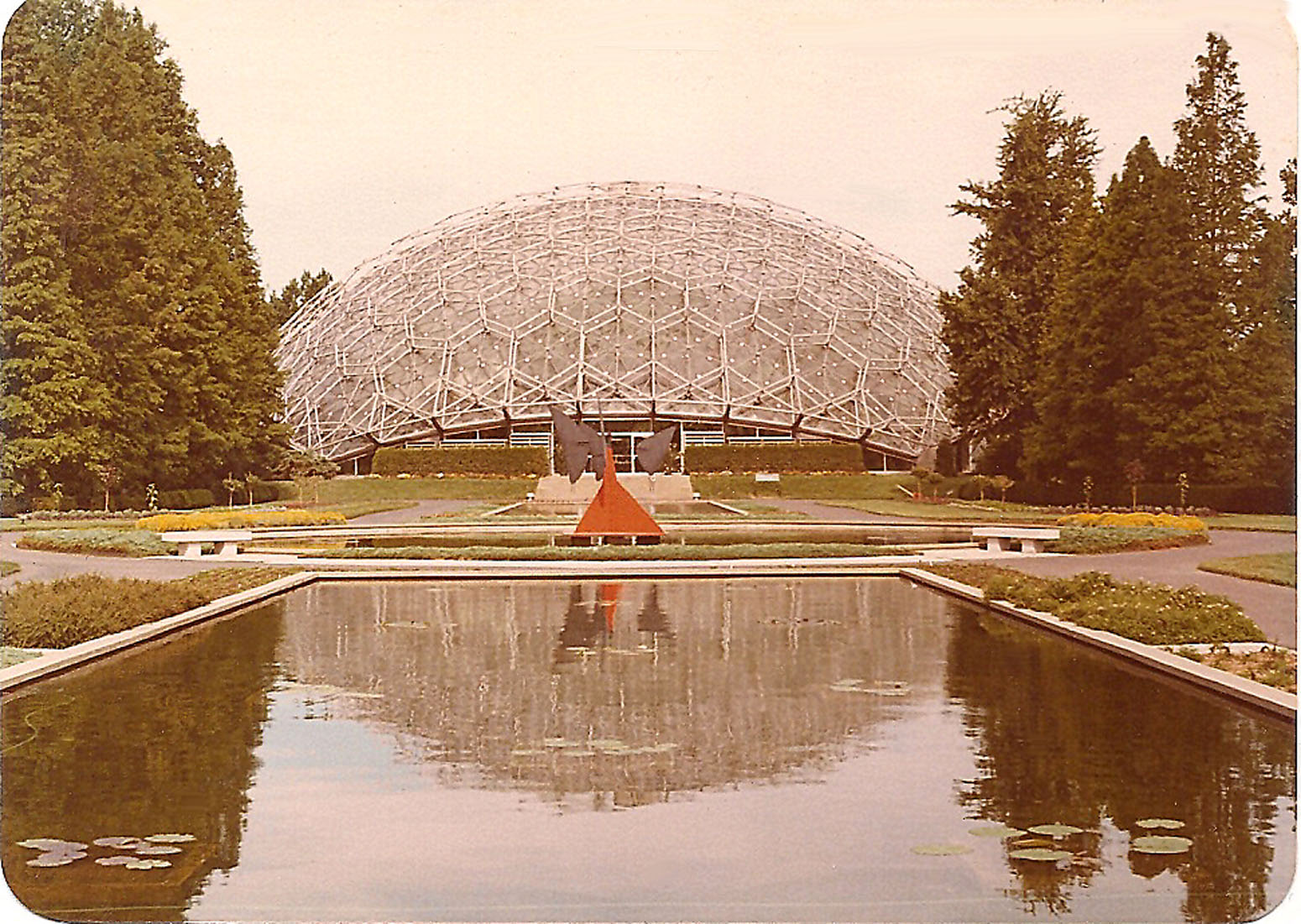
Climatron, St. Louis, '77Another example of dome construction in commercial application is the St. Louis Climatron, part of the Missouri Botanical Gardens built in 1960. Controlled environment in this large dome re-creates a lowland rain forest.

Due to limitations of materials and use requirements, domes today are built for only a few applications, most notably sports arenas and as a complement to other structures such as churches where a separate dome feature may add another dimension to sacred space.


Photographs courtesy of Denny Luke, a longtime resident of the area.

[i] http://bfi.org/design-science/primer/environmental-design-science-primer

A Moveable Feast

dickson copyDickson Street, 1970. Old rock buildings with narrow profiles and high pressed-tin ceilings. An abandoned railroad depot that trembled when freight trains thundered past. A declining backwash between campus and the downtown square of a town still embracing its provincialism.

The university drew them, intense intellectuals seeking knowledge, misfits seeking community, young men determined not to die in Asian jungles. In between time in class and demonstrating against war, they settled into the street’s cheap real estate to paint murals and make free love. Abandoned warehouses and decrepit brick structures a hundred years old became head shops, bars, and art galleries. Downscale restaurants heaped alfalfa sprouts on whole wheat bread sandwiches—radical. Cooperatives sold tobacco and honey in bulk, locally made tofu—far out.

Sweet smoke hung in the air. Street festivals celebrated music of hope and rebellion. People wore crazy hats and stood on the corners laughing and hugging. Dickson Street crackled with excitement.

All this made it a place people wanted to be. Straight people, women wearing hosiery and high heels, men in suits—they loved the experience of freedom, even if they themselves couldn’t be free. They dared to step out of their establishment lives and feel the beat, smell the smoke they didn’t inhale. Well, maybe they inhaled—who would know? On the street, they became part of a separate world, joined a conspiracy in which all participants shared the secrets.

Not everyone loved the street where long-hairs had carved out a world of their own. What on earth went on down there, they lamented—police, city fathers, wives of husbands who slipped out for a drink at one of the dive bars and ogled the braless young women. Owners of real estate along the street stopped repairing the roof and the plumbing, inflated the prices so that the restaurants couldn’t own it for themselves, so the art galleries couldn’t afford the rent. The hippies needed to go.

By 1990, value created by the alternative culture gave the establishment reason to retake the street. There was money to be made. People wanted to eat there, shop there. The street was cool. Never mind that the coolness had been bestowed by starving artists, by inventive bohemians, by fledgling entrepreneurs selling worn-out blue jeans for respectable profits.

The rich bought the street. They demolished landmark gathering places to put in shops selling diamonds and art from back east. They came dressed in their finery to eat at chain restaurants and watch traveling Broadway shows.

The street is now a shell of its former raunchy self, an extravagant display of fakery in expensive plastic packaging—a back to the land scene where the joyful family piles out of their brand new SUV to view nature, a credit card ad with Beatles music playing in the background. There’s no getting it back. They don’t even understand what’s been lost.

Excerpts, Aquarian Revolution

“We’re in the headwaters. It’s pretty wild and wooly. There’s times we have to hike out. We have a highwater trail, and we park our car on the bluff and it takes about a fifteen-minute walk to get down to the house, because the creek’s roaring and we can’t get in or out.” Chapter 1

“If you wake up in the morning and you’re happy, happy to see the sun rise, happy to see your wife or husband lying next to you, happy to be doing what the day promises for you, then I guess you’re in a good place, you’ve done what you’re supposed to do.” Chapter 2

“On really windy days when we couldn’t cut, he’d climb up to the top of the tallest pine and tie himself on and yell and scream. I started doing that. He said, you’ve got to make sure you don’t drink anything for several hours before you go up, because you’re going to pee your pants, totally lose control. The tree tops would make a twenty foot arc—we’re talking Ponderosa pines, or big Douglas firs that are probably a hundred feet tall.” Chapter 4

“I did have to make a living since I was a single woman. I went to Wall Street at that point, doing marketing for tax shelters and oil drilling funds. Pretty successful at it, working for a big brokerage house and pursuing my alternative lifestyle at night, carrying my briefcase, getting on the subway every morning completely dolled up in my full douche regalia, going to work, and then on the weekends going to the Fillmore East and seeing the Grateful Dead. That lasted until ‘71.” Chapter 5

“I loved Haight-Ashbury. Before I went to Haight-Ashbury, my apartment was raided by the Fayetteville police on the rumor that I had a matchbox of marijuana. I had moved out three weeks before. Next scene, Haight-Ashbury. At Haight-Ashbury, people were yelling on the street corners ‘Acid, grass, speed, Berkeley Barb.’ It was like going to the candy store. You couldn’t get arrested.” Chapter 6