The Rich and Social Security

I’m sorry to burst everyone’s bubble about the rich and Social Security, but I believe it’s flat out wrong to think it’s as simple as the rich should pay “their fair share.” Compared to everyone else, they already pay their fair share because what each of us pays in Social Security tax is based on our income. The rich earn more, so they pay more.

The sticking point is the cap, the amount of the tax to be collected before the assessment stops. So what “pay their share” actually means to those hoping for reform is “get rid of the cap.”

But what would that mean?

“In 2024, the maximum amount of earnings subject to Social Security tax is $168,600, which is up from $160,200 in 2023. This limit [cap] is also known as the contribution and benefit base or the taxable maximum. The tax rate for wages paid in 2024 is set by statute at 6.2 percent for employees and employers, each. This means that an individual with wages equal to or larger than $168,600 would contribute $10,453.20 to the OASDI program in 2024.” And no more.

“The federal government adjusts the Social Security cap annually to keep pace with inflation based on changes in the National Average Wage Index. Earnings above this amount are not subject to Social Security tax or factored into Social Security payments in retirement.”

So at the maximum level of taxation this year, a person would pay a total $10,453.20 into the system.

And what does this person draw in benefits?

“The maximum Social Security benefit depends on age, earnings, and when benefits are taken. In 2024, the maximum benefit is $3,822 per month for those who retire at full retirement age, which is between 66 and 67. For those who retire at age 62, the maximum benefit is $2,710 per month, and for those who retire at age 70, the maximum benefit is $4,873 per month.” 

To earn the maximum Social Security benefit, individuals must have been a high earner for 35 years and wait until full retirement age to claim benefits.

The ‘high earner’ contributing to the fund based on $168,600 for 35 years would have a pension balance of over $5,901,000 by retirement. At the $4,873 maximum monthly payout for the retiree, this amount would be depleted in 100.87 years, hardly a likely remaining life span after retirement age. Even living 20 years past retirement age, that person would only recoup about 20% of what he paid in.

On the other end of the tax calculation, a low income earner of $35,000/year might contribute far less than he/she will actually be able to receive at retirement. An employee sees 6.2% of his earnings withheld from his paycheck while his employer pays another 6.2%, for a total of $4,340/year based on $35,000/year. A self-employed person has to pay the entire 12.4% into the fund. Either way, thirty-five years later, that person will have accumulated $151,900 in his benefit fund.

Depending on the age at retirement, let’s say 66 years, his monthly benefit amount would be $1,846. Fortunately for him, if he lives twenty years after retirement, he will receive a total of $443,040 in benefits, a total of $291,140 MORE than he paid into the system.

Yes, there are significant numbers of men who die before they can claim any benefits, although their widows and/or minor children can draw on those accounts. A widow who never earned an income can live on her dead spouse’s benefits for the rest of her life, an amount which can easily skyrocket into large sums as about 16% of the men and about 34% of the women live to ninety or beyond.

Currently, life expectancy for women is 80.2 years while for men, it is 74.8 years. About half of women drawing benefits receive amounts based on their husbands’ earnings. Calculating by averages alone, the 5.4 years that women live past the male average death age creates a disproportionate amount of benefits paid that exceeds taxed earnings.

There is no cap on how many years a person can receive benefits. The benefits continue until death. The longer we live, the more benefits we receive.

So there’s no method by which the “rich must pay their fair share” when it comes to Social Security. Nor is the equity in promising widows a lifetime of benefits based on the husband’s contributions.

But wait! Aside from Social Security, a far simpler method of taxing excessive wealth is a more effective income tax rate. Consider the following:

  • According to a 2021 White House study, the wealthiest 400 billionaire families in the U.S. paid an average federal individual tax rate of just 8.2 percent. For comparison, the average American taxpayer in the same year paid 13 percent.
  • According to leaked tax returns highlighted in a ProPublica investigation, the 25 richest Americans paid $13.6 billion in taxes from 2014-2018—a “true” tax rate of just 3.4 percent on $401 billion of income.[1]

That’s not paying your fair share. Instead of rewarding wealth over work, our tax system should ensure that billionaires play by the same set of rules as the rest of us. It’s good for the planet, and it’s essential to the preservation of our democracy.[2] An easy method of capturing a greater portion of excessive income is the wealth tax plan advocated by Sen. Bernie Sanders:

Key Points:

  • Establish an annual tax on the extreme wealth of the top 0.1 percent of U.S. households.
  • It would only apply to net worth of over $32 million. Anyone who has a net worth of less than $32 million would not see their taxes go up at all under this plan.
  • This would raise an estimated $4.35 trillion over the next decade and cut the wealth of billionaires in half over 15 years, which would substantially break up the concentration of wealth and power of this small privileged class.
  • Ensure that the wealthy are not able to evade the tax by implementing strong enforcement policies.[3]

Aside from higher income taxes on the 1% super wealthy, another major misconception about Social Security is the idea that the government has “borrowed” money from the fund and that’s why it seems to be running out. Yes, the federal government borrows Social Security funds. This is a mechanism that was built in when the program began. The point being, the government is required to pay the money back with interest.

  • Social Security income is deposited into two financial accounts called trust funds – the Old-Age Survivors Insurance (OASI) Trust Fund and the Disability Insurance (DI) Trust Fund. The trust funds are used to pay out Social Security benefits and cover administrative costs.
  • The trust funds hold money that isn’t needed in the current year to pay benefits and other expenses. By law, that money is invested in special Treasury bonds that are guaranteed by the U.S. government and earn interest. This adds to the fund. The Treasury is obligated to pay back the money it borrows with interest, according to AARP and the Congressional Research Service, and the SSA says the federal government has never failed to do so.[4]

Another misunderstood program is the Supplemental Security Income, or SSI, similar to Social Security, which guarantees a minimum level of income for aged, blind, or disabled individuals. It acts as a safety net for individuals who have limited resources and little or no Social Security or other income. Individual States have the option to supplement Federal payments for SSI. Currently, states fund about 33% of the program while the federal government puts up the remaining 66% ($55.4 billion in 2021). SSI is financed by general funds of the U.S. Treasury — personal income taxes, corporate taxes, and other taxes. Social Security taxes collected under the Federal Insurance Contributions Act (FICA) or the Self-Employment Contributions Act (SECA) do not fund the SSI program.[5]

We can and should argue for change. But we need to start out with the facts.


[1] https://www.oxfamamerica.org/explore/stories/do-the-rich-pay-their-fair-share/

[2] Ibid

[3] https://berniesanders.com/issues/tax-extreme-wealth/

[4] https://www.verifythis.com/article/news/verify/social-security-verify/how-government-borrows-social-security-trust-funds/
[5] https://www.ssa.gov/pubs/EN-17-008.pdf

U.S. Budget — Military and Social Security

Deceptive and Counterproductive.

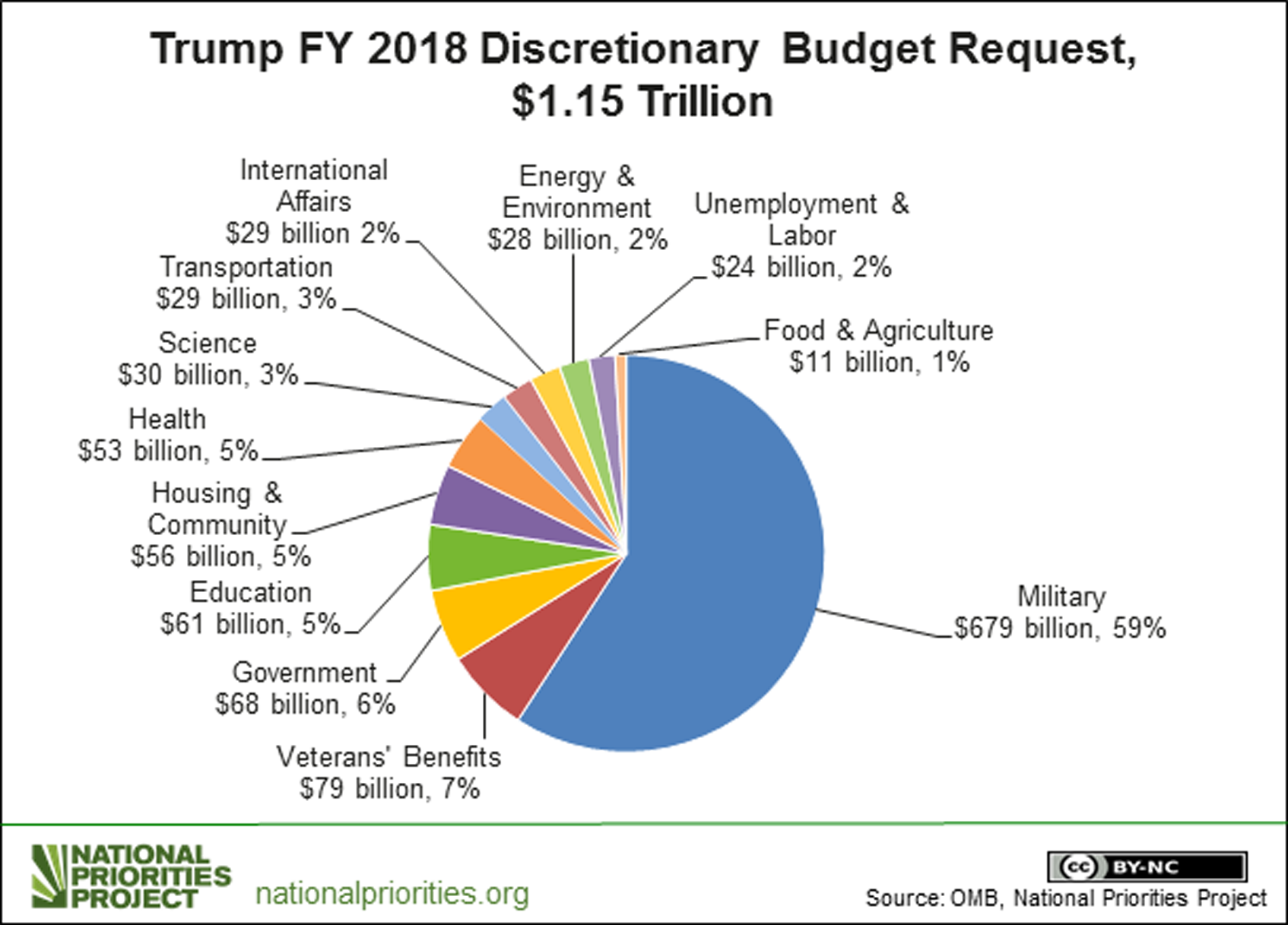
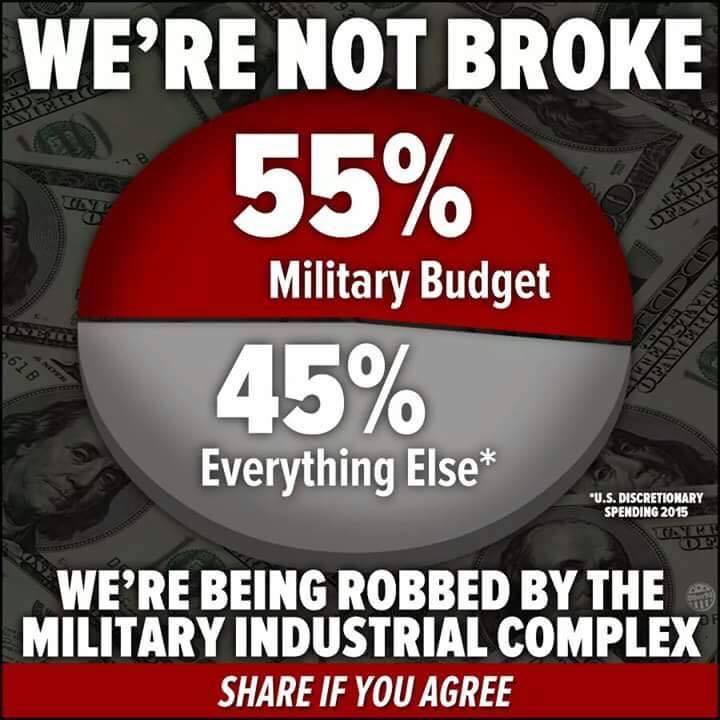
Discussion ebbs and flows on the topic of U.S. spending. Of particular interest to several of my liberal friends is military spending. Frequent Facebook posts on this subject claim that military spending consumes over half the budget.

I agree that the military is not an ideal place to invest so many billions of dollars. I also agree that the U.S. has a history of blowing money on weapons and aggression. Further, I question whether the U.S. uses military means when a better, longer-lasting path to peace and stability in troubled parts of the world would be investments in education, infrastructure, agriculture, and commercial development.

All that said, I have to protest the continuing use of incorrect data in arguing against military spending. The cause for less military spending is not enhanced by presenting incorrect information. Just the opposite.

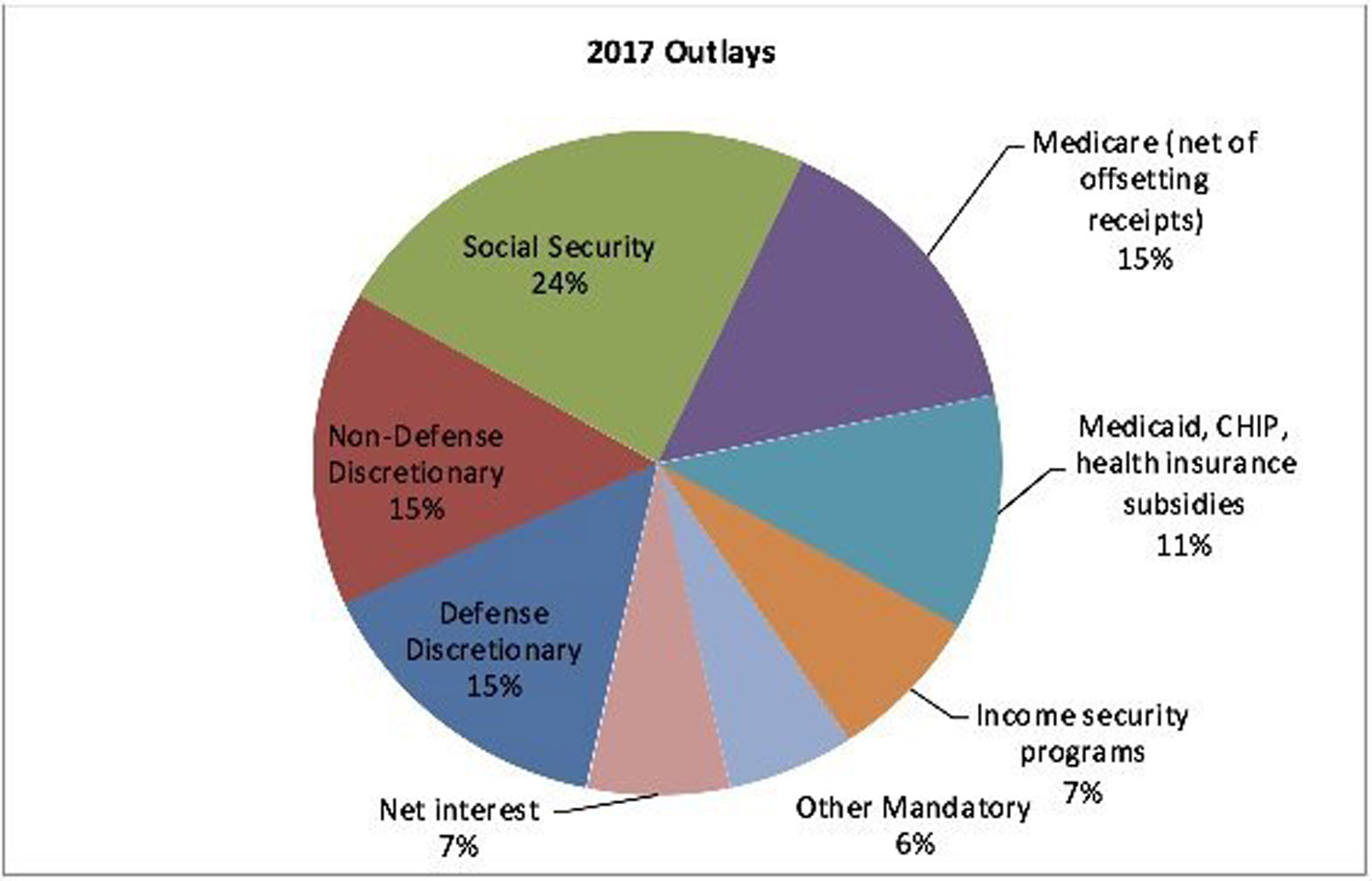
The accurate 2017 budget breakdown:

Please note that the portion designated military spending occurs in the lower left  of this pie chart and as such does not constitute half of the U.S. budget. It’s important to discriminate between a breakdown of discretionary spending and overall spending. Discretionary spending is one category of overall spending. It’s within the slice of pie of discretionary spending where we see the big bite that goes to the military:So yes, military spending within its slice of pie of discretionary spending, is over half the budget. And there’s no limit to the close examination this distribution of funds deserves. But please, let’s make our arguments based on the actual facts.

A second realm of considerable error by liberals calls for a shift in U.S. spending to better honor social programs like Social Security. A popular mantra on social media these days mistakenly claims that we ‘own’ our retirement funds because we paid into them. The following discussion spells out the facts:

“It’s My Money” [WRONG!]

* A common perception about Social Security benefits is: I am entitled to the money. It’s my money. I’ve saved it.

* Social Security is mainly a “pay-as-you-go” program. This means that it pays most of its benefits by taxing people who are currently working.

* Per the Social Security Administration: The money you pay in taxes is not held in a personal account for you to use when you get benefits. Your taxes are being used right now to pay people who now are getting benefits. Any unused money goes to the Social Security trust funds, not a personal account with your name on it.

* From the start of the Social Security program in 1937 through the end of 2016:

  • 94% of all Social Security payroll taxes were spent in the same year they were collected.

  • 13% of Social Security’s total income (including payroll taxes, taxes on Social Security benefits, transfers from the general fund of the Treasury, and interest on the Social Security Trust Fund) has accumulated in the Social Security Trust Fund.

* Per the Social Security Administration: Since the Social Security system has not accumulated assets equal to the liability of promised future benefits, the social security wealth that individuals hold represents a claim against the earnings of future generations rather than a claim against existing real assets.

* After the federal government pays back with interest all of the money it has borrowed from Social Security, the program’s current claim against the earnings of future generations is $30.8 trillion. This amounts to an average of $132,914 for every person now receiving Social Security benefits or paying Social Security payroll taxes.

* Per the Social Security Administration: There has been a temptation throughout the program’s history for some people to suppose that their FICA payroll taxes entitle them to a benefit in a legal, contractual sense. … Congress clearly had no such limitation in mind when crafting the law. … Benefits which are granted at one time can be withdrawn.…

* In 1960, the U.S. Supreme Court ruled (5 to 4) that entitlement to Social Security benefits is not a contractual right. [emphasis added]

[For more discussion of Social Security taxes, allocations, and projections, visit the Just Facts page.]

So let’s get our heads screwed on straight, fellow progressives. While a large chunk of U.S. tax dollars go to military expenditures, it is NOT consuming over half of our tax dollars. Our Social Security and Medicare funds are NOT held for our future use like individual savings accounts, but rather are spent immediately in payouts to persons currently receiving Social Security and Medicare benefits.

If we expect to prevail in directing our nation toward a more equitable and socially conscientious future, we need to be well informed and make our arguments for social justice in ways that make sense and align with the facts.

That is all. For now.

America’s New Greatness

When America was great.

It’s been a crushing year. One after another, hard-won social advancements have been blocked or dismantled in the rush to “Make American Great Again.” But what does that even mean?

Exactly when was America greater? When everyone used outdoor toilets? When women couldn’t work outside the home? When skin color decided who could marry whom, or vote, or eat at a lunch counter?

Is ‘great again’ a worthy goal, the best we should expect? Is the conservative mantra right, that free enterprise and individual liberty “under limited government” was and forever will be the pinnacle of human achievement? If only we could rid ourselves of this ‘big government’ and free ourselves of onerous taxation, would the U.S. of A. become the shining star of the days of yore?

No, no, and no.

Let me explain. At the time of the Founding Fathers, ‘free enterprise’ applied to white male landowners. The constitution ignored the rights of women and non-landowners. Voting rights for Natives or slaves never entered the discussion. The founders conceived of a nation of educated, well-to-do white men who used women, natives, and slaves to meet self-serving goals in creating heirs, seizing ever greater slabs of the continent, and forcing labor from non-whites in order to sustain and increase their wealth.

They weren’t evil men. That’s just how things had always been. No wonder certain white males today would see those as the glory days.

But there’s no lack of free enterprise. Men and women of any class or color routinely open their own businesses. Three out of ten workers in the U. S. are self-employed or are hired by self-employed persons.[1] The ‘small business’ community provides the majority of American jobs.

…large businesses only employ about 38 percent of the private sector workforce while small businesses employ 53 percent of the workforce. In fact, over 99 percent of employing organizations are small businesses and more than 95 percent of these businesses have fewer than 10 employees. The reality is that most Americans are employed by a very small business that has little in common with the tiny sliver of the business demographic represented by corporate America.[2]

The complaint of conservatives is that free enterprise is hindered by big government. They rail against requirements that employers pay into insurance policies that provide medical care for workers injured on the job or that provide health care that meets the employees’ needs. Employers also must pay into Social Security and Medicare funds on a 50-50 basis with the employee’s withheld funds. Employers are required to deduct the appropriate amount of state and federal income tax from employee wages and to deposit this tax into government accounts. Employers also must provide a wage statement at the end of each year (W-2, 1099, etc.).

These requirements annoy the hell out of employers. When I operated my own café, I spent hours working on payroll. I resented spending money on workman’s compensation insurance – I never had an injured employee and all that I paid was money down a hole. But I understood the reason for it. If an employee had become injured, should I expect the government to pay for medical care? Should I personally pay for it? Should the employee be abandoned to pay himself?

These are old problems solved incrementally over a long period of American history back when a majority of legislators worked for the people instead of themselves. We stopped sending disabled or aged persons to poor farms where a pitiful stipend from the state supported them along with the random generosity of wealthy donors who might drop a few crumbs from their tables. We stopped allowing employees to be injured or killed in unsafe workplaces. We required people and their employers to set aside funds for retirement.

Like the Affordable Care Act, social support systems developed by our elected representatives to better provide for the ‘general welfare’ are an evolved safety net for all of us. The simplistic idea that these systems should be dismantled in pursuit of some long-vanished ideal of “free enterprise” fails to recognize all the reasons these systems came into being in the first place. We need them. They serve an important purpose.

‘Individual liberty’ is another often-touted phrase by deconstructionist conservatives. What that concept meant to the founders no longer applies in our current reality. The founders lived on the edge of an unexplored country with such a vast reserve of lands that no one could imagine a time when there weren’t new horizons where young men could ‘go West’ to make their fortunes. Individual liberty was possible only because men gained forty acres or more by simply staking a claim or, in many cases, serving in the military after which they received land grants.[3]

What land is free now? None.

What we took from the Natives was a virgin continent full of natural resources. The lands of Europe had been exploited for over two thousand years and here was a whole new start. Individually and collectively, we harvested those resources while patting ourselves on the back about how smart and industrious we were in building a fabulous new nation. We never considered that sooner or later, the last farmland would be plowed, the last gold nugget would be found, and we would run smack up against the end of the bonanza. We did the same thing here that our forefathers had done in Europe.

Conservatives, enraptured with these myths of a glorious past, believe we can return to times when anyone who wanted to work hard could simply plow his way to success with a mule and a compliant wife. Women, keen for their own ‘individual liberty,’ aren’t so compliant anymore. Farming is no longer a viable path to sufficient livelihood.

Obviously our living standards have changed. No more outdoor toilets or working the fields from dawn to dusk. We’re dependent on electricity and modern medical care and automobiles, all things that as recently as a hundred years ago simply did not factor into the picture for a majority of Americans.

Ever in pursuit of their bankrupt myth, the conservatives’ last gasp is the current grab of political power, attained by selling the myth to those who don’t understand. The conservatives are busy ending food and medical care for the aged, the homeless, and other needy segments of the population. The entire social net crafted over decades is being dismantled in a futile grab for a long-lost past.

The descendants of European colonialism want the glory back. They don’t agree that taking from the rich and giving to the poor is the right approach for modern societies. European nations have already grasped this concept. America today and in the future can never be the America of 1800 or 1900 or even 1950.

Making profit off of sick people or school children is immoral. Just as government regulates utilities, so it must regulate other services required by everyone, including health care and the internet. This is not an appropriate arena for capitalism. Government, not profit-driven capitalists, serves as the most efficient provider for the common welfare –healthcare, affordable housing, education, public transportation, infrastructure like bridges and railways, and a vast network of social services.

Reducing the tax burden for the wealthiest among us accomplishes nothing but the impoverishment of our entire nation. The current imbalance of wealth is clear evidence that the rich should be taxed even more. Expanded social programs should ensure that those at the lowest income levels are brought into counseling, health care, education, and training programs in order to improve their economic status.

We’re a largely urban, multicultural society now, completely different from what the Founding Fathers knew. Just as the founders were right to declare the rights of personal liberty, so were progressives right to end discrimination against minorities, women, and the handicapped and to provide mechanisms by which the damages of such long-term discrimination could be healed. It’s the progressives who have understood that the safety net must be available equally from state to state, a service that only the federal government can ensure.

The personal bankruptcy of a small number of men like Donald Trump and Steve Bannon cannot be allowed to dictate the future of our country. Such men long for a culture where white maleness guarantees ascendancy. Without a white male-dominated social structure, they cannot gain the power they so desperately crave. These are weak men dependent on the subjugation of others for emotional and economic support. They will die off just as the Neanderthal died off.

It’s called failure to evolve.

Here’s a toast to 2018 and the continuing evolution of our great nation.


~~~


[1] http://www.pewsocialtrends.org/2015/10/22/three-in-ten-u-s-jobs-are-held-by-the-self-employed-and-the-workers-they-hire/

[2] https://www.huffingtonpost.com/kristie-arslan/five-big-myths-about-amer_b_866118.html

[3] Bounties of up to 1,100 acres were granted for Revolutionary War service between 1775 and 1783 and up to 320 acres for the War of 1812 through 1815. Additional free lands went to men fighting in the Mexican War 1846-1848 and in Indian Wars from the 1780s through the 1890s. While outright land grants ended in 1855, Union soldiers who fought in the Civil War received homestead rights along with others meeting certain criteria. Much more on land grants and homestead rights at Wikipedia.