Mitchell’s group ‘Arkansas Travelers,’ 1929 UA Yearbook. Mitchell seated at piano. Rex Perkins, violin, standing by piano
Owen Mitchell started teaching music when he was seven years old. A neighborhood boy wanted to learn to play piano so Owen shared what he knew. That was 1892. He would go on to become the first jazz band leader in Fayetteville.[1]
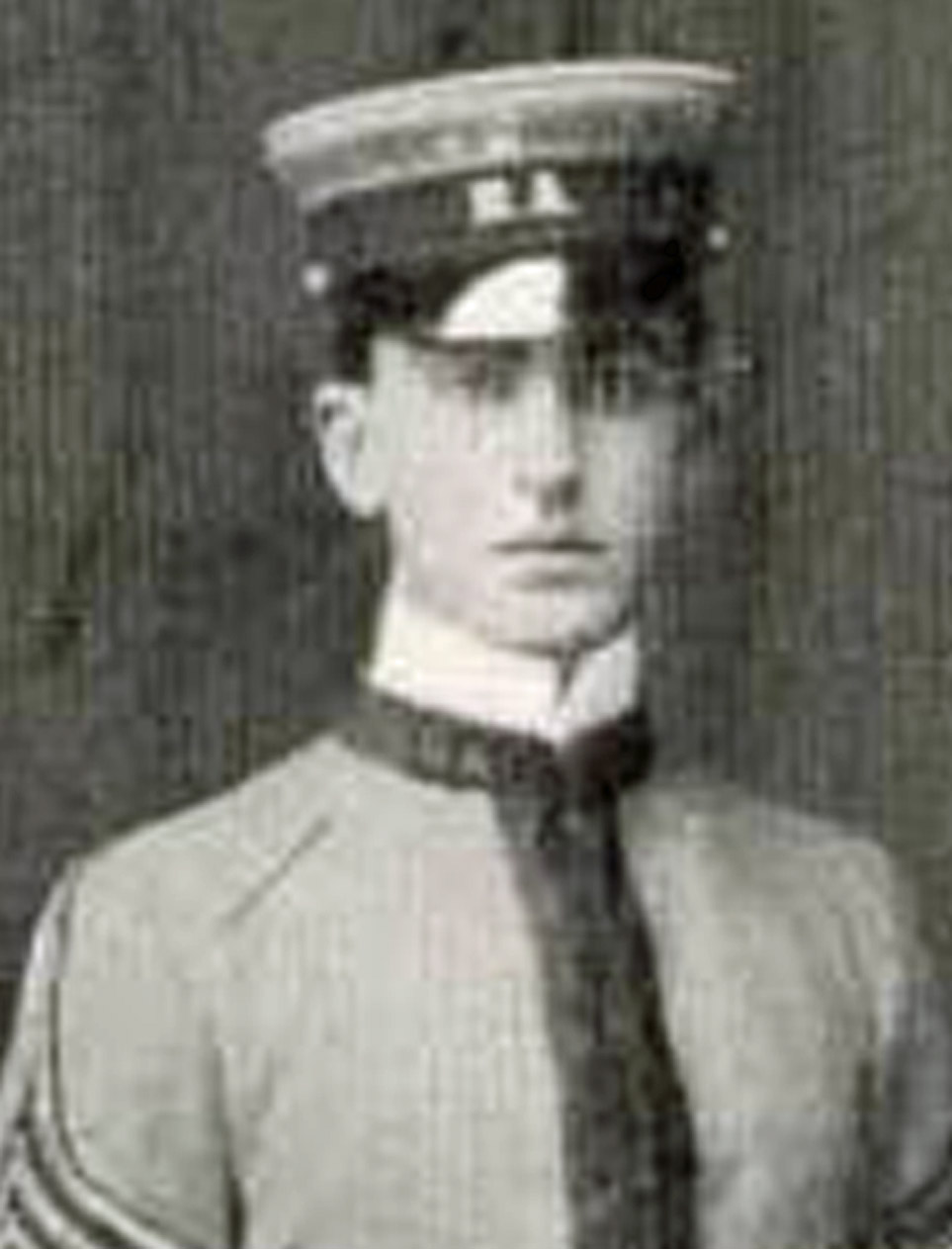
Owen Mitchell 1904, with Cadet Band
Mitchell didn’t start out with jazz. Upon entry to the University of Arkansas at Fayetteville in 1903, Mitchell pursued a degree in chemical engineering while continuing to follow his passion for music as a sideline. Mitchell graduated with a bachelor’s degree in chemistry in 1908 and for a time taught the subject at the University, probably as a graduate assistant. But he was never far from his love of music. Apparently something of a polymath in musical arts, described in one of many newspaper accounts of his performances as a “musician of unusual ability,” Mitchell played trombone, piano, and several other instruments. He understood music theory and composition, and served an important role in Frank Barr’s orchestra which performed at multiple social events around town.
During these early years, Mitchell traveled to St. Louis and Kansas City to experience what big city musicians had to offer, and he often accompanied Barr to help teach community bands in Cane Hill, Westville (Oklahoma), and other towns. [2] Eventually his love of music pulled him away from chemistry altogether, and he went on to lead Owen Mitchell’s Orchestra. The band was among the first to be heard on the new University radio station, KFMQ, in 1924. By January 1925, Mitchell’s radio programming split fifty-fifty between fox trots and waltzes. Within months, fox trot numbers filled two-thirds of the orchestra’s air time. Members of the group included violin, cello, and bass plus trumpet, clarinet, trombone, French horn, and drums. During summer months, the group played every evening at Riverside Park where a dance pavilion accommodated growing crowds.[3]
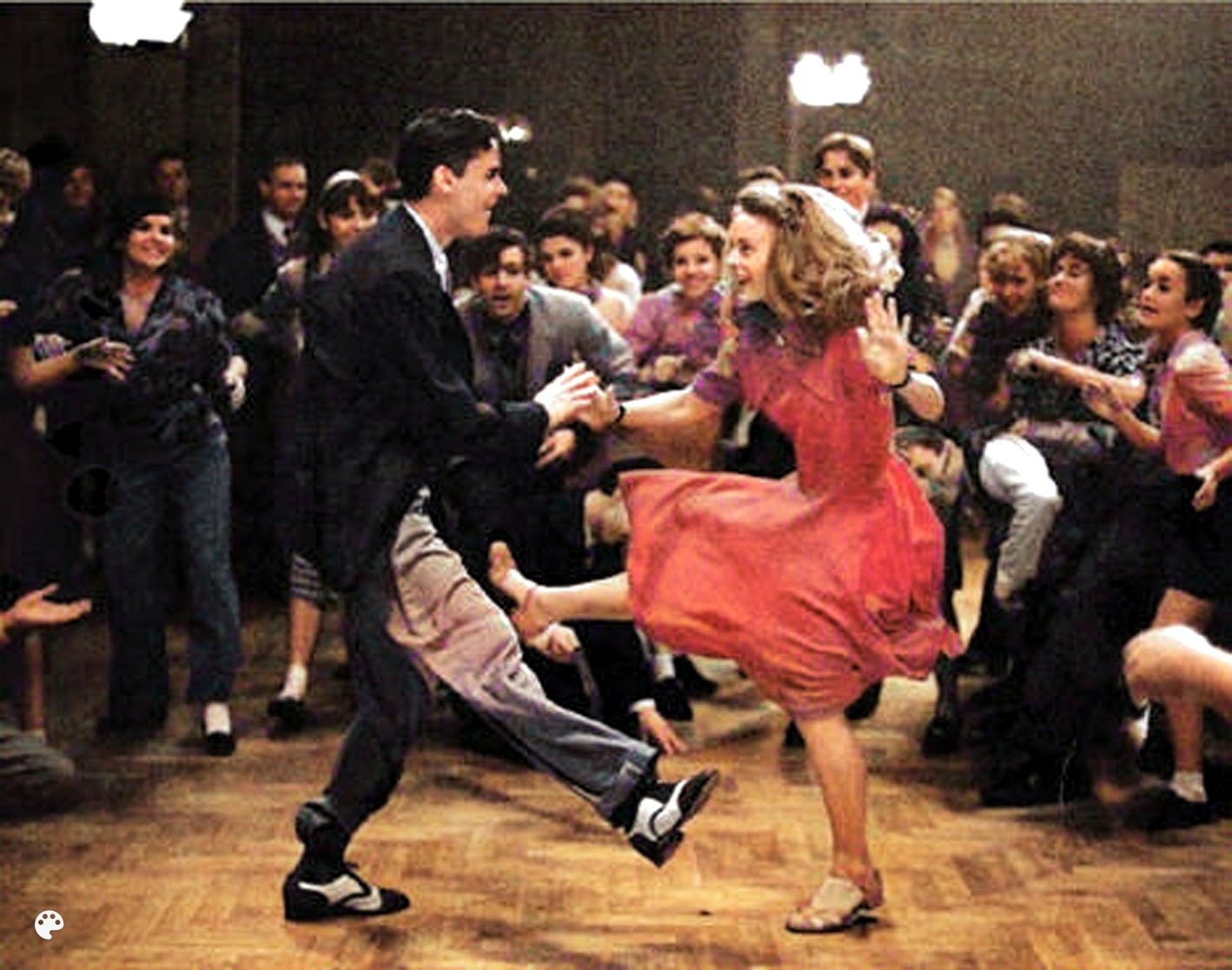
Other jazz groups quickly sprang up to meet public demand for popular new styles of jazz for community events, club gatherings, parties, and University dances. Through the 1920s and into the 1930s, Owen Mitchell kept ahead of the wave with music for dance fads like the Charleston, Black Bottom, and Lindy. Yet he maintained his ties to classical music both with University groups as well as teaching private piano lessons at his home on West Center. He traveled widely and advocated for the UA music department, making a plea in 1933 for better practice facilities. His leadership in innovative new musical styles fostered other jazz groups and informed a new generation of Fayetteville musicians.
The story of Mitchell’s contributions to Fayetteville’s music scene in the early 20th century is found in The Music Men of Turn-of-the-Century Fayetteville, available at the Washington County Historical Society and at Amazon.com
Swing dance remains a popular style and enjoys periodic revivals.
[1] “First” is not proven, since we do not know when he started his jazz group versus when the Black Diamond group started.
[2] The comment regarding his ability followed his solo piano performance of Grieg’s “Norwegian Bridal Procession.” Similar praise followed his performance of Grieg’s “Concerto in A Minor” the following month. FD Apr 3, 1914, p. 4. and Jun 9, p. 1.
[3] Riverside Park was a project of the Parker Brothers who operated a large nursery where the Fayetteville airport is now located. They first intended the park as a swimming spot and built bathhouses, restrooms, and other accommodations alongside the West Fork of White River.
Henry Tovey circa 1905, from his graduation at Knox University. The same image appears in the University of Arkansas Cardinal yearbook, 1910.
Who could have guessed, then or now, that in 1908, little old Fayetteville and the University of Arkansas would eagerly invite a gay man to their midst. Not that Henry Tovey advertised his sexual orientation or, perhaps, even acknowledged it to himself, much less others. But his role over the next 25 years as professor of piano and music as well as his larger-than-life presence in community, state, and even national arenas of music education could not help but reveal that he was not of the ‘traditional’ male ilk.
The fact is that homosexuality was widely tolerated and even admired in certain circles of American culture during that time period. As noted in a 2019 article, journalist Sarah Pruitt wrote:
On a Friday night in February 1926, a crowd of some 1,500 packed the Renaissance Casino in New York City’s Harlem neighborhood for the 58th masquerade and civil ball of Hamilton Lodge. Nearly half of those attending the event, reported the New York Age, appeared to be “men of the class generally known as ‘fairies,’ and many Bohemians from the Greenwich Village section who…in their gorgeous evening gowns, wigs and powdered faces were hard to distinguish from many of the women.” The tradition of masquerade and civil balls, more commonly known as drag balls, had begun back in 1869 within Hamilton Lodge, a black fraternal organization in Harlem. By the mid-1920s, at the height of the Prohibition era, they were attracting as many as 7,000 people of various races and social classes—gay, lesbian, bisexual, transgender and straight alike.[1]
Whether this broader scope of acceptance had managed to trickle down to Northwest Arkansas is debatable, but Tovey’s credentials fit two very important priorities for the university and community. For one, he had graduated from one of the finest music conservatories Illinois had to offer, studied abroad with acclaimed artists, and had gained acclaim in a brief tenure at Ouachita College in Arkadelphia, Arkansas, provoking critics to pronounce he held a “warm place in the hearts of our music lovers.”[2] Such expertise in the performing arts had become a priority to the university on the heels of the Gilded Age. Secondly, then as now, university professors and their families occupied an elevated position in Fayetteville, deriving mostly from far-flung origins and bringing with them not only higher education but also more sophisticated cultural characteristics than those possessed by the ‘locals.’
Tovey immediately became the darling of the town’s elite, invited to join fledgling social groups determined to open Fayetteville to the wider world. For example,
In November 1908, he joined Fayetteville’s Musical Coterie at its second meeting at the home of Mrs. F. O. Gully on Mont Nord, where the group declared “a most auspicious opening” for the beginning of the season. Their objective was to “arouse increased interest in the finest of all fine arts—music… We should have an annual Music Festival here every year… [which] would bring people from all parts of the state and from neighboring states to Fayetteville.”[3]
Henry Tovey 1928
Tovey was uniquely suited to the task before him, and he set about his destiny with great zeal. Not only did he help build a greater appreciation of classical music in Fayetteville and the rest of the state with his innovative teaching method utilizing the Victrola and recordings, a method soon adopted across the nation, he also promoted civic efforts to include town beautification, music education in the public schools, and the establishment of a country club and the Fayetteville Rotary Club. Perhaps most laudable was Tovey’s embrace of the rural people of Arkansas:
In a 1997 music journal article, Tovey is described as part of the Progressive effort to improve rural life with the use of music. “…[R]eformers focused on improving the economic and social conditions of rural people. Rural reformers expanded university offerings in music… In 1918, the Arkansas legislature voted to require music in the schools due largely to the efforts of Henry Doughty Tovey…
From his enormous musical talent to his elephant collection and regular hosting of delightful luncheons he prepared mostly for wives of prominent town and university notables and served at his home near campus, Tovey lived as a type of Renaissance Man. For example, one menu included “Bouillon * Toasted Wafers * Escalloped Oysters, Potatoes en Cream * French Peas * Chow Chow Pickle * Olives * Salt-rising Bread Sandwiches * Coffee * Tomato Aspic Moulded with Olives and Almonds * Mayonnaise Dressing * Cheese Sandwiches * Orange Parfait with Whipped Cream * Bon-Bons.”
The town and the state mourned his untimely end, but his contributions to his chosen community and state continue to resonate today. The story of this man and his amazing realm of accomplishments is part of The Music Men of Turn-of-the Century Fayetteville, available at the Washington County Historical Society, or from Amazon.com
Tovey with his bulldog Stubby MC 779 Lighton Family Papers, Box 28, Folder 7, Photograph 888, Digital Collections, Univ. ofAR, Fayetteville
Henry Doughty Tovey will always be best known as the composer of the music for the University of Arkansas Alma Mater. For everyone who ever attended school there or came to University events like football games, the melodic strains and rich harmonies of that song evoke deeply-felt memories. Without question, Tovey had tremendous musical talent. But that was only a hint at what this man would give to the university, the town of Fayetteville and yes, even the State of Arkansas over the twenty-seven years of his life here.
…Tovey spent the summer of 1909 with friends in Chicago where he discovered the latest version of the Victor gramophone. He immediately purchased one along with a large number of recordings of standard operas including performances by world-famous tenor Enrico Caruso… The gramophone came to serve a key role in Tovey’s grand scheme to offer music education throughout the entire state. Ultimately, his concept caught fire across the nation and even in other places around the world. … Tovey’s growing reputation regarding this teaching method resulted in an article about him published in The Musician, the national journal of music instructors… “The address by Henry Doughty Tovey of the University of Arkansas, which we give in this issue in part, is highly interesting in the demonstration it makes of the wonderful educational power of the talking machine and because it presents such a practical way of working out results. In his plan there is suggestion for every music teacher, for he can use the talking machine in the home and suggest selection of records, and this will have splendid educational results both on the pupil and the entire home.”
…In April 1917, Tovey received notice from Schirmer’s of New York City that their new book, “Energy of American Crowd Music,” would include a chapter about Tovey and his work. No record of this book has been found, but an article thus entitled stated in the preface that “everything we see hear, feel, experience in any way becomes subject matter for music, poetry, painting and sculpture. The things seen and heard in Kentucky or New England or the Ozarks become material for us…”
Much more about this trailblazer in The Music Men of Turn-of-the-Century Fayetteville. Available in paperback, $19.95.
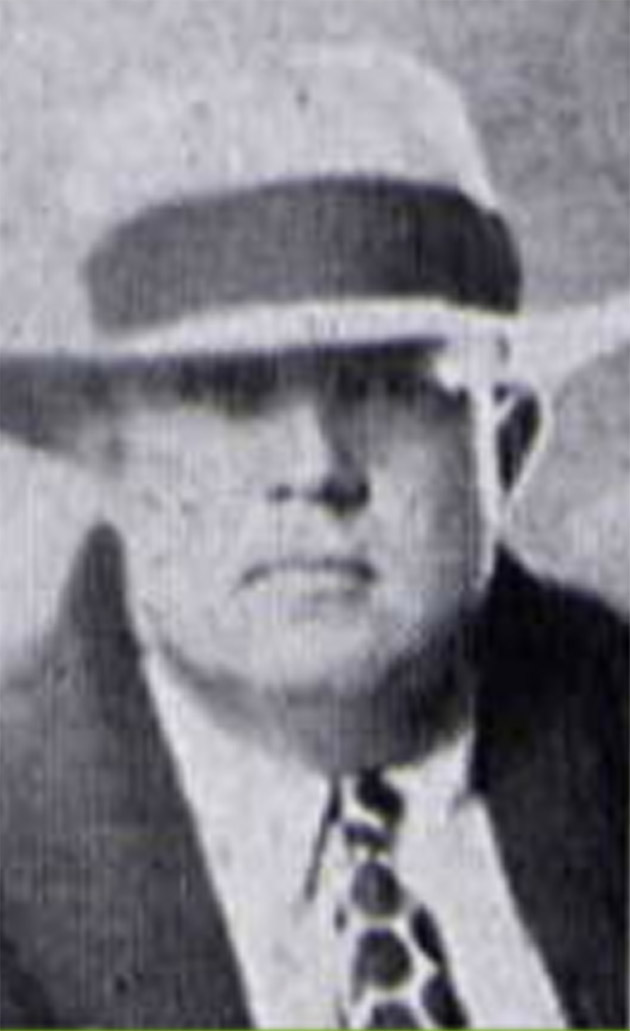
The question of when and how Frank Barr picked up a cornet and learned to play remains unanswered in the mists of time. Yet at the age of eighteen as a student at the University of Arkansas in 1892, this young man not only played but would soon become the bandleader for the University Cadet Band. He would go on to direct the University band for twenty years as well as recruiting youth for “Barr’s Boys Band” through the 1930s. But these were not Frank Barr’s only contribution to the community of Fayetteville and the surrounding region…
…[In 1921] The Elks Club, of which he was a member, agreed to start raising sufficient funds to pay a director and “give Fayetteville boys and men an opportunity to learn to play as well as to have a band ready for the many celebrations and events which a band is needed.” A month later, the Elks announced subscriptions of over $100 per month to finance the band. Barr’s salary would be $75 per month. The Knights of Pythias agreed that they and other lodges about town would be contributors. Barr offered several band instruments he owned which could be used, and County Judge Ernest Dowell consented to the use of the basement of the courthouse for evening rehearsals.
…[In a letter to the editor, 1928] “First, if you will excuse me, I’ll say most of my life has been spent in the entertainment business. At the age of fourteen years, I started teaching bands, and almost continuously since that time, I have been taking bands to picnics, reunions, playing for fairs here, and years ago I played for several fairs held at Rogers and Berryville. For three seasons I managed a Chautauqua here. For 11 years I ran a picture show in Fayetteville and during that time had shows in 14 different towns in Northwest Arkansas and Eastern Oklahoma. I merely give this to show that if anyone is in a position to know what the public as a whole want in the line of entertainment, I am.”
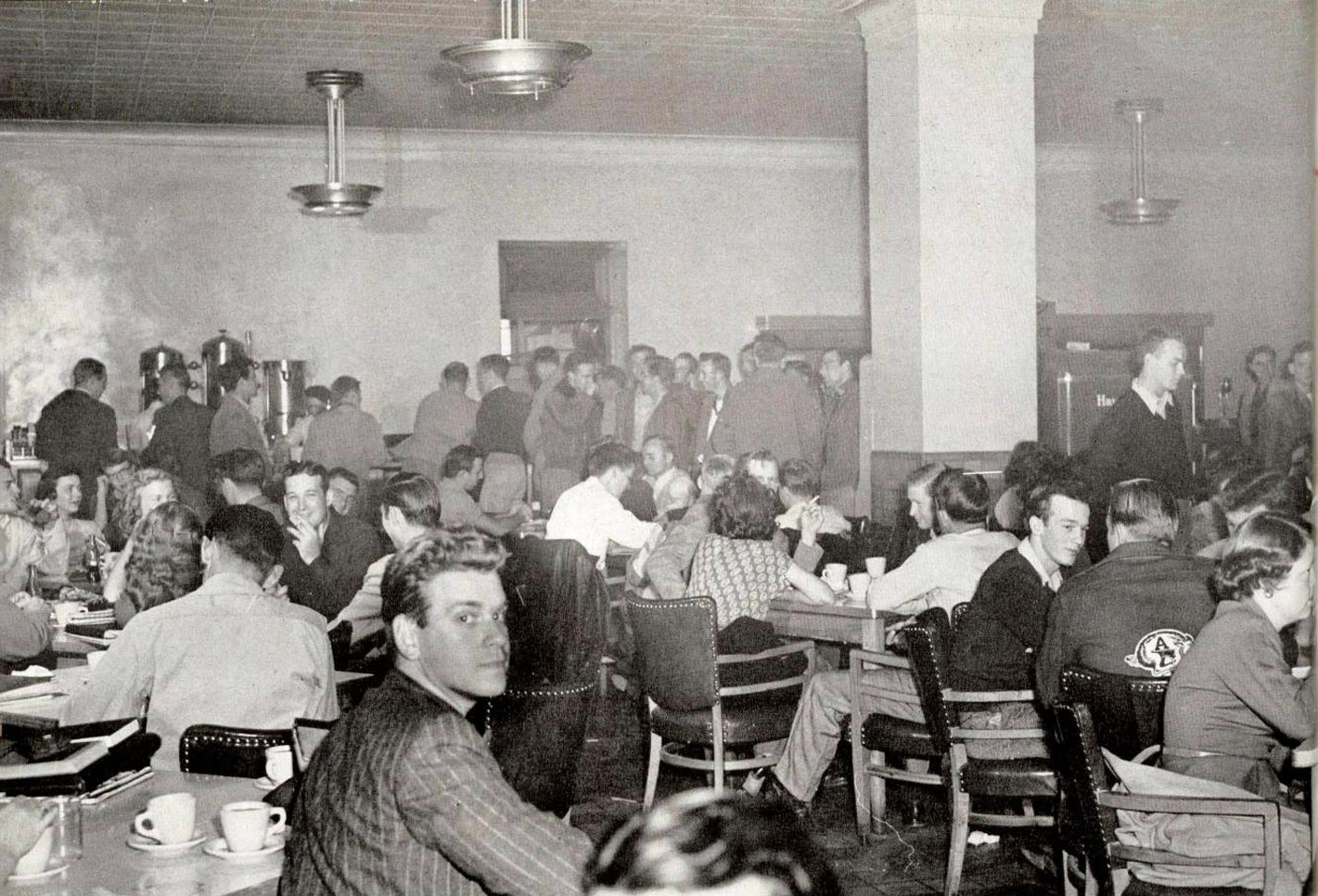
You come in the south door, clamoring down the curve of steps that lead to the basement. Brushing past the expanse of tidy mailboxes on your right, you quickly jog down a couple more steps where you might turn left into the bookshop, mayhap to toss down a dime in payment for a blue book required for an exam in your next class, or just to roam the few aisles appreciating the scent of ink, reams of white paper, or a raft of sketching pencils. But truly, the quest is not here, but across the small lobby where large doors open into the room full of crowded tables, wonderful aromas of coffee and hamburgers, and the roar of chatter from a hundred voices. For me, this place more than any other embodies the reality of life on campus.
There, to the right, behind tall counters laden with coffee and iced tea urns, stand the women in white aprons and hairnets. They watch each student who approaches. At least two of them tend the grill, a massive flattop of well-worn steel burned black by the incessant demand for another hamburger, another fried egg. An endless task of scraping the surface clean with a large flat spatula occupies any spare moment. You watch as one of those women turns her attention to you, and you place your order, mouth already watering.
For a dollar and a quarter, manna from heaven in the form of a grilled cheese sandwich can be yours. You stand there and watch as she turns to her work, wielding a big floppy brush to spread melted butter onto two slices of bread before slapping it onto that grill. The bread quickly turns golden brown before being flipped over—more butter, more searing heat. Then cheese. Glorious marvelous wonderful cheese is added, and the two slices of bread marry it into a sanctified One.
Suffering a quick angled slice of razor-sharp knife to form two triangles, your bundle of deliciousness sails down the line under the supervision of successive women in white, passing the lighted refrigerated case where a person might choose a slice of cream pie, or a peeled egg, or perhaps a salad. But your eyes follow the rich ooze of cheese that rims the bread crust and threatens to inch onto the heavy white china plate. Along the way, a few slices of dill pickle are added along with a glass of iced tea. Finally the plate makes its way to the lady at the cash register and lands on a tray. You tender your cash and then you were standing there, peering through the roiling clouds of cigarette smoke in search of a place to sit.
Squinting toward the bright light pouring in through big windows and glass-paneled doors leading to the porch, you peruse the tables for someone you might know, or—futilely—for an unoccupied table. If fortune fails to smile, you wander through a door to the left of the cashier into the larger dining area where an empty table is more easily found. Or you might, weather permitting, ease out onto the big porch in search of that gang of friends who usually occupy one of the tables. Most desired is the first room with the grill where the bodies, the flattop and the mingled aromas of food generate more warmth than the building’s heat can supply.
Whatever the case, finally dragging out a chair and with the books, notebooks, and other encumbrances unloaded onto an adjacent chair, you lift the sandwich in trembling hand. With a last swallow of eager saliva, your teeth sink into the crisp-tender concoction that will nourish the rest of your afternoon. The bite of just-enough sharpness in the cheese contrasts with the buttery crunch of the toasted bread still hot from the stalwart grill, and the sandwich begins to disappear. The tang of dill clears the palate for the other half of the sandwich, and then, alas, it is gone.
There’s time yet to sip the iced tea. With a brief glance around, you might leave your table to visit the cigarette machine where a quarter dropped into the slot and a quick jerk of the knob yields a fresh pack of your preferred brand. You stroll back to the table, slam the pack a few times against your palm, then unwrap the shiny cellophane to retrieve one of the perfectly-shaped cylinders. Then, with the smoke filling your lungs briefly before you exhale, there is time to look around, assess the day, ponder the meaning of life. A great lassitude supplants your otherwise fraught existential despair, courtesy of butter, cheese, and the endorphins they bestow.
Yes, an exam in French is coming in a half hour, and you’re not ready. You probably didn’t perform as well as you wished on the algebra exam earlier this morning. But these too shall pass, what’s done is done, and so forth. As you tap ash into the tiny flat metal ashtray and consider the nature of life, the comfort of cheese lingers.
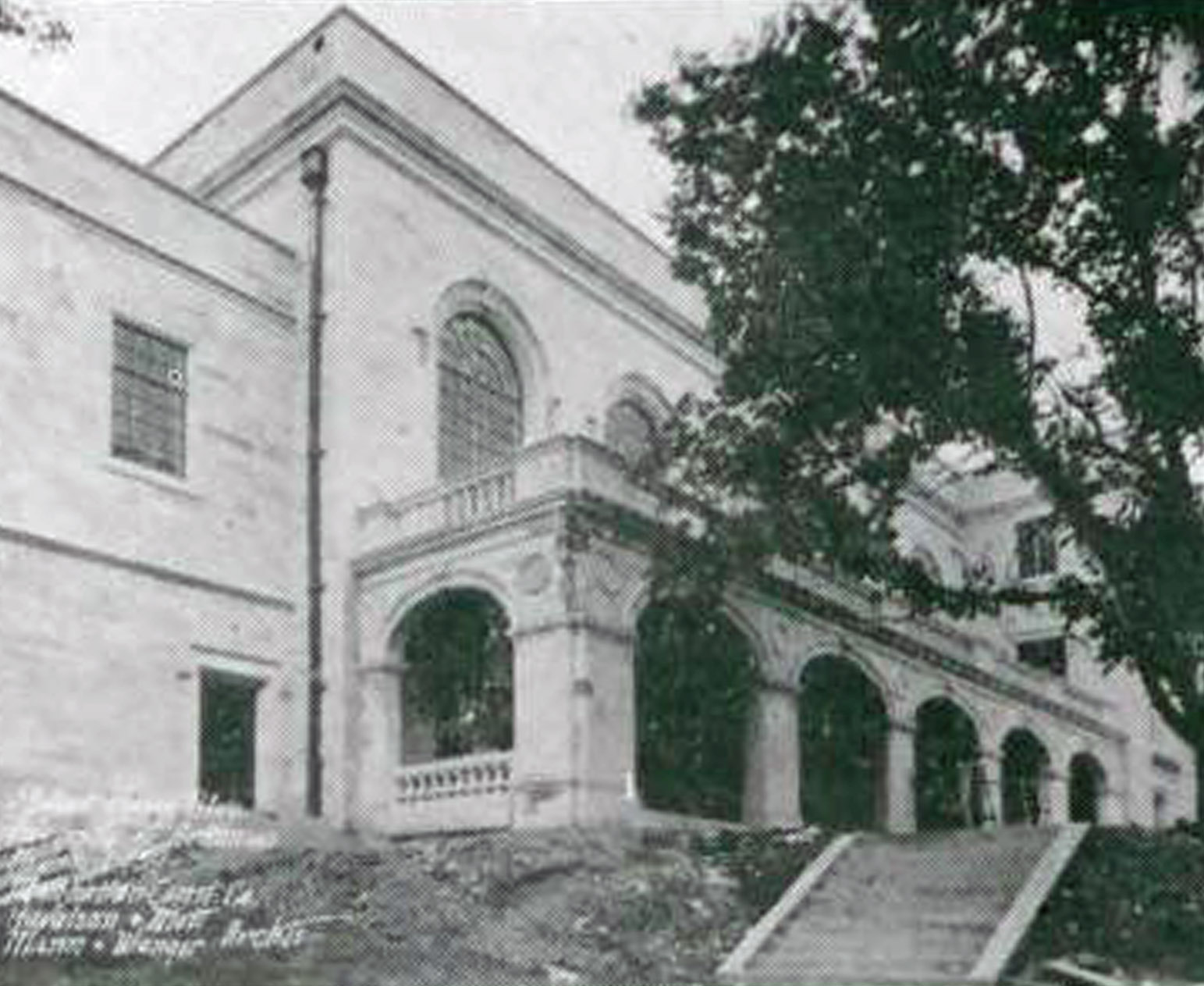
Maple Street side leading into porch area
As do many other memories. I left after my sophomore year to live near Vandenberg Air Force Base in California with my new husband. Two and a half years later when he was transferred to Clark Air Base in the Philippines, I returned to Fayetteville to finish my degree. There were mornings when I’d drive to campus in early morning fog to park in a graveled lot across Maple Street and venture up these steps into the Union for a cup of coffee before my early class. Those too were nostalgic moments thinking of the earlier years, of fellow students and dorm mates, of professors and classes, of ever changing current events.
The student union of those days is gone, sacrificed into other uses for a larger more elaborate facility than what Memorial Hall could ever provide. Built in the early 1970s, the new union seems to us older alumni as somewhat cold and vast compared to the old environs of Memorial Hall. Yes, it was crowded and unquestionably not best suited to more modern needs, but it was our place in our time. In service as a student union only thirty years from its construction in 1940, the facility nevertheless filled a critical role in campus life.
As described in the 1941 yearbook: “The basement floor is made up of the confectionery with a black and chromium soda fountain and cafeteria facilities, and the amusement rooms. Walking down the hall from the confectionery one can go into two rooms equipped with ping-pong tables, and one with large, lively snooker tables. Up the stairs to the main floor, and there one sees the front entrance, from which leads the ballroom and the lounge room. With a lofty ceiling support four huge glass and metal chandeliers and tall arched windows draped with yards and yards of flowing expensive cloth, the ballroom is truly a ‘dream.’ Over the especially designed band shell is a mural depicting all phases of student life at the University, and all around the floor are chairs for chaperones and those who care to sit the dance out. Overlooking the ballroom is a balcony for those who care to watch rather than dance. The chandeliers are all connected with one master switch which changes the lights in the room from red, blue, green, and orange back to natural lighting in a gradual fading process.
“Equipped with heavy leather chairs and divans, the pastel-colored lounge room can compare very well with the lobby of an expensive hotel. Scattered throughout the room are lamps with indirect lighting, and down at the end is a large fireplace topped by a huge square mirror. Here students come to read, talk, or just listen to the radio.” 1941
“The fountain room of the Student Union, where at some time or other, everyone sees everyone, is a happy confusion of coffee lines, bridge games, table-hoppers, and glaring renditions from the juke-box. From 9-11, 2 until 5, it’s the place to see and be seen, grab a late breakfast or a hurried lunch, or just sit and talk.” 1951
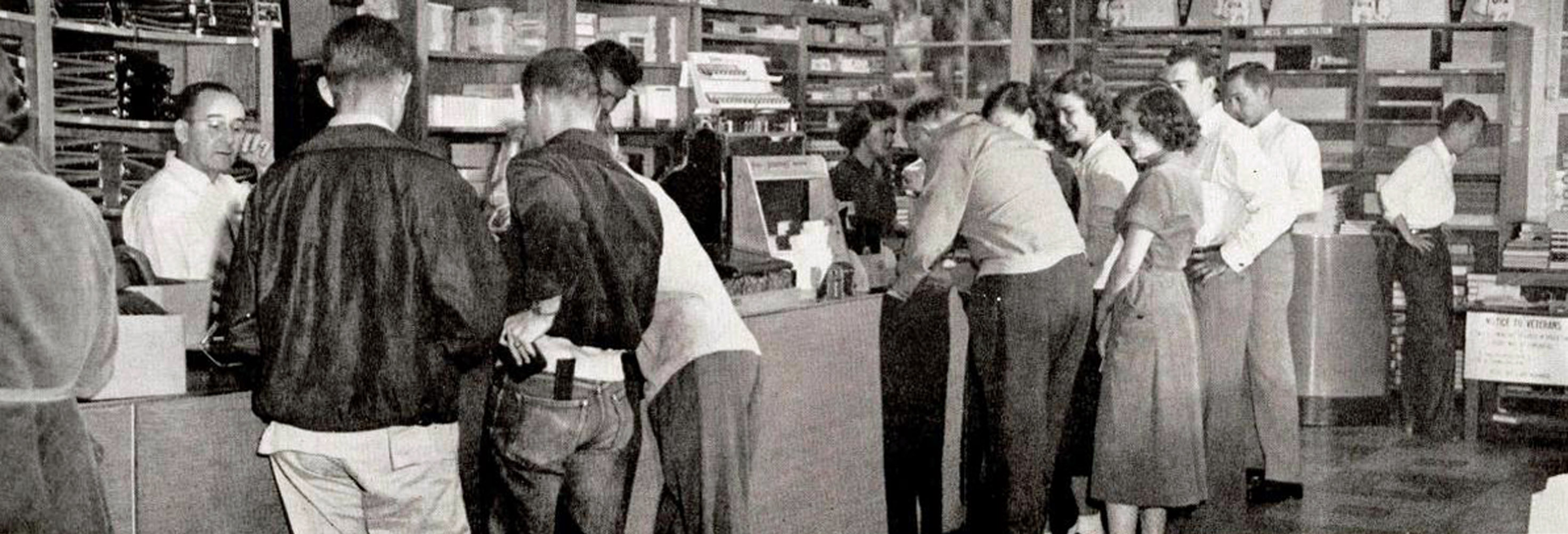
Bookstore 1950s:
Open hallway where advocates of one issue or another could interact with students. In my time, it was to sign the petition to save the Buffalo River and then to stop the war in Vietnam.
Note: If you’d like to wander through the Razorback yearbook from your time on campus, here’s the link
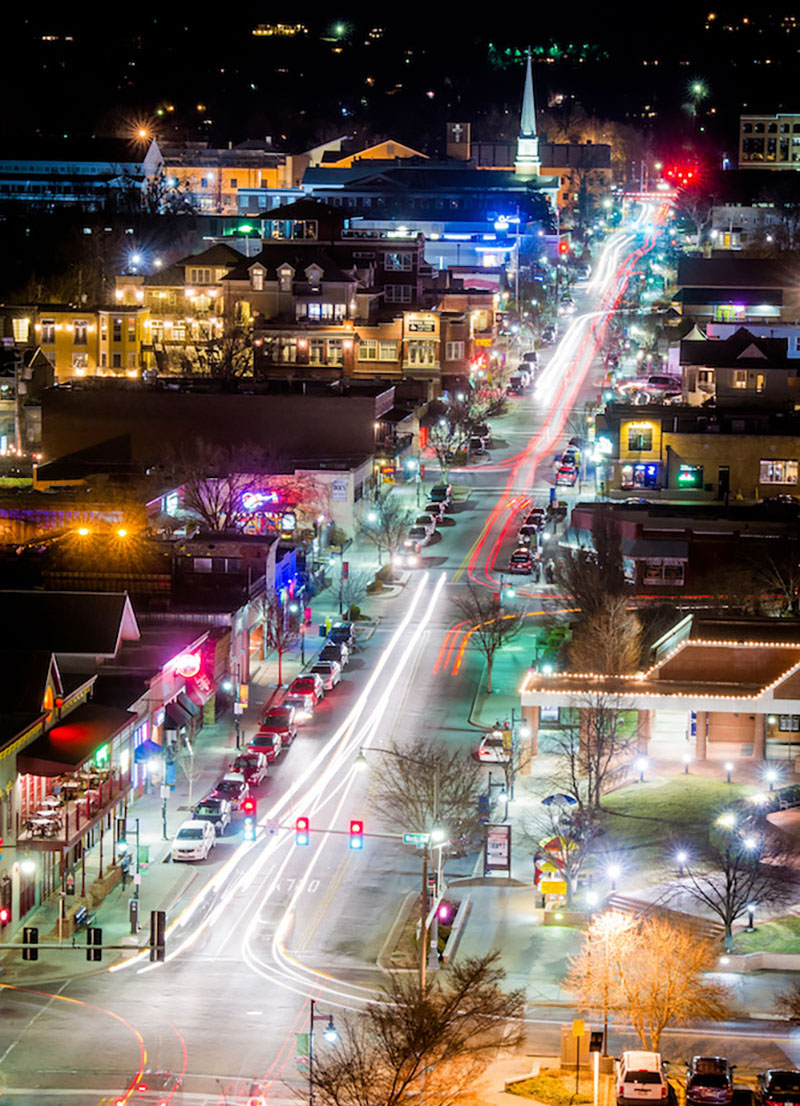
The heart of Dickson Street runs six blocks east from the southeast corner of Fayetteville’s University of Arkansas campus. After one hundred years of industrial and commercial development that came with the railroad, entertainment took over. By the 1970s, bars and nightclubs thrived in the run-down buildings alongside old school barber shops, pawn shops, artist studios, restaurants, and head shops. The sound of live music filled the night air. Patrons from all over the region flocked to the street to mingle with co-eds, quaff a few beers and cheer on the rock ‘n’ roll. The alternative community centered at the street; walking down the sidewalk meant seeing and greeting old friends and meeting new ones.
The 80s saw further decline and the emergence of tawdriness and then with the arrival of the Walton Arts Center in the 1990s and concurrent rising rent, the magic started to drip away like water through fingers. Depending on the point of view, Dickson Street is now either a thriving commercial mecca or a faint shadow of its former glory. In 2004, an article in the bi-monthly tabloid All About Town addressed the issue of Dickson Street and the decline of the music scene. And not for the first time. The first such complaints appeared in an earlier tabloid, The Grapevine, in the 1980s and periodically become the focus of community consternation. Some of it has to do with changing demographics. The people who packed the live music venues in the 1970s were staying at home to raise families in the 1980s. Each generation enjoys its high points on the street then subsides into other activities as years pass.
Nevertheless, the article does a good job of peeling back the layers to discover some basic issues. From that, city leaders, musicians, club owners, and other interested fans of the street might derive some workable ideas of how to ensure that the Dickson Street scene never dies.
Five reasons were cited, which have been added to for this piece.
1. Club owners have to pay the bills. That includes ever increasing costs for rent, utilities, wages for employees, advertising, insurance, supplies like glassware and napkins, and inventory of alcohol and any other items served. Back in the day, rent on Dickson Street reflected the run-down nature of the real estate. Now with gentrification all around, rent has skyrocketed. Also, there’s increasing pressure to pay higher wages, utilities keep going up, and … well, it’s all about the money. The clubs count on alcohol sales to generate the profits they need to keep their heads above water. Some bands don’t attract people who like to drink. And people who like to drink have increasingly begun to patronize stand-up bars.
“Stand-up bars are easier to operate,” said Dave Bass, formerly of Dave’s on Dickson and later yielding to the inevitable by opening two stand-up bars, The Blue Parrot and 414. “It’s impossible to make live music work during the week, and you can’t be open two days a week and make a living.” He admitted losing money with his live music at Dave’s.
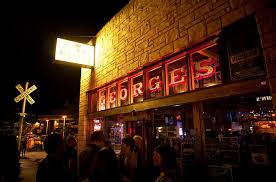
2. People don’t want to pay a cover charge. Many people don’t realize that a cover charge is the only way to pay a band to play. As veteran performer Jed Clampit pointed out, “You don’t get free drinks, but you want free music. Think about going to your job and working for free.” Owner/operator of George’s, Brian Crowne said “People will think nothing of paying $7 or $8 for a two-hour movie but gripe about paying $5 for live, professional entertainment for four hours.”
Another problem for club owners and bands is that many young people today prefer to float from place to place depending on where their friends might be. A friend might text and want to meet them at a specific location. A half hour later, the two friends might decide to go to a third location. Cover charges don’t work for that kind of activity where the objective is socializing, not watching a particular band perform.
3. There are too many clubs and too many bands. Bringing live music to a particular venue requires a lot of upfront investment in securing the band, promoting the event, and doing as much as possible to bring in a crowd. If multiple venues compete for the club-going public, there’s less to go around. That’s the basic math. But there’s no shortage of aspiring bands whose goal of wealth and fame requires building a local following first. Also, painful as it is to recognize, there’s a big disconnect between the many musicians who want to write original songs and audiences who want to hear familiar music. This particular problem is exacerbated by the fact that record deals and other important steps on the road to wealth and fame depend on original music. Nobody wants to record the 38th cover of “Proud Mary.”
Wade Ogle, veteran of the Fayetteville music scene, says the quality of new bands isn’t what it used to be. “With today’s technology, practically everyone can record a CD cheaply. While I think it’s a good thing, the downside is that way too many new bands are looking to play live before they’re really ready.”
So bands thread a narrow line, forced to invest in decent equipment and hours/months of practice until they can get booked to play and then play covers of popular music in their chosen genre while at the same time working on original songs that might be worthy of record label or promoter interest. If they manage to get booked into a club and they’re not ready, people who bother to show up are turned off to live music in general.
4. There aren’t enough fans. This wasn’t so much a problem in the ‘70s when the Baby Boomers came through en masse, the right age and right mindset to thrive on live music. You could almost say that live music was part of their religion. Alas, those days have passed. Somewhat smaller subsequent generations don’t necessarily take song lyrics as their personal anthems. Some might even allege that popular music today can’t hold a candle to the music being created in the ‘60s and ‘70s. With the rise of digital media, music suited to personal taste is available any day, any time, and any place. Free. Why go to a club and pay a cover charge when you can listen to what you like at home? One benefit of live music will never change, however, and that is the attraction of mingling in a crowd of enthusiastic fans, dancing to the same beat and being part of the ‘family.’
5. The town and Dickson Street itself have changed. Yes, this is a big factor. Fayetteville’s population has tripled since the 1970s, and University enrollment has increased from around 15,000 in 1980 to over 50,000 in 2019. More cars and the infill of properties near Dickson means much less parking plus much of the available parking is now metered. Clubs with occasional live music have sprung up along North College Avenue and near the Northwest Arkansas Mall, meaning competition for Dickson Street. Also, until recent years, Dickson Street was the place to party for the entire region. Now that Benton County allows alcohol to be served, clubs have sprung up there like dandelions in early spring. In particular, the Arkansas Music Pavilion (AMP) at Rogers has created a major performance venue for big name performers that in the past would have appeared only in Fayetteville.
Slogans like “Keep Fayetteville Funky” notwithstanding, times change. We change. It’s inconceivable to think that a day might come when Dickson Street would no longer vibrate with the heartbeat of live music and of people streaming through the doors to hear it, commune with each other, and let their hair down. But the world is, after all, what we individually and collectively make it, and it behooves us to not let such a good thing slip unnoticed into the shadows of the past. Dickson Street has been an institution as well as a collective of our entertainment experiences. We have to pay attention and do what we must to keep it that way.











 denelecampbell