Jars

100_1173

If I had considered the question in advance, I would have known that cleaning out the barn would precipitate a crisis. Memories long stored away for some magical future moment when that child’s toy, that handsaw, would again be needed—did I keep them simply for the memory? Furniture—small tables, wooden chairs, an ottoman frame, an old piano bench well made of oak and in need of a few repairs—would I someday find time and reason to fix them and return them to my house?

Too good to throw away. Largely irrelevant to my current life.

Becoming relevant at some future point? Probably not.

Determination to survive in a world lost to chaos drove the accumulation of this minor hoard. It was 1975. We had small children who would need to eat and thrive even if the bomb fell. We labored to renew skills our grandparents knew by heart, certain that within our lifetimes we would have to hide in our house until the fallout settled then emerge to plow, plant, and harvest our food, breed our pigs, chickens, and goats for future generations of meat and milk. We gathered meat saws and grinders, steel axes and shovels, nails and wire.

Time marched on. The Cold War ended and fingers moved away from the annihilation button.  The children are no longer dependent babies who might benefit from a collection of books on history, science, math. The goats departed in the late 80s, the garden in the early 90s, and the last of the chickens about ten years ago. The children have gone off like grown children do to find their own visions of the future.

Why do I need eight hand saws, ten hammers (of various sizes), buckets of random nails, screws, washers, bolts, and nuts? Feed scoops and cheesecloth, empty egg cartons, milk pails. What possible purpose could be met by random pieces of plywood or sheetrock, insulation, screen, tile? Why do I think that at some point I’ll make use of a decrepit power saw, drill, or grinder when, for the last twenty-five years, I have not?

I have created two piles. One is for the junkman to haul away. The other is for craigslist ads and friends who operate flea market booths. I am mildly optimistic that someone might buy the old wooden toolbox, child’s desk, or the sturdy small tables, the ten gallon pickling crock or the T-post driver. Never mind that for what I’d receive in dollars, I could restore only a fraction of this hoard.

In truth, what our energy and money bought in those early days was peace of mind. With our collection of tools, books, supplies, and know-how, we’d have a chance. Our kids would have a chance.

It served its purpose. The purpose no longer exists.

Sounds good. But what I haven’t put in either pile is the pressure canner. And the jars. Dozens and dozens of canning jars—quarts, pints, jelly jars. It’s the jars that have brought me to crisis.

When my firstborn child was two, my grandmother died. My dad’s mom, Nora. Always a country girl, Nora knew how to make soap, kill a chicken with a swing and stiff pop of its neck, and would can just about anything edible. She had jars. When they started clearing her property for the auction, I went down to Cane Hill and helped clean out her cellar. I hauled back cases of canned goods.

She had declined for a decade until her death at age 86. I wouldn’t dare eat any of the food in those jars. We had hogs and chickens at the time which allowed me to make use of Grandma’s labors. Each day I’d go out to the barn and pens and open more jars. Applesauce, whole plums, peaches, pears. Grapes and elderberries. Green beans, tomatoes, cabbage, mixed vegetables. Tallow. Jelly, jam, preserves. Juice. The critters were well fed that year.

We grew a huge garden. Neighbors had pear trees. We visited orchards and vineyards. Even with all of Grandma Nora’s jars, I sometimes ran short. My mother gave me jars. I bought jars.

In those heady days, each fall I stood in the storage closet and stared at my larder. The sight of all those jars filled me with the greatest pleasure that once again, by the labor of my hands, I had set aside enough green beans, tomatoes and sauce, peas, corn, and kraut to last a year. The jars lined up in colorful rows, golden tomato seeds swimming in crimson broth, finely shredded green cabbage fermented into tangy white kraut, wild plum jelly glowing fuscia in the dark.

Producing and preserving food challenged me like nothing I’d ever done. Even with a tractor and rototiller, even with liberal applications of goat manure and mulch, plants struggled to survive against drought, bugs, and predation. How many hours did I spend hoeing weeds or picking off potato bugs? How many hours peeling and chopping, sterilizing and packing, standing over the pressure gauge to ensure the right amount of intense heat and adequate time to prevent spoilage.

There’s a sound as jars cool, the snap of the canning lid sucking down, sealing the contents safely into the future—I loved that sound. Then it was time to use the grease pencil to write on the lid—July 1981.

Now I have all these jars. The cardboard boxes have suffered over the years. Faded brown paper hangs in shreds, the sides bow and buckle. Even if I keep the jars, I have to plow through generations of dead spiders and a healthy population of live ones to retrieve the jars from box wreckage. Why would I go to the trouble to re-package all these jars knowing that twenty years from now, it would all be to do over again? Would I be any more willing to let go of them then?

My children have no interest and no place to store jars. I wouldn’t mind storing them if my kids wanted them. But there’s no longer a tractor or rototiller. The half-acre garden has grown up in saplings and pasture grass. There are no goats to produce manure. Everything is different.

But here’s the argument. Certain things haven’t changed. We have to eat. We have the ability to grow food. With jars and a pressure canner, we could store food. Isn’t that incentive enough to save the jars?

What is my responsibility? For countless generations, as far back at least as civilization, my ancestors have planted, cultivated, harvested, and stored food. These are skills we’ve learned—how to measure the right time to plant onions or corn, what seeds to soak before pressing them into the dark earth, how to dig potatoes without piercing them. We raised our kids to know these things.

Do I simply walk away?

Why not? There are books. There are others still farming, still canning—the knowledge won’t fade simply because I relinquish my jars.

Even with the best of hoards, with all the tools and seeds saved and an endless supply of jars, at the end of the day, survival in a world gone mad would be a tenuous venture. What about grain? No bread, no pasta, no crackers. What about oil, salt, soda, sugar? We’d be dependent on venison and that requires guns and ammunition. My .22 rifle won’t bring down a deer.

At some point, even the most vehement survivalist will face what I face. How many times in your life do you restock your rations and water? How much is enough ammunition? Who are you prepared to kill to protect your hard won ark?

I’m working on a compromise with myself. Today I think I will keep a few jars as mementos of my grandmother, the tall green half gallon jars and a few of the older square-shoulder quarts. I will wash them periodically and keep them up on a shelf, decoration that tugs my heartstrings when I look up from my daily tasks. I will acknowledge the hard work and dedication that touched these jars, my hands, my mother’s hands, my grandmother’s hands.

All the grandmothers. All the jars. All the tomatoes and fine plum jam will not save the world.
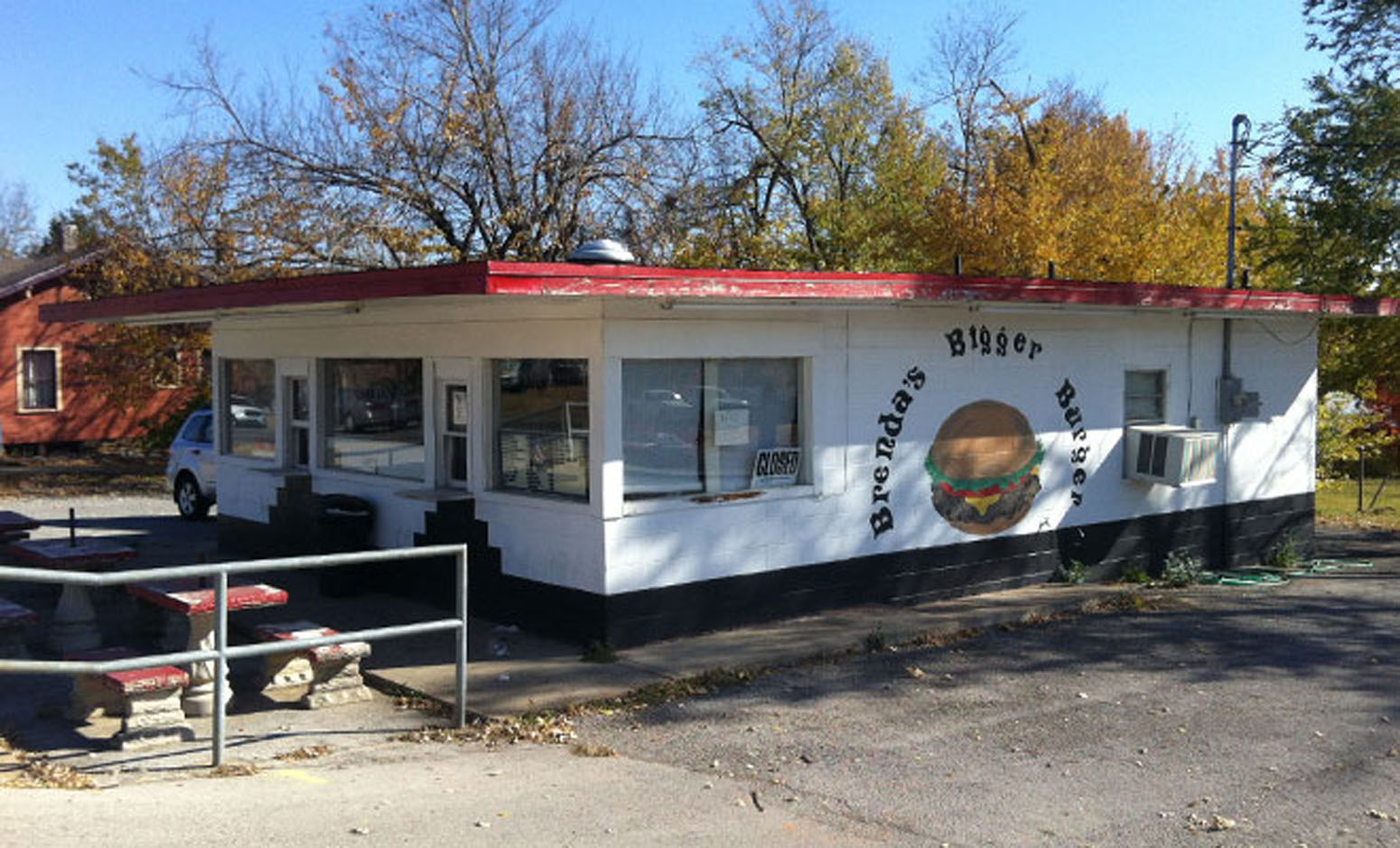
Best Burger Ever

brendas
Brenda’s Bigger Burger circa 2012. The metal railing was added when a street widening took half the parking lot. Photo from an article by Dustin Bartholomew, November 8, 2012, in the Fayetteville Flyer, Fayetteville, Arkansas

Today was one of those days when I came face to face with the passage of time. In traffic at a stoplight, I studied my surroundings and realized that Brenda’s Bigger Burger property sat vacant with a big ‘SOLD’ sign on the parking lot. A pang of nostalgia twisted in my chest. I knew it had closed. I just hadn’t thought about what it meant.

Through no fault of its own, the place always marked a pivotal moment in my life.

I never knew Brenda’s Bigger Burger existed until December 1970. Never mind that it stood on the corner of 6th and South Hill, an intersection I had passed countless times growing up. Several blocks further down South Hill nestled the modest little white building where my parents dragged us kids to church every time the doors opened.

On this particular weekend, my church-going days had long since passed. Finally. Now at the end of my first semester back at university after nearly three years living in California, I sat in the front passenger seat of Sam Holloway’s white Ford Galaxie waiting impatiently for our food. I was starving.

In retrospect, I realize that my ravenous appetite had not just a little to do with my first marijuana ‘high’ the previous night.

Momentous enough in its own right, my initiation into the drug culture hardly topped the chart of radical changes that occurred that night. Even more staggering was the fact that I had unexpectedly become unfaithful to my husband.

I could lay all this at the feet of Sam Holloway, a friend of an old friend whom I’d encountered on campus just a few days earlier. Old Friend and I were both married, him in grad school and me finishing my bachelors. We agreed to get together sometime.

‘Sometime’ turned out to be one evening a few days later when he called and wanted to stop by with a friend. They brought a six-pack. I was on my second glass of Chablis.

When Old Friend and Holloway arrived stamping snow off their shoes at my carport door, I was baking banana nut bread to send to my husband. He was stationed at Clark Air Base in the Philippines earning a captain’s hazardous duty pay as a courier flying in and out of Southeast Asia with top secret missives. Our separation had begun in late September, an eighteen-months’ tour for him before he could get out of the military and enough time for me to finish my degree.

I’d been lonely. I’d fretted over whether to dally, an inclination I’d fought even while still in California. We’d been together five years, married for nearly three. We’d discussed new ideas like open marriage but hadn’t made any moves.

That doesn’t excuse what I did. In an open marriage, there would have been an agreement. This was more delicious and awful than that, unplanned, unexpected, and entirely outrageous.

Old Friend passed out on his fourth beer and snored at the end of the couch. Having no other furniture, I sat in the middle of the couch and Holloway leaned back on the other end, his hand-tooled alligator cowboy boots crossed at the ankle. Twirling one end of his elaborate mustache, he pulled a skinny yellow cigarette out of his jacket pocket and flicked his Zippo. Sweet smelling smoke spiraled from the tip.

Several minutes later, the ‘high’ hit me with a warm caress on the back of my neck. My forehead floated upward. Lights dazzled. Colors like the black and white plaid sofa and the big red and yellow candlesticks I’d made out of flower pots began to pulse. Even more intriguing were Holloway’s green eyes.

Incredible as we found it, we’d been born on the same day in the same town. His mother and my father both taught school at Rogers before we moved away. My father was remembered there, Holloway said.

It was the Chablis. It was the weed. It was the strange coincidence of our connections and the scintillating repartee that flew back and forth between us. It was a slice of time cut from both our regular lives and set aside for this experience.

The next morning every icy surface including the streets glistened in bright sunshine. The ground had been white with snow for two days. Just driving across town to Brenda’s had been an slippery adventure. He insisted on Brenda’s, so that’s where he took me.

The food came out steaming hot, a sizzling beef patty on a big round bun. My teeth sank into the burger and saliva instantly flooded my mouth. Yellow mustard! Fresh sliced onion! Dills lovingly arranged so that each bite included just enough pickle. Tomato when real tomatoes were all you could get.

The burger and fries came wrapped in thin tissue paper, enough layers that when Holloway spread out the fries on the seat between us, the fat didn’t seep through to the upholstery. Heaped in long limp strands, the fries were salty golden treasure.

My hands trembled as I ate. I savored my Dr. Pepper down to the last crunchy nugget of ice. For the third time in less than 24 hours, I died and went to heaven.

I broke two more promises before it all ended. One I broke immediately, my promise never to smoke cigarettes again. After we’d crumpled the mustard-stained tissue papers, Holloway pulled out his pack of Winstons. My brand.

The other, the promise to myself that I’d never do that again? I lasted ten days. The affair lasted a scant two months before we both moved on. The marriage lasted another three years.

When the day arrives that Brenda’s building falls before the bulldozer blade, I can tell you right now—I will shed tears. Not only for Holloway or what we had. Not only for the marriage or the man I never quite stopped loving.

My tears will also fall for the fact that there’ll never be a better burger than the one I ate that day.

[From an untitled work in progress which may or may not see print in my lifetime…]

Bunyard Road and the Personal Adventures of Denny Luke

den w gov
Denny Luke, far right, next to Arkansas Governor Mike Beebe on one of his whistlestop tours of the state. 2006. On left, Ron Johns and in center, Dan Kerlin. At Dan’s store in Winslow.

1972.  A Yankee moves to the Ozarks and lives to tell his tales. Now captured in a tidy little book along with plenty of photographs, these stories track Denny Luke’s life experiences from childhood in Ohio to the backwoods hills of Arkansas.

This man is an adventurer. During his years in the Navy, he built hot rods with money he made with shipboard loansharking. He returned to his native Ohio where he soon tired of the mechanic’s life. Computers had just started to break the surface in 1966, the perfect attraction to a young man with a sharp mind and plenty of ambition.

vette w mom
Denny with his mom in his Corvette. This photo not included in the book.

Money rolled in as he built databases, a brand new idea in the mid-Sixties. A ‘63 Corvette and soon after a new Triumph dirt bike put him in the fast lane for weekend jaunts to the Playboy Club in Chicago and Enduro racing in Wisconsin’s back country.

Then, like so many of his generation, he stepped out of the fast lane and moved to a primitive life in the country. Among his most important first acquaintances was Ray Brown.

11813401_10206126388336787_3165076067443300852_n
Ray Brown teaching hog killin’ to Denny. This photo not in the book.

“We rented a little cabin near Devil’s Den from Ray Brown. He was a genuine hillbilly. His family lived in a little old log cabin. He raised a few cows, cut posts, whatever he could do to make a living. He was smart, smartest man I ever knew, had lots of common sense. His cabin had a big old fireplace that barely kept the place warm. He sat in this big chair over in one corner, and he could reach around behind his chair and grab a big handful of snow—that much would blow in through the cracks.”

Denny and his buddy Butch scouted cheap land all over Northwest Arkansas and ended up with an old log cabin on Bunyard Road. They also learned to be stone masons in order to earn their way.

denny at stove
Denny rustling up some grub at the Bunyard cabin December 1974. This amazing stove had a gas burning side and a wood burning side. Hauled from Wisconsin to the Ozarks.

“There are two or three families out on Bunyard that are cliquish. I wasn’t accepted out there. I was from the north, and I didn’t go to church. The first thing they wanted me to do was go to church. Plus I wasn’t born there. And I owned the old Omie Wood home place and they might have resented that some.”

An avid photographer and storyteller, Denny shares the adventures of his life with Author Denele Campbell as he recalls the outrageous backwoods tales and colorful characters who populate this neck of the woods.

Join us Sunday September 13 in the Connie Wright Gallery of Ozark Folkways at Winslow for live music, refreshments, Author Denele Campbell’s comments on this collaboration, and Denny’s readings from the book. Autographed copies will be available for sale.

Can’t make the event? The book is available at Amazon.com or at your favorite bookstore.