Greetings from Utopia Park — A Review

Greetings from Utopia Park: Surviving a Transcendent Childhood by Chaire Hoffman

If you plan to read this book, be warned there are spoilers ahead.

This book was hard to read in places, not because of poor writing. If the writing had been less skillful, I wouldn’t have been able to read it at all. It was hard to read because I kept having an intellectual argument about how people could be so stupid.

The transcendental meditation movement, in particular the cult following of Maharishi Mahesh Yogi, never made sense to me. I had carefully extricated myself from another cult, that of the Church of Christ so fully embraced by my parents, so I never remotely entertained the idea of allowing another rigid structure to sit on my head and eat the days of my life.

I get that some people want to run and hide inside concepts like this, like someone has figured shit out and if you just listen to them and do what they say, you’ll see the light. Sorry, but it really doesn’t work that way. You can’t find nirvana on someone else’s path.

As far as I’m concerned, that’s the entire problem with all religions. Somebody has an epiphany and tells others about this amazing understanding. They they decide to start spreading the word — what the person was doing/eating/wearing when the epiphany occurred, what he thinks the epiphany means, and then creating a set of rules on how to live and what to believe in order to duplicate that epiphany.

What you get that way is a life of servitude to someone else’s explanation of what they saw/heard/believe all while guaranteeing that you will not ever experience an epiphany of your own.

Anyway.

So this story of a woman’s growing up years with an alcoholic father and a mother who took refuge in TM rubbed me completely the wrong way. Even more upsetting was the author’s failure, after living through this and theoretically reaching adulthood able to think for herself, to ultimately call BS on the whole process.

Yes, maybe meditation is a useful practice. I choose not to waste my time that way, but if it works to bring relaxation and peace of mind to some, that’s fine. It’s your life. But nowhere in this book does the author really come out and say that TM under the Maharishi was a bucket of warm spit engineered with his personal satisfaction and enrichment as the goal. She doesn’t say that her mom, herself, and all the other people she knew were suckered into feeding this weasel’s grandiose scheme.

She does manage to accurately report the ultimate scandal resulting from media exposure of his scheme and share with readers the timeline of his rise and fall. That’s valuable. And it’s valuable that she acknowledges the time and effort it took for her to distance herself from the cult aspect of his teachings.

What disappointed me so greatly was her inability to disavow TM and its impact on her life. She never criticized her mother for being a gullible slave to the Maharishi and for dragging her children through the poverty and deprivation of a cult family. There’s still a lot of introspection due this author which, hopefully, might lead to a later work with more anger about what was inflicted on her.

For me, the book was an eye opener, yet another one, on the subject of how deluded people can be about issues of religion and spirit. Very depressing.

A Day Without Music

One day. That’s all I ask. One day for us to recognize how much we’ve come to depend on and simultaneously disregard music. And to think about life without it.

One day without music in the doctor’s waiting room, the supermarket, the car repair shop. One day in silence while driving, while eating lunch at our favorite café, while having our hair cut. One day to live without a buffer against other people’s conversations, without music’s unique ability to suspend us in our own cocoon while noises of our increasingly crowded world batter us on all sides.

Think about television shows and movies without music to hype the suspense, give us auditory clues about what might happen next and what to feel about the images we see.

Like the old saying that familiarity breeds contempt, music has become so pervasive that we don’t even notice it anymore. Don’t notice, rarely appreciate, and generally don’t support in all the ways that are necessary for it to continue to be a viable art form.

Observers in the business world have warned us. Forbes published an article last year discussing how the music industry is putting itself out of business. Another commentary appears in a short documentary “that reveals the dramatic collapse of the music industry and the unintended consequences the internet revolution is having on creators of all kinds.” The warnings are out there.

Musicians don’t just pick up a guitar or sit down at a piano and magically start producing music. As any parent determined for his/her children to learn piano can attest, years of hard work precede the success of most musicians—learning the names of the lines and spaces, the rhythm designated in key signatures and variously shaped notes, the harmonic requirements in melody and supporting cast of chords in certain sequence.

Aside from the basics of learning to read music, there’s the even more challenging work of learning to express music through voice or an instrument. Applying all ten fingers in opposing motion to a keyboard with 88 keys. The difficulty of reeds and mouthpieces. The fingering of certain saxophone keys to produce an “A” versus an “F”. Mastering intonation—is it sharp or is it flat? Singing for hours a day without destroying our vocal cords. Keeping a steady rhythm, something we depend on drummers to do with both hands and both feet at work.

Do we appreciate musicians? We think we do. We watch the Grammy’s. We listen to the results of their long labor. We might spend a few bucks for a CD, but more often we’re eager to download music for free. We might spend a few dollars for concert tickets, but really, how often do we attend concerts?

Not so long ago, we might have routinely paid a modest sum to enter a club offering live music. Once inside the venerable establishment, we would have kicked back, welcomed a few friends around the table, and eagerly awaited that first slam of the snare, the reverberation of a guitar. Music would flood the room, its driving rhythms and wild harmonics hitting us in the gut and transporting us to a place outside of time.

Now clubs mostly don’t pay bands to play. They say patrons don’t want to bother with a cover charge, don’t expect to hang around for long. Patrons are about their phones, texts from friends who want to meet somewhere else. They’re not invested in a band or a place. Anyway, they can get music free whenever they want.

Where do they expect that music to come from? Bands don’t form out of thin air and suddenly play a big hit. Bands need instruments and they’re not cheap. Bands need places to practice which usually involves paying rent for rehearsal space. Bands need venues where they can offer their performance, feel the audience’s response, and go back to the practice room with a better idea of how to do better. Any climb up the charts is a path of trial and error—better bass lines, a more unique guitar riff, more compelling lyrics. Even touring to build audience rarely pays for itself. Hauling a trailer full of gear and finding a place to sleep for two or three months on the road is a towering success if it breaks even.

These are musicians at work, learning how to express an intangible idea, a heartfelt emotion, how to draw audiences into a new vision. They are participating in an art form older than history, universal among all races and cultures, key to exploring the mysteries of creation.

My concern is not just about popular music. Much of what we hear in movie soundtracks and even in television commercials is ‘serious’ music. Like, violins and trombones and percussion. Symphonies are slowly disappearing from our communities. College music departments continue to shrink. If we just removed ‘serious’ musicians from our daily diet of music, big gaps would open up in our need for constant sound.

Do we need constant sound? What is so terrible about pushing a grocery cart down a store aisle without music in the background? Would it wreck our day if we jogged without earbuds? If we drove to work in silence?

Is it fear of overhearing other people talking? Is it really that we need to be constantly entertained in ways we only dimly acknowledge, if at all?

Is it the need to stamp out the ongoing dialogue with our inner self, to block our feelings, to ignore the warnings and expressions of our subconscious?

How did we migrate from worshipful attention to musical performance  to this ho-hum disregard?

Why do we need music?

“Music gives a soul to the universe, wings to the mind, flight to the imagination and life to everything.” ― Plato

“If I were not a physicist, I would probably be a musician. I often think in music. I live my daydreams in music. I see my life in terms of music.” ― Albert Einstein

“Music is the shorthand of emotion.” ― Leo Tolstoy

“Music was my refuge. I could crawl into the space between the notes and curl my back to loneliness.” ― Maya Angelou

“After silence, that which comes nearest to expressing the inexpressible is music.” ― Aldous Huxley

“Where words fail, music speaks.” ― Hans Christian Andersen

“We are the music makers, and we are the dreamers of dreams.” ― Arthur O’Shaughnessy

“Music produces a kind of pleasure which human nature cannot do without.” ― Confucius

If you ask someone what music does for them or why they like music, no doubt you’d hear responses like some of these cited above. Yet how does that appreciation manifest today? Audiences talk through performances. Amplified music aids and abets this disregard by blasting out sound louder than the crowd murmurs. The routine background music in elevators, stores, cars, and every other possible venue leads us to assume that we’ll always have a soundtrack for our lives.

We take music for granted. We pay little attention to the very real struggle of musicians. We expect to flip a knob or press a key and have instant, free music. We have no idea how our lives would be different if we didn’t have music.

So let’s turn it off. One day without music. Let the silence echo through.

Then let’s pay attention to what we need to do to ensure that music regains its respected and vital role in our society.  Let’s have more silence instead of constant soundtracks so that when music appears, we pay attention. Let’s make sure our children learn music in school even if we have to sacrifice part of the athletic budget. Let’s patronize clubs that host fledgling bands and welcome the opportunity to pay a modest cover charge. Let’s attend local band and symphony concerts and donate to their organizations. Let’s be willing to pay more for our Pandora or other streaming services and discourage our family and friends from free downloads.

Otherwise, we might wake up one day and find there’s no music to be heard.

Smoking

I kind of quit smoking when I was 33 after having incessant heart palpitations. I think the actual trigger had been the exhaust we breathed stuck in traffic the night before after watching fireworks at the mall. Plus I’d had a lot of dental work done which involved repeated doses of ephedrine. Whatever. The doc looked at my EKG and said I had to quit smoking. And drinking caffeine.

I loved smoking. Maybe I imprinted on my father’s lifelong relationship with Winstons. Maybe I was just a natural addict. Maybe the boost I got from nicotine helped me jumpstart the confidence I so badly needed.

Pretty much within the first several weeks of college, I bought Winstons and started smoking. I learned how to French inhale. I learned how to flip ashes and thump butts out of car windows. After a year or so, I gave it up temporarily because my soon-to-be husband didn’t like me to smoke and I wanted him more than I wanted cigarettes.

For a while.

I could write an entire story about my life with cigarettes, about the on again, off again drama while married to him. About the shift to Kools after I met a particular man who was my lover for three months. One spring night as a thunderstorm raged outside, I ran out of Winstons. He offered me a Kool and that was that.

Smoking felt even more exhilarating with Kools, the intense menthol burn on the inhale, the slightly sweet smoky exhale. I loved each new pack in its clean white and green colors, the ceremony of tapping the pack, of pulling the little cellophane thread that opened the top, the careful tearing off one side of the foil interior wrap and the skilled thump on the side of my finger to knock the first lovely white cylinder loose. These were gifts, objects of beauty. That first puff felt wonderful, but it was the second hit that filled my lungs and my body with the full tobacco experience.

If anyone ever wanted a hit of my cigarette, they did not get the second hit.

Cigarettes were my best friend. They were there for me when the rest of my world dissolved into runny shit. In lonely moments, in anger, in grief, I turned to my faithful companion. In the dark of night, I relied on the warm cheery glow of a cigarette’s lit end. In hunger, in drunkenness, in the hours of tripping my brains out, the cigarette was there, centering me, reminding me of myself. Being the lighthouse in the storm.

With my first pregnancy at age twenty-seven, I bravely stopped smoking. Time slowed to a crawl. I so wanted to do right by the future child growing inside me. Then one night my husband and I had a vicious fight. I leapt into the old Ford 150 and drove to the nearest gas station where I purchased a pack of Kools. Then I drove to a vacant parking lot and lit that old friend and sat there crying and smoking. I subsequently smoked through all three of my pregnancies.

I required a cigarette when on the telephone. Otherwise I might leap out of my skin in annoyance with yet another incessant nonsensical blathering about whatever, or another tale of romantic angst, or whatever the fuck it was someone else had to tell me and I thought I had to listen as the minutes of wasted life ticked by. Without cigarettes, I finally learned to just draw my line in the sand and make whatever excuse was necessary to end the call.

After the doc said I had to quit and pointed out that I risked having some other woman mother my young children because I could fucking die, I stumbled out of the building into the glare of July sunlight and sat in my blazing hot car with the windows down while I smoked my last cigarette. I cried. Deep body shaking sobs. Then I drove up North Street, finished the last drag on that luscious Kool then tossed the rest of the pack out the window. Yes, I looked back. The little green and white pack lay forlorn on the pavement.

That wasn’t the end of my smoking. I went through a period where I’d meet a friend for a beer and she smoked my brand and I’d luxuriate in the pleasure of ‘just one.’ Only I never could smoke just one. ‘Just one’ after weeks or even days of abstinence resulted in dizziness and nausea. I had to smoke more often if I wanted to tolerate the effects. And I did smoke more. I stopped and started smoking so many times I lost count. The craving would get so bad, I’d buy a pack, smoke one then throw the pack away. Then I’d buy a pack, smoke one, and keep the pack in my glove box until the next insurmountable craving forced my hand.

It took nearly ten years before I really quit. I’d have dreams of smoking, feel the pleasure of smoke curling over my tongue, drawing deep into my lungs, brushing past my lips as I exhaled. In the dream, I’d panic that I’d started smoking again, that I’d never be free of it, that I’d always be tortured by an addiction I couldn’t beat. Even now, nearly thirty years later, I sometimes have that dream. In recent years when the dream occurs, I know in my dream that it’s a dream. For years, though, I’d wake up not sure if I had started again.

Side note: Maybe I have this dream often. I don’t know because I mostly can’t remember my dreams anymore. Why is that? My life is crumbling away before my very eyes.

I understood my thing with cigarettes was a real addiction. To me, addiction is the ability of a chemical to make a place for itself in the recesses of a human brain and take up residence there. A more refined understanding is that it isn’t the chemical itself that takes up residence, but the effect that chemical has inside the body. The whole endorphin receptor thing. The euphoria that results from those effects will live forever inside me, always ready for that moment when I might finally lay down my guard and say ‘why not?’ and bring flame to the tip and inhale.

Knowing that, I sometimes lament my father’s last request for me to bring him a cigarette. Or, more accurately, I lament my response.

We all knew he was dying. Eighty-five years of life and Winstons finally came to collect its debt in atrophied heart muscle and congested lungs. He spent his days and nights those last weeks in a hospital bed in the family room, unable to walk and perhaps in pain. But he never said he hurt. He didn’t complain.

On one of my last visits before he died, he held my hand and asked if I’d get ‘the old man’ a cigarette. I said no, you know you can’t smoke, you’re on oxygen. But later I thought, what the hell was I thinking? I could have turned off the oxygen. I could have bought a pack and wheeled him to the porch and watched him enjoy the hell out of that damn thing.

It would have been the rational, kind thing for me to do. He hadn’t smoked in nearly a year at that point, so I’m not sure how dizzy it would have made him. Maybe it wouldn’t have been the joyous sensation he expected. Maybe he would have coughed or choked. But he was dying anyway.

I should have done it.

U.S. Budget — Military and Social Security

Deceptive and Counterproductive.

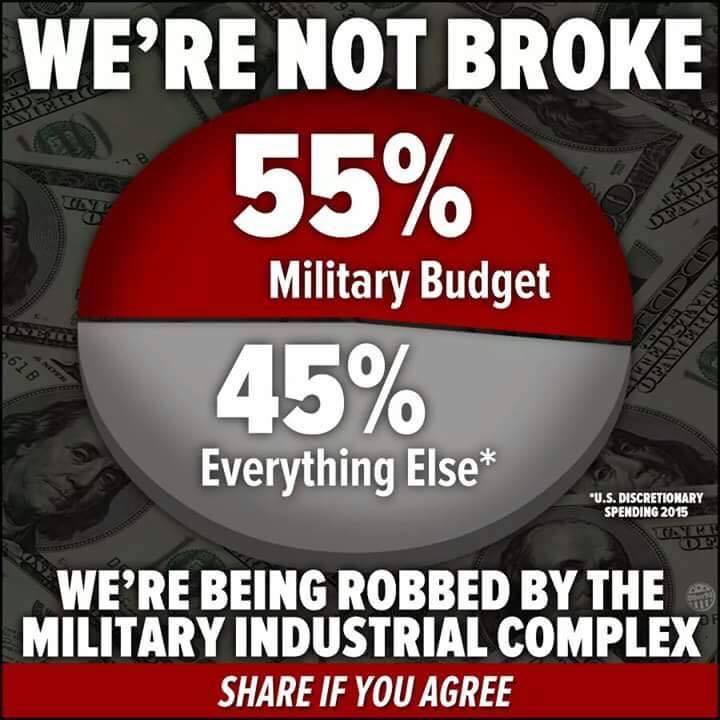
Discussion ebbs and flows on the topic of U.S. spending. Of particular interest to several of my liberal friends is military spending. Frequent Facebook posts on this subject claim that military spending consumes over half the budget.

I agree that the military is not an ideal place to invest so many billions of dollars. I also agree that the U.S. has a history of blowing money on weapons and aggression. Further, I question whether the U.S. uses military means when a better, longer-lasting path to peace and stability in troubled parts of the world would be investments in education, infrastructure, agriculture, and commercial development.

All that said, I have to protest the continuing use of incorrect data in arguing against military spending. The cause for less military spending is not enhanced by presenting incorrect information. Just the opposite.

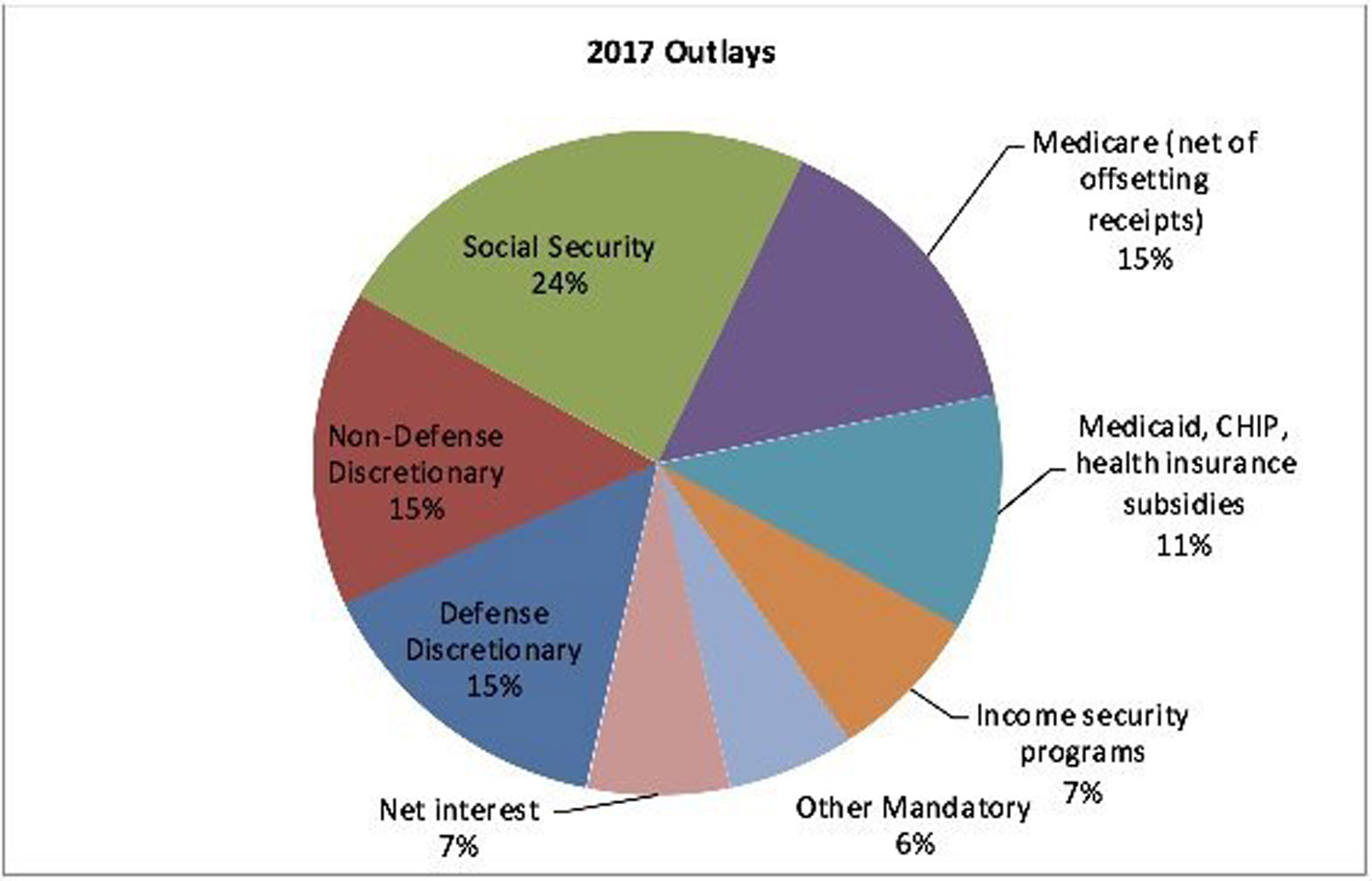
The accurate 2017 budget breakdown:

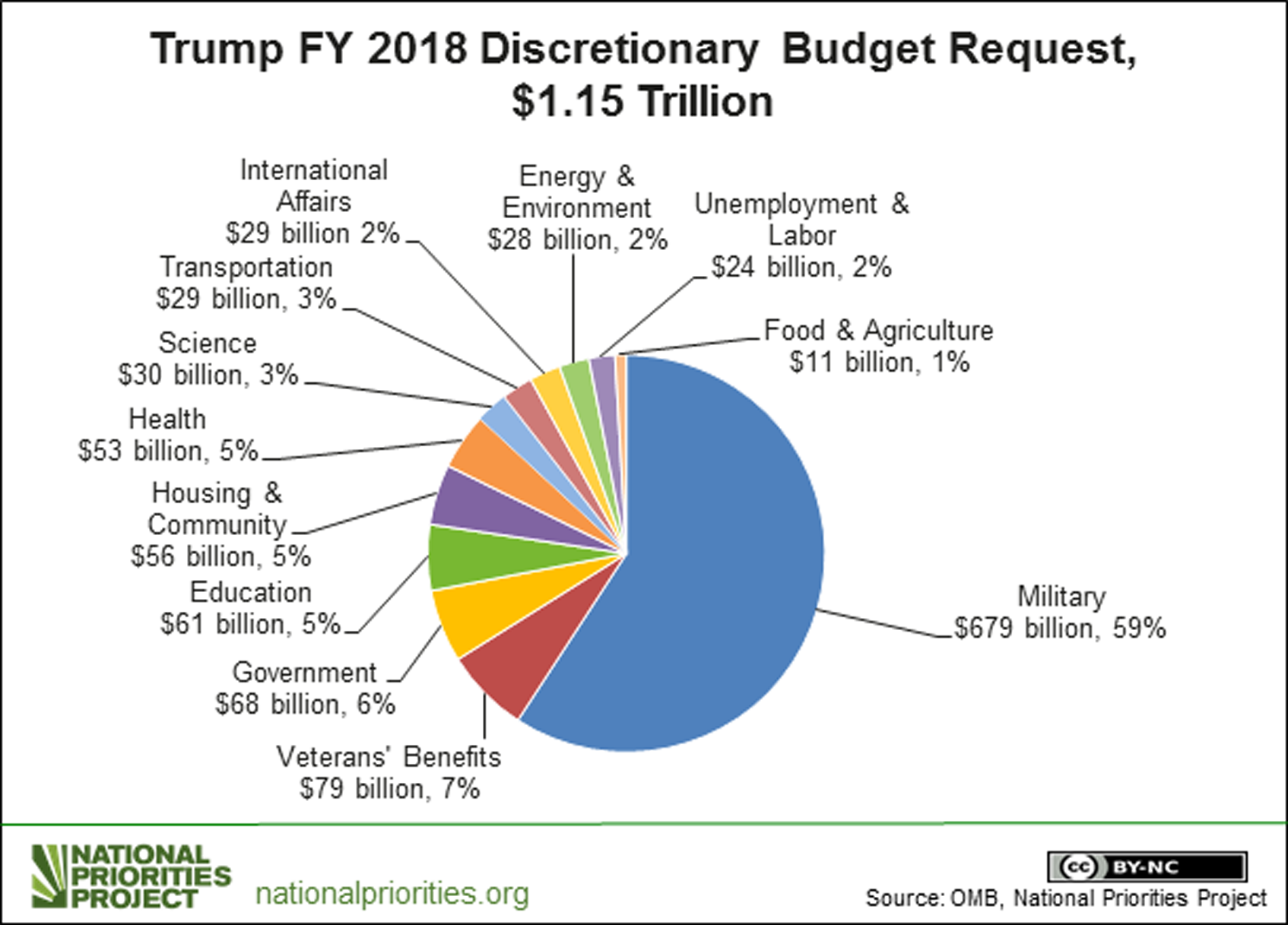
Please note that the portion designated military spending occurs in the lower left  of this pie chart and as such does not constitute half of the U.S. budget. It’s important to discriminate between a breakdown of discretionary spending and overall spending. Discretionary spending is one category of overall spending. It’s within the slice of pie of discretionary spending where we see the big bite that goes to the military:So yes, military spending within its slice of pie of discretionary spending, is over half the budget. And there’s no limit to the close examination this distribution of funds deserves. But please, let’s make our arguments based on the actual facts.

A second realm of considerable error by liberals calls for a shift in U.S. spending to better honor social programs like Social Security. A popular mantra on social media these days mistakenly claims that we ‘own’ our retirement funds because we paid into them. The following discussion spells out the facts:

“It’s My Money” [WRONG!]

* A common perception about Social Security benefits is: I am entitled to the money. It’s my money. I’ve saved it.

* Social Security is mainly a “pay-as-you-go” program. This means that it pays most of its benefits by taxing people who are currently working.

* Per the Social Security Administration: The money you pay in taxes is not held in a personal account for you to use when you get benefits. Your taxes are being used right now to pay people who now are getting benefits. Any unused money goes to the Social Security trust funds, not a personal account with your name on it.

* From the start of the Social Security program in 1937 through the end of 2016:

  • 94% of all Social Security payroll taxes were spent in the same year they were collected.

  • 13% of Social Security’s total income (including payroll taxes, taxes on Social Security benefits, transfers from the general fund of the Treasury, and interest on the Social Security Trust Fund) has accumulated in the Social Security Trust Fund.

* Per the Social Security Administration: Since the Social Security system has not accumulated assets equal to the liability of promised future benefits, the social security wealth that individuals hold represents a claim against the earnings of future generations rather than a claim against existing real assets.

* After the federal government pays back with interest all of the money it has borrowed from Social Security, the program’s current claim against the earnings of future generations is $30.8 trillion. This amounts to an average of $132,914 for every person now receiving Social Security benefits or paying Social Security payroll taxes.

* Per the Social Security Administration: There has been a temptation throughout the program’s history for some people to suppose that their FICA payroll taxes entitle them to a benefit in a legal, contractual sense. … Congress clearly had no such limitation in mind when crafting the law. … Benefits which are granted at one time can be withdrawn.…

* In 1960, the U.S. Supreme Court ruled (5 to 4) that entitlement to Social Security benefits is not a contractual right. [emphasis added]

[For more discussion of Social Security taxes, allocations, and projections, visit the Just Facts page.]

So let’s get our heads screwed on straight, fellow progressives. While a large chunk of U.S. tax dollars go to military expenditures, it is NOT consuming over half of our tax dollars. Our Social Security and Medicare funds are NOT held for our future use like individual savings accounts, but rather are spent immediately in payouts to persons currently receiving Social Security and Medicare benefits.

If we expect to prevail in directing our nation toward a more equitable and socially conscientious future, we need to be well informed and make our arguments for social justice in ways that make sense and align with the facts.

That is all. For now.

Its or It’s?

Unique to humans, language is our most widespread way of communicating. The more clearly we express ourselves, the better our chances of success in any life endeavor. Not only do better communication skills help us interact with others, these skills also allow us to organize our internal thoughts better.

As a former English teacher, I’m often pained with the confusion of language pouring into our ears and eyes on a daily basis. But hey, we were all so young when we sat in our last English class. Much of what we heard went in one ear and out the other without lingering even one minute in our frontal lobes. Therefore, as a public service certain to garner scorn heaped upon my head, I will now embark on a few brief lessons in grammar.

#1 – The most conspicuous in this communication confusion is the wayward apostrophe. This little quirk of ink is meant, most of the time, to show possession. Its close twin in usage is its role in substituting for a missing letter, as in a contraction.

In possessive use, I’m talking about Marcie’s shawl. Or Tom’s briefcase. The apostrophe is NOT meant to show plural, as in “There were twelve Marcies in the room.” NOT “There were twelve Marcie’s in the room.,” the latter suggesting that there twelve of Marcie’s something in the room.
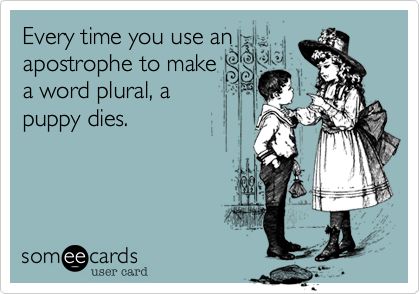
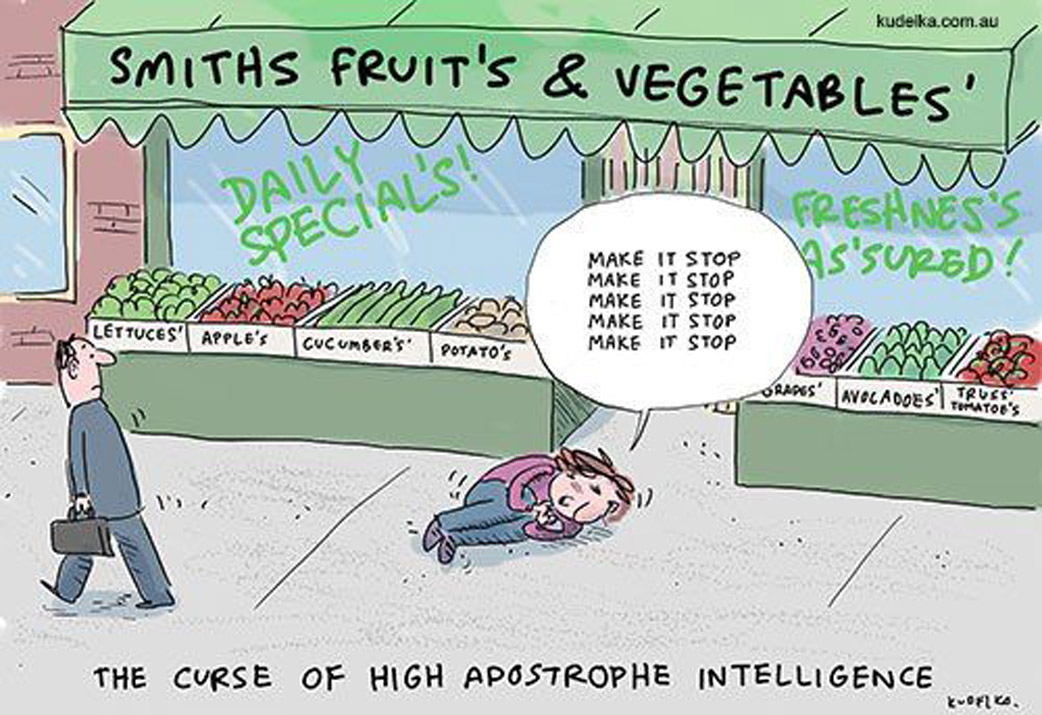
The use of an apostrophe in showing more than one (plural vs singular) is an invasive creeping blight that appears in all kinds of places. You’d think sign painters and retailers would have a glimmer of awareness about this problem. Maybe they just don’t care that their failure to communicate could cause puppies to die.

Or at least lead to Grammar Nazis convulsing on their front sidewalk.
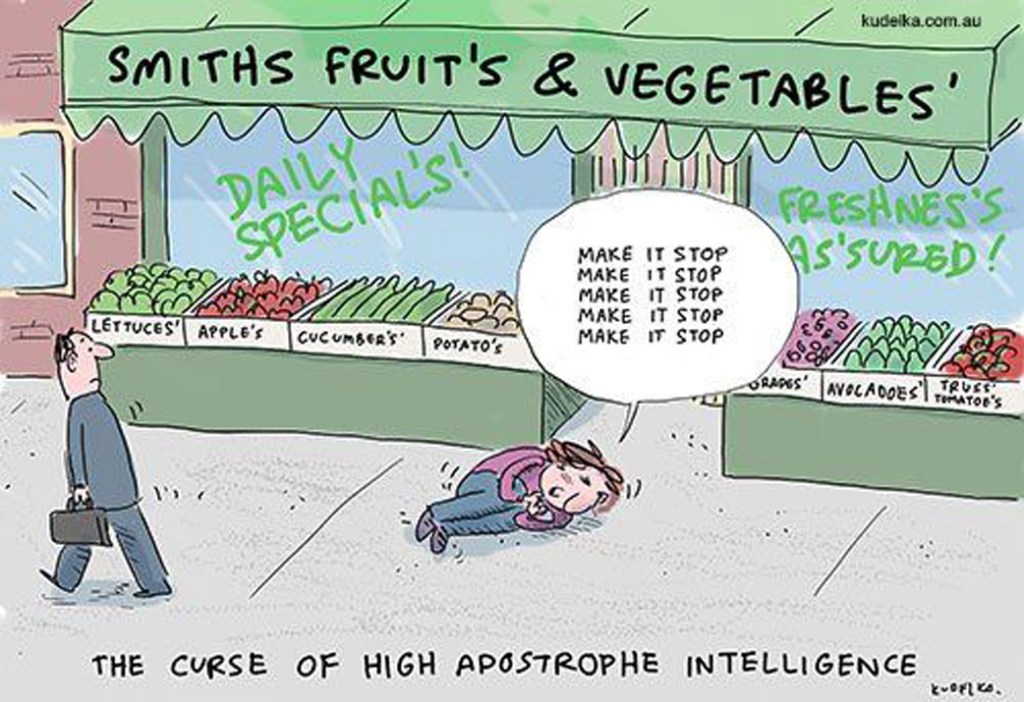
Now this apostrophe problem would be easy to solve for most people if that’s was all there was to it. But apostrophes show up again in contractions such as “I’m” meaning “I am” and “it’s” meaning “it is.” Not too many people miss the “I’m” and “can’t” and “Tom’s” punctuation, but an endless stream of “it’s” show up when someone wants to describe the problem with “its,” in this usage referring to a sled. In “its long path downhill…,” “its” shows possession without an apostrophe.

Simple rule for “it’s”? If you can substitute with “it is,” you’re doing it right.

Otherwise, ask yourself if you’re using the troublesome little quirk in place of a missing letter. That’s a contraction. [Notice my clever usage of the apostrophe in place of the “i” in “That’s,” as in “That is.”

For yet another discussion in this endless harangue over apostrophes, there’s this article in The Atlantic magazine.


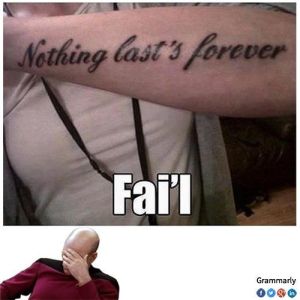
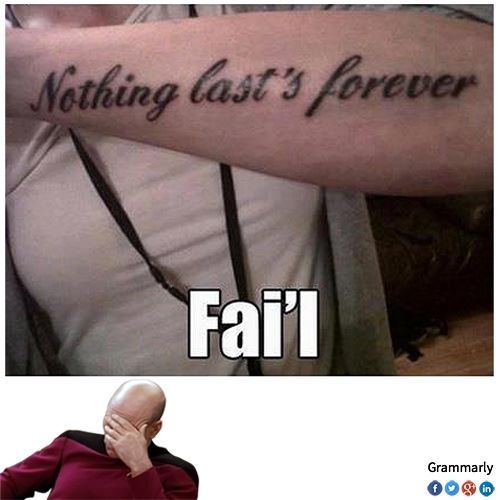
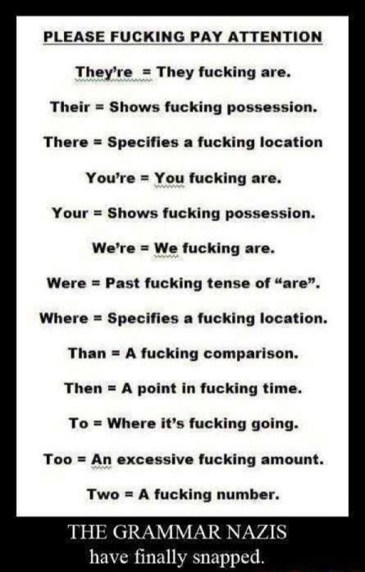
#2 in our list of confusing grammatical mistakes is the endless conundrum about contractions. I’ll simply insert this instructive meme here in hopes of making my point without belaboring it. If the language offends you, please accept my apologies. The creator of this learning aide merely meant to gain your devoted attention.
#3 in our list of confusing grammatical mistakes is the dangling modifier. This is not, as some might think, a reference to certain anatomy. Well, maybe. In some cases. But stop and think—what is a modifier? Or more fundamentally, what does “modify” mean?

Modify means to refine something. Add to it, clean it, change it in some way, large or small. A mechanic overhauling an old car is modifying it. A carpenter repairing a broken staircase is modifying it. Likewise, our communications aren’t “Dick ran.” or “Mary fell.” These words and ideas need modifiers to help us understand more about what we’re trying to say.

When words are added to modify the meaning of a word or phrase, the modifiers add a better understanding of what the modified word means. For example, in the sentence “The boy ran,” we get the basic idea. It’s the noun (boy) with the verb (ran), noun and verb being the skeletal structure of any sentence. But if we say “The seven-year-old boy ran fast.” we have modified “boy” with the adjective “The” and the adjective term “seven-year-old.” We’ve also further explained what we mean about “ran” with the adverb modifier “fast.”

[Clearly, the term “adverb” means adding to the verb. The term “adjective” is less obvious, since it doesn’t explicitly say “adding to a noun.” But that’s what it means.]

Modifiers can be single words or entire phrases. I’ll leave it at that, although in the foggy heights of grammar, entire sentences can also modify. And often do.

Actually, while I’m slightly off-track, I’ll go ahead and say that to some extent, most of what we might say or write serves to modify an initial idea or statement. In a novel, an entire plot concept is modified through hundreds of pages of development and explanation.

But back to the heinous task at hand. Let’s add a bit more information to this basic sentence: “Worried about missing his dinner, the seven-year-old boy ran fast.” Here the initial phrase “Worried about missing his dinner” is a further modifier of “boy.” The mistake that often occurs is that the speaker/writer will not directly connect the modifier to the word it modifies but dangles in some other part of the sentence. You might see this error as “The seven-year-old boy ran fast worried about missing his dinner.”
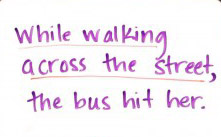
This type of error occurs frequently because our minds gather the words and work out the meaning even if the word placement is somewhat garbled. Even though the modifying phrase is most closely situated next to “run fast,” we could easily understand that the modifier refers to the boy, not that it tells us anything about his running or how fast. This kind of short cut occurs all the time, especially in the media where the objective is to skip through as much language as possible in order to dispense more information in a shorter period of time. Viewers have the advantage of watching body language or seeing images that help modify the limited spoken words.

Shortcuts like these don’t work as well in written media where only words are present to explain what is meant. For example, this sentence attempts to give information about an archaeological discovery:

“Archaeologists have unearthed a 2,400-year-old burial containing the remains of men, women, and children arranged in an interlocking spiral shape while investigating the ancient settlement of Tlalpan in southern Mexico City.”

But because the modifying phrase does not appear next to the word(s) it modifies, the sentence is awkward if not confusing. Better: “While investigating the ancient settlement of Tlalpan in southern Mexico City, archaeologists have unearthed a 2,400-year-old burial containing the remains of men, women, and children arranged in an interlocking spiral shape.”

Multiple websites hosted by Grammar Nazis offer a multitude of similar examples. The following are from one such site:

“Hoping to garner favor, my parents were sadly unimpressed with the gift.”

Problem: This is a dangling modifier because we do not know who or what was hoping to garner favor. It is unlikely that the parents were hoping to garner favor, since they wouldn’t have given an unimpressive gift to themselves.

Correction: This sentence could be corrected by adding a proper subject, or identifying the person who was hoping to win over the parents. For example,

Hoping to garner favor, my new boyfriend brought my parents a gift that sadly unimpressed them.

Now, the modifier is no longer dangling, since the subject- or the person- who is hoping to garner favor is identified.

“Hoping to excuse my lateness, the note was written and given to my teacher.”

Problem: Here, it seems as though we have a subject- my. However, my is part of the modifier and not the subject itself.

Correction: We need a subject that is modified by hoping to excuse my lateness, since obviously the note didn’t have those hopes.

Hoping to excuse my lateness, I wrote a note and gave it to my teacher.

Now, the problem is resolved. I am the person who is hoping to excuse my lateness, so I wrote a note and gave it to my teacher.

After reading the great new book, the movie based on it is sure to be exciting.

Problem: Again, we are left wondering exactly who read the great new book. The phrase can’t possibly be modifying the movie, since the movie can’t read.

Correction: A subject must be added so the modifier has something to describe, change or limit.

After reading the great new book, Anna thought the movie based on it was sure to be exciting.

In the remote possibility that you’re still reading at this point, I’ll just sign off my duty as a worthy citizen by offering this link to yet more common grammar mistakes. Hey, it’s a hellish job but somebody’s got to do it.