Religious Zealots Strike Again

A recent letter to the editor here in Arkansas perfectly portrays the bizarre mindset of certain Christians. The author wrote not about morally-bankrupt Trump, nor about people dying from chemical warfare and barrel bombs, nor about the continuing horror of mass shootings in our gun-mad country. No, that wasn’t the source of this woman’s righteous indignation.

She’s upset about a comic strip.

I wanted to express my outrage at the blasphemy and sacrilege in this cartoon [Wumo]. This disgusting disregard of Christianity expresses all the evils in troubles in our world today… A holy family, Christians, as [a previous letter writer] said, is fair game for those who want to bully and disparage those with whom they do not agree. (Satan is working overtime.)

People should be very careful when targeting others, especially those of us who will indeed make a stand for our God and his precious son, our lord and savior Jesus Christ. Our beliefs and our love for spiritual and heavenly knowledge and healing far supersedes anyone or anything this world (earthly) has to offer.[1]

The letter writer, a woman from Marion, Arkansas, goes on to demand the comic strip be removed from the newspaper. She concludes: “Christians are offended.”

Oh, my. Where to begin?

Might one suggest that she and others of her ilk SIMPLY NOT READ WUMO?

I mean, does that not seem the logical choice here? I go to the comic pages pretty much every day, but I only read four. Those are the only ones I enjoy. Perhaps this Christian extremist doesn’t understand the concept of enjoyment but rather flogs herself through a daily exercise of holy suffering by reading comics that enrage her.

This would be highly amusing to the rest of us if it weren’t for the awful reality that such people have no idea how ridiculous they are. They are convinced that the world must operate by their rules and anything that draws their personal censure is surely Wrong.

A long list of human tragedy unfolds from this viewpoint. The Inquisition springs to mind, an endeavor of the Catholic Church beginning around 1100 AD and continuing in various forms for the next 600 years. Any form of “blasphemy and sacrilege” could result in church leaders taking offense similar to our letter writer.

Sometimes it was difficult to guess, as any of the following were considered serious crimes: changing bedding on a Friday, not eating pork, dressing in certain ways, wearing earrings, speaking in foreign languages, owning foreign books, casual swearing, criticizing a priest, or failing to show due reverence to the Inquisition… People were executed for failing to fast during Lent, for homosexuality, fornication, explaining scientific discoveries, and even for professional acting..[2]

Or, in our case, publishing a cartoon.
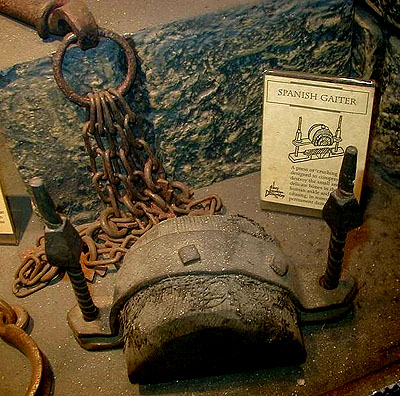
Leg crusher

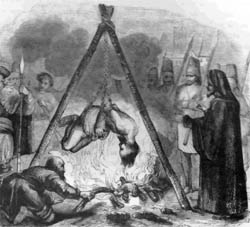
Generously, inquisitors utilized various forms of torture to provide the greatest possible opportunity for the accused to confess his or her sins. Serious effort went into the invention and construction of torture devices including the infamous ‘rack’ and various other gleeful methods of inflicting pain.

When a suspect was convicted of unrepentant heresy, the inquisitorial tribunal was required by law to hand the person over to the secular authorities for final sentencing, at which point a magistrate would determine the penalty, which was usually burning at the stake although the penalty varied based on local law.[3]

Historically, other than the necessary torture required to bring a confession from those blasphemers in order to declare them guilty and then burn them at the stake, religious extremists have demonstrated a fervent interest in killing anyone who doesn’t agree with their point of view. Is this what the letter-writer threatens in her statement that: “People should be very careful when targeting others, especially those of us who will indeed make a stand for our God.”

What exactly is she suggesting? Would her “stand for God” include Inquisition-style discipline on the newspaper publishers or the creator of the Wumo comic strip?
Sadly, we don’t have to look far, even today, to find exactly that kind of violence bestowed upon those who draw the critical attention of religious authorities. Syrian cartoonist Ali Farzat dared to make fun of certain leaders in his cartoons. Assailants hunted him down and used clubs to break his hands.[4] Chinese censors called for a “severe punishment” for a star TV anchor over jokes he made at a dinner party mocking the People’s Republic of China’s founding father, Mao Zedong.[5] Then there was the Islamist terrorist attack on the French satirical weekly publication Charlie Hebdo which resulted in the deaths of twelve people.[6] Their justification? Charlie Hebdo made fun of Allah.

There’s a reason we Americans treasure our right to free speech. We can criticize our leaders, laugh at Saturday Night live skits, and even poke fun at entrenched religious views, all without fear of having our hands broken or being burned at the stake. Somehow in all her years of life, this letter writer missed out on all but the first part of First Amendment to the U. S. Constitution.

Congress shall make no law respecting an establishment of religion, or prohibiting the free exercise thereof; or abridging the freedom of speech, or of the press; or the right of the people peaceably to assemble, and to petition the Government for a redress of grievances.

All this brings to mind the question of why certain religious types find it imperative to force their point of view on everyone else. Is that they are so insecure in their beliefs that they’re comfortable only if they’re certain everyone around them believes the same thing? Isn’t faith the foundation of religious practice, the assurance that no matter what happens, God’s got your back? Wouldn’t that pretty much cover being the only Christian in a sea of infidels? Why so insecure?

Is it that they see it as their duty to convert the rest of the world to their belief system? This certainly seems to be the case, a duty not only to police the statewide newspaper’s comics section for blasphemy but also to righteously demand enforcement of their judgement against a comic deemed offensive. After all, “Christians are offended!”

Do these folks not understand that this exact attitude is responsible for most of the world’s suffering? Most of the wars? Most of the violence currently taking place in the Middle East?

Education is a wonderful thing. But in a state where parents merely need to sign a form to withhold their kids from public schools and then indoctrinate them with whatever folderol fits their world view, people like this benighted letter-writer proliferate, aided and abetted by fundamentalist preachers who don’t hesitate to cast judgement despite the Biblical edict against judging.

Matthew 7: 1-3

Judge not, that you be not judged. For with the judgment you pronounce you will be judged, and with the measure you use it will be measured to you. Why do you see the speck that is in your brother’s eye, but do not notice the log that is in your own eye?

National educational standards exist for a reason. They put us all on a more-or-less level playing field where we all understand the basics of our rule of law, our history as a Western culture, and yes, even the good bad and ugly of religious traditions. Public schools also help us learn to exist in a multicultural, multiracial world where even cartoonists like the creator of Wumo possess as much right to their opinions and creative efforts as the person who goes to church every time the door opens.

It’s a sad testament to the modern evangelical movement that such intolerance is not only accepted but encouraged. This letter writer seems oblivious to the irony in her remark about being “fair game for those who want to bully and disparage those with whom they do not agree…” That would be a thought to reflect on.

~~~


[1] Letters to the Editor, Northwest Arkansas Democrat-Gazette, Saturday March 31, 2018. 7B

[2] http://www.badnewsaboutchristianity.com/gbg_inquisition.htm

[3] https://en.wikipedia.org/wiki/Inquisition

[4] http://www.dw.com/en/arab-cartoonists-walk-a-fine-dangerous-line/a-18184330

[5] https://www.hollywoodreporter.com/news/chinese-tv-host-mao-jokes-814168

[6] https://en.wikipedia.org/wiki/Charlie_Hebdo_shooting

What You Might Not Know About China

With trade politics thickening the air like an April snowstorm, you might be intrigued to know a bit about China’s past history with exports and imports. As in, we should be very careful.

We all know China’s civilization is one of the world’s oldest with historical records dating back at least to 2000 BCE when the Xia dynasty began. Legendary emperors introduced natural medicines including ephedrine, cannabis, and tea—the latter being the crux of a trade matter that would come back to haunt Westerners today.

Over 3000 years passed as the country went through various changes in leadership and cultural developments but here’s the important thing—they stayed within their borders. With all their advancements, they seemed content for all those centuries to keep to themselves.

Just because the Chinese did not use their advancing sophistication in efforts at world conquest did not meant they didn’t trade. Bits of Chinese silk have been found in Egypt from around 1000 BCE. The famous Silk Road, established around 200 BCE, accommodated the trade of Chinese silks, herbs and spices, and cultural ideas ranging from Buddhism to use of horses. Only with the Mongol invasions in the early 13th century were the Chinese forced to deal with outside forces.

The Chinese bounced back with the founding of the Song dynasty, considered the high point of classical Chinese civilization.

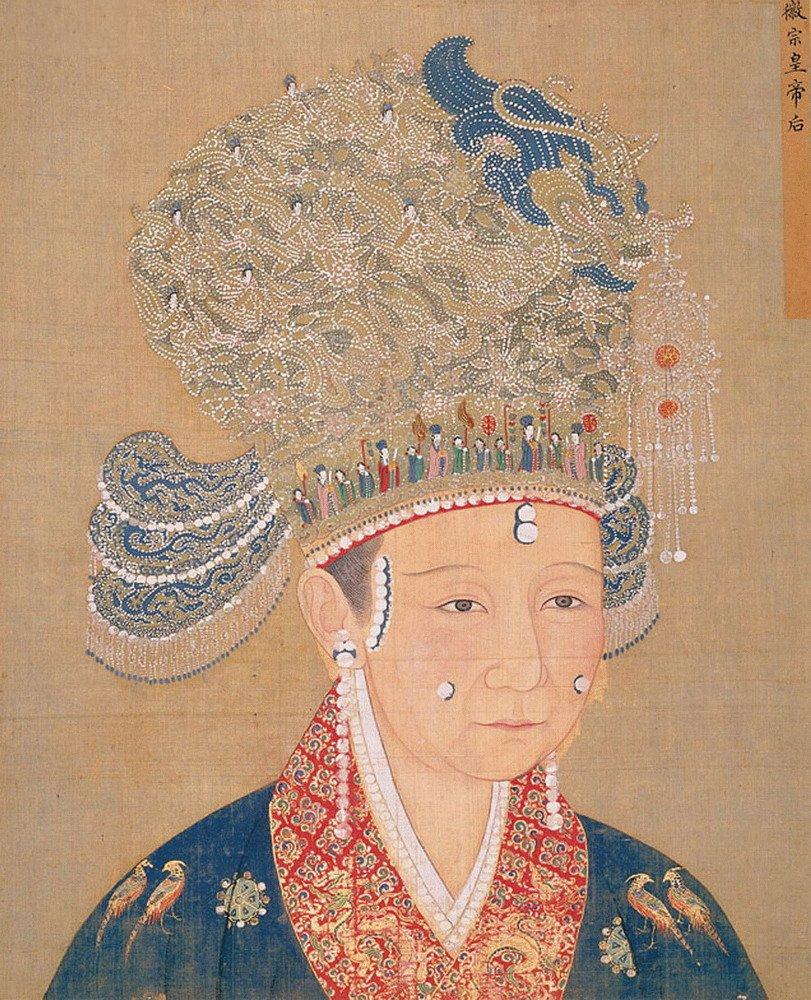
Empress Zheng (1079–1131)

The Song economy, facilitated by technology advancement, had reached a level of sophistication probably unseen in world history before its time. The population soared to over 100 million and the living standards of common people improved tremendously due to improvements in rice cultivation and the wide availability of coal for production. The capital cities of Kaifeng and subsequently Hangzhou were both the most populous cities in the world for their time, and encouraged vibrant civil societies unmatched by previous Chinese dynasties. Although land trading routes to the far west were blocked by nomadic empires, there were extensive maritime trade with neighboring states, which facilitated the use of Song coinage as the de facto currency of exchange. Giant wooden vessels equipped with compasses traveled throughout the China Seas and northern Indian Ocean. The concept of insurance was practiced by merchants to hedge the risks of such long-haul maritime shipments. With prosperous economic activities, the historically first use of paper currency emerged in the western city of Chengdu, as a supplement to the existing copper coins.

The Song dynasty was considered to be the golden age of great advancements in science and technology of China …Inventions such as the hydro-mechanical astronomical clock, the first continuous and endless power-transmitting chain, woodblock printing and paper money were all invented during the Song dynasty.

China’s military and imperial ambitions did eventually lead to imperialistic ambition. By the 1400s, Chinese colonialization in foreign lands extended to Japan and Vietnam. That was small potatoes compared to the Europeans who had begun far-flung expeditions to virtually every corner of the earth. In fact, by 1500 a strong isolationist fervor developed in China. When contacted by Western powers such as Portugal in 1520 and the Dutch in 1622, the Chinese vigorously repelled any and all attempts at collaboration.

Meanwhile, the West had begun to thirst for all things exotic including spices from Indonesia and India and especially tea, silk, and porcelain from China. Despite rich colonial profits from Caribbean sugar and tobacco to American cotton, African ivory, and Mexican silver, imperial appetites were insatiable. Just like today, the West—especially the fanatical tea-drinking British—suffered a terrible trade imbalance with China. China didn’t have much interest in the woolens and other commodities offered in trade by Britain and insisted on silver payment for its tea. By the late 17th and early 18th century, Britain faced a monetary crisis over its trade with China.

And here’s where it becomes very instructive as to our current trade situation with China, “we” meaning Americans, that peculiar offshoot of the British Empire who fired its first shot over the king’s helm by dumping, yes, you’ve heard this before, crates of tea overboard in Boston Harbor. British efforts to shore up its finances meant hiking taxes on tea, and the colonists weren’t having it.

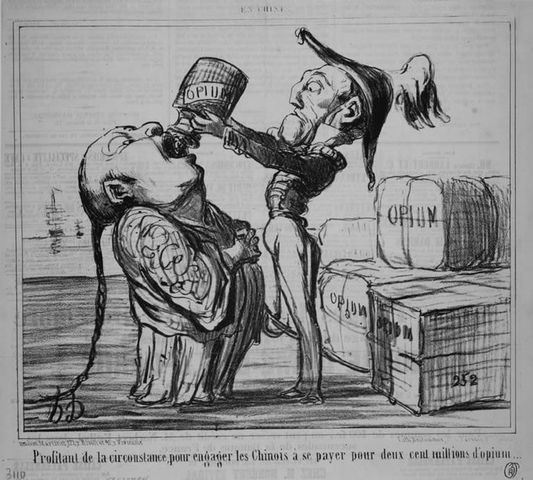
Meanwhile, among its other conquests of empire around the world, British invasion of India brought them local merchants dealing an ancient and powerful substance known as opium. Clever Brits thought to import opium to China in the belief that it could balance its trade debts from tea. It didn’t take long for Chinese authorities to recognize the threat to their social order posed by widespread opium use. In 1780, the Qing government issued an edict against opium and other restrictions soon followed.

… Qing dynasty Qianlong Emperor wrote to King George III in response to the MaCartney Mission’s request for trade in 1793: “Our Celestial Empire possesses all things in prolific abundance and lacks no product within its borders. There is therefore no need to import the manufactures of outside barbarians in exchange for our own produce.” Tea also had to be paid in silver bullion, and critics of the tea trade at this time would point to the damage caused to Britain’s wealth by this loss of bullion. As a way to generate the silver needed as payment for tea, Britain began exporting opium from the traditional growing regions of British India (in present-day Pakistan and Afghanistan) into China. Although opium use in China had a long history, the British importation of opium, which began in the late 18th century, increased fivefold between 1821 and 1837, and usage of the drug became more widespread across Chinese society. The Qing government attitude towards opium, which was often ambivalent, hardened due to the social problems created by drug use, and took serious measures to curtail importation of opium in 1838–39. Tea by now had become an important source of tax revenue for the British Empire and the banning of the opium trade and thus the creation of funding issues for tea importers was one of the main causes of the First Opium War.

Delicate business, trade. By the early 1800s, Americans also began importing opium to China as a blend of opium and Turkish tobacco. The resulting competition between America and Britain brought opium prices down resulting in easier access for the average Chinese resident. By 1838, Britain alone imported more than 1,400 tons of opium to China. It was estimated that 27% of adult male Chinese were addicted.

China’s emperor wrote an impassioned letter to Queen Victoria, explaining the harms of opium use and questioning Britain’s “moral judgement.” Sources say the queen never received the missive, but it probably wouldn’t have made much difference. The economics of trade meant that the nation’s leaders bowed to commercial interests.

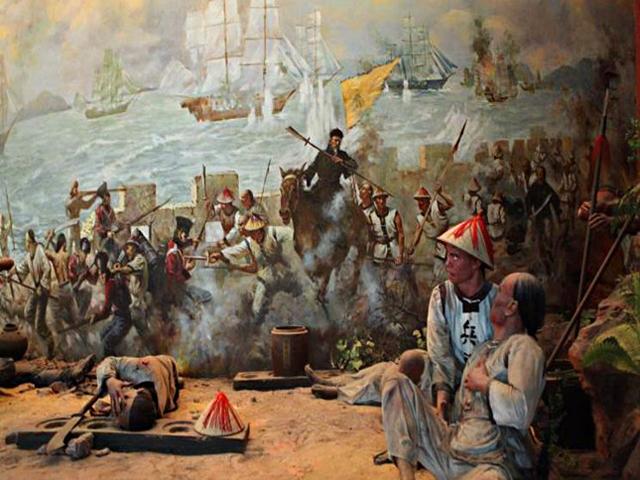
Under the new law in 1839, Chinese began boarding British ships and confiscating opium. In one raid alone, authorities destroyed over 1,200 tons of opium on a public beach. Outraged, British importers demanded the assistance of British military. Matters devolved as Chinese banned British ships from taking supplies or water at Chinese ports and various skirmishes ensued, leading to debate in British parliament. The House of Lords (which included owners of most of the ships and trading companies) wanted war with China. The House of Commons, more sympathetic to the problems caused by opium, wanted the opium trade to stop.

No extra points for guessing who won. In a military buildup of British ships and personnel beginning mid-1840 and supplemented by Indian dragoons by 1841, Western powers with their heavily armed gunships and superior technology sailed up the Pearl River and destroyed less-well-armed Chinese vessels and troops. The British blockaded Chinese ports up and down the coast. In July 1842, British warships steamed up the Yangtze River to Canton where they destroyed Chinese forts protecting the city. Ultimately, China had no choice but to surrender and accept terms including stiff fines payable in silver and British control over Hong Kong and Singapore, initiating what the Chinese called “The Century of Humiliation.”

Meanwhile, the East India Trading Company [British] sent Scottish botanist Robert Fortune to sneak into China to steal tea plants and a few Chinese men who knew how to grow it. Vast tea plantations in India were the result. Under British control until 1947, India’s tea crops bypassed China’s, thus ending the need to trade with China for the tea supply.

I don’t think I need to belabor the point. It seems the Chinese have learned their lessons well.

~~~

Quoted passages pulled from Wikipedia articles:

https://en.wikipedia.org/wiki/History_of_China#Xia_dynasty_(2070%E2%80%931600_BC)

https://en.wikipedia.org/wiki/First_Opium_War

https://en.wikipedia.org/wiki/History_of_tea

https://en.wikipedia.org/wiki/Robert_Fortune

More Ignorance in Arkansas

Opium Poppy

Willful ignorance is a pathetic condition I’ve written about before, but a new and unexpected manifestation came to my attention in the Saturday paper.[1] In an extended interview with the Arkansas Democrat-Gazette, Dr. J. Carlos Roman voiced his thoughts on the Arkansas Medical Marijuana Act and the various twists and turns on its way to becoming a functioning service to people in need. Among those thoughts was this stellar quote: “What are we going to do as a state and culture to make sure medical marijuana doesn’t become the next opioid crisis?”

Oh please, Scotty, beam me up now.

It’s possible Dr. Roman made this statement in an attempt to be politically correct, considering that he’s under fire for possible conflict of interest in his role as one of five members of the commission that oversees the licensing of Arkansas’ first growing and dispensing facilities. As such, he gave the highest score to the Natural State Medicinals Cultivation group. Entities that didn’t score so high were understandably miffed that Natural State was one of only five chosen for a license, considering that Dr. Roman’s friend Dr. Scott Schlesinger is one of the Natural State’s owners. Consequently, several of those potential licensees not chosen have sued for bias.

Roman argues that he didn’t expect or receive any quid pro quo for his ranking of Natural State. He also pointed out that he has worked for years in his role as a pain management physician to fight the opioid crisis. He says his reason for accepting the voluntary role on the licensing board was in part to “ensure that the medical marijuana industry gets off the ground responsibly.”

He goes on to admit that he was initially opposed to the amendment that voters passed in 2016 legalizing medical use, not because he was totally opposed to marijuana’s medical use but because of public “ignorance” and so-called false information about its medical potential touted by many supporters of the new law. He concedes a few benefits of natural marijuana might be in its use in appetite stimulation and anti-anxiety and admits he will “reluctantly” certify patients to receive ID cards required in the program.

He’s such a great guy, isn’t he? And now, through no fault of his own, he’s being villainized by permit applicants who didn’t score as high as the group co-owned by his friend.

Sometimes you have to appreciate karma. Because this scandal about his potential conflict of interest is exactly the kind of spotlight that’s needed for people like Dr. Roman.

Why? Because who should be more qualified or informed about medical research than a physician? Yet here we have a physician who specializes in pain management worrying that marijuana could become the next opioid crisis. Talk about willful ignorance.

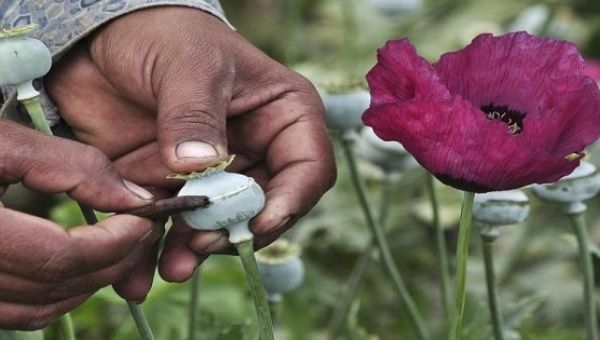
Farmer slicing opium flower pod to harvest the resin. Condensed resin forms raw opium.

Any physician, especially a specialist in pain treatment, should be fully aware of the history and effects of opiates. The opium poppy has been used medically as far back as 4000 BCE. For that matter, so has marijuana. But opium has served a greater role in pain relief.

Not content with what nature had to offer in the opium plant, chemists in the 19th century began tinkering. The first result was morphine, introduced in 1827 by Merck. But after the Civil War with thousands of injured soldiers becoming addicted, Bayer Pharmaceuticals gallantly invented heroin which hit the marketplace in 1894 as a “safe” alternative. Less than twenty years later as the addictive potential of heroin became more widely known, German chemists synthesized oxycodone.

This new “safe” alternative medication spawned generations of synthesized opiate clones, each touted as safer than its precursor: Oxycontin, Percocet, Vicodin, Percodan, Tylox, and Demerol, to name a few. Now we have the latest spawn, Fentanyl, at fifty times the strength of heroin.

Now, in order to capitalize on marijuana’s therapeutic gifts, the chemists are busy again. Already pharmaceutical grade THC, one of many active ingredients in marijuana, has been synthesized for legal sale as Marinol. You see where this is headed. Soon, coming to a town near you, we’ll have a potentially lethal form of marijuana.

But not yet. What Dr. Roman should know and apparently doesn’t is that marijuana is very different from opiates is two important ways. It’s not addictive. Opiates are. And marijuana is non-toxic, meaning no matter how much you manage to ingest, it won’t kill you.

And therein lies the absurdity of his statement.

Not to single him out. I’d wager that most physicians in Arkansas and elsewhere have made zero effort to learn more about the chemical properties of cannabis.

…In a large-scale survey published in 1994 [by] epidemiologist James Anthony, then at the National Institute on Drug Abuse, and his colleagues asked more than 8,000 people between the ages of 15 and 64 about their use of marijuana and other drugs. The researchers found that of those who had tried marijuana at least once, about 9 percent eventually fit a diagnosis of cannabis dependence. The corresponding figure for alcohol was 15 percent; for cocaine, 17 percent; for heroin, 23 percent; and for nicotine, 32 percent. So although marijuana may be addictive for some, 91 percent of those who try it do not get hooked. Further, marijuana is less addictive than many other legal and illegal drugs.[2]

Please note that “dependence” and “addiction” are two very difference things, no matter how Anthony and others might interchange them.

Addiction is a primary, chronic, neurobiologic disease, with genetic, psychosocial, and environmental factors influencing its development and manifestations. It is characterized by behaviors that include one or more of the following: impaired control over drug use, compulsive use, continued use despite harm, and craving.[3]

Psychological dependence develops through consistent and frequent exposure to a stimulus. Behaviors which can produce observable psychological withdrawal symptoms include physical exercise, shopping, sex and self-stimulation using pornography, and eating food with high sugar or fat content, among others.[4]

Marijuana plant showing leaves, generally not containing much of the active ingredients, and flower buds, the primary medically-useful portion of the plant.

“Dependence” in itself is simply an adaptive state associated with a withdrawal syndrome upon cessation of repeated exposure to a stimulus such as the ‘high’ associated with marijuana. Some studies report that ending heavy marijuana use causes some users to experience wakefulness in subsequent nights and possibly headaches.

Compare that to opiate withdrawal. Within six to thirty hours of last use, symptoms include tearing up, muscle aches, agitation, trouble falling and staying asleep, excessive yawning, anxiety, nose running, sweats, racing heart, hypertension, and fever. Then within 72 hours, more severe symptoms ensue and last a week or more, in including nausea and vomiting, diarrhea, goosebumps, stomach cramps, depression, and intense drug cravings.

But more important than symptoms of withdrawal are the risks associated with use, most critical being the risk of overdose death. And this is where Dr. Norman’s ignorance takes center stage. People die from opiates at an increasing rate, about 181 people per day in 2017.

…Victims of a fatal [opiate] overdose usually die from respiratory depression—literally choking to death because they cannot get enough oxygen to feed the demands of the brain and other organ systems. This happens for several reasons… When the drug binds to the mu-opioid receptors it can have a sedating effect, which suppresses brain activity that controls breathing rate. It also hampers signals to the diaphragm, which otherwise moves to expand or contract the lungs. Opioids additionally depress the brain’s ability to monitor and respond to carbon dioxide when it builds up to dangerous levels in the blood.[5]

Compare that to the effects of marijuana.

Because cannabinoid receptors, unlike opioid receptors, are not located in the brainstem areas controlling respiration, lethal overdoses from Cannabis and cannabinoids do not occur.”[6]

Here’s a wake-up call to Dr. Roman and others in Arkansas playing this Mickey Mouse game over marijuana: in states where medical marijuana has been legalized, opiate-related deaths have decreased.

Over the past two decades, deaths from drug overdoses have become the leading cause of injury death in the United States. In 2011, 55% of drug overdose deaths were related to prescription medications; 75% of those deaths involved opiate painkillers. However, researchers found that opiate-related deaths decreased by approximately 33% in 13 states in the following six years after medical marijuana was legalized.

“The striking implication is that medical marijuana laws, when implemented, may represent a promising approach for stemming runaway rates of non-intentional opioid-analgesic-related deaths,” wrote opiate abuse researchers Dr. Mark S. Brown and Marie J. Hayes in a commentary published alongside the study.[7]

We are nearly two years from the day Arkansas voters approved a measure to provide medical marijuana to citizens of the state. With these lawsuits filed against the commission for potential conflict of interest, the date when persons in need might obtain legal weed moves even further from reach.

Dr. Roman’s apparent failure to educate himself is only the last of so many failures regarding public health and marijuana. Prohibition propaganda remains deeply entrenched in those who don’t bother to become informed. Legislative foot dragging has never been more egregious than in the months of throwing everything but the kitchen sink in front of the voters’ choice on this measure. The tragedy is that while all these men and women responsible for the public welfare fiddle with the law’s implementation, people are suffering needlessly. And dying.

~~~

[1] March 31, 2018 issue, page 1

[2] https://www.scientificamerican.com/article/the-truth-about-pot/

[3] https://www.naabt.org/faq_answers.cfm?ID=15

[4] https://en.wikipedia.org/wiki/Psychological_dependence

[5] https://www.scientificamerican.com/article/how-opioids-kill/ 

[6] See https://www.cancer.gov/about-cancer/treatment/cam/hp/cannabis-pdq#section/all; also https://www.leafscience.com/2017/10/17/overdose-marijuana/

[7] https://drugabuse.com/legalizing-marijuana-decreases-fatal-opiate-overdoses/

Now It’s Drone Bees

I recently read a news report that Walmart is investigating the use of drones in pollinating agricultural crops.[1] That just about knocked me out of my chair, but then, on reflection, I saw the Walmart dream: total control of our food supply.

Granted, the bee die-offs are a serious problem for farmers, a result—according to most experts—of our love affair with poisoning our food. You see, spraying herbicides, fungicides, and pesticides on our crops to kill off pests like, well, anything that hurts the crop, also kills off the bees. Without pollination that bees perform so expertly, we’ll have no food.

How clever of Walmart to attempt some redress of this terrible problem! Their concept is to enlist drones with “sticky material or bristles” to spread pollen as they move from plant to plant.  Of course the elephant in the room is the obvious question: if poisons used in agriculture are killing the bees, what are they doing to us?

Already we’ve heard—and mostly ignored—reports that frogs and other amphibians are experiencing reproductive deformities[2] due to environmental pollutants like Round-up’s glyphosate, now banned in Europe, and atrazine which is applied to tens of millions of acres of corn grown in the United States, making it one of the world’s most widely used agricultural chemicals. A powerful, low-cost herbicide, atrazine is also the subject of persistent controversy.[3]

“Atrazine demasculinizes male gonads producing testicular lesions associated with reduced germ cell numbers in teleost fish, amphibians, reptiles, and mammals, and induces partial and/or complete feminization in fish, amphibians, and reptiles,” according to years of study by scientist Tyrone Hayes whose reports on his research are the target of relentless attacks by atrazine’s primary manufacturer, Syngenta.[4]

Atrazine is just one of many chemicals in wide use across the United States known as endocrine disrupters, “shown to disrupt reproductive and sexual development, and these effects seem to depend on several factors, including gender, age, diet, and occupation… Human fetuses, infants and children show greater susceptibility than adults… in diseases such as cancer, allergies, neurological disorders and reproductive disorders.”[5]

Then there are the hundreds of other chemical cocktails we are forced to routinely ingest not only in our food but also in our drinking water. Tens of thousands of chemicals are released into the environment in products ranging from shampoo to toilet bowl cleaner, few if any of which have been tested for potential harmful effects on human health and which, at last count, only a handful are tested for or removed from drinking water supplies. Not that anyone has any idea how to remove them from the water. This is part of the don’t ask, don’t tell philosophy of the chemical industry which is not required by law to test human health effects unless and until some harm is proven.

Europe, more intelligently, requires testing to prove no harm before new chemicals can be used. What a concept.

It’s such a downer to the chemical and agricultural corporations that someone might want to avoid cancer, allergies, neurological disorders and reproductive disorders. What a hero Walmart will be for its clever solution to the bee die-off, allowing for continuing and possibly increasing chemical poisoning of our food supply through the use of drones! According to the report, its grocery business will be “aided by farm-related drones, which could be used to pollinate crops, monitor fields for pests, and spray pesticides.”

If we could believe for one second that Walmart’s concern is the nourishment of Americans, we might also be sold a bridge somewhere in Manhattan. We already know from years of experience with this corporation that its objective, at least since ole Sam Walton died and left the biz to his greedy kids, is only the bottom line. Squeeze producers to make the cheapest possible product. Eliminate warehousers and trucking firms. Pay employees wages so low they qualify for food stamps. Pocket the difference, a method that propels these money grubbers to the top of the wealth lists and gives them extra spending money to proclaim their ‘generosity’ with projects like Crystal Bridges.

They care nothing about American jobs. Sam was eager to advertise that his products were made in American. His body had hardly cooled when the kids were over there making deals in China. It’s hard to find any product in Walmart today that’s made in America.

Or customer service. They can’t work fast enough to eliminate those damn middle management jobs like department supervisors. If the computer models show that a particular inventory item isn’t the very best selling product, the motto is to shit-can the damn thing. It doesn’t matter if people have been purchasing that product at Walmart for the last twenty years. Thus was the case last week when I rushed in to purchase a battery for my camera, already late for a photo-shoot appointment for a book I’m working on, only to discover that Walmart has eliminated its camera department.

Then there’s the Williams seasoning mixes we’ve relied on for chili, tacos, and spaghetti, now swept from the shelves because Walmart is rolling out its store brand seasoning mixes. Okay, now if you really want to set my hair on fire, this is the right topic. How many times have you or I visited Walmart for a particular brand-name product that we especially enjoy only to discover its shelf area filled with Walmart’s Great Value brand. I wrote the corporate CEO: “First, let me say that I’d rather live the rest of my life without chili than to buy a brand I’m being coerced to buy.”

Do I have to tell you there was no response? Oh, and by the way, there’s no online email complaint method and in order to get the snail-mail address for the CEO, you have to spend an hour dodging through multiple departments who are trained, probably on threat of death, to take your complaint and “deliver the message.” Or to direct you to the store where you encountered your problem…

Then there’s the total incompetence of Walmart’s grocery buyers who don’t know the difference between a sliced almond and a slivered almond. Since last October, Walmart stores have had only sliced almonds. Big fat bags of sliced almonds. Great Value brand, of course.

The point is, if Walmart has no idea what it’s doing with almond inventory and no sense of patriotism about supporting American industry and no honor or reliability in customer service, then what will they do to our food supply? Already we can see a hint of how that will go with their careful bait and switch methods in supplanting traditional brands with their store brands. Once they’ve got their thumb in the pie from crops on up to the shelves, we’ll be completely at their mercy.

Yes, I’ve shopped other stores. But so many of us haven’t that the other stores have one by one folded up shop and drifted into shadow. There’s no local stationery store, unless you want to call Office Depot by that name. Which they’re not. They’re as bad or worse than Walmart. No nice little note cards on thick vellum paper. Now even the standard four-squares per inch graph pads have been supplanted by the smaller five per inch, no doubt some efficiency expert’s idea of customer service. Where is McRoy-McNair with their dusty basement of old colored paper and clasp envelopes in every conceivable size?

For years I’ve made it a point to buy everything I can from anyone but Walmart. This year I’ll be especially interested in farmers’ markets in the area where I live in order to support local farmers doing things the old fashioned way. I’ll be growing my own tomatoes, peppers, squash, and niceties like dill, thyme, sage, and basil. I live in the woods where there’s still a modest bee population, and I’m planting more bee-friendly flowers like lavender, rhododendron, California Lilac, and for my cats and the bees late into autumn, catnip.[6]

It’s dangerously late in this game when they start using drones to replace bees.

~~~

[1] “Walmart imagines drone-aided farming,” Northwest Arkansas Democrat-Gazette. Sunday Mar 25, 2018. 1G

[2] http://www.sciencemag.org/news/2002/12/pesticide-cocktail-amplifies-frog-deformities

[3] https://www.ncbi.nlm.nih.gov/pmc/articles/PMC4137807/

[4] https://www.sott.net/article/317851-Biologist-targeted-for-exposing-the-gender-bending-pesticide-Atrazine-poisoning-America

[5] https://www.ncbi.nlm.nih.gov/pmc/articles/PMC3138025/

[6] Big list at http://beefriendly.ca/25-plants-for-bees-in-your-garden/

What’s in Assault Weapons for YOU?

Allepo, Syria. SANA/AP

If gun advocates really want to protect the 2nd Amendment, they would be well advised to disclaim assault weapons. They’ve been banned before and they will be banned again. Why confuse the argument?

The 2nd Amendment is fairly precise in its statement: “A well regulated Militia, being necessary to the security of a free State, the right of the people to keep and bear Arms, shall not be infringed.”

The elemental phrase of this sentence is “a well-regulated militia.” We have that. It’s called the national guard. And yes, these well-regulated military units possess weapons. No one is infringing their right to bear those arms.

And no one is calling for a ban on all guns. The only source of that hue and cry is the National Rifle Association which uses that particular lie to strengthen its grip on the minds of a certain type of person. It’s also a useful lie to sell when your primary objective is to profit from the sale of any and all firearms, mass shootings be damned.

Are military-style weapons really so important that gun owners are willing to risk losing even more rights? This is a no-win argument, conflating assault rifles with more traditional firearms. If the objective is to strengthen the 2nd Amendment, a smart strategy would be to distance personal gun ownership from assault rifles.

It bears saying again that at the time the 2nd Amendment was written, the Founding Fathers did not and could not conceive of a gun like modern day assault rifles.  Even the most basic revolver was unheard of to the common man. Fast forward to a more crowded, more urban, and more vulnerable population and add in the well-demonstrated threat to human life posed by assault weapons and you face the certainty that the Founding Fathers would have excluded assault weapons from the 2nd Amendment.

And let’s get real. What exactly does anyone expect to do with an assault rifle? They are not sporting guns. They are built to kill as many people as possible in the shortest possible amount of time. So unless you plan on becoming yet another mass murderer, you don’t need one.

It seems that assault-rifle aficionados live in fantasy land, believing that they must have such weapons to protect themselves from a potentially tyrannical government. All one must do to see through this delusion is to look at recent uprisings such as the rebellion in Syria. Entire cities have been destroyed in the government’s willingness to wipe out these rebels—chemical weapons, barrel bombs, white phosphorus bombs, entire populations of men, women, and children killed in their homes, schools and hospitals.

Never think for one minute that an armed insurrection within the United States would be met with less than deadly force. We’ve seen a few minor efforts along those lines. The Branch Davidians springs to mind, you know, that group of armed religionists who ended up burning themselves to death at Waco, Texas, rather than yield to the government. Or maybe the role model would be the Covenant, the Sword, and the Arm of the Lord, a white supremacist militia group based in Arkansas that was active in the late 1970s and the ’80s.

These bands of brothers with their camo trucks, prepper shelters, food rations, and an arsenal of AR-15s are hallucinating if they believe they can stand against the U. S. military. The idea is laughable. Even illegal grenade launchers and machine guns won’t help them. Will they shoot at the sky as Patriot missiles start flying their way? What happens when a few M270 rocket launch systems rumble into range? They’ll not even see the high-flying jets dropping cluster bombs. They won’t hear the Abrams tanks rolling toward them until the first rounds start blowing them and their shelters into the next life.

The reality is that U.S. citizens with assault weapons will have zero impact as resistance fighters against a government gone rogue. We already have a way to ensure that our government doesn’t go rogue. It’s called voting.

Then there’s meeting with legislators, running for election, and forming cogent arguments to be voiced among friends and neighbors. It’s called citizenship.

And if the scenario is a world where governments have crumbled and nothing is left but little groups of tough men fighting for God and the American Way, who are they fighting? Other Americans who also have AR-15s? What happens when the ammunition runs out? Why not do that first?

Assault weapons do not belong in the hands of civilians. So let’s get past that whole insanity and start working toward a peaceful future for everyone. Enough already.

1356 — A Review

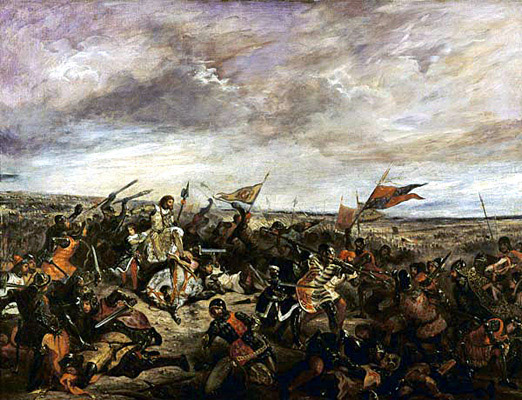
Battle of Poitiers by Eugene Delacroix, 1830


A decisive battle between England and France is the topic of Bernard Cornwell’s 1356. As Cornwell usually manages, the story progresses along multiple fronts in terms of characters—a Scotsman hungry for English blood, an Englishman with various allegiances and most of all a clear-headed distaste for hypocritical churchmen, and of course the French who are not well served by their finicky aristocracy. At times the story’s abrupt transitions from character to character created a jarring loss of focus for this reader, but as I slowly became acquainted with the multiple subplots and nuances of the various personalities, the story flowed increasingly faster toward spectacular final scenes.

The Battle of Poitiers is a perfect subject for Cornwell to demonstrate his chops in portraying men at war. He doesn’t hesitate to fill passages with horrific details of brutality whether macabre emasculation, hunger and thirst, visceral suffering of horses in these times of heavy armor, or mere details of sweat and bowels. I’ve been remiss in studying this particular time of European history, having so far preferred the Viking era and the Northmen’s invasions of the British Isles circa 800 AD. [To that end, I’m still emotionally engaged with Uhtred, the hero of Cornwell’s Saxon stories.] While I acknowledge I can never read or learn enough to satisfy my curiosity, I hope to follow next with Cornwell’s Agincourt which picks up the 100 Years War fifty years after 1356.

One of the things I like most about Cornwell, other than his ability to teach me the fascinating history of world-changing events, is his determination to paint the full picture of life in those times. He’s especially good at portraying the corruption of the Catholic church. The plight of women and children, the means of food production, and the daily travails of travel and social interactions all push along in his stories in the tide of the greater context. It’s fascinating.

The Scenic Route

Between Winslow and Mt. Gayler, across from Grandma’s Cafe

With the opening of Interstate 49, old Highway 71 through northwest Arkansas has lost most of its traffic. Formerly thriving businesses like the Smokehouse Restaurant near Mt. Gayler have folded up and slipped away in the night. Towns along this formerly packed thoroughfare have suffered losses as well, especially enterprises that depended on highway traffic as much as local customers to keep the black ink on their bottom lines.

Soon after the new four-lane highway opened with its easier grades, straighter curves, and swooping (terrifying) bridges high above the mere mortals below, state and regional officials began marketing the old highway as the “scenic” route. And it is, without doubt, scenic. Crossing the Boston Mountains with their sheer drop-offs and stunning vistas never fails to inspire.

Main Street, Winslow

Yet now more than ever, the underbelly of the Ozarks blossoms into view. Not so scenic are places where the property owners have lost the fight with their ‘stuff.’ Mounds of trash, some of it looking as though it was simply tossed out the door, litter their places of habitation. Old vehicles and various implements once used in the pursuit of livelihood sit haphazardly around the place. Cobbled-together homes make creative use of plastic sheeting and various and sundry bits of construction material.

Winslow across from new Dollar Store

These places have become a regular irritant to some locals, one of whom took these photos and sent them to me after I said I’d write a blog post about it. Locals like us have long since accepted the fact that some folks either can’t or won’t make the effort to present a respectable front to the world. There’s no shortage of such scenarios along just about any dirt road you might care to drive. But along the highway, a highway advertised as “scenic,” these places paint the entire region with a dismal color of decay and poverty.

Maybe the world expects to see evidence of destitution and apathy in the Ozarks. After all, ever since the publication of the “Arkansas Traveler” song in 1840, this region has suffered the disdain of many for its slovenly ways. Even now the more ‘civilized’ regions on either coast consider all of the hill states to suffer similar inability to come up to snuff–not that they don’t have their own ghettos.

Across from Silver Leaf campgrounds, Winslow

Unfortunately, time and again those stereotypes are borne out in real life. Homeowners barely scrape by, making do with what they’ve got, saving every scrap in case it might be needed. Or they’re renters unwilling and/or unable to improve on a place they’ll never own and whose owner can’t be bothered to make needed repairs. Or people whose lives have run over them with injuries or job loss or a litany of emotional defeats that leave them incapable of trying to make things better.

Brentwood

There are no zoning laws in Washington County that require people to clean up junk piles or dead vehicles or really much of anything. It wasn’t until the last couple of decades that an ordinance was passed requiring that electrical wiring standards be met in rural housing and that came about only after children died in a fire caused by poor wiring. Laws forbidding the surface disposal of sewage passed only a short time before that, and even now a properly-built outhouse remains legal despite the karst geology that allows pollutants to rush right through fractured layers of rock and loose soil to percolate into groundwater that surfaces as springs and streams. All of it, including discharge from septic tanks, ends up in Beaver Lake which supplies drinking water for the entire region.

It wasn’t until the late 1980s that landfills were required to monitor discharge and place liners under the trash. Some efforts have resulted in the cleanup of junkyards where vehicles in various stages of decay leak oil, gasoline, and various other noxious fluids into the waterways. Other efforts attempt to stop residents from openly burning trash, a practice that releases toxic chemicals like dioxin, furans, and dangerous particulate into the air we all breathe.

But there’s a mindset lurking in the minds of our people, that this is their place and they can damn well do what they please.

And so they do.

The Honorable Act of Protest

Students who walked out of their Montgomery County, Maryland, schools protest against gun violence in front of the White House in Washington, U.S., February 21, 2018. REUTERS/Kevin Lamarque – RC164B322F90

The student walkout last Wednesday presented an excellent parenting opportunity. Sadly, a significant number of parents failed to recognize the opportunity. Instead, many of them sided with authoritarian school boards who insisted that any student who walked out of class in honor of the seventeen students killed at Florida’s Parkland high school should receive disciplinary action for his/her outrageous rebellion.

Parents had the choice to support this, to teach their kids about the history of protest that forms the foundation of our nation. Our country began as a protest. Important change over the subsequent centuries occurred due to protest, not quiet little acceptable moments condoned by the powers that be, but full-bodied march-in-the-streets, dump-your-damn-tea-overboard protests. This was a chance for parents and community leaders to demonstrate a true understanding of what protest means to our nation.

And to our future.

It’s sad to see that so many don’t understand, tragic that so many accept the conditioning to stand quietly and wait for someone to tell you what to do, what to think. It bodes ill for our future that what we seem to be teaching in our schools and homes today focuses on doing what we’re told instead of what is right. Sit in your assigned desk. Don’t talk. Remember to bring a pencil. Stand quietly in line.

This is training for lock-step corporate workers, not the thinking adults needed to guide our nation forward in a time of great global change. Where is the critical thinking, the understanding of history, that education is supposed to instill?

Yes, the need to stand up for the right thing may have consequences. Many of the students who walked out of class despite draconian threats of suspension and other disciplinary action understood and stood up for their rights anyway. This alone should cheer us all with hope for our collective future.

The acceptance and embrace of authoritarianism raised its ugly head last week, a fitting reminder of the mindset that allowed Donald Trump to become president. Above all else, his election to the highest office in our political system reflects this pervasive eagerness for an authority figure who claims to know the right path. This world view reflects the fear of so many who can’t catch up with the times,  with a world going too fast for their 19th century brains to understand what is required of them. They don’t like change. So the solution is a strict set of simple rules enforced by a blustering promise-maker.

These kids aren’t having it. Thank you, kids.

Those Pesky Emotions

From https://www.thenewsgeeks.com/healing-emotional-pain/

Upon waking, I had thought to visit the library in search of more books by John Banville, a particular author who inspires me with his style of writing. I am currently halfway through one of his books and have periodically laid the volume aside to hack again at a long labor of mine, alternately caressed and despised, for nearly fifty years. This memoir relates a seven-year period of my life, if it ever sees print, both gut-wrenching and pathetic, a lament, self-aggrandizing, a confessional if you must.

Banville’s style is similar to my earlier writings, what came out of me in those days before I had published anything. My technical articles had seen print, and even essays on various personal topics—dreams, remembrances, all of it boiling with emotion. But after that first book, my writing wasn’t my own. I felt watched, self-conscious, fully inadequate to create anything of merit. What did I know, anyway?

Since then I have detoured into historical accounts of one thing or another, not anything to be ashamed of but nevertheless not of any emotional import. My slim efforts at fiction, where in theory emotion must reign supreme although within the harness so eloquently described by Frost, have failed to engage me—or readers. I have been terribly disappointed in that effort, as it seems I am unable—unwilling, in fact—to express or convey emotion because I steadfastly refuse to experience emotion. This failure is, as one of my characters says in a flash of fury, a response to the reality that emotion leads to pain.

Not just any pain, but a deep intractable burn that settles in the bones and leads like a labyrinth to all the many experiences of pain that I have swallowed down in the years of my life. Why should I willingly lay myself open to examine those hopeless dead-ends and hidden mortuaries? It’s not as if a re-examination will make anything change. I can’t excise the pain like a surgeon removing a misshapen, hidden tumor. Looking at and expressing it does nothing to ease its ability to wound. And re-wound.

But yet, as a writer, I must create stories that convey the experience of pain, of sadness, loneliness, despair, and all other human torments (alongside joy and pleasure, the light part of duality, the yin-yang) in order to give readers what they want. There’s some sickness in that formula, that readers seek new sources of pain in order to exhume and then exorcise their own long-hidden suffering. Is it that we don’t know we have pain? That we must cast our eyes along the pages to learn what we’ve hidden from ourselves? Is it that in living through fictional pain, distant as we are from any personal experience of it, that we can set aside the dragging fingernails of our own grief?

Honestly, I don’t know the answer. I only know I that must write, and in so doing, I become caught up in the expectation that what I write will have some meritorious impact, and in that I will gain not only self-respect but also some small congratulation even if only from a few. And so I daily strive, like today, to expand my understanding of how and why people read. I endeavor to learn more closely the peculiar ways in which successful authors manage their craft. John Banville wields words like an expert swordsman and inspires me to take a fresh look at my memoir in the belief, perhaps delusional, that if I can only find the right words, a more musical phrasing, a more authoritative approach to my efforts, I might then be able to invoke the appreciation Banville has garnered.

However, the morning nearly gone and having attended—shall we say deviated from my original intent?—to various uninspiring tasks and only just now trying again to read for inspiration, I am distracted by my plan to visit the library. I am only halfway resting in my chair, so urgent is my sense of duty to get in my car and go.

Which makes no sense because I have a half book left to read and therefore no urgent need to visit the library. I have business at the bank and mail to drop, but that’s only side dressing to my actual underlying urgency to visit the library this very moment. It’s not that I wouldn’t like a couple more Banville books in order to compare his style from one work to the next. Of course I would. The real underlying truth is, I want to escape this duty and secure a stack of romance novels to get lost in, to vacate any responsibility to learning or writing, and simply disappear into a fictional world not of my own making.

This leads me to suspect that if I was able, theoretically, to set my emotions free from their harness to run rampant across the page, I would be confronted with feelings I might not want to hear or see and be forced to start cudgeling them back like the wild beasts they are. Or, as I once understood it, I might start screaming and not be able to stop, embarrassing me, my pets, and the neighbors.

The Kiss

I mostly don’t remember my dreams anymore. When I was younger, dreams wound out in vivid detail, some of them becoming stories with strange twists and turns. I regret the loss of that talent or torment or interface with other worlds.

Last night I dreamed a dream I remember intensely. Sadly much of the detail melted away as fast as I dreamed it. But what I remember echoes through me, a repeated experience of great emotion and yes, questionable meaning. I had arrived in a place not familiar, a small wooden frame house with a high porch that I entered as if someone welcomed me there. I stood in the narrow living room, well lighted in the afternoon sunshine, facing a man I once loved.

I still love him, love him in that way we can with those we never completely knew, never joined in the flesh or struggled through the ups and downs of an intimate relationship. I can’t actually discuss all the ways I did know him because how we met and what discourse we participated in over a period of years actually would identify him and would undoubtedly create problems.

Not for me. The situation for me was entirely different than his and even more so now. He’s still married, still in a position of importance in his profession, and esteemed by a great many people. And justly so. He is a truly Good Man.

But then, of course he is. He’s made it the objective of his life to be a good man, and has done admirably well in such a difficult pursuit. In my most fevered moments in our acquaintance, I highly resented his determination to be good. I was not then and am still not, a ‘good’ woman. I’m also not a ‘bad’ woman, but that’s beside the point. And another story entirely.

In the dream, he stood before me in this small well-lighted room, a place with pale blonde  furniture, what there was of it scattered around the place. Behind him, a small table built of a light colored wood sat surrounded by its four chairs. A patterned cloth draped over the table at an angle so that the cloth corners dropped onto the chair seats on each side leaving the table corners bare. The cloth pattern featured faded yellows and greens on a cream background, and these were the same colors as the upholstery on a small couch near us in the living room and perhaps an overstuffed chair, although these were items that I didn’t examine closely.

And why would I? The object of my attention, my full and astonished attention, was him, this amazing good man who for reasons never made clear in the dream, welcomed me into his arms. Whatever I had been carrying, if indeed I carried anything, dropped from my hands as I accepted his invitation.

His chest felt warm and strong as he pulled me into his embrace although now, in trying to remember, I can’t envision how his chest looked or what he wore. Perhaps a dark suit over a white shirt with an open collar. The image seems to have evaporated into a misty phantasm so that nothing below his neck remains concrete in my memory. I regret that this is so, because in real life his chest like the rest of him satisfied, even more than satisfied, the requirements of robust manhood. Not overly muscled. But lithe. Strong. Pleasing.

Tight against that chest, I felt his warmth and his affection. That he grasped my face with his hands and lowered his mouth to mine surprised me, pleasantly so. I had longed for him to kiss me almost as long as I knew him, and it was an act that had always been refused on the grounds of his marriage and his fidelity to his role as a Good Man. The kiss rapidly kindled a deep need, apparently, in both of us, and the gentle touching of lips transformed to a passionate embrace of open mouths and tongues.

In the dream, I worried that his wife would see us and be unhappy about our transgression. He looked away without letting go of me, as if peering out the bright window to see what he needed to see, and then returned to me with his hazel eyes crinkling in a smile, that reassuring smile I’ll always remember, to say I shouldn’t worry. Then he kissed me again, this time softer, more reassuring, more comforting than erotic, and for a long time I marveled at the sensory wonder of that touch of lips, how soft his were, how deeply my lips buried against his.

I can see his face, still, and his wavy hair and the crinkle of his eyes when he smiled. He had a terrific smile, which would have been even more wonderful if it had been reserved for me, but of course it was not. It was his professional smile, probably not simply reserved for his many acquaintances and clients in his work, but his smile for everyone. Probably even the smile he gave to his wife and child. But I wanted it for myself. I wanted to be special, not an acquaintance or a client but me, a unique and mysterious element of his life that set me and us apart from the rest of his life.

Maybe I was. He told me, more than once, I was special. To him. That he loved me. But it was agape love, not physical. Transcendent. Nothing infuriated me more, that he insisted on that. Only once did he let that curtain slip, if it was a curtain. Maybe it was only once that he lost control. Or only once that he felt anything more than his perfect good acceptable kind of love.

He did kiss me. We embraced over the console of his sports car, a fevered touch of lips and then more until we were both sinking into the erotic in ways that I had come to expect in my life, ways of freedom and basic human honesty and pleasure. I don’t know what he expected, whether he planned that moment as a brief ration of the forbidden or if it caught him unawares in the midst of trying to help me, pull me back from the brink of despair. I don’t know if those few moments, really only a few, of what some might consider an almost innocent touching of lips, and then slightly more as the kiss deepened and our tongues spoke the silent language of desire, whether those were the only moments in his entire good life that he deviated from his intended path.

In the dream, he wasn’t troubled by the kiss. He was fully in the moment, focused on me, on holding me in his arms and savoring what we exchanged. His objective, it seemed, was to reassure me, convince me of something important, that he cared, that he had always cared, and that what we had would never be diminished or lost.

I don’t remember anything else, and it seems this must have been the main event of this longer scenario that faded into mist like the yellow and green patterns on the tablecloth. I woke up telling myself to remember it, afraid that like most of my other dreams it would slip away into nothing and that when I tried to retrieve it, it would vanish from my fingertips. By some miracle, the memory remained. And even now, as the day drifts again into the early gray evening of a rainy late February day, the image of him, of his hazel eyes and the curl of his hair and the angle of his jaw and the sensual curve of his lips, remains clear in my mind.

What I feared most when I woke up, when I showered and dressed and made my tea and sat at my desk, was that somehow this dream marked his death. That in the night as I slept, he had passed into the ether and from that brilliant space had joined with me for one last moment of expressed affection. I searched the internet for news, hoping that surely if he had died, there would be an announcement, a notice, for he was well known. There was nothing of his death, only other news of his accomplishments, press releases, his position on boards of directors and other such ephemera.

Perhaps he did not die and the dream rose from the depths of my memory, my loneliness, if indeed I am lonely, for I do not consider myself lonely except in the strictest terms of that condition. Yes, I am alone. I am not lonely. Perhaps something of my current endeavors or books I’ve recently read have opened a path to that phase of my life so that all the unresolved angst of my desire and his restraint has found a path to my present. It’s been forty-five years, but then, some things are never forgotten.

Or perhaps he did die and this morning was too soon for there to be obituaries and notices and mourning. I will watch and wait.

And I will savor the dream.