How to Grow More Ignorance in Arkansas

Arkansas continues to shoot itself in the foot with the recent passage of new regulations governing home schooling. As a new year begins, public hearings on the latest revisions are open only through January 17. After the public comment period, assuming comments fail to arouse concerns at the Arkansas Department of Education (under the leadership of evangelical Christian Johnny Key), the new rules will be submitted to the state Education Board for approval.

Members of the evangelical right have taken an increasingly militant stance about public education. Partly white flight from integration, partly concern over exposure to gay or minority students and the so-called liberal agenda, and partly public school difficulty in maintaining high educational standards in the face of inadequate funding alongside demand for extraordinary services in mainlining students with special needs, reasons abound for conservative parents to seek alternatives.

But by far the greatest reason for parents choosing to homeschool is their determination to teach religion. Evidently church alone isn’t enough to satisfy this need.

According to the surveys conducted by the National Center for Education Statistics, 91 percent of homeschooling parents are more concerned about the environment of schools and want to offer a religious (64 percent) and/or moral (77 percent) alternative.

Smaller-scale studies of parental attitudes have found the same thing, from the conservative fathers who try to form a moral cocoon around their children, to African-American families who want to foster a sense of racial pride in their children, to “quiverfull” families trying to have enough children to Christianize the United States by demographic transformation.[1]

Obviously none of these interests coincide with the need for good citizenship in a blended American society.

In Arkansas, where fundamentalist religious teachings flourish under the guidance of such groups as the Family Council (a conservative research, advocacy, and education organization), the self-explanatory Clark County Christian Home School Organization, and the even more self-explanatory Texarkana Organization for the Resolute Christian Homeschoolers, state lawmakers have signed off on the radical Christian agenda.

On the surface, it might seem a worthy effort to give parents more control over the education of their children. After all, parents love their children and want what’s best for them. The problem lies in the parents’ judgment about what is ‘best.’

Is it best for parents to be the sole instructor and judge of their children’s education? Is it best to prioritize religious beliefs over the U. S. Constitution? What if parents don’t care much about history or math or computer skills, but prefer their children only understand the Bible?

What is the responsibility of the state to ensure that it doesn’t end up with a significant number of young adults incapable of holding down a job, getting along with their neighbors, or functioning as a thoughtful voter?

The latest round of regulations, promulgated during the 2017 legislative session, clarifies requirements for homeschoolers moving in or out of the public schools  and in particular their participation in sports and other extracurricular programs. (Never underestimate the importance of football—and, to a lesser extent, other sports—as the state’s second religion.) As the numbers of homeschoolers have grown, so has the burning need to allow an overlap of public school football and homeschoolers.

Most importantly to anyone concerned about the nation’s future and the potential for our very own religious war, the new regulations remove the state entirely from any oversight of homeschoolers.

“[The statute] eliminates all state-mandated testing and reporting of courses taught and grades earned.”[2]

No one will know if home schooled students are learning any of the reasoning skills or basic facts essential to the maintenance and advancement of our society. No one knows or apparently even cares whether the parents are capable of teaching or well-educated themselves. Most of all, no one seems to care that isolated segments of the population are being given free rein to seclude themselves harboring potentially seditious motivations.

Parents wishing to cloak their children in fundamentalist Christian beliefs can blithely ignore scientific evidence of the earth’s geologic age or evolution of species. They can sidestep entirely the subject of human reproduction and its greater context in biology. Thousands may emerge from their ‘education’ with no knowledge of how babies are made or the use of birth control, much less how lifetimes of suffering might be avoided through pre-natal testing.

No one will know if students are learning that government is evil. No one will interfere if children are taught to ignore the political process or the vital responsibilities of citizenship. The state is stepping back, washing their hands, of the original dictates of the nation’s earliest leaders who recognized the importance of education. Will any of these children, or their parents for that matter, comprehend the urgent truth in the statements of our Founding Fathers?

George Washington: “The best means of forming a manly, virtuous, and happy people will be found in the right education of youth. Without this foundation, every other means, in my opinion, must fail.”

James Madison:  “Learned institutions ought to be favorite objects with every free people. They throw that light over the public mind which is the best security against crafty and dangerous encroachments on the public liberty.”

John Jay: “I consider knowledge to be the soul of a republic, and as the weak and the wicked are generally in alliance, as much care should be taken to diminish the number of the former as of the latter. Education is the way to do this, and nothing should be left undone to afford all ranks of people the means of obtaining a proper degree of it at at cheap and easy rate.”

James Madison: “What spectacle can be more edifying or more seasonable, than that of liberty and learning, each leaning on each on the other for their mutual and surest support?”

Thomas Jefferson: “If a nation expects to be ignorant and free, in a state of civilization, it expects what never was and never will be. …Educate and inform the whole mass of the people… they are the only sure reliance for the preservation of our liberty.”

Surely not all homeschooled children will turn out to be close-minded religious zealots incapable of reasoned understanding of complex issues such as immigration, minority rights, or the nuances of gender and sexual orientation. But as the numbers of homeschoolers continue to increase in Arkansas and the state continues to back off any meaningful oversight, the potential for rabidly ignorant and potentially treasonous segments of our population increase exponentially.

[From a 2012 article in the Arkansas Democrat-Gazette]: The latest count of home-schooled students in Arkansas shows about 400 more students are learning at home compared to the previous year. The Arkansas Education Department said 16,405 students completed the 2011-2012 school year as home-schooled students. That’s compared with 16,003 in the prior year. …State records show that in 1986, 572 students were home-schooled in Arkansas. By 1992, the number was 3,140, and by 2002, 12,497 students were being taught at home. The 16,405 children home-schooled last academic year is equal to 3.5 percent of the state’s 468,000 public school students.[3]

The count in 2017 was 19,000.

~~~

To voice your concerns, view the draft rules at http://bit.ly/2BTClJb or email your thoughts to ADE.RulesComments@arkansas.gov

~~~

Yes, I’ve blogged about similar topics before.

The Poverty of Conservatism

Conscious Evolution

Treason in the Name of God is Still Treason

A Sword Cuts Both Ways

~~~

[1] https://newrepublic.com/article/122987/does-homeschooling-make-children-more-religious

[2] “Home-school rules redo gives parents more rein,” by Cynthia Howell. Arkansas Democrat-Gazette, Northwest Arkansas edition, December 30, 2017. Page 5

[3] “Number of home-schoolers in state rises again,” Associated Press. Arkansas Democrat Gazette, September 10, 2012.

America’s New Greatness

When America was great.

It’s been a crushing year. One after another, hard-won social advancements have been blocked or dismantled in the rush to “Make American Great Again.” But what does that even mean?

Exactly when was America greater? When everyone used outdoor toilets? When women couldn’t work outside the home? When skin color decided who could marry whom, or vote, or eat at a lunch counter?

Is ‘great again’ a worthy goal, the best we should expect? Is the conservative mantra right, that free enterprise and individual liberty “under limited government” was and forever will be the pinnacle of human achievement? If only we could rid ourselves of this ‘big government’ and free ourselves of onerous taxation, would the U.S. of A. become the shining star of the days of yore?

No, no, and no.

Let me explain. At the time of the Founding Fathers, ‘free enterprise’ applied to white male landowners. The constitution ignored the rights of women and non-landowners. Voting rights for Natives or slaves never entered the discussion. The founders conceived of a nation of educated, well-to-do white men who used women, natives, and slaves to meet self-serving goals in creating heirs, seizing ever greater slabs of the continent, and forcing labor from non-whites in order to sustain and increase their wealth.

They weren’t evil men. That’s just how things had always been. No wonder certain white males today would see those as the glory days.

But there’s no lack of free enterprise. Men and women of any class or color routinely open their own businesses. Three out of ten workers in the U. S. are self-employed or are hired by self-employed persons.[1] The ‘small business’ community provides the majority of American jobs.

…large businesses only employ about 38 percent of the private sector workforce while small businesses employ 53 percent of the workforce. In fact, over 99 percent of employing organizations are small businesses and more than 95 percent of these businesses have fewer than 10 employees. The reality is that most Americans are employed by a very small business that has little in common with the tiny sliver of the business demographic represented by corporate America.[2]

The complaint of conservatives is that free enterprise is hindered by big government. They rail against requirements that employers pay into insurance policies that provide medical care for workers injured on the job or that provide health care that meets the employees’ needs. Employers also must pay into Social Security and Medicare funds on a 50-50 basis with the employee’s withheld funds. Employers are required to deduct the appropriate amount of state and federal income tax from employee wages and to deposit this tax into government accounts. Employers also must provide a wage statement at the end of each year (W-2, 1099, etc.).

These requirements annoy the hell out of employers. When I operated my own café, I spent hours working on payroll. I resented spending money on workman’s compensation insurance – I never had an injured employee and all that I paid was money down a hole. But I understood the reason for it. If an employee had become injured, should I expect the government to pay for medical care? Should I personally pay for it? Should the employee be abandoned to pay himself?

These are old problems solved incrementally over a long period of American history back when a majority of legislators worked for the people instead of themselves. We stopped sending disabled or aged persons to poor farms where a pitiful stipend from the state supported them along with the random generosity of wealthy donors who might drop a few crumbs from their tables. We stopped allowing employees to be injured or killed in unsafe workplaces. We required people and their employers to set aside funds for retirement.

Like the Affordable Care Act, social support systems developed by our elected representatives to better provide for the ‘general welfare’ are an evolved safety net for all of us. The simplistic idea that these systems should be dismantled in pursuit of some long-vanished ideal of “free enterprise” fails to recognize all the reasons these systems came into being in the first place. We need them. They serve an important purpose.

‘Individual liberty’ is another often-touted phrase by deconstructionist conservatives. What that concept meant to the founders no longer applies in our current reality. The founders lived on the edge of an unexplored country with such a vast reserve of lands that no one could imagine a time when there weren’t new horizons where young men could ‘go West’ to make their fortunes. Individual liberty was possible only because men gained forty acres or more by simply staking a claim or, in many cases, serving in the military after which they received land grants.[3]

What land is free now? None.

What we took from the Natives was a virgin continent full of natural resources. The lands of Europe had been exploited for over two thousand years and here was a whole new start. Individually and collectively, we harvested those resources while patting ourselves on the back about how smart and industrious we were in building a fabulous new nation. We never considered that sooner or later, the last farmland would be plowed, the last gold nugget would be found, and we would run smack up against the end of the bonanza. We did the same thing here that our forefathers had done in Europe.

Conservatives, enraptured with these myths of a glorious past, believe we can return to times when anyone who wanted to work hard could simply plow his way to success with a mule and a compliant wife. Women, keen for their own ‘individual liberty,’ aren’t so compliant anymore. Farming is no longer a viable path to sufficient livelihood.

Obviously our living standards have changed. No more outdoor toilets or working the fields from dawn to dusk. We’re dependent on electricity and modern medical care and automobiles, all things that as recently as a hundred years ago simply did not factor into the picture for a majority of Americans.

Ever in pursuit of their bankrupt myth, the conservatives’ last gasp is the current grab of political power, attained by selling the myth to those who don’t understand. The conservatives are busy ending food and medical care for the aged, the homeless, and other needy segments of the population. The entire social net crafted over decades is being dismantled in a futile grab for a long-lost past.

The descendants of European colonialism want the glory back. They don’t agree that taking from the rich and giving to the poor is the right approach for modern societies. European nations have already grasped this concept. America today and in the future can never be the America of 1800 or 1900 or even 1950.

Making profit off of sick people or school children is immoral. Just as government regulates utilities, so it must regulate other services required by everyone, including health care and the internet. This is not an appropriate arena for capitalism. Government, not profit-driven capitalists, serves as the most efficient provider for the common welfare –healthcare, affordable housing, education, public transportation, infrastructure like bridges and railways, and a vast network of social services.

Reducing the tax burden for the wealthiest among us accomplishes nothing but the impoverishment of our entire nation. The current imbalance of wealth is clear evidence that the rich should be taxed even more. Expanded social programs should ensure that those at the lowest income levels are brought into counseling, health care, education, and training programs in order to improve their economic status.

We’re a largely urban, multicultural society now, completely different from what the Founding Fathers knew. Just as the founders were right to declare the rights of personal liberty, so were progressives right to end discrimination against minorities, women, and the handicapped and to provide mechanisms by which the damages of such long-term discrimination could be healed. It’s the progressives who have understood that the safety net must be available equally from state to state, a service that only the federal government can ensure.

The personal bankruptcy of a small number of men like Donald Trump and Steve Bannon cannot be allowed to dictate the future of our country. Such men long for a culture where white maleness guarantees ascendancy. Without a white male-dominated social structure, they cannot gain the power they so desperately crave. These are weak men dependent on the subjugation of others for emotional and economic support. They will die off just as the Neanderthal died off.

It’s called failure to evolve.

Here’s a toast to 2018 and the continuing evolution of our great nation.


~~~


[1] http://www.pewsocialtrends.org/2015/10/22/three-in-ten-u-s-jobs-are-held-by-the-self-employed-and-the-workers-they-hire/

[2] https://www.huffingtonpost.com/kristie-arslan/five-big-myths-about-amer_b_866118.html

[3] Bounties of up to 1,100 acres were granted for Revolutionary War service between 1775 and 1783 and up to 320 acres for the War of 1812 through 1815. Additional free lands went to men fighting in the Mexican War 1846-1848 and in Indian Wars from the 1780s through the 1890s. While outright land grants ended in 1855, Union soldiers who fought in the Civil War received homestead rights along with others meeting certain criteria. Much more on land grants and homestead rights at Wikipedia.


What About Cherry Pie?

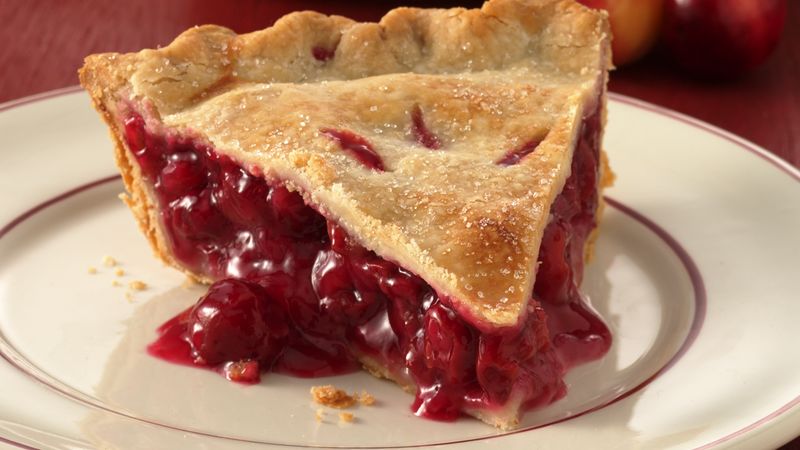
I love cherry pie. Baking cherry pie as a must-have part of family tradition goes back at least as far as my maternal grandmother and the early 20th century. For the last few years, I’ve skipped the cherry pie not out of intent but out of convenience. With the kids grown and my waistline growing, baking for the holidays has become a questionable activity.

This year I really wanted a cherry pie. So I looked for cherries. Not the fat sweet fruit that can be found canned, frozen, or in the fresh fruit department, but those tart cherries that produce such a fabulous flavor when paired with delicate pastry crust. Yum!

After searching my regular grocery stores, I realized there must be a cherry Grinch out there. Not only were there no tart cherries frozen, canned, or otherwise, there weren’t any empty places on the shelves where they might have been. What is going on?

[For the record, canned cherry ‘pie filling’ is so far off the mark that I refuse to take it into consideration. Mostly sugar and cornstarch, these fillings are no substitute for the real thing.]

I searched online and discovered that for a mere $76.60, I can order five pounds of frozen tart cherries. That’s right—a staggering $15.32 per pound. Plus shipping. Other sources offered slightly better deals. Organic tart cherries, 4.5 pounds for $69.89. Three 24-ounce jars of cherries for $51.95. Or my old standby brand of canned tart cherries, Oregon, only $4.31 per 14.5 ounce can. Plus $8 shipping.

That brings a nine-inch pie, which requires a minimum of two cans, coming in at a cost of $16.60 for the cherries alone.

I’m priced out of my pie!

More research starts to reveal some basic truths. A few years ago, some genius discovered that tart cherries offer all kinds of health benefits including the big headliner, antioxidant effects. A plethora of publications heralded the news, such as an article in Men’s Health citing a study published in the The American Journal of Clinical Nutrition.

In the study, mice with Alzheimer’s symptoms were fed cherry extract, fish oil, and emu oil. Mice running on tart cherry extract performed better on cognitive tests like object recognition than did the control group.[1]

The kicker bit of that study revealed that tart cherry juice performed better in reducing high blood pressure than expensive medications!

No wonder the price of cherries has gone through the roof. They’re in demand as a juice (32 ounces of organic juice for $18.99 from one source) as well as a nutritional supplement (200 capsules of tart cherry 4:1 extract from 300 milligrams and mixed with rice powder—for $11.21).

What is the curious tree at the center of this health versus culinary pleasures conflict?

Prunus cerasus (sour cherry, tart cherry, or dwarf cherry) is a species of Prunus in the subgenus Cerasus (cherries), native to much of Europe and southwest Asia. It is closely related to the sweet cherry (Prunus avium), but has a fruit that is more acidic.

The tree is smaller than the sweet cherry (growing to a height of 4–10 m), has twiggy branches, and its crimson-to-near-black cherries are borne upon shorter stalks. There are several varieties of the sour cherry: the dark-red morello cherry and the lighter-red varieties including the amarelle cherry, and the popular Montmorency cherry. The Montmorency cherry is the most popular type of sour cherry. The reason for its popularity is its use in baking and recipe creation including cherry pies, cherry desserts and other cherry-based recipes.

Well, maybe not so much anymore, now that the harvest is almost entirely devoted to diversions like cherry juice and cherry nutritional supplements.

The fruit’s discovery and popularity dates back to the Romans:

The history of the ‘Montmorency’ tart cherry extends back to ancient Rome. The Romans are credited with discovering this tiny red fruit along the Black Sea in Asia Minor. After Roman legionnaires discovered the tart cherries, they carried them with them and introduced them to the rest of Roman territory. They planted cherry trees alongside Roman roads and soldiers used the fruit for food and the wood to build weapons and repair equipment.[2]

Seems the Romans knew a good thing when they saw it.

The problem isn’t just that newly discovered health benefits have cornered the cherry market. The sour cherry tree likes cooler climates, so much of the domestic crop in the United States grows across the upper regions of the country. And that, according to one farmer’s account as stated in a 2017 report on National Public Radio, is key to my lack of a cherry pie.

The tree is “very cold hardy” in the dead of winter, he says, and grows well in the state. But it is susceptible to damage from spring frost, making it very sensitive to the extreme weather shifts made more likely by climate change… In 2002 and 2012, freezing spring temperatures wiped out almost the entire tart cherry crop here [in Michigan].[3]

Farmers faced with this problem point to efforts underway since the 1980s to produce a new strain of sour cherry tree that would be more forgiving of weather anomalies, but such developments take a long term of trial and error. The farmer quoted in this article questions whether the Montmorency will still be around in fifty years.

Also suffering the effects of climate change, bee populations needed for cherry tree pollination have plunged, forcing many cherry farmers to make extreme efforts to sustain their own bee colonies.

Sadly, many farmers refuse to consider climate change as a factor in their troubles with sour cherry production and thus a potentially powerful lobbying voice is not yet making enough noise for the government to pay attention.

Even if the government turned massive attention and resources to this issue, it’s questionable whether anything can be done. At best estimates, the current rate of climate change won’t be changed any time soon. But there is hope, although I wonder if it will come in time for sour cherries.

We emit greenhouse gases like carbon dioxide when we burn fossil fuels like coal—or when the cattle that get turned into burgers fart. When those emissions enter the atmosphere, they trap the sun’s heat, warming the planet. It’s basic physics. The increased heat can become catastrophic by melting the polar ice caps, raising sea levels, and creating weather patterns that are less predictable, more volatile, and more dangerous. Because we’ve been warming the planet this way since the early days of the industrial revolution, we can’t completely avoid the effects of climate change. But by lowering our emissions now, we can avoid the worst effects.[4]

The article goes on to describe a few key changes individuals can make in life choices that will strongly impact climate change including having fewer children and cutting way back on meat consumption. Uh huh.

At my age, I won’t live long enough to see the worst of climate change or the ultimate fate of my beloved tart cherries. That’s just one of many regrets facing me and everyone else as we grow older. But I may experiment with dried cherries to see if rehydrating produces a decent pie. The least expensive source I’ve found offers a one-pound bag for $11.99.[5]

Here’s a recipe I’m going to try, assuming I can afford the shipping:

  • 3 c. dried cherries
  • 3 c. boiling water – some recipes suggest cherry juice instead of water
  • ¼ c. cornstarch
  • 1 c. sugar
  • 1 tsp. almond extract or ⅛ tsp. lemon juice (alternatively, try brandy or Amaretto)

Cover cherries with boiling water, cover and let soak for 30 minutes. Turn burner on medium, simmer and add sugar and flour to thicken. Remove from heat, add almond extract. Pour into prepared pie crust and add top crust. Bake at 400 degrees for about 35 minutes.[6]

I’ll let you know if it’s worth the effort.

~~~

[1] https://www.mensfitness.com/nutrition/what-to-eat/5-health-benefits-tart-cherries

[2] https://en.wikipedia.org/wiki/Montmorency_cherry

[3] https://www.npr.org/sections/thesalt/2017/04/07/523004370/michigans-tart-cherry-orchards-struggle-to-cope-with-erratic-spring-weather

[4] Excellent article “How You Can Actually Help Stop Climate Change” by Kendra Pierre-Louis, published July 12, 2017, in Popular Science magazine. https://www.popsci.com/how-to-stop-climate-change

[5] https://nuts.com/driedfruit/cherries/sour-tart.html

[6] Adapted from https://www.justapinch.com/recipes/dessert/pie/homemade-cherry-pie-filling.html

The New Censorship

Courtesy https://medium.com/@AspieSavant/the-worst-part-of-censorship-aab7879c9f2c

The latest absurdity to emanate from the Trump White House is the edict to scientists at the Centers for Disease Control that they cannot use seven words in a report that will be part of the 2019 budget request. The words are vulnerable, entitlement, diversity, transgender, fetus, evidence-based, and science-based.

If I were a scientist working on that report, I would be strongly tempted to go through the draft that contains those words and simply black them out. That would remove them from the report, as requested. Let those who don’t want to see those words guess what’s under the black mark.

My second temptation would be to replace the words with a first letter and a following blank, as in t__________. Since all the forbidden words begin with different letters, it shouldn’t be too difficult for the reader to figure out the missing letters.

Alternatively, authors less willing to be openly defiant could resort to lengthy talk-arounds. For example, “vulnerable” could be replaced with “persons who through birth defect, age, illness, or other conditions are less able to resist potential harm from…”

“Entitlement” would become “the condition of having a right to have, do, or get something, or the feeling or belief that you deserve to be given something (such as special privileges), or a type of financial help provided by the government for members of a particular group.” Readers get to choose which meaning they prefer.

No reasons were given for the banishment of these seven words. Observers are left to speculate whether more words might be forbidden in the coming months and what they might be. Already we’ve learned that agencies may not refer to “global warming” or “climate change,” all part of this administration’s fervent embrace of denialism. Such an approach speaks volumes about the close-mindedness of the Republican right.

In the psychology of human behavior, denialism is a person’s choice to deny reality, as a way to avoid a psychologically uncomfortable truth.  Denialism is an essentially irrational action that withholds the validation of a historical experience or event, when a person refuses to accept an empirically verifiable reality. In the sciences, denialism is the rejection of basic facts and concepts that are undisputed, well-supported parts of the scientific consensus on a subject, in favor of radical and controversial ideas.[1]

Explanation is also missing about who in particular requested these restrictions. No one would be surprised if the proclamation came from the petulant-child-in-chief himself, since he prefers monosyllables. Maybe the four-syllable “diversity” is too much for him to move his lips over as he attempts to read it. With his utter disregard for science as a discipline and the exacting process science pursues in developing “evidence,” he might prefer, in the possible instance of his developing prostate cancer, that his doctor explains “there’s a bigly bad problem in your thingy down there.”

However, advisors whispering at the Big Baby’s elbow surely find political hay to be made from eradicating the word “fetus” in the hopes that report authors would be forced to use a preferred term such as “unborn child.” However, a fetus is not a child, born or not, and scientists would probably be picky about technicalities like that. They might resort to using a phrase something like “a being in the stage of prenatal development between the embryonic state and birth, occurring after the first eleven weeks of gestation.”

If the report isn’t specified to contain a limited number of words, perhaps no one would mind that a concise single-word scientific term like “fetus” would require twenty-two words to replace it.

This points up the deeply ridiculous aspect of the seven-word ban. Our society – and societies worldwide – agree on words like “fetus” to describe a precisely-understood concept. It’s not that the current administration doesn’t understand what a “fetus” is or feels that it needs a bigger explanation. It’s that the word is involved in a political debate about a woman’s right to choose whether to produce a child. The word “fetus” doesn’t trigger the warm fuzzies that make an evangelical want to rush out and murder a gynecologist or chortle over the prospect of an illegal abortion causing a woman to bleed to death.

Similarly, the word “transgender” triggers instantaneous outrage among the more benighted among us. Ready to drag out the Bible to point out where it clearly states that God only made man and woman, these folks aren’t going to listen to reason anytime soon no matter how clearly it’s explained that there’s a whole other world of gender- and sexual identity-reality out there. They still haven’t accepted that men and women can love and desire members of their own sex. Despite their abysmal ignorance and visceral terror over anything other than their mirror image, the prurient interests of these folks prod them to inspect and judge the more intimate details of Other People’s Lives.

Wikipedia:

Transgender people have a gender identity or gender expression that differs from their assigned sex. Transgender people are sometimes called transsexual if they desire medical assistance to transition from one sex to another. Transgender is also an umbrella term: in addition to including people whose gender identity is the opposite of their assigned sex (trans men and trans women), it may include people who are not exclusively masculine or feminine (people who are genderqueer or non-binary, including bigender, pangender, genderfluid, or agender). Other definitions of transgender also include people who belong to a third gender, or conceptualize transgender people as a third gender. Infrequently, the term transgender is defined very broadly to include cross-dressers, regardless of their gender identity.

Being transgender is independent of sexual orientation:  transgender people may identify as heterosexual, homosexual, bisexual, asexual, or may decline to label their sexual orientation. The term transgender is also distinguished from intersex, a term that describes people born with physical sex characteristics “that do not fit typical binary notions of male or female bodies”. The counterpart of transgender is cisgender, which describes persons whose gender identity or expression matches their assigned sex.[2]

It might be difficult to sum up all that in a short phrase in order to replace the word “transgender.”

Our collective intelligence and good will has been insulted repeatedly in the electoral-college victory of Donald Trump. Both before and after the election, he has intentionally incited violence, misunderstanding, prejudice, racism, and division. His performance as president is an international embarrassment. It’s difficult to believe he actually thinks about anything much less reasons. He’s the worst possible person for the role he managed to grab off the gut wagon.

We’ve been forced to accept a presidency of an essentially illiterate man with such a record of abuses, deceptions, insults, sexual assaults, adultery, and overarching greed that it’s difficult to maintain an appropriate level of disgust. While we may hope for a favorable outcome of Special Counsel Mueller’s investigation into Russian meddling in the election, meaning Trump himself would be found red-handed and subject to prosecution, we face the clear possibility that even this last glimmer of faith in our system will also fall by the wayside. And although we hope for a reversal of Congressional control in the 2018 election, even that will not remove the idiot currently occupying the Oval Office.

But this — this censorship of important words — is alarming evidence of the danger facing our nation.

Whether the seven-word ban is a result of Trump’s petulant desire to get his hands on an easier read—not that anyone thinks for a moment he’ll actually read the CDC report—or his acquiescence to the manipulations of people like Stephen Miller, the remarkably under-investigated wizard whirling the bells and whistles behind Trump’s curtain, no one can say. The most terrifying aspect of the straight-jacket this latest outrage places on scientists is the mentality behind it. Words that describe troubling issues are to be eliminated, as if banishing the word somehow banishes the issue.

These are manipulations of a tyrannical dictatorship, not the supposed world leader in freedom of thought and expression. The very idea of banning certain words from anything violates the fundamental concept of our nation and the stated protection of free speech enshrined in our First Amendment,  facts that are no doubt incomprehensible to this moronic president and the one-track extremists behind his agenda.

~~~

[1] https://en.wikipedia.org/wiki/Denialism

[2] https://en.wikipedia.org/wiki/Transgender

Last Minute Gift? Visit your local bookstore

Great gifts abound at your local bookstore. In Fayetteville, Arkansas, that means Nightbird Books on Dickson Street where you’ll find all my books on local history.

Check out Murder in the County: 50 True Stories of the Old West, a collection of murder stories from the 1800s here in this county.

Less expensive but just as intriguing, The Violent End of the Gilliland Boys chronicles the amazing journey of one pioneer family, also a local story.

Don’t live in Northwest Arkansas? Simple — check out all my books at Amazon.com

Best Gift Ever

All around us, every day, the people and events of the past still echo. What is better than to meet those memories and share them with your loved ones?

From 1835 to the present day, the City of Fayetteville in Washington County, Arkansas, has enjoyed a vibrant and colorful history. Its reputation as a regional center for arts, culture, and education began early in its history. Frequently named one of the nation’s Top 10 cities, Fayetteville hosts the University of Arkansas and its famous Razorback athletic teams.

In Glimpses of Fayetteville’s Past, history comes alive in stories of the town’s origins and development. The five articles contained in Glimpses of Fayetteville’s Past focus on under-reported aspects of that history. Published initially by the county’s historical society, these intensively-researched works have been revised and expanded with illustrations, photographs, and maps.

“The History of Fayette Junction and Washington County’s Timber Boom” now include not only an in-depth review of Fayetteville’s first major industry but also three appendices which examine wagon production in Fayetteville, the name and tradition of Sligo, and the Fulbright mill.

“Quicktown” delves into the story behind this quirky short-lived suburb in south Fayetteville.

“546 West Center” tracks the development of a landmark Fayetteville property from its earliest use as a site for an ice factory in the 1880s.

“The Rise and Fall of Alcohol Prohibition” documents the use, production, and regulation of alcoholic drink in Washington County from before statehood through the repeal of Prohibition in 1933, and features indictment and other crime data.

“175 Years of Groceries” follows the transition from country store to supermarkets to big box stores and includes newspaper advertisements showing price changes over those decades.

Whether a reader is interested in learning more about the history of Fayetteville or simply enjoys the peculiar details of how time changes all things, Glimpses of Fayetteville’s Past will inform and entertain.

Amazon buy link


I Met a Goat on the Road

A visiting guinea? A ‘possum in the dining room? What strange and wondrous occurrences can one expect while living on an Ozark mountaintop for over forty years?

These lyrical adventure stories feature chickens, raccoons, bugs, dogs, cats, and natural critters of this woodland home. Throw in a few neighbors who shoot copperheads or remodel the dirt road. Ponder the passage of time through a philosophical lens of wonder and delight. The seasons bring summer heat, winter snow, pouring rain, the power of fire. Lessons learned, questions posed–who has lived and died on this land? What is our responsibility to this place, its creatures, each other?

Come meet the goat on the road.

Amazon buy link

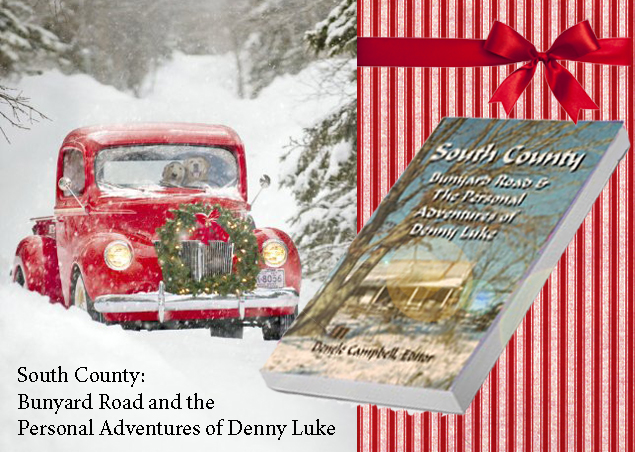
South County

1972. A Yankee learns the Ozarks way and lives to tell his tales. Now almost a native, Denny fondly reminisces about the people and places of his adopted home.

Denny Luke is an adventurer. During his years as a Navy man, he built hot rods with money he made with shipboard loansharking. He returned to his native Ohio where he soon tired of the mechanic’s life. Computers had just started to break the surface in 1966, the perfect attraction to a young man with a sharp mind and plenty of ambition.

Hot cars and Enduro racing occupied Denny’s next few years as he helped usher in the computer age in Minneapolis. But another adventure awaited when in 1970 he fell in with a bunch of hippies. By 1972, he had found his way to the Ozarks.

An avid photographer and storyteller, Denny shares the adventures of his life as he recalls the outrageous backwoods tales and colorful characters who populate the southern fringe of Washington County in Northwest Arkansas.

Amazon buy link

Books Make Easy, Long-Lasting Gifts


Shameless self promotion can’t be avoided when authors have books to sell. While you’ve still got time to receive an Amazon order — or for that matter, time to order through your local bookstore and give them a piece of the pie, here are a few for your consideration.

Shown above: The Violent End of the Gilliland Boys

Christmas Day horse races 1872, Middle Fork Valley. Bud Gilliland waits, eager for another chance at Newton Jones. Only this time, after two years of sparring, Newton gallops up in a cloud of dust, aims his Spencer rifle, and sends Bud to a well-earned grave.

The death of Bud surely grieved his father. But before the curtains closed on these descendants of J. C. and Rebecca Gilliland in 1890, two other sons and a grandson would die a violent death while yet another grandson serves hard time for murder.

What was it about the Gillilands?

This recounting of the family tracks their ancestry, their pioneer years on untamed land, and the hard work that made them one of the wealthiest families in Washington County, Arkansas. A fascinating tale of brash ego, brave gallantry, and bad luck.

Paperback https://www.amazon.com/dp/1977779379

~~~

Serving everything from pita to peach cobbler, Trailside Café and Tea Room became a favorite destination for the few years of its existence. Plate lunches of Pot Roast or Ribs ‘n’ Kraut became overnight hits. Now with a new section on Sandwiches, and a greatly expanded last chapter including many more family recipes sure to be a hit in anyone’s kitchen, Recipes of Trailside Café and Tea Room offers the ‘how-to’ for delicious soups like Split Pea or Potato Leek, hearty salads including Wilted Lettuce, and scrumptious desserts like Lime Pie and the famous Brown Butter Cookies. Over 200 recipes for easy, down home food.

https://www.smashwords.com/books/view/371323

~~~

Contrary to popular notion, Arkansas was part of the Old West along with Texas and the rest of those more familiar dusty southwestern places. Its western border joined up with the Indian Nations where many a weary marshal rode out with his bedroll and pistol carrying writs from the U. S. District Court at Fort Smith in a search for a steady stream of men rustling livestock, stealing horses, selling whiskey, or running from the law.

From its earliest days, Washington County, Arkansas, experienced some of the worst the Old West had to offer. At unexpected moments, county settlers faced their fellow man in acts of fatal violence. These murderous events not only ended hopeful lives but also forever changed those who survived them. Not to say that the murders in the county all stemmed from conflict along

its western border—plenty of blood spilled within its communities and homesteads.

The fifty chapters of Murder in the County each focus on one violent incident. Through family histories, legal records, and newspaper accounts, the long-dead actors tell their shocking stories of rage, grief, retaliation, and despair. A thorough compendium of the county’s 19th century years.

Paperback only  https://www.amazon.com/dp/154427663X


Oh, the Opioids!

Courtesy http://www.sleek-mag.com/2016/12/21/magnum-photos-holiday/

It’s the season of giving, of looking back and looking forward as one year ends and another begins. What better time to consider a fresh outlook on drugs?

Here we are amid the Opioid Crisis, the latest in a long line of similarly heralded events sparking fear, outrage, and call for action. One hundred years ago, it was the Cocaine Crisis quickly followed by the Marijuana Crisis, then the Heroin Crisis. By the late 60s, it was LSD that elicited our fear and loathing.

Doomed to fail from the start, the so-called Drug War was about ‘just saying no’ alongside arming our friendly local cops with military weapons. What we’ve since discovered is that ‘saying no’ meant not talking about it, and that’s a direct route to where we are now. Even worse, we failed to recognize that a war on drugs was actually a war on Americans who use drugs. Now we have embattled inner cities rampant with gun violence and police who dress/act/think like commandos.

What we as a society desperately need to realize is that DRUGS ARE NOT THE PROBLEM. Substance abuse is a SYMPTOM of a much larger and more insidious problem. We’re self-medicating for existential despair.

Existential philosophy arose in the 1950s and early 60s as a way to discuss the unique condition of modern man. Due to mechanization and urban living, the ancient traditions that have helped us cope no longer apply. We are isolated from Nature and its rhythms and lessons that used to sustain us. We are isolated from the sorcery and magic we used to believe was God. We are isolated from our fellow man, often living alone or in nuclear family settings instead of tribal or extended family groups. And most difficult, we are isolated from ourselves, distracted from our thoughts and feelings by constant chatter and material diversions. This is, briefly, the four-fold alienation that describes modern existentialism.

Exacerbating the problem of our modern age are the failures of education, lack of job opportunities, lack of self-esteem, and poor health.

Public or private, schools are missing the target for many youngsters who desperately need logic and critical thinking. Trades we’ll always use, from plumbers to carpenters to seamstresses, are not taught nor are the fundamentals of operating a self-owned business.

Our culture fails to offer a buy-in for young people who need to know they matter. Public service options in avenues other than military are few and far between. Self-esteem has been relegated to displays of material wealth even when no such wealth exists. Debt to last a lifetime is the price we pay for these trappings of social status.

Even more critical is our declining health. Not only are fast food and prepared meals low in nutrition, they’re more expensive than basic foods prepared at home. We’re overeating and starving at the same time, piling on calories in sugar and fat while missing out on the micronutrients, vitamins, and proteins that lead to an uplifted mood and greater energy. No one is advertising chard sautéed with garlic.

Yet the greatest fraud about drugs is perpetuated by the very industries that bear the name of ‘drug manufacturer.’ Since the 1950s, the insidious promotion of drugs by companies like Pfizer, Eli Lilly, or Merck (to name a few) has increased proportionately to the nation’s substance abuse problem.

Slick advertising convinces consumers that with one magic pill, all of life’s ills will go away.

Television especially holds out the false promise. The suffering victim is cast in a muted gray-tone atmosphere while around them everyone else is blissful. With the magic pill, suddenly the victim joins the bliss, bathed in golden light. Meanwhile the precautions about negative effects from the medication are described in a hurried low monotone that fails utterly to overcome the visual imagery.

The message? Consume a drug and your life will be better.

It’s a message that’s not lost on the audience, young and old alike. Who doesn’t want to be part of that golden bliss? Who doesn’t want to live without pain, without worry? All you have to do is take a drug.

It’s exactly this message that has led to the current opioid crisis. It’s not that doctors are overprescribing, although some are. It’s not that manufacturers falsely claimed that OxyContin and its family of synthetic opioids are safe to use, although some undoubtedly did. It’s that all of it is part of a bigger scam wrought upon the American citizenry—that the inevitable aches and pains of life can be made painless.

When we read about the pioneers and ‘old timers,’ we’re aghast at what they endured. No indoor plumbing? No central heat? No food unless they grew it? We marvel at their toughness, their ingenuity.

Yet amid all the labor saving devices and easy consumer goods, we find ourselves without any test of our endurance or strength. We spend too much time in activities that show us nothing at the end of the day. How can we prove ourselves without any proof?

We’re looking for adventure and new horizons. Our natural tendencies as humans drive us toward activities that may result in trauma, pain, or even death. How do we turn back the very features of our make-up that have brought us out of the caves?

The hazard of certain drugs that lead to laws against them is the fear that persons under the influence will harm us. By escaping rationality through intoxication, people may unleash violent tendencies. No abused substance in history lives up to this threat more than alcohol, but our failed war on alcohol should have taught us important lessons about the harm such policies cause.

The need for a national conversation about drugs is long past due. All drugs. Pharmaceutical advertisements should be banned, particularly those requiring a prescription. After all, why are we encouraging people to decide what drugs they need instead of allowing doctors to do their job? Profits for pharmaceuticals should be heavily taxed despite the persistent whine that the money only funds research.

… evidence that Gilead itself uses its profits to “innovate” is thin at best. In 2016, the company reported profit of $13.5 billion. It spent $11 billion to repurchase its own shares, and about $2.5 billion on stock dividends.[1]

Drug manufacturing ranks among the most profitable industries in the world.

Until we set aside our conditioned response to the drug problem, we cannot solve this escalating crisis. We are throwing people away by failing to address fundamental issues that lead people to hide in a drugged haze. We are throwing them away a second time when we stigmatize their drug problem by involving them in the criminal justice system. Or when we force them into a drug court program with limited resources and over-dependence on 12-step programs and which fail to address underlying conditions such as inadequate nutrition.

Treatment programs generally fail in many ways partly because they are set up to create profit. Instead of looking to make money off of people suffering from addiction, we should be looking for ways to express our collection compassion and concern. We should make sure that intake is immediately available for any and all comers, that they’ll be offered a safe setting full of comfort and light, that individual counseling is the best money can buy. When we invest in our fellow man, it’s a win-win for everyone.

So I urge you to give it some thought and talk about this over the holidays as you meet with friends and family. Enjoy that glass of wine as you celebrate the season. Acknowledge the difference between use and abuse. Love your neighbor as yourself. Be part of the change we so desperately need.

~~~

[1] http://www.latimes.com/business/hiltzik/la-fi-hiltzik-gilead-profits-20171023-story.html