On Friday, Christmas Day 1874, and after more than two years of near-death tension, Bud Gilliland joined an energetic crowd at the Lewis Mills, a thriving Northwest Arkansas community along the Middle Fork of White River. In celebration of the season, proud horse owners lined up their snorting high-tempered steeds to compete in a favored recreation of those times, horse racing. The dusty race track stretched down the long valley. More than few friendly bets changed hands among the crowd as people craned their necks to see the red flag at the far end flapping in the stiff breeze.
Bud walked among the gathered horses, greeting people he’d known all his growing up years. He kept looking around, anxious to spot a particular face. If he saw Newton Jones, he knew what he’d do. He clapped his hand against the Colts pistol holstered at his hip. Hidden under his overcoat, the weapon wouldn’t provoke any outcry. At the right time, he’d put it to good use.
As it happened, this wasn’t a great place for someone feuding with a Jones.[1] The valley was the heart of Jones family lands. All the more reason for Bud to attend—he was sure to encounter Newton here. He paced a distance from the crowd, squinting under the overcast sky as he searched, finally satisfied the younger man wasn’t here yet. Bud squared his shoulders and lifted his chin. He’d waited long enough for this lily liver.
Newton had already saddled up when he got wind of Bud’s presence at the races. He’d been lying low, afraid of what Bud might do next. But as the season of holiday gathering approached, he’d decided he had to confront Bud, knowing the likelihood of his appearance at the races and infuriated over the near miss he’d suffered in Bud’s sights two years earlier. Bud’s brief time in jail hadn’t subdued him any. Those damn Gillilands thought they could get away with anything. And they damn near had.
Newton knew what it would take. He had a wife now and a baby on the way. The time for dangerous tomfoolery had ended.
A cold breeze ripped through the crowd as a man on a horse galloped in from the roadway. Bystanders had no time to react as Newton pulled up in a cloud of dust, whipped his Spencer rifle from its saddle scabbard, and quickly centered Bud in his sights. He took a deep breath and squeezed the trigger.
In a mere second, the leaden ball found its target. Shocked, Bud looked up into the eyes of his foe. A few men shouted amid the collective gasp as the gunshot echoed up the hillside.
The event would set off a chain reaction that would forever resonate through the region and the Gilliland and Jones families. Not only Bud but his two brothers Jeff and Fine would face other men at the point of a gun, and the killing didn’t stop there.
~~~
[1] On Arkansas Highway 74 between Arnett and Sulphur City, sometimes marked as Hicks, Arkansas
~~~
In the completion of my recent book, Murder in the County: 50 True Stories of the Old West, it became apparent that three of the fifty murders profiled there were committed by members of the same family! Intrigued, I researched more about these folks and the result is now published under the title The Violent End of the Gilliland Boys. Fascinating and shocking, this story features more twists and turns than an Ozarks dirt road.
The death of Bud surely grieved his father. But before the curtains closed on these descendants of J. C. and Rebecca Gilliland in 1890, two other sons and a grandson would die a violent death while yet another grandson serves hard time for murder.
What was it about the Gillilands?
This recounting of the family tracks their ancestry, their pioneer years on untamed land, and the hard work that made them one of the wealthiest families in Washington County, Arkansas. A fascinating tale of brash ego, brave gallantry, and bad luck.
Bill Tilghman posing with his Winchester rifle in a scene from 1915 movie “The Passing of the Oklahoma Outlaws” (Wikipedia)
Arrest records from Guthrie’s early days as Oklahoma Territorial capitol provide an interesting insight on famed lawman William “Bill” Tilghman, one of the Three Guardsmen (along with Chris Madsen and Heck Thomas) celebrated for their pursuit of the Dalton Gang and the Doolin Gang. Little has been written about Tilghman’s adventures on the wrong side of the law or his likely relationships with a variety of fallen women. One such woman appears in the Guthrie arrest records as Jessie Bond, probably the same person later known as Jessie Whitewings. These records suggest an illicit relationship between Bill and Jessie Whitewings/Bond.[1]
As soon as Oklahoma Territory opened to white settlers in 1889, Bill Tilghman joined the land rush to stake a claim in the place that would, overnight, become Guthrie. He left his wife, ranch, and livelihood behind in Dodge City, Kansas. At this point, he was 35 years old and had pursued many activities so far in his life, including buffalo hunting, service as deputy sheriff under Bat Masterson in Ford County, Kansas, operator of a saloon in Dodge City, and then service as marshal in Dodge City. Most writers of his biographies focus on Tilghman’s illustrious and dedicated years of duty as a law officer in large part due to the efforts of his widow who wrote a book aggrandizing his career.
Not unlike other famous Western lawmen, Tilghman played both sides of the law. Newspaper accounts contemporary to his deputy service in Kansas with Masterson stated that:
Within a month of his appointment, Tilghman was charged with being an accessory to an attempted train robbery. On February 12, 1878, the charges against Tilghman were dropped for lack of evidence. Tilghman was again suspected of a crime only two months later, on April 16, 1878, when he was arrested by his boss, Masterson, on a charge of horse theft. Once again the charges were dismissed.[2]
Tilghman wasn’t so fortunate at Guthrie where surviving police dockets reveal a string of arrests and fines. Early on the scene in the land rush of 1889, Tilghman nabbed a prized corner lot on the main street of the suddenly-forming town and, according to one account, he later used the rent from this commercial location to fund his endeavors as a rancher. This source also states that he obtained his ranch site during another land rush in 1891.[3]
The woman of our inquiry, Jessie Bond, first appeared in the Guthrie, Oklahoma Territory police records in September 1890, detained on the 6th of that month and fined fourteen cents for prostitution. Similar subsequent arrests that year occurred October 11 (fined $7.50), November 1 (no fine recorded), and December 9 (fined $7.50).
Evidence of Tilghman’s associations with ladies of the night also involves Jessie Whitewings. There is no arrest record for a person by this name, but in later newspaper reports (1894) she was described as a “a flaxen-haired woman about twenty three years old and now quite fleshy…[who was a] “well known Oklahoma sport” [and who had] “lived in Guthrie in the early days and had been the mistress of a gambler.”
Was Jessie Bond the same person as Jessie Whitewings? Records support this theory. On October 15, 1891, a person named “White Wings alias Duncan” was arrested in Guthrie for being “intoxicated on [the] street.” This is the only mention of the name “White Wings” in the Guthrie arrest record between 1889 and 1897. If Jessie Whitewings was a ‘well-known sport’ in Guthrie’s early days, she would have had an arrest record. This leads to the assumption that while she may have had the nickname of ‘Whitewings,’ perhaps due to her relationship with Duncan, her real name was in fact Jessie Bond. Assuming Bond and Whitewings are the same person, at the time of her first Guthrie arrest in 1890, she was approximately nineteen years old.[4]
Within a month of Jessie’s first arrest in Guthrie, William “Bill” Tilghman appears on the Guthrie arrest record for maintaining a house of gambling. He was booked on October 10 (no fine recorded) and again in November, no date specified, with a fine of $10.75. The following year, in 1891, Jessie and Bill were arrested multiple times. Jessie was booked January 25 (fined $8.40) for residing in a house of prostitution, and again April 20 ($7.50), May 11 ($10), and June 13 ($7.50).
Bill’s arrests in 1891 were considerably more numerous, all pertaining to his gambling house on the main street of town. The docket shows arrests and fines of January 20 ($11.70), February 12 ($10.30); June 1 ($15); July 14 ($15); July 22 ($15); August 15 ($15), along with his brother Frank ($15); Frank again September 15 ($15); Bill November 14 ($25), Frank November 16 ($15), and Bill December 1 ($40).
In 1892, Jessie Bond’s arrests for prostitution occurred February 1 ($7.50), April 12 ($7.50), May 18 (fourteen cents), August 15 ($8.50); October 19 ($8.50); November 14 ($8.50); and December 26 ($8.50). During the same year, Bill’s arrests for maintaining a house of gambling occurred January 21 ($40); February 15 ($50); March 30 ($25); April 26 ($20); May 15 ($40); June 15 ($20); July 15 ($15); and August 15 ($15). Frank Tilghman was arrested December 16 ($15).
The August 1892 docket listing was Bill Tilghman’s last arrest in Guthrie. His saloon/gambling house continued under his brother Frank’s direction. Frank’s arrests in 1893 were in January 25 ($15) and February 18 ($15). The last record of Frank Tilghman in Guthrie police dockets show four arrests in 1899 for running a gaming table/room.
Jessie Bond’s 1893 arrest record names the offense of “reside in house of prostitution,” with dates of January 16 ($11.50); February 16 ($11.50); March 15 ($8.50); April 15 ($11.50); May 15 ($11.50); June 19 ($11.50); July 17($10.15) (This arrest was recorded in mid-November.); and July 24 ($8.50). No further arrests of Jessie are recorded until December 30, 1893, at which time two arrests are documented with fines of $13.50 and $5.00.
Here’s where the story gets interesting. During the six-month period between July 24 and December 30, 1893 that Jessie Bond was not arrested in Guthrie, “Jessie Whitewings” was arrested in Perry. By Bill Tilghman. News accounts stated “Jessie had made her way to Fort Sill and El Reno, and at the opening of the Cherokee Strip, she was in Perry making the rounds of the saloons.”[5]
Jessie’s sojourn in Perry lasted only until November 1893, when she captured public attention in a drunken debacle which triggered her arrest by none other than her old buddy Bill Tilghman. After his move to Perry the previous year, he’d become the Perry marshal. No details have been found regarding the extent of this incident but after her arrest and quite mysteriously, Jessie made her escape from the Perry jail.
As reported, “after Tilghman jailed Whitewings, a fire broke out in the jail and it was first reported that she had set fire to her own bedclothes. Jess was taken from the jail and handed over to another police officer from whom she quickly escaped. … The next morning someone else confessed to setting the fire and was in turn placed in jail for that offense. By then Jess Whitewings was nowhere to be found.”[6]
After the Perry incident, Jessie Bond again appears in Guthrie arrest records beginning December 30, 1893. Evidently she settled back into her by-now familiar routine of plying the sex trade, with the exception that she now had moved up the professional ladder a rung or two. Some of the charges in 1894 were not simply for prostitution or for residing in a house of prostitution, but for being the proprietor of such a house.
Her 1894 arrest record ran like a regular monthly tithe to the local constabulary: January 29 ($13.65); February 26 ($10.15); April 16 ($13.65); May 16 ($13.65); July 18 ($13.65); September 13 ($14.65); September 19 ($13.65); October 18 ($10.15); December 15 ($13.65). For April’s arrest her charge was “maintain bawdy house.” For July’s arrest, the charge was “maintain house of ill fame.” For September’s arrests and December’s, the charge was “keep a bawdy house.”
~~~
Records show that Tilghman and Jessie Bond hit the Guthrie police docket within a month of each other in the fall of 1890. He ran a saloon and gambling operation at Guthrie triggering a string of 19 arrests for which he paid fines totaling more than $450, a considerable amount in those days equivalent to about $12,000 today. His last recorded episode on the creative side of the law was August 1892. According to his wife’s posthumous biography of Bill, he was appointed deputy U. S. marshal in May 1892. If true, he continued to operate a gambling house for at least three months after taking up a job in law enforcement.
After the opening of the Cherokee Outlet September 16, 1893, and Bill’s relocation to Perry, his next appearance in the public record as a lawman is confirmed in part by his November 1893 arrest of Jessie Whitewings and her subsequent mysterious escape.
An interpretive view of the public record offers an expanded theory of Tilghman’s story. As previously stated, court records and newspaper accounts support the opinion that Jessie Bond was Jessie Whitewings. Further, it seems likely that she was Tilghman’s sometimes mistress during Tilghman’s days in Guthrie from late 1890 through the first half of 1892, both of them enjoying the rowdy frontier life where she could conduct her private enterprise in and around his gambling establishment and Bill could keep an eye on the gaming tables. She would have seen Bill as a protector in the rough recreation of the boom town.
But by 1892 Bill’s fines had gone sky high and he was starting to see that the local authorities were coming to him for hefty allotments each month. Maybe some of the lawmen he had known in Kansas challenged him about the direction of his life in Guthrie or applied pressure which Bill felt gave him little choice but to clean up his act. Maybe his wife announced her plans to join Bill in the Territory. Likely, he saw a better future for himself in a paying job as a lawman.
For about one year from September 1892 until September 1893, Tilghman evidently traveled until ending up at Perry for the opening of the Outlet. He may have returned to his long-suffering wife and family in Kansas for part of that time and he may have traveled to Fort Sill and El Reno along with Jessie. When summoned to rambunctious Perry to employ his law enforcement expertise, Tilghman reportedly arrived there from Guthrie.
Jessie left Guthrie July 26, 1893, destined for the same town as Tilghman, suggesting she may have fallen for the big lout even though she knew he was married. She followed him to Perry when the Outlet opened for claims September 16, 1893.
But once she found Bill, she would have been bitterly disappointed when he let her know he had turned over a new leaf and was not interested in further dalliance. Trying to drown her sorrows in a bottle of whiskey, Jessie got soaked and went on a drunken rampage that resulted in a call for the marshal. It isn’t difficult to imagine that Bill still had a soft spot in his heart for her, so he took her off the street and locked her away until she could simmer down.
Jessie possessed plenty of incriminating information about him that he didn’t wish aired in his new town or before his wife and children. He could have easily arranged for Jessie to escape with the understanding she would leave town and allow him pursue his new life without her, possibly ensuring her exit with a monetary gift that helped her open her own brothel at Guthrie.
Jessie would have returned to Guthrie with a broken heart. But like many independent women of those times, she faced up to her limited options. Arrests of Jessie Bond continued through the following year (1894) and into 1895, when she was arrested January 2 for disturbing the peace, fined $11.65, and arrested again January 15 for keeping a bawdy house and fined $13.65. Another arrest for residing in a bawdy house occurred February 18, with a fine of $10.15.
Her girls were rounded up again for another monthly contribution to the city budget on March 15, 1895, when “Jess” had to pay $10.15. But the April 1895 bust of local prostitutes and gamblers did not include Jessie, nor did any subsequent month. For whatever reason, after five years on the public record, Jessie’s local infamy ended.
Maybe Jess couldn’t bear to continue in a place where she had enjoyed such a happy run of Bill’s attention. The town was getting too settled for the safe enjoyment of her profession. It’s no secret that once a frontier town aged a few years and the dust began to settle, preachers and churches took over. Like many women of the night, Jessie may have found a new location in which to set up trade farther west, maybe in a mining town. Or, like the luckier of her sisters, she may have found love and (or at least) marriage. The last known record of Jessie Bond is March 15, 1895.
Some researchers of Oklahoma’s frontier history claim a different Guthrie prostitute, Molly Morgan, was Tilghman’s mistress. That may be true. Molly’s record in Guthrie begins with a June 25, 1889, arrest for prostitution, and includes four additional arrests that year. In 1890, the year that Jessie Bond and Bill Tilghman first appear on the arrest record, Molly had five arrests, two of which were for maintaining a house of prostitution. One of those arrests, on November 1, 1890, occurred simultaneously with Jessie Bond’s arrest, strongly suggesting that Jessie worked at Mollie’s establishment and they knew each other.
Molly chalked up eleven arrests in 1891, two for disturbing the peace and the rest for prostitution. In one incident, her arrest occurred on the same date as one of Frank Tilghman’s arrests. On May 11, 1891, her arrest occurred simultaneously with an arrest for Jessie Bond, both of them for residing in a house of prostitution. In total, eleven women were arrested that day on the same charge. Also on that date, nine men were charged with maintaining a house of gambling—including Bill Duncan.
In 1892, two early arrests of Molly Morgan for prostitution on January 20 and February 15 are followed by an arrest for disturbing the peace on June 29. Molly’s last arrest in Guthrie was July 16, 1892, for prostitution, and her booking is listed next to a charge against Wm. Tilghman July 15 for maintaining a house of gambling. Tilghman’s last arrest in Guthrie is the following month.
Even if Bill Tilghman considered Molly his primary mistress during his gambling house days at Guthrie, nothing kept him from dabbling with Jessie on the side. Already married with a family back in Kansas, Tilghman obviously did not consider that relationship a barrier to his involvement with other women. He may have overseen prostitution traffic as a kind of pimp/protector for a slice of the profits. He may have whispered empty promises to Jessie at the appropriate times, leading the young girl to believe he loved her.
Once Jessie suffered his refusal in Perry and returned to Guthrie without him, it was little more than a year before she gave up in Oklahoma Territory and struck off for greener pastures. The 1900 census records do not show a Jessie Bond of the appropriate age, suggesting that by age 29, Jessie had died or become a bride.
As far as this less illustrious view of Tilghman, the record of his arrests and gambling operation are not as incongruous with his lawman reputation as it may seem. Many historians have remarked on the peculiar mindset among certain men of authority in those times. For example, William Howard recorded in his 1889 Harper’s Weekly report on the Guthrie land rush that the best lots were preempted by deputies and others empowered to be on site before the bulk of eager claimants arrived. He provided the following exchange:
I ran with the first of the crowd to get a good point of view from which to see the rush. When I had time to look about me I found that I was standing beside a tent, near which a man was leisurely chopping holes in the sod with a new axe.
“Where did you come from, that you have already pitched your tent?” I asked.
“Oh, I was here,” said he.
“How was that?”
“Why, I was a deputy United States marshal.”
“Did you resign?”
“No; I’m a deputy still.”
“But it is not legal for a deputy United States marshal, or any one in the employ of the government, to take up a town lot in this manner.”
“That may all be true, stranger; but I’ve got two lots here, just the same; and about fifty other deputies have got lots in the same way. In fact, the deputy-marshals laid out the town.”[7]
~~~
Life in the Old West abounds in tales of painted ladies with hearts of gold and lawmen with tarnished reputations. Tilghman’s record of saloon ownership in Kansas foreshadows such activity at Guthrie, as do the activities in both locations of his brother Frank. Bill was certainly not the only man of those times to serve the law while pouring drink. A contemporary in Dodge City plying both trades was Charlie Bassett, also friends with others Tilghman admired. The 1882 opening of the railroad in Texas immediately attracted Roy Bean to set up a tent saloon. Later named to a justice position, Judge Roy Bean’s saloon served as his courtroom. Wyatt Earp worked in saloons when he was between jobs as a lawman, and Bat Masterson in advancing years retired from lawman to run a Colorado saloon.
The 1893 photograph of Tilghman (shown above) reveals a man quite proud of himself. His first wife’s action for divorce in 1897 amid her struggles with tuberculosis suggests she had become disenchanted with his philandering. After her death, his 1903 marriage at age 48 to 22-year-old Zoe Stratton provides additional support to a theory that Tilghman enjoyed a certain celebrity among young women and did not hesitate to take advantage of that attraction. After his death, Zoe zealously scrubbed his reputation in her book, Marshal Of The Last Frontier: Life And Services Of William Matthew Bill, Tilghman, For Fifty Years One Of The Greatest Peace Officers Of The West.
Rather than writing a biography of himself, Tilghman took advantage of new technology in the film industry and formed a production company along with Evett Dumas Nix and Chris Madson. Their endeavor, named the Eagle Film Company, produced four films, the most famous entitled “The Passing of the Oklahoma Outlaws,” which premiered on May 25, 1915. Tilghman, one of the film’s stars, promoted the film in person, taking it on tour for several years during which he appeared on stage to lecture about his experiences. Later critics panned the 95-minute film for its staged scenes, naming them “a major source of popular disinformation.”[8]
Tilghman managed to keep his illicit activities out of the media, or at least a secret from his second wife Zoe. The standards of the day permitted men such liberties while at the same time stringently condemning the women they solicited. He was a man who wanted to be seen as a valuable and heroic public servant. In those times, even more than now, involvement with prostitutes or publicity about his arrests for operating a gaming establishment would have tarnished his desired reputation.
In the completion of my recent book, Murder in the County: 50 True Stories of the Old West, I discovered that three of the fifty murders profiled there were committed by members of the same family! Intrigued, I researched more about these folks and the result is now published under the title The Violent End of the Gilliland Boys. Fascinating and shocking, this story features more twists and turns than an Ozarks dirt road.
Christmas Day horse races 1872, Middle Fork Valley. Young Bud Gilliland waits, eager for another chance at his neighbor Newton Jones. Only this time, after two years of sparring, Newton gallops up in a cloud of dust, aims his Spencer rifle, and sends Bud to a well-earned grave.
The death of Bud surely grieved his father. But before the curtains closed on these descendants of J. C. and Rebecca Gilliland in 1891, two other sons and a grandson would die a violent death while yet another grandson served hard time for murder.
What was it about the Gillilands?
This recounting of the family tracks their ancestry, their pioneer years on untamed land, and the hard work that made them one of the wealthiest families in Washington County, Arkansas. A fascinating tale of brash ego, brave gallantry, and plain old bad luck.
Paperback now available for only $9.95 at. Don’t miss it!
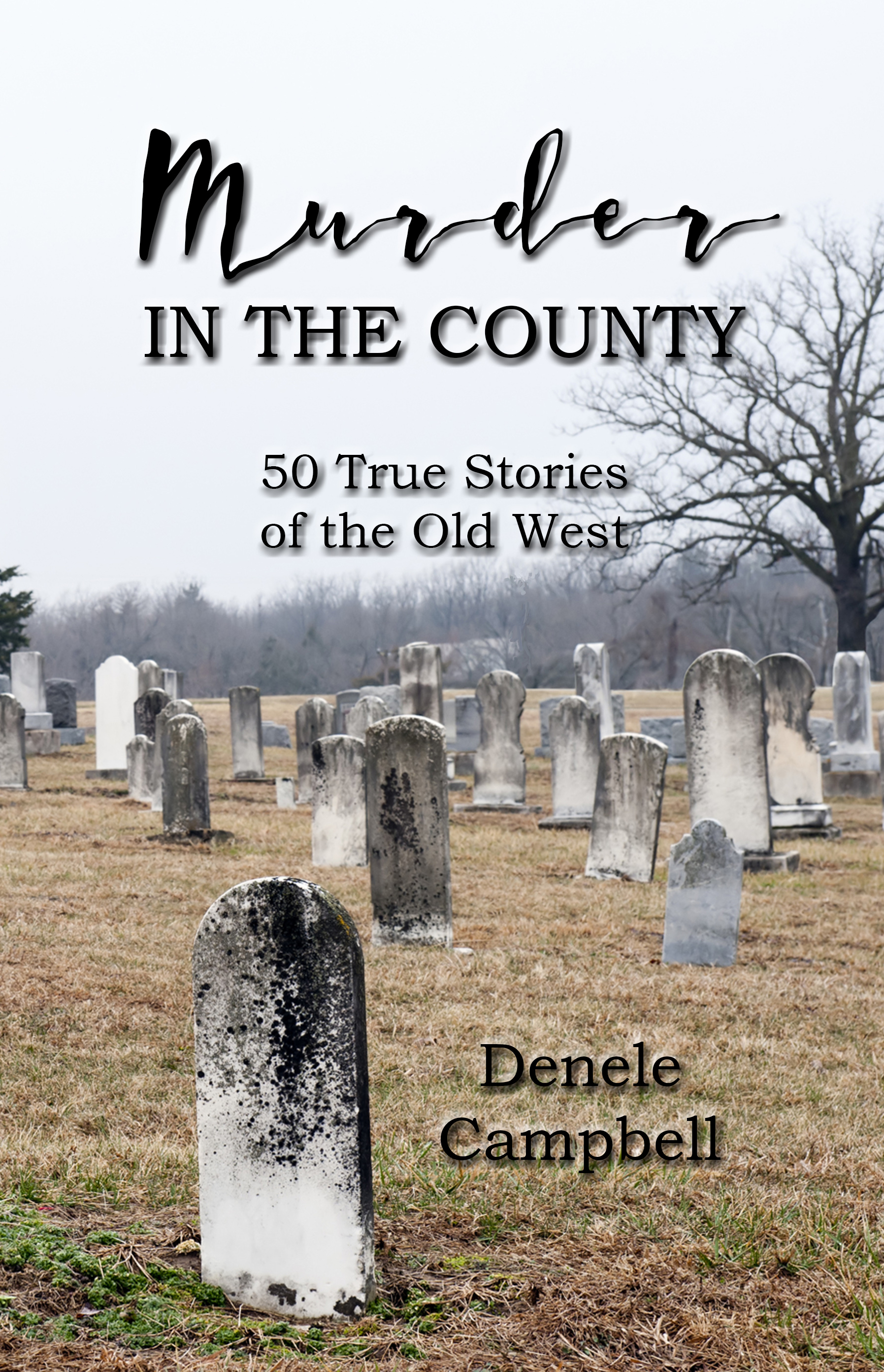
Murder in the County: 50 True Stories of the Old West
Contrary to popular notion, Arkansas was part of the Old West along with Texas and the rest of those more familiar dusty southwestern places. Its western border joined up with the Indian Nations where many a weary marshal rode out with his bedroll and pistol carrying writs from the U. S. District Court at Fort Smith in a search for a steady stream of men rustling livestock, stealing horses, selling whiskey, or running from the law.
From its earliest days, Washington County, Arkansas, experienced some of the worst the Old West had to offer. At unexpected moments, county settlers faced their fellow man in acts of fatal violence. These murderous events not only ended hopeful lives but also forever changed those who survived them. Not to say that the murders in the county all stemmed from conflict along its western border—plenty of blood spilled within its communities and homesteads.
The fifty chapters of this collection each focus on one violent incident. Through family histories, legal records, and newspaper accounts, the long-dead actors tell their shocking stories of rage, grief, retaliation, and despair.
According to the brief description that accompanied this photo that crossed my Facebook timeline the other day, the funeral of Pretty Boy Floyd drew the largest attendance of any such event in Oklahoma history. The image gives me goosebumps, almost puts a lump in my throat. It’s not the coffin—I can’t even discern where it is. It’s the people, backs straight, their attention focused entirely on the dead man.
On what he represented.
My dad sometimes talked about Pretty Boy Floyd although at the time of Floyd’s death, my dad was only seventeen. For him, like so many, Floyd stood as a heroic symbol to survival in their times. Dust bowl, economic depression, most of all the shift of worlds. From the independent farmer working alongside his wife and children to wrest of living from the land to the new reality of the need for money and consequently, jobs in town.
Giving up the farm and its creeks and horses and the smell of fresh cut hay. Learning to work for someone else. Breathing exhaust. Street lights burning the dark. Rigid hours to serve someone else’s profit. Dependent on the dollar instead of the land.
There were men who couldn’t make the change. Men who rebelled, who clung to the old ways. Men who’d rather die than portion out his life in the 9 to 5. They didn’t willingly give up the tradition of their fathers, but rather borrowed money on the hope of better times, more rain, abundant crops. The loans came due before better times arrived.
According to his biography in Wikipedia, “[Charles Arthur] Floyd was viewed positively by the general public. When he robbed banks he allegedly destroyed mortgage documents, but this has never been confirmed and may be myth. He was often protected by locals of Oklahoma, who referred to him as ‘Robin Hood of the Cookson Hills.’” He was thirty when he died.
Floyd’s robberies of banks made him a target for the fledgling FBI and the true manner of his death became one of the agency’s earliest cover-ups. After he was downed by rifle shot, another agent shot him with an automatic weapon at point blank range. Not widely known at the time, the unfairness of his killing nevertheless was understood at a visceral level by the common man.
Woody Guthrie, a native of Oklahoma, penned a song about it in 1939, five years after Floyd’s death. Called “The Ballad of Pretty Boy Floyd,”the song has the form of a Broadside “come-all-ye” ballad opening with the lines:
If you’ll gather ’round me, children, a story I will tell ‘Bout Pretty Boy Floyd, an Outlaw, Oklahoma knew him well.
The lyrics recount Floyd’s supposed generosity to the poor and contain the famous lines comparing foreclosing bankers to outlaws:
As through this world you travel, you’ll meet some funny men; Some will rob you with a six-gun, and some with a fountain pen. And as through your life you travel, yes, as through your life you roam, You won’t never see an outlaw drive a family from their home.
Many other artists have recorded this song, among them Bob Dylan, Joan Baez, and James Taylor as another generation’s anthem to the tragedy of corporate takeover.
It’s easy to see Floyd as a martyr. In his short life, he did what so many others wanted to do. Like the young Chinese man who dared to stand in the path of an oncoming tank, Floyd like similar ‘criminals’ of the early 20th century defied the banks and credit systems that threatened everything that mattered in rural American lives. They instinctively understood they were being swept into a capitalist system that had no sense of morality, no obligation to human circumstance. They fought back the only way they knew how.
The battle that cost Charles Floyd his life has not ended.
“Harley was standing out on the skids and opened with his M-60 as we made the assault. That was extra fire they weren’t expecting. They usually try to take out door gunners, but they weren’t expecting somebody out front on the skids. It’s a bumpy ride, coming in to an assault. The copter comes in fast and then slows down fast, and I don’t know how Harley hung on. That last bump is when you have to jump because we’re under fire.
“Fire is getting heavier. We’re starting to realize there’s a lot more NVA there than we realized. The valley floor has tall grass and holes the size of basketballs where they’re hiding to shoot at us. That’s why the valley is so scary. We’re starting to realize they’re above us and below us. They waited for us to get in there… I’m three feet from this guy that’s hit. I’m trying to find a place to lay my rifle so I could get ahold of it with both hands in case we started taking fire. This guy is screaming…”
Ray Mooney’s biography, Ray: One Man’s Life, is a new release making its debut this coming Saturday June 11. Join us if you can for his appearance at a book signing, 1 pm to 3 pm at Nightbird Books, 205 W. Dickson, Fayetteville, Arkansas.
“I’ve had my jaw broke three times, my nose broke five times to the point that the VA had to do the operation they do to boxers. My hand’s been broke and on fire once, enough that the skin was gone clear back to my wrist. I’ve fell off buildings, ladders, and mountains. Somehow I survived all that craziness.”
How Ray Mooney survived the incredible journey of his life is indeed a question for the ages. Polio, combat assault jumps from helicopters in Vietnam, and three children by three different wives didn’t kill him. Neither did the flagrant murder of his father by his father’s latest wife. But the traumas changed him, as they would change any man.
Told in his own words, Ray’s life story rushes from one shocking experience to the next and brings him to the last days as he faces end stage lung disease. Turkey killer, outlaw, entrepreneur, and disabled vet, this boy from the horse farms and tobacco fields of Kentucky relates his adventures with wry wit and breathtaking honesty.
They were the hippies, the drop-outs, the radicals. They came from New York, Detroit, Chicago, Los Angeles, New Orleans, and bought cheap Arkansas land where they could build lives with meaning. Often the topic of heated rhetoric and armchair analysis, those who went ‘back to the land’ rarely speak in their own voice. Now documented in these personal interviews, their stories reveal the guts, glory, and grief of the 1960s social revolution.
Previously listed at $15.95, now for a limited time the paperback is available for $11.95. A lasting gift! Amazon buy link
“Denele Campbell’s informative ‘Aquarian Revolution: Back to the Land’ fills a much-needed niche in the history of the Counter-Culture movement. Unlike in more crowded Europe, America’s rural expanse offered an escape, a new beginning in the 1960s, from a social cancer spreading through the dominant culture. The dream of finding land to till and an alternative life style had been an American dream since its founding. America’s cities, mired in racism, sexism, poverty, and riots, seemed doomed. The ‘baby boomers’ sought escape by going to the land, many for the first time. Denele Campbell has carefully chronicled the personal stories of thirty-two pioneers who opted to create their utopian vision in the Ozarks. As such, their quest is at times fascinating, amusing, and often painful. Yet, it is a good read for those who lived through this era as well as today’s young.” —-T. Zane Reeves, Regents’ Professor Emeritus, University of New Mexico and author of Shoes along the Danube.
Obscure laws often become weapons used selectively against people who offend prevailing social sensibilities. This was the case examined in A Crime Unfit To Be Named. In 1949, a local man in this small Bible belt town became the target of extraordinary police scrutiny. Despite his advanced age and the private nature of his activities, if found guilty John William Campbell would face hard time. Swept up in this vendetta, two younger women would also become entangled in the notorious Arkansas criminal justice system.
Now for a limited time, this paperback is available for only $6.95, marked down from its regular price of $9.95. Amazon buy link
“I started reading ‘A Crime Unfit to Be Named’ and just didn’t stop. It’s really interesting and well written. Excellent research, too. Very fine job.”
—J. B. Hogan, Historian and Author of “The Apostate.”
Denny Luke, far right, next to Arkansas Governor Mike Beebe on one of his whistlestop tours of the state. 2006. On left, Ron Johns and in center, Dan Kerlin. At Dan’s store in Winslow.
1972. A Yankee moves to the Ozarks and lives to tell his tales. Now captured in a tidy little book along with plenty of photographs, these stories track Denny Luke’s life experiences from childhood in Ohio to the backwoods hills of Arkansas.
This man is an adventurer. During his years in the Navy, he built hot rods with money he made with shipboard loansharking. He returned to his native Ohio where he soon tired of the mechanic’s life. Computers had just started to break the surface in 1966, the perfect attraction to a young man with a sharp mind and plenty of ambition.
Denny with his mom in his Corvette. This photo not included in the book.
Money rolled in as he built databases, a brand new idea in the mid-Sixties. A ‘63 Corvette and soon after a new Triumph dirt bike put him in the fast lane for weekend jaunts to the Playboy Club in Chicago and Enduro racing in Wisconsin’s back country.
Then, like so many of his generation, he stepped out of the fast lane and moved to a primitive life in the country. Among his most important first acquaintances was Ray Brown.
Ray Brown teaching hog killin’ to Denny. This photo not in the book.
“We rented a little cabin near Devil’s Den from Ray Brown. He was a genuine hillbilly. His family lived in a little old log cabin. He raised a few cows, cut posts, whatever he could do to make a living. He was smart, smartest man I ever knew, had lots of common sense. His cabin had a big old fireplace that barely kept the place warm. He sat in this big chair over in one corner, and he could reach around behind his chair and grab a big handful of snow—that much would blow in through the cracks.”
Denny and his buddy Butch scouted cheap land all over Northwest Arkansas and ended up with an old log cabin on Bunyard Road. They also learned to be stone masons in order to earn their way.
Denny rustling up some grub at the Bunyard cabin December 1974. This amazing stove had a gas burning side and a wood burning side. Hauled from Wisconsin to the Ozarks.
“There are two or three families out on Bunyard that are cliquish. I wasn’t accepted out there. I was from the north, and I didn’t go to church. The first thing they wanted me to do was go to church. Plus I wasn’t born there. And I owned the old Omie Wood home place and they might have resented that some.”
An avid photographer and storyteller, Denny shares the adventures of his life with Author Denele Campbell as he recalls the outrageous backwoods tales and colorful characters who populate this neck of the woods.
Join us Sunday September 13 in the Connie Wright Gallery of Ozark Folkways at Winslow for live music, refreshments, Author Denele Campbell’s comments on this collaboration, and Denny’s readings from the book. Autographed copies will be available for sale.
Can’t make the event? The book is available at Amazon.com or at your favorite bookstore.
My new book, Glimpses of Fayetteville’s Past, features five articles I researched and wrote between 2003 and 2010. These were initially published by the Washington County Historical Society’s quarterly journal, Flashback.
In this paperback collection, these articles about this “lovely” county in Northwest Arkansas have been expanded and updated, and now include photos, maps, and other features that greatly enhance the reading experience.
Here’s an excerpt, from “The History of Fayette Junction”:
…One of the most ambitious men to exploit the timber trade was Hugh F. McDanield, a railroad builder and tie contractor who had come to Fayetteville along with the Frisco. He bought thousands of acres of land within hauling distance of the railroad and sent out teams of men to cut the timber. By the mid-1880s, after a frenzy of cutting in south Washington County, he turned his gaze to the untapped fortune of timber on the steep hillsides of southeast Washington County and southern Madison County, territory most readily accessed along a wide valley long since leveled by the east fork of White River. Mr. McDanield gathered a group of backers and the state granted a charter September 4, 1886, giving authority to issue capital stock valued at $1.5 million, which was the estimated cost to build a rail line through St. Paul and on to Lewisburg, which was a riverboat town on the Arkansas River near Morrilton. McDanield began surveys while local businessman J. F. Mayes worked with property owners to secure rights of way. “On December 4, 1886, a switch was installed in the Frisco main line about a mile south of Fayetteville, and the spot was named Fayette Junction.” Within six months, 25 miles of track had been laid east by southeast through Baldwin, Harris, Elkins, Durham, Thompson, Crosses, Delaney, Patrick, Combs, and finally St. Paul.
Soon after, in 1887, the Frisco bought the so-called “Fayetteville and Little Rock” line from McDanield. It was estimated that in the first year McDanield and partners shipped out more than $2,000,000 worth of hand-hacked white oak railroad ties at an approximate value of twenty-five cents each. Mills ran day and night as people arrived “by train, wagon, on horseback, even afoot” to get a piece of the action along the new track, commonly referred to as the “St. Paul line.” Saloons, hotels, banks, stores, and services from smithing to tailoring sprang up in rail stop communities…








 denelecampbell