Climate Wars

War still edges out climate change as the current greatest cause of starvation. It’s an ouroboros (snake eating itself, i.e. vicious cycle) wherein the more devastated a landscape becomes and the less food it can produce, the more people fight over it. Which leads to more conflict, etc. It is important to note that climate change alone has not been proven to increase the likelihood of discord; however, climate change compounded with challenging economic, political, or social conditions can heighten the risk of conflict.

Evidence links rise in temperature to a rise in civil war. Researchers at Princeton University and UC Berkeley found that a rise in average annual temperature by even 1° Celsius (1.8° Fahrenheit) leads to a 4.5% increase in civil war that year. There has been a global increase in the incidence of civil war following World War II, with civil wars even having a greater number of casualties than international wars. Civil wars are dangerous, and climate change is making them more common.[1]

In 2022, the five regions with the highest number of hungry people as a proportion of population included:

  • Middle Africa: 31.8%
  • East Africa: 28.1%
  • Western Africa: 18.7%
  • Caribbean: 16.1%
  • Southern Asia: 15.8%

The Sahel, located between Sudan and the Sahara (West Africa) and regarded as the most vulnerable area to climate change, is a semi-arid region comprising some of the world’s poorest and most fragile states (e.g. Mali, Niger, Burkina Faso, Chad, and Mauritania).[2]

Darfur, a region in the Western part of Sudan, has been in a state of emergency since 2003. “…The general notion is that the decline in rainfall and land degradation increased and intensified already existing violent struggles over pastures, water and farmland, proportionally resulting in a large scale civil war.”[3]

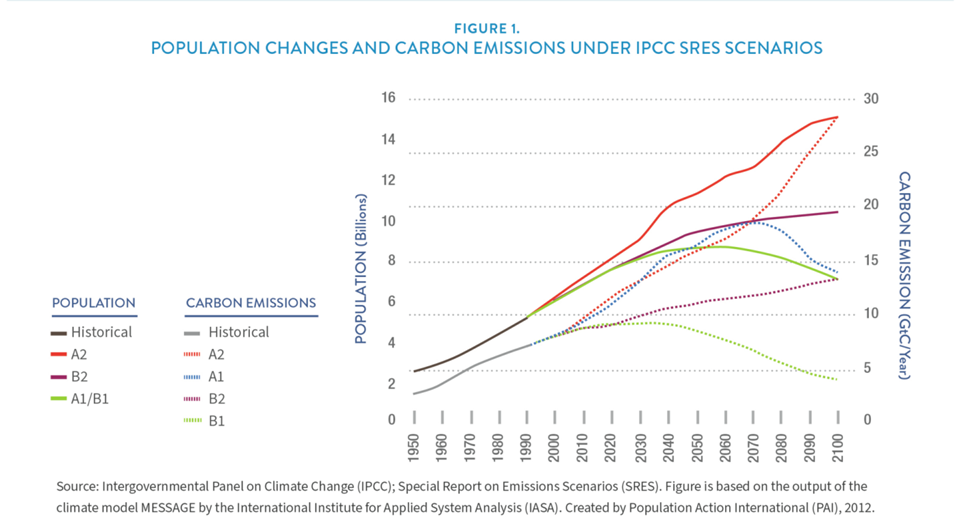
Population growth, along with increasing consumption, tends to increase emissions of climate-changing greenhouse gases. Rapid population growth worsens the impacts of climate change by straining resources and exposing more people to climate-related risks—especially in low-resource regions. There has been a reluctance to integrate discussions of population into climate education and advocacy. Yet climate change is tightly linked to population growth.
Top 10 Countries with the Highest Fertility Rates (by births per woman) – World Bank 2021 (2019 data). If these country names look familiar, check the list above of nations with the greatest rates of starvation.

Niger – 6.8 (West Africa)

Somalia – 6.0 (East Africa)

Congo (Dem. Rep.) – 5.8 (tie) (Middle Africa)

Mali – 5.8 (tie) (West Africa)

Chad – 5.6 (Middle Africa)

Angola – 5.4 (West Africa)

Burundi – 5.3 (tie) (East Africa)

Nigeria – 5.3 (tie) (West Africa)

Gambia – 5.2 (West Africa)

Burkina Faso – 5.1 (West Africa)

As the U.K.-based charity Population Matters summarizes: “Every additional person increases carbon emissions—the rich far more than the poor—and increases the number of climate change victims—the poor far more than the rich.” At the national level, there is a clear relationship between income and per capita CO2 emissions, with average emissions for people living in industrialized countries and key oil producing nations topping the charts. High-consuming lifestyles and production practices in the highest income countries result in much higher emissions rates than in middle and low-income countries, where the majority of the world’s population lives.[4]

Sadly, the people suffering the most from climate change are those least responsible for the problem. For example, the United States represents just over 4% of the global population but accounts for 17% of the world’s energy use. Per person carbon emissions are among the highest in the world. People living in the United States, Australia, and Canada, have carbon footprints close to 200 times larger than people in some of the poorest and fastest-growing countries in sub-Saharan Africa—such as Chad, Niger, and the Central African Republic. In the middle of the spectrum are the middle-income economies, home to 75% of the world’s population. In these places, industrialization will increase standards of living and consumption patterns over the coming decades. Without changes to how economies tend to grow, carbon emissions will rise.[5]

As there is no panacea for combating climate change, a wide variety of options needs to be exercised. An integrated approach includes educating girls and empowering women to make their own decisions about reproduction.

While the United States is best equipped to address the issue of reproduction, Republican lawmakers have systematically gutted programs which offered reproductive health care to these places. President Ronald Reagan first enacted the global gag rule—also known as the Mexico City Policy—in 1984. Every president since Reagan has decided whether to enact or revoke the policy, making NGO funding vulnerable to political changes happening in the United States. The rule forces organizations to choose whether to provide comprehensive sexual and reproductive health care and education without U.S. funding, or comply with the policy in order to continue accepting U.S. funds.

Used by U.S. presidents since 1984 to signal their stance on abortion rights, the rule has been backed by Republicans – including Bush from 2001 to 2008 – and revoked by Democrats.

When the policy was in place in the Bush era, modern contraception use declined by 14% and pregnancy rates rose 12% in Sub-Saharan countries most reliant on U.S. family planning aid, a study found. When the policy was rescinded by Democratic President Barack Obama, the pattern reversed, with higher contraceptive use and fewer abortions.

Former President Donald Trump reinstated the rule in 2017. The evangelical-backed ban on funding for reproductive care extends beyond reproduction. Nearly 50 percent of global HIV and AIDS funding comes from the U.S. government. Under President Trump’s expanded global gag rule, the quality and availability of HIV services, including treatment, testing, and prevention, began suffering dramatically—more than previous iterations of the rule. The policy under Trump undid decades of work to integrate sexual and reproductive health services with HIV services. Vulnerable populations, and men who have sex with men in particular, began experiencing significant health service disruptions as a result of the global gag rule. Clearly, the evangelical-condoned ban isn’t about brotherly love.

Meanwhile, multiple studies have shown that the global gag rule has not decreased rates of abortions but instead has increased the number of unsafe abortions.

U.S. funding for family planning/reproductive health care is governed by several other legislative and policy requirements, including a legal ban on the direct use of U.S. funding overseas for abortion as a method of family planning (the Helms Amendment, which has been in place since 1973) and, when in effect, the Mexico City Policy (reinstated and expanded by President Trump as the “Protecting Life in Global Health Assistance” policy but rescinded by President Biden upon taking office).[6]

In the situation where Republicans routinely disrupt the best efforts of U.S. progressives to reduce human suffering around the world, we can expect more war, more starvation (especially for mothers and children) and much greater human suffering all around.


[1] https://theyearsproject.com/latest/is-climate-change-causing-more-wars

[2] https://www.ips-journal.eu/topics/economy-and-ecology/how-climate-change-fuels-conflicts-in-west-africa-6227/

[3] https://jasoninstitute.com/the-first-climate-war-insight-into-the-war-in-darfur/

[4] https://populationmatters.org/climate-change/

[5] https://populationconnection.org/resources/population-and-climate/

[6] https://www.kff.org/global-health-policy/fact-sheet/the-u-s-government-and-international-family-planning-reproductive-health-statutory-requirements-and-policies/

BREAD!

A entire chapter in the forthcoming AROUND THE COUNTY.

It’s easy to take bread for granted, the first thing grabbed off supermarket shelves as people prepare for any apocalypse. And not only bread, but other products of wheat flour, everything from biscuits to pasta. But the county’s early pioneers did not have supermarkets from which to obtain bread or flour, they didn’t even have grist mills to produce it. And they had to grow the wheat!

Laboring over grinding stones with hand pestles, pioneers cleared land, plowed, planted, harvested, winnowed, and stored wheat (and other grains, especially corn) before turning their energies to building mills. Big grinding stones were turned first by harnessed mules or horses then by water power as streams were channeled to turn big mill wheels. Millwrights had to know their business, not only in the methods of capturing and directing a suitable flow of water but also in the construction of the wheels and the many mechanisms of the operation.

At first, Fayetteville settlers had to travel to Natural Dam to find a mill, then to Evansville. It wasn’t until 1836 that Fayetteville gained its first local mill, and twelve more would follow. Local mills would continue their important work for nearly a century before mechanization and corporate farms would undermine their profitability, thus ending a long mainstay of the local economy.

Walmart’s Okra Problem

Bizarre but delicious, okra was a regular menu item as I was growing up. Sliced thin and rolled in salted cornmeal, okra was fried to a crisp golden brown. Mind you, this was not the half-cooked version found in most restaurants today. Rather, the crunchy umami of well-done okra was an essential part of the flavor.

Moving toward old age and looking toward easier and healthier methods of preparing this dish, I discovered that whole pods of okra could reach a similarly scrumptious state when fried minus the laborious slicing and added cornmeal. A little olive oil and an iron skillet render the pods golden brown after only a half hour or so.

A critical factor in this method is the size of the pod. Okra becomes increasingly tough as it grows larger, something that sends us home growers out to the okra patch on a daily basis. Those little devils can grow an inch almost overnight. Once an okra pod zooms much past four inches, you might as well throw it away.

The exception to this winnowing would be if you plan to use okra in gumbo or other stewed preparations, which cooks long enough to overcome the pending toughness while adding its mucilaginous goodness to the pot. Perhaps even frying larger pods would be acceptable IF the pods were sliced.

Frying whole pods being my current modus operandi, I have searched the local markets during the winter months when this tropical native does not grow in my tiny Ozark garden. Walmart offers a small space for fresh okra in its produce section. Alas, 99% of the time, the okra displayed there is disgusting. Packaged in plastic bags, the okra rapidly sweats itself into a moldy, mushy funk. Or some hopeful produce worker places the packages in the path of the regular misting, guaranteeing that the pods quickly deteriorate into the consistency of lumpy puke.

Look closely at the discolored parts of these deteriorating pods, presented here for the viewers delectation.

An alternative packaging method involves clear plastic cartons with ventilation slots. Here the okra has a better chance of lasting until a customer can purchase and, if she hurries, cook and eat it. If the package has been on the shelf more than a few days, the tell-tale signs of black mold and rot seem to be invisible to the produce manager, and the packages will remain until the entire mass has disgustingly disintegrated into a homogenous mass of putrefying vegetation.

Whole Foods is the only other local market found to offer fresh okra. Viewers will note the appetizing black decay on these pods.

The other problem plaguing Walmart’s fresh okra is size. In Walmart’s $4.23 12 oz. package of fresh okra, which contains maybe 20 pods, one finds only six or seven under four inches. This problem can be traced to the source. Nicaraguan and other contract Central American farmers are apparently unaware of the tenderness issue, understandable since a) okra is native to West Africa, Ethiopia, Southeast Asia, and/or South Asia; and b) farmers and their managers wish to gain the largest product for their efforts. The low sales numbers and rate of spoilage should alert Walmart admins of a problem, but they lumber ever onward, oblivious.

Fortunately, a frozen product is usually available at most stores. But don’t be misled by the pre-cut and/or the pre-breaded okra. It doesn’t cook up crisp, but rather transforms into a gummy wad of flavorless gunk. Defying the imagination, Walmart’s ‘Great Value’ breaded okra is sold in a steamable bag…

Only the frozen whole okra pods are useful, but again there is a size problem. The purchaser is indeed fortunate if even half the pods are four inches or less.

Sadly, if a person shops for frozen okra at any of the Walmart stores, as I did a few days ago, that person would be disappointed to discover that there may be no frozen okra pods in stock, thereby requiring that the hopeful buyer travel to a different Walmart. I find it consistently at the Neighborhood Walmart at 660 W. Martin Luther King Jr. Boulevard, but never at the Walmart Supercenter at 2875 W. Martin Luther King Jr. Blvd. [Okay, ‘never’ is a big word and must confess that I haven’t checked for it every day as my grocery shopping trips are weekly. Still…]

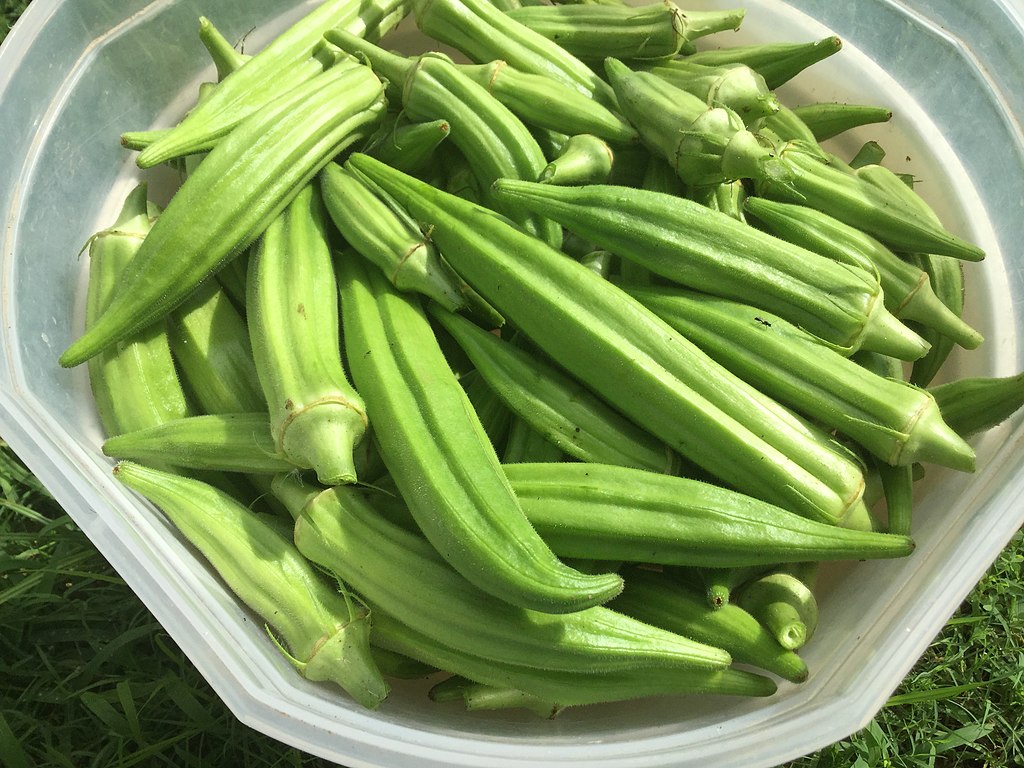
This attractively green batch of fresh okra contains waaaay too many oversized pods.

I plan to grow at least 12 okra plants in my raised beds this year, with an eye to freezing some of my own for cold weather use rather than being constantly at the mercy of commercial growers and retailers’ utter lack of quality control. The real solution to the okra problem is to require growers and merchants to actually EAT some properly-sized and prepared okra. Otherwise this is a hopeless situation for okra lovers everywhere.

Properly fried, sliced okra will not retain a bright green color and neither will the pods, changing instead to a dull olive drab.

Recipes!

Just in time for the holidays, this collection of recipes includes great ideas for entertaining!

Originally, this collection preserved the recipes of Fayetteville’s popular Trailside Café and Tea Room. Plate lunches of Pot Roast or Ribs ‘n’ Kraut became overnight hits. Now, with new additions, crowd pleasers like Cheeseball or Hummus will fit any occasion.

Your guests on a cold night will snuggle in with a steaming bowl of Potato Leek Soup or Spicy Chicken Chili. Or how about platters of Tea Sandwiches for those hungry relatives, bread of your choice plus a delicious array of fillings, from Apple & Cream Cheese to Chicken & Chutney (with our own recipe of Mango Chutney), or try the venerable standard, Egg & Dill.

Test your baking chops with a batch of Brown Butter Cookies (You’ll run out!). Basics for a scrumptious dinner include Chicken & Dumplings and Salmon Fillet with Curried Rice, always great options, but salads sometimes hit the spot. Try Curried Chicken Salad or a delicious Fruit Salad with Tahini-Coconut Milk Dressing.

The greatly expanded last chapter includes Herb Roasted Potaotes and Persimmon Cookies plus many more family recipes sure to be a hit in anyone’s kitchen. Recipes of Trailside Café and Tea Room offers over 200 recipes for easy, down home food. Makes a great gift, too!

Only $9.95, paperback. Available at Amazon.

GAZPACHO! The perfect splash for late summer gardens

From our great recipe collection, Recipes of Trailside Cafe and Tea Room, here’s the answer to all that produce! YUM!

2 English cucumbers, halved, seeded, not peeled

2 red bell peppers, cored and seeded

2 green bell pepper, cored and seeded

2 red onions or one if large

2-3 pounds tomatoes, cored and peeled (boiling water method **)

5 cloves minced garlic

6 cups tomato juice

½ cup white wine vinegar

½ cup olive oil

1 tablespoon kosher salt

2 teaspoon black pepper

¼ teaspoon cayenne

1 tablespoon Worcestershire sauce

Juice of one lime

5-6 springs fresh thyme, tied in bundle

❧ Cut all vegetables into 1 inch chunks. Process each vegetable separately in food processor until coarsely chopped. Add to large bowl until all are processed.

❧ Process garlic with vinegar, oil, salt, pepper, cayenne, lime juice and Worcestershire sauce until fully blended. Pour into bowl with vegetables. Add tomato juice and stir all together.

❧ Add tied bundle of fresh thyme, immersing it into the soup, and chill overnight. Remove thyme before serving.  Garnish with diced avocado.

** To easily peel tomatoes (or other soft fruit like peaches), bring a pan of water to boil. Use strainer or slotted spoon to gently immerse tomatoes into the water for about 30 seconds. Remove to ice water. Skins will slip off.

~~~

Serving everything from pita to peach cobbler, Trailside Café and Tea Room became a favorite destination for the few years of its existence. Plate lunches of Pot Roast or Ribs ‘n’ Kraut became overnight hits. Now with a new section on Sandwiches, and a greatly expanded last chapter including many more family recipes sure to be a hit in anyone’s kitchen, Recipes of Trailside Café and Tea Room offers the ‘how-to’ for delicious soups like Split Pea or Potato Leek, hearty salads including Wilted Lettuce, and scrumptious desserts like Lime Pie and the infamous Brown Butter Cookies. Over 200 recipes for easy, down home food.

A Paeon to Flour

I believe I could live on carbs alone. Preferably derivatives of wheat. Refined into cake. Angel food cake. Chocolate cake. Lemon cake. Pound cake. Cupcakes! We’ve made up holidays so that we can have more cake.

Or cookies. Peanut butter cookies, oatmeal cookies, sugar cookies. Cookies! Biscuits slathered with butter and strawberry jam. Biscuits with sorghum molasses. Biscuits!

I bet you didn’t know that the Roman legions’ staple ration of food was wheat.  Or that from 123 BCE, a ration of unmilled wheat (as much as 72 pounds) was distributed to as many as 200,000 people every month by the Roman state. Hence the old reference to ‘bread and circuses’. Juvenal, a first century Roman poet who originated the phrase, used it to decry the “selfishness” of common people and their neglect of wider concerns because the government pacified them with bread and entertainment. The phrase implies a population’s erosion or ignorance of civic duty as a priority. (‘Circuses’ referred to elaborate spectacles in the coliseum.)

Not surprisingly, the Romans knew how to make flour into piecrust.

In these times of political crisis and viral contagion, I’ve increasingly come to admire the qualities of flour. Bread of course. Bread for sandwiches, toasted bread with eggs, with jam, with melted cheese and tomato soup. Breadsticks!

Without flour, there would be no gravy! No puddings! No graham crackers or the heavenly crusts made from them that lie underneath and beside the beautiful maidens of cheesecake and cream pies. Pretzels, bagels, tortillas, English muffins, blueberry muffins, banana nut bread, crumpets, scones. Scones baked with bits of crisp bacon, or with sharp cheddar, or dried cranberries.

Crackers. Salty crisp crackers.

Pies. Lots of my favorite foods come in pie crust, thick crumbly crust of flour and butter brought to its most exquisitely evolved state. One could argue that American cuisine is lacking in regard to pie crust. Our cousins across the pond seem far more advanced in regard to food wrapped lovingly in crust.

Like pasties.

The genius of pasties and its ilk is its perfect use of crust by wrapping crust entirely around the contents. Maximum crust.

We do have a descendant of pasties in our half-moon pies. Steam some apricots until tender, mash with appropriate sweetener. (There used to be dried apricots that carried the perfect balance of tart and sweet. You can’t find those anymore. Now they’re all too sweet.) Still, with a judicious hand on the sweetener and a hint of ginger, the apricots can be made ready for their marriage bed in crust. She finds herself spread on one side of a flat circle of rolled-out dough where the other side is brought to rise up over her, cover her… Ahem.

The most perfect apricot pies were fried. In deep hot oil, the butter in the dough sizzled, cooking the flour into tender flakes that, once in the mouth with a portion of apricot filling, dissemble like a velvet-tongued seducer, drawing everything connected to the mouth into bliss. For those aging beyond heavily fried foods, the alternative is to bake the pie – with so-so results.

WAIT for the pie to cool. Oops, sorry.

The genius of the Brits with pasties is that the filling is a meal.

A pasty is a baked pastry, a traditional variety of which is particularly associated with Cornwall, United Kingdom. It is made by placing an uncooked filling, typically meat and vegetables, on one half of a flat shortcrust pastry circle, folding the pastry in half to wrap the filling in a semicircle and crimping the curved edge to form a seal before baking.

The traditional Cornish pasty is filled with beef, sliced or diced potato, swede (also known as yellow turnip or rutabaga – referred to in Devon and Cornwall as turnip) and onion, salt, and pepper.

Despite the modern pasty’s strong association with Cornwall, its exact origins are unclear. The English word “pasty” derives from Medieval French (O.Fr. paste from V.Lat pasta) for a pie, filled with venison, salmon or other meat, vegetables or cheese, baked without a dish. Pasties have been mentioned in cookbooks throughout the ages. For example, the earliest version of Le Viandier (Old French) has been dated to around 1300 and contains several pasty recipes. In 1393, Le Menagier de Paris contains recipes for pasté with venison, veal, beef, or mutton.  

Other early references to pasties include a 13th-century charter that was granted by Henry III (1207–1272) to the town of Great Yarmouth. The town is bound to send to the sheriffs of Norwich every year one hundred herrings, baked in twenty four pasties, which the sheriffs are to deliver to the lord of the manor of East Carlton who is then to convey them to the King. Around the same time, 13th century chronicler Matthew Paris wrote of the monks of St Albans Abbey “according to their custom, lived upon pasties of flesh-meat.” A total of 5,500 venison pasties were served at the installation feast of George Neville, archbishop of York and chancellor of England in 1465.[1]

The family of pasty-style meat pies includes those fabulous empanadas which spread with the advance of Portuguese and Spanish conquests of the New World from Argentina to Indonesia (panasan) and the Philippines (several versions).[2] Then there are the Russian and Ukranian pirozhoks, boat-shaped pies made of yeast-leavened dough, with filling completely enclosed. Also the Italian calzone made with pizza dough wrapped around salami, ham or vegetables with mozzarella, ricotta and parmesan or pecorino cheese, plus an egg. Don’t forget the samosa of India, a crusty wrapping of dough around a filling such a spiced potatoes, onions, peas, cheese, beef or other meat, or lentils. And the Jewish knish. Or the Mongolian khuushuur.

We do have Hot Pockets, which hardly merit mention.

The lines blur with the jianbing, a Chinese wheat flour pancake that is wrapped raw around fillings and cooked on a griddle and folded. Traced as far back as 2,000 years, this food was originally made from millet flour or other grains. It is a cousin to crepes, usually served with fruit or other sweet fillings rather than savory ones. But then that brings up pancakes… PANCAKES!

Never forget those thin wrappings of eggrolls and spring rolls, deep fried to crisp perfection, thanks to wheat flour. Spring rolls appeared in the historical record in the Eastern Jin Dynasty (266-420 CE) of ancient China, leading one to theorize that the Western European rise of pasties as a flour-based wrapping around meat fillings might have resulted from the Italian Marco Polo’s wanderings along the Silk Road into Asian lands (1271-1295). Interestingly, the 12th century Arthurian romance Erec and Enide, written by Chrétien de Troyes, includes pasties eaten by characters from the area around Cornwall. Which brings back the question of whether the pasty was indigenous to Cornwall or if the idea followed Polo back from China.

Then there’s pasta. How lost we would be in this world without it? Spaghetti, ravioli, pizza and, among many other shapes of this water and flour invention, macaroni, that star of American comfort food, mac ‘n’ cheese! Developed as early as the 14th century in Italy, the charm of mac ‘n’ cheese quickly gained pride of place in English cuisine of the same century.

Let us not forget the forms of bread that serve us daily in their embrace of hamburger patties or hot dogs, soft pillows of compliant wheat dough providing a handhold on meat and fillings without the trouble of frying or baking a pasty.

People have been making delicious food with flour since, well, since a time before history. We just don’t know exactly when those clever women (of course it was women) started harvesting and then replanting the largest grains of native grasses; the first known cultivation was around 10,000 years ago in the area around modern day southeastern Turkey. Around 6,000 years ago Egyptians figured out how to make wheat bread in an oven. Evidence of the first identifiable bread wheat (Triticum aestivum) with sufficient gluten for yeasted bread is found in Macedonia circa 1350 BCE.[3]

But for flour, someone had to figure that out. Some woman rubbing two rocks together smashed wheat kernels into dust, and flour was born. Sometime before 2,000 BCE, a recipe for chicken pie was written on a clay tablet in Sumer.

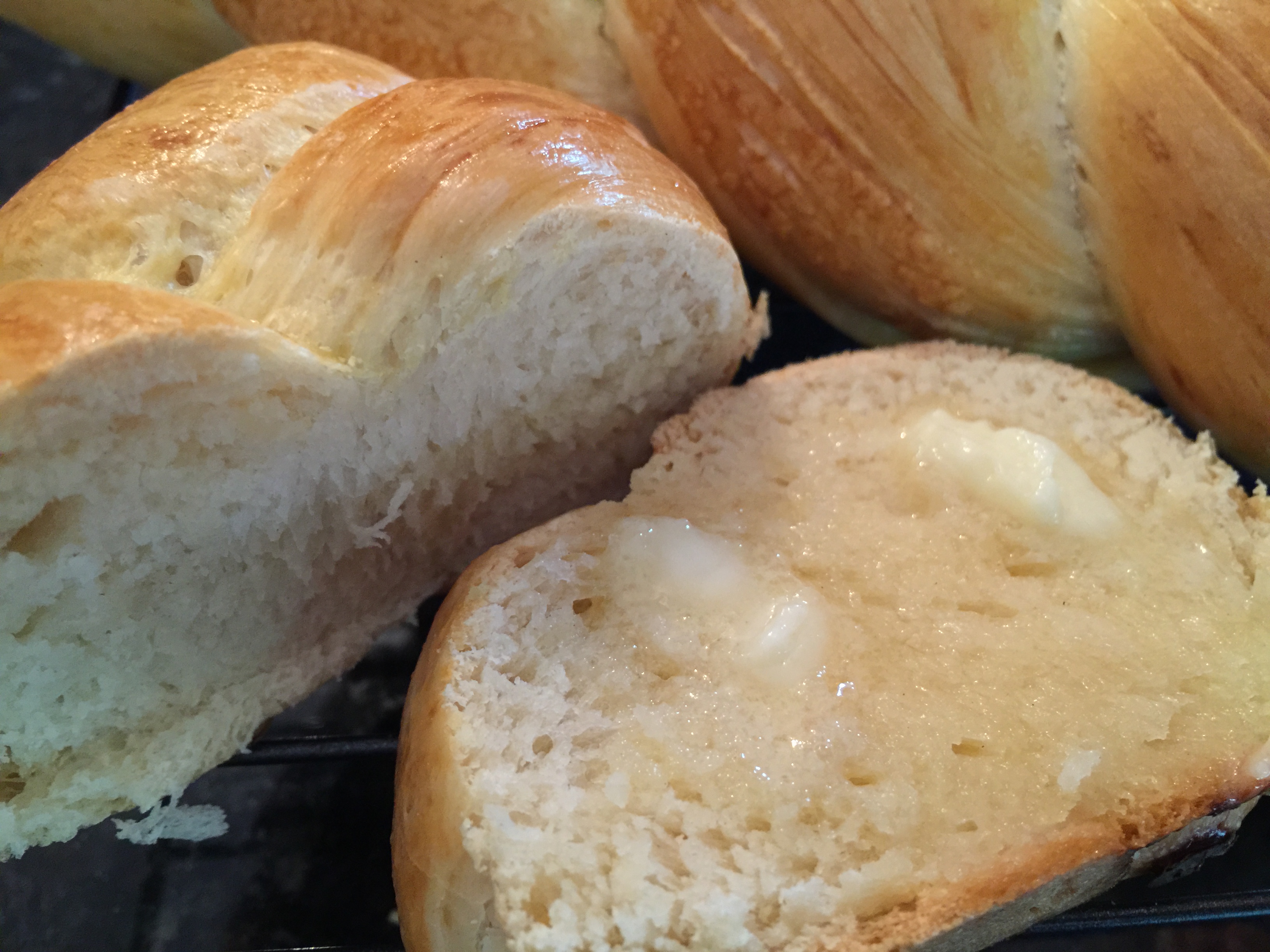
One of the most sublime of all human flour experiences is to wind through the process of making risen bread – the mixing, the kneading, the waiting for it to rise only to punch it down again before waiting yet again for it to rise before shaping loaves or those manna parcels called ROLLS. And then, suffering through the baking as yeasty aroma fills the air, one arrives at the moment of completion when the golden loaves are lifted onto cooling racks and the truest torture begins. One is exhorted to wait until the bread cools, but who can wait? Yes, the soft interior suffers when a knife plunges into the hot loaf.  Equally true is that a slice of bread still steaming from the oven will melt the butter before it can be spread.

But who needs to spread it? Drop thick slabs of cold butter onto the incandescent bread and let it vanish into the textured magic, cooling the bread as it goes so that your trembling hands can bring the slab of hot bread to your mouth and you can absorb the entirely decadent ambrosia directly into your bloodstream.

~~~

[1] https://en.wikipedia.org/wiki/Pasty

[2] https://en.wikipedia.org/wiki/Empanada

[3] https://en.wikipedia.org/wiki/Wheat

Tea Time

A couple of hundred years ago, the Brits figured out the utility of tea. In China where the tea plant is native, tea had been an important human companion for thousands of years. Aside from its refreshing properties, tea offers the opportunity for a satisfying ritual.

Americans need tea time.

It was with that in mind, as well as the beverage’s healthy attributes, that I included 50 loose leaf teas in fulfilling a personal dream of opening a café.

Yes, this blog post has nothing to do with current events, politics, or social disorder.

Trailside Café & Tea Room gained success almost immediately upon opening in March 2009. The old Quonset hut building where it was housed transformed from an out-of-the-way eyesore on the outside to another place in time on the inside. Peaceful pale apricot walls, crisp white tablecloths, and framed images of people taking tea in Arabia, China, Paris, and other parts of the world helped shape an atmosphere of world community centered on tea.

Since the café closed in December 2011, I have on occasion tried to continue my gospel of tea. There’s a terrible hurdle in this effort, however. Everyone thinks they know about tea.

They don’t.

What Americans know about tea – Camellia sinensis – is a tea bag-stained glass of water heavily flavored with lemon and sugar. Friends, that’s not tea.

Well, it’s tea, but not really what tea has to offer.

Consider, for example, the many types of tea. When tea leaves are plucked from their bushes, they are spread out to dry. With no further ‘curing’ process, this become white, yellow, or green tea.

Currently there is no generally accepted definition of white tea and very little international agreement; some sources use the term to refer to tea that is merely dried with no additional processing, some to tea made from the buds and immature tea leaves picked shortly before the buds have fully opened and allowed to wither and dry in natural sun, while others include tea buds and very young leaves which have been steamed or fired before drying. Most definitions agree, however, that white tea is not rolled or oxidized, resulting in a flavor characterized as “lighter” than most green or traditional black teas.

In spite of its name, brewed white tea is pale yellow. Its name derives from the fine silvery-white hairs on the unopened buds of the tea plant, which give the plant a whitish appearance. The unopened buds are used for some types of white tea.

Oolong comes in many styles, my current favorite cup every morning being the Iron Goddess of Mercy oolong. In general, oolong is

… a traditional semi-oxidized Chinese tea produced through a process including withering the leaves under strong sun and oxidation before curling and twisting. Most oolong teas, especially those of fine quality, involve unique tea plant cultivars that are exclusively used for particular varieties. The degree of oxidation, which varies according to the chosen duration of time before firing, can range from 8–85%, depending on the variety and production style.

What most Americans think is ‘tea’ is black tea. Sadly, most teabags sold in stores contain leaf dustings and fragments after the quality leaves have been diverted to more discerning consumers.

Black tea is more oxidized than oolong, green, and white teas. Black tea is generally stronger in flavor than other teas. While green tea usually loses its flavor within a year, black tea retains its flavor for several years. For this reason, it has long been an article of trade, and compressed bricks of black tea even served as a form of de facto currency in Mongolia, Tibet and Siberia into the 19th century. Black tea accounts for over 90% of all tea sold in the West.

After the harvest, the leaves are first withered by blowing air on them. Then the leaves are processed in either of two ways, CTC (Crush, Tear, Curl) or orthodox. The CTC method produces leaves of fannings or dust grades that are commonly used in tea bags but also produces higher (broken leaf) grades. This method is efficient and effective for producing a better quality product from medium and lower quality leaves of consistently dark color. Orthodox processing is done either by machines or by hand. Hand processing is used for high quality teas. While the methods employed in orthodox processing differ by tea type, this style of processing results in the high quality loose tea sought by many connoisseurs. The tea leaves are allowed to completely oxidize.

Jeanne Paul Sartre and Simone de Beauvoir taking tea.

Next, the leaves are oxidized under controlled temperature and humidity. (This process is also called “fermentation”, which is a misnomer since no actual fermentation takes place. Polyphenol oxidase is the enzyme active in the process.) The level of oxidation determines the type (or “color”) of the tea. Since oxidation begins at the rolling stage itself, the time between these stages is also a crucial factor in the quality of the tea; however, fast processing of the tea leaves through continuous methods can effectively make this a separate step. The oxidation has an important effect on the taste of the end product, but the amount of oxidation is not an indication of quality. Tea producers match oxidation levels to the teas they produce to give the desired end characteristics.

Then the leaves are dried to arrest the oxidation process.

Finally, the leaves are sorted into grades according to their sizes (whole leaf, brokens, fannings and dust), usually with the use of sieves. The tea could be further sub-graded according to other criteria.

Ho Chi Minh taking tea

The benefit of black tea processing methods is that by mixing, tea leaf flavors are combined, allowing product standardization. Which takes a lot of the fun out of tea.

Finally, there’s pu-erh (pronounced ‘pooh-er’). I never gained much appreciation for pu-erh. It’s an acquired taste and largely considered medicinal among the Chinese.

Fermented tea (also known as post-fermented tea or dark tea) is a class of tea that has undergone microbial fermentation, from several months to many years. The exposure of the tea leaves to humidity and oxygen during the process also causes endo-oxidation (derived from the tea-leaf enzymes themselves) and exo-oxidation (which is microbially catalyzed). The tea leaves and the liquor made from them become darker with oxidation. The most famous fermented tea is pu-erh.

Experimenting with tea to find one or more favorites doesn’t just require finding a source. (My go-to place for quality teas is Upton Tea.) One must appreciate and meticulously follow proper preparation techniques in order to gain the full flavor of the tea. This involves heating good quality water in a tea kettle (not microwave), the appropriate amount of tea leaves placed in a strainer large enough to permit full expansion of the leaves, careful timing of steep time, and avoidance of adding flavor killers like sugar, milk, or lemon.

PLEASE! Give the tea a chance!

For example, boiling water (212°) is required to steep a black tea, but absolutely ruins green or oolong tea. For those more delicate leaves, the tea kettle should be pulled from the stove when it first starts to steam, around 190°. Steep time for a Darjeeling black tea is only 2-3 minutes whereas an oolong is best at 4-5 minutes. And so forth.

Tea not only offers the stimulation of caffeine, but also of theobromine (also found in chocolate) and theophylline (also found in chocolate and when isolated, serves multiple pharmacological purposes).[1] Additionally, tea contains useful flavonoids[2], EGCG (believed useful in reducing LDL-cholesterol)[3], and other flavins (with complex health benefits)[4].

The preparation and serving of tea to oneself or a small gathering of friends can be a soothing ritual of human-scale attention to detail. The process invokes a sense of timelessness and caring. No wonder early Americans continued this tradition of their British brethren. And no wonder that King George’s 1773 outrageously high taxation of tea became the rallying point of our revolution. After that, it became unpatriotic for Americans to drink tea, instead diverting the need for a social drink to coffee.

I’ve found tea far preferable to coffee, which makes me jittery and upsets my stomach. I enjoy the variety of teas beyond my current Iron Goddess phase. I keep some good quality Darjeeling on hand as well as some Jasmine pearls (green tea scented with jasmine flowers). And my first love in tea is never far from my mind, unsweetened black tea on ice of which I once could drink gallons until I figured out why I couldn’t go to sleep at night…

At my age, tea drinking must take place before noon in order to not lie awake at midnight, which explains why the Brits can have tea time at 4 p.m. and then attend late night parties without suffering. I’ll probably never adopt the British/Irish/Scottish habit of super-strong blends like Irish Breakfast or the practice of steeping a full pot of tea with the leaves left in. As one wag noted, such preparation made tea strong enough ‘to trot a mouse over the surface.’

I haven’t even mentioned flavored teas – smoked, blended with bergamot (Earl Gray), or combined with citrus, spices, or fruits for a wide variety of flavors. Or you might one of a few Westerners who enjoy tea Tibetan style mixed with Yak butter and salt.

Consider experimenting with tea for your new year!


~~~

Related blog post on Tea and China here.


[1] https://en.wikipedia.org/wiki/Theophylline

[2] https://en.wikipedia.org/wiki/Flavonoid

[3] https://en.wikipedia.org/wiki/Epigallocatechin_gallate

[4] https://en.wikipedia.org/wiki/Flavan-3-ol

My Personal Consumerism, Part II

So the appliances.

With this latest wrinkle in my life that has provided a modest financial margin to do things like put a new roof on my house, I’ve also invested in new appliances. This will be the first time in my life I’ve been able to have nice new kitchen appliances. How thrilling!

One would think that purchasing something new would lend a warm feeling of excitement and satisfaction. That’s what we see in advertisements, isn’t it – smiling happy faces with shiny new products? Well, let me tell you…

Previously, I purchased what I had to have from Lowes because I had a charge account there. Never mind their interest rate of 21-25%. No, never mind that. (This is the quiet assault on the poor, those who never can lay out $1,200 for a new fridge when the old one suddenly stops working and so end up paying far more because of interest.)

But now, with my new cash budget in hand, I didn’t need to charge anything!

So I went to Lowe’s for a new stove and dishwasher.  My existing stove had been in service for about 20 years, a purchase made on a credit card at a store in Springdale that carries new stuff but specializes in scratched or dented appliances. The stove was bashed in on the right side and the bottom drawer never worked properly, but the burners and oven performed well until the last several years during which time the right front burner stopped working. Mice had periodically invaded the insulation behind the oven, and so baking produced a slightly mousy odor.

Plus, you know how stoves get – janky – no matter how carefully you clean. Scratched enamel and burnt on film on the burner grids.

Then there was the over-the-range microwave, used when I got it with a break in the bottom door frame. In order to replace the light bulb, a series of tiny screws had to be removed to drop a glass panel. The front grill for ventilation could not be completely cleaned as the intake grid vanished into the upper areas of the microwave. No turntable. Not 1000 watt.

Then there was the dishwasher, installed sometime in the early ‘90s. The panels on the door had long since developed a rich array of rust spots. The door spring busted years ago and I replaced it with a semi-functional spring that made loud squawking noises when the door opened. The bottom spray arm lost part of its assembly at some point, so washing the lower rack became hit or miss with plates spaced widely apart and requiring pre-washing by hand. So yeah, give me a new dishwasher!

Back in August, my early-90s refrigerator died and the new one I got at Lowe’s needed matching stainless steel appliances, although I will admit to feeling disgusted with myself for jumping on the bandwagon for ‘all stainless steel appliances.’ How many times have I rolled my eyes while watching Home and Garden channel and other home improvement programming where invariably someone says they want all stainless steel appliances? It’s like a club of avid consumer cliquishness.

But here I am, trying to obtain all stainless steel appliances. At least my washer and dryer are white.

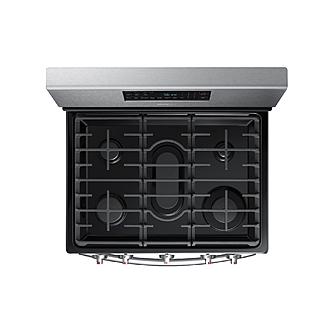
So at Lowe’s I quickly discovered that all their ranges have five burners with metal gridwork completely covering the top of the stove and reminiscent of a medieval drawbridge gate. What the hell? Who decided this? Who wants to lift (and clean) massive metal burners? Where are we supposed to place spoons or spatulas we use while cooking?

At Lowe’s website, I found four-burner stoves in stainless. Problem solved. But no – wait. I read the fine print, then called the store, and learned that installation of said stove-microwave-dishwasher involved a whole new level of expense. For the range, they’d require $60 to convert to propane and another $155 to send a plumber for the installation. (Turn off gas supply, unscrew old hose, screw on new hose…)

For the microwave, they’d require $105 to install and would not touch installation if the old microwave had been direct wired. Well, of course mine had been.

Then for the dishwasher, they’d require $139 for a plumber to install plus $20 for the new water connection hose. And, same as microwave, they wouldn’t touch it if it had been hardwired. (See previous paragraph.)

No, they didn’t offer a combination of plumber duties between stove and dishwasher in order to reduce the cost.

Hell, I could have bought an entire additional appliance for all that.

Then I checked in with the place in Springdale. Sure enough, a very friendly salesman got on the phone and told me everything I wanted to hear. Stove – slightly cheaper, no problem. Dishwasher, cheaper. Microwave cheaper. And all installed by one guy for about $150. Get outta here!

Plus – they would haul off all my old stuff at no charge. Lowe’s wanted $20 for each old appliance.

So several days later the truck arrives and right away I see problems. The microwave is enormous and dented on the right side. The range is white – and not adjusted for propane. At least the dishwasher seemed ok. But no one had lined up the installer.

Thus began a three week saga that is still not finished. The store agreed to switch the massive dented microwave (dent NOT mentioned by salesman) for a small countertop model plus range hood. Dishwasher doesn’t really dry the dishes unless I put it on a long ‘heated dry’ cycle, but that’s part of the slow deterioration of manufacturing quality, not a problem caused by the store. Second delivery of range, adjusted for propane, was a FIVE BURNER model. Are you serious?

Went to store where they admitted they had zero four-burner stainless ranges in stock. What? After I put my fists on my hips and shifted to a slightly louder tone of voice, they finally agreed to order a four-burner, stainless steel range.

Here’s the model I really wanted but they didn’t have him in stock.

Even though I loathe driving to Springdale, I will visit the store BEFORE they deliver the range to see if they’ve adjusted the burners properly because the white stove currently in my kitchen, which they ‘adjusted’ at the store, has no low flame. Turn the burner to ‘low’ and the flames are just as high as they are on ‘high.’ They said that had to be a problem with my propane tank pressure. But it wasn’t a problem with my old stove, so it can’t be that my propane tank has spontaneously jacked up the pressure.

Also, it turned out the installer’s fee wasn’t part of what I paid the store, which wasn’t made clear. (In one of my six phone conversations with the store manager, I asked if they’d fired the salesman yet. They have not.) Plus installer had tried to call me to coordinate his arrival with the delivery but the store hadn’t given him the right phone numbers, so everything on the first delivery arrival had to be rescheduled to match his availability. And the installation fee wasn’t $150 but $275 because he had to wire two outlets at $50 each and connect a new drain line for the dishwasher. Still, even at $275, it was cheaper than Lowe’s.

Highway robbery: Fifty bucks to wire an outlet to an existing wire.

I’m not sure how much more of this consumer joy ride I can stand.


My Personal Consumerism, Part I

A beige plastic spoon rest I’ve used for the last twenty-plus years is now ignominiously stained and warped by more than one close encounter of the worst kind with a stove burner. It contains three shallow cradles where spoons can rest in between stirring whatever I might be cooking. Being well versed in the Gospel of Consumerism, I recently decided to replace it.

This was a job for Amazon.com, where a total of 41 PAGES of search results offer an array of elaborate spoon rest choices. One might find a metal spoon rest with all the features of a fish, or elephant, or sea horse. A multitude of spoon rests have been created with colorful mosaics, period art, or clever or poignant statements about love, life, or food. Spoon rests in solid colors and various shapes abound as do rests that aren’t really rests, but rather exercises in various aspects of geometry by which a spoon might stand on its nose or recline at an angle.

Some of the rests feature an ingenious slotted holder whereby drippings from said spoon might settle below the actual spoon, in essence creating two surfaces to later clean instead of only one. Or consider the utilitarian grater spoon rest for your garlic, cheese, or spice grating in addition to use as a spoon rest. (below) Others form such a textured and convoluted surface that one might never fully clean it.

Despite the enormous array of color, design, and material, none of these elaborate and in many cases outrageously expensive spoon holders offer the key features provided by my humbly stained, warped plastic spoon holder:  a nesting place for three spoons. Virtually all but one or two of these models now available in the vast warehouses of kitschy kitchen gadgets offer a place for only one spoon.

I wasn’t aware that cooking in the modern era had been streamlined down to one pot. In my world, there might be simultaneous preparation of mashed potatoes, green beans, and braised steak with onions, each of which would deserve–indeed, demand–its own utensil.

Yes, there are exceptions. One product offers space for two spoons. It retails at the popular Wayfair.com site and sells for ‘only’ $33.99.

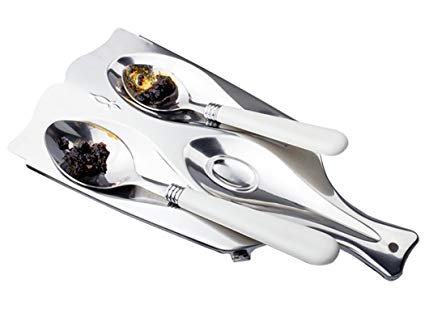
Or there’s this streamlined offering from Amazon.com (below) for only $9.99, if one wishes one’s ladle and spoon handles to become airborne.

Yet another option is the silicone ‘utensil rest’ item which would hold up to five utensils, essentially filling the entire space between left burners and right burners at its 7.3 x 6.7 x 1.5 inches dimensions. The warnings include: “Don’t clean it with abrasive soap or scouring pad, hand-wash recommend. Don’t heat it directly by fire. Don’t pull and impact it violently or scratch it with sharp things. The sudden change of temperature must not exceed 240 centigrade while being used.”

One must admire the energy and creativity invested in this vast array of spoon rest options. Yet I despair.

Why can’t I get a new spoon holder just like the spoon holder I already have?

Well, I could, kind of. By Google searching for “triple spoon rest,” I located one that looks just like my old one and ‘only’ $4.94. But overall, consumer ratings put it at 2.4 stars out of 5. Here’s one review of it:

I had one just like this from the same company that I bought years ago. So when it finally gave up the ghost, I wanted to replace it with the same item. I really like how big it is and that I can put multiple spoons on 1 rest. (If you are really cooking you use more than one utensil). I found this on Amazon and was pretty excited to be able to replace mine with an exact duplicate. Well, the shape and size are the same, but wow!! What happened to the thickness and quality!!?? It is so thin compared to the one I bought years ago. In fact, I washed my old one over and over in the dishwasher. This one came out partly melted the 1st wash.

So that’s a big NO.

I also found one for three spoons made of stainless steel. It’s an ideal concept for a stove-top item. HOWEVER, the piece is 10 x 4.9 x 0.4 inches. Ten inches long? WHY?

This disappointing array of consumer options has brought me to a new understanding. I should respect my old spoon rest and keep it. Its stains are markers of our years together, the many pots of chili and vegetable soup, the hours of simmering pot roast. Its misshapen profile serves as a reminder of neglectful moments when my attention to cooking gave way to refereeing kids or lingering on a too-long phone call.

After all, I too show the marks of my years, kind of warped around the edges from close encounters to heat of a different kind. And other life drama.

With more than 20 years of faithful service to its credit, why should I replace the venerable old servant with something that doesn’t fit my needs, costs too much, and would be bereft of any memory whatsoever?

Consumerism instilled by vast corporate effort turns every item and every occasion into a compelling need to spend money. As the years go by, more and more of our past ends up in the landfill for no good reason other than an infection of consumerism. It must be new! It must be shiny! By what other blood would the corporations of the world flourish if not our pervasive consumerism?

So I won’t participate, at least, not for this item, not for this moment. The old spoon rest will maintain its pride of place on my new stove top.

(More on the new stove in my next blog, My Personal Consumerism, Part II.)


Now It’s Drone Bees

I recently read a news report that Walmart is investigating the use of drones in pollinating agricultural crops.[1] That just about knocked me out of my chair, but then, on reflection, I saw the Walmart dream: total control of our food supply.

Granted, the bee die-offs are a serious problem for farmers, a result—according to most experts—of our love affair with poisoning our food. You see, spraying herbicides, fungicides, and pesticides on our crops to kill off pests like, well, anything that hurts the crop, also kills off the bees. Without pollination that bees perform so expertly, we’ll have no food.

How clever of Walmart to attempt some redress of this terrible problem! Their concept is to enlist drones with “sticky material or bristles” to spread pollen as they move from plant to plant.  Of course the elephant in the room is the obvious question: if poisons used in agriculture are killing the bees, what are they doing to us?

Already we’ve heard—and mostly ignored—reports that frogs and other amphibians are experiencing reproductive deformities[2] due to environmental pollutants like Round-up’s glyphosate, now banned in Europe, and atrazine which is applied to tens of millions of acres of corn grown in the United States, making it one of the world’s most widely used agricultural chemicals. A powerful, low-cost herbicide, atrazine is also the subject of persistent controversy.[3]

“Atrazine demasculinizes male gonads producing testicular lesions associated with reduced germ cell numbers in teleost fish, amphibians, reptiles, and mammals, and induces partial and/or complete feminization in fish, amphibians, and reptiles,” according to years of study by scientist Tyrone Hayes whose reports on his research are the target of relentless attacks by atrazine’s primary manufacturer, Syngenta.[4]

Atrazine is just one of many chemicals in wide use across the United States known as endocrine disrupters, “shown to disrupt reproductive and sexual development, and these effects seem to depend on several factors, including gender, age, diet, and occupation… Human fetuses, infants and children show greater susceptibility than adults… in diseases such as cancer, allergies, neurological disorders and reproductive disorders.”[5]

Then there are the hundreds of other chemical cocktails we are forced to routinely ingest not only in our food but also in our drinking water. Tens of thousands of chemicals are released into the environment in products ranging from shampoo to toilet bowl cleaner, few if any of which have been tested for potential harmful effects on human health and which, at last count, only a handful are tested for or removed from drinking water supplies. Not that anyone has any idea how to remove them from the water. This is part of the don’t ask, don’t tell philosophy of the chemical industry which is not required by law to test human health effects unless and until some harm is proven.

Europe, more intelligently, requires testing to prove no harm before new chemicals can be used. What a concept.

It’s such a downer to the chemical and agricultural corporations that someone might want to avoid cancer, allergies, neurological disorders and reproductive disorders. What a hero Walmart will be for its clever solution to the bee die-off, allowing for continuing and possibly increasing chemical poisoning of our food supply through the use of drones! According to the report, its grocery business will be “aided by farm-related drones, which could be used to pollinate crops, monitor fields for pests, and spray pesticides.”

If we could believe for one second that Walmart’s concern is the nourishment of Americans, we might also be sold a bridge somewhere in Manhattan. We already know from years of experience with this corporation that its objective, at least since ole Sam Walton died and left the biz to his greedy kids, is only the bottom line. Squeeze producers to make the cheapest possible product. Eliminate warehousers and trucking firms. Pay employees wages so low they qualify for food stamps. Pocket the difference, a method that propels these money grubbers to the top of the wealth lists and gives them extra spending money to proclaim their ‘generosity’ with projects like Crystal Bridges.

They care nothing about American jobs. Sam was eager to advertise that his products were made in American. His body had hardly cooled when the kids were over there making deals in China. It’s hard to find any product in Walmart today that’s made in America.

Or customer service. They can’t work fast enough to eliminate those damn middle management jobs like department supervisors. If the computer models show that a particular inventory item isn’t the very best selling product, the motto is to shit-can the damn thing. It doesn’t matter if people have been purchasing that product at Walmart for the last twenty years. Thus was the case last week when I rushed in to purchase a battery for my camera, already late for a photo-shoot appointment for a book I’m working on, only to discover that Walmart has eliminated its camera department.

Then there’s the Williams seasoning mixes we’ve relied on for chili, tacos, and spaghetti, now swept from the shelves because Walmart is rolling out its store brand seasoning mixes. Okay, now if you really want to set my hair on fire, this is the right topic. How many times have you or I visited Walmart for a particular brand-name product that we especially enjoy only to discover its shelf area filled with Walmart’s Great Value brand. I wrote the corporate CEO: “First, let me say that I’d rather live the rest of my life without chili than to buy a brand I’m being coerced to buy.”

Do I have to tell you there was no response? Oh, and by the way, there’s no online email complaint method and in order to get the snail-mail address for the CEO, you have to spend an hour dodging through multiple departments who are trained, probably on threat of death, to take your complaint and “deliver the message.” Or to direct you to the store where you encountered your problem…

Then there’s the total incompetence of Walmart’s grocery buyers who don’t know the difference between a sliced almond and a slivered almond. Since last October, Walmart stores have had only sliced almonds. Big fat bags of sliced almonds. Great Value brand, of course.

The point is, if Walmart has no idea what it’s doing with almond inventory and no sense of patriotism about supporting American industry and no honor or reliability in customer service, then what will they do to our food supply? Already we can see a hint of how that will go with their careful bait and switch methods in supplanting traditional brands with their store brands. Once they’ve got their thumb in the pie from crops on up to the shelves, we’ll be completely at their mercy.

Yes, I’ve shopped other stores. But so many of us haven’t that the other stores have one by one folded up shop and drifted into shadow. There’s no local stationery store, unless you want to call Office Depot by that name. Which they’re not. They’re as bad or worse than Walmart. No nice little note cards on thick vellum paper. Now even the standard four-squares per inch graph pads have been supplanted by the smaller five per inch, no doubt some efficiency expert’s idea of customer service. Where is McRoy-McNair with their dusty basement of old colored paper and clasp envelopes in every conceivable size?

For years I’ve made it a point to buy everything I can from anyone but Walmart. This year I’ll be especially interested in farmers’ markets in the area where I live in order to support local farmers doing things the old fashioned way. I’ll be growing my own tomatoes, peppers, squash, and niceties like dill, thyme, sage, and basil. I live in the woods where there’s still a modest bee population, and I’m planting more bee-friendly flowers like lavender, rhododendron, California Lilac, and for my cats and the bees late into autumn, catnip.[6]

It’s dangerously late in this game when they start using drones to replace bees.

~~~

[1] “Walmart imagines drone-aided farming,” Northwest Arkansas Democrat-Gazette. Sunday Mar 25, 2018. 1G

[2] http://www.sciencemag.org/news/2002/12/pesticide-cocktail-amplifies-frog-deformities

[3] https://www.ncbi.nlm.nih.gov/pmc/articles/PMC4137807/

[4] https://www.sott.net/article/317851-Biologist-targeted-for-exposing-the-gender-bending-pesticide-Atrazine-poisoning-America

[5] https://www.ncbi.nlm.nih.gov/pmc/articles/PMC3138025/

[6] Big list at http://beefriendly.ca/25-plants-for-bees-in-your-garden/