Woodstoves!

Bought a new wood stove lately? Who knew my longtime desire to buy one would bring me to the brink of despair. Let me tell you, my friend. This is not a step you should take without proper warning.

The old stove, fortunately still in my possession in case I give up this fight, was a Big Box model I inherited when my new husband and I moved into an old cabin. That was in 1974. Local lore claimed an old man named “Ringo” died in that cabin, tired of life, sick, and unable to gather wood. Reportedly, he froze to death.

Fire in the Big Box was simple. Two logs with space enough between them for some crumpled newspaper, a handful of twigs and other flammable bits gathered from the surrounding woods, and then another log across the top, positioned so that when the kindling burned up, the third member would not collapse into the middle but rather perch over the coals to burn freely. Air intake open and the damper open, a match set it off. It was safe to walk away to return a half hour later to shut the air intake and let that baby burn. Whenever fresh wood was needed, simply open the damper to let the smoke escape up the chimney, open the stove door to add wood as needed, and there you go! No smoke pouring into the room.

The problem with the Big Box was that by midnight, fast asleep, one started to sense the cold creeping in. Even the most magnificent fat cut of oak or hickory burned up in only 3-4 hours. That’s because any seal that might once have lined the top edges and front door was long gone and so even with all moveable parts closed, air still moved through the stove. Such things as seals or firebrick probably never existed as part of the stove—at least, in my fifty years with it, no such trace remains. So as my knees got worse with advancing age, trekking up and down the five steps to the living room where the Big Box held pride of place became a more troublesome issue especially at two a.m. when I slept past the life of the fire and only a few coals remained.

I lusted after those fabled wood stoves like Jøtul which held fire overnight. Not only would that solve my overnight heat problem, but it also offered a glass door so I would watch the flames leap and glow. Watching fire can lead to trance-like relaxation effects. These effects have been backed by research that shows that watching an open flame can decrease blood pressure. The longer you sit by the fire, the more relaxed you’ll feel. So when I finally had sufficient funds, I visited the local wood stove store and considered my options.

Admittedly, I failed utterly in the research-before-you-buy department. I’m here to share what I’ve learned.
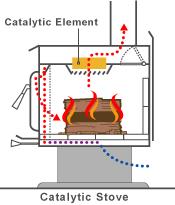
News flash: Woodstoves now must meet new EPA standards, passed sometime in the 1990s, that specify several aspects of the device. Not only did this drive up the prices to absurd levels, but also led to the admonition by my two-man installation team who warned me that the stove would probably smoke. The Jøtul stoves meet EPA requirements with the use of a catalytic device that serves as a kind of filter, but as the EPA guidelines admit, the ‘catalyst’ can burn out within a couple of years.

  • In catalytic combustion, the smoky exhaust is passed through a coated ceramic honeycomb inside the stove where the smoke gases and particles ignite and burn. Catalytic stoves are capable of producing a long, even heat output.
  • All catalytic stoves have a lever-operated catalyst bypass damper which is opened for starting and reloading. The catalytic honeycomb degrades over time and must be replaced, but its durability is largely in the hands of the stove user. The catalyst can last more than six seasons if the stove is used properly; but if the stove is over-fired, inappropriate fuel (like garbage and treated wood) is burned, and if regular cleaning and maintenance are not done, the catalyst may break down in as little as 2 years. 

Not that I would ever burn garbage or treated wood, but spending $300 every couple of years wasn’t on my list of things to do. And as I approach 80 years of age, I have little patience with machines that require “regular cleaning and maintenance.” So for nearly a month I lost sleep worrying about using the stove. It was still summer, so I had time to fret. Finally, after speaking with the store manager, they agreed to allow me to trade my unused Jøtul for a non-catalyst stove manufactured by Pacific Energy.

Beware! The store staff failed utterly to inform me that in many ways, the non-catalyst stove created more problems than the catalyst version.

But I didn’t know that yet. My decision narrowed to the model that allowed for 18” firewood, of which I already had over four ricks of seasoned wood. This model is Pacific Energy’s Alderlea T6. It’s a handsome stove, although several aspects of its construction are big problems.

One of the Alderlea’s many shortcomings is that while the manual states that maximum wood length is 20 inches, the only way to fit a log that size into the stove is on a diagonal from front corner to back corner. Even the owner’s manual phrase “Ideal Wood Length” of 16 to 18 inches placed “endwise” [does this mean end to end sideways or end to end from door to back of stove? No diagram.] leaves zero clearance between the burning wood and the door/firebrick, which means that the glass door quickly becomes coated with soot. So much for watching the fire. The fire box is exactly 18 inches square.

But I’m getting ahead of myself.

After multiple readings of the product manual, I began to break in the stove setting fires meant to burn off the ‘paint’ fumes with house windows open. Right away I noticed what is now a major problem: there is no way to manually vent the stove. Once wood starts burning, if I need to open the stove door to add more wood, or reposition wood, the only option is to open the door and do the task as fast as possible while smoke pours into the room.

Apparently Pacific Energy’s engineers believe the price of making the outside air ‘cleaner’ is to pollute my inside air. The manual fails utterly to address this issue. The instructions for ‘Lighting a Fire’ are:

  1. Adjust air control to “High” position (all the way to the left) and open door.
  2. Place crumpled newspaper in the center of the heater and crisscross with several pieces of dry kindling. Add a few small pieces of dry wood on top.
  3. Ignite the paper and leave the door ajar approximately ½” until the wood kindling is fully engulfed in flame.
  4. After the kindling is fully engulfed, [open the door while smoke pours into the room] add a few small logs. Close door.
  5. Begin normal operation after a good coal base exists and wood has charred. [In other words, spend a half hour watching the stove or make repeated trips to check on it.]

Further instructions follow for Normal Operation:

  1. Set air control to a desired setting. If smoke pours down across the glass, this indicates you have shut the control down too soon or you are using too low a setting. [Wrong. Smoke pours down across the glass with the air control wide open, max setting.]
  2. For extended or overnight burns, unsplit logs are preferred. Remember to char the wood completely on maximum setting before adjusting air control for overnight burn. [“Char” is defined as partially burn wood so that the surface is black.]
  3. Use wood of different shape, diameter and length (up to 18”). Load your wood endwise and try to place the logs so that the air can flow between them [while smoke pours into the room].
  4. Do not load fuel to a height or in such a manner that would be hazardous when opening the door [while smoke pours into the room].

The instructions continue with information about restarting after an overnight or extended burn:

  1. Open door and rake hot embers toward the front of the heater. Add a couple of dry, split logs on top of the embers [This assumes that you need to load wood ONLY when the previous load has burned to embers. What if you want to go to bed and the current load has only burned 75%? Even 90% burned wood smokes. You have to load while smoke pours into the room], close door.
  2. Adjust air control to high and in just a few minutes, logs should begin burning. [If they don’t start burning, open door to add kindling or reposition wood while smoke pours into the room.]
  3. After wood has charred, reset air control to desired setting.
  4. To achieve maximum firing rate, set control to high “H”. Do not use this setting other than for starting or preheating fresh fuel loads.

Nowhere in the manual does one find a drawing showing the “H” and “L” positions. The lever which moves left to right for this function goes a half inch past the H and L lettering, leaving one to wonder if maximum left or maximum right are the correct positions, or if the lever must be positioned exactly under the H or L.

More instructions follow, including how to use the ash clean out system which proposes one use the tiny opening in the bottom of the stove to dump ash into the ash pan that sits underneath the firebox. One is cautioned not to leave the ash dump door open afterwards. One is not shown the location of the ash dump handle, just informed that the handle is located under the ash lip [also not identified in any drawing] on the left hand side. This is a total waste of owner manual space and engineering salary, and a stupid idea to start with. Just shovel it out, for god’s sake.

An entire page of the manual (27 pages in all) is devoted to the door glass. The #1 instruction regards the potential [unavoidable] darkening of the glass:

  1. If glass becomes darkened through slow burning or poor wood, it can readily be cleaned with fireplace glass cleaner when stove is cold. Never scrape with an object that might scratch the glass. The type and amount of deposit on the glass is a good indication of the flue pipe and chimney buildup. A light brown dusty deposit in that is easily wiped off usually indicates good combustion and dry, well-seasoned wood and therefore relatively clean pipes and chimney. On the other hand, a black greasy deposit that is difficult to remove is a result of wet and green wood and too slow burning rate.
    1. WRONG! My wood is well seasoned hardwood (12-18 months) and I don’t adjust the control lever to “L” until the fire is fully engaged, but every morning I must clean the glass, especially the lower side corners where the ‘black greasy deposit’ requires a single-edge razor blade to remove in addition to several applications of glass cleaner. Is this a malfunction of the stove? Queries to the manufacturer are met with advice to contact the dealer! Does this mean that two months into using the stove, I need to have my chimney cleaned?!

Further warnings on that page caution that “excessive ash buildup” should be kept clear of the front of the firebox because it will block air flow. Here’s the problem: Where exactly is this mysterious air intake? It is not shown on any drawing. There are two stair-stepped lips along the front where air might enter, so “excessive” ash remains undefined. Consequently, I keep the fronts of both steps clear. Once again, would a diagram be so hard?

Item #8 on this page is especially informative:

  • Be aware that the hotter the fire, the less creosote is deposited. Weekly cleaning may be necessary in mild weather, even though monthly cleaning is usually enough in the coldest months when burning rates are higher. When wood is burned slowly, it produces tar and other organic vapours, which combine with expelled…

And there the text ends. But apparently the conclusion is that closing the air intake completely is not recommended even though an overnight burn would seem to call for minimal air flow. If the best fire method for this stove is a ‘hot burn’ in order the keep the glass clear, how is that compatible with overnight heat?

Old Faithful, Big Box

Not that it actually matters. There is an ugly creosote buildup on the glass in both lower corners even with ‘hot’ fires, with any level of air control, and if I want to watch the fire through the glass, I have to ignore the creosote or clean it daily, which doesn’t last until the end of the day.

The next page of the manual is about maintenance. Monthly, I’m supposed to check:

  • Brick rail tabs and brick rails
  • Air riser tube in the back of the firebox
  • Back slide of airwash chamber
  • Baffle locking pin
  • Boost tube cover

Not only are there NO DRAWINGS showing the location of these various important maintenance parts, my knees don’t work well enough to crawl around peering inside or under the stove. This would also require that no fire exist in the stove at the time of inspection, meaning my house would have NO HEAT except for little electric heaters in the bathrooms. The last few days have bottomed at sub-zero temps, at no time without fire. That would be a summer job, so I can only hope that the brick rail tabs and airwash chamber are OK for fire throughout the winter.

Genius.

Further, the maintenance instructions continue with “Cleaning the Chimney System”:

  • Top baffle board/blanket
  • Baffle
  • Top heat shield and mountain bolt
  • Baffle gasket
  • Brick rails
  • Manifold

Again, no drawings, diagrams, or other user aid.

I can only hope that I can keep my fires going until warm weather without having something fall apart and/or a chimney fire. Not exactly the peace of mind I had hoped for.

I’m refraining, with difficulty, from speaking of the overall worth of the owner’s manual. After all, I’m a writer and wordsmith dedicated to communicating clearly–not a stove engineer. Somebody apparently did their best with this booklet, sadly. The lack of drawings illustrating the key components of the stove is enough of a failure that the countless other shortcoming hardly bear mention. Pages 11 through 20 detail installation methods. Page 25 is blank. Hint to manual editor: PLENTY OF ROOM FOR DRAWINGS.

There is, however, a full page breakout drawing of the stove PARTS, as if the manufacturer was more interested in selling parts than in adequately explaining the stove’s functions.

At the moment, I’m not sorry I bought it. It does a better job than the old Big Box in keeping heat all night–with luck and holding my mouth right, coals are left in the morning ready for fresh wood. I do have to live with smoke pouring into the room while I try to load in wood and kindling, at which point I’m reminded that I could have stuck with the Jøtul. At least its Norwegian inventors/manufacturers figured out how to create a more environmentally-friendly wood stove without any need to allow smoke to pour into the room.

Note: Look for future updates on this saga once I try to find a person who can service this stove, the possible need for parts replacements, and the status of creosote buildup in the chimney.

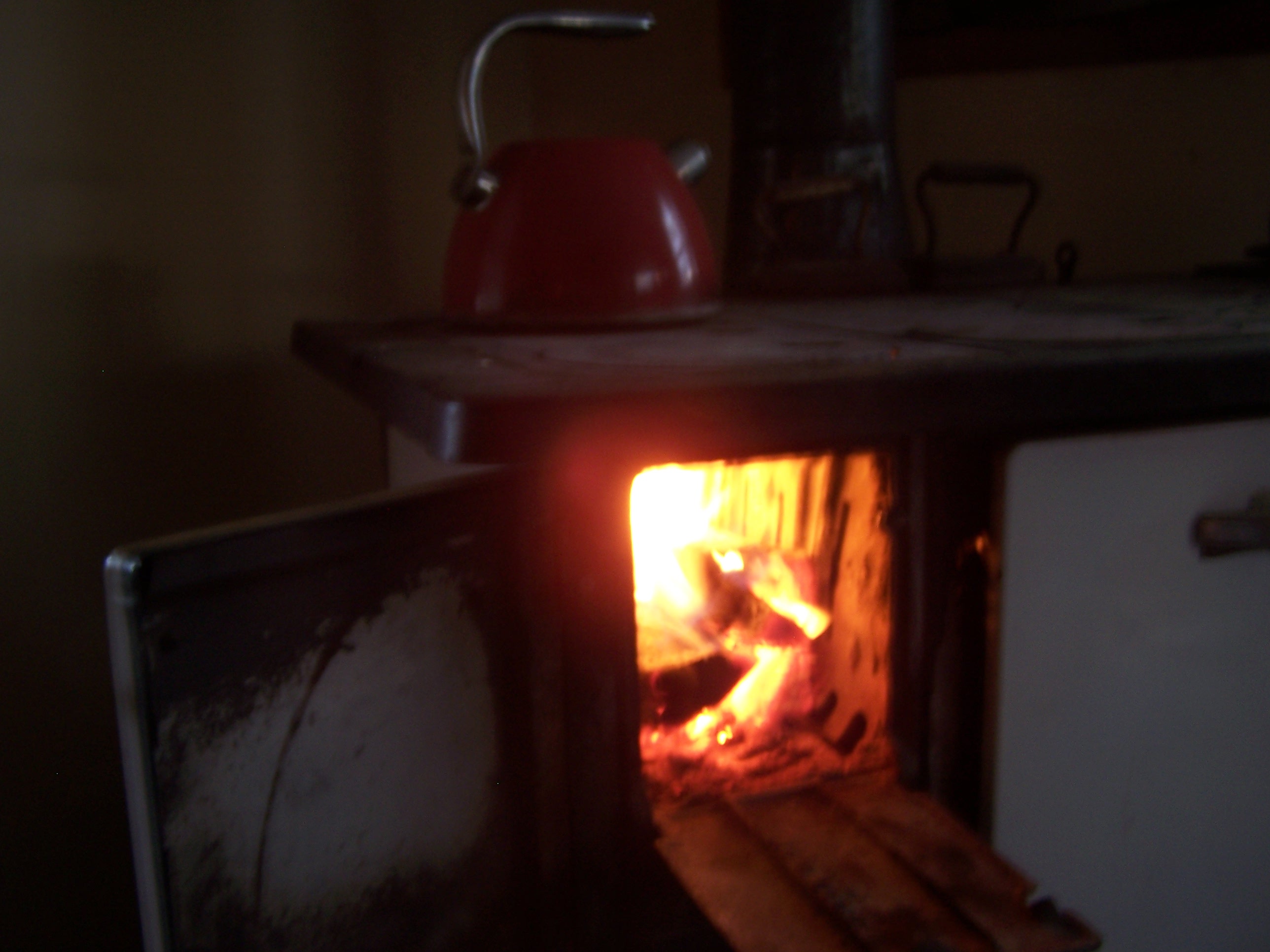
Another note: I failed to mention that I still have the Big Box in use at the back of the house and also have this jewel of an old wood cookstove in my dining room complete with hot water reservoir.
Walmart’s Okra Problem

Bizarre but delicious, okra was a regular menu item as I was growing up. Sliced thin and rolled in salted cornmeal, okra was fried to a crisp golden brown. Mind you, this was not the half-cooked version found in most restaurants today. Rather, the crunchy umami of well-done okra was an essential part of the flavor.

Moving toward old age and looking toward easier and healthier methods of preparing this dish, I discovered that whole pods of okra could reach a similarly scrumptious state when fried minus the laborious slicing and added cornmeal. A little olive oil and an iron skillet render the pods golden brown after only a half hour or so.

A critical factor in this method is the size of the pod. Okra becomes increasingly tough as it grows larger, something that sends us home growers out to the okra patch on a daily basis. Those little devils can grow an inch almost overnight. Once an okra pod zooms much past four inches, you might as well throw it away.

The exception to this winnowing would be if you plan to use okra in gumbo or other stewed preparations, which cooks long enough to overcome the pending toughness while adding its mucilaginous goodness to the pot. Perhaps even frying larger pods would be acceptable IF the pods were sliced.

Frying whole pods being my current modus operandi, I have searched the local markets during the winter months when this tropical native does not grow in my tiny Ozark garden. Walmart offers a small space for fresh okra in its produce section. Alas, 99% of the time, the okra displayed there is disgusting. Packaged in plastic bags, the okra rapidly sweats itself into a moldy, mushy funk. Or some hopeful produce worker places the packages in the path of the regular misting, guaranteeing that the pods quickly deteriorate into the consistency of lumpy puke.

Look closely at the discolored parts of these deteriorating pods, presented here for the viewers delectation.

An alternative packaging method involves clear plastic cartons with ventilation slots. Here the okra has a better chance of lasting until a customer can purchase and, if she hurries, cook and eat it. If the package has been on the shelf more than a few days, the tell-tale signs of black mold and rot seem to be invisible to the produce manager, and the packages will remain until the entire mass has disgustingly disintegrated into a homogenous mass of putrefying vegetation.

Whole Foods is the only other local market found to offer fresh okra. Viewers will note the appetizing black decay on these pods.

The other problem plaguing Walmart’s fresh okra is size. In Walmart’s $4.23 12 oz. package of fresh okra, which contains maybe 20 pods, one finds only six or seven under four inches. This problem can be traced to the source. Nicaraguan and other contract Central American farmers are apparently unaware of the tenderness issue, understandable since a) okra is native to West Africa, Ethiopia, Southeast Asia, and/or South Asia; and b) farmers and their managers wish to gain the largest product for their efforts. The low sales numbers and rate of spoilage should alert Walmart admins of a problem, but they lumber ever onward, oblivious.

Fortunately, a frozen product is usually available at most stores. But don’t be misled by the pre-cut and/or the pre-breaded okra. It doesn’t cook up crisp, but rather transforms into a gummy wad of flavorless gunk. Defying the imagination, Walmart’s ‘Great Value’ breaded okra is sold in a steamable bag…

Only the frozen whole okra pods are useful, but again there is a size problem. The purchaser is indeed fortunate if even half the pods are four inches or less.

Sadly, if a person shops for frozen okra at any of the Walmart stores, as I did a few days ago, that person would be disappointed to discover that there may be no frozen okra pods in stock, thereby requiring that the hopeful buyer travel to a different Walmart. I find it consistently at the Neighborhood Walmart at 660 W. Martin Luther King Jr. Boulevard, but never at the Walmart Supercenter at 2875 W. Martin Luther King Jr. Blvd. [Okay, ‘never’ is a big word and must confess that I haven’t checked for it every day as my grocery shopping trips are weekly. Still…]

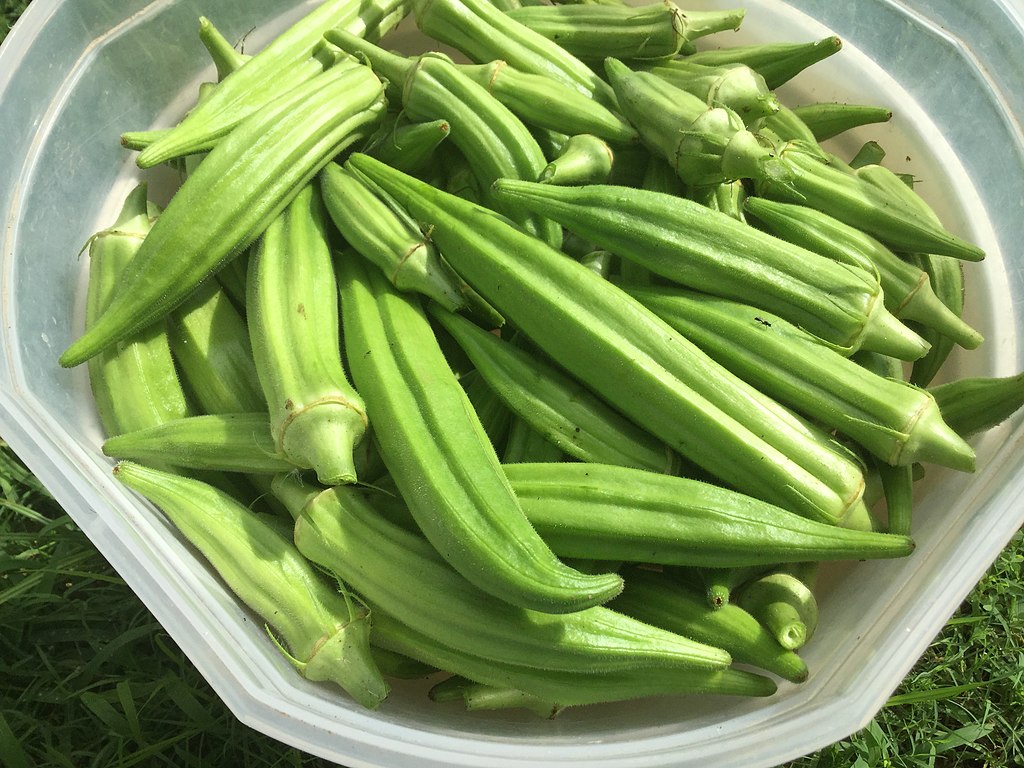
This attractively green batch of fresh okra contains waaaay too many oversized pods.

I plan to grow at least 12 okra plants in my raised beds this year, with an eye to freezing some of my own for cold weather use rather than being constantly at the mercy of commercial growers and retailers’ utter lack of quality control. The real solution to the okra problem is to require growers and merchants to actually EAT some properly-sized and prepared okra. Otherwise this is a hopeless situation for okra lovers everywhere.

Properly fried, sliced okra will not retain a bright green color and neither will the pods, changing instead to a dull olive drab.

Adventures in Real Estate:

A Ridiculous and Mostly Rewarding Journey from Tenant to Landlord

What began as a quest for a larger yet affordable shop space for a small-town repair business turned into a thirty-year adventure in the ups and downs of real estate ownership with detours into such unexpected crises as adverse possession, lawsuits, evictions, city ordinance violations, easements, and endless tenant drama.

The author of this blow-by-blow account offers helpful hints based on hard-earned lessons about ownership of commercial property in a rapidly growing part of the country, Northwest Arkansas. Perhaps even more helpful to anyone interested in dabbling in this particular type of investment opportunity is the entertaining narrative tracking one person’s struggle to learn, adapt, and survive in the onslaught on unexpected legal, construction, and tenant challenges while raising three children and surviving a failed marriage.

Will the story end in despair and bankruptcy? Or will the investment pay off with retirement income sufficient to keep body and soul together into the twilight years?

Author of “how-to” books and over a dozen studies of local history, Campbell’s incisive observations about her adventures in the local real estate market offers a treasure-trove of advice to anyone contemplating investing in commercial real estate. This richly-told story is a profile of how to get in cheap and make it work for anyone looking to provide a decent return on almost zero dollars and a lot of sweat equity.

Paperback, $11.95, Amazon

Self-Publishing: The Basics

Plus

How to Tell Your Story: A Guide for Personal Memoir or Family History

This holiday season, take advantage of family gatherings to save your ancestral history. For the first time in history, you have the opportunity to put your masterpiece ideas into bookstores without a middleman. This revolution in communication comes with a price, however, a steep learning curve about which technology to use and how to use it. That’s where this book comes in handy.

The first part of this book covers the fundamental stages of self-publishing: what software to use and how to use it, step-by-step guidance for working with Amazon’s Kindle Direct Publishing, and understanding important elements like genre. You’ll find discussion about getting reviews and marketing as well as useful hints about maintaining those tender creative sensibilities in the face of seemingly overwhelming obstacles.

The second part provides organizational and writing guidelines for the personal memoir as well as family history. How do you transform the bare bones of genealogical research into a compelling narrative? How do you flesh out the story of a transformative period of your life? Take notes when an older relative starts reminiscing. Someday you’ll be glad you did.

Previously, so-called vanity presses charged a stiff fee to take a manuscript and turn it into a book. Now with print-on-demand technology, the self-publishing author doesn’t need to pay a dime to publish a paperback or e-book. That memoir or family history or sure-to-be-a-bestseller novel only needs some basic pointers to go from brainstorm to reality. Start writing!

Paperback, $12.95, Amazon

Take Note While You Can!

Make good use of that chaotic holiday family gathering! Record family history told by Aunt Tilley and Grandmother Joan while they’re still around or forever regret the history you’ve lost. Interview Granddad Hiram, racy jokes and all. These stories never go out of style! And your grandchildren will thank you.


Wait no longer! Take some time today to write down something, even a few words. Fifteen minutes. An hour. What you write doesn’t have to be a 400-page novel—it can be a list of things you remember about your grandmother. Put her full name at the top of the sheet of paper and then the date and place she was born, if you know it. Who did she marry and when, where? What places did they live? What were the names and birth dates of their children? Did she keep a garden? Crochet? Play tennis every week? Every detail you record will color in the lines of a story prized by your descendants.

Whatever direction your road leads, never doubt that your efforts will be greatly appreciated not only by other family members now but also by those who come after you. Knowing the names, activities, whereabouts, and personalities of our forefathers and foremothers offers each of us a comforting sense of place, a mirror to reflect our greater selves, and reassurance that life for your kind goes on no matter what. Personal and family histories are a critical tool for your descendants to more fully understand what has led to who they are.

Or maybe you’ve been thinking about telling your personal story, those life-changing moments you’ll never forget. This easy-to-follow guide walks you through the steps of making it real: gathering and organizing information, changing a bare-bones family tree or personal memoir into a fascinating narrative, and putting it into print – at no cost!

This book covers the fundamental stages of writing family history or an autobiography with pointers on fleshing out details into compelling narratives, how to organize your materials, and building a story.

The book also provides clear guidelines on how to self-publish: what software to use and how to use it, step-by-step guidance for working with Amazon’s Kindle Direct Publishing, and understanding important elements like genre. You’ll find discussion about getting reviews and marketing as well as useful hints about maintaining those tender creative sensibilities in the face of seemingly overwhelming obstacles.

Don’t miss your holiday opportunities to gather your family history and turn it into a record to be prized by generations to come. Grab your copy today at Amazon.com

Thinking of investing in real estate? A cautionary tale

Dragging a building back from the brink–rotted roof, sagging floor joists, and years of sheltering homeless people were just a few of the tasks waiting this new owner.

What began as a quest for a larger yet affordable shop space for a small-town repair business turned into a thirty-year adventure in the ups and downs of real estate ownership with detours into such unexpected crises as adverse possession, lawsuits, evictions, city ordinance violations, easements, and endless tenant drama.

The author of this blow-by-blow account offers helpful hints based on hard-earned lessons about ownership of commercial property in a rapidly growing part of the country, Northwest Arkansas. Perhaps even more helpful to anyone interested in dabbling in this particular type of investment opportunity is the entertaining narrative tracking one person’s struggle to learn, adapt, and survive in the onslaught of unexpected legal, construction, and tenant challenges while raising three children and surviving a failed marriage.

Will the story end in despair and bankruptcy? Or will the investment pay off with retirement income sufficient to keep body and soul together into the twilight years?

Author of “how-to” books and over a dozen studies of local history, Campbell’s incisive observations about her adventures in the local real estate market offers a treasure-trove of advice to anyone contemplating investing in commercial real estate. This richly-told story is a profile of how to get in cheap and make it work for anyone looking to provide a decent return on almost zero dollars and a lot of sweat equity.

Grab your copy today! Amazon.com

Tea Time

A couple of hundred years ago, the Brits figured out the utility of tea. In China where the tea plant is native, tea had been an important human companion for thousands of years. Aside from its refreshing properties, tea offers the opportunity for a satisfying ritual.

Americans need tea time.

It was with that in mind, as well as the beverage’s healthy attributes, that I included 50 loose leaf teas in fulfilling a personal dream of opening a café.

Yes, this blog post has nothing to do with current events, politics, or social disorder.

Trailside Café & Tea Room gained success almost immediately upon opening in March 2009. The old Quonset hut building where it was housed transformed from an out-of-the-way eyesore on the outside to another place in time on the inside. Peaceful pale apricot walls, crisp white tablecloths, and framed images of people taking tea in Arabia, China, Paris, and other parts of the world helped shape an atmosphere of world community centered on tea.

Since the café closed in December 2011, I have on occasion tried to continue my gospel of tea. There’s a terrible hurdle in this effort, however. Everyone thinks they know about tea.

They don’t.

What Americans know about tea – Camellia sinensis – is a tea bag-stained glass of water heavily flavored with lemon and sugar. Friends, that’s not tea.

Well, it’s tea, but not really what tea has to offer.

Consider, for example, the many types of tea. When tea leaves are plucked from their bushes, they are spread out to dry. With no further ‘curing’ process, this become white, yellow, or green tea.

Currently there is no generally accepted definition of white tea and very little international agreement; some sources use the term to refer to tea that is merely dried with no additional processing, some to tea made from the buds and immature tea leaves picked shortly before the buds have fully opened and allowed to wither and dry in natural sun, while others include tea buds and very young leaves which have been steamed or fired before drying. Most definitions agree, however, that white tea is not rolled or oxidized, resulting in a flavor characterized as “lighter” than most green or traditional black teas.

In spite of its name, brewed white tea is pale yellow. Its name derives from the fine silvery-white hairs on the unopened buds of the tea plant, which give the plant a whitish appearance. The unopened buds are used for some types of white tea.

Oolong comes in many styles, my current favorite cup every morning being the Iron Goddess of Mercy oolong. In general, oolong is

… a traditional semi-oxidized Chinese tea produced through a process including withering the leaves under strong sun and oxidation before curling and twisting. Most oolong teas, especially those of fine quality, involve unique tea plant cultivars that are exclusively used for particular varieties. The degree of oxidation, which varies according to the chosen duration of time before firing, can range from 8–85%, depending on the variety and production style.

What most Americans think is ‘tea’ is black tea. Sadly, most teabags sold in stores contain leaf dustings and fragments after the quality leaves have been diverted to more discerning consumers.

Black tea is more oxidized than oolong, green, and white teas. Black tea is generally stronger in flavor than other teas. While green tea usually loses its flavor within a year, black tea retains its flavor for several years. For this reason, it has long been an article of trade, and compressed bricks of black tea even served as a form of de facto currency in Mongolia, Tibet and Siberia into the 19th century. Black tea accounts for over 90% of all tea sold in the West.

After the harvest, the leaves are first withered by blowing air on them. Then the leaves are processed in either of two ways, CTC (Crush, Tear, Curl) or orthodox. The CTC method produces leaves of fannings or dust grades that are commonly used in tea bags but also produces higher (broken leaf) grades. This method is efficient and effective for producing a better quality product from medium and lower quality leaves of consistently dark color. Orthodox processing is done either by machines or by hand. Hand processing is used for high quality teas. While the methods employed in orthodox processing differ by tea type, this style of processing results in the high quality loose tea sought by many connoisseurs. The tea leaves are allowed to completely oxidize.

Jeanne Paul Sartre and Simone de Beauvoir taking tea.

Next, the leaves are oxidized under controlled temperature and humidity. (This process is also called “fermentation”, which is a misnomer since no actual fermentation takes place. Polyphenol oxidase is the enzyme active in the process.) The level of oxidation determines the type (or “color”) of the tea. Since oxidation begins at the rolling stage itself, the time between these stages is also a crucial factor in the quality of the tea; however, fast processing of the tea leaves through continuous methods can effectively make this a separate step. The oxidation has an important effect on the taste of the end product, but the amount of oxidation is not an indication of quality. Tea producers match oxidation levels to the teas they produce to give the desired end characteristics.

Then the leaves are dried to arrest the oxidation process.

Finally, the leaves are sorted into grades according to their sizes (whole leaf, brokens, fannings and dust), usually with the use of sieves. The tea could be further sub-graded according to other criteria.

Ho Chi Minh taking tea

The benefit of black tea processing methods is that by mixing, tea leaf flavors are combined, allowing product standardization. Which takes a lot of the fun out of tea.

Finally, there’s pu-erh (pronounced ‘pooh-er’). I never gained much appreciation for pu-erh. It’s an acquired taste and largely considered medicinal among the Chinese.

Fermented tea (also known as post-fermented tea or dark tea) is a class of tea that has undergone microbial fermentation, from several months to many years. The exposure of the tea leaves to humidity and oxygen during the process also causes endo-oxidation (derived from the tea-leaf enzymes themselves) and exo-oxidation (which is microbially catalyzed). The tea leaves and the liquor made from them become darker with oxidation. The most famous fermented tea is pu-erh.

Experimenting with tea to find one or more favorites doesn’t just require finding a source. (My go-to place for quality teas is Upton Tea.) One must appreciate and meticulously follow proper preparation techniques in order to gain the full flavor of the tea. This involves heating good quality water in a tea kettle (not microwave), the appropriate amount of tea leaves placed in a strainer large enough to permit full expansion of the leaves, careful timing of steep time, and avoidance of adding flavor killers like sugar, milk, or lemon.

PLEASE! Give the tea a chance!

For example, boiling water (212°) is required to steep a black tea, but absolutely ruins green or oolong tea. For those more delicate leaves, the tea kettle should be pulled from the stove when it first starts to steam, around 190°. Steep time for a Darjeeling black tea is only 2-3 minutes whereas an oolong is best at 4-5 minutes. And so forth.

Tea not only offers the stimulation of caffeine, but also of theobromine (also found in chocolate) and theophylline (also found in chocolate and when isolated, serves multiple pharmacological purposes).[1] Additionally, tea contains useful flavonoids[2], EGCG (believed useful in reducing LDL-cholesterol)[3], and other flavins (with complex health benefits)[4].

The preparation and serving of tea to oneself or a small gathering of friends can be a soothing ritual of human-scale attention to detail. The process invokes a sense of timelessness and caring. No wonder early Americans continued this tradition of their British brethren. And no wonder that King George’s 1773 outrageously high taxation of tea became the rallying point of our revolution. After that, it became unpatriotic for Americans to drink tea, instead diverting the need for a social drink to coffee.

I’ve found tea far preferable to coffee, which makes me jittery and upsets my stomach. I enjoy the variety of teas beyond my current Iron Goddess phase. I keep some good quality Darjeeling on hand as well as some Jasmine pearls (green tea scented with jasmine flowers). And my first love in tea is never far from my mind, unsweetened black tea on ice of which I once could drink gallons until I figured out why I couldn’t go to sleep at night…

At my age, tea drinking must take place before noon in order to not lie awake at midnight, which explains why the Brits can have tea time at 4 p.m. and then attend late night parties without suffering. I’ll probably never adopt the British/Irish/Scottish habit of super-strong blends like Irish Breakfast or the practice of steeping a full pot of tea with the leaves left in. As one wag noted, such preparation made tea strong enough ‘to trot a mouse over the surface.’

I haven’t even mentioned flavored teas – smoked, blended with bergamot (Earl Gray), or combined with citrus, spices, or fruits for a wide variety of flavors. Or you might one of a few Westerners who enjoy tea Tibetan style mixed with Yak butter and salt.

Consider experimenting with tea for your new year!


~~~

Related blog post on Tea and China here.


[1] https://en.wikipedia.org/wiki/Theophylline

[2] https://en.wikipedia.org/wiki/Flavonoid

[3] https://en.wikipedia.org/wiki/Epigallocatechin_gallate

[4] https://en.wikipedia.org/wiki/Flavan-3-ol

Adventures in Real Estate

Friends, I’m pleased to announce the release of Adventures in Real Estate: A Ridiculous and Mostly Rewarding Journey from Tenant to Landlord. The book has been a long time coming, with work progressing slowly over the last several years. It’s sometimes intensely personal, sometimes densely wonky, but mostly–I hope–entertaining and useful.

Officially, the book is about what began as a quest for a larger yet affordable shop space for a small-town repair business and how that turned into a thirty-year adventure in the ups and downs of real estate ownership with detours into such unexpected crises as adverse possession, lawsuits, evictions, city ordinance violations, easements, and endless tenant drama.

As the author of this blow-by-blow account, I offer helpful hints based on hard-earned lessons about ownership of commercial property in a rapidly growing part of the country, Northwest Arkansas. I wish I’d had this book in 1980! Perhaps even more helpful to anyone interested in dabbling in this particular type of investment opportunity is the entertaining narrative tracking my struggle to learn, adapt, and survive in the onslaught on unexpected legal, construction, and tenant challenges while raising three children and surviving a failed marriage.

Will the story end in despair and bankruptcy? Or will the investment pay off with retirement income sufficient to keep body and soul together into the twilight years? Read to the end to find out!

My observations about my adventures in the local real estate market offer a treasure-trove of advice to anyone contemplating investing in commercial real estate. This richly-told story is a profile of how to get in cheap and make it work for anyone looking to provide a decent return on almost zero dollars and a lot of sweat equity.

Grab your copy today, only $19.95 at Amazon.com