A visiting guinea? A ‘possum in the dining room? What strange and wondrous occurrences can one expect while living on an Ozark mountaintop for over forty years?
These lyrical adventure stories feature chickens, raccoons, bugs, dogs, cats, and natural critters of this woodland home. Throw in a few neighbors who shoot copperheads or remodel the dirt road. Ponder the passage of time through a philosophical lens of wonder and delight. The seasons bring summer heat, winter snow, pouring rain, the power of fire. Lessons learned, questions posed–who has lived and died on this land? What is our responsibility to this place, its creatures, each other?
1972. A Yankee learns the Ozarks way and lives to tell his tales. Now almost a native, Denny fondly reminisces about the people and places of his adopted home.
Denny Luke is an adventurer. During his years as a Navy man, he built hot rods with money he made with shipboard loansharking. He returned to his native Ohio where he soon tired of the mechanic’s life. Computers had just started to break the surface in 1966, the perfect attraction to a young man with a sharp mind and plenty of ambition.
Hot cars and Enduro racing occupied Denny’s next few years as he helped usher in the computer age in Minneapolis. But another adventure awaited when in 1970 he fell in with a bunch of hippies. By 1972, he had found his way to the Ozarks.
An avid photographer and storyteller, Denny shares the adventures of his life as he recalls the outrageous backwoods tales and colorful characters who populate the southern fringe of Washington County in Northwest Arkansas.
Personal secret: I’m a purist when it comes to food. Simple basic food, unlike the horror I saw recently where someone wanted to dress up avocado with a coating. For god’s sake, people. Avocado needs nothing but salt!
Take green beans. People go to a lot of trouble to serve green beans—green bean casserole, stir-fry green beans, battered and fried green beans. Well, what’s wrong with just plain green beans? A little salt, cook them tender, voila! Yum.
Then there’s the simple chicken breast. Recipes abound for chicken breast stuffed with cheese, or sausage, or breading. Or for chicken breast coated in this or that, or draped in creamy sauces. What is wrong with a simple chicken breast? Buy it with skin and bone, set it in a baking dish skin side up, sprinkle with seasoning (I prefer Nature’s Seasons by Morton), cover with foil and bake at 425 degrees until completely tender (two hours). The skin comes out crisp, the meat flaky and savory. Delicious.
I have no patience with fancy setups where a tiny portion of something is stacked on top of another tiny portion of something, then some puree on top with a sprig of something else on top of that. It’s like gilding the lily.
And why go to all the trouble for scalloped potatoes–slice potatoes, cut onions, heat milk, and carefully position all that into a baking dish you’ll have to scrub later–when you can just wrap a baking potato in foil, pop it in the oven, and have a wonderful baked potato in less time?
Even with soup, I keep to the basics – vegetable soup is celery, carrot, and onion sautéed then a bit of garlic, canned tomatoes, and water. An hour later, potatoes. That’s it except for salt and pepper, and yes, you can add more if you absolutely will freak out if you don’t make it more complicated, but really, it’s about the heart-warming broth that develops over the two-plus hours of slow cook time.
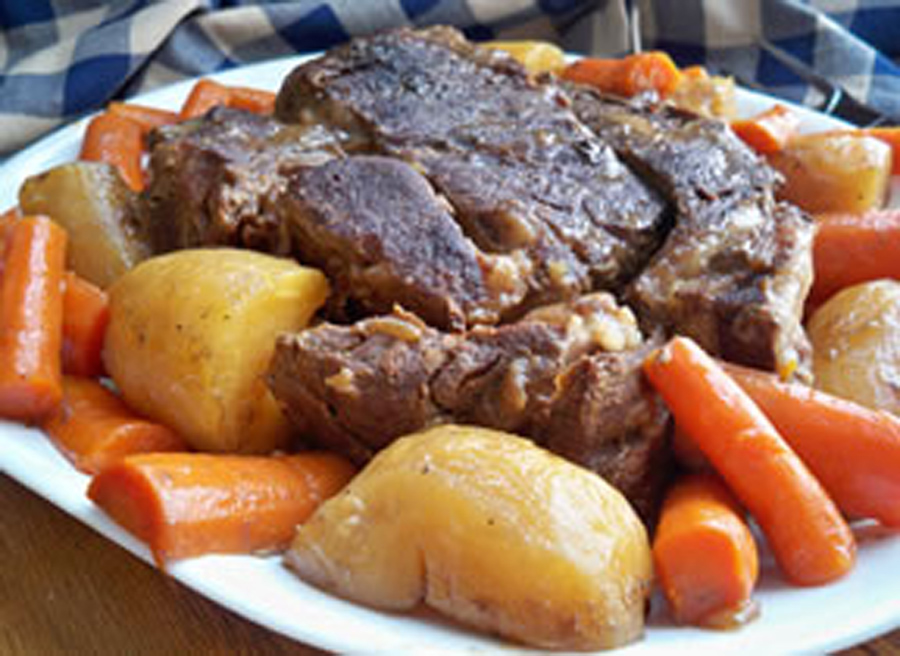
Want beef? Chuck roast is the perfect choice. Grab that slab of meat, sear both sides, add water, onion, garlic, and a bay leaf, then walk away for a few hours. That’s food for several hungry friends or your entire week.
Holidays are no exception to my ‘keep it simple’ rule. Gotta have turkey? Don’t bother with stuffing. Make some cornbread. When cooled, crumble it into a large bowl and set aside. Saute celery and onion, add some garlic, sage, and poultry seasoning then pour in a couple of cups of chicken broth. Simmer until celery is tender, then pour over crumbled cornbread, stir in an egg or two, and bake covered. Tastes fantastic with the turkey.
I get that for a lot of people, cooking is a therapeutic process and the more steps involved, the more therapeutic. For me, the more steps involved, the LESS therapeutic. What is therapeutic for me is ending my hunger, which is the purpose of food, and I find no pleasure in making it take longer or cost more than necessary.
Before I go further, let me confess that this piece of writing is about all the reasons you should rush out and buy my book of recipes. Good quality food doesn’t need sauce to make it tasty. Basic food is good, cheap, easy, and we should eat more of it. That was the idea behind my three-year adventure in operating a café and the subsequent book Recipes of Trailside Café and Tea Room. Yes, there are a few somewhat complicated recipes in there, like the Ribs ‘n’ Kraut. Like Chicken & Dumplings. And don’t get me wrong—the flavors of these specials will knock you off your feet.
But those are kind of special occasion meals, not your fundamental keep-from-starving approach to daily food. Even my peach cobbler recipe I offer with mixed feelings, because WHY MESS UP A GOOD PEACH? I excuse myself by pointing out that most of the year, fresh peaches aren’t available and in that case, it’s permissible to use frozen peaches to create this mouth-watering treat.
And tea sandwiches—what is a better mid-afternoon snack than a tiny sandwich trimmed of its crust? Take the basic boiled egg, smash it with a bit of mayo, add salt and pepper, then spread on some GOOD QUALITY white bread that’s been lightly buttered. My book has an entire chapter devoted to quick, easy tea sandwiches.
I wanted to share my Humbug Fancy Food opinion because, like life, food doesn’t have to be complicated. You can thank me right after I finish my morning cup of first flush Darjeeling tea. No sugar. No milk. No lemon.
~~~
For all my books, visit my Amazon author page or, if you live near Fayetteville, Arkansas, stop by Nightbird Books on Dickson Street.
Shameless self promotion can’t be avoided when authors have books to sell. While you’ve still got time to receive an Amazon order — or for that matter, time to order through your local bookstore and give them a piece of the pie, here are a few for your consideration.
Shown above: The Violent End of the Gilliland Boys
Christmas Day horse races 1872, Middle Fork Valley. Bud Gilliland waits, eager for another chance at Newton Jones. Only this time, after two years of sparring, Newton gallops up in a cloud of dust, aims his Spencer rifle, and sends Bud to a well-earned grave.
The death of Bud surely grieved his father. But before the curtains closed on these descendants of J. C. and Rebecca Gilliland in 1890, two other sons and a grandson would die a violent death while yet another grandson serves hard time for murder.
What was it about the Gillilands?
This recounting of the family tracks their ancestry, their pioneer years on untamed land, and the hard work that made them one of the wealthiest families in Washington County, Arkansas. A fascinating tale of brash ego, brave gallantry, and bad luck.
Serving everything from pita to peach cobbler, Trailside Café and Tea Room became a favorite destination for the few years of its existence. Plate lunches of Pot Roast or Ribs ‘n’ Kraut became overnight hits. Now with a new section on Sandwiches, and a greatly expanded last chapter including many more family recipes sure to be a hit in anyone’s kitchen, Recipes of Trailside Café and Tea Room offers the ‘how-to’ for delicious soups like Split Pea or Potato Leek, hearty salads including Wilted Lettuce, and scrumptious desserts like Lime Pie and the famous Brown Butter Cookies. Over 200 recipes for easy, down home food.
Contrary to popular notion, Arkansas was part of the Old West along with Texas and the rest of those more familiar dusty southwestern places. Its western border joined up with the Indian Nations where many a weary marshal rode out with his bedroll and pistol carrying writs from the U. S. District Court at Fort Smith in a search for a steady stream of men rustling livestock, stealing horses, selling whiskey, or running from the law.
From its earliest days, Washington County, Arkansas, experienced some of the worst the Old West had to offer. At unexpected moments, county settlers faced their fellow man in acts of fatal violence. These murderous events not only ended hopeful lives but also forever changed those who survived them. Not to say that the murders in the county all stemmed from conflict along
its western border—plenty of blood spilled within its communities and homesteads.
The fifty chapters of Murder in the County each focus on one violent incident. Through family histories, legal records, and newspaper accounts, the long-dead actors tell their shocking stories of rage, grief, retaliation, and despair. A thorough compendium of the county’s 19th century years.
As soon as the caller identified himself, my heart sank. Not another one. I let him explain—barely making it, bandmate working three jobs, time to cut back.
This truth hit them suddenly. No time for thirty days’ notice. He’d moved all their stuff out early that day—amps, speakers, drums, guitars, miscellany only musicians know. All of it now crammed into corners of already cramped living space, it won’t see use. It will sit there until their finances improve or until, on some forlorn day, they decide to sell it.
My vacancy rate now hovers at twenty-five percent – four studios out of sixteen. It’s actually worse than that. I’m down to three actual bands plus one unit occupied by a drummer who needs a place to practice when his band isn’t on the road and one unit occupied by a retiree who used to be a big time guitarist. He and his wife live in an RV, no place for him to play.
Then there are the hip-hop and rap guys, three studios without a drum or instrument, nothing but a computer set up, comfortable furniture, and microphones.
The other rented studios are occupied by an accountant, a masseuse, a writer, and an artist. I’m actively advertising the units as office space, work space, a place to store things if someone needs a temperature- and humidity-controlled room. There are two bathrooms including one with a shower for rinsing off that after-gig smoke-and-booze film that mixes with sweat and sticks to hair, skin, and clothing. There’s a break area with microwave, bar sink, and coffee maker.
There’s a loading dock leading to an entry with a keypad lock, steel doors set in steel frames set in concrete block walls. Another key code is required for each tenant to enter his individual studio. Surveillance cameras further enhance security for tens of thousands of dollars worth of gear acquired over time—keyboards, sophisticated mixing boards, smoke machines plus t-shirts, CDs, and other promotional items. Most of all, the studios provide sound control. Heavy metal played at two a.m. does not leak outside because the walls and ceilings are double-layered, offset with sound clips.
It’s a niche business, something I got into by accident. Back in 1989, I gained ownership of an old railroad property where my dad and I had operated our piano repair business since 1981. The ramshackle buildings stretched along a block of spur track once served as warehouses, a 1940s Quonset hut among them. We used only half of one building, leaving room for multiple renters. As it turned out, the greatest demand for space was rock and roll bands who needed rehearsal space.
Many repairs and changes in those old buildings over the coming years created eleven rehearsal units. Even at that, I usually had a waiting list. Nothing about those old buildings worked well for bands—except the price, ranging from $200 to $300 per month. Sound leaked out so badly that police forced rehearsal shut-downs on a regular basis. Keyed doors meant a continuous drama over lost keys or the need for new locks because the drummer lost his mind and they wanted him locked out. No humidity control, no central heat or AC.
Around 2003 when retirement rolled around and we shut down the piano business, real estate development was exploding all around me. I caught the fever. Perfectly positioned between the university, downtown, and the entertainment district, the property could be the home of a profitable development of apartments or condos alongside commercial space. One of the questions that came up during that two-year frenzy of architects, engineers, city planners, and financial shenanigans was: What about the bands?
The bands. By now hundreds of bands had sojourned there, some famous, most of them not. Some lasting a few months, some for years. I continued to have a waiting list.
So I spent considerable time looking at affordable properties where I could create the best possible rehearsal studio space. I borrowed money for a down payment and contracted with various trades for a remodel of an existing building. I went into debt for a quarter million dollars.
On opening day, April 2006, the studios filled up. Except for a few dark months at the bottom of the recession in 2008-9, they stayed filled. At some points, bands shared space in the larger units and still there was a waiting list.
Then, inexplicably in spring 2016, all that changed. Rent was paid late or in partial amounts along with fervent promises—soon as we get this recording deal done, soon as we get back from tour. Vacancies didn’t get filled. By the end of the year, four vacancies existed from month to month. By mid-2017, there were five.
I’ve talked about this with some of the musicians who have rented from me for years. The sad truth is that the local scene has changed dramatically over the past twenty years, especially in the last ten. Back in the day, a person out for a night of revelry could stand on the sidewalk on Dickson Street and hear rock and roll leaking out into the night from clubs up and down the street. Live music brought in the customers, eager to support their favorite bands with a small cover charge. The money added up for the bands, and the club owners made money off the drinks.
People thronged the dance floor, shouting and laughing as the heavy beat and guitar riffs joined them together in a primal celebration of life. These were songs of the soul in the glorious tradition of rock and roll, an expression too heavy for mere words. This was the Beatles, Jimi Hendrix, Led Zepplin, Pink Floyd, and all the greats and not so greats who tapped into the zeitgeist of the times in protest of war, of social injustice, of human angst in the unspeakable onslaught of life itself. We needed the music to get us through.
Do we not need it anymore?
One club owner explained to me that the whole scene changed as more people got iPhones. Patrons wanted to be free to circulate up and down the street, meet friends at one place, go to another. It was about seeing and being seen. Texting ruled. No one wanted to pay a cover or cared whether there was live music. Now on any given night, a person standing on the sidewalk finds the street mostly silent. Two or three clubs still invite live performance and there are occasional music fests. But the bread and butter money has dried up.
More than the loss of local venues is the lingering impact of economic downturn. Prices for food, rent, and everything else has gone up but wages haven’t. For young men and women hoping to move forward in the music industry, there simply isn’t enough to go around and still cover a modest $250 to $300 per month studio rent even when shared among three or four bandmates.
And why should they? Since music went digital, the scaffolding holding up the music industry has mostly collapsed. People routinely steal downloads. Whatever tiny increments of profit someone’s CD might generate are siphoned off by the recording studio and the promoters leaving the band with barely enough to cover the costs of touring.
People take music for granted. It’s ubiquitous. In every office and marketplace, every movie and television show, every waking moment, music undergirds our voice-overs. If someone suddenly pulled the plug and music disappeared, we would stand aghast at the disconcerting silence. The musical background spans awkward moments in conversation, social unease as we crowd together as strangers in increasingly jammed spaces, and in long private moments when we don’t want to face whatever is going on in our own minds.
We rely on music in ways we hardly realize. But we’re mostly not willing to pay for it. It’s not only that musicians are often forced to play for free, it’s that the economy places little value on it.
Four vacancies is my break even point. Fewer means I gain a slim profit to bring home to supplement my meager Social Security. More means the operation isn’t meeting its expenses. A continuation of the status quo means I have to think seriously about selling the property, and I’m not sure that the property will bring what I still owe.
At the time I jumped into the new building, spent weeks learning about acoustics and building materials and security systems, I diligently wrote out my business plan. In the part where I needed to describe my exit plan, I described how the spaces could be used for offices or work spaces or even living quarters. But, I added, rock and roll will never die.
Maybe it won’t. Maybe this is just a weird bubble on the local scene that has little relevance to the future of this art form. Maybe in the near future, local talent will again seek out space to create musical statements about the emotions and challenges we face. The big concerts still draw tens of thousands of fans, and a handful of stars still earn their fortunes in the trade, so there’s still the hope of fame and fortune for those intrepid few who gut out the hardship and keep playing.
I hope I can hold out and do my part to keep the dream alive.
I’m enjoying reading posts on a Facebook group page I’ve discovered, Legends of the Old West. Stories on just about everything the Old West had to offer, most recently a piece on George Maledon, the “Prince of Hangmen.” Reportedly holding the record for executing the most men, Maledon worked for Hanging Judge Parker at Fort Smith from the mid 1870s to the 1890s. Lots of fascinating details in the article.
The photo posted here is also from the Legends page. It’s the Crystal Palace Saloon, Tombstone, 1880.
There are over 8000 members in this Facebook group and you do have to ask permission to join. Of course not all those folks post to the group. They have strict rules banning advertisements or even bits from Western movies–just the real stuff, ma’am. Here’s the address: https://www.facebook.com/groups/724363704322984/
On Friday, Christmas Day 1874, and after more than two years of near-death tension, Bud Gilliland joined an energetic crowd at the Lewis Mills, a thriving Northwest Arkansas community along the Middle Fork of White River. In celebration of the season, proud horse owners lined up their snorting high-tempered steeds to compete in a favored recreation of those times, horse racing. The dusty race track stretched down the long valley. More than few friendly bets changed hands among the crowd as people craned their necks to see the red flag at the far end flapping in the stiff breeze.
Bud walked among the gathered horses, greeting people he’d known all his growing up years. He kept looking around, anxious to spot a particular face. If he saw Newton Jones, he knew what he’d do. He clapped his hand against the Colts pistol holstered at his hip. Hidden under his overcoat, the weapon wouldn’t provoke any outcry. At the right time, he’d put it to good use.
As it happened, this wasn’t a great place for someone feuding with a Jones.[1] The valley was the heart of Jones family lands. All the more reason for Bud to attend—he was sure to encounter Newton here. He paced a distance from the crowd, squinting under the overcast sky as he searched, finally satisfied the younger man wasn’t here yet. Bud squared his shoulders and lifted his chin. He’d waited long enough for this lily liver.
Newton had already saddled up when he got wind of Bud’s presence at the races. He’d been lying low, afraid of what Bud might do next. But as the season of holiday gathering approached, he’d decided he had to confront Bud, knowing the likelihood of his appearance at the races and infuriated over the near miss he’d suffered in Bud’s sights two years earlier. Bud’s brief time in jail hadn’t subdued him any. Those damn Gillilands thought they could get away with anything. And they damn near had.
Newton knew what it would take. He had a wife now and a baby on the way. The time for dangerous tomfoolery had ended.
A cold breeze ripped through the crowd as a man on a horse galloped in from the roadway. Bystanders had no time to react as Newton pulled up in a cloud of dust, whipped his Spencer rifle from its saddle scabbard, and quickly centered Bud in his sights. He took a deep breath and squeezed the trigger.
In a mere second, the leaden ball found its target. Shocked, Bud looked up into the eyes of his foe. A few men shouted amid the collective gasp as the gunshot echoed up the hillside.
The event would set off a chain reaction that would forever resonate through the region and the Gilliland and Jones families. Not only Bud but his two brothers Jeff and Fine would face other men at the point of a gun, and the killing didn’t stop there.
~~~
[1] On Arkansas Highway 74 between Arnett and Sulphur City, sometimes marked as Hicks, Arkansas
~~~
In the completion of my recent book, Murder in the County: 50 True Stories of the Old West, it became apparent that three of the fifty murders profiled there were committed by members of the same family! Intrigued, I researched more about these folks and the result is now published under the title The Violent End of the Gilliland Boys. Fascinating and shocking, this story features more twists and turns than an Ozarks dirt road.
The death of Bud surely grieved his father. But before the curtains closed on these descendants of J. C. and Rebecca Gilliland in 1890, two other sons and a grandson would die a violent death while yet another grandson serves hard time for murder.
What was it about the Gillilands?
This recounting of the family tracks their ancestry, their pioneer years on untamed land, and the hard work that made them one of the wealthiest families in Washington County, Arkansas. A fascinating tale of brash ego, brave gallantry, and bad luck.
In the completion of my recent book, Murder in the County: 50 True Stories of the Old West, I discovered that three of the fifty murders profiled there were committed by members of the same family! Intrigued, I researched more about these folks and the result is now published under the title The Violent End of the Gilliland Boys. Fascinating and shocking, this story features more twists and turns than an Ozarks dirt road.
Christmas Day horse races 1872, Middle Fork Valley. Young Bud Gilliland waits, eager for another chance at his neighbor Newton Jones. Only this time, after two years of sparring, Newton gallops up in a cloud of dust, aims his Spencer rifle, and sends Bud to a well-earned grave.
The death of Bud surely grieved his father. But before the curtains closed on these descendants of J. C. and Rebecca Gilliland in 1891, two other sons and a grandson would die a violent death while yet another grandson served hard time for murder.
What was it about the Gillilands?
This recounting of the family tracks their ancestry, their pioneer years on untamed land, and the hard work that made them one of the wealthiest families in Washington County, Arkansas. A fascinating tale of brash ego, brave gallantry, and plain old bad luck.
Paperback now available for only $9.95 at. Don’t miss it!
Two hundred years ago, in 1819, the first white man known to explore this area, Frank Pierce, traveled up the White River from the Mississippi and across the northern part of the state before arriving at the west fork of the river and stumbling into this valley. Frank had long since run through his supplies and on this day had worked up a powerful hunger. Thinking of fresh meat over an open fire, he had a buffalo in his gun sights when he noticed a band of Natives also stalking the herd. Although the Osage and Quapaw had historically occupied these lands, right after the Louisiana Purchase, the U. S. government had begun moving Cherokee and other eastern tribes into the region. The Natives ole Frank saw that day were probably Cherokee. He gently released the hammer of his gun and slipped back into the dense undergrowth to spend the night hungry in the shelter of a large tree.
But he lived to tell the tale.
Nine years later in 1828, Frank was among the first settlers to arrive with the official opening of Arkansas Territory. Whether receiving bounty land for service in the Indians Wars or the War of 1812, settlers rushing to stake their claim on a forty acre parcel found springs and lush vegetation in these flat hilltops and river valleys. Wildlife including buffalo, cougar, elk, bear and wolf all roamed this valley. Alongside the forest with trees as big as four feet in diameter, there were wide stretches of tall prairie grass in a thriving ecosystem.
Throughout the first fifty years of county history, ‘West Fork’ wasn’t West Fork the town as we know it. The term ‘west fork’ referred to the west fork of White River and West Fork Township. Persons living along this long river valley from Winslow to Greenland were said to be from ‘West Fork,’ so this confuses some of the history. Any records before 1885 that refer to West Fork are not about the current town of West Fork.
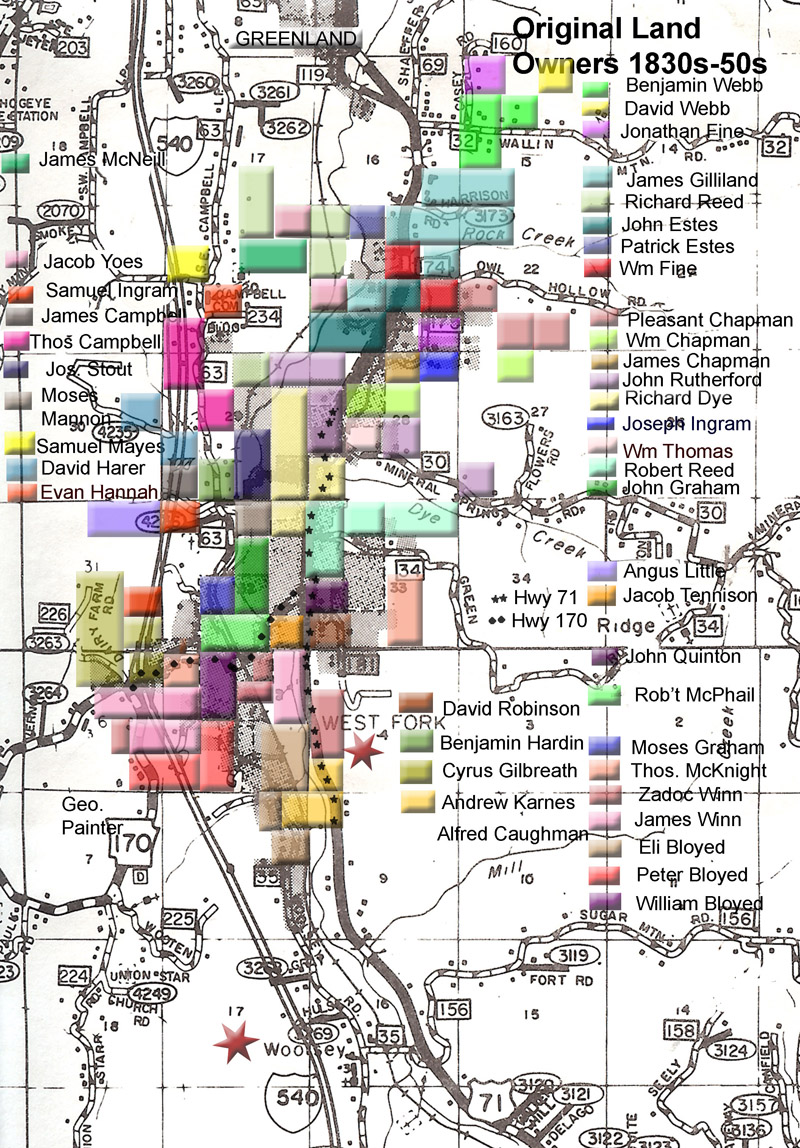
As early as 1831, settlers organized a church in the valley, considered to be the oldest organization of a Christian church in Washington County. Church records from 1837 describe meeting under and elm tree with charter members Stephen Strickland and wife, Richard “Dick” Dye, Eli Bloyed and wife, C. G. Gilbreath and wife, Greene W. Sherry and wife, and fifteen more couples. By 1855, followers of the Cumberland Presbyterian Church were meeting at Dye School House on land owned by Richard Dye. Local residents are probably familiar with his name because of the creek named after him—it crosses Highway 71 beside Dye Creek Road.[1]
Mills served a critical function for early residents who needed their corn and wheat ground into meal and flour and their logs sawn for lumber. Census records suggest a mill serving the south county was first located just north of Brentwood on the properties of William “Billie” Knott and Eleazer Pelphrey, the two men occupied as of the 1850 census as millwright and miller, respectively. Their properties at the SE ¼ of the SW ¼ of Section 23, Township 14, Range 30 West (Knott) and the West ½ of the SE ¼ of the same section (Pelphrey) span a small creek where it feeds into the west fork of White River. This location is four miles south of present-day West Fork, fitting a historical description of the township’s first mill.
Flour mill at West Fork, circa 1885. Looking south.
Another operation known as Gilstrap’s Mill is named in historical records as located at the place later known as Woolsey. One account states this was established in 1838 run by a large water wheel.
In the dry season when the water was too low to turn the wheel, a tramp wheel was put into operation to furnish power. Oxen were unhitched from the wagon bringing the corn or timber and placed on a slat-bottomed structure which moved under them continuously, making it necessary for the oxen to walk in order to stay on their feet. Thus they furnished the power for grinding corn or sawing logs.[2]
The first ‘West Fork’ post office operated from the home of William “Billie” Knott in 1838, a logical location since their mill served as one of the only public places in the area. The post office changed location in 1848 to Gilstrap’s Mill at the place later known as Woolsey, named after William Woolsey who bought the property from Gilstrap in the late 1850s. After 1848, this was known as the West Fork post office. By 1860, Woolsey operated a general store alongside the mill.
The 1840 census for West Fork Township counted 68 households with 394 residents and two slaves. Ten years later, the 1850 census counted 96 households with 605 whites and no slaves. Trades listed in 1850 included blacksmith, teacher, clergy, miller, tanner, and wagon maker. By 1860, population had grown to 262 households with 707 whites and fifteen slaves. Tradesmen included a shoemaker, five blacksmiths, two wagon makers, a saddler, a trader, and a carpenter. William Woolsey named his occupation as merchant.
With tensions mounting prior to the Civil War, a convention assembled at West Fork on April 25, 1861. The men in attendance agreed that they were opposed to secession. They called for a statewide vote of the people to decide, stating their wish to cooperate with other border states. The choice was made within weeks by the Arkansas state convention who voted to secede once the attack on Fort Sumter occurred.
Northwest Arkansas saw military action early in the war with the conflict at Pea Ridge and then Prairie Grove. Musket and cannon fire from the battle at Prairie Grove could be heard down here—someone remarked that it sounded like corn popping. Military forces moved along the Old Wire Road which ran down Cato Springs Road to Strickler before the nightmare of crossing the Boston Mountains.
With the success of Union forces in overtaking Northwest Arkansas, the rough terrain of south county became a perfect setting for guerilla warfare. Troops skirmished throughout this area during those years and commandeered livestock, grain, and anything else they could find. People had to hide their food and valuables in caves or holes in the ground. Salt became impossible to find and folks had to boil the soil from their smokehouses to gather what salt could be retrieved.
The flavor of those days is captured in this excerpt of the Karnes history:
A number of Union soldiers stationed at Fayetteville came out to West Fork one night to attend a dance at the Dick Dye home. All were having a gay time swinging their partners right and left and calling “Balance All” when a Southern captain, Jim Ferguson, thrust his head in at the door and yelled “Surrender All!”
The Union officer gave the command “Fight ‘em, boys!” but soon changed to “Everybody on his own!” when he saw the number of Southern soldiers. Mr. Rutherford said he was sitting on a plank across from the fireplace when suddenly he began to choke with soot, but not until all was over did he know that Lieutenant Huttenour had gone up the chimney.
Some sought shelter in the kitchen, others in the cellar and under the floor. The Southern regiment had been informed of the dance as they were passing through Woolsey and had sent thirty men ahead to investigate. The Union men had been warned to put out a picket but they felt secure without it.[3]
Whether men died or were taken prisoner during this dance-gone-wrong is never stated in Ms. Karnes’ account. But both military and civilian killings occurred frequently during those years. With the normal systems of government shut down and county courthouse records hidden in a cave, few of such cases appear fully documented in official records.
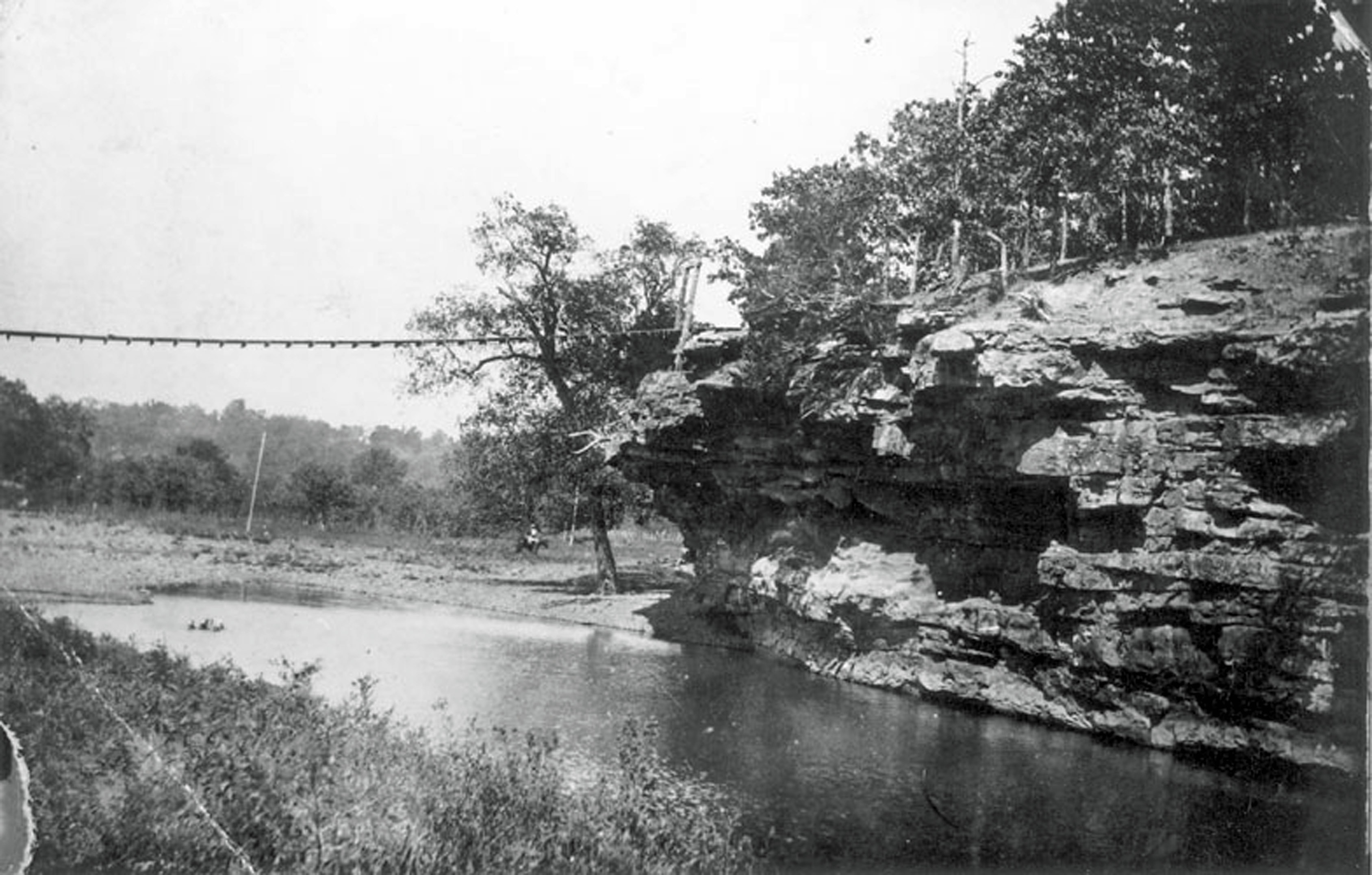
Crossing the river meant riding horseback or wading through the water, but for the hardier sort, there was the swinging bridge. No handrail, folks. This is the site of the modern day two-lane bridge between Highway 71 and ‘downtown’ West Fork.
The first murder involving a West Fork area resident occurred nine years after the end of the war in 1874. This is a complicated story that involved two families, the Jones who lived near Carter’s Store (approximately at Hicks, south of Sulphur City on State Highway 74) and the Gilliland family who lived near Owl Hollow Road at the north end of modern day West Fork.
A feud developed between two members of these families, William Newton Jones and Bud Gilliland. Things came to a violent point on Christmas Day 1874. At a popular horse racing track near Carter’s Store, 23-year-old Jones rode up, pulled a Spencer rifle from his saddle scabbard and before any of the surrounding crowd could stop him, he shot 28-year-old Bud Gilliland through the chest, killing him instantly.
It was later said that most everyone present knew Jones would try to kill Gilliland but no one could move fast enough to stop him. Jones didn’t wait around to be arrested. With his target dead on the ground, he took wheeled his horse around and took off at a gallop. He then became the subject of a manhunt that lasted until the next murder in this feud nearly two years later.
Speculation suggest the conflict may have had something to do with Bud’s dad’s marriage in 1863 to the much younger Mary Amanda Jones, first cousin to Newton. Or it may have had something to do with the rough nature of the Gilliland boys.
For example, Bud’s older brother, Jeff Gilliland, served as a county deputy and court clerk. He owned several lots on the Fayetteville square and operated a dram shop there—otherwise known as a bar. Evidently Jeff wasn’t exactly careful about his official county duties. An 1871 newspaper report stated that he was required to turn over the county tax books “to which the late difficulties in that county are attributable.”
Along the same lines, an 1872 newspaper account about Bud stated that:
On memorial day, ‘Bud’ Gilliland who has at times acted as deputy marshal, procured the keys of the jail from the jailor and deliberately locked himself in the jail, where he remained until 9 o’clock when he came out, ordered the guard who had been placed there to arrest him when he came out to stand aside, which he did, and Bud walked off. While he was locked in the jail with the doors securely locked, two prisoners who were out on bail for a few hours returned at the expiration of their time and failing to be admitted, made their escape. Gilliland was at the time under charge of the constable in default of bail for shooting at a man. He left town but will probably return soon as he is one of those men who are permitted to do pretty much as they please, whether it be shooting within the town limits for the sake of noise, or shooting at a man with intent to kill.
Did this “shooting at a man with intent to kill” involve Newton Jones? We don’t know, but that would certainly explain the hell-bent manner of Jones as he arrived at the horse races.
Later records state that the reason Newton Jones fled after shooting Bud wasn’t that he meant to escape justice but rather that he knew Bud’s older brother Jeff Gilliland would try to kill him.
As it turned out, he was exactly right.
Newton had a lovely young wife and an extended family that needed him. He dodged in and out of the area for nearly two years before his whereabouts could be anticipated and a posse went out to find him. Bud’s big brother Jeff Gilliland wrangled his way into the posse in his role as deputy despite concerns he would carry out his personal vendetta.
The posse waited in ambush for the Jones boys for several hours. Finally, the party approached. Newton’s nephew David Jones had been the wagon driver and gave his testimony in court about what happened:
We started from Lewis & Johnson’s Mill … and we got about a half mile from Johnson’s mill on the road toward Carter’s Store. I was driving the wagon and Matilda was riding in the wagon. The others were riding behind. Newton and [David’s brother] William were riding side by side. [Newton’s brother] Enoch was riding behind them.
The first thing I heard was the report of a gun or pistol. Immediately after several guns were fired, my mules ran off, ran about seventy-five yards. After my mules stopped, I raised up in the wagon and heard someone say “Halt! Halt! Shoot them boys, the last damned son of a bitch of them.” I could see a glimpse of men running up the hill in the woods. I heard horses running on the other side of the road.
I unhitched my mules and went back and found my brother [William] dead, lying close by the side of the road, rather under his horse which was down. Two shots in the head, and in the temple, several in [his] side and leg. Deceased was armed, had his revolver under him, not drawn…
Enoch was wounded in the side of the head and a shot glanced his neck. The voice I heard I thought was Jeff Gilliland’s. Heard but one voice; ‘Halt,’ was given but one time that I heard. If it had been given before, I would have heard it.
Then the shoe was on the other foot. The entire posse was indicted for murder of the innocent young William Jones, and things got even more complicated after that.
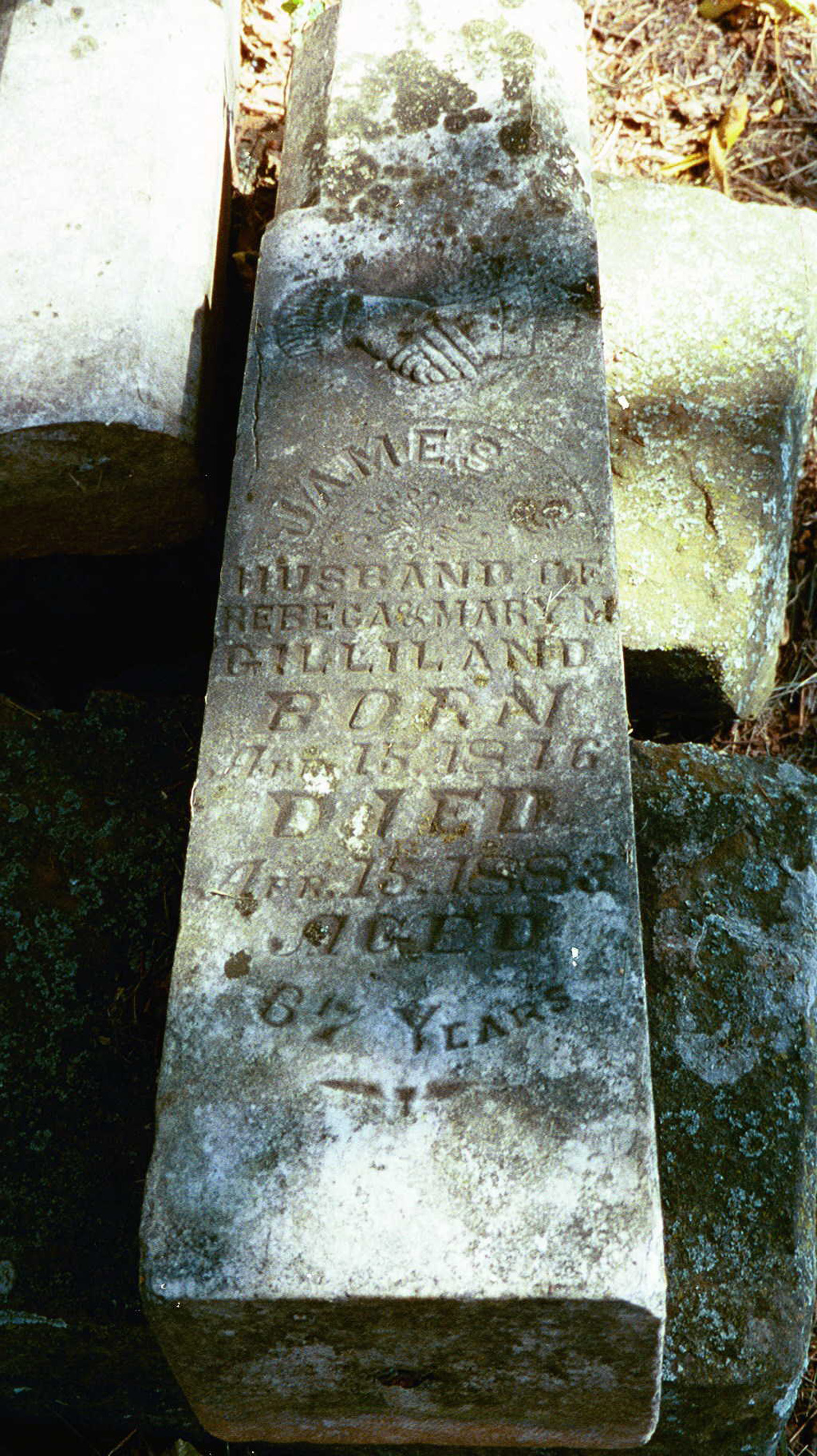
James Gilliland headstone, one of thirteen graves in the Gilliland family cemetery. James was the father of Cal and Jeff.
Three years later, in 1880, Jeff Gilliland remained at large at his home near West Fork. In 1882, a U. S. marshal out of Fort Smith brought a posse to arrest him. He fired on them, wounding two. Over the next two years, Gilliland evidently carried out a war of revenge against the posse members, who reported being shot at on random occasions. He never served time for the William Jones killing, nor did Newton Jones stand trial for killing Bud Gilliland.[4]
This has been one of the more fascinating stories I’ve uncovered in my research for a book I’ve been working on, Murder in the County. It contains 50 murder stories from the 1800s in Washington County. I won’t tell you what happens next to Newton Jones or Jeff Gilliland except to say the story takes a couple more intriguing twists and turns.
During these early years, as I mentioned earlier, West Fork the town did not exist where it’s now located. But the area was known as a peaceful and fruitful location. Local farms produced everything from apples to wheat. A main road south passed through the valley and stagecoaches traveled through Campbell Community north of West Fork and stopped at the home of John Karnes and later his son Daniel Karnes where travelers could have a meal, stay in overnight lodging, and fresh horses or mules teams could be hitched.
However, for particular travelers, another stop a few miles down at the Woolsey store offered a jot of whiskey. As noted by local historian Robert Winn,
It was not unusual for the stage to stop long enough [at Woolsey] that travelers imbibed enough to become tipsy and occasional excitement resulted in the form of fisticuffs or gun play.[5]
Fifty years after the first white people arrived in the west fork valley, the modern day location of West Fork began to formalize. In 1875 or ’76, the old water-mill plant at the head of the creek at Woolsey was moved north to what would become the town of West Fork. The new steam mill at West Fork provided reliable power for grinding grain, sawing lumber, and even operating a carding-machine which straightened and cleaned fibers for weaving into cloth. A spoke factory opened and the place attracted other industries including blacksmith shops.
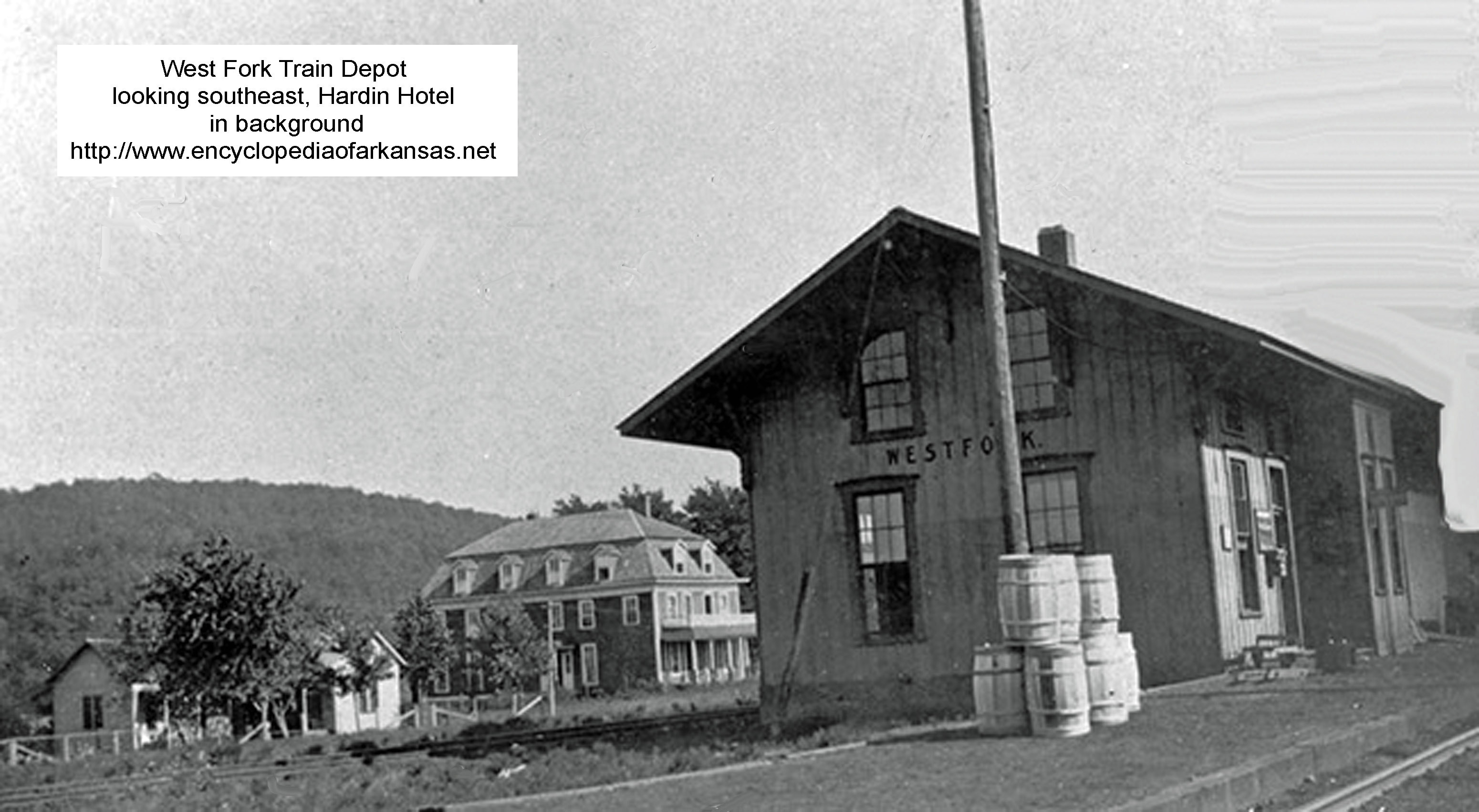
Looking southeast. The Hardin Hotel was built upon the arrival of the railroad at West Fork. The three-story structure included a large dining room where lodgers were fed family style on a huge round table. William Dunbar, who lived at the hotel as a child in the 1920s and 30s remembers an enormous cookstove in the adjacent kitchen. There was a carriage house and the carriage was dispatched to the train depot with each arrival, bringing visitors to the hotel. Robert Winn, in his book “Railroads of Northwest Arkansas,” said that “When drummers arrived at the West Fork station, they registered for lodging–50¢ to $1 per night, meals 25¢ …” There was no indoor plumbing, but according to Dunbar, the outhouse was somewhat luxurious with nice gabled roof, finished interior, and three ‘holes’ for mixed gender usage. But no heat. “You could freeze your bottom off in winter.” Dunbar stated the hotel was taken down in the 30s and the lumber used to build the house currently located on that corner (southeast corner of Main and Maple). The aged oak beams were so hard that when they were repurposed for the house, the carpenters had to use blocks of paraffin to ease the nails through the wood. The existing sidewalk along the property’s north side may date to hotel days.
In 1882, the St. Louis-San Francisco Railroad punched through this area headed south. A flood of newcomers followed, eager to make money off the harvest of virgin forest. This hard work involved teams of mules, men on either end of big crosscut saws, and plenty of hacking by ax to clear limbs off the main trunk. Then there was the matter of getting the logs down to the train depot. Many of those logging roads became the roads we drive today.
Things in the south county changed a lot then. Entrepreneurs of all stripes rushed into the area to make money. One example was a man named Erastus Pitkin. He bought out much of Woolsey’s land and with the formalizing of West Fork at its current location in 1885, the place at Woolsey became known as Pitkin. Pitkin partnered with another man to open a hardwood lumber operation at West Fork. They ordered ‘log wagons’ from the Springfield Wagon Company. These wagons were essential for moving cut logs down to the railroad and featured a specialized heavy-duty construction with independent axles.
From 1906 Plat Book for Washington County. A few businesses have been identified and labeled.
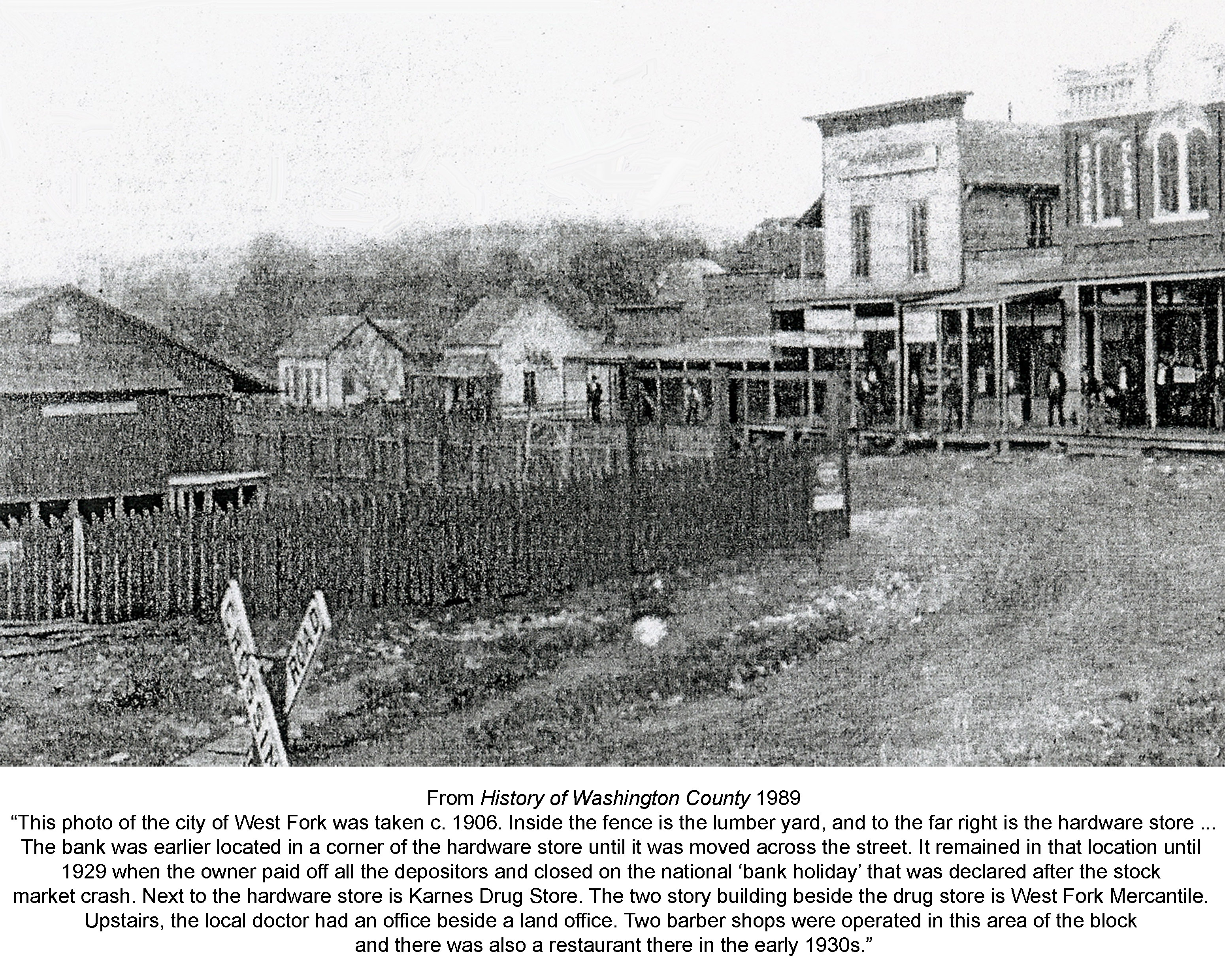
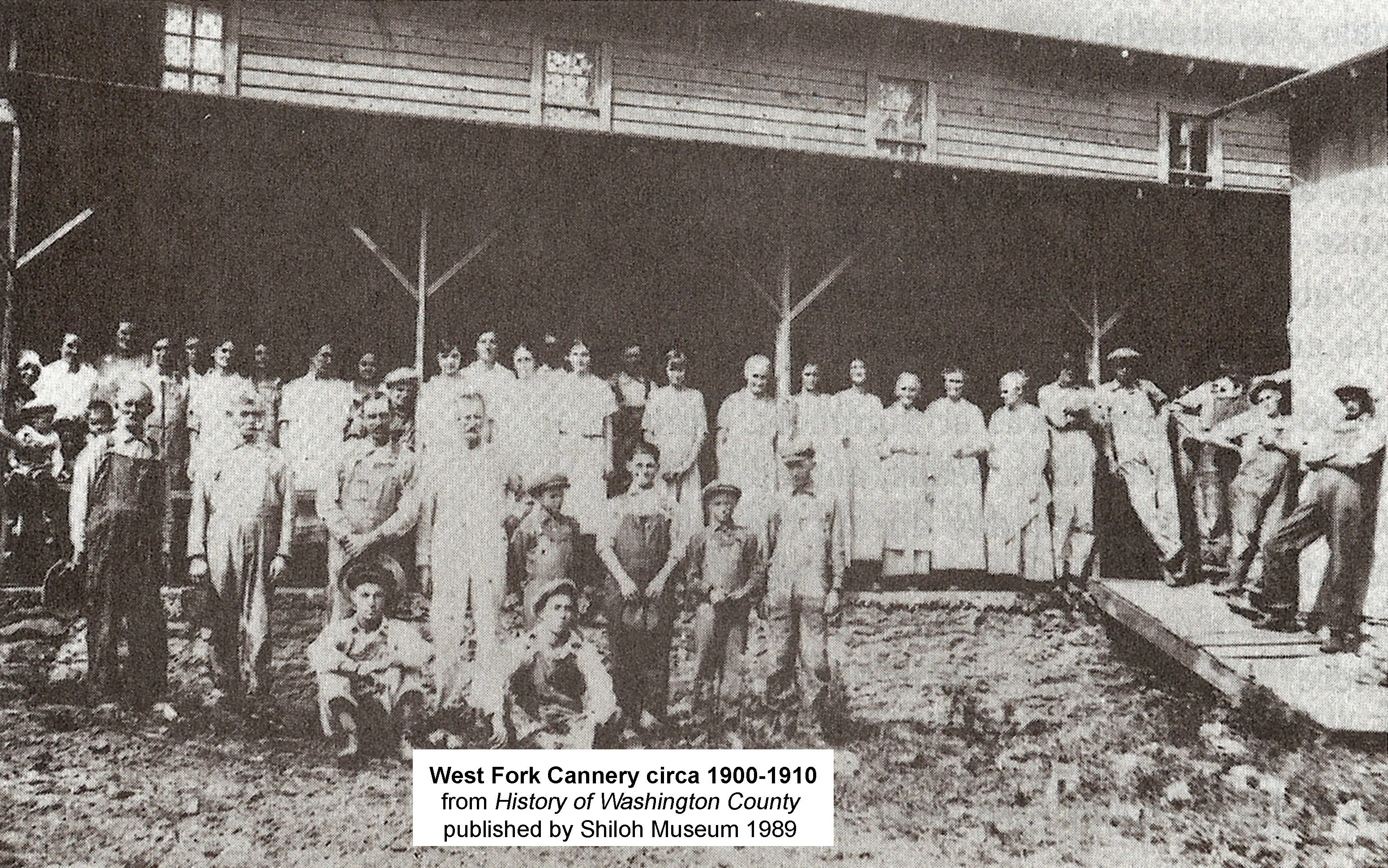
In May 1885, another early settler named Thomas McKnight finalized plans to incorporate the modern day town of West Fork. Since before the railroad’s completion, McKnight had been buying up land in the area that would become the town of West Fork. He platted town lots and sold to men eager to open for business. Within four years, the town included not only the thriving mill, but two general stores, a drug store, a grocery, a meat market, a hardware store, furniture store, the Hardin Hotel, and a food production company that employed 37 workers in canning tomatoes and drying local apples produced on farms up and down the valley.
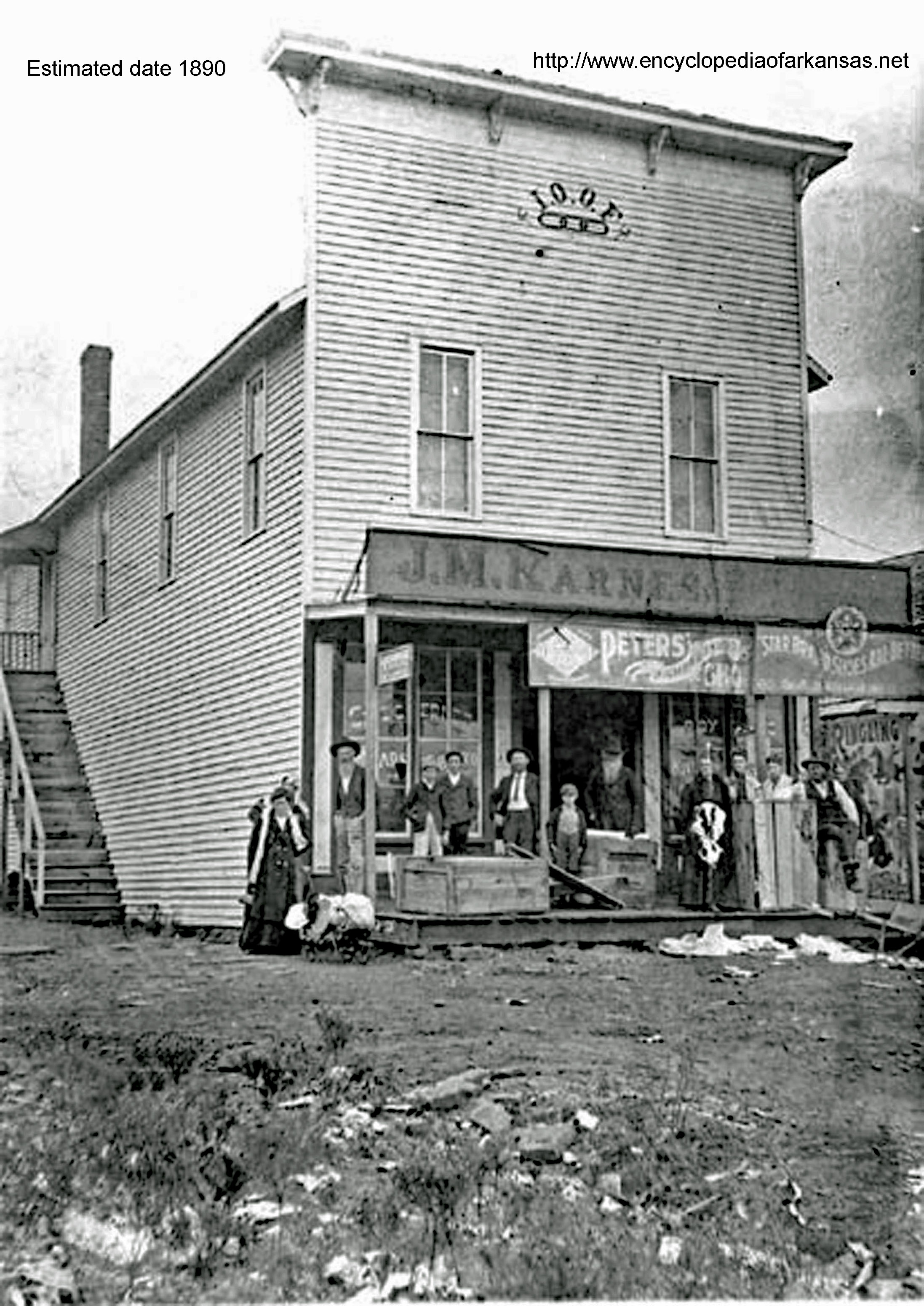
Karnes Store
An amusing note – Robert Winn reported that the West Fork canning factory had an interesting side effect on the local population.
“Juice from the apples ran in shallow trenches from the building out into the warm sunshine. Peelings were also dumped near the factory; these also fermented. All livestock ran on open range and wandered about the factory. Cows, pigs, poultry, and any other livestock drank the juice and ate the peelings. Soon after the factory opened each fall, every cow, pig, and chicken that was permitted on the open range staggered home at night in a drunken condition.”[6]
During this boom period another local feud came to a boil. A man named Jim Graham brought up on charges of arson. Among those testifying against him at trial was Calvin Rutherford. Once Graham had served his two year sentence, he came back to West Fork with a serious grudge against Rutherford. In February 1892, the lid blew off.
Here’s the account published in the Fayetteville paper:
On Friday evening last, [Rutherford and Graham] got into a fight in Yoes’ store and when the smoke cleared away, Graham was found to be mortally wounded by a pistol ball that entered his body near the hip and ranged upward coming out on the opposite side near the collar bone.
Cal Rutherford and his brother Bob were both cut in several places, the latter not seriously. It is hard to get the exact facts in the case but we learn that the Rutherford boys were drinking and that Cal was taking in the town. Before the fight occurred, he rode into a store and smashed the store window and was pretty badly cut by the glass. He then rode his mule into Yoes’ store and as he was coming out, Jim Graham and a stranger whose name we did not learn went into the store.
When Rutherford saw Graham, he is said to have made some remark about whipping him and went back into the store when the fight commenced. Graham cut Cal four times and while he was doing so, Bob Rutherford came in. Graham then started to run upstairs and was shot by Bob. The latter was also cut but whether by Graham or someone else we have not learned.
Graham died Saturday afternoon and a warrant was sworn out before Squire Lusk of this city for the arrest of the Rutherfords charging them with murder. Constable Burkitt took charge of and was guarding them but on Sunday while he was at dinner, Bob Rutherford escaped and has not yet been apprehended.
Jacob Yoes Hardware store, scene of the Graham murder. Presently, this century-old building houses the West Fork Oprey.
A bit more info is found in the Little Rock paper’s article on the matter:
News has reached here of a bloody affray between the Rutherfords and Grahams, of West Fork, two families who have made themselves notorious as desperadoes … Cal Rutherford, Deputy United States Marshal of this District, was drunk and was running the town, and after riding his horse through two or three stores, and shooting at everything in sight, rode in the store owned by Jacob Yoes, United States Marshal Western District of Arkansas, and there found Jim Graham. He began cursing and abusing him and threatened to kill him. He then jumped from his horse and rushed at Graham, who drew his knife and stabbed Rutherford five times in the breast and bowels when Bob Rutherford intervened and Graham stabbed him twice. Bob Rutherford rushed for a pistol, securing one in the store, with which he did lively work, shooting Graham several times, only one shot taking effect which will prove fatal. A bystander, Mack Matthews, made an effort to quell the row and Bob Rutherford crushed his skull with a pistol. Cal Rutherford will probably die from the wounds and Bob may recover. The Sheriff and Constable took charge of the parties and have them under heavy guard.
Yee haw, boys!
So what happened to West Fork? Obviously, times changed. The big tree harvest and easy money from the crowds of timbermen came to an end. Once the tree is cut, it’s gone. Fruit crops and local canneries suffered from growing competition and new food purity laws. Farmers discovered that the soil was easily depleted and crops didn’t flourish. Also, south county water supplies couldn’t meet the growing demand.
West Fork prospered fairly well until 1919 when an entire block of downtown burned to the ground. The bank lasted until 1929 and closed with the stock market crash. As roads improved and more people made use of motor vehicles, travel became much easier and people began commuting to Fayetteville for jobs, taking even more money away from local businesses. It’s the story of thousands of small rural communities in our country.
(Adapted from a talk I gave May 6, 2017, sponsored by the Friends of West Fork Library and the Washington County Historical Society. Additional photographs will uploaded soon.)
Earliest known photograph of West Fork school, circa 1894. Far left is teacher and his assistant.
~~~
[1] After notice of my talk came out, I was contacted by a man who descended from Richard Dye. We chatted about the location of the school and church. He thought it was on the east side of the highway and a little south, roughly in the area where McKnight’s wrecker service is at this time, perhaps upslope south of the creek bottom. Another source confirms that “Dye’s Shed” was located just south of the business location. (We Call It Home by Harold G. Hutcheson and Bernice Karnes. Observer Press circa 1985.)
[2] “Early Days at West Fork,” Bernice Karnes. Flashback November 1956. 13-18. Fayetteville: Washington County Historical Society.
Following 2015 charges against “19 Kids and Counting” star John Duggar for molesting his sisters and the rape of a young girl at the hands of a former employee of Rep. Justin Harris who had adopted the girl then ‘rehomed’ her to the man who would rape her, the latest moral scandal in Arkansas has to do with a scheme of kickbacks in exchange for funneling state tax dollars to a tiny religious college. Earlier this week, former Sen. Jon Woods, Ecclesia College president Oren Paris III, and a business consultant friend of the two, Randell G. Shelton, were named in federal indictments.
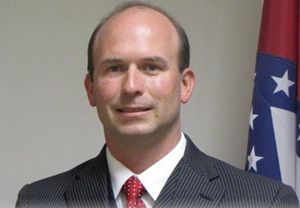
Former Rep. Micah Neal
Previously indicted on several counts in the same scheme, former Rep. Micah Neal entered a plea of guilty to taking kickbacks. Other indictments may follow for additional persons, one of whom is referred to as “Businessman A” and for Ecclesia College, assumed to be “Entity A.”
The federal investigation has been ongoing for a couple of years and covers a period from 2013 to 2015. Until news of the investigation leaked out in the summer of 2016, Neal had been running for county judge. He dropped out of the race, citing residency concerns as his reason. News of his indictment came later.
Former Senator Jon Woods
Woods announced in November 2015 he wouldn’t run for re-election, possibly due to knowledge of the investigation.
Here’s the set up. An Arkansas law allows leftover money from the General Improvement Fund to be allocated for pet projects in legislators’ home districts. If approved, grant requests disperse the money through economic development districts toward worthy nonprofits. It’s a system ripe for abuse.
Currently in session, the legislature is expected to take away this honey hole at the urging of our rather embarrassed governor, Asa Hutchinson, a former Congressman, head of the Drug Enforcement Agency, and more recently, head of Homeland Security.
But the cash cow is already out of the barn, at least for this highly religious group. A total of thirteen indictments against former Senator Woods alleges he committed fraud and took a bribe of $40,000 plus “an undetermined amount of cash” in exchange for helping funnel more than $350,000 to Ecclesia College, purportedly for land on which to build student housing.
But there was no need for student housing. The grant request claimed that the college needed housing due to “rapid growth.” The college with an enrollment of less than 200 mostly off-campus students already owned 200 undeveloped acres. Records show that the GIF money paid for about fifty additional acres at an inflated price. To date, no building permits have been sought to build on any of this land, so evidently the ‘urgent’ need for housing wasn’t so urgent after all.
While indictments do not constitute a conviction, chances are good that plea deals will follow. The money was there and they wanted it and they had a handy nonprofit, namely Ecclesia College, by which to obtain it. According to the indictments, as early as January 2013 these three men “devised a scheme and artifice to defraud and deprive the citizens of the honest services of a public official through bribery.”
A March 3 write-up in the Arkansas Democrat-Gazette reveals a tangle of people eager to get their sweaty hands on state tax dollars. Never mind that Woods and Neal, as elected officials, both swore to uphold the state’s constitution. Never mind that Paris served as president of a college presenting itself as a Christian institution. The elaborate diversions through which the money flowed portrays clear evidence these men knew they were doing something wrong.[1]
But it’s worse than that. It’s not just greed at work here. A text message from college president Paris to Woods is cited in the news article:
Good selling point to conservative legislators is that (Entity A) produces graduates that are conservative voters. All state and secular colleges produce [a] vast majority [of] liberal voters.”
Woods replied: “Agreed.”
This blatant agenda to brainwash students toward conservative views fits right in with the apparent right-wing philosophy that the ends justify the means. These men were leaders of their communities and their church. As such, the highest standard of ethical and moral behavior would be expected. Yet they apparently had no qualms about perverting the intent of GIF grants in order to enrich themselves as well as serve their ultimate goal, that of furthering the Christian agenda in taking over the nation’s political institutions.
I recently wrote that the right-wing effort to make the United States a “Christian nation” constitutes treason. This latest incident is only a tiny glimpse of a pervasive delusion rampant in that group that whatever is done in the name of God is acceptable, even praiseworthy. The text of Oren Paris III clearly states the intent to increase the number of conservative voters in order to bring the country closer to their ideal Christian Nation.
This type of thinking is no different from that of ISIS leaders who justify acts of terror by claiming that it pleases God. They know what Allah wants and the ends justify the means.
Aside from minor inconveniences like federal indictments, Wood, Neal, Paris et al may suffer little consequence among their peers. Shortly after the indictments hit the news, Ecclesia College board chairman Phil Brassfield posted a letter on the college’s Facebook page stating, in part:
While the allegations made against Oren [Paris] are to be taken seriously, we are confident once all the facts and the truth are made known, all will come to understand as we on the Board of Governance believe, that Oren has acted at all times with absolute integrity and always in the best interest of Ecclesia College. We are at peace in the knowledge that Oren is a godly leader, a loving husband and father, a vigilant shepherd and a faithful servant. It is in this confidence that we as a board remain loyal and steadfast with our brother in Christ.[2], [3]
Clearly, right-wing Christian Republican hypocrisy stretches from the lowest levels of government all the way to the top where–at this very moment–perjury, lies, and dissembling of every order permeate the executive and legislative branches. In the name of God. Because the ends justify the means.
[2] In the Arkansas Times article cited above, a testimonial written by Oren Paris’ wife regarding his meeting with then-presidential candidate Ted Cruz, states, in part: “At one of the meetings Oren was able to attend Senator Cruz and his wife Heidi shared how the Lord led them to run for the Presidential Office. I remember Oren sharing with me how the love of Jesus shone through Heidi as she told of her prayer to God whether she should do this for Ted (leave her job and dive into a campaign) or not. The Lord spoke to her and said, “No you should not do it for Ted. You should do it for Me, for my glory.” That meeting lasted more than 7 hours and was filled with Senator Cruz and Heidi (daughter and granddaughter of missionaries) sharing their hearts, answering questions, and joining in prayer for revival in our nation.”
[3] In unanimous agreement, the board confirmed Paris’ continuing role as college president. The letter was signed by board members including the newly elected Washington County judge, Joseph Wood. When former Rep. Micah Neal suddenly dropped out of the county judge race in the summer of 2016, for reasons later revealed to be his federal indictments, Joseph Wood stepped into the candidacy despite concerns about whether such a move was legal. His questionable activities since taking office, including breaking several regulations about appointees, remain under scrutiny. For more, check this article at the Arkansas Times.












 denelecampbell