A Moveable Feast

dickson copyDickson Street, 1970. Old rock buildings with narrow profiles and high pressed-tin ceilings. An abandoned railroad depot that trembled when freight trains thundered past. A declining backwash between campus and the downtown square of a town still embracing its provincialism.

The university drew them, intense intellectuals seeking knowledge, misfits seeking community, young men determined not to die in Asian jungles. In between time in class and demonstrating against war, they settled into the street’s cheap real estate to paint murals and make free love. Abandoned warehouses and decrepit brick structures a hundred years old became head shops, bars, and art galleries. Downscale restaurants heaped alfalfa sprouts on whole wheat bread sandwiches—radical. Cooperatives sold tobacco and honey in bulk, locally made tofu—far out.

Sweet smoke hung in the air. Street festivals celebrated music of hope and rebellion. People wore crazy hats and stood on the corners laughing and hugging. Dickson Street crackled with excitement.

All this made it a place people wanted to be. Straight people, women wearing hosiery and high heels, men in suits—they loved the experience of freedom, even if they themselves couldn’t be free. They dared to step out of their establishment lives and feel the beat, smell the smoke they didn’t inhale. Well, maybe they inhaled—who would know? On the street, they became part of a separate world, joined a conspiracy in which all participants shared the secrets.

Not everyone loved the street where long-hairs had carved out a world of their own. What on earth went on down there, they lamented—police, city fathers, wives of husbands who slipped out for a drink at one of the dive bars and ogled the braless young women. Owners of real estate along the street stopped repairing the roof and the plumbing, inflated the prices so that the restaurants couldn’t own it for themselves, so the art galleries couldn’t afford the rent. The hippies needed to go.

By 1990, value created by the alternative culture gave the establishment reason to retake the street. There was money to be made. People wanted to eat there, shop there. The street was cool. Never mind that the coolness had been bestowed by starving artists, by inventive bohemians, by fledgling entrepreneurs selling worn-out blue jeans for respectable profits.

The rich bought the street. They demolished landmark gathering places to put in shops selling diamonds and art from back east. They came dressed in their finery to eat at chain restaurants and watch traveling Broadway shows.

The street is now a shell of its former raunchy self, an extravagant display of fakery in expensive plastic packaging—a back to the land scene where the joyful family piles out of their brand new SUV to view nature, a credit card ad with Beatles music playing in the background. There’s no getting it back. They don’t even understand what’s been lost.

Reprieve

????????????????????????????????????????????????????????????????????????????????????????

Stories await the telling, scenes the description, ideas the unfolding. Terror that time will run out and the long list of magic truth will be locked away in my grave. Horror that the stories are trite, scenes familiar, ideas old compost. Of course they are, I console myself. But your telling, your words, your angle is new. Uniquely yours. Important to at least one other person. I stare at the blank page.

Revulsion boils up. I hate this. I hate the stories that wait to be finished, the stories half done, the stories not started. They taunt me from my imagination—I can never give them life. They will never be good enough, never true to the inspiration, never worthy of a reader’s scrutiny.

Just write it, I urge myself. Write and the vision will unfold. The character will speak his voice and reveal his future. Let the fingers fly over the keys. Words will form and the story will be wonderful.

But wait.

There’s laundry I should start, or I’ll have no clean underwear tomorrow. Floors long past grim, perhaps fifteen minutes with the broom. There’s a call to be made. A business matter to tend. A window framing spring drizzle, grass greening. Thank god.

The Desk

man at deskFrom the desk, orders issue forth. Bits of paper and ideas settle into orderly stacks. Drawers open to reveal white paper, envelopes, pencils and pens, erasers, rulers, paperclips, checkbooks, random rubber bands and ephemera relevant to the civilization of mind.

The top of my father’s desk curved down at the front and back in a streamlined Art Deco style going out of fashion in the mid-Forties when my mother bought it for him. She purchased the desk new at a hardware store in Rogers, Arkansas, two years before I was born. It remains in the family household seventy years later.

The image of him sitting there with his big stubby fingers busily typing away on his massive old Royal typewriter stays in fresh my memory. Curses muttered in his deep rumbling voice signaled a mistake that required laborious erasures. Sometimes the errors ran so deep that the paper would be ripped from the carriage, accompanied by a mechanical zipping sound as the cylinder spun.

How satisfying, that ripping sound. The end to it, for once and for all! A new sheet of paper! A new start! And then the keys would tap again, clickety-clack, as he pursued the project at hand. A letter to a band parent? A notice to be posted on the bandroom bulletin board?

A bold red band graced the top border of his Bi-State Music Festival paper. It came in wrapped reams redolent of printers’ ink. Documents issued forth—letters to other band directors in the region, schedules of competing bands, ensembles, and soloists. I remember the watermarks on the heavy bond paper, the matching envelopes, the anticipation permeating our house as the festival neared. This was my father’s prize project for his years at Northside High School in Fort Smith, Arkansas.

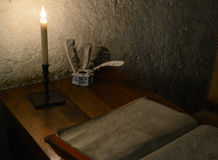
Then there were the hours, late into the night, that he bent over pre-lined manuscript paper with his quill of India ink to join the lines into a musical staff. His practiced flourish produced treble and bass clef signs, quick jots of ink for quarter notes, and quirky flags at the top of the note stem designating its status as eighth note or sixteenth. The side of his hand brushed the heavy manila paper as quarter note rests took shape or as a long slur line arced over two measures.

His concentration palpable, his cigarettes burned down to the filter in the wide glass ashtray. There were the groans and curses when his efforts went awry, when the ink bottle spilled or the muse stopping whispering in his ear. When real life demanded his attention to wife and children, the lawn that needed mowing, the bills past due. An artist at heart, he never fully accepted his role in the world of the mundane.

Command center to the world around us or doorway to the ether of creation, desks are the place where business is done. Here I utter my own curses at the petty requirements of temporal life. Can’t you see I am far away, the whispers of characters and scent of distant meadows flowing from my fingertips? Yet the desk is not only the arena of creation but also where I organize my world, establish schedules for my time and finances, and write letters to compliment the helpful and excoriate the stupid. Here I sit to stare out the window as memories and worries rush onward, ever onward, in my unruly thoughts.

Now the world unfolds on my computer screen. Words scroll across virtual paper, easily erased and corrected. No more ripping paper from the typewriter. How much more music could my father have written with the tools of modern times? Playing a simple phrase on a digitally-connected keyboard would have produced perfectly crafted notes on a virtual page, no ink required.

Maybe the result of such ease in the mechanics of creation is that we are now drowning in a sea of mediocre art. Perhaps we were better served with pages ripped from typewriters and music penned with India ink. When the need to tease out a deeply held emotion, find words that best describe, or form scenes that best reveal, I drag out the paper. It sits expectantly on the desk, this thick pad of white paper. Sometimes even the use of a pen is too facile, and I dig up the Number 2 lead pencil. It makes a satisfying sound as my hand forces the tip over the paper.

What I write on paper with pencil is different from what appears with keystrokes on a digital keyboard. The words are more carefully chosen. The shapes of letters carry significance. The words have real weight and I use them in new ways, unexpectedly poignant.

I am at my desk with paper and pencil. I can see my father bent here, his profile etched against the dark of night in the light from his desk lamp. His quill scratches across the page.

It was the best of times, it was the worst…

People 3995Traditional publishing versus self-publishing used to be a simple question of whether an author frustrated with barriers to traditional publishing would spend a considerable amount of money to get his cherished story into print. Works published through vanity presses might subsequently gain legitimacy if reviewers found merit in the work. But the vast majority of reviews were solicited by publishers whose process in selecting which works to publish assured reviewers that whatever landed on their desks would at least have a coherent plot and few if any dangling participles.

Then along came Amazon and the proliferation of Internet outlets which allowed authors to upload a manuscript and cover image and place their cherished stories instantly on the market, kicking the estimated annual count of new books to the 300,000 mark. Within a short period of time, the avalanche of not-ready-for-primetime books became more than any erudite reviewer could withstand. “We do not accept self-published books” became emblazoned across the reviewing sky. Indies were left to grope in the dark.

Which is understandable considering the poor quality of many self-published works. Many wanna-be authors rush to publish without a grasp of proper grammar, composition, or plot. This creates a big problem for worthy self-pub authors whose work consequently goes unnoticed.

Some might claim the obvious solution for authors is to embrace the traditional process. Join writers’ groups. Enroll in writing classes and workshops. Submit short stories to literary journals in hopes of winning a prize or being published, which can then be touted as credentials. Find an agent who believes in the work (if not the author). Wade through the agent’s editing process. Wait through the agent’s marketing process. If the agent successfully finds a publisher, wade through the publisher’s editing process. After a couple of years and the best of all possible outcomes, the book hits the market complete with professionally-produced cover, solicited mainstream reviews, and a bit of marketing.

Please note that even when accepted by mainstream publishers, authors are expected to build their own ‘platform’ for getting the word out. To develop such a platform, authors must become a presence in social media, develop promotional materials, blog and host a website, and make public appearances, most if not all at the author’s expense.

All of which ensures that the hopeful author remains broke and left with little time to do the only thing he wants to do: write.

One wonders exactly what authors gain from landing a traditional publishing contract. There’s the affirmation, of course, something writers need more than air. The money can be good if the book takes off, which is what the publisher counts on to justify its interest. But once the publisher skims the lion’s share (you know, expenses) and the agent pulls out his fifteen percent, the author earns precious little for all his hard labor. There’s the argument that the traditional route produces a better quality product. But one might justifiably ask what is left of the author’s original concept once various editors have woven their interpretation into the story.

Indie authors don’t have to compromise their vision or wait two years (or centuries) to present their work to the public. In theory, Indies with authentic writing skill produce well-written, innovative stories that extend and enrich the literary frontier. In practice, many Indies may have an innovative idea behind the urge to write/publish but next to zero skills with which to accomplish this goal. It is this open door to lousy writing which has soured reviewers to Indie work.

None of this is new information. I state it as a starting point: now what? Should a writer plunge into writing short stories and spend $20 a pop entering literary contests? Join writer groups and spend days reading and critiquing other author’s works in exchange for bi-annual scrutiny of her own work? Wait perhaps forever to win a nod from the publishing industry? Self-publish in hopes of modest success with higher profit margins than traditional paths offer and then languish in anonymity?

What are the pros and cons of self-publishing?

Aside from the obvious benefits of professional editing, formatting, and cover design which come with a publishing contract, one enormous con for the Indie is the barrier to gaining reviews from mainstream reviewers like the Washington Post or the New York Times. Let’s take a moment to examine that world.

The romance market dominates book sales, Indie or not. According to one source, romance claims “16.7 percent of the U.S. consumer market in books, the single largest slice for any segment – a third larger than the inspirational book market and roughly equivalent to sci-fi and mystery sales combined, according to Valerie Peterson at About.com.” In 2012, romance sales topped $1.4 billion.

Despite strong standing in book sales, romance novels earn little respect from reviewers (or, in fact, just about anyone in the literary publishing world). One possible explanation for this is the disproportionate number of men within the ranks of reviewers. As noted in a Salon article, “Women read more books than men. Yet every year, according to counts conducted by VIDA, most major publications run more book reviews by men than by women, and review more books by men than by women. In 2013, for example, the London Review of Books had 195 male book reviewers to 43 women reviewers: a ratio of almost 4-to-1. The New York Review of Books was in the same ballpark, with 212 male reviewers to 52 female ones.” http://www.salon.com/2014/02/25/highbrow_medias_sexist_blind_spot_romance_novels/

Taking up the slack in this torrid genre, an industry of amateur, largely female reviewer/bloggers has grown to massive proportions. Many such reviewers begin in the thrill of free books and social community only to quickly sink under the same avalanche that buried traditional reviewers. Countless blog sites languish unattended with a notice “Not accepting submissions.” Requests for reviews often number in the hundreds in just one day.

Amateur reviewers aren’t a perfect solution to the review problem. Many fail to actually review the work. Instead, the reviewer falls back on secondary school experiences of writing book reports which summarize the story. Consequently, these reviews compromise the book for any potential reader. Reviews should give a brief overview of the story concept, a bit about the author, and focus on whether the story was well executed in terms of presentation, plot, character development, and writing craft. Without any certifying agency or criteria by which reviewers might be verified as adept at their work, Indies have no method by which to select worthy reviewers.

Websites exist which purport to connect books with reviewers. But like overwhelmed blogs, such sites can’t promise reviews and an author may list the book and wait. Forever. The well-trafficked Goodreads site hosts author giveaways where books are given to winners in a process that draws attention to the book. Relatively few reviews are generated in the process which costs authors not only hard copies of their books but also the expense of packaging and postage. Groups formed within Goodreads, focused on a particular genre or on read/review offers, devolve into countless posts pleading for reviews and virtually none offering them.

An ugly microcosm of this arena features authors retaliating against reviewers for unfavorable reviews and reviewers dissing authors in endless snarky commentary.

Please.

For authors of fiction works other than romance, the field of blogger/reviewers drops to near zero. In nonfiction, forgetaboutit.

Does one—gasp—pay for reviews?

Writing/publishing advisers recommend strongly against paying for reviews. Yet one of the biggest names in the publishing world, Kirkus Reviews, smoothly promotes itself to prospective customers by offering “the most authoritative book reviews” for the modest price of $425 (7-9 weeks). Or, for authors in a hurry, $575 (4-6 weeks). Into this confusion come  authors exchanging reviews in an implicit quid pro quo of ‘you give me five stars, I’ll give you five stars’ which benefits no one in the long run. Lousy works with five star ratings only discourage readers.

I know of no effort made by Kirkus or anyone else in the ‘legitimate’ publishing industry to develop a free, comprehensive vetting and review system for Indie books. Predictably, book sales slumped in 2014 and are likely to slump even further as free books undermine the industry. It’s not enough that other media and an attention-deficit population have driven book readership to record lows. Publishers aren’t exactly weeping that Indies struggle for a market share.

Aside from reviews, what are an Indie author’s options for attracting readers?

Well, there’s social media. This has become the primary avenue by which authors become acquainted with other authors as well as readers. Writers are advised to interact within this community in order to become ‘known’ and therefore, theoretically, generate more sales for their books. Facebook pages may be author pages, interest group pages (for example, domination/submission groups within the romance genre), and marketing pages which become a blur of post after post of book cover/blurbs generated by hopeful (increasingly frantic) authors trying to generate sales. Unfortunately, this is largely authors trying to sell books to other authors.

There are Facebook pages exclusively for posting notice of books that are available free or for .99, pricing strategies meant to introduce readers to an author in the expectation that once someone reads that person’s work, they’ll purchase more of it. I have no research to support my opinion that this is effective less than 5% of the time. Maybe 1%.

Amazon and other online retailers offer authors a variety of ways to promote as well. If an author grants Amazon exclusive rights to market her work for 90 days, they’ll tout the book to its list of customers who sign up for the benefits. Predictably, the benefits largely accrue to Amazon rather than the author. For example, Amazon can ‘lend’ a book to readers at no charge, theoretically benefiting the author by increasing exposure and potentially the number of reviews. The downside is that most readers don’t bother to review and instead see this Amazon service as a way to get free books. This benefits neither the author nor the industry.

There are strategies for how to categorize the book into a less heavily populated sub-genre and thereby increase the chances for a higher ranking. It’s ranking, after all, which determines which books appear first in searches. Romantic suspense is a smaller field, for example, than simply ‘romance.’ Another ploy with Amazon’s ebook platform is to use word groups in categorizing a new release, thus gaining more potential exposure in Amazon’s algorithmic toying with sales rank. The words ‘domination-submission-menage’, for example, create a narrower field than the word ‘erotic.’

Perhaps the strategy that makes most sense is to heed advice to write more books. Not only does an author continue to improve by writing more, she also gains more credibility by placing more of her work before the public. Variations on this theme would be to (a) schedule a set amount of time to build one’s platform in social media et al while reserving the bulk of available time to writing itself; (b) read the genre one is writing, but also other quality works; and (c) enter contests sponsored by literary journals and universities. Chances are you won’t win the $1000 first place prize, but your entry fee in most cases subscribes you to a year of that journal’s issues which in turn exposes you to the academic side of this seething snake pit of an industry you’re so anxious to join.


Intellectual Property Theft, Part III

kbreast

The Breast Book by Maura Spiegel and Lithe Sebesta, outrageously similar to the manuscript my agent had shopped all over New York, performed even worse with readers than the dry work of Marilyn Yalom. At present, Amazon.com finds the book out of print with nine reviews: five 5 star, one 4 star, and three 3 star. Goodreads shows one review and sixteen ratings with a 3.75 average.

One of the book’s biggest drawbacks was its format—too precious for serious readers with a four-by-six inch sideways layout and a ten-point font. The text had been edited to a barely-coherent minimum. The publisher attempted to balance cost with the relatively untried market for a book on breasts. Hardly the loving extravaganza I had in mind, the book became a self-fulfilling prophecy.

Determined to gain justice, I collected my carefully outlined fifty-three points of comparison plus the hard copy of the book and visited an intellectual rights attorney. A week later he called to say that yes, there were “certain uncanny similarities” but that he wasn’t in a position to pursue the matter against the publisher. The reality was that in order to sue for copyright infringement, I’d have to hire a New York attorney because that’s where Workman Publishing offices were located.

In order to have grounds to sue, I’d have to prove ‘damages,’ i.e. show that the money produced by the book would have been mine if not for their theft. Since at that point no one knew what money the book would produce, I had to wait to see if the book became a big seller. I’d also have to figure out how to determine the book’s sales. And I would have to come up with money for that New York attorney, or convince him there would be such a large settlement in this lawsuit that he’d be happy to take it on contingency.

Not.

Was all this simply a horrible case of bad timing and “uncanny” coincidence? I’ll never know. But it taught me a lesson about publishing: it’s a very nasty bucket of snakes. Cut throat tactics run rampant in a world where lazy people with few if any original ideas of their own prey on those of us rich with ideas and short on connections. Publishing, like anything else, is full of ‘who you know’ and glad handed back biting. Perhaps a book published by a mainstream publisher enjoys legal protection against theft. But before it hits the street, there is no protection.

Copyright? Oh, it sounds good. But the burden of proof lies in the claimant. There are no copyright cops walking around checking on these things. If an author is lucky enough to discover a work has been pirated, there’s still the need for attorneys. (Read: money.)

With self-publishing, the author has an advantage in getting the book to print without anyone siphoning the manuscript or concepts, but unfortunately that hasn’t eliminated theft. Now it simply occurs after publication. Lifting an electronic file of a book isn’t exactly rocket science. Stories abound of books for sale through unauthorized channels without any royalties going to the author. Or major sections of books end up in someone else’s publication. I’ve recently heard of an author losing chunks of a manuscript to a wanna-be writer after trusting that person to read and review the work.

Overall, I’d rather take my chances and continue to self-publish than wait months even years for my idea to wind through industry channels of agent, editor, and publishing process. At least with self-pub, I can earn 70% of the sale price on an ebook and 30-50% on a paperback. With traditional publishing, I’d be paid a dollar on the sale of a $16.95 book, and the agent would get fifteen percent of that.

Stealing is a white trash thing to do, whether it’s taking someone’s package off their porch, downloading an illegal movie or song, or ripping off parts of a book. Fortunately for musicians, writers, and other artists, there’s some small solace in the pleasure we find  shaping our ideas into real-world forms. Slime bag thieves who steal our ideas may gain a few dollars for their trouble but the miserable creeps will never know the joy of the creative process.

Maybe a breast book as I envisioned it, told passionately, would have hit the market with the same dull thud as did the works of Yalom and Siegel/Sebesta. After all, breasts are magical in multiple arenas and words, even photos, cannot capture the essence of that magic. I doubt I’ll make another run at the project. I’ve discarded most of my research but haven’t let go—yet—of the manuscript. Tossing that into the trash would be akin to cutting off a breast.

Intellectual Property Theft, Part II

Cbreast

Revived in hope of still capitalizing on my fabulous notion, my new version of the breast book followed these chapter headings:

  • When Breasts Were Bare: Why Fat Breasts? The Shape is the Thing; Apples and Other Allegations; Definition of Female: To Suckle; The Breast: Site of the Soul; Clan of the Breast Queen
  • Get Those Women Out of Here: From bare breasted goddesses to shrouded wives, Sumeria to Rome. What do breasts say about falling from grace?
  • The Amazon: Women of lore who gave up a breast to fight
  • The Breasts of My Distress: Cesspools of sin, women head for cover; how did that lead to corsets and décolletage? Only witches wear their breasts loose; breasts as ornaments
  • Restless Breasts: Breasts in Revolution; A Victorian Life; Women’s Liberation; The Birth of a Fetish; A brief history of breast coverings; Pop culture and breasts
  • Glands, Ducts, and Fat (physiology)
  • Mother’s Milk (milk and human reproduction)
  • Pointedly Erotic (sexual response, arousal, pornography)

Appendices would include personal stories about breast cancer, breast augmentation, breast size. A running text along the bottom of the pages would chronicle the many slang terms for breasts. Chapters would begin with a poem.

Richard began shopping the manuscript around NYC. By January 1999, it was in the hands of four houses. He said length was the primary issue among editors he talked with, but agreed that if they had any vision for the project, they would recommend cuts and help shape the focus.

No one did. New York City froze for a while after 9/11. My idea died cleanly in early 2002 when a cutesy little book came out by Workman Publishing. Entitled ‘The Breast Book,’ it was authored by Maura Spiegel and Lithe Sebesta, two young women who worked in New York City and had connections in the publishing industry.

I bought the book and again experienced shock at the similarities between this and my second manuscript. Furious, I carefully documented the fifty-three main points where the new book paralleled my manuscript. Here are a few examples:

The poem I quoted at the beginning of Chapter 1: “There is something between us.” From “Breasts,” by Donald Hall.

The poem Spiegel and Sebesta quoted at the beginning of Chapter 1: “There is something between us.” From “Breasts,” by Donald Hall.

My first chapter, opening paragraph addresses the question of why women have fat breasts. “Why do women have them? No other animal breasts swell to such voluptuous proportion unless they are producing milk. Even for the chimpanzee, whose genetics are less than two percent variant from humans, the female chest hosts only an insignificant nipple except when feeding young.”

Their first chapter, opening paragraph: “…humans are the only mammals whose females have breasts that are permanently enlarged. While in other mammalian species the paps grow full only during lactation when the mother is suckling her young, female humans are perpetually endowed…”

Second paragraph, mine: “Is there some evolutionary basis for fat breasts?”

Their second paragraph: “Evolutionists have pondered why women developed this outstanding trait.”

Over the second and third page, I discussed various theories of breast fatness, specifically the Desmond Morris idea: that “…primate males mount their females from the rear…primate males must have been naturally stimulated by the sight of buttocks…what if milk-filled breasts reminded the males of buttocks…”

Theirs: “According to writer Desmond Morris, ‘If the female of our species was going to successfully shift the interest of the male round to the front, evolution would have to do something to make the frontal region more stimulating…’”

Next page, mine: “…fat stored in breasts helped provide food to nursing youngsters even when the rest of the tribe went hungry. The female body’s ability to store fat before and during milk production unquestionably assured survival in hard times.”

Theirs: “…[breasts] simply functioned as fat storage areas for females who evolved under nutritional stress. Ancestral humans walked long and far in search of food and they needed fat storage for years of lactation.”

And on it goes, page after page:

Mine: “Most women’s breasts are not equal in size.”

Theirs: “Many women’s breasts are unevenly matched, with one slightly larger.”

Mine (chapter on nursing): The nipple and skin of the areola darken from pink to a brownish color as a woman progresses through pregnancy and with each successive pregnancy.”

Theirs: “…the areola darkens and spreads, sometimes to a shockingly different shape and color.”

Mine (chapter on physiology): “Sometimes…a person is born with extra nipples (polythelia). Occasionally, nipples appear at such unrelated sites as the armpits, stomach, and pelvic region and, rarely, some breast tissue develops in these locations (polymastia).”

Theirs: “An estimated one percent of the human population breaks the rule with either polythelia (extra nipples) or polymastia (extra breast tissue).”

Mine: “In recent years, some women have been arrested for breastfeeding in public…”

Theirs: “In 1975, three women in a Miami park were arrested for indecent exposure while nursing their infants.”

Mine: Regarding the progression of breast coverings through Western culture, I cite Crete and present images and description of bare breasted goddesses

Theirs: same

Mine: Medieval Europe, “The old garb of plain loose chemise underneath coarse woolen robes gave way to finer fabrics and tailoring. Among the favored features of women’s dresses was the tight-laced bodice made possibly by the invention of the corset, which consisted of two layers of linen stiffened with glue.”

Theirs: Women “traded their loose tunics” and “hit upon the innovative front-lacing corset.”

Mine: “During the time of Queen Elizabeth, upper class women experimented with steel corsets which laced up the back. These were lined with thin silk and served to flatten the breasts and give an upright posture…”

Theirs: “Elizabeth I chose rigid corseting that minimized her femininity while enhancing her authority. In such tight girdling, she must indeed have walked with unbending majesty.”

Mine: Historical review of breast improvement methods including creams, exercises, and surgeries. I cited annual plastic surgeries statistics.

Theirs: Historical review of breast improvement methods including creams, exercises, and surgeries. Cited annual plastic surgeries statistics.

I discussed size, is bigger better? Their section “Is Bigger Really Better?”

I discussed augmentation surgery, including price, silicone use, “hardening around the implant” (capsular contracture) and loss of nipple. They discussed augmentation surgery including price, silicone use, “capsular contracture” and loss of nipple.

I discussed ‘falsies,’ the history of their development and advertising terms such as “lemon bosoms.” Their heading: “The truth about falsies,” including history of their development and “lemon bosoms.”

I discussed the breast as a symbol: “Basic symbols derive from the idealized breast image, a circle within a circle…” Their heading: “Magic Circle.” “A round within a round…”

I briefly discussed breast tattoos and provide one photo from a collection. Spiegel and Sebesta briefly discussed breast tattoos and USED THE SAME PHOTO.

I could go on, but I fear you, dear reader, may tire of the tirade. Suffice it to say that if I mentioned Amazons and the derivation of the word in Greek (a=without, mastos=breast), they did too. If I mentioned strip tease and the casual exposure of the breast, so did they. If I related the story of St. Agatha in my group of stories about breast mutilation, so did they, including the same image of breast-shaped baked goods served on a tray. I presented the bare-breasted image of liberty by Delacrois in conjunction with its analysis by Anne Hollander. So did they.

In my appendix of slang terms for breasts, I begin with “abbondanzas, abundance, airbags, angel cakes, apples…” And yes, they have a list of slang terms, too, beginning with “abbondanzas, abundance, angel cakes, antiaircraft guns, apples…”

Those clever girls.

What did I do about this? Check my next post, coming soon.

Intellectual Property Theft, Part I

DbreastI recently read another author’s lament that her self-published book had appeared in the marketplace under another author’s name. Soon other authors in this discussion thread added their emotional stories about finding exact sentences or entire paragraphs of their works appearing in other books. Everyone lamented these problems that seem inherent in self-publishing.

No one should assume such problems occur only in self-publishing. Here’s my story.

As often happens to me in the spring, in March 1995 a brilliant idea captured my imagination. A book on breasts! Why were there hundreds of published works on World War II, for example, and nothing out there about breasts but dry tomes on cancer or breast feeding? What about the rest of the story?

The book I had in mind would explore each aspect of this hallowed and controversial feature of the female anatomy. I jotted down a quick outline as my brainstorming progressed. I went to the library and searched the “books in print” to see if something like this had already been published. I also searched the listings of ‘forthcoming books.’ Thrilled to find nothing similar to my concept, I dove into research.

By late winter that year, I had a chapter outline and partial manuscript, enough to start sending queries to prospective publishers. I kept checking the most recent edition of ‘forthcoming books,’ haunted by the idea that someone would beat me to the punch. My chapters included the following:

  • Female Breast in Society: An overview of how the breast has been viewed in human cultures through art, religion, word derivation; the influence of the breast on women’s place in society.
  • Clothing the Breast: evolution of women’s attire; how women’s identity is influenced by methods of dress.
  • Woman Revealed: how artists since the earliest times have depicted the breast in statuary, engravings, paintings, and pottery; the use of the breast as a symbol of fertility; erotic depictions of the breast; breast in political and religious symbols; classic and modern realism; modern day entertainment and advertising.
  • Her Pappes Round and Thereto Right Pretty: A review of breasts in literature including poetry and modern erotica.
  • Glands, Ducts, and Fat: An overview of breast physiology and its functions, diseases, and treatments; history of breast cosmetic surgery, ritual mutilations, tattoos, and piercings.
  • Mother’s Milk: Review of the biological process of milk production; examination of controversy over formula versus breast milk; breast feeding and breast milk in health and psychological development of the child.
  • Pointedly Erotic: Review of the many roles breasts play in human sexuality
  • Poking Fun: Jokes, slang terms, cartoons.
  • Testimonials: Candid personal testimonials revealing views about breasts; photographs of non-glamorous breasts.

This was a working outline I fully expected to be refined as an editor provided experienced feedback. I said as much in my cover letter, which I sent along with the outline to all the major publishing houses. By early June, I had received form rejection letters from all of them. Of particular interest to my story here is the letter from Alfred A. Knopf, Inc. “Thank you for your recent letter. We have discussed the manuscript which you propose, and I am very sorry to report that it is not a likely prospect for Knopf…”

I regrouped and started contacting agents. I got interested responses from three agents and went with the first one who replied—the Claudia Menza Agency (NYC). Richard, the agent who wrote me, asked for whatever manuscript I had. I sent it to him in October. He projected a read/wait time of 10-12 weeks.

In January 1997, Richard called me to say that Knopf was coming out with a book very much like mine. I couldn’t believe it! Why no mention of this in the listings of ‘forthcoming books’? Why didn’t their rejection letter tell me they already had a similar concept in the works and save me months of work? I had no choice but to wait until the book hit the market January 28. I ordered a copy and steamed through it, hardly able to believe my eyes.

Authored by Marilyn Yalom, a professor at Stanford University’s Institute for Women and Gender and with two books previously published by Knopf, the book was entitled A History of the Breast. The table of contents:

  • The Sacred Breast: Goddesses, Priestesses, Biblical Women, Saints and Madonnas
  • The Erotic Breast: Orbs of Heavenly Frame
  • The Domestic Breast: A Dutch Interlude
  • The Political Breast: Bosoms for the Nation
  • The Psychological Breast: Minding the Body
  • The Commercialized Breast: From Corsets to Cyber-Sex
  • The Medical Breast: Life Giver and Life Destroyer
  • The Liberated Breast: Politics, Poetry, and Pictures
  • The Breast in Crisis

At 279 pages, the book trudged through quotes, a few images, and a boring narrative.

To me, it seemed obvious that someone at Knopf saw my outline, thought it was a great idea, but didn’t think I had any credentials to be the author. Who was I? Not published. Not a professor. Just somebody out in the heartland with a great idea.

Richard tried to comfort me. He said things like this happen. He said it would be unusual for a big publisher like Knopf to resort to such tactics and that pulling together a book that fast would be difficult. I argued back—Knopf had my outline in March. Why no listing in the ‘forthcoming books’? What about Yalom’s stable of graduate assistants to kick up research?

Currently on Amazon.com, Yalom’s book has only ten reviews: six at 5 stars, two at 4 stars, and one each at 3 and 2 stars. On Goodreads, a deeper history of reviews shows an average 3.91 rating. One of the 29 people who wrote a review gave it one star with the following statement: “In reading this book I was hoping for something entertaining and engaging, or something that offered interesting anecdotes, historical facts, people, or situations. That is definitely NOT what this book is. It is actually more of a history of the depictions of breasts in poetry, art, and propaganda, and even then, the book is focused at least as much on a feminist analysis of these texts as it is on the presentation of historical facts/stories…”

In other words, Yalom drew largely on her previous scholarship in feminist studies. She evidently didn’t share my passion in celebrating the breast. But now the book was out there and my project was DOA.

On Richard’s advice, I rewrote. The new book, tentatively entitled simply ‘Breasts,’ would carry a less scholarly tone and take a more ‘fun’ approach to the topic. Richard and the agency liked the rewrite concept I sent two months later. That spring and early summer, I wrote the manuscript, commissioned sample photographs, and sent him the package in July. Over a period of months, we discussed various elements and tweaked the text. The following March 1998 they sent me a contract giving the agency sole right to represent my work.

Stay tuned—the next chapter of this story will be posted in my next blog.

Old Timers

100_0565I’d made it halfway down the dog food aisle when the woman’s words penetrated.

“Hey, aren’t you…? Didn’t you…?”

The woman had turned to look at me. I knew she thought she knew me. I looked at her closely, moving my cart against the bags of dog food so I didn’t block the aisle. She did look kind of familiar. I glanced at the man standing behind her. He looked slightly familiar too.

“Virginia Wilson,” she said. “Dennis,” she added, motioning to her husband.

“Of course! Wow, it’s been so long.” I studied them as my brain clicked backwards through decades. In 1974, when Steve and I first moved to the land his parents deeded us on this mountain, Dennis and Virginia had a place on past ours another two miles down the rough dirt road.

“Yeah, we thought that was you,” she said with a smile. “I hardly know anybody up there anymore. They’re all dying off.”

“I only know a few,” I replied. “Burkart, Northcutt—can’t call them anymore.” I pondered the sorry state of affairs. “After Art died, you know his wife hooked up with a guy named Ron Martin. They had a kid and raised Art’s son Tommy—he was only two when Art died, and he’s about thirty now.”

We shook our heads at the passage of time.

I continued with my story, because at some point it would make sense why I told it. “Ron, he moved out. He lives down there in that little house Williams built for his son out by the road. Lives with a guy named Chris. They work together.”

That brought the topic back to people who lived on the road. Names of people who used to live here. Who lived in their houses now.

I could have said a lot more about Ron and Chris. How Ron’s back is messed up bad, an injury he’s carried since his days in Vietnam when the 101st Airborne was jumping out of helicopters into jungle, when Ron was a skinny little eighteen-year-old kid with a fifty pound pack on his back. He’s missing a few teeth now, thin as a rail, damn proud of his ‘Nam days and the 101st. He still tries to work, has to work since he’s got a seventeen year old son and his military pension even for a disabled person isn’t enough. He’s not supposed to work.

He’s got COPD, has to use oxygen. Wakes up in the morning in agony. Has to take his pain meds and stand in a hot shower until his back settles down. He had to move out on his wife, Art’s widow. She’s got issues, mostly anger. So he moved in with Chris.

Chris never was in the service. He lost an eye when he was nine, one of those running wild in the neighborhood situations, somebody throwing rocks or using a slingshot. Nobody really took care of Chris. His alcoholic dad did things to him, to all his kids, but Chris loved him anyway. Like kids do. By the time Chris hooked up with Ron, he was in his forties, had done every drug long enough to see himself sliding down a hole. Managed to get himself off heroin, off meth.

But Chris will never give up alcohol. Somewhere he’s got grown kids. Once he had good jobs in construction. The man has an amazing talent—just understands how to put things together. And an artful eye—one. Painter, carpenter, drywall guy—he’s got the skills. But he works to drink. Soon as he knocks off the job for the day, he hits Roger’s Rec. Sometimes he has enough sense to give Ron his money and listen to Ron when he says it’s time to go home.

Sometimes he wakes up in the wee hours with police shaking him awake and pulling him from where he passed out in the bushes behind Roger’s. They don’t even book him. They just call Ron. Nobody can fix Chris.

“Yeah,” Virginia says. “Remember Foster Copeland? Lacy Barrett bought that house after he died. I think they rent it out.”

I remember Foster—tall, sandy red hair, big guy. His house sits across the road from Ron and Chris. Not the house he had when we moved up here. That one burned. Then all the Jehovah Witnesses came up to help their ‘brother’ build a new one, a house raising that lasted a weekend and put him and his family back into a home.

Foster sold tool handles. He’d drive around these parts, I don’t know how far his route extended, selling handles from the back of his car. We’d take tools down there for him to fix. Five dollars. Pitchfork, hoe, shovel, maddock, axe—he had all the right handles made of good strong hickory. Some of my tools still have Foster’s handles in them. He died of a brain hemorrhage sometime in the mid-Eighties.

“I know the guy that lives there now,” I said. “Sammy something. He’s friends with Ron and Chris. He and his wife live in Foster’s house.”

“Is there somebody new living in Randy Northcutt’s house?” Dennis asked. Randy’s house is next door to Foster’s. Next door as in, maybe a hundred yards down the road.

“Yeah, I guess it sold—the realtor sign is down and they’ve cleaned up the place. Too bad about Randy. He really let that place get messed up.”

“Oh, that wasn’t Randy,” Virginia said. She glanced at Dennis and he shook his head. I knew he missed Neal. For years, every day, late afternoon, Dennis’ dump truck would be parked up next to Neal Northcutt’s fence and they’d be inside having a beer and discussing things in general.

“He sold that house,” she continued. “Soon as Neal died, Randy sold it to his sister and left. Haven’t heard a word about him since.”

“She lived in that trailer for a while, the one that used to belong to Davenport?” Davenport was a skinny little ex-military who married a big German woman. He died of cancer, left the place to her. She gave up after a couple of years and sold everything to Neal.

“Yeah, her and her husband. They fixed it up then sold it to Wesley Harris, I think was his name. They added on a really nice house, but that trailer’s still in there.” She paused to scoot her cart over so another shopper could go by. “I think they’re there, but I don’t know. I can’t keep up.”

Virginia’s a cute little woman with a petite figure and friendly smile. I think she’s into Jesus. We never socialized much, even in those early years when Steve, his brother Art, and Dennis got together to drink, smoke, and cuss. The guys hung out while the women went about the business of fixing meals, taking care of kids, keeping house. I saw no reason to buck the system—they never talked about much of interest to me.

Early on, we hired Dennis to build us a nice pond below the first pond. He was in the hauling and heavy equipment business. We’d see him driving home, groaning up the mountain with his dump truck in first gear, hauling his bulldozer behind him on a beat-up flatbed. Once the pond filled up, Steve and I took the kids—I think we only had two at the time, late 70s—and drove over to Huntsville to a fish farm. Brought back buckets of fingerling catfish to stock it. Never once caught a catfish out of there, at least that I can remember.

Time changes everything. The dam settled and trees took hold. Now their roots have riven the red clay dam base and weakened it enough to erode. The overflow ditch to the side filled up with fescue and weeds, so water spilled over the top of the dam after heavy rains. A ditch developed across the top. The ditch is big now, maybe three feet across at the top and cutting down into the dam at least two feet. I keep thinking I’ll get somebody up here with a load of red clay to fix all that. I’d have them clean out the overflow ditch at the same time so water can’t top the dam again. But that’s at least $500 that I don’t have. So Dennis’s dam keeps getting worse.

We tried to keep it up. I dug out that overflow ditch. Steve dug it out. The kids got older and the deer population exploded and making a garden down there became a painful futility. Then Art died and a few years later Steve and I fell apart, and then I didn’t have the money or the heart to go down there and walk around in our ghosts.

But things with Dennis fell apart before the pond dam went bad. One day Steve came home from work furious. He’d stopped down at Neal’s. Neal was kind of the godfather of the road, him and Walter Burkart. Both were retired military, hiding out in the Ozark woods after a lifetime of being bossed around. Walter didn’t drink, so he didn’t hang out with the drinking crowd. Neal’s second home was the White Star Tavern, especially after Penny died. He called it his office. Everybody loved Neal and Walter.

So Steve came home from Neal’s where he’d seen a dead redtail hawk in the bed of Dennis’s pickup. Dennis admitted to shooting it, like there was sport in it. Proud of himself.

Steve loved redtails. He loved anything in nature, but especially hawks. When we first got together, he’d tell me the names of trees, types of birds, insects, snakes. I learned a lot in those twenty years until I couldn’t stand living with him anymore. Ironic that because of the kids, I stayed on the land and he moved to town.

Anyway, Steve stormed into the house ranting about the dead redtail and called the game warden. I remember his hands shaking while he looked up the number. Redtails are protected birds. You can’t even have a dead one you pick up off the road. Can’t have a feather off one. Red-shouldered hawks I think are the same, like eagles and other birds of prey mostly killed off by early settlers under the idea of protecting their chickens.

Dennis got in trouble on account of that hawk. I think Art would still socialize with Dennis, but Steve never did. Then when Art died in 1989, the mix of Campbell and Wilson at Mineral Springs just withered on the vine.

We stood there in Walmart, the Wilsons and I, talking about the old timers. We were the old timers now. As we were turning away to go on with our shopping, Virginia laughed and allowed as how I’d probably better not call if I needed anything, because she didn’t do much for anybody anymore. And I said yeah, I felt the same way. Besides, we agreed we didn’t know most of the people who lived up here now and wouldn’t be likely to take kindly to any neighborly overtures unless there was some kind of gawdawful emergency.

Lots of us who lived up here in those early days thought there would be a gawdawful emergency at any moment. Some lunatic would push the button and the world would go up in mushroom clouds. The Ozarks was one of the places where wind drift would save us from the worst of the fallout. We’d be the ones who could still grow food, pull clean water up from our wells, join together in a tribe to share what we had and fend off the savage hordes.

We learned how to raise and slaughter animals, grow and preserve food, and we stocked extra supplies of salt and bullets. Slowly our kids grew up. We started to understand we could never possess enough bullets.

Now we’re the old timers. Until our reunion in the dog food aisle, it had been at least twenty years since I saw Virginia and Dennis. People don’t move to the woods to socialize. We probably won’t live long enough to see each other again.

100_0571

A Journey West, Part 5/5

sc fog
Highway One Santa Cruz, early morning fog

My last night, again too anxious to get a good night’s sleep, I rise early for my flight home. The fog is in along the coast. Overnight chill permeates the distinctly scented air. Stately redwoods stand in silent observation as we merge into Highway One’s rush hour traffic.

Much as I dreaded the journey, I feel nothing but happiness that I came. Spending time with loved ones wrenches me, lingers like a lump in my stomach. Good that aircraft exist. A hundred years earlier, anyone traveling this far left loved ones behind forever.

San Jose airport. I say goodbye to my first born, swallowing back tears. Again I am thrust into a sea of humanity also venturing out into the world. Security is less stressful, boarding less crowded. Maybe I’m slightly inured.san jose copy

The gods smile on my seating, this time next to a window and not over a wing. My forehead presses the glass as the lumbering beast leaves ground and the wheels thump into the plane’s belly. Below spreads San Francisco Bay, San Jose, and streets, buildings, cars, and lives growing smaller by the moment. In striking resemblance to a circuit board, a network of roads, industrial complexes, and neighborhoods form the landscape below. Each serves a critical function, interdependent, vital, alive. Civilization, California style, 2014.

Last distant view of the Pacific. Goodbye salty spray, kelp-scented air. Long gray-blue line beyond jagged dark blue mountains. Horizon.

Kluft-Photo-Aerial-I205-California-Aqueduct-Img_0038
Delta–Mendota Canal (left) and the California Aqueduct (right) near Tracy, California. Courtesy Ian Kluft

Soon the vista below changes to a patchwork of brown and green fields in the inner valley. Aqueducts glimmer blue-green. Bare brown hillocks become the southern Sierra Nevada range.

Across Nevada and then Utah, I marvel at the extent of this desolation. I’ve seen it all before, drove it more than once, but this time it seems even more a wasteland than I had previously considered. A handful of places feature a circular green patch and make me wonder who would struggle to pull water from the depths to grow anything in such a place. Even across New Mexico, the vista unfolds in desert tones of gray, tan, and ochre.desert copy

For the first time, I feel fear for us as a nation, for people everywhere, who confront the loss of rain as land slowly turns barren. For all our irrigation trenches, dams, and pipelines, in the end we are powerless to stay Mother Nature’s hand. Without fresh water, we can’t survive.

ozark scene
Ozarks. Courtesy http://btoellner.typepad.com

The land greens slightly in central Texas and by the time my commuter flight to Northwest Arkansas circles for landing, fertile green fields and thickly wooded hills welcome me home. Unlike the West Coast, the Ozark plateau is among the oldest land masses on the continent. I feel its old bones in me, welcoming me, holding me close in its eroded creek bottoms and smoothed down ridges.

Safely landed and walking to my car, I hear a familiar chorus of crickets and katydids. The air smells of cut hay and crushed weeds. For all my anxiety and curmudgeonly angst, I’m glad I went. I’ve been reintroduced to a world wider than me. I’ve shared a brief happy time with people I love and who love me. I’ve plugged myself into the Pacific for a deep charge of my psychic batteries.

I’ve been renewed.

A Journey West, Part 4/5

arti 2
Artichoke. Courtesy Jeb Campbell
lettuce
Fields of lettuce. Courtesy Jeb Campbell

One of the last days of my California trip featured a venture to Monterey and Seaside where my son lives. The old coast road, Cabrillo Highway, Highway One, muddled south out of Santa Cruz, Soquel, and Aptos in heavy traffic that cleared some after Rio Del Mar. The four lanes narrowed to two for nine miles through fertile agricultural lands. Fields of artichoke, Brussel sprouts, strawberries, lettuce, and kale lined either side of the aging highway. I wondered about irrigation—more wells, more groundwater. How long do these farmers have if the drought continues?

dunes 7
Dunes. Courtesy Jeb Campbell

The fields gave way to huge sand dunes colonized by dune grass and invasive ice plant. Called ‘relic landscapes,’ the dunes occupy a wide swath between the road and the Pacific. According to local authorities, the dunes may shift but are thousands of years old. New ones aren’t forming. Older landscapes of rock and sand slightly more inland provide basis for roads, shopping centers, and neighborhoods. We followed the road around this last tip of the great Monterey Bay arc.

monterey-bay
Looking north to distant outline of Monterey Bay coast, from Sunset Drive, Monterey, California

It was a clear day, brilliant blue sky above and the bay vista stretched fogless twenty-four miles north to Santa Cruz. I thought of the Native Americans who made use of every living thing given by the sea and the fishermen who came on the heels of the Spanish missions to exploit the rich sealife nourished in the recesses of the three-thousand foot deep Monterey trench. I thought of the generations of immigrants—Chinese, Italian, Portugese—who settled here to wrest a living from the land and Pacific Ocean.

sea jewels
Jewels of the sea: kelp strand, mussels, anemone. Courtesy Deste Campbell

At the seaside route around the Asilomar retreat grounds, we parked and walked a short distance to the water’s edge. The tide was outbound. Waves curled onto the sand and crashed against rugged rock outcroppings. Gulls patrolled the beach, peeking into straggles of kelp torn from its offshore forest. Washed up kelp leaves flared from narrow stalks long as a bullwhip. Hordes of tiny insects swarmed the tangled kelp heaps. Tide pools hosted anemone communities and mussel thickets in colors too amazing to believe.

jelly
Jelly, one of many types in this bay. About two inches long. Courtesy Deste Campbell

I could sit all day here, fully entertained by nothing more than the movement of the water. A few surfers in wet suits challenged themselves in the unforgiving breakers. Others, like me and my kids, were content to walk at the high water line, happy to be occasionally caught off guard by a stealthy wave whooshing up to wet our legs. If this was all there was—if there were no bills to pay, schedules, obligations—would I make my life about watching the sea?

3 on beach
Me with Deste and Jeb at Asilomar beach. Thanks Jeb.

Too short is the time at my son’s home, sitting in his living room, touring his garden, smiling as I visit with his family. I’m envious of his ten-minute drive to the beach. Sad as my daughter and I pull away from his home, I can’t look back.

Is an oceanside sojourn the future for my son, this child who became a man when I wasn’t watching?

Or my daughter, happily settled in the hills of her new home near Eugene, Oregon, an hour and half drive from the coast?

Those are among a thousand alternate lives I could have lived close to the sea. The waves murmur and slosh, crash and growl. Another world. I miss it already.

beach filtered
Filtered beach shot. Courtesy Deste Campbell