A visiting guinea? A ‘possum in the dining room? What strange and wondrous occurrences can one expect while living on an Ozark mountaintop for forty years?
These lyrical adventure stories feature chickens, raccoons, bugs, dogs, cats, and natural critters of this woodland home. Throw in a few neighbors who shoot copperheads or remodel the dirt road. Ponder the passage of time through a philosophical lens of wonder and delight. The seasons bring summer heat, winter snow, pouring rain, the power of fire. Lessons learned, questions posed–who has lived and died on this land? What is our responsibility to this place, its creatures, each other?
Come meet the goat on the road.
Three of these stories gained the Rosa Zagnoni Marinoni Writer’s Grant 2002 Award from the Northwest Arkansas branch of the National League of American Pen Women.
Just in time for the holidays, this collection of recipes includes great ideas for entertaining!
Originally, this collection preserved the recipes of Fayetteville’s popular Trailside Café and Tea Room. Plate lunches of Pot Roast or Ribs ‘n’ Kraut became overnight hits. Now, with new additions, crowd pleasers like Cheeseball or Hummus will fit any occasion.
Your guests on a cold night will snuggle in with a steaming bowl of Potato Leek Soup or Spicy Chicken Chili. Or how about platters of Tea Sandwiches for those hungry relatives, bread of your choice plus a delicious array of fillings, from Apple & Cream Cheese to Chicken & Chutney (with our own recipe of Mango Chutney), or try the venerable standard, Egg & Dill.
Test your baking chops with a batch of Brown Butter Cookies (You’ll run out!). Basics for a scrumptious dinner include Chicken & Dumplings and Salmon Fillet with Curried Rice, always great options, but salads sometimes hit the spot. Try Curried Chicken Salad or a delicious Fruit Salad with Tahini-Coconut Milk Dressing.
The greatly expanded last chapter includes Herb Roasted Potaotes and Persimmon Cookies plus many more family recipes sure to be a hit in anyone’s kitchen. Recipes of Trailside Café and Tea Room offers over 200 recipes for easy, down home food. Makes a great gift, too!
The Black Diamond Orchestra first appeared in Fayetteville’s entertainment venues in 1903. They would continue to enjoy bookings in a wide variety of programs for the next thirty years, one of the longest running local talents in the town’s history. Even more remarkable, this entity rose from the depths of the “Holler,” otherwise known as Tin Cup, where the majority of Fayetteville’s Black population lived.
Engagements for the orchestra over the next several years included private parties and receptions as well as bookings by the Shamrock Club, White Chapel Club, and other civic and university entities. By 1911, the group had become a featured event at gatherings such as a Kappa Sigma fraternity dance and a celebration at Fern Dells, “the handsome country home of Mr. and Mrs. W. L. Stuckey on the occasion of the 20th anniversary of their marriage. Over 300 guests were “allowed perfect liberty of choice in the viands [and] left likewise free to choose the place he was to sit and partake of them while listening to the strains of the Black Diamond Orchestra … After the last guests had been served the orchestra was removed from the basement to the stair landing of the big hall where music was furnished throughout the evening and dancing was indulged in by the young and old…”
In September 1924, the University of Arkansas’ new radio station KFMQ featured the Black Diamonds asking listeners to send postcards if they heard the broadcast. “Weeks later, the Fayetteville Democrat reported that the station received postcards from listeners as far away as Canada, New Mexico, and Washington D.C.”
“Colored programs are becoming quite the thing in Fayetteville, with an aroused interest in negro music and African folk-lore. On Friday night a colored troop of entertainers including a local celebrity, E. Young, formerly end–man with Field’s Minstrels when that company had colored end-men, will give an entertainment at Peabody Hall, University of Arkansas, as joint colored church and white school benefit. The Leverett school PTA is sponsoring the event, featuring Black Diamond Orchestra.”
Much more about the celebrated Black Diamond Orchestra and its personnel in The Music Men of Turn-of-the-Century Fayetteville, available in paperback for $19.95.
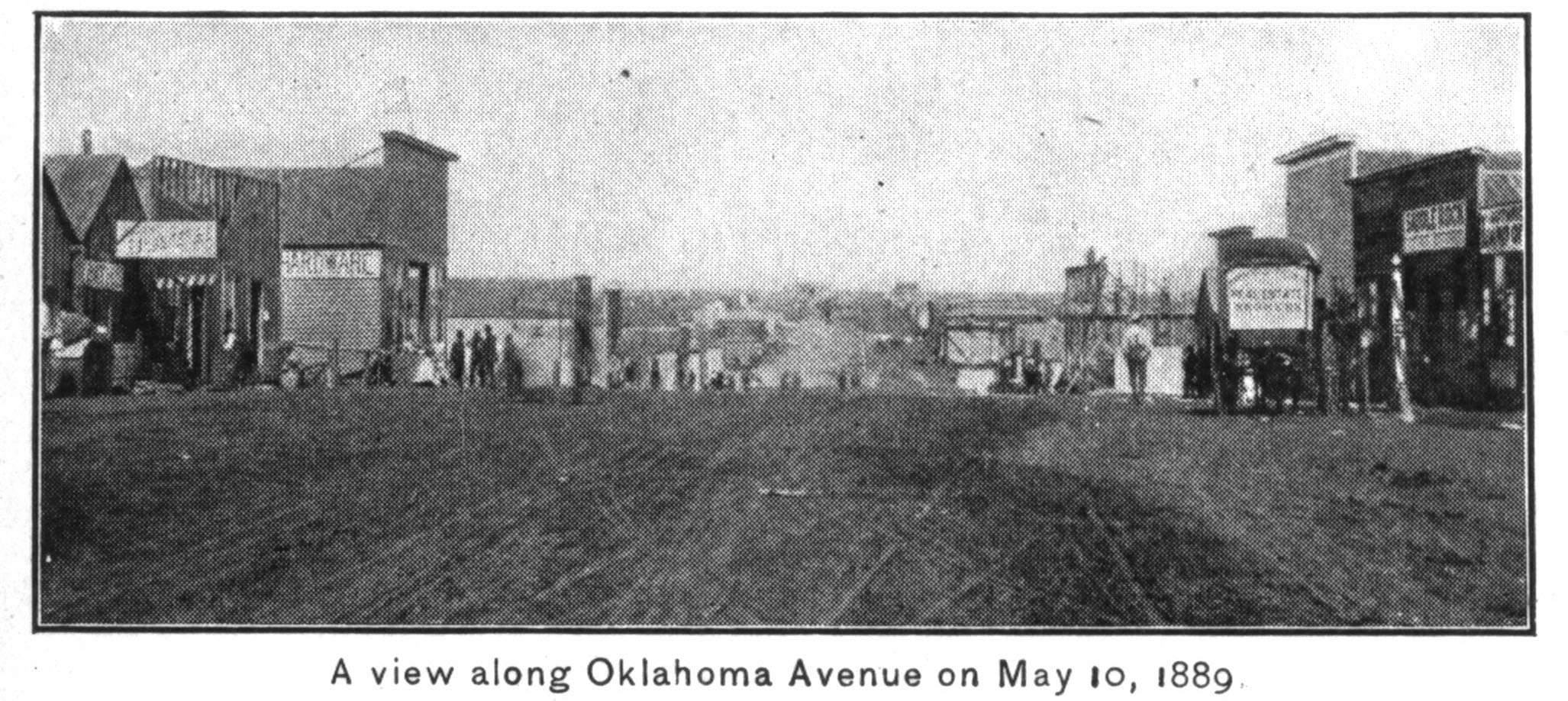
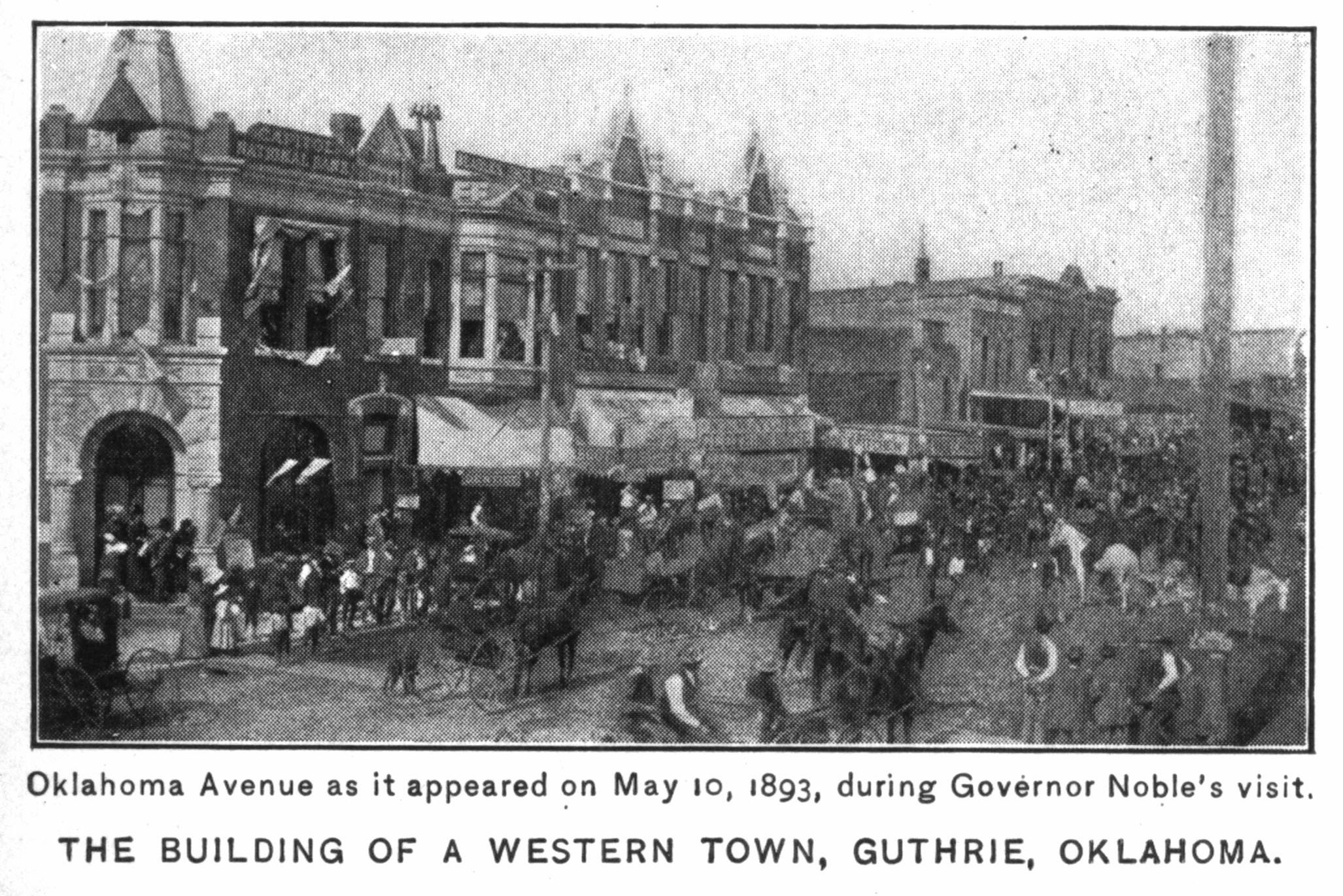
Guthrie Land Office swarmed by people eager to register their claim.
“On April 22, 1889, the day of the Land Run, (sometimes referred to as Harrison’s Hoss Race), Guthrie had its first incarnation as a destination, becoming a city of 10,000 people by nightfall. Located in the Unassigned Lands of the Indian Territory, Guthrie had been chosen as a site for one of the Federal Land Offices where land seekers were required to file claim to their parcels.” [Guthrie Chamber of Commerce]
The police docket records for the first decade of existence for Guthrie (Logan County, Oklahoma Territory) reveal that government operations depended heavily on fines levied against prostitutes, those who maintained houses of gambling, and those who disturbed the peace by cursing, fighting, loitering, or other minor offenses. Taxes and licenses supplemented the city’s income. Major crimes such as murder fell under the jurisdiction of the federal court at Fort Smith.
Despite the heavy and persistent fines, gambling and prostitution flourished in this new frontier town. As shown in the following yearly summary of offenses, these activities tapered off slowly. By 1900, less than a third of the number of fines were levied against gamblers and prostitutes than had occurred in the peak year of 1893.
As the city gained its footing, additional laws were passed. For example, in 1891 fines were instituted for failure to license a dog, suggesting that dogs running loose had become a problem. With a continuing influx of people from other more settled places around the nation, greater pressure fell upon town fathers to clean up. Hogs and cattle became the subject of complaints as did the proper maintenance of outdoor privies. However, even by 1900, the number of arrests by Guthrie police for prostitution and gambling still topped any other offense.
As other sections of the former Indian Nations (Oklahoma) opened to white settlement, the front lines of gamblers and prostitutes moved to the newest places where largely male populations could be counted on as eager customers. Further west, mining of precious metals in California, Colorado, Arizona, New Mexico, and other areas formed the last frontier of rough and ready places where gamblers and ladies of the night could earn a profitable income.
At the time, journalist Frederick Barde reported on the gambling scene at Guthrie for the Kansas City Star, as recorded by Michael J. Hightower in his 2013 book Banking in Oklahoma Before Statehood:
“Those who made it to Guthrie with their wallets intact might have visited the Reeves brothers’ gambling house operated by Dick and Bill Reeves. Opened on the day of the Run of ’89 in a big tent “where there was room enough for 1,500 men and women to gamble and drink and carouse,” the Reeves brothers ran their business in Guthrie for twenty years. Barde’s description of the famed honky-tonk confirms an image of the western saloon that has never yielded its place in our collective memory: ‘Gamblers from every State tackled the game that ran night and day in that sleepless place. Hundreds of thousands of dollars passed over its tables. The six-shooter and the dirk settled many a dispute, and the dead man was hauled away and the blood scrubbed from the floor as part of the day’s business. Outlaw gangs that infested Oklahoma in those days risked their loot against the faro bank and the roulette wheel—and usually lost.’”[1]
As late as 1898, the situation in Guthrie continued to outrage the city’s more upstanding citizenry, as reflected in this editorial in the Guthrie Daily Leader.
“Why is not some action taken toward driving out the hundreds of tramps, bums and tinhorn gamblers that infest the city? The streets and alleys fairly swarm with such vermin and with our present small police force the city is not safe. I hear daily of petty thieving done by this gentry. Such characters do a town no good and I think it high time to begin a crusade. Every night the joints on Second street are crowded with bums, who, after the lights go out, enter on a campaign of larceny. If the evil cannot be checked in any other way, then close the joints.”[2]
Laws passed in 1893 in Oklahoma Territory allowed cities to levy an occupation tax on gaming tables, among many other activities including but not limited to auctioneers, contractors, druggists, restaurants, butchers, taverns, hawkers, peddlers, bankers, brokers, pawnbrokers, merchants of all kinds, grocers, wagons, carts, furniture dealers, real estate agents, and all kinds of exhibitions for pay.[3] The same 1893 law allowed cities to prohibit houses of gambling as well as prostitution, tippling shops, billiard tables, bowling alleys, etc., and specifically prohibits the granting of license for gambling or prostitution.[4] Observers might conclude that Guthrie’s town fathers deemed these activities too lucrative to completely banish, allowing gambling and prostitution to flourish in order to make the most of the fines they produced.
Also passed that year, a law stated that any officer of the law found to be drinking or gambling could be removed from office upon complaint by any citizen. This law may have been the cause of Bill Tilghman’s sudden change of career. After being appointed deputy marshal in Spring 1893, he gave up ownership of his gambling house.[5] Yet these stringent laws, including those that penalized property owners if their tenants pursued any such forbidden activities, seem to have been largely ignored by boom towns of those lawless years, as Guthrie’s police docket reveals.
Guthrie’s arrests in the first decade were as follows:
1889 May thru Dec
Trespass 9
Trespass/Stealing 28
Assault/Fighting 8
Disturb Peace 14
Public Intoxication 1
Conduct Business w/o License 4
Fake Credentials 1 (doctor)
Maintain a House of Gambling 1 (Fine 10.00)
Maintain a Place for Prostitution 2 & Prostitution 46 (Range of fines: 8.50 – 36.00)
1890
Trespass 2
Assault/Fighting: 13
Failure to Pay Business Tax 7
Sell Beverage w/o License 1
Profane Language 6
Disturb Peace 5
Firearm 3
Public Intoxication 13
Maintain Public Nuisance 1
Maintain a House of Gambling 25 (Average fine amount: 10.75)
Maintain a Place for Prostitution 9 // Prostitution 43 (Average fine: 7.50)
1891
Assault 16 – 1 pitchfork, 1 w/ hoe
Disturb Peace/Fighting/Profanity 128
Discharge Firearm 3
Public Intoxication 30
Failure to Pay Business Tax 9
Maintain a House of Gambling 120 (Range of fines: 15.00 – 35.00)
Maintain a Place for Prostitution 9
Prostitution 148 (Range of fines: 7.50 – 10.00)
Unusual:
Unregistered dog: 3
On Street w/o visible means of support 1
Left on ground exposed cow 1
Saloon open on Sunday or after hours: 3
1892
Assault 7
Disturb Peace/Fighting 156
Public Intoxication 52
Failure to Pay Business Tax 14
Maintain Public Nuisance 2 (one charge for hogs)
Maintain a House of Gambling 142 (Range of fines: 10.00 – 40.00)
Prostitution 202 (Range of fines: 7.50 – 10.00)
Unusual:
Frequently found in house of prostitution, fined 46.55
Business open earlier than 5 am
Indecent exposure
Not burying dead pony
1893
Assault/Fighting 50
Disturb Peace 244 (many charges for “bad language”)
Loiter/Vagrant 24
Public Intoxication 84
Maintain a House of Gambling 29 (Range of fines: 8.50 – 40.00) (No arrests after March)
Prostitution 337 (Average fine: 10.15 – 13.65)
Unusual:
Riding horse on sidewalk
Keep hogs in filthy condition
1894
Assault/Fighting 25
Disturb Peace 96
Loiter/Vagrant 6
Public Intoxication 93
Maintain a House of Gambling 1 arrest* (16.65 only recorded charge/fine, June)
Prostitution 270 (Average fine: 10.15 – 13.65)
(Terms used in bookings for prostitution: Place of Assignation, Bawdy House, Keeper, Inmate, House of Ill Fame)
Unusual:
Allow horses to run at large
Carry on sexual intercourse at Arlington Hotel
Slaughter animals
Dress not belonging to his sex
* Mysteriously, arrests for gambling ceased entirely from April 1893 throughout 1894 and remained at a low rate in 1895. This was the same time period that Bill Tilghman ended his gambling operation and moved away.
1895
Assault 22
Disturb Peace 62
Loiter/Vagrant 16
Assault/Fighting 22
Public Intoxication 160
Maintain a House of Gambling 35 (Average fine: 16.65 – 31.65)
Prostitution 219 (Average fine: 11.65 – 31.65)
(Includes “occupy room for unlawful sexual activity”; “use room in restaurant for assignation”)
Unusual:
Appear on street in lewd manner
Garbage in streets and alley
Allow cow to run at large
Hogs in city
Cow in dirty pen
Fail to close saloon at 12 a.m.
Group assault on John ‘Chinaman’
1896
Assault 30
Disturb Peace 77
Loiter/Vagrant 1
Public Intoxication 66
Maintain a House of Gambling 52 (Average fine: 16.65 – 31.65
Prostitution 152 (Average fine: 11.65 – 31.65)
Unusual:
Leaving team of horses unattended
Keep meat market open after 9 a.m. Sunday
1897
Assault/Fighting 23
Disturb Peace 95
Loiter/Vagrant 27
Public Intoxication 147
Maintain a House of Gambling 61
Prostitution 207 (Three women filed physician certificates, assumed to verify state of health); arrests for cohabitation: 23
Unusual:
Appear on street in unbecoming dress (female)
1898
Assault/Fighting 21
Disturb Peace 78
Loiter/Vagrant 30
Public Intoxication 95
Maintain a House of Gambling 41
Prostitution 169 (Cohabit: 36)
Unusual:
Remove contents of privy without license
Sale of liquor on Sunday
1899
Assault/Fighting 34
Disturb Peace 55
Loiter/Vagrant 32
Public Intoxication 181
Maintain a House of Gambling 64 (Average fine $40)
Prostitution 136 (Cohabit: 28) (Average fine $10)
Unusual:
Maintain filthy condition injurious to public health
Overflowing privy vault
Steal 27 hen’s eggs
1900
Assault/Fighting 30
Disturb Peace 73
Loiter/Vagrant 14
Public Intoxication 243
Maintain a House of Gambling 33
Prostitution 142
Unusual:
Giving musical concert on the street without a license
Arrest records from Guthrie’s early days as Oklahoma Territorial capitol provide an interesting insight on famed lawman William “Bill” Tilghman, one of the Three Guardsmen (along with Chris Madsen and Heck Thomas) celebrated for their pursuit of the Dalton Gang and the Doolin Gang known as the ‘Wild Bunch.’ Little has been written about Tilghman’s adventures on the wrong side of the law or his likely relationships with a variety of fallen women. One such woman appears in the Guthrie arrest records as Jessie Bond, probably the same person later known as Jessie Whitewings. These records suggest an illicit relationship between Bill and Jessie Whitewings/Bond.[1]
As soon as Oklahoma Territory opened to white settlers in 1889, Bill Tilghman joined the land rush to stake a claim in the place that would, overnight, become Guthrie. He left his wife, ranch, and livelihood behind in Dodge City, Kansas. At this point, he was 35 years old and had pursued many activities so far in his life, including buffalo hunting, service as deputy sheriff under Bat Masterson in Ford County, Kansas, operator of a saloon in Dodge City, and then service as marshal in Dodge City. Most writers of his biographies focus on Tilghman’s illustrious and dedicated years of duty as a law officer in large part due to the efforts of his widow who wrote a book aggrandizing his career.
Not unlike other famous Western lawmen, Tilghman played both sides of the law. Newspaper accounts contemporary to his deputy service in Kansas with Masterson stated that:
Within a month of his appointment, Tilghman was charged with being an accessory to an attempted train robbery. On February 12, 1878, the charges against Tilghman were dropped for lack of evidence. Tilghman was again suspected of a crime only two months later, on April 16, 1878, when he was arrested by his boss, Masterson, on a charge of horse theft. Once again the charges were dismissed.[2]
Tilghman wasn’t so fortunate at Guthrie where surviving police dockets reveal a string of arrests and fines. Early on the scene in the land rush of 1889, Tilghman nabbed a prized corner lot on the main street of the suddenly-forming town and, according to one account, he later used the rent from this commercial location to fund his endeavors as a rancher. This source also states that he obtained his ranch site during another land rush in 1891.[3]
The woman of our inquiry, Jessie Bond, first appeared in the Guthrie, Oklahoma Territory police records in September 1890, detained on the 6th of that month and fined fourteen cents for prostitution. Similar subsequent arrests that year occurred October 11 (fined $7.50), November 1 (no fine recorded), and December 9 (fined $7.50).
Evidence of Tilghman’s associations with ladies of the night also involves Jessie Whitewings. There is no arrest record for a person by this name, but in later newspaper reports (1894) she was described as a “a flaxen-haired woman about twenty three years old and now quite fleshy… [who was a] “well known Oklahoma sport” [and who had] “lived in Guthrie in the early days and had been the mistress of a gambler.”
Was Jessie Bond the same person as Jessie Whitewings? Records support this theory. On October 15, 1891, a person named Duncan “alias White Wings” was arrested in Guthrie for being “intoxicated on [the] street.” This is the only mention of the name “White Wings” in the Guthrie arrest record between 1889 and 1897. If Jessie Whitewings was a ‘well-known sport’ in Guthrie’s early days, she would have had an arrest record. This leads to the assumption that while she may have had the nickname of ‘Whitewings,’ perhaps due to her relationship with Duncan, her real name was in fact Jessie Bond. Assuming Bond and Whitewings are the same person, at the time of her first Guthrie arrest in 1890, she was approximately nineteen years old.[4]
Within a month of Jessie’s first arrest in Guthrie, William “Bill” Tilghman appears on the Guthrie arrest record for maintaining a house of gambling. He was booked on October 10 (no fine recorded) and again in November, no date specified, with a fine of $10.75. The following year, in 1891, Jessie and Bill were arrested multiple times. Jessie was booked January 25 (fined $8.40) for residing in a house of prostitution, and again April 20 ($7.50), May 11 ($10), and June 13 ($7.50).
Bill’s arrests in 1891 were considerably more numerous, all pertaining to his gambling house on the main street of town. The docket shows arrests and fines of January 20 ($11.70), February 12 ($10.30); June 1 ($15); July 14 ($15); July 22 ($15); August 15 ($15), along with his brother Frank ($15); Frank again September 15 ($15); Bill November 14 ($25), Frank November 16 ($15), and Bill December 1 ($40).
In 1892, Jessie Bond’s arrests for prostitution occurred February 1 ($7.50), April 12 ($7.50), May 18 (fourteen cents), August 15 ($8.50); October 19 ($8.50); November 14 ($8.50); and December 26 ($8.50). During the same year, Bill’s arrests for maintaining a house of gambling occurred January 21 ($40); February 15 ($50); March 30 ($25); April 26 ($20); May 15 ($40); June 15 ($20); July 15 ($15); and August 15 ($15). Frank Tilghman was arrested December 16 ($15).
The August 1892 docket listing was Bill Tilghman’s last arrest in Guthrie. His saloon/gambling house continued under his brother Frank’s direction. Frank’s arrests in 1893 were in January 25 ($15) and February 18 ($15). The last record of Frank Tilghman in Guthrie police dockets show four arrests in 1899 for running a gaming table/room.
Jessie Bond’s 1893 arrest record names the offense of “reside in house of prostitution,” with dates of January 16 ($11.50); February 16 ($11.50); March 15 ($8.50); April 15 ($11.50); May 15 ($11.50); June 19 ($11.50); July 17($10.15) (This arrest was recorded in mid-November.); and July 24 ($8.50). No further arrests of Jessie are recorded until December 30, 1893, at which time two arrests are documented with fines of $13.50 and $5.00.
Here’s where the story gets interesting. During the six-month period between July 24 and December 30, 1893 that Jessie Bond was not arrested in Guthrie, “Jessie Whitewings” was arrested in Perry. By Bill Tilghman. News accounts about the Perry arrest declared that this “well-known Oklahoma sport” had “lived in Guthrie in the early days and had been the mistress of a gambler.” Later, the article stated “Jessie had made her way to Fort Sill and El Reno, and at the opening of the Cherokee Strip, she was in Perry making the rounds of the saloons.”[5]
Jessie’s sojourn in Perry lasted only until November 1893, when she captured public attention in a drunken debacle which triggered her arrest by none other than her old buddy Bill Tilghman. After his move to Perry the previous year, he’d become the Perry marshal. No details have been found regarding the extent of this incident but after her arrest and quite mysteriously, Jessie made her escape from the Perry jail.
As reported, “after Tilghman jailed Whitewings, a fire broke out in the jail and it was first reported that she had set fire to her own bedclothes. Jess was taken from the jail and handed over to another police officer from whom she quickly escaped. … The next morning someone else confessed to setting the fire and was in turn placed in jail for that offense. By then Jess Whitewings was nowhere to be found.”[6]
Was Jessie Bond the same person as Jessie Whitewings? Further analysis suggests that they were. If Whitewings was a known gambler in Guthrie and closely associated with a prostitute as reports claim, the town’s arrest record would reflect that fact. A man named Bill Duncan was arrested on May 11, 1891, for maintaining a house of gambling. But there was only one Whitewings arrest, October 15, 1891, on a charge of public intoxication, listed as “Whitewings alias Duncan.” More likely is a scenario where Jessie became known in the early days by her association with Duncan/Whitewings and the nickname stuck after Duncan disappeared.
After the Perry incident, Jessie Bond again appears in Guthrie arrest records beginning December 30, 1893. Evidently she settled back into her by-now familiar routine of plying the sex trade, with the exception that she now had moved up the professional ladder a rung or two. Some of the charges in 1894 were not simply for prostitution or for residing in a house of prostitution, but for being the proprietor of such a house.
Her 1894 arrest record ran like a regular monthly tithe to the local constabulary: January 29 ($13.65); February 26 ($10.15); April 16 ($13.65); May 16 ($13.65); July 18 ($13.65); September 13 ($14.65); September 19 ($13.65); October 18 ($10.15); December 15 ($13.65). For April’s arrest her charge was “maintain bawdy house.” For July’s arrest, the charge was “maintain house of ill fame.” For September’s arrests and December’s, the charge was “keep a bawdy house.”
~~~
Records show that Tilghman and Jessie Bond hit the Guthrie police docket within a month of each other in the fall of 1890. He ran a saloon and gambling operation at Guthrie triggering a string of 19 arrests for which he paid fines totaling more than $450, a considerable amount in those days equivalent to about $14,677 today. His last recorded episode on the creative side of the law was August 1892. According to his wife’s posthumous biography of Bill, he was appointed deputy U. S. marshal in May 1892. If true, he continued to operate a gambling house for at least three months after taking up a job in law enforcement.
After the opening of the Cherokee Outlet September 16, 1893, and Bill’s relocation to Perry, his next appearance in the public record as a lawman is confirmed in part by his November 1893 arrest of Jessie Whitewings and her subsequent mysterious escape.
An interpretive view of the public record offers an expanded theory of Tilghman’s story. As previously stated, court records and newspaper accounts support the opinion that Jessie Bond was Jessie Whitewings. Further, it seems likely that she was Tilghman’s sometimes mistress during Tilghman’s days in Guthrie from late 1890 through the first half of 1892, both of them enjoying the rowdy frontier life where she could conduct her private enterprise in and around his establishment and Bill could keep an eye on the gambling tables. She would have seen Bill as a protector in the rough recreation of the boom town.
But by 1892 Bill’s fines had gone sky high and he was starting to see that the local authorities were coming to him for hefty allotments each month. Maybe some of the lawmen he had known in Kansas challenged him about the direction of his life in Guthrie or applied pressure which Bill felt gave him little choice but to clean up his act. Maybe his wife announced her plans to join Bill in the Territory. Likely, he saw a better future for himself in a paying job as a lawman.
For about one year from September 1892 until September 1893, Tilghman evidently traveled until ending up at Perry for the opening of the Outlet. He may have returned to his long-suffering wife and family in Kansas for part of that time and he may have traveled to Fort Sill and El Reno along with Jessie. When summoned to rambunctious Perry to employ his law enforcement expertise, Tilghman reportedly arrived there from Guthrie.
Jessie left Guthrie July 26, 1893, destined for the same town as Tilghman, suggesting she may have fallen for the big lout even though she knew he was married. She followed him to Perry when the Outlet opened for claims September 16, 1893.
But once she found Bill, she would have been bitterly disappointed when he let her know he had turned over a new leaf and was not interested in further dalliance. Trying to drown her sorrows in a bottle of whiskey, Jessie got soaked and went on a drunken rampage that resulted in a call for the marshal. It isn’t difficult to imagine that Bill still had a soft spot in his heart for her, so he took her off the street and locked her up until she could simmer down.
Jessie possessed plenty of incriminating information about him that he didn’t wish aired in his new town or before his wife and children. He could have easily arranged for Jessie to escape with the understanding she would leave town and allow him pursue his new life without her, possibly ensuring her exit with a monetary gift that helped her open her own brothel at Guthrie.
Jessie would have returned to Guthrie with a broken heart. But like many independent women of those times, she faced up to her limited options. Arrests of Jessie Bond continued through the following year (1894) and into 1895, when she was arrested January 2 for disturbing the peace, fined $11.65, and arrested again January 15 for keeping a bawdy house and fined $13.65. Another arrest for residing in a bawdy house occurred February 18, with a fine of $10.15.
Her girls were rounded up again for another monthly offering to the city budget on March 15, 1895, when “Jess” had to pay $10.15. But the April bust of the local prostitutes and gamblers did not include Jessie, nor did any subsequent month. For whatever reason, after five years on the public record, Jessie’s infamy ended.
Maybe Jess couldn’t bear to continue in a place where she had enjoyed such a happy run of Bill’s company. The town was getting too settled for the safe enjoyment of her profession. It’s no secret that once a frontier town aged a few years and the dust began to settle, ladies and churches took over. Like many women of the night, Jessie may have found a new settlement in which to set up trade farther west, maybe in a mining town. Or, like the luckier of her sisters, she may have found love and (or at least) marriage. The last known record of Jessie Bond is March 15, 1895.
Some researchers of Oklahoma’s frontier history claim a different Guthrie prostitute, Molly Morgan, was Tilghman’s mistress. Molly’s record in Guthrie begins with a June 25, 1889, arrest for prostitution, and includes four additional arrests that year. In 1890, the year that Jessie Bond and Bill Tilghman first appear on the arrest record, Molly had five arrests, two of which were for maintaining a house of prostitution. One of those arrests, on November 1, 1890, occurred simultaneously with Jessie Bond’s arrest, strongly suggesting that the two women worked at the same place and knew each other.
Molly chalked up eleven arrests in 1891, two for disturbing the peace and the rest for prostitution. In one incident, her arrest occurred on the same date as one of Frank Tilghman’s arrests. On May 11, 1891, her arrest occurred simultaneously with an arrest for Jessie Bond, both of them for residing in a house of prostitution. In total, eleven women were arrested that day on the same charge. Also on that date, nine men were charged with maintaining a house of gambling—including Bill Duncan.
In 1892, two early arrests of Molly Morgan for prostitution on January 20 and February 15 are followed by an arrest for disturbing the peace on June 29. Molly’s last arrest in Guthrie was July 16, 1892, for prostitution, and her booking is listed next to a charge against Wm. Tilghman July 15 for maintaining a house of gambling. Tilghman’s last arrest in Guthrie is the following month.
Even if Bill Tilghman considered Molly his primary mistress during his gambling house days at Guthrie, nothing kept him from dabbling with Jessie on the side. Already married with a family back in Kansas, Tilghman obviously did not consider that relationship a barrier to his involvement with other women. He may have overseen prostitution trafficking as a kind of pimp/protector for a slice of the profits. He may have whispered empty promises to Jessie at the appropriate times, leading the young girl to believe he loved her.
Once Jessie suffered his refusal in Perry and returned to Guthrie without him, it was little more than a year before she gave up in Oklahoma Territory and struck off for greener pastures. The 1900 census records do not show a Jessie Bond of the appropriate age, suggesting that by age 29, Jessie had died or become a bride.
As far as this less illustrious view of Tilghman, the record of his arrests and gambling operation are not as incongruous with his lawman reputation as it may seem. Many historians have remarked on the peculiar mindset among certain men of authority in those times. For example, William Howard recorded in his 1889 report on the Guthrie land rush that the best lots were preempted by deputies and others empowered to be on site before the bulk of eager claimants arrived. He provided the following exchange:
“I ran with the first of the crowd to get a good point of view from which to see the rush. When I had time to look about me I found that I was standing beside a tent, near which a man was leisurely chopping holes in the sod with a new axe.
“Where did you come from, that you have already pitched your tent?” I asked.
“Oh, I was here,” said he.
“How was that?”
“Why, I was a deputy United States marshal.”
“Did you resign?”
“No; I’m a deputy still.”
“But it is not legal for a deputy United States marshal, or any one in the employ of the government, to take up a town lot in this manner.”
“That may all be true, stranger; but I’ve got two lots here, just the same; and about fifty other deputies have got lots in the same way. In fact, the deputy-marshals laid out the town.”[7]
~~~
Life in the Old West abounds in tales of painted ladies with hearts of gold and lawmen with tarnished reputations. Tilghman’s record of saloon ownership in Kansas foreshadows such activity at Guthrie, as do the activities in both locations of his brother Frank. Bill was certainly not the only man of those times to serve the law while pouring drink. A contemporary in Dodge City plying both trades was Charlie Bassett, also friends with others Tilghman admired. The 1882 opening of the railroad in Texas immediately attracted Roy Bean to set up a tent saloon. Later named to a justice position, Judge Roy Bean’s saloon served as his courtroom. Wyatt Earp worked in saloons when he was between jobs as a lawman, and Bat Masterson in advancing years retired from lawman to run a Colorado saloon.
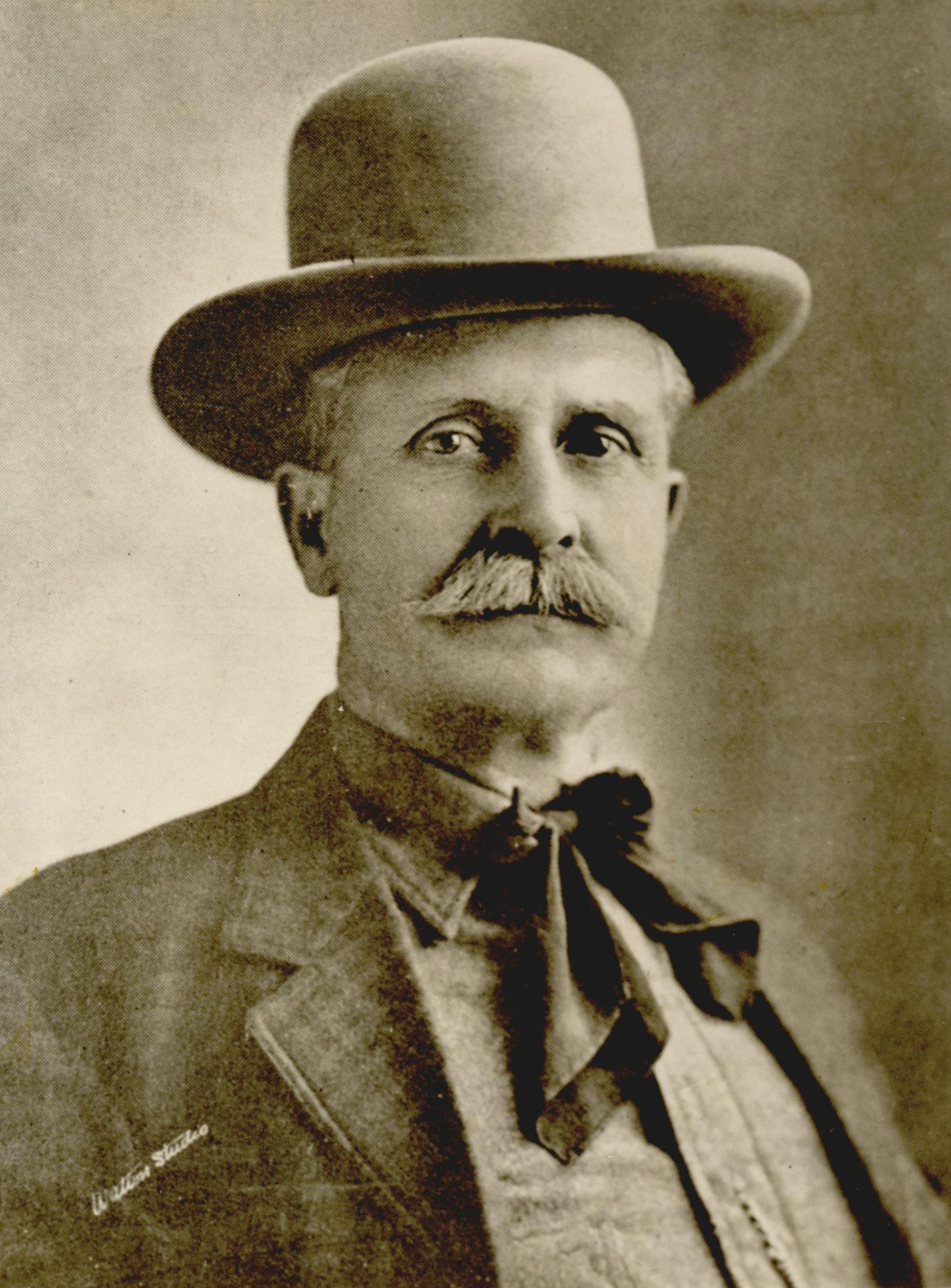
The 1893 photograph of Tilghman reveals a man quite proud of himself. His first wife’s action for divorce in 1897 amid her struggles with tuberculosis suggests she had become disenchanted with his philandering. After her death, his 1903 marriage at age 48 to 22-year-old Zoe Stratton provides additional support to a theory that Tilghman enjoyed a certain celebrity among young women and did not hesitate to take advantage of that attraction. After his death, Zoe zealously scrubbed his reputation in her 1949 book, Marshal Of The Last Frontier: Life And Services Of William Matthew Bill, Tilghman, For Fifty Years One Of The Greatest Peace Officers Of The West.
Rather than writing a biography of himself, Tilghman took advantage of new technology in the film industry and formed a production company along with Evett Dumas Nix and Chris Madson. Their endeavor, named the Eagle Film Company, produced a film entitled “The Passing of the Oklahoma Outlaws,” which premiered on May 25, 1915. Tilghman, one of the film’s stars, promoted the film in person, taking it on tour for several years during which he appeared on stage to lecture about his experiences. Later critics panned the 95-minute film for its staged scenes, naming them “a major source of popular disinformation.”[8]
Tilghman no doubt kept his private illicit activities to himself, or at least a secret from his second wife Zoe. He was a man who wanted to be seen as a valuable and heroic public servant. In those times, even more than now, involvement with prostitutes would have tarnished his desired reputation.
Bill Tilghman posing with his Winchester rifle in a scene from 1915 movie “The Passing of the Oklahoma Outlaws” Wikipedia
Mitchell’s jazz band circa 1930, the Arkansas Travelers
Owen Mitchell started teaching music when he was seven years old. A neighborhood boy wanted to learn to play so Owen shared what he knew. That was 1892. He would go on to become the first jazz band leader in Fayetteville. … In increasing demand, the Owen Mitchell Orchestra performed for dances across the region to audiences eager to break out of the war years’ gloom and embrace the new styles of music and dance. The band was among the first to be heard on the new University radio station, KFMQ, in 1924. By January 1925, Mitchell’s radio programming split fifty-fifty between fox trots and waltzes.
… In a lengthy 1949 article in the Northwest Arkansas Times, reporter Doug Jones provided an overview of the local music scene.
“…What I’m talking about are the guys that have and are still living in and around Fayetteville that plenty of local citizens have heard about. All in all, there has been a lot of pretty good music produced in this area, homegrown and home-consumed.
“To those who have followed music, there have been trends in this town reflecting the jazz of the whole country. There might be a few raised eyebrows when I say jazz, but that’s what it was and still is. Jazz music is the basic foundation for all native American popular music. Even more important, to those who haven’t heard, jazz is the only original art form this country has produced. Everything else, Europe or China did first. But jazz is ours, and more and more it is becoming recognized by critics as a true art form.”
From Chapter 3, The Music Men of Turn-of-the-Century Fayetteville, available in paperback at Amazon. $19.95
Henry Doughty Tovey will always be best known as the composer of the music for the University of Arkansas Alma Mater. For everyone who ever attended school there or came to University events like football games, the melodic strains and rich harmonies of that song evoke deeply-felt memories. Without question, Tovey had tremendous musical talent. But that was only a hint at what this man would give to the university, the town of Fayetteville and yes, even the State of Arkansas over the twenty-seven years of his life here.
…Tovey spent the summer of 1909 with friends in Chicago where he discovered the latest version of the Victor gramophone. He immediately purchased one along with a large number of recordings of standard operas including performances by world-famous tenor Enrico Caruso… The gramophone came to serve a key role in Tovey’s grand scheme to offer music education throughout the entire state. Ultimately, his concept caught fire across the nation and even in other places around the world. … Tovey’s growing reputation regarding this teaching method resulted in an article about him published in The Musician, the national journal of music instructors… “The address by Henry Doughty Tovey of the University of Arkansas, which we give in this issue in part, is highly interesting in the demonstration it makes of the wonderful educational power of the talking machine and because it presents such a practical way of working out results. In his plan there is suggestion for every music teacher, for he can use the talking machine in the home and suggest selection of records, and this will have splendid educational results both on the pupil and the entire home.”
…In April 1917, Tovey received notice from Schirmer’s of New York City that their new book, “Energy of American Crowd Music,” would include a chapter about Tovey and his work. No record of this book has been found, but an article thus entitled stated in the preface that “everything we see hear, feel, experience in any way becomes subject matter for music, poetry, painting and sculpture. The things seen and heard in Kentucky or New England or the Ozarks become material for us…”
Much more about this trailblazer in The Music Men of Turn-of-the-Century Fayetteville. Available in paperback, $19.95.
The question of when and how Frank Barr picked up a cornet and learned to play remains unanswered in the mists of time. Yet at the age of eighteen as a student at the University of Arkansas in 1892, this young man not only played but would soon become the bandleader for the University Cadet Band. He would go on to direct the University band for twenty years as well as recruiting youth for “Barr’s Boys Band” through the 1930s. But these were not Frank Barr’s only contribution to the community of Fayetteville and the surrounding region…
…[In 1921] The Elks Club, of which he was a member, agreed to start raising sufficient funds to pay a director and “give Fayetteville boys and men an opportunity to learn to play as well as to have a band ready for the many celebrations and events which a band is needed.” A month later, the Elks announced subscriptions of over $100 per month to finance the band. Barr’s salary would be $75 per month. The Knights of Pythias agreed that they and other lodges about town would be contributors. Barr offered several band instruments he owned which could be used, and County Judge Ernest Dowell consented to the use of the basement of the courthouse for evening rehearsals.
…[In a letter to the editor, 1928] “First, if you will excuse me, I’ll say most of my life has been spent in the entertainment business. At the age of fourteen years, I started teaching bands, and almost continuously since that time, I have been taking bands to picnics, reunions, playing for fairs here, and years ago I played for several fairs held at Rogers and Berryville. For three seasons I managed a Chautauqua here. For 11 years I ran a picture show in Fayetteville and during that time had shows in 14 different towns in Northwest Arkansas and Eastern Oklahoma. I merely give this to show that if anyone is in a position to know what the public as a whole want in the line of entertainment, I am.”
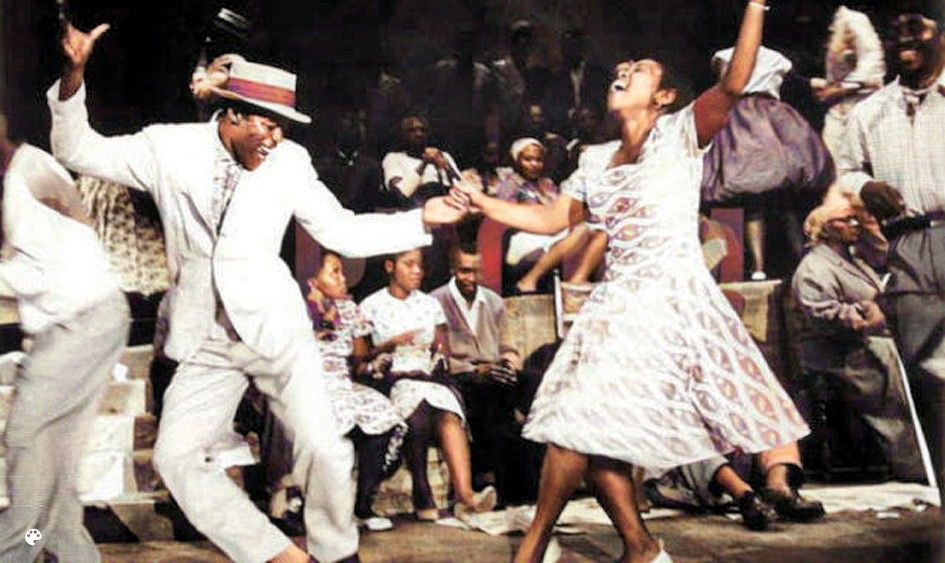
As the 19th century gave way to the 20th, the world of entertainment experienced a massive shift. The invention of electronic media—radio, recordings, movies—brought music to remote homes and new audiences. Sweeping Fayetteville, Arkansas, and its outlying areas before its new wave, the familiar sounds of minstrels and brass bands soon made room for opera, jazz, and the Roaring Twenties.
Key to these transformations were three men and an innovation in the Black community, each taken singly in these chapters. Frank Barr spanned the days of military brass bands to the innovation of his boys’ band that performed soundtracks for silent movies. Henry Tovey, an import from the conservatories of Illinois, took the University of Arkansas fine arts program to unexpected fame. Owen Mitchell, a musician of unusual talent, embraced jazz and led one of the area’s most popular swing bands. Finally, the Black Diamond Orchestra rose from the heart of Fayetteville’s Black community to popular acclaim across the region.
The world of entertainment enjoyed by so many today grew from these roots, from the talented few who generously shared their knowledge and passion and gave music a future of unexpected and thrilling potential.
It should be obvious that everyone in the nation—everyone in the world—benefits when Americans go to college. Americans have earned a reputation for inventiveness and technological advances. Are we ready to give that up?
From James Webb telescope
Back in the day, when the average U.S. worker did just fine with a high school education (or less), the few who went to college were easily subsidized by state taxes up to 80% of the cost. But as the world became increasingly technological, as science became multiple branches of study of everything from our genetic code to the finer points of interstellar rocketry, more and more young people wanted to know more than what high school could teach them.
Few among us want to go back to time when our food supply depended on a plow and a mule and day after day of unrelenting labor, when lights went out with sunset, when one out of every one hundred women died from childbirth. We may feel stressed with the pace of life, but we cannot turn back the tide of progress. The alternative to progress is stagnation, or at worst, destruction.
The United States is slipping behind other nations in the educational achievements of its young people. Rather than analyzing and correcting the reasons behind this decline, our elected leaders succumb to the easy way out which is to facilitate the transfer of tax dollars to private schools and relegate college funding to high-interest loans.
The reluctance, and in many cases the angry protests, of conservatives to support reduction of student loan debt is yet another example of the shortsightedness of this particular slice of our population. These same folks are eager to take advantage of the latest pharmaceuticals, the newest technology in cell phones and digital conveniences/entertainment, as if it all sprang fully formed from the head of Zeus. News flash: These and the many other advancements we enjoy every day are the result of people going to college.
Why would we want to strangle the future our young people can offer?
It could be that there’s a subconscious inclination among conservatives to dig in their heels and not go into that promising future. Maybe the reluctance to facilitate college education is a rejection of modern life and its collection of pros and cons, and instead nostalgia for a long-lost past where completing 8th grade was the biggest accomplishment anyone could expect. That wasn’t so long ago, back when most families lived on a farm and grew most of their own food, when telephones and electricity didn’t exist. But not even the most radical conservative is ready to give up the morning shower, or their cell phone, or the motor vehicle that takes them wherever they want to go.
Progress means finding solutions to problems large and small, problems like Covid 19 (SARS-CoV-2), a virus that so far has left a million Americans dead. In less than a year, our college grads developed a vaccine that provides protection from death and, in most cases, protection from infection, by this virus. Are we ready to give up that kind of science?
The U. S. has to choose whether to continue to lag behind other nations in supporting the education of its young. President Biden and Democrats in general have supported this modest reduction of student loan debt. But over half of student loans will remain to be paid, racking up compound interest that increases the amount owed faster than payments can be made.
It’s a rigged system. Student loans, unlike any other loan, cannot be written off in a bankruptcy, so even when illness or other tragedies of life crash down on a person’s shoulders, those student loans still must be paid. The cost of higher education continues to increase as colleges try to accommodate the loss of state funding while still providing the advanced education students need.
Higher education is the path to future successes for our nation, not only in medicine but in every other aspect of our civilization. Our supply of food and water will increasingly depend on how well we can mitigate the damage caused by climate change. Our health depends on our ability to stave off more exotic viruses. We need to know more about the causes of diseases like cancer, tuberculosis and Alzheimer’s. When we encourage the pursuit of higher education, we not only address future needs for food and medicine, but also provide for an endless advancement of every aspect of human existence.
We need to move our thinking away from the idea that college is ‘extra.’ While we will always need workers skilled in certain trades that are better taught through vocational schools and apprenticeship, increasingly we need people who can program software, refine microchips, and analyze the human genome. And never forget the thousands of college graduates we rely on every day: doctors and dentists, lawyers and judges, engineers and architects, chemists and researchers, managers and accountants, historians and diplomats, psychologists and psychiatrists, and teachers—to name a few.
It is past time for our educational system to provide affordable college education. One way or the other, a student’s cost for college has to return to a reasonable amount—if not free. States need to shoulder more of the burden, as they did before Reaganomics took effect. Lenders for student loans need to be limited to a one-time charge of interest. Colleges need to find ways to reduce costs.
We face a national emergency in education. Public school teachers need much better pay. Taxpayer funds must never be diverted to private schools which don’t have to accommodate special needs students or which promulgate narrow belief systems. As long as our brightest minds are handicapped by the cost of college education, our nation suffers.
The proud image of our nation, which conservatives love to flag-wave about, is not only about those hardworking linemen, farmers, plumbers and other ‘blue-collar’ jobs, but also about the college grads who figured out how to engineer a tractor that can be operated from an air-conditioned cab while pulling a ten-row cultivator, or who calculated the weight and conductivity of wires to carry our power grid, or who invented flex lines and connector glue to replace labor/cost-intensive copper pipe fittings. It takes all of us.










 denelecampbell