

Bought a new wood stove lately? Who knew my longtime desire to buy one would bring me to the brink of despair. Let me tell you, my friend. This is not a step you should take without proper warning.
The old stove, fortunately still in my possession in case I give up this fight, was a Big Box model I inherited when my new husband and I moved into an old cabin. That was in 1974. Local lore claimed an old man named “Ringo” died in that cabin, tired of life, sick, and unable to gather wood. Reportedly, he froze to death.
Fire in the Big Box was simple. Two logs with space enough between them for some crumpled newspaper, a handful of twigs and other flammable bits gathered from the surrounding woods, and then another log across the top, positioned so that when the kindling burned up, the third member would not collapse into the middle but rather perch over the coals to burn freely. Air intake open and the damper open, a match set it off. It was safe to walk away to return a half hour later to shut the air intake and let that baby burn. Whenever fresh wood was needed, simply open the damper to let the smoke escape up the chimney, open the stove door to add wood as needed, and there you go! No smoke pouring into the room.
The problem with the Big Box was that by midnight, fast asleep, one started to sense the cold creeping in. Even the most magnificent fat cut of oak or hickory burned up in only 3-4 hours. That’s because any seal that might once have lined the top edges and front door was long gone and so even with all moveable parts closed, air still moved through the stove. Such things as seals or firebrick probably never existed as part of the stove—at least, in my fifty years with it, no such trace remains. So as my knees got worse with advancing age, trekking up and down the five steps to the living room where the Big Box held pride of place became a more troublesome issue especially at two a.m. when I slept past the life of the fire and only a few coals remained.
I lusted after those fabled wood stoves like Jøtul which held fire overnight. Not only would that solve my overnight heat problem, but it also offered a glass door so I would watch the flames leap and glow. Watching fire can lead to trance-like relaxation effects. These effects have been backed by research that shows that watching an open flame can decrease blood pressure. The longer you sit by the fire, the more relaxed you’ll feel. So when I finally had sufficient funds, I visited the local wood stove store and considered my options.
Admittedly, I failed utterly in the research-before-you-buy department. I’m here to share what I’ve learned.
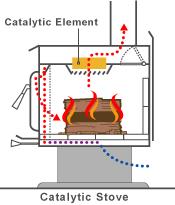
News flash: Woodstoves now must meet new EPA standards, passed sometime in the 1990s, that specify several aspects of the device. Not only did this drive up the prices to absurd levels, but also led to the admonition by my two-man installation team who warned me that the stove would probably smoke. The Jøtul stoves meet EPA requirements with the use of a catalytic device that serves as a kind of filter, but as the EPA guidelines admit, the ‘catalyst’ can burn out within a couple of years.
- In catalytic combustion, the smoky exhaust is passed through a coated ceramic honeycomb inside the stove where the smoke gases and particles ignite and burn. Catalytic stoves are capable of producing a long, even heat output.
- All catalytic stoves have a lever-operated catalyst bypass damper which is opened for starting and reloading. The catalytic honeycomb degrades over time and must be replaced, but its durability is largely in the hands of the stove user. The catalyst can last more than six seasons if the stove is used properly; but if the stove is over-fired, inappropriate fuel (like garbage and treated wood) is burned, and if regular cleaning and maintenance are not done, the catalyst may break down in as little as 2 years.
Not that I would ever burn garbage or treated wood, but spending $300 every couple of years wasn’t on my list of things to do. And as I approach 80 years of age, I have little patience with machines that require “regular cleaning and maintenance.” So for nearly a month I lost sleep worrying about using the stove. It was still summer, so I had time to fret. Finally, after speaking with the store manager, they agreed to allow me to trade my unused Jøtul for a non-catalyst stove manufactured by Pacific Energy.
Beware! The store staff failed utterly to inform me that in many ways, the non-catalyst stove created more problems than the catalyst version.

But I didn’t know that yet. My decision narrowed to the model that allowed for 18” firewood, of which I already had over four ricks of seasoned wood. This model is Pacific Energy’s Alderlea T6. It’s a handsome stove, although several aspects of its construction are big problems.
One of the Alderlea’s many shortcomings is that while the manual states that maximum wood length is 20 inches, the only way to fit a log that size into the stove is on a diagonal from front corner to back corner. Even the owner’s manual phrase “Ideal Wood Length” of 16 to 18 inches placed “endwise” [does this mean end to end sideways or end to end from door to back of stove? No diagram.] leaves zero clearance between the burning wood and the door/firebrick, which means that the glass door quickly becomes coated with soot. So much for watching the fire. The fire box is exactly 18 inches square.
But I’m getting ahead of myself.
After multiple readings of the product manual, I began to break in the stove setting fires meant to burn off the ‘paint’ fumes with house windows open. Right away I noticed what is now a major problem: there is no way to manually vent the stove. Once wood starts burning, if I need to open the stove door to add more wood, or reposition wood, the only option is to open the door and do the task as fast as possible while smoke pours into the room.
Apparently Pacific Energy’s engineers believe the price of making the outside air ‘cleaner’ is to pollute my inside air. The manual fails utterly to address this issue. The instructions for ‘Lighting a Fire’ are:
- Adjust air control to “High” position (all the way to the left) and open door.
- Place crumpled newspaper in the center of the heater and crisscross with several pieces of dry kindling. Add a few small pieces of dry wood on top.
- Ignite the paper and leave the door ajar approximately ½” until the wood kindling is fully engulfed in flame.
- After the kindling is fully engulfed, [open the door while smoke pours into the room] add a few small logs. Close door.
- Begin normal operation after a good coal base exists and wood has charred. [In other words, spend a half hour watching the stove or make repeated trips to check on it.]

Further instructions follow for Normal Operation:
- Set air control to a desired setting. If smoke pours down across the glass, this indicates you have shut the control down too soon or you are using too low a setting. [Wrong. Smoke pours down across the glass with the air control wide open, max setting.]
- For extended or overnight burns, unsplit logs are preferred. Remember to char the wood completely on maximum setting before adjusting air control for overnight burn. [“Char” is defined as partially burn wood so that the surface is black.]
- Use wood of different shape, diameter and length (up to 18”). Load your wood endwise and try to place the logs so that the air can flow between them [while smoke pours into the room].
- Do not load fuel to a height or in such a manner that would be hazardous when opening the door [while smoke pours into the room].
The instructions continue with information about restarting after an overnight or extended burn:
- Open door and rake hot embers toward the front of the heater. Add a couple of dry, split logs on top of the embers [This assumes that you need to load wood ONLY when the previous load has burned to embers. What if you want to go to bed and the current load has only burned 75%? Even 90% burned wood smokes. You have to load while smoke pours into the room], close door.
- Adjust air control to high and in just a few minutes, logs should begin burning. [If they don’t start burning, open door to add kindling or reposition wood while smoke pours into the room.]
- After wood has charred, reset air control to desired setting.
- To achieve maximum firing rate, set control to high “H”. Do not use this setting other than for starting or preheating fresh fuel loads.
Nowhere in the manual does one find a drawing showing the “H” and “L” positions. The lever which moves left to right for this function goes a half inch past the H and L lettering, leaving one to wonder if maximum left or maximum right are the correct positions, or if the lever must be positioned exactly under the H or L.
More instructions follow, including how to use the ash clean out system which proposes one use the tiny opening in the bottom of the stove to dump ash into the ash pan that sits underneath the firebox. One is cautioned not to leave the ash dump door open afterwards. One is not shown the location of the ash dump handle, just informed that the handle is located under the ash lip [also not identified in any drawing] on the left hand side. This is a total waste of owner manual space and engineering salary, and a stupid idea to start with. Just shovel it out, for god’s sake.
An entire page of the manual (27 pages in all) is devoted to the door glass. The #1 instruction regards the potential [unavoidable] darkening of the glass:
- If glass becomes darkened through slow burning or poor wood, it can readily be cleaned with fireplace glass cleaner when stove is cold. Never scrape with an object that might scratch the glass. The type and amount of deposit on the glass is a good indication of the flue pipe and chimney buildup. A light brown dusty deposit in that is easily wiped off usually indicates good combustion and dry, well-seasoned wood and therefore relatively clean pipes and chimney. On the other hand, a black greasy deposit that is difficult to remove is a result of wet and green wood and too slow burning rate.
- WRONG! My wood is well seasoned hardwood (12-18 months) and I don’t adjust the control lever to “L” until the fire is fully engaged, but every morning I must clean the glass, especially the lower side corners where the ‘black greasy deposit’ requires a single-edge razor blade to remove in addition to several applications of glass cleaner. Is this a malfunction of the stove? Queries to the manufacturer are met with advice to contact the dealer! Does this mean that two months into using the stove, I need to have my chimney cleaned?!
Further warnings on that page caution that “excessive ash buildup” should be kept clear of the front of the firebox because it will block air flow. Here’s the problem: Where exactly is this mysterious air intake? It is not shown on any drawing. There are two stair-stepped lips along the front where air might enter, so “excessive” ash remains undefined. Consequently, I keep the fronts of both steps clear. Once again, would a diagram be so hard?
Item #8 on this page is especially informative:
- Be aware that the hotter the fire, the less creosote is deposited. Weekly cleaning may be necessary in mild weather, even though monthly cleaning is usually enough in the coldest months when burning rates are higher. When wood is burned slowly, it produces tar and other organic vapours, which combine with expelled…
And there the text ends. But apparently the conclusion is that closing the air intake completely is not recommended even though an overnight burn would seem to call for minimal air flow. If the best fire method for this stove is a ‘hot burn’ in order the keep the glass clear, how is that compatible with overnight heat?

Not that it actually matters. There is an ugly creosote buildup on the glass in both lower corners even with ‘hot’ fires, with any level of air control, and if I want to watch the fire through the glass, I have to ignore the creosote or clean it daily, which doesn’t last until the end of the day.
The next page of the manual is about maintenance. Monthly, I’m supposed to check:
- Brick rail tabs and brick rails
- Air riser tube in the back of the firebox
- Back slide of airwash chamber
- Baffle locking pin
- Boost tube cover
Not only are there NO DRAWINGS showing the location of these various important maintenance parts, my knees don’t work well enough to crawl around peering inside or under the stove. This would also require that no fire exist in the stove at the time of inspection, meaning my house would have NO HEAT except for little electric heaters in the bathrooms. The last few days have bottomed at sub-zero temps, at no time without fire. That would be a summer job, so I can only hope that the brick rail tabs and airwash chamber are OK for fire throughout the winter.
Genius.
Further, the maintenance instructions continue with “Cleaning the Chimney System”:
- Top baffle board/blanket
- Baffle
- Top heat shield and mountain bolt
- Baffle gasket
- Brick rails
- Manifold
Again, no drawings, diagrams, or other user aid.
I can only hope that I can keep my fires going until warm weather without having something fall apart and/or a chimney fire. Not exactly the peace of mind I had hoped for.
I’m refraining, with difficulty, from speaking of the overall worth of the owner’s manual. After all, I’m a writer and wordsmith dedicated to communicating clearly–not a stove engineer. Somebody apparently did their best with this booklet, sadly. The lack of drawings illustrating the key components of the stove is enough of a failure that the countless other shortcoming hardly bear mention. Pages 11 through 20 detail installation methods. Page 25 is blank. Hint to manual editor: PLENTY OF ROOM FOR DRAWINGS.
There is, however, a full page breakout drawing of the stove PARTS, as if the manufacturer was more interested in selling parts than in adequately explaining the stove’s functions.
At the moment, I’m not sorry I bought it. It does a better job than the old Big Box in keeping heat all night–with luck and holding my mouth right, coals are left in the morning ready for fresh wood. I do have to live with smoke pouring into the room while I try to load in wood and kindling, at which point I’m reminded that I could have stuck with the Jøtul. At least its Norwegian inventors/manufacturers figured out how to create a more environmentally-friendly wood stove without any need to allow smoke to pour into the room.
Note: Look for future updates on this saga once I try to find a person who can service this stove, the possible need for parts replacements, and the status of creosote buildup in the chimney.
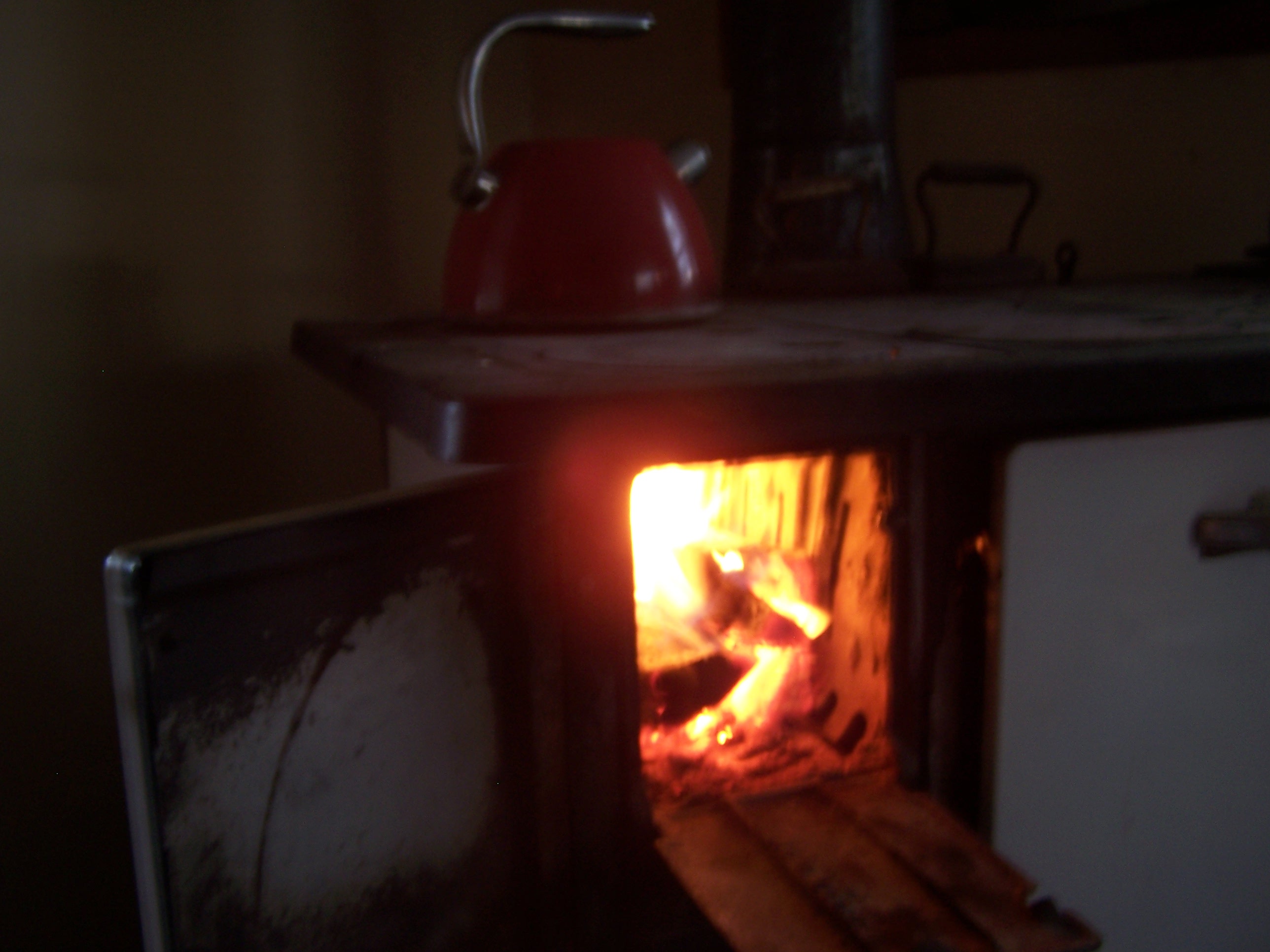
Another note: I failed to mention that I still have the Big Box in use at the back of the house and also have this jewel of an old wood cookstove in my dining room complete with hot water reservoir.


 denelecampbell