War on Americans by Americans

War as a behavioral concept has become so successful, so popular in American culture that a person can choose ‘entertainment’ from a menu of current ‘war’ themed television shows: Neighborhood Wars, Customer Wars, and even a December special called “Christmas Wars.” An endless array of ‘reality’ shows and movies feature one or another war, current or historical. Before the 1970s, war movies generally portrayed actual events in American and world history, serving as a type of education on the many failings and successes of humanity.

Wars on Americans actually began with the first colonists, who began a genocide against the Native Americans. Then there were the Black people, finally freed from slavery with the Civil War but thereafter denigrated, attacked, and lynched with impunity. The War on Black Americans escalated with the Civil Rights movement 1954-1968 when Blacks dared to stand up.

Richard Nixon ushered in a new war in 1971, the War on Drugs. In itself a misnomer, the war on drugs was actually a war on Americans who used, sold, or manufactured any non-sanctioned psychoactive substance including marijuana, hashish, opium/heroin, cocaine, LSD, peyote/mescaline, and psilocybin mushrooms, among others.

The term was popularized by the media shortly after a press conference given on June 18, 1971, by President Richard Nixon—the day after publication of a special message from President Nixon to the Congress on Drug Abuse Prevention and Control—during which he declared drug abuse “public enemy number one.” That message to the Congress included text about devoting more federal resources to the “prevention of new addicts, and the rehabilitation of those who are addicted” but that part did not receive the same public attention as the term “war on drugs.”

The target ‘enemy’ in this war was the Baby Boom generation for whom use of marijuana had become a rite of passage, along with use of psychedelics as a spiritual experience.

The motives behind Nixon’s campaign against drugs are disputed. John Ehrlichman, who was Assistant to the President for Domestic Affairs under Nixon, was quoted by Dan Baum as saying in 1994:

The Nixon campaign in 1968, and the Nixon White House after that, had two enemies: the antiwar left and black people. You understand what I’m saying? We knew we couldn’t make it illegal to be either against the war or black, but by getting the public to associate the hippies with marijuana and blacks with heroin, and then criminalizing both heavily, we could disrupt those communities. We could arrest their leaders, raid their homes, break up their meetings, and vilify them night after night on the evening news. Did we know we were lying about the drugs? Of course we did.[1]

Nixon’s alleged strategy was successful to the extent that many of the best and brightest of the generation were harmed in this war in various ways: imprisonment alongside actual criminals (often including rape, beatings, psychological abuse), loss of employment, disenfranchisement from voting or holding public office, loss of student loans and other financial aid, and outright physical harm including death at the hands of police.

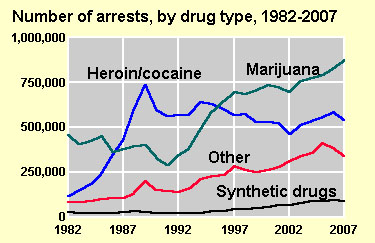
And yet despite this heavy toll on an entire generation and its successors, the drug war has failed utterly to eradicate drug use or addiction. Every 25 seconds, someone in America is arrested for drug possession. The number of Americans arrested for possession has tripled since 1980, reaching 1.3 million arrests per year in 2015. The harsher penalties led to a 1,216% increase in the state prison population for drug offenses, from 19,000 to 250,000 between 1980 and 2008.
An unexpected result of this ‘war’ on drugs was the rise of a widespread underground marketplace where illegal drugs were readily sold. To the detriment of the consumers, these black market drugs were not tested or labeled for purity, nor were buyers checked for age identification as required for alcohol, allowing sales to young teens. Further, this massively lucrative market paid no taxes.

But the least expected and most destructive result of this war on Americans was the rapid proliferation of inner city gangs which used the underground marketplace to reap enormous profits. The wealth flowing into these gangs fulfilled the American dream, allowing impoverished young entrepreneurs to sport nice clothes, new cars, and—most importantly—arsenals.

In the 1980s, Ronald Reagan’s presidency saw a significant expansion of the drug war.

In the first term of the presidency, Ronald Reagan signed the Comprehensive Crime Control Act of 1984, which expanded penalties towards possession of cannabis, established a federal system of mandatory minimum sentences, and established procedures for civil asset forfeiture. From 1980 to 1984, the federal annual budget of the FBI’s drug enforcement units went from 8 million to 95 million. …In 1982, Vice President George H. W. Bush and his aides began pushing for the involvement of the CIA and U.S. military in drug interdiction efforts.

…the number of arrests for all crimes had risen by 28%, the number of arrests for drug offenses rose 126%. The result of increased demand was the development of privatization and the for-profit prison industry. The U.S. Department of Justice, reporting on the effects of state initiatives, has stated that, from 1990 through 2000, “the increasing number of drug offenses accounted for 27% of the total growth among black inmates, 7% of the total growth among Hispanic inmates, and 15% of the growth among white inmates.” In addition to prison or jail, the United States provides for the deportation of many non-citizens convicted of drug offenses.

… during the Presidency of Ronald Reagan … the war on drugs [greatly expanded] a general trend towards the militarization of police. The 1981 Military Cooperation with Civilian Law Enforcement Agencies Act allows the U.S. military to cooperate with domestic and foreign law enforcement agencies. …This allows the U.S. military to give law enforcement agencies access to its military bases and its military equipment.[2]

In the misguided and enormously destructive American war on Americans, the harms have by far outweighed any slim benefit. A 2018 study published in the journal PNAS found that “militarized police units are more often deployed in communities with large shares of African American residents, even after controlling for local crime rates.” The study also found that “militarized policing fails to enhance officer safety or reduce local crime.”[3] The policies of prohibition and police militarization are responsible for the rampant violence inflicted by police on persons ‘suspected’ of criminal activity, most recently resulting in the January 2023 beating death of Tyre Nichols at the hands of five Memphis police officers.

The militarization of police escalated the war on Americans and was met with a more sophisticated response from street gangs and other outlaws. A 2014 ACLU report, War Comes Home: The Excessive Militarization of American Policing, concluded that “American policing has become unnecessarily and dangerously militarized …” The report cites an increase in unnecessarily aggressive raids, “tactics designed for the battlefield,” and equipment such as armored personnel carriers and flashbang grenades—as well as a lack of transparency and oversight. Drug cartels and their street dealers have met the challenge, acquiring semi-automatic weapons and other advanced weaponry.

Lured by the enormous profits involved, Latin Americans tapped into the illegal drug trade by growing fields of marijuana and acres of coca plants. The U.S. response was to send military and CIA operatives to these countries to help form paramilitary forces to eradicate the drug trade. The opposite has occurred, with Mexican and Colombian cartels now said to generate a total of $18 to $39 billion in wholesale drug proceeds per year. Latinos desperate to escape the escalating violence in their home countries settled into places like East Los Angeles and became subjects of white gang violence. Learning from their experience, the young male immigrants formed their own gangs. Ultimately, arrests for criminal activity resulted in deportation, and once deported, many of these men followed the blueprint by building gangs (cartels) in their home countries where they could intimidate local citizens, bribe police and elected officials, and ultimately create a reign of terror with kidnapping, blackmail, and murder that continues to drive terrified residents of those nations toward U.S. borders in an effort to find safety.

Since 2008, the U.S. Congress has supported the Central American Regional Security Initiative (CARSI) with approximately $800 million to “fund programs for narcotics interdiction, strengthening law enforcement and justice institutions and violence prevention through work with at-risk youth.” The CARSI offers equipment (vehicles and communication equipment), technical support and guidance to counter drug trade. The program also supports special units that cooperate with the U.S. Drug Enforcement Administration in Guatemala and Honduras to investigate drug cartels, share intelligence, and promote regional collaboration.[4]

Overall, the harm resulting from the War on Drugs far outweighs any supposed benefit. It has brought us to a point where aggressive policing results in regular beatings, shootings, and murders of Americans, especially Black males. It has drained the U. S. Treasury an estimated $1 trillion while drug use, abuse, and production have accelerated.[5] Currently, drug offenders form 47% of the federal prison population (2020) and 23.5% of Arkansas’ prison population (2019). It has fostered the immigration problem at our southern border.

Legalization of all drugs is the answer, and long past due. People can legally risk/ruin their lives with tobacco and alcohol, and illicit drugs must be regulated and taxed the same. Eliminating this travesty against Americans and the horrific expense of tax dollars will allow the funding of community clinics where anyone can seek help if they need it. Meanwhile, legalization eliminates the inner city police mindset of ‘war’ and moves us a step closer to ending our ‘war’ on our neighbors.   


[1] John Ehrlichman, to Dan Baum for Harper’s Magazine in 1994, about President Richard Nixon’s war on drugs, declared in 1971.

[2] https://en.wikipedia.org/wiki/Militarization_of_police

[3] Mummolo, Jonathan (2018). “Militarization fails to enhance police safety or reduce crime but may harm police reputation”. Proceedings of the National Academy of Sciences. 115 (37): 9181–9186.

[4] https://en.wikipedia.org/wiki/Illegal_drug_trade_in_throughout_Latin_America

[5] https://www.cnbc.com/2021/06/17/the-us-has-spent-over-a-trillion-dollars-fighting-war-on-drugs.html


Best Gift Ever

All around us, every day, the people and events of the past still echo. What is better than to meet those memories and share them with your loved ones?

From 1835 to the present day, the City of Fayetteville in Washington County, Arkansas, has enjoyed a vibrant and colorful history. Its reputation as a regional center for arts, culture, and education began early in its history. Frequently named one of the nation’s Top 10 cities, Fayetteville hosts the University of Arkansas and its famous Razorback athletic teams.

In Glimpses of Fayetteville’s Past, history comes alive in stories of the town’s origins and development. The five articles contained in Glimpses of Fayetteville’s Past focus on under-reported aspects of that history. Published initially by the county’s historical society, these intensively-researched works have been revised and expanded with illustrations, photographs, and maps.

“The History of Fayette Junction and Washington County’s Timber Boom” now include not only an in-depth review of Fayetteville’s first major industry but also three appendices which examine wagon production in Fayetteville, the name and tradition of Sligo, and the Fulbright mill.

“Quicktown” delves into the story behind this quirky short-lived suburb in south Fayetteville.

“546 West Center” tracks the development of a landmark Fayetteville property from its earliest use as a site for an ice factory in the 1880s.

“The Rise and Fall of Alcohol Prohibition” documents the use, production, and regulation of alcoholic drink in Washington County from before statehood through the repeal of Prohibition in 1933, and features indictment and other crime data.

“175 Years of Groceries” follows the transition from country store to supermarkets to big box stores and includes newspaper advertisements showing price changes over those decades.

Whether a reader is interested in learning more about the history of Fayetteville or simply enjoys the peculiar details of how time changes all things, Glimpses of Fayetteville’s Past will inform and entertain.

Amazon buy link


Oh, the Opioids!

Courtesy http://www.sleek-mag.com/2016/12/21/magnum-photos-holiday/

It’s the season of giving, of looking back and looking forward as one year ends and another begins. What better time to consider a fresh outlook on drugs?

Here we are amid the Opioid Crisis, the latest in a long line of similarly heralded events sparking fear, outrage, and call for action. One hundred years ago, it was the Cocaine Crisis quickly followed by the Marijuana Crisis, then the Heroin Crisis. By the late 60s, it was LSD that elicited our fear and loathing.

Doomed to fail from the start, the so-called Drug War was about ‘just saying no’ alongside arming our friendly local cops with military weapons. What we’ve since discovered is that ‘saying no’ meant not talking about it, and that’s a direct route to where we are now. Even worse, we failed to recognize that a war on drugs was actually a war on Americans who use drugs. Now we have embattled inner cities rampant with gun violence and police who dress/act/think like commandos.

What we as a society desperately need to realize is that DRUGS ARE NOT THE PROBLEM. Substance abuse is a SYMPTOM of a much larger and more insidious problem. We’re self-medicating for existential despair.

Existential philosophy arose in the 1950s and early 60s as a way to discuss the unique condition of modern man. Due to mechanization and urban living, the ancient traditions that have helped us cope no longer apply. We are isolated from Nature and its rhythms and lessons that used to sustain us. We are isolated from the sorcery and magic we used to believe was God. We are isolated from our fellow man, often living alone or in nuclear family settings instead of tribal or extended family groups. And most difficult, we are isolated from ourselves, distracted from our thoughts and feelings by constant chatter and material diversions. This is, briefly, the four-fold alienation that describes modern existentialism.

Exacerbating the problem of our modern age are the failures of education, lack of job opportunities, lack of self-esteem, and poor health.

Public or private, schools are missing the target for many youngsters who desperately need logic and critical thinking. Trades we’ll always use, from plumbers to carpenters to seamstresses, are not taught nor are the fundamentals of operating a self-owned business.

Our culture fails to offer a buy-in for young people who need to know they matter. Public service options in avenues other than military are few and far between. Self-esteem has been relegated to displays of material wealth even when no such wealth exists. Debt to last a lifetime is the price we pay for these trappings of social status.

Even more critical is our declining health. Not only are fast food and prepared meals low in nutrition, they’re more expensive than basic foods prepared at home. We’re overeating and starving at the same time, piling on calories in sugar and fat while missing out on the micronutrients, vitamins, and proteins that lead to an uplifted mood and greater energy. No one is advertising chard sautéed with garlic.

Yet the greatest fraud about drugs is perpetuated by the very industries that bear the name of ‘drug manufacturer.’ Since the 1950s, the insidious promotion of drugs by companies like Pfizer, Eli Lilly, or Merck (to name a few) has increased proportionately to the nation’s substance abuse problem.

Slick advertising convinces consumers that with one magic pill, all of life’s ills will go away.

Television especially holds out the false promise. The suffering victim is cast in a muted gray-tone atmosphere while around them everyone else is blissful. With the magic pill, suddenly the victim joins the bliss, bathed in golden light. Meanwhile the precautions about negative effects from the medication are described in a hurried low monotone that fails utterly to overcome the visual imagery.

The message? Consume a drug and your life will be better.

It’s a message that’s not lost on the audience, young and old alike. Who doesn’t want to be part of that golden bliss? Who doesn’t want to live without pain, without worry? All you have to do is take a drug.

It’s exactly this message that has led to the current opioid crisis. It’s not that doctors are overprescribing, although some are. It’s not that manufacturers falsely claimed that OxyContin and its family of synthetic opioids are safe to use, although some undoubtedly did. It’s that all of it is part of a bigger scam wrought upon the American citizenry—that the inevitable aches and pains of life can be made painless.

When we read about the pioneers and ‘old timers,’ we’re aghast at what they endured. No indoor plumbing? No central heat? No food unless they grew it? We marvel at their toughness, their ingenuity.

Yet amid all the labor saving devices and easy consumer goods, we find ourselves without any test of our endurance or strength. We spend too much time in activities that show us nothing at the end of the day. How can we prove ourselves without any proof?

We’re looking for adventure and new horizons. Our natural tendencies as humans drive us toward activities that may result in trauma, pain, or even death. How do we turn back the very features of our make-up that have brought us out of the caves?

The hazard of certain drugs that lead to laws against them is the fear that persons under the influence will harm us. By escaping rationality through intoxication, people may unleash violent tendencies. No abused substance in history lives up to this threat more than alcohol, but our failed war on alcohol should have taught us important lessons about the harm such policies cause.

The need for a national conversation about drugs is long past due. All drugs. Pharmaceutical advertisements should be banned, particularly those requiring a prescription. After all, why are we encouraging people to decide what drugs they need instead of allowing doctors to do their job? Profits for pharmaceuticals should be heavily taxed despite the persistent whine that the money only funds research.

… evidence that Gilead itself uses its profits to “innovate” is thin at best. In 2016, the company reported profit of $13.5 billion. It spent $11 billion to repurchase its own shares, and about $2.5 billion on stock dividends.[1]

Drug manufacturing ranks among the most profitable industries in the world.

Until we set aside our conditioned response to the drug problem, we cannot solve this escalating crisis. We are throwing people away by failing to address fundamental issues that lead people to hide in a drugged haze. We are throwing them away a second time when we stigmatize their drug problem by involving them in the criminal justice system. Or when we force them into a drug court program with limited resources and over-dependence on 12-step programs and which fail to address underlying conditions such as inadequate nutrition.

Treatment programs generally fail in many ways partly because they are set up to create profit. Instead of looking to make money off of people suffering from addiction, we should be looking for ways to express our collection compassion and concern. We should make sure that intake is immediately available for any and all comers, that they’ll be offered a safe setting full of comfort and light, that individual counseling is the best money can buy. When we invest in our fellow man, it’s a win-win for everyone.

So I urge you to give it some thought and talk about this over the holidays as you meet with friends and family. Enjoy that glass of wine as you celebrate the season. Acknowledge the difference between use and abuse. Love your neighbor as yourself. Be part of the change we so desperately need.

~~~

[1] http://www.latimes.com/business/hiltzik/la-fi-hiltzik-gilead-profits-20171023-story.html

On Legalizing Drugs

“Americans must confront the reality that we are the market,” Secretary of State Rex Tillerson said this past Thursday. “We Americans must own this problem.”[1]

Meeting with his Mexican counterpart, Tillerson acknowledged the role of American drug consumption in the proliferation of violent Mexican drug cartels. Citing the enormous demand for heroin, cocaine, and marijuana by Americans eager to get high, he argued that “drug trafficking had to be addressed as a ‘business model,” attacking cash flow, gun procurement, production and distribution.’”

Oh, please. You’d think that an administration that promised new approaches would make some tiny effort to think outside the prohibition box. But never once in Tillerson’s comments or those of his colleague Homeland Security Secretary John Kelly did a new idea appear. Never once did they hint at any effort to consider the success of other nations where various types of legalization and regulation have greatly reduced drug problems.

Take, for example, the success of states like Colorado now in its fifth year of marijuana legalization. Sales of the legal herb generated tax revenues exceeding $150 million between January and October 2016, $50 million of which the state is using to pump up its school systems.[2] Significant shares of this revenue stream will support improved drug treatment, drug education programs, and various projects targeting at-risk populations.[3] All these expenditures help increase education, job skills, and opportunity for persons who might otherwise fall victim to substance abuse.

Yes, Americans are the market. But instead of devoting resources to learning more about why Americans are uniquely prone to drug use and abuse, outdated policies continue to treat Americans as children to be scolded and punished. This attitude helps foster voters’ disgust with government.

Punishment has become increasingly more severe as subsequent generations of policymakers have embraced the government-as-nanny model. Any incremental step away from prohibition has come wrapped in controversy, implemented only in states where the voice of reason has a chance to be heard. Now with the Trump Administration and its appointment of Jeff Sessions as head of the Justice Department, we face the prospect of a full-bore return to the good old failed policies of the past.

Why is there no discussion of legalization and regulation? A modest approach might be similar to that of Portugal, who years ago legalized all drugs. “Weed, cocaine, heroin, you name it – Portugal decided to treat possession and use of small quantities of these drugs as a public health issue, not a criminal one.”[4]

While our nation’s drug warriors lament that such an approach would lead to higher use rates among the young and greater ease of availability would increase use rates, the fact in Portugal is that youth aren’t using more, adults are using slightly less, the rates of HIV and Hep C infection are down, and – hear this – hardly anyone dies of overdose.

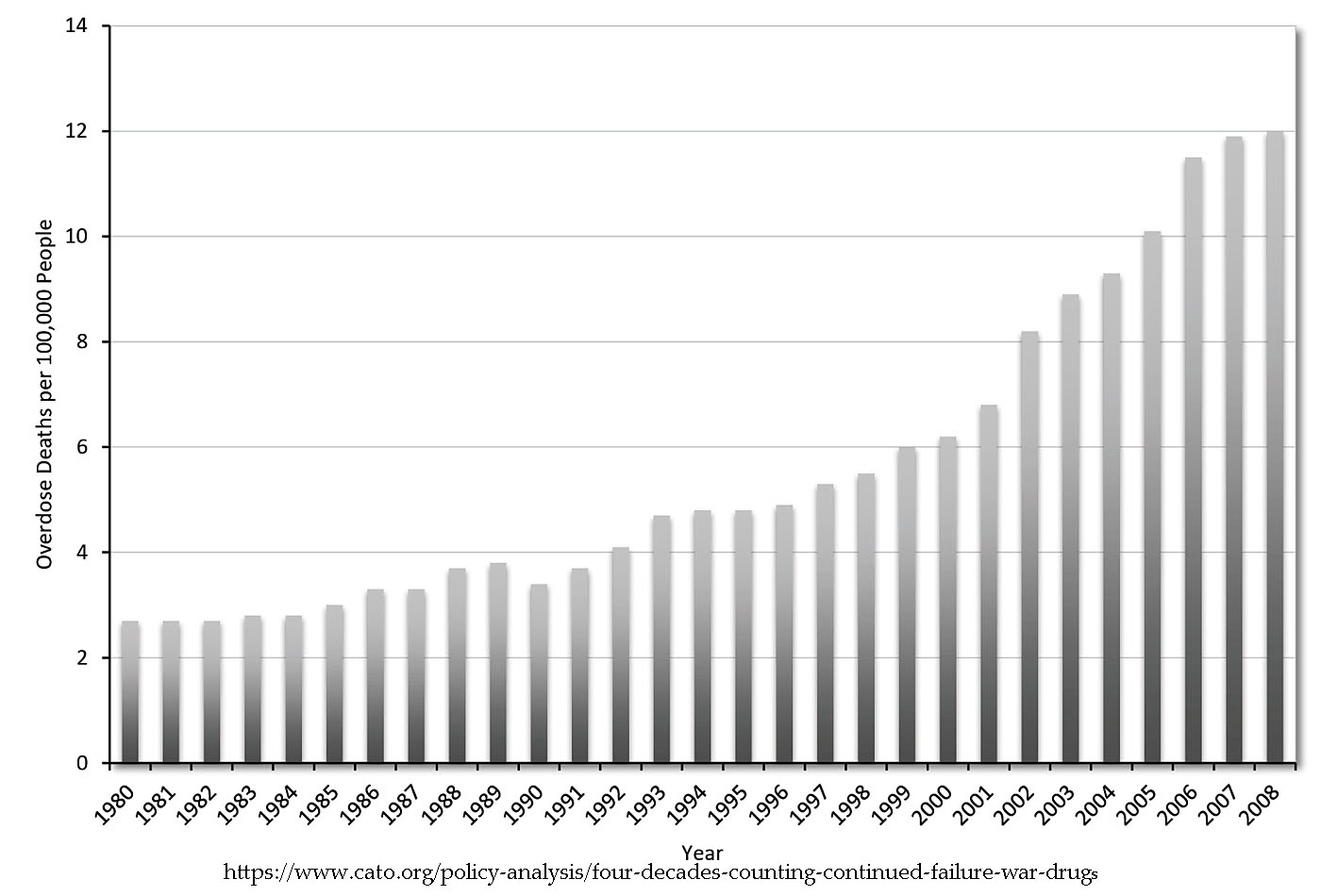
Compare that to the alarming rise in U. S. deaths from opiates which more than tripled between 2010 and 2015.

Drug overdose is the leading cause of accidental death in the US, with 52,404 lethal drug overdoses in 2015. Opioid addiction is driving this epidemic, with 20,101 overdose deaths related to prescription pain relievers, and 12,990 overdose deaths related to heroin.[5]

It’s way past time to face reality: people are going to use drugs. As far back as we can peer into human history, people have consumed everything from beer to cannabis to opium to hallucinogens. These practices are part of who we are, part of our religions, part of our ability to think outside or within ourselves.

Legitimate questions await answers about why various types of drug use throughout the millennia have transformed into today’s raging torrent of human suffering, but we’re not devoting any resources to answer those questions. Have the pressures of our fast-paced modern age forced us to seek refuge in intoxication? Is our multicultural society at fault in erasing old customs and rites of passage that could help us confront our existential crisis? Have the conveniences of our technological age created too much leisure time? What is the impact of a pharmaceutical industry’s marketing campaign flooding us with ads suggesting that the solution to every human ill is a drug?

We simply don’t know.

We should have learned a hundred years ago that criminalizing a popular intoxicant only creates bigger problems. Those who championed alcohol prohibition wanted to stamp out drunkenness. The blissful concept assumed that if alcohol were made illegal and its producers and users criminalized, everyone would simply stop drinking.

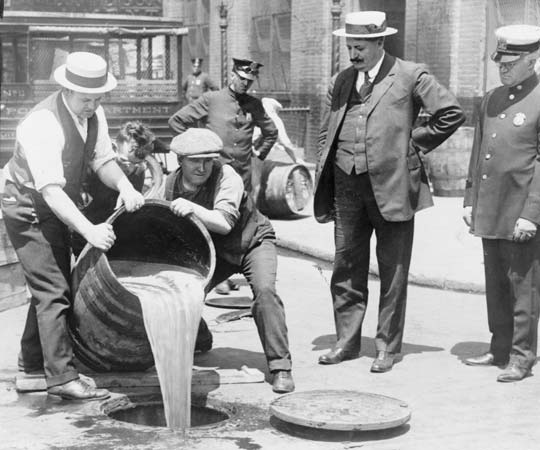
New York City Deputy Police Commissioner John A. Leach (right) watching agents pour liquor into the … New York World-Telegram and the Sun Newspaper Photograph Collection/Library of Congress, Washington, D.C. (neg. no. LC-USZ62-123257)

Far from it. For their trouble in passing the Eighteenth Amendment, the “dry” crusaders found their cities overrun by heavily armed criminals fighting over territory. People flaunted the law, patronizing highly popular speakeasies where drinking served as joyous rebellion against overweening authority.[6] No matter how many barrels of liquor were spilled into public gutters, ever more enterprising moonshiners set up shop in hidden hollows.

It took just over fourteen years for prohibition fervor to sour. Amendment Twenty reversed it in 1933.

As Lincoln famously said in 1840:

“Prohibition… goes beyond the bounds of reason in that it attempts to control a man’s appetite by legislation and makes a crime out of things that are not crimes… A prohibition law strikes a blow at the very principles upon which our government was founded.”[8]

Sadly, it seems little of this lesson actually sank in. Prohibition policies continue to frame our national approach to substance use and abuse, siphoning money into hit squads of heavily armed urban police and burgeoning prisons instead of desperately needed research and treatment of addiction.

Reality is that prohibition does nothing to reduce the market for drugs, but it does create a thriving underworld where dealers make huge profits. Stamp out every drug producer/dealer in the nation and tomorrow another crop will rise to the surface. Among the poor, especially those in marginal economies of Mexico and other Latin American countries, the potential benefits far outweigh the risks. Our inner city youth’s only hope of achieving the American dream seems to lie in the profitable drug trade. It’s about supply and demand.

The economics of prohibition can’t be overstated. Trade in illegal drugs generates so much profit that gangs can afford all the expensive weapons they might ever want. The spiraling up of urban warfare now involves military gear and tactics among the police and armor-piercing bullets in automatic weapons carried by adolescent criminals. The payoff comes in fancy cars, jewelry, and a lifestyle not achievable by legal means. Tax free.

A war on drugs is, after all, a war on our people, with rising collateral damage to our cities, institutions, and most of all, innocent bystanders.

Ironically, prohibition policies fail utterly to accomplish the goal of eradicating drug use/abuse. A smattering of evidence from states with legalized marijuana shows that teen use has dropped, suggesting that by removing the ‘forbidden fruit’ aspect of the drug, rebellions teens may lose interest. Meanwhile on the black market, no ID is required for purchase, and studies have found that teenagers can obtain marijuana more easily than beer. [9]

We the people have to decide what we’re going to do about this, because our so-called ‘leaders’ won’t make the first move. We have to decide and then make our voices heard. Compare:

  • a militarized police force versus friendly neighborhood police to protect and serve.
  • urban warfare versus reclaimed neighborhoods and inner cities
  • illegal search and seizure and loss of property even you’re not convicted of a crime versus government butting out of private lives
  • an overwhelmed judicial system versus our Constitutionally-guaranteed due process
  • half of federal prisoners in jail for drugs and the fact that drug offenses comprise the most serious offense for 16% of state prisoners versus an enormous reduction of prison population
  • our ever-growing investment in prisons versus a renewed investment in schools, mental health care, and state-of-the-art addiction treatment centers.
  • taxpayers struggling under drug war costs versus a regulated, taxed drug industry ensuring purity, restricting sales to adults only, and producing substantial new revenue streams
  • American citizens treated as children by government deciding what they can do in their personal lives versus each person responsible for his/her welfare. Want to be homeless, die in a ditch? Go ahead. Ask for help, we’ll be there for you.
  • overdose of drugs like heroin often resulting from zero information about purity or strength versus a regulated market that includes labeling for purity and precautions about use.

There are no upsides to the drug war. By any tally, this approach has been an enormous policy fiasco partly responsible for the decline of inner cities and disrespect for government in general. Government has never bothered to assess the effectiveness of its policies. No one can cite data showing that getting tough on drug traders and users has reduced supply or demand.

Indeed, judging by the rhetoric of our newest batch of politicos and the news flowing to our ears and eyes on a daily basis, we can say with certainty that drug prohibition continues to be an abysmal failure.

~~~

[1] http://www.latimes.com/politics/washington/la-na-essential-washington-updates-tillerson-puts-onus-of-drug-trafficking-1495131274-htmlstory.html

[2] http://fortune.com/2016/12/13/colorado-billion-legal-marijuana-sales/

[3] https://leg.colorado.gov/sites/default/files/15-10_distribution_of_marijuana_tax_revenue_issue_brief_1.pdf

[4] https://www.washingtonpost.com/news/wonk/wp/2015/06/05/why-hardly-anyone-dies-from-a-drug-overdose-in-portugal/

[5] http://www.asam.org/docs/default-source/advocacy/opioid-addiction-disease-facts-figures.pdf

[6] https://en.wikipedia.org/wiki/Prohibition_in_the_United_States

[7] http://www.autofoundry.com/293/the-best-moonshine-cars-of-all-time/

[8] http://www.americanantiquarian.org/proceedings/44807229.pdf

[9] http://www.cbsnews.com/news/teens-pot-easier-to-buy-than-beer/

Same Old

ditch copy
Creek another thirty feet down on the right.

Oh, the wringing of hands as the State of Arkansas once again tries to cough up more money for prisons. One of the poorest states in the nation, Arkansas struggles to pay for schools and roads. But those programs are optional. Prisons are not.

That is, you see, because we must punish Crime.

Thus comes the grand news that Arkansas ranks third in the nation in prison population growth. Not only are prisons stuffed, so are the county jails where duly convicted criminals await prison space. Not only are all lockups in the state overflowing, we’ve now exported hundreds of prisoners to Texas where their for-profit system takes all the money we want to send them.

Most recently, the genius that is the current state legislature has passed a law wherein persons on probation or parole can be stopped and searched not only by parole/probation officers but also by any other law enforcement officer. The arguably reasonable rationale behind this law is that a would-be burglar might be gently nudged along a path of righteousness with more authority figures looking over his shoulder.

They actually believe this will reduce the prison population. My prediction is the opposite. More noses in private business means more marijuana arrests.

The disconnect lies in the reality of present day culture. Whether our criminal codes yet reflect it, marijuana is the new beer. Over half the states have now made marijuana legal for medical use and three (so far) have made it legal for recreational use. In those states, tax revenues are booming while teen drug use and crime in general are down.

We’ll have none of that in Arkansas. No sir.

No, here we prefer to rope goats and dip snuff. Here we produce an annual crop of Bible-thumpin’ preachers in jail for molesting children. Here we have state and federal legislators fixated on regulating a woman’s uterus and other people’s relationships. (I can say these things—I’m a native.)

I live on a dirt road. Periodically the road is graced by the passage of a road grader. The road grader moves dirt around, swiping it from the edges and piling it up in the middle where it is spread along to fill up holes and trenches cut by rain. Next time it rains, the holes appear again.

At the worst spot (pictured above), a cavernous roadside ditch abruptly ends. Water has nowhere to go. So it runs across the road. The solution is amazingly simple: cut the ditch another 30 feet to the creek. Like magic, no more bone-jarring trench.

I’ve long pondered this particular problem. I’ve sent carefully composed letters and drawings to the county road superintendent. I’ve chanced upon the grader mid-task and stopped to belabor my point with the operator. He’s always amiable, working a big cud and nodding while I talk and point. “Yes, Ma’am,” he says.

Then he grades the road exactly the same as before.

That quiet shredding sound you hear is me ripping my hair.

Is getting high a crime? If you get high on alcohol, it’s not a crime. If you zoom around all smiles on your script of Valium or Xanax, not a crime. Face it. People smoke weed. Water runs downhill. 

There’s never been a study showing that laws against drugs have been effective in stopping drug use or addiction. All we have to do is look at the status of our prisons to know those laws have failed. We have a greater percentage of people using drugs now than ever before. Great work, guys. Keep filling those holes.

In 2014, Arkansas arrest data show 14,480 crimes against persons (murder, rape, assault) with the largest subset of 8,103 for simple assault. There were 20,329 crimes against property (arson, burglary, vandalism, fraud, theft) with the largest subset of 8,360 for shoplifting.

Drug arrests (in the category of ‘crimes against society’) totaled 13,626 with 6965 for marijuana possession and 797 for marijuana sales or manufacture. The next largest subset in drug crimes was 1748 arrests for methamphetamine possession and 481 for meth sales/manufacture. (The other 1218 ‘crimes against society’ include gambling, prostitution, pornography, and weapons laws violations.)

Is possession of marijuana an offense equal to assault? Who is harmed? Equal to shoplifting? Whose goods are stolen? Does it make any sense that almost as many people are arrested for drugs as are arrested for crimes against people?

In 2013, Arkansas prisons held 23,384 inmates. Another 29,946 offenders were on probation and 23,227 on parole. The corrections budget that year was $449 million. We can only guess what percentage of the prison/jail population is serving time for drug offenses because the state doesn’t collect that information.

They don’t want to know.

If drug offenders are convicted at the same rate as offenders in other categories, then we could assume that 30% of our prison population is there for drug offenses and 57% of those for marijuana.

There has always been an element of society which believes its duty is to regulate how people think. Its lineage can be traced to the Inquisition and setting witches on fire. No one argues whether crimes against persons and property should be punished. But the idea that the state should attempt to regulate our minds violates every principle of a free society. 

The standard argument in support of drug prohibition involves token concerns about people harming themselves. Worse, people high on drugs can hurt other people. Yes. But people who harm themselves with potato chips or cigarettes aren’t arrested. People trashed on booze can beat up their wives or get behind the wheel and kill a carload of innocent people. But we don’t need alcohol prohibition to prosecute impaired driving or domestic violence.

Aside from trying to arrest our way out of behavior we don’t like, the would-be guardians of our minds have promulgated a flood of anti-drug propaganda. The drug problem flavor of the decade has moved from psychedelics to marijuana to methamphetamines. Now meth is so ’90s. Today the big evil is prescription drugs. (Ironic, considering the incessant television ads hawking drugs for every conceivable human ache and mood.)

By now there’s a nearly-one hundred year tradition of criminalizing certain substances and the persons who use them. The stigma once attached to demon rum has been transferred to a growing list of psychoactive substances. We have no choice. We have to build more prisons.

Let’s keep filling those holes.

Arkansas will be among the last to let go of its attempt to control what people do in the privacy of their homes or heads. These folks are still trying to get back to the 19th century. Even though the Bible says nothing on the subject of drug use and relates multiple instances of Jesus Christ Himself using wine—hey, even making it out of water—religious extremists in control of the state refuse to allow statewide alcohol sales and would fight to the death before legalizing marijuana even for medical use.

The facts have been clear for decades. Any cost/benefit analysis would show the terrible price we pay for this futile effort. We’re stuck with the same old reaction, prisons before schools, before roads, before social services and other interventions that have the potential to actually reduce drug abuse.

How long, oh Lord, ’til the ditch is cut to the creek?