Goat on the Road

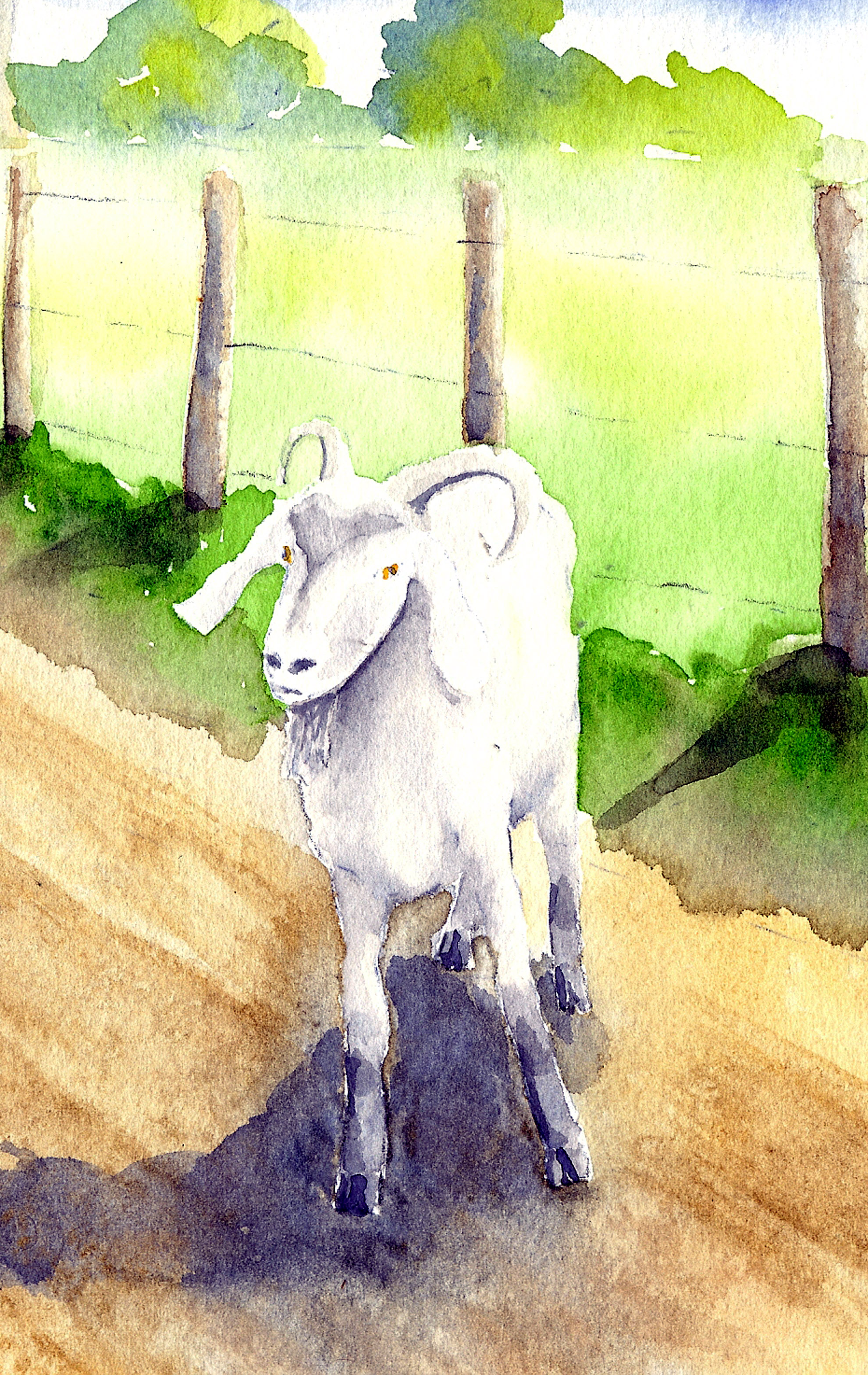
goatI met a goat on the road today. He approached from the opposite direction, running at a steady but moderate pace—not a gallop but more of a trot. It seemed about the same speed as my car had reached, as fast as I felt like driving on a hot August morning when a faster speed would have generated billowing plumes of dust from the powder dry land. He ran in a straight line along the roadway, his intention of uninterrupted travel quite apparent in his demeanor. He needed to be somewhere.

He was a small goat, not exactly a Nubian or Toggenberg but of some mixed breed, with a confidence attesting that in spite of his lesser size, he was most assuredly full grown. His foot-long horns flared from the top of his head up past his ears and off to each side of his black-marked face. The only other markings on his white body were on his legs, black from the knee down. His body held the features of a potent male, well-muscled in the chest and shoulders, his sides curved in health.

As it happened, we took the wrong sides of the road as we approached each other. He seemed to favor the right side of the road and I did not find it necessary to confront him about it. No doubt he had skipped the part of driving lessons that taught the proper side of road, but then perhaps not, since he was a goat and goats have their own firm opinions about what they will and won’t do at any given moment in time, rules be damned

We considered each other with curiosity as we slowed in meeting, a greeting and courtesy that, on reflection, I concede should not be limited to human travelers. His gold-flecked eyes came directly to mine, the black pupil slits narrowed against the sun already brilliant in the hot sky. It was not a hostile exchange, since I was quite willing for him to go on about his urgent business that called to him from somewhere to the west. For myself, I was already late for business to the east.

His expression conveyed a world weary understanding that we all have places we must go, or return to, in the course of conducting our daily affairs. It was not immediately clear whether he was coming or going, but then neither was that really any of my concern. His gold-eyed appraisal was brief and to the point, whether I was someone he knew, whether I meant him any trouble, whether I had any rolled oats he might nibble before continuing on his way. In moments, he gained the answers to his queries and began to move on.

Likewise, my glance carried questions. Was he seeking assistance? Was there any trouble? Was there anything I should do? No, it was clear nothing was required of me. His flat black nose lifted slightly, a nod of acknowledgment which I returned before thinking that I was, in fact, conversing with a goat.

I eased my foot off the brake and the car rolled eastward, tires crunching on the hot gravel. He hurried on without a backward glance which I knew only because I gave a backward glance in my rearview mirror. I did not ponder whether a goat, like fabled dogs and a few cats, might travel to find a family that moved on without him, or whether, once moved to quarters not exactly to his likely, he might make his escape and return to his preferred location.

Those were questions not to be answered unless I followed him. If I followed, as if examining a quark, I would have altered our original trajectories.

~~~

I’m wondering if this is a common occurrence–have you ever met a goat on the road?

One of twenty delightful essays about life on an Ozark hilltop, with watercolor illustrations. I Met A Goat On The Road: and other stories of life on this hill is available as e-book or in paperback.

A Rat’s Ass

Rattus_norvegicus_1Last night, my faithful yellow cat Mao brought me a late supper of Rat. He’s generous that way, concerned that my regular offerings of crunchies and delectable leftovers not go without reciprocation. And unlike some ungrateful cat owners, I accept his offerings with praise, petting, and a token nudge at the critter before turning off the light and trying to get back to sleep.

As usual, Mao became slightly perturbed that I didn’t actually taste his hard-won offering. I admit it’s rude not to appreciate the no-doubt rich flavor of a fine, plump, mostly grown Rattus norvegicus. He resorted to his usual tactic, which was to continue with his breathy purring and occasional trills while tossing the rat across my throw rug and otherwise demonstrating its near-life status in order to tempt my appetite. Eating small mammals while still technically alive is a code among cat-kind and he must think me thick-headed not to take advantage of such a careful presentation.

Sometimes this last flurry of playing with the food results in escapes that require human intervention, such as opening the closet door under which the frenzied furry thing wriggled away or otherwise facilitating the rediscovery of prey. Mostly, Mao is far too skilled to allow real escape. However, he does encourage fake escapes so that the fleeting thrill of capture can be enjoyed multiple times with any given victim.

The half-grown rabbit he brought in a couple of weeks ago managed to escape and get re-caught countless times over what seemed a period of hours. Sleep became a fiction of half-dreams punctuated by shrill bunny screams. It was a relief when the inevitable crunching of skull broke the wee hour silence.

They always start with the head.

Conceding to the gentle reader’s possible horror at these goings-on, allow me to explain that I live in the Ozark woods where Nature exhibits her ruthless beauty on a daily basis. In spite of forty years of living here, always in company of cats and various other domesticated creatures, there has been no diminution of birds or small mammals. I’ve learned to respect the flow of things and step aside for the ways of everything from snakes to ground hornets to the occasional bear. And cats.

Mao came to me as an injured feral stray who even now tolerates contact with few humans besides me and who goes completely nuts when put into a cat carrier. When he appeared at my front steps, he’d been shot. The wounds had mostly healed, but one area on his left shoulder kept abscessing. Over a period of months, I fed him and watched his wounds fester then drain in a desperate cycle that increasingly weakened him until even my tempting roast chicken failed to put much meat on his bones.

I lured him to a cage and the vet discovered a dozen BB-sized pellets lodged in his body, some of which remain ten years later. But the shoulder injury that kept him on death’s door responded to treatment, which involved me locking him in a spare bathroom for ten days in order to visit him twice a day with antibiotics. He literally climbed the walls in that room. Closed doors remain cause for terror.

The vet estimated his age at about one year at the time of his capture. Who am I to get between this cat and the means of survival he learned living alone in the woods? More than most cats, his hunting is part of his life. There’s no shortage of prey. He brings me gifts, heralding his delivery as soon as he hits the pet door. I thank him.

The rat had already succumbed to unconsciousness by the time Mao woke me to announce that the food order had arrived. In order to preserve the relatively unstained state of my new bedside rug, I subtly dragged the senseless limp rat body several feet away. Mao promptly brought it back. I haven’t figured out if the attraction to my bedside rug is based in its proximity to my sleeping body, or if it has to do with the textural similarities between a natural land surface and a rug. But after four futile attempts to relocate this particular feast to the easily-mopped surfaces nearby, I gave up and let Mao have his way.

It took him quite some time to dispose of the rat, due in part to my inconsiderate lack of interest in a meal meant for two. I found a tiny bundle of leftovers this morning, the gall bladder and the skin and tail of the rat’s hindquarters. This phenomena continues to intrigue me, as all cats who have ever patrolled my woodland property and delivered rats to my bedside have left the rat’s ass on the floor. All other creatures are consumed in their entirety, every last bit of fur, nails, feet, and tails of rabbits, moles, voles, and squirrels. But not the rear ends of rats. Quel mysterieux!

I’ve provided the image of last night’s leftovers in order to share Mao’s impressive abilities. The hide of the hindquarters is turned inside-out with tail and foot protruding so that the hip meat could be consumed without touching the anal region. Meticulous butchery, to say the least. I’ve written about this before, my conviction that this particular eccentricity in the cat-rat dynamic is the basis of the old saying that someone wouldn’t give a rat’s ass.

IMG_20140525_144332_899


Lingering Winter

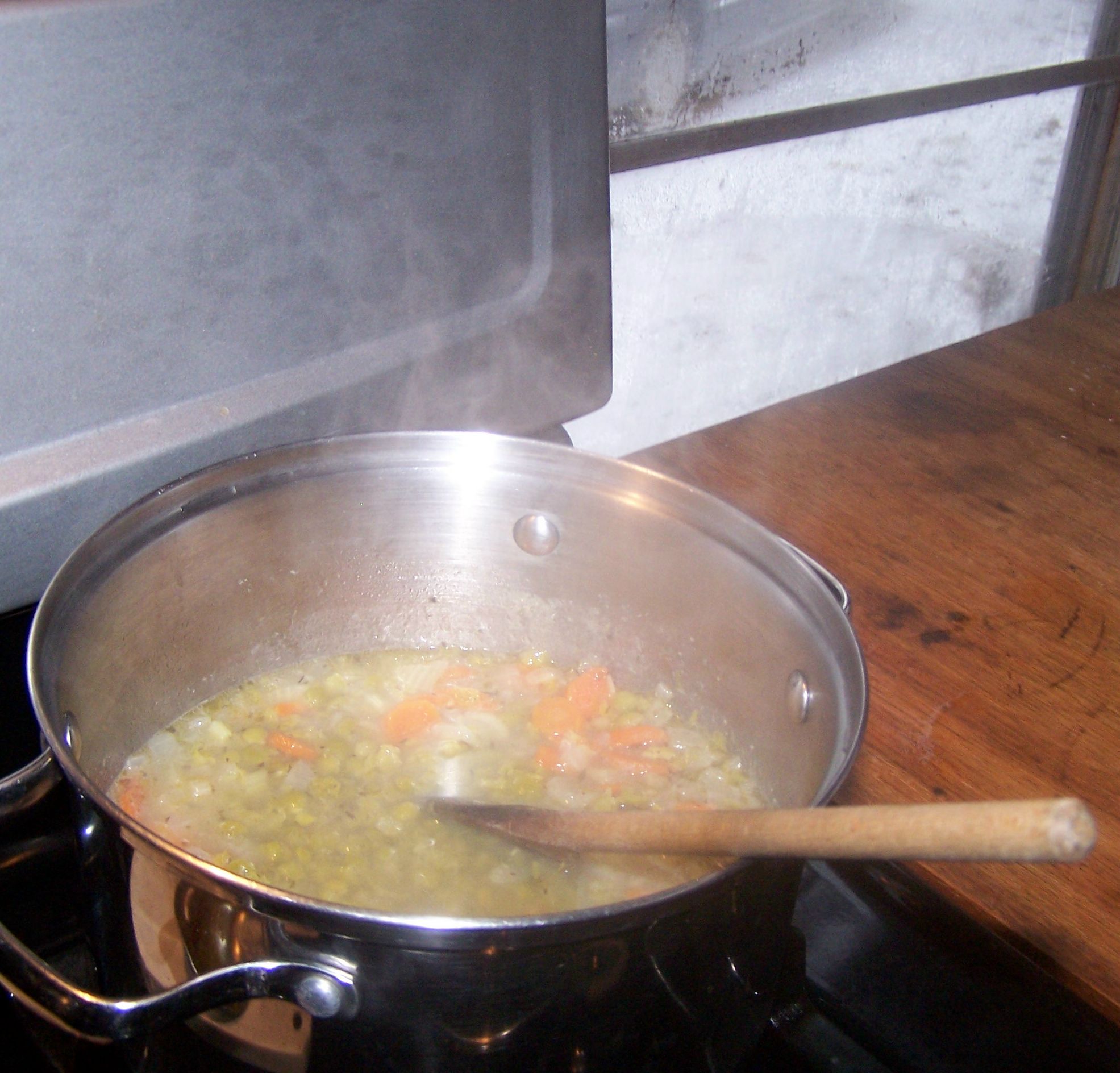
soupAroma thick with thyme and marjoram steams from the simmering split pea soup. I’ve enjoyed the whole process—chopping onion, celery, and carrot, measuring the spices and selecting the bay leaves, stirring until the soupy mass starts to bubble and boil. More condensation to collect on the window panes where sleet bounces and taps it rhythm against the other side.

There’ll be no venturing out today. The roads are slick with ice. Time to relax and accept what the Mother has in store, a lingering blast of winter with all its gifts of cold and white. Wind whistling at the chimney where smoke of my wood fire plumes sideways. Time to muse on past winter days when fire blazed hot and pan lids jiggled, when my gaze settled on the distance and roamed over the years of my life.

Memories of winter’s challenges rise up to nourish me on these days, recollections of times when hardships were met and I was satisfied with my refuge, my larder, my conquest of the elements. In more distant times, I might have twisted strands of wool or linen and watched the wheel spin it to thread, or pounded clothes in a hot kettle for cleaning, or ground corn between stones to make coarse bread. I might have wrapped my children in animal skins and tied my own feet in fur before braving the cold for more wood, or brought the livestock into the other end of a rough cabin to keep them from freezing in the long nights.

How did I, of all my previous iterations, manage to occur here, now, where everything I need comes more or less effortlessly—the twist of a knob, click of a button, the turn of a key? A house with insulated walls and thick glass that keep in the warmth and allow me to watch frozen rain fall from gray-white clouds. What future embodiments of myself will wonder back on this time and what will they know? What I don’t know. What I can imagine for better. Or worse.

I don’t have to figure it out. Anyway, I can’t. Better to turn to the pan and stir the soup, add another log to the fire, stand at the window longer and marvel at the shades of gray and rust among the trees of the woods, the white of the sky and ground. Soon the scene will explode in infinite shades of green and heat will soak the edges. I’ll be pleased then to remember this cold.

Cities

Gloucester Road at dusk, Wanchai district, Hong Kong 0001

The cities glitter like jewels in the night. Towers encrusted in light and streams of red and white define the expanse where only tamed hills and water courses interrupt the hand of man. An artificial world with token trees and ornamental gardens, no food grows here, no herds of deer or buffalo. No cliffs or caves for shelter, no flowing springs.

But most of us live here, packed into tiny rooms in concrete buildings or houses set side by side, our feet traveling over pavement as we hurry from place to place. Like metal filings magnetically drawn to a cluster, we gather under a force we can’t change, the force of commerce, trade, collaboration.

Only hermits, cowboys, farmers, and ramblers populate the open land, understand the smell of approaching rain and how it waters the crops, the cattle, upon which the cities wholly depend.