A Year Later — Justin Harris

harris

Last year I blogged about a “State of Perversion” in Arkansas. The news broke with a sensational expose by the Arkansas Times on our local state representative Justin Harris. Now a year from his outing, this seems an appropriate time to check on how far we’ve come. (Or haven’t.)

Here, in part, is what I wrote:

“Justin Harris is serving his third term in the Arkansas Legislature where he has introduced conservative measures ranging from abortion restriction to denying funding to the state’s department of human services under the campaign promise to reduce government spending. He and his wife own and operate a preschool in his legislative district town of West Fork, a largely rural constituency with a high percentage of fundamentalist church followers. Alongside the alphabet and fingerpainting, Mr. Harris’ school teaches religion.

  • UPDATE: Since the scandal broke, Mr. Harris announced he would not run for another term. However, he refused to resign, meaning he continues to serve at the state capitol until January 2017. Even more disgusting has been the utter and abject failure of any Republican legislator to criticize Mr. Harris.

“In 2012, Harris found himself on the hot seat after a formal complaint was filed by Americans United for Separation of Church and State. Seems Mr. No Government Funding had his hand in the public till by obtaining grant funding for his preschool. Over a million dollars had flowed into his coffers, courtesy of a state agency charged with providing tax monies in support of preschools that addressed the needs of ‘underserved’ youth…

“Mr. Harris mounted a vigorous and outraged defense of his right to all that money. He brought in a team of attorneys from Arizona who specialized in defending schools who want to teach Jesus on the public dime. Subsequently, the ABC program promulgated a set of rules specifically addressing the issue of religious instruction. It is unknown whether the ‘solution’ was put forth by the Arizona attorneys, modeled on rules operating in other states, or sprang from a singular Arkansas process, but the novel approach defines an ‘ABC day’ as a set number of hours of purely secular instruction. Whether religious instruction occurs before the ABC day commences or after it ends would not be the state’s concern.

“Since then, Mr. Harris has expanded his operation and state funding approaches a million dollars annually. His students arrive as early as 7:30 a.m. and leave as late as 6 p.m. The ABC day begins at 9 and lasts until 3. Before and after, it’s all about Jesus.

  • UPDATE: An exchange of information with Americans United for Separation of Church and State reveals that under current federal guidelines, states can use tax dollars in this way. Apparently there’s no compelling interest in establishing a viability test where a school would have to prove that its religious instruction could exist separately without the use of tax dollars. In the case of the Harris school, if tax dollars didn’t support the rent, utilities, and salaries for operations, the school would cease to exist. Repeated questioning of DHS money managers produced zero interest in developing or implementing such a test.
  • Likewise, we can hardly expect much interest for reform among current members of Congress who quake in fear of the Religious Right. Closing a loophole that recruits so many young minds to their way of thinking is simply not to be considered even if that loophole stands in clear violation of the U. S. Constitution.

“Soon after the flap over school funding, the Harrises…decided to adopt little three girls whose dysfunctional family had lost custody. The girls were fairly well adjusted in a foster home, but the natural mother allegedly made a personal plea to Justin Harris. This arguably admirable effort left many to question Harris’ quick use of the girls in a family portrait promoting his re-election campaign (a violation of adoption policy), the nearly $30,000 tax break that came with the adoption, and the monthly stipend allotted to Harris in the form of state support. Clearly, the adoption wasn’t all about benevolence.

“Firmly fixated on the adoption idea, the Harrises refused to listen to DHS field agents who reported that the girls would not be suitable in the Harris household. With all the arrogance befitting a person who believed God directed his acts, Harris apparently used his elected office to pressure DHS to approve the adoption. Local caseworkers opposed to the adoption mysteriously changed their recommendation after their boss advocated on the Harris’ behalf. That Justin Harris held a powerful position in the legislative committee which controlled DHS funding seems never to have been examined as a possible contributor to this department head’s advocacy, which resulted in a local juvenile court judge granting the adoption. Unfortunately, because the case involves adoption, DHS has not released any information.”

  • UPDATE: Unfortunately, nothing is known to have changed regarding inappropriate legislator influence over DHS activities. But the incident does reveal the ugly underbelly of an organized evangelical movement to adopt children. The objective is two-fold: provide a viable argument against abortion rights for women and brainwash vulnerable youngsters to extremist religious views.

“Within a year, the Harrises decided to ‘rehome’ the girls to another family. By early 2014, one of the girls had been raped by her new ‘father,’ Eric Cameron Francis. Later that year, Francis would be convicted of multiple counts of child abuse and is currently serving time. As it turns out, Francis had been an employee at the Harris preschool and his wife was good friends with Mrs. Harris. Not surprisingly, Harris chose to stay quiet about his role in placing the victim in the Francis home until a reporter from the Arkansas Times connected the dots. The story went public in March 2015.

“When the adoption/rehoming scandal broke, Harris held a press conference as reported by the Arkansas Times. He presented himself and his family as the damaged party.

“…He said one of the girls — the implication was the middle sister — had to be medicated to stop hurting her sister, and that he was advised by therapists to treat her RAD [Reactive Attachment Disorder] by removing toys and other belongings from her room.

  • UPDATE: Harris never publicly accepted responsibility for the harm inflicted on these girls. While his initial reaction seemed to portray him and his wife as the aggrieved parties, his last public statement on the issue included a comment to the effect that he felt sad about what happened to the girls…as if he personally had nothing to do with it.
  • ABC News produced a close-up on the Harris adoption scandal. The report failed to address the ignored caseworker input and accepted at face value the excuse of Reactive Attachment Disorder. In response, a statement from a collective of mental health professionals criticized the ABC report and refuted RAD as a legitimate diagnosis.
  • On a more promising note, however, the girls are reportedly well adjusted in their new post-Harris adoptive home. And newly-elected Governor Asa Hutchinson saw fit to accept the resignation of the head of DHS and has hired a new person to fill this slot. He has also instigated a complete revamping of the department.

“Harris said he sought DHS assistance at that time but was given none. He said he thought he’d found the ‘perfect solution’ in handing the girls over to…Eric Cameron Francis. Eric Francis is serving 40 years in prison on charges of raping the child.”

  • UPDATE: Justin Harris has continued to hire questionable employees to care for the vulnerable young children attending his preschool. A school bus driver failed to notice that a child remained on the bus. The child was not discovered until early afternoon. Fortunately, the temperature remained fairly mild that day and the van was parked in the shade. The child suffered no ill effects. Nevertheless, the driver was prosecuted. The Harrises fired the driver immediately upon discovery of the incident and accepted no responsibility even though the school failed to abide by its own protocols in checking attendance which would have discovered the missing child.
  • Additionally, word has leaked out that another male employee was fired in December 2015 for inappropriate contact with the students. Seems the Harrises might need to employ better screening methods for prospective employees other than learning whether the candidate regularly attends church.

“Within a month of the revelation that Arkansas DHS had no rule or restriction on the rehoming of adopted children, the state legislature passed a law making rehoming a felony. Harris voted for the bill, in essence making himself a retroactive felon. He resigned from the chairmanship of the public health committee, but failed to yield his legislative seat. He has also refused to accept any responsibility for the little girl’s sexual abuse. At the peak of this fiasco, his school billboard proclaimed that ‘God Himself will fight for you. Just stay calm.’”

  • UPDATE: Happily for all of us in South Washington County who must drive past the Harris pre-school on a daily basis, the school’s outside billboard has remained empty of Godly exhortations since the beginning of the 2015-16 school year, with the exception of a brief period during Christmas.

“Throughout the intense scrutiny on Harris and his failure as an adoptive parent, a considerable body of information has come to light about ongoing religious activities at his preschool. Although random spot inspections by the state theoretically rule out the chance of illegal religious activity during the ‘ABC day,’ reports from former teachers and others allege that children who misbehave are routinely taken to the office where they are prayed over to ‘cast out demons…’

  • UPDATE: There’s been no official (or unofficial) statement from any elected leader or state agency on the use of prayer to cast demons out of misbehaving youngsters. Why would it be so difficult to issue a blanket policy statement about the negative impact on young minds of promoting the belief that demons might inhabit a person or that such demons, rather than oneself, is the party responsible for misbehavior?

“…While firmly denying funding to DHS based on his campaign promise to reduce government spending, Mr. Harris (as legislator) fought for government handouts to fund his religious school in spite of the fact that he knew he was breaking the law by teaching religion in a tax-supported program. As an elected person who held himself up as an example of Christian righteousness, he should have been the first person to recognize he was crossing the line between church and state as delineated in the U. S. Constitution. Instead, assuming he understood the thrust of the Founding Fathers’ intent, he no doubt privately justified his behavior with his belief that God willed it…

“This kind of simplistic medieval thinking lies behind the ability of political handlers to capture votes from the evangelical demographic. The compelling argument is that demons rule the ‘other’ party, that gay marriage, abortion, and other private activities are the proper province of political action, and only by voting for Mr. Righteous can we satisfy the will of God.

“There are many features of modern life that scare the hell out of those who simply cannot understand science or other changes increasingly widespread in the world. Our technology and culture have evolved faster than our mental or physical state. Everything is too fast and too complicated. It’s only been a hundred years since picking peas and saddling a horse served as the requisite skill set to get through life.

  • UPDATE: Which brings us to the candidacy of Donald Trump. Although no one would claim that Trump is a model of evangelical righteousness, he embodies another characteristic evidently more important to the religious right: the ability to dominate. Of almost equal importance is Trump’s wealth, which evangelicals view as God’s gift to a righteous man.
  • Just as the religious right’s concept of a Supreme Being embodies power and arrogance, so does Trump. By reflecting back the anger, fear, and blind hatred toward those unlike themselves, Trump approaches the brink of gaining the Republican nomination for president. The collusion of willful ignorance and the result of years of religious education (versus education based on logic and fact) now stands before us.

One final encouraging note: Justin and Marsha Harris’ West Fork home is up for sale. It may be asking too much, but one can hope that at least this one preschool operation will be taken over by an educator, not another evangelist, and that the children there will learn rational thought along with their ABCs.

Finally, we’re pleased to note that Mr. Harris earned the top ‘dick’ award for 2015.

Coming soon…an update on the Duggar family’s equally outrageous 2015.

 

Thoughts on Women (Candidates)

Marina-Bychkova-20
Popular dolls created by Russian-Canadian artist Marina Bychkova feature a female with pubescent breasts and childlike eyes and body. While Bychkova intends to reflect her thoughts on “numerous social issues and aspects of our humanity” with her dolls, they instead portray the intensely conflicted self-identity of the modern woman.

In the current political situation where we find ourselves confronted with a viable female candidate for the presidency, questions about women’s real status in the United States have bubbled to the surface. On first glance, criticisms about Hillary Clinton seem substantial. The beleaguered emails, for example. That she doesn’t verbalize her ‘message’ as well as Bernie. But while conservatives and Bernie fans alike point to this and other purported deficiencies, there’s little comparable discussion of male candidates’ shortcomings.

Despite the advances in women’s rights, the fact remains that many take a dim view of women who dare to step out of their traditional roles as supplicants, mothers, and helpmates. If she speaks loudly, she’s shrill and aggressive. If she presents her life experience, she’s bragging or exaggerating. But my topic isn’t Hillary or the fact that she’s the most qualified candidate in the field and that she is, without doubt, experiencing a pernicious assault.

It’s my view that the impetus behind this assault is that she is a woman. My topic is the status of women in our culture today.

Women assume they want respect, equal pay, and an independent, self-confident lifestyle. But if you look around, you see women appearing in public as giddy waifs. Hairstyles blind them. Skirts hobble them. Shoes produce a helpless stagger. I’m not the first to weigh in on the regular absurdities of women’s fashion and I readily agree that not all women buy into the fashion parade. It’s largely younger women eager to emphasize sexual allure in competition for male attention. But it’s also largely younger women who despise Hillary Clinton for reasons they can’t fully explain.

For women not comfortable with themselves or with their confused role in our culture, Hillary is a threat. As women have invaded the workplace and other venues previously occupied by males, many are driven by a need to demonstrate submissiveness. Hillary isn’t submissive.

Uneasy with the gender dynamic, women dress in crippling shoes while peering through the hair in their eyes to say, “Okay, I’m working here beside you, but I’m a helpless little thing.” <giggle>

Recently I read an article arguing that we live in a pedophile culture. The author angrily postulated that the ongoing incidence of pedophilia is perpetuated by male demands that women look like little girls in order to be sexually attractive. In other words, men really want pubescent girls and reward females who fill those expectations. To meet the demand, women starve themselves and remove body hair in order to satisfy male expectation.[1]

This attitude is part of the problem. Men are not in control of what we wear or whether we shave our legs.

I’ll just quickly point out that until a hundred years ago, men were expected to marry much younger females because (a) until at least age thirty, men had not established enough of a livelihood or home base to support a wife and inevitable family, and (b) by age fifteen (onset of puberty), women were considered ripe for marriage and their parents were eager to marry them off.

This tradition of the much older man pairing with a much younger woman goes back at least to Greece and Rome where a fifteen to twenty year difference in age between the bride and groom was the norm. I could argue that this longstanding cultural pattern has created a behavior bias sublimated in countless subtle social clues and which contributes to the tendency for women to emphasize their youthful appearance and for men to desire women who appear young.

Underlying this long-established pattern is the assumption that the youthful female is a virgin, thus assuring the male that any offspring are unquestionably his.

Well, hello. We have birth control. We have genetic testing to determine paternity. The population of our ‘tribe’ isn’t suffering, so women are no longer valued as brood mares tasked with producing a team of farm workers or warriors. In theory, our increasingly sophisticated culture places more value on qualities of men and women besides their ability to produce offspring.

The author of that article mistakenly assumes that men’s desires determine how women present themselves. I disagree. Are men excited by women peering through locks of hair? Does a female staggering in four inch heels trigger male lust?  Can’t men become sexually aroused by women devoid of all the mascara, push-up bras, and pencil skirts?

Fashions are adopted and sustained by women. Yes, we might agree that men expect it. But I’d be willing to wager that men won’t stop wanting sex no matter how women look. After all, some men have sex with blow-up dolls, less-than-lovely prostitutes, and even the random sheep.

It’s the competition among females that creates this false world of absurd fashion. Tighter skirts and higher heels allow a woman to say “Look at me, not that homely bitch over there.”

It’s a pedophile culture if women make it that way. If they identify with images like the Enchanted Dolls created by Bychkova or even with the more developed waif doll Barbie.

One would think that as the female has gained the right to vote, own property, become educated, participate in the business world, and yes, run for president, she has also realized that hooking up with a man doesn’t have to be her only role in life. But there are two big stumbling blocks to that realization. One is that many women have no ambition but to have babies and be a housewife. I’ll go out on a limb here and postulate that this particular point of view is shared by more than half the female population. Maybe they’re hewing to the course embraced by their mothers and grandmothers. Maybe they see great importance in creating family.

Maybe they’re selectively evolved to do little but breed.

The other stumbling block to women’s real independence is that men have become less empowered. It’s as if without women in subjugation, men don’t quite know how to act. Women who exhibit the logical end stages of independence (i.e. Hillary) create too much cognitive dissonance for large segments of the population. Rushing into the void is an onslaught of scandals, ‘lies,’ and mistrust to help explain an otherwise illogical revulsion.

Confusion incited by these shifts in surface gender norms leads to interesting activities. Not only are women unwittingly compromising their independence through restrictive fashions, they are fantasizing about the good old days. For example, consider the wildly popular “Fifty Shades of Gray” in which a simpering virgin claims a perverse billionaire’s heart by accepting his need to dominate her. That he eventually backs off the whips and chains to a lesser degree of domination undercuts the point. He’s the power figure. Their relationship works because she accepts his need for control and because he loves her so much he’s willing to give up something he enjoys. Kind of.

Probably aside from the author’s intent, the story serves as a metaphor for the conflicted state of male-female relations in our modern age. Is it the Darwinian fate of the sexes that women will always crave the powerful male who slams her against the wall and has his way with her? Are women hardwired to look for warrior males because at one time such men were her only protection?

If the lucrative romance literature market serves as any measure of what women want, the answer is a resounding ‘yes.’

Beneath that thriving fictional world, however, is the reality that women today often share with their male partner the responsibility for child care, house care, and earning income. They may initiate sex or take a dominant role in sex play. Those pesky surface gender norms require they be partners in a complex relationship that is both rewarding and exhausting.

What a relief then to pick up a novel that wipes away all the modern obligations and allows her to cavort, however fantastically, in a highly charged romance where all responsibility has been removed, where the perfect male anticipates her every need and forces her to accept what is best for her. Where she is perpetually a teary-eyed, childishly innocent creature in need of male support.

It’s worth remembering that marriage is still considered the greatest accomplishment in a woman’s life.

These undercurrents that drive women to take on submissive appearance and to flock to entertainment that enshrines submission may in fact tell us something about the unliberated psyche of today’s women. It bears consideration that many women may remain hardwired to a primal pattern of submission that doesn’t go away just because of birth control pills and the right to vote.

The behaviors exhibited by a powerful woman like Hillary strike many of us as foreign and even unnatural. Women who are able to move beyond instinctive gender roles and compete with men for the most powerful positions of business and politics trigger suspicion and dislike. In the hearts and minds of many who have yet to recognize their own inner biases, she is not to be trusted.


[1] http://www.feministcurrent.com/2015/09/28/youve-heard-of-rape-culture-but-have-you-heard-of-pedophile-culture/

First, We’re Democrats

peace-flag-at-antiwar-protest-P

An emerging narrative from Bernie supporters alleges that the Baby Boomer generation ‘shit all over’ the younger folks and now it’s time for us to step out of the way. The militant rhetoric evidently serves as a potent recruiting tool. Too bad it’s completely bogus.

Yes, there are some of the Sixties generation who tuned in, turned on, and then made a U-turn in the middle of Main Street to become some of the greediest, most soulless people on the planet. But a few rotten apples did not spoil the whole barrel. The rest of us accomplished amazing things for which we have yet to receive any credit.

To you newbies dissing the Boomers, shut the f*** up and think about this: that yoga meditation that you enjoy? We brought you that. Your baby delivered by a midwife? We gave you that. Those organic salad greens you just bought at your local supermarket? Yeah, us.

The reason you male members of the Bernie True Believers haven’t been drafted and sent to the Middle East with a rifle in your hand is that we forced an end to the draft. We were the generation that lost nearly sixty thousand of our brothers and lovers in Vietnam and spilled our own blood in the streets to make it stop.

You female members of the Bernie True Believers are empowered to be out there on the streets with your political action groups largely because we burned our bras and filled university and government buildings with our sit-ins demanding equal pay and equal rights. We didn’t settle for an apron and dust mop. We elbowed our way into the mainstream.

We pushed our reproductive agenda and got a Supreme Court ruling legalizing abortion. We celebrated our freedom to choose with new technology like birth control pills, so that whatever child was born was a wanted child. We pushed aside the obstetricians with their convenient forceps deliveries and anesthetized mothers and birthed our babies into darkened rooms where the fathers were part of the experience. You were floated in warm baths and held to our breasts in a revolution of childbirth every bit as radical as any Bernie slogan.

We demanded clean food free of pesticides and additives and organized our own food cooperatives. We trucked in hard-to-find organic produce and flour. Many of us went back to the land to raise organic beef and grow our own gardens where our children could eat fresh peas straight off the vine.

We cast aside centuries of misogynist religion to embrace the greater spiritual power of the Universe. Did you think your yoga studio appeared out of the Fifties like Athena sprang from the forehead of Zeus? No—we traveled to India. We read the books. We followed the gurus in order to reframe our embrace of the Divine.

We shared our dorm rooms, our jobs, and our farms with gay men and lesbians, strenghtened their public arrival with our acceptance in spite of the brutality that they encountered in the rest of society. We opened our homes to African Americans and other minorities and joined in their protests. We saw all people as our kinsmen.

We are the reason you can access acupuncture and Asian medicine, holistic practitioners, therapeutic massage, and the proliferation of alternative medicines that spread before you today like a feast-laden table. We sought out health in a world filled with sickness, in world where ‘medicine’ fulfilled all we knew about healing.

We took our children to protests, meetings, and hearings. You played outside in the sunshine while we stuffed envelopes and called friends. We changed the world without social media or computers.

We sacrificed days, weeks, even years of our lives in the fight to save our forests and oceans, our waterways and air from pollution. We fought for the whales and the wolves. We wrote letters, stood in cold wind and glaring sun with our signs, took up residence in trees. The environmental protection you may take for granted came about because of us.

We had help from older generations. Some of them fought to the end just like us. We’re still fighting. Many Baby Boomers are active in Bernie’s campaign.

Whatever disconnect exists between what the Boomers accomplished and the platform from which you launch your tirade is not because the Boomers failed. The disconnect derives from the same power brokers who manipulate every new generation into following certain paths. We called it The Man, The Machine. Their message? If you want the new car, the nice house, all the toys, then you’ll toe the line. Pass the drug tests. Conform.

The history of any war is written by the victors. In the still-simmering culture wars, the corporations want you to see us as the enemy. You have to dig deep to uncover the fullness of what I’ve said here in a few words. You want to change the world? Join the club.

Just keep in mind that because Bernie says all the right things doesn’t mean he’ll lead you to victory. Maybe you’ve never heard about our work for McGovern, walking door to door, keeping faith that we could usher in a New Age. In 1968, we never saw Daly’s henchmen coming or the disaster that would befall the Democrats as a result of that convention. We didn’t anticipate the backlash, all the haters and religionists ready to answer the clarion call of the corporate machine. We invested our future in the hope and change promised by Democrats and watched in horror as Richard Nixon won two terms.

Maybe you never understood what happened to our next great hope, Jimmy Carter. It’s instructive to review how he lost to Ronald Reagan:

  • Carter later wrote that the most intense and mounting opposition to his policies came from the liberal wing of the Democratic Party, which he attributed to Ted Kennedy’s ambition to replace him as president. Kennedy surprised his supporters by running a weak campaign, and Carter won most of the primaries and secured renomination. However, Kennedy had mobilized the liberal wing of the Democratic Party, which gave Carter weak support in the fall election. (Wiki)

Or the loss of Al Gore not because George W. Bush was such a stunning candidate, but because the Democratic left wing blindly flew to support Ralph Nader and his pie in the sky oblivious to the very real possibility that by splitting the progressive vote, a Republican would win. Perhaps some of this language will sound familiar to Bernie fans:

  • Nader’s campaign rejected both parties as institutions dominated by corporate interests, stating that Al Gore and George W. Bush were “Tweedledee and Tweedledum.” A long list of notable celebrities spoke [in his favor]. The campaign also had some prominent union help… (Wiki)

FYI, that could happen again. All the visceral emotion you’re feeling now about us, about Hillary as our ‘representative,’ you’re feeling that for more reasons than you may realize. For over two decades it’s been the Republican end game against a woman they’ve always known could be a successful president.

If their first-wave tactics work, you’ll bring Bernie a successful nomination. Then they’ll begin their second wave, this time against Bernie: Socialism. Higher Taxes. Universal Healthcare. Lions, tigers and bears, oh my! In November, a Republican candidate will win.

You may live in a bubble where pot is legal, polyamory is accepted, and social progress is a straight line from here to there, but you haven’t faced the reality that 70% of the population still identifies as Christian. A third of those folks are evangelical, meaning they will show up and they will vote no matter what you do. They are the active force behind the Republicans, agitated and directed by the corporate money masters.

Your disdain for the Baby Boomers is the result of their careful plan. You like Bernie? So do I. Want to make him president? Go for it. Just keep in mind that if Hillary wins the Democratic nomination, you’ll have a choice. If the Machine is successful, you’ll be so angry at the Boomer generation and Hillary in particular, you’ll not vote for anyone but Bernie.

By indulging your cleverly fomented rage and refusing to support a Democratic candidate other than Bernie, you will play right into the hands of the machine. Another Nixon-Reagan-Bush waits in the wings.

So cultivate your anger with knowledge. Wake up to the real history of the Boomer generation. We had big hopes too. But just because all our goals weren’t completely met doesn’t mean we’ve failed. We’ve moved the ball forward. We welcome you to the fight.

But don’t forget–we’re not the enemy.

Writing About Music

Forestwander.com

Writing music.

In words.

Is simply not possible.

I tried. In my first published book, Notes of a Piano Tuner, I wanted desperately to convey the thrill of hearing a certain piece of music played on a freshly tuned piano. Everything about that time and place added to the intensity of those few bars—an old wooden church house twenty miles out a dirt road in the Arkansas Ozarks, an old upright piano that had somehow survived a century of use to remain remarkably musical, and a rainy late spring afternoon. As the storm front moved on to the east, a green cast permeated the outside air. A wasp buzzed against the nearby window, one of those tall narrow windows with watery glass common in old churches where they needed the light but didn’t want congregants distracted by whatever went on outside.

Moist air carries sound waves better than dry air. The combination of moist air, the resonance of the old church, the magical ancient piano, and the harmonies of that particular music transcended anything I could say with words. The waves rolled up from the soundboard, bounced off the high church ceiling, and resonated through my chest like a physical force.

Well, it was a physical force.

My hair stood up. I got goosebumps.

There’s something about fourths and fifths that does it for me. And old hymns, which make full use of fourths and fifths. Simple, basic harmonies.

An acoustic physicist could probably explain it. The mathematics of tuning never quite penetrated my skull. My dad taught me to tune by ear. I didn’t want or need to understand that when a string produced a fundamental pitch, say the note ‘A,’ it also formed partials. Partials were, predictably, partial vibrations of the string which produce other pitches. So for the note ‘A’ vibrating along a single string, the partials also vibrated in tones of fourths, fifths, other octaves and so forth up into an entire overtone series.

For more than you ever wanted  to know about overtones, check out this article.

Complicated stuff and mostly irrelevant to a tuner who works by ear. My dad, I, and now my son understand these things internally.

To the point, the strings on the old upright in that church still created perfect overtones. As those chords rolled from my fingers, the overtones blended with the fundamental notes I played to create such a rich experience that I actually got tears in my eyes.

I wanted to share that. When I wrote that story, I tried to think of how to convey my experience. I considered writing the actual music on the page, but unless someone knew how to read music, that notation would mean nothing. I blathered on about feeling the effects of the music but that alone wouldn’t make someone’s hair stand up.

I ended up writing the words that accompany that particular sequence of music thinking that if someone heard the words, they would hear the music.

Well, maybe some did. But unfortunately, most readers evidently took the meaning of the words as the message I wanted to convey and never heard the music at all.

Wrong. Not even close. I didn’t want the message of the words to have anything to do with my story. The message of the words wasn’t my message. In fact, they were about as far from my intent as they could possibly be.

The words were “Amazing Grace, how sweet the sound,” etc. I wrote the entire first verse, because those were the notes, the harmonies, the chords and overtones of my experience.

As a result, a lot of readers of my book assumed that I had been ‘saved.’ That my awestruck experience resulting from that loaded afternoon had to do with finding God, getting religion, and all the rest of that stuff.

I’m sorry. That’s not what I meant. Not what I meant at all.

And it strikes me now that religion is a lot like that, all about the words without hearing the music.

Newborn Abuse — the latest atrocity in our war on drugs

gallery_nrm_1416863230-tiffany
Another story of government overreach.

In 2003, the federal government began requiring states to develop strategies to deal with drug-dependent newborns. This came in response to an increasing number of babies born with opioid dependence. The government’s concern directly reflects the rise in opioid addiction nationwide.

“The number of prescriptions for opioids (hydrocodone and oxycodone products) have escalated from around 76 million in 1991 to nearly 207 million in 2013, with the United States their biggest consumer globally, accounting for almost 100 percent of the world total for hydrocodone (e.g., Vicodin) and 81 percent for oxycodone (e.g., Percocet).”[1] Most recently, tightening availability of prescription opioids has shifted abusers to heroin, an early pharmaceutical derived from the opium poppy and grandfather of the modern ‘codone’ products. Heroin is cheaper and in most cases more available than the pharmaceuticals.

No matter what form, opioids pose a real threat of addiction for many users. According to Wikipedia, “opioid addiction and opioid dependence, sometimes classified together as an opioid use disorder, are medical conditions characterized by the compulsive use of opioids (e.g., morphineheroincodeine, oxycodonehydrocodone, etc.) in spite of consequences of continued use and the withdrawal syndrome that occurs when opioid use stops … The opioid dependence-withdrawal syndrome involves both psychological dependence and marked physical dependence upon opioid compounds. Opioid use disorders resulted in 51,000 deaths in 2013 up from 18,000 deaths in 1990.”[2]

It’s not like opioid-dependent pregnant women don’t know they’re sharing their addiction with their fetus. But like all addicts, these women are severely challenged in overcoming their need for the drug not only because of the nature of the drug but also because whatever led them to abuse drugs in the first place has not been addressed. After all, not everyone legitimately prescribed opiate drugs becomes an addict.

Within one to three days after birth, infants born addicted to opioids suffer neonatal abstinence syndrome (NAS). This withdrawal experience may require doctors to administer slowly decreasing doses of morphine or methadone to ease the process. Providing medical protocols to deal with this condition was the intent of the federal law.

Despite this initial specific focus on opioid withdrawal among newborns, states have begun implementing laws that target mothers who test positive for any illegal drug use. The National Institutes of Health agree that “Alcohol and other drugs used during pregnancy can also cause problems in the baby. Babies of mothers who use other addictive drugs (nicotine, amphetamines, barbiturates, cocaine, marijuana) may have long-term problems. However, there is no clear evidence of a neonatal abstinence syndrome for these drugs.”[3]

Notably, millions of American women have used and continue to use alcohol, marijuana, nicotine, and/or prescription drugs during pregnancy with no known ill effect to their offspring. Yet in many states, zealous, usually conservative lawmakers have seized on the situation as yet another way to attack illegal drug use. Newborns and mothers are profiled and drug tested without consent. Infants are separated from their mothers. Mothers are sent to jail.

The State of Arkansas is one of eighteen states which requires health care professionals to profile mothers and newborns to determine who should be drug tested. In 2014, Tennessee became the first state in the nation to pass a law allowing women to be charged with a crime if their babies are born with symptoms of drug withdrawal. Other states, such as Alabama and South Carolina, use interpretations of existing laws to prosecute pregnant women who use drugs.[4]

The potential penalties under Alabama law are especially stiff: one to 10 years in prison if a baby is exposed but suffers no ill effects; 10 to 20 years if a baby shows signs of exposure or harm; and 10 to 99 years if a baby dies.[5]

There is no known law which requires prosecution of fathers for their use of any substance which might have contributed to a newborn’s impairment.

The American College of Obstetricians and Gynecologists guidelines recommend that in cases where substance abuse is suspected, doctors use a separate form to seek consent for drug testing; women can opt out simply by not signing. These guidelines are widely ignored. In Arkansas, for example, if a health care provider or allied professional such as a social worker believe an infant might have been exposed to illegal substances in utero, a claim of probable cause meets the criteria of child abuse and federal laws protecting privacy don’t apply. Mothers are tested without consent and the case is turned over to authorities.

Such professionals employ a widely varying and undocumented set of criteria to identify newborns and mothers to be tested. Conspicuous symptoms such as premature delivery, low birth weight, seizures, fever, hyperactive reflexes, or rapid breathing are among the more obvious reasons to test the newborn. Yet hospitals also single out mothers who obtained little or no prenatal care even though this unfairly targets the poor or those who live far from medical facilities.

Persons who fit certain cultural stereotypes may also be at risk of greater scrutiny: compare the likelihood for suspicion of drug use in a young woman with dreadlocks and reeking of patchouli compared to that of a well-to-do woman with no counterculture identifiers. Racial profiling is also widespread in these cases as is suspicion of women who have engaged a midwife.

Aside from all the outrages involved in these policies, the fact is that they close the barn door after the horses are out. Once the child is born, whatever fetal harm might have occurred is already done. The rational approach would recognize that a few newborns may need intervention treatment and their mothers need access to counseling. End of story.

Instead, state lawmakers take whatever injury might have occurred to a fetus and explode that into the worst case scenario for the newborn infant by separating it from the mother—no cuddling at the breast for milk (one of NIH’s recommended treatments of NAS is breastfeeding), no mother’s heartbeat, no familiar voices. If we wanted to ensure that an already-challenged newborn suffer the greatest possible harm, we can rest assured that arrest of the mother fits the bill.

[I concede that in a very few cases, the mother’s behavior is so out of control that the infant is better off not in her custody. Very few.]

Legislators eager to punish mothers ignore the fact that the damage is already done. They justify punitive action in the belief that punishment serves as a deterrent. But—point of fact—if threat of punishment served as a deterrent, no one would use illegal drugs.

Marijuana use is not known to result in birth defects or NAS. One study even shows benefits to infants born to marijuana-using mothers.[6], [7] But according to a 12/18/15 report in the Arkansas Democrat-Gazette, of the 970 new Arkansas mothers referred to social services in 2014, 65% were for marijuana use.

Lawmakers also skim past the obvious hypocrisy in screening mothers only for illegal drugs when fetal alcohol syndrome has long been identified as a common cause of birth defects. Many of the distress symptoms in newborns can also result from the mother’s use of tobacco.

If punishment for theorized harm to the child is the state’s objective, then why aren’t alcohol and tobacco included in the screening? Why aren’t those mothers arrested and separated from the child?

I’ll tell you why. Because a driving purpose behind such laws is to punish mothers for illegal drug use.

If the real goal is to reduce the number of impaired newborns, a bureaucracy will need to be established which monitors all women of childbearing age with monthly testing for evidence of pregnancy. Once pregnant, women would be placed on 24-hour watch to ensure proper nutrition and adequate exercise. Prospective parents will undergo genetic testing  and embryos will be screened for congenital defects and aborted when appropriate. Controlled environments for gestating women will need to eliminate potential stressors such as spousal abuse and financial troubles. Any possibly harmful substances such as alcohol, tobacco, or illegal drugs would not be allowed.

Ah, brave new world with our Alphas and Epsilons.[8]

There’s nothing wrong with states supporting protocols by which medical professionals can more adequately address NAS in compromised newborns. But compromised newborns should not be used to indict the mothers for real or imagined crimes. There’s no proof that illegal substance abuse alone is the cause of a particular newborn’s problems. A majority of distressed and/or premature newborns come from poor mothers and/or mother who use alcohol and nicotine and/or mothers who don’t exercise or eat properly.

Keep in mind there’s no scientific evidence that an addicted newborn suffers subsequent permanent damage.[9], [10]

The rush to prosecute illegal substance-using mothers of newborns does not assure that their future pregnancies will produce perfect children. Nor, in most cases, does it provide any benefit to the child.

Are women now fetus delivery systems answerable to the state?

Proactive encouragement toward good health and responsible behavior is as far as a free society can go to ensure the best possible outcome in any life pursuit of its citizenry, including parenthood. This approach involves all those abhorrent liberal ideas like sex education in the public schools and easy access to birth control. Access to abortion. Clean air and water. Greater public understanding of proper nutrition. Excellent education. Good job training and job opportunities. Community clinics with affordable, high quality mental and physical health care.

If we want to decrease the American trend toward ever greater substance abuse, we need to take immediate steps to stop commercial advertising of prescription drugs. There is not and never will be a magic pill for most of life’s troubles even if these ads insinuate otherwise.

We need to reorient our medical community toward prevention instead of pharmaceuticals.

We need to devote more resources toward understanding the factors that contribute to substance abuse and addiction and address these problems at their roots: disenfranchisement, poverty, lack of opportunity, low self-worth, racism, mental illness.

Have we done this before rushing to prosecute mothers?

No.


Learn more and offer your help at http://www.advocatesforpregnantwomen.org/ 

[1] http://www.drugabuse.gov/about-nida/legislative-activities/testimony-to-congress/2015/americas-addiction-to-opioids-heroin-prescription-drug-abuse

[2] https://en.wikipedia.org/wiki/Opioid_addiction_and_dependence

[3] https://www.nlm.nih.gov/medlineplus/ency/article/007313.htm

[4] http://www.huffingtonpost.com/entry/pregnant-drugs-crime_5692ea9ee4b0cad15e653dd0?section=politics

[5] http://www.al.com/news/index.ssf/2015/09/covert_drug_tests_child_abuse.html

[6] http://www.ncbi.nlm.nih.gov/pubmed/1957518

[7] http://www.druglibrary.org/schaffer/hemp/medical/can-babies.htm

[8] https://en.wikipedia.org/wiki/Brave_New_World

[9] http://healthland.time.com/2012/05/01/number-of-babies-born-suffering-drug-withdrawal-triples/

[10] http://www.adoptivefamiliescircle.com/groups/topic/Baby_born_opiate_addicted&#8230;.terrified/

Shall We Pray?

A-Prayer-For-You

On any given day, my Facebook feed usually includes one or two prayer requests for sick or injured people. Or for a ridiculously premature infant. Or for someone on his death bed.

I can mostly ignore these random posts. But big events like the tornadoes and flooding of the past weekend bring on an avalanche of prayer requests. These in turn provoke me to rant. Hence, the following.

“Pray for Garland/Rowlett, Texas,” one post says. Pray for what? For God to wave a magic wand and restore everything to its condition before that big funnel cloud did its work? For all those newly homeless people to feel better about being homeless?

Everyone wants prayer, but exactly what the prayer is supposed to accomplish remains obscure.

Survivors of disasters often say God is good. It’s a blessing, they say. It could have been worse. Invariably there’s a wild-haired lady on the TV news saying “Praise God” even though her house is now a mile-long debris pile. None of this makes sense.

One must question the logic of thinking that the same God who invented cancer would somehow change His Mind and heal someone’s cancer because of prayer. If God has any power to answer prayers, God also has power to keep bad stuff from happening in the first place. What kind of ‘merciful’ God sits back, watches a tornado do its damage, then ‘hears’ prayers and decides what He’ll do to make it all better?

The common belief among the prayerful is that God watches over everything and when bad shit starts to happen, He picks and chooses who will die, who will be maimed for life, and whose house will be destroyed. One wonders about God’s criteria—are the ones who die bad people who need to be punished? If you’re not quite so bad, you only lose your house and, in a true miracle of God’s kindness, find that family photo in the mud?

If you’re so good that God spares you from harm, do you pray to thank Him for sparing you while smugly noting (privately) that you were spared when those folks next door got what they had coming?

Of course Satan comes into the picture. Satan makes all the bad stuff happen. God chases around after Satan trying to fix the damage. People who believe stuff like this actually operate vehicles on our highways. Many of them, against all odds, use computers.

You would think that with the advancement of science, we would no longer cling to such prehistoric beliefs. After all, we know that the mixing of cold and warm air, not Satan, causes tornadoes. We know our bodies are the result of genetics. We carry around devices that allow us to speak with anyone in the world and which convey visual and auditory media of any and all kind. We travel in jets, automobiles, and rocket ships. We explore the sea floor, transplant hearts, livers, and corneas, and watch brain parts light up on MRI screens.

We not only expect to use the latest gadget and demand ever higher Internet speed but require access to the latest in medical technology in order to enhance our erections and save our lives. We want what science (that godless extension of Satan himself ) can give us as long as it makes our work easier and our life expectancy longer. Advanced technology suffers no dependence on God, thank God, yet at the same time John Doe is about to undergo open heart surgery, Nancy Doe is asking all her friends for prayers.

Hedge the bet, then.

At least most of us no longer find it useful to cut the throat of a white goat before the races begin in order to ensure our horse wins. Or gut pigs to examine their entrails before we decide whether to take a vacation. And presumably no one is tossing virgins into bottomless pits so that the world will continue turning. Prayer and the occasional genuflect evidently now suffice in place of all those older more difficult methods of getting God to do what we want.

Prayer is the answer to everything. Football games. Our meals. The start of Congress or the school day. We’re infected with an irrational idea that prayer matters.

How long this nonsensical prehistoric behavior might continue, no one can say. After all, we have no method of disproving the possible intervention of a supernatural being. Whatever It is, It might actually be present on the fifty-yard line. That Mighty Hand might guide a hail-Mary pass, which is, not so coincidentally, a reference to prayer.

Unfortunately, historical evidence suggests otherwise.

This is the same God who, according to His own literature, killed off every single living soul on the planet except Noah’s family. The same God who sat back as blood-soaked centuries scrolled by while the Crusades, Inquisition, and the decimation of millions of indigenous people were carried out in His holy name.

But set all that aside because, well, because that’s what you’re supposed to do.

Why is it so incomprehensible to so many people that God does not and cannot possibly monitor the thoughts, acts, and prayers of all seven billion of us? Oh, sure, it was fine when there were thirty five of us in our tribal encampment. God could hear us then. But now? This is why we must align ourselves with a particular group who finds particular favor in God’s eyes.

Religion, for example. If we belong to the right religion instead of all those other ‘wrong’ religions, God will reward us with hearing our prayers and bestowing a glorious afterlife. Nanner-nanner to all those other infidels.

If this life sucks, well, we’ve been warned about the vale of tears as per Job’s experience in the Old Testament. All that suffering is our punishment for what happened thousands of years ago when Eve learned things God didn’t want her to learn. Why God put the apple there in front of her is just another one of His little tricksy secrets.

To get in good with God, a person must also choose the correct political party. If we’re Republican, we’re much closer to having God grant our prayerful wishes because God knows that Democrats are all lewd, blasphemous commies. And so forth.

Even within the religious Republican ranks, however, one must choose the right candidates and belong to the right branch of the Christian faith. Which one is right depends on who you ask. For those in the Church of Christ, for example, no one but their fellow adherents will see Heaven. Ask any Protestant and you’ll likely find out that all Catholics are going straight to hell. Likewise, ask any Catholic and you’ll find out that anyone not a Catholic is going to hell.

Not to mention what Christians think of Muslims. Or what Muslims think of everyone who doesn’t follow Islam. I admit I’m not clear on the Jewish belief about other faiths, but I suspect it tends toward the same narrow beliefs. Which explains why Israel continues to grab ever more Palestinian lands—“God gave that land to me.”

All of which ignores Buddhists, Confucionists, and Zoroastrianists, to name just three of the multitudinous non-Abrahamist religions.

So what does God think of all this? God only knows. But one thing I’m fairly sure of is that God doesn’t look down from Mount Olympus and tweak the weather to suit His agenda. He doesn’t decide that because gays marry, Texas should be plagued with floods. He doesn’t send his Almighty Wrath to incinerate the American West because Miley Cyrus twerks.

He doesn’t have millions of angels listening to all those prayers wafting up from this planet and prioritizing which ones to ignore. He, if He exists, can’t be a He. He can’t even be a physical entity that might have gender. He would be Unimaginable.

I think the power of prayer, if any, lies solely in its ability to focus the prayerful person’s attention on one thought and within that moment, assure the praying person that he/she has done all he/she could toward a problem over which he/she has no control. Group prayer, like meditation, perhaps has the potential to direct psychic energy toward a particular thought or idea. Which is yet another reason why sending prayers to Unimaginable simply detours any possible useful result of the effort.

Now, on the other hand, if the person is standing there praying for God to solve a problem over which he/she does have control, then God should smite him/her on the spot. Or at least send a tornado their way.

Rex Perkins, Excerpt as Gift of the Season Day 9

postcard
As Robert Winn wrote in his book Winslow: Top of the Ozarks, “[Budd] had a large office with a staff of a dozen young ladies mailing out advertising for fence posts. He shipped out uncounted numbers of fence posts to western states. He also carried a complete line of clothing, shoes, feed, hardware, furniture, and groceries. Mr. Budd had branch stores at Brentwood, Woolsey, West Fork, Porter (Schaberg) Chester, Walker’s Switch, Mountainburg, and Rudy.”
High-profile courtroom cases like the 1937 “Cabin Orgy” suit gained public attention for Rex Perkins. His fame as an outstanding trial lawyer spread. His name increasingly appeared in conjunction with front page headlines announcing the most recent sensational case. For example, in June 1943, he successfully defended Tuck Bishop, an admitted murderer of four people. In Bishop’s defense, Rex harped on Bishop’s status as a wounded veteran and filed a nolle prosequi declaration resulting in a precedent-setting life sentence for Mr. Bishop rather than the expected death penalty.

Rex’s success in gaining cases rose not only from his frequent mentions in local media, but also from his enthusiastic and tenacious pursuit of legal options for his clients. In addition to his sharp mind and voracious study of the law, Rex didn’t hesitate to skirt the edges of accepted practice. One anecdote recalls a time when Rex and his client faced a formidable team of well-heeled Little Rock attorneys who traveled to the Madison county courthouse to press their case. In those days, visual aids required to instruct jurors on logistics or scene layout usually depended on the use of a chalkboard. As the Little Rock legal team left the courtroom for a brief recess, Rex strolled past the chalkboard and palmed the chalk. Alas, no further use of the chalkboard could be made.[1]

budd rose
Rose and E. A. Budd, probably at San Francisco. The careful staging of a prop in front of Rose was meant to disguise her delicate condition. Image courtesy Velda Brotherton. Originally published in the Washington County Observer and in the book Washington County by Velda Brotherton, published by Arcadia Publishers.

In 1944, Perkins and his partner Tom Sullins took up the case of Elwin A. Budd, founder of Budd Post and Hardwood Company and a longtime prominent businessman in the region. An Illinois native of impoverished background, Budd had built a fortune buying and selling hardwood fence posts during the peak years of Washington County’s timber boom, becoming known as “the man who fenced the West.”[2] He married Nettie Huey in 1903, settled on a place near Brentwood (south Washington County), and in 1908, the couple gained a son. A young woman named Rose Shackelford came to help with the baby and E. A. fell in love with her.

By this time, Budd had built his fence post fortunes into thriving mercantile operations along the railroad at Winslow and Chester, Arkansas, as the route cut south into virgin forest between Fayetteville to Fort Smith. He divorced Nettie and married Rose in 1909 when he was thirty-two and she was fifteen. His relationship with Rose ended tragically just six years later after the couple took an automobile trip to the 1915 Panama-Pacific International Exposition in San Francisco. Pregnant during the arduous journey, Rose gave birth to a stillborn child in October and died four days later.

It was said that the loss of Rose changed E. A. forever. He threw himself into his business. In the 1920s as the timber trade died down, he along with his brother Arthur invested in expansive commercial enterprises in Fayetteville. Their Royal Movie Theater, Royal Barber Shop, Royal Café, and Budd’s Department Store occupied virtually all of the south side of the Fayetteville Square. Budd’s fence post business continued in Fayetteville with warehouses stretching from South Hill Avenue east to South Government Avenue and filling a half block north of the railroad tracks toward Sixth Street (now Martin Luther King Boulevard). Another warehouse, ‘Budd’s Woodcraft and Spokes,’ fronted 808 South Government, a structure recently housing the ‘The Village Sculptor’ ironworks of the modern-day Fayetteville artist Hank Kaminsky and demolished in 2013.

Budd remarried several times, becoming increasingly more depressed and drinking heavily. Beloved by employees as a “likeable, hard-working, and shrewd man with a knack for making money” and credited with creating jobs during the Depression, his work habit was remembered that he “left home in a three-piece suit to sell posts up and down the river, then later in the day changed to a pair of overalls to do the manual labor.”[3]

budds fire
Fire damage January 15, 1940. Headline, Northwest Arkansas Times: “Budd’s Mercantile, Royal Theater, Barber Shop, and Cafe Contents Total Loss” Caption underneath photo: “The front walls of the Royal theatre and Budd building were about all that remained today after fire destroyed the buildings and contents. Firemen remained at the smouldering ruins throughout the day.” Springdale firemen joined the Fayetteville forces in an effort to save other south side buildings.

Misfortune continued to find him, however. Fire swept through his Fayetteville mercantile, theater, barber shop and café on January 15, 1940, resulting in total loss to the contents, as well as destruction of several rented upstairs offices and apartments.

Four years later, on March 27, 1944, Budd allegedly inflicted fatal wounds to Miss Norma Smith, a Zion schoolteacher of long acquaintance with Budd. The trial opened July 11, 1944. The defense team included Perkins, Tom Sullins, and John Mayes. Prosecuting Attorney Jeff Duty was joined by Assistant Prosecutor Glen Wing and Van Buren attorney Dave Partain in Judge J. W. Trimble’s court. Opening testimony for the prosecution came from Pvt. Dale Fields, 26, who recounted his previous Saturday evening at Mitche’s Place with a crowd from Springdale. Upon exiting the building, he said Miss Smith “hollered” at him to come over to the car where she was sitting.

He went over and talked to her for a while, then got in the car and went to Springdale. She drove him home. He made a date with her to see her the next morning. They drove to Noel, Mo., in her car and visited his uncle, Fields said, returning to Fayetteville about 4:30, and that evening she again took him home to Springdale. ‘She asked me to come back and see her any time I wanted to,’ he said.

He didn’t see her any more until March 27, about 8 or 9 o’clock, Fields testified. ‘We were laying on the bed when Mr. Budd came in there…He walked up on the porch, came in the house, turned on the lights, came in the bedroom and told me “‘Time to leave.’”

When questioned by the defense, Fields said Budd did not say that in an angry tone. Fields got up and began to dress, but Miss Smith said that he wasn’t leaving. She went into the living room and argued with Budd. As Fields got the living room, he saw Budd slap her. She fell into a chair and Budd left.

Fields asked her who Budd was but she wouldn’t tell him…she just said he was a business man up town. Budd returned, threw eggs at the house and Norma ran out and stared hollering at him. One egg came through the door was she went out, and splattered on the wall…Fields said he next heard fighting in the yard. He said he had been sitting near the door and could hear the blows, and ‘it sounded like he was hitting her hard.’ Then she yelled for help. Fields went out and when he first saw them they were fighting in the corner of the yard near a tree. He saw Budd hit her in the face one lick with his fist, and…she hit the ground. “Then the law came down there…Budd started to his car.”

After about an hour at the police station, Fields returned to Miss Smith’s house where he found her lying on the bed. “There was a place on her chin and blood was running down the back of her neck coming from under her hair,” he said. He washed her and convinced her to go to a doctor, but when they got to the car, it wouldn’t start. The wires had been cut. Fields tried to find a doctor who would go to the house, but no one came. He stayed with her all night during which time Budd drove up and down the street blowing his horn…

~~

From Chapter 4 of Rex Perkins: A Biography. Available in Fayetteville and West Fork local bookstores. Or at Amazon.


[1]  Bassett, Marynm. Interview with author May 23, 2014. Author’s notes.

[2] Brotherton, Velda. “Rose Budd the one true love of legendary businessman,” “Wandering the Ozarks with Velda Brotherton.” White River Valley News, June 23, 2005. Page 9

[3] Ibid


The Railroad Comes To Fayetteville — Gift of the Season Day 8

Fayetteville-Arkansas-Depot-date-and-location-unknown
Train depot, Dickson Street, Fayetteville Arkansas, date unknown. Courtesy http://frisco.org/mainline/wp-content/uploads/2015/02/

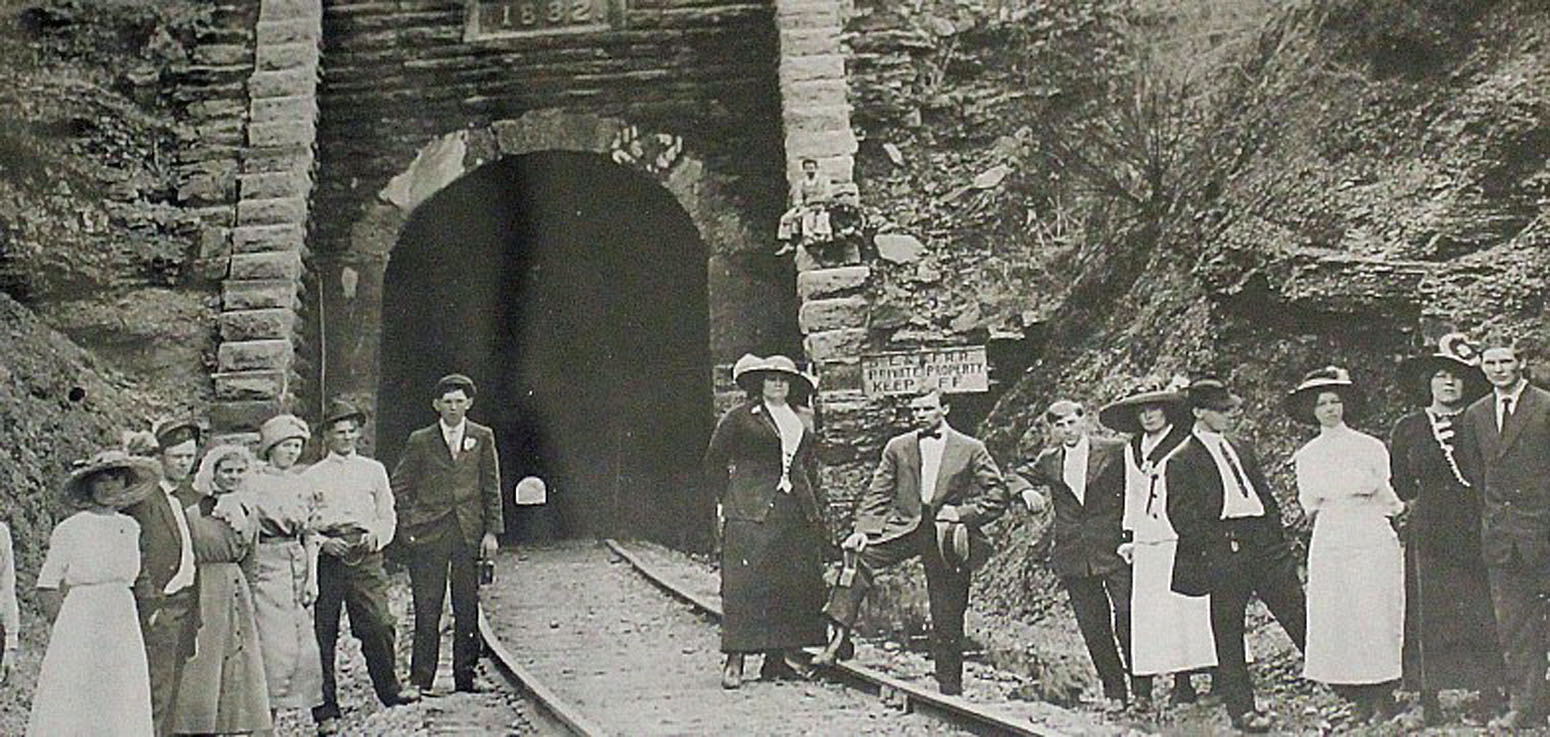
As early as 1855, Fayetteville city leaders had recognized the potential profit and growth that railway connections would bring to the rest of the county. The rugged Ozark terrain isolated their fledgling village, making commerce difficult and expensive for necessities and luxuries alike. Goods came north by ox cart from the Arkansas River at Van Buren or Ft. Gibson, or south from the railhead in Missouri. After the Civil War, in 1868 Arkansas legislators passed a bill granting aid to railroads which in turn prompted the St. Louis and San Francisco to start laying track south from Springfield, Missouri. The Frisco line made it to Fayetteville in 1881 with passenger service delayed until the completion of the Winslow tunnel. On July 4, 1882, a brass band and a crowd of 10,000 greeted the first passenger train at the Fayetteville Dickson Street station.

Arkansas-Railroad-Museum-45
Winslow railroad tunnel circa 1885. Courtesy Arkansas Railroad Museum.

All kinds of goods traveled along the new line from Monett, Missouri to Fort Smith—product of a fourteen-year construction effort—encouraging the hopes of men and families seeking livelihood. The most plentiful and profitable local raw material available for the taking were the old-growth trees. Land sold for $1 per acre with an estimated available merchantable timber of 5000 board feet per acre. A flourishing trade blossomed along the track as virgin forest fell to the hands of hardworking men. Within the first decade after 1882, West Fork, Woolsey, Brentwood, Winslow, and several long-since vanished whistle stops became boom towns where railroad ties, fence posts, and rough-cut lumber were loaded onto railcars.

One of the most ambitious men to exploit the timber trade was Hugh F. McDaniel,[1] a railroad builder and tie contractor who had come to Fayetteville along with the Frisco. He purchased thousands of acres of land within hauling distance of the railroad and sent out teams of men to cut the timber. By the mid-1880s, after a frenzy of cutting in south Washington County, he turned his gaze to the untapped fortune of timber on the steep hillsides of southeast Washington County and southern Madison County, territory most readily accessed along a wide valley long since leveled by the east fork of White River.

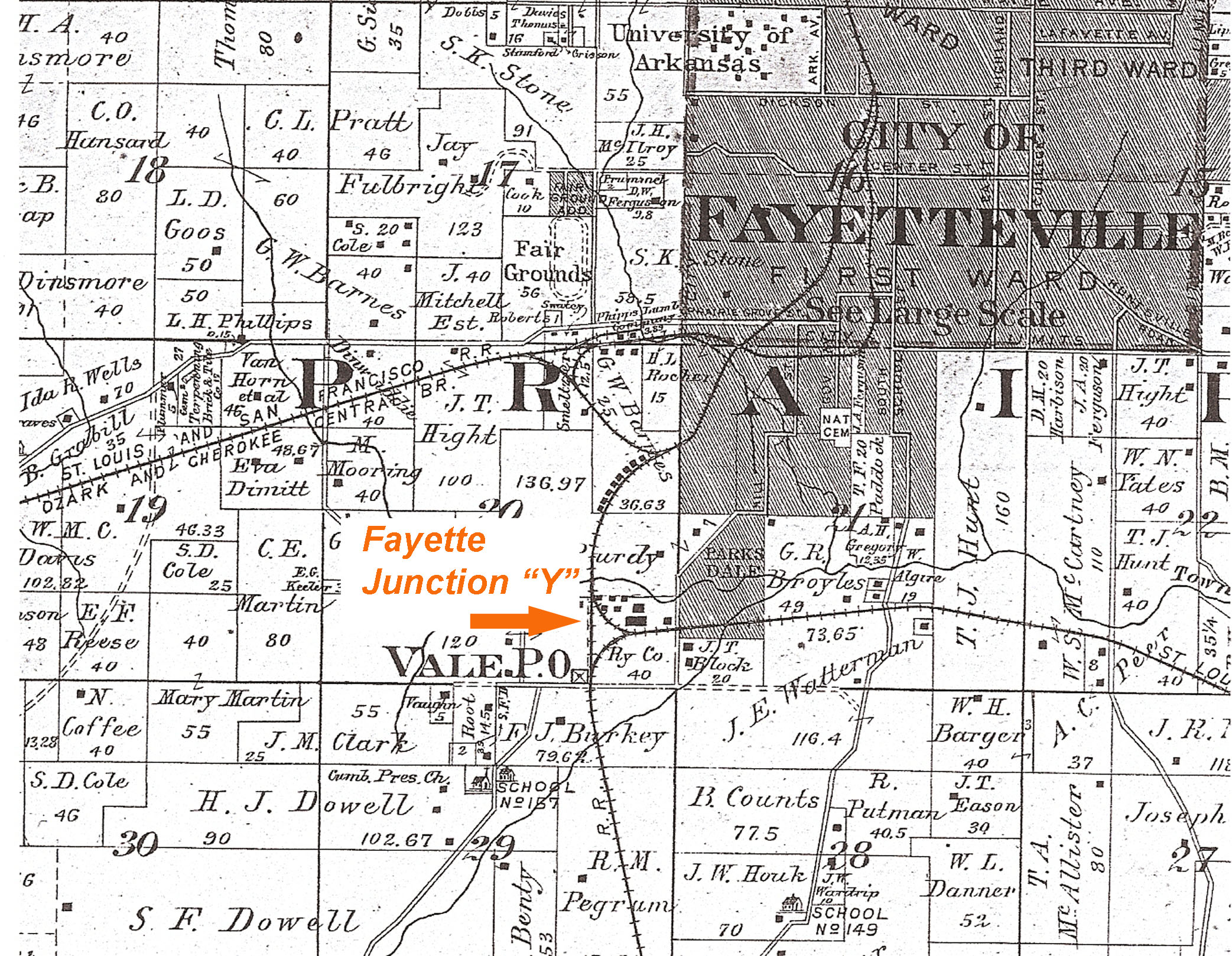
Mr. McDaniel gathered a group of backers,[2] petitioned the state, and was granted a charter September 4, 1886, giving authority to issue capital stock valued at $1.5 million. This was the estimated cost to build a rail line through St. Paul and on to Lewisburg, which was a riverboat town on the Arkansas River near Morrilton. McDaniel began surveys while local businessman J. F. Mayes worked with property owners to secure rights of way. “On December 4, 1886, a switch was installed in the Frisco main line about a mile south of Fayetteville, and the spot was named Fayette Junction.” Within six months, 25 miles of track had been laid east by southeast through Baldwin, Harris, Elkins, Durham, Thompson, Crosses, Delaney, Patrick, Combs, and finally St. Paul.

Soon after, in 1887, the Frisco bought the so-called “Fayetteville and Little Rock” line from McDaniel. It was estimated that in the first year McDaniel and partners shipped out more than two million dollars’ worth of hand-hacked white oak railroad ties at an approximate value of twenty-five cents each. Mills ran day and night as people arrived “by train, wagon, on horseback, even afoot” to get a piece of the action along the new track, commonly referred to as the “St. Paul line.” Saloons, hotels, banks, stores, and services from smithing to tailoring sprang up in rail stop communities.

As the Fayetteville & Little Rock track extended to Dutton and its final easternmost point at Pettigrew in 1897, local sawmills processed massive logs of oak, walnut, maple, and hickory into rough lumber before it was loaded onto the railcars.  “Wagons loaded with hardwood timber—cross ties, fence posts, rives, felloes, sawed lumber to be finished into buggy and wagon wheels and spokes, single trees, neck yokes, handles for hammers and plows, and building materials” streamed into the rail yards along the St. Paul line. Overnight, men became wealthy according to their ability to take advantage of the timber trade.

With the railroad came enormous population growth and the need for more homes, churches, offices, and commercial enterprise. Sufficient supply of building materials depended upon ever more distant timber harvest and upon the increasingly mechanized production of lumber. This frenzy of lumber and milling enterprises fed off the forests of southern Washington and Madison counties, with mills and factories located at various sites around Fayetteville. White oak was preferred for railroad ties, while red oak was the resilient wood of choice for wagon stock, especially bows, hubs, and spokes. Other woods milled included walnut, hickory, ash, and cherry.

All of the trains carrying lumber from the St. Paul line steamed through Fayette Junction, where loads of posts, ties, and raw materials for milling jammed the side tracks.  The 1904 Fayetteville City Directory authors summarize: “Those industries which have to do with the manufacture of various articles from hard wood timber are probably among Fayetteville’s most important enterprises. There are four factories devoted to the manufacture of wood wagon materials alone. Their product is shipped to many foreign parts, to the new Island possessions, as well as to every large manufacturing center in our own country.”

~~~

All the timber from points east and south came through Fayette Junction where railroad crews tended the engines, hooked up or dropped off cars on the sidings, threw appropriate switches, and communicated by telegraph, written messages, and word of mouth with various station agents about activities along the tracks. Serving as conductor along the early St. Paul line required a special breed of man, epitomized by the fabled “Irish” John Mulrenin who took on the job after three predecessors had quit in quick succession. For the next thirty years he handled the passengers of the St. Paul line, not just families and businessmen but backwoods lumberjacks and diamond-jeweled card sharks. He became skilled in quick decisions such as cutting short the Pettigrew switching chores to leave drunks stranded at the depot.

fay junc map
Circa 1890 map of Fayetteville Arkansas and the railroad ‘wye’ at Fayette Junction.

The Fayette Junction tracks formed a “Y”, with the southern “wye” used for “storage” and the northern for “industry”. Where the northern “wye” joined the main track near the northernmost point of present-day Vale Avenue, there was a gravel platform, water tank, and depot, although there was never a passenger depot at Fayette Junction.  Inside the “Y,” Frisco built mechanical department buildings including a shop and storeroom, an 813 foot long “cinder pit” track, and a 416 foot long “depress” track, according to the 1916 Frisco map. At the southern end of the “Y” was a coal chute track, a coaling plant, boiler room, and a sand house.

The November 19, 1905 train schedule from Fayetteville to Pettigrew left the Dickson Street station at 8:10 a.m., passed through Fayette Junction at 8:40 a.m., and arrived at Pettigrew at 11:50 a.m., with stops at Baldwin, Harris, Elkins, Durham, Thompson, Crosses, Delaney, Patrick, Combs, Brashears, St. Paul, and Dutton. After turning the engine on the roundhouse at Pettigrew, the train departed at 12:55 p.m., and arrived at Fayetteville at 4:15 p.m. In 1915, the train ran approximately fifteen minutes earlier, with the stop at Baldwin now named “Leith.” Return run arrived in Fayetteville at 3:30 p.m. The same schedule and stops were in place in 1927.

The Frisco Fayette Junction Roundhouse was listed in the 1932 Fayetteville directory with a telephone number of 641 under “Railroads” in the Yellow Pages. The Personal Data Book of the Division Superintendent for the Ft. Smith station reported the Fayette Junction population that year was fifty, but it is not clear what area he considered “Fayette Junction.”  Three years later, Superintendent S. T. Cantrell inventoried the 75 steam engines and other assets of the division. The oldest engine of the bunch, a “ten-wheeler” No. 488 Baldwin 1910, was in mixed service on the St. Paul to Bentonville line. Also in use to St. Paul was another oil-burner 4-6-0, No. 552 Pittsburgh 1901. Cantrell reported the following locomotive assignments to Fayette Junction as of February 26, 1935. In the shop:  #598, 4-6-0, oil, Dickson 1903. In storage: #648, 4-6-0, oil, Baldwin 1904; #750 4-6-0, oil, Baldwin 1902; #755, 4-6-0, oil, Baldwin 1902; #779 4-6-0, oil, Baldwin 1903; #3651 0-6-0, oil, Baldwin 1906; #3676 0-6-0, coal, Baldwin 1905#3695 0-6-0, coal, Baldwin 1906. Later observers remarked on the number of engines in storage as evidence of the “sorry state” of the railroads by 1935.

The Fayette Junction station force in 1932 included an agent-telegraph operator working 6 a.m. until 3 p.m., with a stipend of $0.67 per day. Holidays the hours were 6:15 a.m. until 8:15 a.m. The schedule by 1931 for ‘St. Paul Branch’ showed a mixed train daily (passengers and freight), starting from Fayetteville at 7:45 a.m., arriving Pettigrew at 11a.m., leaving Pettigrew at 12:01 p.m. to return to Fayetteville, where it arrived at 3:10 p.m.  All the intermediate stations were shown as flag stops except for Combs, where the train stopped at 9:54 a.m. on the outbound trip and 12:50 p.m. on the return trip, and St. Paul at 10:15 a.m. on the outbound trip and 12:30 p.m. on the return trip.

Mogul 345
Mogul 345. From http://www.frisco.org/shipit/index.php?threads/workable-2-6-0.4976/

The fifty years from 1887 to 1937 had seen it all come and go through Fayette Junction. According to favored accounts, the last train to St. Paul ran July 30, 1937, “when ‘Irish’ Mulrenin had in his charge one wheezing locomotive, Mogul #345, and one empty, creaking old wooden coach” with a crate of two hound dogs for passengers.  The logging boom had come to an end. The tracks were taken up some time after, but remained across south Fayetteville accommodating various manufacturers in the new Fayetteville industrial park (east of City Lake Road, south of Hwy 16 East) and the shipment of new and recycled metal to and from Ozark Steel Company on South School as late as the 1970s.


This a condensed excerpt from my article on Fayette Junction, a location in South Fayetteville (Washington County, Arkansas) where the 1880s logging boom centered. For the full article, look for my book Glimpses of Fayetteville’s Past, available in local bookstore or at Amazon.


[1] Hugh McDanield, b 1843 to B. F. and Sarah (Terrell), fought for the Union in the Civil War, worked in mercantile trade in Kansas City until 1873, built the Kansas Midland Railway from Kansas City to Topeka, and then operated a ranch in west Texas. After completing the Texas Western Railway in 1877, he turned his attention to Northwest Arkansas and began selling ties in 1881. He bought, logged, and sold thousands of acres of Washington County land and later Madison and Franklin counties over the next seven years and made a fortune furnishing the Santa Fe Railway nearly all its ties for the railroad west. He is credited as founder of St. Paul by the 1889 Goodspeed. He died at age 45 (1888) in Fayetteville of a month-long, unnamed illness.

[2] Backers included F. H. Fairbanks, J. F. Mayes, and J. S. Van Hoose, along with McDaniel’s brother J. S. McDaniel, all of Fayetteville, and D. B. Elliott of Delaney, J. Pickens of Eversonville, Missouri, J. W. Brown of Brentwood, and another brother, B. F. McDaniel of Bonner Springs, Kansas.

Winter — Gift of the Season Day 7

dawn ice storm

I wrote this piece years ago and included it in my book “I Met a Goat on the Road.” The main grocery store in town was the Lafayette Street IGA, back before Walmart decided to take over the grocery trade. That’s not the only thing that’s changed. Today is December 21 and it’s 61 degrees outside. The ten day forecast finds all overnight lows above freezing. So much for a white Christmas.

Now the story:

She spoke for us all, confessing to the check-out clerk with an excited laugh that if it was going to ice, she’d better get ready. Milk, bread, chocolate bars, corn meal—her choices were different only in detail from the rest of us standing in line in a store so jam-packed that even the stock boys were up front wearing jackets over their aprons and sacking supplies that would keep us secure when the weather moved in. Cars and trucks crowded the parking lot, some left running with the plumes of their exhaust whipped sideways in the freezing wind.

Men waited holding meat, bananas, coffee, restless in insulated tan coveralls with the legs unzipped over their heavy clay-soiled boots, their hair packed down against their heads where knit hats had rested. Uneasy in a role usually filled by their wives, they joked, catching up with old acquaintances who also stood in line, promising to call soon, men not accustomed to being off work at one p.m., hurrying home to family before the sleet started.

The cold came first, thirty-five degrees when I started to town in the morning, twenty two when I returned home, fifteen by three. Wind rocked the great oaks side to side, piling stiff dead leaves in new arrangements at the corner of the woodpile, at the steps. Twelve degrees at dusk, the clouded sky pale pink and white, the countryside settling into frozen night.

Five-thirty a.m. by my bedside clock, the tick-tick of sleet against the windows woke me. I indulged in another hour of fitful sleep, comforted by heavy quilts and cats at my feet. Plans of all I could do raced through my dreams, the albums not finished, correspondence neglected, the watercolors so long set aside. Roads coated in ice meant a day without visitors, a day at home tending the fire, tending myself.

Dressed in sweaters not worn for five years, in long socks and with no regard to appearances, I sipped hot tea at the window. Only a small shift in the light signaled dawn, lifting the dark blue cast of the air to a lighter shade.  Barely visible deer moved slowly through the woods, pawing at the ice-coated duff.  Tiny crystalline flakes of snow filtered into the sleet, thickening the white of the downfall, obscuring trees at the fence line. It was four degrees.

I built a fire in the wood-burning cook stove. A kettle of water with cinnamon oil steamed while I crafted my list of things to do, tasks that seemed too petty or cumbersome for normal days when open roads and obligations burdened the hours. I would simmer apricots with honey and ginger and fry half-moon pies, edges evenly crimped with tender fork lines. I would sketch scenes, the road to my house or the contoured hills, and let watercolor swirl on the heavy paper, a skyscape of gray and blue, fields tan, oaks silhouetted black.

Freshly washed clothes hung by the blistering stove where greedy heat soon pulled out all moisture. With satisfying frugality, a pot of vegetable soup thick with garlic and a pan of beans decorated the stove top, cornbread in the small sooty oven. Every few hours I rushed out for more wood, lingering coatless in the sharp scent of cold and wood smoke, large flakes of snow tumbling down into my hair, resting on my eyelashes.

The winters have not been accommodating in recent years, failing first with abbreviated snows, then disappointing even in temperature. In the onslaught of global warming, the Ozark hills have increasingly remained accessible in deepest January. A few decades earlier, our steep, curving roadways had been reliably impassible for at least two arctic weeks of the year. We grew to expect that at times chosen by Nature, no one would venture out. The guy with the local wrecker service would make enough money to last until June.

In this mid-South clime of Northwest Arkansas, we don’t get winter enough to justify the county’s expense for snow plows. It suits us better to schedule school years with extra days for snow. It pleases us to find ourselves unexpectedly confined to the house. In that splendid isolation, we might discover long lost treasures at the back of the closet, read magazines, stand at the window staring out in silence as midday lightens the sky to a shade barely more luminous than the snow lying thick on the ground.

Lately there has been little winter at all. Days have run together, no time to reflect, restore, sleep in the afternoon. We long for the cold, the ice, roads we could not drive, jobs we could not attend. Our bodies crave hibernation.

Welcome then this celebration of ancient instincts to stay in the cave, content with the provisions we have hoarded, the firewood we have stacked near the door, wrapped in the warmth we have made. Embrace this triumph of survival over the elements, proof of our adequacy in a time when little else seems so clear.

Gift of the Season Day 6 — Price Markdown

Aquar Rev faded coverThey were the hippies, the drop-outs, the radicals. They came from New York, Detroit, Chicago, Los Angeles, New Orleans, and bought cheap Arkansas land where they could build lives with meaning. Often the topic of heated rhetoric and armchair analysis, those who went ‘back to the land’ rarely speak in their own voice. Now documented in these personal interviews, their stories reveal the guts, glory, and grief of the 1960s social revolution.

Previously listed at $15.95, now for a limited time the paperback is available for $11.95. A lasting gift! Amazon buy link

“Denele Campbell’s informative ‘Aquarian Revolution: Back to the Land’ fills a much-needed niche in the history of the Counter-Culture movement. Unlike in more crowded Europe, America’s rural expanse offered an escape, a new beginning in the 1960s, from a social cancer spreading through the dominant culture. The dream of finding land to till and an alternative life style had been an American dream since its founding. America’s cities, mired in racism, sexism, poverty, and riots, seemed doomed. The ‘baby boomers’ sought escape by going to the land, many for the first time. Denele Campbell has carefully chronicled the personal stories of thirty-two pioneers who opted to create their utopian vision in the Ozarks. As such, their quest is at times fascinating, amusing, and often painful. Yet, it is a good read for those who lived through this era as well as today’s young.” —-T. Zane Reeves, Regents’ Professor Emeritus, University of New Mexico and author of Shoes along the Danube.