The United States is supposed to be an effort toward a more evolved culture. No kings. No one above the law. That’s the ideal—freedom of speech, of the press, of religion, a country for all of us to be equal. Thousands have fought and died for this.
How did this vision get perverted into a front for rapacious capitalism? Or was it that way all along?
Time and again we have confronted waves of greed and division, but we have pulled ourselves up from those depths.
It is painful to see the bad guys win, to slide in with their buddies and cover stories to start raping and plundering through every government department and every principle, abandon all integrity and honor and holding no one responsible.
Will this disgrace on our nation’s promise bring about a renewal of all we stand for? Will common sense and the common good rise up in November to put the Trump regime to an end?
The absurdity is overwhelming. Here we are as Americans, all party to the White House’s illegal murder of over eighty (so far) men in boats on the premise they are bringing drugs to the United States. As well remarked elsewhere, there is no evidence these boats are carrying drugs and no credibility in the idea these small vessels with a fuel range of 100-200 miles are embarking on a thousand mile journey to the U.S.
But even more insane is the idea that a nation under any government can stamp out drug use/abuse by ‘interdicting’ drugs enroute to this country. We can’t even stamp out drugs manufactured in within the borders of this country. Anyone who believes such nonsense needs to have these words tattooed onto their forehead: Supply-Demand. If people want a product, no matter how potentially dangerous, there will ALWAYS be a supplier. Basic economic fact. Reducing supply only results in higher prices for said product, i.e. better profits, more incentive to supply.
So let’s get real about illegal drugs. First, “drug users” include people who depend on caffeine in their morning coffee, iced tea at lunch or other caffeinated beverages, persons who ‘must have’ their cigarettes or other tobacco products, and persons prescribed any of a multitude of pharmaceuticals which address any of a multitude of human conditions from depression to headache to cancer. Secondly, there is an enormous difference between the use of and the abuse of any drug. Prohibitionists prefer to consider all illegal drug use as ‘abuse’ in order to justify draconian laws punishing users. We must keep in mind the blurred line dividing legal and illegal drugs is primarily based on their regulatory status and whether their production, sale, and use are permitted by law. Theoretically, this status is determined by government authorities based on factors like medical utility, potential for abuse, and perceived harm to the individual and society. In other words, there is no truly ‘illegal’ drug.
This theory supporting the prohibition of certain drugs has been shown to be a fabrication serving other less savory objectives. The drug war is a tool used by government to carry out activities which are illegal. For example, one might wonder about the president’s single-minded assault on alleged drug smugglers from Venezuela when coca leaf is grown in three other Latin American countries: Peru, Bolivia and Colombia. Surely the fact that Venezuela possesses the world’s largest oil reserves has nothing to do with it. Surely.
Never mind the fact that cocaine is hardly relevant in drug abuse circles since fentanyl hit the streets. In 2023, there were approximately 72,776 overdose deaths involving fentanyl (synthetic opioids other than methadone) compared to about 29,449 deaths involving cocaine.
Postcard showing an underground opium den in San Francisco, pre-1906 earthquake. By 1896, there were around 300 opium dens in San Francisco, mostly in Chinatown. In the 19th century and the early 20th century, opium smoking was common worldwide, especially in Asia, which was one of the sources of the opium poppy.
In order to better understand this absurdity, let’s go back more than a century to the country’s first ‘drug war’. The San Francisco Opium Den Ordinance of 1875 made it a misdemeanor to maintain or visit places where people smoked opium. These places were mainly in Chinese immigrant neighborhoods. Similar racially inflammatory state laws emerged. Soon after came the Chinese Exclusion Act of 1882, which barred Chinese laborers from entering the U.S., a ban expanded to all Chinese people in 1902 and not fully repealed until 1943. The first federal drug law, the 1909 Smoking Opium Exclusion Act, prohibited importing and using opium. It wasn’t that the government suddenly became concerned about opium use. In a nutshell, it was that the railroads powering the economic growth of that period were now built, and thousands of Chinese who had been welcomed to this country to do the backbreaking work of carving tunnels out of rock and laying steel track were no longer of use. Even worse, these immigrants, the primary users of opium, were inviting relatives to immigrate and their jobs were seen as threats to white workers.[1]
Then there was alcohol. After nearly a century of growing religious fervor stemming from massive evangelical movements, especially the “Second Great Awakening,” characterized by fiery camp meetings, frontier revivalism, and emotionally charged preaching, a rising cry against alcohol resulted in ‘prohibition,’ enacted on a federal basis in 1920 but in individual states as early as the 1880s.
Carrie Nation became famous for her attacks on alcohol-serving establishments, using rocks, bricks, and her signature hatchet to destroy liquor bottles, mirrors, and bar fixtures. Before resorting to violence, she would kneel outside saloons, sing hymns, and deliver strong sermons to patrons and owners, sometimes calling herself the “Destroyer of Men’s Souls”.
“A wide coalition of mostly Protestants, prohibitionists first attempted to end the trade in alcoholic drinks during the 19th century. They aimed to heal what they saw as an ill society beset by alcohol-related problems such as alcoholism, domestic violence, and saloon-based political corruption.”[2]
Alcohol prohibition led to massive increases in organized crime (bootlegging, speakeasies), rampant corruption of officials, dangerous unregulated alcohol leading to sickness/death, huge losses in government tax revenue, and a general disrespect for the law, with little measurable public health benefit, ultimately proving a costly failure. Ultimately, prohibition led to the development of the Federal Bureau of Investigation (FBI), significantly expanding the role and authority of the FBI’s predecessor, the Bureau of Investigation (BOI), making it central to federal law enforcement by creating massive new criminal enterprises (bootlegging) that required federal intervention, strained resources, spurred corruption, and ultimately led to bigger federal crime-fighting roles and the rise of modern organized crime, impacting federal investigations for decades.
This powerful new agency could have drifted into irrelevance when alcohol was once again legal in 1932, but instead there is evidence that the federal official who spearheaded cannabis prohibition saw it as a way to maintain his department’s relevance and budget. Harry Anslinger, the head of the Federal Bureau of Narcotics (FBN), needed a new focus for his agency after alcohol prohibition was repealed. He launched a public campaign against cannabis (often using the “marihuana” spelling to associate it with Mexican immigrants), portraying it as a dangerous substance to justify his department’s continued existence. Anslinger’s rhetoric carried strong undercurrents of racial prejudice and xenophobia, targeting Mexican immigrants and Black jazz musicians.
Then as the ‘60s ended with massive marches in support of equal rights for minorities and women, against the Vietnam war, and in support of gay rights, President Richard Nixon officially launched the “War on Drugs” in the early 1970s, declaring drug abuse a public enemy and enacting significant federal legislation like the Controlled Substances Act to combat drug production, distribution, and use, though policies intensified under subsequent administrations.
One of Richard Nixon’s top advisers and a key figure in the Watergate scandal said the war on drugs was created as a political tool to fight blacks and hippies, according to a 22-year-old interview recently published in Harper’s Magazine.
“The Nixon campaign in 1968, and the Nixon White House after that, had two enemies: the antiwar left and black people,” former Nixon domestic policy chief John Ehrlichman told Harper’s writer Dan Baum for the April cover story published Tuesday.
“You understand what I’m saying? We knew we couldn’t make it illegal to be either against the war or black, but by getting the public to associate the hippies with marijuana and blacks with heroin and then criminalizing both heavily, we could disrupt those communities,” Ehrlichman said. “We could arrest their leaders, raid their homes, break up their meetings, and vilify them night after night on the evening news. Did we know we were lying about the drugs? Of course we did.”[3]
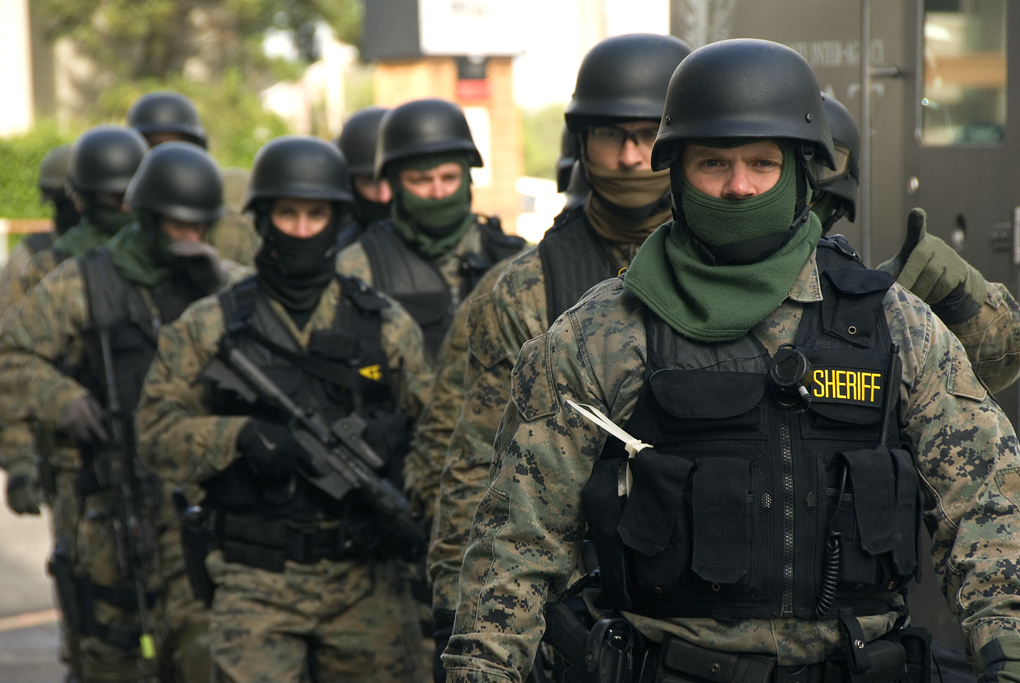
A 2017 study showed that police forces which received military equipment were more likely to have violent encounters with the public, regardless of local crime rates. A 2018 study found that militarized police units in the United States were more frequently deployed to communities with large shares of African-Americans, even after controlling for local crime rates. https://en.wikipedia.org/wiki/Militarization_of_police#cite_ref-17
In the next administration, First Lady Nancy Reagan famously addressed the drug “problem” with her “Just Say No.” advice, unwittingly illustrating the parental role now assumed by government over the private, consensual behavior of drug users. Reagan’s successor, George H.W. Bush, took it a step further. He promoted the 1033 Program (Defense Logistics Agency (DLA) Disposition Services) in the early 1990s to transfer surplus military gear to local law enforcement for the “War on Drugs.” Nowhere in this rush to judgement did anyone point out that M16/AR-15 rifles, grenade launchers, armored vehicles (APCs, MRAPs), night vision, tactical robots, and “less-lethal” gear (beanbag/pepperball guns, flashbangs) have absolutely no effect on drugs. These weapons and the “war” in which they are being used are against PEOPLE—American citizens, most of whom simply preferered to toke a joint after work rather than drink an alcoholic beverage.
This despite the fact that in the 1970s and ‘80s, marijuana was by far the most widely used of illegal drugs, was found in multiple studies not to be addictive and also found not to be a ‘gateway’ to harder drugs, as so often alleged in government reports. Even today, with drugs like cocaine and even fentanyl in the headlines, according to the United Nations Office on Drugs and Crime (UNODC) World Drug Report 2024, the estimated number of people who used various drugs at least once in the prior twelve months was: Cannabis (Marijuana): 228 million users; Opioids: 60 million users; Amphetamines: 30 million users; Cocaine: 23 million users; Ecstasy: 20 million users.
All the while, the drug war of those decades provided cover for illegal U.S. government operations in Central and South America as those nations began to resist colonization by American corporations seeking to exploit natural resources like oil, minerals, and agricultural opportunities. Fertile land and cheap labor could produce crops such as coffee, bananas, and other foods requiring year-round growing seasons.
According to Tim Weiner, the Central Intelligence Agency “has been accused of forming alliances of convenience with drug traffickers around the world in the name of anti-Communism” since its creation in 1947.[4] The CIA has a long, controversial history in South America, primarily during the Cold War, involving covert operations like coups, political destabilization, and support for right-wing regimes (e.g., Operation Condor) to counter perceived communist influence, leading to significant human rights abuses and democratic declines, with operations continuing into recent times, such as those in Venezuela. Key actions included overthrowing governments (Chile, Ecuador, Brazil), supporting anti-communist forces (Contras in Nicaragua, a major scandal where in U.S. operatives sold guns to Iran between 1981 and 1986, facilitated by senior officials of the Ronald Reagan administration. The administration hoped to use the proceeds of the arms sale to fund the Contras, an anti-Sandinista rebel group in Nicaragua.), and involvement in conflicts like the Salvadoran Civil War, with consequences like suppressed democracy and economic impacts.
This kind of interference in the affairs of other nations more or less permeates American history. In the early 20th century, during the “Banana Republic” era of Latin American history, the U.S. launched several interventions and invasions in the region (known as the Banana Wars) in order to promote American business interests. During the Cold War (1950s-1980s), the CIA carried out coordinated campaigns to install South American dictatorships (Argentina, Chile, Brazil, etc.) to track, kidnap, torture, and kill left-wing dissidents, with CIA support and intelligence sharing. In Guatemala (1954), the CIA overthrew the democratically elected President Jacobo Árbenz, linking to U.S. corporate interests, using exile forces and propaganda. In Chile (1970s), CIA efforts undermined President Salvador Allende, paving the way for a military coup. Same idea for Brazil (1964): Supported a coup against President João Goulart, leading to a military dictatorship. Nicaragua (1980s): Funded and trained the right-wing Contra rebels fighting the socialist Sandinista government, with alleged links to cocaine trafficking. El Salvador (1980s): Trained and equipped military units involved in massacres during the civil war.
CIA interventions often resulted in the collapse of democratic institutions, reduced civil liberties, and economic hardship, despite justifications of promoting democracy or fighting communism, according to research. The support ‘troops’ for these political objectives has become de facto occupation of these nations with armed agents of the U.S. Drug Enforcement Agency, with 87 foreign offices in 67 countries. For example, in the so-called “Southern Cone,” (Brazil, Chile, Argentina, Paraguay, Peru and Uruguay), are considered to be transit zones for the movement of cocaine base, cocaine HCL, and heroin being shipped from Colombia and Peru to markets in the U.S. and Europe, or producers of coca leaves. The end result of these often violent interventions in the affairs of our neighbors is the current and ongoing flood of desperate people arriving at our borders.
Not only are drug laws used outside our nation’s borders as cover for extra-judicial interference in international relations, they also serve domestically to selectively target specific individuals and politically inconvenient groups or based on racism or other prejudices, most recently undocumented immigrants. This is a useful tool for xenophobes determined to turn the United States into a white patriarchal “Christian” nation. The current administration manipulates this demographic by playing up the drug war.
Public support for prohibition policies relies on judgments of morality, that becoming intoxicated is immoral, an echo of the early 1800s temperance movement which reached its zenith with alcohol prohibition, the Eighteenth Amendment to the United States Constitution. This same moral judgment about private consensual activity remains a strong current in the United States where prostitution, gambling, and drug use (other than legal drugs) fall under strong government control. While government cannot (yet) spy on the living rooms and bedrooms of its citizens, government agents find such laws useful in targeting specific types of people, as previously illustrated.
“Today, police make more than 1.5 million drug arrests each year, and about 550,000 of those are for cannabis offenses alone. Almost 500,000 people are incarcerated for nothing more than a drug law violation, and Black and brown people are disproportionately impacted by drug enforcement and sentencing practices. Rates of drug use and sales are similar across racial and ethnic lines, but Black and Latinx people are far more likely than white people to be stopped, searched, arrested, convicted, harshly sentenced, and saddled with a lifelong criminal record.
“The wide-ranging consequences of a drug law violation aren’t limited to senseless incarceration: people with low incomes are denied food stamps and public assistance for past drug convictions; states including Texas and Florida suspend driver’s licenses for drug offenses totally unrelated to driving; and numerous other policies deny child custody, voting rights, employment, loans, and financial aid to people with criminal records.”[5]
Despite apparent national political resolve to deal with the drug problem, inherent contradictions regularly appear between U.S. anti-drug policy and other national policy goals and concerns. Pursuit of drug control policies can sometimes affect foreign policy interests and bring political instability and economic dislocation to countries where narcotics production has become entrenched economically and socially. Drug supply interdiction programs and U.S. systems to facilitate the international movement of goods, people, and wealth are often at odds.[6]
“We are still in the midst of the most devastating drug epidemic in U.S. history,” according to Vanda Felbab-Brown, senior fellow at the Center for Security, Strategy, and Technology at Brookings Institution. In 2020, overdose deaths in the United States exceeded 90,000, compared with 70,630 in 2019, according to research from the Commonwealth Fund. Yet, the federal government is spending more money than ever to enforce drug policies. In 1981, the federal budget for drug abuse prevention and control was just over a billion dollars. By 2020, that number had grown to $34.6 billion. When adjusted for inflation, CNBC found that it translates to a 1,090% increase in just 39 years.[7]
What if that money had instead been applied to individuals and programs that support individual ambitions and needs—tiny homes for the homeless, for example? What if the costs of our interference in foreign nations had instead been directed toward helping the people of those nations deal with loss of farmland to multinational corporations, climate-change induced drought and hurricane damage, and support for social programs, education, and entrepreneurship, thereby reducing the urgency of people in those countries to flood to U.S. borders in hope of better lives?
Without hot button issues like women’s reproductory rights and drugs, politicians would have to gain votes based on performance rather than propaganda. Stepping away from “government as nannies” and the idea of controlling private behavior would allow taxpayer dollars to support programs that help deter substance abuse in the same way that public education has helped reduce the use of cigarettes. No one knows better than addicts that they, individually, are the only ones who can control their addiction. Ultimately, as free people, we must claim the fundamental right to kill ourselves if we wish it. Most importantly, awareness of draconian drug policies as a cover for illegal objectives both in and outside our nation’s borders would forever eliminate travesties such as the murdering of likely-innocent people in boats leaving Venezuela.
And, in the case of the current administration, understanding the real agenda of the drug war could rightfully turn the public attention fully to the president’s dirty Epstein laundry.
This meticulously researched work will be particularly interesting to those with Cherokee ancestry. The book creates a personal narrative that allows the reader a first-hand look at the challenges, both personal and political, found in this era. The focus on John Work provides compelling insights into the times. You won’t be disappointed.
~~~
Fayetteville Weekly Democrat, January 11, 1889
“John Work came to the West with John Ross and his party of Cherokee in 1838. He was then in appearance 25 or 30 years old, about six feet in height, weighing 180 or 190 pounds, dark complexion, black hair worn long like the Indians of that day. He was uneducated and unrefined but possessed a strong natural mind. His influence was felt in any crowd or community he associated with or resided amongst. He took up his abode along the line and soon became a frequenter of the gambling and drinking houses then so numerous on the border. He soon became notorious for his fighting and drinking qualities…”[1]
So begins a newspaper article written by Fayetteville attorney and historian James P. Neal (1820-1896). Neal was not alone in his fascination with John Work, a man who to this day remains an enigmatic and compelling figure. Work played an important role in the intertribal conflict of the Cherokee. But according to all reports, he was a white man.
For over 250 years, the Cherokee managed to exist alongside the increasing population of European immigrants before being pushed off their ancestral lands. With the 1836 signing of the Treaty of New Echota, the newly formed United States government sent military troops to force their move west, what became known as the Trail of Tears. Along with the Natives, their slaves, white spouses, and freedmen also made this journey.
John Work was not Cherokee, but he too trekked west on the thousand-mile passage. As he and the others struggled over mountains and rivers toward what is now Oklahoma, their fury grew, so that by the time they had built new homes and licked their wounds, certain selected assassins began killing the treaty signers. This ushered in an era of near civil war among the Cherokee.
One of the most notorious of the anti-treaty assassins was John Work. Little is known of this man whose skill with his Bowie knife became something of legend. Separate from his role in cold blooded murder, his story serves to tell the broader history of those years of vicious violence that spilled over the border into Washington County, Arkansas and helped shape the future of the county.
[1]Fayetteville Weekly Democrat Jan 11, 1889, p. 2. The story continued in the Jan 18 edition, p. 3. Neal never cites sources for his information.
Bought a new wood stove lately? Who knew my longtime desire to buy one would bring me to the brink of despair. Let me tell you, my friend. This is not a step you should take without proper warning.
The old stove, fortunately still in my possession in case I give up this fight, was a Big Box model I inherited when my new husband and I moved into an old cabin. That was in 1974. Local lore claimed an old man named “Ringo” died in that cabin, tired of life, sick, and unable to gather wood. Reportedly, he froze to death.
Fire in the Big Box was simple. Two logs with space enough between them for some crumpled newspaper, a handful of twigs and other flammable bits gathered from the surrounding woods, and then another log across the top, positioned so that when the kindling burned up, the third member would not collapse into the middle but rather perch over the coals to burn freely. Air intake open and the damper open, a match set it off. It was safe to walk away to return a half hour later to shut the air intake and let that baby burn. Whenever fresh wood was needed, simply open the damper to let the smoke escape up the chimney, open the stove door to add wood as needed, and there you go! No smoke pouring into the room.
The problem with the Big Box was that by midnight, fast asleep, one started to sense the cold creeping in. Even the most magnificent fat cut of oak or hickory burned up in only 3-4 hours. That’s because any seal that might once have lined the top edges and front door was long gone and so even with all moveable parts closed, air still moved through the stove. Such things as seals or firebrick probably never existed as part of the stove—at least, in my fifty years with it, no such trace remains. So as my knees got worse with advancing age, trekking up and down the five steps to the living room where the Big Box held pride of place became a more troublesome issue especially at two a.m. when I slept past the life of the fire and only a few coals remained.
I lusted after those fabled wood stoves like Jøtul which held fire overnight. Not only would that solve my overnight heat problem, but it also offered a glass door so I would watch the flames leap and glow. Watching fire can lead to trance-like relaxation effects. These effects have been backed by research that shows that watching an open flame can decrease blood pressure. The longer you sit by the fire, the more relaxed you’ll feel. So when I finally had sufficient funds, I visited the local wood stove store and considered my options.
Admittedly, I failed utterly in the research-before-you-buy department. I’m here to share what I’ve learned.
News flash: Woodstoves now must meet new EPA standards, passed sometime in the 1990s, that specify several aspects of the device. Not only did this drive up the prices to absurd levels, but also led to the admonition by my two-man installation team who warned me that the stove would probably smoke. The Jøtul stoves meet EPA requirements with the use of a catalytic device that serves as a kind of filter, but as the EPA guidelines admit, the ‘catalyst’ can burn out within a couple of years.
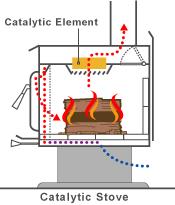
In catalytic combustion, the smoky exhaust is passed through a coated ceramic honeycomb inside the stove where the smoke gases and particles ignite and burn. Catalytic stoves are capable of producing a long, even heat output.
All catalytic stoves have a lever-operated catalyst bypass damper which is opened for starting and reloading. The catalytic honeycomb degrades over time and must be replaced, but its durability is largely in the hands of the stove user. The catalyst can last more than six seasons if the stove is used properly; but if the stove is over-fired, inappropriate fuel (like garbage and treated wood) is burned, and if regular cleaning and maintenance are not done, the catalyst may break down in as little as 2 years.
Not that I would ever burn garbage or treated wood, but spending $300 every couple of years wasn’t on my list of things to do. And as I approach 80 years of age, I have little patience with machines that require “regular cleaning and maintenance.” So for nearly a month I lost sleep worrying about using the stove. It was still summer, so I had time to fret. Finally, after speaking with the store manager, they agreed to allow me to trade my unused Jøtul for a non-catalyst stove manufactured by Pacific Energy.
Beware! The store staff failed utterly to inform me that in many ways, the non-catalyst stove created more problems than the catalyst version.
But I didn’t know that yet. My decision narrowed to the model that allowed for 18” firewood, of which I already had over four ricks of seasoned wood. This model is Pacific Energy’s Alderlea T6. It’s a handsome stove, although several aspects of its construction are big problems.
One of the Alderlea’s many shortcomings is that while the manual states that maximum wood length is 20 inches, the only way to fit a log that size into the stove is on a diagonal from front corner to back corner. Even the owner’s manual phrase “Ideal Wood Length” of 16 to 18 inches placed “endwise” [does this mean end to end sideways or end to end from door to back of stove? No diagram.] leaves zero clearance between the burning wood and the door/firebrick, which means that the glass door quickly becomes coated with soot. So much for watching the fire. The fire box is exactly 18 inches square.
But I’m getting ahead of myself.
After multiple readings of the product manual, I began to break in the stove setting fires meant to burn off the ‘paint’ fumes with house windows open. Right away I noticed what is now a major problem: there is no way to manually vent the stove. Once wood starts burning, if I need to open the stove door to add more wood, or reposition wood, the only option is to open the door and do the task as fast as possible while smoke pours into the room.
Apparently Pacific Energy’s engineers believe the price of making the outside air ‘cleaner’ is to pollute my inside air. The manual fails utterly to address this issue. The instructions for ‘Lighting a Fire’ are:
Adjust air control to “High” position (all the way to the left) and open door.
Place crumpled newspaper in the center of the heater and crisscross with several pieces of dry kindling. Add a few small pieces of dry wood on top.
Ignite the paper and leave the door ajar approximately ½” until the wood kindling is fully engulfed in flame.
After the kindling is fully engulfed, [open the door while smoke pours into the room] add a few small logs. Close door.
Begin normal operation after a good coal base exists and wood has charred. [In other words, spend a half hour watching the stove or make repeated trips to check on it.]
Further instructions follow for Normal Operation:
Set air control to a desired setting. If smoke pours down across the glass, this indicates you have shut the control down too soon or you are using too low a setting. [Wrong. Smoke pours down across the glass with the air control wide open, max setting.]
For extended or overnight burns, unsplit logs are preferred. Remember to char the wood completely on maximum setting before adjusting air control for overnight burn. [“Char” is defined as partially burn wood so that the surface is black.]
Use wood of different shape, diameter and length (up to 18”). Load your wood endwise and try to place the logs so that the air can flow between them [while smoke pours into the room].
Do not load fuel to a height or in such a manner that would be hazardous when opening the door [while smoke pours into the room].
The instructions continue with information about restarting after an overnight or extended burn:
Open door and rake hot embers toward the front of the heater. Add a couple of dry, split logs on top of the embers [This assumes that you need to load wood ONLY when the previous load has burned to embers. What if you want to go to bed and the current load has only burned 75%? Even 90% burned wood smokes. You have to load while smoke pours into the room], close door.
Adjust air control to high and in just a few minutes, logs should begin burning. [If they don’t start burning, open door to add kindling or reposition wood while smoke pours into the room.]
After wood has charred, reset air control to desired setting.
To achieve maximum firing rate, set control to high “H”. Do not use this setting other than for starting or preheating fresh fuel loads.
Nowhere in the manual does one find a drawing showing the “H” and “L” positions. The lever which moves left to right for this function goes a half inch past the H and L lettering, leaving one to wonder if maximum left or maximum right are the correct positions, or if the lever must be positioned exactly under the H or L.
More instructions follow, including how to use the ash clean out system which proposes one use the tiny opening in the bottom of the stove to dump ash into the ash pan that sits underneath the firebox. One is cautioned not to leave the ash dump door open afterwards. One is not shown the location of the ash dump handle, just informed that the handle is located under the ash lip [also not identified in any drawing] on the left hand side. This is a total waste of owner manual space and engineering salary, and a stupid idea to start with. Just shovel it out, for god’s sake.
An entire page of the manual (27 pages in all) is devoted to the door glass. The #1 instruction regards the potential [unavoidable] darkening of the glass:
If glass becomes darkened through slow burning or poor wood, it can readily be cleaned with fireplace glass cleaner when stove is cold. Never scrape with an object that might scratch the glass. The type and amount of deposit on the glass is a good indication of the flue pipe and chimney buildup. A light brown dusty deposit in that is easily wiped off usually indicates good combustion and dry, well-seasoned wood and therefore relatively clean pipes and chimney. On the other hand, a black greasy deposit that is difficult to remove is a result of wet and green wood and too slow burning rate.
WRONG! My wood is well seasoned hardwood (12-18 months) and I don’t adjust the control lever to “L” until the fire is fully engaged, but every morning I must clean the glass, especially the lower side corners where the ‘black greasy deposit’ requires a single-edge razor blade to remove in addition to several applications of glass cleaner. Is this a malfunction of the stove? Queries to the manufacturer are met with advice to contact the dealer! Does this mean that two months into using the stove, I need to have my chimney cleaned?!
Further warnings on that page caution that “excessive ash buildup” should be kept clear of the front of the firebox because it will block air flow. Here’s the problem: Where exactly is this mysterious air intake? It is not shown on any drawing. There are two stair-stepped lips along the front where air might enter, so “excessive” ash remains undefined. Consequently, I keep the fronts of both steps clear. Once again, would a diagram be so hard?
Item #8 on this page is especially informative:
Be aware that the hotter the fire, the less creosote is deposited. Weekly cleaning may be necessary in mild weather, even though monthly cleaning is usually enough in the coldest months when burning rates are higher. When wood is burned slowly, it produces tar and other organic vapours, which combine with expelled…
And there the text ends. But apparently the conclusion is that closing the air intake completely is not recommended even though an overnight burn would seem to call for minimal air flow. If the best fire method for this stove is a ‘hot burn’ in order the keep the glass clear, how is that compatible with overnight heat?
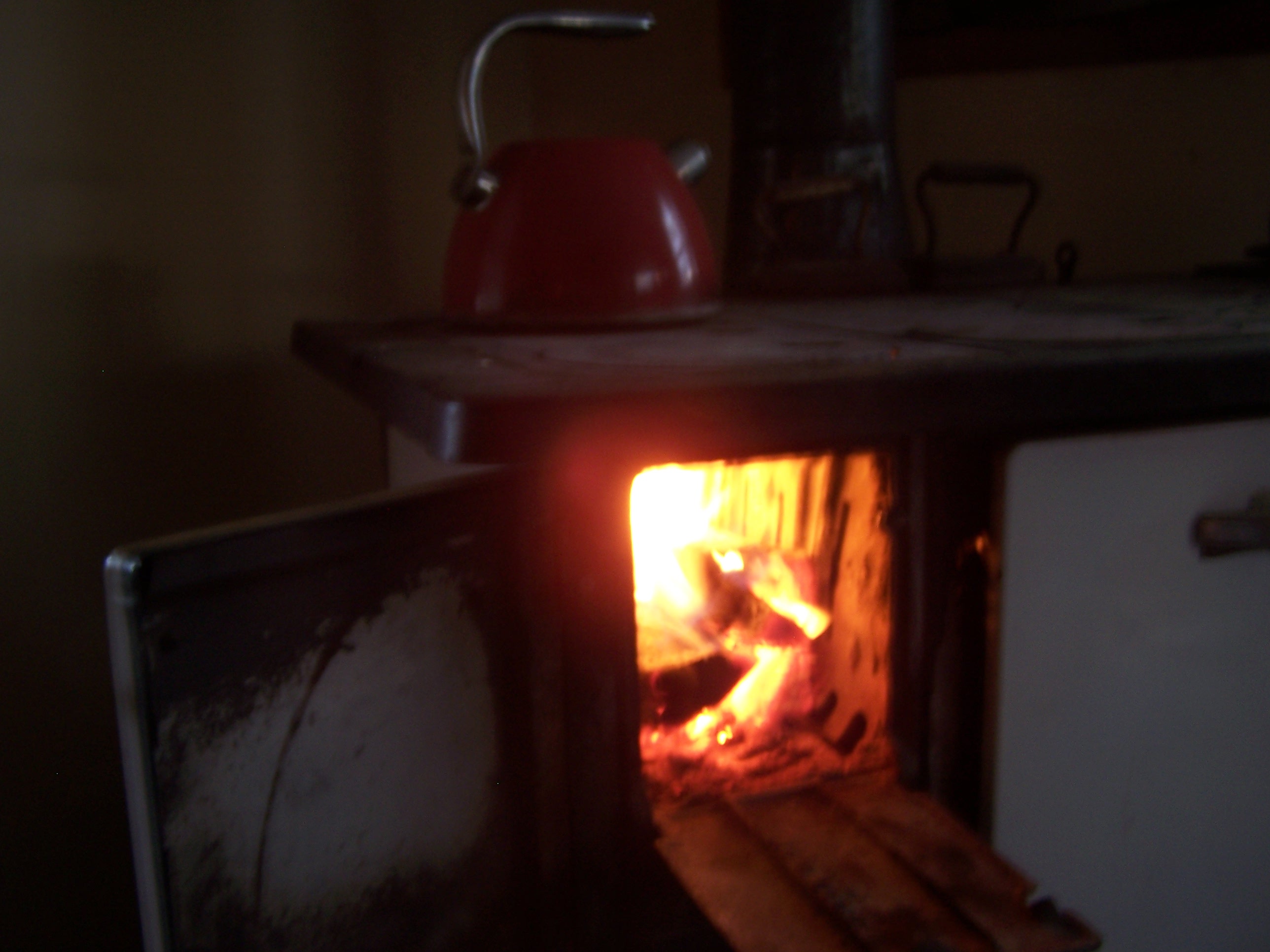
Old Faithful, Big Box
Not that it actually matters. There is an ugly creosote buildup on the glass in both lower corners even with ‘hot’ fires, with any level of air control, and if I want to watch the fire through the glass, I have to ignore the creosote or clean it daily, which doesn’t last until the end of the day.
The next page of the manual is about maintenance. Monthly, I’m supposed to check:
Brick rail tabs and brick rails
Air riser tube in the back of the firebox
Back slide of airwash chamber
Baffle locking pin
Boost tube cover
Not only are there NO DRAWINGS showing the location of these various important maintenance parts, my knees don’t work well enough to crawl around peering inside or under the stove. This would also require that no fire exist in the stove at the time of inspection, meaning my house would have NO HEAT except for little electric heaters in the bathrooms. The last few days have bottomed at sub-zero temps, at no time without fire. That would be a summer job, so I can only hope that the brick rail tabs and airwash chamber are OK for fire throughout the winter.
Genius.
Further, the maintenance instructions continue with “Cleaning the Chimney System”:
Top baffle board/blanket
Baffle
Top heat shield and mountain bolt
Baffle gasket
Brick rails
Manifold
Again, no drawings, diagrams, or other user aid.
I can only hope that I can keep my fires going until warm weather without having something fall apart and/or a chimney fire. Not exactly the peace of mind I had hoped for.
I’m refraining, with difficulty, from speaking of the overall worth of the owner’s manual. After all, I’m a writer and wordsmith dedicated to communicating clearly–not a stove engineer. Somebody apparently did their best with this booklet, sadly. The lack of drawings illustrating the key components of the stove is enough of a failure that the countless other shortcoming hardly bear mention. Pages 11 through 20 detail installation methods. Page 25 is blank. Hint to manual editor: PLENTY OF ROOM FOR DRAWINGS.
There is, however, a full page breakout drawing of the stove PARTS, as if the manufacturer was more interested in selling parts than in adequately explaining the stove’s functions.
At the moment, I’m not sorry I bought it. It does a better job than the old Big Box in keeping heat all night–with luck and holding my mouth right, coals are left in the morning ready for fresh wood. I do have to live with smoke pouring into the room while I try to load in wood and kindling, at which point I’m reminded that I could have stuck with the Jøtul. At least its Norwegian inventors/manufacturers figured out how to create a more environmentally-friendly wood stove without any need to allow smoke to pour into the room.
Note: Look for future updates on this saga once I try to find a person who can service this stove, the possible need for parts replacements, and the status of creosote buildup in the chimney.
Another note: I failed to mention that I still have the Big Box in use at the back of the house and also have this jewel of an old wood cookstove in my dining room complete with hot water reservoir.
Party leaders failed to see the long term need for younger, more vigorous candidates. The bulk of Biden’s term suffered from his shuffling gait, whispery voice, and apparent mental decline. Not that Trump is so much younger, but his demeanor as a bully conveys a message of strength. Sadly.
Dems also failed to foresee Biden’s inability to win a second term and consequently failed to hold a 2024 primary that would have introduced all best possible candidates. Call it allegiance to a venerable old warrior (Biden) or inability to break out of an established order of candidate precedence, or fear of the unknown, this lack of a so-called ‘fair’ fight in selecting a presidential candidate played a significant role in Harris’ defeat.
Sorry, but Kamala Harris was not popular in the 2020 primaries from which she withdrew for lack of funding. Built-in negatives aside from her mixed race and being female included her speech affectations which make her seem smug. One would think that the defeat of Hillary would have been lesson enough. For now, the fight is still between present day realities which are incomprehensible to conservatives and the “good old days” when men were ‘successful’ if they knew how to saddle a horse.
During Biden’s term, there was no apparent coherent approach to illegal immigration. This played into Harris’ weakness on this issue, which Biden appointed her to address. Whatever policy recommendations she made failed to make news cycles. As noted by the Washington Post, “Harris, in fact, has never been in charge of the border. The Department of Homeland Security manages migration. Her immigration role for the Biden administration has included boosting U.S. aid to Central America, traveling to the region and discouraging potential migrants from making the dangerous journey to the United States.” Be that as it may, if there had been a strong Biden policy on illegal immigration and prominent promotion of those policies, Trump wouldn’t have been able to make that topic a centerpiece of his campaign.
Yes, boosting U.S. aid to Central America is foundational to stemming the tide, as Harris knew. Sadly, the fact is that coherent immigration policies addressing root causes aren’t enough to stop people seeking better opportunities for themselves and their children. If your children are starving and your home and livelihood are daily threatened by violent gangs rampaging through neighborhoods, you too would leave behind everything you’ve ever known and walk to the promised land.
THERE IS NO GOOD SOLUTION to illegal immigration. There is no fence high enough, or military/border guard personnel vast enough to make illegal entry impossible. As climate change advances, more and more populations will face starvation and violent domestic turmoil. The U.S. cannot take them all. No one can. This message must be made clear. Trump’s plan to deport millions WILL NOT SOLVE THE PROBLEM. This is whack-a-mole thinking.
Biden, in the seeming tradition of Democrats and, in the words of Michelle Obama, “went high” when the Republicans “went low.” But we’re dealing with primitive thinking where the hero bashes the villain over the head. With no head bashing, there’s no hero. The villain wins. It’s past time for the Democrats to develop more than one track and start bashing. To greatest possible extent, yes, don’t give up the vision of a better world—peace, love, good vibes. But we also must carry a big stick and when somebody needs to get bashed over the head, bash the son of a bitch. The Biden administration’s justice department took waaaay too long quibbling over how/when/why to prosecute Trump for his shocking illegal acts. He should never have been free to run for re-election.
Not that Biden or the justice department had control over local and state prosecutions, but the failure of appropriate federal action left the door open for Trump to escape from prosecution in lower courts, as is now obvious. It was the first Trump presidency which allowed him to stack the Supreme Court, and that will be the case again. His sponsors are playing the long game, moves that have been feverishly planned since at least the 1950s. The strategy is to whip up fear and hatred to drive conservative voters to the polls, desperate to buy God’s favor by forcing the entire nation into a theocracy. None of this matters to Trump, whose entire plan involves self-enrichment, self-aggrandizement, and eluding justice.
True to their religious belief system, conservatives prefer government which regulates what the population does in their bedrooms and allows the business segment to run wild. The opposite is true for liberals, who believe what people do in their bedrooms is no one’s business and what the business community does can ONLY be regulated by government. Who else can force corporations not to dump industrial waste in our rivers? Ensure clean drinking water and safe food supplies? Mitigate the onslaught of pandemics? Enforce design and construction standards for roadways, bridges, and buildings?
These requirements of government are easily forgotten by a fearful, angry electorate who is not educated to understand these fundamental duties, an electorate even more distracted by a wannabe dictator whose success depends on agitating division with lies and false promises. This can only be effectively countered by an equally vociferous Democrat whose presence and actions meet the pseudo-strength of a candidate like Trump. Potential right-wing demagogues have the advantage of money flowing from a huge array of business interests. Liberals have only the People to carry on the framework for freedom established by the Founding Fathers:
We the People of the United States, in Order to form a more perfect Union, establish Justice, insure domestic Tranquility, provide for the common defense, promote the general Welfare, and secure the Blessings of Liberty to ourselves and our Posterity, do ordain and establish this Constitution for the United States of America.
Foundational to this vision was EDUCATION. Public education was not an afterthought of the American Revolution – it was a core ideal of our Founders. They maintained that a well-educated population was the only means of ensuring America’s future. The roots of taxpayer-funded public education in the United States can be traced back to the Massachusetts Bay Colony in 1647. The colony passed a law that required towns to establish schools, made children attend school, and allowed the state to levy taxes to support schools. This traditional determination now stands at risk from religious forces who have managed to divert tax dollars into support for private, religious schools which often slant their programs to fit a religious agenda.[1]
Could Obama have warded off this SCOTUS situation with his nomination of Merrick Garland for the post by steamrolling the Senate?
It is in full accord with traditional notions of waiver to say that the Senate, having been given a reasonable opportunity to provide advice and consent to the president with respect to the [Supreme Court] nomination of [Judge Merrick] Garland, and having failed to do so, can fairly be deemed to have waived its right. Here’s how that would work. The president has nominated Garland and submitted his nomination to the Senate. The president should advise the Senate that he will deem its failure to act by a specified reasonable date in the future to constitute a deliberate waiver of the right to give advice and consent. What date?…90 days is a perfectly reasonable amount of time.
– Excerpt from an op-ed column in The Washington Post on April 10 by Washington, D.C., lawyer Gregory L. Diskant, who is in private practice and also serves as a member of the national governing board of the liberal advocacy group, Common Cause.
“The Appointments Clause [of Article II] clearly implies a power of the Senate to give advice on and, if it chooses to do so, to consent to a nomination, but it says nothing about how the Senate should go about exercising that power. The text of the Constitution thus leaves the Senate free to exercise that power however it sees fit. Throughout American history, the Senate has frequently – surely, thousands of times – exercised its power over nominations by declining to act on them.
– Excerpt from a commentary about the Diskant column by M. Edward Whalen, president of the conservative advocacy group, the Washington-based Ethics and Public Policy Center, published April 10 on the National Review Online’s Bench Memo.[2]
Equally appalling was the lack of foresight by none other than Justice Ruth Bader Ginsberg who refused to retire during Obama’s presidency, which would have allowed another justice to step in on her coattails. Despite her excellent record and unfailing support for liberal causes, a bit of hubris caused her to cheat the future of a suitable replacement.
Democrats need to wake up! Making nice is not always the best course of action when we’re dealing with not only ignorant tyrants like Trump but also foreign bad actors with their thumbs on the scales.
[1] In June 2022, in Carson v. Makin, the high court held that when governments choose to subsidize private schools, they must allow such funds to pay for religious schools. A majority of current justices appear to believe that excluding religious groups from government programs is a violation of the First Amendment’s free exercise clause. Although court precedents prohibit direct funding of religion under the establishment clause, the current court could decide that if the state funds secular public charter schools, religious public charter schools cannot be excluded from such funding. See https://www.freedomforum.org/government-fund-religious-schools/
Progress came too fast for the evolutionary capabilities of humans. Suddenly, within one hundred years, men were expected to accept women as equals after millennia of their submission. Men were expected to adjust to working with their minds instead of their hands, their bodies eager and waiting for the first throw of the spear, the first clubbing of an enemy. The majority of men needed those physical triumphs to feel like man, and they still do.
A significant percentage of women still believe men are their superiors, the representative of their male god who tells them how to live in submission. It’s too much to expect that suddenly after only 100 years of having the right to vote and the right to contraception, women would universally embrace the responsibility of citizenship, of bodily autonomy.
Sadly, an official return to policies constructed of old fears and prejudices destroys people, most of whom have worked for decades—lifetimes—to ensure that Americans are able to pursue our personal needs and dreams, to become who we want and need to be despite centuries of repression and exploitation. Progress means making the world a better place where people don’t suffer from old hatreds and fears. Now women are losing the right to control what happens to their own bodies. Men and women risk losing their right to live and love as they are—gay, lesbian, bisexual, transgender and more. Anyone who isn’t white need not exist.
While attempting to fling us backwards to a time without electricity, running water, or air conditioning, not to mention television, cell phones, and antibiotics, conservatives seem to think society could obtain all those things WITHOUT concurrent changes in social norms. That’s not how it works. Advances in technologies and sciences go hand in hand with social change. In a democratic society, education sufficient to produce people who invent cell phones also produces realization of our innate value as individuals—no matter what gender, skin color, or ethnic background.
Back in the ‘good ole days’ women made the cloth. “Heagerty family members demonstrating the steps needed to spin cotton, Cave Springs (Benton County), about 1900. From right: removing the seeds, carding the fibers, spinning the thread, and winding it on a reel.” Jerry Ritter Collection (S-2004-20-6)
Irony is when people vote for policies that are oppositional to their personal needs. Irony occurs when those voters cherish their cell phones while remaining ignorant of the high levels of education required for their invention or the vast technological network that serves them. Irony occurs when those voters flock to doctors to deal with cancer and other life-threatening conditions whose increasingly successful treatments come about at the hands of highly educated scientists who understand the cellular function of DNA and RNA, terms about which those voters are utterly ignorant. Undoubtedly, key figures in those fields are women and/or LBGTQ+.
Today, mail seems almost quaint, often referred to as “snail mail” as we become more dependent on the easy flow of electronic email, texts, and messages. But in earlier times, as recently as 1900, communication beyond the in-person conversation or perhaps a written message sent across town by courier, mail was the only means of contact. The faithful transit of mail from place to place became an almost sacred duty for the people who established post offices.
Rural delivery to homes was not made available by the U.S. Postal Service until 1890. Even then, in the rugged landscape of parts of Washington County, mail delivery came by horse or mule to remote post offices into the early years of the 20th century. These post offices were gathering places, usually housed in small stores where a person might pick up mail and trade eggs for a fresh batch of crackers while catching up on news. As such, post offices served more than mail, also forging interpersonal connections and a sense of community.
A total of 104 post offices were established in Washington County, of which only fifteen survive today. The other 85 came and then vanished along with the community they served. The men (and a few women) who took the responsibility to provide mail service often became leaders in the county, holding the public trust, letter by letter, at their station at a dusty crossroads.
Most folks who live around these parts know the story of Winslow, Arkansas, a tiny village perched in the highest elevations of the Boston Mountains. They know about the railroad tunnel built back in 1881 that blasted through 1,700 feet of stubborn rock and shale. They know about the all-female city council, the so-called Petticoat Government, back in 1925. And most of them know about the pre-air conditioning turn-of-the-century influx of wealthy summer visitors eager to live in the cooler air found at that elevation.
But what most folks don’t know is what came before the railroad. And what came after the boom years ended in the 1930s. Winslow today is, in many ways, just as interesting and vital as it was in those boom years between 1881 and 1930. Its population remains steady at around 365 people, not counting the hundreds residing in the rugged hills and hollers surrounding the place, both groups peppered with eccentrics, artists, and others typical of the Arkansas Ozarks reputation. Sit a spell and visit.
Great companion read to the new WINFEST book! Check it out at Amazon!
I am grateful for this award from the Arkansas Historical Association, and for the many helpers and sources of information for this article about an amazing woman, Forrestina Bradley Campbell (no kin), otherwise known as White River Red. May she rest in peace. This article may be found in my book, “Around the County,” (available at https://www.amazon.com/Around-County…/dp/B0C126KF23) or in the Spring 2023 issue of “Flashback,” the quarterly journal of the Washington County Historical Society.
We need to stop thinking like peasants. We no longer live under the rule of a king or an aristocratic lineage of dukes, earls, and what not. We citizens of the United States (and most modern democracies) hold equal shares of power over ourselves, each of us with the right to assemble, speak our mind, and vote in order to maintain a government that protects us from any force threatening to bar our path to life, liberty, and the pursuit of happiness.
Apparently some among us have forgotten, or more likely never learned, that this is our gift as Americans. They are the 21st century serfs who plod along ignoring their rights—and their duties—as American citizens. Observers most often label these new age serfs as ignorant, but that’s not entirely the reality. These modern serfs are willfully ignorant, a choice they have made in order to avoid thinking.
True, thinking is a troublesome exercise. Thinking requires the gathering of all pertinent facts on any particular issue. Such fact gathering requires not only the time and effort of the exercise, but also possession of skills in such areas as rationality and research. These skills are taught to children in their school years, but the teaching is clearly inadequate. This inadequacy is not necessarily the fault of the teacher or the school system or the curriculum, although all three can be at fault to some degree. More likely the inadequacy is due to parents not practicing thinking at home.
This kind of generational non-thinking used to be the norm, back when most of us were serfs. Those were the days when a few traditional skills sufficed in meeting life goals. A serf served his/her lord—the duke, earl, or even the king—who made his expectations clear. A woodsman was to cut and haul wood. A farmer was to plant, cultivate, and harvest crops.
As explained in Wikipedia:
Serfdom is the forced labor of serfs in a feudal society. In medieval Europe, serfs were peasant farmers who worked without pay for a lord. In exchange, they got to live and work on the lord’s manor. They also got the lord’s protection. Serfs had more rights than slaves (for example, serfs could own property). However, they were not completely free. They could not move, marry, or leave the manor without the lord’s permission. In most serfdoms, serfs were legally part of the land. If the land was sold, they were sold with it. Serfs worked in their lord’s fields. They sometimes did other things related to agriculture, like forestry and transportation (by both land and river). Some also worked in craft and manufacturing … like the village blacksmith, miller or innkeeper. Serfdom developed from agricultural slavery in the Roman Empire. It spread through Europe around the 10th century. During the Middle Ages, most European people lived in serfdoms.
Serf children grew up learning about life from their parents, a life that followed the rules set down by their lord’s demands. The sawyer’s sons were sawyers. The tanner’s sons were tanners. Owned by their fathers as girls, females were handed over to their husbands to serve as wives and mothers, subject to his absolute control.
Those rules made it easy to decide what to do without having to think about it.
Ah, those were the days. There were established rules about not only what work to do each day, but what to wear (same homespun garments as the day before), what to eat (same basic gruel and bread as the day before), what to believe (acceptance of one’s humble place in life because the Bible said so), and so forth. Even a free man could become a serf if he owed a large debt. He would make an agreement with the lord of the land. The lord would keep him safe, give money to pay his debt, and give him land to work on. In return, he would work for the lord. All his children would become serfs.
So while our early ancestors arrived in the American colonies fresh from their peasantry, only a few of them brought with them the practice of thinking. This is the resistant strain of human nature, to do what the parents did, to blindly accept a set of rules to follow, to spend our days laboring to satisfy our lord and master. The goal has shifted only slightly in that we labor in the belief that if we work hard enough, we too can be a lord. This is the fantasy that controls so many, that someday when we’re lords, we won’t want the government to tax us. This is the thinking that allows the rich to pay taxes at the same rate as the rest of us, when their incomes surpass by billions the amounts we earn. Meanwhile, we bow down (at least mentally) to the lords who have achieved ‘greatness’ through wealth or power.
After all, peasants believe, how could lowly persons such as ourselves manage to decipher the intricacies of big business or political process much less discern the many aspects of personality and manipulation employed by the lords? How are we supposed to know what is true? We must believe what our chosen leaders tells us. Never mind what news source may or may not employ actual journalists, or who provide ‘news’ instead of ‘entertainment.’ It’s all a lie anyway, they say, throwing up their hands, disheartened.
Well, yes, these are difficult mental tasks for people who never learned how to research or reason. Besides, we’re busy trying to keep a roof over our head and food on the table.
A full 34% of the voting-eligible population did not vote in 2020, which saw the highest voter turnout since 1914. Even more concerning is the popularity of wannabe dictators like Donald Trump whose supporters openly ridicule education, basking in the praise of a man who “loves the poorly educated.” It should be no surprise that Democrats control 77% of the U.S.’s most highly educated Congressional districts (107 districts) while Republicans control 64% of districts where the fewest people went to college (107 districts).[1]
There is no controlling force that coerces individuals into peasant thinking. Such a role is heavily influenced by tradition and hardly mitigated by many educational opportunities. Community plays a role as well, either offering role models who use thought and action to move beyond peasantry, or by warning of negative results for those who try to move beyond their family traditions of non-thinking. It is often easier to remain in the trenches than to climb out, especially when one has failed to grasp the tools which make climbing possible. Plus, who wants the responsibility of stepping up to the plate? I might swing and miss.
Our society and especially our educational systems are failing to penetrate the mental laziness of lingering peasantry enticing us to depend on lists of rules handed down by lords. Curriculum for all schools, public, private or religious, should provide the methods of rational thinking in order to protect malingering peasants from their self-destructive (and democracy-destroying) behavior. Curriculum requirements should include debate where fact-based points are presented on a chosen topic. A thorough understanding of civics and history should form the core of classes that also teach language arts and mathematics/logic. At strategic points in those school years, there should be lessons in conflict resolution as well as introduction to introspection.
The answer is stepping up to our human potential, NOT to install a wannabe king.













 denelecampbell
