Family stories

The holiday season is a time when families gather and stories are told. This year I’m happy to see Facebook posts by a cousin who has gone to the trouble to scan his 104-year-old mother’s photos and record the stories behind them. Such a wonderful project!

Here’s the photo and story he posted today.

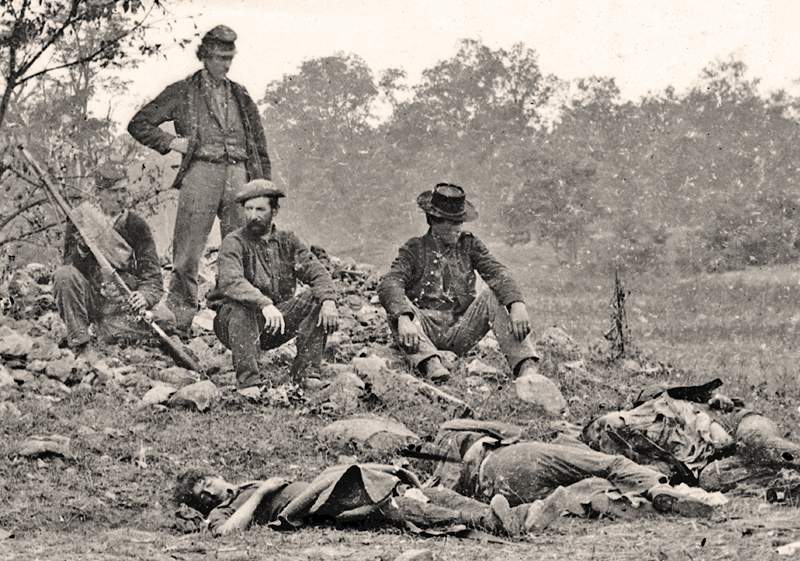
Grandpa Tom Morrow sitting in the field with Uncle Graydon, teaching Uncles Durward and Douglas how to plow. This past weekend, Mom told me that the mule’s name was Toby. Toby evenutally got loose and was killed by a train as they lived near train tracks at the time. Mom said that she and her siblings convinced themselves afterwards that the chugging sound made by trains coming by were actually the train saying “I killed Toby, I killed Toby”. Circa 1925, Texas

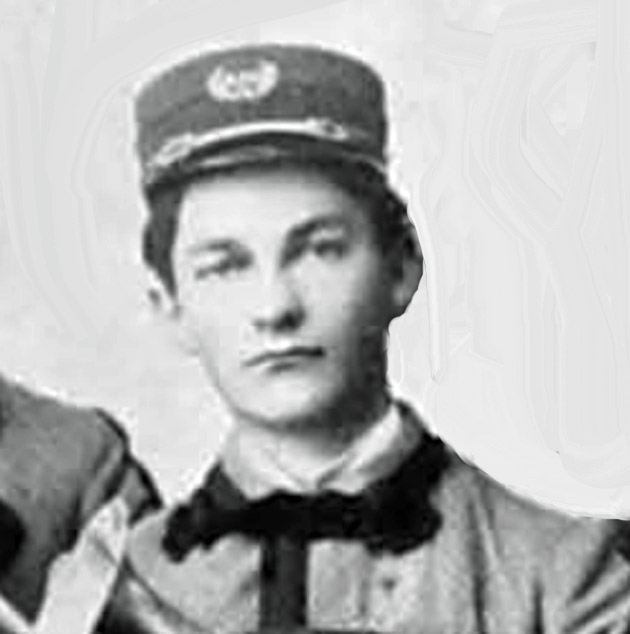
Frank Barr, Bandman

Barr in the UA Cadet Band, 1897
UA Cardinal Yearbook

The question of when and how Frank Barr picked up a cornet and learned to play remains unanswered in the mists of time. Yet at the age of eighteen as a student at the University of Arkansas in 1892, this young man not only played but would soon become the bandleader for the University Cadet Band. He would go on to direct the University band for twenty years as well as recruiting youth for “Barr’s Boys Band” through the 1930s. But these were not Frank Barr’s only contribution to the community of Fayetteville and the surrounding region.

Ambitious and hard-working, Barr seemed to be in many places at once. He ventured throughout the region helping local community bands develop. He traveled in an ever larger arena to establish a string of silent movie theaters, perhaps because at that point in the media, music was expected to be performed while the movie reels rolled. He also prevailed upon Fayetteville town fathers to support a community band, to serve in various settings. The Commercial League Band went on to please multiple regional audiences.

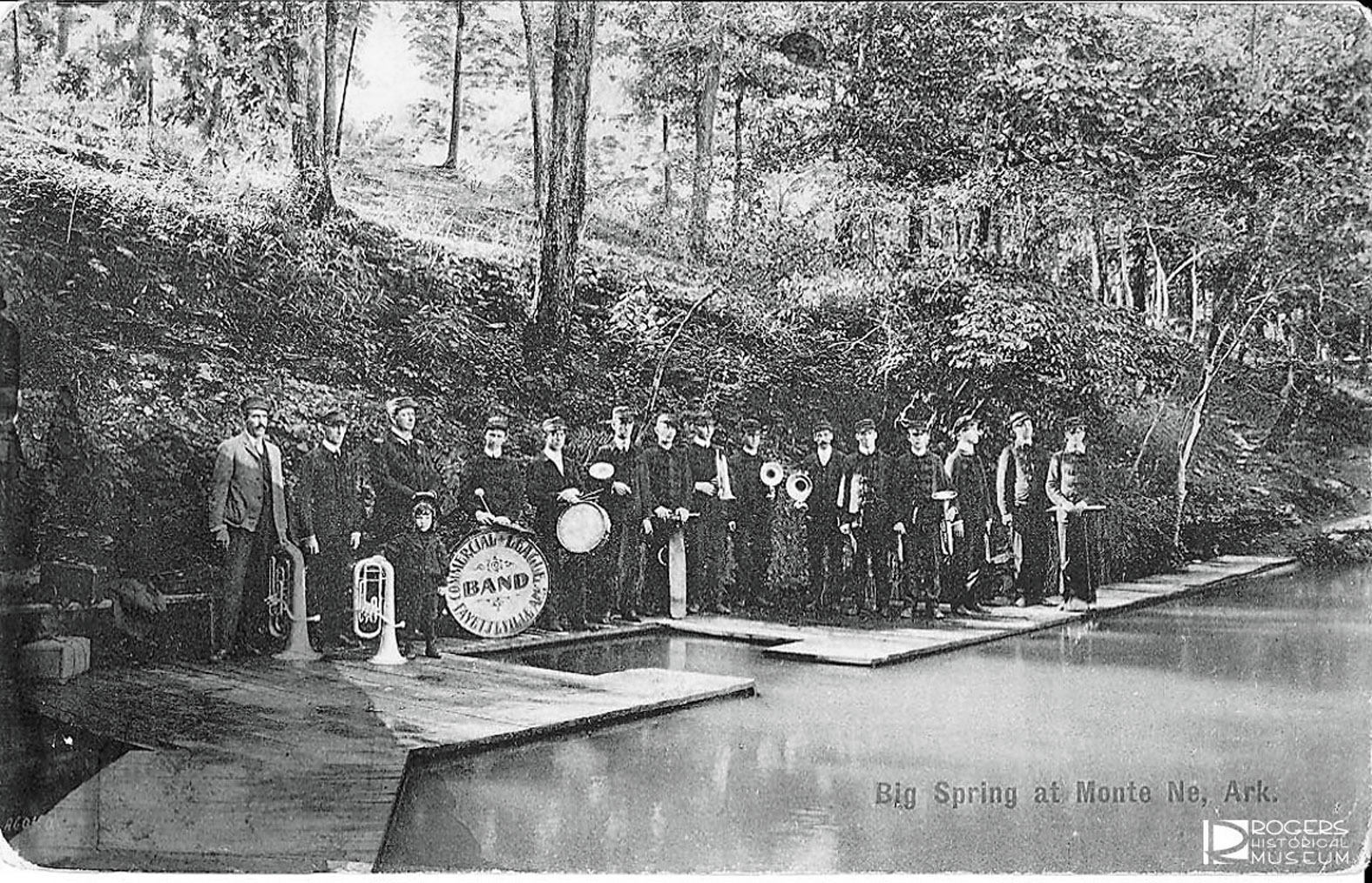
Accessed Dec 5, 2021 @ https://www.facebook.com/RogersHistoricalMuseum/photos/a.124863646257/10160936223681258/

Above: At Monte Ne. Frank Barr third from left with his son Clinton standing in front of him. Monte Ne’s creator William “Coin” Harvey always ensured that his resort guests stayed entertained during their visit. Whether it was by going to plays, listening to music or attending dances, his guests were assured to have a good time while at Monte Ne. This 1910 photo of the Commercial League Band from Fayetteville shows the ensemble standing in uniform on the wooden walkway around the edge of Big Spring.

Barr’s work with the Commercial League Band expanded to include playing at the skating rink as well as dances, the park, and open air concerts on the Square. In 1909, Barr took over a fledgling silent picture project that had operated briefly at the Ozark Opera House. He began showing the films, first in an open air setting at the corner of West and Dickson, then within months at 17 N. Block which he named Lyric Theater. He soon built a new theater at the northwest corner of Block and Meadow, tailored to the needs of an audience with its sloped floor and state of the art ventilation.

Alongside his growing responsibilities to the University, the community, and his various pursuits in promoting music, Frank and his wife Annie suddenly found themselves confronted with unthinkable. Their only child Clinton developed a serious medical condition, an ailment of his lungs. In August 1912, Frank and wife Annie took Clinton to Mayo Clinic in Rochester, Minnesota where two operations were performed. Another operation was performed in early January 1913, and before the end of the month, Annie asked Frank to come to Rochester as Clinton would require yet another operation. By June 1913, the situation with Clinton Barr had not improved. In a telegram to close friend Al Rife, Frank Barr described what his family faced.

“Necessary for another operation, could not live without it. Operation not so serious as before, lungs in far worse condition than ever, the x-ray locating nest of pockets, some the size of walnuts. Don’t know when can get in hospital. Opening made by previous operation will assist in this operation.”

The complicated and amazing story of Frank Barr reveals a man of vision and formidable emotional strength as he managed to keep up with the many demands before him. He and Annie mortgaged their properties to pay for Clinton’s medical expenses. He poured his energy into his Boys Band, playing in local parades and providing music for the new Lyric Theater. First reported in August 1912 when they were praised for their performance at the A.H.T.A. (Anti-Horse Thief Association) picnic at Elkins, the Boys Band was soon in demand around the region. In June 1913, they traveled to St. Paul to play for a three-day reunion. “The reunion people can rest assured that they will be furnished with good music,” the paper reported. “And besides, it will be quite a novelty to hear the Kids play. They always make a big hit wherever they go, and it will be a big drawing card for the Reunion.” The band performed so nicely that fall at the Washington County Fair that they were invited to perform at the state fair at Hot Springs.

Barr’s life is a fascinating testament to one man’s love of music and for his family. Read the whole story in The Music Men of Turn-of-the Century Fayetteville, available at the Headquarters House offices of the Washington County Historical Society, or from Amazon.com


It’s Here! AROUND THE COUNTY: Histories of Washington County, Arkansas

This collection of articles covers an eclectic range of subjects from the earliest settlers (and their contribution to the development of the county and the nation) to the 20th century enigma of a former carnie known as White River Red. What about UFOs? What about the Old Wire Road and its storied history in south Washington County? Or the county’s 4 Riverside Parks, 12 skating rinks, and 8 flour mills are among the stories found here (umm, butter melting on hot BREAD!), each selection delving into some fascinating aspect of Washington County life. It’s a joyful and sometimes heartrending read, perfect for a home library or as a gift. Don’t miss this latest contribution to the archives of local history!

Paperback, $19.99, at Amazon.com

A Tale of Two William Shores

Coming SOON! “Around the County,” new collection of articles about the history of Washington County.

From the first chapter:

Among the earliest settlers of Washington County were two men named William Shore. Distantly related in the Shorr lineage which arrived in the British American colonies by 1750, these two men seem not to have known of each other’s presence in this county. They each set about making a place for themselves. The first, William Dahl Shore, enlisted in the U.S. Army in 1833 and served in Co. H, U. S. Regiment of Dragoons (subsequently 1st U. S. Cavalry Regiment) as they occupied Fort Gibson “employed in scouting among the Indians, especially along the Missouri frontier, a portion of the regiment going to Nacogdoches, Texas, for the purpose of keeping off white trespassers from the Indian country, and preserving peace between whites and Indians and among the Indians themselves; also in building wagon roads and bridges.” Once he’d served his three year term, W.D. Shore bought land at Taney (later Brentwood) and served as the first postmaster.

The other William Shore stayed only ten years on his land along the western boundary of Washington County before leaving with the Lewis Evans Company for the California gold fields. In the process, he quickly saw that providing meat and other supplies for the miners produced greater wealth than mining and adjusted his enterprise accordingly. Some of his siblings remained in the county.

These two William Shores, both entrepreneurs and adventurers, illustrate the type of men who helped create this county.

(Pictured: In the right foreground stands a subaltern of the First Regiment of Dragoons; in the left foreground is an ordnance sergeant-of which there was one on every Army post. By H. Charles McBarron, Jr.)

May be an image of 3 people and people standing

Arkansas and CRT

Arkansas’ new governor, Sarah Huckabee Sanders, has raised the colors for her term at the helm of the ship of this state. Not that these are ‘her’ colors, per se, but rather edicts scripted for her by her bosses behind the Republican curtain. These are the same entities who put her in front of a microphone to lie for Trump as his press secretary, apparently under the promise that they would support her efforts toward future political office.

Evidence of her bought-and-paid-for status can be found in the immediate issuance of her ban on Critical Race Theory (CRT) in the public schools. The boiler-plate executive order commands, in part, that the Arkansas Department of Education:

Review the rules, regulations, policies, materials, and communications of the Department of Education to identify any items that may, purposely or otherwise, promote teaching that would indoctrinate students with ideologies, such as CRT, that conflict with the principle of equal protection under the law or encourage students to discriminate against someone based on the individual’s color, creed, race, ethnicity, sex, age, marital status, familial status, disability, religion, national origin, or any other characteristic protected by federal or state law.

Sanders’ measure is put forth as enforcement of Title IV and Title VI of the Civil Rights Act of 1964 (P.L. 88-352, 78 Stat. 241), which was established to ensure equal rights to everyone.

People of one color, creed, race, ethnicity, sex, age, marital status, familial status, disability, religion, national origin, or any other characteristic protected by federal or state law are inherently superior or inferior to people of another color, creed, race, ethnicity, sex, age, marital status, familial status, disability, religion, national origin, or any other characteristic protected by federal or state law…

This and similar bans present three absurdities. One, the ban alleges that efforts to reduce and/or eliminate the negative impact of entrenched racism are a form of racism. Two, the ban demonstrates either an utter lack of understanding of CRT or an ingrained denial of systemic racism, either of which would be remedied by a study of CRT. The rightwing furor over CRT is a perfect example of racist thinking and reassures its racist followers that rightwing Republicans will resist any effort to encourage white people to think equitably of their darker-skinned brethren.

Critical Race Theory advances the idea that multiple aspects of American law, institutions, and social structures enshrine racist ideas. Wikipedia describes the tenets of CRT as follows:

Scholars of CRT say that race is not “biologically grounded and natural”; rather, it is a socially constructed category used to oppress and exploit people of color; and that racism is not an aberration, but a normalized feature of American society. According to CRT, negative stereotypes assigned to members of minority groups benefit white people and increase racial oppression. Individuals can belong to a number of different identity groups…

Derrick Albert Bell Jr. (1930 – 2011), an American lawyer, professor, and civil rights activist, writes that racial equality is ”impossible and illusory” and that racism in the U.S. is permanent. According to Bell, civil-rights legislation will not on its own bring about progress in race relations; alleged improvements or advantages to people of color “tend to serve the interests of dominant white groups,” in what Bell calls “interest convergence.” These changes do not typically affect—and at times even reinforce—racial hierarchies. This is representative of the shift in the 1970s, in Bell’s re-assessment of his earlier desegregation work as a civil rights lawyer. He was responding to the Supreme Court’s decisions that had resulted in the re-segregation of schools.

The concept of standpoint theory became particularly relevant to CRT when it was expanded to include a black feminist standpoint by Patricia Hill Collins. First introduced by feminist sociologists in the 1980s, standpoint theory holds that people in marginalized groups, who share similar experiences, can bring a collective wisdom and a unique voice to discussions on decreasing oppression. In this view, insights into racism can be uncovered by examining the nature of the U.S. legal system through the perspective of the everyday lived experiences of people of color.

According to Encyclopedia Britannica, tenets of CRT have spread beyond academia, and are used to deepen understanding of socio-economic issues such as “poverty, police brutality, and voting rights violations,” that are impacted by the ways in which race and racism are “understood and misunderstood” in the United States.[1]

Conservatives, including Governor Sanders’ managers, look for any advances toward greater social equity as a destructive force to their world view. Or, perhaps more to the point, greater acceptance of social equity would reduce or eliminate race as a hot button issue in driving Republican voters to the ballot box.

One conservative organization, the Heritage Foundation, recently attributed a whole host of issues to CRT, including the 2020 Black Lives Matter protests, LGBTQ clubs in schools, diversity training in federal agencies and organizations, California’s recent ethnic studies model curriculum, the free-speech debate on college campuses, and alternatives to exclusionary discipline—such as the Promise program in Broward County, Fla., that some parents blame for the Parkland school shootings. “When followed to its logical conclusion, CRT is destructive and rejects the fundamental ideas on which our constitutional republic is based,” the organization claimed.[2]

[On the other hand,] Leading critical race theory scholars view the GOP-led measures as hijacking the national conversation about racial inequality that gained momentum after the killing of George Floyd by a white police officer in Minnesota. Some say the ways Republicans describe it are unrecognizable to them. Cheryl Harris, a UCLA law professor who teaches a course on the topic, said it’s a myth that critical race theory teaches hatred of white people and is designed to perpetuate divisions in American society. Instead, she said she believes the proposals limiting how racism can be discussed in the classroom have a clear political goal: “to ensure that Republicans can win in 2022.”[3]

With all cannons on deck loaded with her preprogrammed agenda, we can be certain this is only the beginning of pushing Arkansas further into the sea floor. Ironically, argument can be made that the label ‘ideologies’ such as forbidden in the CRT ban could be assigned to religion, i.e. “the beliefs and practices of that religion [which] support powerful groups in society, effectively keeping the existing ruling class, or elites, in power.”[4]

Oh, and the third absurdity? Critical Race Theory is not part of public school curriculum. It’s a college level subject.


[1] https://en.wikipedia.org/wiki/Critical_race_theory

[2] Sawchuk, Stephen. “What Is Critical Race Theory and Why Is It Under Attack?” Education Week, Ma 18, 2021. Accessed Jan 12, 2023 @  https://www.edweek.org/leadership/what-is-critical-race-theory-and-why-is-it-under-attack/2021/05

[3]  “Critical race theory is a flashpoint for conservatives, but what does it mean?” PBS Newshour, Nov 4, 2021. Accessed Jan 12, 2023 @ https://www.pbs.org/newshour/education/so-much-buzz-but-what-is-critical-race-theory

[4] https://revisesociology.com/2018/11/09/is-religion-ideological/

The Family Histories of Breckenridge, Williams, Morrow,

Smelser, Andrews, Clark, Hall, Massey, and Eubanks

Plus Lovelady and Futrell

in Greene County, Arkansas

Combining generations of family history and up-to-date genealogical information, this collection of ancestry information tracks a group of families which settled in Greene County, Arkansas in the first two decades of statehood. Family trees, deed records, census records, and other official records create a factual framework for personal narratives and vintage photographs, creating a fascinating archive of information for any descendant of these families as well as any fan of local history.

Each marriage between these pioneer families brought certain talents and backgrounds to the next generation. They farmed the rich land of Crowley’s Ridge and other Greene County areas, weathered the storms of poverty and loss, and suffered the losses to sickness and war. Yet they survived, and their great-grandchildren entered the twentieth century determined to continue as they had begun.

Now the 21st century brings us the internet with its vast collection of historical documents, making it finally possible to reflect on their adventures and aspirations. The story of these families is the story of thousands of us descended from them. Includes an extensive ‘vocabulary’ of downhome sayings.

Paperback $14.95, Amazon

When Fayetteville Moved on Four Hooves

These are the stories of the innkeepers, stagecoach lines, and stablemen who served Fayetteville, Arkansas—and the region—for the first one hundred years. Travelers and new arrivals, salesmen and politicians, and shipments of food and goods all depended on horses, mules, oxen, stagecoaches, wagons, and buggies to carry out their plans. The animals required shelter, experienced care, feed, and hay. An array of craftsmen—wagon makers, blacksmiths, farmers, saddle makers, and farriers—supported the transportation industry, ensuring that the various needs of this expansive industry were met.

Who were the men who established inns, built stables, and bought sturdy stagecoaches? Where did they come from and how did they end up here? What experiences taught them the skills needed to fulfill their ambitions?

These fascinating biographical sketches along with vintage photographs re-create a time long gone, but not forgotten.

Paperback $19.95 Amazon

I’ll be on hand to sign copies 2:30 to 3:30 p.m. December 11, Washington County Historical Society 118 West Dickson, Fayetteville

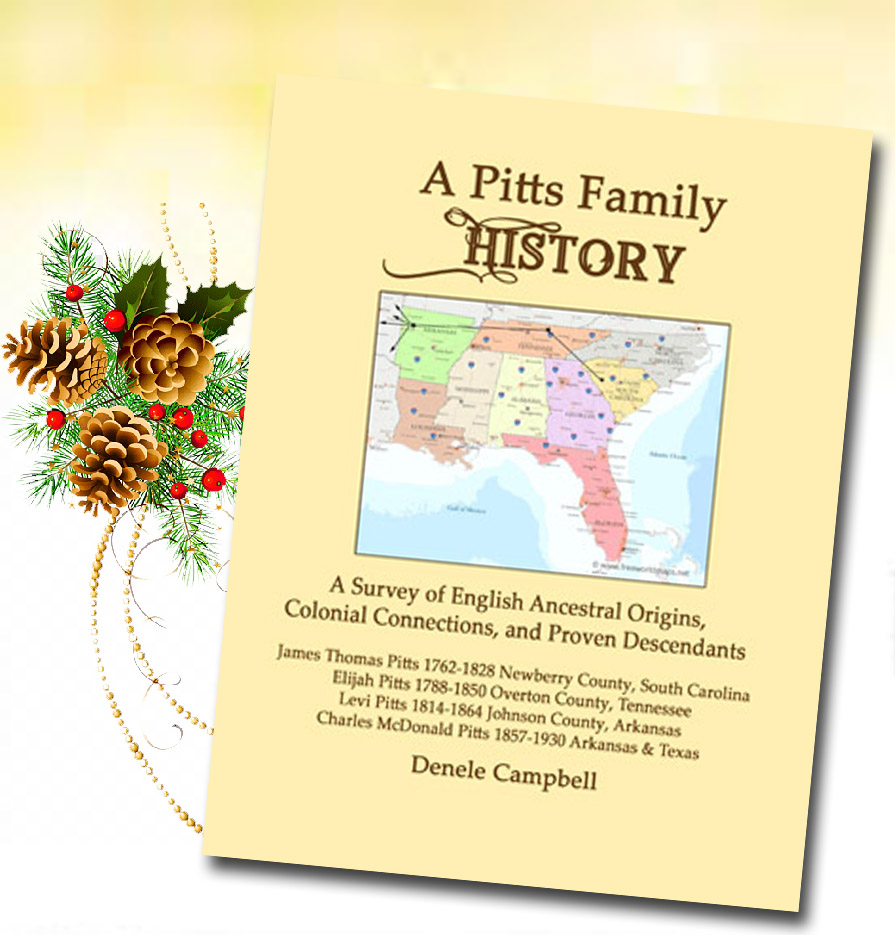
A Pitts Family History

A Survey of English Ancestral Origins, Colonial Connections, and Proven Descendants

This genealogical study of one particular lineage of the many Pitts in America surveys the ancient origins of the Pitts name, the Pitt notables of English history, and the arrival of Pitt/Pitts in the American colonies. Discussion of ancestral Pitt/Pitts in England and American colonies leads to identified ancestors.

At the time of the first U.S. census in 1790, the Pitts ancestors of our interest live in Newberry County, South Carolina. Among the households of Pitts, we find Thomas Pitts and his son Elijah and follow Elijah into Overton County, Tennessee by the early 19th century.

By 1850, the federal census records Elijah’s sons Hiram and Levi in Johnson and Pope counties, Arkansas, working as farmers in the fertile bottomlands of the Arkansas River valley.

Details of Pitts participation in the Revolutionary War and the Civil War are included as well as information about the wives of Elijah’s sons. Subsequent generations are shown up to 1950 as this history narrows down to the life and offspring of Levi’s youngest son, Charles McDonald Pitts.

Full of descriptive details garnered from multiple sources, this family history relies on Ancestry.com, online genealogical resources, census records, wills, deeds, and military records, family histories recorded in family Bibles, letters, and notes, as well as research at cemeteries, churches, and courthouses. Vintage photographs of some family members are also included.

Other families include Matthews, Crabtree, Bilbrey, Davis, Bynum, Parker, Rose, and West.

Paperback $11.95, Amazon

The West Fork Valley: Environs and Settlement before 1900

Rushing down the northern slopes of the Boston Mountains, for millions of years the West Fork of White River has carved its sinuous path northward. Caves, hollers, steep bluffs, and rich bottomland followed in its wake. Native people made their homes here, hunting buffalo and deer. Within a few years after the Louisiana Purchase, white settlers arrived to set up homesteads.

This book briefly describes how this valley formed over millions of years, how Native tribes lived and hunted here, and what the first white men saw when they arrived. Short biographies of the earliest pioneers portray a fascinating assortment of men and women determined to carve out a livelihood from this rugged land.

Subsequent chapters describe the mills, churches, and early roads as well as the neighbor-to-neighbor conflict of the Civil War. Stagecoaches hurtled down the valley roads, later supplanted by the iron horse in 1882 with the completion of the railroad tunnel at Winslow. A chapter on crime reveals shootouts, knife fights, and barn burning. Histories of Winslow, Brentwood, Woolsey, West Fork, and Greenland outline their origins and heydays.

A must read for any resident of the valley, but a fascinating chronicle of human endeavor for any reader.

Paperback $23.95, Amazon or $20 at Headquarters House, Washington County Historical Society, 118 West Dickson, Fayetteville AR

The Violent End of the Gilliland Boys

Christmas Day horse races 1872, Middle Fork Valley. Bud Gilliland waits, eager for another chance at Newton Jones. Only this time, after two years of sparring, Newton gallops up in a cloud of dust, lifts his Spencer rifle to his shoulder to find Bud in his sights, and pulls the trigger, sending Bud to a well-earned grave.

Determined to wreak vengeance on his little brother’s killer, William Jefferson “Jeff” Gilliland takes control of a posse meant to bring Newton Jones to justice. But Jeff’s plan for the posse to kill “every last son of a bitch” goes horribly wrong and brings indictments for murder against Jeff and the rest of his posse.

Before the curtains closed in 1890 on these descendants of West Fork pioneers J. C. and Rebecca Gilliland, two other sons and a grandson would die violent deaths while yet another grandson serves hard time for murder.

What was it about the Gillilands?

This recounting of the family tracks their ancestry, their pioneer years on untamed land, and the hard work that made them one of the wealthiest families in Washington County, Arkansas. A fascinating tale of brash ego, brave gallantry, and plain old bad luck.

Paperback, $ 9.95, Amazon