Kinfolk!

Combining four generations of family history and up-to-date genealogical information, this collection of ancestry information tracks a group of families which settled in Greene County, Arkansas in the first two decades of statehood. Family trees, deed records, census records, and other official records create a factual framework for personal narratives and vintage photographs, creating a fascinating archive of information for any descendant of these families as well as any fan of local history.

Each marriage between these pioneer families brought certain talents and backgrounds to the next generation. They farmed the rich land of Crowley’s Ridge and other Greene County areas, weathered the storms of poverty and loss, and suffered the ravages of sickness and war. Yet they survived, and their great-grandchildren entered the twentieth century determined to continue as they had begun.

Now the 21st century brings us the internet with its vast collection of historical documents, making it finally possible to reflect on their adventures and aspirations. The story of these families is the story of thousands of us descended from them.

Nab your copy, only $14.95

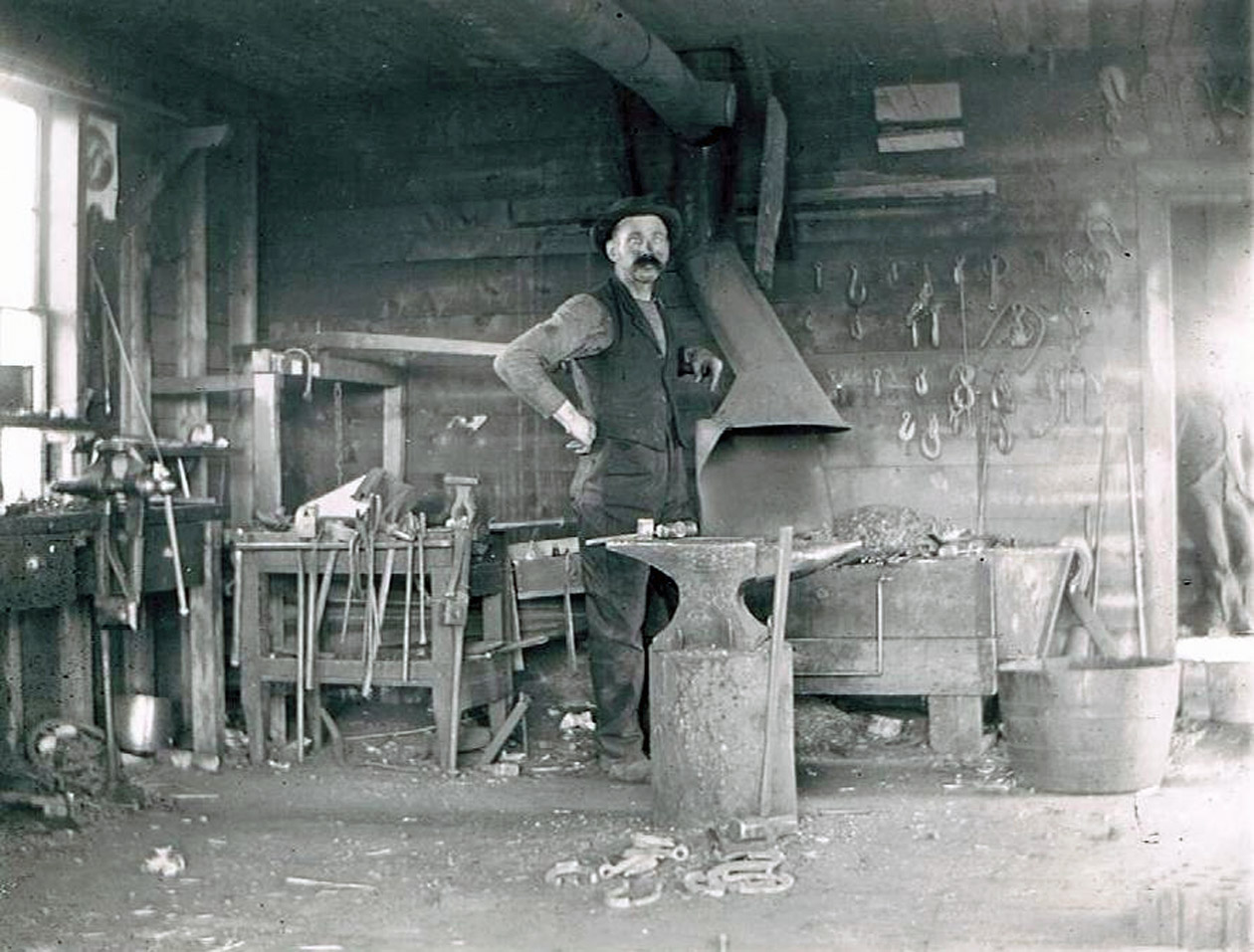
West Fork Blacksmith, James William Bell

James William Bell was born September 6, 1852, to William John and Mary Frances (Boggs) Bell. William’s family lived in Kentucky at the time he was born, but he had moved to Missouri before he married Mary there in 1846. Their son James was born in Missouri. William died at Anderson, McDonald County, Missouri between 1876 and 1880.

Upon the death of his father, James moved to the fledgling village of West Fork in Washington County, Arkansas, where he met and married Lucinda Linda Epps on December 2, 1879. Their children were Edna Mae (Bell) Latham (1880-1953) and Thomas Tillman Bell (1889-1973). The 1900 census shows the family household at West Fork with James 47, Linda 41, and Kilman 11 (Tillman). James named his occupation as blacksmith, and he and Linda owned their home without mortgage.

From the earliest record of West Fork as a formally organized town, Bell’s name appeared regularly. A group of men visiting West Fork noted, in an 1885 newspaper article, that “During our stay in West Fork, we were the guest of Mr. James Bell, the best blacksmith in the whole country, and a most excellent gentleman and citizen.” Bell was among the men who signed the petition to organize the town, submitted to the Washington County Court on May 3, 1885. His blacksmithing business was among West Fork enterprises listed in Goodspeed’s 1889 history of the county.

Bell specialized in horseshoes, but served a wide trade of needs for articles of made of metal. A history of blacksmithing in the 1800s notes:

“Blacksmiths living in the 1800s took on the roles of both tradesmen and businessmen in order to manage successful workshops and provide a variety of services. Townspeople and farmers alike valued the range of skills blacksmiths possessed and relied on them to create the tools and implements necessary for survival. Smiths could manipulate metal in endless ways, but usually created and repaired farm equipment such as hoes, plows, rakes and other tools as well as hardware and wheels for wagons, kitchen utensils and horseshoes.

“Smiths managed their businesses carefully and kept detailed records of daily work orders and the debts owed by their customers. They interacted with other business owners in their community to build solid professional networks and advertise their services. Because they worked for themselves, smiths had to skillfully negotiate their compensation, which often took the form of cash payments, traded goods, or services promised by customers skilled in other trades.

“Smiths kept their workwear simple and functional by dressing in everyday clothing and adding a leather apron to protect from stray sparks. Crafted from affordable cowhide, the apron allowed for free movement while providing essential protection. It covered the blacksmith from the waist to below the knees and sometimes split in the middle to allow smiths to cradle the leg of a horse when fitting shoes. Blacksmiths usually wore sturdy boots to protect their feet and a belt to hold their frequently used tools. Smiths did not wear gloves because they preferred direct contact with the metal being worked.”[1]

In February 1882, Bell was among nine West Fork men who served as charter members for a local chapter of the Odd Fellows lodge. In July 1883, Bell was one of men called to serve on the county’s grand jury. In 1886, he was one of three men selected by the county’s Democratic Party to serve as poll ‘judges’ for West Fork.

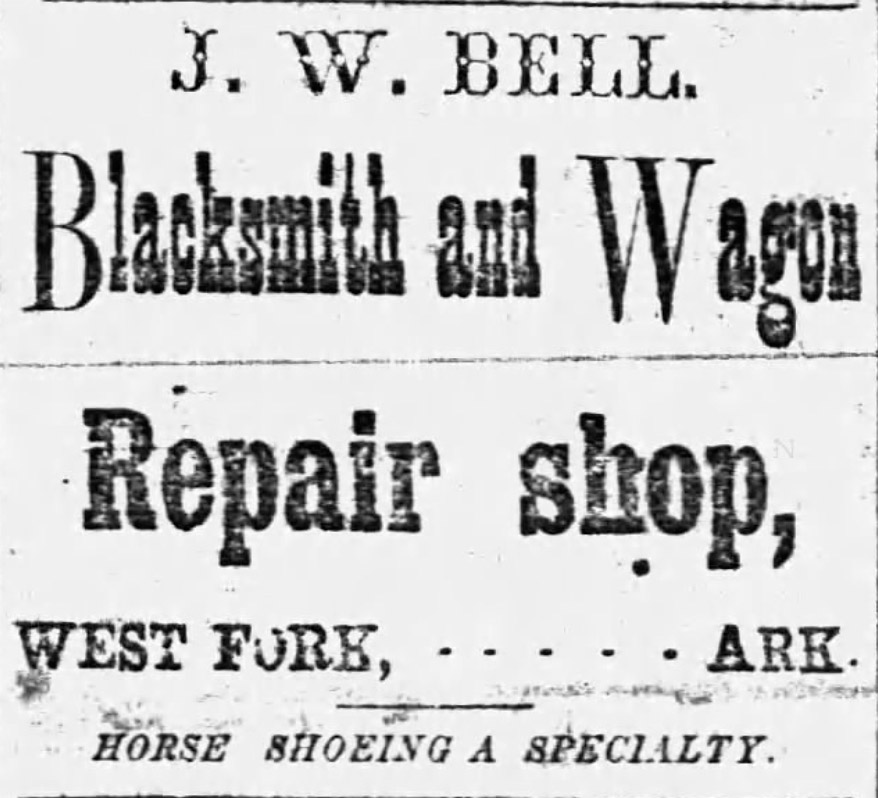
He regularly advertised his blacksmithing services in the Fayetteville Weekly Democrat throughout the early 1880s, stating in one 1887 ad that “Work guaranteed and done on short notice. Prices low.” Another mention in that year’s newspaper stated that “James W. Bell, of West Fork, whose handy-work furnishes the farmers in that community with the best of implements, was in the city [Fayetteville] yesterday. He was accompanied by Mrs. Bell.”[2] No advertisements are found after 1887.

In March 1907, James and Lucinda deeded a West Fork lot to “The Deacons and Elders of the Christian Church of West Fork…for church purposes only, and unto their successors in office.” The property was located in Bells’ Addition to West Fork, “beginning at the NW corner of Bell’s Addition and running south 25 degrees East 100 feet, thence East 50 feet, thence North 25 degrees West 100 feet, thence West 50 feet to the beginning, containing Lot One of Bell’s Addition.” It was further noted that “when not occupied by the Christian Church, it shall be free to any and all orthodox denominations to preach in, and when this property is not used as herein stated, this land shall fall back to the original owners, J. W. Bell and Lucinda Bell, or their heirs.”[3]

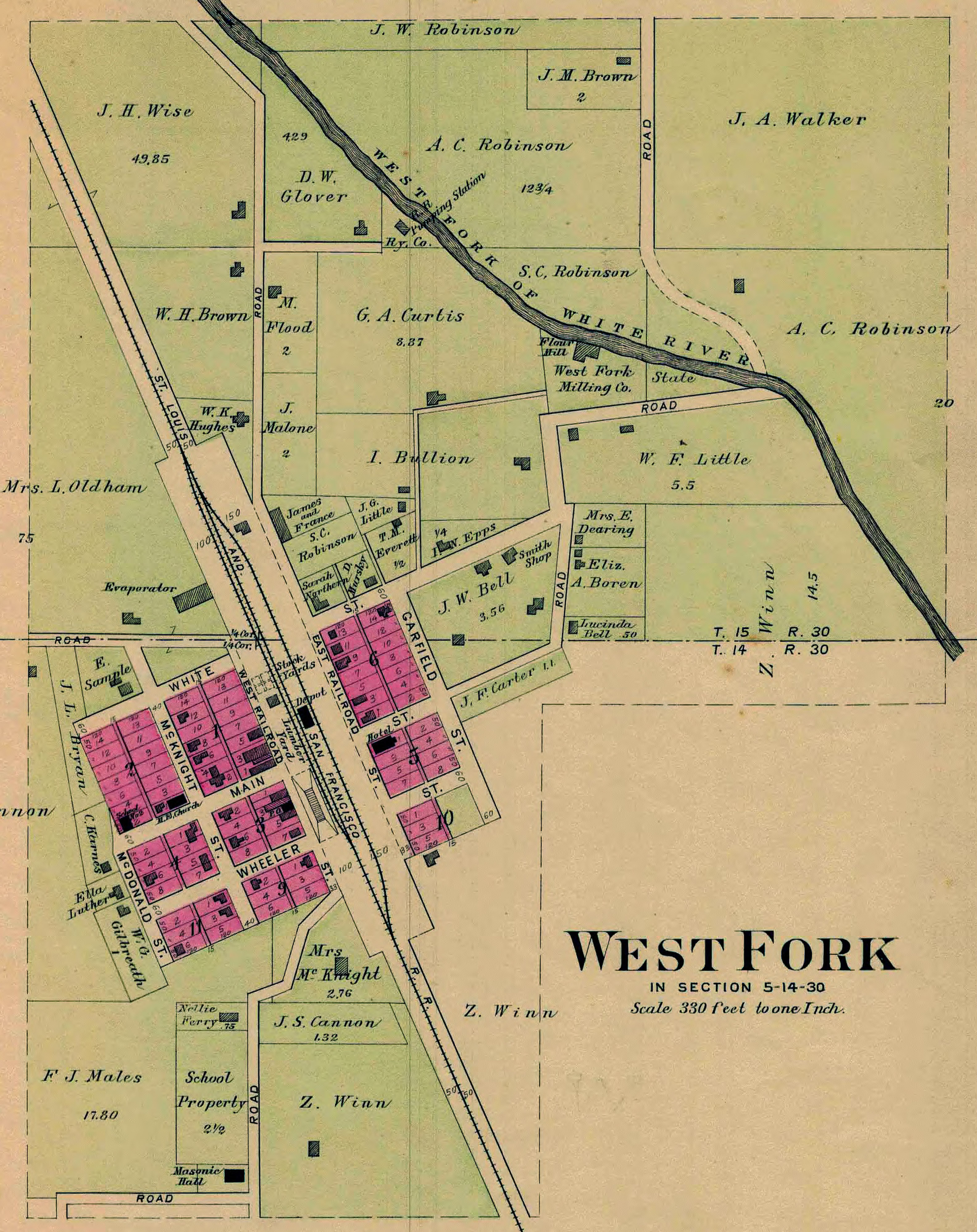
In this 1908 plat of West Fork, J. W. Bell’s property features prominently. His ‘smith shop’ is marked and their home is probably the structure shown just west of the shop.

James died April 8, 1910, at the age of 58 and is buried at the West Fork Cemetery. Lucinda died in 1958 just a few months short of her one hundredth birthday, and is buried beside James.


[1] More at https://workingtheflame.com/blacksmith-life-1800s/

[2] Fay’vl Weekly Democrat, Sept 23, 1887, p 3

[3] Deed Record 116-437, Washington County Archives, Historical Courthouse, Fayetteville, Arkansas

The West Fork Valley: Its environs and settlement before 1900

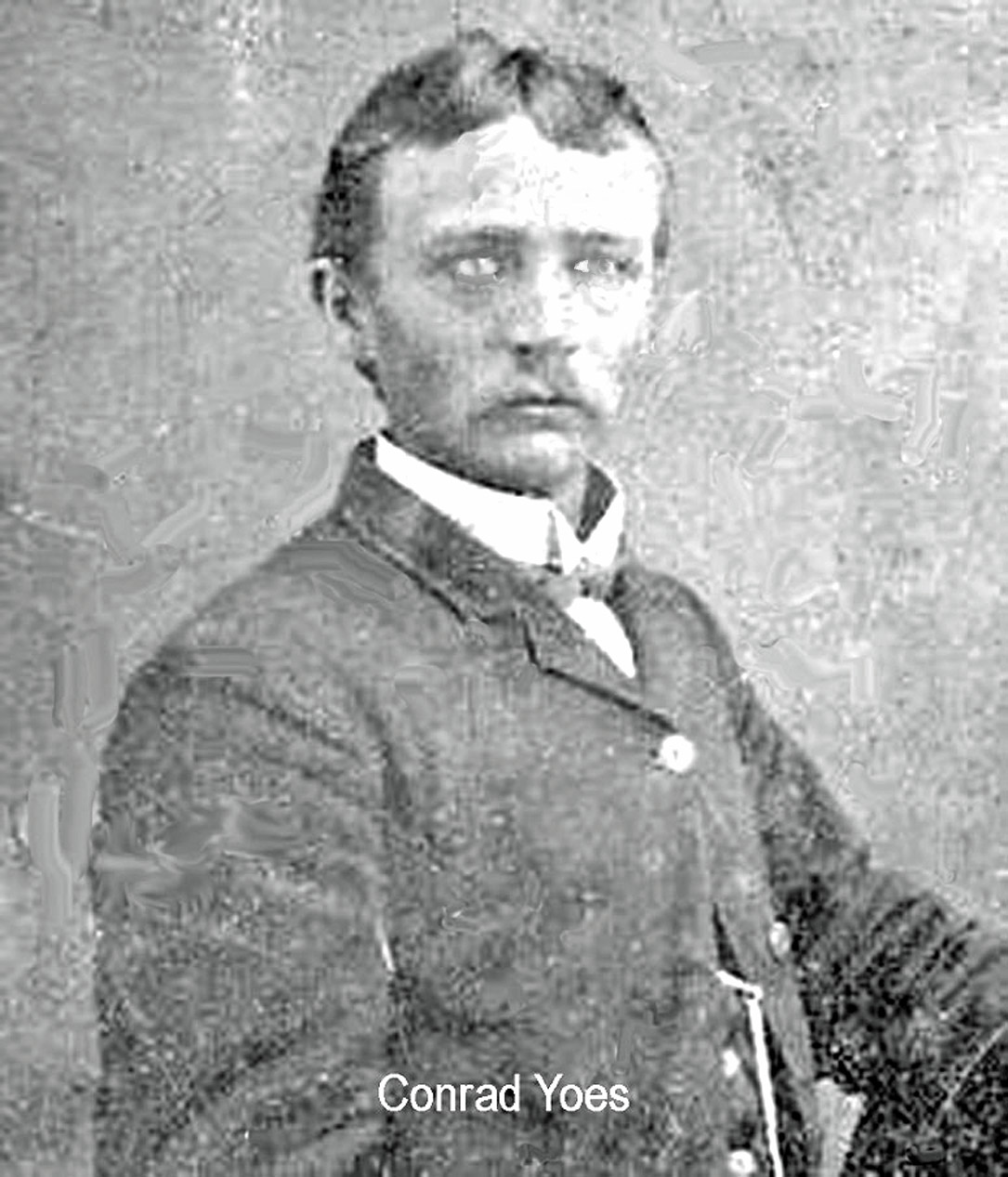
Conrad Yoes, pictured here, was among the earliest settlers along the West Fork valley, arriving around 1822. The extended Yoes family, recent immigrants from Germany, sent down strong roots and became an influential part of county history. Conrad became nicknamed as “Coon Rod” because of his willingness to cross high water creeks on a log in order to carry out his preaching mission. According to a descendant,

“He started on his circuit one day, came to the creek, the ford could not be crossed, so he found where someone had felled a tree across the stream so he “cooned” it and so got that nickname.

In another of Bert Yoes recollections about his grandfather, he said that Conrad was a “small man” who could “conjure warts and stop blood flow.”

Conrad Yoes’ son, Jacob “Black Jake” Yoes served in Union forces during the Civil War then as sheriff of Washington County. With the timber boom that came with the opening of the railroad in 1882, Jacob turned his energy to building a business empire with mercantiles at multiple stops between Fayetteville and Van Buren. The two-story brick store he built at West Fork remains standing today. In 1889, Jacob became a legendary U. S. Marshal working for Hanging’ Judge Parker at Fort Smith, allegedly the inspiration for John Wayne’s famous role in the movie “Big Jake.”

The story of the Yoes family is just one of many documented in these pages, all of them building lives and rich histories along the river valley, all of it fascinating to anyone interested in the 19th century settlement of Washington County.

The West Fork of White River created the West Fork valley and continues to shape it today. Streams, creeks, and springs drain down the steep hillsides to form the river and carve this particular place on Earth. This book is about that valley, how it formed over millions of years, how Nature filled it with plants and animals, how Native people found sustenance and shelter here. And then the immigrants came, arriving from the eastern seaboard of the early colonies, from Europe and beyond. Within these pages are the stories of the first settlers here, the roads and towns they made, the war they fought, and their paths to survival through the end of the 19th century.

Subsequent chapters describe the mills, churches, and early roads as well as the neighbor-to-neighbor conflict of the Civil War. Stagecoaches hurtled down the valley roads, later supplanted by the iron horse with the completion of the railroad tunnel at Winslow. A chapter on crime reveals shootouts, knife fights, and barn burning. Histories of Winslow, Brentwood, Woolsey, West Fork, and Greenland outline their origins and heydays.

One of several 5 star reviews: “The research involved to create such a great history is very obvious. I wanted to know more about my home which was built in 1840 and the family behind many of the objects found on the property. Ms. Campbell’s book answered many of those questions and helped me develop a treasured sense of place. We seem to have lost our appreciation for where we came from and how we created communities. So great to see Campbell’s thorough research and ability to bring the past alive.”

Get your copy today at Amazon.com or at the Headquarters House offices of the Washington County Historical Society.

Take Note While You Can!

Make good use of that chaotic holiday family gathering! Record family history told by Aunt Tilley and Grandmother Joan while they’re still around or forever regret the history you’ve lost. Interview Granddad Hiram, racy jokes and all. These stories never go out of style! And your grandchildren will thank you.


Wait no longer! Take some time today to write down something, even a few words. Fifteen minutes. An hour. What you write doesn’t have to be a 400-page novel—it can be a list of things you remember about your grandmother. Put her full name at the top of the sheet of paper and then the date and place she was born, if you know it. Who did she marry and when, where? What places did they live? What were the names and birth dates of their children? Did she keep a garden? Crochet? Play tennis every week? Every detail you record will color in the lines of a story prized by your descendants.

Whatever direction your road leads, never doubt that your efforts will be greatly appreciated not only by other family members now but also by those who come after you. Knowing the names, activities, whereabouts, and personalities of our forefathers and foremothers offers each of us a comforting sense of place, a mirror to reflect our greater selves, and reassurance that life for your kind goes on no matter what. Personal and family histories are a critical tool for your descendants to more fully understand what has led to who they are.

Or maybe you’ve been thinking about telling your personal story, those life-changing moments you’ll never forget. This easy-to-follow guide walks you through the steps of making it real: gathering and organizing information, changing a bare-bones family tree or personal memoir into a fascinating narrative, and putting it into print – at no cost!

This book covers the fundamental stages of writing family history or an autobiography with pointers on fleshing out details into compelling narratives, how to organize your materials, and building a story.

The book also provides clear guidelines on how to self-publish: what software to use and how to use it, step-by-step guidance for working with Amazon’s Kindle Direct Publishing, and understanding important elements like genre. You’ll find discussion about getting reviews and marketing as well as useful hints about maintaining those tender creative sensibilities in the face of seemingly overwhelming obstacles.

Don’t miss your holiday opportunities to gather your family history and turn it into a record to be prized by generations to come. Grab your copy today at Amazon.com

Rex Perkins, Fayetteville’s celebrated old school attorney

Of all the stories still told about Rex Perkins, none has enjoyed such ongoing and avid public interest as the murder trial of Virginia “Queenie” Rand. Mrs. Rand, an attractive brunette and wife of J. O. Rand, a prominent Rogers businessman, was charged with the crime of second degree murder for the killing of Harry V. “Buddy” Clark on August 9, 1959. Clark, married and father of two, was shot in Virginia Rand’s bedroom.

The Arkansas Supreme Court’s decision in the Rand v. State appeal was delivered December 12, 1960. Their summary of the offense follows:

“It appears from the record that on the evening of August 8, 1959, the deceased, Clark, and his wife entertained Mr. and Mrs. Sam Davis in their home. At about 1:15 a.m. on August 9, Mr. and Mrs. Davis left the Clark home and at the same time Clark left in his car to check the receipts at the Horseshoe Grill, a café which he owned located some 8 blocks from the Clark home in Rogers. Although the evidence is somewhat uncertain, it is clear that Clark finished his work at the café and at 1:30 a.m. the night police radio operator received a call from a woman identifying herself as appellant, who said: “Send someone out here, I have had some trouble.” After the radio operator sent a patrolman to the Rand home, the appellant called again and said: “I have shot a man. I shot Buddy Clark.” Upon arrival at the Rand home, the patrolman was told by appellant that she shot Clark in her bedroom. The patrolman immediately went to the hospital where he found Clark on the floor in the hall. Nurses at the hospital testified that Clark came in the front door and fell to the floor. The records show he was admitted at 1:45 a.m. He expired at 4:17 a.m. that same morning.

“The patrolman testified he found tracks in the heavy dew going in and out of the Rand house and found a gun about 4 to 6 feet from these tracks. There were two bullet holes in the bedroom walls and 5 empty cartridges were found in the bedroom. The deceased was shot 4 times—3 times in the chest and one time in the right arm. No trace of blood was found in or around the Rand house but there was blood on the steering wheel and door of Clark’s automobile.”

The case transcript runs 796 pages leading some to observe that everybody in town must have testified. The question before the jury in the second trial, ordered after the appeal was: Is she guilty of murder? Can Rex get her off?

Rex Perkins was the man of the hour in this case, just as he had been in just about every other case he ever faced from the start of his legal career in 1932. But the law wasn’t his only passion. He loved his hunting dogs almost as much as he loved his wife and daughters, but none of that stood in the way of his pursuit of a strong drink and other women. Most of all he loved to play his fiddle. Truly a man with powerful passions and incisive intellect, even sixty years after his death, his memory remains strong within Washington County’s legal community.

Read his fascinating life story from a time when courtroom hijinks ranked high in the arsenal of criminal defense attorneys like Perkins. Available at Amazon.com

More Adventures of Denny Luke: City-Boy Plowing and other blasphemies

Following the success of his first book, South County: Bunyard Road and the Personal Adventures of Denny Luke, Denny Luke found himself remembering even more moments in his life that seemed worthy of recording.  Brief moments, some of them. Others spurred by a photograph here and there.

Always accommodating to his friends and family, Denny divulges various secrets and outrages that occurred at various points in his eighty years – so far.

Take what you will from his stories, he gives it all in good humor and humility. 

Here’s a taste:

Runaway

Age 12 or 13, I knew everything! Parents disagreed of course, so I plotted to run away. Living in Beloit, Wisconsin, where should I go? Having the entire world to choose from, decided on California, endless beaches, hot rods and beautiful weather and I could get there on my thumb.

Headed west, must change my name, I thought, to disguise myself, picked ‘Conrad Davis.’ Sounded right in case I hit Hollywood.

Somewhere in Iowa a fella picked me up in Chevy station wagon. Stated he’d just installed an anti-sway bar and watch this! He flew around curves, in the days before seat belts, had me white knuckling for my life.

Next, picked up by a guy attending an all-night meeting. He liked me, said I could sleep in the back of his car. Lit out at first light, back on the road.

Next evening was pondering what to do for the night…

Read all of it and much more in this slim but rich treasure trove of ‘Dennyspeak’! Available at Amazon

Ooh, the 70s!

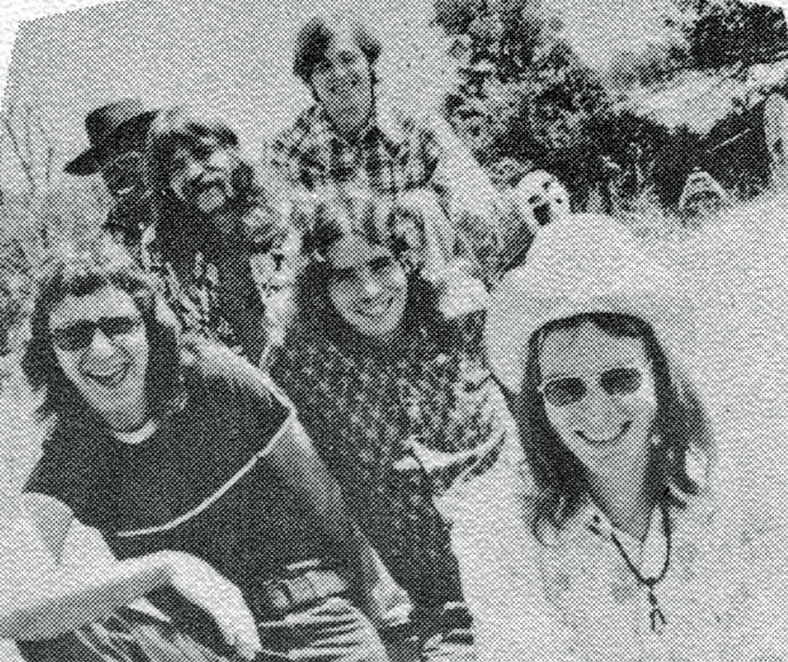
As chronicled in the massive history of Fayetteville’s music scene, the 1970s overflowed with great music that echoed down the length of Dickson Street. The Charles Tuberville Band was among them.


Back: Singleton, Smith, Billy Osteen
Front: Ellis, Tuberville, Womack
Photo courtesy Joe Phelps

Charles Tuberville Band

Charles Tuberville became hooked on the guitar after watching an older cousin plug his “machine” into an amp and began playing a song by The Ventures. Then when The Beatles took rock n’ roll by storm, that changed everything. Charles got his first guitar, an electric Harmony Bobcat, for Christmas in the 7th grade. “‘At the time, I was playing trumpet in the school band. The day I got my electric guitar, that trumpet never again came out of the case,’’ he recalled in an interview for Blues News.[1]

His Fayetteville band formed in the early 1970s and played popular clubs like Notchy’s and The Library. In 1976 when the Brass Monkey took over the former Gaslight space in the basement of the Mountain Inn Annex, the Charles Tuberville Band served as the house band. Members of this powerhouse group were Charles Tuberville and Billy Osteen (Cal Jackson still in Memphis) on guitar; Albert Singleton then later Cherry Brooks, vocals; Lance Womack, drums; Jimmy Smith, keyboards; Jim Sweeney (Tulsa), Joe Ellis, bass. Members of this band later appeared in other groups. Charles Tuberville moved to Tulsa in 1979 and went on to ply his guitar craft in multiple formats, performing on an album with Tulsa musician Jimmy Markham including Get Ya’ Head Right (2018) and producing his own album, Somethin’ in the Water in 2019.

Don’t miss these great stories of creativity, ambition, and craziness that permeates the 550+ pages of GOOD TIMES: A History of Nightspots and Live Music in Fayetteville, Arkansas — available at Amazon.com and the local Washington County Historical Society offices.


[1] Bill Martin, “Charles Tuberville,” Blues News, Sept/Oct 2019, p. 3

Beating the Train

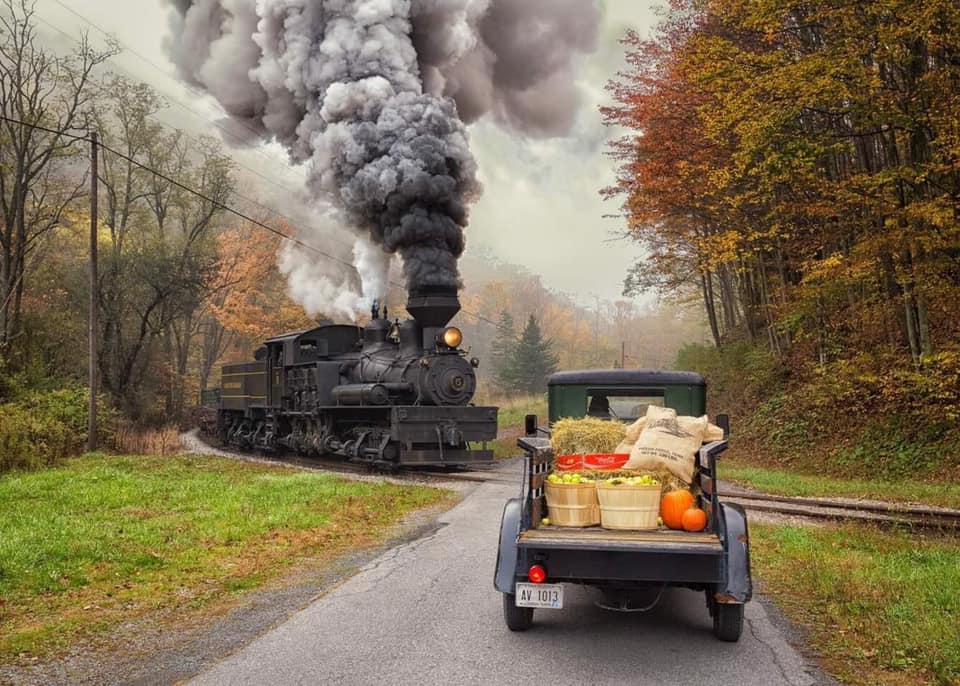
This photo reminds me of my dad Floyd Pitts who would sometimes reminisce about his younger days when he was still in high school at Morrow, Arkansas. He’d tell part of this tale then slap his leg and start laughing.

During that period of his life – early 1930s – his parents and younger sister had to move to West Memphis where his dad found work. Floyd stayed at Morrow to finish high school. He slept on a cot at the Morrow Mercantile with duties to keep the fires going at night so the stock didn’t freeze. Alongside his work duties and high school classes, he and three friends performed around the Northwest Arkansas region as a quartet.

“By 1933, I was the leader of the Morrow Quartet (I played fiddle and sang bass) and we were the best in the whole area. We sang at anything. We’d put on a show at places like the Savoy Community Building, we sang on the radio all the time, KUOA, Voice of the Ozarks [then located in the Washington Hotel on the southwest corner of the Fayetteville square, Mountain and Block], any old breakdown tunes.

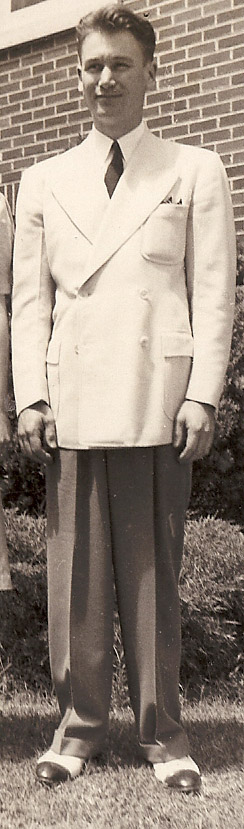
Floyd Pitts circa late 1930s

“It was a novelty for a boy to play the piano. People would take us home for dinner if we’d perform.  Jim Latta was the father of one of the singers—the lead, Vernon Latta. He’d help us out buying gas. Vernon played guitar and mandolin. Or the Morrow Mercantile would help us because of Dennis Carmack, the tenor of our group. There were four main guys who owned the Mercantile: Ernest Ball, Lowrey Carmack, __ Reed, and [can’t remember].  Ty Reed sang alto (high tenor). I played fiddle and Dennis Carmack played guitar.

“Dennis had an old Chevrolet and that’s how we got to Fayetteville for our weekly radio show. One time we were running late. There was a railroad crossing at the turn off from the Cane Hill Road to the main highway just east of Lincoln. We heard the whistle and as we roared up to the crossing, we could see the train coming. Trains were long in those days, usually pulling an endless string of freight cars. We knew we’d miss our broadcast time if we waited for the train.

“The train was barreling down, close, too close, to the crossing. There wasn’t time to discuss it. Dennis floored that old Chevy. The engineer laid on his whistle as we hurtled ahead throwing up a huge dust cloud behind us. We could see the engineer’s mouth moving as we approached. He was shaking his fist at us.

“We flew over those tracks without a second to spare. The force of that train as it passed behind us shook the car. As we made the sharp turn just after crossing the tracks, that old car went up on two wheels. We all leaned to the right, laughing at our near miss as the car slammed back onto all four tires. We made it to the Fayetteville Square in time for our show.”

Floyd Pitts went on to gain his bachelor’s degree in music at Northeastern State University at Tahlequah, Oklahoma, then taught music at Rogers AR public schools until his service as an officer in the U. S. Navy in World War II. After the war, he gained a master’s degree in music at Iowa before returning to Rogers to teach. He took over the band man post for the Grizzly band at Fort Smith’s high school in 1953. During his time at Fort Smith, he moonlighted in vocals and piano with a dance band that played local venues like the Elks Club. In January 1957, he proudly led his band in the Washington D.C. parade for Dwight Eisenhower’s inauguration.

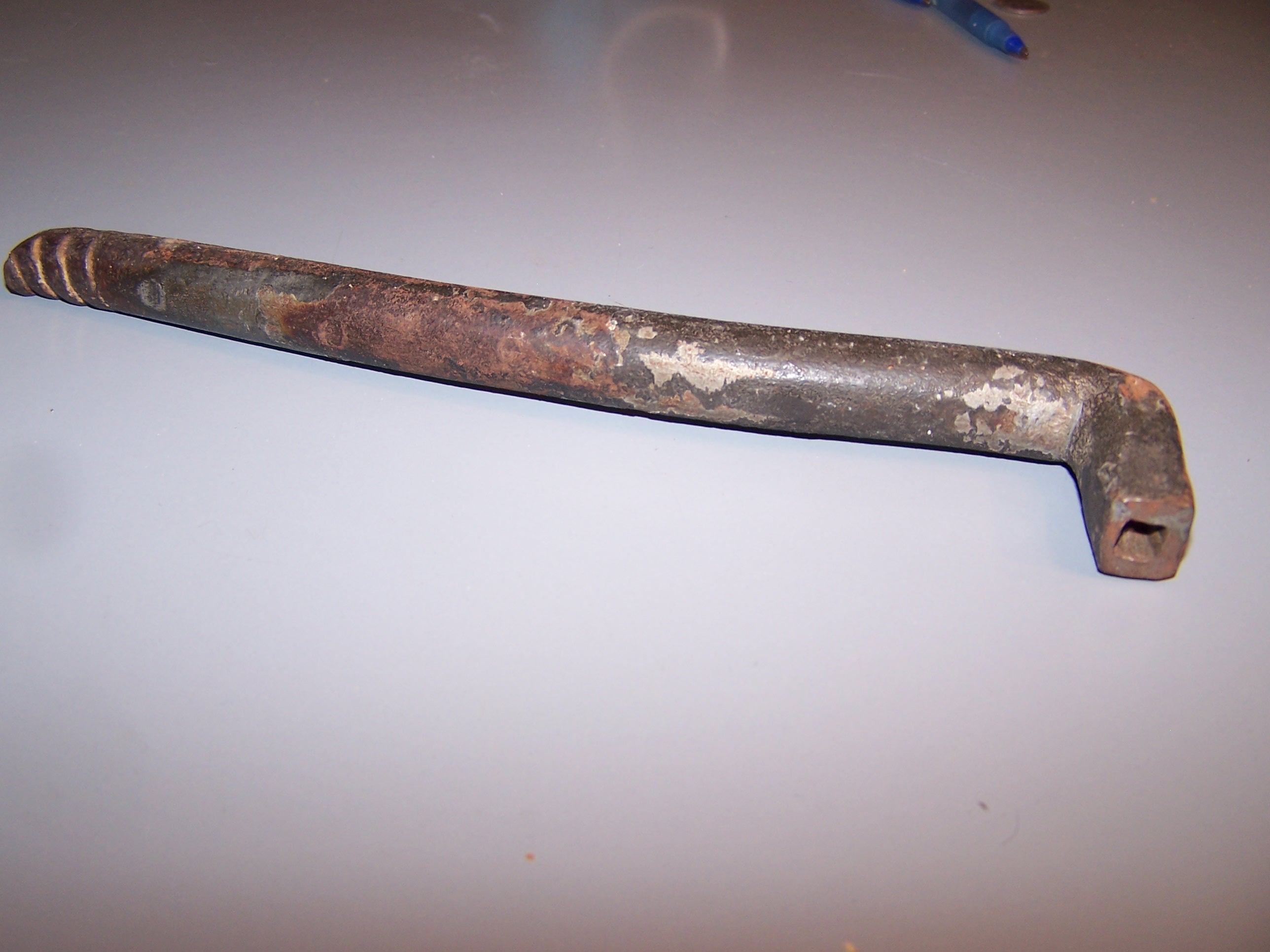
In 1958 in search of better income, he moved his family to Miami, Oklahoma to lead the music programs for the public schools and direct the junior high and high school bands. During those years, he pursued after-hours income by tuning and repairing pianos, something he’d done since his high school days when he’d teach shape note singing at schools and church houses around the area and inevitably encountered out-of-tune pianos. His father, a sometimes blacksmith, forged Floyd’s first tuning hammer from an old Model A tie-rod.

Floyd remained the Wardog band director at Miami until 1967, when the family once again relocated to Fayetteville, Arkansas. (His wife, Carmyn Morrow Pitts, was relieved to be back in “God’s country.”) From there, Floyd taught band a couple of years at Westville, OK and for many more years at Lincoln AR, more or less a return to his roots at the end of his long career in teaching music to multiple generations. He retired in 1979 but continued his new career as a full time piano tuner/technician alongside his daughter Denele until a couple of years before his death in 2004. Even in his last days, a good old fiddle tune would bring on a flurry of foot tapping.

~~~

Floyd’s first tuning hammer from Model T tie-rod, late 1920s

Side note: KUOA began as a project of the University of Arkansas in Fayetteville, using these call letters starting in 1926. With the deepening of the Great Depression, in 1931 the University decided to lease operations to out of town interests. “Members of the Fulbright family then formed KUOA, Incorporated, to purchase the station, and on April 1, 1933, they took control, with Roberta Waugh Fulbright as president, John Clark as secretary-treasurer, and daughters Roberta Fulbright as station manager and Helen Fulbright as vice president.”[1] Ownership of the station shifted to John Brown University in 1936.


[1] https://encyclopediaofarkansas.net/entries/kuoa-radio-station-3678/

Gem’s Gems

Excerpted from the book, Gem’s Gems — a memoir of my mother, Carmyn Gem [Morrow] Pitts.

[Her father Tom Morrow] ventured east into Madison County and ended up at St. Paul where the logging boom was in full steam. He brought his family to live first in a small house northwest of St. Paul before settling into the Casteel place, a two-story house with a bay window and porches upstairs and down, high upon a mountainside overlooking the White River Valley. They enjoyed a glorious summer in this scenic valley before cotton-picking time called them back to Texas.

Tom gathered his St. Paul crops and left Grandpa Clark in charge of the house and getting the sorghum cane to the mill. Left behind was the furniture—a wood burning cookstove, iron bedsteads and bedding, a rocking chair, table and benches, a marble-top round table, Sylvia’s “Princess” dresser with oval mirror, a small drop leaf desk, and a “matting” box with hinged lid Tom had built out of lathe for Sylvia’s quilts [Carmyn’s mother]. The family packed their “batchin’” equipment—a camp stove, a few quilts, feather bed, and feather bolsters, a white enamel bucket with plates, cups, and two serving bowls, the iron skillet, and a deep aluminum stewer Sylvia used to soak whole grain wheat overnight—into the beloved Baby Overland and headed south. Not left behind were the family cat Snowball and the German Shepherd dog “Lightnin’,” who rode on the fender.

On the journey, they stopped along the road each night and made campfires to cook supper. They would stop at a house to ask if they could get water at their spring and camp for the night. Mama made pallets for the younger children to sleep on in the truck and Papa, Durward, Douglas and Graydon slept on pallets on the ground under the truck. Once when they stopped at a house and asked to use the spring, the lady of the house brought them fresh buttermilk.

Littlefield Texas cotton-pickin’ shack. January 1929 L-R: Douglas with dog Trixie True, Graydon, Joy with cat Snowball, Tomazine “Sister,” Carmyn holding her doll Prudence, Una Mae in Durward’s lap

Upon arriving in Texas, they lived first in a cotton-picking shack at one of Sylvia’s sister’s place in Grayson County. After picking for two weeks, they moved on to another of Sylvia’s sister’s farms near Vera in Knox County where they stayed for four weeks. The shacks were crudely built one-room structures about twelve feet by fourteen feet with two windows and a door. Aunt Lillian fixed up their shack at Crosby County for her sister Sylvia and family to live in, scrubbed clean with curtains on the windows. She loaned them a coal-oil stove with an oven. They picked their cotton for three weeks and then finished the season in a shack near Morrison.

In the winter of 1928, the Tom and Sylvia Morrow family moved back to the Casteel place in St. Paul, Arkansas, but Grandpa Clark convinced Tom that the ground was too rocky for farming, so they rented a house together—the Greenway place—about 1.5 miles southwest of Springdale (near the present-day Wal-Mart). It was a temporary home for the two weeks it took Tom to find “Trouble’s End,” the name of the place in Springdale that was their first home with a bathroom and running water. Their seventh child Una May was born here. They had apples and strawberries, and were joined again by the grandparents, who again kept the house when Tom began preparing his family for another summer run back to Texas to pick cotton.

Austin Place, Springdale Arkansas August 1929 Tomazine and Una May

Tom traded the Baby Overland for a big truck, made a wooden box for the pet cat and a puppy to ride in, and the German Shepherd rode on the fender. On the journey, Sylvia and girls slept in the truck while Tom and the boys slept on pallets under the truck. Back in Texas, near Littlefield, they lived in a shack and picked cotton, but the kids all came down with whooping cough, so they couldn’t return to Arkansas until March 1929.

Back in Springdale, they discovered that Grandpa Clark had failed to pay rent at “Trouble’s End,” and had moved three miles east of Springdale to the Crane place. He had rented a nearby house, the Austin place, for Tom’s family, but it was only one bedroom. Tom closed in the breezeway to the smokehouse to provide more room, but that fall he found the Nix place with three bedrooms and a big corner porch. He moved the family there and went to Texas to haul grain from November until February 1930.

Tom Morrow with his mule team, baby on the wagon seat


Read the rest of Gem’s Gems! Available at Amazon.com

A little murder with your lemonade?

What could be more interesting summer reading than murder stories from the 1800s? This collection of fifty stories cover the earliest years of Arkansas statehood, Civil War atrocities, and a shoot-out on Fayetteville’s town square. All the murders occurred in Washington County Arkansas, a mild-mannered place by any other account.

Here’s just one chapter:

On an icy Wednesday January 24, 1872, in a field on the Rev. Riley Jones’ place near Black Oak in eastern Washington County, two young men set about the task of feeding livestock, Riley’s 21-year-old son James Cornelius ‘Nealy’ Jones and Henry Durham, age unknown. Durham had been taken in by the Jones family and lived there as part of the family.

As young men often do, the two exchanged jokes, lies, and dares as they pitched hay off the wagon. According to later accounts, Jones was ribbing Durham pretty hard about some trivial matter.[1] Before either of them realized how or when, the mood changed. The jokes became insults and the dares became threats.  Biting cold set their teeth on edge as they faced each other. Tempers ignited and before anyone paused to think, Durham charged Jones with the pitchfork. One of the tines pierced his coat and went straight to his heart.

Suddenly young ‘Nealy’ Jones lay dying on the field as Henry stood over him watching in disbelief.

Despite Durham’s efforts to resuscitate him, Jones did not revive. Roused by Durham’s shouts, Riley Jones came running to his dying son. But it was too late. They carried the body inside while someone went for the township constable.

The Reverend Riley Jones and his wife Nancy had arrived in Washington County between 1850 and 1860 to settle near his three younger brothers Clairborne, Enoch, and James Jones, all natives of Hawkins County, Tennessee who had arrived in Washington County some years earlier. The descendants of all four brothers would mingle in county records forever after. [2]

Riley took up residence in the Middle Fork Valley near Carter’s Store. Age fifty-five in 1860, Riley and his wife Nancy Bailey had gained eleven children over the years of their marriage including nine daughters and two sons. The couple had suffered their share of tragedy. One daughter died in infancy. Another daughter Eliza Tabitha died unexpectedly June 21, 1861, six days after giving birth to her fifth child Benjamin Calhoun. Eliza’s husband, Pleasant Riley Jones (probably her first cousin),[3] remained to grieve with their children: Jesse 13, John 11, David 9, and William 7—as well as the newborn Benjamin.

With war breaking out all around, in the summer of 1862, Pleasant joined up with the 1st Cavalry Regiment Arkansas (C.S.A.), leaving his children in the care of Eliza’s parents Riley and Nancy.[4] According to family records, his unit met Union forces November 1 at Cross Hollow. Pleasant was killed in a skirmish on November 29.[5] Also lost that fateful year was Absolom Abraham Jones, the older of the two Jones sons, who died at age 27 while engaged in Civil War combat in Northwest Arkansas.

With the deaths of Eliza and now Pleasant, Eliza’s parents Riley and Nancy Jones became the caretakers of their four orphaned grandchildren. For the next five years, the family suffered the deprivations of continued guerrilla warfare that plagued north Arkansas even after the war ended. But in August 1871, they celebrated the promise of a new marriage when the baby of the family, James Cornelius “Nealy” Jones, joined with Matilda Lewis, the lovely young daughter of George Washington Lewis who operated the Lewis Mill on the Middle Fork of White River.

Now a freak encounter had ended Cornelius’ life. In disbelief, the Reverend Riley Jones controlled his rage and grief as he waited for the constable to remove Henry Durham from the premises.  At least with the murderer in custody, he would gain justice for his son’s premature and tragic death. Finally the constable arrived and took the shaken Henry Durham to the local lock-up.

Call it fate. Call it karma. What happened next would be the only semblance of justice in this case. The next morning, the constable left a young man named Lewis, probably a relative of Matilda, in charge of the prisoner while he went for his breakfast. Sensing an opportunity and facing possible execution by hanging, Henry Durham made a run for it. Ignoring Lewis’ demand to halt, Durham pursued his escape. Prepared with a loaded weapon, Lewis fired, striking Durham with a fatal gunshot.

Research has not discovered whether Henry Durham was in any way connected to the naming of the nearby community of Durham. In fact, the only record of this name other than the few facts noted so far is a listing of his name in the 1869 personal property tax records for Washington County. Of further note, a few versions of the story claim that Henry Durham killed Nealy Jones with a knife rather than a pitchfork. But dead is dead and both men found their end on back-to-back frigid January days.

‘Nealy’ Jones was buried beside his brother Absolom and his sister Eliza at Mt. Zion Cemetery. Henry Durham was buried at Reese Cemetery in an unmarked grave.

Finally, a post script about Matilda Lewis Jones. After only five happy months of married life, the young woman had become a widow. In August 1873, eighteen months after the death of Cornelius, Matilda married again, this time to Cornelius’ cousin William Newton Jones, the son of the Rev. Clairborne Jones, Riley  Jones’ brother. Newton Jones will figure prominently in another murder story in Chapter 21.

An interesting story about Matilda involved a recently freed slave named Mary Ann. At the end of the Civil War, slaveholders were required to release all slaves. The owner of Mary Ann wanted to sell her despite the new law. Seeing the value in a young mixed race girl of about fifteen years at the time, the owner expected to receive a thousand dollars for her.

Hearing of Mary Ann’s fervent wish not to be sold, Matilda’s father George Lewis offered Mary Ann work at his household if she wished to leave her former ‘owner.’ (Some rumors alleged the ‘owner’ was in fact her father. Begetting mixed race children upon slaves was a common practice among some slave owners. The act was seen as ‘bettering’ the negro race.) This intervention of Lewis in facilitating her ‘escape’ caused a permanent rift between him and the former slave’s ‘owner’.

Mary Ann eagerly accepted Mr. Lewis’ offer and the young woman flourished in her new home. About five years later, in January 1874, Mary Ann became sick and died. With travel impossible in the icy weather, Matilda contributed her twice-used wedding dress as a burial shroud for Mary Ann, who was then laid to rest in an unmarked grave at the east end of Reese Cemetery.[6]

Get your copy of Murder in the County at Amazon.com

~~~

[1] Fayetteville Democrat January 27, 1872

[2] More on the Jones family in Appendix of Selected Family Histories, Jones, p 394

[3] Pleasant’s father, John Jones, was born in 1789 at Hawkins County, Tennessee. Eliza’s father Riley Jones was born in 1805 in the same county.

[4] The 1st Cavalry Regiment, Arkansas State Troops (1861), was an Arkansas cavalry regiment during the American Civil War. The regiment was organized at Camp Walker near Harmony Springs, Benton County, Arkansas. The regiment was officially designated as the Third Regiment (Cavalry), Arkansas State Troops by the State Military Board but was designated as the 1st Arkansas Cavalry by Brigadier General Nicholas Bartlett Pearce, Commander, 1st Division, Provisional Army of Arkansas. The regiment is referred to as “Carroll’s Regiment” in contemporary accounts.

[5] Family records may be in error here. A large Confederate encampment at Cross Hollow was left in smoldering ruins before a Union advance in February 1862. With the Battle of Pea Ridge in early March 1862, Confederates retreated south from Benton County. With a death date of November 29, 1862, Pleasant Jones may have died in the run-up to the Battle of Prairie Grove, perhaps in the November 28 Battle of Cane Hill.

[6] Coley, Cheri. “The Rest of the Story…Sort of:” Washington County Arkansas Genealogical Society newsletter June 2005.  http://wcags.org/?page_id=784