Christian Nationalism’s Goal: Overturn the Constitutional Separation of Church and State

The Puritans never went away. Rather, they perpetuated their beliefs through a variety of phases over subsequent generations. The intense Puritan drive to create a “Holy Commonwealth” (a society aligned with God’s law) was transformed in the 19th and 20th centuries into secular or civic efforts, such as temperance movements, anti-slavery activism, and educational reforms. The development of Christian Nationalist ideology before the 1960s was triggered by a desire to defend white Protestant dominance rooted in the “Christian nation” myth against social, economic, and demographic changes. Key drivers included early 20th-century anti-communism, the 1930s anti-New Deal push, and 1950s Cold War fears of “godless” Communism. Puritan millennialism—the anticipation of Christ’s kingdom—has been re-engineered into modern political urgency, treating the U.S. as the central battleground for cosmic good vs. evil.
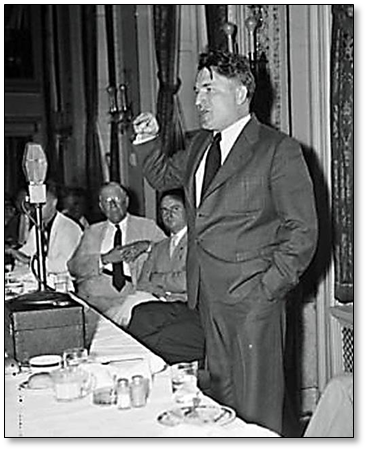
Gerald L.K. Smith, Grandfather of Christian Nationalism (Library of Congress) His “Christ” statue still stands at Eureka Springs, Arkansas

It was the 1940s when a formal “Christian Nationalist” movement began, led by Gerald L.K. Smith, who started the “Christian Nationalist Crusade.” A political organizer for U.S. Sen. Huey Long (D-LA) in the 1930s, he changed parties and ran in the Republican primary for the U.S. Senate in Michigan in 1942. Smith was a fascist, a rabid anti-Semite and anti-communist. His Christian Nationalism was meant to privilege a particular set of cultural values held by a portion of the founding generation of America, a culture to which people of any and every national or ethnic origin could assimilate.[1]

Nevertheless, at a popular level, Christian nationalism almost invariably devolves into rhetoric and language that has elements of white supremacy, discrimination, and xenophobia. And that is because, by its very nature, the Christian nationalist’s definition of “Christian culture” is collocated with white culture. “…[W]e saw this play itself out in the origins of the private Christian school movement, which was wrapped in the language of returning to “Christian values” but was largely a response to racial integration in public schools.”[2]  This sharp increase in “segregation academies” in the South following school desegregation rulings saw private school enrollment in the region growing nearly 130% between 1950 and 1965.

Along with the glaring intent to undermine the First Amendment in the use of tax dollars for Christian Nationalist education in defiance of the nation’s constitution, a further elaboration along these lines must examine the potential failure of private and home schooling to teach students the basic subject matter necessary to function in American society and the further failure of such programs to meet basic measures of accountability. One must wonder how the tech moguls who facilitate the political success of Christian Nationalists expect to fulfill their business ambitions with workers who are not well educated in key areas of mathematics or science. The solution so far, as seen in Silicon Valley, is that roughly 66% of tech workers are foreign-born as of early 2025. The conclusion might be that the moguls aren’t concerned about finding adequate workers as long as they can import better educated workers from China or India whose employment and immigration status are held hostage by their mega-rich employers. The mogul attention is focused on deregulation of their processes and reduced taxes on their billions.

A key interest of the modern American peerage is the usefulness of a dedicated demographic of voters. Based on 2024 campaign data, a significant portion of U.S. billionaire political spending heavily favored Republicans, with roughly 65%–80% of top donor funds going to conservative causes. Data indicates that a small but highly influential number of wealthy individuals use their fortunes to advance Christian nationalist causes, with some notable, high-dollar examples. The alliance between the super-rich and Christian nationalists is rooted in a shared desire to reshape American society by dismantling the separation of church and state, reducing government regulation, and limiting the power of labor. It doesn’t take much thought to deduce which groups pursue which objectives.

Wealthy donors, including figures like the Wilks family and Tim Dunn (both Texas oilmen), Jeff Yass (cofounder of Susquehanna International Group, a massive, privately held global quantitative trading and technology firm), and the Koch brothers (oil; their father co-founded the far-right John Birch Society) fund this movement to secure political influence that favors lower taxes and unregulated capitalism, which they often equate with a “biblical worldview.”[3] Other tech moguls and corporate tycoons supporting the religious/political cabal include Elon Musk, Miriam Adelson, Richard and Elizabeth Uiblein, Timothy Mellon, Ken Griffin, Marc Andreessen, Jan Koum, Peter Thiel, Steve Schwarzman, Diane Hendricks, Phil Ruffin, Steven Witkoff, Harold Hamm, Andrew Beal, and Bernie Marcus.

As in so many other hypocrisies, the teachings of the New Testament stand in direct opposition to such efforts. The concept of not building earthly kingdoms, based on John 18:36, emphasizes that God’s Kingdom is not established through political power, violence, or worldly, selfish ambition. Instead, it is built through the inward transformation of hearts, humility, love, and service, aligning with divine, rather than human, desires. In essence, wealthy donors often adopt the “Judeo-Christian values” rhetoric in name only in order to protect their wealth. In turn, they use their wealth to buy legislators while ignoring the religious message because bought legislators provide a powerful, populist vehicle for achieving political and economic dominance.

Court rulings have made clear that the expenditure of tax dollars is obligated to uphold the U.S. Constitution, primarily through the 14th Amendment’s Equal Protection and Due Process clauses, which prohibit states from violating federal rights. While education is not a fundamental right granted by the federal Constitution, any tax-funded education system is supposed to operate within constitutional limits.

The legal standing for private religious schools and home schooling remains largely protected under the Free Exercise Clause, which prevents the government from interfering with a parent’s right to provide a religious education. Legal challenges have primarily focused on preventing the state from promoting religion, rather than regulating the private curricula of religious schools or homeschools, unless those institutions seek direct government aid or public charter status. While the state cannot start a religious charter school, the Supreme Court has ruled in cases like Carson v. Makin (2022) that if a state provides public funds for private education, it cannot exclude schools solely because they are religious. This creates a “gray area” wherein public money frequently flows to private religious schools.

It’s a thin line. The Oklahoma Supreme Court ruled in 2024 (and upheld in 2025) that establishing a religious public charter school violates both the Oklahoma Constitution and the federal Establishment Clause. The court reasoned that because charter schools are government entities and recipients of public funding, they cannot impose religious teachings, distinguishing them from private religious schools.

In Mahmoud v. Taylor (June 2025), the U.S. Supreme Court ruled that public school districts must allow parents to opt their children out of curriculum that includes LGBTQ+-inclusive books, if those books conflict with their religious beliefs. The Court found that denying opt-outs for curriculum designed to “disrupt” traditional views on gender and sexuality constitutes an unconstitutional burden on the free exercise of religion, breaking from lower court precedents that allowed such curriculum. It seems a natural result of such a ruling would also allow parents to opt their children out of science classes that teach evolution or the geological age of the planet.

Courts have addressed attempts to mandate religious texts in public schools. A federal district court in Arkansas (2026) issued a permanent injunction blocking a law requiring the Ten Commandments be displayed in classrooms, citing violations of the Establishment Clause and improper state proselytizing. However, in a different case, the Fifth Circuit upheld a similar Texas law, demonstrating a split in lower courts on this issue.

In cases brought after the Supreme Court gained a conservative majority, it has held that school vouchers for religious education are permissible under the First Amendment because, according to the court, the aid is indirect, meaning it is not provided directly to schools but instead funneled to individual students and families who then decide which schools to attend, a disingenuous approach at best. However, the court has also recognized that state constitutions can, and often do, provide stronger protections than the federal Constitution against government funding of religion.

ACLU commentary on the 2020 SCOTUS decision in Espinoza vs. Montana Department of Revenue included the following:

…[T]he Supreme Court appears to be marching toward a legal paradigm that would virtually destroy a fundamental principle on which the Establishment Clause of the First Amendment was built. As James Madison, the architect of the First Amendment, explained, even “three pence” in compelled aid to religion was too much of a threat to religious liberty. Madison believed that forcing individuals to financially support religion was a direct assault on the fundamental human right of freedom of conscience. He and the other framers also worried that taxpayer funding of religion would weaken religious institutions by making them dependent on the government aid and engender religious divisiveness.[4],[5]

What Does This Future Hold

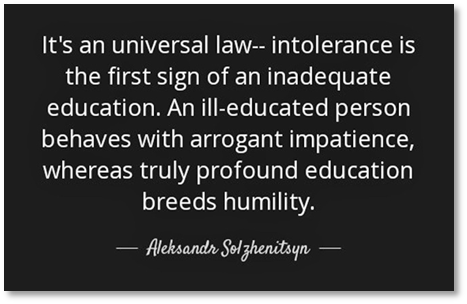
Clearly the health of our constitution’s first amendment is under attack by religious interests. These efforts not only threaten the core of our democracy, they also bolster the extreme minority’s satisfaction with their intellectual laziness. It’s important to note how one Christian homeschooling website glorifies willful ignorance and laments that “there are so many deceitful things [read: facts] being taught in public schools these days…,” citing Corinthians 3:19. “For the wisdom of this world is foolishness to God.” 

But that’s not the consensus on Paul’s meaning. Paul was not condemning the pursuit of knowledge or education altogether. He was warning believers against adopting worldly values as the measure of truth or spiritual success. The passage is an invitation to embrace the humility of the gospel, not the golden dressings of a political figure.

Sadly, that passage is often misinterpreted as an excuse for willful ignorance. Yet biblical context suggests it emphasizes humility, not intellectual laziness. It contrasts arrogant human self-reliance against divine wisdom. While it warns against valuing worldly intellect over God’s truth, scripture also calls for diligence, knowledge, and wisdom, indicating that willfully refusing to understand is distinct from rejecting human arrogance.

In 2 Corinthians 8:7: The Apostle Paul commends the church for excelling in faith, speech, knowledge, and diligence, while encouraging them to apply those same traits to the grace of giving. Additionally, 2 Peter 1:5-8 urges believers to make every effort to supplement their faith with virtue, virtue with knowledge, and knowledge with self-control, ultimately emphasizing the necessity of this diligence to remain fruitful. Two specific Old Testament passages also address this point: Proverbs 2:1-6 calls for the diligent pursuit of understanding, noting that if you search for it like hidden treasure, the Lord will grant wisdom and knowledge. Ecclesiastes 9:10 advises doing everything with your might while on Earth, as there is neither work, plan, knowledge, nor wisdom in the grave.

If taken literally and alone, the Corinthians 3:19 passage should also ban Christian Nationalists (and other strict interpreters of religious texts) from using inventions made possible by modern science. Such ‘fruits’ of non-religious ‘foolishness’ are pervasive in our society, things like cell phones and automobiles, medical care including cancer treatment and drugs for erectile dysfunction, television and TV dinners. Shouldn’t a steadfast Christian Nationalist also avoid these products of “wisdom of this world”?

The lack of respect for or knowledge of the basic workings of science, or our political system, or the responsibilities of citizenship are just a few of the destructive consequences of willful ignorance, just as is blind acceptance of authoritarian rule in a nation where the government is meant to be “of the people, by the people, for the people,” as stated in 1863 by Abraham Lincoln in his Gettysburg Address. At the very least, a person must know enough to know when he/she is being lied to, of increasingly critical importance in the growing use of artificial intelligence. Or, the acceptance of, as disingenuously stated by U.S. Counselor to President Trump, Kellyanne Conway in 2017, “alternative facts.” [6]

Without a healthy body and effective education along with the ability for rational thought, Americans face more of the division and violence that have marked recent years. This is how the extremists guiding the Republican Party make progress in putting people like current Arkansas governor Sarah Huckabee Sanders and current president Donald Trump into powerful authoritarian roles. The longer the uber-wealthy forces behind this trajectory are able to sway the votes of the willfully ignorant, the greater will be the slide toward authoritarian rule in our democracy.

These markers of religious ‘progress’ are enthusiastically noted by the nation’s adversaries, who take every opportunity to accelerate the division and discord. Erosion of our constitution’s principles takes us further from our unity and responsibilities as a free people, none of which is possible without equal education.

That suits the new peerage just fine. While about 19% of political contributions are made by the super-rich, the donor group is dominated by a small group of billionaire megadonors across finance, tech, and inherited wealth. The top contributors are heavily divided by party, though they lean heavily toward the Republican party and conservative issues. These oligarchs use their wealth to shape policy through lobbying, campaign donations, and efforts to repeal taxes, such as the inheritance tax. As it existed in centuries past, the peerage accepted as their due a certain renown, even deference, from the public. Benefits included high social status, immense prestige, and legal privileges, including exemption from certain legal processes. It afforded nobility direct access to the monarch to advise on matters of state.

Historically, the wealthiest elites attained god-like status primarily in civilizations with divine kingship, where economic control and religious authority were merged. Throughout antiquity and the Middle Ages, the richest figures—who were usually monarchs, pharaohs, or high clergy—used this perceived divinity to legitimize their immense power. During the Middle Ages, Christian theology strictly forbade the wealthy from literally claiming to be gods. However, wealthy nobles and high-ranking clergy accrued so much power that contemporaries expressed fear they would act “as gods among men.” The interchangeable use of the word “Lord” applied both to members of the British peerage was well as the Christian God. To justify their monopoly on wealth while the peasantry struggled, these elites constructed elaborate narratives of divine favor, often attributing their extreme privilege to God’s will.

Does any of this sound familiar?

The beneficiaries of Project 2025 include corporations and billionaires who seek massive tax cuts, fewer restrictions on wages and labor rights in their companies, diminished environmental protections while prioritizing oil, gas, and coal industries, rolling back climate protections, drilling restrictions, and workplace safety, and weakened labor unions, to name a few. Employers can legally discriminate against workers based on race, gender, or sexual orientation under recent religious freedom exemptions. The plan expands executive power, making it easier for a puppet president to control agencies, law enforcement, and judicial appointments. Dismantling career civil service allows politicians to fire government workers and replace them with loyalists as well as dismantling watchdog agencies.

Christian extremists and their children are more likely to bow down to the authority of corporate titans and the superrich. This acceptance is driven by a shared, long-term political strategy designed to reshape the United States into a theocracy that supports unregulated capitalism. This explains the fervent embrace of Christian extremists by tech moguls and billionaires. This alliance is largely driven by a combination of shared political goals, economic incentives, and a desire to dismantle existing democratic institutions in favor of a more controlled, “meritocratic” society.

While this may seem contradictory given the secular nature of Silicon Valley, the partnership is viewed by experts as a durable “marriage of convenience” known as a plutocratic theocracy. Financial backing for legislation that supports much of the Christian Nationalist agenda comes through backing by this sector of the uber-rich. Legislation like the proposed SAVE Act makes it harder for women plus Black, brown, young, and poor voters—groups that tend to vote Democrat—to cast ballots. This helps ensure conservatives remain in power, even if their policies are unpopular. The plan promotes religious exemptions in laws, allowing businesses, schools, and healthcare providers to discriminate based on religious beliefs. Plans to cut federal funding for education, healthcare, and public infrastructure open the door for private companies to take over those endeavors.

Already corporations profit from privatized prisons, healthcare, and even schools at higher costs to taxpayers. In reality, private ownership adds to consumer costs with profits to the private owners, whereas government-supported programs for healthcare, prisons, and schools have no profiteers. Users pay for cost of operations, that’s it. There is nothing new about taking profit out of products and services essential to the operations of our society. 70% of electricity and 95% of natural gas in the U.S. are provided by private monopolies (investor-owned utilities) whose rates are regulated by state public utility commissions. Water and sewage are almost universally managed by public or municipally regulated entities.

Many municipalities have regulations that cap the maximum amount landlords can charge or limit how fast rent can increase. Medicare and Medicaid programs establish reimbursement rates for hospitals, doctors, and pharmaceutical products, acting as effective price controls on those services. The Inflation Reduction Act (Joe Biden) grants Medicare the authority to negotiate prices for specific drugs, setting a “maximum fair price.” Bus, subway, and commuter rail fares are typically regulated or directly set by local government authorities. Many cities set maximum rates or fare structures for taxis. Usury laws act as price controls on the maximum interest rates banks can charge.

Government bodies like the Consumer Financial Protection Bureau (CFPB) work to regulate or cap fees, such as ‘swipe fees” or “junk fees.” No wonder that the Trump Administration’s hatchet man and director of the Office of Management and Budget Russell Vought now serves as CFPB’s temporary head of the agency, which has been reduced to one-third its manpower and remains at risk of total demolition.

In the drive to implement the Project 2025 agenda, Vought and others are attempting to privatize everything that can drive profits for the oligarchs while regulating personal behaviors to satisfy their cabal of extreme religionists. The administration and its activist legislators create Christian “sharia” laws with abortion bans and anti-LGBTQ+ laws aligned with religious conservative values. Bans on gender-affirming care and restrictions on contraception access give conservative religious groups more control over everyone’s private life.

We need look no further than nations currently ruled by religious law to see where we are headed under Christian extremism.

  • In Iran, for example, we find mandatory hijab for women, severe censorship of media and internet, limitations on freedom of assembly, bans on alcohol, restrictions on social interactions between unrelated men and women, and severe penalties for perceived moral crimes.
  • In Afghanistan, the Taliban has enforced severe, systematic restrictions largely targeting women and girls, aimed at eliminating them from public life. Key restrictions include a ban on education beyond grade six, prohibiting most employment for women, requiring strict covering and male guardianship for travel, and censoring media, music, and entertainment.
  • Social restrictions in Saudi Arabia are based on a strict interpretation of Sharia law, prohibiting public criticism of the government or Islam, alcohol consumption, and non-marital relationships. Key restrictions include severe limitations on free expression, mandatory modest dress codes, gender segregation in some public spaces, and remnant male guardianship systems affecting women’s freedom of travel and family decisions.

Worldwide, where religion permeates government, restrictions on personal behavior include the following:

  • Islam prohibits the consumption of alcohol, while Jewish laws often dictate specific ways food must be prepared.
  • Baptized Sikh men and women must not cut their hair (Kesh) and often wear a turban (dastaar) to cover it.
  • Orthodox Jews may restrict activities on the Sabbath, including avoiding using electronics, driving, or conducting business from Friday sunset to Saturday sunset.
  • Some religious practices involve the separation of men and women in public or worship spaces, most recently Southern Baptists moving forward to ban women from holding the office of pastor and prohibits women from performing the functions of a pastor, specifically “preaching to the assembled congregation.” Critics say this could be interpreted to prohibit women from any leadership in the church.
  • Some religious traditions discourage or prohibit marrying or having sexual relations with people outside their faith.
  • Certain religious groups, often considered restrictive, may discourage members from maintaining close friendships with people outside the faith to maintain purity or focus.
  • Certain Christian denominations, such as many Pentecostal or Evangelical groups, may restrict or prohibit activities like gambling, dancing, or viewing certain media.
  • Certain interpretations within Catholicism, such as those emphasizing the Vatican’s teachings, restrict the use of artificial contraception.

Which regulations on your private or religious behavior would you prefer to have enforced in the United States?

[1] Long, Rhys. “Origin story: The history of Christian Nationalism is littered with hate and extremism,” Aug 29, 2023, Americans United. https://www.au.org/the-latest/church-and-state/articles/origin-story-the-history-of-christian-nationalism-is-littered-with-hate-and-extremism/

[2] Chamberlain, Dale. “3 Dangers of Christian Nationalism,” Christianity.com, Jan 17, 2023 https://www.christianity.com/wiki/ christian-life/dangers-of-christian-nationalism.html

[3] By this logic, so would doing away with antibiotics, electricity, industrialization, and other modern developments.

[4] Weaver, Heather L. “Taxpayers Shouldn’t Have to Fund Religious Education: How Today’s Supreme Court Decision Further Erodes the Separation of Church and State.” ACLU, June 30, 2020. https://www.aclu.org/news/religious-liberty/taxpayers-shouldnt-have-to-fund-religious-education-how-todays-supreme-court-decision-further-erodes-the-separation-of-church-and-state

[5] Espinoza vs Montana, 2020.  https://www.scotusblog.com/cases/ espinoza-v-montana-department-of-revenue/

[6] The phrase “alternative facts” was coined by former U.S. Counselor to the President, Kellyanne Conway. She used the term during a January 22, 2017, interview on NBC’s Meet the Press while defending White House Press Secretary Sean Spicer’s false claims about the inauguration crowd size for President Donald Trump. When host Chuck Todd confronted her about Spicer uttering provable falsehoods, Conway replied that Spicer was providing “alternative facts.” Todd immediately pushed back, stating, “Look, alternative facts are not facts. They’re falsehoods.”

This is the 7th chapter of my booklet New Puritans and the U.S. Peerage: The Willful Destruction of Public Education

The Education Problem: Bigger than the New Puritans

In 1975, Congress passed a law that mandated mainstreaming students with disabilities. The majority of funding for such programs was never enacted, leaving schools crippled with lower student achievement, increased teacher turnover, and wider educational equity gaps, particularly impacting low-income and minority students. These well-intentioned programs have led to overcrowded classrooms, reduced access to specialized services (such as special education), and fewer extracurricular opportunities, hindering long-term student success and limiting workforce readiness.

The inevitable subsequent shortcomings of education opened the door to other assaults. In the lack of adequate funding, schools frequently cut arts, music, advanced placement courses, and crucial special education, behavioral intervention, and occupational therapy services, most of which offset the likelihood of substance abuse and are key for some students’ success in life. Opportunities are increasingly lost for the social bonding which occurs for participants in school extracurriculars like band or debate to form important relationships that can extend throughout lifetimes. [1]

When Congress passed a broad law on educating children with disabilities in 1975, it agreed to kick in federal dollars to help cover the excess costs of meeting students’ individual education needs. In the time since, federal funding for what’s now known as the Individuals with Disabilities Education Act (IDEA) has consistently fallen short of the target included in the law, leaving state and local officials on the hook. Education groups, who call that shortfall an unfulfilled promise, have long campaigned for “fully funding” IDEA, which underpins services for nearly 7 million students with disabilities. More federal funding for IDEA, which gets $13.6 billion in the current budget, would help special education programs, they say, but it would also more broadly affect all students as schools would no longer have to pull as much from their general education budgets to meet the law’s mandates.

The failure of Congress in 1975 has meant fifty subsequent years of underfunded public education in the United States. Despite some improvements and recoveries, experts note that student achievements have not consistently regained the levels reached in the mid-1960s, while international rankings for math and science have dropped in more recent decades.[2] This educational decline has served as a convenient back door which religionists began using as a justification (along with civil rights legislation forcing school integration and other factors) to put children in private schools.

Currently, according to the Congressional Research Service, funding is at less than 12 percent, and the IDEA shortfall in the 2024-2025 school year nationwide was $38.66 billion. A bipartisan bill currently in Congress, the IDEA Full Funding Act, would fully fund the IDEA programs. By forcing the federal government to meet its obligation of funding 40% of special education costs, local districts could free up their general budgets—currently used to fill the special education funding gap—to support regular education initiatives.

As a result of this deficiency and along with the obsessive intentions of the new Puritans, even greater burden now falls upon public schools as private and religious school vouchers allow those schools to deny admission to special education students. Only about 58.7% of all private schools in the U.S. enroll at least one student with an Individualized Education Program (IEP) or a formally identified disability. While overall enrollment is lower in Catholic schools, they have higher inclusion rates, with 72.7% to 83.8% serving students with disabilities. This means that only about 1.4% of total students in private schools have formally identified disabilities, although studies suggest a higher 6-9% of students may actually have needs.

This funding gap causes inadequate disability services in public schools. Ironically, as more funding is diverted from public schools via vouchers, schools have even fewer resources to serve students with disabilities, accelerating the demand for school choice and further diminishing public education resources.

Exacerbating this problem is a continuing increase in the number of handicapped students. The number of students with disabilities served under federal programs has roughly doubled since the mid-1970s, growing from approximately 3.6 million in 1976-77 to over 7.5 million by 2022-23. Students with disabilities now account for 15% of total public school enrollment, up from 8.3% in 1976, dramatically increasing the financial burden on public schools. This rise is driven by increased diagnoses of ADHD, autism, and severe anxiety (especially post-pandemic), coupled with reduced stigma, better screening, and greater awareness of legal rights for accommodations.

In classrooms where students with disabilities lack a dedicated personal attendant, responsibility for bathroom and feeding needs falls on school-provided staff, typically special education teachers, para-educators (TAs), or classroom aides. These services are legally mandated under a student’s IEP (Individualized Education Program) or 504 Plan to ensure participation in the least restrictive environment, but are often not provided but to inadequate funding.

As a result, classroom teachers have been forced to step away from teaching the rest of the class to personally attend key tasks including toileting support, feeding, dressing, hygiene (such as nose wiping, menstrual care), and mobility assistance like transfers or repositioning. This care often includes behavior management, medication supervision, and facilitating meal times. Ideally, such duties would fall to paraprofessionals trained and hired to provide such care, but lack of school funds often leaves these duties up to classroom teachers who are not only not trained for such efforts, but also not able to accommodate the needs of the rest of their students.

No wonder teachers are leaving the profession. Data indicates that 51% of classroom teachers feel ill-equipped to implement required IEP services, and high turnover exists due to excessive workloads in special education. One elementary teacher stated that by the time she had tended one student’s temper tantrums and assaults on other students plus feeding and bathroom duties in her first grade class, she had almost no time left to actually teach the other 23 students in her classroom.[3] 

That unfunded mandate continues to echo through much of the failure cited today in justification for school vouchers. No one can claim that promoters of IDEA foresaw the lack of funding perpetuated by Congress or the long term role that failure would have in the promotion of school vouchers, but in hindsight the facts are clear: the compromise of public education quality due to the underfunded mandate of IDEA contributed significantly to a rising call for school vouchers.

Adding Insult to Injury

Eliminating the federal department overseeing education is just one of several recent attacks on U.S. public education. As recently as 20 years ago, the United States was ranked No.1 in high school and college education. Sadly, by 2025, in the World Top 20 Project’s Final Rankings of 201 nations’ education systems, the list of best twenty educated countries for 2025 does not include the United States. The U.S. education system generally ranks in the middle to lower tier of developed nations for K-12, particularly struggling in mathematics while performing better in science and reading. According to 2022 PISA data, the U.S. ranked 34th in math, 16th in science, and 9th in reading among 81 education systems, though it remains a global leader in higher education.[4]

Although funding is a critical criterion for the system, American students are also falling behind due to a combination of pandemic-era learning disruptions, increased technology distractions, a deepening teacher shortage, and systemic inequality. Scores in reading and math dropped to historic lows following 2020, with declines continuing due to, in part, reduced student focus, weak accountability, and declining mental health. While remote learning during COVID-19 accelerated losses, student performance in math and reading was already declining since roughly 2013. Heavy use of smartphones and social media is linked to reduced attention spans and lower academic engagement. A 30% drop in teacher enrollment (2010–2019) and low salary growth have made it harder to fill positions.

The U.S. system leaves behind low-performing students more than other developed nations, with significant achievement gaps linked to school funding and location. Schools are facing lower standards and fewer consequences for poor performance compared to previous decades. In 2022–2023, schools reported that roughly half of their students were behind grade level. Many students arrive at college underprepared, leading to high drop-out rates and debt, as schools struggle to align with modern workforce demands. Experts suggest focusing on tutoring, intensive learning recovery, and addressing student mental health.

But that’s hardly enough. American schools face severe faculty shortages, largely due to high turnover rates and a shrinking pipeline of new teachers. Key causes include stagnant, low salaries relative to the cost of living, heavy workloads, declining professional prestige, and intense political scrutiny. These factors drive roughly 40% of new teachers to leave the profession within five years. To gain and maintain sufficient faculty, U.S. schools need competitive compensation, improved retention through mentorship, and broadened hiring criteria—such as valuing professional experience alongside terminal degrees.

Lack of respect for educators is most obvious in the approach to curriculum and teaching methods. Teachers in U.S. public schools often lack a voice in curriculum due to top-down mandates from state and district leaders, high-stakes testing pressures, and increasing political interference. Curricula and textbooks are frequently chosen by politicians and administrators to meet standardized goals or as sold by companies, forcing teachers to follow rigid plans rather than exercising their professional expertise to meet the needs of their students.

Evidence suggests U.S. education rankings and student achievement would likely improve if teachers had greater control over curriculum, textbooks, and school operations. Schools with high teacher leadership in school policy and curriculum development can see student proficiency scores in math and reading increase by at least 10 percentile points.

Teachers are the only persons in the entire educational system certified to have the necessary tools to actually educate. Specialized coursework educates prospective teachers in educational psychology, child development, curriculum planning, assessment methods, classroom management, and technology integration, alongside supervised student teaching. Their college educations for secondary education provide knowledge of history, mathematics, science (biology, chemistry, or physics), social studies, and English and language arts, and depending on their major field of study, experience with arts, music, foreign language, or physical education. Students preparing to teach at the elementary level focus on reading development, foundational math, science, and social studies.

Policymakers, politicians, and district leaders often prioritize compliance over teacher expertise, leaving educators restricted in what they can teach. Many educators self-censor their curriculum choices due to fear of backlash over political or social issues, knowing they lack support from administration if complaints arise. School leadership and state governments often impose curricula rather than collaborating with classroom experts, reducing teachers to implementers rather than creators. Also, the obsession with high-stakes testing encourages, or requires, teachers to follow a rigid script that ensures covering tested materials. In an Alice-in-Wonderland twist, potential backlash is itself a symptom of failed education among the voting public.

A love of learning significantly helps people later in life by protecting against cognitive decline, fostering adaptability, and increasing fulfillment in retirement. It boosts mental health by creating new neural pathways, reduces risks of dementia, and provides a sense of purpose. Lifelong learners maintain better social connections and professional relevance. A love of learning fosters critical thinking and curiosity, and empowers citizens to analyze complex issues rather than blindly following narratives, directly strengthening democracy. Educated individuals are more likely to participate in political processes, stay informed, and tolerate diverse viewpoints, reducing polarization.

Individuals with a love of learning often have higher education levels, which strongly correlates with increased voter turnout, political discussion, and civic engagement. Education teaches citizens to gather empirical evidence and analyze political issues rather than merely accepting rhetoric. A committed, curious citizenry is essential for identifying misinformation, especially as AI makes fabricated media harder to detect which, in turn, leads to the kind of political chaos currently occurring in the United States.

Teachers can and do foster a love of learning by cultivating curiosity, building safe environments, and modeling passion for their subjects. Teachers inspire this through student-centered learning, rather than just lecturing, which transforms students into active participants. Yet in a 2003 survey, only 24% of teachers identified “inspiring a love of learning” as the most important part of good teaching. While almost all teachers value curiosity, studies indicate that only a minority consistently implement high-level curiosity-promoting behaviors, with one study finding that only about 60% provide general opportunities to think or participate.

A group of University of California, Berkeley researchers found that when young children were shown exactly how to do something, they subsequently engaged in less exploration on their own than those who had received no explicit direction. Likewise, enthusiasm about reading—a key predictor of proficiency—tends to be lower when children are subjected to systematic phonics-based instruction rather than a literature-based approach, as Dominic Wyse and Charlotte Hacking explain in their new book The Balancing Act. Math teacher and research mathematician Paul Lockhart, meanwhile, wryly described the conventional curriculum in his field as “a proven cure for curiosity”—also an apt epithet for worksheets.[5]

Research also shows a sharp decline in curiosity as students get older, often due to school practices.[6]

This isn’t a failure of teachers, who often struggle to encourage student curiosity in the quagmire of rigid, test-driven school structures, packed curricula, and a focus on compliance over exploration. Structural constraints like inflexible schedules and standardized testing force teachers to prioritize efficiency over organic, student-led inquiry, which requires time to explore. Further, many teacher training programs prioritize classroom management and content delivery over teaching storytelling, curiosity hooks, or how to spark wonder.

Decreasing educational outcomes in the U.S. diminish long-term economic growth by reducing workforce productivity, lowering lifetime earnings, and increasing public expenditures on social services. A less skilled workforce slows innovation and global competitiveness, with gaps in achievement potentially causing trillions in lost GDP. These declines fuel social inequality, as students from lower socioeconomic backgrounds are disproportionately affected, hindering social mobility. Long-term consequences include increased income inequality, higher crime rates, and strained public resources.

Perhaps more importantly, these shortcomings significantly alter the political landscape by driving educational realignment, widening the partisan divide, and potentially lowering overall voter turnout. Voters without college degrees increasingly favor the Republican Party, while college graduates lean Democratic, shifting party platforms and strengthening political polarization.

This political alignment resulting from diminished educational success is without question a driving principle behind Trump’s aggressive attack on the nation’s flagship universities.[7]

The Trump administration has gutted scientific research funding in the United States to punish ‘liberal’ universities and threatened research institutions with sanctions.  …Universities are now afraid to collaborate with any other country.  Private industry has not stepped up to fund basic research.  Science and technology are collapsing in America and we are steadily falling behind the rest of the world.  China, Japan, the European Union, and the United Kingdom have all maintained robust scientific research programs. Trump’s failure to understand the value of scientific knowledge is creating a Sputnik-like technology deficit in the U.S. that will be extremely difficult to overcome.

As reported in October 2025, the Trump administration sent schools a 10-point memo titled “Compact for Excellence in Higher Education.” Largely rejected, the compact would limit international student enrollment, force universities to share student information with the federal government, enforce the adoption of a specific definition of gender and threaten affinity spaces, and take action against actors that “punish, belittle, and even spark violence against conservative ideas.”

Enter the Heritage Foundation

Project 2025, a policy blueprint authored primarily by The Heritage Foundation, envisions a nation without a department of education. Currently more than 50 high-level officials and approximately 70 percent of the Cabinet have documented ties to the Heritage Foundation and the groups allied behind the Project 2025 agenda. The goal is to install a “4-pillar” plan to restructure the executive branch, focusing on conservative, and often right-wing, ideals. The project explicitly targets for removal or avoidance several ideologies and policies it deems anti-conservative, “woke,” or contrary to its vision of American society. A review of this “blueprint” reveals an absolute denial of science that puts human existence at risk.  

The main ideas, policies, and ideologies to be avoided or eliminated by Project 2025 include: [8]

  • The project treats “gender ideology” and “transgender ideology” as “social contagions” to be removed from public life, education, and government. It calls for outlawing transgender rights, ending protections for trans people in the military, and equating “transgender ideology” with pornography. Yet science has confirmed that gender identity exists on a spectrum, an unavoidable physical condition set in the womb including being born appearing female but have a 5-alpha reductase deficiency and grow a penis at age 12.

Such conditions of gender dysphoria often remain hidden until adolescence when hormones rise to manifest their genetic directives. What a tragedy for young people with one of these conditions who may be forced to suffer a condition becoming increasingly obvious as they move through adolescence. Medical treatments can mitigate the advancing crisis, but those represented by the Heritage Foundation (and others ignorant of science) would deny the existence of their conditions, creating not only a physical crisis but also emotional and psychological trauma. Needless to say, such a crisis severely undercuts a young person’s ability to gain an effective education.

Another hidden tragedy in this ignorance of science is that it embeds hypocrisy into religious thinking. Modern science has discovered not only the cause of such genetic factors, but also hormonal means of helping these people gain greater equilibrium in their conditions. In a rational consideration, to deny both the medical diagnosis as well as an effective treatment for gender dysphoria would also deny diagnosis and treatment for a myriad of other medical conditions: cancer, for example, or tuberculosis, epilepsy, or diabetes, all of which were considered total mysteries, frequently believed caused by divine punishment or demonic possession. What other conditions and treatments would the new Puritans discard from our society?

  • Whether or not a person identifies as Lesbian, Gay, Bisexual, Transgender, and Queer (or Questioning) (LGBTQ) also falls into the science denialism of Christian Nationalists. As typical of religious extremists, other people’s private activities, in particular their sexual relationships, form a primary target for authoritarian control. Yet despite wishes to the contrary, sexual identity is not a matter of choice or ‘perversion.’

Genetics play a role in a person’s sexual identity, but it is highly complex. Hundreds of genetic variants can predispose a person to same-sex behavior, meaning DNA alone cannot predict a person’s sexuality. Scientists believe that conditions in the womb significantly influence sexual orientation. Factors such as fetal exposure to varying levels of sex hormones (like androgens) during critical periods of brain development and maternal immune responses during pregnancy help wire attraction before birth.

Separately, the environment can influence how genes work without changing the DNA sequence itself, a process called “epigenetics.” Some theories suggest epigenetic “switches” are passed down across generations and act to protect parents from hormonal extremes in the womb, which can subsequently influence brain development and attraction in their offspring.

The reality of science should serve to deny religionists the ability to blame matters of gender and identity as a sinful choice. It should eliminate any idea of forcing such persons into conversion therapy, either private practice or facilities operating under the scientifically debunked premise that LGBTQ+ identities are a mental illness, defect, or choice and using harmful practices such as faith-based boot camps or church-operated programs that use prayer, isolation, and guilt to “cure” same-sex attraction along with extreme measures including physical labor, emotional abuse, and deprivation.

  • Another Puritan initiative seeks to purge DEI programs, race-conscious admissions, and “wokeism” from federal agencies, the military, and educational institutions, labeling them “managerialist left-wing race and gender ideology.” These include Critical Race Theory, calling for the removal of critical race theory from public schools and federal funding for programs that teach it. CRT is an academic and legal framework, developed in the 1970s and 80s that examines how racism is systemic and embedded in legal systems and societal institutions, rather than just a product of individual prejudice. Denialism by religionists does not erase the reality of prejudice in cultural traditions driving racism and other harmful discriminations.
  • Project 2025 also calls for eliminating all references to climate change and the need to reduce greenhouse gas emissions. The policy seeks to stop the “war on oil and natural gas,” leaving young people without the knowledge of how to address the warming of our climate.
  • Project 2025 advocates for the abolition of the U.S. Department of Education, returning control of education to states, and promoting school choice over public schools. It aims to remove “pornography” and “woke propaganda” from school libraries, often targeting books with LGBTQ+ content, and seeks to move the nation away from what it considers “leftist” and “woke” ideologies, focusing instead on a “biblically-based,” traditional, and nationalistic approach to American governance and society.

Despite the new Puritan efforts, every thinking person knows that public education must embrace the truths revealed by modern science, bestowing upon our coming generations the insights and understanding necessary to motivate participation in our democracy. Above all, secular education must ensure the survival of our Constitution in its original intent, that religion remains utterly separate from the operations of our government.


[1] Blad, Evie. “Why the Fed Still Falls Short on Special Education Funding,” Education Week, Jan 10, 2020.  https://www.edweek.org/teaching-learning/ why-the-feds-still-fall-short-on-special-education-funding/2020/01

[2] For a more detailed overview, see Shimabukuro, Jim. “The Decline of U.S. Public Education Began in 1967,” Educational Technology & Change, Feb 13, 2026.  https://etcjournal.com/2026/02/13/the-decline-of-u-s-public-education-began-in-1967/

[3] Author’s personal correspondence with the teacher

[4] New Jersey Minority Educational Development (NJMED) organization. Each country’s ranking is based on five educational levels: early-childhood enrollment rates, Elementary Math, Science and Reading scores, Middle-School Math, Science and Reading scores, High School Graduation rates, and College Graduation rates. https://worldtop20.org/worldbesteducationsystem/

[5] Kohn, Alfie. “All Learning, No Questioning: How Schools Smother Curiosity,” Education Week, Sept. 23, 2024. https://www.edweek.org/teaching-learning/opinion-all-learning-no-questioning-how-schools-smother-curiosity/2024/09

[6] Regarding student curiosity as part of classroom outcomes, see Jirout JJ, Zumbrunn S, Evans NS, Vitiello VE. Development and Testing of the Curiosity in Classrooms Framework and Coding Protocol. Front Psychol. 2022 Apr 7;13:875161. doi: 10.3389/fpsyg.2022.875161. PMID: 35465531; PMCID: PMC9022842.

[7] Soeder, Daniel J. “Science, Technology, and Society Discussion Corner,” Facebook, Dec 1, 2025. https://www.facebook.com/groups/ScienceTechnologyAndSocietyDiscussionCorner/posts/10173237402565008/

[8] See, for example, Boucher FJO, Chinnah TI. Gender Dysphoria: A Review Investigating the Relationship Between Genetic Influences and Brain Development. Adolesc Health Med Ther. 2020 Aug 5;11:89-99. doi: 10.2147/AHMT.S259168. PMID: 32801984; PMCID: PMC7415463. https://pmc.ncbi.nlm.nih.gov/articles/PMC7415463/

This post is from Chapter 3, New Puritans and the U.S. Peerage: The Willful Destruction of Public Education

Glimpses of Fayetteville’s Past

From 1835 to the present day, the City of Fayetteville in Washington County, Arkansas, has enjoyed a vibrant and colorful history. Its reputation as a regional center for arts, culture, and education began early in its history. Frequently named one of the nation’s Top 10 cities, Fayetteville hosts the University of Arkansas and its famous Razorback athletic teams.

The five articles contained in “Glimpses of Fayetteville’s Past” focus on under-reported aspects of that history. Published initially by the county’s historical society in their quarterly journal Flashback, these intensively-researched works have been revised and expanded with illustrations, photographs, and maps.

  • “The History of Fayette Junction and Washington County’s Timber Boom” an in-depth review of the city’s first major industry plus three appendices which examine wagon production in Fayetteville, the name and tradition of Sligo, and the Fulbright mill.
  • “Quicktown” delves into the story behind this quirky short-lived suburb in south Fayetteville.
  • “546 West Center” tracks the development of a landmark Fayetteville property from its earliest use as a site for an ice factory in the 1880s.
  • “The Rise and Fall of Alcohol Prohibition” documents the use, production, and regulation of alcoholic drink in Washington County from before statehood through the repeal of Prohibition in 1933, and features indictment and other crime data.
  • “175 Years of Groceries” follows the transition from country store to supermarkets to big box stores and includes newspaper advertisements showing price changes over those decades.

Paperback, $9.95 — Amazon

Pussyfooted Justice

Slave Market in Ancient Rome, by Jean-Léon Gérôme

If Samuel Alito, Clarence Thomas, Neil Gorsuch, Brett Kavanaugh and Amy Coney Barrett really stood up for their convictions on the abortion issue, they wouldn’t just shuffle the decision to the states. They’d completely overturn Roe v Wade.

Why didn’t they?

Because they AREN’T convinced they are right.

If bodily autonomy isn’t guaranteed for the entire nation, and states are the appropriate venue for giving or denying those rights, what’s next? Slavery?

After all, former Confederate states form the bulk of those states eager to strip women of bodily autonomy.

What is loss of bodily autonomy other than slavery?

But wait! Save those cogent arguments!

  • Fanatic evangelicals eager to sacrifice women on the altar to their angry misogynistic god will never change their minds.
  • Lawmakers eager to harvest the fruits of their fifty-year campaign to be elected by targeting women will never stop the manipulation.
  • Evangelical women eager to bow down to male authority in order to avoid taking responsibility for their own lives believe their salvation depends on submitting to authority, God and men.

These people do not have the intellectual capacity to reason through the facts. Whatever intellect they might naturally possess has been subverted by religious brainwashing.

Throughout the millennia, women have aborted unwanted pregnancies—or abandoned unwanted newborns to die. Their decisions have shaped the human race. Yes, evangelicals, even you are the result of selective breeding.

Evangelicals believe that overturning Roe will magically end abortions. They are willingly ignorant of the history.

What would it take to really stop abortion?

  • Monitor all women of childbearing age, every month, for pregnancy.
  • If they test positive, sequester them so they can’t grab a coat hanger. Keep them locked up until they give birth.
  • That means keeping them away from their jobs, their husbands, their children.
  • It means turning women into baby machines under the force of law.

In truth, it is not possible to stop abortion.

What is possible—and predictable—is that laws restricting abortion rights will cause women to suffer. Sterility and even death are often outcomes of back-alley abortions.

This is the Big Win for evangelicals. In religious teachings, God said women should suffer because Eve tempted Adam into falling for the apple. So why ease that suffering? God said.

Never mind that pathetic Adam couldn’t think for himself and Just Say No. That bitch used her sexuality to manipulate the poor guy into something he knew he shouldn’t do.

What could better ensure that God extends welcoming arms when the faithful reach those pearly gates than a record of supporting the punishment of women?

NEVER MIND the truth staring us in the face, the result of smug religious thoughtlessness: OVERPOPULATION.

The greater the world population, the greater the environmental damage. The higher our standard of living, the greater the environmental damage. Electricity, motor vehicles, chemical agriculture, waste disposal—already we see the oceans rise, thick with waste. Already we watch as climate change disrupts agriculture and water supply.

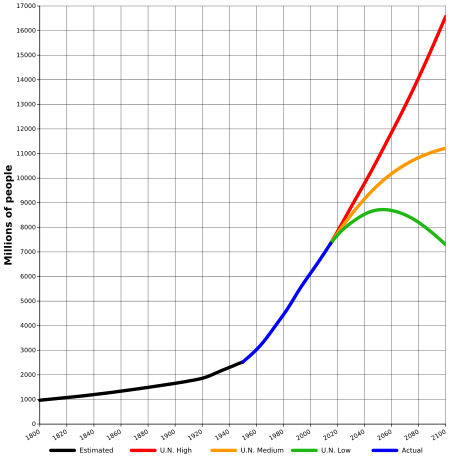
It’s not possible to maintain anywhere near our standard of living with the population projected to double in the next 80 years.

World population estimates from 1800 to 2100, based on “high”, “medium” and “low” United Nations projections in 2010 (colored red, orange and green) and US Census Bureau historical estimates (in black). Actual recorded population figures (as of 2010) are colored in blue. According to the highest estimate, the world population may rise to 16 billion by 2100; according to the lowest estimate, it may decline to 7.2 billion.

For decades, we’ve seen the increasingly negative results of overpopulation—people dying of starvation, the spread of disease, the expansion of desert into previously productive lands due to climate change as well as overuse of farming and grazing in marginal areas.

The evangelical solution: Teach them about Jesus. It’s in God’s hands.

No. It is in OUR hands.

We see the rush of people from marginal lands into areas of greater resources. From Africa into the Middle East, from the Middle East into Europe. From Central America and South America across our southern border.

The evangelical solution: Build a wall.

How long until the money runs out to care for the disabled, the elderly, the compromised? How long until schools are so crippled that they fail utterly? These are problems of OVERPOPULATION.

When the time comes, do we allow women to continue their ancient role of deciding who is born, or do we authorize the government to make those decisions? A government empowered to force birth is equally empowered to deny birth.

The evangelical fight to make the United States a “Christian” nation is nothing less than an attempt to overturn our government. The Founding Fathers were clear on this point, to keep religion OUT of government. Power to the people.

“The people have the power. All we have to do is awaken the power in the people.”
— John Lennon

Fayetteville’s Bawdy Houses

“Sylvia Sidney prefers brimmed hats.(Left)”Pied Piper,” in black pebble crepe straw, topped with yellow fan feather, tips far forward over one eye for that demure look in the Spring sunshine.
(Right), “Gingham Girl,” for afternoon and restaurant dining, in cloudy blue. New squared crown and coquettish brim that permits the wearer to see without being seen !” https://glamourdaze.com/2017/04/sylvia-sidney-1930s-hat-style-for-spring.html

Hats were a disguise for many women in the 1930s, creating a protective shield around her feminine innocence while at the same time allowing for curious–if not blatant–flirtation. In Fayetteville, at least for one madam who operated a house of prostitution three blocks from the town square, hats provided a useful cover. Advertising as “Cookingham Millinery,” Birdie Hickey set up residence at 115 West Spring where she housed several girls as well as a slightly older couple, the husband of which probably served as her bouncer/protector.

“In the 1930 census, she named her occupation as “manager.” One of the lodgers was her 33-year-old sister Norma Bigger. Other tenants included Robert Gholson, a restaurant manager, and his wife Rosa. Of particular interest are the other four other tenants: Pat Roberts age 24, Pat’s sister Laverne age 21, Nannie Morrison 23, and her sister Loretta age 19. Pat, Laverne, and Loretta claimed work as seamstresses while Nannie told the census collector that she worked as a telephone operator.”

There was nothing unusual about ‘public women’ then or at any time of human history. What was unusual is that Fayetteville’s newspapers, courts, and police pretended such unsavory activities did not exist within the boundaries of their lovely town. More to the point, parents sending their sons to attend college there must not be worried that their darling boys might be tempted into illicit bed sport. At least, that was the idea, an unofficial policy probably promulgated in private between town fathers, university leaders, and local law enforcement from the earliest days of the institution.

Meanwhile, Arkansas towns as near to Fayetteville as Eureka Springs and as far as Little Rock openly admitted the presence of prostitutes.

“Allegedly hosting as many as nineteen bawdy houses at one time, Little Rock passed its first ordinances regulating its prostitution industry in 1841. In 1875, the state granted local governments jurisdiction to deal with such thorny problems in A.C.A. §14-54-103, giving cities the right to “suppress bawdy or disorderly houses, houses of ill-fame, or houses of assignation.” By the turn of the 20th century, Fort Smith’s red light district hosted up to seven bordellos alongside gambling halls and saloons including a brothel owned by Belle Starr’s daughter Pearl which featured a “talented piano player, good whiskey, and ‘the most beautiful girls west of the Mississippi.’”[1] Hot Springs, long known for its gambling and underworld associations, tolerated extensive prostitution; as late as the mid-20th century, the infamous Maxine’s Brothel operated in full view of the world. Even in the quirky village of Eureka Springs, the sex trade flourished through the late 19th and early 20th century. Today one of the town’s top tourist attractions is the 1901 Palace Hotel with a sign whose shape clearly announces the nature of its business.”

Evidence shows that Fayetteville’s police force routinely harassed, arrested, and jailed women for trading their bodies for money, but these transactions mysteriously failed mention in the news. Town folk were shocked, then, in 1935 when the police chief’s statement regarding such unsavory activities appeared on the front page of the Fayetteville Democrat. Under duress and the threatened loss of his job, Chief Neal Cruse rebutted accusations that he had failed to eradicate such practices from the town by citing four separate locations where he had ‘shut down’ the operations in question, among them Birdie’s “millinery shop.” Only one of the named ‘houses’ remains standing today, at 9 North West.

9 N. West, as shown in Google maps

The circumstances leading up to this revelation involved illegal alcohol, a car theft ring, and the downfall of Fayetteville’s city attorney, among other things, all of it stirred with a big stick by reformers led by none other than the newspaper’s publisher and local society scion, Roberta Fulbright.

Details of this scandal are explored in depth in “Fayetteville’s Immoral Houses,” one of nine articles about local history in the recently released Second Glimpses of Fayetteville’s Past.

To obtain your copy of this fascinating collection, visit Amazon. Only $11.95


[1] https://www.nps.gov/fosm/learn/historyculture/pearl-starr.htm

Justice! Josh Duggar Convicted.

Josh Duggar Leaves Court with Pregnant Wife Anna (7th child) After Push to Dismiss His Child Porn Case Fails  https://www.youtube.com/watch?v=0-YfxGgVeAQ Credit: 40/29 News

Some of my blog followers may remember my report on the State of Perversion a few years back. At the time, the tip of an iceberg had been uncovered, but there was no justice because the statute of limitations had run on Duggar’s child molestation (and incest) crimes before it came to light.

We all know a leopard can’t change his spots, and likewise–apparently–neither can a pedophile. In the interim, Duggar has fathered several more children on his hapless wife, but at least now his children as well as perhaps other children can rest easy while he serves his time.

Here’s the report:

Federal Jury Convicts Former Reality Television Personality for Downloading and Possessing Child Sexual Abuse Material

A federal jury convicted an Arkansas man today for receiving and possessing material depicting minors engaged in sexually explicit conduct.

According to court documents and evidence presented at trial, Joshua James Duggar, 33, of Springdale, repeatedly downloaded and viewed images and videos depicting the sexual abuse of children, including images of prepubescent children and depictions of sadistic abuse. Duggar, a former reality television personality who appeared with his family on the TLC series “19 Kids and Counting,” installed a password-protected partition on the hard drive of his desktop computer at his used car lot in Springdale to avoid pornography-detecting software on the device. He then accessed the partition to download child sexual abuse material from the internet multiple times over the course of three days in May 2019. The password for the partition was the same one he used for other personal and family accounts. Duggar downloaded the material using the dark web and online file-sharing software, viewed it, and then removed it from his computer.

“Today’s verdict sends a message that we will track down and prosecute people who download and view child sexual abuse material, regardless of the lengths they go to conceal their conduct,” said Assistant Attorney General Kenneth A. Polite Jr. of the Justice Department’s Criminal Division. “I am grateful for the efforts of the prosecution team and our law enforcement partners who helped ensure the defendant would be held accountable for his crimes. I hope today’s conviction serves as a reminder of the department’s steadfast commitment to bringing to justice those who callously contribute to the online sexual exploitation of young children.”

“Over 7% of the cases sentenced in the year 2020 in the Western District of Arkansas were child pornography and sexual abuse cases,” said the U.S. Attorney Clay Fowlkes for Western Arkansas. “Our office is focused on expending all the resources necessary to the very important work of protecting children in Arkansas and elsewhere. This verdict sends the message that these cases are a top priority for our office. This verdict also demonstrates that no person is above the law. Regardless of wealth, social status, or fame, our office will continue to seek out all individuals who seek to abuse children and victimize them through the downloading, possession, and sharing of child pornography.”

“Because of the exceptional efforts by HSI special agents and our law enforcement partners, a child predator has been brought to justice,” said Special Agent in Charge Jack Staton of Homeland Security Investigations (HSI) New Orleans, U.S. Immigration and Customs Enforcement. “Every time child exploitation imagery is shared, it re-victimizes innocent and vulnerable children. The verdict demonstrates that regardless of an individual’s notoriety or influence, they are not above the law. HSI agents make it a priority to protect children by investigating these offenders and ensuring they pay for their incomprehensible actions.”

Law enforcement in Arkansas detected Duggar’s activity during an undercover investigation involving the online file-sharing program, subsequently searched his car lot in November 2019, and seized Duggar’s desktop computer as well as other evidence. Significant evidence was found that pointed to Duggar’s presence at the times of the offenses, including pictures that Duggar took on his phone that geolocated at or near the car lot. Duggar also sent multiple timestamped text messages to various individuals that indicated he was at the car lot at the relevant times; the messages were sent, and the iPhone pictures were created, at times within minutes of when the child sexual abuse material was downloaded or displayed on the desktop computer. Additionally, he was the only paid employee on the lot at those times.

Duggar was convicted of receipt and possession of child pornography. His sentencing date has not been scheduled yet. Receipt of child pornography is punishable by a term of imprisonment of five to 20 years. Possession of child pornography depicting prepubescent children has a maximum penalty of 20 years of imprisonment as well. A federal district court judge will determine any sentence after considering the U.S. Sentencing Guidelines and other statutory factors.

HSI in Fayetteville, Arkansas, the Little Rock Police Department, and the High Technology Investigative Unit of the Criminal Division’s Child Exploitation and Obscenity Section (CEOS) investigated the case.

Trial Attorney William G. Clayman of CEOS and Assistant U.S. Attorneys Dustin Roberts and Carly Marshall of the U.S. Attorney’s Office for the Western District of Arkansas are prosecuting the case.

This case was brought as part of Project Safe Childhood, a nationwide initiative to combat the epidemic of child sexual exploitation and abuse, launched in May 2006 by the Department of Justice. Led by U.S. Attorneys’ Offices and CEOS, Project Safe Childhood marshals federal, state, and local resources to better locate, apprehend and prosecute individuals who exploit children via the internet, as well as to identify and rescue victims. For more information about Project Safe Childhood, please visit www.justice.gov/psc.

[This report from https://www.justice.gov/opa/pr/federal-jury-convicts-former-reality-television-personality-downloading-and-possessing-child%5D

See previous posts on this topic:

https://denelecampbell.com/2021/05/01/evangelical-christian-perversion/

https://denelecampbell.com/2015/06/03/the-devil-within/

https://denelecampbell.com/2015/05/24/a-state-of-perversion/

The Immeasurable Harm of Legislative Ignorance

As the Arkansas legislature passes a bill to deny medical care to transgender individuals, the spotlight once again shines down on this state as the home of vastly destructive ignorance. One of the bill’s Republican sponsors, state Rep. Robin Lundstrum, compared gender-affirming treatments to surgical and chemical “mutilation,” and said children should not be allowed to make such decisions before they turn 18.

“This is about protecting minors,” she said. “Many of you, I would hazard to guess, did things under 18 that you probably shouldn’t have done … why would we ever even consider allowing a sex change for a minor?”[1]

This statement reveals the abysmal ignorance of Lundstrum and other sponsors who not only failed to research the science behind transgender needs, but also ignored testimony from parents and medical professionals who pointed out that once treated with appropriate therapies, transgender incidents of extreme depression and suicide drop off significantly.

Lundstrum and colleagues fail utterly to grasp that the crisis point for most trans individuals is adolescence, when the body they expect and hope to live inside starts to change away from that expected form.

“According to the American Psychological Association, gender dysphoria is defined as persistent distress related to the feeling that one’s body is not congruent with their perceived gender.  Simply put, gender dysphoria occurs when the way a person looks on the outside doesn’t match the gender they feel on the inside.  Gender dysphoria is actually a relatively new diagnosis.  It replaced “gender identity disorder” in 2013, in a move intended to underscore the fact that being transgender is not an illness or a disorder—only individuals who experience distress related to their gender status require mental health treatment.  Research suggests that a number of factors can help to reduce the levels of distress and psychological dysfunction related to being transgender.  In addition to psychotherapy with an empathetic provider who is well-versed in transgender issues, interventions that increase family, peer, and community acceptance can go a long way towards improving outcomes and quality of life for transgender men and women.”[2]

Not surprisingly, among Arkansas legislators whose primary source of information is an ancient religious text, this new legal restriction reflects zero awareness of the increasingly startling body of evidence that shows how modern chemicals play a role in our sexuality.

“Exposure to hormone-altering chemicals called phthalates — which are found in many plastics, foods and personal care products — early in pregnancy is associated with a disruption in an essential pregnancy hormone and adversely affects the masculinization of male genitals in the baby, according to new research. The findings focus on the role of the placenta in responding to these chemicals and altering levels of a key pregnancy hormone.[3]

One need not delve deeply into scientific literature to discover the impact of prenatal exposures upon our sexuality. An extensive entry in the free online encyclopedia Wikipedia offers two important points:

1 – “An endocrinology study by Garcia-Falgueras and Swaab postulated that ‘In humans, the main mechanism responsible of [sic] sexual identity and orientation involves a direct effect of testosterone on the developing brain.’ Further, their study puts forward that intrauterine exposure to hormones is largely determinative. Sketching the argument briefly here, the authors say that sexual organs are differentiated first, and then the brain is sexually differentiated ‘under the influence, mainly, of sex hormones such as testosterone, estrogen and progesterone on the developing brain cells and under the presence of different genes as well … The changes brought about in this stage are permanent. … Sexual differentiation of the brain is not caused by hormones alone, even though they are very important for gender identity and sexual orientation.’”

2 – “Endocrine disrupting chemicals (EDCs) are chemicals that, at certain doses, can interfere with the endocrine system in mammals. Work on possible neurotoxic effects of endocrine disruptors, and their possible effects on sexual orientation when a fetus is exposed to them, is in its infancy: ‘we mostly know about the relationship between EDC exposure and neurobehavioral function through an examination of outcomes within a limited sphere of questions.’ While studies have found that xenoestrogens and xenoandrogens can alter the brain’s sexual differentiation in a number of species used as animal models, from the data in hand to date, it is ‘misleading …to expect EDCs to produce profiles of effects, such as sexually dimorphic behaviors, as literal copies of those produced by native hormones. Such agents are not hormones. They should not be expected to act precisely as hormones.’”[4]

Endocrine disruptors aren’t some rare trace element. They’re present in the lives of all of us. What are some common endocrine disruptors?

  • Bisphenol A (BPA) — used to make polycarbonate plastics and epoxy resins, which are found in many plastic products including food storage containers
  • Dioxins — produced as a byproduct in herbicide production and paper bleaching, they are also released into the environment during waste burning and wildfires
  • Perchlorate — a by-product of aerospace, weapon, and pharmaceutical industries found in drinking water and fireworks
  • Perfluoroalkyl and Polyfluoroalkyl Substances (PFAS) — used widely in industrial applications, such as firefighting foams and non-stick pan, paper, and textile coatings
  • Phthalates — used to make plastics more flexible, they are also found in some food packaging, cosmetics, children’s toys, and medical devices
  • Phytoestrogens — naturally-occurring substances in plants that have hormone-like activity, such as genistein and daidzein that are in soy products, like tofu or soy milk
  • Polybrominated diphenyl ethers (PBDE) — used to make flame retardants for household products such as furniture foam and carpets
  • Polychlorinated biphenyls (PCB) — used to make electrical equipment like transformers, and in hydraulic fluids, heat transfer fluids, lubricants, and plasticizers
  • Triclosan — may be found in some anti-microbial and personal care products, like liquid body wash[5]

In 2016, the Obama Administration pushed legislation that required the Environmental Protection Agency to begin testing the over 80,000 unregulated chemicals currently on the market in everything from food packaging to shampoo.

“The new law requires EPA to test tens of thousands of unregulated chemicals currently on the market, and the roughly 2,000 new chemicals introduced each year, but quite slowly. The EPA will review a minimum of 20 chemicals at a time, and each has a seven-year deadline. Industry may then have five years to comply after a new rule is made. At that pace it could take centuries for the agency to finish its review.”[6]

Chemicals are not the only factor potentially involved in transgender cases. Even the most vigilant pregnant woman cannot avoid times of extreme stress or hormonal fluctuation triggered by a variety of situations. Yet no one escapes the silent chemical flood surrounding us every day in every way. Even more shocking, micro-plastics are now appearing in placentas.

“The health impact of microplastics in the body is as yet unknown. But the scientists said they could carry chemicals that could cause long-term damage or upset the foetus’s developing immune system. The particles are likely to have been consumed or breathed in by the mothers.

“The particles were found in the placentas from four healthy women who had normal pregnancies and births. Microplastics were detected on both the foetal and maternal sides of the placenta and in the membrane within which the foetus develops.

“A dozen plastic particles were found. Only about 4% of each placenta was analysed, however, suggesting the total number of microplastics was much higher. All the particles analysed were plastics that had been dyed blue, red, orange or pink and may have originally come from packaging, paints or cosmetics and personal care products.

“It is like having a cyborg baby: no longer composed only of human cells, but a mixture of biological and inorganic entities,” said Antonio Ragusa, director of obstetrics and gynaecology at the San Giovanni Calibita Fatebenefratelli hospital in Rome, and who led the study.”[7]

Despite years of awareness that plastics and other chemicals were exerting unwelcome changes in human existence, the production and consumption of these synthetics continue unabated. A 2019 study by the World Health Organization concluded: “In 2015, humans produced around 407 million tons of plastic. A recent review collated 50 studies wherein scientists found microplastics in fresh water, drinking water, or waste water. Some of these studies counted thousands of microplastic particles in every liter of drinking water.”[8]

In a society—indeed a world—deeply dependent on plastics and other chemical products in everyday life, Arkansas legislators are not alone in failing utterly to provide the kind of informed compassionate leadership the American people deserve. Similar legislation pushed by religious groups at home and abroad attempt to cram a square peg into a round hole—withholding medical care, threatening prosecution for providing medical care, and enforcing blatant discrimination against anyone who doesn’t fit the round hole. Without understanding anything of the scientific facts behind growing anomalies like transgenderism, this effort to force binary sexuality onto a modern population creates crushing harm to those impacted and will do nothing to address the underlying cause.


[1] https://www.washingtonpost.com/dc-md-va/2021/03/29/arkansas-passes-bill-restricting-access-medical-treatments-transgender-children/

[2] https://thetranscenter.com/clinical-research/

[3] https://www.sciencedaily.com/releases/2015/03/150305125409.htm

[4] https://en.wikipedia.org/wiki/Prenatal_hormones_and_sexual_orientation

[5] https://www.niehs.nih.gov/health/topics/agents/endocrine/index.cfm

[6] https://www.pbs.org/newshour/science/it-could-take-centuries-for-epa-to-test-all-the-unregulated-chemicals-under-a-new-landmark-bill

[7] https://www.theguardian.com/environment/2020/dec/22/microplastics-revealed-in-placentas-unborn-babies

[8] https://www.medicalnewstoday.com/articles/326144

More Arkansas Failure

You may remember my last blog post documenting the chaos ongoing at the Arkansas Department of Workforce Services (DWS) and its utter failure to accommodate claims by self-employed workers for federal Pandemic Unemployment Assistance (PUA).

Earlier this morning, I was on hold for over a half hour at which point the line went dead, a continuation of what is assuredly an endlessly futile effort to speak with a human at the state’s DWS offices on behalf of Bill, my neighbor who is owed, according to DWS policies, for claims going back to November 2020.

Bill and I learned back in January that no further PUA claims would be accepted until they had verified his identity. Nothing in their materials explained how to verify his identity but rather stated that he would be notified by mail or email as to the procedure.

A month later on Saturday February 13, Bill told me that he had received a letter from DWS demanding that he verify his ID within 7 days of the date on the letter. The letter was dated February 6. 7 + 6 = 13

On Monday, Feb. 15, Bill managed to wait on hold long enough to speak with someone at DWS on a phone number given to him by a friend, NOT the phone numbers listed for DWS. The man who answered the call took Bill’s information, verified him, and gave him a password so that he (I) could access his PUA account at arunemployment.com. It did not work.

Here’s the Feb. 15 follow-up email I wrote for Bill to the info email address for DWS

Regarding your recommendation via telephone on Feb 15, 2021, I am attaching photo of myself with ID card plus photo of ID card front and back. You gave me a temporary password of –xxx– but I can’t access the PUA claim page at www.pua.arkansas.gov/home. It won’t open. Is there a different web address I should use?

Please note that this email and all my access to the internet is through my neighbor, Denele Campbell, and her computer. She sent a letter this morning to your info email ADWS.Info@arkansas.gov The letter states:

 “Your letter dated Feb 6 to –xxx– was received Feb 13 by Mr. –xxx–. The letter requires him to present his state-issued ID at the local workforce center within 7 days of the date on the letter. 

“THAT IS NOT POSSIBLE. Not only did he not receive the letter within 7 days, our roads are impassable and will be impassable at least another 7 days.

Ms. Campbell has been the person filing Mr. –xxx–‘s PUA claims because HE DOESN’T HAVE A COMPUTER OR INTERNET. HIS PHONE DOESN’T HAVE DATA — when he can afford to have the phone working. He is desperately in need of money because he’s a self-employed construction worker and COVID has kept him away from most jobs for the last year.” 

You may respond to me through Ms. Campbell’s email or on my phone at —.

No big surprise that the email did not result in a response until Feb. 22, at which point the following email came through.

Good Morning,

Please contact the hotline number 1-844-908-2178. They are open from 6am to 4pm Monday through Saturday. Please use the following emails below if you cannot reach anyone by phone.

PUA.documents@arkansas.gov

ADWS.PUAHelp@arkansas.gov

Dear Reader, you may remember that telephone number. It is the unemployment hotline. For over three weeks, I’ve been dialing that number and waiting on hold for hours at a time, to no avail. Try it yourself for a fun time! Be sure to press #2 and #2 on the menu for PUA assistance.

Finally, last Friday the 19th after the roads were semi-passable, Bill drove to the Fayetteville DWS office and waited along with a very long line of other people standing outside in the freezing temps. He got there early enough to be #7 in line and soon sat face to face with a human who typed some info into his computer and told Bill he was now verified.

There is no accounting for the previous verification email we sent to DWS. Obviously whoever receives emails is so far behind they did not register the verification we sent within the five days that passed before he appeared in person at the local DWS office to – again – verify.

Now that he’s verified both by email and his in-person verification, I returned to the PUA webpage at DWS. The page won’t open.

Here’s today’s email to DWS:

I am the neighbor of PUA claimant –XXX–. Last year I filed his weekly claims. As of mid-January 2021, I could no longer access his account. Information from the DWS website informed us that until his identity was verified, he (I) would not be able to access the account. Those instructions said he would receive an email or letter telling him how to verify.

A month later on Feb. 13, he received a letter stating that he had seven days from the data on the letter to verify in person at the local DWS office. The letter was dated Feb 6. We were under eight inches of snow with subzero temperatures at the time. So I emailed photos of his state-issued ID front and back plus a photo of him holding the ID beside his face. No response.

On Feb. 19, Mr. X stood in a line at the Fay’vl DWS office until they had an opening at which point a DWS worker took his ID and information and told him he was now verified. Apparently the Feb 15 email identification information had not been processed into the system as of five days after it was sent.

Upon the Feb 19 verification, the DWS employee stated that he could now access his PUA account at the DWS unemployment site.

WRONG. The website will not open. I AM THE ONE WHO HAS TO FILE HIS CLAIMS. HE DOES NOT HAVE A COMPUTER.

What is the problem? I can’t spend even more hours on hold waiting for a real person to answer the phone. The Fay’vl DWS office says they don’t handle anything to do with PUA except to verify IDs. 

Why is it beyond the capacity of the State of Arkansas to gear up for this ridiculous situation by adding more hotline numbers and more personnel to handle what is obviously a large number of people who need help????????

Can somebody please HELP me gain website access for Mr. –xxx—so that he can file his PUA claims?

It’s difficult to imagine how incompetent (also, how understaffed) DWS must be for these kinds of dead ends to continue. The process runs in perpetual loops. It’s not that expensive to add more hotline numbers, but I suspect the problem is that even with only one hotline number, there isn’t enough staff to handle the call volume.

Same holds true for responses to emails from people who need help. There is NO EXCUSE for this level of dysfunction at a state agency charged with providing a lifeline to people who can’t work. Bill picked up a short-term construction job two weeks ago – working on a roof in freezing temperatures – before the snowpocalypse kept him at home for a week.

By the way, I’m now on hold again. For the last half hour. Bill’s phone has been shut off and he’s living on money from pawning tools. Tools that he uses to earn income.

More Than Meets the Ear

The tune is catchy and the lyrics intriguing. That was my first impression. The clip ended fairly quickly and I played it again. And again. Now I can’t get it out of my head.

Here’s the clip: https://www.reddit.com/r/JustGuysBeingDudes/comments/kzocvf/just_a_sing_along_with_the_boys/

The tune is entitled “Soon May the Wellerman Come” and is labeled a sea shanty in most media. Over the last few months, it’s become a hot item, spreading virally through several online platforms. There’s even a piece about it on Wikipedia where its origins are discussed:

“The song’s lyrics describe a whaling ship called the “Billy o’ Tea” and its hunt for a right whale. The song describes how the ship’s crew hope for a “wellerman” (an employee of the Weller brothers, who owned ships that brought provisions to New Zealand whalers) to arrive and bring them supplies of luxuries, with the chorus stating “soon may the wellerman come, to bring us sugar and tea and rum.” According to the song’s listing on the website New Zealand Folk Song, “the workers at these bay-whaling stations (shore whalers) were not paid wages, they were paid in slops (ready-made clothing), spirits and tobacco.” In the whaling industry in 19th-century New Zealand, the Weller brothers owned ships that would sell provisions to whaling boats. The chorus continues with the crew singing of their hope that “one day when the tonguin’ is done we’ll take our leave and go.” “Tonguing” in this context refers to the practice of cutting strips of whale blubber to render into oil. Subsequent verses detail the captain’s determination to bring in the whale in question, even as time passes and multiple whaling boats are lost in the struggle. In the last verse, the narrator describes how the Billy o’ Tea is still locked in an ongoing struggle with the whale, with the wellerman making a “regular call” to encourage the captain and crew.[1]

An Engraving of Cramped Quarters and Leisure on a Whaling Ship circa 1850. (Photo by Fotosearch/Getty Images)

Whaling was one of the most dangerous pursuits among fishermen. Crews of hardy sailors endured extended sea voyages through storms and high seas before ever sighting their prey. They ventured out on wooden boats to make the kill, harpooning enormous whales that didn’t give up without  a fight. Once the whale succumbed to its injuries, the next task was to haul it to land where the sailors dissected the massive marine mammals mostly to render their blubber into whale oil which, at the time, served as an important fuel for oil lamps.

“In the days before the discovery of petroleum, whale oil supplied the fuel for the lamps that illuminated the nights in American homes. In addition, the whale was the source of a boney substance called baleen used in women’s corsets, hairbrushes, buggy whips, collar stays and various other products.”[2]

The practice of whaling nearly destroyed several species of whales including the one mentioned in the song, the ‘right’ whale.[3] Prior to whaling in the southern seas, whalers had nearly exterminated northern varieties that existed closer to places the British, American, and other whaling ships called home. Wives were left to fend for themselves for months on end while their husbands rode the high seas in search of nature’s bounty, and the men themselves spent long hours on deck, tending to the business of sailing a ship while watching the waters for signs of whales.

The songs men created in those circumstances reflected the nature of their lives. The lyrics of Wellerman revealed those circumstances – waiting for ‘sugar, tea, and rum’ when suddenly a right whale is spotted.

There once was a ship that put to sea
And the name of that ship was the Billy o’ Tea
The winds blew hard, her bow dipped down
Blow, me bully boys, blow (huh)

Chorus

Soon may the Wellerman come
To bring us sugar and tea and rum
One day, when the tonguing’ is done
We’ll take our leave and go

She had not been two weeks from shore
When down on her a right whale bore
The captain called all hands and swore
He’d take that whale in tow (huh)

Chorus

Before the boat had hit the water
The whale’s tail came up and caught her
All hands to the side, harpooned and fought her
When she dived down below (huh)

Chorus

Men tossed overboard by a whale while hunting, engraving from L’album, giornale letterario e di belle arti, Saturday, August 22, 1835, Year 2.

No line was cut, no whale was freed
An’ the captain’s mind was not on greed
But he belonged to the Whaleman’s creed
She took that ship in tow (huh)

Chorus

For forty days or even more (ooh)
The line went slack then tight once more
All boats were lost, there were only four
And still that whale did go

Chorus

As far as I’ve heard, the fight’s still on
The line’s not cut, and the whale’s not gone
The Wellerman makes his regular call
To encourage the captain, crew and all

Soon may the Wellerman come
To bring us sugar and tea and rum
One day, when the tonguing’ is done
We’ll take our leave and go

Since its apparent origin circa 1850-1860, the Wellerman song has enjoyed multiple reincarnations not only as a sea shanty but also as a folk ballad. Its most recent popularity began with an a capella version recorded in 2018 by The Longest Johns, a British group. The recording went viral on TikTok in 2020.[4]

In late January 2021, a version by Scottish musician Nathan Evans brought in a multitude of contributors lending their voices to the mix, which is the version I heard first. I like it. I think I mentioned that.

But why? A lifetime of exposure to and participation in music has not prepared me for how this piece resonates with me. It’s emotional. It haunts me. And I detest the wasteful cruel practice of slaughtering whales which continues today in some parts of the world.

As I pondered the unexpected appeal of the song, I considered its various elements. The rhythm is fast paced and evocative of songs so typical of human endeavors where the song’s beat matches the movement of the labor. You know, like marching to war.

Then I considered the melody and harmonies, rich with folk ballad nuances meant to evoke tender feelings and, conversely, a reflection of those feelings. I even considered the minor intervals involved here and there and how these particular harmonics speak of sadness and darkness. There is an underlying fatalism in the song, that we do what we must despite the risks.

One explanation for the popularity makes the connection to the current pandemic, such as an article in The Guardian which concludes:

“My guess is that the Covid lockdowns have put millions of young [people] into a similar situation that young whalers were in 200 years ago: confined for the foreseeable future, often far from home, running out of necessities, always in risk of sudden death, and spending long hours with no communal activities to cheer them up.”[5]

I agree that must be a factor, but I’m not young. Surely that’s not all there is behind this phenomenon.

Then it slowly dawned on me. Like so many works of art, the song speaks to something greater than its apparent subject. A metaphor if you will, akin to the appeal of Moby Dick.

The Wellerman is a cautionary tale, a philosophical statement on the human condition, that we prepare ourselves to succeed at the pursuit we believe most likely to provide what we need to live. As we labor in pursuit of our prize, we seek relief in “sugar and tea and rum.” Finally we spot it. Harpoon it. Make it ours.

But instead of taking the prize, we belatedly realize it owns us, drags us interminably across vast seas, the days and years of our lives.

Underneath our conscious minds, we understand the song’s message. Its meaning addresses our heart, informs our quest for the meaning of life. There’s a resignation here, that we will go out again and again, risking everything, in the hope of seizing the prize that will make it all worthwhile. In the end, it is our lives we have paid.

~~~

[1] https://en.wikipedia.org/wiki/Soon_May_the_Wellerman_Come

[2] http://www.eyewitnesstohistory.com/whaling.htm

[3] https://en.wikipedia.org/wiki/Southern_right_whale

[4] https://www.youtube.com/watch?v=-KO7cofMJH0

[5] https://www.theguardian.com/world/2021/jan/15/shantytok-how-a-19th-century-seafaring-epic-inspired-a-covid-generation

COVID Relief — Fail

The first absurd assumption is that people who need income assistance during COVID have computers or access to the internet. They might have had smart phones at one point, but not now when they don’t have food.

I can only hope that other states are more skilled in dispensing unemployment assistance than Arkansas. The Arkansas Department of Workforce Services (DWS) has lots of problems, in particular with COVID unemployment money meant for people who are (were) self-employed.

Traditionally, unemployment benefits have never applied to the self-employed. State law requires employers to buy unemployment compensation policies for their employees. No law requires such backup for those who work for themselves.

I got into this issue because I’m helping a neighbor, a 58-year-old man [I’ll call him Bill] skilled in building trades, specifically carpentry, drywall finishing, and painting. Bill owns no property, has no savings, and possesses a few tools of his trade plus a 2001 Dodge Dakota that’s one wheeze away from vehicular death. He lives hand to mouth. He can do just about anything, his livelihood forged over decades of getting by any way he could.

By June 2020 when the CARES Act passed Congress, he told me he didn’t know how to get money through the program even though it promised unemployment income for the self-employed. I agreed to help.

The information, application, and weekly claims go through the DWS website in the PUA special page for Pandemic Unemployment Assistance. But Bill doesn’t have a computer. His phone doesn’t have data – he can’t afford it. So on my computer, I’ve filled out his information and filed weekly claims. At first, the process involved stating what aspects of COVID kept him from working, in his case that his workplaces were shut down and jobs he was supposed to start had been cancelled. The application then required him to state whether he was receiving benefits from any other source. Then he had to verify the information was accurate.

It was a huge relief for Bill (and me) when he received a debit card with money flowing in from the claims we filed weekly. He could buy groceries, pay rent, and repair his truck.

About three or four months in, the state suddenly started requiring him to name at least three job contacts he had made that week and any work he’d done. There was no statement in advance that he would have to make job contacts in order to receive benefits, so a few weeks of claims were denied. Once I figured out the requirement, I let him know and he started making phone calls and checking in with people he had worked for.

Nothing had changed. Nobody was hiring interior labor and damn few outside construction jobs were hiring. Still, he made the required effort so we could state on the unemployment claim forms that he met those requirements.

Then he fell and cracked a bone in his arm, so for three weeks I noted on his claim form that he had broken his arm and couldn’t work. Well, that’s not COVID related, so they didn’t pay him for those weeks.  

Once he got better enough to handle his tools, we filed more claims but they didn’t send any money. Blank claims forms did not appear on his PUA page and there was nothing to fill out. He had no other income and the infection rate in our area was in the top five worst of the entire nation. Afraid to try to work even if jobs had been open, he began pawning his tools. His phone shut off. His truck insurance expired. He went to a church for food handouts and I gave him sacks of groceries to keep him from starving during the holidays.

In early January, I went again to the PUA page and found claim forms available back to November. So I filed claims for him through mid-December. So far he’s received just over $700.

He now has a working phone again, but he’s three months behind on his electricity bill. His arm is permanently bent from the cracked bone near his elbow because he had to cut and split firewood before it was fully healed in order to keep himself, his dog, and the plumbing in the house where he lives from freezing. Fortunately, his rental is on wooded property where he could cut trees. He did receive the recent $600 stimulus check and is using it to reinstate insurance on his truck and get some of his tools out of pawn.

But I can’t file any more claims for the new round of PUA unemployment because the AR DWS is apparently incapable of providing coherent support for the process. After a delay throughout most of January 2021, citing technological issues, their website offers now PUA information with instructions as follows:

“…PUA has been extended under the Continued Assistance for Unemployed Workers Act. The PUA extension will provide additional weeks of benefits, to a maximum of 50 weeks, ending with the week of March 13, 2021. Weekly certification, identification, and documentation will be required.

“If your application is approved, you will need to file continued claims for each week you are unemployed to receive benefits. The work search requirement is now in effect, and you must report the number of job contacts when filing your weekly claim. The one-week waiting period is also back in effect.

“Submit your application and file weekly claims for PUA benefits online at www.pua.arkansas.gov/home   Sunday – Saturday: 6 am – 6 pm

“If you have trouble filing online, or if you have questions regarding your account, you may call the hotline 844-908-2178 Monday – Saturday 6 am – 6 pm

“Those eligible will also receive the additional $300 FPUC for weeks claimed starting with the week ending January 2, 2021 and ending with the week ending March 13, 2021.

“You will be required to verify your ID to receive PUA benefits. You will receive notice in the mail and/or via email with instructions on how to complete the process. If you have already verified your ID, you do not have to do it again. If you are unable to verify your ID online, you may present your identification in person at a local DWS office or at an Arkansas Workforce Center.

“You will be required to provide documentation showing proof of employment/self-employment or planned employment/self-employment. You must submit the following supporting documents:

“1. Proof of earning from the last tax year or other financial documents. Until documents are received, the minimum PUA benefit amount will be applied.

“2. Documentation substantiating employment or self-employment or the planned commencement of employment or self-employment.

Needless to say, there is no hope of actually speaking with someone at that hotline number. The laconic voice on the recording remarks on ‘the high call volume’ and regrets there is no one who can take the call at this time. The caller is referred to their website.

To date, Bill has received no mail or email instructing him how to verify his identification.

The website allows no entry to Bill’s previous account, claiming the password is wrong. We did not change his password. Attempts to obtain password assistance are supposed to result in an email with instructions, but no emails have been forthcoming.

The website does not provide any information about what exactly they meant in item #2, “documentation substantiating self-employment” or “plans to commence self-employment.” If Bill had self-employment or plans for work, he wouldn’t need PUA money. More to the point, would it have killed them provide an EXAMPLE of how to document “plans to commence self-employment”???????

Without any further explanation of what exactly the documentation for such ‘plans’ might comprise, how is one to meet the requirement?

The PUA Handbook states that: “The PUA weekly assistance amount will be calculated in accordance with Arkansas Employment Security law. The weekly assistance minimum is $133 per week and the maximum is $451 per week. The weekly amount shall be the weekly amount of compensation that individual would have been paid as a regular unemployment insurance compensation unless the weekly benefit amount is less than 50% of the average weekly payment of regular unemployment insurance benefits. The maximum weekly benefit amount shall not exceed the maximum weekly benefit amount of regular unemployment insurance benefits payable in the state. … [and on and on with more incomprehensible drivel]

At one point in their PUA handbook, DWS states that “The weekly assistance amount payable to you will be reduced by the amount that you have received for a week or will receive for a week based on the following criteria: [four income sources that don’t apply to Bill] and…Gross earnings in excess of 40% of your Weekly Assistance Amount.” So, apparently, if your weekly assistance amount is $133 and you earn $55 that week, your assistance will be $78 which tops out your $133. Or not?

We won’t know from one week to the next whether Bill will find work or whether his “plans to commence work” will be considered adequate by whatever mysterious criteria they use.

I’m a college graduate and fairly skilled dealing with bureaucracy. I’ve plowed through the formation of more than one small business corporation and a couple of nonprofits. If I can’t make sense of this bullshit, how is a man of limited resources and a high school education supposed to negotiate the process?

Answer: He’s not.

That’s the entire point. Throw up as many barriers as possible – lack of access, incomprehensible “information,” verification requirements that are impossible to meet – and voila you have a program that is just about as worthless as the paper it’s written on.

I’m outraged for him. I’m outraged for all the other self-employed people who make up a huge segment of our economy who have been left in the ditch by COVID – gig-workers like musicians, audio guys, recording studios etc., as well as carpenters, painters, and other repair folks, plus restaurants and night clubs and other venues that have been forced to close. These people are losing their homes, their vital services, everything that they depended on to earn a living and survive.

As I said at the start of this rant, I hope other states are far better in providing PUA funding to the people who need it. This isn’t the first time I’m been ashamed and outraged by the failures of Arkansas government. I don’t have any hope that things will improve in the near term. But I just wanted to make people aware that despite federal efforts to extend a helping hand, many of those in Arkansas who need help AREN’T GETTING IT.