Fire

Over a period of weeks, sometimes months, my dad would collect bits of debris to burn in the big garden beside their house in town. At the edge of the dormant garden, he would back up to his growing stack of brush, the bed of his rusted blue Ford Ranger piled high with dead limbs and old fence posts and oddly shaped pieces of wood that he might find alongside the road. The truck unloading was ceremonial, it seemed to me one day when I watched him, a kind of ritualistic process where he lifted each piece from the truck, carried it slowly in his now-halting pace across the soft, plowed dirt, and strategically placed it on the rising, unruly mound. Even the very last, tiny pieces merited his attention, scraped from the truck bed with his worn-out broom and thrown in fistfuls onto the top of the pile.

Sometimes I watched my father with his fires. Early into the process, he studied the future shape of it, how high it would blaze, whether the base would attract a good draft, whether unwanted combustibles had been suitably removed from the perimeter. He stacked his fuel accordingly, bits of wood and old lumber and limbs broken in winter storms, piled akimbo with large against small, thick against thin in a perfect formula for flame.

He would light it in the morning, when his footsteps tracked rich green across the silvery coat of dew on the lawn. His time at the donut shop for six a.m. coffee with the old liars, as he called them, would be cut short for the fire.

Usually he stood to the side of the shimmering heat, shovel in hand. After one of the last fires, my mother complained that he stood so close that the skin on his forehead turned red and later peeled. Standing in the dining room with them, I looked at my dad as she pointed out the damaged skin. He raised his eyebrows and smiled, offering no excuse except to agreeably remark that it had been hot.

I know his mind traveled to his past while he watched the fire. The flames would dance and reflect in his eyes while he talked about fields they had burned when he was growing up, his dad, his brothers, and how the mules had to plow a line around the field to keep the fire from jumping the fence. He remembered his mother and how she burned off her garden in the winter, leaving the ground filmed in ash for the early planting of onion, cabbage, and potato. He talked about the cold of the night, when the feather bed kept him warm until his father got up to build a fire the stove and his mother would mix biscuits.

A friend once remarked on the task of clearing out the old family house after his grandmother died, particularly the basement. It seems during her waning years, she had stockpiled kindling carefully gleaned from her wooded yard. Grocery sacks and cardboard boxes, each one stuffed with dried twigs and broken limbs, filled the space like so many sockets in a wasp’s nest. She had prepared a hive of future warmth. He said it took seven pickup truck loads to remove her cache of carefully prepared comfort.

At first, I discounted my friend’s grandmother’s collection of kindling as some kind of mental or emotional disorder. But today, as I picked up fallen oak twigs in my own yard, the wind tearing through the woods glowing orange with autumn, I thought about this wealth of fuel and one of the more opportune swaps in my life—my old refrigerator for a wood cookstove.

Neighbors had inherited the stove when they bought the old house down the road from me. A “Royal” brand, its heavy cast iron top features six burner plates and a water warming bin on the right. There’s a small firebox and ash bin on the left and an oven in the middle. The sides and front are white enamel, and a glass-covered chromed dial on the oven door features a double-ended needle which simultaneously points to a number and a description of the temperature: slow, warm, medium, hot, and very hot, the intervals also marked at the other end of the needle at 100, 200, up to 600. 

I pick up more dead wood and stack it by the door, worrying that my bundles of twigs will be similarly disparaged someday, a burden requiring disposal by patient descendants. But I must plan for future winters when ice coats the electric lines and snow piles up on the roads and I end up with several days of splendid isolation, maybe without running water or the benefit of electricity. Then the old cookstove will spring to life, its grate glowing in a steady bed of coals, lids jiggling as food simmers on its top, the rocked chimney a beacon of warmth into the gray sky outside my window where wind will whip streams of smoke into the icy mist. In a bad winter, a person might need a basement full of kindling.

But I suspect it is not completely the need for fire that pushed my friend’s grandmother or my father in their almost religious attendance to the needs of fire. As much as they might have needed the bodily comfort the fire would assure, they had a greater, more present need—the need to accomplish. In my father’s later years, he could not show much to account for the hours of his days. But he could still build a superior fire.

When he was eighty-five and suffering mini-strokes that, he said, was like hearing distant music, we had taken away his truck keys and he couldn’t go for donuts with the old liars or gather wood for a fire. I found him one day by an old wood pile at the side of his house. He had the sledge hammer in one hand, gripped up close to the head, and a foot-diameter length of oak sitting upright on a nearby stump. He had driven a splitting wedge into the center of the oak, sweat pouring off his forehead, his slight frame bent to the task.

In response to my concerned questioning, he replied: “The ole dad is still worth something.”

I turned away so he couldn’t see my tears.

~~~

Back when his neighbor Cotton was still alive, my dad would call out to him on the morning of a fire.

“Come on over,” he’d wave his arm.

And Cotton would bring over a few limbs he’d been saving or anything wooden he wanted to get rid of, set up his lawn chair next to Dad’s, and they’d tend the fire together. Dad would stick his cigarette lighter down to the bits of paper and cardboard he had crumpled at the base of the heap, and then light a fresh Winston and draw on the cigarette strong and deep while the blaze flared into the brush and started working its way up the near side of the pile.

The fire merited their full attention. Orange-red flames would tear through the heap of wood, picking up speed. They listened to the snapping and popping of it, smelled the scent of wood smoke. Dad would take another drag off the Winston and then launch into one or another of his stories.

In one of his tales, he recalled high school at Morrow. Among his buddies there, he joined with three friends in a quartet that performed on the Fayetteville radio station. They were late one day, racing down the road in a Model T. As they approached the railroad crossing between Cane Hill and Prairie Grove, the freight train whistle sounded loud and long. In those days, the trains were endless. The quarter didn’t have time to wait. So the driver floored that old car, and they barreled through the turn on two left wheels and a cloud of dust seconds before the steam engines roared across the road, whistles blaring and the engineer shaking his fist at them.

He’d have to stop and laugh about that, full of renewed vigor.

On occasion, my dad would muse over his adventures teaching singing school. The shaped note method simplified the more arcane aspects of reading music, and folks would flock to these gatherings, although the popularity had as much to do with socializing as it did with music. He liked to reminisce about the time he forded the White River at Goshen to teach singing school there. Mid-river, he fell off the mule and wore wet clothes the rest of the day.

His father’s job with the railroad gave way to the Depression, and after trying to make his way with blacksmithing, in 1933 the family moved to West Memphis. Dad was in his last year of high school, so he stayed at Morrow in an arrangement with the folks who owned the general store. He would live at the store and keep the fire going in the wood stove overnight so the canned goods didn’t freeze.  After a few months, he got word his mother was sick, and he had to hitchhike to West Memphis. He had nothing but an apple in his pocket.

When he told his stories, Dad didn’t have to look at Cotton to know he was paying attention. Cotton came from the same times.

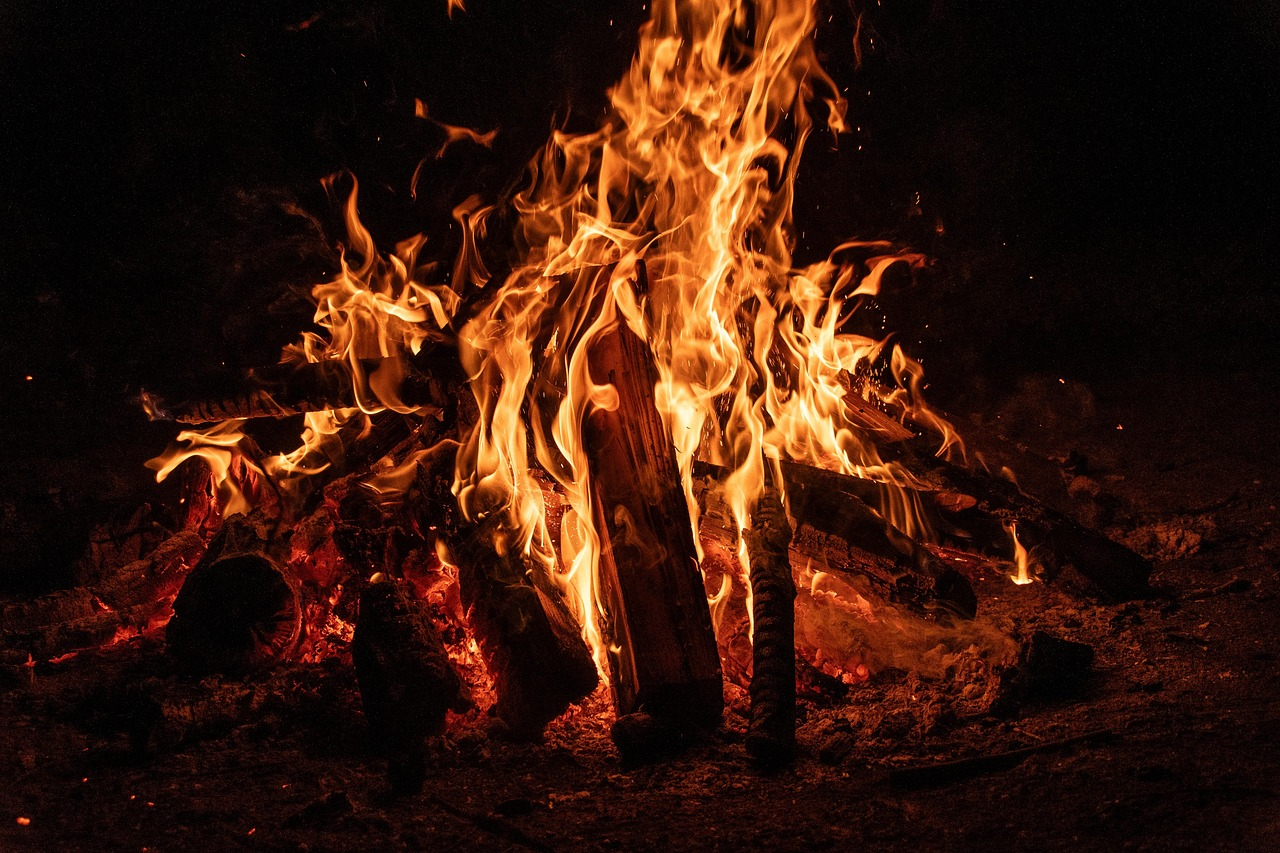
The flames would leap high in the air, twice as high as the shimmering cone of wood, twisting into the air like a curling orange hand with only a faint grey vapor of smoke rushing from the top of it. Periodically Dad or Cotton would walk around to the side or back of the pile and pick up ends of logs or still-burning sticks that had fallen out of the path of the flame and throw them back onto the fire. Each thrown piece caused a great cavalcade of sparks to explode into the air, a celebration of new fuel, of longer life to the fire.

Cotton would stay with my dad while the fire burned down, sometimes for the rest of the afternoon, poking at it, throwing on newly discovered fallen twigs or dead weeds to keep it alive. By that time, there was little talking. Dad would use the shovel to drag the last few little unburned pieces over to the center of the ash circle where the coals ate them up in quick yellow blazes.

Finally Cotton’s wife would call him home to dinner. Mom could have called Dad too, but he wouldn’t have come. He would lean on the shovel, watching the red embers swell and throb in the slight breeze of dusk, until the last bit of fire had died.

My friend’s grandmother probably labored slowly, moving from place to place in her yard to collect the fallen twigs, carrying the brown paper grocery bag in her stiffened hand. Breezes would have lifted the tendrils of white hair that had escaped her tidy braid, and she would have stopped on occasion to stare off in memory of past times, when young she might have run laughing through green spring fields chased by a lover, perhaps examined in close intensity the phosphorescent emerald glow of new moss at the base of a big tree. Each time she bent to a fallen twig, a fresh scene spilled into her mind and she was transported to a better time. Later, she may have sat on her porch to review the tidied yard and the merits of her life.

That hasn’t happened to me yet but I expect it. For now, gathering fallen twigs is a practical exercise when I have come outside to put scraps in the compost or rake a few more leaves. But gathering twigs and preparing for fire leads me to examine the purpose of my existence. In the long tradition of humans and fire, I seek proper reverence for the knowledge I carry forward, the experience of my father, of all the grandmothers, who depended on fire for survival. We are removed from that now. My children in their comfortable homes have no need to build fire.

Yet there is ceremony in every fire. When I begin to clear a brush pile or dispose of too many fallen leaves, I think of composition, how the tiny start of flame will need room and air to burn upward, where larger limbs should be placed to catch early and burn long. After all the fires of my life, each new one is still an experiment testing whether I can prove my worth.

The flames of my success warm me and encourage me. My success is the fire. Its flames live on my arrangement of wood and air, orange and red, leaping and cracking. Embers fall to the ground and glow in the gathering bed of hot ash. My thoughts and life rush outwards in a vision of times more than my own, more than my father’s.

The ancient tribe has gathered and their shadows circle my fire.

From I Met a Goat on the Road

Family stories

The holiday season is a time when families gather and stories are told. This year I’m happy to see Facebook posts by a cousin who has gone to the trouble to scan his 104-year-old mother’s photos and record the stories behind them. Such a wonderful project!

Here’s the photo and story he posted today.

Grandpa Tom Morrow sitting in the field with Uncle Graydon, teaching Uncles Durward and Douglas how to plow. This past weekend, Mom told me that the mule’s name was Toby. Toby evenutally got loose and was killed by a train as they lived near train tracks at the time. Mom said that she and her siblings convinced themselves afterwards that the chugging sound made by trains coming by were actually the train saying “I killed Toby, I killed Toby”. Circa 1925, Texas

Self-Publishing: The Basics

Plus

How to Tell Your Story: A Guide for Personal Memoir or Family History

This holiday season, take advantage of family gatherings to save your ancestral history. For the first time in history, you have the opportunity to put your masterpiece ideas into bookstores without a middleman. This revolution in communication comes with a price, however, a steep learning curve about which technology to use and how to use it. That’s where this book comes in handy.

The first part of this book covers the fundamental stages of self-publishing: what software to use and how to use it, step-by-step guidance for working with Amazon’s Kindle Direct Publishing, and understanding important elements like genre. You’ll find discussion about getting reviews and marketing as well as useful hints about maintaining those tender creative sensibilities in the face of seemingly overwhelming obstacles.

The second part provides organizational and writing guidelines for the personal memoir as well as family history. How do you transform the bare bones of genealogical research into a compelling narrative? How do you flesh out the story of a transformative period of your life? Take notes when an older relative starts reminiscing. Someday you’ll be glad you did.

Previously, so-called vanity presses charged a stiff fee to take a manuscript and turn it into a book. Now with print-on-demand technology, the self-publishing author doesn’t need to pay a dime to publish a paperback or e-book. That memoir or family history or sure-to-be-a-bestseller novel only needs some basic pointers to go from brainstorm to reality. Start writing!

Paperback, $12.95, Amazon

Durward’s Cart

My uncle Durward seemed to be older than his years, a result of his bashful traits which I now, belatedly, attribute to the overbearing nature of his mother Sylvia Clark Morrow. Always ready with the harsh critique, she sought perfection and never found it, either in herself, her spouse, or her nine children of which Durward was the oldest. He learned at an early age there was no pleasing her. As far as I could tell, she was never pleased about anything.

So he fretted and obsessed and squirmed through life, marrying a spinster neighbor when he was forty and producing one child. They adopted a second one. He devoted his energy to his job, working in a newspaper printing operation, and to his flourishing garden. He also kept chickens. Gardening and chickens were necessity for the family, dirt poor hill folk in the Arkansas Ozarks.

He was sixty or so when I married a wild man and set up housekeeping on a wooded hilltop in a half finished house. We—husband, baby, and I—pursued the hillfolk life with a passion. Among other things like firewood and a garden, we needed chickens. That was about the same time that Durward decided he no longer wanted to mess with chickens, and so a project was born, to dismantle his chicken house and bring the walls, roof, and other bits up to our place. We had a pickup, but it alone wasn’t enough to perform the task, and so Durward also gave us his cart.

The cart—and the chicken house—were handcrafted by Durward himself, pulled together from scraps and, in the case of the cart, an old rear axle of some early vehicle. Our load of dismantled walls and roof of the approximately 10’ x 10’ coop were laboriously positioned into the lovingly-framed bed and the modest sideboards of his trailer, and the long journey from his farm near Johnson to our farm near West Fork began.

The distance of about twenty miles progressed slowly, red flags whipping in the breeze as the conveyances edged toward forty miles per hour. In due time, the roof became a wall to our fledgling barn while Durward’s chicken house walls were reborn as our chicken house walls with a new metal roof. The trailer was parked in the expectation there might be future use.

There wasn’t. It sits today, forty-six years later, where we parked it in 1976. The bed has rotted away as has the chicken house and the barn. One of the trailer’s sidewalls lingers. The rear axle and attached tires also remain, I suspect because they are solid rubber and probably the original tires that came with the vehicle. A phantasm of welds connect the original drive shaft to various pieces of metal to accommodate hauling.

Durward died in 2005 at the age of 89, but his cart lives on. I see it and think of him, remember his anxious ways, wringing his hands at family gatherings when the daylight started to fade. He’d mutter, “Gotta get home, it’s late.” He’d pace and entertain a few exhortations from his attending siblings to relax, hang around, but he’d shake his head and repeat “Gotta go” under his breath until he escaped the chaos to find his way home.

About Searching for Ancestors

My mother’s family at St. Paul, Arkansas, early 1920s. Mom is third from left.

Without question, discovering the people from whom you descend is an exhilarating and fascinating endeavor. Idiosyncrasies of your known kinsmen—and yourself—suddenly make a lot of sense, not to mention that red hair or tall stature. It’s remarkably emotional to learn of an ancestor who fought to the death in a war or whose wife–your 3x great grandmother–died in house fire.

Several internet sources for genealogical information are free—simply search “Name” “date of birth” and if you know it, “location” and you’ll discover a group of results with respectable information. Sadly, you’ll also discover a trove of spammers and click bait.

But a word to the wise. The most extensive and useful source, Ancestry.com, also can be less than forthcoming. Here are a few helpful hints.

Using the “Search” “All Collections” option yields the best results especially for a beginner. Once you’ve entered the name and whatever other information you may have on hand, you’ll find results that don’t exactly match up with what you’re looking for.

Refinements could include selecting the gender for your subject, isolating the location to “exact” as shown by the arrow, and narrowing the birth year to within a year or two of the assumed date of birth. Yet in the case of Albert Taylor as shown in the image, the search yields nothing more than the 1860 census where, at age 17, he and his 19-year-old sister Jane reside in the household of Alcie Haton [Heaton] to whom his relationship is not known.

My interest in Albert Taylor is his military record with the 1st Arkansas Cavalry, U.S., where he served in Company L as a private. His death in the regiment records occurred February 22, 1863, as shown on one of the most extensive records of Civil War military personnel, the Edward G. Gerdes Civil War homepage. He is also listed in this regiment at the National Park Service website. But in Ancestry.com, his name does not appear in military records.

One of the most frustrating of Ancestry.com problems is the tendency of many family historians to simply duplicate what someone else has posted to that lineage history without confirming any of the information. In an ideal situation, a search of Family Trees produces a lot of histories. For example, my search for information about Van Buren Covington, who lost his life in 1864 while serving in Co. A, 1st AR Cavalry, led to an Ancestry.com Family Tree record showing only one result, as seen below. The only option from here is to click on the name of his fourteen-year-old bride, which yields her family background, locations of family members, and other possibly useful leads.

But in many cases, Family Tree results show one or two trees with two or three ‘records’ or ‘sources’ and then the rest of the trees, of which there may be dozens, have no records and only one source, if any. Inevitably, these trees perpetuate inaccurate information and are simply not to be trusted. This problem grows exponentially as you track family trees back through generations because researching materials established before modern record keeping involves tedious attention to details often preserved in an arcane manner. So don’t just take the first couple of family trees as gospel; make a thorough investigation of those with the most sources and records, and compare the information before accepting it.

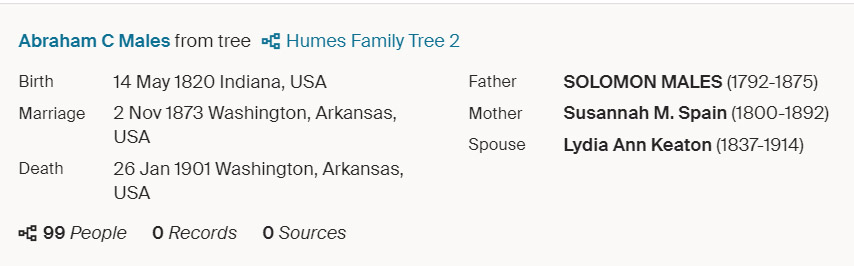
One option with a search result like this one with 0 records and 0 sources is to do another search on the father’s name. Or continue with this search until you find some with multiple records and sources.

Note: If your ancestry leads you to records in another country, you’ll have to pay Ancestry.com an additional subscription fee in order to access those records.

Ancestry.com is very much a user-created database assisted by an extensive organizational effort on the part of the company to provide as many institutional records as possible. But nothing is perfect. Subscribe if you want to search your genealogy, enjoy the nuggets of pure gold that you find, but always remain aware that in order to glean the greatest accuracy, you must not only limit your family tree searches to those with multiple records and sources, but also compare them to information found on other internet sites.

For Van Buren Covington, an internet search beyond Ancestry.com resulted in several discoveries. Geni.com shows his full name was Martin Van Buren Covington, born in 1839, not 1837. It also shows family members. But beware—Geni.com is one of those sites that requires membership before giving out any further info. You may find useful free resources at genealogy.com and many more. Bottom line? HAVE FUN!

Kinfolk!

Combining four generations of family history and up-to-date genealogical information, this collection of ancestry information tracks a group of families which settled in Greene County, Arkansas in the first two decades of statehood. Family trees, deed records, census records, and other official records create a factual framework for personal narratives and vintage photographs, creating a fascinating archive of information for any descendant of these families as well as any fan of local history.

Each marriage between these pioneer families brought certain talents and backgrounds to the next generation. They farmed the rich land of Crowley’s Ridge and other Greene County areas, weathered the storms of poverty and loss, and suffered the ravages of sickness and war. Yet they survived, and their great-grandchildren entered the twentieth century determined to continue as they had begun.

Now the 21st century brings us the internet with its vast collection of historical documents, making it finally possible to reflect on their adventures and aspirations. The story of these families is the story of thousands of us descended from them.

Nab your copy, only $14.95

Take Note While You Can!

Make good use of that chaotic holiday family gathering! Record family history told by Aunt Tilley and Grandmother Joan while they’re still around or forever regret the history you’ve lost. Interview Granddad Hiram, racy jokes and all. These stories never go out of style! And your grandchildren will thank you.


Wait no longer! Take some time today to write down something, even a few words. Fifteen minutes. An hour. What you write doesn’t have to be a 400-page novel—it can be a list of things you remember about your grandmother. Put her full name at the top of the sheet of paper and then the date and place she was born, if you know it. Who did she marry and when, where? What places did they live? What were the names and birth dates of their children? Did she keep a garden? Crochet? Play tennis every week? Every detail you record will color in the lines of a story prized by your descendants.

Whatever direction your road leads, never doubt that your efforts will be greatly appreciated not only by other family members now but also by those who come after you. Knowing the names, activities, whereabouts, and personalities of our forefathers and foremothers offers each of us a comforting sense of place, a mirror to reflect our greater selves, and reassurance that life for your kind goes on no matter what. Personal and family histories are a critical tool for your descendants to more fully understand what has led to who they are.

Or maybe you’ve been thinking about telling your personal story, those life-changing moments you’ll never forget. This easy-to-follow guide walks you through the steps of making it real: gathering and organizing information, changing a bare-bones family tree or personal memoir into a fascinating narrative, and putting it into print – at no cost!

This book covers the fundamental stages of writing family history or an autobiography with pointers on fleshing out details into compelling narratives, how to organize your materials, and building a story.

The book also provides clear guidelines on how to self-publish: what software to use and how to use it, step-by-step guidance for working with Amazon’s Kindle Direct Publishing, and understanding important elements like genre. You’ll find discussion about getting reviews and marketing as well as useful hints about maintaining those tender creative sensibilities in the face of seemingly overwhelming obstacles.

Don’t miss your holiday opportunities to gather your family history and turn it into a record to be prized by generations to come. Grab your copy today at Amazon.com

Beating the Train

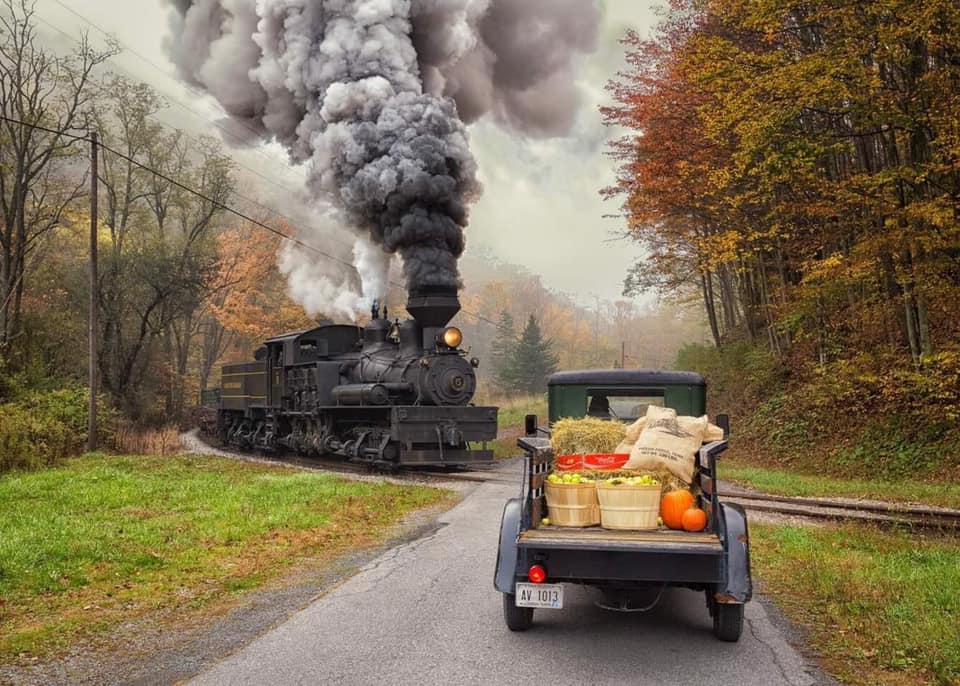
This photo reminds me of my dad Floyd Pitts who would sometimes reminisce about his younger days when he was still in high school at Morrow, Arkansas. He’d tell part of this tale then slap his leg and start laughing.

During that period of his life – early 1930s – his parents and younger sister had to move to West Memphis where his dad found work. Floyd stayed at Morrow to finish high school. He slept on a cot at the Morrow Mercantile with duties to keep the fires going at night so the stock didn’t freeze. Alongside his work duties and high school classes, he and three friends performed around the Northwest Arkansas region as a quartet.

“By 1933, I was the leader of the Morrow Quartet (I played fiddle and sang bass) and we were the best in the whole area. We sang at anything. We’d put on a show at places like the Savoy Community Building, we sang on the radio all the time, KUOA, Voice of the Ozarks [then located in the Washington Hotel on the southwest corner of the Fayetteville square, Mountain and Block], any old breakdown tunes.

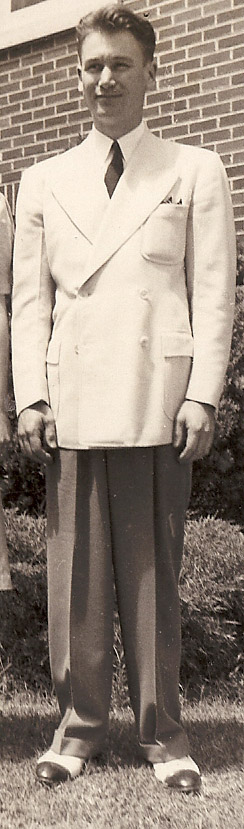
Floyd Pitts circa late 1930s

“It was a novelty for a boy to play the piano. People would take us home for dinner if we’d perform.  Jim Latta was the father of one of the singers—the lead, Vernon Latta. He’d help us out buying gas. Vernon played guitar and mandolin. Or the Morrow Mercantile would help us because of Dennis Carmack, the tenor of our group. There were four main guys who owned the Mercantile: Ernest Ball, Lowrey Carmack, __ Reed, and [can’t remember].  Ty Reed sang alto (high tenor). I played fiddle and Dennis Carmack played guitar.

“Dennis had an old Chevrolet and that’s how we got to Fayetteville for our weekly radio show. One time we were running late. There was a railroad crossing at the turn off from the Cane Hill Road to the main highway just east of Lincoln. We heard the whistle and as we roared up to the crossing, we could see the train coming. Trains were long in those days, usually pulling an endless string of freight cars. We knew we’d miss our broadcast time if we waited for the train.

“The train was barreling down, close, too close, to the crossing. There wasn’t time to discuss it. Dennis floored that old Chevy. The engineer laid on his whistle as we hurtled ahead throwing up a huge dust cloud behind us. We could see the engineer’s mouth moving as we approached. He was shaking his fist at us.

“We flew over those tracks without a second to spare. The force of that train as it passed behind us shook the car. As we made the sharp turn just after crossing the tracks, that old car went up on two wheels. We all leaned to the right, laughing at our near miss as the car slammed back onto all four tires. We made it to the Fayetteville Square in time for our show.”

Floyd Pitts went on to gain his bachelor’s degree in music at Northeastern State University at Tahlequah, Oklahoma, then taught music at Rogers AR public schools until his service as an officer in the U. S. Navy in World War II. After the war, he gained a master’s degree in music at Iowa before returning to Rogers to teach. He took over the band man post for the Grizzly band at Fort Smith’s high school in 1953. During his time at Fort Smith, he moonlighted in vocals and piano with a dance band that played local venues like the Elks Club. In January 1957, he proudly led his band in the Washington D.C. parade for Dwight Eisenhower’s inauguration.

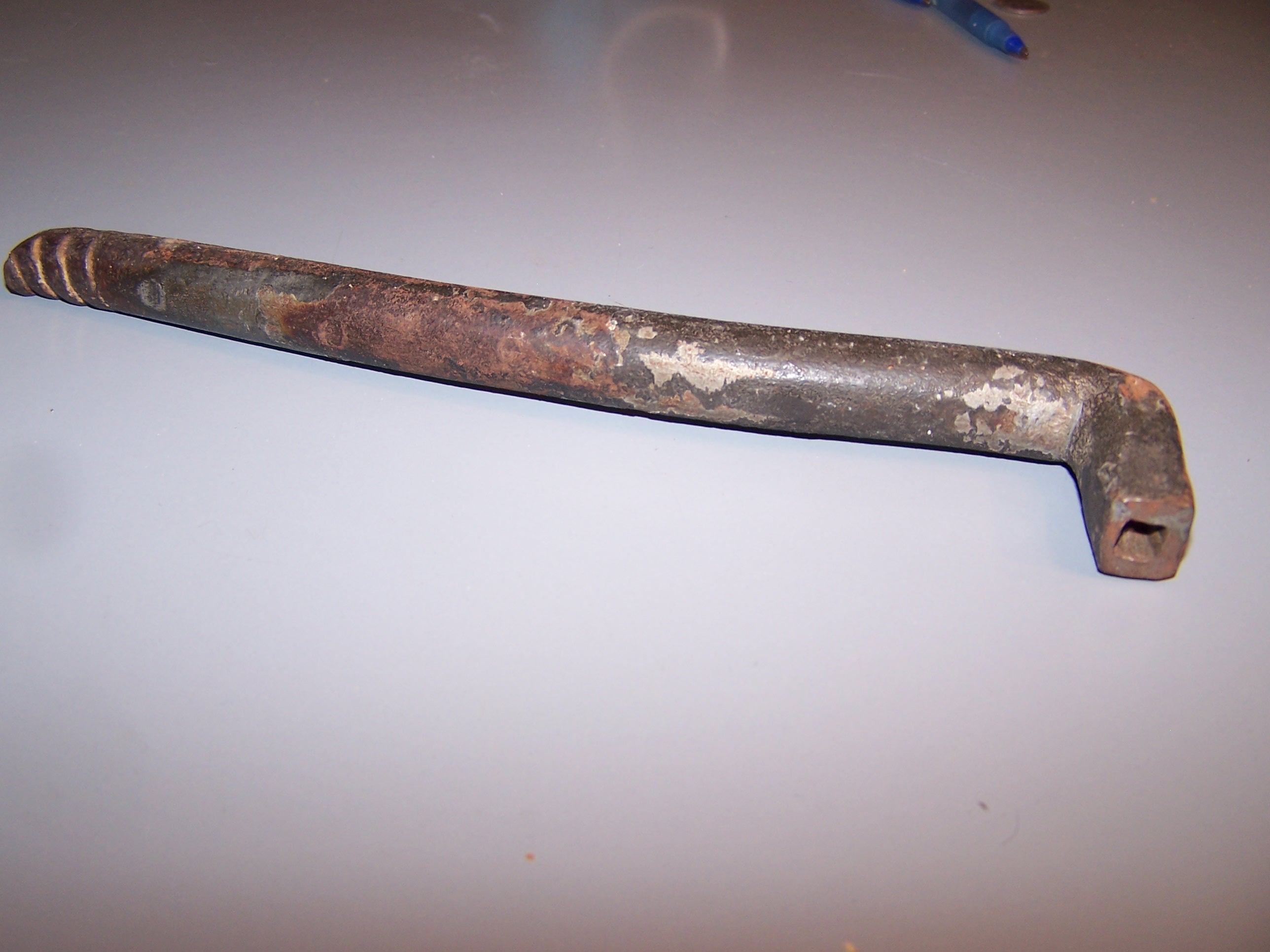
In 1958 in search of better income, he moved his family to Miami, Oklahoma to lead the music programs for the public schools and direct the junior high and high school bands. During those years, he pursued after-hours income by tuning and repairing pianos, something he’d done since his high school days when he’d teach shape note singing at schools and church houses around the area and inevitably encountered out-of-tune pianos. His father, a sometimes blacksmith, forged Floyd’s first tuning hammer from an old Model A tie-rod.

Floyd remained the Wardog band director at Miami until 1967, when the family once again relocated to Fayetteville, Arkansas. (His wife, Carmyn Morrow Pitts, was relieved to be back in “God’s country.”) From there, Floyd taught band a couple of years at Westville, OK and for many more years at Lincoln AR, more or less a return to his roots at the end of his long career in teaching music to multiple generations. He retired in 1979 but continued his new career as a full time piano tuner/technician alongside his daughter Denele until a couple of years before his death in 2004. Even in his last days, a good old fiddle tune would bring on a flurry of foot tapping.

~~~

Floyd’s first tuning hammer from Model T tie-rod, late 1920s

Side note: KUOA began as a project of the University of Arkansas in Fayetteville, using these call letters starting in 1926. With the deepening of the Great Depression, in 1931 the University decided to lease operations to out of town interests. “Members of the Fulbright family then formed KUOA, Incorporated, to purchase the station, and on April 1, 1933, they took control, with Roberta Waugh Fulbright as president, John Clark as secretary-treasurer, and daughters Roberta Fulbright as station manager and Helen Fulbright as vice president.”[1] Ownership of the station shifted to John Brown University in 1936.


[1] https://encyclopediaofarkansas.net/entries/kuoa-radio-station-3678/

My Dad

Family of Floyd Pitts at the family home, Cane Hill, Arkansas: Standing back row, left to right: Older brother Harvey, his wife Ina, youngest sister Verna, younger sister Opal, Floyd, oldest brother Noah with wife Nellie holding Betty with Laverne standing. Front row, children of Harvey and Ina, Bobby Ray and Joy Lee. Seated: William “Bill” Pitts and his wife Nora West Pitts.

My dad, Floyd D. Pitts, didn’t fit a traditional male identification, not that he wasn’t fully male. His talent for music set him up for ridicule and bullying by his two older brothers. He hated the fields of cotton where, as a child, he was once flogged with a cotton stalk by his mom for sleeping at the end of a long row with his bag only partly filled. He was eight years old. It was a lesson in working to survive, and he never forgot it.

His high school diploma from Morrow, Arkansas, hardly counted when he entered college on a music scholarship. He’d already been part of a popular men’s quartet with classmates from high school performing regularly on Fayetteville’s KUOA, Voice of the Ozarks radio station. He played piano and fiddle, and also taught singing school. A makeshift piano tuning hammer had been fashioned from a tie-rod end by his blacksmith father because invariably when Floyd showed up at some rural church house to teach shape-note singing, the piano needed tuning.

Band Director, Rogers Arkansas circa 1940

Time in the U. S. Navy during World War II gave him the opportunity to later obtain a master’s degree as well as hours toward a doctorate. After the war, he returned to Rogers (Arkansas) to again teach choir and band. Another forty years would pass in this career, at Fort Smith in the 1950s, then Miami, Oklahoma until 1967, then part time at Westville, Oklahoma and Lincoln, Arkansas, until he retired from teaching.

From the early 1960s on, however, he advanced his moonlighting career of piano tuning and repair, which he took up full time once he left Lincoln schools. And while I had been his student in the Miami schools band, my first opportunity to work at his side came with the piano business. And it was here that we stepped outside the normal father-daughter roles.

He didn’t treat me like a girl. I remember that even as a youngster, when he was trying to remodel an old house we lived in at Fort Smith, he’d show me how to drive a nail or spread mud on a sheetrock seam. When I began ‘helping’ him in the piano business, he didn’t pay attention to whether my nails would get broken or if my feet were cold. He’d say “Come hold this clamp, sis,” or “Get that Phillips and come over here.”

I learned so much this way, not only how to repair and rebuild these complex instruments called pianos, but how to refinish wood whether solid or veneered, how to mix stains to get rid of red tones, how to smooth off delicate veneer edges with 220 grit sandpaper. If I had a shop today, there’s no end to the kinds and numbers of projects I could pursue and conclude with pleasing results.

Most women don’t get that kind of education.

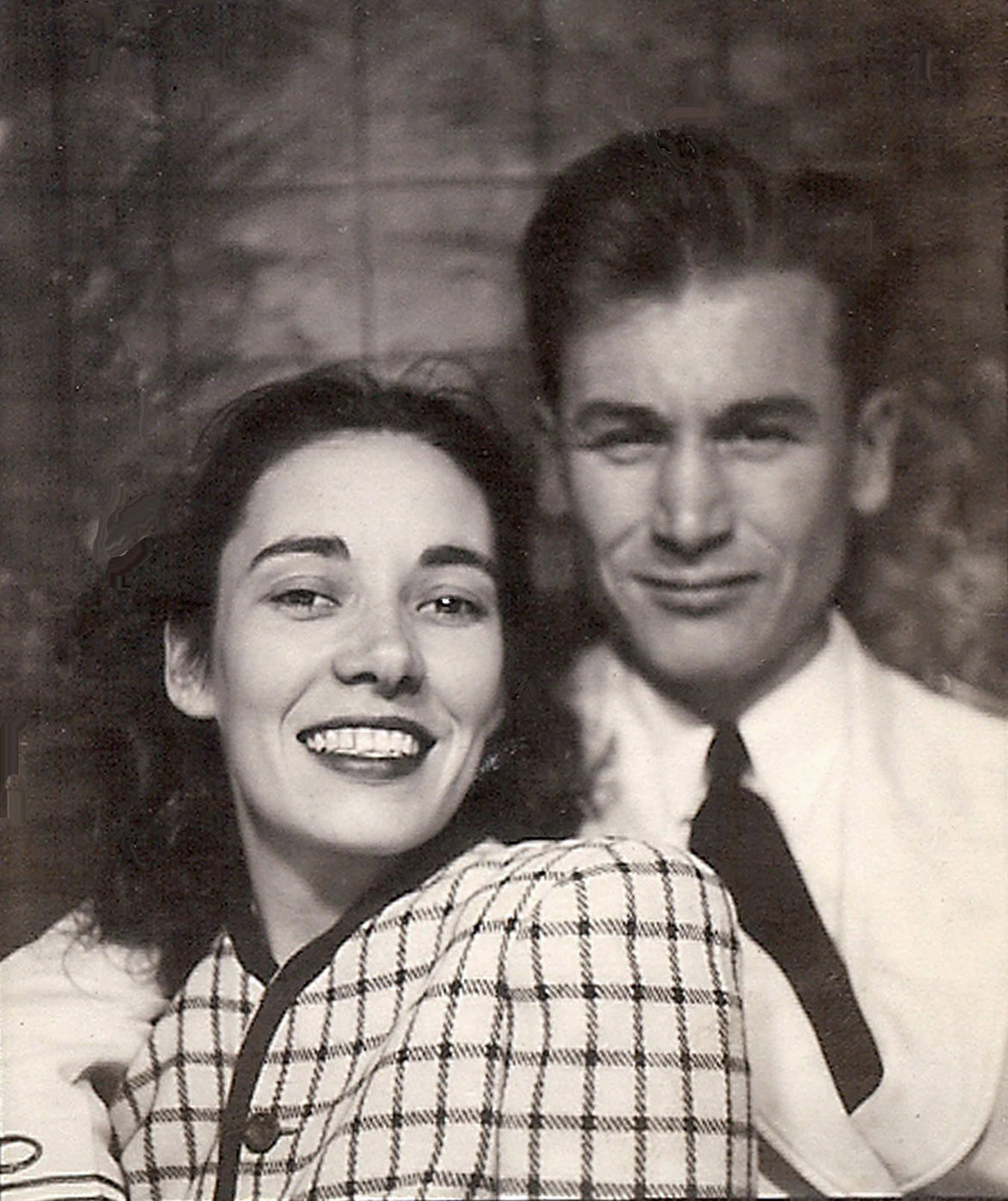
Carmyn Gem Morrow and Floyd Denver Pitts, Benton County Fair circa 1945

Maybe he realized he wasn’t a “traditional” male in the sense of muscles and macho. Maybe he realized I wasn’t a traditional female in the sense of lace and flirting and whatever else defines that sort. Maybe he didn’t realize any of that but rather just moved forward through time with the work his hands could do well and the concept of work as an honorable and necessary pursuit.

I learned more from my dad’s view of the world than from my mom’s. Oh, I washed dishes and hung clothes on the line and changed my little brothers’ diapers. I sewed most of my own clothes through high school. Gardening, milking goats, keeping chickens—those were also part of my education through mom. But none of that really meant much in the greater world of the late 20th century when a woman might need her own income.

Whereas my mom’s social circles didn’t reach much past her extended family, my dad had to learn how to interact with the greater community despite his rural background. He’d have a social drink, laugh at jokes, and recruit band parents and faculty to help sell snow cones to raise money for new band uniforms. It was his charmingly open approach to people that showed me how to build a social network that became an essential part of a thriving thirty-year career as a piano tuner/technician.

If he thought I could lift one end of a 1910 upright piano, who was to say I couldn’t? If he could dig mouse nests out from under piano keys or drill through the cast iron plate to insert lag bolts in restoring a pin block to its correct position, then so could I. I was stronger than I knew, more mechanically minded, my hands—like his—able to tug strings made of cold drawn steel into the right position on a tuning pin.

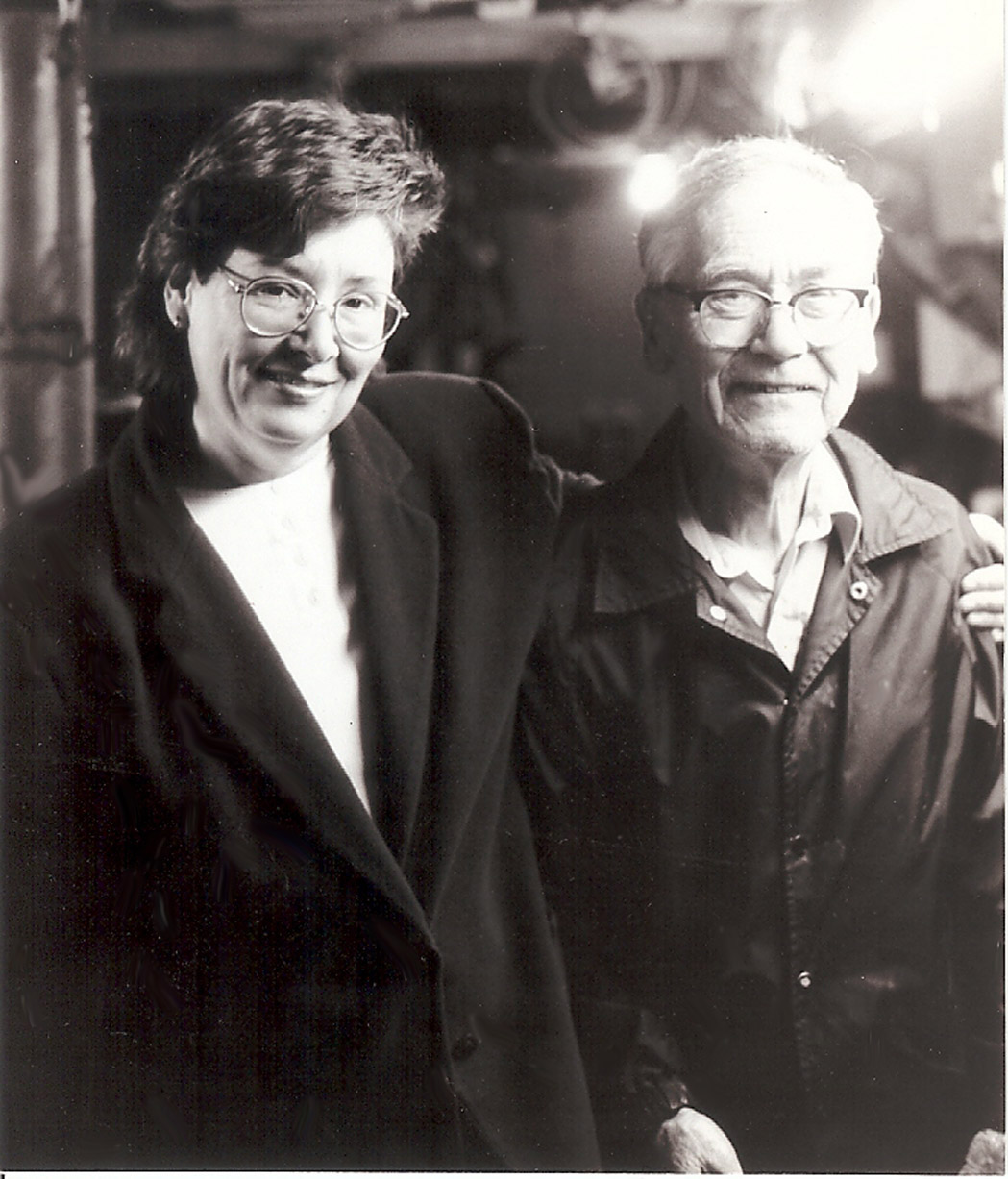
Me and my dad, mid-1990s at the piano shop, Pitts Piano Service, Fayetteville

I admit to occasional worries that I had lost all chance of being a ‘real’ woman. What woman crawled under a grand piano to refasten the pedal lyre? In 1982 when I passed my Piano Technician Guild exams for registered tuner/technician status, there were less than two dozen women in the field. Plenty of customers would open their door at the appointed time and express shock at seeing a female tech. My hands weren’t delicate with slim fingers and manicured nails, but rather slightly rough tools used to create a well-tuned musical instrument.

But then, even as a child, I never felt feminine. The mysterious talent by which a female might lure a male into courtship totally escaped me. My body didn’t cooperate with the idea of feminine wiles, but rather expressed itself in somewhat androgynous terms—tallish, fairly flat-chested, angular. Interestingly, my dad too seemed somewhat of an anomaly in his family, handsome, lithe rather than muscled. Did he recognize, at least subconsciously, that we both didn’t quite fit the mold?

Nevertheless, I enjoyed my share of love and marriage, cherish my three children, and never turn down a romance novel–unless it’s poorly written.

As his oldest, I gained my dad’s attention first and perhaps it was only the bond of fatherhood that propelled his urge to teach me what he knew. In his heart, he was a teacher more than anything else. He was also an artist—a bass vocalist who could track any part in a four-part harmony, a clarinetist,  and a pianist who loved to pound out the keyboard version of jump music like “Bugle Call Rag” or marches like “Under the Double Eagle.” He cherished his role as both a composer and a conductor who pushed his students to produce excellent music whether Sousa marches or Copland’s Appalachian Spring. It was natural for him to insist I learn piano, clarinet and oboe and how to sing alto, and to teach me how to shim a cracked soundboard and identify the difference between real ivory and early celluloid keytops.

All five of us kids learned music. Both my brothers earned master’s degrees in that field. Sadly, I was the only one privileged to work with him in the piano trade and see the broader side of him than as just a parent.

Whether by conscious intent or as the consequence of his personality, my father allowed me to be me. He encouraged me in skills that were beyond anything considered traditional for a female. His open-mindedness about the life choices of his oldest daughter freed me from any sense of duty to the stereotypes that so often limit women.

Today, fifteen years after his death, I appreciate him more than I was ever able to express while he lived. Thanks, Dad.

I Killed a Dog

When I was twelve, I killed a dog.

We lived in a rent house next door to Frank and Ethyl McMillen, a nice older couple who allowed our entire family (dad, mom, me, sister, two little brothers) to tromp into their living room every Monday at 8 p.m. to watch Gunsmoke on their nice big console television. The adults sat in chairs, Frank and Ethyl in their recliners, we kids on the floor–they had carpet– and sometimes Ethyl would serve us homemade cookies but only when my mom said okay.

McMillens had a dog named Penny. Her muzzle had started to turn gray and her black-and-white body had taken on some extra weight. Little terriers like that don’t handle extra weight very well. She walked like a sausage with legs. We weren’t encouraged to pet Penny. She moved stiffly and had her own ideas about company. But she never growled or scared us.

Each day I walked to school down a long gravel alleyway that ran from beside our house (and McMillen’s house) due west to the end of the block. The route then took me across railroad tracks, then alongside the athletic field and into the north wing of Will Rogers Elementary where I attended sixth grade. When school was over, I walked home.

One day as I returned home, I heard kids shouting and screaming. I spotted a group of kids jumping around on the far side of McMillen’s house, so I ran over there. At least six kids of various ages had gathered around the flower bed where Penny and another dog were in a fight. Only Penny wasn’t fighting. The other dog, a brown boxer more than twice her size, had her by the throat and pinned down.

One little girl screamed, “He’s going to kill her.”

I saw that was true. I ran around and knocked on the McMillen’s door, but I already knew they weren’t home. I looked around for a weapon—a shovel, a stick—something I could use to pry the dogs apart. I considered reaching down to pull the boxer off Penny, but then I worried the boxer would attack me. I thought of calling for help, but everyone there had been yelling and no one had come.

I was the oldest kid there, a head taller than anyone else. Someone had to do something, and the task fell to me. I couldn’t stand there and watch Penny be killed.

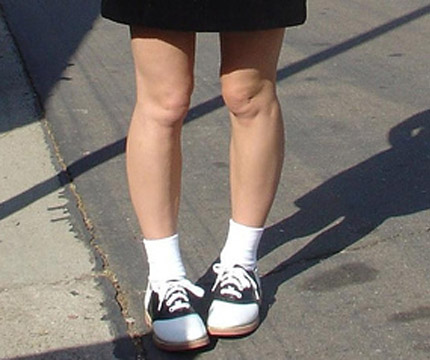
So I kicked the boxer. In the head. With my saddle oxfords, big heavy shoes I had to wear with specially-made arch supports inside so I wouldn’t get fallen arches. My feet in those shoes dangled from the end of my legs like concrete blocks. It wasn’t without some serious clout that I aimed and fired with the toe of those shoes.

The boxer didn’t budge. In retrospect, I suspect my assault may have only intensified his determination. I kicked his head, careful not to also hit Penny. She had collapsed by now, resting against the red brick wall of the house and the well-tilled soil of Ethyl McMillen’s rose garden.

I kicked again and again, each time terrified I’d miss and hit Penny or that the boxer would turn and sink his teeth into my leg.

Why didn’t he let go? Why didn’t somebody come, a grown-up, someone who would know what to do? My heart pounded. Sweat poured off me. I was shaking all over.

Finally the boxer let go. Penny didn’t move. The boxer trotted away. The kids dispersed. I went home.

Two or three hours later, my dad stood outside talking to a man. My dad came back inside and asked me if I knew what I’d done. I told him what happened. He shook his head.

“That man,” he said, gesturing. “He came down here to tell me that his kids’ dog just died. In their bathtub, bleeding from his nose and ears. He said you kicked him to death.”

I stood there as all the feeling drained out of my head and chest. I couldn’t breathe. I had killed a dog. It wasn’t that my dad lectured me or seemed angry with me. He seemed bemused, unsure what to think that his oldest child had done such a thing.

The man had told him they paid fifty dollars for that dog. Did my dad have to pay him for the dog? I don’t know.

I don’t remember if my dad said I’d done something wrong. But I felt terrible anyway. No one hugged me and said they understood, that everything would be okay. No one seemed to recognize the trauma of my experience.

I think I cried later, after my sister in the twin bed next to me had gone to sleep, when no one would see or hear me.

I didn’t mean to kill a dog. I was trying to save a dog. Surely everyone understood that. Who else had any idea of what else I could have done? What anyone could have done? But it was my fault their dog died and they were mad.

Penny died, too. She would have died even if I hadn’t killed the boxer with my big heavy oxfords. My right foot.

It was their fault the boxer died, not mine. I understand this now. They had a dog who for no apparent reason invaded Penny’s home turf and attacked her. A dog like that shouldn’t have been allowed to roam loose, but in those days, leash laws didn’t exist. For all I know, the boxer may have killed other dogs in that neighborhood.

At the time, I knew none of that. I only knew that I had kicked a dog to death and its owners were mad at me and my dad was uneasy with the whole thing. I think the McMillens thanked me, but I don’t remember that part.

I remember the deep red of the brick, the soft sun-warmed dirt, the rose bushes and the big evergreen at the corner of the house. I remember the agitated neighborhood kids jumping around, yelling. I remember that boxer straddled over Penny as her big dark eyes bulged, her mouth gaping while the boxer kept his jaws firmly fastened over her throat. I remember the impact in my body of each kick, of holding myself steady for yet another carefully aimed blow to the boxer’s head.

I remember the impact of my foot against that dog’s skull. It traveled up my leg, through my hip, up my spine, and lodged in my head where memories stay forever.