What About Cherry Pie?

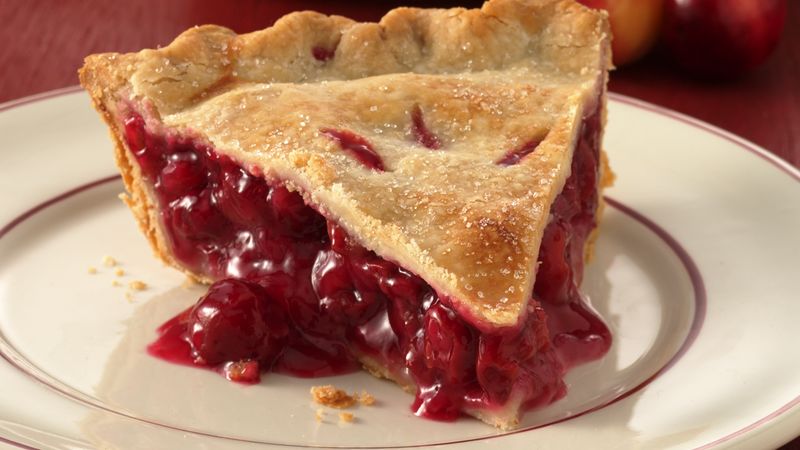
I love cherry pie. Baking cherry pie as a must-have part of family tradition goes back at least as far as my maternal grandmother and the early 20th century. For the last few years, I’ve skipped the cherry pie not out of intent but out of convenience. With the kids grown and my waistline growing, baking for the holidays has become a questionable activity.

This year I really wanted a cherry pie. So I looked for cherries. Not the fat sweet fruit that can be found canned, frozen, or in the fresh fruit department, but those tart cherries that produce such a fabulous flavor when paired with delicate pastry crust. Yum!

After searching my regular grocery stores, I realized there must be a cherry Grinch out there. Not only were there no tart cherries frozen, canned, or otherwise, there weren’t any empty places on the shelves where they might have been. What is going on?

[For the record, canned cherry ‘pie filling’ is so far off the mark that I refuse to take it into consideration. Mostly sugar and cornstarch, these fillings are no substitute for the real thing.]

I searched online and discovered that for a mere $76.60, I can order five pounds of frozen tart cherries. That’s right—a staggering $15.32 per pound. Plus shipping. Other sources offered slightly better deals. Organic tart cherries, 4.5 pounds for $69.89. Three 24-ounce jars of cherries for $51.95. Or my old standby brand of canned tart cherries, Oregon, only $4.31 per 14.5 ounce can. Plus $8 shipping.

That brings a nine-inch pie, which requires a minimum of two cans, coming in at a cost of $16.60 for the cherries alone.

I’m priced out of my pie!

More research starts to reveal some basic truths. A few years ago, some genius discovered that tart cherries offer all kinds of health benefits including the big headliner, antioxidant effects. A plethora of publications heralded the news, such as an article in Men’s Health citing a study published in the The American Journal of Clinical Nutrition.

In the study, mice with Alzheimer’s symptoms were fed cherry extract, fish oil, and emu oil. Mice running on tart cherry extract performed better on cognitive tests like object recognition than did the control group.[1]

The kicker bit of that study revealed that tart cherry juice performed better in reducing high blood pressure than expensive medications!

No wonder the price of cherries has gone through the roof. They’re in demand as a juice (32 ounces of organic juice for $18.99 from one source) as well as a nutritional supplement (200 capsules of tart cherry 4:1 extract from 300 milligrams and mixed with rice powder—for $11.21).

What is the curious tree at the center of this health versus culinary pleasures conflict?

Prunus cerasus (sour cherry, tart cherry, or dwarf cherry) is a species of Prunus in the subgenus Cerasus (cherries), native to much of Europe and southwest Asia. It is closely related to the sweet cherry (Prunus avium), but has a fruit that is more acidic.

The tree is smaller than the sweet cherry (growing to a height of 4–10 m), has twiggy branches, and its crimson-to-near-black cherries are borne upon shorter stalks. There are several varieties of the sour cherry: the dark-red morello cherry and the lighter-red varieties including the amarelle cherry, and the popular Montmorency cherry. The Montmorency cherry is the most popular type of sour cherry. The reason for its popularity is its use in baking and recipe creation including cherry pies, cherry desserts and other cherry-based recipes.

Well, maybe not so much anymore, now that the harvest is almost entirely devoted to diversions like cherry juice and cherry nutritional supplements.

The fruit’s discovery and popularity dates back to the Romans:

The history of the ‘Montmorency’ tart cherry extends back to ancient Rome. The Romans are credited with discovering this tiny red fruit along the Black Sea in Asia Minor. After Roman legionnaires discovered the tart cherries, they carried them with them and introduced them to the rest of Roman territory. They planted cherry trees alongside Roman roads and soldiers used the fruit for food and the wood to build weapons and repair equipment.[2]

Seems the Romans knew a good thing when they saw it.

The problem isn’t just that newly discovered health benefits have cornered the cherry market. The sour cherry tree likes cooler climates, so much of the domestic crop in the United States grows across the upper regions of the country. And that, according to one farmer’s account as stated in a 2017 report on National Public Radio, is key to my lack of a cherry pie.

The tree is “very cold hardy” in the dead of winter, he says, and grows well in the state. But it is susceptible to damage from spring frost, making it very sensitive to the extreme weather shifts made more likely by climate change… In 2002 and 2012, freezing spring temperatures wiped out almost the entire tart cherry crop here [in Michigan].[3]

Farmers faced with this problem point to efforts underway since the 1980s to produce a new strain of sour cherry tree that would be more forgiving of weather anomalies, but such developments take a long term of trial and error. The farmer quoted in this article questions whether the Montmorency will still be around in fifty years.

Also suffering the effects of climate change, bee populations needed for cherry tree pollination have plunged, forcing many cherry farmers to make extreme efforts to sustain their own bee colonies.

Sadly, many farmers refuse to consider climate change as a factor in their troubles with sour cherry production and thus a potentially powerful lobbying voice is not yet making enough noise for the government to pay attention.

Even if the government turned massive attention and resources to this issue, it’s questionable whether anything can be done. At best estimates, the current rate of climate change won’t be changed any time soon. But there is hope, although I wonder if it will come in time for sour cherries.

We emit greenhouse gases like carbon dioxide when we burn fossil fuels like coal—or when the cattle that get turned into burgers fart. When those emissions enter the atmosphere, they trap the sun’s heat, warming the planet. It’s basic physics. The increased heat can become catastrophic by melting the polar ice caps, raising sea levels, and creating weather patterns that are less predictable, more volatile, and more dangerous. Because we’ve been warming the planet this way since the early days of the industrial revolution, we can’t completely avoid the effects of climate change. But by lowering our emissions now, we can avoid the worst effects.[4]

The article goes on to describe a few key changes individuals can make in life choices that will strongly impact climate change including having fewer children and cutting way back on meat consumption. Uh huh.

At my age, I won’t live long enough to see the worst of climate change or the ultimate fate of my beloved tart cherries. That’s just one of many regrets facing me and everyone else as we grow older. But I may experiment with dried cherries to see if rehydrating produces a decent pie. The least expensive source I’ve found offers a one-pound bag for $11.99.[5]

Here’s a recipe I’m going to try, assuming I can afford the shipping:

  • 3 c. dried cherries
  • 3 c. boiling water – some recipes suggest cherry juice instead of water
  • ¼ c. cornstarch
  • 1 c. sugar
  • 1 tsp. almond extract or ⅛ tsp. lemon juice (alternatively, try brandy or Amaretto)

Cover cherries with boiling water, cover and let soak for 30 minutes. Turn burner on medium, simmer and add sugar and flour to thicken. Remove from heat, add almond extract. Pour into prepared pie crust and add top crust. Bake at 400 degrees for about 35 minutes.[6]

I’ll let you know if it’s worth the effort.

~~~

[1] https://www.mensfitness.com/nutrition/what-to-eat/5-health-benefits-tart-cherries

[2] https://en.wikipedia.org/wiki/Montmorency_cherry

[3] https://www.npr.org/sections/thesalt/2017/04/07/523004370/michigans-tart-cherry-orchards-struggle-to-cope-with-erratic-spring-weather

[4] Excellent article “How You Can Actually Help Stop Climate Change” by Kendra Pierre-Louis, published July 12, 2017, in Popular Science magazine. https://www.popsci.com/how-to-stop-climate-change

[5] https://nuts.com/driedfruit/cherries/sour-tart.html

[6] Adapted from https://www.justapinch.com/recipes/dessert/pie/homemade-cherry-pie-filling.html

Humbug Fancy Food

Personal secret: I’m a purist when it comes to food. Simple basic food, unlike the horror I saw recently where someone wanted to dress up avocado with a coating. For god’s sake, people. Avocado needs nothing but salt!

Take green beans. People go to a lot of trouble to serve green beans—green bean casserole, stir-fry green beans, battered and fried green beans. Well, what’s wrong with just plain green beans? A little salt, cook them tender, voila! Yum.

Then there’s the simple chicken breast. Recipes abound for chicken breast stuffed with cheese, or sausage, or breading. Or for chicken breast coated in this or that, or draped in creamy sauces. What is wrong with a simple chicken breast? Buy it with skin and bone, set it in a baking dish skin side up, sprinkle with seasoning (I prefer Nature’s Seasons by Morton), cover with foil and bake at 425 degrees until completely tender (two hours). The skin comes out crisp, the meat flaky and savory. Delicious.

I have no patience with fancy setups where a tiny portion of something is stacked on top of another tiny portion of something, then some puree on top with a sprig of something else on top of that. It’s like gilding the lily.

And why go to all the trouble for scalloped potatoes–slice potatoes, cut onions, heat milk, and carefully position all that into a baking dish you’ll have to scrub later–when you can just wrap a baking potato in foil, pop it in the oven, and have a wonderful baked potato in less time?

Even with soup, I keep to the basics – vegetable soup is celery, carrot, and onion sautéed then a bit of garlic, canned tomatoes, and water. An hour later, potatoes. That’s it except for salt and pepper, and yes, you can add more if you absolutely will freak out if you don’t make it more complicated, but really, it’s about the heart-warming broth that develops over the two-plus hours of slow cook time.

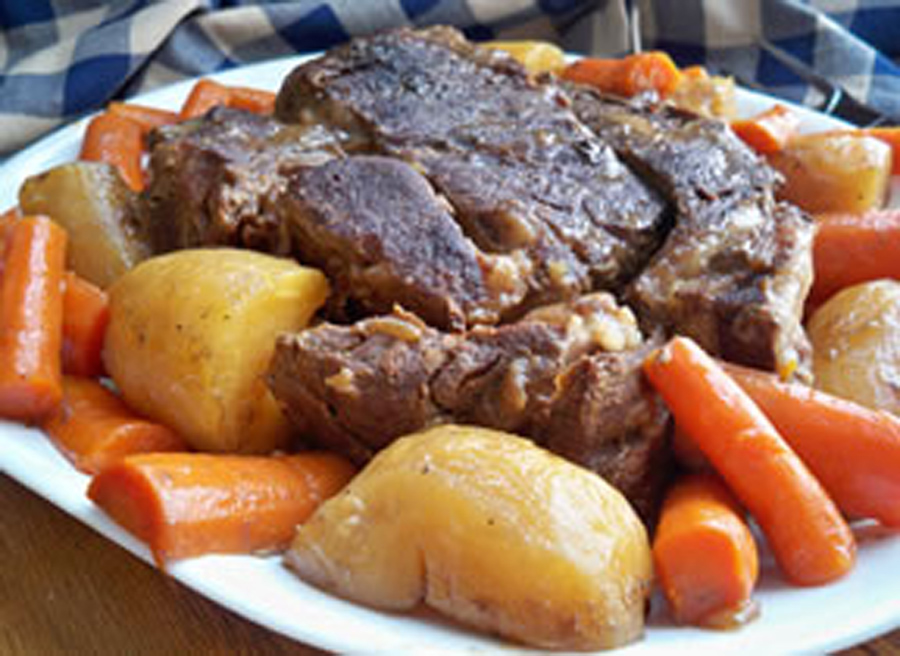
Want beef? Chuck roast is the perfect choice. Grab that slab of meat, sear both sides, add water, onion, garlic, and a bay leaf, then walk away for a few hours. That’s food for several hungry friends or your entire week.

Holidays are no exception to my ‘keep it simple’ rule. Gotta have turkey? Don’t bother with stuffing. Make some cornbread. When cooled, crumble it into a large bowl and set aside. Saute celery and onion, add some garlic, sage, and poultry seasoning then pour in a couple of cups of chicken broth. Simmer until celery is tender, then pour over crumbled cornbread, stir in an egg or two, and bake covered. Tastes fantastic with the turkey.

I get that for a lot of people, cooking is a therapeutic process and the more steps involved, the more therapeutic. For me, the more steps involved, the LESS therapeutic. What is therapeutic for me is ending my hunger, which is the purpose of food, and I find no pleasure in making it take longer or cost more than necessary.

Before I go further, let me confess that this piece of writing is about all the reasons you should rush out and buy my book of recipes. Good quality food doesn’t need sauce to make it tasty. Basic food is good, cheap, easy, and we should eat more of it. That was the idea behind my three-year adventure in operating a café and the subsequent book Recipes of Trailside Café and Tea Room. Yes, there are a few somewhat complicated recipes in there, like the Ribs ‘n’ Kraut. Like Chicken & Dumplings. And don’t get me wrong—the flavors of these specials will knock you off your feet.

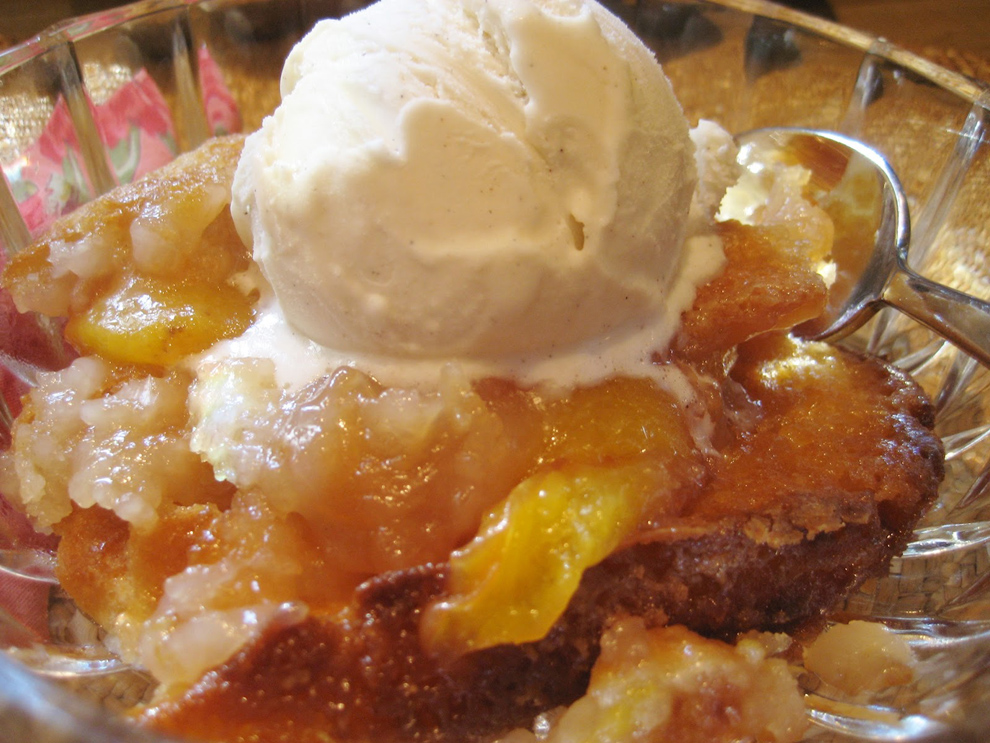
But those are kind of special occasion meals, not your fundamental keep-from-starving approach to daily food. Even my peach cobbler recipe I offer with mixed feelings, because WHY MESS UP A GOOD PEACH? I excuse myself by pointing out that most of the year, fresh peaches aren’t available and in that case, it’s permissible to use frozen peaches to create this mouth-watering treat. 

And tea sandwiches—what is a better mid-afternoon snack than a tiny sandwich trimmed of its crust? Take the basic boiled egg, smash it with a bit of mayo, add salt and pepper, then spread on some GOOD QUALITY white bread that’s been lightly buttered. My book has an entire chapter devoted to quick, easy tea sandwiches.

I wanted to share my Humbug Fancy Food opinion because, like life, food doesn’t have to be complicated. You can thank me right after I finish my morning cup of first flush Darjeeling tea. No sugar. No milk. No lemon.

~~~

For all my books, visit my Amazon author page or, if you live near Fayetteville, Arkansas, stop by Nightbird Books on Dickson Street.

Books Make Easy, Long-Lasting Gifts


Shameless self promotion can’t be avoided when authors have books to sell. While you’ve still got time to receive an Amazon order — or for that matter, time to order through your local bookstore and give them a piece of the pie, here are a few for your consideration.

Shown above: The Violent End of the Gilliland Boys

Christmas Day horse races 1872, Middle Fork Valley. Bud Gilliland waits, eager for another chance at Newton Jones. Only this time, after two years of sparring, Newton gallops up in a cloud of dust, aims his Spencer rifle, and sends Bud to a well-earned grave.

The death of Bud surely grieved his father. But before the curtains closed on these descendants of J. C. and Rebecca Gilliland in 1890, two other sons and a grandson would die a violent death while yet another grandson serves hard time for murder.

What was it about the Gillilands?

This recounting of the family tracks their ancestry, their pioneer years on untamed land, and the hard work that made them one of the wealthiest families in Washington County, Arkansas. A fascinating tale of brash ego, brave gallantry, and bad luck.

Paperback https://www.amazon.com/dp/1977779379

~~~

Serving everything from pita to peach cobbler, Trailside Café and Tea Room became a favorite destination for the few years of its existence. Plate lunches of Pot Roast or Ribs ‘n’ Kraut became overnight hits. Now with a new section on Sandwiches, and a greatly expanded last chapter including many more family recipes sure to be a hit in anyone’s kitchen, Recipes of Trailside Café and Tea Room offers the ‘how-to’ for delicious soups like Split Pea or Potato Leek, hearty salads including Wilted Lettuce, and scrumptious desserts like Lime Pie and the famous Brown Butter Cookies. Over 200 recipes for easy, down home food.

https://www.smashwords.com/books/view/371323

~~~

Contrary to popular notion, Arkansas was part of the Old West along with Texas and the rest of those more familiar dusty southwestern places. Its western border joined up with the Indian Nations where many a weary marshal rode out with his bedroll and pistol carrying writs from the U. S. District Court at Fort Smith in a search for a steady stream of men rustling livestock, stealing horses, selling whiskey, or running from the law.

From its earliest days, Washington County, Arkansas, experienced some of the worst the Old West had to offer. At unexpected moments, county settlers faced their fellow man in acts of fatal violence. These murderous events not only ended hopeful lives but also forever changed those who survived them. Not to say that the murders in the county all stemmed from conflict along

its western border—plenty of blood spilled within its communities and homesteads.

The fifty chapters of Murder in the County each focus on one violent incident. Through family histories, legal records, and newspaper accounts, the long-dead actors tell their shocking stories of rage, grief, retaliation, and despair. A thorough compendium of the county’s 19th century years.

Paperback only  https://www.amazon.com/dp/154427663X


Food for the Holidays!

cake

A holiday treat might include a big slab of delicious cake with that hot cup of tea. Here’s an easy recipe that’s become one of my family favorites!

Applesauce Cake

2 ½ cups flour
1 ¾ cups sugar, or 1 cup sugar and ¾ cup honey
1 ½ teaspoon soda
1 ½ teaspoon salt
¼ teaspoon baking powder
¾ teaspoon cinnamon
½ teaspoon ground cloves
½ teaspoon allspice
1 ½ cups unsweetened applesauce
½ cup hot water (⅓ c if using honey)
½ cup shortening
2 eggs at room temperature
Optional: 1 cup raisins and ½ cup chopped English walnuts

Heat oven to 350°. Grease and flour baking pan, either 13x9x2 or 2 round layers 8 or 9 x1½ inches.
Measure wet ingredients into bowl and mix thoroughly. If eggs or water are cold, the shortening won’t blend well. Add dry ingredients and mix on low speed until well blended, then increase mixer speed and beat three minutes. Pour into pans.
Bake oblong 60-65 minutes, layers 50-55 minutes, until wooden pick inserted in center comes out clean.
When cake has cooled, frost with Penuche Icing.

Penuche Icing

½ cup butter
1 cup brown sugar, packed
¼ cup milk
2 cup confectioners’ sugar

Melt butter in medium saucepan. Stir in brown sugar. Heat to boiling, stirring constantly. Boil and stir over low heat 2 minutes. Stir in milk. Heat to boiling, then remove from heat and cool to lukewarm. Stir in confectioners’ sugar then beat with mixer until fully smooth and of spreading consistency. If frosting becomes too stiff, heat slightly while stirring.

For this and many more wonderful recipes, check out my cookbook “Recipes of Trailside Cafe and Tea Room”

Available at AMAZON and SMASHWORDS (all formats)

Pineapple Candy! — Gift for the Season, Day 3

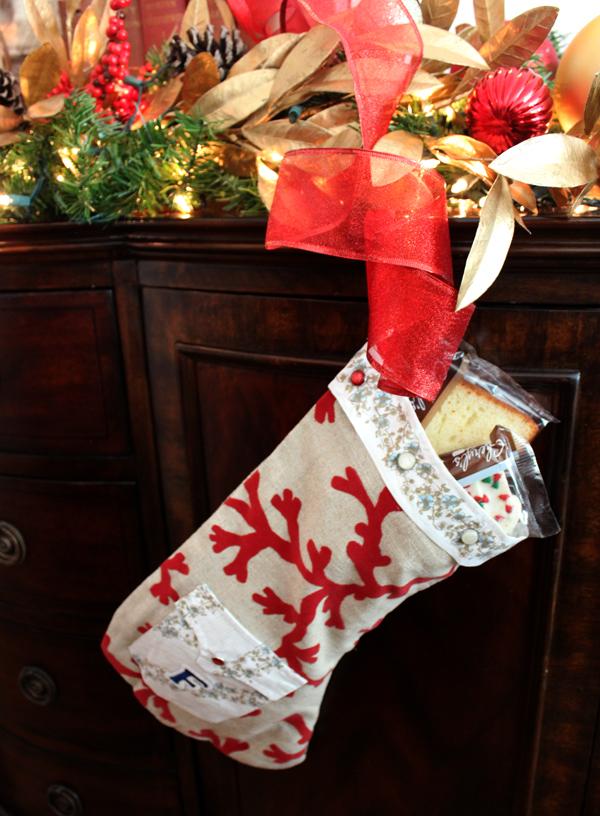
2014-11-04_Bilotto-diy-christmas-stocking-dress-shirt-pocket

One of my fondest holiday memories is of my mother making Pineapple Candy. Without a candy thermometer to ensure the mixture had boiled long enough, she would pace and mutter, repeatedly dipping out tiny portions to drop in cold water to see if it would hold a soft ball shape. I particularly remember that part because I happily retrieved the test portion. Yum! Somehow, despite all the drama, many a Christmas morning found us enjoying this delicious treat!

Pineapple Candy

3 cups brown sugar, packed

1 8-ounce can crushed pineapple

2 cups English walnuts, coarsely chopped

❧ Stir sugar and pineapple together in medium saucepan over medium high heat.

❧ Cook to the firm end of soft ball stage, 240° on candy thermometer.

❧ Cool pan in water bath, beating while it cools.

❧ When mixture has mostly cooled, add walnuts and continue beating until it starts to thicken, then quickly spread into buttered 8x8x2 pan.

❧ Let set until fully cooled, then cut into 1-inch squares.

pineapple-fudge-packet

Enjoy this and other down home recipes in my cookbook, Recipes of Trailside Cafe and Tea Room

Amazon page:  http://www.amazon.com/dp/1492137405

Cheese Ball! — Gift for the Season, Day 2

TK-Blog-Favorite-Cheese-Ball-Finished41


Yes, there are about as many cheese ball recipes as there are cooks. I’ve used this one since 1969! It’s an easy tangy treat that never fails to please!  Makes a great holiday gift, too.

Cheese Ball

12 ounces cream cheese (1 ½ 8-ounce packages)

4 ounces blue cheese, crumbled

1 cup sharp cheddar, shredded

⅓ cup finely chopped red onion

1 clove minced garlic

1 tablespoons Worcestershire sauce

Soften cream cheese. (Remove from package and microwave 30 seconds) Place in mixing bowl and mash with spatula until fully blended and softened. Add other ingredients and mix well. Yield: about 3 cups.

Cheese Ball shaping and decorating options:

1.  Divide into three portions. Place a sheet of parchment paper on a work surface and put one portion of the cheese mixture onto the paper. Gently roll cheese inside of paper into a log shape. Repeat for other two portions. Place the three rolls into refrigerator for at least three hours, until fully chilled. Remove paper. Logs may be rolled in minced fresh parsley or chopped toasted pecans. Place on serving plate, cover with plastic wrap, and refrigerate. Allow to come to room temperature about ½ hour before serving.

2.  Place full recipe of cheese ball onto platter and spread out into a Christmas tree shape about 1 inch thick overall. Form 4-5 limb end points along each side. Use roasted red pepper strips or pimento strips to create a garland that zigzags from side to side. Slice green olives with pimento centers to create tree ornaments.  Alternately, the entire “tree” can be sprinkled with minced fresh parsley and then ornamented with red pepper strips and olives as described. Cover with plastic wrap and refrigerate. Allow to come to room temperature about ½ hour before serving.

3. Using waxed paper between your hands and portions of cheese ball, roll balls of various sizes. Coat each ball in a different material: minced fresh parsley, toasted pecans, toasted chopped almond slivers, finely sliced green onion (include some of the green part), diced red and green peppers, diced green olives, diced black olives, or other ingredients of your preference. Arrange balls on serving platter.

Serve Cheeseball with cheese knives and any of the following:

Savory crackers, toasted pita bread or pita chips, raw vegetable sticks such as carrots and celery, toasted french bread thinly sliced, sliced apple or pear

A Gift for the Season — Day 1

soup
Image from tasteofhome.com


This yummy recipe for vegetable soup is sure to cure whatever ails you from the common cold to a lousy mood. Simple, flexible, and easy. From my cookbook, Recipes of Trailside Cafe & Tea Room.

Vegetable Soup

1 large onion, chopped small (1 ½ cups)

4 ribs celery including leaves if possible, chopped small (1 ½ cups)

2-3 carrots, chopped small (1 ½ cups)

3 cloves garlic, minced

3 tablespoons olive oil

1 15-ounce can petite dice tomatoes

1 ½ teaspoons sugar

1 ½ quarts water

2 baby yellow squash (or 1 medium size), bad skin areas and seeds removed, ½ inch dice

½ tablespoon salt

½ teaspoon black pepper

2 large potatoes, ½ inch dice

❧ Heat large soup pan, add oil, sauté onion, celery, and carrot over high heat until they start to soften (about 10 minutes).

❧ Add garlic, stir briefly, add tomatoes. Stir to heat through.

❧ Add squash, water, sugar, salt, pepper.

❧ Heat to boil, cover, reduce heat to gentle simmer for about 1 hour.

❧ Add potato, cover, increase heat until bubbling, immediately reduce to very low heat so mixture barely simmers. Cover and cook until potatoes are tender, about 30 minutes. Too long or too hot cook time will cause potatoes to break down and broth will be milky.

❧ Taste for seasoning, add salt if needed.

Options: Use leftover cooked vegetables such as lima beans, English peas, green beans, or corn in addition to or instead of the squash.

Lingering Winter

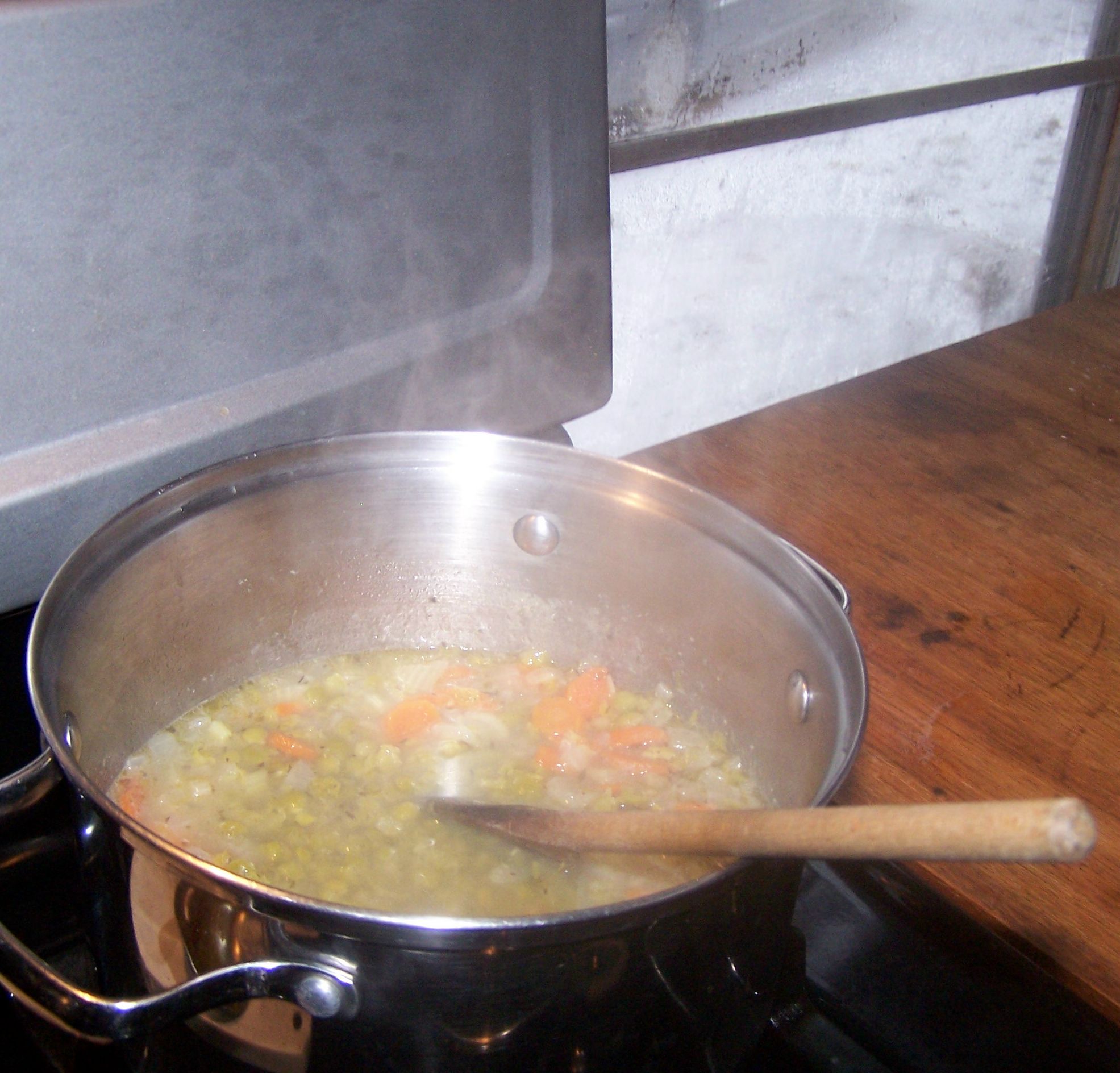
soupAroma thick with thyme and marjoram steams from the simmering split pea soup. I’ve enjoyed the whole process—chopping onion, celery, and carrot, measuring the spices and selecting the bay leaves, stirring until the soupy mass starts to bubble and boil. More condensation to collect on the window panes where sleet bounces and taps it rhythm against the other side.

There’ll be no venturing out today. The roads are slick with ice. Time to relax and accept what the Mother has in store, a lingering blast of winter with all its gifts of cold and white. Wind whistling at the chimney where smoke of my wood fire plumes sideways. Time to muse on past winter days when fire blazed hot and pan lids jiggled, when my gaze settled on the distance and roamed over the years of my life.

Memories of winter’s challenges rise up to nourish me on these days, recollections of times when hardships were met and I was satisfied with my refuge, my larder, my conquest of the elements. In more distant times, I might have twisted strands of wool or linen and watched the wheel spin it to thread, or pounded clothes in a hot kettle for cleaning, or ground corn between stones to make coarse bread. I might have wrapped my children in animal skins and tied my own feet in fur before braving the cold for more wood, or brought the livestock into the other end of a rough cabin to keep them from freezing in the long nights.

How did I, of all my previous iterations, manage to occur here, now, where everything I need comes more or less effortlessly—the twist of a knob, click of a button, the turn of a key? A house with insulated walls and thick glass that keep in the warmth and allow me to watch frozen rain fall from gray-white clouds. What future embodiments of myself will wonder back on this time and what will they know? What I don’t know. What I can imagine for better. Or worse.

I don’t have to figure it out. Anyway, I can’t. Better to turn to the pan and stir the soup, add another log to the fire, stand at the window longer and marvel at the shades of gray and rust among the trees of the woods, the white of the sky and ground. Soon the scene will explode in infinite shades of green and heat will soak the edges. I’ll be pleased then to remember this cold.

Pineapple Candy

pineapple-fudge-packetMouthwatering treat for your candy jar!

3 cups brown sugar, packed

1 8-ounce can crushed pineapple

2 cups English walnuts, coarsely chopped

❧ Stir sugar and pineapple together in medium saucepan over medium high heat.

❧ Cook to the firm end of soft ball stage, 240° on candy thermometer.

❧ Cool pan in water bath, beating while it cools.

❧ When mixture has mostly cooled, add walnuts and continue beating until it starts to thicken, then quickly spread into buttered 8x8x2 pan.

❧ Let set until fully cooled, then cut into 1-inch squares.