Yes, Get Over It — Constructively

16832288_10208629742763961_1882694048835745391_n
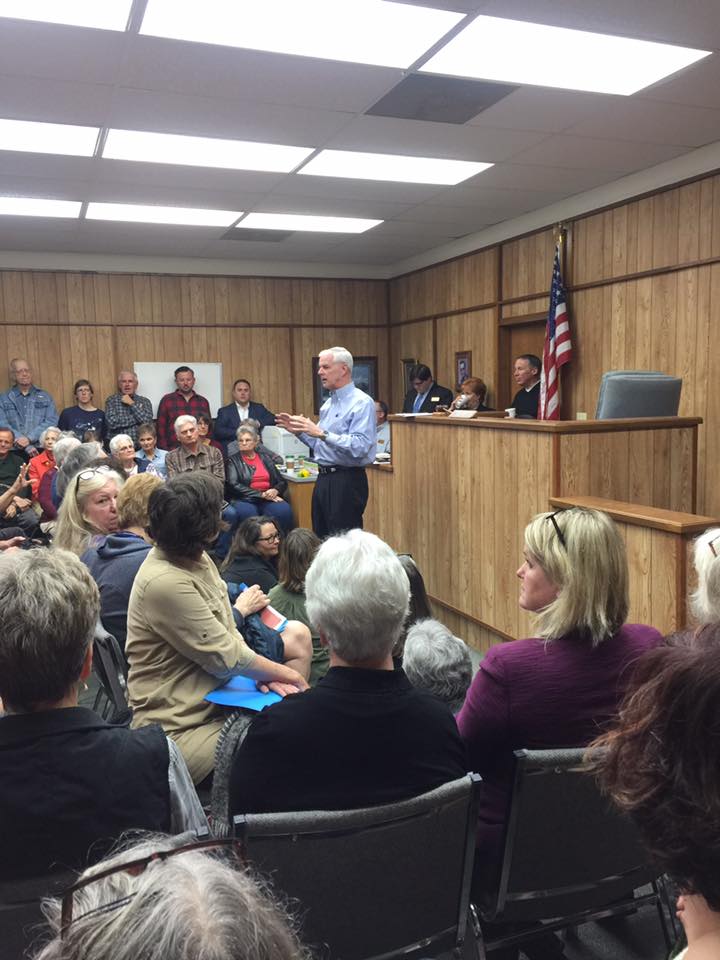
Rep. Steve Womack addressing an overflowing crowd at town hall Feb 21, 2017

Yesterday I attended a town hall meeting sponsored by Rep. Steve Womack (Republican) of our 3rd Congressional District (Northwest Arkansas). The room would comfortably hold thirty people. Over 200 showed up. With the hallways and doorways and standing room thronged, half the people ended up standing outside in the parking lot for the 1.5 hour event. In light rain and a heavy temper.

Womack could have taken charge of the situation by reconvening five blocks away in the much larger community center. He chose not to do so. He could have opened the meeting by immediately taking questions, but instead he spent at least twenty minutes talking about his agenda. His primary concern was the national debt which he elaborated citing numbers and projections intended to shock and awe.

Not surprising for Col. Womack, a 30-year national guard veteran who commanded the 2nd Battalion, 153rd Infantry, 39th Separate Infantry Brigade in the Sinai, Egypt, between 2002 and 2009. He’s a member of Cross Church, earthly kingdom of Ronnie Floyd who has served in a leadership role of the world’s largest Southern Baptist denomination and the largest Protestant body in the United States, with over 15 million members as of 2016. Womack is a poster child for the right wing.

The Arkansas 3rd district rolled to the Republican side in 1967 following continuous Democratic control since Reconstruction and has remained in Republican hands ever since. Only a couple of times have strong Democratic candidates come close (1992: 47.2% to 50.2%) to regaining the seat while generally Republicans enjoy over 70% majority on Election Day. Womack is serving his fourth term.

Despite this position of strength for Womack, the crowd wasn’t having it. In a surly mood in a room whose temperature approached one hundred degrees due to severe overcrowding, people jostled signs, interrupted, and talked over Rep. Womack in what became the norm for the entire exchange. His temper flared on occasion, telling people to shut-up and reiterating his party line position on issues ranging from the EPA to National Endowment for the Arts to Medicare. Less than a quarter of those who wanted to ask questions were actually able to do so before his ‘drop dead’ quit time of 10 a.m.

Driving home, I kept wondering what people actually expected. Did anyone think for an instant that he would agree to demands that he personally ‘do something’ about the ‘man-child Trump,’ as one speaker requested? Did anyone think that he would suddenly veer off the positions in which the political right has grown increasingly entrenched for the last fifty years?

I didn’t. I know lots of people like him. They’re my relatives and my neighbors. They’re positive they’re right. Nothing is going to change them.

But after a lifetime of advocacy on various impossible causes (women’s rights, environment, and most recently drug policy reform), I remain optimistic that in some small demilitarized zone between right and left, a productive dialogue can lead to some understanding. At the least, a grudging mutual respect.

Few in the crowd seemed to understand that philosophy. They had an ax to grind in their outrage over Donald Trump and his agenda. They wanted to shout and hurl accusations. Whatever ground might have been gained in building a tenuous link of communication died under the stomping feet of those who only wanted to protest what has come to be the current reality: Republicans control the government.

Despite a few well-considered questions that earned a thoughtful response from Rep. Womack, less than a quarter of those who kept raising hands ever had a chance to speak. Womack avoided replying to demands for increasing taxes on the so-called ‘one percent’ as he explaining how government had exceeded its mandate and was spending two-thirds of its income on ‘mandatory’ programs compared to the 1960s when mandatory only consumed one third.

Womack, along with the Republican majority, condemn food stamps and other social support programs as well as protections for waterways and the air we breathe. This isn’t a new conflict. It’s been picking up steam for five decades. Aligned on the side of the protesters are the progressives who—many of them—have worked to enact those very programs. Aligned on Womack’s side are those who see those programs as a symptom of moral decay.

Railing about the national debt is a convenient cover for such moralistic thinking. Every president since Calvin Coolidge had added to the national debt, most recently George W. Bush by 101% and Obama by 68%. The elephant in the room (literally) is the wars started by Bush after 9/11. The cost of the Iraq War tops two trillion and in Afghanistan, over four trillion with no end in sight.[1]

As we all know, financing what we want when we want it ends up with the ugly reality of paying off debt without getting anything in return. With interest. This is the staggering problem keeping Womack and other legislators awake at night, Democrats among them. But while the portion of national revenues dedicated to mandatory spending has increased, military spending now gobbles up fifty percent of discretionary spending. So while Womack et al set their sights on cutting other discretionary spending such as public broadcasting,[2] none of them mention the possibility of letting the Middle East sink or swim on its own.

Republicans seem hell bent on continuing to wage war on behalf of Israel and oil, throwing in the specter of terrorism and a nuclear Iran for good measure. The truth is, none of these ‘reasons’ hold water. The U. S. could fully withdraw from the Middle East without suffering any real threat here at home.[3] But that would outrage the special interests: military contractors, oil sheikdoms, the Israel lobby, and a hypnotized electorate who equates patriotism and war.

Unless we culturally divest from war, even a massive cut in non-military discretionary spending would do little to offset the debt, much less make a dent in the mandatory side of the scales.[4] And while Social Security and Medicare are theoretically paid for through payroll tax deductions, the increasingly longer projected life expectancy of Americans means that people far outlive the amount they’ve paid in.[5] Fewer workers paying for increasing numbers of retirees leads to the brick wall ahead.

One of the main arguments raised against Womack’s insistence on cutting programs, including ‘restructuring’ mandatory spending programs, was the repeated cry to increase taxes on the rich. He never once acknowledged the question or attempted to answer. The facts are that in the 1950s and ‘60s, the time praised by Womack when mandatory spending only constituted about a third of the national revenue, the wealthiest Americans paid a top income tax rate of 91%. Today, the top rate is 43.4%. In 2014, after deductions, the richest one-percent paid an effective federal income tax rate of 24.7%.[6]

Loopholes which allow billionaires like Trump to pay zero taxes have been skillfully placed into the tax code by cooperative legislators benefiting from generous campaign contributions and other perks. These same legislators prize their own interests above their constituents, catering to corporate profits instead of forcing lower prices on essentials like prescription drugs. This outrages Americans, causes distrust in government, and propels a demagogue like Trump into power.

Meanwhile, in the guise of addressing the debt, Republicans gleefully set about righting the perceived moral decay they’ve campaigned on since Ronald Reagan. They’re eager to cut federal spending for Planned Parenthood (further restrict abortion rights), public radio and television (stifle the progressive agenda), and especially social support programs like unemployment and food stamps (force slackers to work), but such changes promise little more than a drop in the bucket of deficits.

As in yesterday’s meeting with Womack, progressives repeatedly fail to make a strong case for their agenda or provide meaningful solutions to the nation’s fiscal distress. Angry demonstrations only delay what progressives must do to take back leadership of the political spectrum. We must show why improving conditions for the poor, the jobless, and the weakest among us is the only path to solvency, why strong environmental protection must be preserved, why women must be allowed to decide who gets born.

These arguments must be made, and in order for them to gain purchase in the near term, dialogue with elected officials like Womack is essential. Public tantrums are counterproductive. In the long term, refinement of and spirited advocacy for progressive policies will form the platform by which a progressive political party can regain control. Among us, we must find those willing to sacrifice themselves to the public arena as candidates capable of inciting voters’ imaginations with such an agenda.

Then will be the time to shout.

~~~


[1] https://www.theatlantic.com/international/archive/2016/09/cost-wars-iraq-afghanistan/499007/

[2] https://www.nationalpriorities.org/campaigns/military-spending-united-states/

[3]  http://www.huffingtonpost.com/jeff-faux/why-are-we-in-the-middle_b_7301370.html

[4] https://www.nationalpriorities.org/budget-basics/federal-budget-101/spending/

[5] https://www.thebalance.com/current-federal-mandatory-spending-3305772

[6] http://americansfortaxfairness.org/tax-fairness-briefing-booklet/fact-sheet-taxing-wealthy-americans/


A Sword Cuts Both Ways

swordFor decades, the religious right has gained access to tax dollars by filling a niche in the education system. In addressing an ‘at risk’ population among children, these religious activists have made great strides toward the use of tax dollars for religious instruction.

It’s a clever end-run around the law. In Arkansas until 2012, a quietly growing swarm of such preschools illegally utilized millions of tax dollars for programs that began each day with prayer and Bible study. (Which they have never been required to pay back.) Classroom activities included coloring images of Biblical scenes, singing hymns, and the occasional time-out at the principal’s office where the recalcitrant child might be prayed over to cast out the demons causing his/her unruly behavior.

Tipped off by thoughtful journalists, Americans United for Separation of Church and State (AU) threatened a lawsuit against the state. Specifically cited in the complaint was the Growing God’s Kingdom preschool at West Fork. The Arkansas Times, arguably the state’s only non-rightwing media, reported that “According to the school’s handbook, parents are assured that staff members will ‘strive too [sic] ensure that your child feels the love of Jesus Christ while preparing them for Kindergarten.’ The preschoolers, it continues, will be taught ‘the word of God’ so that they can ‘spread the word of God to others.’”

Outrageous not only because the preschool blatantly advertised its religious intent in its name and literature without the state blinking an eye before handing over tax dollars, its owner/operator Justin Harris also served as an elected representative in the state’s legislature. And he wasn’t the only elected official sworn to uphold the Constitution who grabbed illegal tax dollars hand over fist. Similar preschools operated under the leadership of Johnny Key, also a legislator and – incredibly – in 2015 designated by the Republican governor Asa Hutchinson as head of the Department of Education, even though Hutchinson had to massage the state’s rules about qualifications for the department head because Key didn’t meet them.

Specifically targeted by religious preschools in order to boost their standing for ever greater grant funding, potential ‘students’ are rounded up from problematic environments.

  • The ABC Program serves educationally deprived children, ages birth through 5 years, excluding a kindergarten program. The Arkansas Better Chance for School Success Program serves children ages 3 and 4 years from families with gross income not exceeding 200% of the federal poverty level.
  • Eligible children for the ABC program shall have at least one of the following characteristics: § Family with gross income not exceeding exceeding 200% of FPL  § Has a demonstrable developmental delay as identified through screening  § Parents without a high school diploma or GED  § Eligible for services under IDEA  § Low birth weight (below 5 pounds, 9 ounces)  § Income eligible for Title I programs  § Parent is under 18 years of age at child’s birth  § Limited English Proficiency  § Immediate family member has a history of substance abuse/addiction  § Parent has history of abuse of neglect Or is a victim of abuse or neglect
  • An age-eligible child who falls into one of the following categories shall be exempt from family income requirements: § Foster child § Child with an incarcerated parent § Child in the custody of/living with a family member other than mother or father § Child with immediate family member arrested for or convicted of drug-related offenses § Child with a parent activated for overseas military duty

Further enticement for struggling parents is that ABC funded programs provide free child care and pick-up/delivery services for children. What low income parent would not rush to place their child in such a program whether or not they want their child indoctrinated in fundamentalist Christian religion?

State employees at the Department of Human Services, which oversees this particular realm of education and tax dollars and in charge of the Arkansas Better Chance (ABC) program, could not account for how the money was spent by these schools, citing chaotic bookkeeping methods. The state did not require any particular accounting method. The state then or now does not know whether tax dollars granted to preschools and other educational programs serving ‘at risk’ children actually are used for that purpose, only requiring that grants be kept in a separate bank account.

Despite the wimpy crackdown in 2012, random yet infrequent inspections by state enforcement personnel lack the ability to determine whether prayers, hymn singing, and exorcising of demons might yet continue, stopping only the moment an inspector walks through the door.

In the aftermath of unwanted scrutiny by AU, the state allowed these powerful religious entities to fabricate an imaginary line between religious instruction and the so-called ‘ABC Day,’ a block of seven hours where secular education supposedly occurs without any religious indoctrination. While delineating these requirements in a new section of is program codes (see Section 23 at the DHS website), the restrictions on how tax dollars might be used fail to include rent, insurance, utilities, and other overhead expenses of the overall operation. Children bused to the school before the ABC day begins or who remain after are immersed in religious instruction, a convenient sleight of hand since parents’ work hours rarely coincide with ABC instruction hours.

As specifically stated in Section 23.04.4 of ABC Rules:

  • No religious activity may occur during any ABC day and no ABC funds may be used to support religious services, instruction or programming at any time.

Without a viability test by which religious preschools must prove their religious instruction could continue without tax dollars, there is no method to determine if ABC funds are used to support religion. Such a viability test would have to show that without tax dollar grants, these schools generate enough income from other sources to keep the rent paid and the lights on. The state has made no effort to devise such a test.

Now let’s take a sharp turn to a similar situation on the other side of the coin. As the newly installed majority Republican Congress rubs its hands in glee over its sudden ascension to total control over the nation’s lawmaking, no issue is more eagerly addressed than the longstanding thorn in the abortion debate—Planned Parenthood. Early calls for defunding this nonprofit organization cite exactly the same argument as those opposed to tax dollars for religious education.

Recently questioned by CNN’s reporter Jake Tapper, Speaker of the House Paul Ryan explained the need to stop tax dollars from supporting Planned Parenthood.

Well, there is a long-standing principle that we’ve all believed in. And—by the way, this is for pro-choice, pro-life people—that we don’t want to commit taxpayer funding for abortion. And, Planned Parenthood is the largest abortion provider.

So, we don’t want to effectively commit taxpayer money to an organization providing abortions. But, we want to make sure that people get their coverage. That’s why there’s no conflict by making sure that these dollars go to federal community health centers, which provide these services and have a vast larger network than these Planned Parenthood clinics, which—which are surrounded by a lot of controversy.

And, we don’t want to commit people’s taxpayer dollars to effectively funding something that they believe is morally unconscionable. Not everybody believes that and I understand that. But, that’s a long-standing principle that we’ve had in this country that we want to maintain.

Tapper countered Ryan’s remarks by citing the Hyde Amendment which ensures that federal funding isn’t paying for abortion, Tapper asked “of course, taxpayers don’t fund abortions, right now, right?”

“Right,” Ryan fumbled. “But, they get a lot of money and—and you know, money is fungible and it effectively floats these organizations which then use other money. You know, money is fungible.”

Ah. Money is fungible.

Of course it’s beyond Ryan’s comprehension that anyone would consider early childhood religious indoctrination to be “morally unconscionable.”

If Ryan and his cabal of rightwing religionists pursue their effort to kill Planned Parenthood (and thereby leave millions of women without reproductive health care), their argument goes against them in the wholesale religious perversion of our nation’s youth.

Religionists cite the helpless condition of a fetus and the ruthless medical procedures which may be used to terminate its life all while they discount the agonized decision-making women engage in before choosing such a path. Yet what is more helpless than a barely verbal child relinquished to a daily dose of brainwashing?

More to the point central to any federal legislation, what has longer and more consequential ramifications for the nation? While those terminated in the womb are removed from the overall population, the clear agenda for youthful brainwashing is to “Grow God’s Kingdom.”

Let’s not kid ourselves. The Religious Right will not stop until they have forced the United States of America to fit their definition of a Christian nation.

Compare the two programs: one provides financial assistance for medical care to women old enough to bear children and therefore old enough for reasoned decision-making. The other takes children not old enough to reason or speak for themselves and forces them to undergo religious indoctrination.

Imagine, if you will, religious tax-funded preschools which teach Islam.

~~~

Note: The red herring in Ryan’s argument centers on his theory that community clinics could provide adequate replacement services for those now available through Planned Parenthood. It would take significant expansion and investment for such clinics to equal the services offered by PP to over five million people per year.

Smoke This!

Marijuana medical choice dilemma health care concept as a person standing in front of two paths with one offering traditional medicine and the other option with cannabis.

When considering the pros and cons of medical cannabis, voters benefit from knowing as many facts as possible. Most people are not aware that the human body manufactures chemicals identical to those found in the cannabis plant. This stunning nugget of information was discovered as recently as 1990.

Wikipedia: “The endocannabinoid system (ECS) is a group of endogenous cannabinoid receptors located in the mammalian brain and throughout the central and peripheral nervous systems, consisting of neuromodulatory lipids and their receptors. Known as ‘the body’s own cannabinoid system,’ the ECS is involved in a variety of physiological processes including…regulation of appetite, immune system functions and pain management…and are found in the brain and nervous system, as well as in peripheral organs and tissues.”[1]

Native to central Asian and the Indian subcontinent, the cannabis plant found in ancient literature and prehistoric burials served as medicine for seizures, pain, and other human ailments. Over time, three differing species have developed–sativaindica, and ruderalis— with the more psychoactive and medically useful plants diverging from a type containing less psychoactive agents—hemp–used for rope and textiles and farmed extensively through World War II.

At least 113 active cannabinoids have been identified in the plant, one of which—tetrahydrocannabinol (THC)—is the chemical cloned for medical use as the legal pharmaceutical drug Marinol. Many patients report better results from natural cannabis than with Marinol, perhaps due to the balancing effects of the plant’s other ingredients.

Another element of natural cannabis, cannabidiol (CBD), is highly effective in treating seizures and muscle spasms.[2] Families with children suffering seizures are pulling up stakes to move to states where their ailing child can access legal CBD oil. In natural proportions, all 113 active elements in cannabis balance each other in important ways that no synthetic isolated elements like Marinol could ever do.

Those advocating for more research and FDA approval before allowing medical use fail to acknowledge the fact that cannabis has been in the human pharmacopoeia for at least 5000 years. Compared to that, FDA approval means nothing. But aside from that, the fact is that drug companies are not going to invest the millions of dollars required to gain FDA approval of natural cannabis. They’d never recoup their investment on a plant that people can grow in their back yards. And they’ve started to understand that medical cannabis outshines many of their most profitable drugs both in effectiveness and in the absence of dangerous side effects. Drug companies are above all else profit-driven corporations.

It’s a little known fact that before the government will allow legal access to cannabis plant material for medical research, the researcher’s goal must be to find the harms that could be caused by the plant. If a researcher wants federal approval to research the potential medical benefits of natural cannabis, the request will be denied. These conditions are written into federal law.

Those in Arkansas voicing opposition to medical cannabis haven’t researched the issue with an open mind. They react based on old prejudices and discredited propaganda. There’s still the culture war specter haunting cannabis, that stinky weed that hippies used as part of their rebellion from the Establishment. It’s still a point of contention between parents and their teens in the ongoing generational battle over control.

Yet studies in states with legal medical cannabis have found reduced use of illegal drugs by teens and reduced rates of crime.  A multi-year study published by the journal Lancet Psychiatry found: “…When researchers looked at marijuana use over time in the 21 states where medical marijuana was legal by 2014, they found no change in marijuana use after a medical marijuana law was passed, compared with before. About 16 percent of teens said they had used marijuana in the past month before a law was passed, compared with 15 percent who said the same after a law was passed.”[3]

The fact is, the long anticipated ‘end of civilization as we know it if marijuana is legalized’ has simply failed to materialize.

A 2014 Texas study states: “Results did not indicate a crime exacerbating effect of MML on any of the Part I offenses. Alternatively, state MML may be correlated with a reduction in homicide and assault rates, net of other covariates. These findings run counter to arguments suggesting the legalization of marijuana for medical purposes poses a danger to public health in terms of exposure to violent crime and property crimes.”[4]

Researchers at the Norwegian School of Economics used FBI statistics “to investigate the effect of the legalization on two types of crime: theft and violence. In the study, they looked at the 18 states that had introduced such laws before 2012…The researchers found a clear decline in both theft and violent crime in the states that legalized marijuana and share a border with Mexico.”[5]

Arkansas’ governor and others who voice alarm about opioid addiction should think again about their opposition to medical cannabis. One notable result of medical cannabis laws is the reduction of prescription drug use. “Fewer people are using opioids in states that have legalized medical marijuana, according to a study published September 15 in the American Journal of Public Health that bolsters advocates’ claims that marijuana can substitute for more deadly drugs.”[6]

An extensive study by the RAND Corporation (2015) concluded that legal medical cannabis reduces opioid use: “The fact that opioid harms decline in response to medical marijuana dispensaries raises some interesting questions as to whether marijuana liberalization may be beneficial for public health. Marijuana is a far less addictive substance than opioids and the potential for overdosing is nearly zero.”[7]

On November 8, citizens of Arkansas have an opportunity to cast a vote for compassion and common sense in the Natural State by bringing back the right to use this natural medicine. In the process, they also have the opportunity to nudge this state a baby step closer to the vision and advantages enjoyed by citizens in 25 other states of this nation.


[1] https://en.wikipedia.org/wiki/Endocannabinoid_system

[2] https://en.wikipedia.org/wiki/Cannabidiol

[3] Quoted from http://www.ctvnews.ca/ctv-news-channel/medical-marijuana-laws-don-t-lead-to-increased-use-by-teens-large-u-s-study-1.2424012 ; Lancet study is at http://www.thelancet.com/pdfs/journals/lanpsy/PIIS2215-0366(15)00217-5.pdf

[4] http://journals.plos.org/plosone/article?id=10.1371/journal.pone.0092816

[5] http://sciencenordic.com/legalization-medical-marijuana-reduces-crime

[6] http://www.usnews.com/news/articles/2016-09-15/study-opioid-use-decreases-in-states-that-legalize-medical-marijuana

[7] https://www.rand.org/content/dam/rand/pubs/working_papers/WR1100/WR1130/RAND_WR1130.pdf


An Ozark Interlude

snake

Yesterday, the pesky doe had circled the fenced yard all day, causing the dogs to bark incessantly. Nerves shot, at around 5 p.m. I decided to fire off a few rounds to scare her away. I grabbed my .22 rifle and stood on the porch at the west end of the house, which is my daughter’s apartment, and looked for the doe. From there a person can look downhill toward the ponds and pasture, normal doe hangout. Nowhere to be seen.

I returned to my dinner preparations, fed the dogs, fed the cats, and fed the goldfish. One cat of the four—Esmeralda—didn’t show up. I thought, okay, she followed me to the apartment. So I went back there and looked for her, called, nothing. Usually she is front and center demanding food at that point, so this was highly unusual.

Then the barking started again. I grabbed the .22 and went to the gate. There stood that stubborn doe not a hundred feet from the house.

Now let me say that this has been an ongoing war for multiple deer generations. Before we got these two hounds, the deer jumped over our yard fence and helped themselves to whatever they pleased—hosta, flower beds right by the porch, any tomatoes or other veggies I tried to grow in the raised beds. But for the last five years with hounds running free in the yard, the deer have decided discretion is the better part of valor, hosta notwithstanding.

But this doe has become quite clever at avoiding the hounds by jumping the fence in the wee hours of morning when the hounds are sacked out in the house. Consequently my tomato plants have been topped multiple times and the peppers probably won’t come back. This is after a second planting. So I really don’t care that it’s not deer season or that my .22 bullet wouldn’t be a clean kill.

In the winter, I would have opened the gate and let the hounds chase her off. But it’s tick season. Worse, the last time we let both hounds go at the same time, the younger one—Weezie—didn’t come back until well after dark. She was shaking and terrified and smelled of tobacco smoke. Someone had penned her up. So now when we let Weezie out, it’s without her big sister Cu. She usually bounds around chasing squirrels in the adjacent woodland, living dog ecstasy for ten or fifteen minutes before she’s ready to come back in the yard. Cu, on the other hand, will stay out much longer, baying as she tracks scent clear back to the canyon.

So I’m standing at the gate with my rifle and the dogs are going nuts. The deer is being coy, facing me with several large trees between us. I can’t get a clear shot. Plus I’m having pangs of conscience. The .22 can’t deliver a kill shot. She might have a fawn around here. I’m thinking, well, if I let Weezie out, she’ll put a good scare in that bitch and I won’t have to shoot her.

I’m juggling the rifle and Annoying Emma the mongrel terrier is underfoot. The minute my hand touches the gate latch, Emma lunges, Weezie lunges, I nearly drop the rifle, and all three dogs are out the gate. Damn it.

dogs
Look, that deer is right out there. Can we go out, please please?

Okay, calling them is worthless. In two seconds, two brown streaks are hurtling through the underbrush down by the pond. The doe bounds east and then south toward the canyon, dogs in fast pursuit. I go inside, put the rifle away, and eat my cold dinner.

This is worse than it sounds because Cu is my daughter’s dog. She’s housesitting this week and swamped with coursework for the two graduate level summer school classes she’s taking. Plus she’s seriously attached to Weezie. If she knew the dogs were out there dashing through the late afternoon heat harvesting ticks by the bucket and bound not to return for hours, she would be worried sick. So I decide not to tell her. Dinner goes down hard.

Then I remember I have a missing cat! Why? I could understand if she was preoccupied with her last stealth moves on a mouse or mole, but it’s been an hour. Something is wrong. I go back outside and stand by the gate. Emma goes out too, because she’s way too smart (and too old and too fat) to try to run with the hounds. As she exits the gate, which I’ve left open for the hounds’ return, she briefly sniffs the bed of ivy growing along the fence. She immediately jumps back.

ivyWhat fresh hell is this? I lean forward toward the ivy before I hear the unmistakable rattle. I can see nothing—the ivy is a green mass about five feet wide and ten feet long and at least a foot deep. But the sound is familiar.

Snake.

I go back and grab the .22. I’m holding the gun listening. Can’t see a thing. Rattling continues. I shoo Emma back because of course if I told her to, she’d jump into the ivy.

I aim and fire at the sound. The first round cracks out of the gun and the rattle continues. I give it my Shaolin concentration and fire again. The rattle stops and the ivy starts to move. I fire a couple more rounds.

I set down the gun and grab the hoe from the other side of the porch. I start hacking at the ivy, trying to pull that tenacious vine apart so I can see what I’m up against. I don’t want a coiled snake to suddenly strike, so I’m working incrementally from the edge inward. Finally I see a flash of color, that familiar brown-rust pattern of a copperhead. It’s coiling and turning as I expose part of it to view.

I’ve learned that lots of snakes rattle their tails. Once I thought about it, I remembered that rattlesnake rattles are higher pitched, a hissing sound like air escaping a tire. This rattle was lower pitched, a tail hitting leaves. Either way, I’m always thankful for the rattle.

Hack, hack, I drive the hoe down on its body. As it moves toward me, I realize I’m only hacking at the last six inches. I chop more vine. Finally, there’s the wedge-shaped head. I slam the hoe down but it has moved. Toward me.

I’m sweating and cursing and keep telling Emma to get back damn it. I rip more vines and finally I can see the whole snake. I’ve done a fairly decent job of smashing a place six inches from its tail, and now I can see a bullet hole I managed to send straight through its middle. From that point to its head, it seems unable to fully move. Maybe the shot injured its spine.

That doesn’t mean it can’t bite and send its load of venom into my ankle. Or Emma’s face. So I land the hoe behind its head. The ground under all that ivy is super soft. I’m just burying the snake in dirt.

I hook the hoe under the snake’s midsection and lift it out of the ivy. Once I’ve tossed it onto the driveway, a swift blow behind its head finishes it off. Of course it’s still moving and Emma still wants in the middle of it, so I leave the hoe blade sitting on its neck and step back.

I’m thinking this explains the missing cat. This area here between the gate and my car is a place she frequents. If she spotted the snake, she might do what lots of cats do, which is chase the snake. I once had a cat that specialized in chasing snakes. She’d herd them right out of the yard and away from the house. That’s when the kids were little and I always thought she knew exactly what she was doing, protecting our babies.

Of course, I also once had a cat that got bit. Twice. Old Reece’s Pieces was a slow learner or had a contract with death, I never could figure out which. I’ve written about him before. Once he burst through the pet door and ran down the back hallway. I found him my daughter’s closet, cowering in the corner. His right eye was swollen shut and the area around it bloody and turning purple. Trip to vet. Fangs hit his forehead and eyelid, barely missing the eyeball. Vet thought he’d lose the eye but he didn’t.

A year or so later, Reece’s didn’t show up for dinner, just like Esmeralda hadn’t shown up. I remembered what happened then, how I searched around the house for two days before I found him lying in tall weeds. I talked to him, wondering why he didn’t get up and come to me. He was less than twenty feet from the house. How I missed him before I’ll never know.

But he didn’t get up, just meowed weakly. So I picked him up and the hand I put under his belly came back bloody. He’d been snake bit in the stomach. In the two days he’d been laid up, the bite wound had spread about six inches in diameter, the hair had fallen off, and the skin was black and rotten. He was too weak to move.

The vet shook his head, shot him full of antibiotics, and sent him home to die. I kept him in my bedroom where he crawled under my bed. He wouldn’t eat. The next day, I sat nearby eating cantaloupe and he sniffed the air. I gave him some. He couldn’t eat enough.

Who knew? For the next several days, Reece’s Pieces ate mashed cantaloupe. Then he started eating regular food. Slowly he got well.

Is this what happened to Esmeralda? Was she lying in the grass somewhere or in the woods, paralyzed by copperhead poison?

I began searching, again touring the house, under the beds, my daughter’s apartment. Then outside—the flower beds, under the porch, under my car. The weeds. The underbrush, hoe in hand, because one snake is never the whole story.

Meanwhile, every fifteen minutes or so, I’m calling the dogs. I can hear them way down in the woods. Then even further, like they were down in the canyon now. Paying absolutely no attention to my calls, my demands that they get in the yard right now. They’re tracking, hollering as they go.

Which is, of course, what hounds do.

What about snakes?! They could easily stumble across a big rattler—years back, a neighbor shot a timber rattler that was nine feet long. I killed a velvet tail coiled up right by my car door after I thought I was getting a flat. I shot two bigger ones about six feet long and traveling across my yard. I regret killing them. They were beautiful and if the stupid little Pekinese I had at the time had left them alone, I wouldn’t have needed to shoot them.

If those hounds got snake bit out there in that rugged country, I’d never find them. I’d have to wait for the buzzards to start circling. Oh, damn, this is not going well.

I don’t find the cat. Anywhere.

cats2
Taco instructing Finnegan on cat rules.

I’ve never regretted killing a copperhead. I leave this one lying on the drive. Our old patriarch cat, Taco, comes by to sniff. Our two younger cats investigate, appropriately wary of the smell. There is a strong scent to poisonous snakes and cats have good instincts. Except the young male Finnegan, appropriately bold for a young king. He wants to pop it a couple of times. The snake is still writhing like they do after death. That thrills him. He stalks around it, hair standing up on his spine.

I try to watch television, springing up at every commercial to look again for Esmeralda. I imagine she’s dead or dying somewhere. I may never find her.

I call the dogs. It’s 7:30 p.m. I can’t hear them at all.

Light is fading. It’s 8:30. No dogs. No Esmeralda. I’m calling, calling. Go to the far end on my daughter’s porch and call some more.

Minutes tick by. I listen to the bullfrogs warming up at the pond. I hear lapping noises at the water bowl. I think it’s Emma. But it sounds like a big dog…

Yes! I step back inside her living room and there is Weezie lapping water like she’s dying of thirst and Cu spread out of the floor like she can’t move one more step. Both dogs panting as fast as they can.

I hurry through the house to close the yard gate before they decide to venture out again. They have no such intention. They’ve been running for three hours in this miserable heat. They follow me to the kitchen where they stretch out on the cool floor. Panting. Lots of panting.

esm
Esmeralda temporarily captive.

As I step back into the kitchen from closing the gate, there’s Esmeralda. What? Where did she come from? She’s all relaxed, doing her ballet stretches as I scold her. Then she’s all about her dinner.

The only thing I can figure out is that she was having a nap in the apartment and just wasn’t ready to respond when I was back there searching. Or whatever. She’s one of those Cats.

As for the dogs, they are too exhausted to move. Forty-five minutes elapsed before they stopped panting. Covered in ticks. Fortunately, their meds kills the ticks once they bite, so it wasn’t like they were going to be sucked dry. Still, I couldn’t stand it. I got about a dozen off each ear and that was all they’d let me look for. I’m so glad it’s not late July. That’s when the super tiny ticks start, the ones you can’t see that spread like dust by the thousands.

Today has been a vast improvement. The snake is in an old dishpan. It’s about two and a half feet long. Esmeralda is pursuing enigma. The dogs are napping. Once it cools off a little, I’ll walk down the driveway and toss the snake into the woods.

snake2

The Homeschool Plague

dreamstime_xs_6706052

Last week the Arkansas Department of Education announced a public comment period on the implementation of new rules regarding home schooled students. The comment period ends June 29. If you haven’t commented already, don’t worry. Your comment won’t make much difference. These rules are mere housekeeping details in the wake of legislation enacted over the last few years which remove any accountability in home schooling.

Previously the state paid for standardized testing to assess student progress at specified points along the educational path, including home schooled students. But the teeth were removed from that effort when the state failed to institute any meaningful follow-up if the student performed badly on those tests. Now even the testing will cease to exist.

Touted as a money saving measure, the legislation actually satisfies a long-sought goal of the religious right. That is, nobody is going to tell my kid we’re descended from monkeys. And so forth.

As recently attested in a Texas court case, “…A lower court ruling allowed for Texas homeschoolers to legally teach their children absolutely zilch if they believe their family is waiting to be raptured.” Texas counts over 300,000 homeschooled students. There, in a nutshell, is the problem with Texas.[1]

An Arkansas family wishing to home school is able to choose their own curricula, accredited or not, pursue the education at whatever pace they wish, and accept whatever outcome suits their personal whim. The Arkansas law still stands that a child between the ages of five and seventeen must be educated, but for homeschooling devotees, this is sidestepped very easily.  Parents must sign a form stating they will homeschool. Period.

Currently in Arkansas, over 18,000 students are homeschooled. Undoubtedly not all 18,000 homeschooled students are failed utterly by the state’s willful abandonment of oversight. Some parents have reasons other than fundamentalist religion to homeschool—a child’s disabilities, perhaps, or the conviction that non-traditional education better serves their parental goals. Many parents may work hard to ensure their homeschooled child gains skills needed to enter college and/or otherwise pursue a successful life. Many homeschooling parents choose standardized tests to measure their children’s progress.

Unfortunately for the future, recent surveys show that the “most important reason” parents give to homeschool is “a desire to provide religious or moral instruction (36%). Typically the religious belief being represented is evangelical Christian.”  In these homeschool situations, modern scientific knowledge—geologic age of the planet, for example—is disregarded. Math and critical thinking are not highly prized. The objective is that the child obtain minimal literacy so he or she can read the Bible.

Or, put another way, the Koran.

Arkansas students in public schools are regularly tested so that if they are failing to learn, their school can provide remediation. No such option exists for homeschooled students. If they are failing to learn, the state doesn’t know or care.

The problem is bigger than homeschooled students. Non-accredited private and parochial schools also escape state oversight. If a school is not receiving tax dollars, it does not have to meet state standards. Whatever they teach and whatever the students may know or not know at the point of ‘graduation’ is beyond the state’s purview.

All this irrational fear of compulsory state education feeds the rising plague of intentional ignorance. It undergirds the success of extremist conservative politics. These folks don’t believe in global warming because they have no comprehension of science. To them, state standards are part of a humanist conspiracy to stamp out religion.

If only.

As far back as Ancient Greece, leaders advocated for compulsory education that started kids learning at age six. By the 16th century, European church leaders enforced compulsory education to ensure that people could read the Scriptures. Colonial governments in early American settlements required education as well, a practice that spread with the growth of the nation. These were largely private, tuition supported efforts. As more immigrants arrived through the 19th century, support grew for tax-supported schools that could provide education for rich and poor alike. The last state to pass compulsory education laws was Mississippi (1919), a circumstance perhaps reflected even today in that state’s continuing struggle to move out of last place in just about everything.

Compulsory education was good while it lasted.

The first challenge arose in 1925 and the U.S. Supreme Court ruled that while the state had the right to enforce certain standards, it could not eliminate the right of parents to place their children in parochial or private schools. Generally, however, it was upheld through this and other legal actions that while states may grant exemptions for home schooling, that schooling must meet the standards required of public and state-accredited private schools.

This is no longer the case in Arkansas, one of fifteen states which require only notification of intent to preschool. As long as a parent signs that one form, they are free to home school in any way they desire. There is no follow-up, no checkpoint, no tests. Nobody looks in to see if the parents are teaching anything. There is no safety net.

While one might assume that parents want the best for their children and that any well-intentioned parent understands that education holds the key to a child’s successful future, one might be wrong. Some parents do not care and may select the homeschool route simply to avoid waking up early and getting the kid ready for school. Some parents may embark on homeschooling for vague reasons and fail utterly in selecting and teaching adequate curricula.

Worst of all are parents who intentionally subvert their child’s education in order to satisfy reactionary belief systems based on religious faith. Such parents are deluded with the idea that God is coming soon, or God tells them whatever they need to know, or that the holy scriptures are all the education anyone needs. (Feel free to substitute ‘Allah’ for ‘God’ in the preceding sentence.) The results are staggering: young adults unable to function even in minimum wage jobs, unable to reason through simple logical processes, and incapable of thinking past whatever dogma is imposed on them.

Which is—sadly—the objective.

That the State of Arkansas has disgraced itself by falling to such a low non-standard in its education of young people correlates exactly with the rise of extremist Republican government. It does not bode well for the state’s future. The greater the number of intentionally ignorant citizens, the higher the likelihood of more extremists being elected to public office. It’s difficult to imagine how far the state might fall.

But wait! We may not fall that far. We’re already damn near the bottom.

Surely there is legal remedy for this descent into religious lunacy. I propose that would-be voters be required to have obtained a GED or high school diploma. Literacy tests were ruled unconstitutional when used in southern states as a racial barrier, but if the standard were applied equally to all races, that objection would fail.

Democracy depends on reasoned political discourse and informed voters. It’s in the national interest that elections be conducted fairly. Neither bribes nor brainwashing nor willful ignorance should be allowed to subvert the democratic process.

We all suffer when young people aren’t taught to read, think, and process information in ways that are necessary in most types of employment. We suffer when people don’t understand and respect differences of race, ethnicity, or gender. We suffer when extremist religion dominates all other aspects of life.

We can see what the rule of extremist religion accomplishes for a nation by looking at the Middle East and even at the acts of extremists here at home. Fear is the first reaction in someone confronted with something he or she doesn’t understand. The next reaction after fear is hate. After hate comes violence.

With violence comes the downfall of civilization.

~~~

[1] Texas is one of nine states where parents are required to give no notice to the state as to their intention to homeschool. Arkansas is one of fifteen states where parents must only give notice of their intent. For a map showing all states and homeschool requirements, visit here.

Photo credit: Credit: ID 6706052 © Ron Sumners | Dreamstime.com

The Duggars

Michelle and Jim Bob Duggar at the time of their marriage, ages 17 and 19 respectively.

One year ago, the Duggar family’s oldest son Josh had his coming out party as a perv. News broke of his serial molestation of five young girls. Four were his sisters. Despite some local politics with the newspaper, Springdale police, and Arkansas Department of Human Services, most of the story finally gained a full airing. Shortly thereafter, TLC yanked the Duggar reality TV show “19 Kids and Counting” from the airwaves.

Thank you Jesus.

Attempts by Josh’s parents to smooth things over resulted in the revelation that church elders had experienced this in other families. (Who are these people?) Soon news broke about Josh’s pornography addiction and his two accounts at the ‘cheating’ website “Ashley Madison.” [Because…one wasn’t enough?] He entered a faith-based rehab facility at Rockford, Illinois, where he spent seven months begging the porn and sex addiction demons to leave him alone.

Most knowledgeable observers will tell you these kinds of programs are worthless. Like ‘gay conversion’ therapy. If you’re gay, you’re gay. If you’re a horn-dog, no amount of manual labor or prayer will suppress that drive. What might work is real therapy where the individual learns that control issues and other emotional and psychological motivators propel some people into compulsive behavior. But that’s science based, not faith based, and about as far from the Duggar lexicon as you can get.

Josh has returned to live near his parents at Tontitown, Arkansas, where he spends his days at the family home or the place of his father’s original business, a used car lot. Reportedly, he’s trying to sell off vehicles he collected while rolling in money from his share from the TV show and later from his ‘job’ for the Family Research Council for which, we guess, his credentials centered on name recognition. The sad fact is that for him and the rest of this Duggar overpopulation of ignorance, he doesn’t know how to do anything and, as one wag puts it, “none are well enough educated to get a fast food job.”

Now that his name recognition is a liability, the truth about the Duggar clan rises to the surface. Josh doesn’t have any job training. Like the rest of his siblings, he grew up learning to disrespect education. Anything beyond high school might have been a threat to this carefully cultivated climate of willful ignorance.  Some of this home-schooled bunch never bothered to get their GED.

Most recently, Bill Gothard, the Duggar’s former minister and founding father of their home-schooling curriculum, has been sued by five women who claim he oversaw decades of systematic sexual abuse.   This is who Josh’s parents brought in to counsel him when his sisters first ratted him out. Gothard’s standard teaching on sexual matters is that a victim of sexual abuse is partly responsible for that abuse. In other words, those young girls made him feel them up.

Compare that to extremist Islam which blames the female if she’s raped. “The laws of Islam came to protect women’s honor and modesty. Islam forbids women to wear clothes that are not modest and to travel without a mahram; it forbids a woman to shake hands with a non-mahram man. Islam encourages young men and women to marry early, and many other rulings which close the door to rape. Hence it comes as no surprise when we hear or read that most of these crimes occur in permissive societies…”

Rape cases in the strictly Islamic nation of Saudi Arabia in 1988 stood at 2.19 rapes per 100,000 population. Under Sharia law, generally enforced by Islamic states, punishment imposed by the court punishes the rape victim if she first entered the rapist’s company in violation of purdah. (Purdah takes two forms: physical segregation of the sexes and the requirement that women cover their bodies so as to hide their skin and conceal their form.) In those cases, the victim can be sentenced to even harsher punishment than the assailant. So maybe there’s a bit of under-reporting going on…

Both Christian and Islamic extremist religionists adhere to the idea that the female is responsible for tempting the male, as much or more than the male is responsible for keeping it in his pants. Just like Eve was responsible for the downfall of humanity, evidently some of Josh’s ‘sin’ was the result of too much exposure to his sisters. Hence their duty to forgive their molester.

In an effort to prevent the ‘spoiling’ of young girls by uncontrolled sexual desires, extremist church fathers advocate early marriage. In Islam, if they give consent, girls who have begun their periods are fair game, pretty much identical to the beliefs of the Duggars and others in the Quiverfull movement. It goes without saying that the more girls on the market, the fewer men will have to suffer restraint.

Recently stories emerged about the Quiverfull movement’s founder Vaughn Ohlman who believes that girls should be married off as soon as they’re “physically mature enough to handle” childbirth “without damage.” Ohlman was organizing a ‘convention’ in Kansas this summer “designed to help parents find suitable arranged marriage partners for girls in their teens so that they can start producing offspring.” Word got out and the campground rescinded its welcome. No doubt they’ll gather somewhere else to practice their unique form of white slavery.

Evidently nothing of the Duggar family’s public humiliation has caused them to rethink their beliefs. They have not repudiated their close ties to the Quiverfull movement or Bill Gothard. They continue to homeschool their children. They continue to adhere to a belief system that sets up young females to be abused and controlled by their fathers, brothers, pastors, and any other male authority figure.

The fallout for the Duggars is that like Josh, the daughters who are married along with their husbands depend on patriarch Jim Bob for support. One report alleges that “Jill and her lazy unemployed husband Derrick scammed for donations for a fake missionary trip and had to give donations back.” Another states that “Jessa lives rent free in her grandmother’s home. Her husband Ben is not employed outside [but does] odd jobs like mowing lawns for her dad.”

Jim Bob has worked hard trying to regain airtime—or any time in the public eye—that might produce an income. The result has been the recent TLC “Counting On” series starring Jill and Jessa, their spouses, and their children. According to one person close to the situation, the show was “supposed to be about what is going on with the girls, yet Jim Bob and Michelle found their way on tv in the very first episode.”

Further, Josh Duggar has recruited his wife Anna to “reach out to people like Dr. Phil and Megyn Kelly so he can have his mea culpa moment. If that goes well and people are sympathetic towards him, he is sure he can convince TLC to give him and Anna a spin-off – something to do with healing their marriage within the Christian faith.”

Thankfully for the rest of us, that might not happen. Sponsor rejections came fast and furious once the “Counting On” series began. “After the first episode of Counting On aired, seven advertisers publicly distanced themselves from the program after their advertisements were run during the episode. Those companies included Pure Michigan, Verizon Wireless, Mattress Firm, Cici’s Pizza, Choice Hotels, The UPS Store and Whitewave foods…It got worse during the second week.” Additional companies retreating from the Duggar family include RCN Corporation, Credit Karma, Gazelle, Ring.com, candy and gum giant Wrigley, and Combe Inc. Chattem, Inc. saw ads aired for its ACT Kids Batman Rinse and more during the program and are now stating those commercials aired “in error.”

(Such ad placements occur when companies buy air time and allow the network to place the ads where they want them. Questions about TLC’s programming decisions have put Nancy Daniels, general manager, on the hot seat.)

A depressing timelime of the Duggar family proliferation can be found here.

The greater issue concerning anyone even dimly cognizant of these goings-on is the failure of TLC or any religious organization to stand up and disavow not only the Duggars but everything they stand for. Unbelievably, the Duggars still enjoy a cult following.

In their isolated east/west coast lives, media mavens may see the Duggars, Honey Boo-Boo, Duck Dynasts, and other cultural deviants as entertainment. They make good money playing these folks to the rest of us. What the network people don’t understand is that by the mere presence of extremists on television, they encourage and inspire others to take up the same beliefs and behaviors.

At the least, TLC and advertisers for such programs should post a large disclaimer with each episode stating this is what NOT to do.

It is irresponsible, selfish, and arrogant to produce nineteen children in a world where too many children already live in desperate conditions. It is morally wrong to add to world suffering. If someone wants to have a houseful of kids, once you’ve replicated your gene pool three or four times, ADOPTION is the only decent route.

There are already too many under- and un-educated people struggling to find ways to make ends meet. EDUCATION should be the top priority of any responsible parent.

Too many women suffer abuse, abduction, assault, rape, marrying too young and/or yielding all autonomy to a male. EQUAL RIGHTS is about females having the same rights as males to be educated, hold gainful employment, refuse sex she doesn’t want, and otherwise be in control of her own body and life. Propagating any other viewpoint is criminal.

For all their pious beliefs, reproduction as practiced by the Duggars is animal behavior. Only animals blindly try to fertilize every egg that rolls down the tube because…predators. We have intellects, undeveloped as they may be in some cases, and have subdued our natural predators.

That leaves us duty bound as humans to think about what we’re doing.


A Year Later — Justin Harris

harris

Last year I blogged about a “State of Perversion” in Arkansas. The news broke with a sensational expose by the Arkansas Times on our local state representative Justin Harris. Now a year from his outing, this seems an appropriate time to check on how far we’ve come. (Or haven’t.)

Here, in part, is what I wrote:

“Justin Harris is serving his third term in the Arkansas Legislature where he has introduced conservative measures ranging from abortion restriction to denying funding to the state’s department of human services under the campaign promise to reduce government spending. He and his wife own and operate a preschool in his legislative district town of West Fork, a largely rural constituency with a high percentage of fundamentalist church followers. Alongside the alphabet and fingerpainting, Mr. Harris’ school teaches religion.

  • UPDATE: Since the scandal broke, Mr. Harris announced he would not run for another term. However, he refused to resign, meaning he continues to serve at the state capitol until January 2017. Even more disgusting has been the utter and abject failure of any Republican legislator to criticize Mr. Harris.

“In 2012, Harris found himself on the hot seat after a formal complaint was filed by Americans United for Separation of Church and State. Seems Mr. No Government Funding had his hand in the public till by obtaining grant funding for his preschool. Over a million dollars had flowed into his coffers, courtesy of a state agency charged with providing tax monies in support of preschools that addressed the needs of ‘underserved’ youth…

“Mr. Harris mounted a vigorous and outraged defense of his right to all that money. He brought in a team of attorneys from Arizona who specialized in defending schools who want to teach Jesus on the public dime. Subsequently, the ABC program promulgated a set of rules specifically addressing the issue of religious instruction. It is unknown whether the ‘solution’ was put forth by the Arizona attorneys, modeled on rules operating in other states, or sprang from a singular Arkansas process, but the novel approach defines an ‘ABC day’ as a set number of hours of purely secular instruction. Whether religious instruction occurs before the ABC day commences or after it ends would not be the state’s concern.

“Since then, Mr. Harris has expanded his operation and state funding approaches a million dollars annually. His students arrive as early as 7:30 a.m. and leave as late as 6 p.m. The ABC day begins at 9 and lasts until 3. Before and after, it’s all about Jesus.

  • UPDATE: An exchange of information with Americans United for Separation of Church and State reveals that under current federal guidelines, states can use tax dollars in this way. Apparently there’s no compelling interest in establishing a viability test where a school would have to prove that its religious instruction could exist separately without the use of tax dollars. In the case of the Harris school, if tax dollars didn’t support the rent, utilities, and salaries for operations, the school would cease to exist. Repeated questioning of DHS money managers produced zero interest in developing or implementing such a test.
  • Likewise, we can hardly expect much interest for reform among current members of Congress who quake in fear of the Religious Right. Closing a loophole that recruits so many young minds to their way of thinking is simply not to be considered even if that loophole stands in clear violation of the U. S. Constitution.

“Soon after the flap over school funding, the Harrises…decided to adopt little three girls whose dysfunctional family had lost custody. The girls were fairly well adjusted in a foster home, but the natural mother allegedly made a personal plea to Justin Harris. This arguably admirable effort left many to question Harris’ quick use of the girls in a family portrait promoting his re-election campaign (a violation of adoption policy), the nearly $30,000 tax break that came with the adoption, and the monthly stipend allotted to Harris in the form of state support. Clearly, the adoption wasn’t all about benevolence.

“Firmly fixated on the adoption idea, the Harrises refused to listen to DHS field agents who reported that the girls would not be suitable in the Harris household. With all the arrogance befitting a person who believed God directed his acts, Harris apparently used his elected office to pressure DHS to approve the adoption. Local caseworkers opposed to the adoption mysteriously changed their recommendation after their boss advocated on the Harris’ behalf. That Justin Harris held a powerful position in the legislative committee which controlled DHS funding seems never to have been examined as a possible contributor to this department head’s advocacy, which resulted in a local juvenile court judge granting the adoption. Unfortunately, because the case involves adoption, DHS has not released any information.”

  • UPDATE: Unfortunately, nothing is known to have changed regarding inappropriate legislator influence over DHS activities. But the incident does reveal the ugly underbelly of an organized evangelical movement to adopt children. The objective is two-fold: provide a viable argument against abortion rights for women and brainwash vulnerable youngsters to extremist religious views.

“Within a year, the Harrises decided to ‘rehome’ the girls to another family. By early 2014, one of the girls had been raped by her new ‘father,’ Eric Cameron Francis. Later that year, Francis would be convicted of multiple counts of child abuse and is currently serving time. As it turns out, Francis had been an employee at the Harris preschool and his wife was good friends with Mrs. Harris. Not surprisingly, Harris chose to stay quiet about his role in placing the victim in the Francis home until a reporter from the Arkansas Times connected the dots. The story went public in March 2015.

“When the adoption/rehoming scandal broke, Harris held a press conference as reported by the Arkansas Times. He presented himself and his family as the damaged party.

“…He said one of the girls — the implication was the middle sister — had to be medicated to stop hurting her sister, and that he was advised by therapists to treat her RAD [Reactive Attachment Disorder] by removing toys and other belongings from her room.

  • UPDATE: Harris never publicly accepted responsibility for the harm inflicted on these girls. While his initial reaction seemed to portray him and his wife as the aggrieved parties, his last public statement on the issue included a comment to the effect that he felt sad about what happened to the girls…as if he personally had nothing to do with it.
  • ABC News produced a close-up on the Harris adoption scandal. The report failed to address the ignored caseworker input and accepted at face value the excuse of Reactive Attachment Disorder. In response, a statement from a collective of mental health professionals criticized the ABC report and refuted RAD as a legitimate diagnosis.
  • On a more promising note, however, the girls are reportedly well adjusted in their new post-Harris adoptive home. And newly-elected Governor Asa Hutchinson saw fit to accept the resignation of the head of DHS and has hired a new person to fill this slot. He has also instigated a complete revamping of the department.

“Harris said he sought DHS assistance at that time but was given none. He said he thought he’d found the ‘perfect solution’ in handing the girls over to…Eric Cameron Francis. Eric Francis is serving 40 years in prison on charges of raping the child.”

  • UPDATE: Justin Harris has continued to hire questionable employees to care for the vulnerable young children attending his preschool. A school bus driver failed to notice that a child remained on the bus. The child was not discovered until early afternoon. Fortunately, the temperature remained fairly mild that day and the van was parked in the shade. The child suffered no ill effects. Nevertheless, the driver was prosecuted. The Harrises fired the driver immediately upon discovery of the incident and accepted no responsibility even though the school failed to abide by its own protocols in checking attendance which would have discovered the missing child.
  • Additionally, word has leaked out that another male employee was fired in December 2015 for inappropriate contact with the students. Seems the Harrises might need to employ better screening methods for prospective employees other than learning whether the candidate regularly attends church.

“Within a month of the revelation that Arkansas DHS had no rule or restriction on the rehoming of adopted children, the state legislature passed a law making rehoming a felony. Harris voted for the bill, in essence making himself a retroactive felon. He resigned from the chairmanship of the public health committee, but failed to yield his legislative seat. He has also refused to accept any responsibility for the little girl’s sexual abuse. At the peak of this fiasco, his school billboard proclaimed that ‘God Himself will fight for you. Just stay calm.’”

  • UPDATE: Happily for all of us in South Washington County who must drive past the Harris pre-school on a daily basis, the school’s outside billboard has remained empty of Godly exhortations since the beginning of the 2015-16 school year, with the exception of a brief period during Christmas.

“Throughout the intense scrutiny on Harris and his failure as an adoptive parent, a considerable body of information has come to light about ongoing religious activities at his preschool. Although random spot inspections by the state theoretically rule out the chance of illegal religious activity during the ‘ABC day,’ reports from former teachers and others allege that children who misbehave are routinely taken to the office where they are prayed over to ‘cast out demons…’

  • UPDATE: There’s been no official (or unofficial) statement from any elected leader or state agency on the use of prayer to cast demons out of misbehaving youngsters. Why would it be so difficult to issue a blanket policy statement about the negative impact on young minds of promoting the belief that demons might inhabit a person or that such demons, rather than oneself, is the party responsible for misbehavior?

“…While firmly denying funding to DHS based on his campaign promise to reduce government spending, Mr. Harris (as legislator) fought for government handouts to fund his religious school in spite of the fact that he knew he was breaking the law by teaching religion in a tax-supported program. As an elected person who held himself up as an example of Christian righteousness, he should have been the first person to recognize he was crossing the line between church and state as delineated in the U. S. Constitution. Instead, assuming he understood the thrust of the Founding Fathers’ intent, he no doubt privately justified his behavior with his belief that God willed it…

“This kind of simplistic medieval thinking lies behind the ability of political handlers to capture votes from the evangelical demographic. The compelling argument is that demons rule the ‘other’ party, that gay marriage, abortion, and other private activities are the proper province of political action, and only by voting for Mr. Righteous can we satisfy the will of God.

“There are many features of modern life that scare the hell out of those who simply cannot understand science or other changes increasingly widespread in the world. Our technology and culture have evolved faster than our mental or physical state. Everything is too fast and too complicated. It’s only been a hundred years since picking peas and saddling a horse served as the requisite skill set to get through life.

  • UPDATE: Which brings us to the candidacy of Donald Trump. Although no one would claim that Trump is a model of evangelical righteousness, he embodies another characteristic evidently more important to the religious right: the ability to dominate. Of almost equal importance is Trump’s wealth, which evangelicals view as God’s gift to a righteous man.
  • Just as the religious right’s concept of a Supreme Being embodies power and arrogance, so does Trump. By reflecting back the anger, fear, and blind hatred toward those unlike themselves, Trump approaches the brink of gaining the Republican nomination for president. The collusion of willful ignorance and the result of years of religious education (versus education based on logic and fact) now stands before us.

One final encouraging note: Justin and Marsha Harris’ West Fork home is up for sale. It may be asking too much, but one can hope that at least this one preschool operation will be taken over by an educator, not another evangelist, and that the children there will learn rational thought along with their ABCs.

Finally, we’re pleased to note that Mr. Harris earned the top ‘dick’ award for 2015.

Coming soon…an update on the Duggar family’s equally outrageous 2015.


Rex Perkins, Excerpt as Gift of the Season Day 9

postcard
As Robert Winn wrote in his book Winslow: Top of the Ozarks, “[Budd] had a large office with a staff of a dozen young ladies mailing out advertising for fence posts. He shipped out uncounted numbers of fence posts to western states. He also carried a complete line of clothing, shoes, feed, hardware, furniture, and groceries. Mr. Budd had branch stores at Brentwood, Woolsey, West Fork, Porter (Schaberg) Chester, Walker’s Switch, Mountainburg, and Rudy.”
High-profile courtroom cases like the 1937 “Cabin Orgy” suit gained public attention for Rex Perkins. His fame as an outstanding trial lawyer spread. His name increasingly appeared in conjunction with front page headlines announcing the most recent sensational case. For example, in June 1943, he successfully defended Tuck Bishop, an admitted murderer of four people. In Bishop’s defense, Rex harped on Bishop’s status as a wounded veteran and filed a nolle prosequi declaration resulting in a precedent-setting life sentence for Mr. Bishop rather than the expected death penalty.

Rex’s success in gaining cases rose not only from his frequent mentions in local media, but also from his enthusiastic and tenacious pursuit of legal options for his clients. In addition to his sharp mind and voracious study of the law, Rex didn’t hesitate to skirt the edges of accepted practice. One anecdote recalls a time when Rex and his client faced a formidable team of well-heeled Little Rock attorneys who traveled to the Madison county courthouse to press their case. In those days, visual aids required to instruct jurors on logistics or scene layout usually depended on the use of a chalkboard. As the Little Rock legal team left the courtroom for a brief recess, Rex strolled past the chalkboard and palmed the chalk. Alas, no further use of the chalkboard could be made.[1]

budd rose
Rose and E. A. Budd, probably at San Francisco. The careful staging of a prop in front of Rose was meant to disguise her delicate condition. Image courtesy Velda Brotherton. Originally published in the Washington County Observer and in the book Washington County by Velda Brotherton, published by Arcadia Publishers.

In 1944, Perkins and his partner Tom Sullins took up the case of Elwin A. Budd, founder of Budd Post and Hardwood Company and a longtime prominent businessman in the region. An Illinois native of impoverished background, Budd had built a fortune buying and selling hardwood fence posts during the peak years of Washington County’s timber boom, becoming known as “the man who fenced the West.”[2] He married Nettie Huey in 1903, settled on a place near Brentwood (south Washington County), and in 1908, the couple gained a son. A young woman named Rose Shackelford came to help with the baby and E. A. fell in love with her.

By this time, Budd had built his fence post fortunes into thriving mercantile operations along the railroad at Winslow and Chester, Arkansas, as the route cut south into virgin forest between Fayetteville to Fort Smith. He divorced Nettie and married Rose in 1909 when he was thirty-two and she was fifteen. His relationship with Rose ended tragically just six years later after the couple took an automobile trip to the 1915 Panama-Pacific International Exposition in San Francisco. Pregnant during the arduous journey, Rose gave birth to a stillborn child in October and died four days later.

It was said that the loss of Rose changed E. A. forever. He threw himself into his business. In the 1920s as the timber trade died down, he along with his brother Arthur invested in expansive commercial enterprises in Fayetteville. Their Royal Movie Theater, Royal Barber Shop, Royal Café, and Budd’s Department Store occupied virtually all of the south side of the Fayetteville Square. Budd’s fence post business continued in Fayetteville with warehouses stretching from South Hill Avenue east to South Government Avenue and filling a half block north of the railroad tracks toward Sixth Street (now Martin Luther King Boulevard). Another warehouse, ‘Budd’s Woodcraft and Spokes,’ fronted 808 South Government, a structure recently housing the ‘The Village Sculptor’ ironworks of the modern-day Fayetteville artist Hank Kaminsky and demolished in 2013.

Budd remarried several times, becoming increasingly more depressed and drinking heavily. Beloved by employees as a “likeable, hard-working, and shrewd man with a knack for making money” and credited with creating jobs during the Depression, his work habit was remembered that he “left home in a three-piece suit to sell posts up and down the river, then later in the day changed to a pair of overalls to do the manual labor.”[3]

budds fire
Fire damage January 15, 1940. Headline, Northwest Arkansas Times: “Budd’s Mercantile, Royal Theater, Barber Shop, and Cafe Contents Total Loss” Caption underneath photo: “The front walls of the Royal theatre and Budd building were about all that remained today after fire destroyed the buildings and contents. Firemen remained at the smouldering ruins throughout the day.” Springdale firemen joined the Fayetteville forces in an effort to save other south side buildings.

Misfortune continued to find him, however. Fire swept through his Fayetteville mercantile, theater, barber shop and café on January 15, 1940, resulting in total loss to the contents, as well as destruction of several rented upstairs offices and apartments.

Four years later, on March 27, 1944, Budd allegedly inflicted fatal wounds to Miss Norma Smith, a Zion schoolteacher of long acquaintance with Budd. The trial opened July 11, 1944. The defense team included Perkins, Tom Sullins, and John Mayes. Prosecuting Attorney Jeff Duty was joined by Assistant Prosecutor Glen Wing and Van Buren attorney Dave Partain in Judge J. W. Trimble’s court. Opening testimony for the prosecution came from Pvt. Dale Fields, 26, who recounted his previous Saturday evening at Mitche’s Place with a crowd from Springdale. Upon exiting the building, he said Miss Smith “hollered” at him to come over to the car where she was sitting.

He went over and talked to her for a while, then got in the car and went to Springdale. She drove him home. He made a date with her to see her the next morning. They drove to Noel, Mo., in her car and visited his uncle, Fields said, returning to Fayetteville about 4:30, and that evening she again took him home to Springdale. ‘She asked me to come back and see her any time I wanted to,’ he said.

He didn’t see her any more until March 27, about 8 or 9 o’clock, Fields testified. ‘We were laying on the bed when Mr. Budd came in there…He walked up on the porch, came in the house, turned on the lights, came in the bedroom and told me “‘Time to leave.’”

When questioned by the defense, Fields said Budd did not say that in an angry tone. Fields got up and began to dress, but Miss Smith said that he wasn’t leaving. She went into the living room and argued with Budd. As Fields got the living room, he saw Budd slap her. She fell into a chair and Budd left.

Fields asked her who Budd was but she wouldn’t tell him…she just said he was a business man up town. Budd returned, threw eggs at the house and Norma ran out and stared hollering at him. One egg came through the door was she went out, and splattered on the wall…Fields said he next heard fighting in the yard. He said he had been sitting near the door and could hear the blows, and ‘it sounded like he was hitting her hard.’ Then she yelled for help. Fields went out and when he first saw them they were fighting in the corner of the yard near a tree. He saw Budd hit her in the face one lick with his fist, and…she hit the ground. “Then the law came down there…Budd started to his car.”

After about an hour at the police station, Fields returned to Miss Smith’s house where he found her lying on the bed. “There was a place on her chin and blood was running down the back of her neck coming from under her hair,” he said. He washed her and convinced her to go to a doctor, but when they got to the car, it wouldn’t start. The wires had been cut. Fields tried to find a doctor who would go to the house, but no one came. He stayed with her all night during which time Budd drove up and down the street blowing his horn…

~~

From Chapter 4 of Rex Perkins: A Biography. Available in Fayetteville and West Fork local bookstores. Or at Amazon.


[1]  Bassett, Marynm. Interview with author May 23, 2014. Author’s notes.

[2] Brotherton, Velda. “Rose Budd the one true love of legendary businessman,” “Wandering the Ozarks with Velda Brotherton.” White River Valley News, June 23, 2005. Page 9

[3] Ibid


The Railroad Comes To Fayetteville — Gift of the Season Day 8

Fayetteville-Arkansas-Depot-date-and-location-unknown
Train depot, Dickson Street, Fayetteville Arkansas, date unknown. Courtesy http://frisco.org/mainline/wp-content/uploads/2015/02/

As early as 1855, Fayetteville city leaders had recognized the potential profit and growth that railway connections would bring to the rest of the county. The rugged Ozark terrain isolated their fledgling village, making commerce difficult and expensive for necessities and luxuries alike. Goods came north by ox cart from the Arkansas River at Van Buren or Ft. Gibson, or south from the railhead in Missouri. After the Civil War, in 1868 Arkansas legislators passed a bill granting aid to railroads which in turn prompted the St. Louis and San Francisco to start laying track south from Springfield, Missouri. The Frisco line made it to Fayetteville in 1881 with passenger service delayed until the completion of the Winslow tunnel. On July 4, 1882, a brass band and a crowd of 10,000 greeted the first passenger train at the Fayetteville Dickson Street station.

Arkansas-Railroad-Museum-45
Winslow railroad tunnel circa 1885. Courtesy Arkansas Railroad Museum.

All kinds of goods traveled along the new line from Monett, Missouri to Fort Smith—product of a fourteen-year construction effort—encouraging the hopes of men and families seeking livelihood. The most plentiful and profitable local raw material available for the taking were the old-growth trees. Land sold for $1 per acre with an estimated available merchantable timber of 5000 board feet per acre. A flourishing trade blossomed along the track as virgin forest fell to the hands of hardworking men. Within the first decade after 1882, West Fork, Woolsey, Brentwood, Winslow, and several long-since vanished whistle stops became boom towns where railroad ties, fence posts, and rough-cut lumber were loaded onto railcars.

One of the most ambitious men to exploit the timber trade was Hugh F. McDaniel,[1] a railroad builder and tie contractor who had come to Fayetteville along with the Frisco. He purchased thousands of acres of land within hauling distance of the railroad and sent out teams of men to cut the timber. By the mid-1880s, after a frenzy of cutting in south Washington County, he turned his gaze to the untapped fortune of timber on the steep hillsides of southeast Washington County and southern Madison County, territory most readily accessed along a wide valley long since leveled by the east fork of White River.

Mr. McDaniel gathered a group of backers,[2] petitioned the state, and was granted a charter September 4, 1886, giving authority to issue capital stock valued at $1.5 million. This was the estimated cost to build a rail line through St. Paul and on to Lewisburg, which was a riverboat town on the Arkansas River near Morrilton. McDaniel began surveys while local businessman J. F. Mayes worked with property owners to secure rights of way. “On December 4, 1886, a switch was installed in the Frisco main line about a mile south of Fayetteville, and the spot was named Fayette Junction.” Within six months, 25 miles of track had been laid east by southeast through Baldwin, Harris, Elkins, Durham, Thompson, Crosses, Delaney, Patrick, Combs, and finally St. Paul.

Soon after, in 1887, the Frisco bought the so-called “Fayetteville and Little Rock” line from McDaniel. It was estimated that in the first year McDaniel and partners shipped out more than two million dollars’ worth of hand-hacked white oak railroad ties at an approximate value of twenty-five cents each. Mills ran day and night as people arrived “by train, wagon, on horseback, even afoot” to get a piece of the action along the new track, commonly referred to as the “St. Paul line.” Saloons, hotels, banks, stores, and services from smithing to tailoring sprang up in rail stop communities.

As the Fayetteville & Little Rock track extended to Dutton and its final easternmost point at Pettigrew in 1897, local sawmills processed massive logs of oak, walnut, maple, and hickory into rough lumber before it was loaded onto the railcars.  “Wagons loaded with hardwood timber—cross ties, fence posts, rives, felloes, sawed lumber to be finished into buggy and wagon wheels and spokes, single trees, neck yokes, handles for hammers and plows, and building materials” streamed into the rail yards along the St. Paul line. Overnight, men became wealthy according to their ability to take advantage of the timber trade.

With the railroad came enormous population growth and the need for more homes, churches, offices, and commercial enterprise. Sufficient supply of building materials depended upon ever more distant timber harvest and upon the increasingly mechanized production of lumber. This frenzy of lumber and milling enterprises fed off the forests of southern Washington and Madison counties, with mills and factories located at various sites around Fayetteville. White oak was preferred for railroad ties, while red oak was the resilient wood of choice for wagon stock, especially bows, hubs, and spokes. Other woods milled included walnut, hickory, ash, and cherry.

All of the trains carrying lumber from the St. Paul line steamed through Fayette Junction, where loads of posts, ties, and raw materials for milling jammed the side tracks.  The 1904 Fayetteville City Directory authors summarize: “Those industries which have to do with the manufacture of various articles from hard wood timber are probably among Fayetteville’s most important enterprises. There are four factories devoted to the manufacture of wood wagon materials alone. Their product is shipped to many foreign parts, to the new Island possessions, as well as to every large manufacturing center in our own country.”

~~~

All the timber from points east and south came through Fayette Junction where railroad crews tended the engines, hooked up or dropped off cars on the sidings, threw appropriate switches, and communicated by telegraph, written messages, and word of mouth with various station agents about activities along the tracks. Serving as conductor along the early St. Paul line required a special breed of man, epitomized by the fabled “Irish” John Mulrenin who took on the job after three predecessors had quit in quick succession. For the next thirty years he handled the passengers of the St. Paul line, not just families and businessmen but backwoods lumberjacks and diamond-jeweled card sharks. He became skilled in quick decisions such as cutting short the Pettigrew switching chores to leave drunks stranded at the depot.

fay junc map
Circa 1890 map of Fayetteville Arkansas and the railroad ‘wye’ at Fayette Junction.

The Fayette Junction tracks formed a “Y”, with the southern “wye” used for “storage” and the northern for “industry”. Where the northern “wye” joined the main track near the northernmost point of present-day Vale Avenue, there was a gravel platform, water tank, and depot, although there was never a passenger depot at Fayette Junction.  Inside the “Y,” Frisco built mechanical department buildings including a shop and storeroom, an 813 foot long “cinder pit” track, and a 416 foot long “depress” track, according to the 1916 Frisco map. At the southern end of the “Y” was a coal chute track, a coaling plant, boiler room, and a sand house.

The November 19, 1905 train schedule from Fayetteville to Pettigrew left the Dickson Street station at 8:10 a.m., passed through Fayette Junction at 8:40 a.m., and arrived at Pettigrew at 11:50 a.m., with stops at Baldwin, Harris, Elkins, Durham, Thompson, Crosses, Delaney, Patrick, Combs, Brashears, St. Paul, and Dutton. After turning the engine on the roundhouse at Pettigrew, the train departed at 12:55 p.m., and arrived at Fayetteville at 4:15 p.m. In 1915, the train ran approximately fifteen minutes earlier, with the stop at Baldwin now named “Leith.” Return run arrived in Fayetteville at 3:30 p.m. The same schedule and stops were in place in 1927.

The Frisco Fayette Junction Roundhouse was listed in the 1932 Fayetteville directory with a telephone number of 641 under “Railroads” in the Yellow Pages. The Personal Data Book of the Division Superintendent for the Ft. Smith station reported the Fayette Junction population that year was fifty, but it is not clear what area he considered “Fayette Junction.”  Three years later, Superintendent S. T. Cantrell inventoried the 75 steam engines and other assets of the division. The oldest engine of the bunch, a “ten-wheeler” No. 488 Baldwin 1910, was in mixed service on the St. Paul to Bentonville line. Also in use to St. Paul was another oil-burner 4-6-0, No. 552 Pittsburgh 1901. Cantrell reported the following locomotive assignments to Fayette Junction as of February 26, 1935. In the shop:  #598, 4-6-0, oil, Dickson 1903. In storage: #648, 4-6-0, oil, Baldwin 1904; #750 4-6-0, oil, Baldwin 1902; #755, 4-6-0, oil, Baldwin 1902; #779 4-6-0, oil, Baldwin 1903; #3651 0-6-0, oil, Baldwin 1906; #3676 0-6-0, coal, Baldwin 1905#3695 0-6-0, coal, Baldwin 1906. Later observers remarked on the number of engines in storage as evidence of the “sorry state” of the railroads by 1935.

The Fayette Junction station force in 1932 included an agent-telegraph operator working 6 a.m. until 3 p.m., with a stipend of $0.67 per day. Holidays the hours were 6:15 a.m. until 8:15 a.m. The schedule by 1931 for ‘St. Paul Branch’ showed a mixed train daily (passengers and freight), starting from Fayetteville at 7:45 a.m., arriving Pettigrew at 11a.m., leaving Pettigrew at 12:01 p.m. to return to Fayetteville, where it arrived at 3:10 p.m.  All the intermediate stations were shown as flag stops except for Combs, where the train stopped at 9:54 a.m. on the outbound trip and 12:50 p.m. on the return trip, and St. Paul at 10:15 a.m. on the outbound trip and 12:30 p.m. on the return trip.

Mogul 345
Mogul 345. From http://www.frisco.org/shipit/index.php?threads/workable-2-6-0.4976/

The fifty years from 1887 to 1937 had seen it all come and go through Fayette Junction. According to favored accounts, the last train to St. Paul ran July 30, 1937, “when ‘Irish’ Mulrenin had in his charge one wheezing locomotive, Mogul #345, and one empty, creaking old wooden coach” with a crate of two hound dogs for passengers.  The logging boom had come to an end. The tracks were taken up some time after, but remained across south Fayetteville accommodating various manufacturers in the new Fayetteville industrial park (east of City Lake Road, south of Hwy 16 East) and the shipment of new and recycled metal to and from Ozark Steel Company on South School as late as the 1970s.


This a condensed excerpt from my article on Fayette Junction, a location in South Fayetteville (Washington County, Arkansas) where the 1880s logging boom centered. For the full article, look for my book Glimpses of Fayetteville’s Past, available in local bookstore or at Amazon.


[1] Hugh McDanield, b 1843 to B. F. and Sarah (Terrell), fought for the Union in the Civil War, worked in mercantile trade in Kansas City until 1873, built the Kansas Midland Railway from Kansas City to Topeka, and then operated a ranch in west Texas. After completing the Texas Western Railway in 1877, he turned his attention to Northwest Arkansas and began selling ties in 1881. He bought, logged, and sold thousands of acres of Washington County land and later Madison and Franklin counties over the next seven years and made a fortune furnishing the Santa Fe Railway nearly all its ties for the railroad west. He is credited as founder of St. Paul by the 1889 Goodspeed. He died at age 45 (1888) in Fayetteville of a month-long, unnamed illness.

[2] Backers included F. H. Fairbanks, J. F. Mayes, and J. S. Van Hoose, along with McDaniel’s brother J. S. McDaniel, all of Fayetteville, and D. B. Elliott of Delaney, J. Pickens of Eversonville, Missouri, J. W. Brown of Brentwood, and another brother, B. F. McDaniel of Bonner Springs, Kansas.

Winter — Gift of the Season Day 7

dawn ice storm

I wrote this piece years ago and included it in my book “I Met a Goat on the Road.” The main grocery store in town was the Lafayette Street IGA, back before Walmart decided to take over the grocery trade. That’s not the only thing that’s changed. Today is December 21 and it’s 61 degrees outside. The ten day forecast finds all overnight lows above freezing. So much for a white Christmas.

Now the story:

She spoke for us all, confessing to the check-out clerk with an excited laugh that if it was going to ice, she’d better get ready. Milk, bread, chocolate bars, corn meal—her choices were different only in detail from the rest of us standing in line in a store so jam-packed that even the stock boys were up front wearing jackets over their aprons and sacking supplies that would keep us secure when the weather moved in. Cars and trucks crowded the parking lot, some left running with the plumes of their exhaust whipped sideways in the freezing wind.

Men waited holding meat, bananas, coffee, restless in insulated tan coveralls with the legs unzipped over their heavy clay-soiled boots, their hair packed down against their heads where knit hats had rested. Uneasy in a role usually filled by their wives, they joked, catching up with old acquaintances who also stood in line, promising to call soon, men not accustomed to being off work at one p.m., hurrying home to family before the sleet started.

The cold came first, thirty-five degrees when I started to town in the morning, twenty two when I returned home, fifteen by three. Wind rocked the great oaks side to side, piling stiff dead leaves in new arrangements at the corner of the woodpile, at the steps. Twelve degrees at dusk, the clouded sky pale pink and white, the countryside settling into frozen night.

Five-thirty a.m. by my bedside clock, the tick-tick of sleet against the windows woke me. I indulged in another hour of fitful sleep, comforted by heavy quilts and cats at my feet. Plans of all I could do raced through my dreams, the albums not finished, correspondence neglected, the watercolors so long set aside. Roads coated in ice meant a day without visitors, a day at home tending the fire, tending myself.

Dressed in sweaters not worn for five years, in long socks and with no regard to appearances, I sipped hot tea at the window. Only a small shift in the light signaled dawn, lifting the dark blue cast of the air to a lighter shade.  Barely visible deer moved slowly through the woods, pawing at the ice-coated duff.  Tiny crystalline flakes of snow filtered into the sleet, thickening the white of the downfall, obscuring trees at the fence line. It was four degrees.

I built a fire in the wood-burning cook stove. A kettle of water with cinnamon oil steamed while I crafted my list of things to do, tasks that seemed too petty or cumbersome for normal days when open roads and obligations burdened the hours. I would simmer apricots with honey and ginger and fry half-moon pies, edges evenly crimped with tender fork lines. I would sketch scenes, the road to my house or the contoured hills, and let watercolor swirl on the heavy paper, a skyscape of gray and blue, fields tan, oaks silhouetted black.

Freshly washed clothes hung by the blistering stove where greedy heat soon pulled out all moisture. With satisfying frugality, a pot of vegetable soup thick with garlic and a pan of beans decorated the stove top, cornbread in the small sooty oven. Every few hours I rushed out for more wood, lingering coatless in the sharp scent of cold and wood smoke, large flakes of snow tumbling down into my hair, resting on my eyelashes.

The winters have not been accommodating in recent years, failing first with abbreviated snows, then disappointing even in temperature. In the onslaught of global warming, the Ozark hills have increasingly remained accessible in deepest January. A few decades earlier, our steep, curving roadways had been reliably impassible for at least two arctic weeks of the year. We grew to expect that at times chosen by Nature, no one would venture out. The guy with the local wrecker service would make enough money to last until June.

In this mid-South clime of Northwest Arkansas, we don’t get winter enough to justify the county’s expense for snow plows. It suits us better to schedule school years with extra days for snow. It pleases us to find ourselves unexpectedly confined to the house. In that splendid isolation, we might discover long lost treasures at the back of the closet, read magazines, stand at the window staring out in silence as midday lightens the sky to a shade barely more luminous than the snow lying thick on the ground.

Lately there has been little winter at all. Days have run together, no time to reflect, restore, sleep in the afternoon. We long for the cold, the ice, roads we could not drive, jobs we could not attend. Our bodies crave hibernation.

Welcome then this celebration of ancient instincts to stay in the cave, content with the provisions we have hoarded, the firewood we have stacked near the door, wrapped in the warmth we have made. Embrace this triumph of survival over the elements, proof of our adequacy in a time when little else seems so clear.