According to the brief description that accompanied this photo that crossed my Facebook timeline the other day, the funeral of Pretty Boy Floyd drew the largest attendance of any such event in Oklahoma history. The image gives me goosebumps, almost puts a lump in my throat. It’s not the coffin—I can’t even discern where it is. It’s the people, backs straight, their attention focused entirely on the dead man.
On what he represented.
My dad sometimes talked about Pretty Boy Floyd although at the time of Floyd’s death, my dad was only seventeen. For him, like so many, Floyd stood as a heroic symbol to survival in their times. Dust bowl, economic depression, most of all the shift of worlds. From the independent farmer working alongside his wife and children to wrest of living from the land to the new reality of the need for money and consequently, jobs in town.
Giving up the farm and its creeks and horses and the smell of fresh cut hay. Learning to work for someone else. Breathing exhaust. Street lights burning the dark. Rigid hours to serve someone else’s profit. Dependent on the dollar instead of the land.
There were men who couldn’t make the change. Men who rebelled, who clung to the old ways. Men who’d rather die than portion out his life in the 9 to 5. They didn’t willingly give up the tradition of their fathers, but rather borrowed money on the hope of better times, more rain, abundant crops. The loans came due before better times arrived.
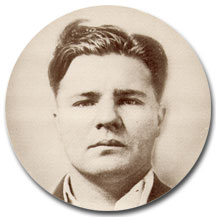
According to his biography in Wikipedia, “[Charles Arthur] Floyd was viewed positively by the general public. When he robbed banks he allegedly destroyed mortgage documents, but this has never been confirmed and may be myth. He was often protected by locals of Oklahoma, who referred to him as ‘Robin Hood of the Cookson Hills.’” He was thirty when he died.
Floyd’s robberies of banks made him a target for the fledgling FBI and the true manner of his death became one of the agency’s earliest cover-ups. After he was downed by rifle shot, another agent shot him with an automatic weapon at point blank range. Not widely known at the time, the unfairness of his killing nevertheless was understood at a visceral level by the common man.
Woody Guthrie, a native of Oklahoma, penned a song about it in 1939, five years after Floyd’s death. Called “The Ballad of Pretty Boy Floyd,”the song has the form of a Broadside “come-all-ye” ballad opening with the lines:
If you’ll gather ’round me, children, a story I will tell ‘Bout Pretty Boy Floyd, an Outlaw, Oklahoma knew him well.
The lyrics recount Floyd’s supposed generosity to the poor and contain the famous lines comparing foreclosing bankers to outlaws:
As through this world you travel, you’ll meet some funny men; Some will rob you with a six-gun, and some with a fountain pen. And as through your life you travel, yes, as through your life you roam, You won’t never see an outlaw drive a family from their home.
Many other artists have recorded this song, among them Bob Dylan, Joan Baez, and James Taylor as another generation’s anthem to the tragedy of corporate takeover.
It’s easy to see Floyd as a martyr. In his short life, he did what so many others wanted to do. Like the young Chinese man who dared to stand in the path of an oncoming tank, Floyd like similar ‘criminals’ of the early 20th century defied the banks and credit systems that threatened everything that mattered in rural American lives. They instinctively understood they were being swept into a capitalist system that had no sense of morality, no obligation to human circumstance. They fought back the only way they knew how.
The battle that cost Charles Floyd his life has not ended.
Yesterday, the pesky doe had circled the fenced yard all day, causing the dogs to bark incessantly. Nerves shot, at around 5 p.m. I decided to fire off a few rounds to scare her away. I grabbed my .22 rifle and stood on the porch at the west end of the house, which is my daughter’s apartment, and looked for the doe. From there a person can look downhill toward the ponds and pasture, normal doe hangout. Nowhere to be seen.
I returned to my dinner preparations, fed the dogs, fed the cats, and fed the goldfish. One cat of the four—Esmeralda—didn’t show up. I thought, okay, she followed me to the apartment. So I went back there and looked for her, called, nothing. Usually she is front and center demanding food at that point, so this was highly unusual.
Then the barking started again. I grabbed the .22 and went to the gate. There stood that stubborn doe not a hundred feet from the house.
Now let me say that this has been an ongoing war for multiple deer generations. Before we got these two hounds, the deer jumped over our yard fence and helped themselves to whatever they pleased—hosta, flower beds right by the porch, any tomatoes or other veggies I tried to grow in the raised beds. But for the last five years with hounds running free in the yard, the deer have decided discretion is the better part of valor, hosta notwithstanding.
But this doe has become quite clever at avoiding the hounds by jumping the fence in the wee hours of morning when the hounds are sacked out in the house. Consequently my tomato plants have been topped multiple times and the peppers probably won’t come back. This is after a second planting. So I really don’t care that it’s not deer season or that my .22 bullet wouldn’t be a clean kill.
In the winter, I would have opened the gate and let the hounds chase her off. But it’s tick season. Worse, the last time we let both hounds go at the same time, the younger one—Weezie—didn’t come back until well after dark. She was shaking and terrified and smelled of tobacco smoke. Someone had penned her up. So now when we let Weezie out, it’s without her big sister Cu. She usually bounds around chasing squirrels in the adjacent woodland, living dog ecstasy for ten or fifteen minutes before she’s ready to come back in the yard. Cu, on the other hand, will stay out much longer, baying as she tracks scent clear back to the canyon.
So I’m standing at the gate with my rifle and the dogs are going nuts. The deer is being coy, facing me with several large trees between us. I can’t get a clear shot. Plus I’m having pangs of conscience. The .22 can’t deliver a kill shot. She might have a fawn around here. I’m thinking, well, if I let Weezie out, she’ll put a good scare in that bitch and I won’t have to shoot her.
I’m juggling the rifle and Annoying Emma the mongrel terrier is underfoot. The minute my hand touches the gate latch, Emma lunges, Weezie lunges, I nearly drop the rifle, and all three dogs are out the gate. Damn it.
Look, that deer is right out there. Can we go out, please please?
Okay, calling them is worthless. In two seconds, two brown streaks are hurtling through the underbrush down by the pond. The doe bounds east and then south toward the canyon, dogs in fast pursuit. I go inside, put the rifle away, and eat my cold dinner.
This is worse than it sounds because Cu is my daughter’s dog. She’s housesitting this week and swamped with coursework for the two graduate level summer school classes she’s taking. Plus she’s seriously attached to Weezie. If she knew the dogs were out there dashing through the late afternoon heat harvesting ticks by the bucket and bound not to return for hours, she would be worried sick. So I decide not to tell her. Dinner goes down hard.
Then I remember I have a missing cat! Why? I could understand if she was preoccupied with her last stealth moves on a mouse or mole, but it’s been an hour. Something is wrong. I go back outside and stand by the gate. Emma goes out too, because she’s way too smart (and too old and too fat) to try to run with the hounds. As she exits the gate, which I’ve left open for the hounds’ return, she briefly sniffs the bed of ivy growing along the fence. She immediately jumps back.
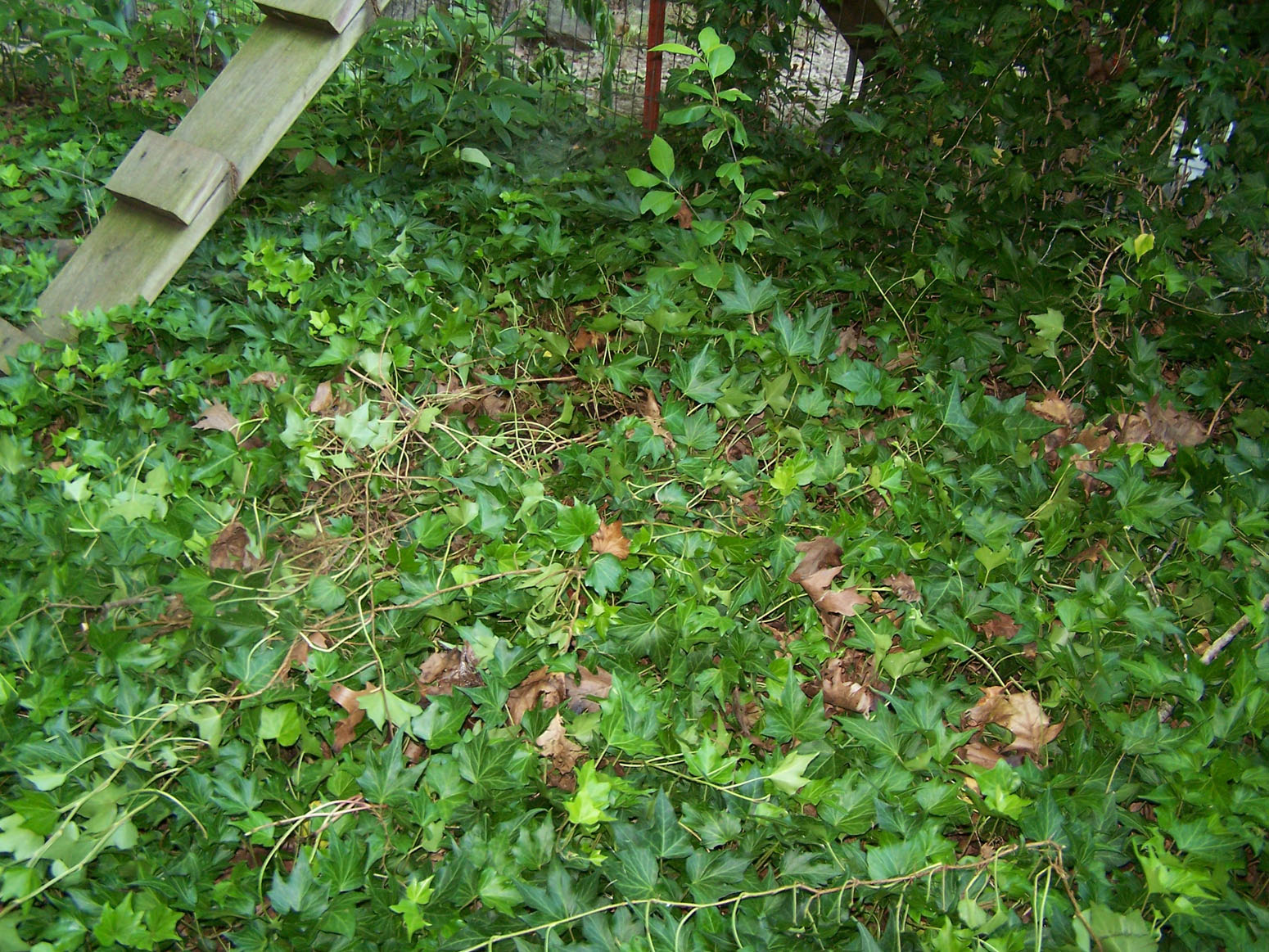
What fresh hell is this? I lean forward toward the ivy before I hear the unmistakable rattle. I can see nothing—the ivy is a green mass about five feet wide and ten feet long and at least a foot deep. But the sound is familiar.
Snake.
I go back and grab the .22. I’m holding the gun listening. Can’t see a thing. Rattling continues. I shoo Emma back because of course if I told her to, she’d jump into the ivy.
I aim and fire at the sound. The first round cracks out of the gun and the rattle continues. I give it my Shaolin concentration and fire again. The rattle stops and the ivy starts to move. I fire a couple more rounds.
I set down the gun and grab the hoe from the other side of the porch. I start hacking at the ivy, trying to pull that tenacious vine apart so I can see what I’m up against. I don’t want a coiled snake to suddenly strike, so I’m working incrementally from the edge inward. Finally I see a flash of color, that familiar brown-rust pattern of a copperhead. It’s coiling and turning as I expose part of it to view.
I’ve learned that lots of snakes rattle their tails. Once I thought about it, I remembered that rattlesnake rattles are higher pitched, a hissing sound like air escaping a tire. This rattle was lower pitched, a tail hitting leaves. Either way, I’m always thankful for the rattle.
Hack, hack, I drive the hoe down on its body. As it moves toward me, I realize I’m only hacking at the last six inches. I chop more vine. Finally, there’s the wedge-shaped head. I slam the hoe down but it has moved. Toward me.
I’m sweating and cursing and keep telling Emma to get back damn it. I rip more vines and finally I can see the whole snake. I’ve done a fairly decent job of smashing a place six inches from its tail, and now I can see a bullet hole I managed to send straight through its middle. From that point to its head, it seems unable to fully move. Maybe the shot injured its spine.
That doesn’t mean it can’t bite and send its load of venom into my ankle. Or Emma’s face. So I land the hoe behind its head. The ground under all that ivy is super soft. I’m just burying the snake in dirt.
I hook the hoe under the snake’s midsection and lift it out of the ivy. Once I’ve tossed it onto the driveway, a swift blow behind its head finishes it off. Of course it’s still moving and Emma still wants in the middle of it, so I leave the hoe blade sitting on its neck and step back.
I’m thinking this explains the missing cat. This area here between the gate and my car is a place she frequents. If she spotted the snake, she might do what lots of cats do, which is chase the snake. I once had a cat that specialized in chasing snakes. She’d herd them right out of the yard and away from the house. That’s when the kids were little and I always thought she knew exactly what she was doing, protecting our babies.
Of course, I also once had a cat that got bit. Twice. Old Reece’s Pieces was a slow learner or had a contract with death, I never could figure out which. I’ve written about him before. Once he burst through the pet door and ran down the back hallway. I found him my daughter’s closet, cowering in the corner. His right eye was swollen shut and the area around it bloody and turning purple. Trip to vet. Fangs hit his forehead and eyelid, barely missing the eyeball. Vet thought he’d lose the eye but he didn’t.
A year or so later, Reece’s didn’t show up for dinner, just like Esmeralda hadn’t shown up. I remembered what happened then, how I searched around the house for two days before I found him lying in tall weeds. I talked to him, wondering why he didn’t get up and come to me. He was less than twenty feet from the house. How I missed him before I’ll never know.
But he didn’t get up, just meowed weakly. So I picked him up and the hand I put under his belly came back bloody. He’d been snake bit in the stomach. In the two days he’d been laid up, the bite wound had spread about six inches in diameter, the hair had fallen off, and the skin was black and rotten. He was too weak to move.
The vet shook his head, shot him full of antibiotics, and sent him home to die. I kept him in my bedroom where he crawled under my bed. He wouldn’t eat. The next day, I sat nearby eating cantaloupe and he sniffed the air. I gave him some. He couldn’t eat enough.
Who knew? For the next several days, Reece’s Pieces ate mashed cantaloupe. Then he started eating regular food. Slowly he got well.
Is this what happened to Esmeralda? Was she lying in the grass somewhere or in the woods, paralyzed by copperhead poison?
I began searching, again touring the house, under the beds, my daughter’s apartment. Then outside—the flower beds, under the porch, under my car. The weeds. The underbrush, hoe in hand, because one snake is never the whole story.
Meanwhile, every fifteen minutes or so, I’m calling the dogs. I can hear them way down in the woods. Then even further, like they were down in the canyon now. Paying absolutely no attention to my calls, my demands that they get in the yard right now. They’re tracking, hollering as they go.
Which is, of course, what hounds do.
What about snakes?! They could easily stumble across a big rattler—years back, a neighbor shot a timber rattler that was nine feet long. I killed a velvet tail coiled up right by my car door after I thought I was getting a flat. I shot two bigger ones about six feet long and traveling across my yard. I regret killing them. They were beautiful and if the stupid little Pekinese I had at the time had left them alone, I wouldn’t have needed to shoot them.
If those hounds got snake bit out there in that rugged country, I’d never find them. I’d have to wait for the buzzards to start circling. Oh, damn, this is not going well.
I don’t find the cat. Anywhere.
Taco instructing Finnegan on cat rules.
I’ve never regretted killing a copperhead. I leave this one lying on the drive. Our old patriarch cat, Taco, comes by to sniff. Our two younger cats investigate, appropriately wary of the smell. There is a strong scent to poisonous snakes and cats have good instincts. Except the young male Finnegan, appropriately bold for a young king. He wants to pop it a couple of times. The snake is still writhing like they do after death. That thrills him. He stalks around it, hair standing up on his spine.
I try to watch television, springing up at every commercial to look again for Esmeralda. I imagine she’s dead or dying somewhere. I may never find her.
I call the dogs. It’s 7:30 p.m. I can’t hear them at all.
Light is fading. It’s 8:30. No dogs. No Esmeralda. I’m calling, calling. Go to the far end on my daughter’s porch and call some more.
Minutes tick by. I listen to the bullfrogs warming up at the pond. I hear lapping noises at the water bowl. I think it’s Emma. But it sounds like a big dog…
Yes! I step back inside her living room and there is Weezie lapping water like she’s dying of thirst and Cu spread out of the floor like she can’t move one more step. Both dogs panting as fast as they can.
I hurry through the house to close the yard gate before they decide to venture out again. They have no such intention. They’ve been running for three hours in this miserable heat. They follow me to the kitchen where they stretch out on the cool floor. Panting. Lots of panting.
Esmeralda temporarily captive.
As I step back into the kitchen from closing the gate, there’s Esmeralda. What? Where did she come from? She’s all relaxed, doing her ballet stretches as I scold her. Then she’s all about her dinner.
The only thing I can figure out is that she was having a nap in the apartment and just wasn’t ready to respond when I was back there searching. Or whatever. She’s one of those Cats.
As for the dogs, they are too exhausted to move. Forty-five minutes elapsed before they stopped panting. Covered in ticks. Fortunately, their meds kills the ticks once they bite, so it wasn’t like they were going to be sucked dry. Still, I couldn’t stand it. I got about a dozen off each ear and that was all they’d let me look for. I’m so glad it’s not late July. That’s when the super tiny ticks start, the ones you can’t see that spread like dust by the thousands.
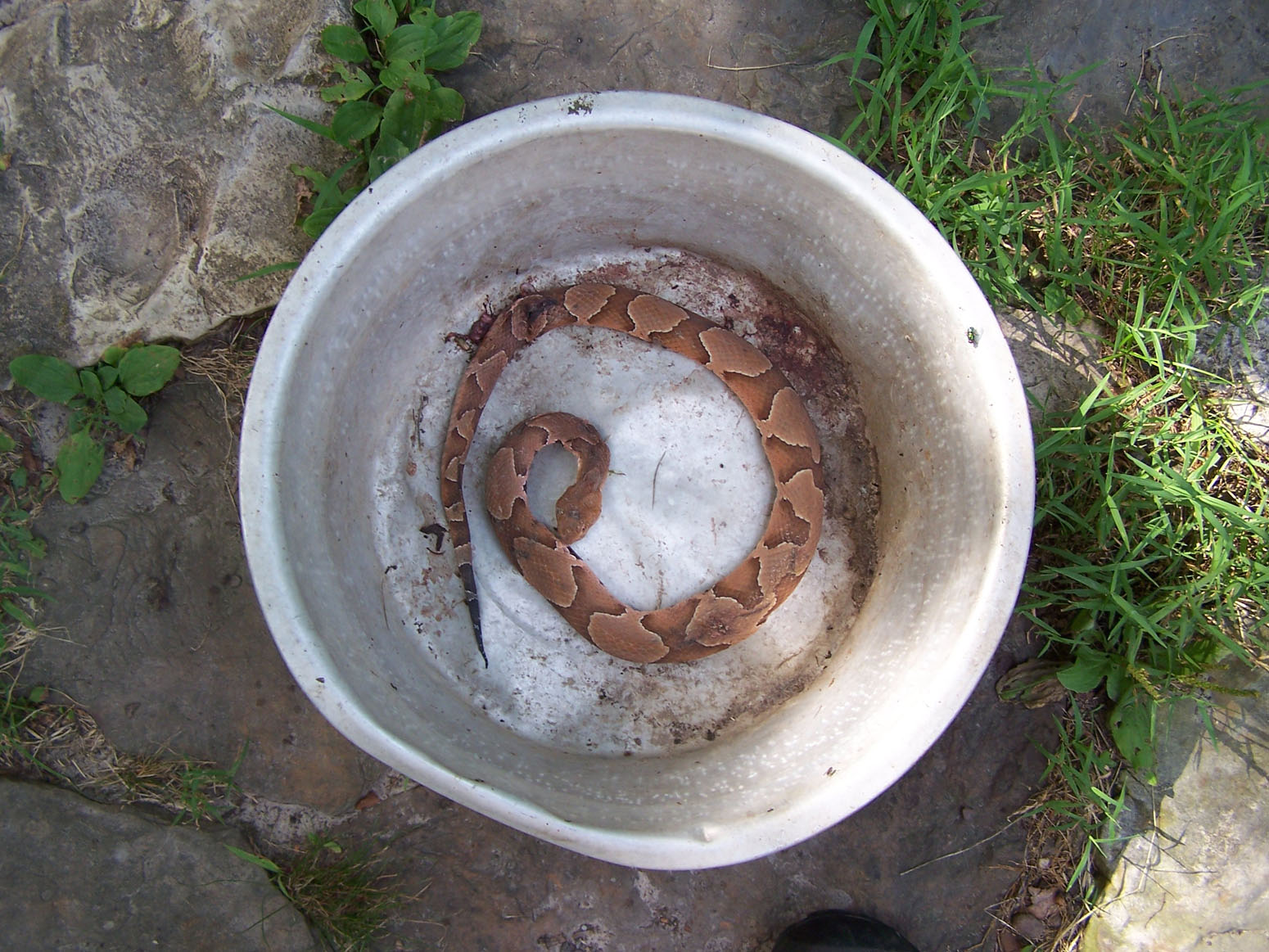
Today has been a vast improvement. The snake is in an old dishpan. It’s about two and a half feet long. Esmeralda is pursuing enigma. The dogs are napping. Once it cools off a little, I’ll walk down the driveway and toss the snake into the woods.
I tried. In my first published book, Notes of a Piano Tuner, I wanted desperately to convey the thrill of hearing a certain piece of music played on a freshly tuned piano. Everything about that time and place added to the intensity of those few bars—an old wooden church house twenty miles out a dirt road in the Arkansas Ozarks, an old upright piano that had somehow survived a century of use to remain remarkably musical, and a rainy late spring afternoon. As the storm front moved on to the east, a green cast permeated the outside air. A wasp buzzed against the nearby window, one of those tall narrow windows with watery glass common in old churches where they needed the light but didn’t want congregants distracted by whatever went on outside.
Moist air carries sound waves better than dry air. The combination of moist air, the resonance of the old church, the magical ancient piano, and the harmonies of that particular music transcended anything I could say with words. The waves rolled up from the soundboard, bounced off the high church ceiling, and resonated through my chest like a physical force.
Well, it was a physical force.
My hair stood up. I got goosebumps.
There’s something about fourths and fifths that does it for me. And old hymns, which make full use of fourths and fifths. Simple, basic harmonies.
An acoustic physicist could probably explain it. The mathematics of tuning never quite penetrated my skull. My dad taught me to tune by ear. I didn’t want or need to understand that when a string produced a fundamental pitch, say the note ‘A,’ it also formed partials. Partials were, predictably, partial vibrations of the string which produce other pitches. So for the note ‘A’ vibrating along a single string, the partials also vibrated in tones of fourths, fifths, other octaves and so forth up into an entire overtone series.
For more than you ever wanted to know about overtones, check out this article.
Complicated stuff and mostly irrelevant to a tuner who works by ear. My dad, I, and now my son understand these things internally.
To the point, the strings on the old upright in that church still created perfect overtones. As those chords rolled from my fingers, the overtones blended with the fundamental notes I played to create such a rich experience that I actually got tears in my eyes.
I wanted to share that. When I wrote that story, I tried to think of how to convey my experience. I considered writing the actual music on the page, but unless someone knew how to read music, that notation would mean nothing. I blathered on about feeling the effects of the music but that alone wouldn’t make someone’s hair stand up.
I ended up writing the words that accompany that particular sequence of music thinking that if someone heard the words, they would hear the music.
Well, maybe some did. But unfortunately, most readers evidently took the meaning of the words as the message I wanted to convey and never heard the music at all.
Wrong. Not even close. I didn’t want the message of the words to have anything to do with my story. The message of the words wasn’t my message. In fact, they were about as far from my intent as they could possibly be.
The words were “Amazing Grace, how sweet the sound,” etc. I wrote the entire first verse, because those were the notes, the harmonies, the chords and overtones of my experience.
As a result, a lot of readers of my book assumed that I had been ‘saved.’ That my awestruck experience resulting from that loaded afternoon had to do with finding God, getting religion, and all the rest of that stuff.
I’m sorry. That’s not what I meant. Not what I meant at all.
And it strikes me now that religion is a lot like that, all about the words without hearing the music.
As Robert Winn wrote in his book Winslow: Top of the Ozarks, “[Budd] had a large office with a staff of a dozen young ladies mailing out advertising for fence posts. He shipped out uncounted numbers of fence posts to western states. He also carried a complete line of clothing, shoes, feed, hardware, furniture, and groceries. Mr. Budd had branch stores at Brentwood, Woolsey, West Fork, Porter (Schaberg) Chester, Walker’s Switch, Mountainburg, and Rudy.”High-profile courtroom cases like the 1937 “Cabin Orgy” suit gained public attention for Rex Perkins. His fame as an outstanding trial lawyer spread. His name increasingly appeared in conjunction with front page headlines announcing the most recent sensational case. For example, in June 1943, he successfully defended Tuck Bishop, an admitted murderer of four people. In Bishop’s defense, Rex harped on Bishop’s status as a wounded veteran and filed a nolle prosequi declaration resulting in a precedent-setting life sentence for Mr. Bishop rather than the expected death penalty.
Rex’s success in gaining cases rose not only from his frequent mentions in local media, but also from his enthusiastic and tenacious pursuit of legal options for his clients. In addition to his sharp mind and voracious study of the law, Rex didn’t hesitate to skirt the edges of accepted practice. One anecdote recalls a time when Rex and his client faced a formidable team of well-heeled Little Rock attorneys who traveled to the Madison county courthouse to press their case. In those days, visual aids required to instruct jurors on logistics or scene layout usually depended on the use of a chalkboard. As the Little Rock legal team left the courtroom for a brief recess, Rex strolled past the chalkboard and palmed the chalk. Alas, no further use of the chalkboard could be made.[1]
Rose and E. A. Budd, probably at San Francisco. The careful staging of a prop in front of Rose was meant to disguise her delicate condition. Image courtesy Velda Brotherton. Originally published in the Washington County Observer and in the book Washington County by Velda Brotherton, published by Arcadia Publishers.
In 1944, Perkins and his partner Tom Sullins took up the case of Elwin A. Budd, founder of Budd Post and Hardwood Company and a longtime prominent businessman in the region. An Illinois native of impoverished background, Budd had built a fortune buying and selling hardwood fence posts during the peak years of Washington County’s timber boom, becoming known as “the man who fenced the West.”[2] He married Nettie Huey in 1903, settled on a place near Brentwood (south Washington County), and in 1908, the couple gained a son. A young woman named Rose Shackelford came to help with the baby and E. A. fell in love with her.
By this time, Budd had built his fence post fortunes into thriving mercantile operations along the railroad at Winslow and Chester, Arkansas, as the route cut south into virgin forest between Fayetteville to Fort Smith. He divorced Nettie and married Rose in 1909 when he was thirty-two and she was fifteen. His relationship with Rose ended tragically just six years later after the couple took an automobile trip to the 1915 Panama-Pacific International Exposition in San Francisco. Pregnant during the arduous journey, Rose gave birth to a stillborn child in October and died four days later.
It was said that the loss of Rose changed E. A. forever. He threw himself into his business. In the 1920s as the timber trade died down, he along with his brother Arthur invested in expansive commercial enterprises in Fayetteville. Their Royal Movie Theater, Royal Barber Shop, Royal Café, and Budd’s Department Store occupied virtually all of the south side of the Fayetteville Square. Budd’s fence post business continued in Fayetteville with warehouses stretching from South Hill Avenue east to South Government Avenue and filling a half block north of the railroad tracks toward Sixth Street (now Martin Luther King Boulevard). Another warehouse, ‘Budd’s Woodcraft and Spokes,’ fronted 808 South Government, a structure recently housing the ‘The Village Sculptor’ ironworks of the modern-day Fayetteville artist Hank Kaminsky and demolished in 2013.
Budd remarried several times, becoming increasingly more depressed and drinking heavily. Beloved by employees as a “likeable, hard-working, and shrewd man with a knack for making money” and credited with creating jobs during the Depression, his work habit was remembered that he “left home in a three-piece suit to sell posts up and down the river, then later in the day changed to a pair of overalls to do the manual labor.”[3]
Fire damage January 15, 1940. Headline, Northwest Arkansas Times: “Budd’s Mercantile, Royal Theater, Barber Shop, and Cafe Contents Total Loss” Caption underneath photo: “The front walls of the Royal theatre and Budd building were about all that remained today after fire destroyed the buildings and contents. Firemen remained at the smouldering ruins throughout the day.” Springdale firemen joined the Fayetteville forces in an effort to save other south side buildings.
Misfortune continued to find him, however. Fire swept through his Fayetteville mercantile, theater, barber shop and café on January 15, 1940, resulting in total loss to the contents, as well as destruction of several rented upstairs offices and apartments.
Four years later, on March 27, 1944, Budd allegedly inflicted fatal wounds to Miss Norma Smith, a Zion schoolteacher of long acquaintance with Budd. The trial opened July 11, 1944. The defense team included Perkins, Tom Sullins, and John Mayes. Prosecuting Attorney Jeff Duty was joined by Assistant Prosecutor Glen Wing and Van Buren attorney Dave Partain in Judge J. W. Trimble’s court. Opening testimony for the prosecution came from Pvt. Dale Fields, 26, who recounted his previous Saturday evening at Mitche’s Place with a crowd from Springdale. Upon exiting the building, he said Miss Smith “hollered” at him to come over to the car where she was sitting.
He went over and talked to her for a while, then got in the car and went to Springdale. She drove him home. He made a date with her to see her the next morning. They drove to Noel, Mo., in her car and visited his uncle, Fields said, returning to Fayetteville about 4:30, and that evening she again took him home to Springdale. ‘She asked me to come back and see her any time I wanted to,’ he said.
He didn’t see her any more until March 27, about 8 or 9 o’clock, Fields testified. ‘We were laying on the bed when Mr. Budd came in there…He walked up on the porch, came in the house, turned on the lights, came in the bedroom and told me “‘Time to leave.’”
When questioned by the defense, Fields said Budd did not say that in an angry tone. Fields got up and began to dress, but Miss Smith said that he wasn’t leaving. She went into the living room and argued with Budd. As Fields got the living room, he saw Budd slap her. She fell into a chair and Budd left.
Fields asked her who Budd was but she wouldn’t tell him…she just said he was a business man up town. Budd returned, threw eggs at the house and Norma ran out and stared hollering at him. One egg came through the door was she went out, and splattered on the wall…Fields said he next heard fighting in the yard. He said he had been sitting near the door and could hear the blows, and ‘it sounded like he was hitting her hard.’ Then she yelled for help. Fields went out and when he first saw them they were fighting in the corner of the yard near a tree. He saw Budd hit her in the face one lick with his fist, and…she hit the ground. “Then the law came down there…Budd started to his car.”
After about an hour at the police station, Fields returned to Miss Smith’s house where he found her lying on the bed. “There was a place on her chin and blood was running down the back of her neck coming from under her hair,” he said. He washed her and convinced her to go to a doctor, but when they got to the car, it wouldn’t start. The wires had been cut. Fields tried to find a doctor who would go to the house, but no one came. He stayed with her all night during which time Budd drove up and down the street blowing his horn…
~~
From Chapter 4 of Rex Perkins: A Biography. Available in Fayetteville and West Fork local bookstores. Or at Amazon.
[1] Bassett, Marynm. Interview with author May 23, 2014. Author’s notes.
[2] Brotherton, Velda. “Rose Budd the one true love of legendary businessman,” “Wandering the Ozarks with Velda Brotherton.” White River Valley News, June 23, 2005. Page 9
I wrote this piece years ago and included it in my book “I Met a Goat on the Road.” The main grocery store in town was the Lafayette Street IGA, back before Walmart decided to take over the grocery trade. That’s not the only thing that’s changed. Today is December 21 and it’s 61 degrees outside. The ten day forecast finds all overnight lows above freezing. So much for a white Christmas.
Now the story:
She spoke for us all, confessing to the check-out clerk with an excited laugh that if it was going to ice, she’d better get ready. Milk, bread, chocolate bars, corn meal—her choices were different only in detail from the rest of us standing in line in a store so jam-packed that even the stock boys were up front wearing jackets over their aprons and sacking supplies that would keep us secure when the weather moved in. Cars and trucks crowded the parking lot, some left running with the plumes of their exhaust whipped sideways in the freezing wind.
Men waited holding meat, bananas, coffee, restless in insulated tan coveralls with the legs unzipped over their heavy clay-soiled boots, their hair packed down against their heads where knit hats had rested. Uneasy in a role usually filled by their wives, they joked, catching up with old acquaintances who also stood in line, promising to call soon, men not accustomed to being off work at one p.m., hurrying home to family before the sleet started.
The cold came first, thirty-five degrees when I started to town in the morning, twenty two when I returned home, fifteen by three. Wind rocked the great oaks side to side, piling stiff dead leaves in new arrangements at the corner of the woodpile, at the steps. Twelve degrees at dusk, the clouded sky pale pink and white, the countryside settling into frozen night.
Five-thirty a.m. by my bedside clock, the tick-tick of sleet against the windows woke me. I indulged in another hour of fitful sleep, comforted by heavy quilts and cats at my feet. Plans of all I could do raced through my dreams, the albums not finished, correspondence neglected, the watercolors so long set aside. Roads coated in ice meant a day without visitors, a day at home tending the fire, tending myself.
Dressed in sweaters not worn for five years, in long socks and with no regard to appearances, I sipped hot tea at the window. Only a small shift in the light signaled dawn, lifting the dark blue cast of the air to a lighter shade. Barely visible deer moved slowly through the woods, pawing at the ice-coated duff. Tiny crystalline flakes of snow filtered into the sleet, thickening the white of the downfall, obscuring trees at the fence line. It was four degrees.
I built a fire in the wood-burning cook stove. A kettle of water with cinnamon oil steamed while I crafted my list of things to do, tasks that seemed too petty or cumbersome for normal days when open roads and obligations burdened the hours. I would simmer apricots with honey and ginger and fry half-moon pies, edges evenly crimped with tender fork lines. I would sketch scenes, the road to my house or the contoured hills, and let watercolor swirl on the heavy paper, a skyscape of gray and blue, fields tan, oaks silhouetted black.
Freshly washed clothes hung by the blistering stove where greedy heat soon pulled out all moisture. With satisfying frugality, a pot of vegetable soup thick with garlic and a pan of beans decorated the stove top, cornbread in the small sooty oven. Every few hours I rushed out for more wood, lingering coatless in the sharp scent of cold and wood smoke, large flakes of snow tumbling down into my hair, resting on my eyelashes.
The winters have not been accommodating in recent years, failing first with abbreviated snows, then disappointing even in temperature. In the onslaught of global warming, the Ozark hills have increasingly remained accessible in deepest January. A few decades earlier, our steep, curving roadways had been reliably impassible for at least two arctic weeks of the year. We grew to expect that at times chosen by Nature, no one would venture out. The guy with the local wrecker service would make enough money to last until June.
In this mid-South clime of Northwest Arkansas, we don’t get winter enough to justify the county’s expense for snow plows. It suits us better to schedule school years with extra days for snow. It pleases us to find ourselves unexpectedly confined to the house. In that splendid isolation, we might discover long lost treasures at the back of the closet, read magazines, stand at the window staring out in silence as midday lightens the sky to a shade barely more luminous than the snow lying thick on the ground.
Lately there has been little winter at all. Days have run together, no time to reflect, restore, sleep in the afternoon. We long for the cold, the ice, roads we could not drive, jobs we could not attend. Our bodies crave hibernation.
Welcome then this celebration of ancient instincts to stay in the cave, content with the provisions we have hoarded, the firewood we have stacked near the door, wrapped in the warmth we have made. Embrace this triumph of survival over the elements, proof of our adequacy in a time when little else seems so clear.
A visiting guinea? A ‘possum in the dining room? What strange and wondrous occurrences can one expect while living on an Ozark mountaintop for thirty-five years?
These lyrical adventure stories feature chickens, raccoons, bugs, dogs, cats, and natural critters of this woodland home. Throw in a few neighbors who shoot copperheads or remodel the dirt road. Ponder the passage of time through a philosophical lens of wonder and delight. The seasons bring summer heat, winter snow, pouring rain, the power of fire. Lessons learned, questions posed-who has lived and died on this land? What is our responsibility to this place, its creatures, each other?
Come meet the goat on the road.
Now available for only $6.95. A lovely gift for anyone. Amazon buy link
“I enjoyed all these stories and especially admired the author’s ability to describe the creatures she encounters with a naturalist’s eye and a pet lover’s emotions. My favorite story was ‘Summer,’ a languorous description of a 102-degree day on the mountain where the smallest movement seems difficult and time slows down. The author’s prose is lyrical and yet unsentimental. You can feel the heat and the sense of relief when the day draws to a close. A beautifully-written series of stories…” Reviewed by Annamaria Farbizio for Readers’ Favorite
Denny Luke, far right, next to Arkansas Governor Mike Beebe on one of his whistlestop tours of the state. 2006. On left, Ron Johns and in center, Dan Kerlin. At Dan’s store in Winslow.
1972. A Yankee moves to the Ozarks and lives to tell his tales. Now captured in a tidy little book along with plenty of photographs, these stories track Denny Luke’s life experiences from childhood in Ohio to the backwoods hills of Arkansas.
This man is an adventurer. During his years in the Navy, he built hot rods with money he made with shipboard loansharking. He returned to his native Ohio where he soon tired of the mechanic’s life. Computers had just started to break the surface in 1966, the perfect attraction to a young man with a sharp mind and plenty of ambition.
Denny with his mom in his Corvette. This photo not included in the book.
Money rolled in as he built databases, a brand new idea in the mid-Sixties. A ‘63 Corvette and soon after a new Triumph dirt bike put him in the fast lane for weekend jaunts to the Playboy Club in Chicago and Enduro racing in Wisconsin’s back country.
Then, like so many of his generation, he stepped out of the fast lane and moved to a primitive life in the country. Among his most important first acquaintances was Ray Brown.
Ray Brown teaching hog killin’ to Denny. This photo not in the book.
“We rented a little cabin near Devil’s Den from Ray Brown. He was a genuine hillbilly. His family lived in a little old log cabin. He raised a few cows, cut posts, whatever he could do to make a living. He was smart, smartest man I ever knew, had lots of common sense. His cabin had a big old fireplace that barely kept the place warm. He sat in this big chair over in one corner, and he could reach around behind his chair and grab a big handful of snow—that much would blow in through the cracks.”
Denny and his buddy Butch scouted cheap land all over Northwest Arkansas and ended up with an old log cabin on Bunyard Road. They also learned to be stone masons in order to earn their way.
Denny rustling up some grub at the Bunyard cabin December 1974. This amazing stove had a gas burning side and a wood burning side. Hauled from Wisconsin to the Ozarks.
“There are two or three families out on Bunyard that are cliquish. I wasn’t accepted out there. I was from the north, and I didn’t go to church. The first thing they wanted me to do was go to church. Plus I wasn’t born there. And I owned the old Omie Wood home place and they might have resented that some.”
An avid photographer and storyteller, Denny shares the adventures of his life with Author Denele Campbell as he recalls the outrageous backwoods tales and colorful characters who populate this neck of the woods.
Join us Sunday September 13 in the Connie Wright Gallery of Ozark Folkways at Winslow for live music, refreshments, Author Denele Campbell’s comments on this collaboration, and Denny’s readings from the book. Autographed copies will be available for sale.
Can’t make the event? The book is available at Amazon.com or at your favorite bookstore.
Oh, the wringing of hands as the State of Arkansas once again tries to cough up more money for prisons. One of the poorest states in the nation, Arkansas struggles to pay for schools and roads. But those programs are optional. Prisons are not.
That is, you see, because we must punish Crime.
Thus comes the grand news that Arkansas ranks third in the nation in prison population growth. Not only are prisons stuffed, so are the county jails where duly convicted criminals awaitprison space. Not only are all lockups in the state overflowing, we’ve now exported hundreds of prisoners to Texas where their for-profit system takes all the money we want to send them.
Most recently, the genius that is the current state legislature has passed a law wherein persons on probation or parole can be stopped and searched not only by parole/probation officers but also by any other law enforcement officer. The arguably reasonable rationale behind this law is that a would-be burglar might be gently nudged along a path of righteousness with more authority figures looking over his shoulder.
They actually believe this will reduce the prison population. My prediction is the opposite. More noses in private business means more marijuana arrests.
Thedisconnect lies in the reality of present day culture. Whether our criminal codes yet reflect it, marijuana is the new beer. Over half the states have now made marijuana legal for medical use and three (so far) have made it legal for recreational use. In those states, tax revenues are booming while teen drug use and crime in general are down.
We’ll have none of that in Arkansas. No sir.
No, here we prefer to rope goats and dip snuff. Here we produce an annual crop of Bible-thumpin’ preachers in jail for molesting children. Here we have state and federal legislators fixated on regulating a woman’s uterus and other people’s relationships. (I can say these things—I’m a native.)
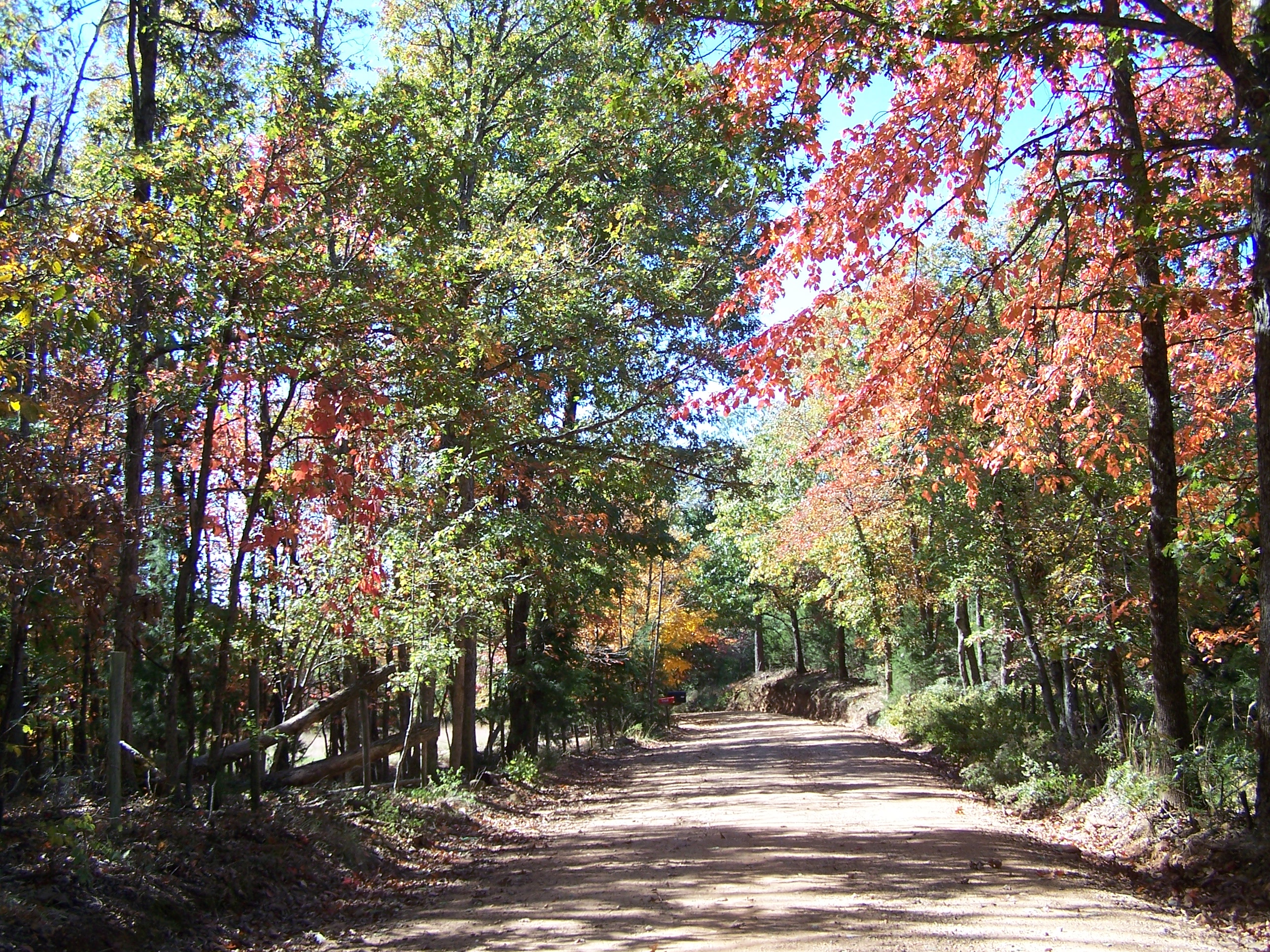
I live on a dirt road. Periodically the road is graced by the passage of a road grader. The road grader moves dirt around, swiping it from the edges and piling it up in the middle where it is spread along to fill up holes and trenches cut by rain. Next time it rains, the holes appear again.
At the worst spot (pictured above), a cavernous roadside ditch abruptly ends. Water has nowhere to go. So it runs across the road. The solution is amazingly simple:cut the ditch another 30 feet to the creek. Like magic, no morebone-jarring trench.
I’ve long pondered this particular problem. I’ve sent carefully composed letters and drawings to the county road superintendent. I’ve chanced upon the grader mid-task and stopped to belabor my point with the operator. He’s always amiable, working a big cud and nodding while I talk and point. “Yes, Ma’am,” he says.
Then he grades the road exactly the same as before.
That quiet shredding sound you hear is me ripping my hair.
Is getting high a crime? If you get high on alcohol, it’s not a crime. If you zoom around all smiles on your script of Valium or Xanax, not a crime. Face it. People smoke weed. Water runs downhill.
There’s never been a study showing that laws against drugs have been effective in stopping drug use or addiction. All we have to do is look at the status of our prisons to know those laws have failed. We have a greater percentage of people using drugs now than ever before. Great work, guys. Keep filling those holes.
In 2014, Arkansas arrest data show 14,480 crimes against persons (murder, rape, assault) with the largest subset of 8,103 for simple assault. There were 20,329 crimes against property (arson, burglary, vandalism, fraud, theft) with the largest subset of 8,360 for shoplifting.
Drug arrests (in the category of ‘crimes against society’) totaled 13,626 with 6965 for marijuana possession and 797 for marijuana sales or manufacture. The next largest subset in drug crimes was 1748 arrests for methamphetamine possession and 481 for meth sales/manufacture. (The other 1218 ‘crimes against society’ include gambling, prostitution, pornography, and weapons laws violations.)
Is possession of marijuana an offense equal to assault? Who is harmed? Equal to shoplifting? Whose goods are stolen? Does it make any sense that almost as many people are arrested for drugs as are arrested for crimes against people?
In 2013, Arkansas prisons held 23,384 inmates. Another 29,946 offenders were on probation and 23,227 on parole. The corrections budget that year was $449 million. We can only guess what percentage of the prison/jail population is serving time for drug offenses because the state doesn’t collect that information.
They don’t want to know.
If drug offenders are convicted at the same rate as offenders in other categories, then we could assume that 30% of our prison population is there for drug offenses and 57% of those for marijuana.
There has always been an element of society which believes its duty is to regulate how people think. Its lineage can be traced to the Inquisition andsetting witches on fire. No one argues whether crimes against persons and property should be punished. Butthe idea that the state should attempt to regulate our mindsviolates every principle of a free society.
The standard argument in support of drug prohibition involves token concerns about people harming themselves. Worse, people high on drugs can hurt other people. Yes. But people who harm themselves with potato chips or cigarettes aren’tarrested. People trashed on boozecan beat up their wives or get behind the wheel and kill a carload of innocent people.But we don’t need alcohol prohibition to prosecute impaired driving ordomestic violence.
Aside from trying to arrest our way out ofbehaviorwe don’t like, the would-be guardians of our minds have promulgated a flood of anti-drug propaganda. The drug problem flavor of the decade has moved from psychedelics to marijuana to methamphetamines. Now meth is so ’90s. Today the big evil is prescription drugs. (Ironic, considering the incessant television ads hawking drugs for every conceivable human ache and mood.)
By now there’s a nearly-one hundred year tradition of criminalizing certain substances and the persons who use them. The stigma once attached to demon rum has been transferred to a growing list of psychoactive substances. We have no choice. We have to build more prisons.
Let’s keep filling those holes.
Arkansas will be among the last to let go of its attempt to control what people do in the privacy of their homes or heads. These folks are still trying toget back to the19th century. Even though the Bible says nothing on the subject of drug use and relates multiple instances of Jesus Christ Himself using wine—hey, even making it out of water—religious extremists in control of the state refuse to allow statewide alcohol sales and would fight to the death before legalizing marijuana even for medical use.
The facts have been clear for decades. Any cost/benefit analysis would show the terrible price we pay for this futile effort. We’re stuck with the same old reaction, prisons before schools, before roads, before social services and other interventions that have the potential to actually reduce drug abuse.
How long, oh Lord, ’til the ditch is cut to the creek?
I’d made it halfway down the dog food aisle when the woman’s words penetrated.
“Hey, aren’t you…? Didn’t you…?”
The woman had turned to look at me. I knew she thought she knew me. I looked at her closely, moving my cart against the bags of dog food so I didn’t block the aisle. She did look kind of familiar. I glanced at the man standing behind her. He looked slightly familiar too.
“Virginia Wilson,” she said. “Dennis,” she added, motioning to her husband.
“Of course! Wow, it’s been so long.” I studied them as my brain clicked backwards through decades. In 1974, when Steve and I first moved to the land his parents deeded us on this mountain, Dennis and Virginia had a place on past ours another two miles down the rough dirt road.
“Yeah, we thought that was you,” she said with a smile. “I hardly know anybody up there anymore. They’re all dying off.”
“I only know a few,” I replied. “Burkart, Northcutt—can’t call them anymore.” I pondered the sorry state of affairs. “After Art died, you know his wife hooked up with a guy named Ron Martin. They had a kid and raised Art’s son Tommy—he was only two when Art died, and he’s about thirty now.”
We shook our heads at the passage of time.
I continued with my story, because at some point it would make sense why I told it. “Ron, he moved out. He lives down there in that little house Williams built for his son out by the road. Lives with a guy named Chris. They work together.”
That brought the topic back to people who lived on the road. Names of people who used to live here. Who lived in their houses now.
I could have said a lot more about Ron and Chris. How Ron’s back is messed up bad, an injury he’s carried since his days in Vietnam when the 101st Airborne was jumping out of helicopters into jungle, when Ron was a skinny little eighteen-year-old kid with a fifty pound pack on his back. He’s missing a few teeth now, thin as a rail, damn proud of his ‘Nam days and the 101st. He still tries to work, has to work since he’s got a seventeen year old son and his military pension even for a disabled person isn’t enough. He’s not supposed to work.
He’s got COPD, has to use oxygen. Wakes up in the morning in agony. Has to take his pain meds and stand in a hot shower until his back settles down. He had to move out on his wife, Art’s widow. She’s got issues, mostly anger. So he moved in with Chris.
Chris never was in the service. He lost an eye when he was nine, one of those running wild in the neighborhood situations, somebody throwing rocks or using a slingshot. Nobody really took care of Chris. His alcoholic dad did things to him, to all his kids, but Chris loved him anyway. Like kids do. By the time Chris hooked up with Ron, he was in his forties, had done every drug long enough to see himself sliding down a hole. Managed to get himself off heroin, off meth.
But Chris will never give up alcohol. Somewhere he’s got grown kids. Once he had good jobs in construction. The man has an amazing talent—just understands how to put things together. And an artful eye—one. Painter, carpenter, drywall guy—he’s got the skills. But he works to drink. Soon as he knocks off the job for the day, he hits Roger’s Rec. Sometimes he has enough sense to give Ron his money and listen to Ron when he says it’s time to go home.
Sometimes he wakes up in the wee hours with police shaking him awake and pulling him from where he passed out in the bushes behind Roger’s. They don’t even book him. They just call Ron. Nobody can fix Chris.
“Yeah,” Virginia says. “Remember Foster Copeland? Lacy Barrett bought that house after he died. I think they rent it out.”
I remember Foster—tall, sandy red hair, big guy. His house sits across the road from Ron and Chris. Not the house he had when we moved up here. That one burned. Then all the Jehovah Witnesses came up to help their ‘brother’ build a new one, a house raising that lasted a weekend and put him and his family back into a home.
Foster sold tool handles. He’d drive around these parts, I don’t know how far his route extended, selling handles from the back of his car. We’d take tools down there for him to fix. Five dollars. Pitchfork, hoe, shovel, maddock, axe—he had all the right handles made of good strong hickory. Some of my tools still have Foster’s handles in them. He died of a brain hemorrhage sometime in the mid-Eighties.
“I know the guy that lives there now,” I said. “Sammy something. He’s friends with Ron and Chris. He and his wife live in Foster’s house.”
“Is there somebody new living in Randy Northcutt’s house?” Dennis asked. Randy’s house is next door to Foster’s. Next door as in, maybe a hundred yards down the road.
“Yeah, I guess it sold—the realtor sign is down and they’ve cleaned up the place. Too bad about Randy. He really let that place get messed up.”
“Oh, that wasn’t Randy,” Virginia said. She glanced at Dennis and he shook his head. I knew he missed Neal. For years, every day, late afternoon, Dennis’ dump truck would be parked up next to Neal Northcutt’s fence and they’d be inside having a beer and discussing things in general.
“He sold that house,” she continued. “Soon as Neal died, Randy sold it to his sister and left. Haven’t heard a word about him since.”
“She lived in that trailer for a while, the one that used to belong to Davenport?” Davenport was a skinny little ex-military who married a big German woman. He died of cancer, left the place to her. She gave up after a couple of years and sold everything to Neal.
“Yeah, her and her husband. They fixed it up then sold it to Wesley Harris, I think was his name. They added on a really nice house, but that trailer’s still in there.” She paused to scoot her cart over so another shopper could go by. “I think they’re there, but I don’t know. I can’t keep up.”
Virginia’s a cute little woman with a petite figure and friendly smile. I think she’s into Jesus. We never socialized much, even in those early years when Steve, his brother Art, and Dennis got together to drink, smoke, and cuss. The guys hung out while the women went about the business of fixing meals, taking care of kids, keeping house. I saw no reason to buck the system—they never talked about much of interest to me.
Early on, we hired Dennis to build us a nice pond below the first pond. He was in the hauling and heavy equipment business. We’d see him driving home, groaning up the mountain with his dump truck in first gear, hauling his bulldozer behind him on a beat-up flatbed. Once the pond filled up, Steve and I took the kids—I think we only had two at the time, late 70s—and drove over to Huntsville to a fish farm. Brought back buckets of fingerling catfish to stock it. Never once caught a catfish out of there, at least that I can remember.
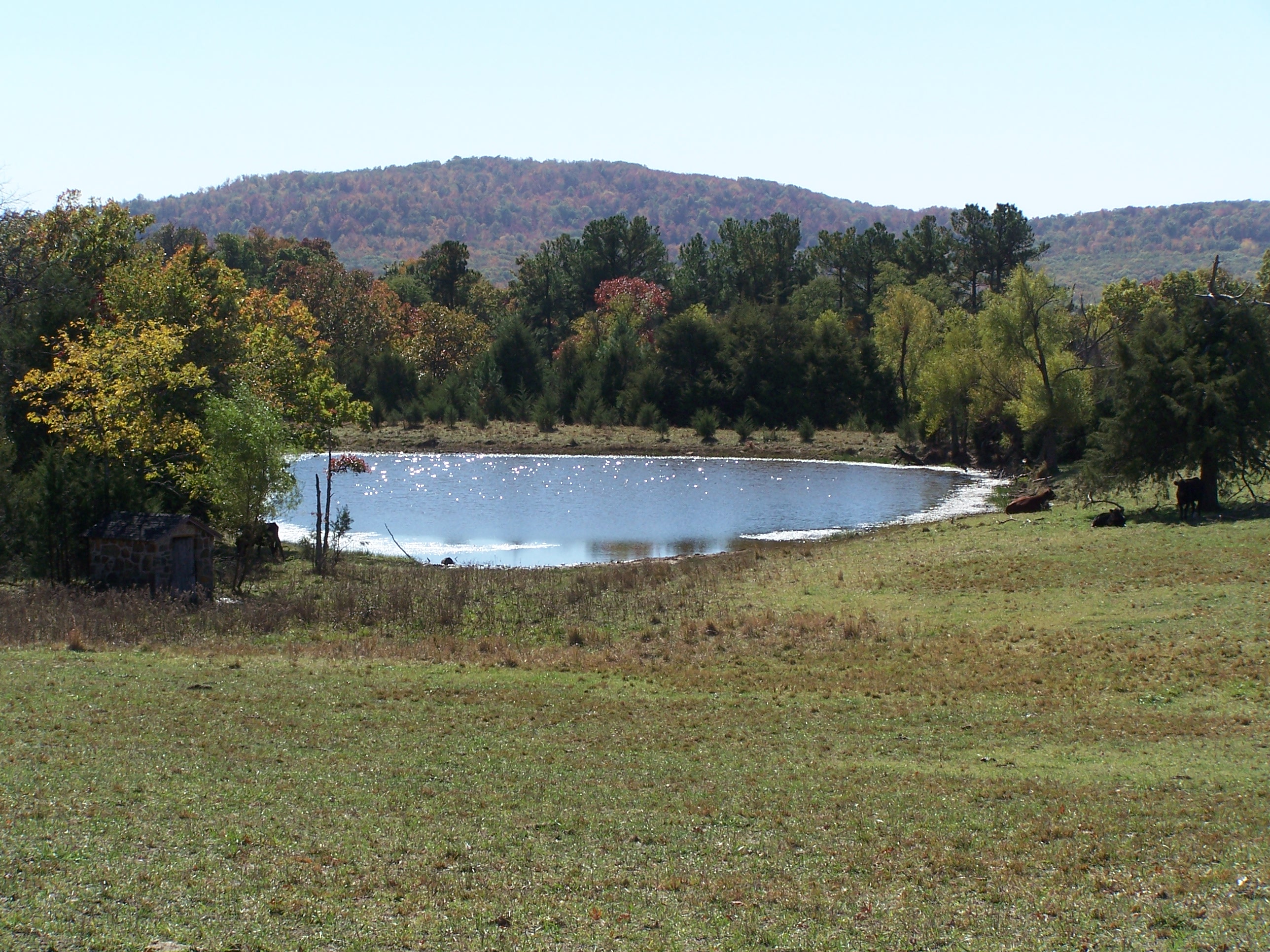
Time changes everything. The dam settled and trees took hold. Now their roots have riven the red clay dam base and weakened it enough to erode. The overflow ditch to the side filled up with fescue and weeds, so water spilled over the top of the dam after heavy rains. A ditch developed across the top. The ditch is big now, maybe three feet across at the top and cutting down into the dam at least two feet. I keep thinking I’ll get somebody up here with a load of red clay to fix all that. I’d have them clean out the overflow ditch at the same time so water can’t top the dam again. But that’s at least $500 that I don’t have. So Dennis’s dam keeps getting worse.
We tried to keep it up. I dug out that overflow ditch. Steve dug it out. The kids got older and the deer population exploded and making a garden down there became a painful futility. Then Art died and a few years later Steve and I fell apart, and then I didn’t have the money or the heart to go down there and walk around in our ghosts.
But things with Dennis fell apart before the pond dam went bad. One day Steve came home from work furious. He’d stopped down at Neal’s. Neal was kind of the godfather of the road, him and Walter Burkart. Both were retired military, hiding out in the Ozark woods after a lifetime of being bossed around. Walter didn’t drink, so he didn’t hang out with the drinking crowd. Neal’s second home was the White Star Tavern, especially after Penny died. He called it his office. Everybody loved Neal and Walter.
So Steve came home from Neal’s where he’d seen a dead redtail hawk in the bed of Dennis’s pickup. Dennis admitted to shooting it, like there was sport in it. Proud of himself.
Steve loved redtails. He loved anything in nature, but especially hawks. When we first got together, he’d tell me the names of trees, types of birds, insects, snakes. I learned a lot in those twenty years until I couldn’t stand living with him anymore. Ironic that because of the kids, I stayed on the land and he moved to town.
Anyway, Steve stormed into the house ranting about the dead redtail and called the game warden. I remember his hands shaking while he looked up the number. Redtails are protected birds. You can’t even have a dead one you pick up off the road. Can’t have a feather off one. Red-shouldered hawks I think are the same, like eagles and other birds of prey mostly killed off by early settlers under the idea of protecting their chickens.
Dennis got in trouble on account of that hawk. I think Art would still socialize with Dennis, but Steve never did. Then when Art died in 1989, the mix of Campbell and Wilson at Mineral Springs just withered on the vine.
We stood there in Walmart, the Wilsons and I, talking about the old timers. We were the old timers now. As we were turning away to go on with our shopping, Virginia laughed and allowed as how I’d probably better not call if I needed anything, because she didn’t do much for anybody anymore. And I said yeah, I felt the same way. Besides, we agreed we didn’t know most of the people who lived up here now and wouldn’t be likely to take kindly to any neighborly overtures unless there was some kind of gawdawful emergency.
Lots of us who lived up here in those early days thought there would be a gawdawful emergency at any moment. Some lunatic would push the button and the world would go up in mushroom clouds. The Ozarks was one of the places where wind drift would save us from the worst of the fallout. We’d be the ones who could still grow food, pull clean water up from our wells, join together in a tribe to share what we had and fend off the savage hordes.
We learned how to raise and slaughter animals, grow and preserve food, and we stocked extra supplies of salt and bullets. Slowly our kids grew up. We started to understand we could never possess enough bullets.
Now we’re the old timers. Until our reunion in the dog food aisle, it had been at least twenty years since I saw Virginia and Dennis. People don’t move to the woods to socialize. We probably won’t live long enough to see each other again.
I met a goat on the road today. He approached from the opposite direction, running at a steady but moderate pace—not a gallop but more of a trot. It seemed about the same speed as my car had reached, as fast as I felt like driving on a hot August morning when a faster speed would have generated billowing plumes of dust from the powder dry land. He ran in a straight line along the roadway, his intention of uninterrupted travel quite apparent in his demeanor. He needed to be somewhere.
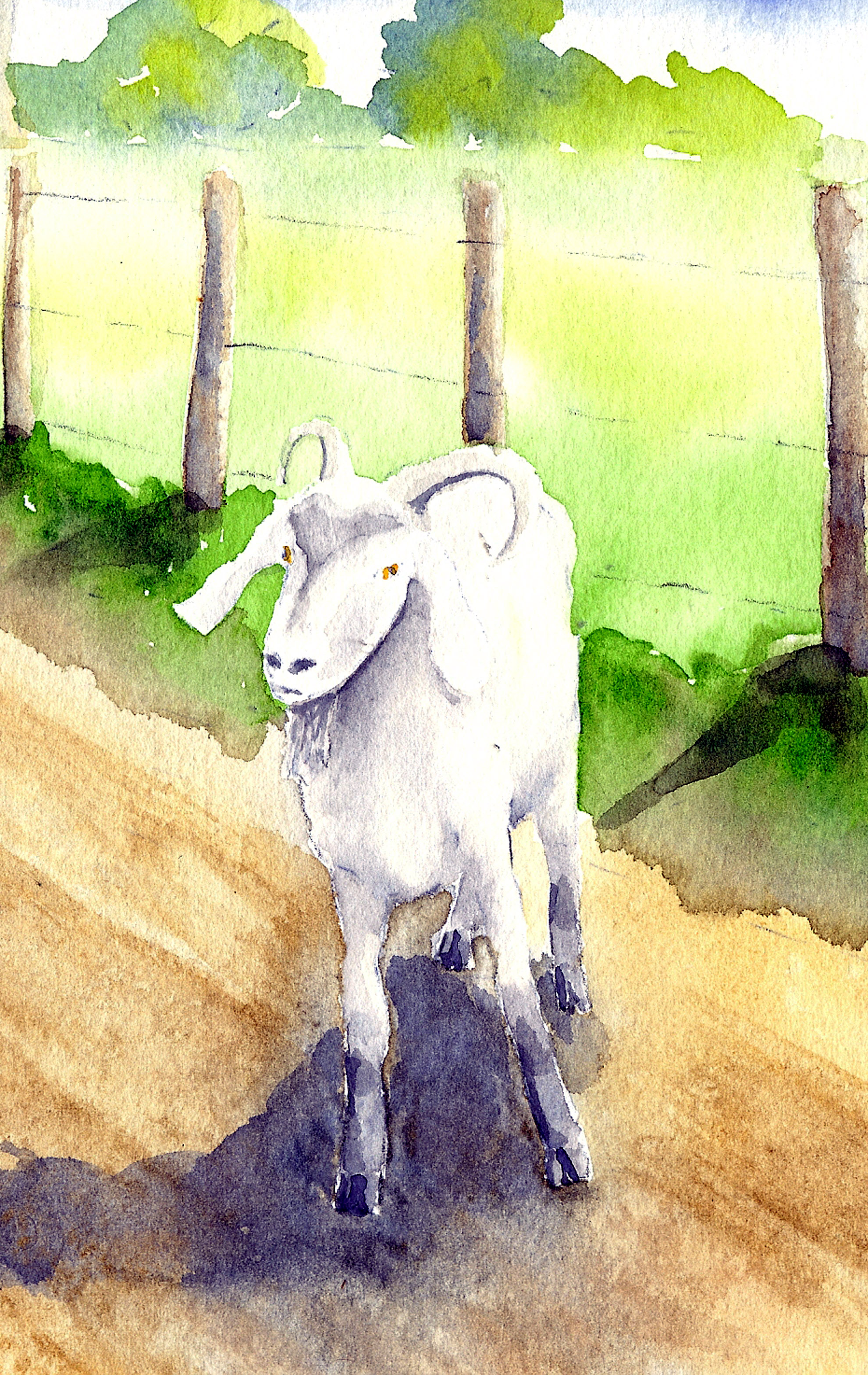
He was a small goat, not exactly a Nubian or Toggenberg but of some mixed breed, with a confidence attesting that in spite of his lesser size, he was most assuredly full grown. His foot-long horns flared from the top of his head up past his ears and off to each side of his black-marked face. The only other markings on his white body were on his legs, black from the knee down. His body held the features of a potent male, well-muscled in the chest and shoulders, his sides curved in health.
As it happened, we took the wrong sides of the road as we approached each other. He seemed to favor the right side of the road and I did not find it necessary to confront him about it. No doubt he had skipped the part of driving lessons that taught the proper side of road, but then perhaps not, since he was a goat and goats have their own firm opinions about what they will and won’t do at any given moment in time, rules be damned
We considered each other with curiosity as we slowed in meeting, a greeting and courtesy that, on reflection, I concede should not be limited to human travelers. His gold-flecked eyes came directly to mine, the black pupil slits narrowed against the sun already brilliant in the hot sky. It was not a hostile exchange, since I was quite willing for him to go on about his urgent business that called to him from somewhere to the west. For myself, I was already late for business to the east.
His expression conveyed a world weary understanding that we all have places we must go, or return to, in the course of conducting our daily affairs. It was not immediately clear whether he was coming or going, but then neither was that really any of my concern. His gold-eyed appraisal was brief and to the point, whether I was someone he knew, whether I meant him any trouble, whether I had any rolled oats he might nibble before continuing on his way. In moments, he gained the answers to his queries and began to move on.
Likewise, my glance carried questions. Was he seeking assistance? Was there any trouble? Was there anything I should do? No, it was clear nothing was required of me. His flat black nose lifted slightly, a nod of acknowledgment which I returned before thinking that I was, in fact, conversing with a goat.
I eased my foot off the brake and the car rolled eastward, tires crunching on the hot gravel. He hurried on without a backward glance which I knew only because I gave a backward glance in my rearview mirror. I did not ponder whether a goat, like fabled dogs and a few cats, might travel to find a family that moved on without him, or whether, once moved to quarters not exactly to his likely, he might make his escape and return to his preferred location.
Those were questions not to be answered unless I followed him. If I followed, as if examining a quark, I would have altered our original trajectories.
~~~
I’m wondering if this is a common occurrence–have you ever met a goat on the road?
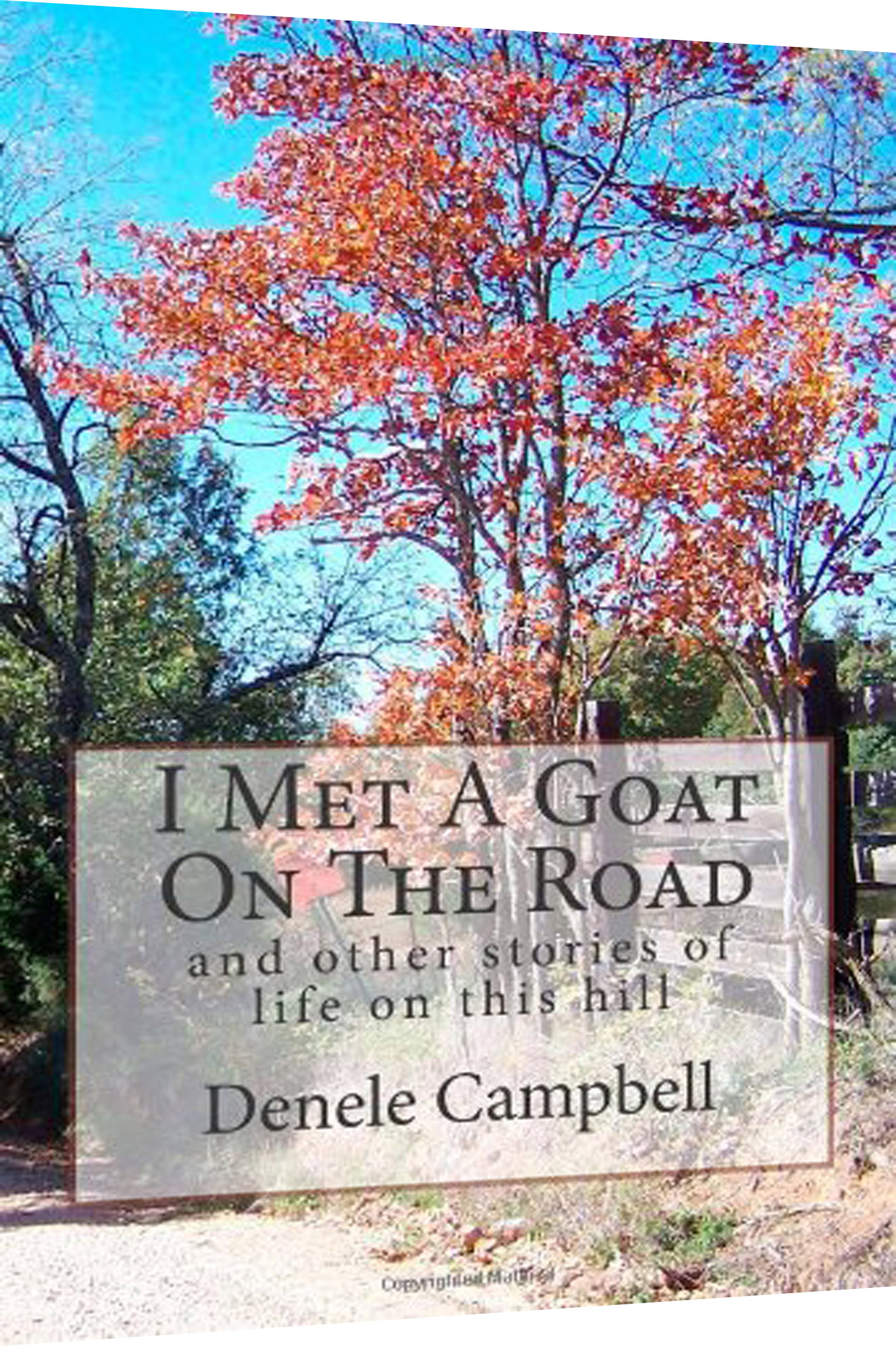
One of twenty delightful essays about life on an Ozark hilltop, with watercolor illustrations. I Met A Goat On The Road: and other stories of life on this hill is available as e-book or in paperback.


 Floyd’s robberies of banks made him a target for the fledgling FBI and the true manner of his death became one of the agency’s earliest cover-ups. After he was downed by rifle shot, another agent shot him with an automatic weapon at point blank range. Not widely known at the time, the unfairness of his killing nevertheless was understood at a visceral level by the common man.







 denelecampbell