The American Way

column
Cartoon by Tim Eagan. http://www.timeagan.com/?deepcover

Is it really any surprise that so much in our nation has devolved into violence? We did this to ourselves. This is our legacy.

We set foot on American shores and through violence eradicated the bulk of the indigenous population. We justified our killing with belief in our superiority, our ‘divine right’ to the land and its resources. Unlike the Natives, we carried a Bible and guns so we concluded God wanted us to have it. Might makes right.

Since the beginning, our westward migration progressed under the rationale that we ‘discovered’ gold and silver, ‘harvested’ virgin timber and furs, and settled the ‘wild’ lands. We wrested wealth from the soil by enslaving not only the surviving Natives but imported Africans and Asians. These ‘lesser’ creatures deserved to be subdued just as a work animal yearns for the yoke. They should thank us.

All to the glory of God, who showed us the path to our greatness.

In truth, our nation became rich not because we’re so clever or God’s chosen people but because we stumbled onto a pristine continent. The world’s civilizations had not risen here, had not built their empires, waged their wars, suffered plague and famine here. The Americas weren’t like the rest of the world’s continents, already ravaged by millennia of man’s turmoil.

We Europeans who invaded this land became rich through accidental opportunity, theft, and violence.

And when the land had been conquered, when the virgin forests had been cut and the hillsides left to erode, when the gold and silver had been mined and the waste pits left to leach impurities into the streams, when the frontier came to a screeching halt at the Pacific shore, we turned on ourselves.

With our eye on the prize, we killed anyone who got in our way. Natives, former slaves, immigrants, those too poor or too weak to stand up for themselves—they were cast to the edges to starve. Or lynched. Taught their place away from our table.

Then the mid-twentieth century arrived with its transformative movements on behalf of the poor, the Black and Native, the handicapped, the gay, and the women, all the people whose subjugation had enabled the white patriarchy to herald its God-given triumph.

The power structure reeled in shock.

Assassinations followed. And the war on drugs, a less obvious form of assassination. It wasn’t drugs that subsequently filled our prisons. It wasn’t drugs who became disenfranchised and even more marginalized. Drugs were the tool, the label selectively wielded against those who threatened the system.

For many in the underclass, the black market in drugs became the only means to reach for the American dream. The bait. The wealth of those markets and the inherent lack of regulation led to the current open warfare in our inner cities. In our war against our own people, we have set our law enforcement against our neighborhoods. We have armed them with military weapons and tactics. We have hidden behind our curtains as they firebombed apartment buildings and battered in doors.

We chose to ignore what we’d learned from alcohol prohibition, that such policies not only failed in their stated intent but also gave rise to even worse consequences. We knew that tax dollars invested in education, in mental health care, and in social support would eventually pay dividends in a healthier more vibrant society. Not prisons. Not guns.

We turned away from what we knew because we were taught fear by those with their own agendas—wealth and power at any cost. Fear higher taxes. Fear the government. Fear programs that help the poor.

Everything we should have gladly given became ‘taken.’

What if we hoard all the guns that can be made? What if our barns, our spare bedrooms, bristle with automatic weapons and crates of ammunition? Does that make us safe?

Safe from whom? From the random madman who lurks unknown in suburbia until the day he pulls the trigger? How will you know today is the day, the school is the place, that you should appear with your loaded gun in hand? None of the mass shootings of the last thirty years have been stopped by an armed citizen.

Safe from gangs roaming the dark streets of a declining city? Why bother? They’re killing each other by the hundreds.

From the government? Obviously you haven’t thought this through. Your spare room arsenal, your heavily armed survival shelter, will last about one nanosecond once the U. S. military decides you’re the target. If the Apache helicopters with Hellfire missiles don’t pound you, the fighter jets, Abrams tanks, and missiles launched from drones surely will. Get over yourself.

Now that we’ve had this friendly chat, can you calm down long enough to talk reason? Let go of the gun. Come, let us sit together.

Poor things, we have become islands of fear. We suffer existential crisis. Torn from our historical and biological roots, we are caught up in a world of machines and corporations. We don’t know our neighbors. Our communities have shrunk to a small circle of friends. We are beleaguered, lonely, and overwhelmed.

We need naps after lunch, long walks in nature, communion around campfires. We haven’t evolved fast enough to keep up with the culture. We’re not ready to travel sixty miles an hour.

We are physically ill—overweight, strung out on prescription drugs, anxious, and undernourished. What we take into our mouths becomes our energy, our blood, our skin. Yet much of our food is short on nutrition and long on adulterants. How can we think clearly or feel anything but cornered with flavored dross in our veins? We use caffeine to put one foot in front of the other.

In this melting pot of a nation, we cling to rituals that have lost their meaning. There’s no passage in our rites of teenage drunkenness, no ‘arrival’ in our coming of age. What is our totem, our spirit guide? Our ceremonies are shells of their former meaning dolled up in slick packages.

Even now, after all this, we have the opportunity to evolve. Live up to our dream. Turn away from our violent past and join together in creating solutions to all that ails us.

We don’t have to create armed camps in our midst. We don’t have to teach our young that violence is the solution. We’ve been too lazy to learn and think, too distracted to look beyond our television. Too eager to label and blame the Other for problems we’ve brought onto ourselves.

Too damn busy trying to stay afloat. Trying to have it all.

Can we save the dream of our nation? Is it too late to make love not war? Too late to treat our neighbors as ourselves? Let’s invest our energy and resources in solutions–interventions for those teetering on the edge of mental illness, for disrupted families and children. Pour our money into schools and teachers, not prisons and guards. Free health clinics in every community with counseling for anyone who walks in the door–that day, that moment. Not after someone brings in proof of income and household bills, not after a two week wait.

We embrace delusions of a past that never was. We got lucky. We got spoiled. We want too much and if we can’t have it, it’s somebody else’s fault. The immigrant’s fault that we can’t buy a new car. The poor man’s fault that our groceries cost so much. The gay man’s fault that our marriage failed.

The police are not yet a force unto themselves but they’re moving closer, fed by fear. Their job is to enforce the laws. The laws are not made by the police. They are made by our elected representatives. Our. Elected. Representatives.

Us.

The free ride is over. The trees are cut, the gold nuggets found. The frontier lies within.
The Red-Headed Bug

bug

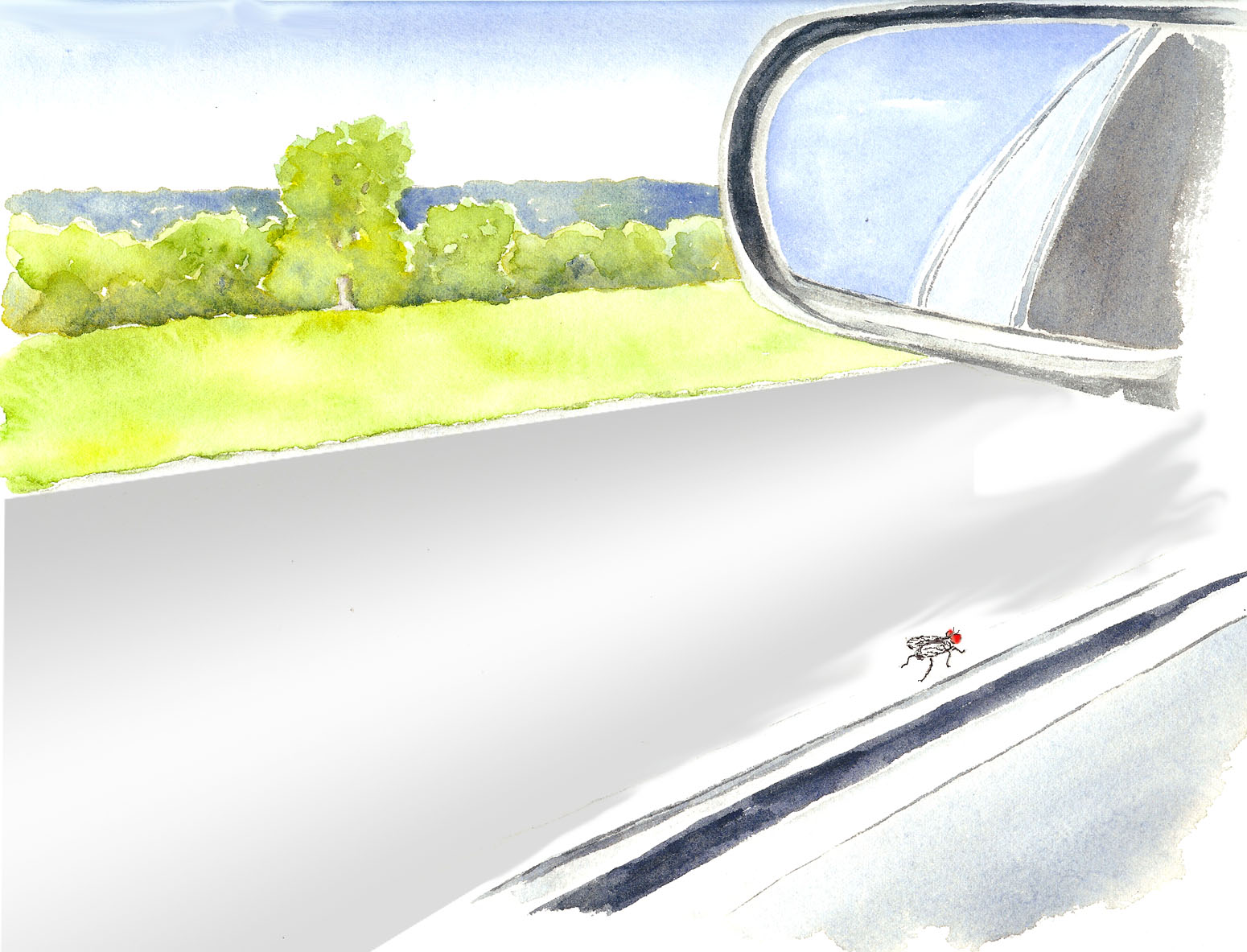
The car kicked up a cloud of dust as I hurtled down the long driveway. In my rush, I turned onto the county road and traveled another half mile before I noticed the creature that furiously held on just outside my side window, some kind of small waspish fly, its bulbous eyes perched like wire-rimmed glasses on its orangey-maroon head, its tidy black veined wings tucked sleekly along the sides of its narrow black thorax. Its thin legs flexed and strained to remain anchored in spite of the force of the air stream as I sped along.

This was not a singular event. My rural wooded property hosts bugs of infinite variety, some of which end up resting on my car.  On any given trip to town, I might inadvertently transport tan walking sticks, red, yellow, or black wasps, skinny dirt-dobbers, black, blue, or green flies, beetles of every conceivable shape and shade, spiders, ticks, bees, mosquitos, gallinippers, moths, ants of assorted size, and any other of so many multiple-legged beings that I suspect some of them have, to date, escaped scientific classification.

Notable creatures such as the saddle-backed, black stinkbug or the lime green preying mantis usually merit my immediate pull-over where I carefully remove them to roadside vegetation wondering if they find any advantage in new territory. I’ve considered whether higher insect intelligences, like flies, might purposefully plan for such transport. One large green fly made it all the way to town, having carefully positioned himself in a joint of the windshield wiper, perhaps with a particular lady city-fly in mind.

I rarely see them as I load in my gear, back up, and drive away, not until I have picked up speed, until they begin to slide, inexorably, across the waxed paint of the car’s body or the smooth glass of the windshield. They ride in ignorance, misunderstanding the threat. From their egocentric viewpoint, the problem is not that they are unwitting passengers on the rides of their lives, but simply that a strong wind has sprung up.

The challenge is to hold fast.

On this particular morning, the red-headed fly had arrived at my parked car door, at what seemed a perfectly fine spot to rest, groom, and digest his latest meal. As I began driving and the sudden gale blustered around him, he braced himself, securing every foot firmly to the spot. He had no concepts through which to anticipate that his greatest risk came with hanging on to what seemed familiar surroundings, that ultimately he would be farther away from what he knew and desired than he would have been if he had simply let go.

As I cruised along the road, the tiny red and black fly gripped ever more frantically to maintain his hold. In order to offer the least wind resistance, his body bent and contorted, stretched and elongated, the severity of his effort betrayed by erratic flare-ups of his wing tips.  Staring at me through the side window glass, he seemed to question me in panicky stares.

I advised him based on my previous experience.

Some bugs come to a forty mile per hour realization, I said. While I’m still on this back road, in a serendipitous flash of insight, they let go.

I waited for his response. He tensely adjusted his wings and aimed his head more into the wind.

After some scary free fall, I continued, they find themselves in the thickets near Miller’s pond. We drove farther and his stance remained resolute.

Or in the rocky ditch, I said, or in the middle of Mr. Breedlove’s herd of Angus. Wherever you might find yourself, I’m sure you could optimize the situation—you know, discover a trove of aphids or a lonely female.

I glanced to see if he was listening. The red-black fly showed no hint of a high-speed epiphany but instead re-exerted his desperate clench.

Ignoring the urging of my more generous side, I accepted little ongoing responsibility as to the fly’s future well-being. It was, after all, an insect. And I was in a hurry.

The road merged onto the highway, and I accelerated. Listening to the radio, absorbed in anticipating my day’s schedule, and maneuvering through heavy traffic, I failed to notice when his tiny sticky foot pads ripped loose from the slick paint of my car door.

Halfway into town, I realized he was gone.

Briefly, I suffered anxiety on his behalf. Had he made his leap at the right moment, I wondered? Was his grip torn free in the surge of a passing truck, bringing him to join countless distant kinsmen already pasted to its front grill?

Had he ever understood the threat?

Had he understood and somehow just hadn’t figured out the best timing?

I narrowed my thoughts to more pressing considerations. The city lay ahead. In a continuing ethical quandary about my role in the greater scheme of things, I decided to believe that he knew what he was doing all along and got off right where he intended.

From the collection I Met a Goat on the Road and other stories of life on this hill. Available in paperback with the original watercolor illustrations, or as an unillustrated paperback, or as an ebook.

Unillustrated paperback: http://www.amazon.com/dp/1500913197

Illustrated color paperback edition & Kindle edition: http://www.amazon.com/dp/B00DW9QLKO

Jars

100_1173

If I had considered the question in advance, I would have known that cleaning out the barn would precipitate a crisis. Memories long stored away for some magical future moment when that child’s toy, that handsaw, would again be needed—did I keep them simply for the memory? Furniture—small tables, wooden chairs, an ottoman frame, an old piano bench well made of oak and in need of a few repairs—would I someday find time and reason to fix them and return them to my house?

Too good to throw away. Largely irrelevant to my current life.

Becoming relevant at some future point? Probably not.

Determination to survive in a world lost to chaos drove the accumulation of this minor hoard. It was 1975. We had small children who would need to eat and thrive even if the bomb fell. We labored to renew skills our grandparents knew by heart, certain that within our lifetimes we would have to hide in our house until the fallout settled then emerge to plow, plant, and harvest our food, breed our pigs, chickens, and goats for future generations of meat and milk. We gathered meat saws and grinders, steel axes and shovels, nails and wire.

Time marched on. The Cold War ended and fingers moved away from the annihilation button.  The children are no longer dependent babies who might benefit from a collection of books on history, science, math. The goats departed in the late 80s, the garden in the early 90s, and the last of the chickens about ten years ago. The children have gone off like grown children do to find their own visions of the future.

Why do I need eight hand saws, ten hammers (of various sizes), buckets of random nails, screws, washers, bolts, and nuts? Feed scoops and cheesecloth, empty egg cartons, milk pails. What possible purpose could be met by random pieces of plywood or sheetrock, insulation, screen, tile? Why do I think that at some point I’ll make use of a decrepit power saw, drill, or grinder when, for the last twenty-five years, I have not?

I have created two piles. One is for the junkman to haul away. The other is for craigslist ads and friends who operate flea market booths. I am mildly optimistic that someone might buy the old wooden toolbox, child’s desk, or the sturdy small tables, the ten gallon pickling crock or the T-post driver. Never mind that for what I’d receive in dollars, I could restore only a fraction of this hoard.

In truth, what our energy and money bought in those early days was peace of mind. With our collection of tools, books, supplies, and know-how, we’d have a chance. Our kids would have a chance.

It served its purpose. The purpose no longer exists.

Sounds good. But what I haven’t put in either pile is the pressure canner. And the jars. Dozens and dozens of canning jars—quarts, pints, jelly jars. It’s the jars that have brought me to crisis.

When my firstborn child was two, my grandmother died. My dad’s mom, Nora. Always a country girl, Nora knew how to make soap, kill a chicken with a swing and stiff pop of its neck, and would can just about anything edible. She had jars. When they started clearing her property for the auction, I went down to Cane Hill and helped clean out her cellar. I hauled back cases of canned goods.

She had declined for a decade until her death at age 86. I wouldn’t dare eat any of the food in those jars. We had hogs and chickens at the time which allowed me to make use of Grandma’s labors. Each day I’d go out to the barn and pens and open more jars. Applesauce, whole plums, peaches, pears. Grapes and elderberries. Green beans, tomatoes, cabbage, mixed vegetables. Tallow. Jelly, jam, preserves. Juice. The critters were well fed that year.

We grew a huge garden. Neighbors had pear trees. We visited orchards and vineyards. Even with all of Grandma Nora’s jars, I sometimes ran short. My mother gave me jars. I bought jars.

In those heady days, each fall I stood in the storage closet and stared at my larder. The sight of all those jars filled me with the greatest pleasure that once again, by the labor of my hands, I had set aside enough green beans, tomatoes and sauce, peas, corn, and kraut to last a year. The jars lined up in colorful rows, golden tomato seeds swimming in crimson broth, finely shredded green cabbage fermented into tangy white kraut, wild plum jelly glowing fuscia in the dark.

Producing and preserving food challenged me like nothing I’d ever done. Even with a tractor and rototiller, even with liberal applications of goat manure and mulch, plants struggled to survive against drought, bugs, and predation. How many hours did I spend hoeing weeds or picking off potato bugs? How many hours peeling and chopping, sterilizing and packing, standing over the pressure gauge to ensure the right amount of intense heat and adequate time to prevent spoilage.

There’s a sound as jars cool, the snap of the canning lid sucking down, sealing the contents safely into the future—I loved that sound. Then it was time to use the grease pencil to write on the lid—July 1981.

Now I have all these jars. The cardboard boxes have suffered over the years. Faded brown paper hangs in shreds, the sides bow and buckle. Even if I keep the jars, I have to plow through generations of dead spiders and a healthy population of live ones to retrieve the jars from box wreckage. Why would I go to the trouble to re-package all these jars knowing that twenty years from now, it would all be to do over again? Would I be any more willing to let go of them then?

My children have no interest and no place to store jars. I wouldn’t mind storing them if my kids wanted them. But there’s no longer a tractor or rototiller. The half-acre garden has grown up in saplings and pasture grass. There are no goats to produce manure. Everything is different.

But here’s the argument. Certain things haven’t changed. We have to eat. We have the ability to grow food. With jars and a pressure canner, we could store food. Isn’t that incentive enough to save the jars?

What is my responsibility? For countless generations, as far back at least as civilization, my ancestors have planted, cultivated, harvested, and stored food. These are skills we’ve learned—how to measure the right time to plant onions or corn, what seeds to soak before pressing them into the dark earth, how to dig potatoes without piercing them. We raised our kids to know these things.

Do I simply walk away?

Why not? There are books. There are others still farming, still canning—the knowledge won’t fade simply because I relinquish my jars.

Even with the best of hoards, with all the tools and seeds saved and an endless supply of jars, at the end of the day, survival in a world gone mad would be a tenuous venture. What about grain? No bread, no pasta, no crackers. What about oil, salt, soda, sugar? We’d be dependent on venison and that requires guns and ammunition. My .22 rifle won’t bring down a deer.

At some point, even the most vehement survivalist will face what I face. How many times in your life do you restock your rations and water? How much is enough ammunition? Who are you prepared to kill to protect your hard won ark?

I’m working on a compromise with myself. Today I think I will keep a few jars as mementos of my grandmother, the tall green half gallon jars and a few of the older square-shoulder quarts. I will wash them periodically and keep them up on a shelf, decoration that tugs my heartstrings when I look up from my daily tasks. I will acknowledge the hard work and dedication that touched these jars, my hands, my mother’s hands, my grandmother’s hands.

All the grandmothers. All the jars. All the tomatoes and fine plum jam will not save the world.

Best Burger Ever

brendas
Brenda’s Bigger Burger circa 2012. The metal railing was added when a street widening took half the parking lot. Photo from an article by Dustin Bartholomew, November 8, 2012, in the Fayetteville Flyer, Fayetteville, Arkansas

Today was one of those days when I came face to face with the passage of time. In traffic at a stoplight, I studied my surroundings and realized that Brenda’s Bigger Burger property sat vacant with a big ‘SOLD’ sign on the parking lot. A pang of nostalgia twisted in my chest. I knew it had closed. I just hadn’t thought about what it meant.

Through no fault of its own, the place always marked a pivotal moment in my life.

I never knew Brenda’s Bigger Burger existed until December 1970. Never mind that it stood on the corner of 6th and South Hill, an intersection I had passed countless times growing up. Several blocks further down South Hill nestled the modest little white building where my parents dragged us kids to church every time the doors opened.

On this particular weekend, my church-going days had long since passed. Finally. Now at the end of my first semester back at university after nearly three years living in California, I sat in the front passenger seat of Sam Holloway’s white Ford Galaxie waiting impatiently for our food. I was starving.

In retrospect, I realize that my ravenous appetite had not just a little to do with my first marijuana ‘high’ the previous night.

Momentous enough in its own right, my initiation into the drug culture hardly topped the chart of radical changes that occurred that night. Even more staggering was the fact that I had unexpectedly become unfaithful to my husband.

I could lay all this at the feet of Sam Holloway, a friend of an old friend whom I’d encountered on campus just a few days earlier. Old Friend and I were both married, him in grad school and me finishing my bachelors. We agreed to get together sometime.

‘Sometime’ turned out to be one evening a few days later when he called and wanted to stop by with a friend. They brought a six-pack. I was on my second glass of Chablis.

When Old Friend and Holloway arrived stamping snow off their shoes at my carport door, I was baking banana nut bread to send to my husband. He was stationed at Clark Air Base in the Philippines earning a captain’s hazardous duty pay as a courier flying in and out of Southeast Asia with top secret missives. Our separation had begun in late September, an eighteen-months’ tour for him before he could get out of the military and enough time for me to finish my degree.

I’d been lonely. I’d fretted over whether to dally, an inclination I’d fought even while still in California. We’d been together five years, married for nearly three. We’d discussed new ideas like open marriage but hadn’t made any moves.

That doesn’t excuse what I did. In an open marriage, there would have been an agreement. This was more delicious and awful than that, unplanned, unexpected, and entirely outrageous.

Old Friend passed out on his fourth beer and snored at the end of the couch. Having no other furniture, I sat in the middle of the couch and Holloway leaned back on the other end, his hand-tooled alligator cowboy boots crossed at the ankle. Twirling one end of his elaborate mustache, he pulled a skinny yellow cigarette out of his jacket pocket and flicked his Zippo. Sweet smelling smoke spiraled from the tip.

Several minutes later, the ‘high’ hit me with a warm caress on the back of my neck. My forehead floated upward. Lights dazzled. Colors like the black and white plaid sofa and the big red and yellow candlesticks I’d made out of flower pots began to pulse. Even more intriguing were Holloway’s green eyes.

Incredible as we found it, we’d been born on the same day in the same town. His mother and my father both taught school at Rogers before we moved away. My father was remembered there, Holloway said.

It was the Chablis. It was the weed. It was the strange coincidence of our connections and the scintillating repartee that flew back and forth between us. It was a slice of time cut from both our regular lives and set aside for this experience.

The next morning every icy surface including the streets glistened in bright sunshine. The ground had been white with snow for two days. Just driving across town to Brenda’s had been an slippery adventure. He insisted on Brenda’s, so that’s where he took me.

The food came out steaming hot, a sizzling beef patty on a big round bun. My teeth sank into the burger and saliva instantly flooded my mouth. Yellow mustard! Fresh sliced onion! Dills lovingly arranged so that each bite included just enough pickle. Tomato when real tomatoes were all you could get.

The burger and fries came wrapped in thin tissue paper, enough layers that when Holloway spread out the fries on the seat between us, the fat didn’t seep through to the upholstery. Heaped in long limp strands, the fries were salty golden treasure.

My hands trembled as I ate. I savored my Dr. Pepper down to the last crunchy nugget of ice. For the third time in less than 24 hours, I died and went to heaven.

I broke two more promises before it all ended. One I broke immediately, my promise never to smoke cigarettes again. After we’d crumpled the mustard-stained tissue papers, Holloway pulled out his pack of Winstons. My brand.

The other, the promise to myself that I’d never do that again? I lasted ten days. The affair lasted a scant two months before we both moved on. The marriage lasted another three years.

When the day arrives that Brenda’s building falls before the bulldozer blade, I can tell you right now—I will shed tears. Not only for Holloway or what we had. Not only for the marriage or the man I never quite stopped loving.

My tears will also fall for the fact that there’ll never be a better burger than the one I ate that day.

[From an untitled work in progress which may or may not see print in my lifetime…]

Bunyard Road and the Personal Adventures of Denny Luke

den w gov
Denny Luke, far right, next to Arkansas Governor Mike Beebe on one of his whistlestop tours of the state. 2006. On left, Ron Johns and in center, Dan Kerlin. At Dan’s store in Winslow.

1972.  A Yankee moves to the Ozarks and lives to tell his tales. Now captured in a tidy little book along with plenty of photographs, these stories track Denny Luke’s life experiences from childhood in Ohio to the backwoods hills of Arkansas.

This man is an adventurer. During his years in the Navy, he built hot rods with money he made with shipboard loansharking. He returned to his native Ohio where he soon tired of the mechanic’s life. Computers had just started to break the surface in 1966, the perfect attraction to a young man with a sharp mind and plenty of ambition.

vette w mom
Denny with his mom in his Corvette. This photo not included in the book.

Money rolled in as he built databases, a brand new idea in the mid-Sixties. A ‘63 Corvette and soon after a new Triumph dirt bike put him in the fast lane for weekend jaunts to the Playboy Club in Chicago and Enduro racing in Wisconsin’s back country.

Then, like so many of his generation, he stepped out of the fast lane and moved to a primitive life in the country. Among his most important first acquaintances was Ray Brown.

11813401_10206126388336787_3165076067443300852_n
Ray Brown teaching hog killin’ to Denny. This photo not in the book.

“We rented a little cabin near Devil’s Den from Ray Brown. He was a genuine hillbilly. His family lived in a little old log cabin. He raised a few cows, cut posts, whatever he could do to make a living. He was smart, smartest man I ever knew, had lots of common sense. His cabin had a big old fireplace that barely kept the place warm. He sat in this big chair over in one corner, and he could reach around behind his chair and grab a big handful of snow—that much would blow in through the cracks.”

Denny and his buddy Butch scouted cheap land all over Northwest Arkansas and ended up with an old log cabin on Bunyard Road. They also learned to be stone masons in order to earn their way.

denny at stove
Denny rustling up some grub at the Bunyard cabin December 1974. This amazing stove had a gas burning side and a wood burning side. Hauled from Wisconsin to the Ozarks.

“There are two or three families out on Bunyard that are cliquish. I wasn’t accepted out there. I was from the north, and I didn’t go to church. The first thing they wanted me to do was go to church. Plus I wasn’t born there. And I owned the old Omie Wood home place and they might have resented that some.”

An avid photographer and storyteller, Denny shares the adventures of his life with Author Denele Campbell as he recalls the outrageous backwoods tales and colorful characters who populate this neck of the woods.

Join us Sunday September 13 in the Connie Wright Gallery of Ozark Folkways at Winslow for live music, refreshments, Author Denele Campbell’s comments on this collaboration, and Denny’s readings from the book. Autographed copies will be available for sale.

Can’t make the event? The book is available at Amazon.com or at your favorite bookstore.

Dazed and Confused

ID-100184515For every new technology, archaeological discovery, or advancement in medical science, there is an equal and opposite reactionary impulse to dive deeper into the ignorance enshrined in fundamentalist religion. Evidence of this mind-jarring disconnect can be found on all fronts.

In March, Florida’s Governor Rick Scott issued a fatwa forbidding state employees from including the terms ‘climate change’ or ‘global warming’ in their studies and reports. He justified his stance by stating that he wasn’t a scientist, which of course is all the more reason he has no business restricting educators, researchers, and scientists on the state’s payroll from using whatever scientific terms they may deem appropriate. Ultimately, this rightwing Republican deferred to his religious beliefs, intimating that God is in control of everything.

Including, evidently, the weather.

A recent proliferation of similar inanities include the appointment of science-denier Sen. Ted Cruz (R-Texas) to the chairmanship of the Senate Subcommittee on Space, Science, and Competitiveness, the placement of rabidly anti-science Sen. James Inhofe (R-Oklahoma) in charge of the committee that oversees the Environmental Protection Agency, and the positioning of Sen. Marco Rubio (R-Florida) to chair the Subcommittee on Oceans, Atmosphere, Fisheries, and Coast Guard, which oversees the NOAA. As noted by one report, “Rubio is a climate change denier…and the NOAA is, after all, the National Oceanic and Atmospheric Administration. Putting him in charge of the NOAA is like installing an atheist as Pope.”[1]

In the same vein of self-righteous stupidity, last fall the House passed a bill that forbids scientific experts from “participating in ‘advisory activities’ that either directly or indirectly involve their own work. In case that wasn’t clear,” says Salon columnist Lindsay Abrams, “experts would be forbidden from sharing their expertise in their own research — the bizarre assumption, apparently, being that having conducted peer-reviewed studies on a topic would constitute a conflict of interest.” Abrams cites Union of Concerned Scientists director Andrew A. Rosenberg in his editorial in RollCall: “…academic scientists who know the most about a subject can’t weigh in, but experts paid by corporations who want to block regulations can.”[2]

The rush to deny science is hardly new. At least since the Middle Ages, persons in the thrall of religion have ignored, repudiated, tortured, and/or burned at the stake anyone who tried to break out of the prevailing mythological bubble. One might have hoped such mindsets were things of the past, but alas, the tendency has picked up steam in recent years. It seems the more we learn about our world, the greater the rush to fundamentalism.

Why and how can this trend occur in the United States of America, where supposedly we enjoy a higher level of literary and education than much of the world?

Would you be surprised if I told you that your tax dollars are part of the reason?

Would you care if substantial portions of state and federal education dollars find their way into funding for religious instruction, much of it extremist?

How can this be? What happened to separation of church and state?

A quick survey finds that through its Child Care Development Fund, the U. S. Department of Education hands out vouchers for low-income working parents to use on childcare anywhere including religious programs. Government similarly looks the other way while handing out tax money to pre-school programs which acknowledge a religious mission, as long as the school claims to isolate the religious instruction to hours before and after the ‘education’ hours, a convenient ruse.

Another effort to spread religion through public education has focused on athletics. Since 1954, the Fellowship of Christian Athletes (FCA) has built a multi-level, global Christian outreach targeting junior high, high school and college campuses. They sponsor team Bible studies, chaplain programs and Bible studies for coaches. One of the requirements for its adult leaders is ‘sexual purity,’ a blanket term covering marital fidelity as well as sexual orientation. So called ‘team-building’ exercises for college athletes include mandatory attendance at church services.

The push for religion in college athletics has resulted in use of tax dollars to pay salaries for chaplains who pray over athletes, counsel coaches, and lead college athletes in religious activities. In some instances, chaplains volunteer for such powerful positions while a few have wages paid by the FCA. Whether on the public dime or not, Christian advocates are given unfettered access to captive audiences in our schools, access provided to no other outside group.

In recent weeks, Freedom From Religion Foundation (FFRF) has singled out the University of Georgia as “one of the major offenders.” The organization noted that Kevin “Chappy” Hynes, UGA’s chaplain, is head coach Mark Richt’s brother-in-law, and cited Hynes as saying, “Our message at Georgia doesn’t change, and that’s to preach Christ and Him crucified, it’s to win championships for the state of Georgia and win souls for the Kingdom of God, so we’re going to continue down that path.”[3] All chaplains investigated by FFRF were promoting Christianity, usually with an evangelical bent.[4]

Aside from the outrage of forced religious activity for non-religious athletes, there’s the mind-boggling absurdity underlying this effort. Does God Almighty care who wins a football game?

All this and still the steady drumbeat of demand for prayer in schools.

The insidious creep of religion into public education and the equally alarming rise in religion-based home schooling steadily increases the number of adults who are functionally illiterate in terms of reasoning capacity. Given the dedicated efforts of fundamentalists to infiltrate all levels of education for our young people, it’s not difficult to understand why an increasing number of legislators don’t understand climate change and refuse to accept any responsibility for the condition of the environment.

The rejection of science and reason in terms of public policy results in steadily increasing collateral damage. The longer we continue to use fossil fuels, the more severe climate change becomes. The more restrictions are placed on sex education, birth control, and abortion services, the more unwanted children are born to desperate lives of deprivation and abuse. The more religion commands top role in policy making, the more likely we will wage war on those of different faiths.

In short, reliance on religion as the most important element in public policy ensures greater human suffering.

It’s not supposed to work that way, as any reasonable person of faith would attest. Religion is supposed to be a path toward love for our fellow man, among other things. The extent to which extremist religion has become an agent of harm is the measure of how its use has been twisted to a less than divine agenda.

Unlike previous times when religion ruled nations, voters still retain the power to rule the United States. Even though approximately 75% of the population claims to embrace some religious belief, only 25% are evangelical Christians. It’s a bigger interest group than any other force in American politics, but they are ultimately less than one out of five of the rest of us.

Reality demands a change in how we regulate tax dollars. Too many inroads have been made in allowing those who cling to outdated beliefs to risk the future of every life form on the planet. It’s time to stand up to the extremist bullies in our midst.

[1] http://www.slate.com/blogs/bad_astronomy/2015/01/13/nasa_trouble_science_denier_ted_cruz_will_oversee_senate_committee_for_oversight.html

[2] http://www.salon.com/2014/11/19/house_republicans_just_passed_a_bill_forbidding_scientists_from_advising_the_epa_on_their_own_research/

[3] https://www.washingtonpost.com/news/early-lead/wp/2015/08/21/why-25-public-universities-have-been-asked-to-drop-their-college-football-chaplains/

[4] http://ffrf.org/news/news-releases/item/23528-state-church-watchdog-issues-report-damning-college-football-chaplains-coaches#sthash.KhWg2v2N.dpuf

Image courtesy of stock images at FreeDigitalPhotos.net

Legal. Immoral.

Artists-impressions-of-Lady-Justice,_(statue_on_the_Old_Bailey,_London)For better or worse, religious affiliation remains an important thread in the social fabric of these United States. ‘Better,’ most would say. Political candidates campaign on their religious credentials. Religious leaders are sought out as advisers in business and community affairs.

A large segment of the population assumes that religion provides important moral guidelines for life. The theory is that without religion, there would be no morality.

But what if the opposite were true? What if religion gets in the way of moral behavior?

The assumption has been that highly religious people such as our locally infamous Justin and Marsha Harris are highly moral. They go to church. They ‘witness’ their faith in public. Mr. Harris has used his Christian standing in his successful campaigns for public office. Their religious mission is to ‘grow God’s kingdom’ at their pre-school by indoctrinating children with religious teachings.

In the last year, events have unfolded that cause many to question the morality of the Harrises. Believing that God guided their steps, about four years ago they adopted two little girls. Within a relatively short time, the girls became such as problem that the Harrises gave them away. The six-year-old was subsequently raped by her new ‘father.’ In March 2015, the story became public.

In addressing that horrible outcome, Justin Harris belatedly stated he felt sorry for the little girls’ experience. Aside from that, he has blamed the state’s social services agency for not helping more. That’s it.

The irony is that the Harrises felt free to dispose of their newly adopted young daughters and then, in the public fallout after their ‘rehoming’ came to light, agreed that such a practice should be defined as a felony.

Is such an act wrong only if it breaks a law? Did the act of rehoming change somehow once the law was passed, so that when Justin and Marsha rehomed these girls, it wasn’t wrong?

The moral reality is that if it’s a felony now, it was a felony when it happened.

Unfortunately, this is often how religion works in people’s minds. An act is immoral, wrong, bad only when someone has already written a rule or law about it. Does the religious person have license to ignore (or never bother to understand) a greater responsibility to adhere to an inner moral code that would say, emphatically, that dumping young children you’ve pledged to make your own is wrong, bad, immoral?

It’s the ultimate mea culpa. Throw up the hands. “Nobody said…”

Justin and Marsha found themselves at a loss about how to handle these two troubled young girls. They pulled out all their parenting skills to punish bad behavior—isolating, taking away privileges, removing toys and entertainment. They prayed out demons and perhaps did not spare the rod. Nothing worked. The behavior became worse.

This would have been a rich opportunity for the Harrises to learn some new parenting skills. Perhaps positive reinforcement, or long sessions of hugging and other positive physical contact, or one-on-one time pursuing new and interesting activities would have been useful in breaking down the wall of mistrust and anger that grew between these adults and their two young daughters.

Sympathetic observers point out that the Harrises had successfully raised three sons, concluding that they must be decent parents. It remains to be seen how well the sons turn out. But it’s also worth questioning whether the Harris’ success in raising their own children wasn’t a result of stellar parenting as much as a result of the boys’ adaptation to repressive, authoritarian parenting from Day One.

We know the girls were capable of appropriate behavior. The foster parents who cared for them before the Harris adoption as well as the family who have subsequently become the girls’ parents have remarked on the girls’ loving nature. Neither families have run shrieking in terror from the girls or found them a threat to the stability of their households. It’s not much of a stretch to conclude, based on this evidence, that the problem between the girls and the Harrises was the Harrises.

The rape has dominated discussion of the Harris’ rehoming decision. But a much bigger issue looms in the background. That is, the immorality of legal behavior.

For example, law enforcement beats up an innocent person because he didn’t instantly abide by police orders. A hunter spends $50,000 to kill a trophy animal. Legal. Immoral. A list of other examples would be long.

As far as I’ve heard, the Harrises have never said they did the wrong thing. Justin never admitted that he may have used his legislative seat (as representative for my home district) to push through an adoption against the expressed advice of caseworkers and the girls’ foster parents.

Yet it was a chain of events propelled by the Harrises which led to their custody of the girls in the first place. Where exactly does the responsibility begin?

Were the Harrises wrong to be so arrogant that they ignored advice from experienced caseworkers? Was it immoral to commit to parenting two very troubled young children and then renege?

Yes.

How is it possible for the Harrises to have engaged in immoral, arrogant behavior and still—after all the exposure and shame—not recognize the depth of their immorality?

I would suggest that their hubris stems directly from pride in their own religiosity.

A recent study found that religious people aren’t more likely to do good than their nonreligious counterparts.[1] This isn’t the first or last evidence that religion does not impart morality. Here’s just one of many comments on this question.

  • These studies begin to provide empirical support for the idea that like other psychological faculties of the mind, including language and mathematics, we are endowed with a moral faculty that guides our intuitive judgments of right and wrong, interacting in interesting ways with the local culture. These intuitions reflect the outcome of millions of years in which our ancestors have lived as social mammals, and are part of our common inheritance as much as our opposable thumbs are.[2]

It makes sense that humans possess innate morality. In the view of those who subscribe to evolution, morality is an evolved necessary component of our continued existence. In the view of those who adhere to beliefs in extraterrestrial interference in human existence, morality would have been a key ingredient in intelligent design. Either way, all investigation points to an innate morality in human consciousness.

Recognition of innate wisdom and individual responsibility should be taught in every pulpit. Instead, especially in fundamentalist religions, individuals are taught to be afraid of their instincts. They’re taught to follow rules laid out in religious texts and nothing else matters.

Inevitably, a person’s avid embrace of institutionalized religion can and does interfere with the application of inborn human morality. The person trusts the religion, not himself. The religion’s rules or lack thereof in any given application supersedes any instinctive understanding of right action.

Assuming that the fundamental element of morality in human nature is not somehow missing in the genetic code of Justin and Marsha Harris, an interested observer would be forced to conclude that it was their religion that got them into this mess. Religion is the reason why, even months after their poor judgment became front page news, they still have not said they made a mistake, have not said they regret what they did. Have not apologized to the state agencies they maligned. Have not asked forgiveness of the public they supposedly served.

They did what they believed their religion and the law allowed. They parented according to a model condoned by the church, perhaps modeled after how they themselves were raised. What they did wasn’t a felony when they did it, therefore they did nothing wrong.

Harris has announced he won’t run for another term in office but stopped short of resigning from a seat he’ll hold another eighteen months. He continues to wield regulatory and fiscal power over the same state agency which he says forced him and Marsha to dump the little girls. He and his wife continue to operate their pre-school where they pass on their questionable religious teachings to innocent children.

As an embarrassed constituent who never voted for this man in the first place, I’ve given up hoping for a Harris epiphany any time soon. Even more regrettably, I doubt we’ll ever hear a word of censure from his equally-religious legislative colleagues and governor.

Perhaps the most we can salvage from this unsavory affair is to recognize the broader lessons. Religion doesn’t confer morality. Worse, an individual’s duty to pursue moral behavior is easily abdicated in favor of going to church.

We need more morality and less religion.

[1] http://www.livescience.com/47799-morality-religion-political-beliefs.html

[2] http://www.qcc.cuny.edu/SocialSciences/ppecorino/INTRO_TEXT/Chapter%208%20Ethics/Reading-Morality-without-Religion.htm

Men Who Kill Lions

Animals 4140Once upon a time, men proved their bravery and strength by killing animals. Mammoth flesh was needed for food, dire wolves and cave bears threatened their families. Then we got tractors and supermarkets.

It all happened so fast. Only a few thousand years separate us from the need to kill or be killed, the need to slaughter for food. Our genes haven’t caught up with our culture.

Actually, quite a few men today manage to see themselves as powerful and successful while selling real estate for a living. Or programming software. Or teaching school. These men jog for sport or hang out at basketball courts. Or write books.

Who are these men who have to go kill lions?

What backwater of these male minds still finds pleasure in killing? What short circuit in brain function ignores the endangered status of rhino or leopard? What personal sickness requires going to another continent and tracking down an animal in its own habitat in order to kill it, skin it, and take its head as a trophy?

Is this a failure of nature or nurture?

Perhaps not coincidentally, the particular cretin whose acts have been the subject of heated discussion over the last few days has also been in trouble for sexually harassing women.

If we knew all Walter Palmer’s secrets, what other offensive behavior would come to light? That he was verbally or physically abusive to women, children, or employees? That he repressed his homosexual tendencies? Participated in adolescent bullying? Tortured small animals as a child?

All these and more are traits of men who aren’t real men. Oh, they may make money. They may wear gold Rolex watches and golf with the mayor. They may gain political office or the corner office.

But as real men, as what it means to be a courageous, intelligent male capable of steering a loving path through a complicated world, these big games hunters are failures. Any time someone has to kill something to be a man, hurt women or his children, insult an underling, hate a minority, that’s the signal that this person is a failure. Anyone who has no respect or affection for lifeforms other than himself is a failure.

Deep down inside he’s a cowering little whelp pissing himself in fear. He needs big guns and trophies to prove his manhood, to drive the goblins out from under his bed. And at the end of the day, victorious over his hapless victim, he is no more reassured than before he began.

Before you start labeling me as a man-hater, I’ll hasten to agree that women sometimes kill big game as well. I see that as a function of an insecure woman’s twisted idea of how to attract a man. Killing may top the charts in that regard, but a woman’s pseudo-practice of predation is similar to plastic surgery, wearing clothes, shoes, and hair styles that compromise the ability to move or see, or the cultivated art of simpering.

Sadly, insecure women do attract men this way. Failed men. Men who appreciate idiot women and dead lions. Even more sadly, they breed more of the same.

Unevolved humans aren’t restricted to the class of people rich enough to fly to Africa and kill lions. They can be Louisiana rednecks who shoot ducks for fun and gig a hundred frogs in one night. They can be publicly righteous Christians who practice incest and sexually molest young girls. They can be tight-assed suburban wannabe warriors with Confederate flag decals on the back windows of their pickup trucks.

All of them terrified. Proudly ignorant. Bewildered by a world that has outgrown them with its computers, educated women, racial integration, and gay marriage.

Aren’t there rules we’re supposed to follow? What do we do when the old rules don’t work and we’re left standing on the corner while the rest of the world marches past? We panic. We have to kill something.

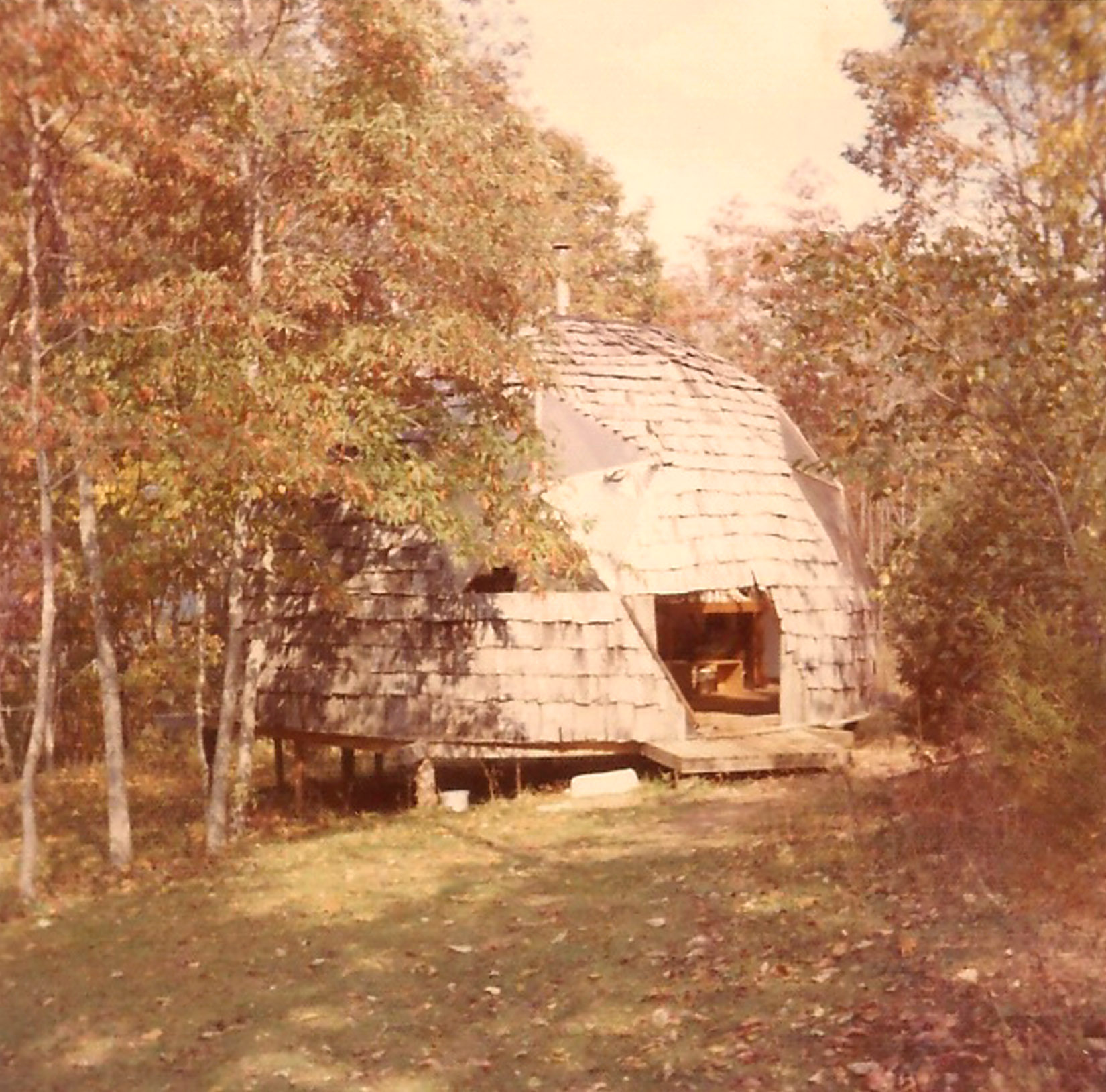
Domes

zome is stretched dome
A ‘zome,’ a stretched dome. One of several domes constructed in South Washington County Arkansas at a rural intentional community.

In the 1960s and into the early 1970s, geodesic dome structures cropped up around the world, including in Northwest Arkansas. Some lasted, many did not.

Based on the idea that what we see externally informs how we understand ourselves internally, domes epitomized a philosophical approach to human habitation.

dome1Traditional architecture with its multiple separate rooms leads to a segmented self view, according to this argument.  Rounded open space such as provided in a dome fosters a more holistic view of self and the world in general.

The dome concept was developed by Buckminster Fuller. Fuller discovered that if a spherical structure was created from triangles, it would have unparalleled strength.

3-8ths or half geodesicIn 1928, he wrote:

“These new homes are structured after the natural system of humans and trees with a central stem or backbone, from which all else is independently hung, utilizing gravity instead of opposing it. This results in a construction similar to an airplane, light, taut, and profoundly strong.”

looks like a zome
None of the eleven or more domes built at the intentional community have survived.

The sphere uses the “doing more with less” principle in that it encloses the largest volume of interior space with the least amount of surface area thus saving on materials and cost. Fuller reintroduced the idea that when the sphere’s diameter is doubled it will quadruple its square footage and produce eight times the volume.

Fuller worked towards the development of a Comprehensive Anticipatory Design Science which he defined as, “the effective application of the principles of science to the conscious design of our total environment in order to help make the Earth’s finite resources meet the needs of all humanity without disrupting the ecological processes of the planet.”[i]

eye doc dome
Optometrist office in Fayetteville, newly built in 1970s.

Domes were built not only by idealistic hippies pursuing an improved state of consciousness but also ended up in use at commercial locations. A enhanced dome built to house an optometry practice in Fayetteville, Arkansas remains in good condition.

Newman's dome homeOne of the surviving residential domes in the area includes bump-outs and other additions that make for a more family-friendly features. This one includes a basement and a rear deck.

Other commercial uses included the Southern Energy Fast Oxide Reactor (SEFOR) built in south Washington County near Stricker. SEFOR operated from 1969 to 1972, when the original program was completed as planned. It was privately operated by General Electric and funded by the United States government through the Southwest Atomic Energy Associates, a nonprofit consortium formed by 17 power companies of the Southwest Power Pool and European nuclear agencies.

Southern Energy Fast Oxide Reactor, Stricker, '78 (SEFOR)The facility was then acquired by the University of Arkansas in hopes that it could be used as a research facility. However that never happened and the university has been paying $50,000 in maintenance fees yearly since. SEFOR is still considered contaminated and the University continues to seek federal funds to clean up the site.

Climatron, St. Louis, '77Another example of dome construction in commercial application is the St. Louis Climatron, part of the Missouri Botanical Gardens built in 1960. Controlled environment in this large dome re-creates a lowland rain forest.

Due to limitations of materials and use requirements, domes today are built for only a few applications, most notably sports arenas and as a complement to other structures such as churches where a separate dome feature may add another dimension to sacred space.


Photographs courtesy of Denny Luke, a longtime resident of the area.

[i] http://bfi.org/design-science/primer/environmental-design-science-primer

The Report Is In

Child's hand 0001Initiated in early spring, a study of Arkansas’ Department of Human Services (DHS) is Governor Asa Hutchinson’s first step in addressing systemic problems within the agency. The driving force behind this initiative was the ‘rehoming’ and subsequent rape of a six-year-old girl originally adopted by Rep. Justin Harris and his wife Marsha of West Fork, owner and operator of a pre-school, Growing God’s Kingdom.

Harris’ excuse for their ‘rehoming’ of two already traumatized little girls was that he had asked DHS for help and they had refused. He stated that the girls had been “damaged by previous abuse and he couldn’t manage them,” according to Friday’s coverage by the Northwest Arkansas Democrat-Gazette (July 17, 2015).

Unfortunately, the governor failed to require this study to investigate whether Harris abused the power of his legislative position to coerce DHS approval of the adoption in the first place.

The couple fostering the two girls prior to the Harris adoption have voiced their belief that Harris had done exactly that. More than one observer cited local caseworkers’ opposition to the adoption. Harris was warned that the girls would not be suitable for his household. He pushed the adoption through anyway and immediately included the girls in a photograph used in his reelection campaign.

Less than a year later, when he and his wife decided the girls were too much to handle, Harris ‘rehomed’ them to a Benton County couple, Eric Francis and his wife.

Harris may have believed that the Francis household would serve as a suitable home. He cited the couple’s adoption of other children as evidence of their suitability. In hindsight, an observer might suspect that the couple’s eagerness to adopt had to do with the husband’s predilection for molesting children rather than any altruistic urge.

Prior to a stiff “I’m sorry for what happened to the girls” statement in June, Harris has admitted no wrongdoing. Now that the governor’s study is complete, it seems no blame will be assigned. We can take small comfort that Harris won’t run for another term.

State police investigating the extent of Francis’ abuse forced Harris to acknowledge to parents of his preschool students that a former employee had been convicted of sexually molesting children. Investigators found no specific evidence that Francis abused any children at the preschool, but several parents removed their children from the program anyway.

A year passed.

Without a reporter digging into the matter, the link between the conviction of Eric Francis and the role of Justin and Marsha Harris would never have been made public. Harris had reasons not to want any of this known. Not only was he holding elected office and operating a religious pre-school, he served as the co-chair of the House committee with control over the Department of Human Services. The whole debacle reflected poorly on his judgement.

Apparently none of this lit up on Gov. Hutchinson’s radar when he commissioned the study of DHS even though the trigger for the study was Harris’ accusation that he had to rehome the girls because DHS wouldn’t help. There has been nothing from the governor or in the report to criticize Harris for ignoring DHS advice and pressing for the adoption. There’s been no known follow-up on whether Harris held up the DHS budget request as part of his coercion as alleged by some observers. There’s been no statement by any of Harris’ Republican colleagues in the state legislature as to his ethics–or lack thereof.

Yes, DHS has problems and the report confirms just how bad they are. None of that excuses what Harris did.

Gov. Hutchinson brought in Paul Vincent to conduct the study, an experienced career man who formerly headed Alabama’s social services department. Vincent has conducted similar studies in numerous states. His analysis reveals a state agency in deep distress, understaffed and suffering long-term problems, all of which fell under Harris’ purview as Vice Chair of the House Committee on Aging, Children and Youth and as a member of the Joint Budget, a powerful committee which approves all appropriations for state agencies.

The study found that caseworkers in Arkansas are expected to handle twice as many cases as the national average (29 versus 15). The state has only two foster homes for every three children who need them which results in one of every five children in need being placed in a non-family living situation. Some caseworkers are forced to hold the child overnight at the office or at their own home.

The problem gets worse by the day. The number of children in foster care increased in just the last two months from 3,875 to 4,323. Fifty-five percent of fostered children are placed outside their home county because adequate arrangements aren’t available locally. With this kind of pressure within the system, the default option for caseworkers is to ignore cases where abuse is not clear cut.

The outcome is horrific. In 2011, 23 children died in families where social services had been in contact but had not taken the child out of the home. By 2014, the number jumped to 40. Most recently, a six year old boy died of intestinal rupture after being raped by his father. Social services had previously visited the home twice and found nothing to justify removing the child from the home.

The six-year-old raped after being rehomed by Justin and Marsha Harris came from an extremely troubled home situation. According to reports, this middle child of three daughters had already been through hell.

  • The girls had been taken into DHS custody in early 2011 after suffering through a staggering sequence of chaos and abuse. First, [the mother Sarah] Young discovered her husband sexually assaulting Jeannette, the oldest of the three girls, and turned him in; he is now in prison. (Other sources claim Young waited for days to turn the husband over to the police.) Young then became involved with a man who cooked and sold methamphetamine; a fire started by his meth lab provoked a police investigation that sent that man, too, to prison. The child abuse hotline soon thereafter received a call from an individual concerned for the girls’ safety, and investigators found the children in the care of a woman in a house with multiple adults who tested positive for meth; one man at the home had been sexually abusing both Jeannette and Mary, and he is now serving a 120-year sentence. When DHS collected the children, the eldest was 5, the middle girl was 3 and the youngest was under a year old. (More here)

Vincent pointed out the frustration experienced by caseworkers who want to help children and yet are left without sufficient resources and methods by which to do so. In response to the report, Gov. Hutchinson estimates it will mean hiring an additional 200 caseworkers at a cost of at least $8 million. No one knows where that money will come from.

Price tags remain unknown for the report’s recommendation for better and more accessible mental health care for foster children and others in the state’s care. For years, law enforcement and prison administrators have called for better mental health interventions for troubled offenders who end up incarcerated. The death toll among mentally ill prisoners continues to climb along with deaths of abused children while to date the state legislature has made no real strides in addressing this need.

Meanwhile, in their 2015 sessions Harris and fellow legislators spent countless hours fomenting unconstitutional laws to restrict abortion rights and to allow a Ten Commandments monument to be erected on state capitol grounds. And they’ve given themselves a pay increase from $15,869 to $39,400 per year.

If the Justin Harris case hadn’t been brought before the public by a reporter at the Arkansas Times, it’s questionable whether this study would have occurred. Because that’s how things are done in Arkansas. We don’t want to go looking for trouble.

We know trouble is out there. We know we are among the poorest states but other than appropriating scarce tax dollars to bribe companies to locate here, we can’t figure out how to do better.

Nearly 17% of Arkansans never graduate high school and less than 14% obtain a college degree. We have the next to lowest per capita income in the nation. Our crime rate is significantly higher than the national average and our prison population is growing accordingly. We also rank high in poor health, obesity, and use of tobacco and other dangerous drugs.

Despite the continuing lousy achievement levels in Arkansas, we seem incapable of trying to change anything. The conservative voters of this state loathe national standards in education; they want local control and tax dollars for programs such the Harris preschool where children are taught that their misbehavior is the result of demon possession.

Conservatives are outraged by the Affordable Care Act and legislators promise to end the state’s participation despite its progressive reforms including increased coverage for mental health care.

The governor says he will take the DHS problems to the faith-based community to increase foster care resources and improve care. Because religion helped Justin and Marsha Harris make good choices? Because religion guided Eric Francis? Because religion saved those little girls?

Why am I not reassured?