It’s Here! AROUND THE COUNTY: Histories of Washington County, Arkansas

This collection of articles covers an eclectic range of subjects from the earliest settlers (and their contribution to the development of the county and the nation) to the 20th century enigma of a former carnie known as White River Red. What about UFOs? What about the Old Wire Road and its storied history in south Washington County? Or the county’s 4 Riverside Parks, 12 skating rinks, and 8 flour mills are among the stories found here (umm, butter melting on hot BREAD!), each selection delving into some fascinating aspect of Washington County life. It’s a joyful and sometimes heartrending read, perfect for a home library or as a gift. Don’t miss this latest contribution to the archives of local history!

Paperback, $19.99, at Amazon.com

The Spectacular ‘White River Red

Coming April 2 — AROUND THE COUNTY: Histories of Washington County, Arkansas

As the legend goes, by 1931 when Forrestina Magdalene (Bradley) Campbell settled in Washington County, Arkansas, she had run away from her “well-to-do” family as a teen, joined the circus, married “Big Broad Tosser” Keyes, and lost a pregnancy after falling from a trapeze. Local historian Phillip Steele described her as “a beautiful woman…with long gorgeous red hair.”

Beauty or not, her husband Keyes abandoned her when medical complications of her miscarriage cost her the ability to ever bear children. Maybe he would have left her anyway. No records of him have been found.

This was just the beginning of Forrestina’s fascinating life story which would continue into the 1970s from Head’s Ford and Springdale to the West Fork area along Highway 71 as she forged her unique path in local lore.

This article won the 2022 Washington County Historical Society’s Walter J. Lemke Award for the best article on Washington County History outside of Fayetteville and was published in the Spring issue of the WCHS quarterly journal Flashback. [This image of her appeared on the cover of Philip Steele’s booklet about her, circa 1970.]

May be an image of 1 person

UFOs in Washington County

Coming April 2 — AROUND THE COUNTY: Histories of Washington County, Arkansas

The people of Arkansas have reported UFO (Unidentified Flying Object) sightings since the late 19th century. In the 20th century, a cluster of sightings in Washington County occurred in 1965, when Bill Estep of Viney Grove reported his experience to the local newspaper:

“An unidentified flying object (UFO) “the size of a car” was reported at tree-top level eight miles north of Viney Grove last night. The Bill Estep family said they were seated in their living room around 10 p.m. when a flashing light outside attracted their attention. Mrs. Estep said when they went outside they saw a ‘long narrow, silver object with lighted windows and revolving light on top hovering in the air just above the trees.’”

More sightings have been reported, but it was a pilot’s 1952 observation of a ‘saucer-shaped’ UFO over Skylight Mountain that captured the attention of J. Allen Hynek, scientific observer for the U. S. Air Force and Project Blue Book. In recent years since the CIA released images and reports verifying such sightings, UFO incidents have become more accepted by a skeptical public. This article includes current reporting methods and sightings in our area.

May be an image of tree, sky, nature and text that says 'ব Photoshopped image'

Skating Rinks

Roller skating took the public by storm in the years following the Civil War. Other than the cost of skates, all a person needed was a smooth surface and a modicum of courage in order to enjoy speeding along with the rush of wind through his or her hair. Fayetteville didn’t lag behind in embracing this novel sport. Crowds flocking to the rink to try their hand at this challenging new recreation must have been aware that their activities would be fodder for onlooker commentary including wiseacre sketches which made their way into the local news announcing prizes awarded for “the most graceful lady skater” or “the awkward squad.”

Fayetteville led the state in offering roller rinks to an eager public. As the sport took its various twists and turns through the years, the community met the demand with a total of (so far) twelve roller rinks. One that stands out in recent memory was the fond dream of Dayton Stratton, a visionary businessman who saw the potential of a rink to accommodate much more than roller skates. It was Stratton that put Fayetteville on the national map of live music concerts, sponsoring local performances of breakout acts like Conway Twitty, Roy Orbison, Jerry Lee Lewis, and Ronnie Hawkins and The Hawks (later to become The Band).

Read the history of local (and state) roller rinks in the forthcoming AROUND THE COUNTY: Histories of Washington County, Arkansas.

Odell, Arkansas

Another article in the forthcoming AROUND The COUNTY: Histories of Washington County, Arkansas

Long forgotten villages dot the maps of Washington County, places like Floss, Sugar Hill, Clyde, and Arnett. Odell is another, no longer existing as more than a place name. For a time in the 19th century, this village was a tiny but important commercial center in that vicinity the southwest county. School No. 69, Shady Grove, was located there as well as a blacksmith shop, general store, and post office, all along a long established roadway mostly following the ridge tops in this western edge of the Boston Mountains.

Both Confederate and Union troops used this road, now County Road 295, as an alternative to the more heavily traveled routes like the Old Wire Road up the middle of the county, or the route later to become Highway 59 along the state’s boundary with Indian Territory, or the newly marked-out Cove Creek Road which rose from the depths of Crawford County and led directly to Prairie Grove.

Noah West, the owner of the Odell general store circa 1900, stands proudly at its entry with his extended family, a moment and place captured for all time.

May be an image of 12 people, people standing and outdoors

Riverside Park

Another chapter in the upcoming AROUND The COUNTY – “The County’s Four Riverside Parks”

One of the greatest attractions of Washington County is water, fresh flowing creeks and streams with fishing, swimming, and poking around in the shallows for fossils and arrowheads. Since the late 19th century, ‘Riverside Park’ has attracted all sorts of people to the banks of the West Fork of White River in Washington County, Arkansas. Picnics, restful scenic outings, and swimming were (and are) in the offing at Riverside Park, and even in winter visitors may be found there.

But which Riverside Park?

The first Riverside Park was established by 1882 with the construction of the Pacific & Great Eastern Railroad from Fayetteville east. Fun-seeking citizens rode the train to the park where they could enjoy picnics and events as well as the simple pleasures of the river. “Excursions were run every day out to Wyman during the hot seasons, where there was provision for boating and swimming. … a July 4th program in 1882 featured an all-day picnic. Trains were to run every two hours to accommodate the public, and a printed program announced the speakers of the day would be the Honorable William Walker Bishop on “The Tariff and Financial Questions of the Day” and “Arkansas As It Was and Is” by Uncle Ann Fitzgerald. An onion-eating contest offered prizes while order would be enforced by Sheriff Ike Combs.”

May be an image of tree, sky, body of water and nature

BREAD!

A entire chapter in the forthcoming AROUND THE COUNTY.

It’s easy to take bread for granted, the first thing grabbed off supermarket shelves as people prepare for any apocalypse. And not only bread, but other products of wheat flour, everything from biscuits to pasta. But the county’s early pioneers did not have supermarkets from which to obtain bread or flour, they didn’t even have grist mills to produce it. And they had to grow the wheat!

Laboring over grinding stones with hand pestles, pioneers cleared land, plowed, planted, harvested, winnowed, and stored wheat (and other grains, especially corn) before turning their energies to building mills. Big grinding stones were turned first by harnessed mules or horses then by water power as streams were channeled to turn big mill wheels. Millwrights had to know their business, not only in the methods of capturing and directing a suitable flow of water but also in the construction of the wheels and the many mechanisms of the operation.

At first, Fayetteville settlers had to travel to Natural Dam to find a mill, then to Evansville. It wasn’t until 1836 that Fayetteville gained its first local mill, and twelve more would follow. Local mills would continue their important work for nearly a century before mechanization and corporate farms would undermine their profitability, thus ending a long mainstay of the local economy.

A Tale of Two William Shores

Coming SOON! “Around the County,” new collection of articles about the history of Washington County.

From the first chapter:

Among the earliest settlers of Washington County were two men named William Shore. Distantly related in the Shorr lineage which arrived in the British American colonies by 1750, these two men seem not to have known of each other’s presence in this county. They each set about making a place for themselves. The first, William Dahl Shore, enlisted in the U.S. Army in 1833 and served in Co. H, U. S. Regiment of Dragoons (subsequently 1st U. S. Cavalry Regiment) as they occupied Fort Gibson “employed in scouting among the Indians, especially along the Missouri frontier, a portion of the regiment going to Nacogdoches, Texas, for the purpose of keeping off white trespassers from the Indian country, and preserving peace between whites and Indians and among the Indians themselves; also in building wagon roads and bridges.” Once he’d served his three year term, W.D. Shore bought land at Taney (later Brentwood) and served as the first postmaster.

The other William Shore stayed only ten years on his land along the western boundary of Washington County before leaving with the Lewis Evans Company for the California gold fields. In the process, he quickly saw that providing meat and other supplies for the miners produced greater wealth than mining and adjusted his enterprise accordingly. Some of his siblings remained in the county.

These two William Shores, both entrepreneurs and adventurers, illustrate the type of men who helped create this county.

(Pictured: In the right foreground stands a subaltern of the First Regiment of Dragoons; in the left foreground is an ordnance sergeant-of which there was one on every Army post. By H. Charles McBarron, Jr.)

May be an image of 3 people and people standing

Walmart’s Okra Problem

Bizarre but delicious, okra was a regular menu item as I was growing up. Sliced thin and rolled in salted cornmeal, okra was fried to a crisp golden brown. Mind you, this was not the half-cooked version found in most restaurants today. Rather, the crunchy umami of well-done okra was an essential part of the flavor.

Moving toward old age and looking toward easier and healthier methods of preparing this dish, I discovered that whole pods of okra could reach a similarly scrumptious state when fried minus the laborious slicing and added cornmeal. A little olive oil and an iron skillet render the pods golden brown after only a half hour or so.

A critical factor in this method is the size of the pod. Okra becomes increasingly tough as it grows larger, something that sends us home growers out to the okra patch on a daily basis. Those little devils can grow an inch almost overnight. Once an okra pod zooms much past four inches, you might as well throw it away.

The exception to this winnowing would be if you plan to use okra in gumbo or other stewed preparations, which cooks long enough to overcome the pending toughness while adding its mucilaginous goodness to the pot. Perhaps even frying larger pods would be acceptable IF the pods were sliced.

Frying whole pods being my current modus operandi, I have searched the local markets during the winter months when this tropical native does not grow in my tiny Ozark garden. Walmart offers a small space for fresh okra in its produce section. Alas, 99% of the time, the okra displayed there is disgusting. Packaged in plastic bags, the okra rapidly sweats itself into a moldy, mushy funk. Or some hopeful produce worker places the packages in the path of the regular misting, guaranteeing that the pods quickly deteriorate into the consistency of lumpy puke.

Look closely at the discolored parts of these deteriorating pods, presented here for the viewers delectation.

An alternative packaging method involves clear plastic cartons with ventilation slots. Here the okra has a better chance of lasting until a customer can purchase and, if she hurries, cook and eat it. If the package has been on the shelf more than a few days, the tell-tale signs of black mold and rot seem to be invisible to the produce manager, and the packages will remain until the entire mass has disgustingly disintegrated into a homogenous mass of putrefying vegetation.

Whole Foods is the only other local market found to offer fresh okra. Viewers will note the appetizing black decay on these pods.

The other problem plaguing Walmart’s fresh okra is size. In Walmart’s $4.23 12 oz. package of fresh okra, which contains maybe 20 pods, one finds only six or seven under four inches. This problem can be traced to the source. Nicaraguan and other contract Central American farmers are apparently unaware of the tenderness issue, understandable since a) okra is native to West Africa, Ethiopia, Southeast Asia, and/or South Asia; and b) farmers and their managers wish to gain the largest product for their efforts. The low sales numbers and rate of spoilage should alert Walmart admins of a problem, but they lumber ever onward, oblivious.

Fortunately, a frozen product is usually available at most stores. But don’t be misled by the pre-cut and/or the pre-breaded okra. It doesn’t cook up crisp, but rather transforms into a gummy wad of flavorless gunk. Defying the imagination, Walmart’s ‘Great Value’ breaded okra is sold in a steamable bag…

Only the frozen whole okra pods are useful, but again there is a size problem. The purchaser is indeed fortunate if even half the pods are four inches or less.

Sadly, if a person shops for frozen okra at any of the Walmart stores, as I did a few days ago, that person would be disappointed to discover that there may be no frozen okra pods in stock, thereby requiring that the hopeful buyer travel to a different Walmart. I find it consistently at the Neighborhood Walmart at 660 W. Martin Luther King Jr. Boulevard, but never at the Walmart Supercenter at 2875 W. Martin Luther King Jr. Blvd. [Okay, ‘never’ is a big word and must confess that I haven’t checked for it every day as my grocery shopping trips are weekly. Still…]

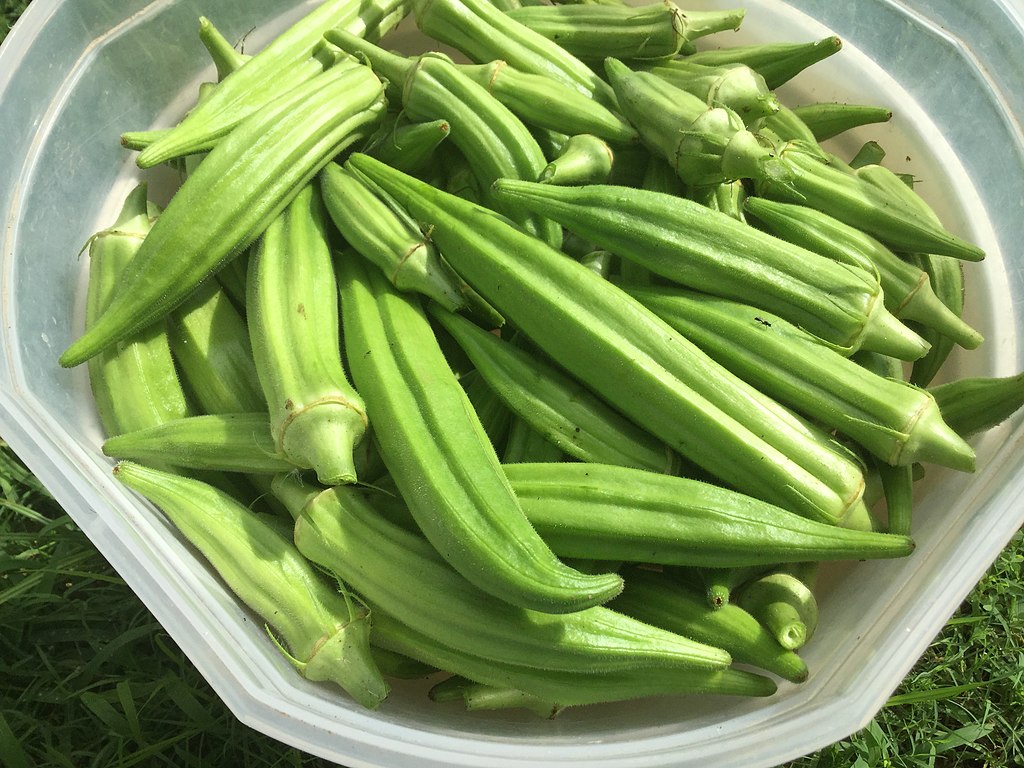
This attractively green batch of fresh okra contains waaaay too many oversized pods.

I plan to grow at least 12 okra plants in my raised beds this year, with an eye to freezing some of my own for cold weather use rather than being constantly at the mercy of commercial growers and retailers’ utter lack of quality control. The real solution to the okra problem is to require growers and merchants to actually EAT some properly-sized and prepared okra. Otherwise this is a hopeless situation for okra lovers everywhere.

Properly fried, sliced okra will not retain a bright green color and neither will the pods, changing instead to a dull olive drab.

The Tragic Trajectory of the “Freedom” Party

In political science, a reactionary is a person who holds political views that favor a return to the status quo ante, the previous political state of society, which that person believes possessed positive characteristics absent from contemporary society.

Increasingly since the 1960s, terrified conservatives and the power brokers behind them have pursued increasingly extreme political efforts to turn back time. What terrified the people were the changes wrought by new technologies and ideas of personal liberty. Suddenly women had legal access to effective contraceptives and by 1973, to abortion. To many, even more upsetting were the ramifications of the Civil Rights Act.

What terrified the power brokers were the Baby Boomers who rejected corporatism and the war machine. Young people from all kinds of families turned to the counter-culture in its denunciation of the war in Vietnam and the draft, its embrace of psychoactive substances that expanded consciousness, and a revolutionary denial of consumer culture.

The shock and horror was met by a series of efforts meant to reclaim the past. Called everything from the Silent Majority, Tea Party, and now the so-called “Freedom” Caucus, these political mavens proclaim their ‘freedom’ to not accept progress, to hang by their fingernails clenching the coattails of a vanishing way of life.

The effort puts the nation and humanity at risk.

Fundamentally, the resistance stems from love of money coupled with extremist religion (always a useful tool). Only God knows how viruses work. God doesn’t want people to question His will. God will take care of us. Et cetera. Fear drives these knee-jerk reactions, fear of learning enough to question certain religious beliefs, fear of having to think for oneself. Fear of personal responsibility.

Fear incited by behind-the-scenes power brokers.

Take, for example, the reactionary refusal to vaccinate. Science tell us that the availability of unprotected humans gives viruses fresh grounds in which to breed. And clever viruses reproduce with slightly altered offspring (mutations) that make them more likely to succeed—more virulent, or more resistant to medicine, or less likely to be stopped by the vaccine. Sadly, many reactionaries are unaware of this because they are not well informed on the nature of viruses, or of the nature of biological entities overall.

That’s because many reactionaries resisted the lessons of science that were offered in public schools. Either underpaid, overworked teachers failed to connect with the student or, more often, the student refused to allow the information to process in his/her mind. The resistance had been long taught at home through parental dismissal of science, passed on through generations.

Yet, remarkably, the same reactionaries usually turn to science when they fall ill. Vaccine refusers end up in hospitals partaking of the latest technologies and therapies science has to offer. And it doesn’t take a virus to incite their embrace of the latest scientific-medical interventions. Or take cancer, for example. Few if any persons facing a cancer diagnosis are interested in waiting for God to heal them. They rush to embrace chemotherapy, radiation, and surgery.

But perhaps I overstate the point.

Reactionaries’ views on the financial world progress much faster than their views on advances in the social order. The proliferation of the extremely wealthy resonates in reactionary minds as a promise of what they might themselves gain if they play their cards right. Conditioned by clever propaganda put forth by the rich, the reactionaries wait for the ship to come in, much as a serf waited for the lord of their domain to grant a favor, perhaps by granting an extra field to plant or a new wagon in which to haul the harvest–which coincidentally largely lined the lord’s pockets, not their own.

This faith in the wealthy stems from several religious concepts, that God grants wealth to the virtuous and that people who are rich are God’s favored children. Therefore, in reactionary logic, by accepting and respecting the excessive wealth of a few, they are acknowledging God’s plan. If they’re extra good, God might also reward them with a windfall.

Never mind that the same teachings embraced by reactionaries state that wealthy men cannot expect to be accepted by God.

A darker side of this primitive thinking is the compulsion to protect those things so honored by God. If material goods of the wealthy are threatened by angry mobs, the appropriate reaction by God’s people is to kill the mobs. Hence Kyle Rittenhouse. Hence the thousands who believe young Kyle did the right thing. But this is apostasy: valuing material things over human life is a big NO in Scriptural teachings.

Another favorite mindset among reactionaries is the accumulation and embrace of multiple prejudices. Supported by twisted interpretations of Biblical bits and pieces, the religious reactionary becomes a racist, sexist hater ready to take up arms against any effort to bring them in closer, more accepting contact with people of different color, ethnicity, or gender. The actual cause of these prejudices is not religion but rather fear—fear of the unknown, the Other–as well as the urgent need to cling to what is known.

Ironically, eliminating fear is a fundamental objective of religion. Except, of course, fear of God. In theory, if a person is suitably fearful of God, and therefore religious in following God’s rules, then God will take care of everything else. This is called faith.

For many people, this narrow faith doesn’t quite get them past that man’s dark skin or that woman’s clever mind or that ‘person’ who pretends he’s a woman when he’s probably a man. Faith doesn’t provide any assistance in dealing with people who don’t have the same religious beliefs, or who speak a foreign language.

Faith has no suggestions on how to deal with sexual desires toward a person of same sex, so the default response is to call it sin and try to ignore it. But the desire never goes away and to compensate, the person in this quandary may direct his sexual frustration in other ways, such as child molestation.

Trapped in their unquestioning religious beliefs and narrow-minded view of the world, these folks hardly experience the ‘freedom’ their mantras espouse. And the power brokers don’t hesitate to play on their ignorance to enhance their financial opportunities. Not only are conservatives bound up in their tunnel vision of the world, their every effort is to restrict the freedom of others—banning books, restricting speech to avoid words they don’t like, forbidding medical care to women—there’s a long list of freedoms the Freedom Party would eliminate from American life.