How to Tell Your Story: A Guide for Personal Memoir or Family History
This holiday season, take advantage of family gatherings to save your ancestral history. For the first time in history, you have the opportunity to put your masterpiece ideas into bookstores without a middleman. This revolution in communication comes with a price, however, a steep learning curve about which technology to use and how to use it. That’s where this book comes in handy.
The first part of this book covers the fundamental stages of self-publishing: what software to use and how to use it, step-by-step guidance for working with Amazon’s Kindle Direct Publishing, and understanding important elements like genre. You’ll find discussion about getting reviews and marketing as well as useful hints about maintaining those tender creative sensibilities in the face of seemingly overwhelming obstacles.
The second part provides organizational and writing guidelines for the personal memoir as well as family history. How do you transform the bare bones of genealogical research into a compelling narrative? How do you flesh out the story of a transformative period of your life? Take notes when an older relative starts reminiscing. Someday you’ll be glad you did.
Previously, so-called vanity presses charged a stiff fee to take a manuscript and turn it into a book. Now with print-on-demand technology, the self-publishing author doesn’t need to pay a dime to publish a paperback or e-book. That memoir or family history or sure-to-be-a-bestseller novel only needs some basic pointers to go from brainstorm to reality. Start writing!
My mother’s family at St. Paul, Arkansas, early 1920s. Mom is third from left.
Without question, discovering the people from whom you descend is an exhilarating and fascinating endeavor. Idiosyncrasies of your known kinsmen—and yourself—suddenly make a lot of sense, not to mention that red hair or tall stature. It’s remarkably emotional to learn of an ancestor who fought to the death in a war or whose wife–your 3x great grandmother–died in house fire.
Several internet sources for genealogical information are free—simply search “Name” “date of birth” and if you know it, “location” and you’ll discover a group of results with respectable information. Sadly, you’ll also discover a trove of spammers and click bait.
But a word to the wise. The most extensive and useful source, Ancestry.com, also can be less than forthcoming. Here are a few helpful hints.
Using the “Search” “All Collections” option yields the best results especially for a beginner. Once you’ve entered the name and whatever other information you may have on hand, you’ll find results that don’t exactly match up with what you’re looking for.
Refinements could include selecting the gender for your subject, isolating the location to “exact” as shown by the arrow, and narrowing the birth year to within a year or two of the assumed date of birth. Yet in the case of Albert Taylor as shown in the image, the search yields nothing more than the 1860 census where, at age 17, he and his 19-year-old sister Jane reside in the household of Alcie Haton [Heaton] to whom his relationship is not known.
My interest in Albert Taylor is his military record with the 1st Arkansas Cavalry, U.S., where he served in Company L as a private. His death in the regiment records occurred February 22, 1863, as shown on one of the most extensive records of Civil War military personnel, the Edward G. Gerdes Civil War homepage. He is also listed in this regiment at the National Park Service website. But in Ancestry.com, his name does not appear in military records.
One of the most frustrating of Ancestry.com problems is the tendency of many family historians to simply duplicate what someone else has posted to that lineage history without confirming any of the information. In an ideal situation, a search of Family Trees produces a lot of histories. For example, my search for information about Van Buren Covington, who lost his life in 1864 while serving in Co. A, 1st AR Cavalry, led to an Ancestry.com Family Tree record showing only one result, as seen below. The only option from here is to click on the name of his fourteen-year-old bride, which yields her family background, locations of family members, and other possibly useful leads.
But in many cases, Family Tree results show one or two trees with two or three ‘records’ or ‘sources’ and then the rest of the trees, of which there may be dozens, have no records and only one source, if any. Inevitably, these trees perpetuate inaccurate information and are simply not to be trusted. This problem grows exponentially as you track family trees back through generations because researching materials established before modern record keeping involves tedious attention to details often preserved in an arcane manner. So don’t just take the first couple of family trees as gospel; make a thorough investigation of those with the most sources and records, and compare the information before accepting it.
One option with a search result like this one with 0 records and 0 sources is to do another search on the father’s name. Or continue with this search until you find some with multiple records and sources.
Note: If your ancestry leads you to records in another country, you’ll have to pay Ancestry.com an additional subscription fee in order to access those records.
Ancestry.com is very much a user-created database assisted by an extensive organizational effort on the part of the company to provide as many institutional records as possible. But nothing is perfect. Subscribe if you want to search your genealogy, enjoy the nuggets of pure gold that you find, but always remain aware that in order to glean the greatest accuracy, you must not only limit your family tree searches to those with multiple records and sources, but also compare them to information found on other internet sites.
For Van Buren Covington, an internet search beyond Ancestry.com resulted in several discoveries. Geni.com shows his full name was Martin Van Buren Covington, born in 1839, not 1837. It also shows family members. But beware—Geni.com is one of those sites that requires membership before giving out any further info. You may find useful free resources at genealogy.com and many more. Bottom line? HAVE FUN!
John Randolph Campbell, holding a Bible, believed in his late 20s circa 1875-1880
Records of John Randolph’s birth name a birth year of 1853, although various other records show conflicting dates. A church record states that he was born December 24, 1853, in Independence County, Arkansas. In 1873 at age 19, he married Sarah “Sally” Elizabeth Prince at Sulphur Rock, Independence County, Arkansas. She was his second cousin once removed.
Miss Prince was born September 1849 in Tennessee, daughter of William Prince and Martha Lamberson. This Lamberson is related to John’s mother’s family: Melinda was her first cousin once removed. William J. Prince was born 1813 in Georgia, and died during the Civil War in Independence County, Arkansas, as did his wife Martha Lamberson Prince, born 1825 in North Carolina. Sarah Sally’s siblings were William H., b 1842 TN (CSA AR 8th Inf. Co. E, enrolled August 6, 1862 at Sulphur Rock, AR, between Newark and Batesville); Mary A., born 1847 TN (married James Scott); Virginia b 1850 MS; James Ferdinand b 1852 AR; Martha Jane b 1857 AR (married George Hill 1872; David Bruton 1879); John T. b 1858 AR; Tennessee “Babe” b 1860 (raised by Mary, married Riley Whaley).
Birth records for the couple’s sixth child, Benjamin, dated 1888, states that John age 38 was a farmer and preacher, born at Newark Arkansas, and that Sarah age 40 was born in Mississippi.
John Randolph Campbell and his new wife Sally produced the following children:
i. Emma Campbell b. 1874, Newton Co., AR, d. 1888 of rheumatic fever at age fourteen
ii. Mary Molly Campbell b 1876, m. Frank Pratt(s). Children were Mabel m. Fred Albert; Lizzie m. John Hilburn; Beulah; Pierce; Lennox; Urcil “Huck”; Margie; Nettie (died).
iii. John William Campbell, b 1878, m. Mary Jane Ellis. John William is the great-great grandfather of my three Campbell children.
iv. Jack O’Neil, b. Dec 25, 1882 at Newark, Indep. Co, AR, d. Apr 14, 1960, Newport, married July 19, 1903 to Emma Bell Hicks and produced Lennie Mae, Bertha, Commie O’Neal, Rutha Lee, and Opal Christine. Jack then married Donnie Inness and produced another eight children: Edna Irene, Burl Nathaniel, Aubrey Evereett, Almeta Beatrice, Leeaun Utah, J. C., Alvin Newton, and Thelma Joyce.
v. James Campbell b 1880, m. Mary Willis. Children were Dallas, Nanny, and another daughter.
vi. Clu Campbell, died at age 9 – not found in family birth records
vii. Benjamin Harvey Campbell, b June 14, 1888, Pleasant Plains, Indep. Co AR, d. Nov 19, 1966, Newport, Jackson Co, AR. married Willie Hicks, married Ocra Ellen Tibbs, and their children were Eva Jewell and Clemins Alvin. He then married Helen Carmen “Nell” Yancy, and produced Vesta Lola, Virginia Vivian, Mather Carnell, Veda Lee, Milous Harvey, and Benjamin Morris.
The 1880 Newton County Arkansas census for Jackson Township lists John Campbell age 26 with wife Sarah age 25, with children Emma age 6, Mary age 4, John age 2, and James six months. John’s occupation was farming.
John Randolph and Sarah Prince Campbell, circa 1900
The 1900 census for Fairview Township, Newton County (?) lists John R. Campbell age 46 as a mail carrier, land owner with a mortgage, married 27 years to Sarah, age 50, with seven children of which five were living. Jackson, age 17, was a hack driver, and Harvey age 13 was a farm laborer. They housed a lodger named William Hicks. The 1920 census for Jackson County Arkansas, Richwoods Township, finds John R. Campbell age 67 and Sarah A. age 72 living in a rented home, with his occupation described as clergyman and evangelist. The 1930 census for Amagon (Richwoods Twp) lists John R. age 80 and Sarah age 84 living in a rented home without occupation.
John Randolph was about five-nine at 185 pounds, although in older age he became “heavy set.” He worked as an itinerant preacher, following the Church of Christ denomination. “On September 29, 1895, John R. Campbell was authorized to work as an evangelist by the “Disciples of Christ, worshiping at Surrounded Hill Arkansas.” In 1889, he was ordained as a preacher by E. M Kilpatrick, and J. L. Kitridge, Clerk for Tex-Ark & Indian Territory: Credentials, page 32.
This poor quality image shows John Randolph in the process of baptizing a convert, date unknown.
According to one descendant, “John Randolph used to preach near Bradford [Arkansas] at least once a month; Aunt Nell [wife of Benjamin Harvey] remembers hearing him preach in 1914 near Swifton … said his name was Campbell and he was a Campbellite preacher. In 1917 he lived in the Pennington community and preached at different places. He received very little money as payment, mostly fresh vegetables, canned food, and some meats. Aunt Nell said she overheard some older women talking about the time he received a large handkerchief and two week’s board for holding a meeting. He preached some at Amagon and went to church barefoot … services were held in the schoolhouse.”
John Randolph and Sally, date and location unknown
He also rented farms to grow cotton and he traded horses and any other item of value. When his third child John William and family settled in Fayetteville after 1918, John Randolph and Sarah joined them, living first at John William’s store at the corner of Rock and Mill, then on Frisco Street and finally on the south side of Spring Street in the four hundred block before moving back to east Arkansas. His grandson John Carl later recollected that he drove an old Overland Blue Bird.
Overland Blue Bird
One descendant stated that “John R. Campbell was a preacher. He was really a corker. Pulled some pretty good stunts. Think he drank a lot.” It was said by his grandson Zack that there were only two places that John Randolph would drink home brew, and that was “on this side of the Bible and on the other side.” His wife Sally dipped snuff, and sometimes smoked a cob pipe. Sally’s daughter-in-law (Mary Jane Ellis) stated that the Prince women were known to have “woods colts,” a euphemism for illegitimate children. In old age, Sally suffered a “dowager’s hump,” now known as osteoporosis. Sally and John Randolph both died in the Newport Arkansas area.
Mary Molly Campbell
Little is known about William and Melinda Campbell’s second child, Mary Molly. She is not listed in the 1860 census of Howell County Missouri. Later records show her spouse as John Willis Payne. Willis was born in 1854 in Kentucky, with both parents also born in Kentucky.
Willis and Mary Payne are found in the 1880 Newton County, Arkansas census, Jackson Township, at ages 25 and 26, respectively, evidence she was born in 1855 two years after John Randolph. Also in the household is her younger brother James, listed a ‘boarder.’
In a letter dated 1971 from Elizabeth Campbell Farmer, daughter of James “Jim” William Campbell, Elizabeth states: “Mary Payne is my papa’s (Jim Campbell) only sister. We called her Aunt Molly and she was married to Willis Payne.”
After 1880, Willis and Mary vanish from public records.
James William Campbell
James William Campbell with his first wife Nancy Jane Bell on his right and her half-sister and his second wife Eliza Lawson on his left, circa 1888. James holds a pistol in his hand.
At age 24, James married Nancy Jane Bell (age 19), daughter of William Levi and Nancy Busby Bell, September 18, 1882, in Newton County, Arkansas. This was two years after he was named as ‘boarder’ in the household of his sister Mary and brother-in-law Willis Payne. James and Nancy moved to Harrison (Boone County) Arkansas but in 1886 they moved back to Newton County where they settled in the Mt. Judea area (pronounced “Judy” by locals). There James dug wells and cisterns and built chimneys, as well as farming his land with cotton, corn, and small grains. He was a “great hand with a scythe and cradle and would get $1.00 per day for cutting wheat, a good wage for that time and more than most men were paid.” His son, Wesley A. Monroe, said they had “biscuits one to three times each day during the wheat harvest then cornbread three times a day for the rest of the year.”
He was elected Justice of the Peace in 1892 and remained in office for years. About the same time the family moved into a “box” house on land they homesteaded, a cause for celebration since most families lived in rough log cabins. In his capacity as JP, he married many couples and was said to shed tears during the ceremonies. He only went to school two days in his life, according to his descendants, but was a self-educated man. He taught school two summers – “Script” or conscript school. Each family paid one dollar for each child attending.
James and Nancy Jane Bell Campbell 1905, with children Dewey Floyd (between them) and Rosa on right
In the fall of the year, James would go away to pick cotton (probably in the river bottoms) and would take his wife’s handicapped half-sister Eliza Lawson as well as his older children. His wife Nancy Jane stayed home to care for the younger children and the homestead. It is said that James and Eliza lived as husband and wife during the cotton-picking trips. Nancy spun thread and wove most the cloth used for their clothes, including coats. The pants and coats were made of half wool and half cotton, called “linsey-woolsey.”
James also served in some capacity with the Spear Mining Company for their lead and zinc mine near Pendle. He was a school trustee for the board of education and helped to hire teachers. He was a “jack of all trades,” doctoring animals and people by setting broken limbs on splits that he whittled. He farmed and grew everything his family ate, including the livestock.
The eleven children of James and Nancy, as well as his child by Eliza Lawson and children by Nancy Walls, his third wife, are not listed for sake of privacy.
Sarah E. Campbell
The 1860 census, taken July 19, gives Sarah’s age as one month. Thereafter, no record of her is found. Assumed she died in infancy.
Dear Reader — you may search for Part III, but recent DNA testing has shown that our tenuous theory on the lineage of Duncan Campbell and the Campbells of Glenorchy is WRONG. The evidence shows that the Patrick Campbell of Barbados is not related to the Campbells of Glenorchy. We’ve learned that John Campbell, grandson of William Campbell of Virginia, moved to Kentucky. From there, records are not complete enough to convince us that the military service shown below is for John Campbell, the son of John who moved to Kentucky. But we follow what records we have found to lead us to John and Nancy Spencer Campbell, assumed parents of our William Campbell.
RECORDS OF JOHN CAMPBELL (1795-1850)
1812 War of 1812 Service Records, 1812-1815
John Campbell, Brown’s Reg’t, East Tennessee Vols. Rank: Private on induction and discharge. [Roll Box 33, Microfilm Publication M 602. Direct Data Capture, comp. U.S., War of 1812 Service Records, 1812-1815 [database on-line]. Provo, UT, USA: Ancestry.com Operations Inc, 1999. Original data: National Archives and Records Administration. Index to the Compiled Military Service Records for the Volunteer Soldiers Who Served During the War of 1812. Washington, D.C.: National Archives and Records Administration. M602, 234 rolls.]
Research from Clark Family Tree by kimberlyjolson [Ancestry.com] found John Campbell military records:
Military 28 Apr 1814, enlisted in 17th infantry for 5 yrs by Lieut Monday. Described as 5’7” w/ blue eyes and fair hair, light complexion, 21 yrs old, laborer from Hawkins Co TN.
1814 Marriage Record:
Nancy Spencer marriage to John W. Campbell Jr. Dec 6, 1814, in Christian Co KY. They were both 19 that year.
Ancestry.com. Kentucky, U.S., County Marriage Records, 1783-1965 [database on-line]. Lehi, UT, USA: Ancestry.com Operations, Inc., 2016. Original data: Marriage Records. Kentucky Marriages. Madison County Courthouse, Richmond, Kentucky
1820 U. S. Census Reconstructed Records, 1660-1820
Jno Campbell, male, Arkansas Territory: List, 27 Aug 1823, of suits in the territorial Supreme Court, When instituted: May 1823; No.: 9; Against whom instituted: Jno Campbell; In what capacity delinquent acted: Trespass on public land; Amou…” Document: Territorial Papers of the US; Volume Number: Vol 19; Page Number: 539; Family Number: 9
1821 Homestead and Cash Entry Patent
John Campbell, Arkansas Land Office, Document #23062. 160 acres 1 SE 5TH PM No 2S 2E 13, issued Dec 4, 1821 under Act May 6, 1812, Script Warrant Act of 1812.
1830 census at Walnut, Phillips Co., AR Territory
1 m 30-39, 2 f <5, 2 f 5-9, 1 f 10-14, 1 f 15-19, 1 f 30-39 Year: 1830; Census Place: Walnut, Phillips, Arkansas Territory; Series: M19; Roll: 5; Page: 124; Family History Library Film: 0002473
Phillips County, Arkansas
Land Records
1821 – Dec 4: James Monroe, President of the United States of America, To all whom these presents shall come, Greeting: Know ye, that in, in pursuance of the Acts of Congress appropriating and granting land to the late Army of the United States, passed on and since the 6th day of May 1812, John Campbell having deposited in the General Land-Office a Warrant in his favor number 23,062, there is granted unto the said John Campbell, late a private in Baker’s Comp J of the 3rd Reg’mt of Infantry, a certain Tract of Land containing one hundred and sixty acres being in the South East quarter of Section 13 of Two 2 S in Range 2 east in the Tract appropriated (by the Acts aforesaid) for Military Bounties, in the Territory of Arkansas, To Have and To Hold the said quarter section of land with the appurtenances thereof, unto the said John Campbell and his heirs and assigns forever. Bureau of Land Management, General Land Office Records; Washington D.C., USA; Federal Land Patents, State Volumes
1837- Aug 15, Deed at Phillips Co., AR, for NW ¼ of Section 11, Twp 2S, R 3 E., 160 acres. Helena Land Office. Bureau of Land Management, General Land Office Records; Washington D.C., USA; Federal Land Patents, State Volumes
1837 – Aug 15, Deed at Lee Co., AR for W ½ SW ¼, Section 15, Twp 2N, R 4 E, 80 acres. Bureau of Land Management, General Land Office Records; Washington D.C., USA; Federal Land Patents, State Volumes
1840 census at Richland Twp, Phillips Co, AR
1 m <5, 1 m 10-14, 1 m 40-49, 1 f <5, 1 f 10-14, 3 f 15-19, 1 f 40-49 Year: 1840; Census Place: Richland, Phillips, Arkansas; Roll: 19; Page: 57; Family History Library Film: 0002474
Independence County, AR
1850 census at Greenbrier Twp, Independence Co., AR – Taken Nov 1850 after John died, Nancy is head of household
1850 death record
John died April 12, 1850 of pneumonia at Independence Co., AR Records show date and place of birth: Tennessee 1795. Arkansas Historical Commission; Little Rock, Arkansas; U.S. Census Mortality Schedules, Arkansas, 1850-1880; Archive Roll Number: 1; Census Year: 1849; Census Place: Independence, Arkansas; Page: 365
1850 Probate
Nancy Campbell executor for John’s estate. Arkansas Historical Commission; Little Rock, Arkansas; U.S. Census Mortality Schedules, Arkansas, 1850-1880; Archive Roll Number: 1; Census Year: 1849; Census Place: Independence, Arkansas; Page: 365
A letter of administration names Nancy, Wm Hightower, and Joseph P. James as bond for $800 on estate of John Campbell. Probate date 24 Jan 1851, Independence Co., AR. Letters of Administration, 1821-1845; Administrators and Guardians Bonds, 1847-1854.
An additional probate record from March 1851 states further proves that the John Campbell of Philips County is the same as the John Campbell of Independence County.
Independence County, with county seat Batesville in center
Received of Nancy Campbell as Administrator of the Estate of John Campbell deceased the sum of Eighteen dollars and Eighty cents (illegible) for my expenses on the River trip from Philips County and my Services in bringing honey from Philips County to Independence belonging to the Estate of John Campbell (illegible) this 20th May AD 1851 … Signed by Thomas (illegible, possibly ‘G’) Perry.
1850 census for Nancy Campbell
Taken at Greenbriar Twp, Indep Co in November 1850 shows her age 55 b KY with Sarah 20 b 1830, Rebecca 17, John H. 11, and two unrelated. Nancy’s kids all marked as born AR meaning they were in the state at least by 1830.
Ancestry family trees and other online resources name the oldest child of John and Nancy as Sarah born in 1830 while a few name Fanny b. 1828 as the oldest. However, the couple married in 1814 and surely did not wait until 1828 or 1830 to start a family. This gives plenty of room for William to be born in 1818-19.
Nancy’s death
Nancy died in 1852 without a will and her affairs were handled by next door neighbor Calvin Lacefield age 29, b KY, as shown in the 1850 census.
Administrators and Guardians Bonds and Letters, 1821-1902; Author: Arkansas. Probate Court (Independence County); Probate Place: Independence, Arkansas
Discussion of Problems
According to land records, John Campbell’s household in Phillips County 1830 census shows John Campbell household with NO SONS and six daughters. Our William was 10-12 years old in 1830. Other Campbell households in Phillips Co. show Samuel C. with two adults in their 20s, which is too young for William. The only other Campbell household in Phillips Co. is William Campbell’s, again too young for William.
Our William’s parents had to have been at least 20-25 when he was born, making their birth dates in the mid -1790s, or, more to the point, they would be in their 30s at the 1830 census. This fits well with John and Nancy both born 1795.
Rationale for strongly favoring these persons as William’s parents:
The 1850 census shows all these people in Greenbrier Township, Independence County, AR
A total of ten Campbells are listed in that county census for 1850, 6 in Greenbrier Twp:
Nancy Campbell household in Greenbrier, Township: Nancy 55 b KY, Sarah 20 b AR 1830, Rebecca 17 b AR 1833, John H. 11 b AR 1839. Nancy cannot read or write. Two lodgers include Joseph H Lane, farmer age 17, and Milla Lane age 8, both b. AR Year: 1850; Census Place: Greenbrier, Independence, Arkansas; Roll: 26; Page: 356b – Household #623
William Campbell household in Greenbrier Twp: William 32 b TN. Year: 1850; Census Place: Greenbrier, Independence, Arkansas; Roll: 26; Page: 357b—Household #637
Maud Campbell, age 25, place of birth not known, lives in household of Joab H. Peel age 36 b. KY, and his family including wife Martha A. age 27 b TN, and four Peel children ages 2 to 9 all b AR; as well as Martin Crisman age 31 b TN, occupied as ‘ferryman’. Year: 1850; Census Place: Greenbrier, Independence, Arkansas; Roll: 26; Page: 355b—Household #608
About ten miles away, in Ruddell Twp were the following Campbells:
John Campbell, age 50 b GA, in household of John E. Womack and family, working as ‘farmer.’ This John Campbell died in 1853 and Womack was executor. Womack’s wife Nancy was 41, too old to have been the daughter of our John and Nancy.
George W. Campbell, age 30, b TN, farmer. Living with wife Elizabeth 19 and son Robert A., infant.
I’m convinced that the Greenbrier Campbells are of the same family. It is obvious Nancy and John were a couple since she was appointed his executor upon his death. It’s also obvious that with a marriage in 1814, they didn’t wait until 1830 to start having children, which is what all the Ancestry records show, few if any of which were developed by an experienced genealogist.
I believe that Maud Campbell age 25 and Joab Peel’s wife Martha age 27 were John and Nancy’s daughters, and that William 32 was also their child, possibly the first. It’s also likely that George W. age 30 in Ruddell Twp. was a child of John and Nancy. There may have been another older sister who married a Lane whose children lived with Nancy in 1850.
It seems very likely that if George W. Campbell was the son of John Campbell of Georgia, as shown in the 1850 census for Ruddell Twp, he would be living in one of the Campbell households instead of the Womack household. I’m aware this does not constitute proof.
Considering the theoretical ancestry for John, it’s not surprising that he would have sons named William, George, and John.
Note: Ancestry family trees which show this John Campbell as married to Ellender Neel do not take into account that Nancy was the executor.
Campbell of Argyll: Duke of Argyll (S), Duke of Argyll (UK), Chief of Clan Campbell
Campbell of Breadalbane: Earl of Breadalbane and Holland
Campbell of Cawdor: Earl Cawdor, of Castlemartin in the County of Pembroke
Campbell of Loudoun: Earl of Loudoun
Cadet Houses of Clan Campbell
Campbell of Lochnell (Heirs should Argyll line fail.)
Campbell of Airds
Campbell of Ardkinglas
Campbell of Auchinbreck
Campbell of Caenmore & Melfort
Campbell of Craignish
Campbell of Dunstaffnage
Campbell of Duntroon
Campbell of Inverawe
Campbell of Strachur
Inveraray Castle, the principal family seat of the Dukes of Argyll
House of Argyll
Overview: Sir Colin Campbell of Lochow was knighted in 1280. In 1445 James II of Scotland raised Sir Colin’s descendant Sir Duncan Campbell to the peerage to become Duncan Campbell of Lochow, Lord of Argyll, Knight, 1st Lord Campbell. Colin Campbell (c. 1433–1493) succeeded his grandfather as the 2nd Lord Campbell in 1453 and was created Earl of Argyll in 1457.
The 8th Earl of Argyll was created a marquess in 1641, when Charles I visited Scotland and attempted to quell the rising political crisis (and the fall-out from the event known as The Incident). With Oliver Cromwell‘s victory in England, the marquess became the effective ruler of Scotland. Upon the restoration, the marquess offered his services to King Charles II but was charged with treason and executed in 1661. His lands and titles were forfeited but in 1663, they were restored to his son, Archibald, who became the 9th Earl of Argyll. In 1685 the 9th Earl was executed for his part in the Monmouth rebellion.
History
Gille Escoib (or Gilleasbaig of Menstrie)[1] is the earliest member of the Campbell family to be attested in contemporary sources, appearing in royal charters dating to the 1260s. His existence is confirmed by later Campbell pedigrees. According to these genealogies, he was the son of a man named Dubhghall (“Dugald”). However, nothing is known of this man, nor of the 4 or 5 generations of his ancestors who constitute the probable historical section these genealogies preceding Dubhghall.[2] Gilleasbaig’s first historical appearance dates to 1263, when he appeared in a charter of King Alexander III of Scotland, being named as “Gilascoppe Cambell.” He was granted the estates of Menstrie and Sauchie in Clackmannanshire (but then under the supervision of the sheriff of Stirling). His next appearance, and indeed his final appearance, is in 1266, when he witnessed another royal charter at Stirling granting favors to Lindores Abbey.[3] The genealogies, and indeed later 13th century patronymic appellations, tell us that Gilleasbaig was the father of Cailean Mór, probably by marriage to the Carrick noblewoman, Afraig, a daughter of Cailean of Carrick.
Cailean Mór Caimbeul (also known as Sir Colin Campbell; died after 1296) is one of the earliest attested members of Clan Campbell and an important ancestor figure of the later medieval Earls of Argyll. Cailean was the son of Gilleasbaig, a knight and lord of the estates of Menstrie and Sauchie in Clackmannanshire.[4] It was first suggested in the 1970s that Cailean’s mother was Afraig, a daughter of Cailean mac Dhonnchaidh,[5] the probable father of Niall, Earl of Carrick. Although it has also been suggested that this Afraig was the daughter of Niall himself, there is no doubt that Afraig was of the family of the Gaelic Earls of Carrick.[6] This means that Cailean himself was the cousin of the future king, Robert I of Scotland, which explains why the Campbells were so attached to the Bruce cause during the Wars of Scottish Independence.[7] Cailean himself took part in the Great Cause, and was one of the Bruce representative advocates to King Edward I of England in 1291.
He appears as a witness in various documents dating to the 1290s and relating to lordships in southwestern Scotland. He appears in the Newbattle Registrum of around 1293, where he is called the son of “Gylascop Kambel” (“Gilleasbaig Caimbeul”), obtaining from Sir Robert Lindsay the estate of Symington; the document, which has James Stewart, 5th High Steward of Scotland, Lord of Kyle, as one of Cailean’s pledgers, guarantees continued payment of rent to Newbattle Abbey. In 1295, Cailean appears as a witness in a charter of James Stewart granted to Paisley Abbey, and in 1296 appears again in the Paisley Registrum attesting the marriage of James to the sister of Richard de Burgh, Earl of Ulster. Cailean also witnessed a charter of Maol Choluim, the contemporary Mormaer or Earl of Lennox, and in another Lennox charter in which he is granted lands in Cowal by John Lamont, one of Maol Chaluim’s vassals.
By 1296, and perhaps by 1293, Cailean held the position of “Ballie” of Loch Awe and Ardscotnish, a position he was granted either by King John Balliol or Edward I of England. It was this position that made him the enemy of Iain of Lorn, the MacDougall Lord of Lorne. Sometime after September 1296, Cailean was killed by the MacDougalls at the “Red Ford” on the borders of Loch Awe and Lorne at a place known as the String of Lorne. A cairn called Carn Chailein, located within 2km of Kilmun on Loch Avich, is traditionally said to mark the place where Cailean was killed.[8] The age of the cairn is unknown, although it seems to have been in existence by the seventeenth century.
According to the 17th century compilation Ane Accompt of the Genealogie of the Campbells, Cailean married Janet Sinclair, daughter of Sir John Sinclair of Dunglass.[9] However, by its own admission, this document was not intended to be perfectly accurate, and there are no 13th century documents known to verify such a marriage took place. Ane Accompt states that they had the following children:
Domhnall mac Cailein
Neil (or Niall) Campbell, died 1315
Gillespic (or Archibald) Campbell
Dougall (or Dugald) Campbell
Sir Niall mac Cailein (died 1315), also known as Neil Campbell or Nigel Campbell, was a nobleman and warrior who spent his life in the service of King Robert I of Scotland. His Gaelic name means “Niall, Colin’s son” since he was the son of Cailean Mór. His services to the King elevated the Campbells into the higher ranks of the Scottish nobility.
By later Campbell tradition, Niall was the elder son of Cailean Mór; however, contemporary evidence seems to suggest that his brother Domhnall enjoyed this distinction.[10] Niall’s earliest appearance in the sources occurs in 1282 on a witness list to a royal charter in favor of Cambuskenneth Abbey. Niall disappears for 20 years, unless the “Master Niall” active in the service of the then Earl of Carrick, Robert, in the 1290s can be identified with Niall mac Cailein. This seems likely, because one official source styles him Mestre Neel Cambell. Another of the sources for “Master Niall” tells us that he came from the “county of Ayr”; this would tie in with the known background of the Campbells of the era, and with Niall’s later affiliation with King Robert. In 1293, Niall was sent to Norway to deliver personal items to Robert’s sister, Isabella Bruce, Queen of Norway. In 1296, this Master Niall swore fealty to King Edward I of England and was issued with a safe passage through England, on 12 June 1297, to return to Scotland.[11]
The Niall mac Cailein who appears again in the source in 1302 was still in the service of the English crown. Until 1306, he remained on the side of the officially Bruce-backed English regime. Niall served in the war band of Richard Óg de Burgh, 2nd Earl of Ulster and in the “English” army which besieged Stirling Castle in 1305. Niall and his brother Domhnall were rewarded for their services. In 1302, Niall was given lands in Cumberland. In the same year, Niall and his brother Domhnall received the guardianship of the heiresses of Andrew de Crawford, lord of the Baronies of Loudoun, Lochmartnaham and Draffan. However, Niall and Domhnall, like their lord the Earl of Carrick, were drifting towards renewing their war against the English conquest. Niall was at Westminster in 1305, because his rights were being challenged by a knight called Robert Keith. In Spring 1305, Edward decided in favor of Keith, judging “to allow [Keith] to have these children and to distrain Sir Dovenald Chambel and Sir Nel Chambel by their lands and bodies.”[12] In the same year, Edward granted some Campbell lands to an English knight, Sir John Dovedale. Such judgments were both a cause and effect of deteriorating relations with the English crown.
When Robert de Bruce decided to raise the Scottish banner in 1306, it is not surprising that Niall and Domhnall were among the would-be king’s first adherents. Niall was present at Scone in March 1306 when Robert was crowned King of Scots. After the defeats King Robert suffered at the Battle of Methven and Battle of Dalrigh, Niall was one of the men who remained faithful, as John Barbour testified later in the century.[13] All the evidence suggests that Niall remained in King Robert’s war band for the years to come, fighting both the English-side generally and the MacDougalls in the west of Scotland. Niall also acted as a representative of King Robert in negotiations with the English crown, on two occasions, in 1309 and 1314.
Arms of Campbell, Dukes of Argyll: Quarterly, 1st & 4th: Gyronny of eight or and sable (Campbell); 2nd & 3rd: Argent, a lymphad or ancient galley sails furled flags and pennants flying gules and oars in action sable (Lorne).
Niall married Robert de Bruce’s sister, Mary Bruce. The date of their marriage is unknown. Niall and Mary had a son, Iain (John). King Robert granted the couple the lands confiscated from David Strathbogie, almost certainly so that Iain would eventually become the Earl, which is indeed what happened. This was part of a general policy by Robert of redistributing lands and titles to his extended kin. Niall, however, had been married previously to Alyse de Crawford,[14] by whom he had at least two sons, Sir Colin Og Campbell of Lochawe and Dubhghall. In 1315, King Robert granted the baronies of Loch Awe and Ardscotnish to Cailean/Colin for the service of a 40-oared galley for 40 days per annum. This grant, in the view of the most recent historian of the subject, is the real beginning of the Campbell lordship of Lochawe. In 1326, King Robert created the post of sheriff of Argyll, and granted it to Niall’s son, Dougall.
Niall probably died in 1315-16, leaving a strong legacy of heroism and royal favor, from which his offspring would benefit enormously.
Sir Colin Og Campbell of Lochawe (died 1340 at Locale Argyle), also known as Cailean Óg Caimbeul, Sir Colyn Cambel,[15] Colin the Young, and Coline Oig Campbell,[16] was an early member of Clan Campbell and patrilineal ancestor of the Earls of Argyll. He was lord of Lochawe and Ardscotnish from 1316 until his death sometime before 1343.
Colin was the oldest son of Sir Neil Campbell and his first wife, likely Alyse Crawford.[17] His stepmother was Mary Bruce, sister of king Robert the Bruce. It has been theorized that Cailean of Carrick was Colin’s great-great grandfather, which would also make Robert the Bruce his second cousin once removed. Tradition has it that William Wallace’s mother was Margaret Crawford,[18] which if accurate, would make Wallace and Colin first cousins once removed.
In 1316, shortly after his father’s death, Colin was granted the entirety of Lochawe and Ardscotnish (lands along the shore of Loch Awe) as a free barony by Robert the Bruce. In exchange for this, Colin agreed to provide troops for Robert’s army and a single 40-oared ship when requested.[19] He served in Robert’s army during the Irish campaign of 1315-1318. The Brus relates a tale from this campaign in which Colin disobeyed Robert’s orders and charged a pair of English archers. While Colin killed the first archer, the second killed Colin’s horse. Robert himself intervened, riding to Colin and hitting him with a truncheon as punishment. During the reign of Edward Balliol, Colin sided with David II. Amidst the struggle, Dunoon Castle was captured by a force led by members of the Campbell clan, possibly Colin, and has remained held by the family ever since (though mostly in ruins today).
Archibald Campbell of Lochawe (died before 1394),[20] also known as Gillespic Campbell and Gillespig More, was an early member of Clan Campbell and patrilineal ancestor of the Earls of Argyll. Archibald was the son of Sir Colin Og Campbell of Lochawe and his wife Helena, a possible daughter of John de Menteith. He became Lord of Lochawe either through inheritance from his father or the disenfranchisement of his brother, Dougall. In 1342, King David II granted Archibald the forfeited lands of his brother Dougall as well as the barony of Melfort. Melfort was in turn granted to Archibald’s half-brother Neil, from whom the Campbells of Kenmore and Melfort descend. In the 1350s, Archibald was granted numerous properties in Argyll by John, Lord of Menteith and John’s cousin Mary de Menteith, most notably Castle Sween. In 1373, he received the lands of Finnart and Stronewhillen from Paul Glenn. In 1382, he and his son, Colin, were appointed the hereditary position of King’s Lieutenants and Special Commissioners in the Sheriffdom of Argyll, which would provide them income in exchange for performing various bureaucratic duties.
According to Ane Accompt of the Genealogie of the Campbells, Archibald married Isabella, daughter of John Lamont. She is referred to as Mary in other sources. Archibald and Isabella had the following children:
Colin ‘Iongantach’ Campbell, father of Duncan (1st Lord Campbell). Born about 1338 – Lochow, Argyllshire, Scotland. Deceased about 1413, aged about 75 years old. King’s Lieutenant, Special Commisioner,Knight,Sir.
Married to MacAlister ?1341- issue: Neal Campbell, Dean of Argyle ?1361-1442/
Married in 1362 to Catherine MacDougal, of Lorne ?1343- issue: Duncan Mor Campbell, of Glenshira ?1364-
Married to Margaret Drummond ?1362- (Parents : Sir John Drummond, of Stubhall ?1332- & ? ?)
Married before March 1387, Lochow, Argyllshire, Scotland, to sosa Mariota Campbell ca 1354- (Parents : sosa John Campbell, of Menstrie ?1331-1358..1366 & sosa Mary of Glenorchy ?1352-) with
sosa Colin Campbell, of Ardkinglass ?1370-1434
sosa Sir Duncan Campbell, Lord Campbell ca 1375-1453
John Campbell ?1389-
Dugald Campbell, 1st Captain av Dunstaffnage Castle ?1392-
Donald Campbell ?1394-1442/
Christian Campbell ?1395-
Helena Campbell
Duncan ‘Skeodanasach’ (or Skeodnish) Campbell
Duncan Campbell abt 1370-1453, 1st Lord Campbell (Classical Gaelic “Donnchadh mac Cailein,” and also called Donnchadh na-Adh (English: Duncan the fortunate) of Loch Awe, was a Scottish nobleman and politician. He was an important figure in Scottish affairs in the first half of the 15th century and Justiciar of Argyll. He was head of the Clan Campbell for 40 years.
Duncan’s date of birth date is uncertain but around 1370 in Lochow, Argyll.[21] He was the son of Colin Campbell of Lochawe and Mariota Campbell. Colin (called Colin Iongantach ‘Wonderful,’ and ‘Colin The Good Knight’) was the eldest son of Archibald Campbell of Lochawe, while Mariota was the daughter of John Campbell, and thus heiress to the lands of Ardscotnish and Glen Orchy. Colin obtained a dispensation by 13 January 1366 permitting the marriage of Mariota to his son John. He evidently changed his plans and married Mariota himself as in 1372 he obtained a second dispensation, this allowing Colin and Mariota to remarry, after a separation, having already married although within the prohibited degree of kinship.[22]
A 16th or 17th century illustration from The Black Book of Taymouth shows Duncan flanked by two of his descendants. On Duncan’s right stands his grandson Colin Campbell, 1st Earl of Argyll and on his left is his son Colin of Glenorchy. (Description after Boardman, The Campbells.) Wikipedia
Duncan may not have been their eldest son: a brother named John Annam, John the Weak, is said to have been passed over. Duncan was seemingly the chosen heir by 6 February 1393 when he was granted the lands of Menstrie by his father. On Colin’s death, sometime before 19 January 1414, Duncan became head of the Campbells of Loch Awe.
Duncan was twice married, his first wife was Marjorie/Marjory Stewart (sometimes identified as Marcellina Stewart), daughter of Robert Stewart, Duke of Albany, she died before August 1432, but not before giving Duncan a son, Archibald Campbell, Master of Campbell, also known as Celestin Campbell, and Gillespic or Gillaspy Campbell (d. 1440).
Archibald married Elizabeth Somerville, daughter of John Somerville, 3rd Lord Somerville; Archibald and Elizabeth were the parents of Colin Campbell, 2nd Lord Campbell (c. 1433–1493), created Earl of Argyll in 1457, also known as Colin M’Gillespic.
Duncan’s second wife was Margaret Stewart of Ardgowan (d. after August 1442), the daughter of John Stewart of Ardgowan and Blackhall, illegitimate son of King Robert III of Scotland. With Margaret, Duncan gained the following son:
Sir Colin Campbell “Black Colin” of Glenurchy, born c. 1395-1406, ancestor of the Breadalbane family. Duncan’s closeness to the Albany Stewarts led to King James I of Scotland viewing him with some suspicion, and James sent Duncan south as a hostage in England. The documentary record calls him Campbell of Argyll, and gives his share of the liability for the king’s ransom as 1500 merks, more than any other hostage save one.[23] In time Duncan and the king were somewhat reconciled and following James’s assassination Duncan was among the supporters of Queen Dowager Joan. (More below)
During the minority of King James II, Duncan professed support and loyalty to the regency, while constantly expanding his power in Argyll, often at the expense of the Crown. He was nevertheless knighted before March 1440 and created a Lord of Parliament as Lord Campbell of Lochawe by James II in 1445.
He died between February 1453 and 21 May 1454, and was buried in the collegiate church at Kilmun, which he and his wife Margaret Stewart had founded in 1442. Their effigies can still be seen in a niche with a wide cusped arch.[24]
His first successor was Archibald, Master of Campbell; also known as Archibald Roy of Kilbride since he was born in Kilbride, two miles from Inverary. Archibald Roy of Kilbride was the 14th Campbell, the Sixth McCailen More, and 16th Knight of Lochow.
Duncan’s son Colin, known later as Black Colin, head of the Campbells of Breadalbane, the leading family after the House of Argyll. His grandson Colin, son of Archibald ‘Gillespic,’ (d. 1440) his only child by his first wife, succeeded him as Chief of the Clan Campbell.[25]
Neil Campbell of Ormidale (fl. 1442), from whom it is said the houses of Ormidale and Ellengreig descend; father of a son named Colin.
Duncan Campbell of Auchinbreck (fl. 1452), said to have been first of the house of Auchinbreck.
Archibald Campbell (fl. 1452) ancestor of the old family of Otter, now extinct.
More about Black Colin1395-1406
Sir Duncan gave his son Glenorchy after throwing the MacGregors off it. With the dispersal of the MacGregors from Glenorchy during the late 15th century, Sir Duncan gifted the lands to Black Colin who, through marriage to the co-heiress of John, Lord of Lorne, also inherited one-third of the lands of Lorne. It was he who built the castle of Kilchurn at the north east end of Loch Awe, to command the gateway to the Western Highlands. By this stage, it was said, the Chief of Glenorchy could travel from the east end of Loch Tay to the coast of Argyll without leaving his own land.
Colin was much travelled, with his visits to Rome providing the by-name Black Colin of Rome (Cailean Dubh na Roimh). When fighting the Turks in Rhodes alongside the Knights Hospitallers, according to tradition, he was protected by the Glenorchy charm stone (now in the National Museum of Scotland). For his bravery during a Crusade to Palestine he became a Knight of Rhodes. He died in 1475 at Strathfillan and was buried at Kilmartin, in Argyll.
His son Duncan (c.1443-1513) had an equally long career, during which he made major territorial acquisitions in the Breadalbane region, in particular securing the strategically vital holdings at the east and west ends of Loch Tay. He was helped by the military power of his allies, the MacGregors, who expanded east alongside the Campbells. That alliance later disintegrated with a bitter feud between the kin groups starting when Grey Colin was laird.
Duncan’s considerable literary and artistic skills placed him at the center of the Gaelic literary circle. He patronized the Fortingall MacGregors who compiled The Book of the Dean of Lismore to which Duncan contributed nine humorous and bawdy poems.
For many years he worked closely with his cousin, the 2nd earl of Argyll, and when both were killed at the battle of Flodden (9 September 1513) they were buried side by side at Kilmun, Argyll. The subsequent family members were exceptional in their procurement of land and property, expanding into the lands of Finlarig, Glenlyon, and areas of Argyll and Perthshire.
Black Colin
As for other descendants of Black Colin, in 1625, ‘Black Duncan,’ 7th of Glenorchy, was created a baronet. Born Aug 7, 1551, at Kilchurn Castle in Glenorchy, he married Lady Jean/Janet Stewart of Atholl. This is the lineage we will pursue in the next chapter.
Another descendant of Black Colin was Sir John, 11th of Glenorchy, who was described in 1681 as “cunning as a fox, wise as a serpent, and slippery as an eel” and created the 1st Earl of Breadalbane. Still another descendant was John Campbell of Glenorchy, 1st Earl of Breadalbane and Holland, who in 1681, having won favor with William of Orange, was given the responsibility of ensuring that Highland Jacobite chiefs came to terms with King William’s invasion, although he is known to have taken a relatively impartial stance. This was totally compromised in 1692 when his cadet clan, Campbell of Glenlyon, implicated him in the massacre of the MacIan Macdonalds on Glencoe. The Campbells already had the slaughter of their neighbors, the Catholic MacDonalds of Glencoe, in mind. Dalrymple of Stair persuaded King William to sign the order, while the 1st Earl of Breadalbane was given a purse of public money to buy off the other Highland chiefs, though a measure of coercion was also required. The Earl skillfully concealed from the courts his part in the slaughter, but the Breadalbane line has suffered ill luck since then.
More about Breadalbane
Colin, 1480-1523, father of Colin the Grey
“Cailean Liath, Grey Colin, the youngest son of Sir Colin [Campbell], the third Laird, came into the family possessions on the death of his brother John. He was born in 1499, and had thus passed middle age at his succession; yet his career as laird extended to thirty-three years, and covered one of the most eventful periods in the history of Scotland. ***
“[He was intent on building a castle and did so at the East end of Loch Tay.] “The castle was built there, and it was called Caisteal Bhealaich, the Castle of Balloch, by the common people, but Taymouth by the gentry.” The Castle of Balloch appears to have been occupied by the Laird of Glenorchy some time before 12th October, 1560…..
“Sir Colin took a leading part in promoting the Reformation. He was a member of the Parliament of 1560 when the Protestant doctrines received the sanction of law….
“He was twice married. His first wife was Margaret, daughter of Alexander Stewart, Bishop of Moray, and widow of Patrick Grahame of Inchbrakie. By her he had two daughters…. Sir Colin’s second wife was Katherine, daughter of William, Lord Ruthven. By her he had a family of four sons and four daughters…. Sir Colin died at Balloch on 11th April, 1583, in the eighty-fourth year of his age….” (William A. Gillies, In Famed Breadalbane, pp. 120-124 (Perth, Scotland; The Munro Press: 1938)
According to The Black Book of Taymouth, p. 23 (Bannatyne Club, Edinburgh: 1855), Colin was “honorablie burreit in the chapell of Finlarg,” which now is, according to Wm. A. Gillies, supra p. 119, the Breadalbane family mausoleum.
Colin “The Grey” Campbell was the son of Colin Campbell (d. 1523, reckoned 3rd laird of Glenorchy), and Mariota/Margaret Stewart (d. 1524, daughter of John Stewart, 3rd Earl of Atholl). As a child he was fostered with Fearnan MacGregors.As a younger son he was given the lands of Crannich on the north shore of Loch Tay. He married Margaret Stewart, daughter of Andrew Stewart, Bishop of Moray, and widow of Patrick Graham of Inchbrakie.
He became laird of Glenorchy in 1550 upon the death of his older brother John in 1550. He married Katherine Ruthven, a daughter of William Ruthven, 2nd Lord Ruthven and Janet Haliburton, heiress of Patrick Haliburton of Dirleton and sister of Mariotta Haliburton, Countess of Home. In middle-age became known as “Grey Colin” or “Cailean Liath” because of his white hair and long flowing beard.
One of his first actions as laird, was to evict the Clan Gregor from Balloch at the east end of Loch Tay. In 1552 he built a tower house known then as Balloch Castle, and now as Taymouth Castle. Balloch means “house at the narrow pass.” Colin is said to have chosen the site of the castle in a novel manner. He was apparently instructed in a dream to found the castle on the spot where he first heard a blackbird sing, whilst making his way down the strath of the Tay.
On 3 August 1564 Mary, Queen of Scots wrote from Glen Tilt to Colin Campbell of Glenorchy, asking him to demolish a house of strength on an island in Loch Rannoch. The Clan Macdonald of Clanranald were rebuilding the house, which her father James V had previously ordered to be demolished.
There was a feud between the Campbells and the Clan Gregor. In 1569, when Colin captured the clan chief Gregor Roy whilst visiting his wife. On 7 April 1570, after securing the consent of the Regent Morton, Colin personally beheaded Gregor at Balloch, in the presence of the Earl of Atholl, the Justice Clerk. Gregor’s wife, Marion Campbell, who also witnessed her husband’s execution, wrote a bitter lament about the affair, called ‘Griogal Cridhe’. The fighting continued until a settlement was finally reached between the two clans in the winter of 1570.
As a landowner, Colin claimed to have ‘the power of pit and gallows’, which was the right to imprison and execute. In the Black Book of Taymouth, Sir Colin was described as a great ‘justiciar’ of his time who sustained the deadly feud with the Gregor clan and executed many notable lymmars (rogues).
James VI visited Balloch Castle in August 1582, tipping the gardener 40 shillings. However, only a few days later, the king was seized at the Ruthven Raid.
Colin died on 11 April 1583 and was buried at Finlarig.
Grey Colin wrote and kept a large number of letters.
Colin had eleven children from two marriages. Children from his first marriage with Margaret Stewart include Beatrix and Margaret.Children from his second marriage to Katherine Ruthven include:
Duncan Campbell “The Black” of Glenorchy, who married Jean Stewart, daughter of John Stewart, 4th Earl of Atholl and Margaret Fleming, on 11 July 1574.
Colin Campbell of Glenample
Patrick Campbell of Auchinyre
Archibald Campbell of Monzie
The member of a junior branch of Clan Campbell, Breadalbane was a descendant of Sir Colin Campbell, 1st of Glenorchy (died 1475), the son of Duncan Campbell, 1st Lord Campbell by his second wife Margaret Stewart and the half-brother of Archibald Campbell, Master of Campbell, ancestor of the Dukes of Argyll. Colin Campbell was granted Glenorchy and other lands by his father and built Kilchurn Castle on Loch Awe in Argyll. King James III knighted him and granted him land around Loch Tay in thanks for hunting down the local earls who had assassinated James II, and to end the power vacuum in the surrounding region that had resulted when they were executed. The land around Loch Tay formed Breadalbane, creating the association between the area and Colin Campbell’s descendants.
His son Sir Duncan “The Black” Campbell of Glenorchy was one of the many Scottish nobles killed at the Battle of Flodden in 1513. His great-grandson and namesake Duncan Campbell represented Argyllshire in the Scottish Parliament. He was knighted in 1590 and created a baronet, of Glenorchy in the County of Perth, in the Baronetage of Nova Scotia in 1625. His elder son, Sir Colin, the second Baronet, died childless and was succeeded by his younger brother, Sir Robert, the third Baronet. He represented Argyllshire in the Scottish Parliament. He was succeeded by his son, Sir John, the fourth Baronet. He also represented Argyllshire in Parliament. He was succeeded by his son by his first marriage, the aforementioned Sir John Campbell, the fifth Baronet, who was created Earl of Breadalbane and Holland in 1681.
Colin Campbell, 1st Earl of Argyll (c. 1433 – 10 May 1493) was a medieval Scottish nobleman, peer, and politician.[26] He was the son of Archibald Campbell, successor of Duncan and Master of Campbell and Elizabeth Somerville, daughter of John Somerville, 3rd Lord Somerville. He had the sobriquet Colin Mulle, Bold Earl Colin.[27]
In 1453, young Colin Campbell was placed in the custody of his uncle, Colin Campbell, 1st of Glenorchy, and succeeded his grandfather, Duncan “The Black” Campbell, 1st Lord Campbell, to become 2nd Lord Campbell. In 1457, he was created Earl of Argyll by King James II of Scotland, who was grateful for the loyalty of his father during the troubles early in his reign.[28] In 1460, Campbell had a commission as Bailie of Cowal.[29]
His uncle Colin arranged his marriage with Isabella Stewart, daughter and co-heiress of John Stewart, Lord Lorne (d.1463).[30] Through this marriage, he received Castle Gloom (he would change the name of the castle to “Castle Campbell” in February 1490), and the neighboring estate in the parish of Dollar in Clackmannanshire. Castle Campbell then became the primary seat of the Earls and Dukes of Argyll for the next two centuries.
The exact date of the marriage is unknown, but in 1460, shortly after the boy-king, James III of Scotland, came to the throne, Campbell was called upon to intervene in a feud in his wife’s family. Allan MacDougall (called Allan of Lorne of the Wood), desiring to hold the estates belonging to his elder brother, John Ker of Lorne, seized his brother and imprisoned him in a dungeon on the island of Kerrera, with the intention of starving him to death. Campbell appeared with a fleet of war galleys and completely defeated MacDougall, burning his fleet, killing most of his men, and restoring the elder brother to his rightful inheritance.[31]
Colin Campbell was often sent on diplomatic missions, the first in 1463, when King James III sent him to negotiate a truce with King Edward IV of England.[32] One of the main terms was that neither king would support the enemies of the other.[33]
In 1464, Campbell was made master of the King’s household.[34] In 1465, he was appointed Lord Justiciary of Scotland, south of the Firth of Forth, a position he held in conjunction with Robert Boyd, 1st Lord Boyd, until Boyd fell out with the King and fled to England later in 1469, at which time, Campbell held the position alone. In 1466, he founded a chapel dedicated to St. Ninian at Dunure in Ayrshire.[35]
As a result of his marriage with Isabel Stewart, Campbell acquired the title Lord Lorne in 1469, which had previously been held by his wife’s uncle, John Stewart. In exchange for this title, Campbell gave Stewart other lands, and Stewart received the title Lord Innermeath.[36] Having received the title Lord Lorne, Campbell took the symbol of the galley from the Lorne heraldry as part of his Achievement. In the event that he might never have a male heir, he entailed the lordship of Lorne to his uncle Colin; if his uncle were to die, to his other uncle, Duncan Campbell; then to Colin Campbell of Arduquholm and to the heirs male of his body, which failing, then to his brothers, Archibald and Robert. In 1471, he received the heritable offices of Justiciary and Sheriff of Lorne.
On 15 January 1472, King James III granted Dunoon Castle to Campbell and his heirs, with the power to appoint constables, porters, jailers, watermen, and other necessary offices. At the same time, he granted him the lands of Borland. On 20 February 1473, Campbell was made Justiciar, Chamberlain, Sheriff, and Bailie within the King’s lordship of Cowal. Then on 8 May 1474, he received a charter to erect his town of Inverary into a burgh of barony.
In 1474, Campbell was again sent as a commissioner to treat with King Edward IV, regarding breaches of the truce. In the resulting pact, which was to endure until July 1483, a marriage was arranged between Prince James Stewart of Scotland (King James III’s son) and Princess Cecily of England (King Edward IV’s daughter), a match which did not come to pass due to continued hostilities between the two nations.[37]
In 1475, when King James III was trying to subjugate John of Islay, Earl of Ross, Campbell was given a commission of lieutenancy to execute the forfeiture of the Earl of Ross’ lands.[38] In 1479, he was confirmed in the offices of Lieutenant and Commissary of Argyll, which had been held by his ancestors, Gillespic and Colin Campbell, since 1382.[39]
Further favors came to the Earl of Argyll in 1480, when the King granted him 160 marklands of the lordship of Knapdale, including the keeping of Castle Sween, for one silver penny in blench farm, i.e., nominal rent.[40] This property had formerly belonged to the Earl of Ross. Early in 1483, King James III appointed Campbell as Lord High Chancellor of Scotland and awarded him the lands of Pinkerton in the barony of Dunbar, probably for Campbell’s loyalty to the King during the rebellion of Archibald Douglas, Earl of Angus, which had led to the murder of some of King’s favorites, after the confrontation at Lauder in 1482.[41] These lands had previously been held by the King’s brother, Prince Alexander Stewart, Duke of Albany, who was in league with the Earl of Angus.
In 1484, Campbell was active in diplomatic campaigns. In July, he was sent as a commissioner to Paris to renew the “ancient league” between France and Scotland, a mission completed on 9 July. Then on 21 September, once King James III had gotten the upper hand against the rebels, he was part of the delegation who met with King Richard III of England at Nottingham to conclude peace, a treaty which was to run until September 1487. He was also appointed to periodically meet with the English at Berwick to determine whether or not the stipulations in the treaty were being followed. To strengthen the resolve of the parties and to keep the truce, a second marriage was arranged, between Prince James Stewart and Lady Ann de la Pole (1476–1495), daughter of John de la Pole, 2nd Duke of Suffolk, and a niece of King Richard III. This second marriage negotiation collapsed as a result of King Richard’s defeat at the Battle of Bosworth in 1485.[42]
Campbell threw in with the rebels, after Parliament had strengthened King James’s hand against the rebellious nobles in October 1487.[43] At about this time, the King forced Campbell out of the chancellorship in favor of William Elphinstone, Bishop of Aberdeen. In 1488, Campbell was not present at the Battle of Sauchieburn on 11 June, or in the days following, because he was in England on an embassy to King Henry VII of England, having been sent there on behalf of Prince James Stewart and the rebels to seek English help against King James III.
After Prince James was crowned as James IV, he restored Campbell to the position of High Chancellor. Furthermore, the new king gave him the lands of Rosneath in Dunbartonshire on 9 January 1490, which remained in the Campbell family until 1939.[44] Campbell continued in favor with King James IV, and on 21 December 1491, he was one of the conservators of the truce between England and Scotland, which was extended to 1496. One author has claimed that, one reason James III of Scotland has long had a sinister reputation is that “such accounts as we have of him are written by the partisans of his unruly nobles, such as the Earls of Argyll, Lennox, and Angus.”[45]
Colin Campbell, 1st Earl of Argyll, died in 1493, and was buried at Kilmun Parish Church on Cowal Peninsula. He was succeeded by his eldest son, Archibald Campbell.[46] By his wife Isabel Stewart, Campbell had two sons and seven daughters. His sons were:
• Archibald Campbell, 2nd Earl of Argyll
• Thomas Campbell, ancestor of the Campbells of Lundie in Forfarshire.
Gillespie Archibald Campbell, 2nd Earl of Argyll (c. 1465 – 9 September 1513) was a Scottish nobleman and politician who was killed at the Battle of Flodden. Archibald was the eldest son of Colin Campbell, 1st Earl of Argyll and Isabel Stewart, daughter of John Stewart, 2nd Lord Lorne.[47] He married Lady Elizabeth Stuart, first daughter of John Stuart, Earl of Lennox.
Their sons were:
Hon Colin Campbell, later 3rd Earl of Argyll
Hon Archibald Campbell of Skipnish (d. 18 Jul 1537), Married: bef. 1535 Lady Janet Lyon (widow of John Lyon, 6th Lord Glamis; d. 17 Jul 1537), sister of Archibald Douglas, 6th Earl of Angus, and 3rd dau. of Hon George Douglas, Master of Angus (by his wife Hon Elizabeth Drummond, 2nd dau. of John Drummond, 1st Lord Drummond), 1st son and heir ap. of Archibald Douglas, 5th Earl of Angus, by his first wife Elizabeth Boyd, 1st dau. of Robert Boyd, 1st Lord Boyd
Hon Sir John Campbell, 1st of Cawdor (d. 1 May 1546), Married: 1510 Muriel Cawdor (b. 13 Feb 1498; d. c. 1575), dau. and hrss. of Sir John Cawdor, 8th Thane of Cawdor, and had issue: Archibald (Campbell) Campbell 10th of Calder and 2nd of Cawdor (1510-1558), John Campbell (1512-1605), Alexander Calder (1518-1572), and daughters.
Hon Donald Campbell of Keithock, Abbot of Couper 1526-59 (b. 1492; d. 1562)
Archibald was made Master of the Royal Household of James IV of Scotland on 24 March 1495.[48] After a crisis of law and order in the west of Scotland, Argyll was made governor of Tarbert Castle and Baillie of Knapdale, and this was followed by an appointment as Royal Lieutenant in the former Lordship of the Isles on 22 April 1500.[49] Argyll eventually rose to the position of Lord High Chancellor of Scotland. His clan was rivalled only by Clan Gordon.
The Earls of Argyll were hereditary Sheriffs of Lorne and Argyll. However, a draft record of the 1504 Parliament of Scotland records a move to request Argyll to hold his Sherriff Court at Perth, where the King and his council could more easily oversee proceedings, if the Earl was found at fault. The historian Norman Macdougall suggests this clause may have been provoked by Argyll’s kinship with Torquil MacLeod and MacLean of Duart.[50] These western chiefs supported the suppressed Lordship of the Isles.
The Earl of Argyll was killed at the Battle of Flodden on 9 September 1513, with the king and many others. He is buried at Kilmun Parish Church.
Colin Campbell, known as “Cailen Malloch,” was the son of Archibald Campbell, 2nd Earl of Argyll and Lady Elizabeth Stuart, daughter of John Stewart, 1st Earl of Lennox. In 1506/07, he married Lady Jean Gordon, the eldest daughter of Alexander Gordon, 3rd Earl of Huntly by his first wife, Lady Jean Stewart and granddaughter of King James I by his youngest daughter Annabella. He succeeded as Earl of Argyll upon the death of his father on September 9, 1513.
Campbell led an army against the insurrection of various Highland chieftains; a few years later, he joined the court of King James V of Scotland. He was given the position of Lord Warden of the Marches, and in 1528, Lord Justice General of Scotland. He died on 9 October 1529, and was buried at Kilmun Parish Church in Cowal, ScotlandThe children of Colin Campbell and Jean Gordon were:
Archibald Campbell, 4th Earl of Argyll (d. bt 21 August 1558 – 2 December 1558), married three times.
John Campbell, 1st of Lochnell (d. 13 May 1568), was killed at the Battle of Langside.[2]
Lady Elizabeth Campbell (d. c. 1548), married: firstly, James Stewart, 1st Earl of Moray, an illegitimate son of King James IV of Scotland; secondly, John Gordon, 11th Earl of Sutherland
Lady Agnes Campbell (b. 1526, d. 1601), married: firstly, James MacDonald, 6th of Dunnyveg; secondly, Sir Turlough Luineach O’Neill of Tír Eoghain, Ireland.
Colin was born at Castle Glenurchy, Lorn, Argyllshire, Scotland and died October 9, 1529 at Ardkinglass, Lochgoilhead Parish, West Lothian, Argyll, Scotland. Janet was born August 11, 1479 at Huntly Castle, Aberdeenshire, Scotland, and died May 9, 1530, at Stirling, Stirlingshire, Scotland. He was succeeded by his son, Archibald Campbell. The Campbell family resided at Castle Campbell, near Dollar, Clackmannanshire, Scotland.[51]
While we enjoy the many twists and turns of the Campbell clan, since we can’t prove any connections to our lineage, we leave the successive generations in order to more closely examine the most likely progenitor of our own Campbell.
[1] The name Gilleasbaig is a modernization of “Gilla Escoib” (with a variety of related spellings, such as Gille Escoib), and is often rendered as “Archibald” in English or occasionally “Gillespie” or “Gillespic”
[2] David Sellar, “The Earliest Campbells – Norman, Briton, or Gael”, in Scottish Studies, 17 (1973), pp. 116-7.
[3] Stephen Boardman, The Campbells, 1250-1513, (Edinburgh, 2006), pp. 13, 29, n. 24
[4] Stephen Boardman, The Campbells, 1250-1513, (Edinburgh, 2006), pp. 10, 13, 15-7.
[5] David Sellar, “The Earliest Campbells – Norman, Briton, or Gael”, in Scottish Studies, 17 (1973), pp. 116-7.
[6] Stephen Boardman, op. cit., (Edinburgh, 2006), pp. 18, 32, notes 51-2.
[7] Boardman, op. cit., p. 18; for the staunch and unequivocal Campbell adherence to the Bruce cause, see pp. 36-55
[9] MacPhail, J. R. N. (Mar 1916). Highland Papers, Volume II (PDF). Publications of the Scottish Historical Society. XII (Second Series ed.). Edinburgh, Scotland: University Press. pp. 72–114. ISBN 978-0788400438.
[10] Stephen Boardman, The Campbells, 1250-1513, (Edinburgh, 2006), p.21
[11] Stevenson, Joseph (1870); Documents Illustrative of the History of Scotland from the Death of King Alexander the Third to the Accession of Robert Bruce. MCCLXXXVI-MCCCVI, Volume 2; p175
[12] quoted and translated in Boardman, op. cit., p. 24
[13] John Barbour, The Bruce: an edition with translation and notes by A.A.M. Duncan, (Edinburgh, 1997), p. 104.
[14] Campbell of Airds, Alastair (June 15, 2000). A History of Clan Campbell. Volume 1: From Origins to the Battle of Flodden. Edinburgh, Scotland: Polygon. ISBN 978-1902930176.
[16] MacPhail, J. R. N. (Mar 1916). Highland Papers, Volume II (PDF). Publications of the Scottish Historical Society. XII (Second Series ed.). Edinburgh, Scotland: University Press. pp. 72–114. ISBN 978-0788400438.
[22] Boardman, The Campbells, pp. 72–72, 102 & 104; Paul, The Scots Peerage, Vol I, p. 330.
[23] Boardman, The Campbells, p. 291. William Douglas, heir of the Lord of Dalkeith, was also assessed as liable for 1500 merks. See also Paul, The Scots Peerage, vol. I, p. 330, where the amount is described as Duncan’s income. The value of 1500 Scots merks in English Pounds sterling, in then-current gold coin was some 750 English merks or 500 pounds sterling. The Scots demy (108 pence Scots money) was considered to be of equal value to the English half-noble (54 pence English money); Grueber, Handbook, p. 171.
[47]Yearbook of the American Clan Gregor Society. 1978. “Archibald Campbell, 2nd Earl of Argyll. He was the son of Colin Campbell, second Lord Campbell and 1st Earl of Argyll, … In addition to five daughters, the 2nd Earl of Argyll had four sons: 1. Colin Campbell – who became 3rd Earl of …” A list of his offspring is found at https://en.wikipedia.org/wiki/Archibald_Campbell,_2nd_Earl_of_Argyll
[48] Macdougall, Norman, James IV, Tuckwell (1997), 107, citing Register of the Great Seal, vol. 2, no. 2240.
[49] Macdougall, Norman, James IV, Tuckwell (1997), 178, citing Register of the Privy Seal, vol. 1, nos. 413, 513, 520.
[50] MacDougall, Norman, James IV, Tuckwell (1997), 184–5, citing Acts of the Parliaments of Scotland, vol. 2, (1814), 241.
Combining four generations of family history and up-to-date genealogical information, this collection of ancestry information tracks a group of families which settled in Greene County, Arkansas in the first two decades of statehood. Family trees, deed records, census records, and other official records create a factual framework for personal narratives and vintage photographs, creating a fascinating archive of information for any descendant of these families as well as any fan of local history.
Each marriage between these pioneer families brought certain talents and backgrounds to the next generation. They farmed the rich land of Crowley’s Ridge and other Greene County areas, weathered the storms of poverty and loss, and suffered the ravages of sickness and war. Yet they survived, and their great-grandchildren entered the twentieth century determined to continue as they had begun.
Now the 21st century brings us the internet with its vast collection of historical documents, making it finally possible to reflect on their adventures and aspirations. The story of these families is the story of thousands of us descended from them.
Typical Western European/American representation of Jesus Christ as a white man with light hair and blue eyes
If we track the roots of Western civilization to its earliest evidence in language and genetics, we find that our language and other markers of our ancestry track the spread of the Proto-Indo-European (PIE) language from its roots in the Eurasian steppe circa 4,500 years ago. This expansion can be traced through word relationships as well as commonalities of myth and religion, but also through similarities in social behaviors. From Bronze Age Greeks, Indo-Iranians, and Anatolian (Hittite) people, this cultural thread weaves through Iron Age Indo-Aryans, Iranians and, most importantly for our consideration, European groups including Celts, Germanic peoples, Italic peoples, and other Western European populations.
Recent DNA analyses of these populations support the theory of PIE migration and conquest over earlier human settlements.[1] By the Middle Ages, ancient Indo-European traditions, myths, and languages had reached Scandinavian cultures and spread across medieval Europe. Genetic information shows that certain characteristics currently attributed to European ancestry such as blue eyes first appeared in the genetic record around 13,000 to 14,000 years ago in Italy and the Caucasus. Light skin is less easily tracked as a genetic factor but researchers believe this feature spread through Western Europe between 19,000 and 11,000 BCE (Before Current Era). Other physical characteristics also follow this migration, including taller height and blond hair.
This movement from east to west parallels the penetration of farming practices into hunter-gatherer populations. Farming required settling into one location to oversee the planting, cultivation, and harvesting of farmed crops, meaning that people were able to accumulate more worldly goods which in turn led to inequalities as well as the need to determine paternity of children who might inherit such goods. Social rules proliferated to govern communal norms including the sexual behavior of women.
Migrations that spread PIE language and culture
By around 3500 BCE, people of the PIE traditions had domesticated the horse, adapted the wheel to chariots and wagons, and begun herding food animals such as cattle. The growth of grazing herds led to conquest of neighboring lands to expand grazing space. Increasing use of metals for weaponry (copper, bronze, iron) alongside war chariots pulled by domesticated horses led to the rise of empires from Greece and Rome to the European colonialism that shaped the modern world starting in 1500s. Just like their PIE ancestors, early Western civilizations seized power by conquering bordering indigenous populations and usurping any natural resources native to those lands.
Operating in the arrogance of supremacy, or the ‘might-makes-right ideology,’ expansionists viewed the world as theirs for the taking. If the tools of conquest could overcome native defenses, then it was conveniently considered a God-given right to take whatever the natives might have, not limited to their possessions and lands but also their very lives. Enslaved to their new masters, conquered people endured the various brutal labors required of empire building whether mining lead, tin, or salt or building roads, temples, and coliseums where even more slaves could be forced to ‘entertain’ their masters with fights to the death.
Rising from the ashes of the vast Roman Empire, by 1500 CE, Western European powers traveled the world, spiking their nation’s flags into new lands to claim it for king and country. During the next five hundred years, Spain ‘discovered’ the so-called New World. France, Great Britain, Portugal, and Holland (Netherlands) quickly joined the land grab, swooping in to establish their own satellites in the Americas and then around the globe. Most of these conquered people were people of color, therefore automatically considered inferior and suitable for genocide or enslavement.
Ironically, all these Western European powers were themselves shaped by invasions by outsiders, virtually all of which were also PIE cultures. For example, after the Celts penetrated the British Isles sometime around 2000 BCE, continuing waves of foreign invaders included the Romans (circa 55 BCE); Germanic Angles, Saxons, and Jutes (circa 400-500 CE); Norse, Danes and other ‘Viking’ entities (700-900 CE); and finally the conquest by Normans (1066). The influence of Scandinavian influence on British culture and language can’t be understated, since the Normans (Northmen) themselves were Norse Viking invaders of France circa 900 CE who agreed to stop pillaging Paris in exchange for lands along France’s western coast.[2]
England and subsequently the British Empire staked its claim first on Ireland and Scotland, but also on North America, India, Australia, Egypt and a major swath of Africa along with portions of China, Indonesia, and various Pacific islands.[3] Spain plundered most of South America as well as the western half of the present-day United States and the Philippine Islands. Not wanting miss out on native hoards of gold, silver, and precious gems, the Catholic Church worked through both Spain and Portugal to destroy indigenous religious traditions and take possession of their wealth.[4] France suffered the loss of much of their colonized territories to the British in the Seven Years War (1756-1763) including a large swath of the United States heartland and much of eastern Canada, then made up its losses with the occupation of northwest Africa, parts of India, and various parts of Indochina.[5]
Along the way, racism stood as a primary justification for enslaving not only Africans to produce wealth in American and Caribbean colonies, but virtually any indigenous peoples who fell before the advance of Western Europeans. A standard concept undergirded these actions, perhaps best stated in 1884 by the Frenchman Jules Ferry: “”The higher races have a right over the lower races, they have a duty to civilize the inferior races.”
The western European colonial powers claimed that, as Christian nations, they were duty-bound to disseminate Western civilization to what Europeans perceived as the heathen and primitive cultures… In addition to economic exploitation and imposition of imperialist government, the ideology of the civilizing mission required the cultural assimilation of “primitive peoples,” as the nonwhite Other, into the colonial subaltern of eastern Europe.[6]
Then, just like that, there were no more new lands to conquer and movement westward turned back on itself. Throughout the rush to ‘conquer’ the American West, freed slaves, migrant laborers from Mexico and the rest of Central America, and imported Chinese performed the backbreaking labor of building railroads, mining, and agriculture. Today’s U. S. agricultural industries depend heavily on the descendants of mixed Spanish-Native peoples.
For a time, the tradition of colonization continued into the 20th century in the form of wars against lesser nations. In a belated effort to rein in this long tradition of conquest, “In 1941, PresidentFranklin D. Roosevelt and British Prime MinisterWinston Churchill jointly released the Atlantic Charter, which broadly outlined the goals of the U.S. and British governments. One of the main clauses of the charter acknowledged the right of all people to choose their own government. The document became the foundation for the United Nations and all of its components were integrated into the UN Charter, giving the organization a mandate to pursue global decolonization.”[7]
Meanwhile, domestic discrimination by whites takes form in laws that are used selectively in the United States to disproportionately imprison Blacks and Latinos where they are used as a labor force and whose imprisonment enriches the rapidly growing private prison industry. The racist white-supremacy inheritance of PIE ancestry continues in the 21st century, thriving in right-wing hate groups and political party movements across the United States and Western Europe.
The racialist perspective of the Western world during the 18th and 19th centuries was invented with the Othering of non-white peoples, which also was supported with the fabrications of scientific racism, such as the pseudo-science of phrenology, which claimed that, in relation to a white-man’s head, the head-size of the non-European Other indicated inferior intelligence; e.g. the apartheid-era cultural representations of coloured people in South Africa (1948–94).
…Despite the UN’s factual dismissal of racialism, in the U.S., institutional Othering continues in government forms that ask a citizen to identify and place him or herself into a racial category; thus, institutional Othering produces the cultural misrepresentation of political refugees as illegal immigrants (from overseas) and of immigrants as illegal aliens (usually from México).[8]
The same science that has tracked white ancestry over thousands of years has not only provided modern civilization with countless amenities but also clear evidence that underneath our skin and other outward appearances, humans are all the same.
One wonderful result of writing books is hearing from people who read them. Recently I heard from Jim Terry who was reading my collection of stories about 19th century murders in Washington County, Arkansas – Murder in the County. He wanted to know why a murder involving one of his ancestors wasn’t in the book. Once he gave me more information, it became clear that the murder involved members of the Cherokee tribe. That’s why it wasn’t in my book.
During those early years of Washington County, a steady traffic of bad actors flowed back and forth across the Arkansas-Indian Territory border. Cherokee lawmen attempting to make arrests in Indian Territory had no jurisdiction if the outlaw stood on the Arkansas side of the line. Similarly, federal marshals authorized out of Fort Smith were the only whites who had any jurisdiction in Indian Territory. Local lawmen like the Washington County sheriff couldn’t arrest anyone on Indian land. This made Evansville, Cane Hill, and other Washington County border towns hot spots for outlaw activity.
Jim’s ancestry includes a Cherokee outlaw named Isaac Gann, brother to a woman in Jim’s direct lineage. Not only that, Jim is directly descended from Susannah Harnage, an adopted child of the Harnage family, one of Washington County’s earliest settlers who was subsequently murdered. There’s an irony here and an interesting little story.
The earliest days of our county were fraught with the crisis of the Cherokee people, a powerful detached tribe of the Iroquoian family, formerly holding the whole mountain region of the south Alleghenies, in southwest Virginia, western North Carolina and South Carolina, north Georgia, east Tennessee, and northeast Alabama, and claiming even to the Ohio River. By the turn of the 19th century, increasing pressure by white settlers led to efforts by the federal government to force their move. Despite winning a case in the U. S. Supreme Court confirming they held an inalienable right to their lands, the Cherokee were forced to leave by President Andrew Jackson.
Previous to their removal, Cherokee had adopted much of the cultural amenities of the whites and intermarried with European settlers. This was the case of Ambrose Harnage, later a Washington County resident in the area near Cane Hill. Harnage, an ambitious, educated Englishman with clear leadership skills, married a Cherokee woman and built a large dwelling that served as a residence, public inn, and tavern. Located on the north Georgia federal road, the inn was built around 1805 and was designated a federal post office in 1819, earning the location its name of Harnageville.
After the Indian Removal Act of 1830, Harnage and others faced increasing pressure to abandon their property. He and other white men who had intermarried with Cherokee women negotiated for the best possible terms and made the move to new land in what is now Oklahoma. Upon their departure, Georgia passed a law to establish Cherokee County where Harnage’s tavern was chosen as a meeting place to conduct the business of court and county government.
In 1815, another white man, William H. Hendricks, had built his homestead near the Harnage home and married a full-blood Cherokee woman named Sokinny. She and her brother Youngdeer were orphaned at an early age and Sokinny was later adopted by the Harnage family where she was given the name Susannah Harnage. Whether this is the same Harnage family as Ambrose is not proven.
In 1832, William and Susannah/Sokinny Hendricks and the Ambrose Harnage family moved west, part of the first wave of Cherokee accepting the government’s offer to relocate in exchange for logistical and financial assistance for the move. Typically, extended families and neighbors moved to new territories as a group suggesting a close connection between the Ambrose Harnage family and Susannah/Sokinny. After 1836, the Cherokee who had initially refused the removal order (Indian Removal Act of 1830) were forced west on the so-called Trail of Tears.
Also among Jim Terry’s ancestors was a woman named Ruth Gambold Gann, sister to Isaac Gann and two other siblings. Thanks to Jim’s research into his heritage, the rest of this odd irony comes to light.
In June 1847, twenty-year-old Isaac Ferguson Gann mustered in as private to Captain Enyart’s Company, Arkansas Mounted Infantry, at Fort Smith. Military service provided a small monthly stipend as well as regular meals, and was the fallback option for many young men without other opportunities. His military records include one from January 12, 1848, that states “deserted from camp near Mier, Mexico, taking holsters and pistols belonging to the government.” Also, the muster roll for June 23, 1848, at Camargo, Mexico, lists him as “deserted.”
Thereafter, Isaac became an outlaw, partnering with a man named Ellis “Creek” Starr. They were active in the Cherokee Nation and Washington County, Arkansas.
Creek was among several members of the Starr clan, a Cherokee family notorious for whiskey, cattle, and horse thievery in the Indian Territory. If the “Starr” name sounds familiar, it’s because by the late 1800s, the family name had become famous for its association with Belle Starr, originally Maybelle Shirley.
In 1880 [after the death of her first husband Jim Reed], she [married] a Cherokee man named Sam Starr and settled with the Starr family in the Indian Territory. There, she learned ways of organizing, planning and fencing for the rustlers, horse thieves and bootleggers, as well as harboring them from the law. Belle’s illegal enterprises proved lucrative enough for her to employ bribery to free her cohorts from the law whenever they were caught.
In 1883, Belle and Sam were arrested by Bass Reeves, charged with horse theft and tried before “The Hanging Judge” Isaac Parker’s Federal District Court in Fort Smith, Arkansas; the prosecutor was United States Attorney W. H. H. Clayton. She was found guilty and served nine months at the Detroit House of Corrections in Detroit, Michigan. Belle proved to be a model prisoner and during her time in jail she won the respect of the prison matron, while Sam was more incorrigible and was assigned to hard labor.
In 1886, she escaped conviction on another theft charge, but on December 17, Sam Starr was involved in a gunfight with Officer Frank West. Both men were killed, while Belle’s life as an outlaw queen—and what had been the happiest relationship of her life—abruptly ended with her husband’s death.[1]
Jim Reed and Belle at their marriage 1866
Belle’s first husband Jim Reed was killed in Texas in the aftermath of the Civil War. Reed was friends with the Starrs which was how Belle became acquainted with them. After Belle’s murder in 1889, her daughter Rosie “Pearl” Reed-Starr built a tidy little home at Winslow where she sojourned in between stints at operating her houses of ill repute in Van Buren and Fort Smith.
Long before the heyday of Belle or Pearl Starr, Ellis “Creek” Starr alongside Isaac Gann pursued their own outlaw ways. An 1848 write-up in the Cherokee Advocate, Tahlequah, provides more insight into the efforts of the Cherokee Nation to address such criminal gangs:
We learn that a meeting composed of the persons engaged in the recent killing in Flint District, and a numbers of others, was held at the Court House of said district, some days since, for the purpose of adopting certain measures in relation to that affair.
A series of resolutions, commendatory of what has already been done, and urging the importance of freeing the country of the following persons, to wit: — Thos. Starr, Jas. Starr, Creek Starr, Wm. Starr, Ezekiel Rider, Shadrach Cordery, Isaac Gann, and Tre-gi-ske and Ult-tees-kee, were passed.
Writs have been taken out for the above-named persons. Several companies were organized to cooperate with the whites. These companies are actively engaged in scouting the country. We learn that a deputation was sent down, on last Tuesday, to advise the Executive upon the late proceedings, also with a reply to his protest. A second meeting has been held since this interview with the Executive, and we learn that the whole matter will soon be laid before the public.
From the evidence before us, we are under the necessity of disapproving, heartily, a part of the proceedings of our fellow citizens. Ellis Starr, Wash Starr, and John Rider, it is true, were once engaged openly in the most fiendish deeds that ever characterized any set of men, but by the treaty of 1846, though out-laws, they were pardoned—and by that act were again placed upon an equality with other citizens. And if they have since been guilty of misdemeanor, the law should be pushed against them, — and if, after the most ample opportunity has been afforded to test its efficacy, it should prove inadequate, then, though extremely humiliating to a regularly organized Government, the people may take upon themselves the management of affairs.
We learn that one of the companies above named surprised Creek Starr and Isaac Gann, the supposed murderers of the woman who was killed near Evansville [Washington County, Arkansas] on the 27th ult., at a dance in Washington Cove [probably a misprint of Washington County], Ark., some days since. Gann was killed in the attempt to arrest him. Creek Starr was made prisoner. On the return of the party with him, to the Nation, he made his escape—was fired upon, but supposed, only slightly wounded.[2]
Another source, the Van Buren newspaper Arkansas Intelligencer, reports on this murder in their June 12, 1848, edition.
Foul Murder – Creek Starr and Isaac Gann, half-blood Cherokees, killed a Cherokee woman near Evansville, on the 27th. Gann is a deserter from Capt. Enyart’s company of volunteers, now in Mexico.
This was the murder not included in my book.
This is where the murder of Ambrose Harnage joins the story. Evidently with a history of seeing himself as a liaison between the Cherokee nation and whites, Harnage gave incriminating evidence against men accused of participating in the notorious 1839 Wright family murders at Cane Hill where a nighttime assault killed the father and several children and burned the family cabin to the ground. Initially, these murders were blamed on Indians. But Harnage overheard conversations between white neighbors that he reported to a committee investigating the murders. Several white men some believed innocent were subsequently hanged.
Whether Harnage’s report led to his murder is not known. No one saw his murder and all “evidence” was based on supposition leading to the accusation of a Cherokee named John Work for the crime. Many loose ends about Work’s supposed guilt for Harnage’s murder remain unresolved.
Harnage was also a close friend to Major John Ridge, a Cherokee leader who had signed the federal agreement to remove to new lands in Indian Territory, thereby earning the enmity of those in the tribe who didn’t agree with the removal act. In June 1839, Ridge spent the night at Harnage’s home before traveling south along the Line Road. En route, Ridge was assassinated.
Harnage’s friendship and influence on Ridge may have earned him a death warrant among the Cherokee. In the investigation of Harnage’s murder, which occurred in 1841, one line of inquiry yielded possible evidence of Gann’s involvement.
[John] Work wished to kill Dr. F. and John [George Ambrose] Harnage and leave the country. In watching the movements of Dr. F., he learned that he fed a lot of hogs near a thicket once every day about the same hour. He told Jake to steal the doctor’s fine mare and a bridle and saddle and to bring them to him a certain night, that he would kill the Dr. the next day and leave the country, leaving Harnage to Mat Feating or Isaac Gann.[3]
Major John Ridge
Whether it was Gann or the man ultimately arrested for the offense, John Work, who killed Harnage, the point is the peculiar heritage of Jim Terry. In his person, he juxtaposes the lineages of Gann and the adopted daughter of Harnage.
Was Ambrose Harnage’s murder a result of his close involvement with the Cherokee chief John Ridge or revenge for the Wright family murder hangings? Was Gann his killer?
Because Gann and Starr’s murder of the Cherokee woman fell under tribal jurisdiction, the records never appear in Washington County archives. No one can say how many other similar murders there might have been. This is just one of many stories whose tangled details have forever vanished with the passage of time. My thanks to Jim Terry for bringing this particular episode to light.
The Family of Sylvia and Tom. Left to right, front: Una, Sylvia, Thurston, Tom, and Sula. Back: Joy, Carmyn, Graydon, Tomazine, Douglas, and Durward.
Great strength comes from family tradition. I’ve seen it once again for myself, a gathering of elders I’ve known all my life. In the days and hours leading up to this October reunion, trepidation warred with exhilaration in the prospect of seeing my kin again. Three days past my last contact, I am only now able to let the anxiety fall away.
Tomazine, oldest of the girls and third oldest of Sylvia’s children. Mother of seven who adopted four more orphaned children. Gardener, artist, advocate for common sense and women’s liberation.
Why anxiety? The clan was the community, at least for many of us older ones, and gathered each summer for a week of Rook tournaments, debates on myriad subjects, talent shows, and general mayhem. These people were my judges as well as my mentors, the audience for baby pranks and elementary accomplishments. Like my forty first cousins, of which I was the fifth oldest, I was subjected to quizzes and scrutiny on everything from the ruffles in my skirt to the cleverness of my retort.
A person would think that by the age of sixty-seven, I would have grown past the traumas and dramas of childhood. But no, like the genes we share, interactions with the pantheon of my mother’s family remain a strong influence. I should be glad of the genes—of my Grandmother Sylvia’s nine children, six remain among the living. The oldest recently celebrated her 96th birthday. The youngest, feted at this recent gathering for his 80th, remains—like all of them—in remarkably good health.
My mother Carmyn, mother of five, gardener extraordinaire. College graduate, family historian. Early advocate for environmental protection and organic food.
Matriarch to her own tribe of five offspring, my mother was the middle child of nine born to an even sterner matriarch in Sylvia. Herself the oldest of nine, Sylvia followed a lineage of strong women who simultaneously chafed at the yoke of traditional wifedom while, at least in theory, subscribed to the religious role of subservient ‘helpmate.’ Sylvia’s mother Zeulia raised nine in a marriage with a man never far from his Bible but nonetheless willing to watch his aging wife wade out into mid-winter snow to gather firewood. Zeulia’s mother Armina enjoyed a few years of happy marriage to Jeptha Futrell and the arrival of two sons (one of whom, Junius Marion Futrell, became a governor of Arkansas) before losing Jeptha to pneumonia and remarrying during Arkansas’ devastating aftermath of the Civil War. Armina’s mother Frances Massey, as the fabled family account goes, grew up in the lap of southern luxury at her father’s plantation only to elope at age thirteen with the property’s caretaker Jimmy Eubanks. Their first child, born when she was fourteen, was said to have a head the size of a teacup and yet grew to robust male adulthood.
Joy, fourth youngest, mother of four. College graduate, school teacher, gardener, comforting presence.
By the mid-1840s, Jimmy and Frances crossed the Mississippi River on a barge and set up housekeeping in the northeast wilds of the new state of Arkansas. Subsequent generations married and lived in similar barebones circumstances in the farmlands near Crowley’s Ridge. After the Civil War, some of the family settled in Texas, and by the time my mother was born in 1923, entire households pulled up stakes each season to pick cotton in Texas before returning to “God’s Country” for the winter.
At the time Sylvia gave birth to her first child, her mother Zeulia was still producing children of her own. Both generations lived together at times in dog-trot houses on Ozark dirt farms, scraping up a livelihood from gardens, milk cows, and free range chickens and hogs. Despite their often desperate economic conditions, the families pursued education. Of my cousins, several hold graduate degrees and many more undergraduate degrees, while others have become successful entrepreneurs, engineers, and educators.
Una, mother of eight and third youngest of Sylvia’s children. College graduate, world traveler, genealogical researcher, firecracker in general.
We are told that our genes carry not only the codes for our biology, but also the encoded experiences of our ancestors. I’m left to wonder if my tendencies toward worry derive at least in part from the epigenetic traces of the Civil War and the Great Depression. Is my desire for solitude and rural landscapes the result not only of my own life but even more from the generations of ancestry that found safety and sustenance in the land?
As far back as genealogical research has taken us, efforts largely spearheaded by one of my aunts, the family follows a long tradition of yeoman farmers. Perhaps we were serfs not too many centuries ago, tuned to the change of seasons and the requirement to please a rich master. Our histories find sparse mention of cities and their trappings. We care more about the weather than women’s clubs, more for landscapes than local politics. Yet we do care, passionately, about our freedoms and the direction of the nation despite the fact that we divide fairly evenly between conservative and liberal.
Sula, second youngest and mother of four. Avid Razorback fan, gardener, loving wife. Current holder of the Rook championship trophy.
Of the forty cousins, only fourteen made an appearance at this gathering. Only six or seven lingered for more than one evening. My oldest, now turning forty, waded in and was welcomed as were a few other grandchildren. My mother and two of her five siblings live in this area. Three others, two from Texas and one from New Mexico, stayed for six days, variously taking naps, visiting graves and old homesteads, and arguing over Rook scores. Wrenched to see them come and equally wrenched to see them go, I have since stared out my office window to contemplate the emotions set in play by the event.
The cousins who did attend agreed not to let our next meetings occur only at funerals. Inevitably, the funerals will come, not just for our aunts and uncle, but for us. There’s the strange comfort of time and conversation with those we’ve known all our lives, even though as adults we have little in common, hardly know each other at all. There are our children, grandchildren, even great grandchildren of which we are barely cognizant, yet each of them remain connected in these threads that grow ever thinner as the generations expand.
Thus is the history of all man’s tribes.
Thurston, youngest of the clan. Father of five, loving husband, modern day farmer and Razorback fan.
As children, my cousins and I not only played together at the annual family reunions but also at reunions of Sylvia’s siblings. We learned the names and faces of great aunts and second cousins, many of them still firmly entrenched in the lands of northeast Arkansas. The rest of us have remained as near as northwest Arkansas or as far as Georgia, California, and all points in between. There’s a mathematical impossibility to any attempt to acquaint the offspring of the forty cousins, or even to gather the forty cousins in one place.
Whether knowledge of one’s ancestry holds any relevance may be debated from various points of view. Whether I want to have these ties or not, I can’t imagine life without them. The huge array of people linked to me through family offers an oddly reassuring backdrop to any of my peculiar interests and life patterns. I’m no longer a child intimidated by their observation or awed by their arguments. They care about me as I care about them, not because we’ve done anything in particular to earn the caring, but simply because we are connected by inheritance.


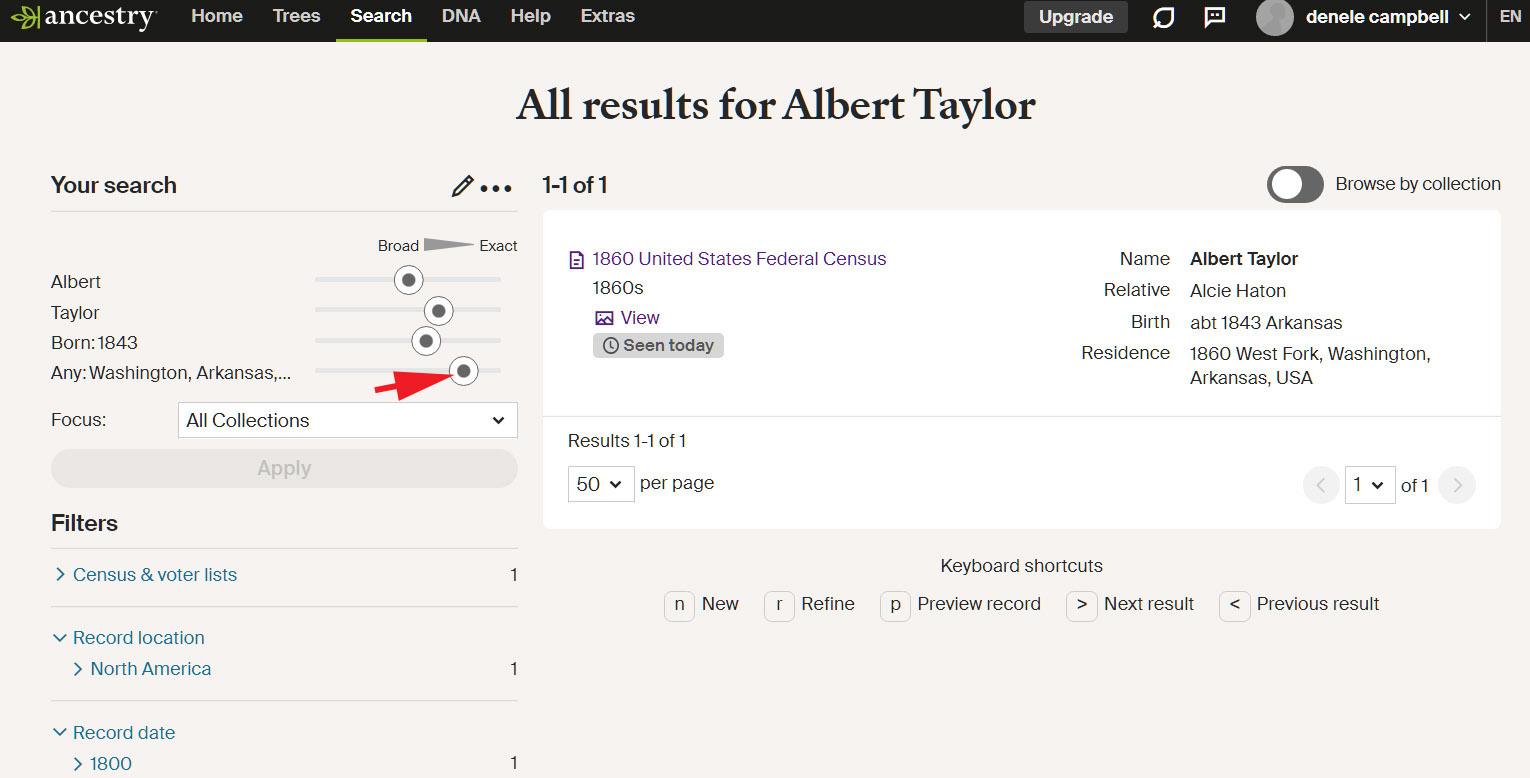

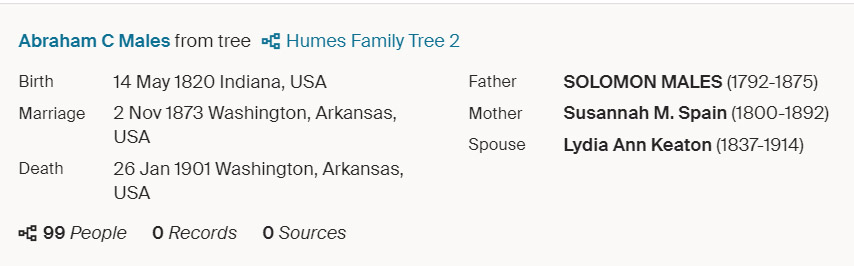


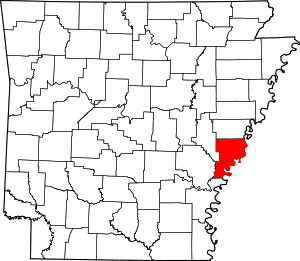
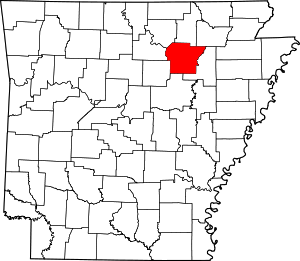
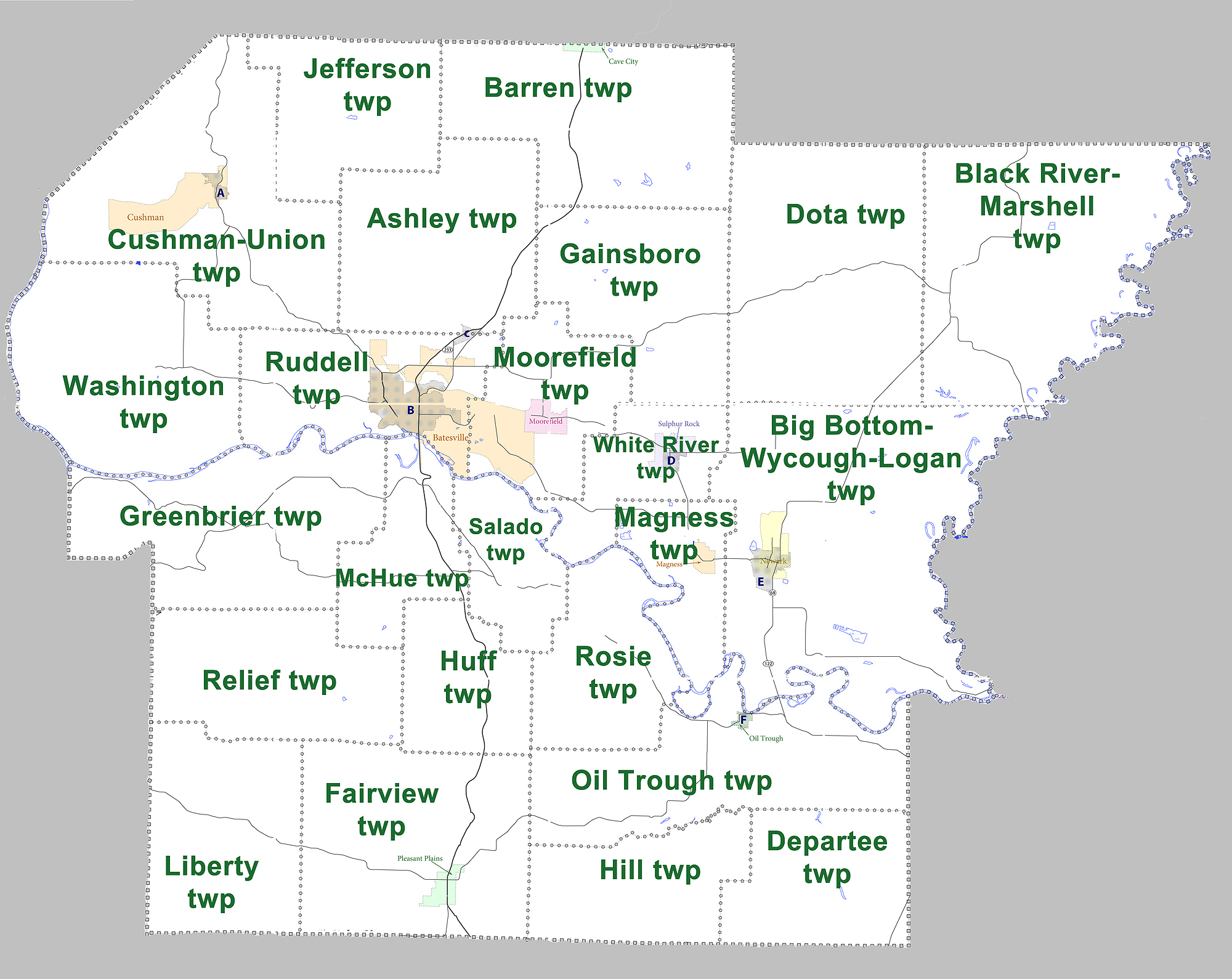
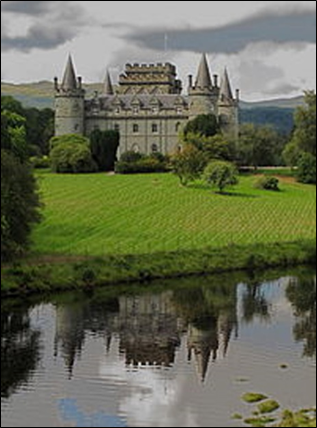
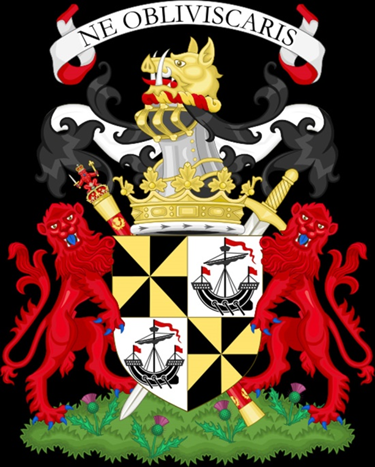
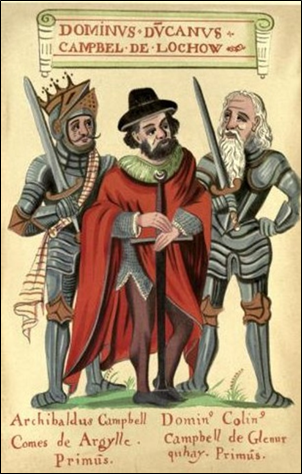
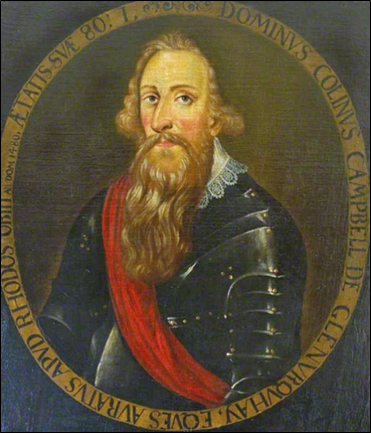
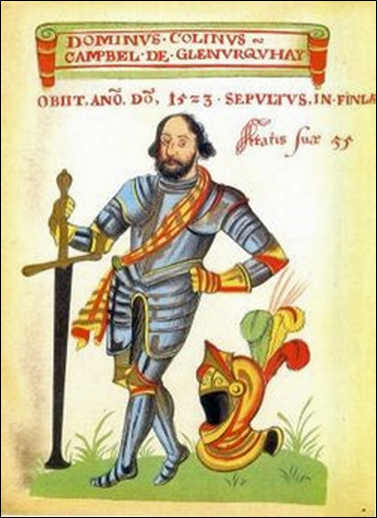


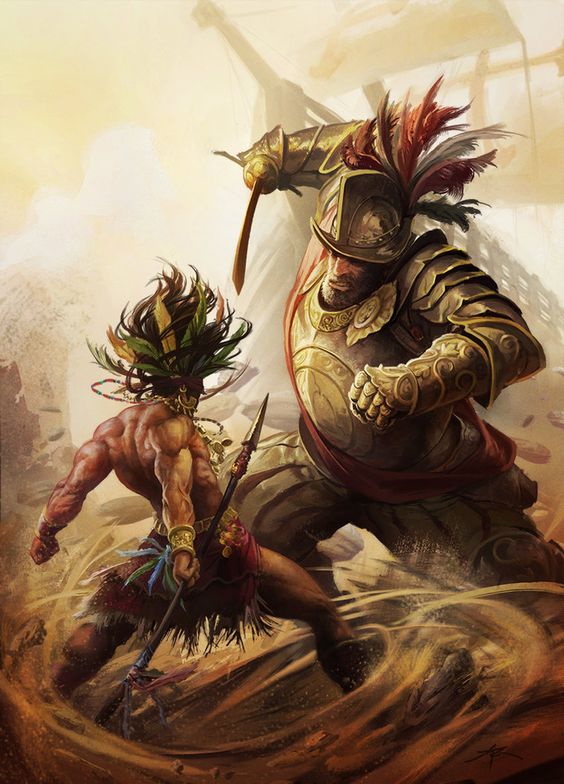


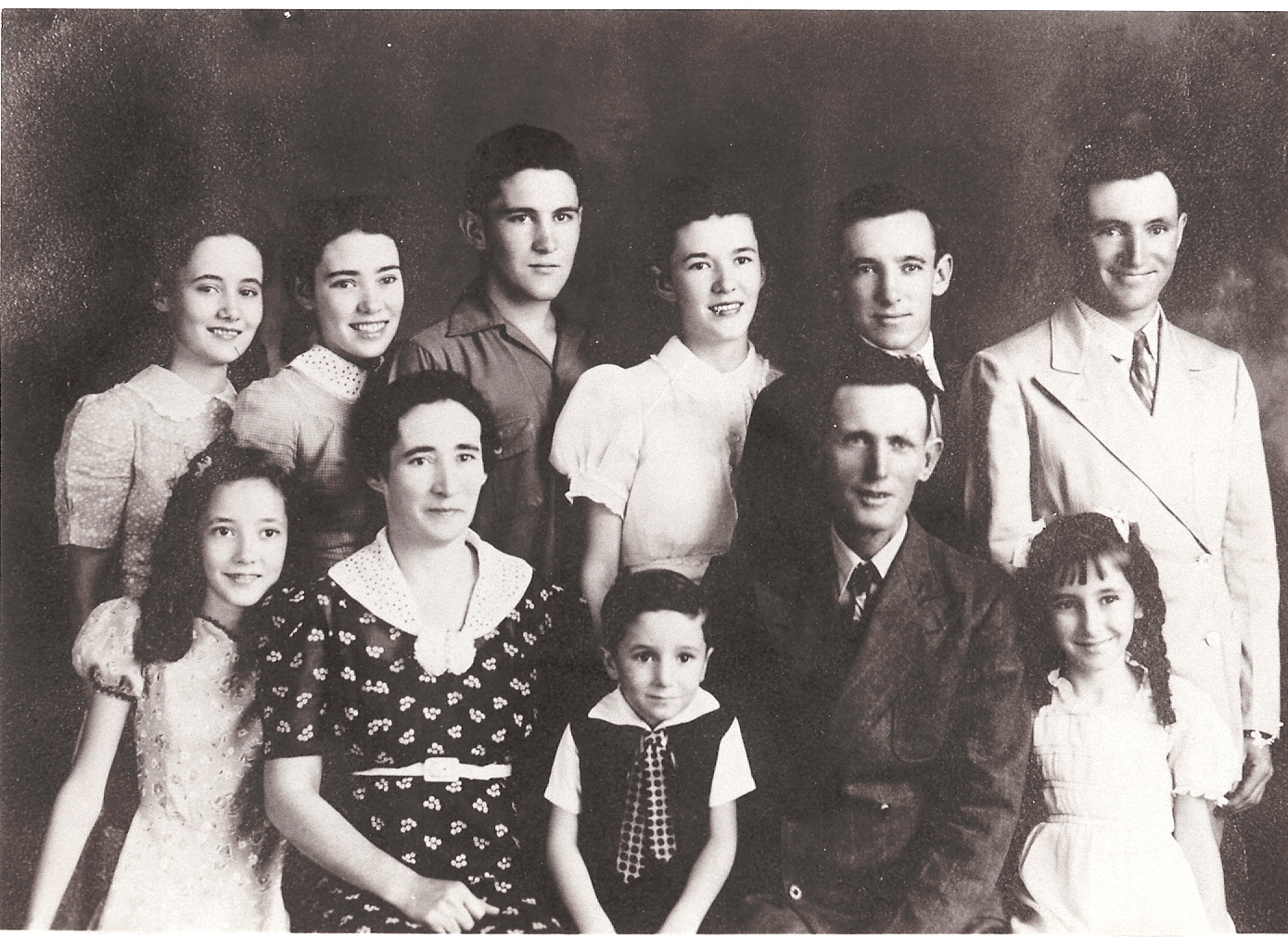




 denelecampbell