A visiting guinea? A ‘possum in the dining room? What strange and wondrous occurrences can one expect while living on an Ozark mountaintop for thirty-five years?
Tag: Arkansas
A Gathering of the Tribe

Great strength comes from family tradition. I’ve seen it once again for myself, a gathering of elders I’ve known all my life. In the days and hours leading up to this October reunion, trepidation warred with exhilaration in the prospect of seeing my kin again. Three days past my last contact, I am only now able to let the anxiety fall away.

Why anxiety? The clan was the community, at least for many of us older ones, and gathered each summer for a week of Rook tournaments, debates on myriad subjects, talent shows, and general mayhem. These people were my judges as well as my mentors, the audience for baby pranks and elementary accomplishments. Like my forty first cousins, of which I was the fifth oldest, I was subjected to quizzes and scrutiny on everything from the ruffles in my skirt to the cleverness of my retort.
A person would think that by the age of sixty-seven, I would have grown past the traumas and dramas of childhood. But no, like the genes we share, interactions with the pantheon of my mother’s family remain a strong influence. I should be glad of the genes—of my Grandmother Sylvia’s nine children, six remain among the living. The oldest recently celebrated her 96th birthday. The youngest, feted at this recent gathering for his 80th, remains—like all of them—in remarkably good health.

Matriarch to her own tribe of five offspring, my mother was the middle child of nine born to an even sterner matriarch in Sylvia. Herself the oldest of nine, Sylvia followed a lineage of strong women who simultaneously chafed at the yoke of traditional wifedom while, at least in theory, subscribed to the religious role of subservient ‘helpmate.’ Sylvia’s mother Zeulia raised nine in a marriage with a man never far from his Bible but nonetheless willing to watch his aging wife wade out into mid-winter snow to gather firewood. Zeulia’s mother Armina enjoyed a few years of happy marriage to Jeptha Futrell and the arrival of two sons (one of whom, Junius Marion Futrell, became a governor of Arkansas) before losing Jeptha to pneumonia and remarrying during Arkansas’ devastating aftermath of the Civil War. Armina’s mother Frances Massey, as the fabled family account goes, grew up in the lap of southern luxury at her father’s plantation only to elope at age thirteen with the property’s caretaker Jimmy Eubanks. Their first child, born when she was fourteen, was said to have a head the size of a teacup and yet grew to robust male adulthood.

By the mid-1840s, Jimmy and Frances crossed the Mississippi River on a barge and set up housekeeping in the northeast wilds of the new state of Arkansas. Subsequent generations married and lived in similar barebones circumstances in the farmlands near Crowley’s Ridge. After the Civil War, some of the family settled in Texas, and by the time my mother was born in 1923, entire households pulled up stakes each season to pick cotton in Texas before returning to “God’s Country” for the winter.
At the time Sylvia gave birth to her first child, her mother Zeulia was still producing children of her own. Both generations lived together at times in dog-trot houses on Ozark dirt farms, scraping up a livelihood from gardens, milk cows, and free range chickens and hogs. Despite their often desperate economic conditions, the families pursued education. Of my cousins, several hold graduate degrees and many more undergraduate degrees, while others have become successful entrepreneurs, engineers, and educators.

We are told that our genes carry not only the codes for our biology, but also the encoded experiences of our ancestors. I’m left to wonder if my tendencies toward worry derive at least in part from the epigenetic traces of the Civil War and the Great Depression. Is my desire for solitude and rural landscapes the result not only of my own life but even more from the generations of ancestry that found safety and sustenance in the land?
As far back as genealogical research has taken us, efforts largely spearheaded by one of my aunts, the family follows a long tradition of yeoman farmers. Perhaps we were serfs not too many centuries ago, tuned to the change of seasons and the requirement to please a rich master. Our histories find sparse mention of cities and their trappings. We care more about the weather than women’s clubs, more for landscapes than local politics. Yet we do care, passionately, about our freedoms and the direction of the nation despite the fact that we divide fairly evenly between conservative and liberal.

Of the forty cousins, only fourteen made an appearance at this gathering. Only six or seven lingered for more than one evening. My oldest, now turning forty, waded in and was welcomed as were a few other grandchildren. My mother and two of her five siblings live in this area. Three others, two from Texas and one from New Mexico, stayed for six days, variously taking naps, visiting graves and old homesteads, and arguing over Rook scores. Wrenched to see them come and equally wrenched to see them go, I have since stared out my office window to contemplate the emotions set in play by the event.
The cousins who did attend agreed not to let our next meetings occur only at funerals. Inevitably, the funerals will come, not just for our aunts and uncle, but for us. There’s the strange comfort of time and conversation with those we’ve known all our lives, even though as adults we have little in common, hardly know each other at all. There are our children, grandchildren, even great grandchildren of which we are barely cognizant, yet each of them remain connected in these threads that grow ever thinner as the generations expand.
Thus is the history of all man’s tribes.

As children, my cousins and I not only played together at the annual family reunions but also at reunions of Sylvia’s siblings. We learned the names and faces of great aunts and second cousins, many of them still firmly entrenched in the lands of northeast Arkansas. The rest of us have remained as near as northwest Arkansas or as far as Georgia, California, and all points in between. There’s a mathematical impossibility to any attempt to acquaint the offspring of the forty cousins, or even to gather the forty cousins in one place.
Whether knowledge of one’s ancestry holds any relevance may be debated from various points of view. Whether I want to have these ties or not, I can’t imagine life without them. The huge array of people linked to me through family offers an oddly reassuring backdrop to any of my peculiar interests and life patterns. I’m no longer a child intimidated by their observation or awed by their arguments. They care about me as I care about them, not because we’ve done anything in particular to earn the caring, but simply because we are connected by inheritance.
We’re still a tribe.
The Red-Headed Bug
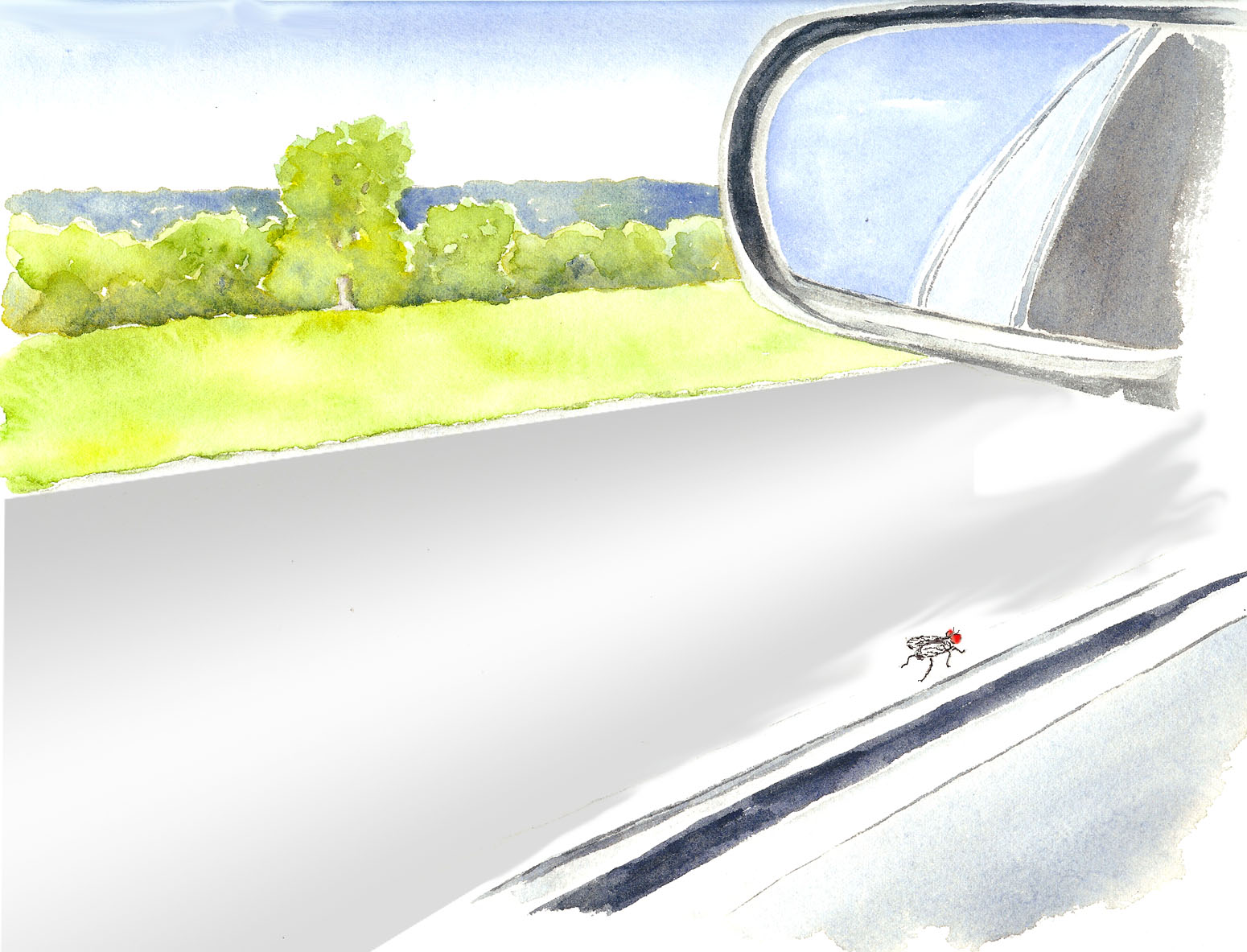
The car kicked up a cloud of dust as I hurtled down the long driveway. In my rush, I turned onto the county road and traveled another half mile before I noticed the creature that furiously held on just outside my side window, some kind of small waspish fly, its bulbous eyes perched like wire-rimmed glasses on its orangey-maroon head, its tidy black veined wings tucked sleekly along the sides of its narrow black thorax. Its thin legs flexed and strained to remain anchored in spite of the force of the air stream as I sped along.
This was not a singular event. My rural wooded property hosts bugs of infinite variety, some of which end up resting on my car. On any given trip to town, I might inadvertently transport tan walking sticks, red, yellow, or black wasps, skinny dirt-dobbers, black, blue, or green flies, beetles of every conceivable shape and shade, spiders, ticks, bees, mosquitos, gallinippers, moths, ants of assorted size, and any other of so many multiple-legged beings that I suspect some of them have, to date, escaped scientific classification.
Notable creatures such as the saddle-backed, black stinkbug or the lime green preying mantis usually merit my immediate pull-over where I carefully remove them to roadside vegetation wondering if they find any advantage in new territory. I’ve considered whether higher insect intelligences, like flies, might purposefully plan for such transport. One large green fly made it all the way to town, having carefully positioned himself in a joint of the windshield wiper, perhaps with a particular lady city-fly in mind.
I rarely see them as I load in my gear, back up, and drive away, not until I have picked up speed, until they begin to slide, inexorably, across the waxed paint of the car’s body or the smooth glass of the windshield. They ride in ignorance, misunderstanding the threat. From their egocentric viewpoint, the problem is not that they are unwitting passengers on the rides of their lives, but simply that a strong wind has sprung up.
The challenge is to hold fast.
On this particular morning, the red-headed fly had arrived at my parked car door, at what seemed a perfectly fine spot to rest, groom, and digest his latest meal. As I began driving and the sudden gale blustered around him, he braced himself, securing every foot firmly to the spot. He had no concepts through which to anticipate that his greatest risk came with hanging on to what seemed familiar surroundings, that ultimately he would be farther away from what he knew and desired than he would have been if he had simply let go.
As I cruised along the road, the tiny red and black fly gripped ever more frantically to maintain his hold. In order to offer the least wind resistance, his body bent and contorted, stretched and elongated, the severity of his effort betrayed by erratic flare-ups of his wing tips. Staring at me through the side window glass, he seemed to question me in panicky stares.
I advised him based on my previous experience.
Some bugs come to a forty mile per hour realization, I said. While I’m still on this back road, in a serendipitous flash of insight, they let go.
I waited for his response. He tensely adjusted his wings and aimed his head more into the wind.
After some scary free fall, I continued, they find themselves in the thickets near Miller’s pond. We drove farther and his stance remained resolute.
Or in the rocky ditch, I said, or in the middle of Mr. Breedlove’s herd of Angus. Wherever you might find yourself, I’m sure you could optimize the situation—you know, discover a trove of aphids or a lonely female.
I glanced to see if he was listening. The red-black fly showed no hint of a high-speed epiphany but instead re-exerted his desperate clench.
Ignoring the urging of my more generous side, I accepted little ongoing responsibility as to the fly’s future well-being. It was, after all, an insect. And I was in a hurry.
The road merged onto the highway, and I accelerated. Listening to the radio, absorbed in anticipating my day’s schedule, and maneuvering through heavy traffic, I failed to notice when his tiny sticky foot pads ripped loose from the slick paint of my car door.
Halfway into town, I realized he was gone.
Briefly, I suffered anxiety on his behalf. Had he made his leap at the right moment, I wondered? Was his grip torn free in the surge of a passing truck, bringing him to join countless distant kinsmen already pasted to its front grill?
Had he ever understood the threat?
Had he understood and somehow just hadn’t figured out the best timing?
I narrowed my thoughts to more pressing considerations. The city lay ahead. In a continuing ethical quandary about my role in the greater scheme of things, I decided to believe that he knew what he was doing all along and got off right where he intended.
—
From the collection I Met a Goat on the Road and other stories of life on this hill. Available in paperback with the original watercolor illustrations, or as an unillustrated paperback, or as an ebook.
Unillustrated paperback: http://www.amazon.com/dp/1500913197
Illustrated color paperback edition & Kindle edition: http://www.amazon.com/dp/B00DW9QLKO
Jars
If I had considered the question in advance, I would have known that cleaning out the barn would precipitate a crisis. Memories long stored away for some magical future moment when that child’s toy, that handsaw, would again be needed—did I keep them simply for the memory? Furniture—small tables, wooden chairs, an ottoman frame, an old piano bench well made of oak and in need of a few repairs—would I someday find time and reason to fix them and return them to my house?
Too good to throw away. Largely irrelevant to my current life.
Becoming relevant at some future point? Probably not.
Determination to survive in a world lost to chaos drove the accumulation of this minor hoard. It was 1975. We had small children who would need to eat and thrive even if the bomb fell. We labored to renew skills our grandparents knew by heart, certain that within our lifetimes we would have to hide in our house until the fallout settled then emerge to plow, plant, and harvest our food, breed our pigs, chickens, and goats for future generations of meat and milk. We gathered meat saws and grinders, steel axes and shovels, nails and wire.
Time marched on. The Cold War ended and fingers moved away from the annihilation button. The children are no longer dependent babies who might benefit from a collection of books on history, science, math. The goats departed in the late 80s, the garden in the early 90s, and the last of the chickens about ten years ago. The children have gone off like grown children do to find their own visions of the future.
Why do I need eight hand saws, ten hammers (of various sizes), buckets of random nails, screws, washers, bolts, and nuts? Feed scoops and cheesecloth, empty egg cartons, milk pails. What possible purpose could be met by random pieces of plywood or sheetrock, insulation, screen, tile? Why do I think that at some point I’ll make use of a decrepit power saw, drill, or grinder when, for the last twenty-five years, I have not?
I have created two piles. One is for the junkman to haul away. The other is for craigslist ads and friends who operate flea market booths. I am mildly optimistic that someone might buy the old wooden toolbox, child’s desk, or the sturdy small tables, the ten gallon pickling crock or the T-post driver. Never mind that for what I’d receive in dollars, I could restore only a fraction of this hoard.
In truth, what our energy and money bought in those early days was peace of mind. With our collection of tools, books, supplies, and know-how, we’d have a chance. Our kids would have a chance.
It served its purpose. The purpose no longer exists.
Sounds good. But what I haven’t put in either pile is the pressure canner. And the jars. Dozens and dozens of canning jars—quarts, pints, jelly jars. It’s the jars that have brought me to crisis.
When my firstborn child was two, my grandmother died. My dad’s mom, Nora. Always a country girl, Nora knew how to make soap, kill a chicken with a swing and stiff pop of its neck, and would can just about anything edible. She had jars. When they started clearing her property for the auction, I went down to Cane Hill and helped clean out her cellar. I hauled back cases of canned goods.
She had declined for a decade until her death at age 86. I wouldn’t dare eat any of the food in those jars. We had hogs and chickens at the time which allowed me to make use of Grandma’s labors. Each day I’d go out to the barn and pens and open more jars. Applesauce, whole plums, peaches, pears. Grapes and elderberries. Green beans, tomatoes, cabbage, mixed vegetables. Tallow. Jelly, jam, preserves. Juice. The critters were well fed that year.
We grew a huge garden. Neighbors had pear trees. We visited orchards and vineyards. Even with all of Grandma Nora’s jars, I sometimes ran short. My mother gave me jars. I bought jars.
In those heady days, each fall I stood in the storage closet and stared at my larder. The sight of all those jars filled me with the greatest pleasure that once again, by the labor of my hands, I had set aside enough green beans, tomatoes and sauce, peas, corn, and kraut to last a year. The jars lined up in colorful rows, golden tomato seeds swimming in crimson broth, finely shredded green cabbage fermented into tangy white kraut, wild plum jelly glowing fuscia in the dark.
Producing and preserving food challenged me like nothing I’d ever done. Even with a tractor and rototiller, even with liberal applications of goat manure and mulch, plants struggled to survive against drought, bugs, and predation. How many hours did I spend hoeing weeds or picking off potato bugs? How many hours peeling and chopping, sterilizing and packing, standing over the pressure gauge to ensure the right amount of intense heat and adequate time to prevent spoilage.
There’s a sound as jars cool, the snap of the canning lid sucking down, sealing the contents safely into the future—I loved that sound. Then it was time to use the grease pencil to write on the lid—July 1981.
Now I have all these jars. The cardboard boxes have suffered over the years. Faded brown paper hangs in shreds, the sides bow and buckle. Even if I keep the jars, I have to plow through generations of dead spiders and a healthy population of live ones to retrieve the jars from box wreckage. Why would I go to the trouble to re-package all these jars knowing that twenty years from now, it would all be to do over again? Would I be any more willing to let go of them then?
My children have no interest and no place to store jars. I wouldn’t mind storing them if my kids wanted them. But there’s no longer a tractor or rototiller. The half-acre garden has grown up in saplings and pasture grass. There are no goats to produce manure. Everything is different.
But here’s the argument. Certain things haven’t changed. We have to eat. We have the ability to grow food. With jars and a pressure canner, we could store food. Isn’t that incentive enough to save the jars?
What is my responsibility? For countless generations, as far back at least as civilization, my ancestors have planted, cultivated, harvested, and stored food. These are skills we’ve learned—how to measure the right time to plant onions or corn, what seeds to soak before pressing them into the dark earth, how to dig potatoes without piercing them. We raised our kids to know these things.
Do I simply walk away?
Why not? There are books. There are others still farming, still canning—the knowledge won’t fade simply because I relinquish my jars.
Even with the best of hoards, with all the tools and seeds saved and an endless supply of jars, at the end of the day, survival in a world gone mad would be a tenuous venture. What about grain? No bread, no pasta, no crackers. What about oil, salt, soda, sugar? We’d be dependent on venison and that requires guns and ammunition. My .22 rifle won’t bring down a deer.
At some point, even the most vehement survivalist will face what I face. How many times in your life do you restock your rations and water? How much is enough ammunition? Who are you prepared to kill to protect your hard won ark?
I’m working on a compromise with myself. Today I think I will keep a few jars as mementos of my grandmother, the tall green half gallon jars and a few of the older square-shoulder quarts. I will wash them periodically and keep them up on a shelf, decoration that tugs my heartstrings when I look up from my daily tasks. I will acknowledge the hard work and dedication that touched these jars, my hands, my mother’s hands, my grandmother’s hands.
All the grandmothers. All the jars. All the tomatoes and fine plum jam will not save the world.
Legal. Immoral.
For better or worse, religious affiliation remains an important thread in the social fabric of these United States. ‘Better,’ most would say. Political candidates campaign on their religious credentials. Religious leaders are sought out as advisers in business and community affairs.
A large segment of the population assumes that religion provides important moral guidelines for life. The theory is that without religion, there would be no morality.
But what if the opposite were true? What if religion gets in the way of moral behavior?
The assumption has been that highly religious people such as our locally infamous Justin and Marsha Harris are highly moral. They go to church. They ‘witness’ their faith in public. Mr. Harris has used his Christian standing in his successful campaigns for public office. Their religious mission is to ‘grow God’s kingdom’ at their pre-school by indoctrinating children with religious teachings.
In the last year, events have unfolded that cause many to question the morality of the Harrises. Believing that God guided their steps, about four years ago they adopted two little girls. Within a relatively short time, the girls became such as problem that the Harrises gave them away. The six-year-old was subsequently raped by her new ‘father.’ In March 2015, the story became public.
In addressing that horrible outcome, Justin Harris belatedly stated he felt sorry for the little girls’ experience. Aside from that, he has blamed the state’s social services agency for not helping more. That’s it.
The irony is that the Harrises felt free to dispose of their newly adopted young daughters and then, in the public fallout after their ‘rehoming’ came to light, agreed that such a practice should be defined as a felony.
Is such an act wrong only if it breaks a law? Did the act of rehoming change somehow once the law was passed, so that when Justin and Marsha rehomed these girls, it wasn’t wrong?
The moral reality is that if it’s a felony now, it was a felony when it happened.
Unfortunately, this is often how religion works in people’s minds. An act is immoral, wrong, bad only when someone has already written a rule or law about it. Does the religious person have license to ignore (or never bother to understand) a greater responsibility to adhere to an inner moral code that would say, emphatically, that dumping young children you’ve pledged to make your own is wrong, bad, immoral?
It’s the ultimate mea culpa. Throw up the hands. “Nobody said…”
Justin and Marsha found themselves at a loss about how to handle these two troubled young girls. They pulled out all their parenting skills to punish bad behavior—isolating, taking away privileges, removing toys and entertainment. They prayed out demons and perhaps did not spare the rod. Nothing worked. The behavior became worse.
This would have been a rich opportunity for the Harrises to learn some new parenting skills. Perhaps positive reinforcement, or long sessions of hugging and other positive physical contact, or one-on-one time pursuing new and interesting activities would have been useful in breaking down the wall of mistrust and anger that grew between these adults and their two young daughters.
Sympathetic observers point out that the Harrises had successfully raised three sons, concluding that they must be decent parents. It remains to be seen how well the sons turn out. But it’s also worth questioning whether the Harris’ success in raising their own children wasn’t a result of stellar parenting as much as a result of the boys’ adaptation to repressive, authoritarian parenting from Day One.
We know the girls were capable of appropriate behavior. The foster parents who cared for them before the Harris adoption as well as the family who have subsequently become the girls’ parents have remarked on the girls’ loving nature. Neither families have run shrieking in terror from the girls or found them a threat to the stability of their households. It’s not much of a stretch to conclude, based on this evidence, that the problem between the girls and the Harrises was the Harrises.
The rape has dominated discussion of the Harris’ rehoming decision. But a much bigger issue looms in the background. That is, the immorality of legal behavior.
For example, law enforcement beats up an innocent person because he didn’t instantly abide by police orders. A hunter spends $50,000 to kill a trophy animal. Legal. Immoral. A list of other examples would be long.
As far as I’ve heard, the Harrises have never said they did the wrong thing. Justin never admitted that he may have used his legislative seat (as representative for my home district) to push through an adoption against the expressed advice of caseworkers and the girls’ foster parents.
Yet it was a chain of events propelled by the Harrises which led to their custody of the girls in the first place. Where exactly does the responsibility begin?
Were the Harrises wrong to be so arrogant that they ignored advice from experienced caseworkers? Was it immoral to commit to parenting two very troubled young children and then renege?
Yes.
How is it possible for the Harrises to have engaged in immoral, arrogant behavior and still—after all the exposure and shame—not recognize the depth of their immorality?
I would suggest that their hubris stems directly from pride in their own religiosity.
A recent study found that religious people aren’t more likely to do good than their nonreligious counterparts.[1] This isn’t the first or last evidence that religion does not impart morality. Here’s just one of many comments on this question.
- These studies begin to provide empirical support for the idea that like other psychological faculties of the mind, including language and mathematics, we are endowed with a moral faculty that guides our intuitive judgments of right and wrong, interacting in interesting ways with the local culture. These intuitions reflect the outcome of millions of years in which our ancestors have lived as social mammals, and are part of our common inheritance as much as our opposable thumbs are.[2]
It makes sense that humans possess innate morality. In the view of those who subscribe to evolution, morality is an evolved necessary component of our continued existence. In the view of those who adhere to beliefs in extraterrestrial interference in human existence, morality would have been a key ingredient in intelligent design. Either way, all investigation points to an innate morality in human consciousness.
Recognition of innate wisdom and individual responsibility should be taught in every pulpit. Instead, especially in fundamentalist religions, individuals are taught to be afraid of their instincts. They’re taught to follow rules laid out in religious texts and nothing else matters.
Inevitably, a person’s avid embrace of institutionalized religion can and does interfere with the application of inborn human morality. The person trusts the religion, not himself. The religion’s rules or lack thereof in any given application supersedes any instinctive understanding of right action.
Assuming that the fundamental element of morality in human nature is not somehow missing in the genetic code of Justin and Marsha Harris, an interested observer would be forced to conclude that it was their religion that got them into this mess. Religion is the reason why, even months after their poor judgment became front page news, they still have not said they made a mistake, have not said they regret what they did. Have not apologized to the state agencies they maligned. Have not asked forgiveness of the public they supposedly served.
They did what they believed their religion and the law allowed. They parented according to a model condoned by the church, perhaps modeled after how they themselves were raised. What they did wasn’t a felony when they did it, therefore they did nothing wrong.
Harris has announced he won’t run for another term in office but stopped short of resigning from a seat he’ll hold another eighteen months. He continues to wield regulatory and fiscal power over the same state agency which he says forced him and Marsha to dump the little girls. He and his wife continue to operate their pre-school where they pass on their questionable religious teachings to innocent children.
As an embarrassed constituent who never voted for this man in the first place, I’ve given up hoping for a Harris epiphany any time soon. Even more regrettably, I doubt we’ll ever hear a word of censure from his equally-religious legislative colleagues and governor.
Perhaps the most we can salvage from this unsavory affair is to recognize the broader lessons. Religion doesn’t confer morality. Worse, an individual’s duty to pursue moral behavior is easily abdicated in favor of going to church.
We need more morality and less religion.
[1] http://www.livescience.com/47799-morality-religion-political-beliefs.html
[2] http://www.qcc.cuny.edu/SocialSciences/ppecorino/INTRO_TEXT/Chapter%208%20Ethics/Reading-Morality-without-Religion.htm
Domes

In the 1960s and into the early 1970s, geodesic dome structures cropped up around the world, including in Northwest Arkansas. Some lasted, many did not.
Based on the idea that what we see externally informs how we understand ourselves internally, domes epitomized a philosophical approach to human habitation.
Traditional architecture with its multiple separate rooms leads to a segmented self view, according to this argument. Rounded open space such as provided in a dome fosters a more holistic view of self and the world in general.
The dome concept was developed by Buckminster Fuller. Fuller discovered that if a spherical structure was created from triangles, it would have unparalleled strength.
“These new homes are structured after the natural system of humans and trees with a central stem or backbone, from which all else is independently hung, utilizing gravity instead of opposing it. This results in a construction similar to an airplane, light, taut, and profoundly strong.”

The sphere uses the “doing more with less” principle in that it encloses the largest volume of interior space with the least amount of surface area thus saving on materials and cost. Fuller reintroduced the idea that when the sphere’s diameter is doubled it will quadruple its square footage and produce eight times the volume.
Fuller worked towards the development of a Comprehensive Anticipatory Design Science which he defined as, “the effective application of the principles of science to the conscious design of our total environment in order to help make the Earth’s finite resources meet the needs of all humanity without disrupting the ecological processes of the planet.”[i]

Domes were built not only by idealistic hippies pursuing an improved state of consciousness but also ended up in use at commercial locations. A enhanced dome built to house an optometry practice in Fayetteville, Arkansas remains in good condition.
One of the surviving residential domes in the area includes bump-outs and other additions that make for a more family-friendly features. This one includes a basement and a rear deck.
Other commercial uses included the Southern Energy Fast Oxide Reactor (SEFOR) built in south Washington County near Stricker. SEFOR operated from 1969 to 1972, when the original program was completed as planned. It was privately operated by General Electric and funded by the United States government through the Southwest Atomic Energy Associates, a nonprofit consortium formed by 17 power companies of the Southwest Power Pool and European nuclear agencies.
The facility was then acquired by the University of Arkansas in hopes that it could be used as a research facility. However that never happened and the university has been paying $50,000 in maintenance fees yearly since. SEFOR is still considered contaminated and the University continues to seek federal funds to clean up the site.
Another example of dome construction in commercial application is the St. Louis Climatron, part of the Missouri Botanical Gardens built in 1960. Controlled environment in this large dome re-creates a lowland rain forest.
Due to limitations of materials and use requirements, domes today are built for only a few applications, most notably sports arenas and as a complement to other structures such as churches where a separate dome feature may add another dimension to sacred space.
Photographs courtesy of Denny Luke, a longtime resident of the area.
[i] http://bfi.org/design-science/primer/environmental-design-science-primer
The Report Is In
Initiated in early spring, a study of Arkansas’ Department of Human Services (DHS) is Governor Asa Hutchinson’s first step in addressing systemic problems within the agency. The driving force behind this initiative was the ‘rehoming’ and subsequent rape of a six-year-old girl originally adopted by Rep. Justin Harris and his wife Marsha of West Fork, owner and operator of a pre-school, Growing God’s Kingdom.
Harris’ excuse for their ‘rehoming’ of two already traumatized little girls was that he had asked DHS for help and they had refused. He stated that the girls had been “damaged by previous abuse and he couldn’t manage them,” according to Friday’s coverage by the Northwest Arkansas Democrat-Gazette (July 17, 2015).
Unfortunately, the governor failed to require this study to investigate whether Harris abused the power of his legislative position to coerce DHS approval of the adoption in the first place.
The couple fostering the two girls prior to the Harris adoption have voiced their belief that Harris had done exactly that. More than one observer cited local caseworkers’ opposition to the adoption. Harris was warned that the girls would not be suitable for his household. He pushed the adoption through anyway and immediately included the girls in a photograph used in his reelection campaign.
Less than a year later, when he and his wife decided the girls were too much to handle, Harris ‘rehomed’ them to a Benton County couple, Eric Francis and his wife.
Harris may have believed that the Francis household would serve as a suitable home. He cited the couple’s adoption of other children as evidence of their suitability. In hindsight, an observer might suspect that the couple’s eagerness to adopt had to do with the husband’s predilection for molesting children rather than any altruistic urge.
Prior to a stiff “I’m sorry for what happened to the girls” statement in June, Harris has admitted no wrongdoing. Now that the governor’s study is complete, it seems no blame will be assigned. We can take small comfort that Harris won’t run for another term.
State police investigating the extent of Francis’ abuse forced Harris to acknowledge to parents of his preschool students that a former employee had been convicted of sexually molesting children. Investigators found no specific evidence that Francis abused any children at the preschool, but several parents removed their children from the program anyway.
A year passed.
Without a reporter digging into the matter, the link between the conviction of Eric Francis and the role of Justin and Marsha Harris would never have been made public. Harris had reasons not to want any of this known. Not only was he holding elected office and operating a religious pre-school, he served as the co-chair of the House committee with control over the Department of Human Services. The whole debacle reflected poorly on his judgement.
Apparently none of this lit up on Gov. Hutchinson’s radar when he commissioned the study of DHS even though the trigger for the study was Harris’ accusation that he had to rehome the girls because DHS wouldn’t help. There has been nothing from the governor or in the report to criticize Harris for ignoring DHS advice and pressing for the adoption. There’s been no known follow-up on whether Harris held up the DHS budget request as part of his coercion as alleged by some observers. There’s been no statement by any of Harris’ Republican colleagues in the state legislature as to his ethics–or lack thereof.
Yes, DHS has problems and the report confirms just how bad they are. None of that excuses what Harris did.
Gov. Hutchinson brought in Paul Vincent to conduct the study, an experienced career man who formerly headed Alabama’s social services department. Vincent has conducted similar studies in numerous states. His analysis reveals a state agency in deep distress, understaffed and suffering long-term problems, all of which fell under Harris’ purview as Vice Chair of the House Committee on Aging, Children and Youth and as a member of the Joint Budget, a powerful committee which approves all appropriations for state agencies.
The study found that caseworkers in Arkansas are expected to handle twice as many cases as the national average (29 versus 15). The state has only two foster homes for every three children who need them which results in one of every five children in need being placed in a non-family living situation. Some caseworkers are forced to hold the child overnight at the office or at their own home.
The problem gets worse by the day. The number of children in foster care increased in just the last two months from 3,875 to 4,323. Fifty-five percent of fostered children are placed outside their home county because adequate arrangements aren’t available locally. With this kind of pressure within the system, the default option for caseworkers is to ignore cases where abuse is not clear cut.
The outcome is horrific. In 2011, 23 children died in families where social services had been in contact but had not taken the child out of the home. By 2014, the number jumped to 40. Most recently, a six year old boy died of intestinal rupture after being raped by his father. Social services had previously visited the home twice and found nothing to justify removing the child from the home.
The six-year-old raped after being rehomed by Justin and Marsha Harris came from an extremely troubled home situation. According to reports, this middle child of three daughters had already been through hell.
- The girls had been taken into DHS custody in early 2011 after suffering through a staggering sequence of chaos and abuse. First, [the mother Sarah] Young discovered her husband sexually assaulting Jeannette, the oldest of the three girls, and turned him in; he is now in prison. (Other sources claim Young waited for days to turn the husband over to the police.) Young then became involved with a man who cooked and sold methamphetamine; a fire started by his meth lab provoked a police investigation that sent that man, too, to prison. The child abuse hotline soon thereafter received a call from an individual concerned for the girls’ safety, and investigators found the children in the care of a woman in a house with multiple adults who tested positive for meth; one man at the home had been sexually abusing both Jeannette and Mary, and he is now serving a 120-year sentence. When DHS collected the children, the eldest was 5, the middle girl was 3 and the youngest was under a year old. (More here)
Vincent pointed out the frustration experienced by caseworkers who want to help children and yet are left without sufficient resources and methods by which to do so. In response to the report, Gov. Hutchinson estimates it will mean hiring an additional 200 caseworkers at a cost of at least $8 million. No one knows where that money will come from.
Price tags remain unknown for the report’s recommendation for better and more accessible mental health care for foster children and others in the state’s care. For years, law enforcement and prison administrators have called for better mental health interventions for troubled offenders who end up incarcerated. The death toll among mentally ill prisoners continues to climb along with deaths of abused children while to date the state legislature has made no real strides in addressing this need.
Meanwhile, in their 2015 sessions Harris and fellow legislators spent countless hours fomenting unconstitutional laws to restrict abortion rights and to allow a Ten Commandments monument to be erected on state capitol grounds. And they’ve given themselves a pay increase from $15,869 to $39,400 per year.
If the Justin Harris case hadn’t been brought before the public by a reporter at the Arkansas Times, it’s questionable whether this study would have occurred. Because that’s how things are done in Arkansas. We don’t want to go looking for trouble.
We know trouble is out there. We know we are among the poorest states but other than appropriating scarce tax dollars to bribe companies to locate here, we can’t figure out how to do better.
Nearly 17% of Arkansans never graduate high school and less than 14% obtain a college degree. We have the next to lowest per capita income in the nation. Our crime rate is significantly higher than the national average and our prison population is growing accordingly. We also rank high in poor health, obesity, and use of tobacco and other dangerous drugs.
Despite the continuing lousy achievement levels in Arkansas, we seem incapable of trying to change anything. The conservative voters of this state loathe national standards in education; they want local control and tax dollars for programs such the Harris preschool where children are taught that their misbehavior is the result of demon possession.
Conservatives are outraged by the Affordable Care Act and legislators promise to end the state’s participation despite its progressive reforms including increased coverage for mental health care.
The governor says he will take the DHS problems to the faith-based community to increase foster care resources and improve care. Because religion helped Justin and Marsha Harris make good choices? Because religion guided Eric Francis? Because religion saved those little girls?
Why am I not reassured?
Same Old

Oh, the wringing of hands as the State of Arkansas once again tries to cough up more money for prisons. One of the poorest states in the nation, Arkansas struggles to pay for schools and roads. But those programs are optional. Prisons are not.
That is, you see, because we must punish Crime.
Thus comes the grand news that Arkansas ranks third in the nation in prison population growth. Not only are prisons stuffed, so are the county jails where duly convicted criminals await prison space. Not only are all lockups in the state overflowing, we’ve now exported hundreds of prisoners to Texas where their for-profit system takes all the money we want to send them.
Most recently, the genius that is the current state legislature has passed a law wherein persons on probation or parole can be stopped and searched not only by parole/probation officers but also by any other law enforcement officer. The arguably reasonable rationale behind this law is that a would-be burglar might be gently nudged along a path of righteousness with more authority figures looking over his shoulder.
They actually believe this will reduce the prison population. My prediction is the opposite. More noses in private business means more marijuana arrests.
The disconnect lies in the reality of present day culture. Whether our criminal codes yet reflect it, marijuana is the new beer. Over half the states have now made marijuana legal for medical use and three (so far) have made it legal for recreational use. In those states, tax revenues are booming while teen drug use and crime in general are down.
We’ll have none of that in Arkansas. No sir.
No, here we prefer to rope goats and dip snuff. Here we produce an annual crop of Bible-thumpin’ preachers in jail for molesting children. Here we have state and federal legislators fixated on regulating a woman’s uterus and other people’s relationships. (I can say these things—I’m a native.)
I live on a dirt road. Periodically the road is graced by the passage of a road grader. The road grader moves dirt around, swiping it from the edges and piling it up in the middle where it is spread along to fill up holes and trenches cut by rain. Next time it rains, the holes appear again.
At the worst spot (pictured above), a cavernous roadside ditch abruptly ends. Water has nowhere to go. So it runs across the road. The solution is amazingly simple: cut the ditch another 30 feet to the creek. Like magic, no more bone-jarring trench.
I’ve long pondered this particular problem. I’ve sent carefully composed letters and drawings to the county road superintendent. I’ve chanced upon the grader mid-task and stopped to belabor my point with the operator. He’s always amiable, working a big cud and nodding while I talk and point. “Yes, Ma’am,” he says.
Then he grades the road exactly the same as before.
That quiet shredding sound you hear is me ripping my hair.
Is getting high a crime? If you get high on alcohol, it’s not a crime. If you zoom around all smiles on your script of Valium or Xanax, not a crime. Face it. People smoke weed. Water runs downhill.
There’s never been a study showing that laws against drugs have been effective in stopping drug use or addiction. All we have to do is look at the status of our prisons to know those laws have failed. We have a greater percentage of people using drugs now than ever before. Great work, guys. Keep filling those holes.
In 2014, Arkansas arrest data show 14,480 crimes against persons (murder, rape, assault) with the largest subset of 8,103 for simple assault. There were 20,329 crimes against property (arson, burglary, vandalism, fraud, theft) with the largest subset of 8,360 for shoplifting.
Drug arrests (in the category of ‘crimes against society’) totaled 13,626 with 6965 for marijuana possession and 797 for marijuana sales or manufacture. The next largest subset in drug crimes was 1748 arrests for methamphetamine possession and 481 for meth sales/manufacture. (The other 1218 ‘crimes against society’ include gambling, prostitution, pornography, and weapons laws violations.)
Is possession of marijuana an offense equal to assault? Who is harmed? Equal to shoplifting? Whose goods are stolen? Does it make any sense that almost as many people are arrested for drugs as are arrested for crimes against people?
In 2013, Arkansas prisons held 23,384 inmates. Another 29,946 offenders were on probation and 23,227 on parole. The corrections budget that year was $449 million. We can only guess what percentage of the prison/jail population is serving time for drug offenses because the state doesn’t collect that information.
They don’t want to know.
If drug offenders are convicted at the same rate as offenders in other categories, then we could assume that 30% of our prison population is there for drug offenses and 57% of those for marijuana.
There has always been an element of society which believes its duty is to regulate how people think. Its lineage can be traced to the Inquisition and setting witches on fire. No one argues whether crimes against persons and property should be punished. But the idea that the state should attempt to regulate our minds violates every principle of a free society.
The standard argument in support of drug prohibition involves token concerns about people harming themselves. Worse, people high on drugs can hurt other people. Yes. But people who harm themselves with potato chips or cigarettes aren’t arrested. People trashed on booze can beat up their wives or get behind the wheel and kill a carload of innocent people. But we don’t need alcohol prohibition to prosecute impaired driving or domestic violence.
Aside from trying to arrest our way out of behavior we don’t like, the would-be guardians of our minds have promulgated a flood of anti-drug propaganda. The drug problem flavor of the decade has moved from psychedelics to marijuana to methamphetamines. Now meth is so ’90s. Today the big evil is prescription drugs. (Ironic, considering the incessant television ads hawking drugs for every conceivable human ache and mood.)
By now there’s a nearly-one hundred year tradition of criminalizing certain substances and the persons who use them. The stigma once attached to demon rum has been transferred to a growing list of psychoactive substances. We have no choice. We have to build more prisons.
Let’s keep filling those holes.
Arkansas will be among the last to let go of its attempt to control what people do in the privacy of their homes or heads. These folks are still trying to get back to the 19th century. Even though the Bible says nothing on the subject of drug use and relates multiple instances of Jesus Christ Himself using wine—hey, even making it out of water—religious extremists in control of the state refuse to allow statewide alcohol sales and would fight to the death before legalizing marijuana even for medical use.
The facts have been clear for decades. Any cost/benefit analysis would show the terrible price we pay for this futile effort. We’re stuck with the same old reaction, prisons before schools, before roads, before social services and other interventions that have the potential to actually reduce drug abuse.
How long, oh Lord, ’til the ditch is cut to the creek?
Us and Them
We thought we were the top of the world. The most advanced. The richest. The strongest. The U. S. of A., best of the best. All those things are true in so many ways. Aside from our wealth of natural resources, the nation’s strength and riches are what we, each and collectively, have to offer.
But strengths and riches aren’t all we have to offer. We also perform acts of insane violence that kill young children or innocent churchgoers, of smug self-righteousness that allows a brother to repeatedly molest his sisters, that allows an adopted six year old girl to be ‘rehomed’ and raped by her new ‘father.’
Why do deep veins of ignorance, hate, and fear continue to burn through our national body like a stream of caustic lye?
More urgently, what are we going to do about it?
Cultural Tradition: The Scots, for example
Following centuries of armed conflict between the native Scots and the British, in 1745 the British brutally terminated the last rebellion. Traditional Scottish kilts were outlawed and inherited lands were taken from the ruling class. A century earlier, Britain had moved large numbers of Scots into northern Ireland in an effort to weaken the equally rebellious Irish. (The volatile results of that maneuver continue to simmer today.) This Scots population of northern Ireland became known as the Scotch-Irish.
Aside from the desire for self-rule, the Protestant Scots and Catholic Irish fought the Anglican British over religion.
Between 1717 and 1775, nearly a quarter million Scots and Scotch-Irish migrated to the American colonies. Earlier settlers had already built their towns, farms, and plantations along the eastern seaboard so these newcomers moved west to unsettled land. They fought Native Americans and the wilderness to carve out a life where nobody told them how to worship or what to wear.

These are the people who formed the predominant original working class white populations of the southern states and parts of the Midwest. Already inured by generations of religious conflict in their native lands, the Scots clung fiercely to their religious beliefs, cultural traditions, and desire for independence from government rule. Generally not slave-holders, they nevertheless rallied to the Confederate cause, seeing it as their own because it was against government control, against someone telling them what to do.
The defeat of the South with its quarter-million deaths, injuries that came home with the veterans, and the loss of land, homes and families added to a long memory of defeat and humiliation. It is in this memory that the South will rise again, just as Scotland will once again enjoy independence from its British overlords. This is the vein of anger that holds tight to the Confederate flag, not because it is celebrated as a symbol of white over black, but because it serves as the rallying point for independent men against a conquering army. Rational analysis or details don’t matter. It’s the feeling of injustice that holds sway.
Many American Scots and Scotch-Irish have moved on, accepted the evolution of modern society and its rewards of broader understanding and tolerance. But many have not. For these folks, if you’re not with them, you’re against them.
They are but one example of ancient traditions which continue to guide attitudes and influence behavior in modern America.
Instinctive Fear: Racism
Humans innately tend to associate with others of our own kind. Researchers have given the labels of ‘in-groups’ and ‘out-groups’ in discussing this behavior. Within an ‘in-group,’ individuals are assured of mutual support in everything from caring for an injury to defending against attack. We can count on our in-group guys.
At the most primal level, an instant response rises when confronted with someone who doesn’t fit the model of our ‘in-group’. This was an important survival instinct among early humans who relied on visual cues while the stranger remained at a distance. A fight-or-flight reflex rises from the old brain upon encountering a person clearly not of our in-group and we respond accordingly.
What we hope for and strive for in an advanced multicultural, multi-racial society is an immediate secondary and reasoned response that supersedes the instantaneous first reaction to a stranger. We look again and think about whether there’s a real risk. Just because that person doesn’t fit our in-group criteria doesn’t mean he’s a threat.
A fear-based response underlies behavior like freshman Senator Tom Cotton’s advocacy for a new war against Islam. Extremist Christianity such as embraced by Cotton focuses on differences as a way to define and protect group identity. Kill the out-group! A more loving and confident mindset seeks grounds of commonality. A more realistic stance for responsible elected leaders involves negotiation and understanding to lower barriers between groups.
But the more stressed the person or occasion, the more likely the primal reflex remains in force. Cotton may suffer residual PTSD from his two combat tours in Iraq and Afghanistan. Tests have shown that people are more likely to identify an ambiguous object in a stranger’s hand as a weapon if the stranger is from an out-group. Most importantly, people who regularly operate from a position of feeling threatened are more likely to react instinctively. Everyone but me and my known friends are ‘other.’ (Click here for more.)
Within our most stressed populations, acts of violence are committed by persons of a self-identified group against those seen as outsiders. The outsider is a target for the anger, frustration, and hatred of the in-group member who wants desperately to prove himself to the rest of his group. This behavior can be found in gang warfare, where fabric color designates group identity. It can be found in acts of violence in the Middle East, where a disagreement in 632 about the rightful heir to Mohammad’s leadership resulted in Sunni and Shia still killing each other 1383 years later.
Such acts on behalf of the in-group are carried out as a moral imperative.
The Charleston shooter clearly stated his moral imperative in murdering nine innocent people. They were African-American. “They” were raping “his people, taking over his country.” He did it for his group, whites. His reality, his moral imperative.
Jesus: Not What I Meant. Not What I Meant At All
Murder on behalf of racial purity is little different from those who murder on behalf of their religion. Each Islamic sect claims to be the true follower of Allah. By definition, all others are not ‘of God.’ All others deserve to die. Similarly, many Christian denominations in the U. S. believe all but their kind will burn in the fires of hell.
Faith traditions are, by their very nature, a useful measuring stick by which people may define their most important in-group. More than any other group, religion and its rules ensure a mutual understanding of appropriate behavior, ethics, traditions, and hierarchy. Ideally, religion could serve as the bridge between disparate groups and unite us in spiritual brotherhood.
Sadly, religion has more often than not become yet another means of categorizing a person as out of ‘our’ group. Thus Ronnie Floyd, current head of the Southern Baptist Convention, second largest religious denomination in the U.S. after Catholics, has proclaimed his intention to defy the highest court in the land if it rules in favor of same-sex marriage. He stated that “God, not the Supreme Court” holds final authority over marriage, as if the licensing of marriage were not a legal function of the government.
The issue of gay marriage is but one conflict between primal instinct and the tolerance and acceptance evolving as a world culture. “Raising consciousness is a persuasive enterprise,” Michael Walzer writes in his new book The Paradox of Liberation: Secular Revolutions and Religious Counterrevolutions, “but it quickly turns into a cultural war between the liberators and what we can call the traditionalists.” This conflict gives rise to fundamentalism and religious ultra-orthodoxy in unexpected places around the world, including the United States.
The more threatened an individual may feel, the more likely he will invest in behavior that he believes will strengthen his in-group. Floyd speaks for all Southern Baptists in voicing fear of a social change perceived as a threat to their religion. This unreasoned primal reaction ignores the reality of the situation: gay marriage has no effect on traditional marriage—unless, as the quip goes, one of the partners in a traditional marriage is gay.
Ideally, religion serves as a pathway not only to seeing the entire human family as the in-group but also to higher self-esteem, respect for others, and a general sense of well-being, all of which help move an individual toward a less fearful stance in life. But this is where religion often plays its most destructive role. Extremist teachings emphasize differences and negatives. Only a few will be chosen. Homosexuals are not like us. Demons can control our lives. We have no personal power. Everything derives from an angry and punishing God.
Differences in economic status are also seen as a reflection of God’s will. The Protestant work ethic involves the relationship between religion, work, and capital. In order to demonstrate our Godliness, we are expected to work hard. With sufficient effort, our labors produce wealth, a sign that we have pleased God. This is why the wealthy are seen as uniquely imbued by God’s grace. For the religious extremist, the wealthy are almost worthy of worship in their own right.
If you’re poor, it’s because you’re unworthy of God’s blessings.
This is why worshipers gravitate to big fancy churches. God likes it there.
Our natural inclination is to accept authority from those we deem more worthy than ourselves. This is why corporate interests have been able to shape American lives around materialism and consumption, a development staunchly supported by religious extremists in spite of Biblical teachings that specifically condemn wealth. (More here)
Adoration of the rich and powerful is why marginalized populations resent any effort by government to assist the poor. It defies God’s will to give assistance, especially since the funding for such assistance derives from those who have worked hard and gained God’s favor. This holds particularly true in prejudices against African-Americans or Hispanics, who are often caught in a vicious cycle of economic disadvantage and notable markers of an out-group (different skin color, speech patterns, social traditions).
Likewise, yielding authority to self-anointed leaders of religion occurs as a form of obeisance to the leader of the in-group. Recently the Arkansas Times quoted employees of a preschool operated by Arkansas legislator Justin Harris, whose failed strict parenting of two adopted girls resulted in rehoming and the subsequent rape of a six year old: “This was way out of control,” said the worker quoted throughout this piece. “You know how you have an ‘aha moment’? I said the other day to [a co-worker], ‘Why didn’t any of us make a hotline call?’ She said, ‘I don’t know’ … I think because Justin is so religious, we sort of accepted it.”
Did the Charleston murderer understand instinctively that his act would call into question the entire concept of group trust? Should the church members now carry guns, mistrust all newcomers? There can be little doubt that his act, in his tiny mind, served a goal of his self-identified in-group which was/is to destroy the ‘other.’ In that, he now sees himself as a victorious hero.
Similarly, the murder of Christians or other non-Sunni sects by ISIS serves the purpose of their in-group. As one cleric has stated, “We’re ridding the world of polytheism and spreading monotheism across the planet.” (Cite)
The Failure of Education
Our nation’s citizenry can’t operate on a level playing field if they are not educated equally as children. Breaking through destructive cultural, economic, and religious barriers seems an obvious avenue toward eliminating or at least defusing in-group fears and prejudices. And it is.
Which is why members of extremist in-groups violently resist efforts like school integration and uniform curriculum standards.
One might assume that any parent wants his/her child to love learning the lessons of history, the ways of numbers, the use of language in communication and reasoning, the amazing details of biology. We have, as a nation, understood that a thriving economy and successful democracy depend on the fruits of education, which is why we dedicate significant tax dollars to support our public schools. It is why we have set standards for teacher education and defined specific educational goals, why we have forced integration and provided school lunches. We need every child to develop to his/her fullest potential.
For some, the nation’s success or even the child’s well-being hardly register on the radar when held up against the perceived value of in-group traditions.
The more embattled parents feel in protecting their religious beliefs, for example, the more likely they will fight efforts to extend their children’s acceptance of broader cultural norms.
The increase in homeschooling is a product of this mindset. Homeschooling gained its first significant boost after forced integration. With the cultural changes of the 1960s and the rise of the religious right in the 1980s, it continued to pick up steam. From 2003 to 2007, the percentage of students whose parents resorted to homeschooling in order to provide religious or moral instruction increased from 72 percent to 83 percent. (Other reasons given for homeschooling included concerns about the school environment such as safety, drugs, or negative peer pressure and dissatisfaction with the academic instruction available at other schools.)
Germany, among others, has outlawed homeschooling for this very reason. But in the United States, Supreme Court decisions have found that parents have a right to homeschool their children or send them to private schools based on the definition of ‘liberty’ in the Due Process clause of the Fourteenth Amendment. The only saving grace of these court decisions was the finding that the extent and content of private or home schooling must meet standards set by the government. (See more here.)
Because of the ‘liberty’ protected in the high court’s rulings, not all homeschooling is equal. Each state has its own set of rules about what is or isn’t required for homeschooling. While homeschooling can produce thoughtful, well-rounded children ready to pursue life as a functional American citizen, many such efforts fail utterly to meet that goal. The end result is a significant population of undereducated adults. Currently about 3.5% of young people, or around two million, are homeschooled. A majority of this segment of our nation’s people poses a real and present danger to the future of the American way of life.
Which is just what their parents intended.
Critical skills such as the scientific method of investigation and logical reasoning processes are often left out of extremist curriculum, partly because the parents have never understood such things and therefore have no appreciation for the benefits they offer. For these reactionary parents, already threatened by their perception that valued cultural traditions are being eroded, the goal is not to provide an excellent education by academic standards which mesh with the rest of the nation and world but rather to insulate their children from those very things and thus preserve the norms of their in-group.
There seems no easy resolution. The most recent effort has been the development of Common Core Standards, a widely vilified move to bring clarity and commonality to the nation’s education systems including homeschool curricula. The result of a state-led effort coordinated by the National Governors Association Center for Best Practices (NGA Center) and the Council of Chief State School Officers (CCSSO), the standards were developed in collaboration with teachers, school administrators, and experts to provide a clear and consistent framework to prepare children for college and the workforce.
These standards focus only on language arts and mathematics, unfortunately leaving aside a more ambitious (and contentious) goal of setting standards for such important subjects as history, social studies, or the sciences. The government’s method of enforcing these bare-bones standards is to withhold federal education funds from states which do not adopt the standards. Eight states have so far refused to adopt them, but the situation remains in flux.
Inevitably, American children fall through the cracks all the time. The Charleston assassin had advanced only as far as ninth grade, a fact which underscores his likely inability to reason clearly or appreciate the broad scope of the world around him. (As noted in a previous blog post, persons with low intelligence are more likely to nurture racial prejudices and view the world from a perspective of threat.)
At their most progressive moments, federal and state governments attempt to break into the cycle of poverty, ignorance, and entrenched in-group thinking. Whether the methods actually help is another question. For example, in an effort to reach children in at-risk populations, the U. S. Department of Education hands out vouchers through its Child Care Development Fund which parents can use anywhere including religious schools.
Such programs target children with at least one of the following characteristics: Family with gross income not exceeding 200% of federal poverty level; Has a demonstrable developmental delay as identified through screening; Parents without a high school diploma or GED; Eligible for services under IDEA[1]; Low birth weight (below 5 pounds, 9 ounces); Income eligible for Title I programs; Parent is under 18 years of age at child’s birth; Limited English Proficiency; Immediate family member has a history of substance abuse/addiction; Parent has history of abuse or neglect; Or is a victim of abuse or neglect.[2]
Noble goals. But by inadvertently encouraging the expansion of religious instruction, such programs may do more harm than good. In Arkansas, this avenue of government aid for children in need has become heavily trafficked by people on a religious mission.
Rep. Justin Harris’s preschool, Growing God’s Kingdom, receives nearly a million tax dollars a year through such programs. Despite theoretical restrictions that religion cannot be part of the academic day, these schools teach religion in the hours before and after the academic day, taking advantage of the extra time children are in their care while parents remain at work. Further, the state’s only method of monitoring these schools for violations is through random inspections.
That’s effective. “Stop praying, the state is here.” Numerous current and former employees of Harris report that children who misbehave during the academic day are taken to the office where they are prayed over in order to cast out the demons causing their misbehavior.
The message inculcated in these young minds is that God is in charge and prayer is the answer.
Rational thought? Personal responsibility? It’s all up to God. Join God’s group and everything will be fine. Such early indoctrination easily leads to a continuation of the conditions that led to their qualification for such programs in the first place. Pregnant at 16? God’s will. Pray. Victim of domestic abuse? Women are to submit to their husband. Pray. Addicted to meth? I’m a sinner. Pray.
At the height of Mr. Harris’ public shaming over the rehoming and subsequent rape of his adopted six year old girl, his school’s signboard proclaimed his membership in his self-identified in-group: “God Himself will fight for you.” To date, Mr. Harris has not acknowledged that he did anything wrong.
In states with the highest populations of at-risk children, legislators in charge of determining everything from curriculum to school funding are increasingly drawn from the ranks of religious extremists. Unable or unwilling to see beyond the walls of their in-group, such legislators circle the wagons against ‘outsiders’ who attempt to set new standards or otherwise interfere with group identity. In Arkansas, the only entity legally empowered to remove Justin Harris from his elected office were his like-minded legislative colleagues. Despite evidence that he illegally used his elected position to gain adoption rights to the two girls he subsequently gave away, there was no investigation. He remains in office and his school remains in operation.
Nowhere in such arguments do we hear that professional educators should be in charge of deciding the best methods of education. (This makes about as much sense as allowing politicians to decide best accounting methods for CPAs or best construction methods for engineers.) A consensus among professional educators is that homeschooling often involves inadequate standards of academic quality and comprehensiveness, lack of socialization with peers of different ethnic and religious backgrounds, the potential for development of religious or social extremism/individualism, and potential for development of parallel societies that do not fit into standards of citizenship and community.
Specifically because parents fear of loss of in-group values, professional educators do not control the purse strings or the programs. Children continue to be victims of their parents’ fears and prejudices, prey to the ebb and flow of political opinion. We continue, as a nation, to suffer the consequences.
What are the solutions?
I don’t pretend to have presented all points relevant to this complicated state of affairs. Nor are my proposed solutions an exhaustive or foolproof list.
But given the failure rate to date, I think it’s safe to say that religion does not and cannot serve as the unifying force for humanity.
What we need is for each person to develop so fully that his/her self-esteem and intellectual skill set outweighs the primal need for narrow in-group identification.
We need to invest in strategies which reduce perceived threats and increase opportunities to break down barriers between groups.
We need broader educational standards so that children in private and home schools have to pass tests for subjects including state, national, and world history; basics of scientific method and the facts of biology, geology, and other sciences; social studies—how government works, the role of voters. Parents need to be held accountable if 17-year-old homeschooled kids can’t pass key tests.
We must stand firm against attempts to teach Creationism as an alternative to science. We must eliminate tax funding which in any way supports religious instruction at any grade level.
We must find ways, both institutionally and personally, to facilitate in-group/out-group encounter sessions and counseling alongside cultural education at all grade levels.
We must end the war on drugs. Legalize and tax all of it. Get over the idea that government can dictate what people ingest to alter their consciousness or that altered consciousness is in itself a crime. Demilitarize our police forces and deliver our communities from the tyranny of criminal gangs. Use tax dollars currently wasted on bigger prisons along with new revenues produced from legal drug sales to initiate pro-active programs in support of early childhood health and education, family intervention in cases of abuse and neglect, substance abuse treatment, and free/low cost mental/physical health care in every community.
We must require a significant period of public service from young people. Such service would broaden the scope away from a family or church or racial in-groups and instead build ownership in the in-group of our nation.
Don’t agree with the actions of our current elected leaders? Don’t support the policies of our nation? The instrument of change lies in our hands. An informed, self-confident electorate can be—should be—the strength of America.
We can feel a bit of relief in the amazing power of television and the Internet to instill greater understanding of different lifestyles, different races, and unfamiliar cultures. Social media such as Facebook allows us to engage in constructive dialogue with members of out-groups without the immediate threat of physical violence. These are opportunities we must use carefully in order not to trigger an even more visceral in-group identification among the ‘other.’
Many of these things are already being done.
Finally, there’s this:
“…The data…demonstrates that only the more secular, pro-evolution democracies have, for the first time in history, come closest to achieving practical ‘cultures of life’ that feature low rates of lethal crime, juvenile-adult mortality, sex related dysfunction, and even abortion. The least theistic secular developed democracies such as Japan, France, and Scandinavia have been most successful in these regards. The non-religious, pro-evolution democracies contradict the dictum that a society cannot enjoy good conditions unless most citizens ardently believe in a moral creator. The widely held fear that a Godless citizenry must experience societal disaster is therefore refuted. Contradicting these conclusions requires demonstrating a positive link between theism and societal conditions in the first world with a similarly large body of data – a doubtful possibility in view of the observable trends.”[3]
[2] http://www.arkansased.org/public/userfiles/rules/Current/ade_257_Arkansas_Better_Chance_October_2012.pdf
[3] “National Correlations of Quantifiable Societal Health with Popular Religiosity and Secularism in the Prosperous Democracies,” Gregory S. Paul. Journal of Religion & Society Volume 7 (2005) http://moses.creighton.edu/jrs/2005/2005-11.pdf Accessed June 19, 2015
The Devil Within
In my last blog post, I wrote about Josh Duggar, Justin Harris, and Arkansas’ continuing stream of revealed perversion by rightwing religious and political leaders. I thought I said it all. I turned off the light and went to bed.
Then came responses in defense of Josh Duggar. Oh, he was a kid. It happened a long time ago. It wasn’t that big of a deal, and anyway he confessed and asked forgiveness. They prayed and he became closer to God.
So let me first address those points.
There is no evidence that Josh Duggar came forward as a penitent to admit his wrongdoing. The heavily redacted police report allows for multiple interpretations of who said what. “Someone” tearfully came to the Duggar parents, stating that “someone” had been sneaking into “their” bedroom at night and that it had happened “four or five times.”
Another objection to the public airing of the poor boy’s ‘minor offense’ is that he was only fourteen. Yes, when first reported in March 2002, Josh was fourteen. His parents considered ‘discipline’ a sufficient response. Four months later in July 2002, Josh was found to have resumed his incestuous behavior. He was again ‘disciplined.’
Because if it didn’t work the first time, it’s sure to work the second time.
This too failed to achieve the expected results. Once again apparently oblivious to potentially permanent psychological and emotional harm suffered by Josh’s prey, the parents continued life as usual. A full year after the first report, in March 2003, the now-fifteen year old Josh’s incestuous abuse again came to the parents’ attention.
Clearly Josh sought opportunities to ‘cop a feel.’ Just as clearly, his targets did not report every single incident at the time it happened. Josh knew how far he could go without triggering a complaint. This is not the behavior of a child, but rather a person capable of calculated predation.
It was only after this third complaint that Josh’s father Jim Bob Duggar consulted with church elders. That’s because everyone knows that in cases of sexual deviancy and incest, church elders are the experts. According to the police report, the initial consensus was that Josh should be placed in treatment. On second thought, Mr. Duggar voiced concern about the possible negative effects of exposure to other youth at the treatment facility. It was this threat of contamination by troubled non-Christian peers that drove the placement of Josh with a known Christian friend in Little Rock.
Apparently the overriding concern focused on Josh. Get him away from his tempting sisters. Place him with an understanding adult male where no such temptation existed. Put a hammer in his hands and set him to hard labor for a while.
Based on statements made to date, we assume the possibility of mental health care never came up. Evidently a treatment program was initially viewed as a punishment, not a means to access therapy that might have helped Josh understand why he felt such urges. Counseling for his victims also apparently never entered the discussion.
A different face of the same problem awaits appropriate closure in the failed adoption of three sisters by Rep. Justin Harris and his wife Marsha. Certain that God guided them to bring the girls into their home, the Harrises pushed through a private adoption against the advice of therapists and caseworkers for the Arkansas Department of Human Services, who warned that the girls had endured significant sexual abuse in the home. According to the foster parents who had kept the girls in their home for over a year, Harris used his position as a state legislator to pressure DHS to sign off on the adoption.
Almost immediately, the oldest of the three, age six, was sent away after the Harrises experienced the extent of her disturbed behavior first hand. For the next year, the two younger girls suffered through the twisted parenting of Justin and Marsha which included being locked in a room stripped of books, toys, and other diversions and allowed no contact with her sister. The girls were signed in as ‘present’ at the Harris preschool, ‘Growing God’s Kingdom,’ but often were not present. And despite denials by the Harris attorney, former and current school employees have described Marsha Harris’ practice of ‘praying out demons.’ [The Arkansas Times’ ongoing coverage of the Harris adoption/preschool story has included use of assigned names for the three girls. The youngest, age four at the time of the incident described below, has the name Annie.]
The former classroom aide recalled a specific incident in 2013 in which Marsha Harris voiced a conviction that her adopted girls’ behavior was fueled by demonic influences. “I remember [Annie] was in the classroom just crying and crying, and [the other teacher] couldn’t even talk to her. I sat on the floor and started saying, ‘I see a purple dinosaur,’ or whatever was around the room. She’d cry, and then stop and look, and cry again, and I kept talking and kind of brought her out of the little tizzy she was in.
“I finally asked her what’s wrong. She said she wet her pants, and I said, ‘That’s OK, we all have accidents,’ and I went out, took her wet ones off, and was getting some other ones. About that time, Marsha came storming in and said, ‘What’s going on in here?’ I said [Annie] had an accident, and she said, ‘That was no accident.’
“And that’s when she told me that it was one of her demons that was making her do that. Then that afternoon or maybe later, she told me that they’d already driven out nine demons, but [Annie] still has one that’s making her do those kind of things.”
It wasn’t long after, in late 2013, that the Harrises gave up entirely on the girls and shuffled them off to another family, Eric and Stacey Francis.
Evidently God had changed His mind.
Only a few months after that, the middle girl now age six was raped by her new ‘father.’ After that incident and several other revealed instances of sexual abuse by Mr. Francis, he was ultimately sentenced to forty years in prison.
Just as the Duggars kept Josh’s secret for twelve years, so did the Harrises fail to notify parents of their preschool flock that a former instructor, Eric Francis, had been convicted of child rape and molestation. Harris also failed to mention that his and Marsha’s adopted girls had been given to the Francis household. Undoubtedly they would have preferred their role in the whole sordid mess never see the light of day. Only the careful journalism of an Arkansas Times reporter uncovered the mess.
Harris has yet to apologize for his role in this little girl’s rape, for his utter and abject failure as an adoptive parent. Instead, his only response has been through an attorney and an occasional Biblical quote on social media such as: The wicked plots against the righteous and gnashes his teeth at him.
Oh poor Justin Harris!
Which brings up the bigger problem.
The crushing outcome of the Harris involvement in the lives of these already horrifically traumatized young girls didn’t earn Mr. Harris any censure or removal from office by his rightwing colleagues in the state legislature or a rebuke by the rightwing governor. Based on Mr. Harris’ most recent public appearances and remarks in social media, he continues to view himself as the victim. It surely has not occurred to him that he and his wife might benefit from mental health care in addressing Justin’s god complex and Marsha’s belief in demons.
Where is oversight—government or church—that could intervene? The Harrises are daily in charge of over one hundred vulnerable young minds in an operation funded by our tax dollars.
The failure of the Harrises, Duggars, church elders, and even a state police officer and elected officials to understand the need for mental health care for abuser and victims stems from the pervasive practice of willful ignorance among fundamental/evangelical extremists in general. They view mental health caregivers in the same ilk as witches and ‘godless pagans.’ There’s a belief that what a person ‘thinks’ is between him and God. Prayer is the cure for all ills.
For most extremists, practice of faith has moved a few steps away from refusing all medical care. But anyone can see a broken arm. No one can see the terror and confusion inside little girls who have lived with sexual abuse by meth addicts in their family home, then suffered moving through foster care to finally be adopted before learning—from their new parents—that they are demon possessed. No one can see emotional trauma that results from sexual molestation such as anxiety, fear, or post-traumatic stress disorder likely to surface years later in the Duggar abuse case. No one can see the obsession controlling the abuser’s acts, the neurochemical and dissociative high produced by intense sexual fantasy likely to surface at some point in Josh Duggar’s future.
This willful ignorance and inevitable negative results hold true not only in Christian fundamentalism-evangelism, but also in Amish communities and populations of orthodox Jews. One Israeli study confirmed that “…religious Jews who were in prison were more likely to be in for sex crimes.”[1] A study of freshmen at a southern university in the U.S. found that “…those who had been sexually abused by a relative were much more likely to be affiliated with fundamental Protestant religions.”[2] It probably goes without saying that Catholics have a sordid history along these lines. A study of religious affiliations among adult sexual offenders found that persons who maintained religious involvement from childhood to adulthood had more sexual offense convictions, more victims, and younger victims, than other groups including atheists.[3]
Studies in social dynamics have long shown that placing a person in absolute authority over others often leads to tyrannical behavior. The set-up for sexual abuse is inherent in patriarchal environments required by fundamentalist religion. The all-powerful male gains a sense of divine empowerment: “I can do anything. God is with me.” Abusers believe forgiveness through confession and prayer solves any problem. The abuser struggles with obsessive responses to sexual repression. The victims are within easy access, either siblings, children in a church group, or a church member seeking emotional support for some personal crisis. The victim trusts the abuser and accepts his authority. Fear and shame often prevent the victim from talking to anyone about the experience(s).[4]
In 2001, Dr. James Dobson’s evangelical radio show “Focus on the Family” hosted a discussion about a “crisis” among pastors of evangelical churches. A study had found that 21% of evangelical/protestant pastors had had inappropriate sexual contact with members of their congregations including children and youth. Sixty percent had a problem with pornography. Victims were pressured not to report the abuse—it would harm the church, harm the mission. God does not want you to tell, the Bible says to handle such offenses privately.
It’s almost as if sex offenders self-select for extremist religion because (a) they don’t understand their secret desires would be more appropriately addressed by mental health care, (b) God will cure/forgive them, and (c) they are more able to indulge their illness in an environment rich with molestation opportunities.
The rot goes all the way to the top.
After a particularly threatening scandal came to light in a 2011 20/20 report, the nation’s flagship fundamentalist institution Bob Jones University commissioned an internal study by a group called Godly Response to Abuse in the Christian Environment (GRACE). GRACE was founded by Boz Tchividjian, a grandson of Billy Graham and a professor at Liberty University. In 2003, driven by his experiences as a sex crimes prosecutor, Tchividjian set up a team of investigators including lawyers, pastors, and therapists. He sums up his work over the intervening years by stating that evangelicals are worse than Catholics at covering up sexual abuse.
[An extensive article about the work of GRACE can be found here.]
GRACE spent over two years working on the Bob Jones University case. They found that men in top positions at the school, one of them charged with providing counseling to students, routinely engaged in victim blaming and shaming in order to suppress complaints. After BJU reviewed preliminary copies of the GRACE study, they attempted to cancel the study. That too became public and they re-engaged. Released in late 2014, the study revealed that Bob Jones III, chancellor and grandson of the founder, and Jim Berg, counselor and dean of students for thirty years, earned the harshest criticism. (Typical for such cases, Berg had zero professional training in counseling.)
GRACE found that students who reported abuse were blamed for bringing it on themselves and that proper authorities had not been notified. The organization said Jones, as the president from 1971 until 2005, and Berg, who stepped down as dean in 2010, were primarily responsible. The report recommended that Jones be disciplined and that Berg be banned from both counseling and teaching counseling and that the school no longer use or sell his books or DVDs.
To date, BJU has ignored these recommendations. Berg remains on staff. BJU ‘investigated’ and found that his teaching materials followed the Bible and there was no reason to discontinue them. The school evidenced no concern for the emotional or psychological health of the victims, not only students at BJU, but people everywhere who relied on Berg’s teaching materials for guidance on how to handle such problems.
What did GRACE find at BJU that caused them to recommend the dismissal of Berg? Here’s a small sample from the report:
[BJU student Cathy] Harris said she was counseled by Berg for six months in 1996 after she started to have flashbacks of childhood sexual abuse. She said she’d go to his office on the second floor of the Administration Building weekly and sit in a wing-back chair. He remained seated behind his desk.
She told him she wanted to go to the police, she said.
“He said the police wouldn’t believe me,” she said.
He told her a report would bring shame on the cause of Christ.
Berg also asked whether she felt any pleasure during any of the abuse and, if she did, she needed to repent, she said.
[See more here ]
Tchividjian says the goal of GRACE is to avoid a major scandal for Protestants similar to what happened over a period of years within the Catholic church. He wants churches to be more open, more responsive to the victims’ needs. Tchividjian worries that while a few larger institutions and even a few homeschooling systems have accessed GRACE and followed its recommendations, many who commission studies refuse to accept the final report. It’s a perfect storm of denial and the inability to comprehend the full extent of the problem.
Even worse, many churches and homeschooling networks in particular continue to operate with the traditional patriarchal framework that leads to such abuses in the first place: authority of males over females, an obsession with sexuality, tribalism, hostility to science and anything else modern, and an extremely literal interpretation of the Bible.[5] The persons in charge are those who have the most to lose. They won’t let go easily.
Coming Soon: The Threat of Willful Ignorance
Image courtesy of David Castillo Dominici at FreeDigitalPhotos.net
[1] Ben-David S, & Weller L (1995). Religiosity,criminality and types of offences of Jewish male prisoners. Medicine and law, 14 (7-8), 509-19 PMID: 8667998
[2] Stout-Miller, R., Miller, L., & Langenbrunner, M. (1998). Religiosity and Child Sexual Abuse: A Risk Factor Assessment Journal of Child Sexual Abuse, 6 (4), 15-34 DOI: 10.1300/J070v06n04_02
[3] Eshuys, Donna and Stephen Smallbone, “Religious Affiliations Among Adult Sexual Offenders.” August 2006. http://static1.squarespace.com/static/500ee7f0c4aa5f5d4c9fee39/t/53e90d54e4b07e6a4418caff/1407782228523/Religious+Affiliations+Among+Adult+Sexual+Offenders.pdf
[4] http://www.patheos.com/blogs/friendlyatheist/2013/07/03/does-religion-and-not-just-catholicism-produce-more-than-its-fair-share-of-child-abusers/
[5] “The Duggars: How Fundamentalism’s Teachings on Sexuality Create Predatory Behavior ,” Diary of an Autodidact. May 23, 2015. http://fiddlrts.blogspot.com/2015/05/the-duggars-how-fundamentalisms.html