Waah!

ID-10090006I admit it. Displays of emotion bother me. I’m not talking about a quick hug or peck on the lips in greeting, or a quiet dab of handkerchief at the corner of the eye. And laughter of just about any level slips past my discomfort zone.

It’s the wailing and shrieking of grief that sets my teeth on edge, a face wadded up with tears streaming, shoulders hiccupping. Whoever is suffering to this extreme shouldn’t be watched. Grief on display is, to me, a bit of fakery, or at least exaggeration, an attempt to garner attention and sympathy.

Similarly, I don’t want to observe someone convulsing in pain. If it’s an emergency, I would be the first to summon medical care or do what I could to relieve the injury. But if there’s nothing to be done, if the person is recovering from surgery or an illness and the moans and groans tumble from his lips in a constant agony, unless it’s a loved one who can benefit from my bedside assurances, I don’t need to be there.

It’s not that I deny soul-stirring experiences. But to me, these moments of extremis should be kept private. This was how I was raised, likely a tradition hearkening back to my cultural origins in the British Isles where a stiff upper lip practically goes without saying. I suspect an evolved survival instinct at work here. Indisposed by injury or seized in grief, a person is unaware of a lurking threat who means to take advantage.

And it’s not that I myself don’t wail and sob in sorrow, or writhe with a crushing headache. But I do it alone, behind closed doors, where I’m assured that no one observes. Alone, I am safe to let down my defenses and lick my wounds in solitude.

I’m one of those people who don’t want a hospital stay to become the next big event. I’m very appreciative of new laws requiring the hospital to gain my explicit permission before allowing anyone to wander into my room. Once, years ago, as I lay in a hospital bed in considerable discomfort following surgery, I was set upon by do-gooders from my mother’s church who stood at the bedside and murmured various platitudes as if (a) I could actually comprehend what they were saying through the fog of pain meds, (b) their words somehow provided me important comfort, and (c) we could all pretend that their visit had little to do with anything but a kind of distorted voyeurism. I hardly knew them. I was outraged, but of course I couldn’t leap up and show them the door, which—I think—may have contributed to their pleasure in being there.

Like church do-gooders, many people evidently get off on watching other people expose themselves. This would explain the otherwise incomprehensible rise of various types of television shows where people intentionally throw their bodies through sadistic obstacle courses, or wade into a competition for a love partner, or allow cameras to track their every private moment. Who are these people? And I don’t mean just those crazy or desperate enough to submit to this kind of “challenge.” Who watches this stuff? Who wants to observe someone farting, or gasping for air, or sobbing in humiliation? Ye gods! Spare me.

Is it a good thing that people are recently more willing to exhibit their pathos for public consumption? Some argue ‘yes,’ that it is only when we acknowledge our feelings that we can breathe through the suffering and grow as a person. But please note—I’m not advocating for denial of feelings. I for one am confident I can acknowledge my feelings and ‘grow’ without subjecting those around me to the process. Please explain how exactly internal growth benefits from an audience? If anything, the audience factor dilutes the event’s vehemence and immediacy.

Is emotive denuding a new kind of drug? Are we reducing our most heart-felt moments to ridicule and (excuse me, it’s time for popcorn) commonality as another way to avoid really feeling what we’re feeling? Are we watching gladiators fight for their lives while laughing in the stands? At what point do we connect the dots between routine trivialization of sensibilities and killing without compunction?

But pardon me while I change hats. I am not only an extremely private person but also an author, striving to create stories that someone wants to read. And while I myself will not let my personal emotions slip past my mask, I have to keep in mind that my characters will gain no purchase among readers if they do not spill their guts all over the page. In order to breathe life into made-up people, I must make them laugh, cry, tremble in terror, and contort in agony. Whether the descriptions of these various feelings are torrid or restrained as befits the tone of the story, characters must reflect their intimate experience of love or battle in ways that reflect what the reader would expect of a real person. My bias against overt expressions of passion thus works against me in my writing.

Consolation in this conflict between what I do and what I write lies in the fact that my stories are a private experience between the reader and the page. Even more to the point, the way in which I develop and expose characters to events that wring their hearts and tear their flesh is in itself a private process contained within the scene and its circumstances. Beyond that point, if the day arrived that a story of mine appeared on television or the big screen where all those intense moments were exposed to the scrutiny of large audiences, I myself would not be able to watch.
Lingering Winter

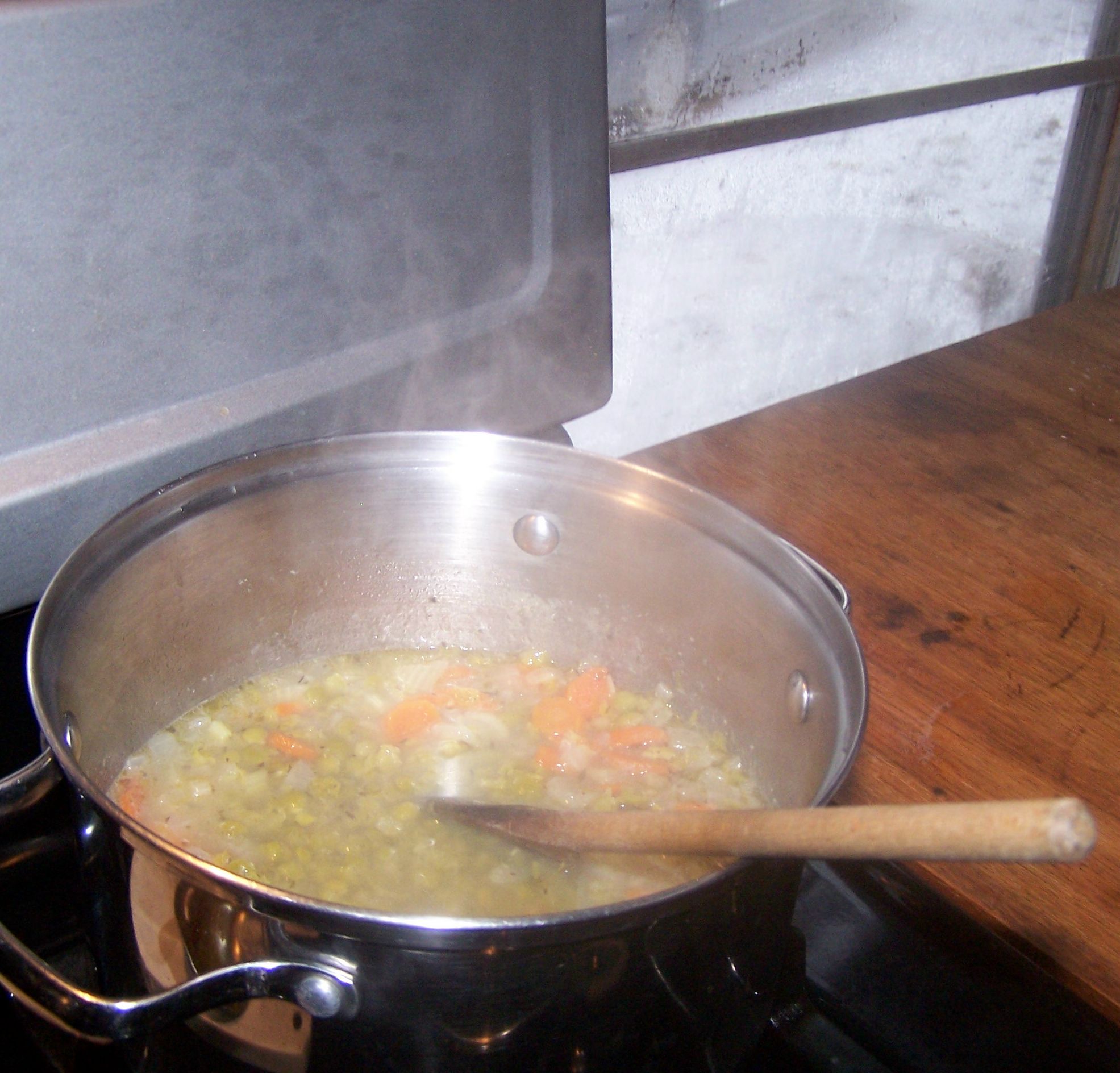
soupAroma thick with thyme and marjoram steams from the simmering split pea soup. I’ve enjoyed the whole process—chopping onion, celery, and carrot, measuring the spices and selecting the bay leaves, stirring until the soupy mass starts to bubble and boil. More condensation to collect on the window panes where sleet bounces and taps it rhythm against the other side.

There’ll be no venturing out today. The roads are slick with ice. Time to relax and accept what the Mother has in store, a lingering blast of winter with all its gifts of cold and white. Wind whistling at the chimney where smoke of my wood fire plumes sideways. Time to muse on past winter days when fire blazed hot and pan lids jiggled, when my gaze settled on the distance and roamed over the years of my life.

Memories of winter’s challenges rise up to nourish me on these days, recollections of times when hardships were met and I was satisfied with my refuge, my larder, my conquest of the elements. In more distant times, I might have twisted strands of wool or linen and watched the wheel spin it to thread, or pounded clothes in a hot kettle for cleaning, or ground corn between stones to make coarse bread. I might have wrapped my children in animal skins and tied my own feet in fur before braving the cold for more wood, or brought the livestock into the other end of a rough cabin to keep them from freezing in the long nights.

How did I, of all my previous iterations, manage to occur here, now, where everything I need comes more or less effortlessly—the twist of a knob, click of a button, the turn of a key? A house with insulated walls and thick glass that keep in the warmth and allow me to watch frozen rain fall from gray-white clouds. What future embodiments of myself will wonder back on this time and what will they know? What I don’t know. What I can imagine for better. Or worse.

I don’t have to figure it out. Anyway, I can’t. Better to turn to the pan and stir the soup, add another log to the fire, stand at the window longer and marvel at the shades of gray and rust among the trees of the woods, the white of the sky and ground. Soon the scene will explode in infinite shades of green and heat will soak the edges. I’ll be pleased then to remember this cold.

Love

farm house door 0001Slowly and over years, he broke her down. Where there had been joy and affection and spontaneity, her emotions shrank until now she could not cry. Or sing.

His arms held her, his mouth took her, and with his body he brought her to the pinnacle of love. What she had never known, she knew with him. And she gave in return, every moment of their pleasure a stream of heart-joy flowing between them. There were flowers, jewels, children, brilliant afternoons bathed in sunlight.

But the mornings, only hours after being consumed in their most intimate moments, the mornings found him as another man. This man did not bring flowers or smile. He woke raging. No hugs, no warm exchange of touch or conversation. Any sound, any dish out of place, and his fury exploded in shouts, slams, curses.

The excuses she made for him could fill a book. It was a dry drunk, his need for alcohol stronger than his ability to live without it. Therapy added more excuses, that he’d repressed a traumatic childhood, that he had a blood sugar problem, that he couldn’t handle the vulnerability that came with strong emotion.

He never made excuses for himself. To him, every angry moment had legitimate reason. Any attempt to force realization or ownership produced more anger.

It took on its own cycle. The buildup with friendly conversation, daily routines, desire slowly building to consummation. The eruption—door ripped off hinges, dog kicked, screaming as veins protruded in his neck. The alienation–her withdrawal, sheltering in herself, with her children, with a routine that slowly became more of the norm that any courtship, than any love.

“One of these days,” she told him, “it will all be gone.”

And after twenty years of trying, believing, hoping, when it was all gone, she asked him to leave. And he left.

And when another twenty years had passed, she still loved him. Still didn’t understand the anger, still couldn’t sing.

Oh, Writing

Performing Arts 0063Wake up. Shower. Dress. Computer—Pandora on New Age Electronic, email two accounts. Facebook sometimes, if I’m not deep in a project.  All that angst and friendly chatter impacts the story, the dialogue, the next scene that has penetrated my dreams, followed me to the toilet at one a.m., hovered around me until this moment.

This moment, when I start to write… Wait, make a cup of tea, get a glass of water. Eat a pear to stave off serious hunger, to buy at least an hour before I have to deal with food. Get the document open, remind myself of where I quit the day before, edit, equivocate, pep talk about how I’ll get there, how it will work out, how to let go and let the words flow.

Finally, the hunger becomes overpowering. It’s 9:30 a.m. I’ve barely geared up into the mind-frame of the story, what century I’m in, what character is speaking through my voice. I tear myself away to the kitchen for a bowl of granola, not in itself a major task, but then I’m reminded that I meant to do dishes yesterday, and the goldfish is swirling frantically in the tank, signaling in big gorps that it’s past feeding time.

And then there’s the guilt that comes in looking at cat food bowls now empty, cat water below their preferred level of freshness, dog food bowls also down to a few crunchies, and laundry wrinkling in the dryer. I should tend all these things, check the folder of bills due, write some checks, go to town for groceries.

NO! Carry bowl of granola to desk, sloshing milk on the floor (clean it up later) and get back into the story. The person. The scene. Belly shuts up loaded with granola and milk. I have maybe three hours now before my body makes other demands. Well, yes, I need to pee.

The hunger starts around eleven, but I sip the cold remnants in my tea cup and try to ignore the nagging voice in the back of my head. What will you have? Do you need to cook? What about grocery shopping? Finally angry with a hunger headache hovering in the top of my head, around 12:30 I peel myself away from the desk, the plot, the people, and try to find something to eat.

The kitchen is a wasteland. Oh, sometimes I’m very good and prepare a stew or chili or a pot of beans, anything that might work for several meals. I can eat stuff I’m tired of if I’m hungry enough. Open a can of blackeyed peas and have it with a bread and butter sandwich. Heat up the meager leftovers from last night’s supper, left in a thoughtful moment for this very purpose. I can no longer force myself to eat microwaved one-dollar frozen entrees, and peanut butter and honey on crackers is pretty much on its way out as well. Lunch, in other words, is hell.

But—I must eat, because I live inside a freaking biological entity that requires food. Once the belly is silenced, I’m back to the computer and this thing that drives me, this play of words, this world—multiple worlds—screaming for release from inside my head. More hours. My hips ache. My back aches. I want never to do anything but write, but the plants in my solar porch are shriveling. The floor begs for a broom. I have errands to run.

Cholesterol is gathering.

And phone calls, oh please God not the phone. Relatives, friends, whoever thinks it’s his or her duty to wish me a happy birthday, or Merry Christmas. Chat. Please take note. My happiest birthday truly would be a day left utterly and serenely alone, perhaps food served at my desk, the house cleaned while I don’t watch. Bills paid by magic, without me wrangling over every last dime, juggling which gets paid first, which waits until a bit more money finds its way into my accounts.

It would be dishonest of me not to say that I own two deeply mortgaged commercial rental properties, a total of sixteen units in one which are rehearsal studios for rock bands, and a total of ten units in the other which are low-cost entry level downtown business spots for fledgling entrepreneurs. These properties also have bills to pay and endless drama. Vacancies and eager new faces come and go. It’s a business. It’s how I pay my home mortgage, electric, and the numerous and sundry costs for existence in this world. Well, maybe not new clothes this year… I thank myself often for having the foresight oh so long ago to pursue these bits of real estate. Without it, I’d be working in some else’s employ into the dim days of my antiquity.

Never mind the dream that someday, with due diligence and supreme good fortune, this play with words might actually produce meaningful income. I can’t think about that. It’s too much to hope for, too out of the norm for all us who stumble along this writerly path.

So by four or perhaps five p.m. depending on the story, the people spilling onto the screen at the stroke of the keys, my creative juices finally dwindle to a drip and my writing day ends. In all, if I’m blessed with the least possible number of distractions, I’ve been able to write/plot/dream a total of eight hours. I collapse on the couch to watch mindless television, have a drink (or not) and deal with the last demon, that monolithic hurdle of What To Have For Dinner.

The body is relentless. As are the plants, cats, dog, goldfish gorping again at me from his tank, the dirt caked on my hapless Honda, the twigs and other debris littering my porch, the dust bunnies taunting me from the corners, the laundry still wrinkled in the dryer.The evening sinks into a war between my guilt for so many shortcomings and quickly jotted notes as one, perhaps another, plot point resolves itself in my subconscious.

The bed looks good, refuge, haven. But by the time I’ve wrestled my night’s sleep thru distant gangs of howling coyote, a relentless full moon, and the continuing bits of dialogue slipping in and out from wherever it lives, I’m ready to get up. It’s dawn. The story calls.

Winter Night

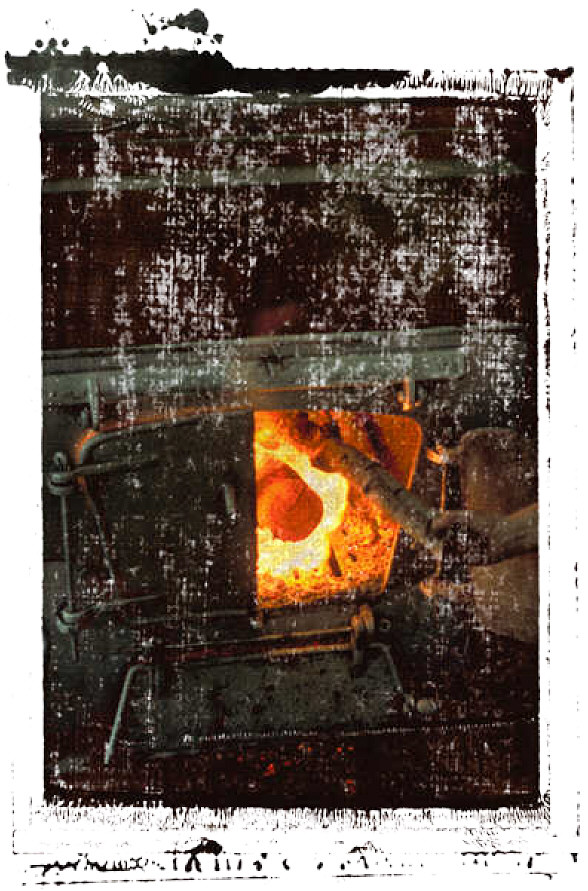
adding wood to boiler 0001By two a.m. the fire in the woodstove had died down enough that the cold took over. Under heavy blankets and comforter, I could feel the temperature dropping in the house. The electric radiator in the bedroom is no match for six degrees, even with window curtains pulled tight.

A quick trip to the bathroom brought me shivering back to the bed. With the covers pulled up to my nose, I imagined myself not in this last century of modern comforts but rather in the earlier vast millennia of human existence. The cave, skin-covered hut or even the wooden long house would have been far colder, warmed only by open hearth fires and our breath. Heavy furs of mammoth or bear lay under and over us as we curled our knees to our chest and ducked our cold ears into the hidden warmth.

Fire tenders dragged long dead limbs further into the blaze and tugged their fur cloaks around their shoulders, watching as sparks flew into the air and ensuring the fire stayed in its place. Cabbages, apples, onions, and turnips rested in straw lined pits, safe from the cold, and around the perimeter of the shelter, chunks of meat sat semi-frozen, waiting to be brought to the flat rocks at the fire’s edge to drip fat and send up tantalizing aroma. Even then, as food cooked, as men dragged in more wood from the pile near the shelter’s door, we kept our furs tucked over us, waiting for spring.

In the long hours of midwinter night, sleep comes and goes. Fantastical dreams shift us from our known world, so that we fly into the future or past. I relived the death of a loved one and the loss resonated through me, and then magic knowledge enabled me to speed backwards in time with him until I found a new path, a year when a different choice meant longer life, and even before that, an even better restart. Our lives moved forward from there and when we came to the fatal day, he lived.

What was the magic? In the dream, I told myself I would remember. But I don’t. I remember that it was simple, that if I had let myself know what I really know, it would have been obvious. But it’s not.

Other visions of long sleep arise and fade, memories recast in distorted frames, possible futures emblazoned on unfamiliar horizons. The mysteries of embodiment tease around the edges, other forms, foreign memories. Deep in the warm thicket of my bed, I am free to fly away and see it all.

My feet find warm spots at the dog’s side, where the cat lies curled. A screech owl screams its cry at the wood’s edge. At the three a.m. passing of the train, its distant warning echoes up from the valley and sets the coyotes singing. At four-thirty, I’m awake again, fresh from another restive dream, and wondering if I should brave the cold to start new fire.

I wait, snuggled in all my wealth of warmth, finding one comfortable position, then another, until the night starts to lighten and the dogs go outside. Now the quick wood catches  in its cove of dried twigs and crumpled newspaper, and the cast iron around it warms. I make tea, open the curtains to stare out at the pale blue and pink world of dawn. Winter sets its own rhythm, and I am content to follow.

No Ecstasy Here

godWe shouldn’t hold our breath. Phil Robertson and the Church of Christ aren’t going to change. They pride themselves in rigidity, which they see as their unwavering discipline in the Word of God. Descended to American backwoods and byways from the Puritans and Presbyterian Scots tradition of strict religious practice, the practitioners of this fundamentalist sect forbid women to speak in church, refuse instrumental music, and do not offer Sunday school. Worship is intellectual rather than emotional, an embrace of rules and edicts interpreted from the King James version of the Bible.

I was raised in this church. There were preachers in the family, and church formed the social and political center of our lives. We went every time the door was open—literally. Sunday morning, Sunday night, Wednesday night, plus special nightly meetings with a traveling preacher or “singing” services where the church elders would take turns leading songs…a cappella, of course—all were mandatory to the true Christian.

None of this was fun. It wasn’t supposed to be fun. Oh, there were the sometimes pleasurable associations with others of our own kind. This was our world. There was the benefit of being relieved, temporarily, of our duty to work without ceasing. But whatever enjoyment might be gained in the gathering had to be tempered by the greater framework of our purpose in obedience to the Almighty Father’s plan. Outright laughter in the House of the Lord would have been unseemly.

The teachings were that humans were born with sin, and that we were here to suffer for it. Without a life of suffering, we couldn’t get to heaven. Sensory gratification formed the greatest temptation to sin, especially delight in The Flesh. It all served as major stumbling blocks on the road to salvation. Our embodiment in corporeal form was punishment, no ecstasy allowed. Joy came after life—if we toed the line. Otherwise we would burn in eternal hellfire. Church services dragged on with a few songs to break up sermons where a certain cadence of voice marked the rising passion of the message until the thundering conclusion arrived meant to stir every heart to confess the inevitable sin we all carried.

At the conclusion of the sermon, a song invited sinners to come home. Those with guilty consciences were expected to walk down the aisle of the church toward the front, where—if previously baptized—he/she would kneel and confess before the congregation. If not baptized, this wayward soul would be scheduled for full-immersion baptism, usually on the heels of the regular church program. Everyone would cluster in excited hushed conversation while the sinner was taken to a private room, dressed in a white gown, led to a tank of water which in many cases had not been warmed, and lowered into the water while the preacher called on God to welcome His new servant.

Although as a thoughtful female child I had resisted much of what the preachers had to say, I still wanted to belong to this club. I wanted to be saved, to experience the blessings of God, and partake in the weekly communion of wafers and grape juice given as a symbolic sharing of the body of Christ. I wanted that magical sense of well-being in my otherwise fretful existence. So when I was fourteen I walked down the aisle. My parents wept at my salvation. The water in that small Oklahoma church was ice cold, and I gasped as it surrounded me. Water flooded into my nose and mouth and I strangled. The thin cotton gown hid nothing when I stood up coughing in the miserable icy water, newly formed as a child of God but shivering as the wet fabric clung to my naked pubescent form. The overriding sensation was not that I had been welcomed to the loving arms of Jesus but that I wanted to die of humiliation

I didn’t feel saved, relieved, or welcomed. I would never admit it, not in those early years, but I didn’t really believe in any of it. How could a loving God also be an angry and vengeful God? Why was God a man if we were made in his image? Where did God come from? I asked these questions but quickly learned that these were questions not to be asked. Certain things were to be taken on faith. Shut up and listen.

I wanted to feel ecstasy about God the way I felt when I looked at a stunning blue sky or the wings of a butterfly. Everywhere around me I saw beauty, yet I wasn’t supposed to embrace the pleasures of the earth. Slowly I came to understand that only a sadistic, evil God would create a sensational world and people who gained such joy in experiencing those sensations, and then threaten eternal damnation for enjoying it. Nothing sacred or holy existed in that God. I rejected all of it.

For those who accept this belief system, the official expression is dour. Like Phil Robertson’s stern face, outward demeanor is meant to convey the seriousness of God’s judgment and unceasing fear of His wrath. Everything is sin, but especially certain things that threaten the patriarchal foundations of the faith. Women are advised to be obedient and serve their husbands in the same way that men are to serve God. As the lesser sex, woman’s path to God is through her husband, as he was formed in God’s image and she was formed from man’s rib. Many a sermon centers on woman’s innately sinful nature and her duty to suffer for tempting Adam to eat that damn apple.

In spite of their Christian belief in the role of Jesus Christ and the New Testament as the foundation of their religion, fundamentalists love to dredge up Old Testament bits as a rich source of rules and exhortations, with quoted sections carefully chosen to serve the featured topic of the day. Other parts of these old conglomerated writings, not so useful bits about slaves (how to obtain slaves, how hard you can beat them, and when you can have sex with the female slaves) or war captives (Follow him through the city and kill everyone whose forehead is not marked.  Show no mercy; have no pity! Kill them all – old and young, girls and women and little children.) tend to be left out.

As I grew older and made a point to study the entire Bible’s text, these selective uses of Scripture caused a growing cognitive dissonance that affirmed my instinctive rejection of this narrow-minded view of the world and of God. Perhaps most alarming, those most faithful to the dogma seemed to lack any real belief in their own salvation. Satan lurked at every corner. Constant fear and anxiety haunted my parents and others in the congregation. And ironically, instead of benefitting from their religious practice, they suffered. There was no joy.

To me, the most unacceptable tenant of the Church of Christ was the belief that this faith is the only path to God. Followers of all other belief systems are going to hell. There is no wiggle room on this point of total arrogance and closed-mindedness. Any hint of updating to a more open-minded view of our fellow man is trumped by the feverish fear of offending God.

Mr. Robertson and his ilk risk hellfire and damnation if they don’t exhort against sin. They believe it’s their Christian duty. Perhaps he faintly recognizes that he’s already skirting condemnation because he has accumulated great wealth, and this drives him to an ever-more agitated thumping of his holy book. (“Again I say to you, it is easier for a camel to go through the eye of a needle, than for a rich man to enter the kingdom of God.”)

If A&E had persevered in its banishment of Phil, he might have secretly welcomed his exile as a suitable end to his dabbling in the perverse world of commercial entertainment and all the divorce, blended families, homosexuality, half-dressed bodies, independent women, and other defilements of God’s plan that are routinely displayed there. Secure in his manly beard and violent conquest of Nature as his God-given right, Phil will always sink to the level of his ultimate comfort, the ways and beliefs he has always known.

As it is, he and his Ducky family can continue to feel righteous as they judge the rest of us. Once again in the tradition of all fundamentalists, they’ve managed to skip over key parts of their own literature:  “Judge not, that ye be not judged. For with what judgment ye judge, ye shall be judged: and with what measure ye mete, it shall be measured to you again. And why beholdest thou the mote that is in thy brother’s eye, but considerest not the beam that is in thine own eye?”

Pineapple Candy

pineapple-fudge-packetMouthwatering treat for your candy jar!

3 cups brown sugar, packed

1 8-ounce can crushed pineapple

2 cups English walnuts, coarsely chopped

❧ Stir sugar and pineapple together in medium saucepan over medium high heat.

❧ Cook to the firm end of soft ball stage, 240° on candy thermometer.

❧ Cool pan in water bath, beating while it cools.

❧ When mixture has mostly cooled, add walnuts and continue beating until it starts to thicken, then quickly spread into buttered 8x8x2 pan.

❧ Let set until fully cooled, then cut into 1-inch squares.

The Box of Christmas Past

heart ornament 0006Twenty years ago, I started putting things in a box, a big box that came to hold Christmas photos, greeting cards, graduation announcements, newspaper clippings. Everything that marked our days and years, things that in the previous twenty years had been carefully placed into a family album or one of the albums dedicated to each child, or special scrapbooks of family trips complete with dried flowers, matchbooks from restaurants, bits of seashells. Sooner or later, I consoled myself as the box grew fuller, I will deal with all that.

My marriage had ended, leaving me with three children aged 13, 15, and 17. I was self-employed as a piano tuner, partnered with my aging dad and an employee. An old commercial rental property provided extra income but its own litany of problems to solve. I drove kids to school from a rural home, split firewood, fed and butchered chickens, planned menus and cooked meals, and drove to an even further city for the youngest’s dance classes. I had a newspaper column to write in support of my environmental advocacy. There were surgeries, termites, and kidnapped dogs.

The previous year, my oldest had dropped out of her junior year in high school and lived on the streets before returning home a few months later to start her first year of college. Two years later, the second child quit his senior year in disgust–he only needed two credits to graduate, but they wouldn’t allow him to finish those credits in the fall term. He went off in a VW van to live with another couple in the remote countryside. The youngest alternated between rage and over-achieving.

Grief over the loss of a dream to live out life with my soul partner slowly subsided to the back of my mind. I lived large. I hosted dinner parties, hit the occasional nightclub, took a younger lover. Christmas trees in our living room were twelve feet tall and encrusted with ornaments and garlands. Gaily wrapped gifts heaped thick on the floor. The children grew older, in and out of college and romances, to New Mexico, the Caribbean, Florida, one of them in New York City when 9/11 happened. Time flew by.

In 2000, I spearheaded a statewide effort to allow medical use of marijuana. In a southern state like Arkansas, the “m” word was not spoken in polite company. Public appearances of any kind stressed me to the max, but I forced myself. I wanted to set an example for my children, how we must work for the changes that are needed. Trips to Washington D.C. Up and down the road to locations around the state. More years, more stuff in the box.

A few years later, my dad died and the next year, I retired from piano work. Thirty years at concert halls, churches, homes had taken their toll on my hearing. And my heart wasn’t in it. My activist work tapered off, taken up by younger, less-exhausted hands. Children were on their own and I lived alone with cats, dogs, watercolors, writing.

Rental property demanded action if it was to adequately support my retirement, and so a three-year investment of time and energy consumed me in a world of architects and engineers, construction, zoning hearings, easements. Carpenters, electricians, plumbers. Bankers. Cost overruns. Pleasure in brick and mortar accomplishment.

More surgery, termites, and dogs. (OK, you may wonder why the termites. But my house sits on a hill overlooking our spring-fed ponds, and the operative word is “spring.” Year round, this natural source of sweet, pure water supplies us even in drought. So you can understand my hesitancy to pump poison into the ground that sooner or later will make its way downhill.)

Construction projects finally ended. And I opened a café. For three years I chased the joy of preparing delicious food and exotic tea for an appreciative clientele. Christmas trees and scented candles ornamented the café. Decorated cookies and figgy pudding appeared on the menu. I had dreamed of the café for so many years. Proud I made it come true, but it was grueling. Employees, payroll, never enough profit to justify a wage for me. Financial suicide.

More stuff in the box.

Two years now since the café closed its doors, and I’ve been firmly lodged on this hill ever since. Writing. This year, no Christmas tree. A strand of colored lights drapes over my dresser top and office doorway. No gifts, I’m too broke. Rental property and family concerns are the only outside diversion, plenty for an increasingly crotchety woman. It will be years before I can break out of the debt incurred from real estate developments and the dream café project. I squeak by strangely content to be the impoverished writer. It’s what I always wanted to do.

But I’m so rich. I don’t need any more Christmas trees, trips to exotic places, dinner parties. Today was the day to stagger down the hallway with the big box full of the last twenty years, to sort through the mementos of all those times, a holiday gift to myself. A bit of detective work is required, examining haircuts, expressions, clothing, a calendar in the background to figure out what year…1998? 2002? How did we get to the eve of 2014?

An empty box will mark my progress as the contents slowly form stacks that swamp the dining room table. A stack per year. So many years. Each item, each photograph, will take its place on the scrapbook page. Each page will lead to the next, the next Christmas with its tree, gifts, laughter. The next year with its particular challenges, losses, rewards.

Some of the photos will end up on Facebook (oh brave new world) to be shared with my children, now in California, Oregon, the youngest at home in her own part of the house to pursue another master’s degree, their lives racing past. In each item I lift from the box, the long gone years will come alive, sights, smells, sounds of voices, music, feasts. All of it to be treasured, worthy of the effort to preserve it, think on it, remember.

In the spirit of the season, of cold, dark days and inevitable renewal, in memory of those now gone, I give thanks to every loved one, every moment, to every participant, acquaintance, to the wind in these trees. I won’t forget Janis Joplin, who exhorted me with inspired words so many years ago: Get it while you can, honey. Get it while you can.

Thank you, Janis. Thank you all. I got enough to last me if I never do another thing.

Cities

Gloucester Road at dusk, Wanchai district, Hong Kong 0001

The cities glitter like jewels in the night. Towers encrusted in light and streams of red and white define the expanse where only tamed hills and water courses interrupt the hand of man. An artificial world with token trees and ornamental gardens, no food grows here, no herds of deer or buffalo. No cliffs or caves for shelter, no flowing springs.

But most of us live here, packed into tiny rooms in concrete buildings or houses set side by side, our feet traveling over pavement as we hurry from place to place. Like metal filings magnetically drawn to a cluster, we gather under a force we can’t change, the force of commerce, trade, collaboration.

Only hermits, cowboys, farmers, and ramblers populate the open land, understand the smell of approaching rain and how it waters the crops, the cattle, upon which the cities wholly depend.

More Bits from Aquarian Revolution

“We thought we were going to buy eighty acres—it was $75 an acre—but after we moved in, we found out that the front forty acres had already been sold, so we had no road access. We had to walk through the woods to get to it. We dragged lumber, built platforms for tents, we lived in tents, we dragged beds. In the rain.” Chapter 7

“We were tearing the shit out of that country, bulldozing over a million acres of trees, spraying defoliant over more area. Once you got over the ohhh, shit, here we are in this war zone and realized that well, about as many people have died here in the last five years as are killed yearly on the American highways, you kind of adapted to it. I really didn’t like the way most Americans treated the Vietnamese.” Chapter 8

“The Black Fox thing was the beginning of our local Peace and Justice Center. We needed a place to do stuff. We started the center to have a place to meet, a place to work, type a newsletter, fold it, etc. The environmental work was ongoing, although it was getting harder. It became obvious that we weren’t going to be able to close down Arkansas Nuclear I, especially from here, and the group down there was having too many problems.” Chapter 9

“S. G–’s caravan came through. He was a college professor at Berkeley, and he decided to get a bus and travel around the country. He’d been holding these Monday night classes, kind of group gatherings, where they talked about peace and cooperating. He wanted to end the classes and travel around, but everyone said, no, you can’t stop the classes, so he said go get a bus, and before you knew it, about two hundred people had joined him in old school buses, VW vans, and campers.” Chapter 10Aquar Rev photoshop copy