A Journey West, Part 1

How could so much change in only six years? I had flown before, many times. Between 1968 and 2008, I lost count of the times I swallowed down excitement as the plane lifted me toward the sky. Airports were the threshold of adventure, the place where infinite possibilities scrolled down the flight departures screen.

But in the intervening years since my last sojourn, I settled firmly at my desk. My adventures became mental journeys into the pages of my writing. I’m comfortable here with my dogs, the woods, my bed.DOGS
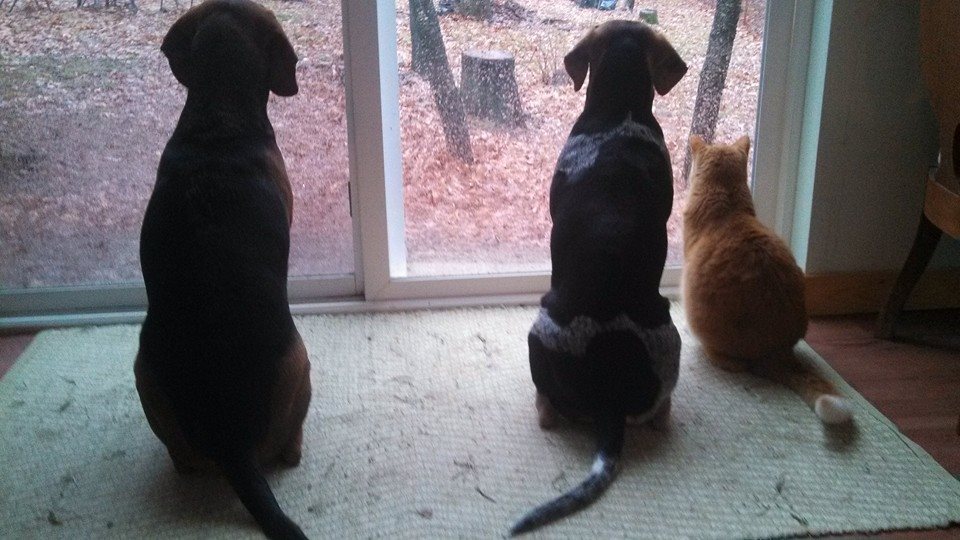
Okay, I’m getting old.

So when my friend Ginny extended her invitation, my immediate response was anxiety. Could I sleep well on an unfamiliar bed? What about air travel in these days of crazy passenger outbursts and terror threats? Did I really want to go?

My two older children live on the West Coast. I hadn’t seen Ginny for years, and her invitation made me contemplate not only spending time with her and seeing my kids, but also absorbing myself in that uniquely California environment of salty, kelp-flavored air and laid back attitudes. Of course I wanted to go, but couldn’t I please just instantly appear in Santa Cruz instead of going through the journey?

After weeks of increasing anxiety, I hardly slept the night before my departure. What if I didn’t arrive at the airport in time for my flight? What if I forgot to pack something important? What if there were problems with the flight? By the time I parked in the economy lot and hurried across the vast expanse of asphalt, my pulse hammered in my neck. Breathless, I scanned my ticket barcode to print out the boarding pass then mounted the escalator.

Swallowing over a dry throat, I handed the attendant my ticket and identification, moved forward to the screening line, and took refuge in the actions of those ahead of me. At least I could follow their lead. Carry-on luggage on the conveyor belt. Backpack with my purse inside. Take off shoes. No, attendant said. I didn’t have to take off my shoes, courtesy of the first attendant’s notation on my boarding pass which, I assume, had to do with my age. What are the characteristics one must exhibit at the Northwest Arkansas airport to qualify for remaining shod through security? That and another hundred questions and worries flooded my mind as I accompanied my baggage along the conveyor.

“What liquids…(blah)?” The uniformed guard’s words rolled over me as I tried to remember what I had packed. At the last minute, I had abandoned all hope of forcing my thick crème rinse into the tiny travel container. It globbed up at the rim and cascaded down the outside of the container. So I had stuck the entire bottle in my case. Hadn’t I read somewhere that larger containers were okay?

At this point, my voice had become husky and I shook. It wasn’t like they were going to take me outside and shoot me for packing an oversized container of crème rinse. But it was expensive. Other travelers piled up behind me while I tried to make an intelligent decision. The options for keeping it meant paying $25 to check my bag or walking back across the north forty to my car. No, I’d have to give it up. I watched my nearly full bottle of organic hair product land in their disposal bin.

That was only the first of a day of indignities. Maybe growing older and even more rigidly set in my ways preordained that travel by public conveyance would unfold as a series of rude shocks. Jostling in line to board. Wading to the next to last row of seats. Cramming myself into a tiny seat by a window—which I would have chosen if I had been willing to pay the extra money—but facing out over the wing, which I would not have chosen. Enduring the mind-boggling cacophony of human voices shouting over the engine noise as we made the short trip to Dallas-Fort Worth.

By the time we arrived at DFW, my back had spasmed in my effort not to rub against the passenger in the adjacent seat. Clearly comfortable with air travel and close association with whomever, she spent the trip jawing with the man across the aisle, her conversation frequently punctuated with loud laughter. That her leg touched mine or her elbow periodically brushed my arm seemed never to appear on her personal radar.
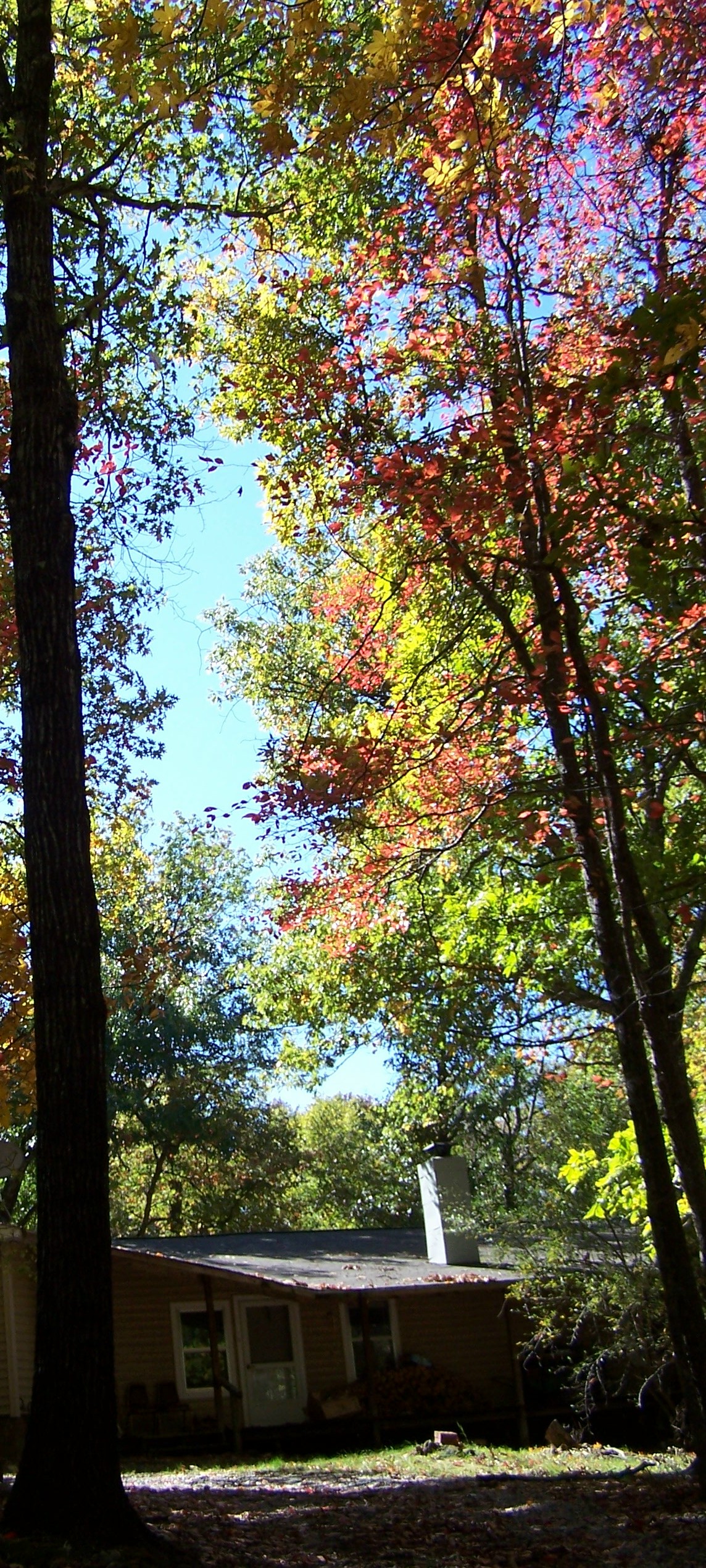
100_0575I live in near total isolation on an Ozark hilltop. I see more deer than people. Coyotes routinely howl at my back fence before disappearing back into the oak and hickory forest. Driving into town for groceries and random errands usually results in a hasty revision of my ambitious to-do list so that my time amid busy streets and crowded store aisles is reduced to only the most urgent items. I return home annoyed and clogged with Other People’s Energy.

Now, barely started on my journey, my back aching with don’t-touch-me tension, I hurry along the wide corridors of DFW’s Terminal C to find the trolley that will whisk me to Terminal A. I dodge businessmen and women wheeling fine leather cases, families straggling with children, retirees looking faintly lost and grumpy. After a fast jerky trolley ride clinging to a grab rail, I descend into Terminal A. Even greater throngs greet me there.

I’m hungry and wander along the crowded corridor. McDonalds swarms with customers, deterrent enough even if I could choke down the food. Starbucks isn’t lunch. I don’t want seafood. Taking a tentative space in the line at TGI Friday’s, I’m soon seated facing out over the hive activity in the corridors and presented a menu. After a heart-stopping moment of sticker shock, I order a cup of broccoli-cheddar soup for $7. It comes with four saltines.

Okay. I can do this. Refreshed from my cheesy lunch, I soon board the jet bound for San Jose. Blessedly, I am not seated in the back or over a wing. Cursedly, I am the first aisle seat in the three-seat side of economy class, meaning the aisle jogs right there as passengers move through from first class. Each passage jostles or brushes me in some way. Plenty of leg room, but since there are no seats in front of me, the tray table folds up from the chair arm. Which would be fine in a perfect world. However, I admit to a less than trim waistline and so the table fits snugly across my midsection. Embarrassing and uncomfortable. I drag out my book and try to concentrate on the lovely biography of Doc Holliday.

An hour into this three and a half hour flight, my back is killing me. The friendly lady on my right enjoys a gin and tonic while reading her Kindle. She’s relaxed and her arm touches mine. Her knee touches mine. My need not to touch someone else is so ingrained that I can’t relax even when I tell myself to get over it. Even when she’s asleep.

With perhaps an hour left in the flight, I lurch to the bathroom at the back of the cabin. Here, for a brief blissful moment, I am alone. But these hours of being crammed into a metal box with a hundred other people is taking its toll. My back muscles have seized. My head aches. My nose has become stuffy with breathing recycled air. The thoughts and emotions of a hundred other human beings have invaded my consciousness. Let me out!

Finally the jet screams down the runway and slams to a halt at Gate 18 of SJC. The blessing aspect of my seating reasserts itself as I follow first class passengers on an early disembarkation. I hurry down the terminal’s long passageways to emerge blinking into the bright San Jose afternoon. The air smells of ocean. Moments later, my daughter calls and then appears to pick me up in a borrowed car.

Strange how children always look the same and yet, at least initially after a long absence, appear as strangers. We plunge into happy conversation as if it was yesterday instead of 28 months since our last meeting. I luxuriate in the absence of strangers and the comfort of a well-padded car seat.

The drive over the mountains along Highway 17 is curvy and steep, plagued with heavy traffic. SoonDEST she turns onto a side route that leads into Soquel over the old San Jose Road. Her smile and the sound of her voice are beautiful.

The rich odor of pine sap and eucalyptus starts to clear my clogged nose. The narrow lane winds along sharp inclines cut into the face of newly minted earth—slabs of granite bedrock under hulking chunks of sandstone pushed up from the ocean floor as recently as the last three million years. Even after two years of drought, native vegetation maintains a stubborn gray-green grip on the land, all subordinated to the towering redwoods.

We talk about her flight from Oregon, her plans. The eight days we’ll have together. This is more like it. I have survived. I am here.

The Difference Between Men and Women

goddessSince 1998, I’ve interviewed over sixty people about their experiences of the 1960s, all them ‘baby boomers’ who shared that particular cultural upheaval. The stories have a lot in common. We wanted to break away from entrenched beliefs and stereotypes to embrace a more tolerant view of the world. We saw a responsibility to work for change. We searched out environments where we had the freedom to reinvent ourselves as citizens of a new age.

But recently I’ve reached a startling realization having to do with a striking difference between the male and female narrative. That is, the men I’ve interviewed rarely if ever mention their sexual activities of those times. Women, on the other hand, describe sexual activity as a key point in their lives.

At first I thought this had to do with the natural reticence of men to discuss emotional and/or personal experiences, and their tendency to focus more on activities and interactions having to do with work and other external matters. But it occurs to me now that the difference more likely is a result of the fact that for men, not much of the tradition of male sex lives changed with the ‘60s. (Unless they were gay, of course.)

Not so for women! The Sixties and the Seventies were times of major change in women’s sex lives, and from there, a change in just about everything else as well. Birth control pills meant that for the first time, women could enjoy sex without the overwhelming risk of pregnancy. On the heels of widely-available birth control, the U S Supreme Court’s decision in Roe v Wade meant that even if raped or confronted with the failure of birth control, a woman could obtain a safe medical abortion.

Suddenly women were masters of their own lives. Without the unnatural expectation to wait until marriage to engage in sexual activity, women could focus on education, political action, and career building. For the first time, women could approach men as an equal in the sexual arena, pick and choose sex partners, and be just as promiscuous as men had always been. Not that all women were. The liberation of women had to do with gaining options.

So of course women who came of age in those years would include stories of how those changes affected them. Raised in the mindset of earlier times, women of the ‘boomer’ generation suddenly could set aside the old threats of illegitimate children and the social stigma that inevitably followed such public evidence of out-of-wedlock sex. A female’s identity no longer centered around her role as wife and mother, but rather what she could offer her community in any of multiple roles.

Maybe women are more likely to discuss private emotional experiences than are men. But I think that women of my generation are rightfully proud to be the ground upon which a revolution took place. From this has flowed a wealth of new ideas in the workplace, changes in the arts including erotic literature in a manner never before imagined, and exciting relationship options inconceivable fifty years ago. I encourage all of us to tell our stories so that our daughters and all women coming after us never lose sight of what we have won.

Goat on the Road

goatI met a goat on the road today. He approached from the opposite direction, running at a steady but moderate pace—not a gallop but more of a trot. It seemed about the same speed as my car had reached, as fast as I felt like driving on a hot August morning when a faster speed would have generated billowing plumes of dust from the powder dry land. He ran in a straight line along the roadway, his intention of uninterrupted travel quite apparent in his demeanor. He needed to be somewhere.

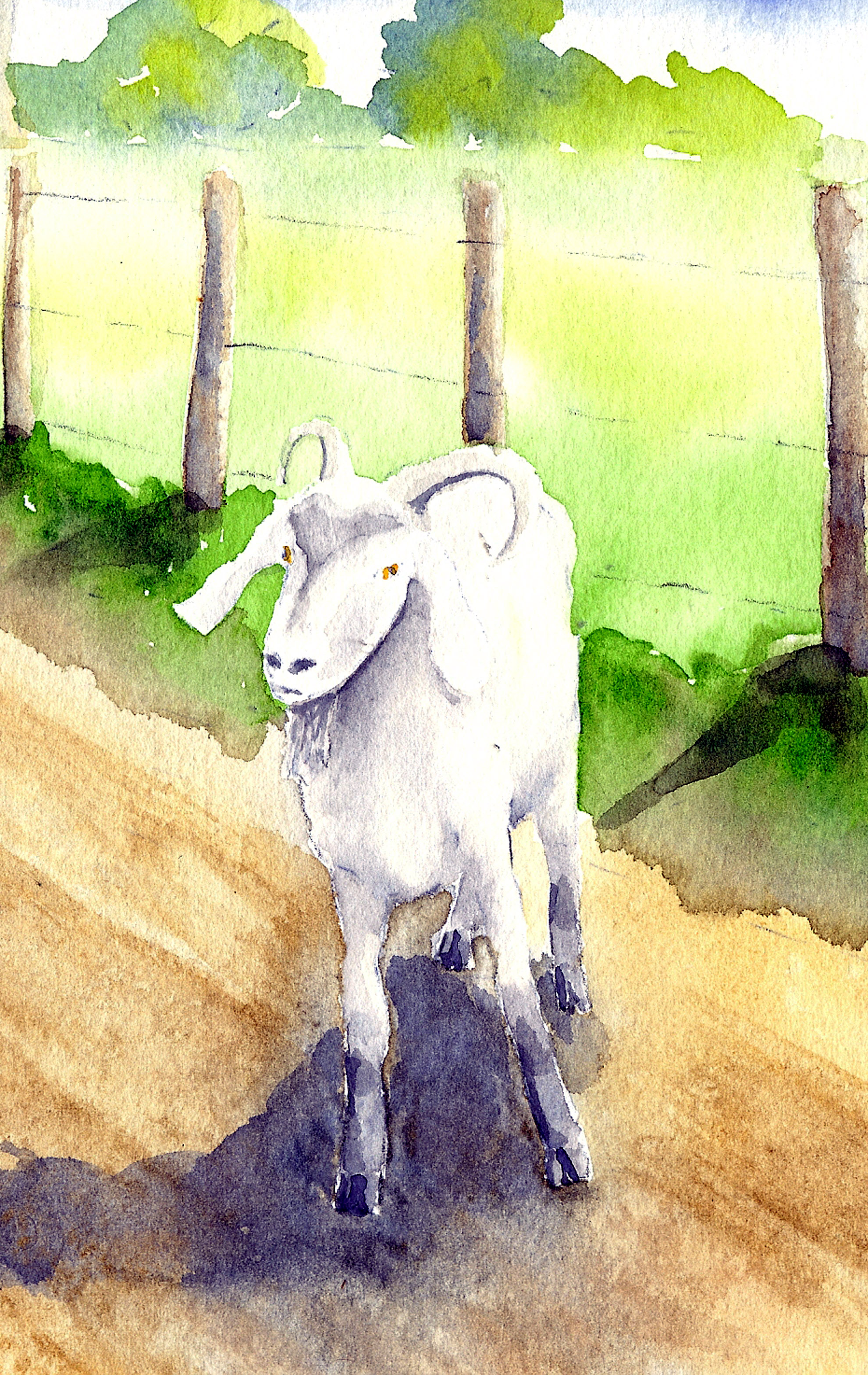
He was a small goat, not exactly a Nubian or Toggenberg but of some mixed breed, with a confidence attesting that in spite of his lesser size, he was most assuredly full grown. His foot-long horns flared from the top of his head up past his ears and off to each side of his black-marked face. The only other markings on his white body were on his legs, black from the knee down. His body held the features of a potent male, well-muscled in the chest and shoulders, his sides curved in health.

As it happened, we took the wrong sides of the road as we approached each other. He seemed to favor the right side of the road and I did not find it necessary to confront him about it. No doubt he had skipped the part of driving lessons that taught the proper side of road, but then perhaps not, since he was a goat and goats have their own firm opinions about what they will and won’t do at any given moment in time, rules be damned

We considered each other with curiosity as we slowed in meeting, a greeting and courtesy that, on reflection, I concede should not be limited to human travelers. His gold-flecked eyes came directly to mine, the black pupil slits narrowed against the sun already brilliant in the hot sky. It was not a hostile exchange, since I was quite willing for him to go on about his urgent business that called to him from somewhere to the west. For myself, I was already late for business to the east.

His expression conveyed a world weary understanding that we all have places we must go, or return to, in the course of conducting our daily affairs. It was not immediately clear whether he was coming or going, but then neither was that really any of my concern. His gold-eyed appraisal was brief and to the point, whether I was someone he knew, whether I meant him any trouble, whether I had any rolled oats he might nibble before continuing on his way. In moments, he gained the answers to his queries and began to move on.

Likewise, my glance carried questions. Was he seeking assistance? Was there any trouble? Was there anything I should do? No, it was clear nothing was required of me. His flat black nose lifted slightly, a nod of acknowledgment which I returned before thinking that I was, in fact, conversing with a goat.

I eased my foot off the brake and the car rolled eastward, tires crunching on the hot gravel. He hurried on without a backward glance which I knew only because I gave a backward glance in my rearview mirror. I did not ponder whether a goat, like fabled dogs and a few cats, might travel to find a family that moved on without him, or whether, once moved to quarters not exactly to his likely, he might make his escape and return to his preferred location.

Those were questions not to be answered unless I followed him. If I followed, as if examining a quark, I would have altered our original trajectories.

~~~

I’m wondering if this is a common occurrence–have you ever met a goat on the road?

One of twenty delightful essays about life on an Ozark hilltop, with watercolor illustrations. I Met A Goat On The Road: and other stories of life on this hill is available as e-book or in paperback.

Letters Not Sent #1

marieLetters Not Sent #1

Dear Money People,

Why is it that when someone is too broke to pay on time, or too broke to pay at all, the first thing you do is charge more? As if that’s going to help. As if the person who can’t make payments on time at 9.9% interest can suddenly make payments more promptly at 29.9%. Seriously?

And what about those penalties? When someone is struggling to get by with making minimum payments, how does it help the situation to add a $29 late fee?

And what’s this backwards double standard on interest rates? If I go to borrow money for a house or a car, I get an interest rate based on my net worth. The truly stupid thing is, the less I’m worth, the more I have to pay. Yeah, I understand, it has to do with your risk—you figure, if I have less money then I’m a bigger risk not to pay you back. Well, genius, if I have less money and you charge me more, you’re the one increasing the risk I can’t pay.

Clearly it’s your world. When I call the utility company to start electric service, you guys won’t touch my meter until I’ve paid a deposit. But when I call to end service, do I get to say, OK, now I want my deposit today or I won’t let you shut it off? No, I get to hear you say it will be a month before I get my money back. Sweet deal, f**kers.

I’d like to remind you money guys of a situation a little over two hundred years ago when the rich people said ‘Let them eat cake,’ and a short time later, their heads were no longer attached to their bodies. That should be an instructive thought for you. We’re still out here.

Sincerely,

Not Eating Cake

Letters Not Sent #3

Cartoon Characters 0331Dear Universal Order,

Please rearrange your schedule as it pertains to me. I admit I’m getting old and cranky. I’m easily annoyed. But the regularity with which certain events interrupt my activities cannot possibly be coincidental. You may claim you have no responsibility for these events, but I can think of no one else to contact regarding this matter.

Please note that I no longer wish to receive phone calls while I’m on the toilet. Further, I prefer not to hear the dogs set up a howl at the far end of the yard just as I’ve poured milk on my granola. Also, I’d appreciate not receiving UPS deliveries or random visits by Jehovah’s Witnesses when I’ve just stepped out of the shower. Nor, actually, while I’m on the aforementioned toilet.

I realize this may inconvenience the Machiavellian entity or entities responsible for this particular scheduling strategy. But these malevolent disruptions occur with a greater-than-random frequency. In fact, the phone often rings ONLY when I’ve settled on the porcelain throne after hours of no calls.

If it comes down to whether I’m allowed to enjoy my bathroom time or receive the UPS delivery (which is probably for the neighboring house anyway), please delete the delivery.

Sincerely,

Constipated

Indies and Reviews

Yosemite-Sam-warner-brothers-animation-30976315-800-766As an indie author, I’ve become increasingly uncomfortable with five-star ratings for books that suffer egregious errors in grammar, structure, and other basic elements of writing. I make no claim of perfection. Improvement is an ongoing process for any writer.

Back in the day, agents and publishers’ editors served as a crucial line of defense against not only incorrect spelling, but also horrific word choice, lousy sentence structure, and overall failures in form. But those defenses have been stripped away with self-publishing. In a perfect world, authors would be able to monitor their own works for possible shortcomings, but I’ll be the first to admit that this is a very difficult task.

The first thing that went out the window with the proliferation of unfiltered self-publishing was mainstream reviewers. And who wouldn’t run for the hills to escape this tidal wave of works containing every possible flaw? How could one ever know which book was worthy of price and time in a sea of astonishingly awful wordcraft?

Into this vacuum comes a growing thicket of independent bloggers and homespun reviewers. In most cases, the relative importance and authority of any given blogger/reviewer is judged solely by how many “likes” they have generated on their Facebook page. There is not, to my knowledge, any kind of accreditation. This is the Wild West of indie publishing and reviewing, and there’s no sheriff in town.

I confess I’ve also jumped on this boat out of the need to utilize whatever means are available to promote my works. I routinely “like” authors and books I’ve never read. I participate in contests that offer prizes in exchange for “likes.” This is so wrong! But to award more ethical “likes,” I’d spend all my time and money reading.

Before readers lose faith in self-published works, indie authors would be well served by any effort to upgrade not only the quality of writing, but also the integrity of reviews.

For example, here are a few common errors which should automatically disqualify a work from receiving a five-star rating:

  1. Point of view. Switching from one character to the next in hearing their thoughts or conversation is called “head jumping” and it’s highly unsettling and disruptive to the story. At the least, a character’s point of view should continue uninterrupted by another point of view until the end of a section designated by a mark of some kind.
  2. Modifiers should appear as close as possible to the word or phrase they are modifying. A common misuse of modifier placement is an opening phrase such as “As though rising from the sea, Margie saw Lance moving up from his bed…” Lance is the one rising from the sea. His name should immediately follow the phrase. A correct usage would be “As though rising from the sea, Lance’s form moved up from his bed…”
  3. Incorrect verb tense: “…she don’t want to date and don’t want to fall for no one else…” If a writer doesn’t have better command of language than this, they absolutely must not self-publish without spending money for a good editor.
  4. Incorrect punctuation. “It is” abbreviates to it’s. Designating an object possessed by “It” abbreviates to “Its.” But this is an anomaly within the use of an apostrophe, which is generally used to show possession. A dog belonging to Anne is Anne’s dog.

And I could go on. These mistakes and many more occur on page after page of self-published works. Yet these same works often sport five-star ratings because the blogger/reviewer became enamored of a character, or liked the suspense, or found the BDSM premise titillating. Unfortunately, many blogger/reviewers are not up to speed on the technical rules of language.

Correct language and story presentation is no secret. Countless webpages, books, and blogs recount the many ways a writer can go wrong. But learning is hard, especially for writers who blew though school without paying attention and doubly hard for those who grew up in households where improper language was the norm. Reading well-written prose is a good first step toward improvement.

Self-publishing holds such exciting promise—the author is finally able to present his/her creation directly to the reader without the “approval” of an agent or publisher. It’s thrilling to read stories from writers who never before might have been able to offer their ideas for public consumption. This new landscape nourishes literacy and intellectual questing, a much needed change in a culture too long slouching toward passive viewing.

Which makes it even more critical to do everything possible to ensure the success of self-publishing. Why not insist on the formation of an accrediting body which would establish fundamental guidelines for reviewers? A grading method could spell out specifics. No matter how great the story or charming the character, if there is rampant head-jumping and incessant incorrect grammar, the rating would be three stars at best.

Why not publicize accredited reviewers as the ones readers can trust for opinions about which books meet basic standards?

It’s time to hire a sheriff.

A Rat’s Ass

Rattus_norvegicus_1Last night, my faithful yellow cat Mao brought me a late supper of Rat. He’s generous that way, concerned that my regular offerings of crunchies and delectable leftovers not go without reciprocation. And unlike some ungrateful cat owners, I accept his offerings with praise, petting, and a token nudge at the critter before turning off the light and trying to get back to sleep.

As usual, Mao became slightly perturbed that I didn’t actually taste his hard-won offering. I admit it’s rude not to appreciate the no-doubt rich flavor of a fine, plump, mostly grown Rattus norvegicus. He resorted to his usual tactic, which was to continue with his breathy purring and occasional trills while tossing the rat across my throw rug and otherwise demonstrating its near-life status in order to tempt my appetite. Eating small mammals while still technically alive is a code among cat-kind and he must think me thick-headed not to take advantage of such a careful presentation.

Sometimes this last flurry of playing with the food results in escapes that require human intervention, such as opening the closet door under which the frenzied furry thing wriggled away or otherwise facilitating the rediscovery of prey. Mostly, Mao is far too skilled to allow real escape. However, he does encourage fake escapes so that the fleeting thrill of capture can be enjoyed multiple times with any given victim.

The half-grown rabbit he brought in a couple of weeks ago managed to escape and get re-caught countless times over what seemed a period of hours. Sleep became a fiction of half-dreams punctuated by shrill bunny screams. It was a relief when the inevitable crunching of skull broke the wee hour silence.

They always start with the head.

Conceding to the gentle reader’s possible horror at these goings-on, allow me to explain that I live in the Ozark woods where Nature exhibits her ruthless beauty on a daily basis. In spite of forty years of living here, always in company of cats and various other domesticated creatures, there has been no diminution of birds or small mammals. I’ve learned to respect the flow of things and step aside for the ways of everything from snakes to ground hornets to the occasional bear. And cats.

Mao came to me as an injured feral stray who even now tolerates contact with few humans besides me and who goes completely nuts when put into a cat carrier. When he appeared at my front steps, he’d been shot. The wounds had mostly healed, but one area on his left shoulder kept abscessing. Over a period of months, I fed him and watched his wounds fester then drain in a desperate cycle that increasingly weakened him until even my tempting roast chicken failed to put much meat on his bones.

I lured him to a cage and the vet discovered a dozen BB-sized pellets lodged in his body, some of which remain ten years later. But the shoulder injury that kept him on death’s door responded to treatment, which involved me locking him in a spare bathroom for ten days in order to visit him twice a day with antibiotics. He literally climbed the walls in that room. Closed doors remain cause for terror.

The vet estimated his age at about one year at the time of his capture. Who am I to get between this cat and the means of survival he learned living alone in the woods? More than most cats, his hunting is part of his life. There’s no shortage of prey. He brings me gifts, heralding his delivery as soon as he hits the pet door. I thank him.

The rat had already succumbed to unconsciousness by the time Mao woke me to announce that the food order had arrived. In order to preserve the relatively unstained state of my new bedside rug, I subtly dragged the senseless limp rat body several feet away. Mao promptly brought it back. I haven’t figured out if the attraction to my bedside rug is based in its proximity to my sleeping body, or if it has to do with the textural similarities between a natural land surface and a rug. But after four futile attempts to relocate this particular feast to the easily-mopped surfaces nearby, I gave up and let Mao have his way.

It took him quite some time to dispose of the rat, due in part to my inconsiderate lack of interest in a meal meant for two. I found a tiny bundle of leftovers this morning, the gall bladder and the skin and tail of the rat’s hindquarters. This phenomena continues to intrigue me, as all cats who have ever patrolled my woodland property and delivered rats to my bedside have left the rat’s ass on the floor. All other creatures are consumed in their entirety, every last bit of fur, nails, feet, and tails of rabbits, moles, voles, and squirrels. But not the rear ends of rats. Quel mysterieux!

I’ve provided the image of last night’s leftovers in order to share Mao’s impressive abilities. The hide of the hindquarters is turned inside-out with tail and foot protruding so that the hip meat could be consumed without touching the anal region. Meticulous butchery, to say the least. I’ve written about this before, my conviction that this particular eccentricity in the cat-rat dynamic is the basis of the old saying that someone wouldn’t give a rat’s ass.

IMG_20140525_144332_899


Letters Not Sent #4

e=mcLetters Not Sent #4

Dear Highway Department,

Regarding your frequently posted sign “Reduced Speed Ahead,” could you please explain the term “reduced” in this context? If your message to drivers is a command to reduce the speed at which they are traveling, then your sign should read “Reduce Speed Ahead.”

If your message to drivers is a notice that the speed limit is reduced ahead, then the sign should read “Reduced Speed Limit Ahead.”

However, if your sign is meant to announce that speed in general is reduced ahead, I’d personally appreciate some explanation of this localized phenomenon of physics. I can appreciate the difficulty of conveying such a weighty concept on a small yellow sign. But with “speed,” “reduced,” and “ahead” as imprecise terms related to velocity, relative diminution, and relative location, the overall message is terribly unclear. I may, in some instances, prefer to take the next off ramp rather than enter a zone of unstable wave/particle manifestation. And are all drivers who enter this area of speed reduction equally impacted, or do larger objects experience a greater effect?

I admit I’m no specialist in physics, so the mystery of “reduced speed ahead” leaves me a bit off center. However, I have invested considerable time and effort in study and use of language, and it seems to me if you wish to command drivers to slow down, you should consider your leadership position as an agency of the state and use proper wording for your signage.

Sincerely,

Entering the Twilight Zone

Letters Not Sent #12

ID-10084449Dear Samsung Design Department,

Thank you so much for your clever idea of adding a light to the front of my new flat screen television that will shine when the unit is turned off. I always thought electrical appliances should be on when they’re off. It’s so confusing otherwise.

I especially enjoy the built-in anti-sabotage feature. When I accidentally put black electrician’s tape over the red light one night at 2 a.m., the next day I learned that the remote control doesn’t work with tape over the light. Very clever indeed! Now if someone wants to avoid the unblinking red eye from staring at them all night, they’ll have to get out of bed to turn off the television after falling asleep. Who wants to do that?

Hopefully the in-house genius who designed this feature has received the highest possible award your company offers for superfluous engineering. However, just a hint here—you might want to check out his/her likely under-the-table cash flow from the power company.

Just sayin’.

Sincerely,

Wide Awake at 2 a.m.

Toss It, I Say

Reblogging so I can read this again and again and again…

Lisa's avatarLisa Stowe - The Story River Blog

Many years ago while driving down the freeway, my son pulled his sock off, opened the window, and held it out. In his mind, the wind would fill the sock like a balloon (which he’d lost out the window earlier) and slow the car. Instead, there’s a little white sock out there on the shoulder of a road, slowly decomposing.

I remembered that today, thinking about my writing process. So picture me speeding down the highway, ripping the following pages out of a rule book and sending them flying.

Writers must outline. Rip, gone.
Characters must be developed before you start the story (or writers must use character dossiers). Rip, really gone.
Keep your theme/premise in mind as you write. Also gone.
Know the motivations of your characters. That one went very fast.
Write every day. Rip, with laughter.
Write a thousand words a day. Rip, with hysterical laughter.

Why…

View original post 340 more words