
Why devote tax dollars to teach children to read? Why do they need to understand how numbers work? What do we benefit from learning about our history, the past 250 years of this nation, the past millennia of human existence? Why not let churches provide education?
Why? Because a review of the past warns us of where religious government can lead. Colonists sailing to these shores in the early 1600s taught reading to support religion, a purpose that continued through the mid-19th century. Warring among themselves over which doctrine would be in control, Protestant-Catholic conflicts were driven by intense religious prejudice, political fears of loyalty to the Pope, and imperial wars against France and Spain. While Maryland was founded as a Catholic refuge, Protestants often took control, passing anti-Catholic laws. Maryland’s 1649 Toleration Act, providing freedom, was twice overturned by Puritans. In 1654, Puritan forces overthrew the proprietary government, outlawing Catholicism. Later, in 1689, “Protestant Associators” led by John Coode defeated Maryland’s Catholic proprietarial government, leading to the prohibition of public Catholic worship and the loss of their political rights.
Needless to say, religious violence didn’t start with American colonists. As far back as you care to examine European history, you find religious wars. The Crusades (11th–13th centuries) were launched by Western European Christians, sanctioned by the Pope, primarily to reclaim the Holy Land (Jerusalem) from Muslim rule, assist the Byzantine Empire against the Seljuk Turks, and reunite Christendom. Total deaths are estimated between two to six million. While exact breakdowns are impossible due to limited records, contemporary estimates suggest hundreds of thousands of Muslims died, while Christian losses included roughly one to two million Europeans.
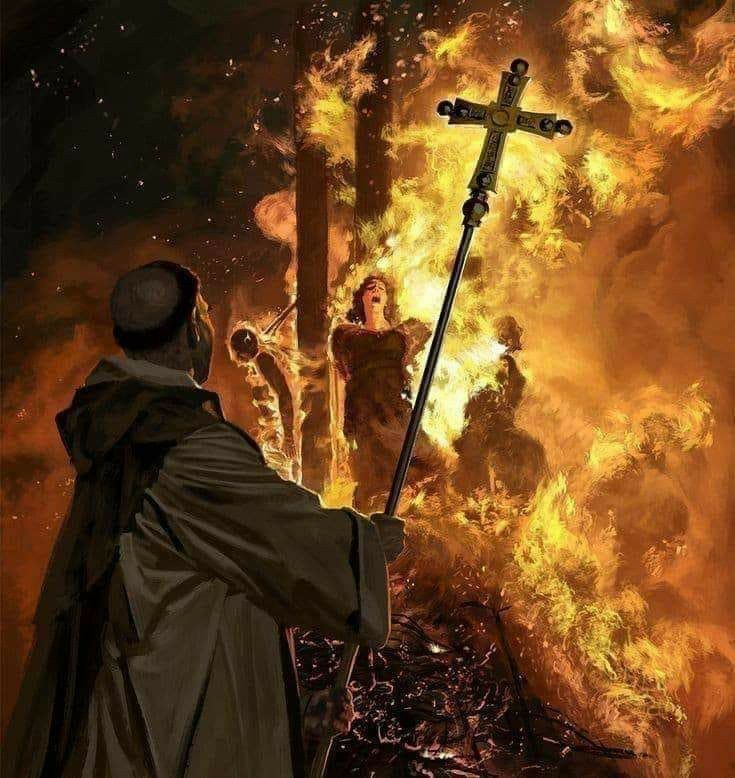
Perhaps most horrific of these bloody religious wars were the years of the so-called Spanish Inquisition (1478–1834) which used systematic, often bureaucratic, methods to enforce Catholic orthodoxy including secret interrogations, psychological coercion, property confiscation, and calculated torture to extract confessions. Common torture methods included waterboarding, the rack, and pulley-based limb dislocating to force confessions which led to public auto-da-fé ceremonies and executions. Roughly 150,000 people, with an estimated 3,000–5,000 burned alive, were caught up in this religious insanity. As a global power, Spain engaged in religious wars against Protestantism, including conflicts with England, culminating in the 1588 Spanish Armada.
These actions were driven by Spain’s determination to create a uniformly Catholic society. Sound familiar?
Other similar conflicts included:
- The Wars of the Three Kingdoms (1639–1653): A series of armed conflicts, including the Bishops’ Wars, the English Civil War (1642–1651), and the Irish Confederate Wars. This involved Anglicans (Royalists/Cavaliers) fighting Puritans (Parliamentarians/Roundheads), who were often allied with Scottish Presbyterians, against a backdrop of Catholic uprising in Ireland.
- The English Civil War: A fundamental conflict between Anglicans (supporters of King Charles I) and Puritans (supporters of Parliament), leading to over 100,000 battle deaths and thousands more non-combat deaths.
- Cromwellian Conquest of Ireland (1649–1653): Part of the wider civil war, aimed primarily at Catholic forces.
- The Glorious Revolution (1688–1689) and Williamite War: A shift in power from Catholic King James II to Protestant forces (Anglicans and others), featuring battles between Anglicans and Catholics, particularly in Ireland.
- Persecution of Quakers: Quakers were not an army but faced severe persecution from Puritans in New England (1656–1661) and both Anglicans and Puritans in England.
Other European religious wars included the Thirty Years’ War (1618–1648) resulting in 4.5 to 8 million deaths, while the French Wars of Religion (1562–1598) caused 2 to 4 million deaths.
The period after “discovery” of the New World featured the slaughter of millions of indigenous people. Upon arriving on these lands, still thriving with wildlife and virgin forests despite 40,000+ years of indigenous settlement, Europeans viewed these peoples as inferior and un-Christian, a view which justified brutal violence. Estimates suggest that roughly 55 to 56 million native people died in the Americas due to European colonization between 1492 and the early 1600s. This mass mortality, known as the “Great Dying,” represented about 90% of the indigenous population and was primarily caused by introduced diseases, alongside warfare, forced labor (slavery), and societal collapse.
Based on a 1493 papal decree, Christian explorers believed they had the right to claim land belonging to non-Christians, often viewing themselves as bringing civilization and God to “pagan populations.”
One wonders, what would Jesus do?
Religious conflicts in colonial America were widespread, characterized by Puritan persecution of Quakers and Baptists in New England, anti-Catholic laws in Maryland, and violence against dissenting evangelicals by Anglican authorities in the South. Conflicts also occurred between “Old Light” traditionalists and “New Light” revivalists during the Great Awakening. Puritans in Massachusetts Bay exiled dissenters like Roger Williams and Anne Hutchinson, and hanged four Quakers between 1659 and 1661.
Intermingled among these loving brothers and sisters in Christ were the witch hunts driven by Puritan beliefs and fear of the devil, culminating in the 1692–1693 Salem witch trials, which saw 19 people hanged, one pressed to death,[1] and over 200 accused. While Salem is most famous, over 100 cases occurred across New England and Virginia between 1626 and 1730, including a significant 1662 panic in Hartford, Connecticut.
You’ll notice that in all that violent turmoil, it was the Puritans who were the most intolerant, the most determined to force everyone to their chosen faith. The Puritans believed they had a divine mandate to establish a “Holy Commonwealth” that would influence all areas of life, including public morality, law, and social behavior. This strongly parallels the Catholic crown’s effort to create a uniformly Catholic society across Europe.
Nothing could be closer to this four-hundred year old depraved mindset than the present-day reality of the Christian Nationalists’ ongoing determination to force their beliefs on everyone else, that “God has called Christians to exercise dominion over all areas of American society.” They seek secure political power, social dominance, and the implementation of policies based on their religious worldview.
Small wonder that by 1776, the Founding Fathers emphasized the importance of separating the powers of the church and the function of government in writing the new nation’s fundamental governing document and its First Amendment: “Congress shall make no law respecting an establishment of religion or prohibiting the free exercise thereof.”
In the same line of thinking, founders like Thomas Jefferson and later reformers argued that a republic could not survive on ignorance. They viewed tax-supported public education as an insurance premium paid for by the wealthy to ensure political stability, create good citizens, and prevent social unrest. Nativism, driven by fears that newcomers would steal jobs, lower wages, threaten national identity, bring crime, and fail to assimilate particularly targeted Catholicism in the 19th century and non-northern European immigrants later. As immigration increased, particularly in the mid-19th century, public schools were viewed as a mechanism for assimilating children from diverse cultural and religious backgrounds into a shared “American” culture.
Education’s role today is all that and more, critical to our role as citizens of a nation meant to be governed by the people. We are tasked with self-governance as well as developing our moral character, intellectual growth, science-based literacy, and academic proficiency. Few would argue that most modern employment would be possible without these skills.
The chaos permeating United States society today is a primary outcome of our compromised educational system. It’s only going to get worse as budget cuts further undermine school operations and digital media becomes more permeated by artificial intelligence. But the greatest threat is the insidious creep of religious indoctrination, a largely unrecognized form of subversion which demands tax dollars in support of religious teachings in specific opposition to the Founding Fathers’ intent.
These efforts have simmered through our nation’s history, but only in the last fifty years have they made strides in overthrowing our constitutional foundations. We truly face a crisis.
[1] “Pressing” was a method where victims were laid down with heavy weights placed on their bodies, causing breathing to become impossible as ribs fractured, lungs collapsed, and internal organs failed over several hours or days. This happened to Giles Corey, an 81-year-old farmer.



Thanks for all the good information
Sent from Yahoo Mail for iPhone
Thanks Charles!