CHROMA Excerpt

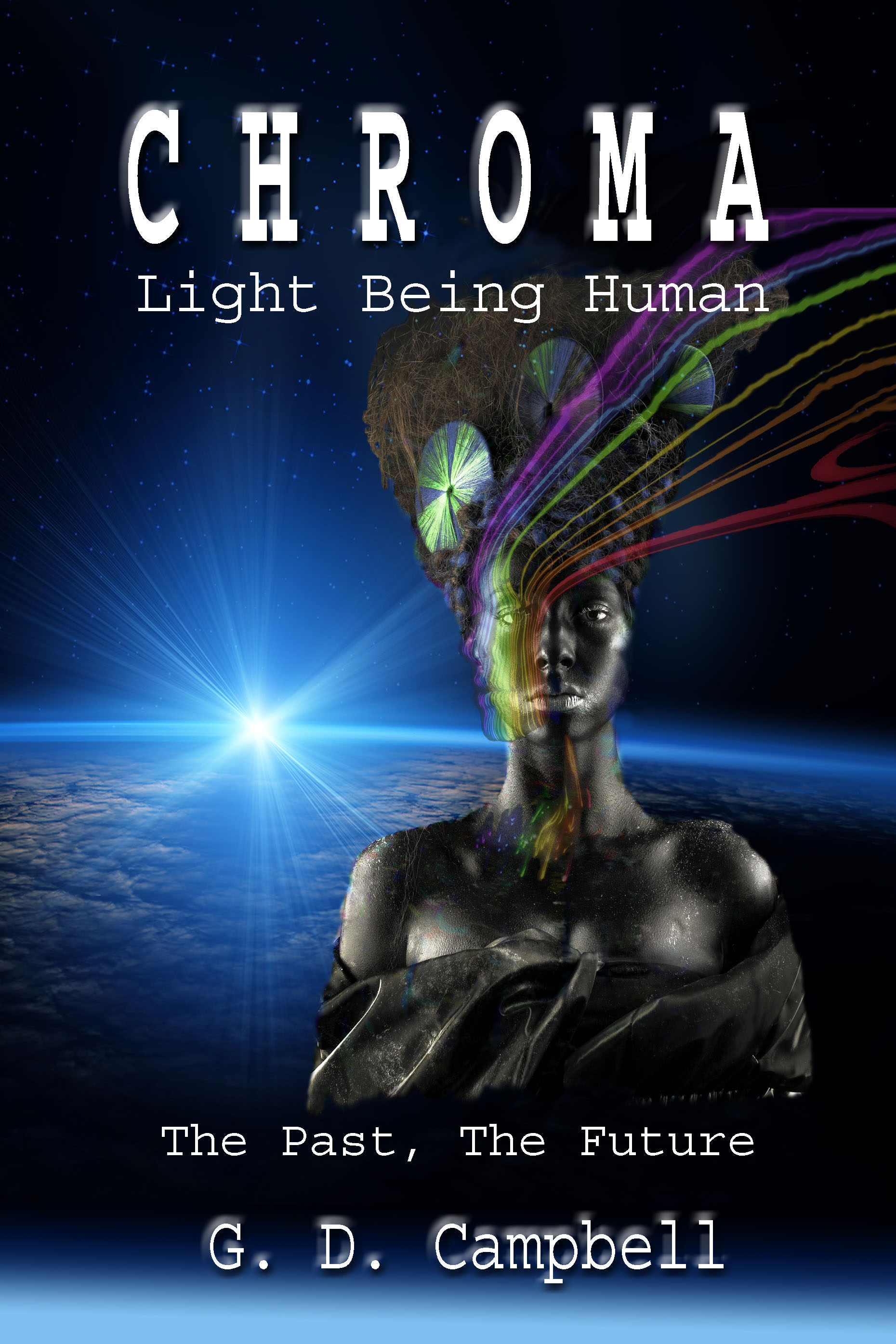
chroma-coverMuch of what I write is history. My blog posts are usually about current events or my publications about local history. This is different.

My new novel, Chroma, is history of an entirely different sort. Theoretical history firmly rooted in factual evidence of human evolution. It’s available in ebook format at half price now until November 15 release date.

They were aware of nothing. Not movement, even though they existed within a stream of photons traveling at the speed of light. Not thought, even though they contained among them all the knowledge that could be known.

They were One, Chroma.

A world of physical existence unfolded before them as they encountered a blue planet and its cycles of life, forms already ancient in their traditions of birth, life, and death. The Aspects of Chroma begin to question. How would it be to know embodiment? Could they learn the pleasure of food, of rest and procreation?

Among them, B4 Indigo—more precisely 493.883 Hertz in her spectral array between 420 and 450 nanometers of visible light—flourished into her own identity. Immediately resonating with her harmonic companion F369.994 Yellow and his fellow octaves of F sharp, B4 pursued a fateful agenda. What could be known? What could be changed?

Chroma: Light Being Human submerges readers in the intimate process of becoming human.

Excerpt:

Several entities manipulate dials and adjust various screens and mechanisms. The green glow of instrumentation reflects on their thin metallic arms and black sensory lens. Outside, visible through a wide expanse of glass that spreads above the console, the curve of the ship’s upper hull shines faintly silver as we pass a nearby sun, a reflection that repeats in luminous arcs along the huge outer ring as it revolves around the ship. Our vessel emits its own light, a faint glow of pink and yellow, pastel blue and green. The pale kaleidoscope of color changes as the ring rotates. A faint jingling sound emanates from the ring.

The crystal from which we flow stands in the midst of the upper deck, mounted at the heart of an elegant curving focular. The metal device reaches up to a clear dome in the ceiling, the portal through which our photons flow. At the heart of the focular, the tall crystal pulses with light. Each facet sparks with color, throwing my existence—the existence of us all—into the cabin.

You can’t imagine seeing all this at once. Without any understanding. I can’t imagine it either, not any more. It’s been too long. What’s left for me now, for any of us in Light, is the faint dying away of sound from a bell long after it’s been struck.

What lingers more clearly is the question ‘why’? I’ve come up with countless answers, but my cigarette has gone out. Its ashes and butt have already been incorporated into the cabin’s refuse bin. What can I say? I always want to smoke. It calms me.

~~~

We were so innocent then. None of us knew how long we’d been traveling or even that we were. I speak for us all because back then, we were One.

We’d been speeding through the soup of space-time. It could be said that we didn’t move at all, that we were in all places at once, and that would have been closer to the actual physics of the situation. We understood so little.

As if we understand now. Get that straight. I can look back now and say, oh, yeah, this and that. But we blew into this excruciating process without knowing anything. You’d think after all this time we’d have the answers. Everyone thinks we know everything. I’m telling this story because you need to understand—we don’t know.

At the time, we didn’t have human reference. Consider yourself lucky that I can use these terms. Otherwise, I’d have to present a symphony with flashing lights and you wouldn’t get it.

Please allow me to introduce us, the Aspects of Chroma. I’m of the electromagnetic range known as Indigo, and my frequency is of the musical tone B at the fourth octave of human perception, 493.883 Hertz. Call me B4. From me up the diatonic scale and across the visible spectrum are C Violet, D Red, E Orange, F Yellow, G Green, and A Blue, each like me with countless shades and sub-tones just as there are infinite fractions between the number one and the number two. These are my kinsmen and companions. Part of me, at least in the beginning.

Beginning? Again, that’s an amorphous concept. What we’ve learned so far is that our piercing column of white light, this stream of photons, originates somewhere past Sirius. The big star’s gravity bends our trajectory and slings us on a new path like a stone from a slingshot.

In the moment of our awakening, we existed as a refraction off the face of a doubly terminated clear quartz crystal, SiO4 tetrahedra. We broke into brilliant shapes of every color: red lines and blue spheres, violet spirals and yellow-orange loops, green and turquoise, russet and tan, swirling and sparkling, our voice a mighty chorus throbbing with the vibration of our existence.

This is the armchair quarterback version. Like I said, we didn’t know any of this. We just were. Ambulatory entities moved around us in a physical existence unlike ours. They could travel from place to place as discrete beings. Do things. Move things. I envied them.

Looking back, I’m amazed at how easy it was to take the next step. I can’t tell you when. We’re talking infinities of time, at least in human terms. And that’s how I’m trying to keep this, in human terms.

At a random moment, I the fourth octave of Indigo separated my wave of sound and light from the others. I clung to one of these ambulatory forms as it passed near the crystal. I had been part of the full sound of Chroma, a band of its electromagnetic spectra. Suddenly I wasn’t.

I admit it was a thrilling moment. That first taste of discrete existence riveted my attention. This physiognomy went places, did things. I went with it. Interacted. I became able to think and speak of things not previously known, concepts not known to us in One.

That was how it started.

~~~

I rode the Phiz, these gray physiognomies with their gleaming black eyes and dexterous fingers, around our contained metal vessel. On its shoulders, I dove deep into the belly of the ship where sleek engines chewed through harvested dark matter and thrust us ever onward. I swept along corridors to technical rooms where Phiz performed maintenance on each other and the ship’s devices. With the Phiz, I found that my suggestions resulted in certain responses so that when I wanted to see beyond a particular door, whichever Phiz I rode opened it. When I wanted to alter the direction of the ship so that it turned more toward the nearby nebulae or a particular galaxy, the Phiz manipulated the controls accordingly.

What pleasure I found in these interactions! The heady exercise of power, autonomy, control, adventure! The gratification of cause and effect, initiation and conclusion, hunger and satiety—I couldn’t get enough. How could one ever forget such things, once tasted?

My fellow Aspects twirled and tumbled in a constantly changing wash of rainbow hues and choirs of sound. Calculations of mathematics, rhymes of words and phrases, patterns of triangles, squares, octagons, words merging into other words that grew from combinations of letters, new meanings and ideas forming from old meanings and old ideas, scenes of color shifting constantly into different color—all of it poured out in a continuing stream, all of it made audible by the rush of sound, each tone carrying its own frequency and pitch, each color merging upward or downward into the next hue, each pitch sliding upward or downward through infinite frequencies.

Indigo posed our fateful question to the thought stream pulsing within our One: Could we have form as do the Phiz?

Immediately the texture of light in the room changed. Shades of color diminished until only the primary hue of each band remained. The wild disarray of sound subsided as sub-tones, flats and sharps and semi-notes aligned with their dominant pitches. One next to each other, each of the Aspects formed their primary hue of colored light in a single prismatic emission from the crystal face.

“What would you have us do, B Indigo?” asked D293.665 Red, surging in a beam of crimson. “Will it be pleasurable?”

“What will form accomplish?” A440 Blue said, his cobalt column intense. “I admit to some interest in your idea, but I have no data that support this proposal.”

“No data,” said the sphere of E329.628 Orange.

F369.994 Yellow rippled over the room, casting everything in golden brilliance. “A challenging proposal, my dear B4,” he said. “I’ve seen you coming this. I’ve felt your excitement. Why would you change us?”

Even separated from them as I had become in my questioning, I could not overcome the pull of our vibrational unity. But among them all, none had greater fundamental frequency with me than the energy of F369.994 and his fellow octaves of F sharp. For a moment, I couldn’t control my visceral response, an emission of sound that rang out beside his pitch in perfect intervals of fourths and fifths.

Such joy! Tremors of luxurious warmth swept along my wavelength. I wanted him always with me.

“Don’t spoil this, Yellow.” I wrested away, shivering in the rush of our harmonic joining. “Think of what I ask.”

His tone settled on one note. “Do you know what you ask?”

“Surely we have other purpose than endless play,” I said, resisting the urge to acknowledge his doubt. “What do we know of our beginning? Where are we going? What is our purpose? Is this all there is?”

None of them replied. Only the faintest choir of sound emanated from us.

“What of this adjacent plane, these physical constructs that force us from One into many, that contain us and attend us?” I said, swirling toward the crystal and the Phiz then laying my purple ribbon of light along the glass that separated our enclosed space from the streaming vista ahead. I couldn’t express, then or now, the swelling up I felt, the urgency pushing me. “What are the natures of the bodies we pass, these suns and novas, the congregates?”

The room remained abnormally silent with faint spikes of color flickering on the lustrous high ceiling.  I couldn’t blame them for their reaction. Part of me remained in sync with them, stunned at my rebellion.

“These are challenging observations, B4,” Blue intoned.

Green flourished in chartreuse, emerald, lime, as octaves of G echoed. “We could instruct the Phiz to such a task. I sense creative possibilities.”

“Yes, exactly,” I said, my Indigo family growing more intense. “How can we wait one more moment to explore?”

“Dearest B4, we have everything here,” Violet C murmured. “Existence in its purest form. We are One. Why would we want to disturb this with unknowns?”

“But we are no longer One…” I said.

“Theoretical questions, Violet,” F Yellow said. “Questioning within unity is not the same as chasing ideas on your own. What B4 proposes takes us outside anything we’ve known.”

“The risks of unknowns, statistically speaking…the odds are quite staggering that we would have any success in finding an equivalent amount of pleasure, if I respond to Red’s posed question,” Orange said. She calculated, sending up waves of mathematical images to the upper deck walls. “Drawing from Phiz data stores—they have no specific description of pleasure or any other subjective experience, but they do record a significant number of potentially damaging interactions between our containment here and various elements of the external environment. If we extrapolated that we, like the vessel around us, would also encounter a variety of similar interactions, we could assume that pleasure would not be the only feature of such a ‘physical’ experience.”

“A blind leap, it seems to me,” Blue said. “Why would we risk it? I believe Indigo’s ideas stem from disengagement from our union. We should be reminded—it’s been a long time since we acknowledged the primal energy of our source. A joining can’t be far off. Until the time when our One is reenergized, we should focus on discussion, perhaps expanding our theoretical analyses. We can generate ideas and experiences among us that are new and challenging—Orange alone has infinite sequences of formulae—without shifting the fundamental nature of our experience. We are, after all, physical in the sense that we exist in light and sound beyond the energy stream radiated at the grating. The possibilities…”

“And what of my offerings—spontaneous, organic…” Green said.

“Take my D,” Red said. “Tones seducing to the sharp, to the flat …”

The column of light swirled brighter. Choirs of sound pulsed the air and rose to the walls, to the high ceiling, until the shades of color painted the room in song. I saw their hesitation. I slipped away, allowing my bandwidth to drift into shadows. I don’t know what I expected. The old songs resonated through the conversation.

Whether my fellows agreed or not, whether Indigo might later suffer regret, I could not stop myself. I see now that my destiny would find outlet no matter what. Ironically, I understand it now in terms of the physical world. My fate advanced like a sudden rivulet of rainwater caught behind a clump of leaves and silt which pile up in a widening dam until, finding fresh course to its inevitable downhill destiny, the flood rushes around and through the obstacle.

~~~

Amazon purchase link, only $2.99!

Smashwords purchase link, only $2.99 — includes all formats

What’s New with Gender?

09164402431cd5749db37663e66a8459

Is LGBT new? Is it the craven abandon of our modern godless age that foments such perversion, as social conservatives believe?

Briefly, no.

The Greek island of Lesbos, currently under pressure in the route of refugees seeking safe harbor from war in Syria and Iraq, gave its name to the practice of female-female sexuality. That was 2500 years ago.

Male-male relations aren’t new nor is bisexuality. Greek and Roman men routinely married and produced children with their wives while finding pleasure with other males.

Among the indigenous peoples of the Americas prior to European colonization, a number of nations had respected roles for homosexual, bisexual, and gender-nonconforming individuals; in many Indigenous communities, these roles still exist.[1]

So what’s really new?

Consider this:

“If you ask experts at medical centers how often a child is born so noticeably atypical in terms of genitalia that a specialist in sex differentiation is called in, the number comes out to about 1 in 1500 to 1 in 2000 births. But a lot more people than that are born with subtler forms of sex anatomy variations, some of which won’t show up until later in life.”[2]

Even at the lesser rate of one in two thousand, this is an astonishing number of newborns with ‘ambiguous’ genitalia.

“For 50 years, the medical response to such external abnormalities has been the same: operate quickly to make the genitals as “normal” as possible, then hide the child’s medical history even from parents in the hope of reinforcing the new gender. Convinced they were doing the best for their patients, doctors in the past labeled ambiguous children boys or girls according to the alteration that seemed most feasible and performed highly invasive, irreversible surgeries accordingly. Thus a boy with a tiny penis might be castrated, given a rudimentary vagina, and designated a girl. Even more commonly, in cases in which a girl’s clitoris looked larger than the norm, her clitoris would be cut away entirely.”[3]

Now consider this:

“Over the past decades, an increasing trend in male external genital malformations such as cryptorchidism and hypospadias has led to the suspicion that environmental chemicals are detrimental to male fetal sexual development. Several environmental pollutants, including organochlorine pesticides, polychlorinated biphenyls, bisphenol A, phthalates, dioxins and furans have estrogenic and anti-androgenic activity and are thus considered as endocrine-disrupting chemicals (EDCs). Since male sex differentiation is critically dependent on the normal production and action of androgens during fetal life, EDCs may be able to alter normal male sex differentiation.”[4]

Elementary arithmetic is hardly required to connect these dots.

Not surprisingly, most of the research on the effect of environmental pollutants on gender/sexuality has focused on males rather than females. Male sexuality is easier to “measure” and of urgent interest to males who dominate arenas of research and funding. That doesn’t negate the high likelihood that environmental contaminants produce hormonal effects in females.

Since there has never been a ‘norm’ determined for an average number of LGBTs in any population, there’s no way to determine whether the current LGBT ‘movement’ is a result of increasing numbers or simply the result of a freer society. Conversely, we can hardly deny the gender effects resulting from increasing pollution.

Data is data.

Given that data proving climate change seems beyond comprehension for social conservatives, there’s little hope these medievalists would be capable of understanding data showing that any ‘increase’ in the number of LGBTs could be a direct result of fetal exposure to contaminants.

Separate from the effects of increasingly pervasive chemicals and considering that so-called sexual deviance has been a standard throughout human history, maybe it’s safe to conclude that deviance is the norm.


[1] https://en.wikipedia.org/wiki/History_of_homosexuality

[2] https://en.wikipedia.org/wiki/Intersex or http://www.isna.org/faq/frequency

[3] http://www.slate.com/articles/health_and_science/medical_examiner/2004/06/the_cutting_edge.html

[4] http://www.ncbi.nlm.nih.gov/pubmed/21868402

Have a Sexy Easter, Y’all

Genrich_Ippolitovich_Semiradsky_-_Roma,_1889 (1)
Henryk Siemiradzki. Phryne in Eleusus (1889)

This morning my Facebook newsfeed included an image of a bloody thorn-crowned Christ on the cross. I’ve never understood why death is enshrined in our culture, especially at a time we’re seeing the natural world revive from winter. This is spring. Why worship death?

In reality, spring equinox and the celebration of Easter are simply new names for one of the oldest observances of mankind—the renewal of life. For millennia, sex has animated the celebration. Without sex, life would stop in its tracks.

So why has our celebration of spring has been stripped of its sexual origins and reframed in death?

Judeo-Christian religion has led the war against sex, somehow missing the point that perfect life in the Garden of Eden must have included sex. If not, then if Eve hadn’t tasted the apple, we wouldn’t be here. So it hardly follows that humans weren’t intended to have sex. Otherwise, what was the point of God’s fabulous creation if Adam and Eve were going to be the whole enchilada?

So right off the bat we can see that Eve and sex got a bad rap. Here we’ve been led to believe that sex and those troubling genitalia are intricately linked with sin and that’s why women are less than men and why men need to rule women with an iron hand.

No one can argue that religious rules came before sex. Sex existed from Day One, before primates, before cities. Unless of course you believe that God created Man and then crafted Woman from Adam’s rib and then boom, you had people without sex. (This story gets complicated if you ask how these two people produced the rest of us without incest.)

In the days before Christianity, civilizations worshipped sex as the best possible ceremony for welcoming spring. Now, not so much.

Unless spring break counts.

In case you haven’t already figured this out, I’ll warn you in advance that modern ceremonies tied to the spring equinox have little to do with celebrating the magical renewal of life and everything to do about controlling sex. Here’s my take on how that happened.

Among hunter-gatherers, women found it useful for men to bring food, skins, firewood, or other ‘gifts’ to exchange for sexual favors, sewn leggings, and a slab of fry bread. Women, stuck with staying home with the children, tended the fire and performed other more sedentary tasks while men ranged far afield in search of mammoth. Slowly, they began to connect the amazing dots between sex and reproduction. It was women who performed the magic.

Sex magic became ritualized as fortified settlements developed in fertile lands and material wealth could be accumulated. Pesky traveling salesmen entered the community. With wealth inheritance, keeping track of paternity became an issue. Rules governing and restricting females and their sex were necessary. Who wants his hard-earned herd of goats going to a son who looks at lot like that visiting salt dealer?

As the need for powerful enforcer gods developed to control unruly masses in crowded cities, traditions celebrating the springtime renewal of life became more complicated. They still needed sex magic to ensure fertility in their herds and crops. So they came up with ritualized sex.

In Sumeria, one of the earliest known civilizations, sex was celebrated at the spring equinox as part of fertility rites. A young woman would sit on the grounds of the goddess Ishtar’s temple and wait for a man to couple with her, a requirement to be fulfilled before she could get married.

Similarly, ancient Egyptians enshrined the sacred sex ritual in their god stories. Osiris was murdered and dismembered by his jealous brother Set then revived by his beloved sister and wife Isis, who found all the discarded parts of him except his phallus. So she crafted one out of gold and mated with him, producing the god Horus. Osiris thus died and was reborn. For sex.

In ancient Greece, the god of the spring equinox was Dionysus. He was associated with flowering plants and fruitful vines and survived a painful winter to celebrate the revival of life. Not surprisingly, the spring festival of Dionysia involved obscene songs and erotic dances intended to stimulate plant growth. In a continuation of tradition from prehistoric Crete, peasants participated in sex orgies on freshly plowed fields.

Slowly, power shifted away from the female’s sex magic as men took over. The idea of a male hero’s death and rebirth gained traction. Temple prostitutes might perform spring rites with the king or priests, but let’s not have the wives and daughters randomly consorting with men in freshly plowed fields. Gradually priestesses originally reserved for sex rituals became virgins dedicated to the (male) gods.

Our old friend Dionysus ranks among the most famous stories of death and rebirth in ancient religions. His mother Semele, a mortal impregnated by none other than Zeus, became the target of jealousy from Zeus’ aging wife Hera who suggested that the Zeus Semele thought got her with child wasn’t really the god Zeus. Acting on the idea Hera planted, Semele demanded Zeus show proof that the father of her child was in fact the All-Powerful Zeus.

  • Though Zeus begged her not to ask this, she persisted and he agreed. Therefore, he came to her wreathed in bolts of lightning; mortals, however, could not look upon an undisguised god without dying, and she perished in the ensuing blaze. Zeus rescued the unborn Dionysus by sewing him into his thigh.[1]

Scottish anthropologist Sir James George Frazer reached the obvious conclusion that old religions were at heart fertility cults that revolved around the worship and periodic sacrifice of a sacred king. In his work The Golden Bough, he argued that the king was the incarnation of a dying and reviving god, a solar deity who underwent a mystic marriage to a goddess of the Earth. He died at the harvest and was reincarnated in the spring.[2]

So how did we get to a spring equinox religious ritual called Easter that includes not even a hint of sex? I mean, what is less erotic than the crucifixion? Last time I checked, Christ never enjoyed marriage, mystic or otherwise.

By now, everyone knows that Christianity superimposed itself onto old pagan traditions and holy days. So it’s no surprise that the Germanic custom to celebrate the lunar goddess Ostara on the first full moon after the spring equinox has become the Catholic Church’s method to set the date for Easter. And—you might have guessed—there’s also a direct connection between Ostara and Easter. The Germanic Saxon word for Ostara was Eostre: Easter.

Circa the time of Christ, folks needed to spruce up those old spring revival traditions from our pastoral past. What could be more logical than to replace the fecund female with the dying hero? The symbolism says the same thing—important stuff dies and then comes back to life. Only now, renewal of abundant crops gives way to life in an immortal hereafter gifted to humanity by a male Trinity bereft of any female sex.

You see how this works. Discredited by her pas de deux with a snake, Eve is the cause of God’s displeasure. She’s got no traction. It’s now up to the guys to keep the gods happy.

Meanwhile, with fairly little recognition for what lies beneath our modern customs and under the benign tolerance of the Church, we continue with a few of the old pagan accouterments of the Easter season—bunnies (an ancient symbol of fertility and new life) and eggs.

  • “The egg as a symbol of fertility and of renewed life goes back to the ancient Egyptians and Persians, who had also the custom of coloring and eating eggs during their spring festival.”[3]

Robbed of her sexuality by divine insemination, the most revered female of the modern Christian church—Mary—becomes little more than a uterus by which the Divine Male is born to become the savior of humanity.

There’s something wrong with this picture.

~~~~~


A local (Northwest Arkansas) event celebrates women and the rites of spring through March 27. To learn more, visit The Goddess Festival.

A good source for an overview of the topic is Ancient Origins.

[1] https://en.wikipedia.org/wiki/Dionysus

[2] https://en.wikipedia.org/wiki/The_Golden_Bough

[3] – See more at: http://www.ancient-origins.net/myths-legends/ancient-pagan-origins-easter-001571?page=0%2C1#sthash.xUSOEla5.dpuf

And a Merry Solstice to You!

charliebrownsingingchristmas

Seems like every year about this time we hear the same outcry from certain sectors of the Christian community. And every year the same responses arise, that Christians do not ‘own’ the midwinter holidays. Rebirth of the sun on the year’s shortest day, not any particular religion, lies at the heart of midwinter celebrations around the world. The modern Christian custom of marking December 25 as the birth date of Jesus Christ was established by church fathers sometime in the 4th century in their effort to override pagan beliefs.[1] Yet modern holiday traditions surrounding Christmas derive from those ancient roots, not the other way around.

So yes, you could call this another response. But I wanted to gather, in one fairly tidy summation, an overview of the non-Christian winter solstice traditions. So I dug in and thought I’d share the results with you.

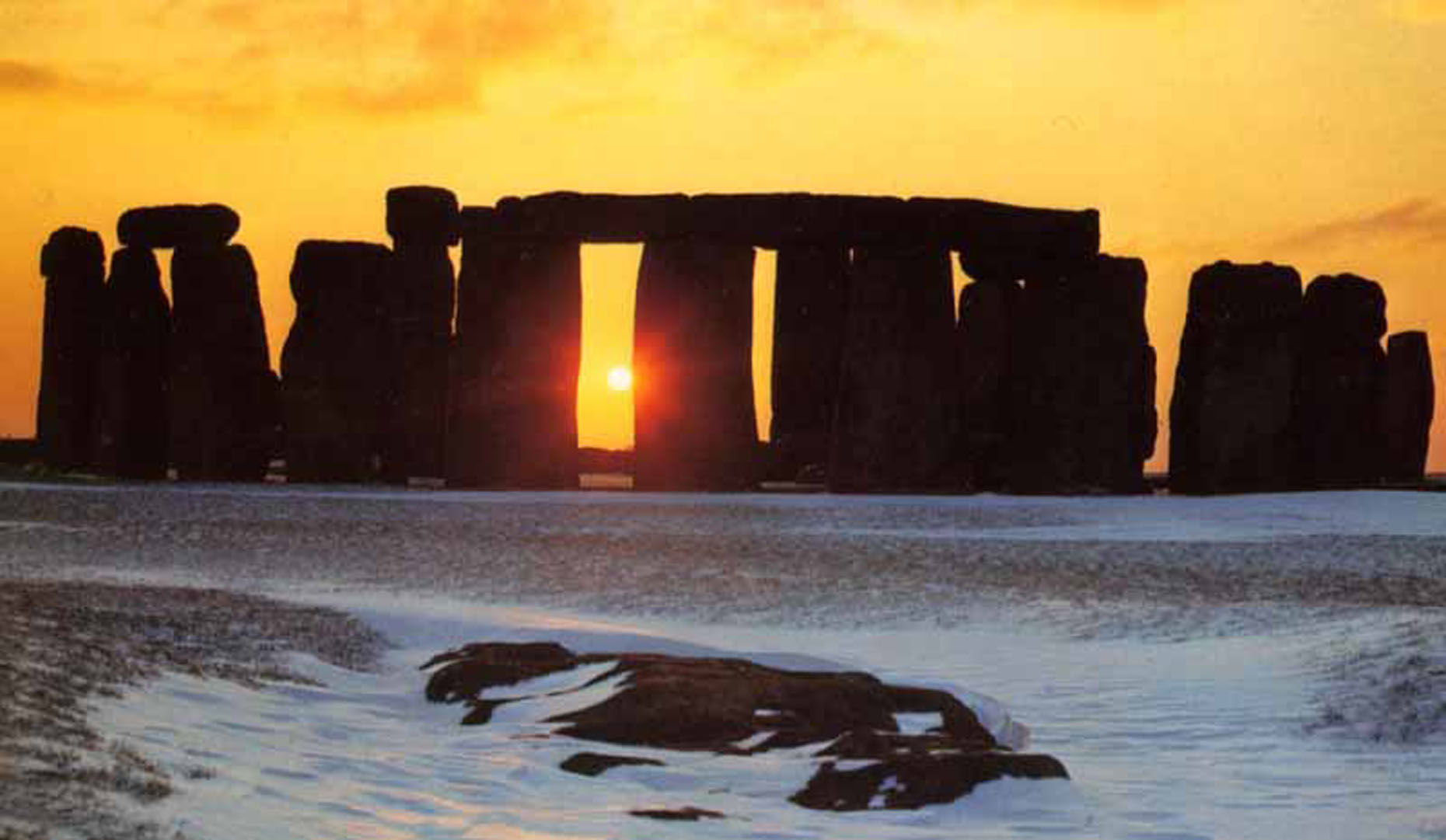
stonehengewinter
Stonehenge Midwinter

Far back into prehistory, human rituals marked the winter solstice. The year’s shortest day arguably served as early man’s most important marker of the passage of time, a point of reckoning enshrined in monolithic stone structures which align with the sun’s movement. Archaeological examinations of better known sites such as Stonehenge (it’s believed the site was established by 8000 BCE) have uncovered evidence of fires, feasting, and ritual sacrifice. Manmade monuments with midwinter alignments are found on every continent.[2]

The earliest written records of solstice celebrations are Sumerian and Egyptian myths dating from around 3000 BCE. In Egyptian myth, the birthday of the god Horus was celebrated on the winter solstice. His mother Isis was impregnated by the resurrected body of Osiris. The annual celebration marking that birth included offerings, feasting, and sacrifice. Writing in 65 BCE, Plutarch stated “…it is said that Isis…at the winter solstice gave birth to Harpocrates (from Hor-pa-khered, Horus the Child).[3], [4] The story of Horus is one of several original archetypes of a sky god born by supernatural means.

The Twelve Days of Christmas came from the Sumerians. The celebration for the rebirth of the year lasted twelve days. It is also from the Sumerian celebration that the next oldest tradition derives, gift giving. During their celebrations, the Sumerians held huge parades, wished good tidings to each other, and exchanged gifts. Early Greeks adopted the Solstice with celebrations honoring Zeus’s victory over Kronos and the Titans.[5],[6]

chinaAs early as 1000 BCE, Eastern Asians including Japanese, Chinese, Vietnamese, and Koreans celebrated the year’s shortest day with the Dongzhi Festival on or about December 22. The solstice festival gives a nod to the yin-yang philosophy of balance and harmony in the cosmos as recorded in the Daoist teachings of the I Ching.[7] After the celebration, days of longer daylight hours brought an increase in positive energy as symbolized in the I Ching hexagram  (復, “Returning”). Today, Asian people cook special foods such as the colorful balls of glutinous rice known as tangyuan or, in more northern regions, a certain type of dumpling. Old traditions also require people with the same surname or from the same clan to gather at their ancestral temples to worship on this day. A grand reunion dinner follows.

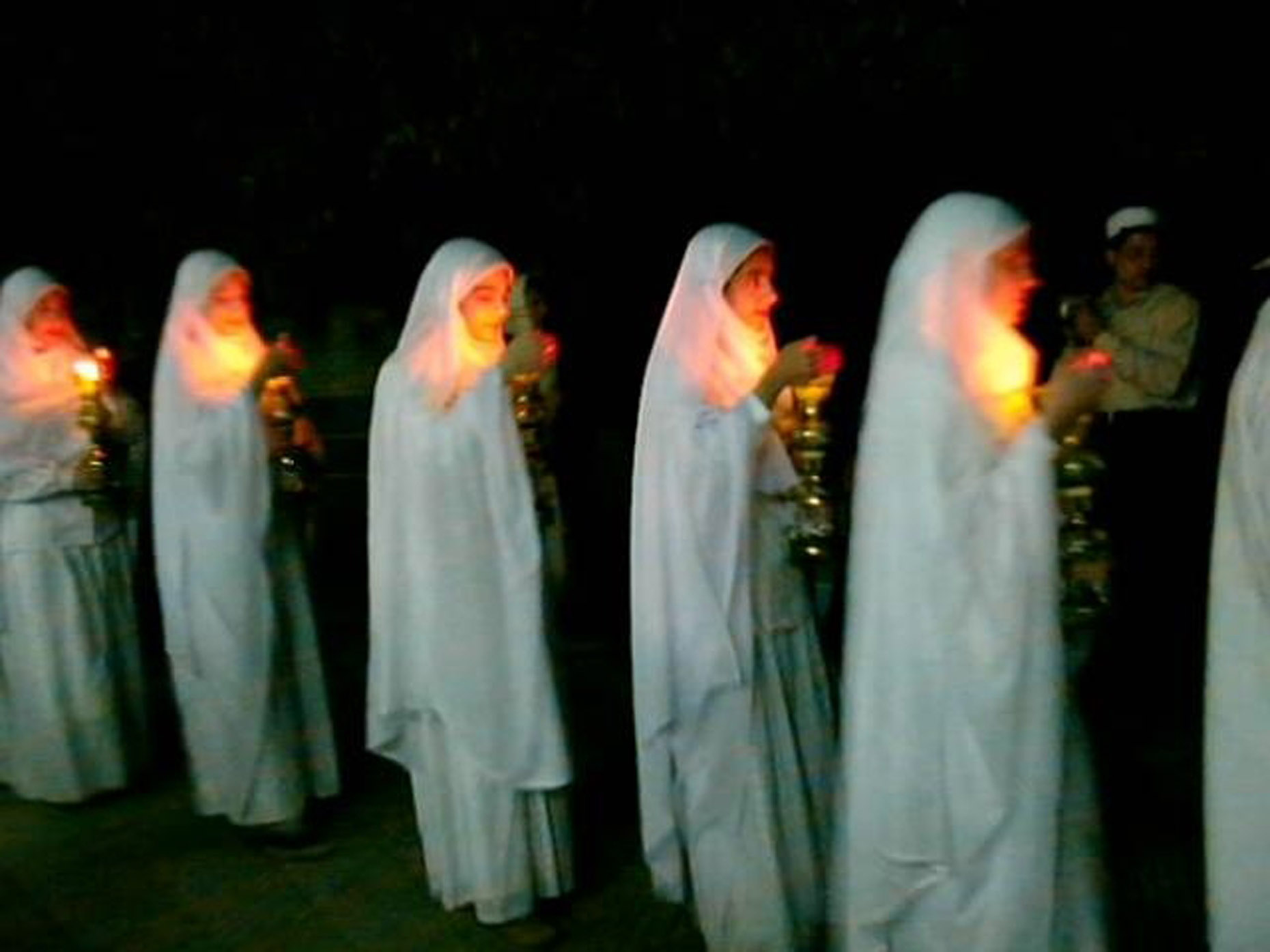
sadeh
Sadeh/Yalda celebration, Iran. From Iranreview.org

The early Iranian religion Zoroastrianism recognized a holiday they called Sadeh which is now celebrated in Iran as Yalda. Documented as early as 600 BCE, fires were set on December 25 near water and the temples. The fire was originally meant to assist the revival of the sun and bring back the warmth and light of summer. It was also supposed to drive off the demons of frost and cold which turned water to ice and thus could kill the roots of plants.[8]

The Vainakh people of the North Caucasus include the modern Chechens and Ingush who celebrate Malkh on December 25 as the birthday and the festival of the Sun. During the ceremonies suppliants turned to the east.[9] The Hindu Sankranti historically takes place on the Solstice, although the date is January 14, which gives evidence to how much time has elapsed since it started. It is believed that people who die on this day end the reincarnation cycle, for which reason it is very lucky. Gifts are exchanged, sweets and other special food are consumed, and bonfires are lit on Sankranti eve, which is known as Lohari.[10]

More specific to our Western traditions, pagans of Scandinavia and Germanic regions celebrated the season as Yule. People came to the common hall and brought food. It was a three day celebration in memory of ancestors and dates back to the Stone Age in Western Europe. Animals were sacrificed and everyone drank ale. A specially selected Yule log burned through these days as a symbol of the returning sun.[11]

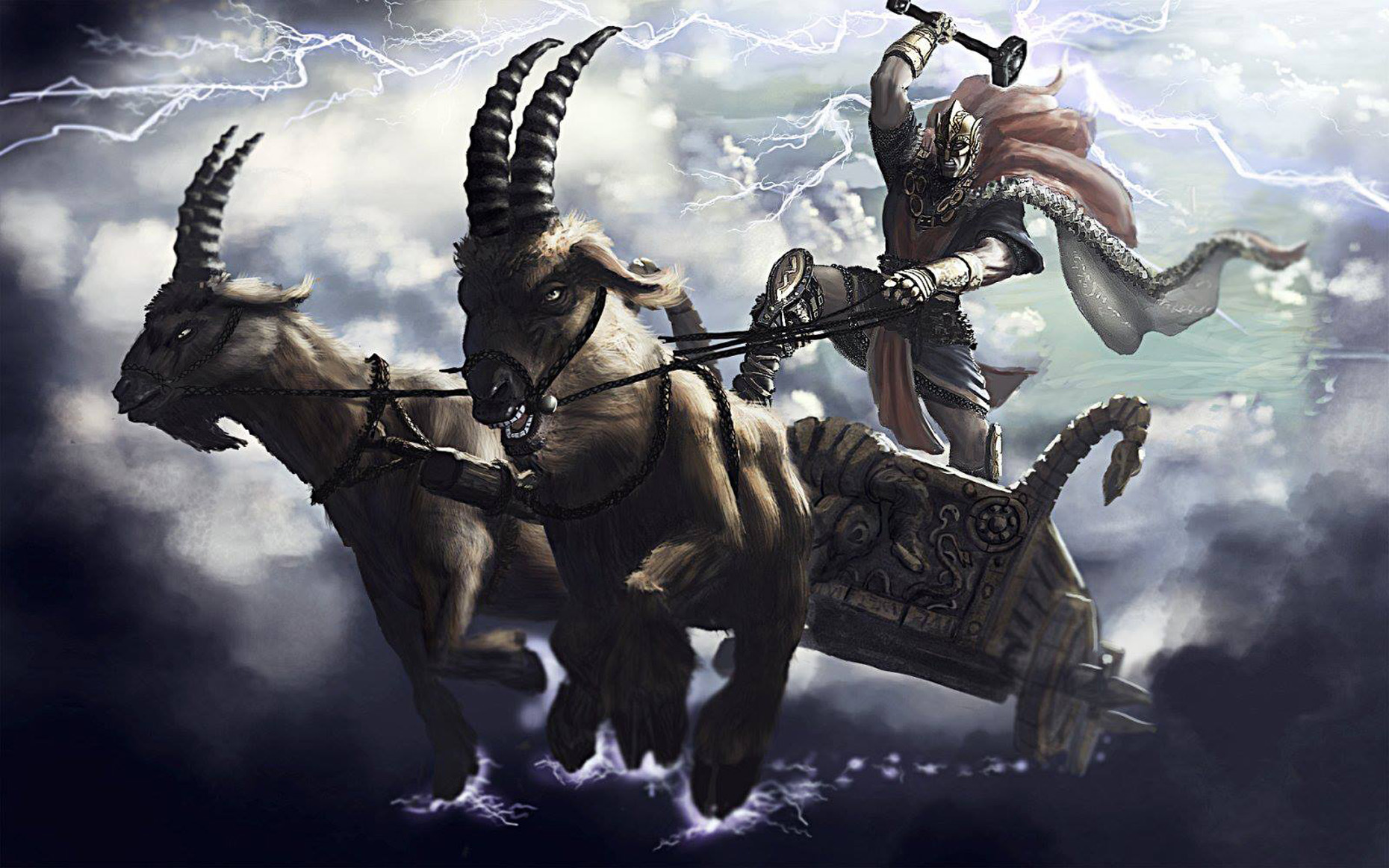
thor
Thor rides in a chariot pulled by two great goats named Tanngnjóstr (Old Norse “teeth-barer, snarler”) and Tanngrisnir (Old Norse “teeth grinder”). From twayneheeter.wordpress.com

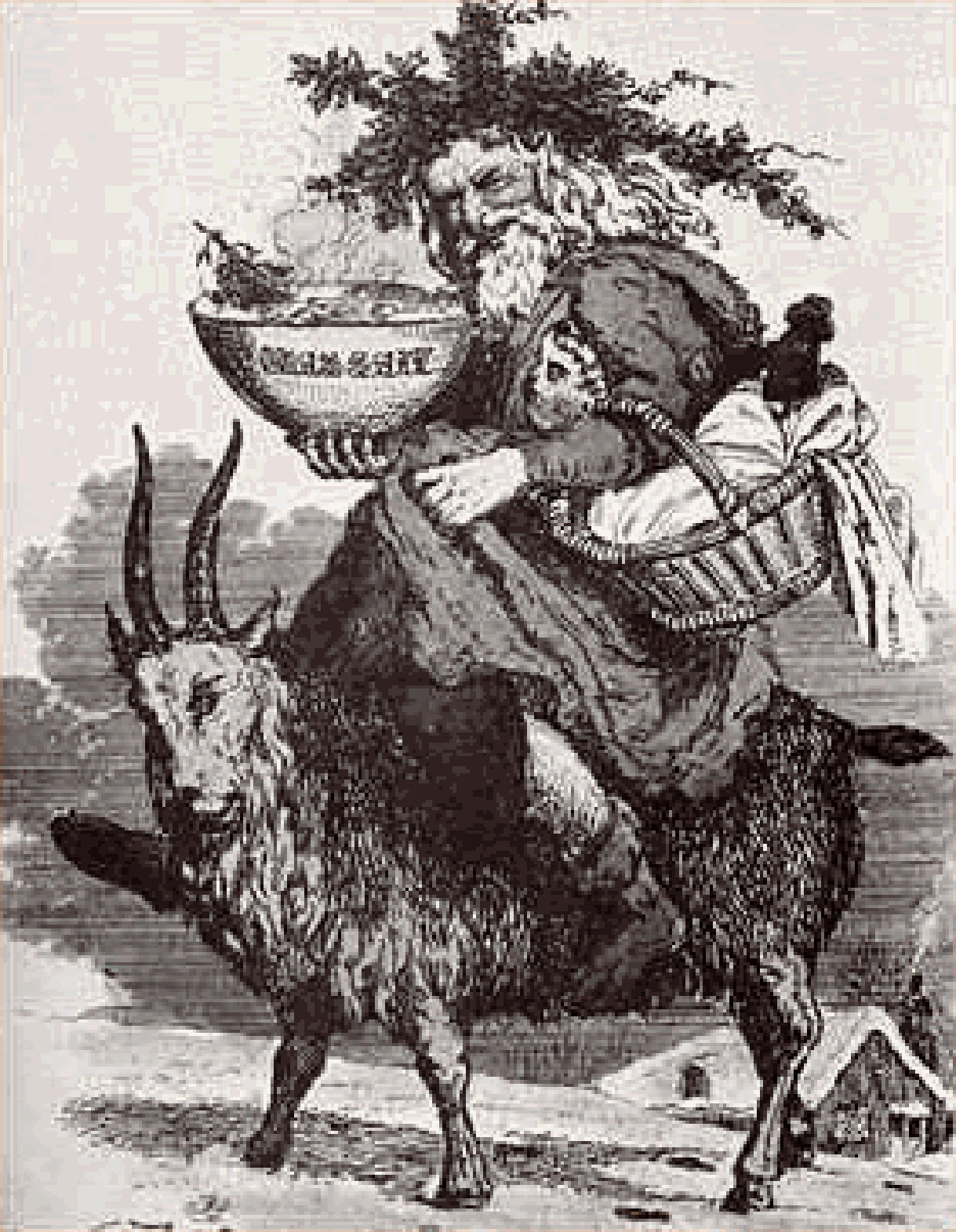
Particularly in Scandinavia, the last sheaf of grain from the harvest was preserved for the occasion, believed to hold magical properties and called the ‘Yule goat.’ Another tradition holds that the Yule goat is a spirit that appears during preparations for the Yule to ensure things are done right. A popular theory is that the celebration of the goat is connected to worship of the Norse god Thor, who rode the sky in a chariot drawn by two goats.[12]

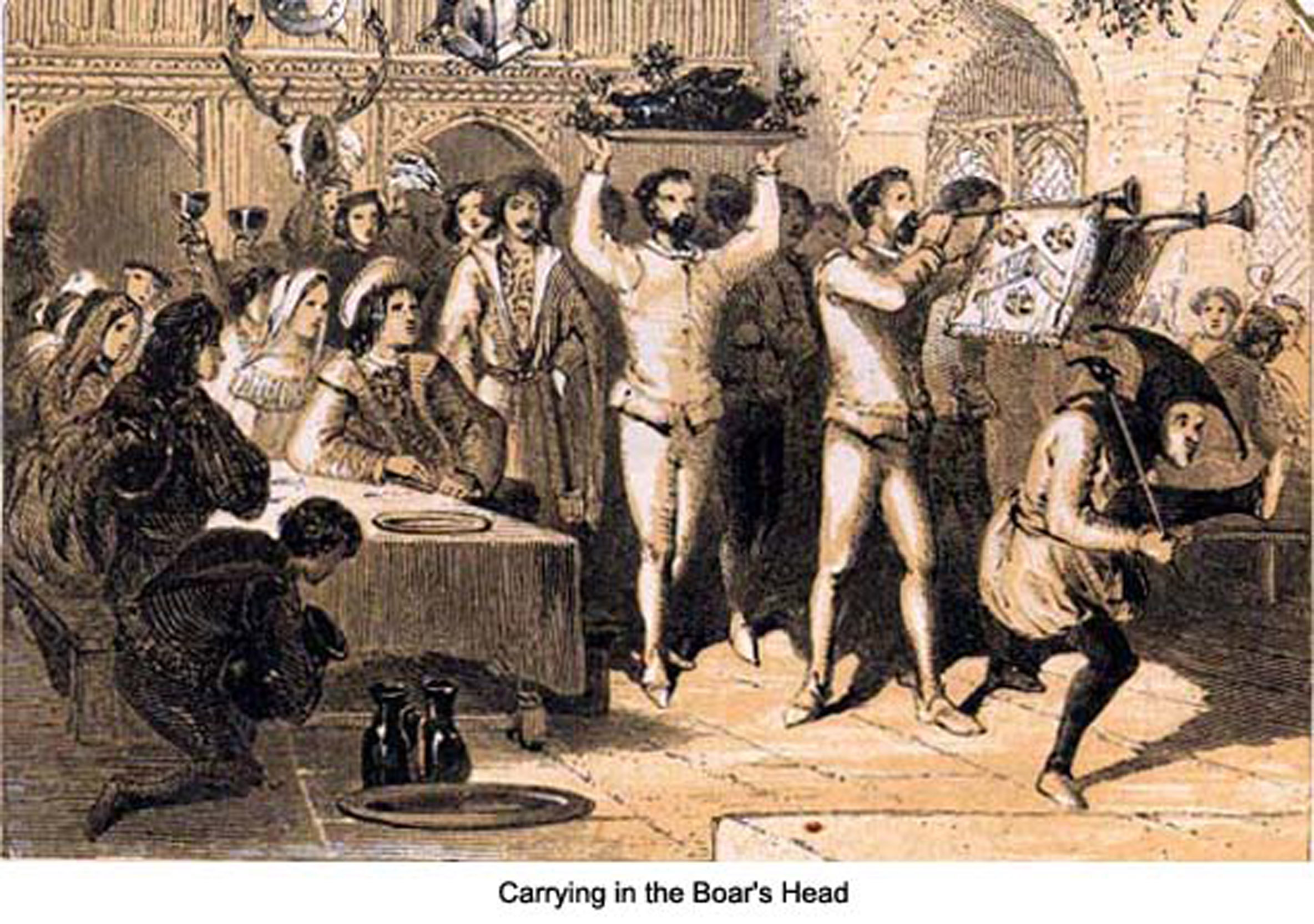
BoarNorthern Europeans also celebrated the Yule boar in a tradition where all men laid hands on the bristles of a sacrificed boar and solemn vows made. There is believed to be a connection between the choice of a boar and the Nordic god Freyr, whose mount is the gold-bristled boar Gullinbursti. The continuing Swedish tradition of eating pig-shaped cakes at Christmas recalls the heathen custom. The serving of a roasted pig’s head at midwinter feasts in England also recreates this ancient tradition as does the serving of a Christmas ham on many American tables. [13]

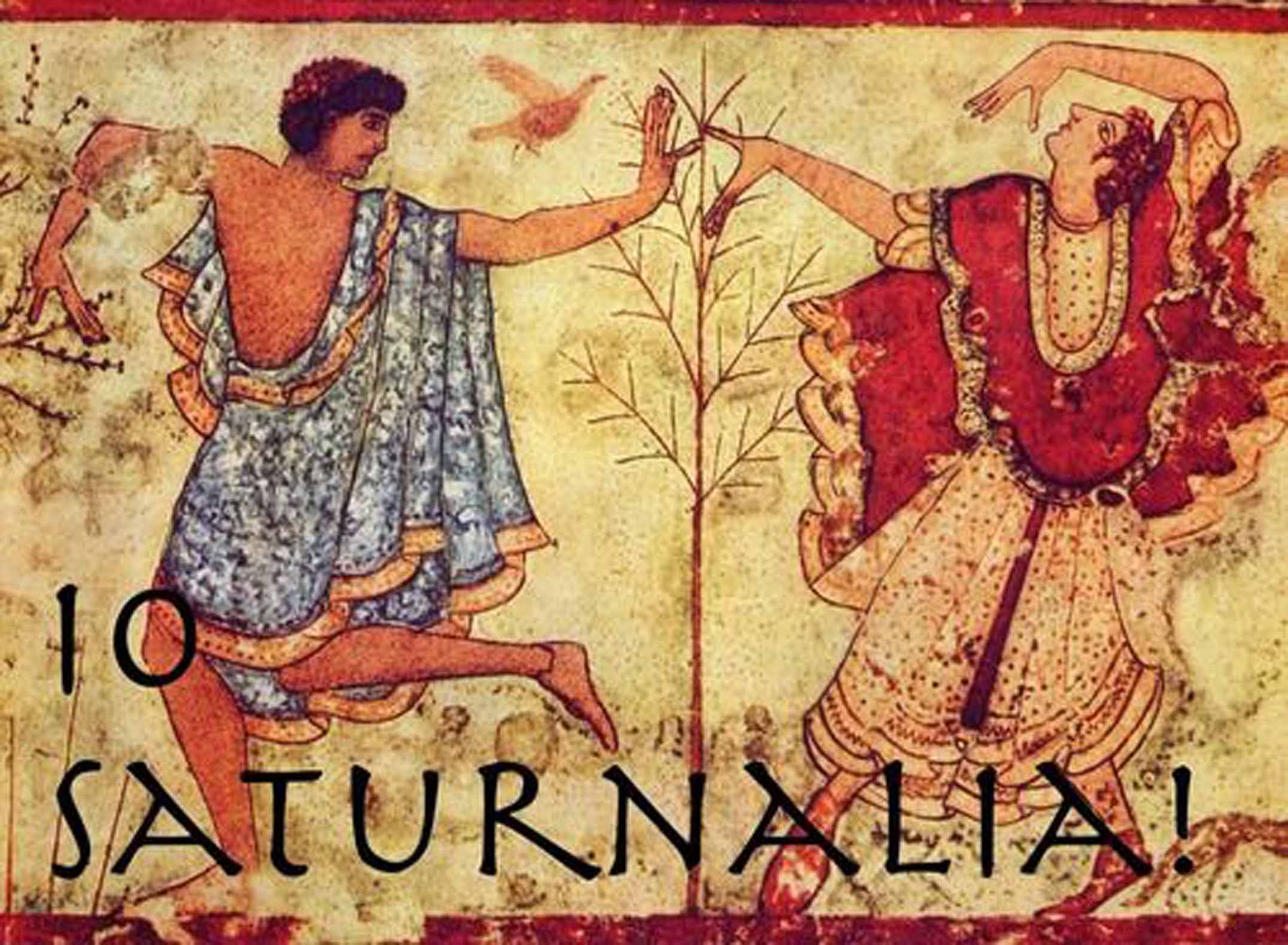
saturnalia
“Io Saturnalia” was shouted as part of the celebration. “Io” translates as “Yo,” an exclamation still in common usage.

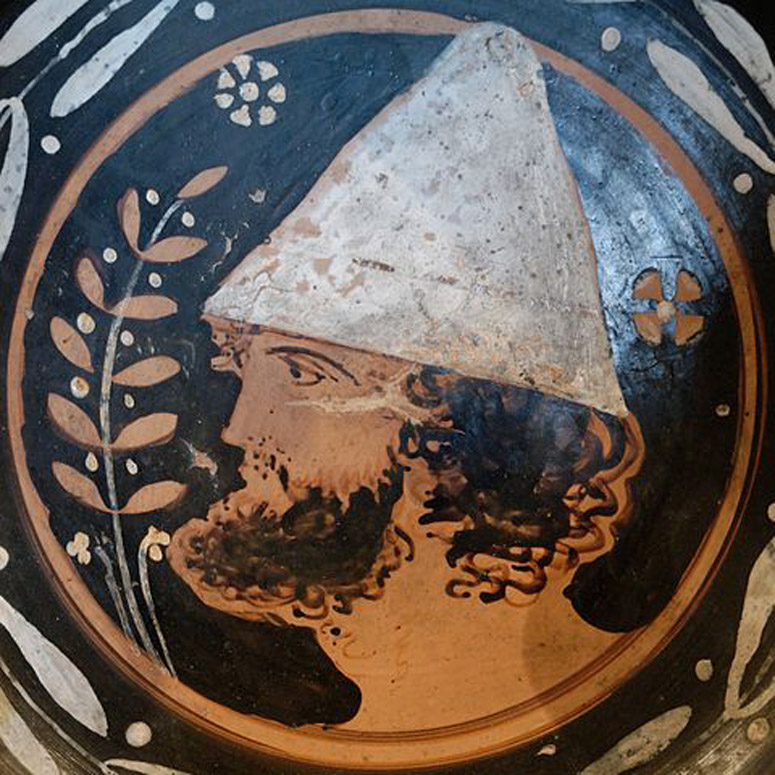
Saturnalia was an ancient Roman midwinter festival in honor of the deity Saturn. It occurred within the broader seasonal celebration known as Brumalia and continued from December 17 through December 23.[14] Sacrifices to the gods, a public banquet, and private gift giving were the primary activities. Candles were given to help drive away evil and encourage the return of the sun. Other gifts included toys for children and gag gifts as well as monetary gifts from employers and ranking members of society to their employees or underlings. On the day of Saturnalia, Roman social norms reversed so that masters served the servants, gambling was allowed, and a carnival atmosphere prevailed. In keeping with the reversal, Roman citizens wore the conical felt hat (pileus) typically worn by freed slaves as a symbol of their freedom, an ancient Greek tradition. The idea of reversal is believed to have symbolized the reversal of the sun’s decline.

Man pilos Louvre MNE1330 by Marie-Lan Nguyen (2009). Licensed under CC BY 2.5 via Commons
The pileus, possibly the inspiration for Santa’s hat? From Louvre MNE1330 by Marie-Lan Nguyen (2009). Licensed under CC BY 2.5 via Commons

In Roman mythology, Saturn was an agricultural deity who was said to have reigned over the world in the Golden Age when humans enjoyed the spontaneous bounty of the earth without labor. The revelries of Saturnalia were supposed to reflect the conditions of the lost mythical age. Following Saturnalia, on December 25 the renewal of light and coming of a new year was celebrated as Dies Natalis of Sol Invictus, the “Birthday of the Unconquerable Sun.”

Similarly, the celebration of Hannukah among Jews tracks the same prehistoric tradition. As noted by one rabbi, “…it is a short leap to surmise that the Maccabees, when they took the anniversary of that day as the day of rededication, were rededicating not only the Temple but the day itself to Jewish holiness; were capturing a pagan solstice festival that had won wide support among partially Hellenized Jews, in order to make it a day of God’s victory over paganism. Even the lighting of candles for Hanukkah fits the context of the surrounding torchlight honors for the sun.”[15]

SantaandgoatThe origins of the Christian gift-bringer figures in European folklore connect specifically with the Yule festivals of Germanic paganism and are often associated with the figure of Odin, the leader of the Wild Hunt at the time of Yule. Santa Claus’ reindeer have been compared to Sleipnir, the eight-legged horse of Odin. After Christianization, the benign mid-winter gift bringer was associated with the 4th century Christian Saint Nicholas of Myra, based on his generous gifts to the poor.[16]

MerryYule
Merry Yule from http://www.kitchenwiccan.com/2013/11/)

The use of mistletoe as a kissing bough evidently derives from a Celtic custom in which Druid priests climbed a sacred oak to cut down mistletoe from which they made an elixir to cure infertility.[17] Holly use during the holiday season also derives from Celtic custom; Druid priests wore wreaths of holly on their heads. Wreaths as household ornaments originated with Greeks and Etruscans (by 600 BCE) as an offering to the gods to prevent crop failure and plagues. Evergreens were sacred because they did not ‘die,’ thereby representing the eternal aspect of the Divine.[18]

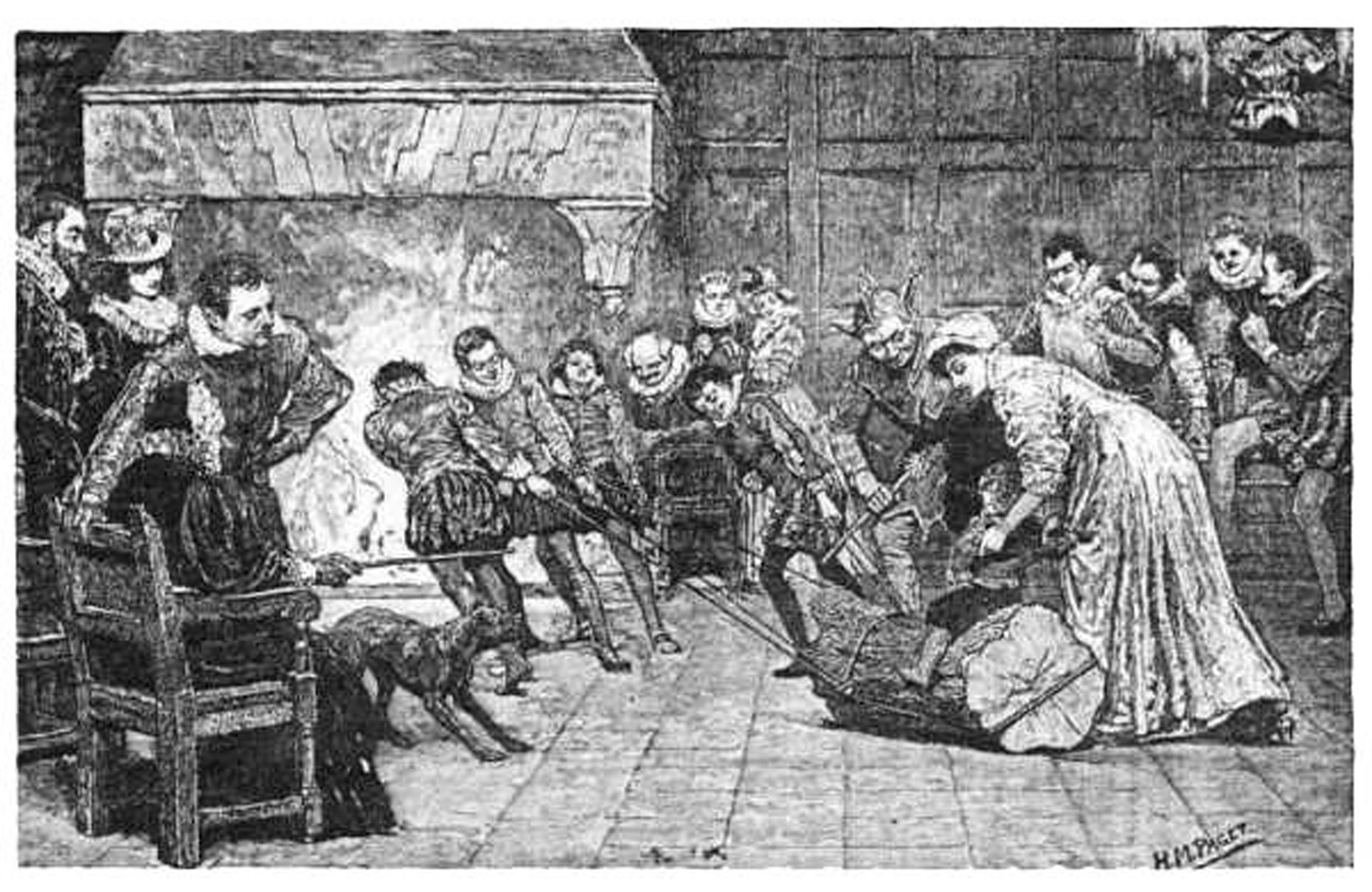
yule log
Bringing in the Yule log

Wassailing as a house-to-house caroling tradition follows from the Anglo-Saxon toast Wæs þu hæl, meaning “be thou hale”—i.e., “be in good health.” In medieval Britain, the practice became an exchange between feudal lords and their peasants wherein the lords could practice charitable giving. Songs sung by visiting bands of peasants such as “Here We Come A’Wassailing” and “We Wish You A Merry Christmas” emphasized this dynamic but also hinted at the implied threat that if ‘figgy pudding’ wasn’t given ‘right here,’ vandalism or at least curses might be inflicted upon the manor house.[19]

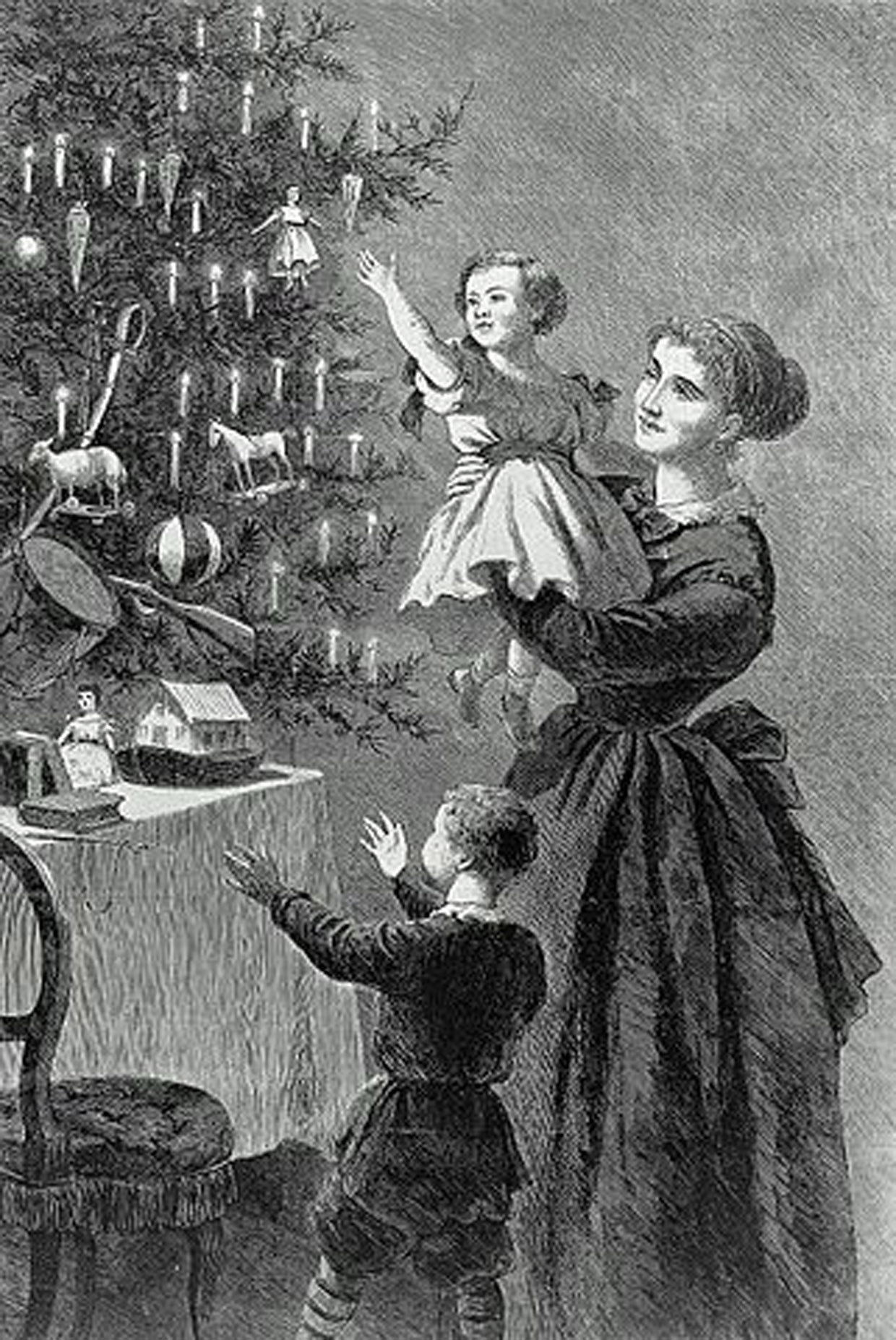
321px-1870_ChristmasTree_byEhninger_HarpersBazaar
Illustration for Harper’s Bazaar, published January 1, 1870

Christmas trees were relatively unknown in the United States until well into the 19th century and were first considered strictly a German custom. According to the Encyclopedia Britannica, “The use of evergreen trees, wreaths, and garlands to symbolize eternal life was a custom of the ancient Egyptians, Chinese, and Hebrews. Tree worship was common among the pagan Europeans and survived their conversion to Christianity in the Scandinavian customs of decorating the house and barn with evergreens at the New Year to scare away the devil and of setting up a tree for the birds during Christmastime.”[20]

Nativity_tree2011Advent, a period of Christian rituals leading up to Christ’s Mass, began sometime in the late 5th century. The earliest Christmas hymns date to the same period. Modern Christian worship centered on the holiday may involve lighting of candles, prayers, giving to the poor, and other elements of earlier pagan traditions.

The midwinter celebration is the oldest of human traditions. With its darkness and cold, the shortest day gives pause even to the most jaded world citizen. Remembrance of family, feasting, exchange of gifts, and well wishes are no less compelling today than they were in the shadows of our ancient past. Future generations will continue to note this compelling point of the sun-earth cycle, no matter by what name.

May your days be merry and bright!

hd-wallpaper-christmas-gifts-and-globes-wallpaper

Please note I openly confess to shameless usage of cited materials.

[1] https://en.wikipedia.org/wiki/Winter_solstice

[2] BCE refers to “Before Common Era,” sometimes notated as BC, or “Before Christ.”

[3] https://en.wikipedia.org/wiki/Horus

[4] http://isiopolis.com/2011/12/25/isis-osiris-horus-and-the-holy-day-of-december-25th/

[5] http://blog.chron.com/thewiccanway/2011/12/winter-solstice-and-christmas-traditions-and-where-they-came-from/

[6] See also Crump, William D., The Christmas Encyclopedia, 3rd Edition. McFarland. p 369

[7] https://en.wikipedia.org/wiki/Yin_and_yang

[8] https://en.wikipedia.org/wiki/Sadeh

[9] https://en.wikipedia.org/wiki/Malkh-Festival

[10] http://ancienthistory.about.com/od/winterholidays/p/WinterHolidays.htm

[11] https://en.wikipedia.org/wiki/Yule_log

[12] https://en.wikipedia.org/wiki/Yule_Goat

[13] https://en.wikipedia.org/wiki/Sonarg%C3%B6ltr

[14] https://en.wikipedia.org/wiki/Brumalia

[15] http://www.myjewishlearning.com/article/hanukkah-and-the-winter-solstice/

[16] https://en.wikipedia.org/wiki/Christmas_gift-bringer

[17] https://en.wikipedia.org/wiki/Ritual_of_oak_and_mistletoe

[18] https://wicca.com/celtic/akasha/yule.htm

[19] https://en.wikipedia.org/wiki/Wassailing

[20] http://www.britannica.com/plant/Christmas-tree

Creating ISIS

warrior


Some Facebook posts circulating since the Paris tragedy voice outrage that the U.S. and its allies failed to stop ISIS at its inception.

To those I ask what, pray tell, was the beginning?

Was it during the three hundred years of Crusades when Western European Christians invaded the Middle East to drive out Islam?

Was it after WWI when the Western powers reorganized the colonized Middle East, shifting borders to suit the desires of various Western nations regardless of existing ethnic, tribal, or religious boundaries?

Was it after WWII when Western powers again reorganized Arab lands, shoving the Palestinians aside to carve out a homeland for the Jews? Couldn’t we have predicted that Arabs would resist? Perhaps that would have been the best time to nuke the whole region.

Was it when we armed the Afghan Mujaheddin in the 1980s to help them overthrow Soviet occupation? Couldn’t we have predicted that once the Cold War ended, we would abandon Afghanistan and leave tribal leaders like Osama bin Laden to take what he’d been taught to organize his devastated homeland.

Was it when we marched into Iraq, toppling the strong man government of Saddam Hussein and unleashing sectarian violence between Sunnis and Shias?

Was it when the 2011 Arab spring spread from Egypt through other Middle Eastern nations and Syria’s President Assad fought back against his nation’s rebellion? The U.S. and allies hurried into Syria with support and secret ‘advisors’ to assist the rebels, bringing in sophisticated arms and other supplies that are now in the hands of ISIS. Gee, how could we have guessed?

The claim that the U. S. could have inflicted a fatal incisive strike against ISIS at any point along this tortured path shows ignorance and a single-minded obsession to heap criticism on President Obama. ISIS has never existed as a discrete target. Any attack on ISIS would result in massive collateral damage.

The entire mess points to one overarching conclusion: the more we intervene in the Middle East, the worse things get.

We’re good at meddling in other people’s affairs. At what point do we have an honest national dialogue centered on the question: Why are we in the Middle East at all?

I can tell you. It’s because of money, oil and religion. And money. Did I say money?[i]

According to a 2013 report, “over the last six decades, the U.S. has invested $299 billion in military and economic aid for Middle Eastern and Central Asian countries currently in turmoil. Egypt tops a list of ten nations, receiving $114 billion since the end of World War II. Iraq comes in second, getting nearly $60 billion from the U.S. (over and above war costs). Far outpacing those ten countries is Israel, an ally that received another $185 billion in U.S. aid in the same period.”[ii]

Why not just hand all that arms money over to the arms dealers and let them keep the weapons?

Are we getting what we paid for? If the objective is to keep the region destabilized so that we can maintain a level of control over the oil, yes. If the objective is to undermine Arab strength in order to further prop up Israel, yes.

We continue to send billions of dollars of foreign aid to the region, larding the already excessive oil profits lining the pockets of the region’s leaders. With all that money, leaders so inclined can invest in distant terrorists or add to their nation’s arsenal by purchasing arms and equipment manufactured in Western nations.

Supporters of Israel dismiss dollar amounts because their agenda is religious. People concerned about U. S. energy profits dismiss dollar amounts because their agenda is oil. Both groups fail to recognize the larger agenda behind their pet projects: money.

According to a 2013 report, “Each year, around $45-60 billion worth of arms sales are agreed. Most of these sales (something like 75%) are to developing countries. The five permanent members of the UN Security Council (U.S., Russia, France, United Kingdom and China), together with Germany and Italy account for around 85% of the arms sold between 2004 and 2011.[iii]

Nearly twenty years ago, an incisive review of our foreign aid pointed to this folly:

“An examination of $13.6 billion in U.S. foreign aid activity for Fiscal Year 1997 reveals that almost half of the aid is military in nature. This assistance, in conjunction with large-scale arms exports, may actually be working counter to many stated U.S. foreign policy objectives such as promoting sustainable development, protecting human health and fostering economic growth.”[iv]

George Washington famously cautioned against the quagmire in which we’re now floundering:

“The great rule of conduct for us in regard to foreign nations is in extending our commercial relations, to have with them as little political connection as possible.”[v]

Just six days ago, the columnist citing this wisdom called for an end to all but humanitarian aid to foreign nations. He’s not alone.

Opponents of a hands-off approach will cite the potential for increasing interference in the region from nations like Russia and China. In theory, our presence at the arms trade table balances their influence. But we have to ask ourselves, who was there first? I can tell you. It was us.[vi]

If we want the violence to stop, we’ll have to

  • stop giving our tax dollars to nations who spend it on arms,
  • eliminate any and all subsidies to arms dealers and manufacturers,
  • remove our forces entirely from the region and let them sort it out themselves, and
  • rescind and renegotiate any treaties with other nations so that any and all foreign aid is in the form of food, educational materials, medical supplies, and other humanitarian assistance.

Why not? It’s the only thing we haven’t tried.


[i] For an excellent overview of the money problem, see http://www.esquire.com/news-politics/politics/news/a39727/paris-attacks-middle-eastern-oligarchies/

[ii] A graph showing money received by various nations: http://www.huffingtonpost.com/2013/05/06/us-aid-middle-east_n_3223151.html

[iii] http://www.globalissues.org/issue/73/arms-trade-a-major-cause-of-suffering

[iv] http://www.bu.edu/globalbeat/usdefense/whelan0798.html

[v] http://www.washingtontimes.com/news/2015/nov/9/bruce-fein-end-mideast-arms-sales-nonhumanitarian-/?page=all

[vi] https://en.wikipedia.org/wiki/History_of_the_Middle_East

The American Way

column
Cartoon by Tim Eagan. http://www.timeagan.com/?deepcover

Is it really any surprise that so much in our nation has devolved into violence? We did this to ourselves. This is our legacy.

We set foot on American shores and through violence eradicated the bulk of the indigenous population. We justified our killing with belief in our superiority, our ‘divine right’ to the land and its resources. Unlike the Natives, we carried a Bible and guns so we concluded God wanted us to have it. Might makes right.

Since the beginning, our westward migration progressed under the rationale that we ‘discovered’ gold and silver, ‘harvested’ virgin timber and furs, and settled the ‘wild’ lands. We wrested wealth from the soil by enslaving not only the surviving Natives but imported Africans and Asians. These ‘lesser’ creatures deserved to be subdued just as a work animal yearns for the yoke. They should thank us.

All to the glory of God, who showed us the path to our greatness.

In truth, our nation became rich not because we’re so clever or God’s chosen people but because we stumbled onto a pristine continent. The world’s civilizations had not risen here, had not built their empires, waged their wars, suffered plague and famine here. The Americas weren’t like the rest of the world’s continents, already ravaged by millennia of man’s turmoil.

We Europeans who invaded this land became rich through accidental opportunity, theft, and violence.

And when the land had been conquered, when the virgin forests had been cut and the hillsides left to erode, when the gold and silver had been mined and the waste pits left to leach impurities into the streams, when the frontier came to a screeching halt at the Pacific shore, we turned on ourselves.

With our eye on the prize, we killed anyone who got in our way. Natives, former slaves, immigrants, those too poor or too weak to stand up for themselves—they were cast to the edges to starve. Or lynched. Taught their place away from our table.

Then the mid-twentieth century arrived with its transformative movements on behalf of the poor, the Black and Native, the handicapped, the gay, and the women, all the people whose subjugation had enabled the white patriarchy to herald its God-given triumph.

The power structure reeled in shock.

Assassinations followed. And the war on drugs, a less obvious form of assassination. It wasn’t drugs that subsequently filled our prisons. It wasn’t drugs who became disenfranchised and even more marginalized. Drugs were the tool, the label selectively wielded against those who threatened the system.

For many in the underclass, the black market in drugs became the only means to reach for the American dream. The bait. The wealth of those markets and the inherent lack of regulation led to the current open warfare in our inner cities. In our war against our own people, we have set our law enforcement against our neighborhoods. We have armed them with military weapons and tactics. We have hidden behind our curtains as they firebombed apartment buildings and battered in doors.

We chose to ignore what we’d learned from alcohol prohibition, that such policies not only failed in their stated intent but also gave rise to even worse consequences. We knew that tax dollars invested in education, in mental health care, and in social support would eventually pay dividends in a healthier more vibrant society. Not prisons. Not guns.

We turned away from what we knew because we were taught fear by those with their own agendas—wealth and power at any cost. Fear higher taxes. Fear the government. Fear programs that help the poor.

Everything we should have gladly given became ‘taken.’

What if we hoard all the guns that can be made? What if our barns, our spare bedrooms, bristle with automatic weapons and crates of ammunition? Does that make us safe?

Safe from whom? From the random madman who lurks unknown in suburbia until the day he pulls the trigger? How will you know today is the day, the school is the place, that you should appear with your loaded gun in hand? None of the mass shootings of the last thirty years have been stopped by an armed citizen.

Safe from gangs roaming the dark streets of a declining city? Why bother? They’re killing each other by the hundreds.

From the government? Obviously you haven’t thought this through. Your spare room arsenal, your heavily armed survival shelter, will last about one nanosecond once the U. S. military decides you’re the target. If the Apache helicopters with Hellfire missiles don’t pound you, the fighter jets, Abrams tanks, and missiles launched from drones surely will. Get over yourself.

Now that we’ve had this friendly chat, can you calm down long enough to talk reason? Let go of the gun. Come, let us sit together.

Poor things, we have become islands of fear. We suffer existential crisis. Torn from our historical and biological roots, we are caught up in a world of machines and corporations. We don’t know our neighbors. Our communities have shrunk to a small circle of friends. We are beleaguered, lonely, and overwhelmed.

We need naps after lunch, long walks in nature, communion around campfires. We haven’t evolved fast enough to keep up with the culture. We’re not ready to travel sixty miles an hour.

We are physically ill—overweight, strung out on prescription drugs, anxious, and undernourished. What we take into our mouths becomes our energy, our blood, our skin. Yet much of our food is short on nutrition and long on adulterants. How can we think clearly or feel anything but cornered with flavored dross in our veins? We use caffeine to put one foot in front of the other.

In this melting pot of a nation, we cling to rituals that have lost their meaning. There’s no passage in our rites of teenage drunkenness, no ‘arrival’ in our coming of age. What is our totem, our spirit guide? Our ceremonies are shells of their former meaning dolled up in slick packages.

Even now, after all this, we have the opportunity to evolve. Live up to our dream. Turn away from our violent past and join together in creating solutions to all that ails us.

We don’t have to create armed camps in our midst. We don’t have to teach our young that violence is the solution. We’ve been too lazy to learn and think, too distracted to look beyond our television. Too eager to label and blame the Other for problems we’ve brought onto ourselves.

Too damn busy trying to stay afloat. Trying to have it all.

Can we save the dream of our nation? Is it too late to make love not war? Too late to treat our neighbors as ourselves? Let’s invest our energy and resources in solutions–interventions for those teetering on the edge of mental illness, for disrupted families and children. Pour our money into schools and teachers, not prisons and guards. Free health clinics in every community with counseling for anyone who walks in the door–that day, that moment. Not after someone brings in proof of income and household bills, not after a two week wait.

We embrace delusions of a past that never was. We got lucky. We got spoiled. We want too much and if we can’t have it, it’s somebody else’s fault. The immigrant’s fault that we can’t buy a new car. The poor man’s fault that our groceries cost so much. The gay man’s fault that our marriage failed.

The police are not yet a force unto themselves but they’re moving closer, fed by fear. Their job is to enforce the laws. The laws are not made by the police. They are made by our elected representatives. Our. Elected. Representatives.

Us.

The free ride is over. The trees are cut, the gold nuggets found. The frontier lies within.

Men Who Kill Lions

Animals 4140Once upon a time, men proved their bravery and strength by killing animals. Mammoth flesh was needed for food, dire wolves and cave bears threatened their families. Then we got tractors and supermarkets.

It all happened so fast. Only a few thousand years separate us from the need to kill or be killed, the need to slaughter for food. Our genes haven’t caught up with our culture.

Actually, quite a few men today manage to see themselves as powerful and successful while selling real estate for a living. Or programming software. Or teaching school. These men jog for sport or hang out at basketball courts. Or write books.

Who are these men who have to go kill lions?

What backwater of these male minds still finds pleasure in killing? What short circuit in brain function ignores the endangered status of rhino or leopard? What personal sickness requires going to another continent and tracking down an animal in its own habitat in order to kill it, skin it, and take its head as a trophy?

Is this a failure of nature or nurture?

Perhaps not coincidentally, the particular cretin whose acts have been the subject of heated discussion over the last few days has also been in trouble for sexually harassing women.

If we knew all Walter Palmer’s secrets, what other offensive behavior would come to light? That he was verbally or physically abusive to women, children, or employees? That he repressed his homosexual tendencies? Participated in adolescent bullying? Tortured small animals as a child?

All these and more are traits of men who aren’t real men. Oh, they may make money. They may wear gold Rolex watches and golf with the mayor. They may gain political office or the corner office.

But as real men, as what it means to be a courageous, intelligent male capable of steering a loving path through a complicated world, these big games hunters are failures. Any time someone has to kill something to be a man, hurt women or his children, insult an underling, hate a minority, that’s the signal that this person is a failure. Anyone who has no respect or affection for lifeforms other than himself is a failure.

Deep down inside he’s a cowering little whelp pissing himself in fear. He needs big guns and trophies to prove his manhood, to drive the goblins out from under his bed. And at the end of the day, victorious over his hapless victim, he is no more reassured than before he began.

Before you start labeling me as a man-hater, I’ll hasten to agree that women sometimes kill big game as well. I see that as a function of an insecure woman’s twisted idea of how to attract a man. Killing may top the charts in that regard, but a woman’s pseudo-practice of predation is similar to plastic surgery, wearing clothes, shoes, and hair styles that compromise the ability to move or see, or the cultivated art of simpering.

Sadly, insecure women do attract men this way. Failed men. Men who appreciate idiot women and dead lions. Even more sadly, they breed more of the same.

Unevolved humans aren’t restricted to the class of people rich enough to fly to Africa and kill lions. They can be Louisiana rednecks who shoot ducks for fun and gig a hundred frogs in one night. They can be publicly righteous Christians who practice incest and sexually molest young girls. They can be tight-assed suburban wannabe warriors with Confederate flag decals on the back windows of their pickup trucks.

All of them terrified. Proudly ignorant. Bewildered by a world that has outgrown them with its computers, educated women, racial integration, and gay marriage.

Aren’t there rules we’re supposed to follow? What do we do when the old rules don’t work and we’re left standing on the corner while the rest of the world marches past? We panic. We have to kill something.

The Confederate Flag: Just Another Step

int l cyclopaedia vol 1 1 2f2 0021

I doubt I’ll ‘wow’ anyone with my observations about the problems of ‘Other’ in America. It’s all been said in one way or another. But I think it’s worth pointing out that we still don’t get it.

The recent take-down of the Confederate flag is a good example.

In this eight-second attention span world, it’s not difficult to understand why so many people find justification for their prejudices. Unless we know history and have learned to reason, we have little chance to appreciate other people’s reality. Instead we see anything not of our ‘in group’ with fear and anger—an eight-second take.

Racism, for example. The longer version goes like this. Ripped from their native lands and cultures, indigenous African people sold into slavery had no previous experience in Western norms. And aside from the lash of a whip, precious little of those norms were imbued when they arrived on our shores. In the fields of the American South, they weren’t here to learn our ways but to labor as a slightly more capable worker than a mule. For two hundred years, they weren’t educated or otherwise enabled to gain knowledge of Western customs.

Then one hundred fifty years ago, they were turned loose. This would have been a good time to wrap these folks in our arms and invest significant resources in education, social services, and other methods of making them part of our world. But few considered them ‘equal’ whether or not they believed slavery to be wrong.

And how could we consider them equal?

They weren’t like us. They didn’t talk like us, didn’t look like us, and didn’t act like us. They were ignorant, uneducated, unsophisticated. They suffered all the disabilities of their isolated and abused status: a poor grip on our language, cobbled together speech patterns, behaviors and beliefs that reflected their African roots.

These characteristics justified a continuing discrimination that hasn’t yet ended. Ample examples exist today of blacks who exhibit tribal behavior in angry demonstrations or celebrations, whose speech holds little in common with ‘white’ speech, whose appearances are different from the white norm. Unequal and inadequate education, poll taxes, economic exploitation, Jim Crow, and direct attacks on any and all aspects of Black community perpetuate this vicious cycle.

Yes, there were and are exceptions. Blacks who matriculated through the institutions of white culture, who intermingled and socialized with whites, became—surprise—just as educated, intelligent, and sophisticated as many whites!

Substitute ‘Mexican’ or ‘Native American’ or ‘Italian’ for the word ‘Black’ and the truth of our cultural tendency to operate from a hard-wired position of prejudice speaks for itself. But unlike other immigrants to American shores, Blacks suffer an additional stigma. Because we knew Blacks had been enslaved, beaten and abused, their families broken apart, and their traditions denigrated, it didn’t take a lot of mental arithmetic for us to believe that freed Blacks would have it in for us.

If you’d been treated that way, wouldn’t you be mad as hell?

So as soon as Blacks could walk freely among us, fear took over. The Ku Klux Klan formed to save white women from black men, because just as surely as white slave owners had ‘improved’ the black race by rape and interbreeding, why wouldn’t we assume that black men would want to do the same? Blacks who talked back, organized with labor unions, had the nerve to walk about in white society were quietly lynched or burned out of their churches and homes. If not at the end of a whip as slave, at least the black could be kept in his ‘place’ through systematic terrorism.

In its most recent incarnation, the preferred instrument of our racial prejudice has been drug laws. Laws against opium (1914, 1935) had to do with controlling increasingly unpopular Chinese immigrants. (The railroads were built and the mines had become mechanized. No more Chinese needed.) Laws against marijuana (1937) had to do with controlling Blacks and Mexicans. (During the Great Depression, these two groups were seen as competition for scarce jobs, especially in the agricultural South and Midwest.)

anslinger copyAs stated before Congress by Henry Anslinger, godfather of our federal drug control agencies, banning marijuana was a matter of protecting white women. Coming in off a heady run busting moonshiners, Anslinger probably hadn’t failed to notice that the 1932 end of alcohol prohibition could easily spell the end of his job unless he came up with more substances to demonize.

In a perhaps-not-so-coincidental coincidence, drug prohibition laws expanded in direct proportion to the success of the civil rights movement. Arguably, hippies were the intended target of stricter drug policy, but like any unenforceable law, drug prohibition became an easy tool to use selectively against anyone that law enforcement wanted to target. After the Seventies when the counterculture had gone underground, drug policy became a useful weapon against blacks, resulting in arrest and incarceration rates for blacks that far exceeded white rates. (This in spite of the fact that multiple studies have found that blacks were statistically less likely to use and traffic drugs than their white neighbors. More here.)

As progressive elements in American culture have worked to bring an end to racial discrimination, those most likely to be threatened by ‘Other’ have become more active in resistance. It hasn’t helped that cynical political interests have seized on racism as an easy button to push in gaining avid supporters. Hand in hand with religious extremism, racism is a reliable tool for galvanizing voters. In response, persons elected by these demographics are resistant to passing laws that could feasibly reduce racism or religious extremism.

As a result, racists and religious extremists have become key operatives in hate-fueled reactionary politics. Private schools and homeschooling have increased in direct proportion to forced school integration. Fights over academic standards and tax allocations to schools are essentially fights over whether minorities will have access to equal education. The development and expansion of suburban neighborhoods parallel the consolidation of minority groups in the inner cities. Every advantage offered to Blacks in order to help them break out of the poverty and cultural isolation spawned by their history in America is seen as a direct ‘taking’ by extremist whites.

Their kids. Their jobs. Their tax dollars given away to undeserving welfare queens. The depraved depth of this unreasoning mindset has come to the big screen with Barack Obama’s presidency. Who has more than eight seconds to spare?

Drug laws have spawned a vast and lucrative underworld where the uneducated and stigmatized minority can grab a piece of the American dream. This is the path whereby the white extremist’s worst nightmare comes true. The terrible ‘Other’ is not only clasped to our culture’s bosom through laws attempting to force equality but also empowered to own guns and defy police. That this point has been reached in an accelerating statistic of black on black crime fails to succor the terrified white extremist.

They are coming for you and they have guns, a fear not missed by the gun industry and its lobbyists. Another eight-second response.

The combination of white extremist fear, the fallout of drug prohibition, and the rise of militarized police forces has brought us to the brink of urban warfare.  What might be a routine administrative process in a white neighborhood becomes a major SWAT operation in the black one where fifty men in body armor and wielding assault rifles storm an apartment with flash-bangs and battering rams in order to arrest a single black man. It’s a bigger operation than the take-down of Osama bin Laden.

This would be almost comical if it wasn’t so outrageous. So horrifying. So un-American.

There is nothing that we can do to immediately change the key factors which maintain the ‘Otherness’ of Blacks. They are not going to become light-skinned nor are their facial features going to become more European. They can’t immediately overcome centuries of failure by American law and institutions to facilitate equal and adequate skills conducive to social assimilation.

Unfortunately, there is also little we can do to immediately change the key factors which maintain the prejudices of extremist whites. They are of a willfully ignorant tradition, raised to see the world from an essentially defensive position. Like the minorities they despise, this segment of the white population is more often undereducated and poor. The threat is a misunderstood and exaggerated ‘Other’—other races, other nationalities, other religious beliefs, other lifestyles, other sexualities.

Taking down the Confederate flag as a symbolic act might reassure minorities and awaken whites to the underlying problem. But the backlash isn’t going to quickly die away. The flag has been an important identifier used to mark others of their own kind. Its denigration and disappearance only increases the extremists’ sense of threat.

What we absolutely must understand both on a personal level as well in our politics and public life is how much more remains to be done. Yes, we’ve come a long way. But much remains to be done. Government must become less ambivalent in enforcing meaningful educational standards and in addressing the physical and mental needs of families and children, not just for Blacks who have long suffered the parental nightmare of their children falling through the cracks, but for whites who ironically have the same problem.

Both need better reasoning skills and understanding of history.

Both must be brought to the table where they can meet and become friends with ‘Other.’

We can’t bargain hunt for solutions. We have to put our money on our people. All of them.

A rising tide lifts all boats.

[If you’re wondering about my use of a capital ‘B’ for Blacks and not a capital for whites, here’s some explanation.]

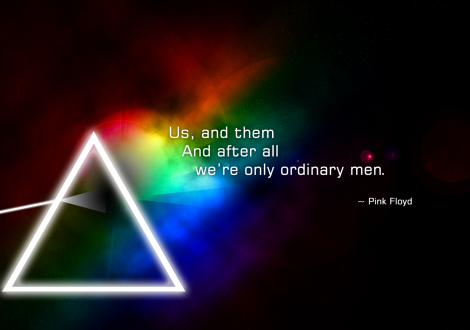
Us and Them

usandthem-470x330

We thought we were the top of the world. The most advanced. The richest. The strongest. The U. S. of A., best of the best. All those things are true in so many ways. Aside from our wealth of natural resources, the nation’s strength and riches are what we, each and collectively, have to offer.

But strengths and riches aren’t all we have to offer. We also perform acts of insane violence that kill young children or innocent churchgoers, of smug self-righteousness that allows a brother to repeatedly molest his sisters, that allows an adopted six year old girl to be ‘rehomed’ and raped by her new ‘father.’

Why do deep veins of ignorance, hate, and fear continue to burn through our national body like a stream of caustic lye?

More urgently, what are we going to do about it?

Cultural Tradition: The Scots, for example

Following centuries of armed conflict between the native Scots and the British, in 1745 the British brutally terminated the last rebellion. Traditional Scottish kilts were outlawed and inherited lands were taken from the ruling class. A century earlier, Britain had moved large numbers of Scots into northern Ireland in an effort to weaken the equally rebellious Irish. (The volatile results of that maneuver continue to simmer today.) This Scots population of northern Ireland became known as the Scotch-Irish.

Aside from the desire for self-rule, the Protestant Scots and Catholic Irish fought the Anglican British over religion.

Between 1717 and 1775, nearly a quarter million Scots and Scotch-Irish migrated to the American colonies. Earlier settlers had already built their towns, farms, and plantations along the eastern seaboard so these newcomers moved west to unsettled land. They fought Native Americans and the wilderness to carve out a life where nobody told them how to worship or what to wear.

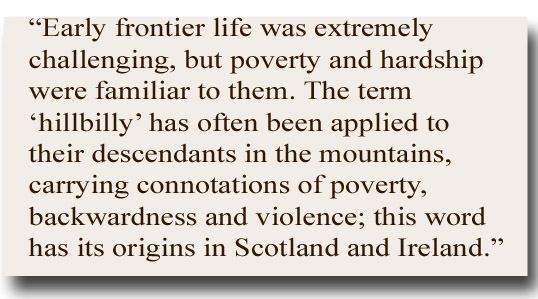
quotescots copy (Wikipedia)

These are the people who formed the predominant original working class white populations of the southern states and parts of the Midwest. Already inured by generations of religious conflict in their native lands, the Scots clung fiercely to their religious beliefs, cultural traditions, and desire for independence from government rule. Generally not slave-holders, they nevertheless rallied to the Confederate cause, seeing it as their own because it was against government control, against someone telling them what to do.

The defeat of the South with its quarter-million deaths, injuries that came home with the veterans, and the loss of land, homes and families added to a long memory of defeat and humiliation. It is in this memory that the South will rise again, just as Scotland will once again enjoy independence from its British overlords. This is the vein of anger that holds tight to the Confederate flag, not because it is celebrated as a symbol of white over black, but because it serves as the rallying point for independent men against a conquering army. Rational analysis or details don’t matter. It’s the feeling of injustice that holds sway.

Many American Scots and Scotch-Irish have moved on, accepted the evolution of modern society and its rewards of broader understanding and tolerance. But many have not. For these folks, if you’re not with them, you’re against them.

They are but one example of ancient traditions which continue to guide attitudes and influence behavior in modern America.

Instinctive Fear: Racism

Humans innately tend to associate with others of our own kind. Researchers have given the labels of ‘in-groups’ and ‘out-groups’ in discussing this behavior. Within an ‘in-group,’ individuals are assured of mutual support in everything from caring for an injury to defending against attack. We can count on our in-group guys.

At the most primal level, an instant response rises when confronted with someone who doesn’t fit the model of our ‘in-group’. This was an important survival instinct among early humans who relied on visual cues while the stranger remained at a distance. A fight-or-flight reflex rises from the old brain upon encountering a person clearly not of our in-group and we respond accordingly.

What we hope for and strive for in an advanced multicultural, multi-racial society is an immediate secondary and reasoned response that supersedes the instantaneous first reaction to a stranger. We look again and think about whether there’s a real risk. Just because that person doesn’t fit our in-group criteria doesn’t mean he’s a threat.

A fear-based response underlies behavior like freshman Senator Tom Cotton’s advocacy for a new war against Islam. Extremist Christianity such as embraced by Cotton focuses on differences as a way to define and protect group identity. Kill the out-group! A more loving and confident mindset seeks grounds of commonality. A more realistic stance for responsible elected leaders involves negotiation and understanding to lower barriers between groups.

But the more stressed the person or occasion, the more likely the primal reflex remains in force. Cotton may suffer residual PTSD from his two combat tours in Iraq and Afghanistan. Tests have shown that people are more likely to identify an ambiguous object in a stranger’s hand as a weapon if the stranger is from an out-group. Most importantly, people who regularly operate from a position of feeling threatened are more likely to react instinctively. Everyone but me and my known friends are ‘other.’ (Click here for more.)

Within our most stressed populations, acts of violence are committed by persons of a self-identified group against those seen as outsiders. The outsider is a target for the anger, frustration, and hatred of the in-group member who wants desperately to prove himself to the rest of his group. This behavior can be found in gang warfare, where fabric color designates group identity. It can be found in acts of violence in the Middle East, where a disagreement in 632 about the rightful heir to Mohammad’s leadership resulted in Sunni and Shia still killing each other 1383 years later.

Such acts on behalf of the in-group are carried out as a moral imperative.

The Charleston shooter clearly stated his moral imperative in murdering nine innocent people. They were African-American. “They” were raping “his people, taking over his country.” He did it for his group, whites. His reality, his moral imperative.

Jesus: Not What I Meant. Not What I Meant At All

Murder on behalf of racial purity is little different from those who murder on behalf of their religion. Each Islamic sect claims to be the true follower of Allah. By definition, all others are not ‘of God.’ All others deserve to die. Similarly, many Christian denominations in the U. S. believe all but their kind will burn in the fires of hell.

Faith traditions are, by their very nature, a useful measuring stick by which people may define their most important in-group. More than any other group, religion and its rules ensure a mutual understanding of appropriate behavior, ethics, traditions, and hierarchy. Ideally, religion could serve as the bridge between disparate groups and unite us in spiritual brotherhood.

Sadly, religion has more often than not become yet another means of categorizing a person as out of ‘our’ group. Thus Ronnie Floyd, current head of the Southern Baptist Convention, second largest religious denomination in the U.S. after Catholics, has proclaimed his intention to defy the highest court in the land if it rules in favor of same-sex marriage. He stated that “God, not the Supreme Court” holds final authority over marriage, as if the licensing of marriage were not a legal function of the government.

The issue of gay marriage is but one conflict between primal instinct and the tolerance and acceptance evolving as a world culture. “Raising consciousness is a persuasive enterprise,” Michael Walzer writes in his new book The Paradox of Liberation: Secular Revolutions and Religious Counterrevolutions, “but it quickly turns into a cultural war between the liberators and what we can call the traditionalists.” This conflict gives rise to fundamentalism and religious ultra-orthodoxy in unexpected places around the world, including the United States.

The more threatened an individual may feel, the more likely he will invest in behavior that he believes will strengthen his in-group. Floyd speaks for all Southern Baptists in voicing fear of a social change perceived as a threat to their religion. This unreasoned primal reaction ignores the reality of the situation: gay marriage has no effect on traditional marriage—unless, as the quip goes, one of the partners in a traditional marriage is gay.

Ideally, religion serves as a pathway not only to seeing the entire human family as the in-group but also to higher self-esteem, respect for others, and a general sense of well-being, all of which help move an individual toward a less fearful stance in life. But this is where religion often plays its most destructive role. Extremist teachings emphasize differences and negatives. Only a few will be chosen. Homosexuals are not like us. Demons can control our lives. We have no personal power. Everything derives from an angry and punishing God.

Differences in economic status are also seen as a reflection of God’s will. The Protestant work ethic involves the relationship between religion, work, and capital. In order to demonstrate our Godliness, we are expected to work hard. With sufficient effort, our labors produce wealth, a sign that we have pleased God. This is why the wealthy are seen as uniquely imbued by God’s grace. For the religious extremist, the wealthy are almost worthy of worship in their own right.

If you’re poor, it’s because you’re unworthy of God’s blessings.

This is why worshipers gravitate to big fancy churches. God likes it there.

Our natural inclination is to accept authority from those we deem more worthy than ourselves. This is why corporate interests have been able to shape American lives around materialism and consumption, a development staunchly supported by religious extremists in spite of Biblical teachings that specifically condemn wealth. (More here)

Adoration of the rich and powerful is why marginalized populations resent any effort by government to assist the poor. It defies God’s will to give  assistance, especially since the funding for such assistance derives from those who have worked hard and gained God’s favor. This holds particularly true in prejudices against African-Americans or Hispanics, who are often caught in a vicious cycle of economic disadvantage and notable markers of an out-group (different skin color, speech patterns, social traditions).

Likewise, yielding authority to self-anointed leaders of religion occurs as a form of obeisance to the leader of the in-group. Recently the Arkansas Times quoted employees of a preschool operated by Arkansas legislator Justin Harris, whose failed strict parenting of two adopted girls resulted in rehoming and the subsequent rape of a six year old: “This was way out of control,” said the worker quoted throughout this piece. “You know how you have an ‘aha moment’? I said the other day to [a co-worker], ‘Why didn’t any of us make a hotline call?’ She said, ‘I don’t know’ … I think because Justin is so religious, we sort of accepted it.”

Did the Charleston murderer understand instinctively that his act would call into question the entire concept of group trust? Should the church members now carry guns, mistrust all newcomers? There can be little doubt that his act, in his tiny mind, served a goal of his self-identified in-group which was/is to destroy the ‘other.’ In that, he now sees himself as a victorious hero.

Similarly, the murder of Christians or other non-Sunni sects by ISIS serves the purpose of their in-group. As one cleric has stated, “We’re ridding the world of polytheism and spreading monotheism across the planet.” (Cite)

The Failure of Education

Our nation’s citizenry can’t operate on a level playing field if they are not educated equally as children. Breaking through destructive cultural, economic, and religious barriers seems an obvious avenue toward eliminating or at least defusing in-group fears and prejudices. And it is.

Which is why members of extremist in-groups violently resist efforts like school integration and uniform curriculum standards.

One might assume that any parent wants his/her child to love learning the lessons of history, the ways of numbers, the use of language in communication and reasoning, the amazing details of biology. We have, as a nation, understood that a thriving economy and successful democracy depend on the fruits of education, which is why we dedicate significant tax dollars to support our public schools. It is why we have set standards for teacher education and defined specific educational goals, why we have forced integration and provided school lunches. We need every child to develop to his/her fullest potential.

For some, the nation’s success or even the child’s well-being hardly register on the radar when held up against the perceived value of in-group traditions.

The more embattled parents feel in protecting their religious beliefs, for example, the more likely they will fight efforts to extend their children’s acceptance of broader cultural norms.

The increase in homeschooling is a product of this mindset. Homeschooling gained its first significant boost after forced integration. With the cultural changes of the 1960s and the rise of the religious right in the 1980s, it continued to pick up steam. From 2003 to 2007, the percentage of students whose parents resorted to homeschooling in order to provide religious or moral instruction increased from 72 percent to 83 percent. (Other reasons given for homeschooling included concerns about the school environment such as safety, drugs, or negative peer pressure and dissatisfaction with the academic instruction available at other schools.)

Germany, among others, has outlawed homeschooling for this very reason. But in the United States, Supreme Court decisions have found that parents have a right to homeschool their children or send them to private schools based on the definition of ‘liberty’ in the Due Process clause of the Fourteenth Amendment. The only saving grace of these court decisions was the finding that the extent and content of private or home schooling must meet standards set by the government. (See more here.)

Because of the ‘liberty’ protected in the high court’s rulings, not all homeschooling is equal. Each state has its own set of rules about what is or isn’t required for homeschooling. While homeschooling can produce thoughtful, well-rounded children ready to pursue life as a functional American citizen, many such efforts fail utterly to meet that goal. The end result is a significant population of undereducated adults. Currently about 3.5% of young people, or around two million, are homeschooled. A majority of this segment of our nation’s people poses a real and present danger to the future of the American way of life.

Which is just what their parents intended.

Critical skills such as the scientific method of investigation and logical reasoning processes are often left out of extremist curriculum, partly because the parents have never understood such things and therefore have no appreciation for the benefits they offer. For these reactionary parents, already threatened by their perception that valued cultural traditions are being eroded, the goal is not to provide an excellent education by academic standards which mesh with the rest of the nation and world but rather to insulate their children from those very things and thus preserve the norms of their in-group.

There seems no easy resolution. The most recent effort has been the development of Common Core Standards, a widely vilified move to bring clarity and commonality to the nation’s education systems including homeschool curricula. The result of a state-led effort coordinated by the National Governors Association Center for Best Practices (NGA Center) and the Council of Chief State School Officers (CCSSO), the standards were developed in collaboration with teachers, school administrators, and experts to provide a clear and consistent framework to prepare children for college and the workforce.

These standards focus only on language arts and mathematics, unfortunately leaving aside a more ambitious (and contentious) goal of setting standards for such important subjects as history, social studies, or the sciences. The government’s method of enforcing these bare-bones standards is to withhold federal education funds from states which do not adopt the standards. Eight states have so far refused to adopt them, but the situation remains in flux.

Inevitably, American children fall through the cracks all the time. The Charleston assassin had advanced only as far as ninth grade, a fact which underscores his likely inability to reason clearly or appreciate the broad scope of the world around him. (As noted in a previous blog post, persons with low intelligence are more likely to nurture racial prejudices and view the world from a perspective of threat.)

At their most progressive moments, federal and state governments attempt to break into the cycle of poverty, ignorance, and entrenched in-group thinking. Whether the methods actually help is another question. For example, in an effort to reach children in at-risk populations, the U. S. Department of Education hands out vouchers through its Child Care Development Fund which parents can use anywhere including religious schools.

Such programs target children with at least one of the following characteristics: Family with gross income not exceeding 200% of federal poverty level; Has a demonstrable developmental delay as identified through screening; Parents without a high school diploma or GED; Eligible for services under IDEA[1]; Low birth weight (below 5 pounds, 9 ounces); Income eligible for Title I programs; Parent is under 18 years of age at child’s birth; Limited English Proficiency; Immediate family member has a history of substance abuse/addiction; Parent has history of abuse or neglect; Or is a victim of abuse or neglect.[2]

Noble goals. But by inadvertently encouraging the expansion of religious instruction, such programs may do more harm than good. In Arkansas, this avenue of government aid for children in need has become heavily trafficked by people on a religious mission.

Rep. Justin Harris’s preschool, Growing God’s Kingdom, receives nearly a million tax dollars a year through such programs. Despite theoretical restrictions that religion cannot be part of the academic day, these schools teach religion in the hours before and after the academic day, taking advantage of the extra time children are in their care while parents remain at work. Further, the state’s only method of monitoring these schools for violations is through random inspections.

That’s effective. “Stop praying, the state is here.” Numerous current and former employees of Harris report that children who misbehave during the academic day are taken to the office where they are prayed over in order to cast out the demons causing their misbehavior.

The message inculcated in these young minds is that God is in charge and prayer is the answer.

Rational thought? Personal responsibility? It’s all up to God. Join God’s group and everything will be fine. Such early indoctrination easily leads to a continuation of the conditions that led to their qualification for such programs in the first place. Pregnant at 16? God’s will. Pray. Victim of domestic abuse? Women are to submit to their husband. Pray. Addicted to meth? I’m a sinner. Pray.

At the height of Mr. Harris’ public shaming over the rehoming and subsequent rape of his adopted six year old girl, his school’s signboard proclaimed his membership in his self-identified in-group: “God Himself will fight for you.” To date, Mr. Harris has not acknowledged that he did anything wrong.

In states with the highest populations of at-risk children, legislators in charge of determining everything from curriculum to school funding are increasingly drawn from the ranks of religious extremists. Unable or unwilling to see beyond the walls of their in-group, such legislators circle the wagons against ‘outsiders’ who attempt to set new standards or otherwise interfere with group identity. In Arkansas, the only entity legally empowered to remove Justin Harris from his elected office were his like-minded legislative colleagues. Despite evidence that he illegally used his elected position to gain adoption rights to the two girls he subsequently gave away, there was no investigation. He remains in office and his school remains in operation.

Nowhere in such arguments do we hear that professional educators should be in charge of deciding the best methods of education. (This makes about as much sense as allowing politicians to decide best accounting methods for CPAs or best construction methods for engineers.) A consensus among professional educators is that homeschooling often involves inadequate standards of academic quality and comprehensiveness, lack of socialization with peers of different ethnic and religious backgrounds, the potential for development of religious or social extremism/individualism, and potential for development of parallel societies that do not fit into standards of citizenship and community.

Specifically because parents fear of loss of in-group values, professional educators do not control the purse strings or the programs. Children continue to be victims of their parents’ fears and prejudices, prey to the ebb and flow of political opinion. We continue, as a nation, to suffer the consequences.

What are the solutions?

I don’t pretend to have presented all points relevant to this complicated state of affairs. Nor are my proposed solutions an exhaustive or foolproof list.

But given the failure rate to date, I think it’s safe to say that religion does not and cannot serve as the unifying force for humanity.

What we need is for each person to develop so fully that his/her self-esteem and intellectual skill set outweighs the primal need for narrow in-group identification.

We need to invest in strategies which reduce perceived threats and increase opportunities to break down barriers between groups.

We need broader educational standards so that children in private and home schools have to pass tests for subjects including state, national, and world history; basics of scientific method and the facts of biology, geology, and other sciences; social studies—how government works, the role of voters. Parents need to be held accountable if 17-year-old homeschooled kids can’t pass key tests.

We must stand firm against attempts to teach Creationism as an alternative to science. We must eliminate tax funding which in any way supports religious instruction at any grade level.

We must find ways, both institutionally and personally, to facilitate in-group/out-group encounter sessions and counseling alongside cultural education at all grade levels.

We must end the war on drugs. Legalize and tax all of it. Get over the idea that government can dictate what people ingest to alter their consciousness or that altered consciousness is in itself a crime. Demilitarize our police forces and deliver our communities from the tyranny of criminal gangs. Use tax dollars currently wasted on bigger prisons along with new revenues produced from legal drug sales to initiate pro-active programs in support of early childhood health and education, family intervention in cases of abuse and neglect, substance abuse treatment, and free/low cost mental/physical health care in every community.

We must require a significant period of public service from young people. Such service would broaden the scope away from a family or church or racial in-groups and instead build ownership in the in-group of our nation.

Don’t agree with the actions of our current elected leaders? Don’t support the policies of our nation? The instrument of change lies in our hands. An informed, self-confident electorate can be—should be—the strength of America.

We can feel a bit of relief in the amazing power of television and the Internet to instill greater understanding of different lifestyles, different races, and unfamiliar cultures. Social media such as Facebook allows us to engage in constructive dialogue with members of out-groups without the immediate threat of physical violence. These are opportunities we must use carefully in order not to trigger an even more visceral in-group identification among the ‘other.’

Many of these things are already being done.

Finally, there’s this:

“…The data…demonstrates that only the more secular, pro-evolution democracies have, for the first time in history, come closest to achieving practical ‘cultures of life’ that feature low rates of lethal crime, juvenile-adult mortality, sex related dysfunction, and even abortion. The least theistic secular developed democracies such as Japan, France, and Scandinavia have been most successful in these regards. The non-religious, pro-evolution democracies contradict the dictum that a society cannot enjoy good conditions unless most citizens ardently believe in a moral creator. The widely held fear that a Godless citizenry must experience societal disaster is therefore refuted. Contradicting these conclusions requires demonstrating a positive link between theism and societal conditions in the first world with a similarly large body of data – a doubtful possibility in view of the observable trends.”[3]

[1] http://idea.ed.gov/

[2] http://www.arkansased.org/public/userfiles/rules/Current/ade_257_Arkansas_Better_Chance_October_2012.pdf

[3] “National Correlations of Quantifiable Societal Health with Popular Religiosity and Secularism in the Prosperous Democracies,” Gregory S. Paul. Journal of Religion & Society Volume 7 (2005) http://moses.creighton.edu/jrs/2005/2005-11.pdf Accessed June 19, 2015

Lingering Winter

soupAroma thick with thyme and marjoram steams from the simmering split pea soup. I’ve enjoyed the whole process—chopping onion, celery, and carrot, measuring the spices and selecting the bay leaves, stirring until the soupy mass starts to bubble and boil. More condensation to collect on the window panes where sleet bounces and taps it rhythm against the other side.

There’ll be no venturing out today. The roads are slick with ice. Time to relax and accept what the Mother has in store, a lingering blast of winter with all its gifts of cold and white. Wind whistling at the chimney where smoke of my wood fire plumes sideways. Time to muse on past winter days when fire blazed hot and pan lids jiggled, when my gaze settled on the distance and roamed over the years of my life.

Memories of winter’s challenges rise up to nourish me on these days, recollections of times when hardships were met and I was satisfied with my refuge, my larder, my conquest of the elements. In more distant times, I might have twisted strands of wool or linen and watched the wheel spin it to thread, or pounded clothes in a hot kettle for cleaning, or ground corn between stones to make coarse bread. I might have wrapped my children in animal skins and tied my own feet in fur before braving the cold for more wood, or brought the livestock into the other end of a rough cabin to keep them from freezing in the long nights.

How did I, of all my previous iterations, manage to occur here, now, where everything I need comes more or less effortlessly—the twist of a knob, click of a button, the turn of a key? A house with insulated walls and thick glass that keep in the warmth and allow me to watch frozen rain fall from gray-white clouds. What future embodiments of myself will wonder back on this time and what will they know? What I don’t know. What I can imagine for better. Or worse.

I don’t have to figure it out. Anyway, I can’t. Better to turn to the pan and stir the soup, add another log to the fire, stand at the window longer and marvel at the shades of gray and rust among the trees of the woods, the white of the sky and ground. Soon the scene will explode in infinite shades of green and heat will soak the edges. I’ll be pleased then to remember this cold.