

Chapter 2, Artificial Intelligence: A Pandora’s Box
Who will work and what will they do?
Some studies predict a net gain in jobs by 2030, but also say the transition period will involve significant turnover. While 50–55% of U.S. jobs are expected to be “reshaped” by 2026–2027, only an estimated 10–15% are said to be vulnerable to elimination. While optimistic reports claim AI is currently a “modest net drag” on employment—reducing monthly job growth by roughly 16,000 in early 2026—it also supposedly drives productivity and could create 170 million new jobs by 2030, exceeding the 92 million expected to be displaced.
But just in case that’s wrong, and millions of people are in fact displaced from gainful employment, industry leaders suggest that governments likely will need to provide alternative means of support for the un- or under-employed. The idea of providing a Universal Basic Income (UBI) of $1,000 per month to every adult citizen in the U.S. has been tossed around, but that would cost approximately $3.1 trillion to $3.8 trillion per year.
While it only seems fair to give ‘free’ money equally to everyone, those costs are prohibitively high for a nation already $38.99 trillion to $39.5 trillion in debt, more than the entire GDP (Gross Domestic Product). Furthermore, workers who are not impacted by AI have no need for UBI no matter how ‘fair’ it would be. A more rational approach would be to provide such support only to persons actually un- or under-employed because of AI. A $10,000 annual payment for ~6-7% of the U.S. workforce (roughly 12-15 million people), as projected by Goldman Sachs for AI displacement, would cost upwards of “only” $120-150 billion annually. Such programs are already making a tentative start:
The first basic income program for workers who have lost pay, jobs, or opportunities to AI began sending out its first funds this week. The program is run by the nonprofits the AI Commons Project and What We Will, who together are administering the AI Dividend, which will issue a no-strings payment of $1,000 a month for a year to a cohort of 25-50 impacted workers. The project’s organizers say they have $300,000 in initial funding, and hope to expand quickly. They plan to distribute $3 million in funds in 2026—and aim to do so by pushing the major AI companies to contribute to the effort.[1]
That effort is by nonprofits dependent on donations, and good for them. But a basic, single-person household in the U.S. generally needs roughly $3,500 to $5,000+ per month (after-tax) to cover necessities like housing, food, and transport, varying significantly by location. As of 2024-2025 data, bare minimum survival often requires at least $3,000–$3,500, while “comfortable” living usually requires over $5,000 monthly ($60,000/year). Jobs at highest risk of AI elimination often pay in the mid-to-high range, with many impacted white-collar roles earning between $60,000 and $100,000+ per year.
Taking a person off a wage of $60,000 a year so AI can do that work and expecting that person to survive in the same house, same car, and supporting the same family needs is pie in the sky at $1,000 a month—or anything near that figure. The assumption seems to be that out of nowhere, this person can just do something else to make up the missing $50k. You can bet that this person a) won’t find that $50k (or anywhere near that amount) within a short or even mid-range timeframe and b) won’t be able to meet existing mortgage payments or rent, or car payments and insurance, or most of whatever else he/she was able to pay before being kicked out of his/her career.
Experts argue that professionals using AI will replace those who do not, rather than AI replacing the worker entirely. AI is expected to impact up to 30% of U.S. jobs by automating substantial portions of tasks rather than replacing the entire job task. From 50-55% of U.S. jobs are expected to be reshaped by AI, requiring retraining and upskilling to focus on higher-level, strategic, or creative tasks. Highly exposed roles include technical writers, software engineers, and financial analysts, while administrative roles earning less are also at risk.
As of April 2026, average annual salaries in the U.S. are approximately $147,500 for Software Engineers, $91,670 for Technical Writers, and $88,000–$101,000 for Financial Analysts. Software engineers generally command the highest pay, with senior roles often exceeding $170,000 per year. Estimates of the time required for such retraining ranges from 60 days to six months, and even one to two years for in-depth specialization in AI development or machine learning.
So yeah, maybe the employees removed from these “highly exposed roles” can retrain quickly and with unemployment income maintain earnings that sustain their lifestyle, but what about the rest of us? It’s not just high paying tech jobs that will be impacted. Jobs like secretaries and data entry keyers are highly exposed and likely have lower adaptability to new roles. Already companies are reducing hiring for junior roles in high-exposure areas, as AI increasingly handles foundational tasks.
China, somewhat ahead of the United States in AI development, is already taking steps to deal with the human labor problem. In early 2026, Chinese courts and labor authorities ruled that companies cannot fire human workers simply to replace them with artificial intelligence. Several high-profile labor rulings established the precedent that AI adoption is a strategic business choice, not an uncontrollable, unforeseeable catastrophe that legally justifies mass layoffs or severe pay reductions.
I should mention here that the public already is not happy with AI. Many consumers express strong dislike for AI chatbots used by companies, citing a lack of empathy and the inability to solve nuanced problems. Need to know how to get your pick-up order brought out to the car when designated parking is blocked? Punch buttons through three or four AI responses and still no answer to your question. Finally, an employee taps on your car window… What if I don’t want to install your app on my phone then suffer through flurries of texts promoting your products? Clearly customer ‘service’ is not the priority in such scenarios.
The International Labor Organization states that:
Our research at the ILO suggests relatively small employment losses from generative AI, but effects that will nonetheless be concentrated, particularly among clerical support workers including professions such as customer service workers, receptionists or secretaries who have experienced declining employment levels over the past 10-15 years, and where the effects of AI are just beginning to take hold. Many of these clerical support jobs are held by women. As a result, women are 2.5 times as exposed to automation risks than men. Overall, we estimate that 2.3 per cent of [global] employment (or 75 million jobs) is at risk of automation because of high exposure to generative AI technology. In high-income countries, the share is greater at 5.1 percent of employment (or 30 million jobs), as this type of work is more prevalent. [2]
Universal Basic Income (or Replacement Basic Income) is designed to provide a guaranteed, unconditional financial “floor”—covering essential needs like food and shelter—rather than acting as a full replacement for all income. No one explains that food and shelter is NOT AVAILABLE at $1,000 per month. Google AI says: “Affordable food and shelter for around $1,000 per month is achievable in specific low-cost, rural areas, particularly in the Midwest, South, and some small mountain towns. Key locations include rural Oklahoma, parts of Georgia (e.g., Leesburg), and cities like Wichita, KS; Pueblo, CO; and Toledo, OH. Achieving this requires high frugality, such as renting shared rooms, mobile homes, or seeking income-restricted housing, often with rent under $500–$600. Primary resources include local Salvation Army branches.”
What fun!
According to businessman and political figure Andrew Yang, a recent poll found that about two-thirds of Americans are now in favor of universal basic income (UBI). “This is now very much a mainstream policy that we’re going to see implemented,” he says. In fact, the U.S. government’s stimulus payments to ordinary Americans during the COVID-19 pandemic are considered a type of UBI; several American cities, including Stockton, California ($500/month); Los Angeles ($1,000/month); Newark, New Jersey ($250-$500/month); and St. Paul, Minnesota ($500/month), have recently piloted their own “guaranteed income” programs.
Yang says UBI payments would benefit every American by permanently growing the economy and creating millions of jobs. “A universal basic income would enable millions of Americans to meaningfully transition in the time of economic transformation, including that brought by AI,” he says, “and it would improve our strength, health, and mental health; kids’ ability to learn; our civic engagement; and our public trust, confidence, and optimism.” He specifically outlined how he would fund his Universal Basic Income (UBI) proposal, which he termed the “Freedom Dividend” ($1,000 per month for every American adult). He proposed paying for it primarily through a 10 percent Value-Added Tax (VAT) on goods and services, aimed at capturing revenue from automation and large tech companies. He estimates that his plan would generate roughly $800 billion in revenue.[3]
As noted in a 2024 CNN report,
As AI and automation increasingly impact the labor market, with studies indicating that 11.7% to 44% of jobs could be subject to automation in the coming decade, the debate over a guaranteed minimum income or Universal Basic Income (UBI) has shifted from a radical idea to a serious policy consideration. Proponents argue it is necessary to provide a safety net for workers displaced by technology, while critics raise concerns about high costs, reduced work incentives, and the effectiveness of such programs.[4]
Not all industry forecasts are so sanguine. As reported in an October 2025 article,
“By 2030, 30% of current U.S. jobs could be automated, one McKinsey report projects. Goldman Sachs $GS +1.10% predicts 6-7% of the workforce will be displaced, which would take unemployment to around 12%, factoring in the current rate. To put that into perspective: during the 2007-2009 Great Recession, unemployment didn’t climb above 10%. Others foresee something far more radical in the long-term.
“There will come a point where no job is needed,” Elon Musk fantasized in 2023. “I think society will very quickly say, ‘Okay, we’ve got to have some new economic model where we share that and distribute that to people.” Further, he stated:
“There will be universal high income (not merely basic income). Everyone will have the best medical care, food, home, transport and everything else,” he said on X $TWTR 0.00% last month when asked how those made jobless from robots will sustain their lives. “Sustainable abundance,” he added.
OpenAI CEO Sam Altman told podcaster Theo Von in July. “I still am kind of excited about universal basic income where you just give everybody money,” he added. [5]
Altman has said that corporations profiting from AI should be the primary provider of funds for UBI. Further, he’s begun backing off his enthusiasm for UBI.
After spending years funding one of the most high-profile universal basic income experiments, … Altman now says the idea falls short of what the future will demand. “I no longer believe in universal basic income as much as I once did,” Altman said in a recent interview with The Atlantic. “I’m much more interested in ways where we think about kind of collective ownership.”[6]
Dario Amodei, the CEO of Anthropic, has advocated for large-scale public relief, potentially including UBI, to counteract the displacement of white-collar and entry-level jobs.
Marc Benioff, Salesforce CEO, frequently advocates for UBI, suggesting that corporate savings and efficiencies generated by AI can fund a robust wealth-redistribution system.
Jack Dorsey and Mark Zuckerberg have historically supported the idea of unconditional cash aid, with Dorsey referring to UBI as a foundational floor for humanity and Zuckerberg co-funding pilot programs in the Bay Area.
While not completely opposed to UBI, the Microsoft co-founder Bill Gates has expressed caution, arguing that the economy and public policy are not yet ready for large-scale implementation.
Marc Andreessen the venture capitalist strongly opposes the concept. In his “Techno-Optimist Manifesto,” he claimed that UBI would “turn people into zoo animals to be farmed by the state” and that humans inherently need productive work. He joins labor economists and progressive politicians who have raised concerns. They warn that the UBI push serves to justify mass layoffs and worry that tech billionaires may resist the necessary corporate taxes on AI needed to fund these ambitious safety nets.
…[Article authors note,] …it just so happens that these workers — white-collar professionals — play an inflated role in economic activity. The top 10% of U.S. earners — households earning more than $250,000 — accounted for nearly half of total consumer spending during the second quarter of this year, according to Moody’s Analytics, a record high since data collection began in 1989.[7]
Just one example: automobile sales. AI-driven job losses are poised to create a complex, bifurcated impact on auto corporation profits, likely boosting short-term margins through cost reduction while simultaneously threatening long-term sales volume. While AI enables significant operational efficiency and lower labor costs for manufacturers and dealers, it may simultaneously shrink the consumer base by reducing household income and delaying major purchases. The automotive industry, including manufacturing and sales, represents approximately 3% to 4.9% of the U.S. Gross Domestic Product (GDP). The sector drives over $1 trillion into the U.S. economy annually, with auto and auto parts stores accounting for 20% of total U.S. retail sales.
Automobiles aren’t the only part of our economy to suffer loss of sales. Reduced income for retail workers and clerical staff leads to lower sales in mid-tier retail, clothing, and apparel, as consumers cut back on discretionary purchases. Housing market activity—including both home sales and rentals—could face stagnation, especially in areas heavily reliant on administrative employment. The total housing market typically accounts for 15% to 18% of U.S. GDP. This includes residential fixed investment (new construction, remodeling, and brokers’ fees) at roughly 3–5%, and housing services (rent, utilities, and imputed rent) at 12–13%. As of early 2026, housing’s total share of GDP was approximately 15.9%.
Finally, a word from the George W. Bush Institute:
Universal Basic Income (UBI) would be an unaffordable way to undermine our social safety net’s successes. UBI would transfer money away from those who need it most, change the distinctly American relationship between citizen and government, and sharply raise taxes or the national debt (or both). And critically, it would fail to improve upon our current safety net’s biggest weakness: UBI would destroy – not improve – incentives to work.[8]
Bottom line? Corporations wouldn’t be eager for AI if they didn’t expect to profit from it. The profits come from paying fewer workers or reduced wages, or both. Either way, it’s human workers who take the hit.
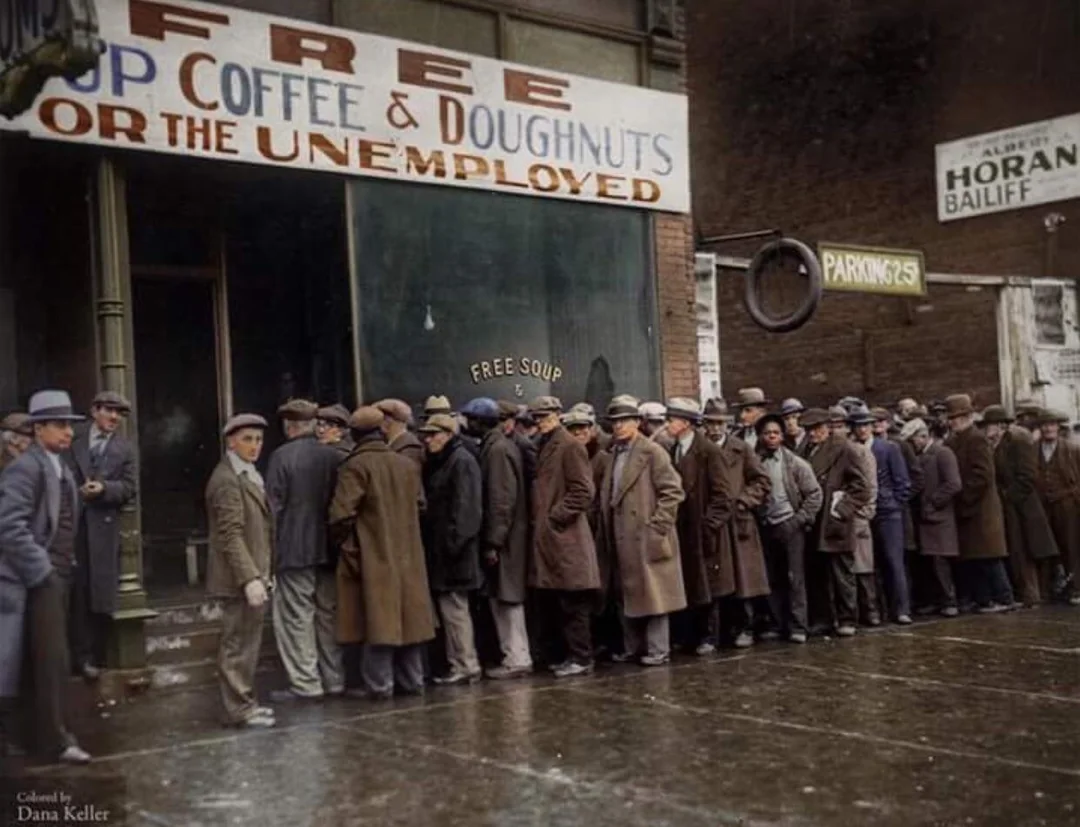
Al Capone’s soup kitchen feeding the poor during the Great Depression- 1930s
[1] Merchant, Brian. “The first basic income for workers impacted by AI has begun sending out $1,000 monthly payments,” Blood in the Machine, Mar 24, 2026. https://www.bloodinthemachine.com/p/the-first-basic-income-for-workers
[2] Berg, Janine. “Minimizing the negative effects of AI-induced technological unemployment,” International Labour Organization, Oct 9, 2024. https://www.ilo.org/resource/article/minimizing-negative-effects-ai-induced-technological-unemployment
[3] This view ignores recent cuts in services offered by the federal government such as subsidized costs of health insurance.
[4] https://www.cnn.com/2024/04/13/tech/ai-jobs-threat-guaranteed-income
[5] Rowe, Niamh. “AI is coming for our jobs. AI titans say universal basic income will save us. Will it?” Quartz, Oct 4, 2025.
[6] Volenik, Adrian. “Sam Altman Put $14M into Studying Universal Basic Income. Now Says It’s Useful, But Not ‘What We’re Really Going To Need For This Next Phase,’” Yahoo!Finance, May 7, 2026. https://finance.yahoo.com/economy/policy/articles/sam-altman-put-14m-studying-160110092.html
[7] Ibid
[8] Doar, Robert. “Universal Basic Income Would Undermine the Success of Our Safety Net,” Bush Institute, Spring 2018. https://www.bushcenter.org/catalyst/are-we-ready/doar-universal-basic-income

