
Chapter 5, Artificial Intelligence: A Pandora’s Box
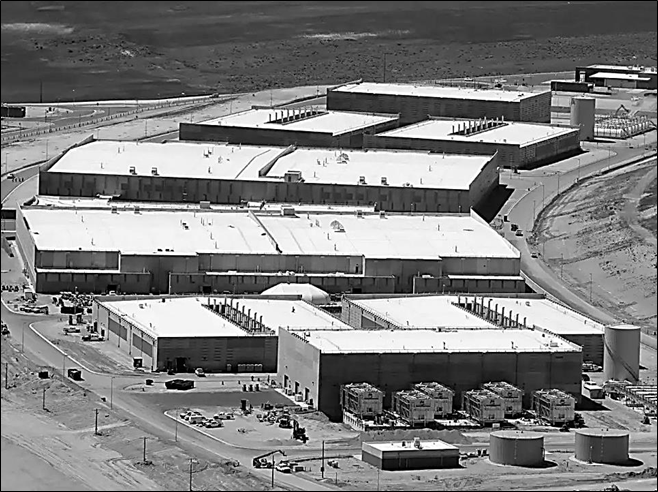
Short of the end of human life as we know it, and in addition to the problems including loss of purchasing power and job satisfaction with the advancement of AI, there are the so-called “data centers” as the rush toward an AI world accelerates. Considered critical infrastructure for the computer age, data centers serve as the backbone of the modern digital economy by storing, processing, and managing massive amounts of data. They enable daily digital activities, including internet usage, cloud computing, streaming services, and AI technologies. These facilities ensure business continuity, security, and high-speed connectivity while driving significant regional economic growth and tax revenue.
China has roughly 350 to 450 commercial data centers, ranking as the fourth largest in the world behind the United States (4,000 to 4,300), Germany (514 to 529), and the United Kingdom (515 and 560). But is it AI alone driving an exponential surge in U.S. data center construction, with projections indicating an estimated $5.2 trillion in global investment by 2030 to meet AI compute demand?
No. In fact, the first “data centers” were built in the 1940s-1950s, the dedicated rooms housing bulky, vacuum-tube computers like ENIAC. In the 1960s-1970s, the mainframe era saw companies developing dedicated, climate-controlled environments (machine rooms) to manage massive computing systems. In the 1980s, the rise of desktop computers led to increased demand for centralized data storage, with early, efficient computer room air conditioners being developed. Then in the 1990s, the internet boom drove a surge in data center construction, leading to modern colocation and, eventually, cloud-based facilities.
This new surge of data center building in the U.S. follows the exploding power and compute requirements of generative AI, cloud computing, and modern digital infrastructure. These facilities act as the foundational factories of the digital economy, processing everything from banking and medical records to advanced AI models and defense systems. Several primary factors drive this extensive build-out including the Artificial Intelligence Boom. Training and operating Large Language Models (LLMs) requires immense parallel processing power and specialized hardware. To meet this demand, tech giants are constructing hyperscale clusters that use millions of high-power GPUs. Also, virtually every aspect of modern life—including GPS logistics, online streaming, video conferencing, and smartphone backups—relies on centralized servers distributed across the country to keep latency low.
National security and geopolitics serve as additional justification for the U.S. data center boom. Federal and defense agencies need highly secure, localized facilities to process real-time intelligence, protect classified information, and maintain a competitive edge in emerging tech. And, as critics point out, these centers are key to mass surveillance programs.
What data centers existed in past decades was all a drop in the bucket compared to now when AI-related data center demand is expected to add 125 gigawatts of capacity between 2025 and 2030, with U.S. data centers consuming up to 12% of national electricity by 2028. These huge centers present significant local drawbacks, including massive electricity and water consumption that can drive up utility bills for residents. They require immense water for cooling and power, impacting local resources and potentially depleting water tables. They drain the local power grid, often forcing utilities to raise rates for residents and increasing reliance on fossil fuels.
Residents often complain about a constant ”hum” from cooling equipment and industrial lighting, which can affect quality of life. Backup generators, often running for maintenance or emergencies, can emit harmful pollutants including nitrogen oxides and fine particulate matter, increasing rates of respiratory diseases, cardiovascular conditions, and elevating cancer risk in nearby communities, according to environmental health studies. And in addition to noise and pollution, the sheer size of the buildings (often equaling multiple football fields) can alter rural or residential landscapes.
Data centers primarily consume water through evaporation in cooling towers and compromise local water quality through chemical-heavy wastewater discharge (blowdown), often consuming 1–5 million gallons of potable water daily. High-density AI servers exacerbate this, with one AI chat session of 20 queries using roughly one 16-ounce bottle of water.
Water consumption vs. water withdrawal: It’s crucial to distinguish these terms. When a data center withdraws water, that’s the amount taken from the source (e.g. pumping from the city water line). “Consumption” means water that’s actually used up (not returned) – primarily through evaporation. The difference (withdrawal minus consumption) is the water returned, usually as wastewater (warm water or “blowdown” drained from cooling systems). In a data center cooling context, most of the water that is withdrawn ends up consumed.
Typically, 70–80% of the water in evaporative cooling is lost as evaporation into the air. The remaining 20–30% is discharged as liquid wastewater (which goes to a sewer or treatment plant). For example, if a site draws 1000 gallons, roughly 700–800 gallons might evaporate through the cooling towers (this portion is gone from the local water system until it falls again as rain), while 200–300 gallons exit as effluent that can potentially be treated and reused downstream. This means not every gallon taken is a gallon gone – but a large fraction is effectively consumed.
Data centers pose human health risks primarily to nearby communities and employees through air pollution, noise, and chemical exposure. Key issues include respiratory and cardiovascular diseases from diesel generator exhaust, high stress levels due to constant noise (up to 96 decibels), and potential exposure to toxic PFAS chemicals used in cooling. Ninety-six decibels is very loud and can cause hearing damage within 30 minutes to an hour of exposure. Examples at that sound level include power mowers, weed whackers, motorcycles, industrial alarms, and some construction equipment.
You have to wonder what will happen as climate change advances leading to increased cooling costs, reduced energy efficiency, and risks of physical damage from extreme weather. Rising temperatures and increased drought frequency create a vicious cycle, straining water-based cooling systems, forcing higher electricity consumption and increasing the risk of service disruptions or shutdowns.
Gee, imagine what could happen when the entire power grid, government systems including our military, financial transactions, healthcare administration, and transportation logistics are all dependent on AI controls, and global warming shuts it all down. Who could have seen that coming?
Without AI, the demand for data centers would still exist to support traditional internet, cloud services, and digitalization, but without the “voracious” electricity demand driven by AI, which could power 28 million homes.
Of the over 4,000 data centers in the continental United States, Virginia takes the lead with 600 of them, followed by Texas with 440. Vermont has the least, with three.[1] Data centers in Arkansas are concentrated around Little Rock, Conway, and West Memphis, with major developments expanding in early 2026. Key facilities include a $6 billion AVAIO Digital hub near Little Rock, a Google project in West Memphis, and TierPoint in Little Rock. As of June 3, 2026, Bloomberg NEF says Americans are building 831 new data centers.
Arkansas passed laws preventing local governments from banning data centers (via Act 851 of 2023) in order to attract multibillion-dollar technology and AI infrastructure investments. Lawmakers aimed to prevent cities and counties from using restrictive zoning or moratoriums to block large-scale projects, establishing a business-friendly environment supported by state tax exemptions. Local opposition to this law is growing.
In sum, the immediate rush involves lots of construction projects and huge amounts of money spent to build them, and as data centers prepare to go live, they quickly fill up with AI chips, server racks, motherboards, graphics processing units, cooling systems, CPUs, and the like. The world’s largest centers for production of these parts are the three Science Park complexes Taiwan launched in the 1970s—Hsinchu, Southern Taiwan, Central Taiwan—which now serve as home bases for semiconductor and IT hardware manufacturers of the TSMC, UMC, MediaTek, Foxconn, etc. type. For the past two years, they have been sending a torrent of this stuff from Taiwan – a recent Air Cargo News report suggests likely 1,500 tons of semiconductors and AI server racks arrive by plane daily, along with ships loaded with power distribution units, heavy cooling systems, and fiber-optics—to the new data centers Bloomberg describes. No wonder China has renewed its insistence of returning Taiwan to Chinese control.
The good news, for now, is that public reaction to data center construction has shifted dramatically from welcoming to deeply skeptical. Nearly 70% of Americans now oppose having AI data centers built in their communities, with environmental and resource concerns driving widespread resistance. Nearly half of planned 2026 data centers have reportedly been delayed or canceled amid growing outrage over energy use, water demand, and local impact.
But don’t get too excited about the perceived tech response to local protest. They’re not really paying much attention to mere people. The primary blockage is a severe shortage of critical electrical equipment—such as step-up transformers, batteries, and switchgear—now grinding construction to a halt. Because U.S. manufacturing is struggling to keep pace, builders have been forced to rely heavily on foreign imports, introducing massive supply chain risks.
Also, traditional power grids are buckling under AI’s massive energy demands. Out of roughly 140 planned projects targeting 16 gigawatts of new capacity, only about 5 gigawatts have actually started physical construction.
[1] A map of these centers is found at https://www.datacentermap. com/usa/.

