Make good use of that chaotic holiday family gathering! Record family history told by Aunt Tilley and Grandmother Joan while they’re still around or forever regret the history you’ve lost. Interview Granddad Hiram, racy jokes and all. These stories never go out of style! And your grandchildren will thank you.
Wait no longer! Take some time today to write down something, even a few words. Fifteen minutes. An hour. What you write doesn’t have to be a 400-page novel—it can be a list of things you remember about your grandmother. Put her full name at the top of the sheet of paper and then the date and place she was born, if you know it. Who did she marry and when, where? What places did they live? What were the names and birth dates of their children? Did she keep a garden? Crochet? Play tennis every week? Every detail you record will color in the lines of a story prized by your descendants.
Whatever direction your road leads, never doubt that your efforts will be greatly appreciated not only by other family members now but also by those who come after you. Knowing the names, activities, whereabouts, and personalities of our forefathers and foremothers offers each of us a comforting sense of place, a mirror to reflect our greater selves, and reassurance that life for your kind goes on no matter what. Personal and family histories are a critical tool for your descendants to more fully understand what has led to who they are.
Or maybe you’ve been thinking about telling your personal story, those life-changing moments you’ll never forget. This easy-to-follow guide walks you through the steps of making it real: gathering and organizing information, changing a bare-bones family tree or personal memoir into a fascinating narrative, and putting it into print – at no cost!
This book covers the fundamental stages of writing family history or an autobiography with pointers on fleshing out details into compelling narratives, how to organize your materials, and building a story.
The book also provides clear guidelines on how to self-publish: what software to use and how to use it, step-by-step guidance for working with Amazon’s Kindle Direct Publishing, and understanding important elements like genre. You’ll find discussion about getting reviews and marketing as well as useful hints about maintaining those tender creative sensibilities in the face of seemingly overwhelming obstacles.
Don’t miss your holiday opportunities to gather your family history and turn it into a record to be prized by generations to come. Grab your copy today at Amazon.com
Following the success of his first book, South County: Bunyard Road and the Personal Adventures of Denny Luke, Denny Luke found himself remembering even more moments in his life that seemed worthy of recording. Brief moments, some of them. Others spurred by a photograph here and there.
Always accommodating to his friends and family, Denny divulges various secrets and outrages that occurred at various points in his eighty years – so far.
Take what you will from his stories, he gives it all in good humor and humility.
Here’s a taste:
Runaway
Age 12 or 13, I knew everything! Parents disagreed of course, so I plotted to run away. Living in Beloit, Wisconsin, where should I go? Having the entire world to choose from, decided on California, endless beaches, hot rods and beautiful weather and I could get there on my thumb.
Headed west, must change my name, I thought, to disguise myself, picked ‘Conrad Davis.’ Sounded right in case I hit Hollywood.
Somewhere in Iowa a fella picked me up in Chevy station wagon. Stated he’d just installed an anti-sway bar and watch this! He flew around curves, in the days before seat belts, had me white knuckling for my life.
Next, picked up by a guy attending an all-night meeting. He liked me, said I could sleep in the back of his car. Lit out at first light, back on the road.
Next evening was pondering what to do for the night…
Read all of it and much more in this slim but rich treasure trove of ‘Dennyspeak’! Available at Amazon
Pioneers who settled Washington County and other areas of the state in the early 1800s would have been shocked and highly annoyed with laws passed before the end of the century which regulated and ultimately prohibited the production and use of alcoholic drink. Personal freedoms taken for granted by men who forged the frontier slowly eroded as reform elements in society attempted to change the nation’s drinking habits. Instead of men guiding their own ‘manifest destiny,’ those who considered themselves “God’s defenders” presumed to know what was best for every man. Along with such moral regulations, however, came an onerous cost to the young nation as commonly accepted behavior became criminalized. Inevitably, the rule of morality would be replaced by the rule of outlaws.
…Washington County’s county seat Fayetteville hosted a well-established temperance movement by 1841, at which time the local chapter was humiliated by the discovery that its vice president had fled to Texas after embezzling over $20,000 through his job at the bank. Stirred to greater vigilance by this event, the society publicly excoriated a member who confessed to drinking wine. In another “outing,” the society issued a summons against such noteworthy local citizens as Joseph J. Wood, John J. Stirman, and H. J. Sanderson for “the violation of their pledge to said Society.” According to an account of the Fayetteville Temperance Society 1841-1844, published in the Arkansas Historical Quarterly, “Sanderson arose and publicly confessed that he frequently drank Ardent spirits and sometimes to excess.” The Society approved a motion to report him as a person unworthy of membership.
Reflecting the increasing regulation and growing public hysteria about alcohol use under the incitement of temperance activists, the issuance of licenses in Washington County dropped off dramatically by the mid-1850s. In 1855, the Arkansas legislature passed a law allowing local townships to vote whether to allow alcohol sales within their boundaries. Fayetteville’s newspaper the South-West Independent carried frequent comment on this state of affairs, the tenor of which insinuates the editor’s low regard for such efforts, such as this February 10, 1855, piece:
“Bear it in mind, that the law now in force, in regard to retailing ardent spirits, requires the individual wishing to set up a dram shop to present to the county court a petition signed by a majority of the voters of the township in which the grocery is to be located, before he can obtain license to retail drams!
“Some of these petitions are already before the people, and it will soon be tested whether a majority of voters of Washington county are in favor of retail liquor shops or not. We believe, however, that there is, at present, only one licensed grocery in the county, and it may be that the hundred dollar tax will prevent the test from being applied to all but Prairie township; if so, the present law will affect only the people in and about Fayetteville. Practically, the passage of this law can affect Washington county but little. Still, for its moral effect, the public mind ought to be wide awake upon the subject, and act from principle.
“How would it do to hold public meetings and have a little free discussion upon the subject? We make the suggestion and hope to see it acted upon; in this way both sides of the question may be freely and fairly presented to the public. We want the test to be a fair one.”
A local establishment selling alcohol had its own ideas about the call for stricter regulation, as noted in this advertisement published in the Fayetteville newspaper.
Don’t miss these fascinating stories of early Fayetteville available in Glimpses of Fayetteville’s Past. Available at Amazon.com
From 1835 to the present day, the City of Fayetteville in Washington County, Arkansas, has enjoyed a vibrant and colorful history. Its reputation as a regional center for arts, culture, and education began early in its history. Frequently named one of the nation’s Top 10 cities, Fayetteville hosts the University of Arkansas and its famous Razorback athletic teams.
The five articles contained in “Glimpses of Fayetteville’s Past” focus on under-reported aspects of that history. Published initially by the county’s historical society, these intensively-researched works have been revised and expanded with illustrations, photographs, and maps.
“The History of Fayette Junction and Washington County’s Timber Boom” now include not only an in-depth review of its first major industry but also three appendices which examine wagon production in Fayetteville, the name and tradition of Sligo, and the Fulbright mill.
“Quicktown” delves into the story behind this quirky short-lived suburb in south Fayetteville.
“546 West Center” tracks the development of a landmark Fayetteville property from its earliest use as a site for an ice factory in the 1880s.
“The Rise and Fall of Alcohol Prohibition” documents the use, production, and regulation of alcoholic drink in Washington County from before statehood through the repeal of Prohibition in 1933, and features indictment and other crime data.
“175 Years of Groceries” follows the transition from country store to supermarkets to big box stores and includes newspaper advertisements showing price changes over those decades.
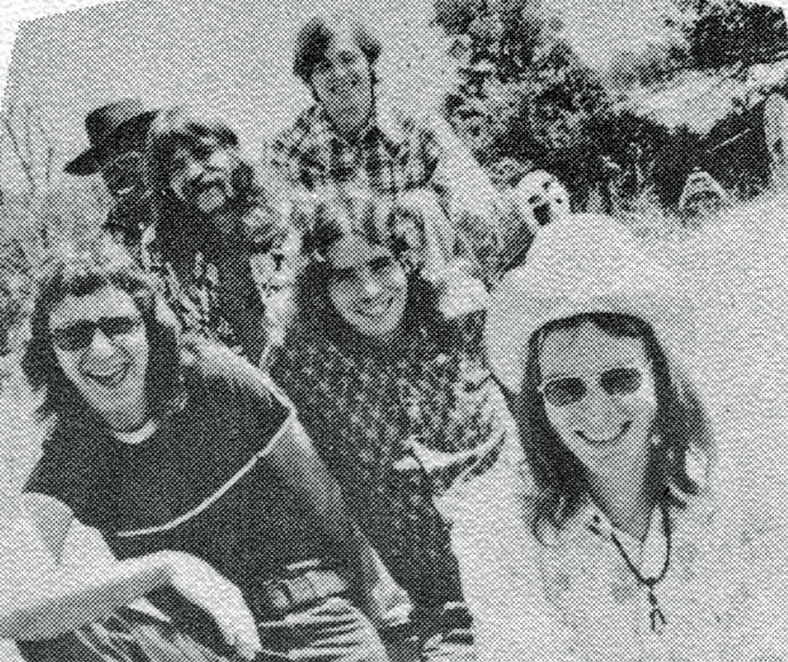
As chronicled in the massive history of Fayetteville’s music scene, the 1970s overflowed with great music that echoed down the length of Dickson Street. The Charles Tuberville Band was among them.
Back: Singleton, Smith, Billy Osteen Front: Ellis, Tuberville, Womack Photo courtesy Joe Phelps
Charles Tuberville Band
Charles Tuberville became hooked on the guitar after watching an older cousin plug his “machine” into an amp and began playing a song by The Ventures. Then when The Beatles took rock n’ roll by storm, that changed everything. Charles got his first guitar, an electric Harmony Bobcat, for Christmas in the 7th grade. “‘At the time, I was playing trumpet in the school band. The day I got my electric guitar, that trumpet never again came out of the case,’’ he recalled in an interview for Blues News.[1]
His Fayetteville band formed in the early 1970s and played popular clubs like Notchy’s and The Library. In 1976 when the Brass Monkey took over the former Gaslight space in the basement of the Mountain Inn Annex, the Charles Tuberville Band served as the house band. Members of this powerhouse group were Charles Tuberville and Billy Osteen (Cal Jackson still in Memphis) on guitar; Albert Singleton then later Cherry Brooks, vocals; Lance Womack, drums; Jimmy Smith, keyboards; Jim Sweeney (Tulsa), Joe Ellis, bass. Members of this band later appeared in other groups. Charles Tuberville moved to Tulsa in 1979 and went on to ply his guitar craft in multiple formats, performing on an album with Tulsa musician Jimmy Markham including Get Ya’ Head Right (2018) and producing his own album, Somethin’ in the Water in 2019.
Don’t miss these great stories of creativity, ambition, and craziness that permeates the 550+ pages of GOOD TIMES: A History of Nightspots and Live Music in Fayetteville, Arkansas — available at Amazon.com and the local Washington County Historical Society offices.
[1] Bill Martin, “Charles Tuberville,” Blues News, Sept/Oct 2019, p. 3
Existence is a slippery construct, it seems to me. I tend to embrace the rational, the concrete, which makes it difficult for me to drift off into theorizing about other dimensions or other possible spheres of existence aside from our three-dimensional sensory world. But all that is countered by my own very bizarre personal experiences.
So far, I have refrained from talking about this because, well, people tend to look at you oddly when you bring up stuff like this. But hey, I’m not getting any younger and I want to put these experiences on the record. For what it’s worth.
In the mid-1970s, I was living in a rural area in a small cabin while my new husband and I tried to get a house built. The cabin sat on a ridge of pasture land surrounded by oak-hickory forest. To the north, the land fell away sharply into steep wooded hillsides. To the south, the pasture land dropped slowly for about a quarter mile before it too veered down forested hillsides. Ozark land verging into the Boston Mountains.
From the window of the cabin, looking west, the view spread across maybe forty acres of pasture and pond with woods all around. Midway in that field, I saw them one day, a man and woman standing side by side in the grass, facing me from about fifty yards away. Far enough that I couldn’t see facial detail, close enough that I could observe their clothing and posture.
They appeared in the corner of my eye. When I turned to stare, they vanished.
The man wore a brown suit and a brown hat, a vest and white shirt, the style dating to the mid-19th century. The woman’s dress was long and slightly full, what I assume would have been a modest garb with petticoat for someone who needed to walk across rough land. She too wore a hat, a straw hat held by a tie under her chin.
I saw them a few more times after I learned not to look directly. Each time they stood together, the man in his brown suit of clothes, not fancy, and the woman in a gray cotton dress with long sleeves and long skirt, the bodice fitted in the style of the times. I wondered at their presence, whether they had died there while their spirits remained, whether they had lived in that spot and attached themselves emotionally so that wherever they went afterwards, their energy remained there.
I’m a writer so I can think up stuff like that, their story, why I saw them. So I really can’t say whether those ideas explaining their presence were from them or from me.
A few years later, after moving into the new house, I had another sighting. Not the same place, but across the road and onto a wooded hill. From my office window, I can still point out the exact spot, a small clearing at the highest elevation of this entire ridge. At some previous time, a massive old tree had fallen and left the spot open to sunlight. I’ve walked out there over the years since, careful to take such jaunts in winter when the ticks aren’t out. There are large flat rocks like paving stones alongside the fallen tree, creating a defined space about twenty feet square.
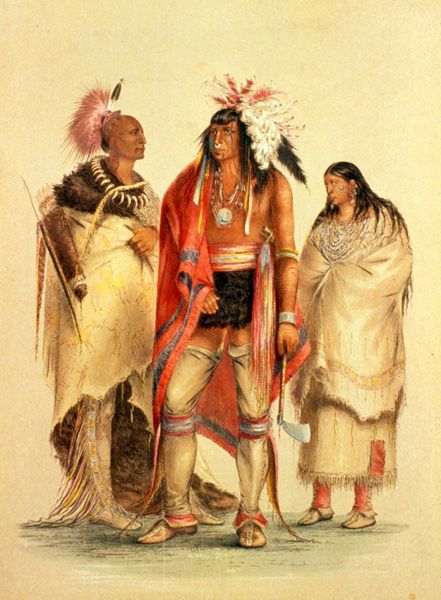
I had not discovered that spot until the day of the sighting. I was staring into the distance from what then was a child’s bedroom, taking a time out from marriage, motherhood, and the demands of my profession. Two individuals appeared, again at the edge of my peripheral vision so I could only see them indirectly. These were Natives, two men dressed in deerskins and carrying the weapons of their culture. They were looking east while I observed them to my south.
Rendering of Osage First People by George Catlin. The Osage claimed this area for hunting grounds, moved off involuntarily when the U. S. government forced the Cherokee to relocate. Soon after, the Cherokee were also forced west into Indian Territory (Oklahoma). I think what I saw were Osage.
They were waiting for someone, or so the thought struck me. I saw a Native woman there once, alone, her long deerskin dress finely made as she, too, waited for someone. I saw them a few more times over the coming years, but as my life picked up speed and my time for staring out windows diminished to nearly nothing, I saw no more people hovering at the brink of this dimension.
And that’s what I’ve come to believe has occurred. Perhaps elevation has something to do with this portal, because the elevation is about the same for both spots. I reached that conclusion after a third and more disturbing incident that occurred twenty years later.
A friend had come to stay with me while she searched for a place to live. She had lived in Europe for several years, and on her journey back to the States had stayed for a time in London with an old friend. He was ailing and subsequently died. She told me about her mysterious experience with his ghost visiting her after his death.
After returning to the States, she lived at my house maybe two or three months before finding a rental she liked. After she moved out, a month or so later, I was sitting in the living room watching television like I did every night when I suddenly became aware of another presence in the house. The hair went up on my neck.
At first I tried to convince myself it was my imagination, because that’s what we all do at moments like that, right? Then I reasoned that if someone had come in at the back end of the house through that seldom-used door, I would have heard it. It didn’t open without a creak. I heard no creak.
But after several minutes of very eerie energy wafting through the house, I forced myself to go back there. I slowly walked the thirty feet down the hallway to that back door, gooseflesh on my arms. I even stopped to pick up a large bamboo rod to use on an intruder. I flipped on lights, calling out ‘Who’s there?’
When I got to the room with the door, it was empty. So was the rest of that part of the house, including closets and under the beds. Yes, I checked. And the door was locked. But Something was there, an energy that was so strong and so haunting that I could feel it all around me.
I realized it was the ghost of my friend’s friend. I thought it must have followed her, since she was the person who had seen him through his last days. I remembered her remarks that she had visited with the ghost more than once.
Well, thanks a lot! I didn’t need that ghost and I didn’t appreciate her leaving it here with me.
It was hostile, maybe because she had left it behind. I didn’t trust it. Didn’t want it. But, I reasoned, it was likely just lost.
So I addressed it. I stood there in the rooms she had stayed in and told it this wasn’t where it needed to be. I tried to change my energy from fear and resistance to a more loving and sympathetic frame. I said it would rest better if it joined the other spirits in the places they lived. I told it to go to the light.
I thought it had listened, because the presence seemed to leave. Later, though, when I went back there after a few days, my eye caught on a work of art one of my kids had done in grade school. Taking pride of place near the end of the hallway, it was well done rendering of a clown with a tear drop on its cheek that had always made it a sad image.
Well, now the image was not sad. It was demonic.
The ghost had taken up residence.
Disturbed by what was either a supernatural presence existing within my house or, alternatively, the fact that I was losing my mind, I ended up asking my daughter to take the art to her dad. Where it remains. I have not been bothered by that ghost again.
There have been other transient ellipses of space and time at that end of the house, which isn’t space inhabited unless one of my adult children come to stay. One or the other of them has experienced unexplained sounds or an energy presence, enough that I’m fairly convinced—at least on that matter – that I’m not losing my mind.
But it occurs to me, in retrospect, that this was at the same elevation and in almost a straight line along this ridge with the other two occurrences. And in contemplating this, I have concluded that there might be a wrinkle in time here, a portal of sorts that cracks along this ridge and allows transitory visitations by one or another realm of existence.
I’m wondering if I’ll come back to visit, too.
One day they appeared, walking across my land. Then they were gone.
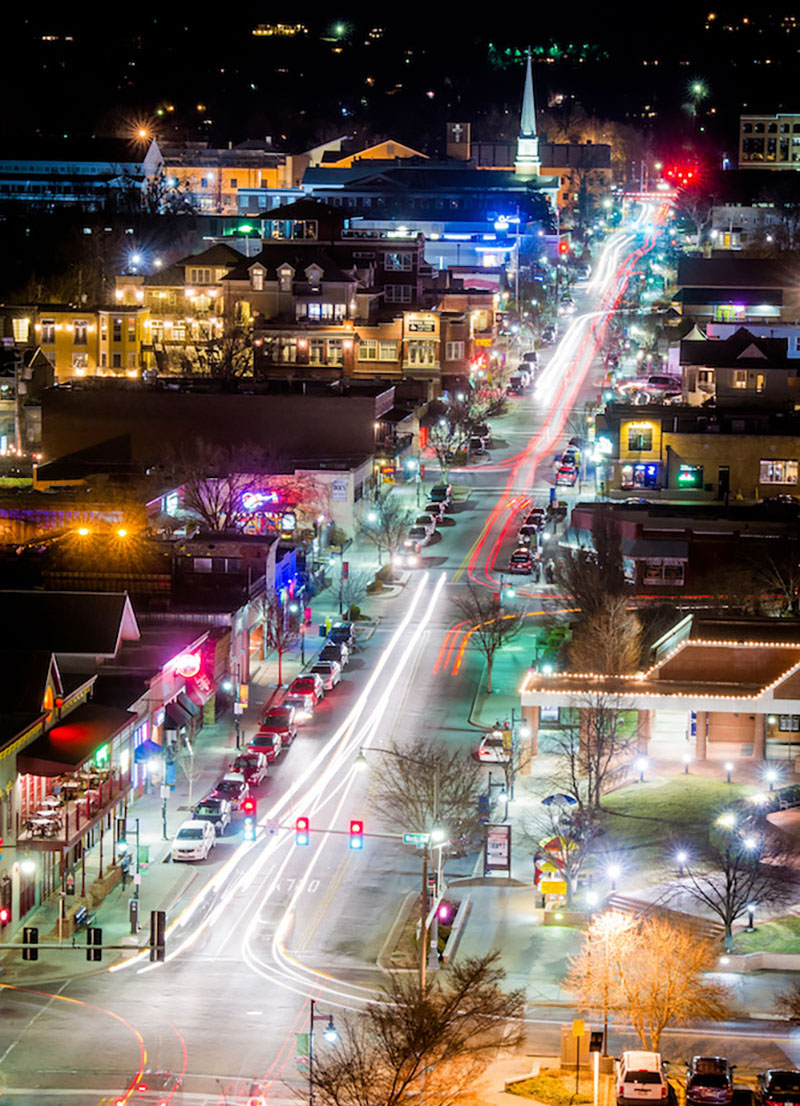
The heart of Dickson Street runs six blocks east from the southeast corner of Fayetteville’s University of Arkansas campus. After one hundred years of industrial and commercial development that came with the railroad, entertainment took over. By the 1970s, bars and nightclubs thrived in the run-down buildings alongside old school barber shops, pawn shops, artist studios, restaurants, and head shops. The sound of live music filled the night air. Patrons from all over the region flocked to the street to mingle with co-eds, quaff a few beers and cheer on the rock ‘n’ roll. The alternative community centered at the street; walking down the sidewalk meant seeing and greeting old friends and meeting new ones.
The 80s saw further decline and the emergence of tawdriness and then with the arrival of the Walton Arts Center in the 1990s and concurrent rising rent, the magic started to drip away like water through fingers. Depending on the point of view, Dickson Street is now either a thriving commercial mecca or a faint shadow of its former glory. In 2004, an article in the bi-monthly tabloid All About Town addressed the issue of Dickson Street and the decline of the music scene. And not for the first time. The first such complaints appeared in an earlier tabloid, The Grapevine, in the 1980s and periodically become the focus of community consternation. Some of it has to do with changing demographics. The people who packed the live music venues in the 1970s were staying at home to raise families in the 1980s. Each generation enjoys its high points on the street then subsides into other activities as years pass.
Nevertheless, the article does a good job of peeling back the layers to discover some basic issues. From that, city leaders, musicians, club owners, and other interested fans of the street might derive some workable ideas of how to ensure that the Dickson Street scene never dies.
Five reasons were cited, which have been added to for this piece.
1. Club owners have to pay the bills. That includes ever increasing costs for rent, utilities, wages for employees, advertising, insurance, supplies like glassware and napkins, and inventory of alcohol and any other items served. Back in the day, rent on Dickson Street reflected the run-down nature of the real estate. Now with gentrification all around, rent has skyrocketed. Also, there’s increasing pressure to pay higher wages, utilities keep going up, and … well, it’s all about the money. The clubs count on alcohol sales to generate the profits they need to keep their heads above water. Some bands don’t attract people who like to drink. And people who like to drink have increasingly begun to patronize stand-up bars.
“Stand-up bars are easier to operate,” said Dave Bass, formerly of Dave’s on Dickson and later yielding to the inevitable by opening two stand-up bars, The Blue Parrot and 414. “It’s impossible to make live music work during the week, and you can’t be open two days a week and make a living.” He admitted losing money with his live music at Dave’s.
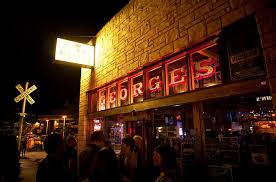
2. People don’t want to pay a cover charge. Many people don’t realize that a cover charge is the only way to pay a band to play. As veteran performer Jed Clampit pointed out, “You don’t get free drinks, but you want free music. Think about going to your job and working for free.” Owner/operator of George’s, Brian Crowne said “People will think nothing of paying $7 or $8 for a two-hour movie but gripe about paying $5 for live, professional entertainment for four hours.”
Another problem for club owners and bands is that many young people today prefer to float from place to place depending on where their friends might be. A friend might text and want to meet them at a specific location. A half hour later, the two friends might decide to go to a third location. Cover charges don’t work for that kind of activity where the objective is socializing, not watching a particular band perform.
3. There are too many clubs and too many bands. Bringing live music to a particular venue requires a lot of upfront investment in securing the band, promoting the event, and doing as much as possible to bring in a crowd. If multiple venues compete for the club-going public, there’s less to go around. That’s the basic math. But there’s no shortage of aspiring bands whose goal of wealth and fame requires building a local following first. Also, painful as it is to recognize, there’s a big disconnect between the many musicians who want to write original songs and audiences who want to hear familiar music. This particular problem is exacerbated by the fact that record deals and other important steps on the road to wealth and fame depend on original music. Nobody wants to record the 38th cover of “Proud Mary.”
Wade Ogle, veteran of the Fayetteville music scene, says the quality of new bands isn’t what it used to be. “With today’s technology, practically everyone can record a CD cheaply. While I think it’s a good thing, the downside is that way too many new bands are looking to play live before they’re really ready.”
So bands thread a narrow line, forced to invest in decent equipment and hours/months of practice until they can get booked to play and then play covers of popular music in their chosen genre while at the same time working on original songs that might be worthy of record label or promoter interest. If they manage to get booked into a club and they’re not ready, people who bother to show up are turned off to live music in general.
4. There aren’t enough fans. This wasn’t so much a problem in the ‘70s when the Baby Boomers came through en masse, the right age and right mindset to thrive on live music. You could almost say that live music was part of their religion. Alas, those days have passed. Somewhat smaller subsequent generations don’t necessarily take song lyrics as their personal anthems. Some might even allege that popular music today can’t hold a candle to the music being created in the ‘60s and ‘70s. With the rise of digital media, music suited to personal taste is available any day, any time, and any place. Free. Why go to a club and pay a cover charge when you can listen to what you like at home? One benefit of live music will never change, however, and that is the attraction of mingling in a crowd of enthusiastic fans, dancing to the same beat and being part of the ‘family.’
5. The town and Dickson Street itself have changed. Yes, this is a big factor. Fayetteville’s population has tripled since the 1970s, and University enrollment has increased from around 15,000 in 1980 to over 50,000 in 2019. More cars and the infill of properties near Dickson means much less parking plus much of the available parking is now metered. Clubs with occasional live music have sprung up along North College Avenue and near the Northwest Arkansas Mall, meaning competition for Dickson Street. Also, until recent years, Dickson Street was the place to party for the entire region. Now that Benton County allows alcohol to be served, clubs have sprung up there like dandelions in early spring. In particular, the Arkansas Music Pavilion (AMP) at Rogers has created a major performance venue for big name performers that in the past would have appeared only in Fayetteville.
Slogans like “Keep Fayetteville Funky” notwithstanding, times change. We change. It’s inconceivable to think that a day might come when Dickson Street would no longer vibrate with the heartbeat of live music and of people streaming through the doors to hear it, commune with each other, and let their hair down. But the world is, after all, what we individually and collectively make it, and it behooves us to not let such a good thing slip unnoticed into the shadows of the past. Dickson Street has been an institution as well as a collective of our entertainment experiences. We have to pay attention and do what we must to keep it that way.
Excerpted from the book, Gem’s Gems — a memoir of my mother, Carmyn Gem [Morrow] Pitts.
[Her father Tom Morrow] ventured east into Madison County and ended up at St. Paul where the logging boom was in full steam. He brought his family to live first in a small house northwest of St. Paul before settling into the Casteel place, a two-story house with a bay window and porches upstairs and down, high upon a mountainside overlooking the White River Valley. They enjoyed a glorious summer in this scenic valley before cotton-picking time called them back to Texas.
Tom gathered his St. Paul crops and left Grandpa Clark in charge of the house and getting the sorghum cane to the mill. Left behind was the furniture—a wood burning cookstove, iron bedsteads and bedding, a rocking chair, table and benches, a marble-top round table, Sylvia’s “Princess” dresser with oval mirror, a small drop leaf desk, and a “matting” box with hinged lid Tom had built out of lathe for Sylvia’s quilts [Carmyn’s mother]. The family packed their “batchin’” equipment—a camp stove, a few quilts, feather bed, and feather bolsters, a white enamel bucket with plates, cups, and two serving bowls, the iron skillet, and a deep aluminum stewer Sylvia used to soak whole grain wheat overnight—into the beloved Baby Overland and headed south. Not left behind were the family cat Snowball and the German Shepherd dog “Lightnin’,” who rode on the fender.
On the journey, they stopped along the road each night and made campfires to cook supper. They would stop at a house to ask if they could get water at their spring and camp for the night. Mama made pallets for the younger children to sleep on in the truck and Papa, Durward, Douglas and Graydon slept on pallets on the ground under the truck. Once when they stopped at a house and asked to use the spring, the lady of the house brought them fresh buttermilk.
Littlefield Texas cotton-pickin’ shack. January 1929 L-R: Douglas with dog Trixie True, Graydon, Joy with cat Snowball, Tomazine “Sister,” Carmyn holding her doll Prudence, Una Mae in Durward’s lap
Upon arriving in Texas, they lived first in a cotton-picking shack at one of Sylvia’s sister’s place in Grayson County. After picking for two weeks, they moved on to another of Sylvia’s sister’s farms near Vera in Knox County where they stayed for four weeks. The shacks were crudely built one-room structures about twelve feet by fourteen feet with two windows and a door. Aunt Lillian fixed up their shack at Crosby County for her sister Sylvia and family to live in, scrubbed clean with curtains on the windows. She loaned them a coal-oil stove with an oven. They picked their cotton for three weeks and then finished the season in a shack near Morrison.
In the winter of 1928, the Tom and Sylvia Morrow family moved back to the Casteel place in St. Paul, Arkansas, but Grandpa Clark convinced Tom that the ground was too rocky for farming, so they rented a house together—the Greenway place—about 1.5 miles southwest of Springdale (near the present-day Wal-Mart). It was a temporary home for the two weeks it took Tom to find “Trouble’s End,” the name of the place in Springdale that was their first home with a bathroom and running water. Their seventh child Una May was born here. They had apples and strawberries, and were joined again by the grandparents, who again kept the house when Tom began preparing his family for another summer run back to Texas to pick cotton.
Austin Place, Springdale Arkansas August 1929 Tomazine and Una May
Tom traded the Baby Overland for a big truck, made a wooden box for the pet cat and a puppy to ride in, and the German Shepherd rode on the fender. On the journey, Sylvia and girls slept in the truck while Tom and the boys slept on pallets under the truck. Back in Texas, near Littlefield, they lived in a shack and picked cotton, but the kids all came down with whooping cough, so they couldn’t return to Arkansas until March 1929.
Back in Springdale, they discovered that Grandpa Clark had failed to pay rent at “Trouble’s End,” and had moved three miles east of Springdale to the Crane place. He had rented a nearby house, the Austin place, for Tom’s family, but it was only one bedroom. Tom closed in the breezeway to the smokehouse to provide more room, but that fall he found the Nix place with three bedrooms and a big corner porch. He moved the family there and went to Texas to haul grain from November until February 1930.
Tom Morrow with his mule team, baby on the wagon seat
Read the rest of Gem’s Gems! Available at Amazon.com
Family of Floyd Pitts at the family home, Cane Hill, Arkansas: Standing back row, left to right: Older brother Harvey, his wife Ina, youngest sister Verna, younger sister Opal, Floyd, oldest brother Noah with wife Nellie holding Betty with Laverne standing. Front row, children of Harvey and Ina, Bobby Ray and Joy Lee. Seated: William “Bill” Pitts and his wife Nora West Pitts.
My dad, Floyd D. Pitts, didn’t fit a traditional male identification, not that he wasn’t fully male. His talent for music set him up for ridicule and bullying by his two older brothers. He hated the fields of cotton where, as a child, he was once flogged with a cotton stalk by his mom for sleeping at the end of a long row with his bag only partly filled. He was eight years old. It was a lesson in working to survive, and he never forgot it.
His high school diploma from Morrow, Arkansas, hardly counted when he entered college on a music scholarship. He’d already been part of a popular men’s quartet with classmates from high school performing regularly on Fayetteville’s KUOA, Voice of the Ozarks radio station. He played piano and fiddle, and also taught singing school. A makeshift piano tuning hammer had been fashioned from a tie-rod end by his blacksmith father because invariably when Floyd showed up at some rural church house to teach shape-note singing, the piano needed tuning.
Band Director, Rogers Arkansas circa 1940
Time in the U. S. Navy during World War II gave him the opportunity to later obtain a master’s degree as well as hours toward a doctorate. After the war, he returned to Rogers (Arkansas) to again teach choir and band. Another forty years would pass in this career, at Fort Smith in the 1950s, then Miami, Oklahoma until 1967, then part time at Westville, Oklahoma and Lincoln, Arkansas, until he retired from teaching.
From the early 1960s on, however, he advanced his moonlighting career of piano tuning and repair, which he took up full time once he left Lincoln schools. And while I had been his student in the Miami schools band, my first opportunity to work at his side came with the piano business. And it was here that we stepped outside the normal father-daughter roles.
He didn’t treat me like a girl. I remember that even as a youngster, when he was trying to remodel an old house we lived in at Fort Smith, he’d show me how to drive a nail or spread mud on a sheetrock seam. When I began ‘helping’ him in the piano business, he didn’t pay attention to whether my nails would get broken or if my feet were cold. He’d say “Come hold this clamp, sis,” or “Get that Phillips and come over here.”
I learned so much this way, not only how to repair and rebuild these complex instruments called pianos, but how to refinish wood whether solid or veneered, how to mix stains to get rid of red tones, how to smooth off delicate veneer edges with 220 grit sandpaper. If I had a shop today, there’s no end to the kinds and numbers of projects I could pursue and conclude with pleasing results.
Most women don’t get that kind of education.
Carmyn Gem Morrow and Floyd Denver Pitts, Benton County Fair circa 1945
Maybe he realized he wasn’t a “traditional” male in the sense of muscles and macho. Maybe he realized I wasn’t a traditional female in the sense of lace and flirting and whatever else defines that sort. Maybe he didn’t realize any of that but rather just moved forward through time with the work his hands could do well and the concept of work as an honorable and necessary pursuit.
I learned more from my dad’s view of the world than from my mom’s. Oh, I washed dishes and hung clothes on the line and changed my little brothers’ diapers. I sewed most of my own clothes through high school. Gardening, milking goats, keeping chickens—those were also part of my education through mom. But none of that really meant much in the greater world of the late 20th century when a woman might need her own income.
Whereas my mom’s social circles didn’t reach much past her extended family, my dad had to learn how to interact with the greater community despite his rural background. He’d have a social drink, laugh at jokes, and recruit band parents and faculty to help sell snow cones to raise money for new band uniforms. It was his charmingly open approach to people that showed me how to build a social network that became an essential part of a thriving thirty-year career as a piano tuner/technician.
If he thought I could lift one end of a 1910 upright piano, who was to say I couldn’t? If he could dig mouse nests out from under piano keys or drill through the cast iron plate to insert lag bolts in restoring a pin block to its correct position, then so could I. I was stronger than I knew, more mechanically minded, my hands—like his—able to tug strings made of cold drawn steel into the right position on a tuning pin.
Me and my dad, mid-1990s at the piano shop, Pitts Piano Service, Fayetteville
I admit to occasional worries that I had lost all chance of being a ‘real’ woman. What woman crawled under a grand piano to refasten the pedal lyre? In 1982 when I passed my Piano Technician Guild exams for registered tuner/technician status, there were less than two dozen women in the field. Plenty of customers would open their door at the appointed time and express shock at seeing a female tech. My hands weren’t delicate with slim fingers and manicured nails, but rather slightly rough tools used to create a well-tuned musical instrument.
But then, even as a child, I never felt feminine. The mysterious talent by which a female might lure a male into courtship totally escaped me. My body didn’t cooperate with the idea of feminine wiles, but rather expressed itself in somewhat androgynous terms—tallish, fairly flat-chested, angular. Interestingly, my dad too seemed somewhat of an anomaly in his family, handsome, lithe rather than muscled. Did he recognize, at least subconsciously, that we both didn’t quite fit the mold?
Nevertheless, I enjoyed my share of love and marriage, cherish my three children, and never turn down a romance novel–unless it’s poorly written.
As his oldest, I gained my dad’s attention first and perhaps it was only the bond of fatherhood that propelled his urge to teach me what he knew. In his heart, he was a teacher more than anything else. He was also an artist—a bass vocalist who could track any part in a four-part harmony, a clarinetist, and a pianist who loved to pound out the keyboard version of jump music like “Bugle Call Rag” or marches like “Under the Double Eagle.” He cherished his role as both a composer and a conductor who pushed his students to produce excellent music whether Sousa marches or Copland’s Appalachian Spring. It was natural for him to insist I learn piano, clarinet and oboe and how to sing alto, and to teach me how to shim a cracked soundboard and identify the difference between real ivory and early celluloid keytops.
All five of us kids learned music. Both my brothers earned master’s degrees in that field. Sadly, I was the only one privileged to work with him in the piano trade and see the broader side of him than as just a parent.
Whether by conscious intent or as the consequence of his personality, my father allowed me to be me. He encouraged me in skills that were beyond anything considered traditional for a female. His open-mindedness about the life choices of his oldest daughter freed me from any sense of duty to the stereotypes that so often limit women.
Today, fifteen years after his death, I appreciate him more than I was ever able to express while he lived. Thanks, Dad.
Excerpt from Glimpses of Fayetteville’s Past, “History of Fayette Junction.”
By 1936, the canning business was the dominant regional industry. At Fayette Junction in south Fayetteville, a new facility sprang up right across the tracks from Sligo Wagon Wood Company and began its own railcar shipments of canned goods. The 1936 Sanborn maps document this enterprise as “Thomas and Drake Canning Company Warehouse,” remarking that stated building dimensions had been taken “from plans.” It was a state of the art facility: plans specified iron posts, concrete block pilaster, and gypsum board roof on steel joists. The Rev. Jake Drake and his son Ezra Drake joined with Rylan C. Thomas in this enterprise.
According to the 1939 city directory, “Drake and Hargis Cannery” was located at 605 W. Dickson. Crates of canned tomatoes, greens, and other produce from this cannery would have been warehoused at Fayette Junction. In 1947, the business was called “Thomas and Drake Canning” and had offices at 19 East Center. Several Drakes may have been involved as a venture of the extended Drake family of Drake’s Creek area, Madison County. It is not clear whether the Fayette Junction property built by Drake ever served as more than a storage facility.
Drake’s brother Bill and sister-in-law Vida (Ma Drake) operated a favored local café known first as “Bill Drake’s Place,” no doubt taking advantage of his brother’s access to inexpensive local canned goods. At some point before 1951, Drake and Thomas was taken over by Hargis. Among the litter later found on the old Sligo mill’s vast dark floor were cancelled checks of Drake Canning Company and Thomas and Drake Canning Company with dates in the 1950s.
Hargis and Drake canneries rode a wave of profitable commerce as Arkansas fruits and vegetables, especially tomatoes, captured a significant market share nationally. But by 1950, production and sales of tomato and strawberry crops comprised a mere one-fourth the volume it had in 1930. Disease, economic forces, and stringent new sanitation regulations began to crush the local canning market.
Vida Drake continued the business after Bill’s death. Frequent winner of awards for Best Plate Lunch, “Ma Drake’s” continued her café even after suffering a heart attack in the early 1990s. Her lunches included a meat, mashed potatoes with gravy, three vegetables, salad, and a roll for $3.75. Homemade pies rounded off the menu, usually available in apple, cherry, lemon, chocolate, coconut, and pecan. The café was first located at the northeast corner of Sixth and S. College, but later moved to 504 E. 15th Street. Drake’s closed after her death in 1997.
Ronnie Hawkins, 1959. From his official website, http://www.ronniehawkins.com Toronto, Ontario Ron Scribner Agency, courtesy of Toronto Hawk Records
“I remember running the red light there,” Hawkins said, referring to Leverett at the top of Garland hill. “I had the daughter of one of the biggest lawyers in Arkansas with me, underage of course. We ran that red light. She did.”
Robert Cochran, interviewing Ronnie Hawkins: “I think I’ve heard that story. That’s where you switch places with her, so you’d take the hit.”
“Yes, I’d take the hit,” Hawkins said. “Pearl Watts was the sheriff. He smoked those old rolled Bull Durham tobaccos. He always had one a fraction of an inch long in the corner of his mouth, [smoke] going right up into his eye while he was interrogating you. Judge Packet said I was a menace to the highway, and I’d better straighten up… They were sitting right behind Leverett school. When we were going over that hill, we were in a hurry to get out to the university farm. That’s where everybody parked.”[1]
Hawkins was indeed in the company of an underage girl, none other than Marcia Perkins, daughter of Rex Perkins. Even though technically too young to hold a driver’s license, she drove a brand new 1956 red-and -white Chevy Bel-Air, courtesy of Rex’s close professional relationships with Fayetteville car dealers.
From Rex Perkins – A Biography:
“By the time Marcia was fourteen in 1955, she had developed a secretive months-long relationship with twenty-one-year-old Ronnie Hawkins, a fledgling star in the music world. Older sister Carole had started college, but Marcia had her own ideas about her future. One night, Marcia attended a slumber party and ended up on the phone with Hawkins. Whether the slumber party had been a strategic maneuver to give her a means to meet him is unknown. But the upshot was that she slipped out of the slumber party to join Hawkins at the golf course where he and other members of his popular group “Ronnie Hawkins and the Hawks” were hanging out and jamming in what turned out to be an all-nighter.
“One version of this story claims that Roy Orbison was in town for this jam session, which wasn’t completely unusual. The early form of rock and roll (later named ‘rockabilly’) blossomed around Huntsville-native Hawkins and his friend Levon Helm, along with other members of this group. Other music notables who came to Fayetteville to jam with Hawkins and/or to play at a favorite nightspot, the Rockwood Club, included Jerry Lee Lewis, Carl Perkins, and Conway Twitty.
“An acquaintance of Hawkins remembered those early years. ‘Ronnie was a natural athlete and a ‘Greek god’ of a life guard at the Wilson Park swimming pool. He understandably received lots of attention from a wide range of women.’[1]
“It was assumed that Marcia and Hawkins were sleeping together, although whether they were intimate during the night in question is not known. One of her slumber party friends confessed the story of Marcia slipping out to her mother, Jane McDonald. Jane told Georgia, Georgia told Rex, and the proverbial mess hit the fan. Marcia was Rex’s baby, Daddy’s little girl, and like most fathers in similar circumstances, Rex wasn’t prepared for another man in Marcia’s young life.
Rex Perkins
“As the story goes, even though fourteen was the legal age of consent at that time in Arkansas, a fired-up Rex gave the young man a choice: leave town or suffer my wrath. The result was that Ronnie Hawkins and the Hawks made a hasty departure from the region. The official version of Hawkins’ life story states he began touring Canada (date unspecified) and later made it his home (1958), and that he ventured there on advice from Conway Twitty.[2]
“Contacted regarding this biography, Hawkins confirmed that Rex made certain threats. ‘Rex was the biggest lawyer ever in Fayetteville at that time,’ Hawkins stated. ‘I would have married her but I was afraid somebody was gonna kill me.’”[3]
If Marcia’s girlfriend hadn’t spilled the beans, Rex would have found out anyway. Pearl Watts knew Marcia’s car and would have made sure Rex knew that his daughter had been found in the company of that rock-and-roller Hawkins, flying through that stoplight.
~~~
[1] “Long on Nerve: An Interview with Ronnie Hawkins,” Robert Cochran and Ronnie Hawkins. The Arkansas Historical Quarterly Vol 65, No. 2 (Summer 2006) pp. 99-115.
[1] Scott Lunsford interview, by email June 26, 2014. Author’s notes.
[2] From there, the story of Hawkins’ group is well known to music buffs. After 1964, fellow-Arkansan Helm and other band members regrouped to form ‘The Band,” toured with Bob Dylan in 1965-66, and went on to fame and fortune. Hawkins continued his musical career to become a mentor to other musicians as well as an award-winning performer.
[3] Scott Lunsford interview, his email relating phone conversation with Ronnie Hawkins August 15, 2014. Author’s notes.












 denelecampbell