Tracking the Campbell Ancestry

In this ensuing series, I lay out what I have found about the Campbells. Since I married one, I thought it would be good to investigate and share my findings with my children. As it turns out, this is pretty much an impossible task.

I’ve come up against ‘impossible’ before so I forged ahead. I’m presenting my discoveries in a series, made available here for anyone interested.

Preface

The following material from Chapter 1 through Chapter 3 has been lifted wholesale from other sources including Wikipedia and sites listed in footnotes. The purpose is to learn about the origins of Scotland and Clan Campbell as background to subsequent chapters which focus on generations closer to our own.

I am not, by birth, a Campbell. I married one and gained a rambunctious, intelligent and inscrutable family of in-laws who fulfilled some of my earlier affectionate regard for Scots that had grown from reading and education. I still find Scotland and Scots fascinating. The minute I hear the beginning drone and wail of the bagpipes, tears burn my eyes. The bold daring of Scotsmen in battle from the earliest times up to the present day earns my heartfelt admiration. And of course, there are men in kilts…

Campbell tartan * For more information on the Campbell tartan, see https://www.ccsna.org/clan-campbell-tartans

This project has been for our children and coming generations who are Campbells or especially descendants of this particular issue of William.

Watch this video of massed pipes and drums at Edinburgh Castle, starting with cannon fire. Note that the various clans are represented by their separate pipe and drum bands, as shown by the various tartans.

https://www.youtube.com/watch?v=Yq7R2MBkqlk


Chapter 1 – Prehistory of Scotland

People lived in Scotland for at least 8,500 years before Britain’s recorded history. At times during the last interglacial period (130,000–70,000 BC), Europe had a climate warmer than today’s, and early humans may have made their way to Scotland, evidenced by the possible discovery of pre-Ice Age axes on Orkney and mainland Scotland. Glaciers then scoured their way across most of Britain, and only after the ice retreated did Scotland again become habitable, around 9600 BC. Upper Paleolithic hunter-gatherer encampments formed the first known settlements, and archaeologists have dated an encampment near Biggar to around 12,000 BC. Numerous other sites found around Scotland build up a picture of highly mobile boat-using people making tools from bone, stone and antlers. The oldest house for which there is evidence in Britain is the oval structure of wooden posts found at South Queensferry near the Firth of Forth, dating from the Mesolithic period, about 8240 BC. The earliest stone structures are probably the three hearths found at Jura, dated to about 6000 BC.

Neolithic farming brought permanent settlements. Evidence of these includes the well-preserved stone house at Knap Howar on Papa Westray, dating from around 3500 BC and the village of similar houses at Skara Brae on West Mainland, Orkney from about 500 years later. The settlers introduced chambered cairn tombs from around 3500 BC, as at Maeshowe, and from about 3000 BC the many standing stones and circles such as those at Stenness on the mainland of Orkney, which date from about 3100 BC, of four stones, the tallest of which is 16 feet in height. These were part of a pattern that developed in many regions across Europe at about the same time.

The creation of cairns and Megalithic monuments continued into the Bronze Age, which began in Scotland about 2000 BC. As elsewhere in Europe, hill forts were first introduced in this period, including the occupation of Eildon Hill near Melrose in the Scottish Borders, from around 1000 BC, which accommodated several hundred houses on a fortified hilltop. From the Early and Middle Bronze Age there is evidence of cellular round houses of stone, as at Jarlshof and Sumburgh in Shetland. There is also evidence of the occupation of crannogs, roundhouses partially or entirely built on artificial islands, usually in lakes, rivers and estuarine waters.

In the early Iron Age, from the seventh century BC, cellular houses began to be replaced on the northern isles by simple Atlantic roundhouses, substantial circular buildings with a dry stone construction. From about 400 BC, more complex Atlantic roundhouses began to be built, as at Howe, Orkney and Crosskirk, Caithness. The most massive constructions that date from this era are the circular broch towers, probably dating from about 200 BC. This period also saw the first wheelhouses, a roundhouse with a characteristic outer wall, within which was a circle of stone piers (bearing a resemblance to the spokes of a wheel), but these would flourish most in the era of Roman occupation. There is evidence for about 1,000 Iron Age hill forts in Scotland, most located below the Clyde-Forth line, which have suggested to some archaeologists the emergence of a society of petty rulers and warrior elites recognizable from Roman accounts.[1]

The Roman Invasion
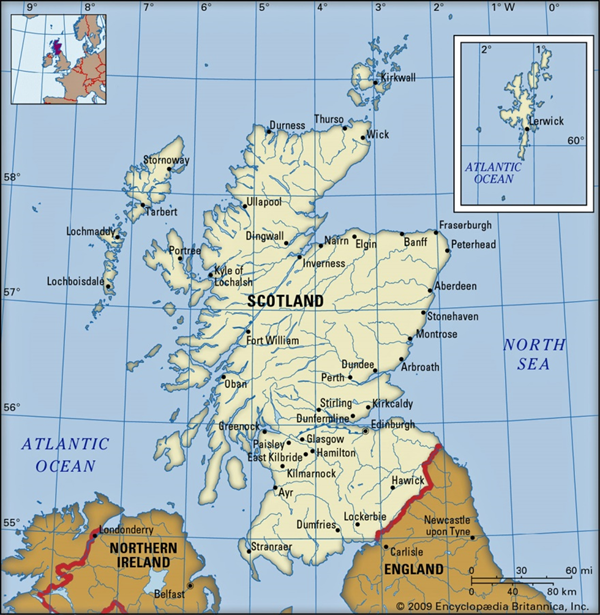
The surviving pre-Roman accounts of Scotland originated with the Greek Pytheas of Massalia, who may have circumnavigated the British Isles of Albion (Britain) and Ierne (Ireland) sometime around 325 BC. The most northerly point of Britain was called Orcas (Orkney). By the time of Pliny the Elder, who died in AD 79, Roman knowledge of the geography of Scotland had extended to the Hebudes (The Hebrides), Dumna (probably the Outer Hebrides), the Caledonian Forest and the people of the Caledonii, from whom the Romans named the region north of their control Caledonia. Ptolemy, possibly drawing on earlier sources of information as well as more contemporary accounts from the Agricolan invasion, identified 18 tribes in Scotland in his Geography, but many of the names are obscure and the geography becomes less reliable in the north and west, suggesting early Roman knowledge of these areas was confined to observations from the sea.

The Roman invasion of Britain began in earnest in AD 43, leading to the establishment of the Roman province of Britannia in the south. By the year 71, the Roman governor Quintus Petillius Cerialis had launched an invasion of what is now Scotland.  In the year 78, Gnaeus Julius Agricola arrived in Britain to take up his appointment as the new governor and began a series of major incursions. He is said to have pushed his armies to the estuary of the “River Taus” (usually assumed to be the River Tay) and established forts there, including a legionary fortress at Inchtuthil. After his victory over the northern tribes at Mons Graupius in 84, a series of forts and towers were established along the Gask Ridge, which marked the boundary between the Lowland and Highland zones, probably forming the first Roman limes or frontier in Scotland. Agricola’s successors were unable or unwilling to further subdue the far north. By the year 87, the occupation was limited to the Southern Uplands and by the end of the first century the northern limit of Roman expansion was a line drawn between the Tyne and Solway Firth. The Romans eventually withdrew to a line in what is now northern England, building the fortification known as Hadrian’s Wall from coast to coast.

Around 141, the Romans undertook a reoccupation of southern Scotland, moving up to construct a new line between the Firth of Forth and the Firth of Clyde, which became the Antonine Wall. The largest Roman construction inside Scotland, it is a sward-covered wall made of turf around 20 feet (6 m) high, with nineteen forts. It extended for 37 miles (60 km). Having taken twelve years to build, the wall was overrun and abandoned soon after 160. The Romans retreated to the line of Hadrian’s Wall.

Roman troops penetrated far into the north of modern Scotland several more times, with at least four major campaigns. The most notable invasion was in 209 when the emperor Septimius Severus led a major force north. After the death of Severus in 210 they withdrew south to Hadrian’s Wall, which would be Roman frontier until it collapsed in the 5th century. By the close of the Roman occupation of southern and central Britain in the 5th century, the Picts had emerged as the dominant force in northern Scotland, with the various Brythonic tribes the Romans had first encountered there occupying the southern half of the country. Roman influence on Scottish culture and history was not enduring.

In the centuries after the departure of the Romans from Britain, there were four groups within the borders of what is now Scotland. In the east were the Picts, with kingdoms between the river Forth and Shetland. In the late 6th century the dominant force was the Kingdom of Fortriu, whose lands were centered on Strathearn and Menteith and who raided along the eastern coast into modern England. In the west were the Gaelic (Goidelic)-speaking people of Dál Riata with their royal fortress at Dunadd in Argyll [including Campbell ancestry], with close links with the island of Ireland, from whom comes the name Scots. In the south was the British (Brythonic) Kingdom of Strathclyde, descendants of the peoples of the Roman influenced kingdoms of “Hen Ogledd” (Old north), often named Alt Clut, the Brythonic name for their capital at Dumbarton Rock. Finally, there were the English or “Angles”, Germanic invaders who had overrun much of southern Britain and held the Kingdom of Bernicia, in the south-east. The first English king in the historical record is Ida, who is said to have obtained the throne and the kingdom about 547. Ida’s grandson, Æthelfrith, united his kingdom with Deira to the south to form Northumbria around the year 604. There were changes of dynasty, and the kingdom was divided, but it was re-united under Æthelfrith’s son Oswald (r. 634–42).

Sidebar:
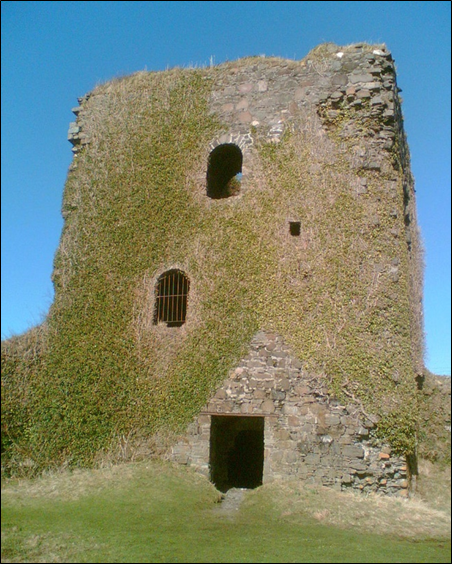
The images to the right are the ruins of Dunollie. This was a fortification on this high promontory in the Early Middle Ages, when Dunollie was the royal centre of the Cenél Loairn within the kingdom of Dál Riata. The Irish annals record that “Dun Ollaigh” was attacked or burned down three times, in 686, 698, and in 701. It was subsequently rebuilt in 714 by Selbach mac Ferchair (died 730), the King of Dál Riata credited with destroying the site in 701. Excavations in the 1970s suggest that this early fortification was abandoned sometime in the 10th century.

The area around Dunollie subsequently became part of the semi-independent Kingdom of the Isles, ruled over by Somerled in the 12th century. On his death the MacDougalls became Lords of Lorne. Dougall, Somerled’s son, held most of Argyll and also the islands of Mull, Lismore, Jura, Tiree, Coll and many others in the 12th century.
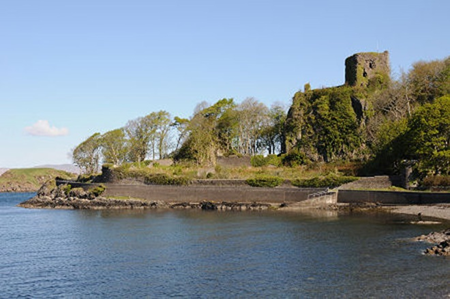
Excavations show that Dunollie was refortified with an earthwork castle in the 13th century or potentially the late 12th century. The builder may have been Dougall, or his son Duncan. Ewan MacDougall, great-grandson of Somerled and the third chief of the MacDougalls, switched the clan’s allegiance in the mid-13th century: initially allied with Haakon IV of Norway, from the 1250s, Ewan remained loyal to the kings of Scotland.

In the 14th century Ewan’s grandson John MacDougall, along with his kinsmen the Comyns, sided with the Balliols against the interests of Robert the Bruce. John MacDougall’s army defeated the Bruce at the Battle of Dalrigh in 1306, but Bruce returned in 1308 and crushed the MacDougalls at the Battle of the Pass of Brander. The MacDougall lands of Lorne were subsequently forfeit and were given to the Campbells, though Dunollie and other estates were regained later in the 14th century.

Scotland was largely converted to Christianity by Irish-Scots missions associated with figures such as St. Columba, from the fifth to the seventh centuries. These missions tended to found monastic institutions and collegiate churches that served large areas. Partly as a result of these factors, some scholars have identified a distinctive form of Celtic Christianity, in which abbots were more significant than bishops, attitudes to clerical celibacy were more relaxed and there were some significant differences in practice with Roman Christianity, particularly the form of tonsure and the method of calculating Easter, although most of these issues had been resolved by the mid-7th century.

Kingdom of Alba

Conversion to Christianity may have sped a long-term process of gaelicisation of the Pictish kingdoms, which adopted Gaelic language and customs. There was also a merger of the Gaelic and Pictish crowns, although historians debate whether it was a Pictish takeover of Dál Riata, or the other way around. This culminated in the rise of Cínaed mac Ailpín (Kenneth MacAlpin) in the 840s, which brought to power the House of Alpin. In 867 AD the Vikings seized the southern half of Northumbria, forming the Kingdom of York; three years later they stormed the Britons’ fortress of Dumbarton and subsequently conquered much of England except for a reduced Kingdom of Wessex, leaving the new combined Pictish and Gaelic kingdom almost encircled. When he died as king of the combined kingdom in 900, Domnall II (Donald II) was the first man to be called rí Alban (i.e. King of Alba). The term Scotia was increasingly used to describe the kingdom between North of the Forth and Clyde and eventually the entire area controlled by its kings was referred to as Scotland.

The long reign (900–942/3) of Causantín (Constantine II) is often regarded as the key to formation of the Kingdom of Alba. He was later credited with bringing Scottish Christianity into conformity with the Catholic Church. After fighting many battles, his defeat at Brunanburh was followed by his retirement as a Culdee monk at St. Andrews. The period between the accession of his successor Máel Coluim I (Malcolm I) and Máel Coluim mac Cináeda (Malcolm II) was marked by good relations with the Wessex rulers of England, intense internal dynastic disunity and relatively successful expansionary policies. In 945, Máel Coluim I annexed Strathclyde as part of a deal with King Edmund of England, where the kings of Alba had probably exercised some authority since the later 9th century, an event offset somewhat by loss of control in Moray. The reign of King Donnchad I (Duncan I) from 1034 was marred by failed military adventures, and he was defeated and killed by MacBeth, the Mormaer of Moray, who became king in 1040. MacBeth ruled for seventeen years before he was overthrown by Máel Coluim, the son of Donnchad, who some months later defeated MacBeth’s step-son and successor Lulach to become King Máel Coluim III (Malcolm III).

It was Máel Coluim III, who acquired the nickname “Canmore” (Cenn Mór, “Great Chief”), which he passed to his successors and who did most to create the Dunkeld dynasty that ruled Scotland for the following two centuries. Particularly important was his second marriage to the Anglo-Hungarian princess Margaret. This marriage, and raids on northern England, prompted William the Conqueror to invade and Máel Coluim submitted to his authority, opening up Scotland to later claims of sovereignty by English kings. When Malcolm died in 1093, his brother Domnall III (Donald III) succeeded him. However, William II of England backed Máel Coluim’s son by his first marriage, Donnchad, as a pretender to the throne and he seized power. His murder within a few months saw Domnall restored with one of Máel Coluim sons by his second marriage, Edmund, as his heir. The two ruled Scotland until two of Edmund’s younger brothers returned from exile in England, again with English military backing. Victorious, Edgar, the oldest of the three, became king in 1097. Shortly afterwards Edgar and the King of Norway Magnus Barefoot concluded a treaty recognizing Norwegian authority over the Western Isles. In practice, Norse control of the Isles was loose, with local chiefs enjoying a high degree of independence. He was succeeded by his brother Alexander, who reigned 1107–24.

When Alexander died in 1124, the crown passed to Margaret’s fourth son David I, who had spent most of his life as a Norman French baron in England. His reign saw what has been characterized as a “Davidian Revolution”, by which native institutions and personnel were replaced by English and French ones, underpinning the development of later Medieval Scotland. Members of the Anglo-Norman nobility took up places in the Scottish aristocracy and he introduced a system of feudal land tenure, which produced knight service, castles and an available body of heavily armed cavalry. He created an Anglo-Norman style of court, introduced the office of justicar to oversee justice, and local offices of sheriffs to administer localities. He established the first royal burghs in Scotland, granting rights to particular settlements, which led to the development of the first true Scottish towns and helped facilitate economic development as did the introduction of the first recorded Scottish coinage. He continued a process begun by his mother and brothers helping to establish foundations that brought reform to Scottish monasticism based on those at Cluny and he played a part in organizing diocese on lines closer to those in the rest of Western Europe.

These reforms were pursued under his successors and grandchildren Malcolm IV of Scotland and William I, with the crown now passing down the main line of descent through primogeniture, leading to the first of a series of minorities. The benefits of greater authority were reaped by William’s son Alexander II and his son Alexander III, who pursued a policy of peace with England to expand their authority in the Highlands and Islands. By the reign of Alexander III, the Scots were in a position to annex the remainder of the western seaboard, which they did following Haakon Haakonarson’s ill-fated invasion and the stalemate of the Battle of Largs with the Treaty of Perth in 1266.[2]

Clan Campbell

In traditional genealogies of the Clan Campbell, its origins are placed amongst the ancient Britons of Strathclyde; the earliest Campbell in written records is Gillespie who is recorded in 1263. Early grants to Gillespie and his relations were almost all in east-central Scotland, but the family’s connection with Argyll came some generations before, when a Campbell married the heiress of the O’Duines and she brought with her the Lordship of Loch Awe. Because of this the early clan name was Clan O’ Duine and this was later supplanted by the style Clann Diarmaid. This name came from a fancied connection to Diarmid the Boar, a great hero from early Celtic mythology.
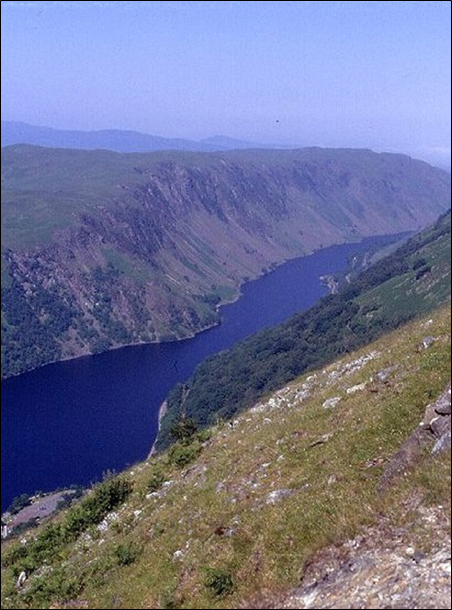
Text Box: Loch Awe (Scottish Gaelic: Loch Obha) is a large body of mostly freshwater in Argyll and Bute, Scottish Highlands. It has also given its name to a village on its banks, variously known as Loch Awe or Lochawe. Below is the northern part of the loch where the Battle of Red Ford was fought, so named because the abundance of blood from the battle tinted the water red.

Loch Awe

The original seat of the Clan Campbell was either Innis Chonnell Castle on Loch Awe or Caisteal na Nigheann Ruaidh on Loch Avich. The clan’s power soon spread throughout Argyll, though at first the Campbells were under the domination of the Lords of Lorne, chiefs of Clan MacDougall. The MacDougalls killed the Campbell chief Cailean Mór (Colin Campbell) in 1296. (See: Battle of Red Ford). All of the subsequent chiefs of Clan Campbell have taken MacCailean Mór as their Gaelic patronymic.

Between 1200 and 1500 the Campbells emerged as one of the most powerful families in Scotland, dominant in Argyll and capable of wielding a wider influence and authority from Edinburgh to the Hebrides and western Highlands.

The Name and Places

Allegedly, the Campbell name came from the Gaelic “cam” or crooked, and “beul” for mouth. Prior to this name arising, the clan was always known as the Clann O’Duibhne. Clan Duibhne derived its name from Diarmid O’ Duin, an individual from whom descended a long line of chiefs, the Lords of Lochawe.[3]

The first of the name Cambel (the original spelling) who can be found in the surviving records was one who owned lands near Stirling in 1263. The earliest written date for the main clan-lands in Argyll is that for Duncan Dubh, landowner in the Kintyre peninsular in 1293.

The first date which survives for the Cambels on Lochawe is the record of the killing of Sir Cailein Mor (Great Colin) of Lochawe in 1296 when he was attacked by men of the Clan Dougall on the Stringe of Lorne. His family had been long established on Lochawe and at that time at least two other Cambels owned land in Argyll; Sir Duncan Dubh and Sir Thomas in Kintyre.

Tradition holds that the first of the Campbell ancestors (still not yet called Campbell) who came into Argyll married Eva, daughter of Paul an Sporran and the heiress of the O’Duibhne tribe on northwestern Loch Awe in Argyll.
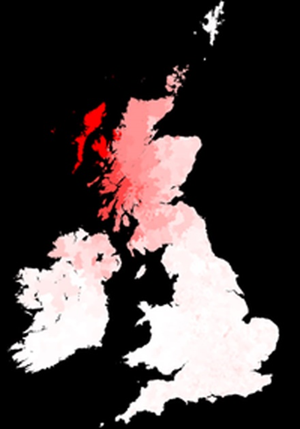
This ancestor may well have first been established in Argyll as a follower of the Earl of the neighboring Lennox clan when Alexander II, king of Scots, marched into Argyll to enforce the loyalty of its people. Alexander is said by Fordun, a medieval writer, to have visited Argyll in 1222, and this period for a Campbell ancestral arrival on Lochawe is supported by the Gaelic genealogies and later charters.

Argyll is a county on the west coast of Scotland, the second largest in the country, embracing a large tract of country on the mainland and a number of the Hebrides or Western Isles. The Argyll branch of the Clan Campbell controlled the area round Loch Awe, an inland loch in the ruddy heart of the Argyll region.
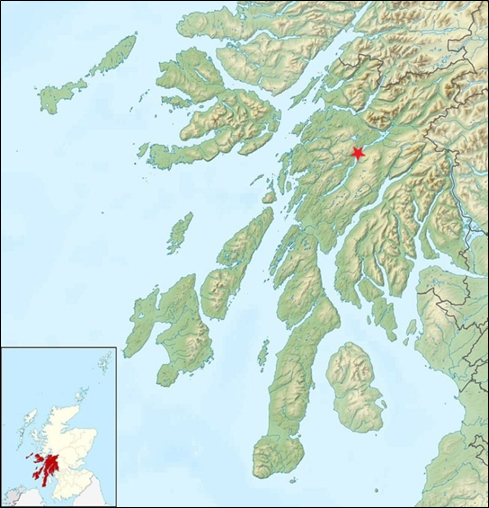
Map of Argyll region of Scotland. Starred location is Loch Awe.

The middle of the shire contains:- Inveraray Castle and furnishing the titles of earl and duke to the Campbells; – Cowall, between Loch Fyne and the Firth of Clyde, in which lie Dunoon and other favorite holiday resorts; – Knapdale between the Sound of Jura and Loch Fyne; and – Kintyre or Cantyre, a long narrow peninsula (which, at the isthmus of Tarbert, is little more than 1m. wide), the southernmost point of which is known as The Mull, the nearest part of Scotland to the coast of Ireland, only 13m. distant.

The mainland portion of the County of Argyll is bounded : – North by Inverness-shire; – East by Perth and Dumbarton, Loch Long and the Firth of Clyde; – South by the North Channel (Irish Sea); and – West by the Atlantic.

The principal districts are Ardnamurchan on the Atlantic, Ardnamurchan Point being the most westerly headland of Scotland; Morven or Morvern, bounded by Loch Sunart, the Sound of Mull and Loch Linnhe; Appin, on Loch Linnhe, with piers at Ballachulish and Port Appin; Benderloch, lying between Loch Creran and Loch Etive; Lorne, surrounding Loch Etive and giving the title of marquess to the Campbells.

Septs of the Clan Campbell

Septs are families that follow a certain clan chief and are under his responsibility as clan chief. Arthur, Bannatyne, Burnes, Burness, Burnett, Burns, Connochie, Conochie, Denoon, Denune, Gibbon, Gibson, Harres, Harris, Hawes, Haws, Hawson, Isaac, Isaacs, Iverson, Kellar, Keller, Kissack, Kissock, Lorne, Macartair, Macarthur, Maccarter, Maccolm, Maccolmbe, Macconachie, Macconchie, Macconnechy, Macconochie, Maceller, Macelvie, Macgibbon, Macever, Macglasrich, Macgubbin, Macgure, Macisaac, Maciver, Macivor, Mackellar, Mackelvie, Mackerlie, Mackerlich, Mackessack, Mackessock, Mackissoch, Maclaws, Maclehose, Macnichol, Macnocaird, Maconachie, Macoran, Macowen, Macphedran, Macphun, Mactause, Mactavish, Macthomas, Macure, Moore, Muir, Ochiltree, Orr, Pinkerton, Taweson, Tawesson, Thomas, Thomason, Thompson, Thomson, Ure

Wars of Scottish Independence

The family of Colin Campbell went on to become firm supporters of King Robert the Bruce and benefited from his successes with grants of lands, titles and good marriages. During the Wars of Scottish Independence the Campbells fought for Scotland against the English at the Battle of Bannockburn in 1314. During the 14th century the Clan Campbell rapidly expanded its lands and power. This is partly explained by the loyalty of Sir Neil Campbell (Niall mac Caile), (d.1315), to the cause of Robert the Bruce – a loyalty which was rewarded with marriage to Bruce’s sister Mary. The family was also closely associated with the Stewarts as well as the Bruces in the time of Cailean Mór. Sir Neil, as a staunch ally of the Bruce was rewarded with extensive lands that had been taken from the forfeited MacDougall, Lords of Lorne and other enemies of the Bruces in Argyll.

~~~

Our hope has been to discover the ancestry of our known predecessors in the United States. We have not accomplished that goal. Indeed, such a pursuit has absorbed many genealogists in decades of study only to emerge dissatisfied. And while the older records are meticulous in tracking the descendants of Campbell lairds, no such effort was been made to track those not of the noble households, i.e. the commoners. Further problems arise when trying to discover the link between those records and the haphazard documentation, if any, of early American Campbells. As noted by Mary Turner of the University of Arizona at Flagstaff in her paper on this subject written February 28, 1996:

“The ways that led from Scotland to North America were many and diverse, often circuitous and usually hazardous to some degree. Those Campbells and other Highlanders who came to the new world in the 17th and 18th centuries were, perhaps, more ready to adapt to a raw frontier and to cope with life in an absolute wilderness than most travelers from Edinburgh or London.

“The Gaels who came from the lochs and glens of Argyll and Perthshire had already survived hardship and want, like as not, and they often came in groups when they could, families, kinsfolk and neighbors. Whether they came early or late it was very much a new world, with many adjustments to be made. Their shared memories of the scenes left behind must have been of great comfort. The legends they held in common and their mutual language were a strong support. Many a genealogical report begins with, “Three brothers left Argyll …” or, “There were the four brothers who sailed from Glasgow in the company of local families bound for …”

“The stories of these Campbell immigrants are as varied as the individuals. The reasons they came and the routes they took make fascinating reading. Many went to Ireland first – particularly those who fought in the ill-fated Monmouth Rebellion of 1685. Ireland was close; safety was near, and time was of the essence. But escape was of primary importance for those in political difficulties, so what then? America was farther and so safer and there was land for the winning.

“While in the late 18th and early 19th centuries there would be some ‘clearances’ or forced evictions of tenants from Breadalbane lands in Perthshire, there were very few in Argyll. The concept that most Campbells left Scotland due to clearances is a slight on their initiative and on the humanity of the Dukes of Argyll. Without a doubt most Campbells who left from Argyll left of their own free will and most often in search of land to own.

“Some had no choice but to come, being deported or indentured for being on the wrong side in politics or the law. But most came with the glow of promise, with the hope of better times and of land enough for all. Land was the greatest motivating factor for Highland people who were used to a predominantly cattle economy and wealth being counted on the hoof. From the younger sons of landowning families to the tacksmen and tenants and their servants, North America meant that all had the chance to become landowners.

“Some of the earliest Campbells in North America were likely privateers, traders and indentured servants working out their time until they were free to settle their own place. Then in the first part of the 18th century a large organized group from Argyll crossed the Atlantic to settle in the Cape Fear area of North Carolina. Their descendants spread down to Scotch Neck, the 96 District and over the Cumberland Gap to Kentucky and Tennessee.

“Later in the 18th century Captain Lachlan Campbell from Islay led several shiploads of people to New York State where some later gained their promised land in the Argyle Colony and others moved to New Jersey and further west. Those who came by Virginia and Philadelphia had descendants who crossed the hills into Pennsylvania and Ohio. Others still came to Boston and became New Englanders.

“In the French Indian Wars the Black Watch regiment, a number of whose officers and men were Campbells, landed in New York in 1756 among the first British regular soldiers sent to defend the colonies from the French. Some Campbells and others elected to stay when the regiment eventually left North America.

“Campbells fought on both sides in the Revolutionary War. Many of the Highland families in the Carolinas, remembering the 1745, were Loyalists and so obliged to leave for Canada.

“Early in the 19th century there were sailings from the west coast of Scotland to Nova Scotia and Cape Breton. In the later years of the 19th century more Campbells were attracted to the newly opened lands of eastern Canada in Ontario. And then in later generations some of the younger members of these families would move west to the high plains and Rocky Mountains of both the United States and Canada.

“When the rich lands of the Pacific coast territories were opened for settlement, Campbells left the rocky fields of the Appalachians, from New England to Kentucky, to cross the plains and mountains of the west. A Campbell from the South founded Campbell, California.

Campbells fought on both sides in the Civil War, the War Between the States. By then there was a Campbell judge on the Supreme Court whose actions in the infamous Dred Scott case helped to precipitate the war.”[4]

That said, in the next chapter we proceed to give detail on the earliest Campbells of both Argyll and Breadalbane in order to give the flavor of their lives even though we have no evidence that our lineage derives from these houses.


[1] https://en.wikipedia.org/wiki/History_of_Scotland

[2] All of the preceding from https://en.wikipedia.org/wiki/History_of_Scotland

[3] Based on my personal experience with Campbells, I think this ‘crooked mouth’ could describe their compulsion to twist words and meanings. Word play at its best, obfuscation at its worst, never a straight comment or answer.

[4] From https://www.ccsna.org/campbells-in-north-america, accessed Jan 13, 2022. Much more on the Campbells ata this website.

Kinfolk!

Combining four generations of family history and up-to-date genealogical information, this collection of ancestry information tracks a group of families which settled in Greene County, Arkansas in the first two decades of statehood. Family trees, deed records, census records, and other official records create a factual framework for personal narratives and vintage photographs, creating a fascinating archive of information for any descendant of these families as well as any fan of local history.

Each marriage between these pioneer families brought certain talents and backgrounds to the next generation. They farmed the rich land of Crowley’s Ridge and other Greene County areas, weathered the storms of poverty and loss, and suffered the ravages of sickness and war. Yet they survived, and their great-grandchildren entered the twentieth century determined to continue as they had begun.

Now the 21st century brings us the internet with its vast collection of historical documents, making it finally possible to reflect on their adventures and aspirations. The story of these families is the story of thousands of us descended from them.

Nab your copy, only $14.95

Pussyfooted Justice

Slave Market in Ancient Rome, by Jean-Léon Gérôme

If Samuel Alito, Clarence Thomas, Neil Gorsuch, Brett Kavanaugh and Amy Coney Barrett really stood up for their convictions on the abortion issue, they wouldn’t just shuffle the decision to the states. They’d completely overturn Roe v Wade.

Why didn’t they?

Because they AREN’T convinced they are right.

If bodily autonomy isn’t guaranteed for the entire nation, and states are the appropriate venue for giving or denying those rights, what’s next? Slavery?

After all, former Confederate states form the bulk of those states eager to strip women of bodily autonomy.

What is loss of bodily autonomy other than slavery?

But wait! Save those cogent arguments!

  • Fanatic evangelicals eager to sacrifice women on the altar to their angry misogynistic god will never change their minds.
  • Lawmakers eager to harvest the fruits of their fifty-year campaign to be elected by targeting women will never stop the manipulation.
  • Evangelical women eager to bow down to male authority in order to avoid taking responsibility for their own lives believe their salvation depends on submitting to authority, God and men.

These people do not have the intellectual capacity to reason through the facts. Whatever intellect they might naturally possess has been subverted by religious brainwashing.

Throughout the millennia, women have aborted unwanted pregnancies—or abandoned unwanted newborns to die. Their decisions have shaped the human race. Yes, evangelicals, even you are the result of selective breeding.

Evangelicals believe that overturning Roe will magically end abortions. They are willingly ignorant of the history.

What would it take to really stop abortion?

  • Monitor all women of childbearing age, every month, for pregnancy.
  • If they test positive, sequester them so they can’t grab a coat hanger. Keep them locked up until they give birth.
  • That means keeping them away from their jobs, their husbands, their children.
  • It means turning women into baby machines under the force of law.

In truth, it is not possible to stop abortion.

What is possible—and predictable—is that laws restricting abortion rights will cause women to suffer. Sterility and even death are often outcomes of back-alley abortions.

This is the Big Win for evangelicals. In religious teachings, God said women should suffer because Eve tempted Adam into falling for the apple. So why ease that suffering? God said.

Never mind that pathetic Adam couldn’t think for himself and Just Say No. That bitch used her sexuality to manipulate the poor guy into something he knew he shouldn’t do.

What could better ensure that God extends welcoming arms when the faithful reach those pearly gates than a record of supporting the punishment of women?

NEVER MIND the truth staring us in the face, the result of smug religious thoughtlessness: OVERPOPULATION.

The greater the world population, the greater the environmental damage. The higher our standard of living, the greater the environmental damage. Electricity, motor vehicles, chemical agriculture, waste disposal—already we see the oceans rise, thick with waste. Already we watch as climate change disrupts agriculture and water supply.
It’s not possible to maintain anywhere near our standard of living with the population projected to double in the next 80 years.

World population estimates from 1800 to 2100, based on “high”, “medium” and “low” United Nations projections in 2010 (colored red, orange and green) and US Census Bureau historical estimates (in black). Actual recorded population figures (as of 2010) are colored in blue. According to the highest estimate, the world population may rise to 16 billion by 2100; according to the lowest estimate, it may decline to 7.2 billion.

For decades, we’ve seen the increasingly negative results of overpopulation—people dying of starvation, the spread of disease, the expansion of desert into previously productive lands due to climate change as well as overuse of farming and grazing in marginal areas.

The evangelical solution: Teach them about Jesus. It’s in God’s hands.

No. It is in OUR hands.

We see the rush of people from marginal lands into areas of greater resources. From Africa into the Middle East, from the Middle East into Europe. From Central America and South America across our southern border.

The evangelical solution: Build a wall.

How long until the money runs out to care for the disabled, the elderly, the compromised? How long until schools are so crippled that they fail utterly? These are problems of OVERPOPULATION.

When the time comes, do we allow women to continue their ancient role of deciding who is born, or do we authorize the government to make those decisions? A government empowered to force birth is equally empowered to deny birth.

The evangelical fight to make the United States a “Christian” nation is nothing less than an attempt to overturn our government. The Founding Fathers were clear on this point, to keep religion OUT of government. Power to the people.

“The people have the power. All we have to do is awaken the power in the people.”
— John Lennon

Freedom from Religion

Book burning on the rise

Senior year in high school included the long-feared ‘senior paper.’ A project of English class, the paper’s thesis had to be approved first then the long drudgery of research would begin. The paper itself, to be footnoted and typed, would form a significant part of the final grade in that class.

I was no stranger to research and looked forward to hours at the local library, which was located only a block from the high school. Unexplored wonders could be found in that quiet place, books on the history of the world and the various exploits of human kind. As I sought further information to prove my thesis, I jotted my notes on 4×6 index cards, another requirement for the project.

My thesis asked the question: Why did existential thought that existed throughout the history of mankind suddenly become an overwhelming condition of modern mankind?

The material I explored included Will Durant’s The Story of Civilization, James Gutman’s Philosophy A to Z, John Killinger’s The English Journal, and a long list of citations from the Bible as well as ancient writings from world cultures. In reading these materials and processing the information into a coherent statement in proof of my thesis, I realized that much of what I had come to believe in my eighteen years was right: Christianity—indeed, all organized religion—was a construct of humanity meant to salve our existential despair.

The difference with the modern age, as so clearly delineated in philosophical examination, is/was that by the very process of advancing civilization, humans have cut themselves off from key partnerships that once provided balm to our woe: Nature, tribal life, our gods, and ourselves, the latter with our frenetic pace and endless amusements. With these alienations, we find ourselves utterly alone, a condition so difficult that we endlessly seek escape in intoxicants, entertainment, and work.

The paper earned me an “A.” I packed it away along with the notecards in their little clasp envelope. I’ve always remembered the paper and the education I gained in my research, but I never looked at those cards again. If the question ever arose, I would have guessed they had been tossed out a long time ago.

Not so. My mother saved them, and they once again entered my domain when a few years ago she handed me a couple of boxes crammed with souvenirs of my life—photographs of junior high and high school friends, letters home from California or the Philippine Islands, clippings of my various public activities through the years. And the notecards.

At first, I picked up the small packet of cards not knowing what it contained. On the outside, at some point my mother had written “Denele’s – what helped her turn away from God!”

Well.

Yes, insomuch as I indeed turned away from the Church of Christ’s concept of God, this project helped. But what my mother could never grasp is that I had been questioning God, or more to the point, religion in general, since age five. By eight years of age, I had settled on key questions no one wanted to answer, typical questions for young people such as ‘Where did God come from?” and “Who did Adam and Eve’s children marry?” The answer always condensed down to “Don’t ask.”

Fast forward six or seven decades while I continued to read and question and discover. I have no regrets that I discarded the blinders imposed by my parents’ fundamentalist faith. I’m happy that my curiosity led me to explore philosophy, natural history, and science with the many mysteries of human existence. What makes me sad is that even today parents still seek to limit their children’s exposure to knowledge that exists outside the boundaries of their rigid belief systems or which violates the dogma of their faith.

The burning of the pantheistic Amalrician heretics in 1210, in the presence of King Philip II Augustus. In the background is the Gibbet of Montfaucon and, anachronistically, the Grosse Tour of the Temple. Illumination from the Grandes Chroniques de France, c. AD 1455–1460.

For example, I once lamented the limited extracurricular activities available at the small rural school my children attended, pointing out that so many opportunities were being lost. Where was the encouragement to attend college, learn music or art, explore the wonders of the world? The response from one parent actually struck me speechless. “Well, honey, somebody’s got to flip the burgers,” she said, fist propped on her hip. “What about that?”

Indeed, what about that? How tragic that her children and so many others would be trapped in that mindset.

The price of limiting the thinking of our children is immeasurable. We see it every day in intolerance even hatred for anyone different, whether ethnic, racial, or gender differences. We see it in embrace of authoritarian figures like Trump who fit a distorted concept of leadership based on an authoritarian god. We see it in the fear of change that leads to violence against those perceived as ‘Other.’

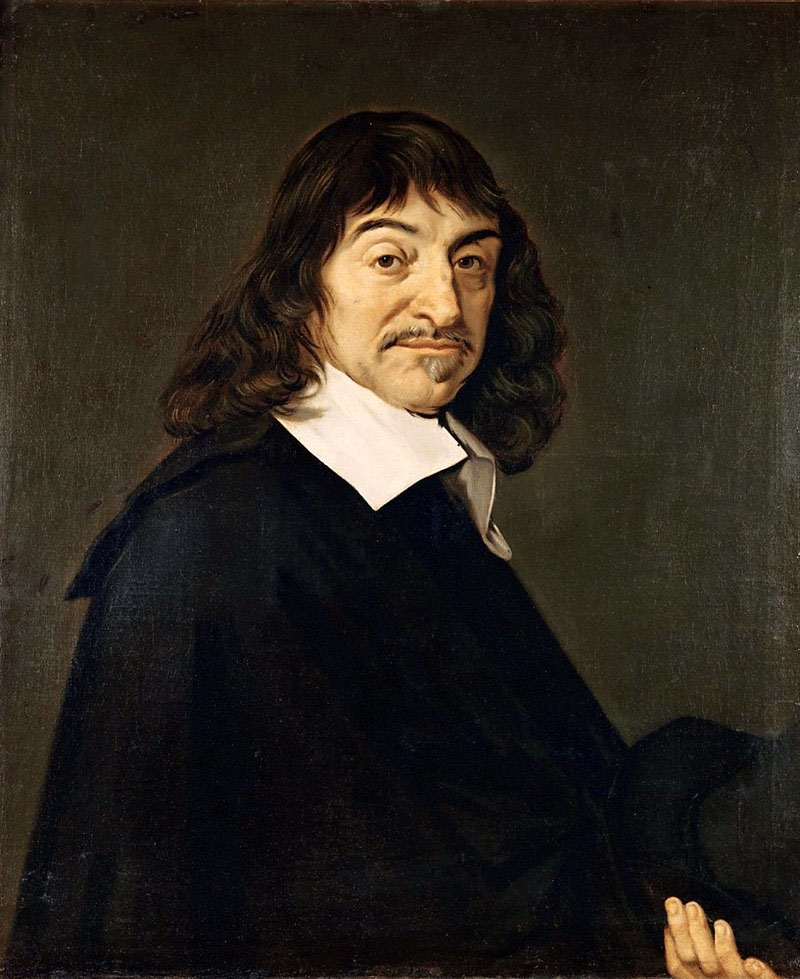
Frans Hals – Portret van René Descartes, Wikipedia

Much of what is written on those cards is nonsensical taken in isolation, like quotes from Heidegger’s book Being and Time (1927) about the two kinds of being, “Sein” meaning all things, and “Dasein” meaning only mankind. Or the postulation of Descartes in his 1637 Discourse on the Method wherein he wrote: Ego Ergo Sic, or “I am, therefore I am thus,” or more widely conceived as “I think, therefore I am.” Pondering these kinds of concepts is not easy and tends to take oneself out of the hum of routine. And away from the strict belief systems of doctrines undergirding religion.

What my mother exclaimed in her quickly penned remark about my notecards is true. Those learning experiences helped me abandon religion entirely. Another big step on that path was a college course in English Bible, where the three authors of the Books of Moses were examined with comparisons of material in Genesis to the Sumerian books of Gilgamesh—and much more. It’s been a lifelong study, full of empathy for others who, like me, struggle with the very essence of existence, remarked by feminist French philosopher Simone de Beauvoir in her book The Ethics of Ambiguity (1948):

“The sub-man is not very clear about what he has to lose, since he has nothing, but this very uncertainty re-enforces his terror. Indeed, what he fears is that the shock of the unforeseen may remind him of the agonizing consciousness of himself. …Everything is a threat to him, since the thing which he has set up as an idol is an externality and is thus in relationship with the whole universe; and since, despite all precautions, he will never be the master of this exterior world to which he has consented to submit, he will be constantly upset by the uncontrollable course of events.”

For de Beauvoir, freedom comes in the act of trying to be free and accepting that this journey is the freedom.[1] Freedom to believe, to act, to question, to reach out to others in individual acts of kindness—these fulfill us in myriad ways that counter the existential despair of modern life. Understanding that, and the awareness that our personal journey is best seen as an opportunity to make the world a better place, has helped me live a rich life.

I thank the notecards. I thank the Founding Fathers for enshrining my freedom of thought within the Constitution. And I thank my parents and ancestors for giving me the intelligence, if not the freedom, to choose.


[1] Summarized at https://fs.blog/simone-de-beauvoir-ethics-freedom/

Fayetteville’s Bawdy Houses

“Sylvia Sidney prefers brimmed hats.(Left)”Pied Piper,” in black pebble crepe straw, topped with yellow fan feather, tips far forward over one eye for that demure look in the Spring sunshine.
(Right), “Gingham Girl,” for afternoon and restaurant dining, in cloudy blue. New squared crown and coquettish brim that permits the wearer to see without being seen !” https://glamourdaze.com/2017/04/sylvia-sidney-1930s-hat-style-for-spring.html

Hats were a disguise for many women in the 1930s, creating a protective shield around her feminine innocence while at the same time allowing for curious–if not blatant–flirtation. In Fayetteville, at least for one madam who operated a house of prostitution three blocks from the town square, hats provided a useful cover. Advertising as “Cookingham Millinery,” Birdie Hickey set up residence at 115 West Spring where she housed several girls as well as a slightly older couple, the husband of which probably served as her bouncer/protector.

“In the 1930 census, she named her occupation as “manager.” One of the lodgers was her 33-year-old sister Norma Bigger. Other tenants included Robert Gholson, a restaurant manager, and his wife Rosa. Of particular interest are the other four other tenants: Pat Roberts age 24, Pat’s sister Laverne age 21, Nannie Morrison 23, and her sister Loretta age 19. Pat, Laverne, and Loretta claimed work as seamstresses while Nannie told the census collector that she worked as a telephone operator.”

There was nothing unusual about ‘public women’ then or at any time of human history. What was unusual is that Fayetteville’s newspapers, courts, and police pretended such unsavory activities did not exist within the boundaries of their lovely town. More to the point, parents sending their sons to attend college there must not be worried that their darling boys might be tempted into illicit bed sport. At least, that was the idea, an unofficial policy probably promulgated in private between town fathers, university leaders, and local law enforcement from the earliest days of the institution.

Meanwhile, Arkansas towns as near to Fayetteville as Eureka Springs and as far as Little Rock openly admitted the presence of prostitutes.

“Allegedly hosting as many as nineteen bawdy houses at one time, Little Rock passed its first ordinances regulating its prostitution industry in 1841. In 1875, the state granted local governments jurisdiction to deal with such thorny problems in A.C.A. §14-54-103, giving cities the right to “suppress bawdy or disorderly houses, houses of ill-fame, or houses of assignation.” By the turn of the 20th century, Fort Smith’s red light district hosted up to seven bordellos alongside gambling halls and saloons including a brothel owned by Belle Starr’s daughter Pearl which featured a “talented piano player, good whiskey, and ‘the most beautiful girls west of the Mississippi.’”[1] Hot Springs, long known for its gambling and underworld associations, tolerated extensive prostitution; as late as the mid-20th century, the infamous Maxine’s Brothel operated in full view of the world. Even in the quirky village of Eureka Springs, the sex trade flourished through the late 19th and early 20th century. Today one of the town’s top tourist attractions is the 1901 Palace Hotel with a sign whose shape clearly announces the nature of its business.”

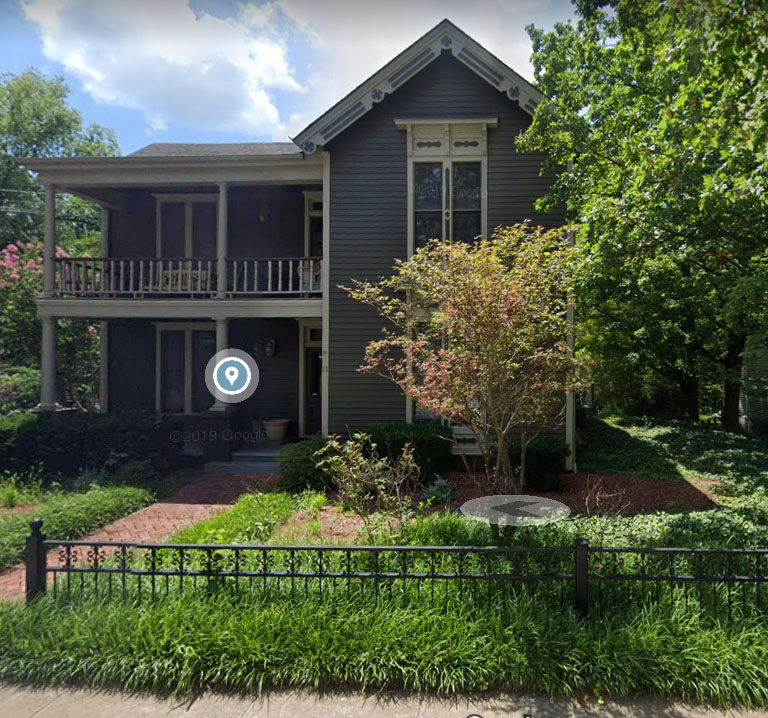
Evidence shows that Fayetteville’s police force routinely harassed, arrested, and jailed women for trading their bodies for money, but these transactions mysteriously failed mention in the news. Town folk were shocked, then, in 1935 when the police chief’s statement regarding such unsavory activities appeared on the front page of the Fayetteville Democrat. Under duress and the threatened loss of his job, Chief Neal Cruse rebutted accusations that he had failed to eradicate such practices from the town by citing four separate locations where he had ‘shut down’ the operations in question, among them Birdie’s “millinery shop.” Only one of the named ‘houses’ remains standing today, at 9 North West.

9 N. West, as shown in Google maps

The circumstances leading up to this revelation involved illegal alcohol, a car theft ring, and the downfall of Fayetteville’s city attorney, among other things, all of it stirred with a big stick by reformers led by none other than the newspaper’s publisher and local society scion, Roberta Fulbright.

Details of this scandal are explored in depth in “Fayetteville’s Immoral Houses,” one of nine articles about local history in the recently released Second Glimpses of Fayetteville’s Past.

To obtain your copy of this fascinating collection, visit Amazon. Only $11.95


[1] https://www.nps.gov/fosm/learn/historyculture/pearl-starr.htm

West Fork Blacksmith, James William Bell

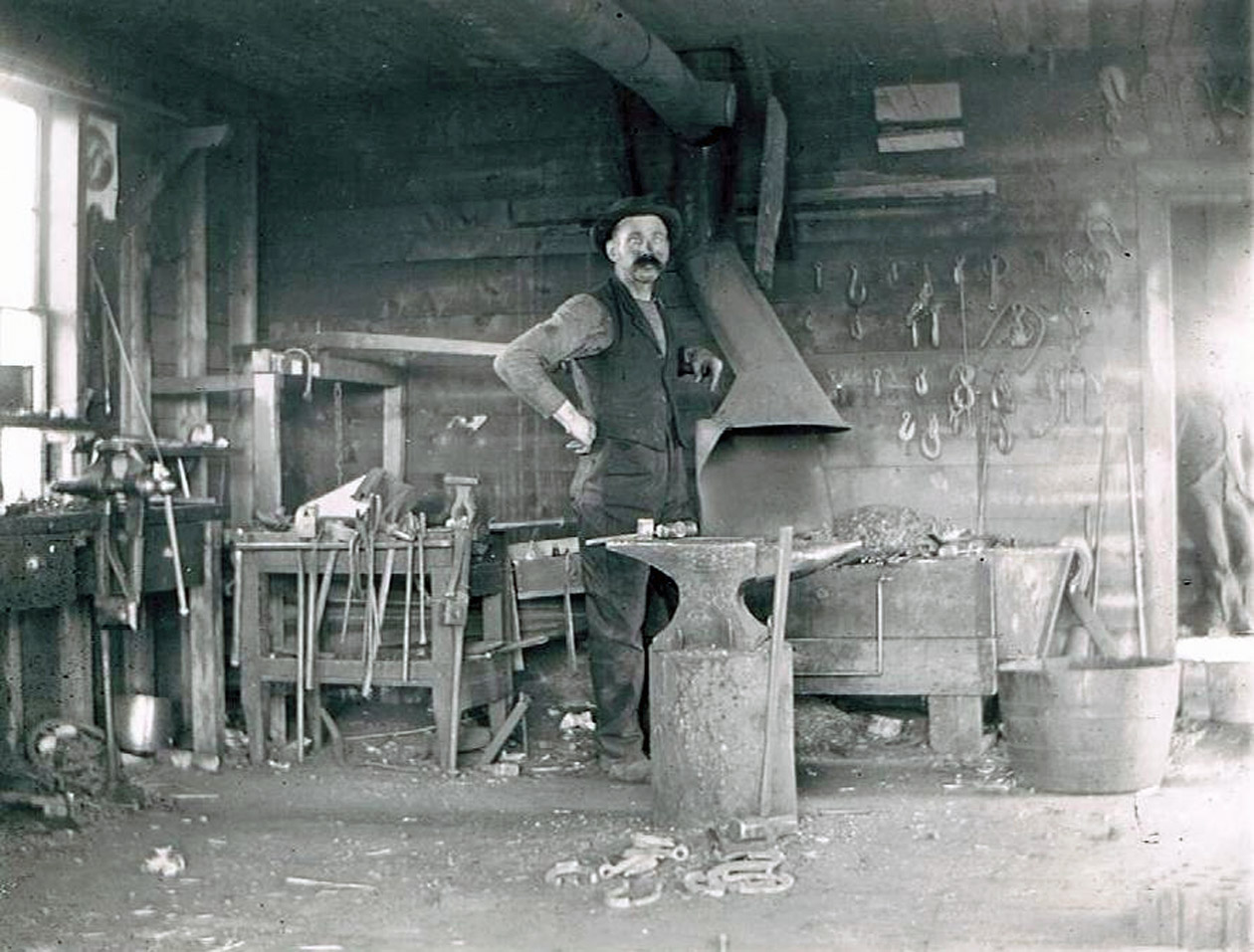
James William Bell was born September 6, 1852, to William John and Mary Frances (Boggs) Bell. William’s family lived in Kentucky at the time he was born, but he had moved to Missouri before he married Mary there in 1846. Their son James was born in Missouri. William died at Anderson, McDonald County, Missouri between 1876 and 1880.

Upon the death of his father, James moved to the fledgling village of West Fork in Washington County, Arkansas, where he met and married Lucinda Linda Epps on December 2, 1879. Their children were Edna Mae (Bell) Latham (1880-1953) and Thomas Tillman Bell (1889-1973). The 1900 census shows the family household at West Fork with James 47, Linda 41, and Kilman 11 (Tillman). James named his occupation as blacksmith, and he and Linda owned their home without mortgage.

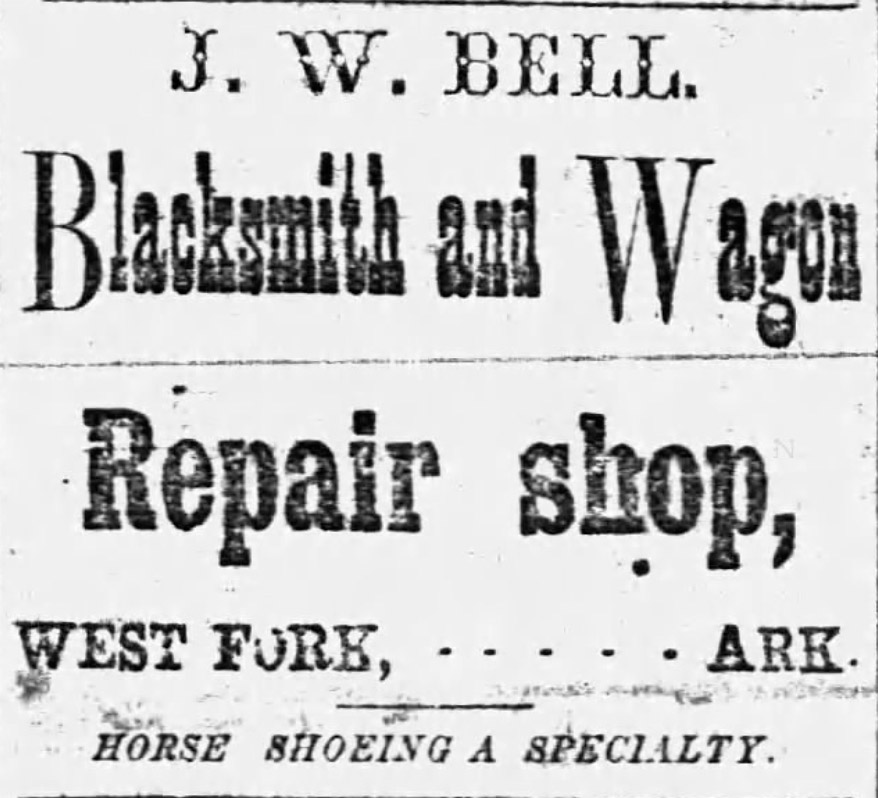
From the earliest record of West Fork as a formally organized town, Bell’s name appeared regularly. A group of men visiting West Fork noted, in an 1885 newspaper article, that “During our stay in West Fork, we were the guest of Mr. James Bell, the best blacksmith in the whole country, and a most excellent gentleman and citizen.” Bell was among the men who signed the petition to organize the town, submitted to the Washington County Court on May 3, 1885. His blacksmithing business was among West Fork enterprises listed in Goodspeed’s 1889 history of the county.

Bell specialized in horseshoes, but served a wide trade of needs for articles of made of metal. A history of blacksmithing in the 1800s notes:

“Blacksmiths living in the 1800s took on the roles of both tradesmen and businessmen in order to manage successful workshops and provide a variety of services. Townspeople and farmers alike valued the range of skills blacksmiths possessed and relied on them to create the tools and implements necessary for survival. Smiths could manipulate metal in endless ways, but usually created and repaired farm equipment such as hoes, plows, rakes and other tools as well as hardware and wheels for wagons, kitchen utensils and horseshoes.

“Smiths managed their businesses carefully and kept detailed records of daily work orders and the debts owed by their customers. They interacted with other business owners in their community to build solid professional networks and advertise their services. Because they worked for themselves, smiths had to skillfully negotiate their compensation, which often took the form of cash payments, traded goods, or services promised by customers skilled in other trades.

“Smiths kept their workwear simple and functional by dressing in everyday clothing and adding a leather apron to protect from stray sparks. Crafted from affordable cowhide, the apron allowed for free movement while providing essential protection. It covered the blacksmith from the waist to below the knees and sometimes split in the middle to allow smiths to cradle the leg of a horse when fitting shoes. Blacksmiths usually wore sturdy boots to protect their feet and a belt to hold their frequently used tools. Smiths did not wear gloves because they preferred direct contact with the metal being worked.”[1]

In February 1882, Bell was among nine West Fork men who served as charter members for a local chapter of the Odd Fellows lodge. In July 1883, Bell was one of men called to serve on the county’s grand jury. In 1886, he was one of three men selected by the county’s Democratic Party to serve as poll ‘judges’ for West Fork.

He regularly advertised his blacksmithing services in the Fayetteville Weekly Democrat throughout the early 1880s, stating in one 1887 ad that “Work guaranteed and done on short notice. Prices low.” Another mention in that year’s newspaper stated that “James W. Bell, of West Fork, whose handy-work furnishes the farmers in that community with the best of implements, was in the city [Fayetteville] yesterday. He was accompanied by Mrs. Bell.”[2] No advertisements are found after 1887.

In March 1907, James and Lucinda deeded a West Fork lot to “The Deacons and Elders of the Christian Church of West Fork…for church purposes only, and unto their successors in office.” The property was located in Bells’ Addition to West Fork, “beginning at the NW corner of Bell’s Addition and running south 25 degrees East 100 feet, thence East 50 feet, thence North 25 degrees West 100 feet, thence West 50 feet to the beginning, containing Lot One of Bell’s Addition.” It was further noted that “when not occupied by the Christian Church, it shall be free to any and all orthodox denominations to preach in, and when this property is not used as herein stated, this land shall fall back to the original owners, J. W. Bell and Lucinda Bell, or their heirs.”[3]

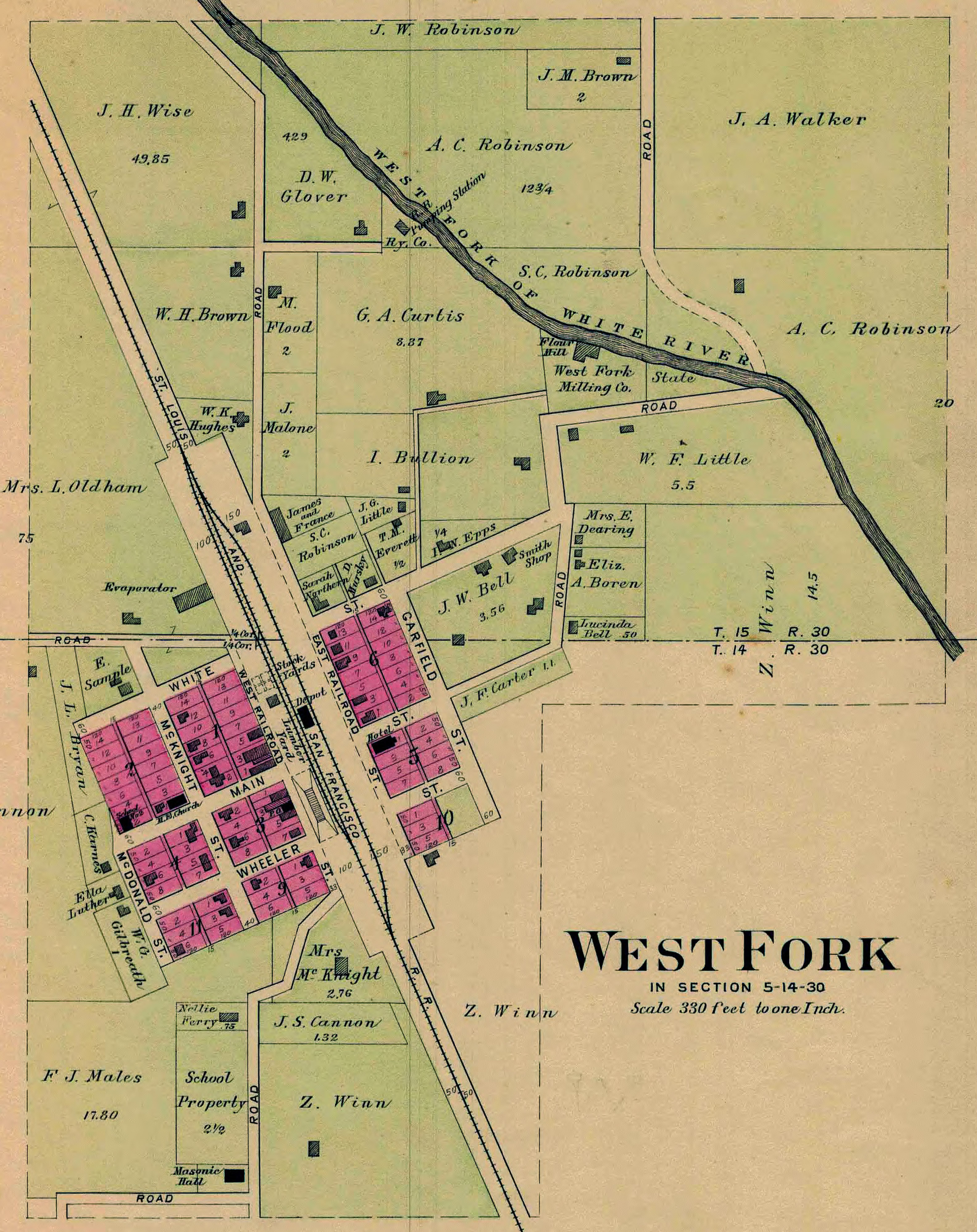
In this 1908 plat of West Fork, J. W. Bell’s property features prominently. His ‘smith shop’ is marked and their home is probably the structure shown just west of the shop.

James died April 8, 1910, at the age of 58 and is buried at the West Fork Cemetery. Lucinda died in 1958 just a few months short of her one hundredth birthday, and is buried beside James.


[1] More at https://workingtheflame.com/blacksmith-life-1800s/

[2] Fay’vl Weekly Democrat, Sept 23, 1887, p 3

[3] Deed Record 116-437, Washington County Archives, Historical Courthouse, Fayetteville, Arkansas

The Girl from Ipanema

This morning a friend commented on Facebook that he’d received a treasured gift for Christmas, a re-issued vinyl of the original Getz/Gilberto 1964 album that included the ever-stunning “Girl from Ipanema.” I was immediately sent hurtling back to my high school years in a small Oklahoma town (1964-1966) where, after classes, I worked at a music store and performed various tasks out front as well as teaching guitar lessons to various motivated pupils.

One day while I dusted store shelves, the manager set that particular album on the stereo. When that song came up, I couldn’t move. The music and lyrics filled me with wonder and emotion.

Denele Pitts

So it was that in the late spring of 1966 in preparing for the annual senior event where most of the graduating class were expected to perform in some way or another, this song sprang instantly to my mind. I had hummed it, sang it to myself in the mirror, and couldn’t get it out of my head. I was an experienced vocalist, having performed in the select choir as well as Allstate Choir in addition to a trio of me (on guitar) and two other females (tambourine, banjo) who sang folks ballads of the day for civic luncheons and other similar events.

A collaboration quickly developed between me and my high school sweetheart Bill, a performer in his own right on percussion as well as modern dance. I labored hard and long to transcribe the recording into written music for a piano accompaniment as there was no sheet music available, but the transitions in the piece evaded me entirely, and so I determined to sing acapella with only rhythm instruments. Bill planned to ‘hoof it,’ as he said, making it up as he went along. We rehearsed together once.

Our duet, as it were, presented me in a slim pale blue sheath at one corner of the stage singing my husky rendition of Astrud Gilberto’s song at the microphone while, in black tights and leotard, Bill danced his evocative modern style along the shadowy blue footlights. At the brick back wall where we’d pulled back the curtains, three of our musical classmates, also in black, carried the rhythm of the piece with claves, maracas, and guiro while perched at various position on a tall platform ladder.

A few notes into the song, the packed house became dead silent. They all knew the history of the relationship between me and Bill, a passionate on-again, off-again torment that had been no secret among our 300-odd classmates. We’d been voted “Most Talented” in our graduating class, and that acknowledgement seemed to require that we surpass anything we’d previously accomplished.

And it felt like we did. My naturally low-pitched voice perfectly suited the song, and Bill’s lithely muscled body moved in exact response to the lyrics. We had changed the lyrics to make the song about the ‘boy’ from Ipanema…

Tall and tan and young and handsome
The boy from Ipanema goes walking
And when he passes, each one he passes
Goes “A-a-a-h”
When he walks he’s like a samba
That swings so cool and sways so gentle
That when he passes, each one he passes
Goes “A-a-a-h”
Oh, but I watch him so sadly
How can I tell him I love him
Yes, I would give my heart gladly
But each day as he walks to the sea
He looks straight ahead, not at me
Tall and tan and young and handsome
The boy from Ipanema goes walking
And when he passes, I smile, but he
Doesn’t see. He just doesn’t see
No, he just doesn’t see…

As Bill moved across the stage, strutting and sauntering to fit the lyrics, I whispered my love song as if nothing existed but the two of us. I hit the notes perfectly as his movements gave visual fulfilment of the lyrics. It was, for both of us, a moment of unrestrained joy.

At the last fading breath of my voice, as Bill’s body slowly became immobile in the footlights, a long extended moment of silence filled that auditorium. I thought briefly that somehow we had failed in the execution of our performance, that my voice or his dance had been unworthy of the audience. Then, as if waking from a dream, the applause came thundering down, whistles and shouts and calls that exceeded any response to any of the countless times either of us had given ourselves to a song or dance. We had two curtain calls after which I simply refused to go back out for another.

Bill in “A Chorus Line,” third from front

All these years later, that experience lives on in my memory. I suspect it lives on in Bill’s as well, but within a few years of graduation, he landed in New York where he pursued his talents on Broadway with the fortuitous experience of working with Bob Fosse and performing in The Most Happy FellaA Chorus LineCabaretRags, Dancin’, and Sweet Charity. to name a few. I, on the other hand, left my stage presence behind and ended up a back-to-the-land wife and mother of three in a thirty-year career as a piano tuner/technician, somehow feeling better suited to working behind the scenes.

For me, the song remains a highly emotional experience and a high point in my high school years. Singing in that style suited me whereas all the voice lessons and choral performances had pushed a more operatic style, which I did not enjoy. I’m still proud of myself for stepping outside the expected boundaries of my music education and daring to break new ground. I suspect Bill feels the same in breaking away from tap and ballet. Although we’ve had infrequent contact over the years, we’ve never discussed that event, as if somehow any remembrance would tarnish the glow we both felt.

And that’s perhaps best, since there is nothing either of us could say that would make the memory any more perfect. Just as the song as preserved forever on that slip of black vinyl would not be made any more perfect. It was a moment in time.

Stan Getz, left, and Astrud Gilberto https://www.youtube.com/watch?v=sVdaFQhS86E&t=126s

Duggar’s Failed Defense

A particular mindset thrives within certain layers of the evangelical set, that a person is merely a pawn of God’s wishes and the Devil’s intent. The disciplining of children, for example, is pursued not as a punishment for bad deeds, but as a casting out of demons who have, for inexplicably malevolent reasons, infested the immediate presence of that child and forced him/her to do bad things.

So it comes as no surprise that Josh Duggar’s defense team would come up with a far-fetched concept that staggers the imagination. Not that Duggar himself, or perhaps one of his equally delusional siblings, inlaws, or—possibly his parents, paragons of evangelical ineptitude—might have been the one who struck upon this brilliant scheme. The key point in his defense was: It wasn’t Josh who secreted his way into the dark web to view babies and young children being defiled in abhorrent scenes of the most depraved form of pedophilia. No, it wasn’t Josh at all!

The person(s) responsible for those videos and images tracked on his work computer and personal Apple device were mysterious strangers who fiendishly crept into his hard drive, manipulated all the right layers of interface, and planted that stuff in there just to hurt poor Josh and, by extension, the rest of his righteous family. Because we all know that True Christians are always persecuted, falsely accused, and otherwise made to suffer the slings and arrows of the world. It’s a story as old as, well, the New Testament, at least.

Government prosecutors asserted that Duggar had installed Linux systems where he worked at the family car lot in order to evade the “accountability” application that would notify his wife if he tried to access sites showing child molestation. Witnesses for the prosecution stated that Duggar has questioned them about installing a Linux system as early as 2010, with the intention of evading the restrictions.

The key defense witness, Michelle Bush, a digital forensics expert, admitted under prosecution questioning that she had never been trained on a Linux system or the Torrential Downpour software used in investigating Duggar’s case. She also agreed that the installation of Linux on the computer at Duggar’s used car lot had to have been done by someone at the car lot, not remotely as Duggar’s defense tried to claim. Furthermore, she admitted that a thumb drive could not have been plugged into that computer unless a person was present at the car lot to plug it in.

Further questioning of Ms. Bush confirmed that the bookmarked Hidden Wiki site found in these computers was frequently accessed specifically for viewing child exploitation sites. She also agreed that multiple applications were found on both the car lot’s computer as well as Duggar’s personal Apple devices, and there were no files or evidence of remote access to those systems.

Despite the utter absurdity of this attempted defense, attorneys for Duggar really had no other option. Their client has a long history—at least since he was fourteen years old—of being a pedophile. Many evangelicals who hung on every episode of the long running television series enshrining the Duggars’ reproductive excess utterly rejected the idea that he was a pedophile even after he admitted that he had regularly crept into his sisters’ bedroom to fondle them while they slept.

Oh, they said, he just made a mistake. He’s sorry.

That there could be some scientific understanding of pedophilia evaded the consciousness of Jim Bob and Michelle Duggar whose firstborn child first confessed his attraction in early adolescence. In keeping with the typical evangelical denial of science in general, their response included a lot of prayer to cast out those quirky demons and to ask divine forgiveness. Ultimately, when his continued indulgence in his perversion pressed their hand, the solution was to send Josh off to do hard manual labor in the company of another evangelical.

That worked well.

Savaoph God the Father, 1885-96, Mikhailovich Vasnetsov

Legitimate treatment of pedophilia might include cognitive-behavior therapy such as relapse-prevention therapy, aversion therapy, and other forms of psychotherapy (conditioning approaches, behavior skills training, social skills, empathy training, and trying to address the underlying sexual arousal pattern) as well the use of drugs to affect androgen levels or serotonin inhibition. Treatments for obsessive-compulsive disorder have also been shown to be effective in treating pedophilia.

Some might have privately suggested the quite effective old-fashioned method of treatment: castration.

No treatment will be effective if the pedophile does not want treatment. As long as Josh Duggar lives within a cloud of denial, he will not stop craving child molestation. Sadly, there’s little chance that he will find his way out of that cloud. It exists all around him, in his parents, his siblings, and in the greater community of evangelical believers who see themselves as pawns to God’s will or Satan’s.

There is some evidence that pedophilia may run in families, though it is unclear whether this stems from genetics or learned behavior. A history of childhood sexual abuse is another potential factor in the development of pedophilias, although this has not been proven.

According to mental health studies, “some experts propose that the causes are neurodevelopmental. Differences in the brain structure of pedophiles have been noted, such as frontocortical differences, decreased gray matter, unilateral and bilateral frontal lobe and temporal lobe and cerebellar changes,” according to mental health specialists.

“Pedophilia could be a byproduct of other co morbid psychiatric diseases. These brain abnormalities may have been formed by abnormal brain development. However, post-traumatic stress disorder also causes these types of brain abnormalities. Traumatic experiences in the pedophile’s early life could have caused this atypical development. Other neurological differences found in pedophiles included lower intelligence levels and the lower the intelligence level, the younger the preferred victim.

“Some pedophiles were also found to have chromosomal abnormalities. Out of 41 men studied, seven of them were found to have chromosomal abnormalities, including Klinefelter syndrome, which is a condition in which a male will have an extra X chromosome in their genetic code.

“The environmental factors involved in pedophilia must also be considered. There is much controversy over whether or not being sexually abused as a child causes that child to grow up to be a sexual abuser. Statistics do weigh out indicating, that in general, more people who abuse children as adults were abused themselves as children.”[1]

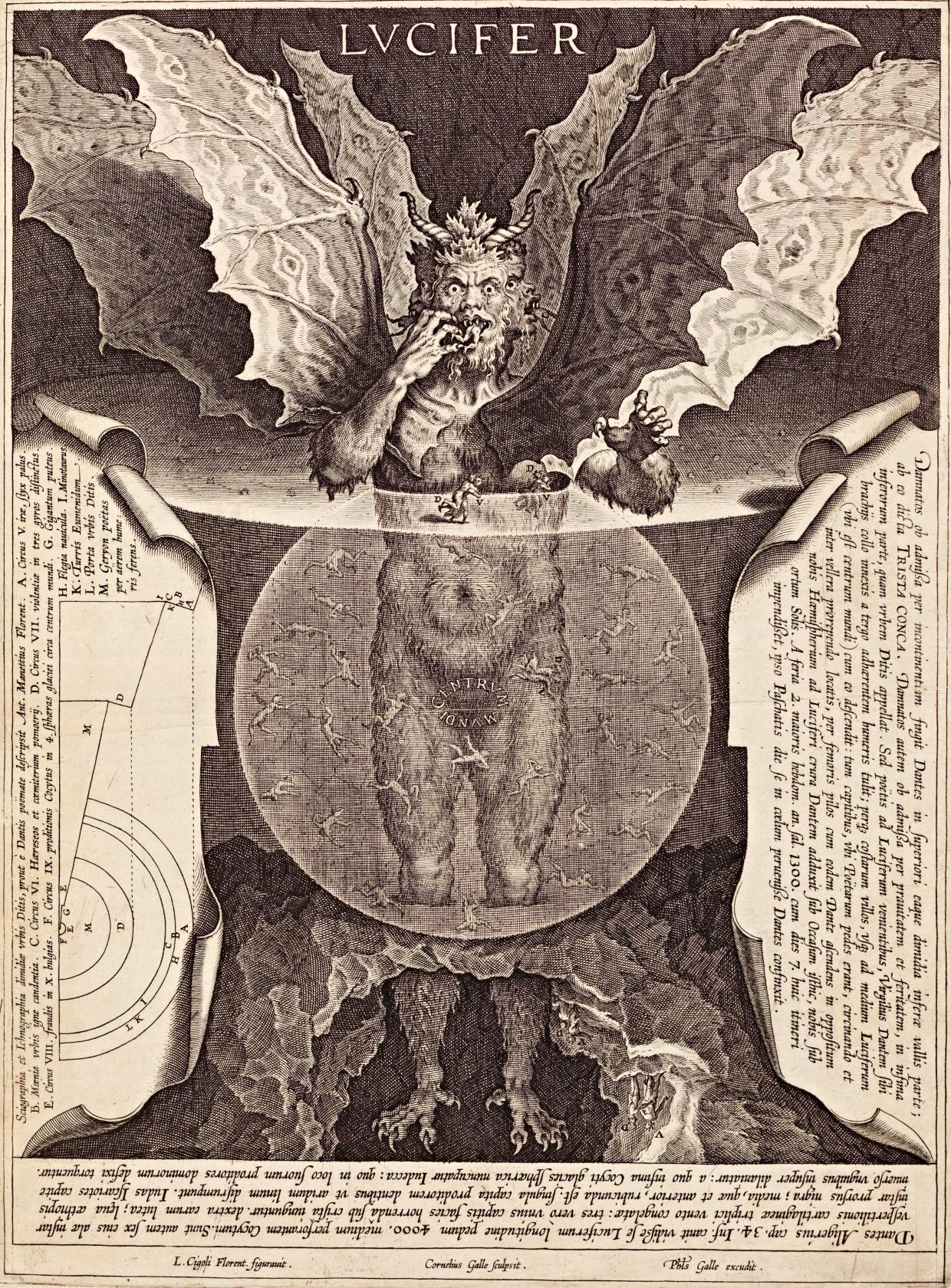
Cornelis Galle I, “Lucifer” (c. 1595)

Whatever the reason for Josh Duggar’s sexual perversion, it is most certainly not that “the Devil made him do it.” It is possible that other members of his family suffer similar mental health issues but have been more successful in keeping them secret. It is possible—even likely—that one or more of his children have been the target of his obsession. As noted in mental health studies of this affliction, pedophiles feel that they ‘love’ their victims and believe that the victims enjoy the interaction.

Clearly Josh Duggar’s parents, Jim Bob and Michelle, are not “normal” in their sexual proclivities which urged them to keep producing children far beyond what might be considered a healthy number, even past the point when doctors were warning Michelle not to become pregnant again after, at age forty-three, her nineteenth child required a Caesarian delivery. At forty-five, she miscarried her 20th pregnancy. Again, this is the mindset that the individuals themselves bear no responsibility for the outcome. In other words, having unprotected sex doesn’t make babies, God does.

It follows that when one believes that sex itself is not to be indulged unless one intends to produce children, one might end up with lots of children. Simple.

Medieval thinking is comfortable for those who don’t have the capacity to think for themselves and for those who have been convinced early in life that thinking somehow insults God. Science has long shown that disease and natural disasters are not, in fact, a punishment sent by the Invisible Almighty, but rather the result of natural forces like bacteria, viruses, and weather/geology. But to understand science, a person needs the capacity and will to learn about cells, bacteria, and tectonic forces which, to many, is simply an insurmountable task. Much easier is willful ignorance dressed up like God’s will and the intercession of demons.

Until the insidious impact of religious and home schooling is interrupted by enforced teaching of science, this plague of irresponsible stupidity will continue alongside inevitable fallout such as pedophilia in denial.


[1] https://psychcentral.com/pro/causes-of-pedophilia#1

Justice! Josh Duggar Convicted.

Josh Duggar Leaves Court with Pregnant Wife Anna (7th child) After Push to Dismiss His Child Porn Case Fails  https://www.youtube.com/watch?v=0-YfxGgVeAQ Credit: 40/29 News

Some of my blog followers may remember my report on the State of Perversion a few years back. At the time, the tip of an iceberg had been uncovered, but there was no justice because the statute of limitations had run on Duggar’s child molestation (and incest) crimes before it came to light.

We all know a leopard can’t change his spots, and likewise–apparently–neither can a pedophile. In the interim, Duggar has fathered several more children on his hapless wife, but at least now his children as well as perhaps other children can rest easy while he serves his time.

Here’s the report:

Federal Jury Convicts Former Reality Television Personality for Downloading and Possessing Child Sexual Abuse Material

A federal jury convicted an Arkansas man today for receiving and possessing material depicting minors engaged in sexually explicit conduct.

According to court documents and evidence presented at trial, Joshua James Duggar, 33, of Springdale, repeatedly downloaded and viewed images and videos depicting the sexual abuse of children, including images of prepubescent children and depictions of sadistic abuse. Duggar, a former reality television personality who appeared with his family on the TLC series “19 Kids and Counting,” installed a password-protected partition on the hard drive of his desktop computer at his used car lot in Springdale to avoid pornography-detecting software on the device. He then accessed the partition to download child sexual abuse material from the internet multiple times over the course of three days in May 2019. The password for the partition was the same one he used for other personal and family accounts. Duggar downloaded the material using the dark web and online file-sharing software, viewed it, and then removed it from his computer.

“Today’s verdict sends a message that we will track down and prosecute people who download and view child sexual abuse material, regardless of the lengths they go to conceal their conduct,” said Assistant Attorney General Kenneth A. Polite Jr. of the Justice Department’s Criminal Division. “I am grateful for the efforts of the prosecution team and our law enforcement partners who helped ensure the defendant would be held accountable for his crimes. I hope today’s conviction serves as a reminder of the department’s steadfast commitment to bringing to justice those who callously contribute to the online sexual exploitation of young children.”

“Over 7% of the cases sentenced in the year 2020 in the Western District of Arkansas were child pornography and sexual abuse cases,” said the U.S. Attorney Clay Fowlkes for Western Arkansas. “Our office is focused on expending all the resources necessary to the very important work of protecting children in Arkansas and elsewhere. This verdict sends the message that these cases are a top priority for our office. This verdict also demonstrates that no person is above the law. Regardless of wealth, social status, or fame, our office will continue to seek out all individuals who seek to abuse children and victimize them through the downloading, possession, and sharing of child pornography.”

“Because of the exceptional efforts by HSI special agents and our law enforcement partners, a child predator has been brought to justice,” said Special Agent in Charge Jack Staton of Homeland Security Investigations (HSI) New Orleans, U.S. Immigration and Customs Enforcement. “Every time child exploitation imagery is shared, it re-victimizes innocent and vulnerable children. The verdict demonstrates that regardless of an individual’s notoriety or influence, they are not above the law. HSI agents make it a priority to protect children by investigating these offenders and ensuring they pay for their incomprehensible actions.”

Law enforcement in Arkansas detected Duggar’s activity during an undercover investigation involving the online file-sharing program, subsequently searched his car lot in November 2019, and seized Duggar’s desktop computer as well as other evidence. Significant evidence was found that pointed to Duggar’s presence at the times of the offenses, including pictures that Duggar took on his phone that geolocated at or near the car lot. Duggar also sent multiple timestamped text messages to various individuals that indicated he was at the car lot at the relevant times; the messages were sent, and the iPhone pictures were created, at times within minutes of when the child sexual abuse material was downloaded or displayed on the desktop computer. Additionally, he was the only paid employee on the lot at those times.

Duggar was convicted of receipt and possession of child pornography. His sentencing date has not been scheduled yet. Receipt of child pornography is punishable by a term of imprisonment of five to 20 years. Possession of child pornography depicting prepubescent children has a maximum penalty of 20 years of imprisonment as well. A federal district court judge will determine any sentence after considering the U.S. Sentencing Guidelines and other statutory factors.

HSI in Fayetteville, Arkansas, the Little Rock Police Department, and the High Technology Investigative Unit of the Criminal Division’s Child Exploitation and Obscenity Section (CEOS) investigated the case.

Trial Attorney William G. Clayman of CEOS and Assistant U.S. Attorneys Dustin Roberts and Carly Marshall of the U.S. Attorney’s Office for the Western District of Arkansas are prosecuting the case.

This case was brought as part of Project Safe Childhood, a nationwide initiative to combat the epidemic of child sexual exploitation and abuse, launched in May 2006 by the Department of Justice. Led by U.S. Attorneys’ Offices and CEOS, Project Safe Childhood marshals federal, state, and local resources to better locate, apprehend and prosecute individuals who exploit children via the internet, as well as to identify and rescue victims. For more information about Project Safe Childhood, please visit www.justice.gov/psc.

[This report from https://www.justice.gov/opa/pr/federal-jury-convicts-former-reality-television-personality-downloading-and-possessing-child%5D

See previous posts on this topic:

https://denelecampbell.com/2021/05/01/evangelical-christian-perversion/

https://denelecampbell.com/2015/06/03/the-devil-within/

https://denelecampbell.com/2015/05/24/a-state-of-perversion/

The Old Student Union

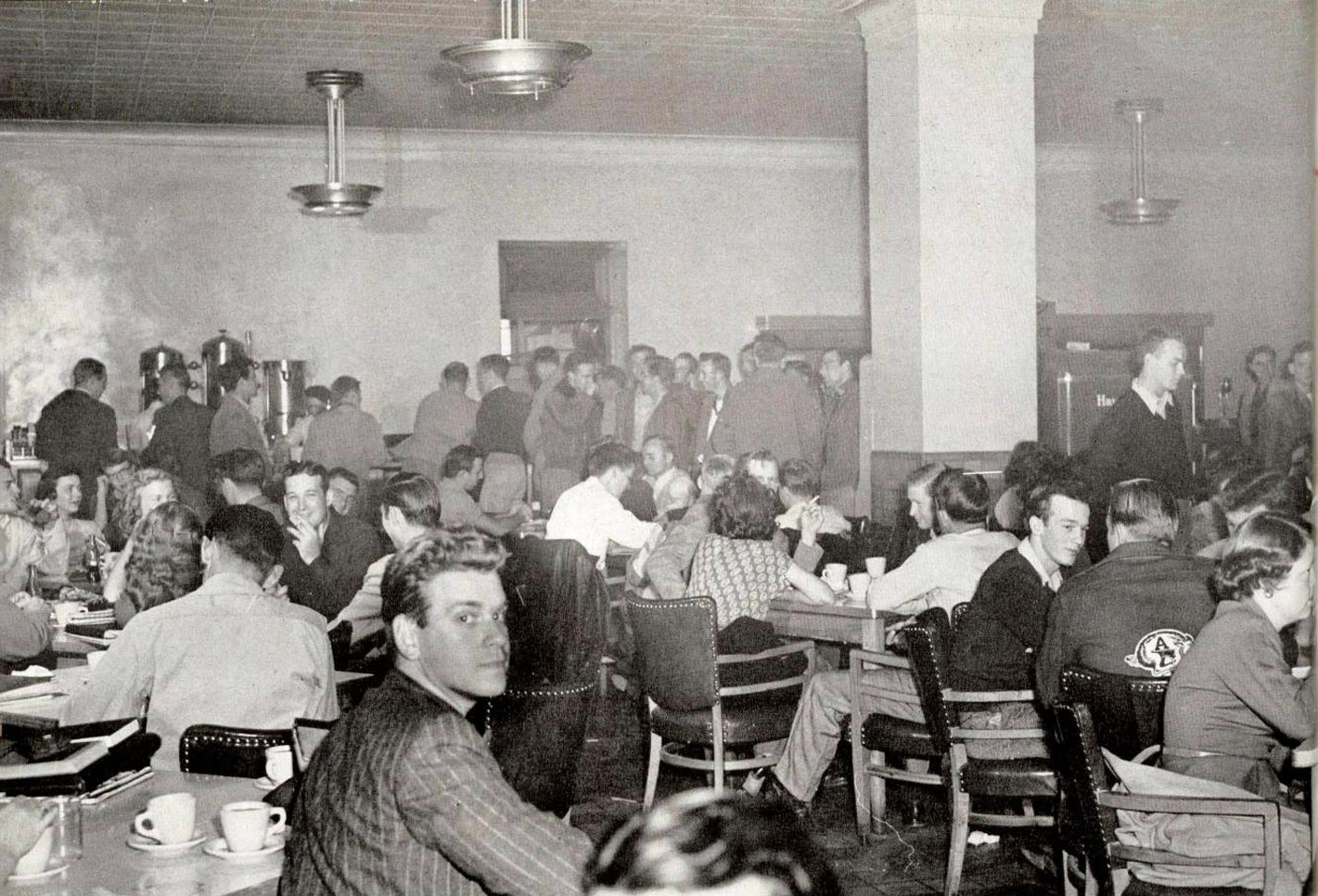
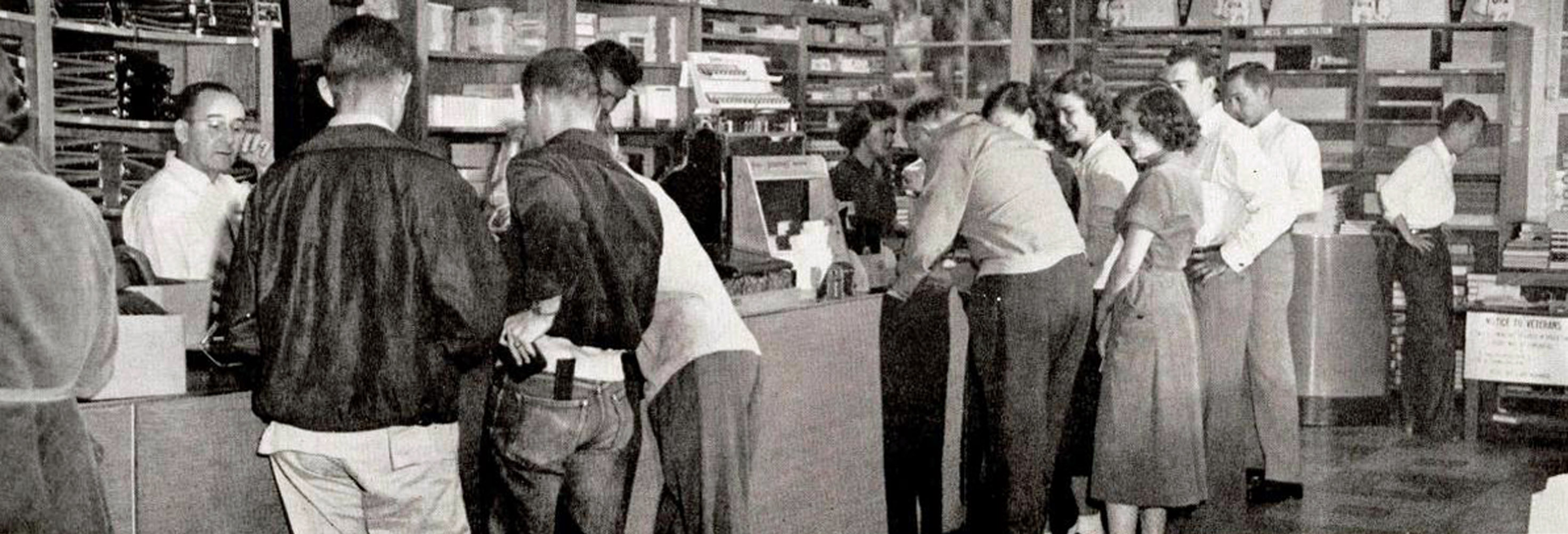
You come in the south door, clamoring down the curve of steps that lead to the basement. Brushing past the expanse of tidy mailboxes on your right, you quickly jog down a couple more steps where you might turn left into the bookshop, mayhap to toss down a dime in payment for a blue book required for an exam in your next class, or just to roam the few aisles appreciating the scent of ink, reams of white paper, or a raft of sketching pencils. But truly, the quest is not here, but across the small lobby where large doors open into the room full of crowded tables, wonderful aromas of coffee and hamburgers, and the roar of chatter from a hundred voices. For me, this place more than any other embodies the reality of life on campus.

There, to the right, behind tall counters laden with coffee and iced tea urns, stand the women in white aprons and hairnets. They watch each student who approaches. At least two of them tend the grill, a massive flattop of well-worn steel burned black by the incessant demand for another hamburger, another fried egg. An endless task of scraping the surface clean with a large flat spatula occupies any spare moment. You watch as one of those women turns her attention to you, and you place your order, mouth already watering.

For a dollar and a quarter, manna from heaven in the form of a grilled cheese sandwich can be yours. You stand there and watch as she turns to her work, wielding a big floppy brush to spread melted butter onto two slices of bread before slapping it onto that grill. The bread quickly turns golden brown before being flipped over—more butter, more searing heat. Then cheese. Glorious marvelous wonderful cheese is added, and the two slices of bread marry it into a sanctified One.

Suffering a quick angled slice of razor-sharp knife to form two triangles, your bundle of deliciousness sails down the line under the supervision of successive women in white, passing the lighted refrigerated case where a person might choose a slice of cream pie, or a peeled egg, or perhaps a salad. But your eyes follow the rich ooze of cheese that rims the bread crust and threatens to inch onto the heavy white china plate. Along the way, a few slices of dill pickle are added along with a glass of iced tea. Finally the plate makes its way to the lady at the cash register and lands on a tray. You tender your cash and then you were standing there, peering through the roiling clouds of cigarette smoke in search of a place to sit.

Squinting toward the bright light pouring in through big windows and glass-paneled doors leading to the porch, you peruse the tables for someone you might know, or—futilely—for an unoccupied table. If fortune fails to smile, you wander through a door to the left of the cashier into the larger dining area where an empty table is more easily found. Or you might, weather permitting, ease out onto the big porch in search of that gang of friends who usually occupy one of the tables. Most desired is the first room with the grill where the bodies, the flattop and the mingled aromas of food generate more warmth than the building’s heat can supply.

Whatever the case, finally dragging out a chair and with the books, notebooks, and other encumbrances unloaded onto an adjacent chair, you lift the sandwich in trembling hand. With a last swallow of eager saliva, your teeth sink into the crisp-tender concoction that will nourish the rest of your afternoon. The bite of just-enough sharpness in the cheese contrasts with the buttery crunch of the toasted bread still hot from the stalwart grill, and the sandwich begins to disappear. The tang of dill clears the palate for the other half of the sandwich, and then, alas, it is gone.

There’s time yet to sip the iced tea. With a brief glance around, you might leave your table to visit the cigarette machine where a quarter dropped into the slot and a quick jerk of the knob yields a fresh pack of your preferred brand. You stroll back to the table, slam the pack a few times against your palm, then unwrap the shiny cellophane to retrieve one of the perfectly-shaped cylinders. Then, with the smoke filling your lungs briefly before you exhale, there is time to look around, assess the day, ponder the meaning of life. A great lassitude supplants your otherwise fraught existential despair, courtesy of butter, cheese, and the endorphins they bestow.

Yes, an exam in French is coming in a half hour, and you’re not ready. You probably didn’t perform as well as you wished on the algebra exam earlier this morning. But these too shall pass, what’s done is done, and so forth. As you tap ash into the tiny flat metal ashtray and consider the nature of life, the comfort of cheese lingers.

Maple Street side leading into porch area

As do many other memories. I left after my sophomore year to live near Vandenberg Air Force Base in California with my new husband. Two and a half years later when he was transferred to Clark Air Base in the Philippines, I returned to Fayetteville to finish my degree. There were mornings when I’d drive to campus in early morning fog to park in a graveled lot across Maple Street and venture up these steps into the Union for a cup of coffee before my early class. Those too were nostalgic moments thinking of the earlier years, of fellow students and dorm mates, of professors and classes, of ever changing current events.

The student union of those days is gone, sacrificed into other uses for a larger more elaborate facility than what Memorial Hall could ever provide. Built in the early 1970s, the new union seems to us older alumni as somewhat cold and vast compared to the old environs of Memorial Hall. Yes, it was crowded and unquestionably not best suited to more modern needs, but it was our place in our time. In service as a student union only thirty years from its construction in 1940, the facility nevertheless filled a critical role in campus life.

As described in the 1941 yearbook: “The basement floor is made up of the confectionery with a black and chromium soda fountain and cafeteria facilities, and the amusement rooms. Walking down the hall from the confectionery one can go into two rooms equipped with ping-pong tables, and one with large, lively snooker tables. Up the stairs to the main floor, and there one sees the front entrance, from which leads the ballroom and the lounge room. With a lofty ceiling support four huge glass and metal chandeliers and tall arched windows draped with yards and yards of flowing expensive cloth, the ballroom is truly a ‘dream.’ Over the especially designed band shell is a mural depicting all phases of student life at the University, and all around the floor are chairs for chaperones and those who care to sit the dance out. Overlooking the ballroom is a balcony for those who care to watch rather than dance. The chandeliers are all connected with one master switch which changes the lights in the room from red, blue, green, and orange back to natural lighting in a gradual fading process.

“Equipped with heavy leather chairs and divans, the pastel-colored lounge room can compare very well with the lobby of an expensive hotel. Scattered throughout the room are lamps with indirect lighting, and down at the end is a large fireplace topped by a huge square mirror. Here students come to read, talk, or just listen to the radio.” 1941

“The fountain room of the Student Union, where at some time or other, everyone sees everyone, is a happy confusion of coffee lines, bridge games, table-hoppers, and glaring renditions from the juke-box. From 9-11, 2 until 5, it’s the place to see and be seen, grab a late breakfast or a hurried lunch, or just sit and talk.” 1951

Bookstore 1950s:

Open hallway where advocates of one issue or another could interact with students. In my time, it was to sign the petition to save the Buffalo River and then to stop the war in Vietnam.

Note: If you’d like to wander through the Razorback yearbook from your time on campus, here’s the link