The Honorable Act of Protest

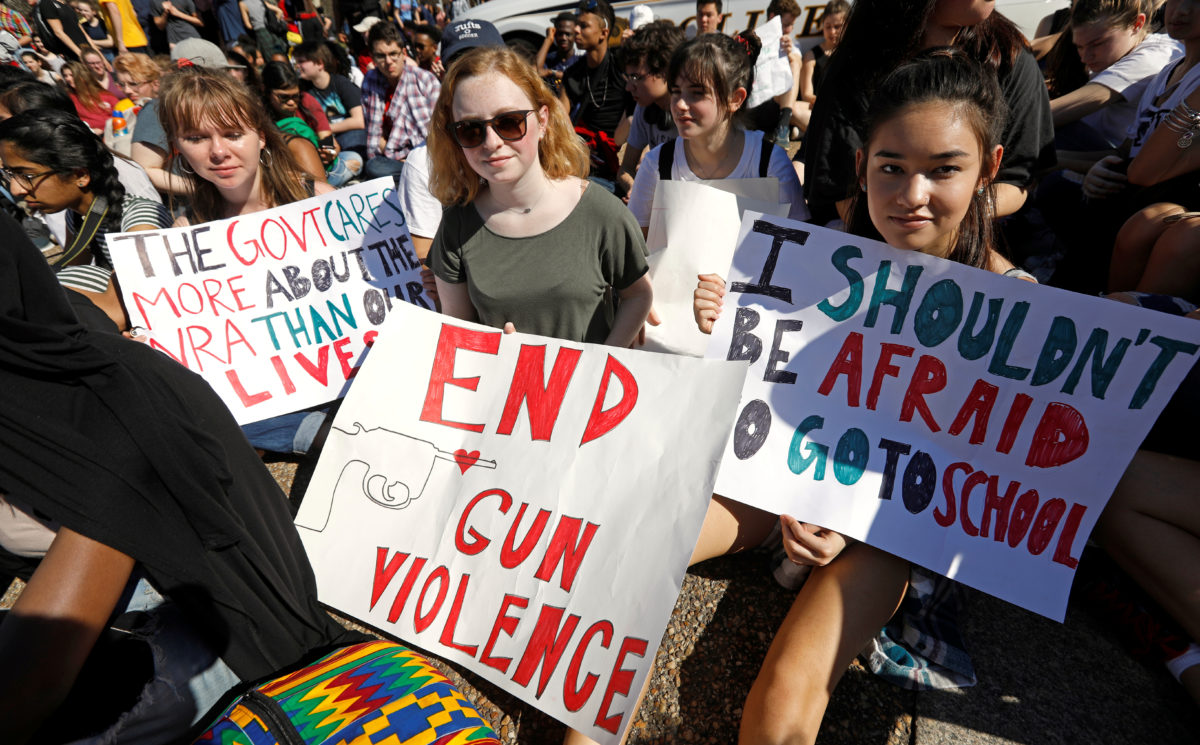
Students who walked out of their Montgomery County, Maryland, schools protest against gun violence in front of the White House in Washington, U.S., February 21, 2018. REUTERS/Kevin Lamarque – RC164B322F90

The student walkout last Wednesday presented an excellent parenting opportunity. Sadly, a significant number of parents failed to recognize the opportunity. Instead, many of them sided with authoritarian school boards who insisted that any student who walked out of class in honor of the seventeen students killed at Florida’s Parkland high school should receive disciplinary action for his/her outrageous rebellion.

Parents had the choice to support this, to teach their kids about the history of protest that forms the foundation of our nation. Our country began as a protest. Important change over the subsequent centuries occurred due to protest, not quiet little acceptable moments condoned by the powers that be, but full-bodied march-in-the-streets, dump-your-damn-tea-overboard protests. This was a chance for parents and community leaders to demonstrate a true understanding of what protest means to our nation.

And to our future.

It’s sad to see that so many don’t understand, tragic that so many accept the conditioning to stand quietly and wait for someone to tell you what to do, what to think. It bodes ill for our future that what we seem to be teaching in our schools and homes today focuses on doing what we’re told instead of what is right. Sit in your assigned desk. Don’t talk. Remember to bring a pencil. Stand quietly in line.

This is training for lock-step corporate workers, not the thinking adults needed to guide our nation forward in a time of great global change. Where is the critical thinking, the understanding of history, that education is supposed to instill?

Yes, the need to stand up for the right thing may have consequences. Many of the students who walked out of class despite draconian threats of suspension and other disciplinary action understood and stood up for their rights anyway. This alone should cheer us all with hope for our collective future.

The acceptance and embrace of authoritarianism raised its ugly head last week, a fitting reminder of the mindset that allowed Donald Trump to become president. Above all else, his election to the highest office in our political system reflects this pervasive eagerness for an authority figure who claims to know the right path. This world view reflects the fear of so many who can’t catch up with the times,  with a world going too fast for their 19th century brains to understand what is required of them. They don’t like change. So the solution is a strict set of simple rules enforced by a blustering promise-maker.

These kids aren’t having it. Thank you, kids.

Those Pesky Emotions

From https://www.thenewsgeeks.com/healing-emotional-pain/

Upon waking, I had thought to visit the library in search of more books by John Banville, a particular author who inspires me with his style of writing. I am currently halfway through one of his books and have periodically laid the volume aside to hack again at a long labor of mine, alternately caressed and despised, for nearly fifty years. This memoir relates a seven-year period of my life, if it ever sees print, both gut-wrenching and pathetic, a lament, self-aggrandizing, a confessional if you must.

Banville’s style is similar to my earlier writings, what came out of me in those days before I had published anything. My technical articles had seen print, and even essays on various personal topics—dreams, remembrances, all of it boiling with emotion. But after that first book, my writing wasn’t my own. I felt watched, self-conscious, fully inadequate to create anything of merit. What did I know, anyway?

Since then I have detoured into historical accounts of one thing or another, not anything to be ashamed of but nevertheless not of any emotional import. My slim efforts at fiction, where in theory emotion must reign supreme although within the harness so eloquently described by Frost, have failed to engage me—or readers. I have been terribly disappointed in that effort, as it seems I am unable—unwilling, in fact—to express or convey emotion because I steadfastly refuse to experience emotion. This failure is, as one of my characters says in a flash of fury, a response to the reality that emotion leads to pain.

Not just any pain, but a deep intractable burn that settles in the bones and leads like a labyrinth to all the many experiences of pain that I have swallowed down in the years of my life. Why should I willingly lay myself open to examine those hopeless dead-ends and hidden mortuaries? It’s not as if a re-examination will make anything change. I can’t excise the pain like a surgeon removing a misshapen, hidden tumor. Looking at and expressing it does nothing to ease its ability to wound. And re-wound.

But yet, as a writer, I must create stories that convey the experience of pain, of sadness, loneliness, despair, and all other human torments (alongside joy and pleasure, the light part of duality, the yin-yang) in order to give readers what they want. There’s some sickness in that formula, that readers seek new sources of pain in order to exhume and then exorcise their own long-hidden suffering. Is it that we don’t know we have pain? That we must cast our eyes along the pages to learn what we’ve hidden from ourselves? Is it that in living through fictional pain, distant as we are from any personal experience of it, that we can set aside the dragging fingernails of our own grief?

Honestly, I don’t know the answer. I only know I that must write, and in so doing, I become caught up in the expectation that what I write will have some meritorious impact, and in that I will gain not only self-respect but also some small congratulation even if only from a few. And so I daily strive, like today, to expand my understanding of how and why people read. I endeavor to learn more closely the peculiar ways in which successful authors manage their craft. John Banville wields words like an expert swordsman and inspires me to take a fresh look at my memoir in the belief, perhaps delusional, that if I can only find the right words, a more musical phrasing, a more authoritative approach to my efforts, I might then be able to invoke the appreciation Banville has garnered.

However, the morning nearly gone and having attended—shall we say deviated from my original intent?—to various uninspiring tasks and only just now trying again to read for inspiration, I am distracted by my plan to visit the library. I am only halfway resting in my chair, so urgent is my sense of duty to get in my car and go.

Which makes no sense because I have a half book left to read and therefore no urgent need to visit the library. I have business at the bank and mail to drop, but that’s only side dressing to my actual underlying urgency to visit the library this very moment. It’s not that I wouldn’t like a couple more Banville books in order to compare his style from one work to the next. Of course I would. The real underlying truth is, I want to escape this duty and secure a stack of romance novels to get lost in, to vacate any responsibility to learning or writing, and simply disappear into a fictional world not of my own making.

This leads me to suspect that if I was able, theoretically, to set my emotions free from their harness to run rampant across the page, I would be confronted with feelings I might not want to hear or see and be forced to start cudgeling them back like the wild beasts they are. Or, as I once understood it, I might start screaming and not be able to stop, embarrassing me, my pets, and the neighbors.

The Kiss

I mostly don’t remember my dreams anymore. When I was younger, dreams wound out in vivid detail, some of them becoming stories with strange twists and turns. I regret the loss of that talent or torment or interface with other worlds.

Last night I dreamed a dream I remember intensely. Sadly much of the detail melted away as fast as I dreamed it. But what I remember echoes through me, a repeated experience of great emotion and yes, questionable meaning. I had arrived in a place not familiar, a small wooden frame house with a high porch that I entered as if someone welcomed me there. I stood in the narrow living room, well lighted in the afternoon sunshine, facing a man I once loved.

I still love him, love him in that way we can with those we never completely knew, never joined in the flesh or struggled through the ups and downs of an intimate relationship. I can’t actually discuss all the ways I did know him because how we met and what discourse we participated in over a period of years actually would identify him and would undoubtedly create problems.

Not for me. The situation for me was entirely different than his and even more so now. He’s still married, still in a position of importance in his profession, and esteemed by a great many people. And justly so. He is a truly Good Man.

But then, of course he is. He’s made it the objective of his life to be a good man, and has done admirably well in such a difficult pursuit. In my most fevered moments in our acquaintance, I highly resented his determination to be good. I was not then and am still not, a ‘good’ woman. I’m also not a ‘bad’ woman, but that’s beside the point. And another story entirely.

In the dream, he stood before me in this small well-lighted room, a place with pale blonde  furniture, what there was of it scattered around the place. Behind him, a small table built of a light colored wood sat surrounded by its four chairs. A patterned cloth draped over the table at an angle so that the cloth corners dropped onto the chair seats on each side leaving the table corners bare. The cloth pattern featured faded yellows and greens on a cream background, and these were the same colors as the upholstery on a small couch near us in the living room and perhaps an overstuffed chair, although these were items that I didn’t examine closely.

And why would I? The object of my attention, my full and astonished attention, was him, this amazing good man who for reasons never made clear in the dream, welcomed me into his arms. Whatever I had been carrying, if indeed I carried anything, dropped from my hands as I accepted his invitation.

His chest felt warm and strong as he pulled me into his embrace although now, in trying to remember, I can’t envision how his chest looked or what he wore. Perhaps a dark suit over a white shirt with an open collar. The image seems to have evaporated into a misty phantasm so that nothing below his neck remains concrete in my memory. I regret that this is so, because in real life his chest like the rest of him satisfied, even more than satisfied, the requirements of robust manhood. Not overly muscled. But lithe. Strong. Pleasing.

Tight against that chest, I felt his warmth and his affection. That he grasped my face with his hands and lowered his mouth to mine surprised me, pleasantly so. I had longed for him to kiss me almost as long as I knew him, and it was an act that had always been refused on the grounds of his marriage and his fidelity to his role as a Good Man. The kiss rapidly kindled a deep need, apparently, in both of us, and the gentle touching of lips transformed to a passionate embrace of open mouths and tongues.

In the dream, I worried that his wife would see us and be unhappy about our transgression. He looked away without letting go of me, as if peering out the bright window to see what he needed to see, and then returned to me with his hazel eyes crinkling in a smile, that reassuring smile I’ll always remember, to say I shouldn’t worry. Then he kissed me again, this time softer, more reassuring, more comforting than erotic, and for a long time I marveled at the sensory wonder of that touch of lips, how soft his were, how deeply my lips buried against his.

I can see his face, still, and his wavy hair and the crinkle of his eyes when he smiled. He had a terrific smile, which would have been even more wonderful if it had been reserved for me, but of course it was not. It was his professional smile, probably not simply reserved for his many acquaintances and clients in his work, but his smile for everyone. Probably even the smile he gave to his wife and child. But I wanted it for myself. I wanted to be special, not an acquaintance or a client but me, a unique and mysterious element of his life that set me and us apart from the rest of his life.

Maybe I was. He told me, more than once, I was special. To him. That he loved me. But it was agape love, not physical. Transcendent. Nothing infuriated me more, that he insisted on that. Only once did he let that curtain slip, if it was a curtain. Maybe it was only once that he lost control. Or only once that he felt anything more than his perfect good acceptable kind of love.

He did kiss me. We embraced over the console of his sports car, a fevered touch of lips and then more until we were both sinking into the erotic in ways that I had come to expect in my life, ways of freedom and basic human honesty and pleasure. I don’t know what he expected, whether he planned that moment as a brief ration of the forbidden or if it caught him unawares in the midst of trying to help me, pull me back from the brink of despair. I don’t know if those few moments, really only a few, of what some might consider an almost innocent touching of lips, and then slightly more as the kiss deepened and our tongues spoke the silent language of desire, whether those were the only moments in his entire good life that he deviated from his intended path.

In the dream, he wasn’t troubled by the kiss. He was fully in the moment, focused on me, on holding me in his arms and savoring what we exchanged. His objective, it seemed, was to reassure me, convince me of something important, that he cared, that he had always cared, and that what we had would never be diminished or lost.

I don’t remember anything else, and it seems this must have been the main event of this longer scenario that faded into mist like the yellow and green patterns on the tablecloth. I woke up telling myself to remember it, afraid that like most of my other dreams it would slip away into nothing and that when I tried to retrieve it, it would vanish from my fingertips. By some miracle, the memory remained. And even now, as the day drifts again into the early gray evening of a rainy late February day, the image of him, of his hazel eyes and the curl of his hair and the angle of his jaw and the sensual curve of his lips, remains clear in my mind.

What I feared most when I woke up, when I showered and dressed and made my tea and sat at my desk, was that somehow this dream marked his death. That in the night as I slept, he had passed into the ether and from that brilliant space had joined with me for one last moment of expressed affection. I searched the internet for news, hoping that surely if he had died, there would be an announcement, a notice, for he was well known. There was nothing of his death, only other news of his accomplishments, press releases, his position on boards of directors and other such ephemera.

Perhaps he did not die and the dream rose from the depths of my memory, my loneliness, if indeed I am lonely, for I do not consider myself lonely except in the strictest terms of that condition. Yes, I am alone. I am not lonely. Perhaps something of my current endeavors or books I’ve recently read have opened a path to that phase of my life so that all the unresolved angst of my desire and his restraint has found a path to my present. It’s been forty-five years, but then, some things are never forgotten.

Or perhaps he did die and this morning was too soon for there to be obituaries and notices and mourning. I will watch and wait.

And I will savor the dream.

Greetings from Utopia Park — A Review

Greetings from Utopia Park: Surviving a Transcendent Childhood by Chaire Hoffman

If you plan to read this book, be warned there are spoilers ahead.

This book was hard to read in places, not because of poor writing. If the writing had been less skillful, I wouldn’t have been able to read it at all. It was hard to read because I kept having an intellectual argument about how people could be so stupid.

The transcendental meditation movement, in particular the cult following of Maharishi Mahesh Yogi, never made sense to me. I had carefully extricated myself from another cult, that of the Church of Christ so fully embraced by my parents, so I never remotely entertained the idea of allowing another rigid structure to sit on my head and eat the days of my life.

I get that some people want to run and hide inside concepts like this, like someone has figured shit out and if you just listen to them and do what they say, you’ll see the light. Sorry, but it really doesn’t work that way. You can’t find nirvana on someone else’s path.

As far as I’m concerned, that’s the entire problem with all religions. Somebody has an epiphany and tells others about this amazing understanding. They they decide to start spreading the word — what the person was doing/eating/wearing when the epiphany occurred, what he thinks the epiphany means, and then creating a set of rules on how to live and what to believe in order to duplicate that epiphany.

What you get that way is a life of servitude to someone else’s explanation of what they saw/heard/believe all while guaranteeing that you will not ever experience an epiphany of your own.

Anyway.

So this story of a woman’s growing up years with an alcoholic father and a mother who took refuge in TM rubbed me completely the wrong way. Even more upsetting was the author’s failure, after living through this and theoretically reaching adulthood able to think for herself, to ultimately call BS on the whole process.

Yes, maybe meditation is a useful practice. I choose not to waste my time that way, but if it works to bring relaxation and peace of mind to some, that’s fine. It’s your life. But nowhere in this book does the author really come out and say that TM under the Maharishi was a bucket of warm spit engineered with his personal satisfaction and enrichment as the goal. She doesn’t say that her mom, herself, and all the other people she knew were suckered into feeding this weasel’s grandiose scheme.

She does manage to accurately report the ultimate scandal resulting from media exposure of his scheme and share with readers the timeline of his rise and fall. That’s valuable. And it’s valuable that she acknowledges the time and effort it took for her to distance herself from the cult aspect of his teachings.

What disappointed me so greatly was her inability to disavow TM and its impact on her life. She never criticized her mother for being a gullible slave to the Maharishi and for dragging her children through the poverty and deprivation of a cult family. There’s still a lot of introspection due this author which, hopefully, might lead to a later work with more anger about what was inflicted on her.

For me, the book was an eye opener, yet another one, on the subject of how deluded people can be about issues of religion and spirit. Very depressing.

A Day Without Music

One day. That’s all I ask. One day for us to recognize how much we’ve come to depend on and simultaneously disregard music. And to think about life without it.

One day without music in the doctor’s waiting room, the supermarket, the car repair shop. One day in silence while driving, while eating lunch at our favorite café, while having our hair cut. One day to live without a buffer against other people’s conversations, without music’s unique ability to suspend us in our own cocoon while noises of our increasingly crowded world batter us on all sides.

Think about television shows and movies without music to hype the suspense, give us auditory clues about what might happen next and what to feel about the images we see.

Like the old saying that familiarity breeds contempt, music has become so pervasive that we don’t even notice it anymore. Don’t notice, rarely appreciate, and generally don’t support in all the ways that are necessary for it to continue to be a viable art form.

Observers in the business world have warned us. Forbes published an article last year discussing how the music industry is putting itself out of business. Another commentary appears in a short documentary “that reveals the dramatic collapse of the music industry and the unintended consequences the internet revolution is having on creators of all kinds.” The warnings are out there.

Musicians don’t just pick up a guitar or sit down at a piano and magically start producing music. As any parent determined for his/her children to learn piano can attest, years of hard work precede the success of most musicians—learning the names of the lines and spaces, the rhythm designated in key signatures and variously shaped notes, the harmonic requirements in melody and supporting cast of chords in certain sequence.

Aside from the basics of learning to read music, there’s the even more challenging work of learning to express music through voice or an instrument. Applying all ten fingers in opposing motion to a keyboard with 88 keys. The difficulty of reeds and mouthpieces. The fingering of certain saxophone keys to produce an “A” versus an “F”. Mastering intonation—is it sharp or is it flat? Singing for hours a day without destroying our vocal cords. Keeping a steady rhythm, something we depend on drummers to do with both hands and both feet at work.

Do we appreciate musicians? We think we do. We watch the Grammy’s. We listen to the results of their long labor. We might spend a few bucks for a CD, but more often we’re eager to download music for free. We might spend a few dollars for concert tickets, but really, how often do we attend concerts?

Not so long ago, we might have routinely paid a modest sum to enter a club offering live music. Once inside the venerable establishment, we would have kicked back, welcomed a few friends around the table, and eagerly awaited that first slam of the snare, the reverberation of a guitar. Music would flood the room, its driving rhythms and wild harmonics hitting us in the gut and transporting us to a place outside of time.

Now clubs mostly don’t pay bands to play. They say patrons don’t want to bother with a cover charge, don’t expect to hang around for long. Patrons are about their phones, texts from friends who want to meet somewhere else. They’re not invested in a band or a place. Anyway, they can get music free whenever they want.

Where do they expect that music to come from? Bands don’t form out of thin air and suddenly play a big hit. Bands need instruments and they’re not cheap. Bands need places to practice which usually involves paying rent for rehearsal space. Bands need venues where they can offer their performance, feel the audience’s response, and go back to the practice room with a better idea of how to do better. Any climb up the charts is a path of trial and error—better bass lines, a more unique guitar riff, more compelling lyrics. Even touring to build audience rarely pays for itself. Hauling a trailer full of gear and finding a place to sleep for two or three months on the road is a towering success if it breaks even.

These are musicians at work, learning how to express an intangible idea, a heartfelt emotion, how to draw audiences into a new vision. They are participating in an art form older than history, universal among all races and cultures, key to exploring the mysteries of creation.

My concern is not just about popular music. Much of what we hear in movie soundtracks and even in television commercials is ‘serious’ music. Like, violins and trombones and percussion. Symphonies are slowly disappearing from our communities. College music departments continue to shrink. If we just removed ‘serious’ musicians from our daily diet of music, big gaps would open up in our need for constant sound.

Do we need constant sound? What is so terrible about pushing a grocery cart down a store aisle without music in the background? Would it wreck our day if we jogged without earbuds? If we drove to work in silence?

Is it fear of overhearing other people talking? Is it really that we need to be constantly entertained in ways we only dimly acknowledge, if at all?

Is it the need to stamp out the ongoing dialogue with our inner self, to block our feelings, to ignore the warnings and expressions of our subconscious?

How did we migrate from worshipful attention to musical performance  to this ho-hum disregard?

Why do we need music?

“Music gives a soul to the universe, wings to the mind, flight to the imagination and life to everything.” ― Plato

“If I were not a physicist, I would probably be a musician. I often think in music. I live my daydreams in music. I see my life in terms of music.” ― Albert Einstein

“Music is the shorthand of emotion.” ― Leo Tolstoy

“Music was my refuge. I could crawl into the space between the notes and curl my back to loneliness.” ― Maya Angelou

“After silence, that which comes nearest to expressing the inexpressible is music.” ― Aldous Huxley

“Where words fail, music speaks.” ― Hans Christian Andersen

“We are the music makers, and we are the dreamers of dreams.” ― Arthur O’Shaughnessy

“Music produces a kind of pleasure which human nature cannot do without.” ― Confucius

If you ask someone what music does for them or why they like music, no doubt you’d hear responses like some of these cited above. Yet how does that appreciation manifest today? Audiences talk through performances. Amplified music aids and abets this disregard by blasting out sound louder than the crowd murmurs. The routine background music in elevators, stores, cars, and every other possible venue leads us to assume that we’ll always have a soundtrack for our lives.

We take music for granted. We pay little attention to the very real struggle of musicians. We expect to flip a knob or press a key and have instant, free music. We have no idea how our lives would be different if we didn’t have music.

So let’s turn it off. One day without music. Let the silence echo through.

Then let’s pay attention to what we need to do to ensure that music regains its respected and vital role in our society.  Let’s have more silence instead of constant soundtracks so that when music appears, we pay attention. Let’s make sure our children learn music in school even if we have to sacrifice part of the athletic budget. Let’s patronize clubs that host fledgling bands and welcome the opportunity to pay a modest cover charge. Let’s attend local band and symphony concerts and donate to their organizations. Let’s be willing to pay more for our Pandora or other streaming services and discourage our family and friends from free downloads.

Otherwise, we might wake up one day and find there’s no music to be heard.

Smoking

I kind of quit smoking when I was 33 after having incessant heart palpitations. I think the actual trigger had been the exhaust we breathed stuck in traffic the night before after watching fireworks at the mall. Plus I’d had a lot of dental work done which involved repeated doses of ephedrine. Whatever. The doc looked at my EKG and said I had to quit smoking. And drinking caffeine.

I loved smoking. Maybe I imprinted on my father’s lifelong relationship with Winstons. Maybe I was just a natural addict. Maybe the boost I got from nicotine helped me jumpstart the confidence I so badly needed.

Pretty much within the first several weeks of college, I bought Winstons and started smoking. I learned how to French inhale. I learned how to flip ashes and thump butts out of car windows. After a year or so, I gave it up temporarily because my soon-to-be husband didn’t like me to smoke and I wanted him more than I wanted cigarettes.

For a while.

I could write an entire story about my life with cigarettes, about the on again, off again drama while married to him. About the shift to Kools after I met a particular man who was my lover for three months. One spring night as a thunderstorm raged outside, I ran out of Winstons. He offered me a Kool and that was that.

Smoking felt even more exhilarating with Kools, the intense menthol burn on the inhale, the slightly sweet smoky exhale. I loved each new pack in its clean white and green colors, the ceremony of tapping the pack, of pulling the little cellophane thread that opened the top, the careful tearing off one side of the foil interior wrap and the skilled thump on the side of my finger to knock the first lovely white cylinder loose. These were gifts, objects of beauty. That first puff felt wonderful, but it was the second hit that filled my lungs and my body with the full tobacco experience.

If anyone ever wanted a hit of my cigarette, they did not get the second hit.

Cigarettes were my best friend. They were there for me when the rest of my world dissolved into runny shit. In lonely moments, in anger, in grief, I turned to my faithful companion. In the dark of night, I relied on the warm cheery glow of a cigarette’s lit end. In hunger, in drunkenness, in the hours of tripping my brains out, the cigarette was there, centering me, reminding me of myself. Being the lighthouse in the storm.

With my first pregnancy at age twenty-seven, I bravely stopped smoking. Time slowed to a crawl. I so wanted to do right by the future child growing inside me. Then one night my husband and I had a vicious fight. I leapt into the old Ford 150 and drove to the nearest gas station where I purchased a pack of Kools. Then I drove to a vacant parking lot and lit that old friend and sat there crying and smoking. I subsequently smoked through all three of my pregnancies.

I required a cigarette when on the telephone. Otherwise I might leap out of my skin in annoyance with yet another incessant nonsensical blathering about whatever, or another tale of romantic angst, or whatever the fuck it was someone else had to tell me and I thought I had to listen as the minutes of wasted life ticked by. Without cigarettes, I finally learned to just draw my line in the sand and make whatever excuse was necessary to end the call.

After the doc said I had to quit and pointed out that I risked having some other woman mother my young children because I could fucking die, I stumbled out of the building into the glare of July sunlight and sat in my blazing hot car with the windows down while I smoked my last cigarette. I cried. Deep body shaking sobs. Then I drove up North Street, finished the last drag on that luscious Kool then tossed the rest of the pack out the window. Yes, I looked back. The little green and white pack lay forlorn on the pavement.

That wasn’t the end of my smoking. I went through a period where I’d meet a friend for a beer and she smoked my brand and I’d luxuriate in the pleasure of ‘just one.’ Only I never could smoke just one. ‘Just one’ after weeks or even days of abstinence resulted in dizziness and nausea. I had to smoke more often if I wanted to tolerate the effects. And I did smoke more. I stopped and started smoking so many times I lost count. The craving would get so bad, I’d buy a pack, smoke one then throw the pack away. Then I’d buy a pack, smoke one, and keep the pack in my glove box until the next insurmountable craving forced my hand.

It took nearly ten years before I really quit. I’d have dreams of smoking, feel the pleasure of smoke curling over my tongue, drawing deep into my lungs, brushing past my lips as I exhaled. In the dream, I’d panic that I’d started smoking again, that I’d never be free of it, that I’d always be tortured by an addiction I couldn’t beat. Even now, nearly thirty years later, I sometimes have that dream. In recent years when the dream occurs, I know in my dream that it’s a dream. For years, though, I’d wake up not sure if I had started again.

Side note: Maybe I have this dream often. I don’t know because I mostly can’t remember my dreams anymore. Why is that? My life is crumbling away before my very eyes.

I understood my thing with cigarettes was a real addiction. To me, addiction is the ability of a chemical to make a place for itself in the recesses of a human brain and take up residence there. A more refined understanding is that it isn’t the chemical itself that takes up residence, but the effect that chemical has inside the body. The whole endorphin receptor thing. The euphoria that results from those effects will live forever inside me, always ready for that moment when I might finally lay down my guard and say ‘why not?’ and bring flame to the tip and inhale.

Knowing that, I sometimes lament my father’s last request for me to bring him a cigarette. Or, more accurately, I lament my response.

We all knew he was dying. Eighty-five years of life and Winstons finally came to collect its debt in atrophied heart muscle and congested lungs. He spent his days and nights those last weeks in a hospital bed in the family room, unable to walk and perhaps in pain. But he never said he hurt. He didn’t complain.

On one of my last visits before he died, he held my hand and asked if I’d get ‘the old man’ a cigarette. I said no, you know you can’t smoke, you’re on oxygen. But later I thought, what the hell was I thinking? I could have turned off the oxygen. I could have bought a pack and wheeled him to the porch and watched him enjoy the hell out of that damn thing.

It would have been the rational, kind thing for me to do. He hadn’t smoked in nearly a year at that point, so I’m not sure how dizzy it would have made him. Maybe it wouldn’t have been the joyous sensation he expected. Maybe he would have coughed or choked. But he was dying anyway.

I should have done it.

U.S. Budget — Military and Social Security

Deceptive and Counterproductive.

Discussion ebbs and flows on the topic of U.S. spending. Of particular interest to several of my liberal friends is military spending. Frequent Facebook posts on this subject claim that military spending consumes over half the budget.

I agree that the military is not an ideal place to invest so many billions of dollars. I also agree that the U.S. has a history of blowing money on weapons and aggression. Further, I question whether the U.S. uses military means when a better, longer-lasting path to peace and stability in troubled parts of the world would be investments in education, infrastructure, agriculture, and commercial development.

All that said, I have to protest the continuing use of incorrect data in arguing against military spending. The cause for less military spending is not enhanced by presenting incorrect information. Just the opposite.

The accurate 2017 budget breakdown:

Please note that the portion designated military spending occurs in the lower left  of this pie chart and as such does not constitute half of the U.S. budget. It’s important to discriminate between a breakdown of discretionary spending and overall spending. Discretionary spending is one category of overall spending. It’s within the slice of pie of discretionary spending where we see the big bite that goes to the military:So yes, military spending within its slice of pie of discretionary spending, is over half the budget. And there’s no limit to the close examination this distribution of funds deserves. But please, let’s make our arguments based on the actual facts.

A second realm of considerable error by liberals calls for a shift in U.S. spending to better honor social programs like Social Security. A popular mantra on social media these days mistakenly claims that we ‘own’ our retirement funds because we paid into them. The following discussion spells out the facts:

“It’s My Money” [WRONG!]

* A common perception about Social Security benefits is: I am entitled to the money. It’s my money. I’ve saved it.

* Social Security is mainly a “pay-as-you-go” program. This means that it pays most of its benefits by taxing people who are currently working.

* Per the Social Security Administration: The money you pay in taxes is not held in a personal account for you to use when you get benefits. Your taxes are being used right now to pay people who now are getting benefits. Any unused money goes to the Social Security trust funds, not a personal account with your name on it.

* From the start of the Social Security program in 1937 through the end of 2016:

  • 94% of all Social Security payroll taxes were spent in the same year they were collected.

  • 13% of Social Security’s total income (including payroll taxes, taxes on Social Security benefits, transfers from the general fund of the Treasury, and interest on the Social Security Trust Fund) has accumulated in the Social Security Trust Fund.

* Per the Social Security Administration: Since the Social Security system has not accumulated assets equal to the liability of promised future benefits, the social security wealth that individuals hold represents a claim against the earnings of future generations rather than a claim against existing real assets.

* After the federal government pays back with interest all of the money it has borrowed from Social Security, the program’s current claim against the earnings of future generations is $30.8 trillion. This amounts to an average of $132,914 for every person now receiving Social Security benefits or paying Social Security payroll taxes.

* Per the Social Security Administration: There has been a temptation throughout the program’s history for some people to suppose that their FICA payroll taxes entitle them to a benefit in a legal, contractual sense. … Congress clearly had no such limitation in mind when crafting the law. … Benefits which are granted at one time can be withdrawn.…

* In 1960, the U.S. Supreme Court ruled (5 to 4) that entitlement to Social Security benefits is not a contractual right. [emphasis added]

[For more discussion of Social Security taxes, allocations, and projections, visit the Just Facts page.]

So let’s get our heads screwed on straight, fellow progressives. While a large chunk of U.S. tax dollars go to military expenditures, it is NOT consuming over half of our tax dollars. Our Social Security and Medicare funds are NOT held for our future use like individual savings accounts, but rather are spent immediately in payouts to persons currently receiving Social Security and Medicare benefits.

If we expect to prevail in directing our nation toward a more equitable and socially conscientious future, we need to be well informed and make our arguments for social justice in ways that make sense and align with the facts.

That is all. For now.

Its or It’s?

Unique to humans, language is our most widespread way of communicating. The more clearly we express ourselves, the better our chances of success in any life endeavor. Not only do better communication skills help us interact with others, these skills also allow us to organize our internal thoughts better.

As a former English teacher, I’m often pained with the confusion of language pouring into our ears and eyes on a daily basis. But hey, we were all so young when we sat in our last English class. Much of what we heard went in one ear and out the other without lingering even one minute in our frontal lobes. Therefore, as a public service certain to garner scorn heaped upon my head, I will now embark on a few brief lessons in grammar.

#1 – The most conspicuous in this communication confusion is the wayward apostrophe. This little quirk of ink is meant, most of the time, to show possession. Its close twin in usage is its role in substituting for a missing letter, as in a contraction.

In possessive use, I’m talking about Marcie’s shawl. Or Tom’s briefcase. The apostrophe is NOT meant to show plural, as in “There were twelve Marcies in the room.” NOT “There were twelve Marcie’s in the room.,” the latter suggesting that there twelve of Marcie’s something in the room.

The use of an apostrophe in showing more than one (plural vs singular) is an invasive creeping blight that appears in all kinds of places. You’d think sign painters and retailers would have a glimmer of awareness about this problem. Maybe they just don’t care that their failure to communicate could cause puppies to die.

Or at least lead to Grammar Nazis convulsing on their front sidewalk.

Now this apostrophe problem would be easy to solve for most people if that’s was all there was to it. But apostrophes show up again in contractions such as “I’m” meaning “I am” and “it’s” meaning “it is.” Not too many people miss the “I’m” and “can’t” and “Tom’s” punctuation, but an endless stream of “it’s” show up when someone wants to describe the problem with “its,” in this usage referring to a sled. In “its long path downhill…,” “its” shows possession without an apostrophe.

Simple rule for “it’s”? If you can substitute with “it is,” you’re doing it right.

Otherwise, ask yourself if you’re using the troublesome little quirk in place of a missing letter. That’s a contraction. [Notice my clever usage of the apostrophe in place of the “i” in “That’s,” as in “That is.”

For yet another discussion in this endless harangue over apostrophes, there’s this article in The Atlantic magazine.


#2 in our list of confusing grammatical mistakes is the endless conundrum about contractions. I’ll simply insert this instructive meme here in hopes of making my point without belaboring it. If the language offends you, please accept my apologies. The creator of this learning aide merely meant to gain your devoted attention.

#3 in our list of confusing grammatical mistakes is the dangling modifier. This is not, as some might think, a reference to certain anatomy. Well, maybe. In some cases. But stop and think—what is a modifier? Or more fundamentally, what does “modify” mean?

Modify means to refine something. Add to it, clean it, change it in some way, large or small. A mechanic overhauling an old car is modifying it. A carpenter repairing a broken staircase is modifying it. Likewise, our communications aren’t “Dick ran.” or “Mary fell.” These words and ideas need modifiers to help us understand more about what we’re trying to say.

When words are added to modify the meaning of a word or phrase, the modifiers add a better understanding of what the modified word means. For example, in the sentence “The boy ran,” we get the basic idea. It’s the noun (boy) with the verb (ran), noun and verb being the skeletal structure of any sentence. But if we say “The seven-year-old boy ran fast.” we have modified “boy” with the adjective “The” and the adjective term “seven-year-old.” We’ve also further explained what we mean about “ran” with the adverb modifier “fast.”

[Clearly, the term “adverb” means adding to the verb. The term “adjective” is less obvious, since it doesn’t explicitly say “adding to a noun.” But that’s what it means.]

Modifiers can be single words or entire phrases. I’ll leave it at that, although in the foggy heights of grammar, entire sentences can also modify. And often do.

Actually, while I’m slightly off-track, I’ll go ahead and say that to some extent, most of what we might say or write serves to modify an initial idea or statement. In a novel, an entire plot concept is modified through hundreds of pages of development and explanation.

But back to the heinous task at hand. Let’s add a bit more information to this basic sentence: “Worried about missing his dinner, the seven-year-old boy ran fast.” Here the initial phrase “Worried about missing his dinner” is a further modifier of “boy.” The mistake that often occurs is that the speaker/writer will not directly connect the modifier to the word it modifies but dangles in some other part of the sentence. You might see this error as “The seven-year-old boy ran fast worried about missing his dinner.”

This type of error occurs frequently because our minds gather the words and work out the meaning even if the word placement is somewhat garbled. Even though the modifying phrase is most closely situated next to “run fast,” we could easily understand that the modifier refers to the boy, not that it tells us anything about his running or how fast. This kind of short cut occurs all the time, especially in the media where the objective is to skip through as much language as possible in order to dispense more information in a shorter period of time. Viewers have the advantage of watching body language or seeing images that help modify the limited spoken words.

Shortcuts like these don’t work as well in written media where only words are present to explain what is meant. For example, this sentence attempts to give information about an archaeological discovery:

“Archaeologists have unearthed a 2,400-year-old burial containing the remains of men, women, and children arranged in an interlocking spiral shape while investigating the ancient settlement of Tlalpan in southern Mexico City.”

But because the modifying phrase does not appear next to the word(s) it modifies, the sentence is awkward if not confusing. Better: “While investigating the ancient settlement of Tlalpan in southern Mexico City, archaeologists have unearthed a 2,400-year-old burial containing the remains of men, women, and children arranged in an interlocking spiral shape.”

Multiple websites hosted by Grammar Nazis offer a multitude of similar examples. The following are from one such site:

“Hoping to garner favor, my parents were sadly unimpressed with the gift.”

Problem: This is a dangling modifier because we do not know who or what was hoping to garner favor. It is unlikely that the parents were hoping to garner favor, since they wouldn’t have given an unimpressive gift to themselves.

Correction: This sentence could be corrected by adding a proper subject, or identifying the person who was hoping to win over the parents. For example,

Hoping to garner favor, my new boyfriend brought my parents a gift that sadly unimpressed them.

Now, the modifier is no longer dangling, since the subject- or the person- who is hoping to garner favor is identified.

“Hoping to excuse my lateness, the note was written and given to my teacher.”

Problem: Here, it seems as though we have a subject- my. However, my is part of the modifier and not the subject itself.

Correction: We need a subject that is modified by hoping to excuse my lateness, since obviously the note didn’t have those hopes.

Hoping to excuse my lateness, I wrote a note and gave it to my teacher.

Now, the problem is resolved. I am the person who is hoping to excuse my lateness, so I wrote a note and gave it to my teacher.

After reading the great new book, the movie based on it is sure to be exciting.

Problem: Again, we are left wondering exactly who read the great new book. The phrase can’t possibly be modifying the movie, since the movie can’t read.

Correction: A subject must be added so the modifier has something to describe, change or limit.

After reading the great new book, Anna thought the movie based on it was sure to be exciting.

In the remote possibility that you’re still reading at this point, I’ll just sign off my duty as a worthy citizen by offering this link to yet more common grammar mistakes. Hey, it’s a hellish job but somebody’s got to do it.


The Shannon-Fisher Feud

Old Washington County Courthouse with the jail in the basement. None of the murderers in the Shannon-Fisher feud ever made it to the jail.

[Special shout-out to Legends of the Old West for their tireless work in collecting and preserving information about our past.]

On Saturday December 19, 1868, young Maurice K. Shannon joined a card game at one of Evansville’s taverns. The bustling town in the extreme southwest corner of Washington County sat nearly astride the border between Arkansas and Indian Territory and suffered a rough traffic of traders, cattle rustlers, whiskey smugglers, and other desperadoes who came and went alongside established local farmers and hopeful merchants who enjoyed a thriving commercial trade of everything from guns to gingham. Maurice grew up here, the eighth of twelve children in a thriving pioneer family. Like most young men, he was itching to prove himself.

Around the table betting alongside the eager eighteen-year-old were men experienced in games of chance including one known as Major Fisher.[1] As might have been predicted by any worldly-wise onlooker, Maurice suffered a distinct disadvantage in this company and soon exhausted his betting purse. Eager to redeem himself and undoubtedly encouraged by Fisher and company to further his embarrassment, Shannon wagered his horse and its saddle on the next hand.

He lost.

Shamefaced, the boy returned home to suffer the wrath of his father Granville Shannon whose fine personal mount and prized saddle had been the property so casually lost to a game of cards. History fails to describe what punishment might have befallen young Maurice. His father had endured hardship for all of his nearly seventy years and didn’t suffer fools lightly.

Soon after his son’s ignominious blunder, Granville rode into Evansville to settle the value of his loss. He demanded Fisher pay him thirty dollars. Bemused, Fisher paid up then put out the word that he wanted full reimbursement from Maurice.

Maurice met with Fisher about a week later on December 26th and tried to make his case. He flat didn’t have thirty dollars, an equivalent of $500 in the present day. Exactly what he said to Fisher, whether he offered terms for settlement or accused Fisher of cheating, is not known. Maurice stood at the bar debating his options of which he had few. The older man had no intention of letting him off the hook.

Finis[2] Shannon, seven years older than Maurice and concerned about his younger brother’s welfare among these hardened tinhorns, had trailed him into town. Now standing in the tavern doorway, he sized up Fisher where he stood some distance from Maurice. Fisher turned and Finis thought he saw the man draw a gun. Quick to defend his brother, Finis fired and shot Fisher through the head, killing him instantly.

Finis Shannon made no effort to escape as people reacted to the shooting.  He stood judgment in a hastily called court session before the township’s justice of the peace. After hearing multiple witnesses give evidence for and against and taking into consideration the history of the conflict, the justice found Shannon’s act to be justifiable and he was set free.[3] Thus began a drawn-out affair that would span more than a year of bloody retribution.

~~~

The infamous John King Fisher of Texas. Is this the man leading the Fisher Gang in Arkansas?

According to the story passed down since the time, John K. Fisher, brother of Major Fisher, had been away at the time of the shooting. He and a friend, Calvin Carter, had been ‘south’ to attend some horse races. On his return, John learned of his brother’s death and became outraged that Finis Shannon had gone free. Demanding a higher court of justice, John K. Fisher quickly saw to Shannon’s re-arrest and had him brought to Fayetteville. There, contrary to John’s expectations, the higher court also found Shannon’s act to be justified and set him free.

John Fisher vowed revenge.

~~~

Much of the lore surrounding the Shannon-Fisher feud had to do with the so-called Fisher Gang led by John King Fisher. His right hand men in this gang were Calvin H. Carter, James “Jim” Reed, Charlie Bush, and James Black. In particular, Jim Reed’s involvement has spilled a gallon of printer’s ink due to the fact that he was married to Belle Starr, a woman whose notoriety far exceeded the reality.

One account claims that the only reason Reed came into the picture was that his brother William Scott Reed had been killed in one of the original shootouts with the Shannons, and Reed wanted revenge. Scott Reed did die in the upcoming Evansville gun battle, but that’s beside the point.

This excuse, promoted by Glenn Shirley who was a kinsman of Belle and a Western writer of the mid-20th century, may have been part of his effort to show Jim Reed as a man brought into the fight against his will.[1] But months before the shoot-out over a card game, Jim Reed, John K. Fisher, Calvin Carter, and Charlie Bush were indicted on a federal charge of selling liquor in the Indian Nations. One of the witnesses was Finis Shannon.[2],[3]

After his failed attempt to put Finis Shannon behind bars for the death of Jarrett Fisher, John K. Fisher made it known around Evansville that he planned to kill Finis. His threat hung in the air as he and his friends lay low. Meanwhile, those close to the Shannon family had risen to Finis’ defense in court as well as in the community and made no effort to hide their disgust with the vigilante justice promised by Fisher.

In particular, Finis Shannon’s father-in-law, Dr. J. C. McKinney, had taken it upon himself to advocate for Finis, no doubt in an effort to ease the mind of his distraught daughter who lived in daily fear of Fisher’s promised retribution. The couple’s daughters Laura Alice and Sophie were only three years and one year old.

A month after Finis shot Major Fisher, on January 21, 1869, Dr. McKinney made his way along Evansville’s main street to George W. McClure’s store for a few purchases. John K. Fisher spotted him outside, followed him into the store, and after exchanging a few words, shot McKinney through the heart. He walked out as McKinney lay dying in the shopkeeper’s arms.

~~~

Do you have any information about this feud or the Shannons and Fishers? Please let me know–this is still an active investigation.

These pieces of the story are excerpted from Chapter 17, Murder in the County: Fifty True Stories of the Old West, by Denele Campbell. The Shannon-Fisher Feud winds on for over a year leaving dead bodies in its wake. For the full account and the collection of all the 19th century murders in Washington County Arkansas, obtain your copy of the book at Nightbird Books in Fayetteville or order from Amazon.com 

~~~

[1] One court record names him as Major Jarrett Fisher.

[2] A corruption of Phineas, ‘Finis’ is but one of several spellings found in historical records for this man. Also found is Fins, Finas, Finias, Finius, Finies, and Fines.

[3] Goodspeed 192-194

[1] Shirley, Glenn. Belle Starr and Her Times: The Literature, the Facts, and the Legends. Norman: University of Oklahoma Press, 1982. Pages 86-93

[2] Jacket 68, pp 570-578 and p 241. Defendant Jacket Files for U. S. District Court Western Division of Arkansas, Fort Smith Division, 1866-1900. Records of District Courts of the United States 1685-2004, ARC ID: 201532. Record Group Number 21. The National Archives at Fort Worth, Fort Worth, Texas, U.S.A.

[3] Glenn Shirley’s account states that “On February 12, 1869, Finnis M. Shannon swore a writ against Fisher, Carter, Bush, and Black for introducing spirituous liquors into the Indian country, a crime for which Shannon had been arrested many times by Fort Smith federal marshals. In response to this capias, Deputy Marshal B. F. Little ‘proceeded to the Indian Nation’ with a posse of four men and ‘was gone in constant and active search for thirty-six days’ without finding his quarry.” Shirley has it wrong. Up until this time, Shannon had never been arrested.

Evansville in lower left corner of the county. Map circa 1909. Oklahoma to the left of the state line.

***History of Evansville from the 1889 Goodspeed History of Washington County, Arkansas:

This village was named in honor of Capt. Lewis Evans, who opened a store there about 1830. He was succeeded by Charles McClellan, and about 1838 a flood of merchants came in, bringing large stocks of goods to sell to the immigrant Cherokees, to whom large sums of money were due from the Government. As payment was delayed for fifteen years, many of these merchants failed, and the business interests of the town were seriously impaired. Soon after the town was laid off, Leonard Schuler established a tan-yard, the most extensive ever in the county. A horse-mill was built by Evans soon after he opened his store, and for a short time it supplied nearly the whole county with meal. There are now in the town two steam saw and grist mills, with cotton gins attached. The first was erected by C. E. Rose, in 1870, and the other by Littlejohn & McCormick, about five years ago.

The first schools in Evansville were taught by Allen M. Scott, who was succeeded by Mrs. Dr. Bartlett. For four years, from about 1874 to 1878, a graded school was maintained, but it has since been abandoned.

The business interests of the town are now represented by the following firms: J. A. Bacon, Basham & Goodrich, J. M. Chandler, J. R. Flinn, F. N. & N. B. Littlejohn and G. W. McClure, general stores; L. W. Rosser, cabinet maker; W. L. Childress, cabinet and wagon maker, and J. C. Ferguson, wagon maker. About one mile north of Evansville is a little village known as Greersburg, containing a store, a blacksmith shop, carpenter shop, a Masonic lodge and a school-house.

No known images of 19th century Evansville exist.

Incessant Self-Righteous Ignorance

Thursday afternoon I got a phone call. I had forgotten it was the day before the anniversary of Roe v Wade, immersed as I was in my current writing project. Usually I hang up as soon as the pause-click-click tells me it’s a solicitor.

The woman said her name was Grace. This time I said “Hi, Grace.”

“How are you?”

“I’m fine, how are you?”

“I’m calling on behalf of the Right to Life. We need to stop the killing of unborn babies.”

“Oh,” I said, instantly furious. “Well, you can stop right there. I’m Pro-Choice.”

I hung up.

Then I spent the rest of the evening thinking of what I should have said.

  • Oh really, Grace? Are you referring to an embryo or a fetus? Do know what an embryo looks like or that 67% of abortions occur before eight weeks? So in this image of a human embryo, is this the chicken or egg phase? When you have eggs for breakfast, are you eating a chicken?
  • So are you in favor of government forcing women to have children? Is that part of your ‘smaller government’ plan? Smaller except the part where the Fetus Police want to control what’s going on INSIDE YOUR BODY?
  • Gee, Grace, how exactly would you suggest the government keep women from terminating unwanted pregnancies—should they require them to check in monthly for a pregnancy test? Then if they’re pregnant, the government can keep them in a Safe-For-The-Unborn-Baby Compound until the baby is born, thereby preventing any ‘home remedy’ abortions. Women wouldn’t be allowed to leave, so taking care of other children in the home or providing meals/laundry service for their husbands would have to stop, not to mention finishing school or keeping a job.
  • So you’re in favor of forcing women to produce children they don’t want? Tell me, Grace—do you think those women will be good mothers to those children? Did you know that 70% of abortions are performed on women making 200% or less than the federal poverty line of $11,670? Did you know that this same group of women, without health insurance, are far less likely to have access to birth control? Did you know that children from families with annual incomes below $15,000 were over 22 times more likely to experience maltreatment than children from families whose income exceeded $30,000? Did you know these children were almost 56 times more likely to be educationally neglected and over 22 times more likely to be seriously injured? Did you know that childhood poverty is closely related to the later incidence of crime? Think of prisons, Grace, more and more prisons built to hide away children forced on poor families by the lack of access to birth control.
  • So Grace, since I’ve got you on the phone, maybe you can explain to me how you plan to stop abortion. Ending unwanted pregnancies has been going on for thousands of years. Maybe you didn’t know that. Maybe you thought that it was only after the passage of Roe v Wade that women started having abortions. Maybe you didn’t know that throughout the ages, women have decided who will be born—not men, not governments, not churches. Women are the ones responsible for selecting future generations. I bet everyone alive today came from a woman sometime in the past who terminated other pregnancies. Even you, Grace, probably have a grandmother back in the mists of time who decided to limit the number of children so she could take proper care of the ones she already had.

I’ve got some abortion statistics for you, Grace, showing women’s reasons for obtaining an abortion.

    • 74% felt “having a baby would dramatically change my life” (which includes interrupting education, interfering with job and career, and/or concern over other children or dependents)
    • 73% felt they “can’t afford a baby now” (due to various reasons such as being unmarried, being a student, inability to afford childcare or basic needs of life, etc.)
    • 48% “don’t want to be a single mother or [were] having relationship problem[s]”
    • 38% “have completed [their] childbearing”
    • 32% were “not ready for a(nother) child”
    • 25% “don’t want people to know I had sex or got pregnant”
    • 22% “don’t feel mature enough to raise a(nother) child”
    • 14% felt their “husband or partner wants me to have an abortion”
    • 13% said there were “possible problems affecting the health of the fetus”
    • 12% said there were “physical problems with my health”
    • 6% felt their “parents want me to have an abortion”
    • 1% said they were “a victim of rape”
    • <0.5% “became pregnant as a result of incest”[1]

Shall we discuss some of this data? You’ll notice that almost all the reasons for abortion have to do with lack of birth control. What is your position regarding birth control? Do you agree that birth control and all related information regarding human reproduction should be taught by middle school level? Do you agree that birth control should be freely dispensed at middle school level to any student who requests it? How about churches dispensing free birth control so there aren’t so many precious Unborn Children being aborted?

Did you know that only 1.3% of pregnancies are aborted after 21 weeks and generally only for medical reasons?

≤6 wks 7 wks 8 wks 9 wks 10 wks 11 wks 12 wks 13 wks 14-15 wks 16-17 wks 18-20 wks ≥21 wks
37.2% 16.9% 12.8% 8.3% 5.5% 4.5% 3.5% 2.7% 3.3% 2.0% 1.9% 1.3%

Grace, did you know that President Obama’s Affordable Care Act mandated that all employers were required to provide 100% coverage for all birth control methods? The only exception came after religious groups refused to provide such coverage and took their argument to court where they won the right not to provide coverage.

Maybe you can explain that for me, Grace. If the horror is abortion, why is there such outrage about preventing unwanted pregnancies? Because that really doesn’t make sense.

I mean, yeah, I get it. I know the unspoken thought. People aren’t supposed to have sex unless they want a child because sex isn’t for enjoyment. Sex is a duty to produce another generation—period. Because the only reason we’re on earth is make more of us. So if you’re having sex for fun, to feel good, then you’re doing it wrong and God will smite you.

It’s true that in all this, it’s the woman who suffers. I’m guessing that has to do with eating a forbidden apple. That’s on Eve. So she’s the one who has to suffer, all part of God’s loving plan to make people do what He wants them to do, which is, evidently, to keep having babies.

By the way, Grace, I don’t know how old you are, but if you were around in 1987, that’s the year the world population reached five billion. Now picture where you were and what you were doing in 1987 and imagine twice as many people. Because that’s where we’ll be in another thirty years. Twice as many cars, twice as many houses or twice as many people living in one house, twice as many big cities. Twice as many people grabbing that last loaf of bread.

It’s true that much of that population growth won’t be in the U.S. or Europe. The growth will mostly occur in Africa, you know, that “shithole” place where people already born are starving and killing each other. And Asia, of course. Those are the places where humanitarian agencies bring in food and provide medical care, including birth control. So the moral stance of this ‘Christian’ administration is to cut off financial support for any humanitarian health care group that offers abortion counseling along with birth control. So if a woman wants to obtain birth control, she can’t get it because someone in that same facility is answering questions about or providing an abortion.

That’s so perfect. So genius. So in keeping with the goal of stopping abortion.

~~~

[1] Finer, Lawrence B. and Lori F. Frohwirth, Lindsay A. Dauphinee, Susheela Singh and Ann F. Moore. “Reasons U.S. Women Have Abortions: Quantitative and Qualitiative Perspectives.”Perspectives on Sexual and Reproductive Health, Guttmacher.org, September 2005.
White, Angela. “Cost of Giving Birth at the Hospital or at Home.” Blisstree.com, 21 September 2008.
“Why It Matters: Teen Pregnancy and Education.” The National Campaign to Prevent Teen Pregnancy, retrieved 19 May 2009.