Another War With The Indians

defend


This past weekend I attended my 50-year class reunion. I blogged about that last time around. While I was there, I visited the fabulous Coleman Theater, a restored 1930s opera house that graces the main street of Miami Oklahoma. The guided tour through its opulent staircases and gilded facades included a narrative about George Coleman himself.[1]

coleman_theater_interiorWhat lingered in my mind afterwards and grows ever more prominent in my thoughts even now is about how Mr. Coleman made his money. You see, in 1904 that area of Northeast Oklahoma was found to harbor vast deposits of lead and zinc. During the years of production, Oklahoma mines produced 1.3 million tons of recoverable lead and 5.2 million tons of recoverable zinc.[2] The discovery of such potential wealth undoubtedly helped drive the state’s push for statehood in 1907.

George and initially his brother Albert made such a success of this mining operation that they earned a million dollars a week. No wonder George could import African mahogany and commission a massive chandelier of Venetian glass, sparing no expense for a theater that would remind him of his summer home near Versailles. After Albert’s poor health forced his relocation to Colorado, George expanded his empire to build cattle ranches and finance local businesses.chandelier

This fabulous exploitation of natural resources supplied industrial processes which, for example, galvanized steel against corrosion. Zinc is also used to make die-cast alloys, brass and zinc oxides and chemicals. Prior to the early 1900s, lead was used in the United States primarily in ammunition, burial vault liners, ceramic glazes, leaded glass and crystal, paints or other protective coatings, pewter, and water lines and pipes. The first and second world wars placed such demand on the mines that crews worked around the clock. Automobiles boosted demand for lead not only for batteries but also as a fuel additive.

Safely buried underground by Mother Nature, lead never goes away once mined and brought to the surface.[3]

Once the tour ended, I was like, wait a minute.  I asked a question of my friend who lives there. “How is it that George Coleman made all this money? What about the Native Americans who supposedly owned these lands?”

He laughed. “They got five percent. There were a few rich Quapaws.”

picher18
Picher, Oklahoma

I’m still grappling with this. While the Colemans and a few connected business associates raked in millions, the local landowners made a few thousand. Worse, one hundred years later we see the real costs of this enterprise. Consider, for example, the nearby town of Picher, a ghost town now, formerly a major national center of lead and zinc mining at the heart of the Tri-State Mining District.

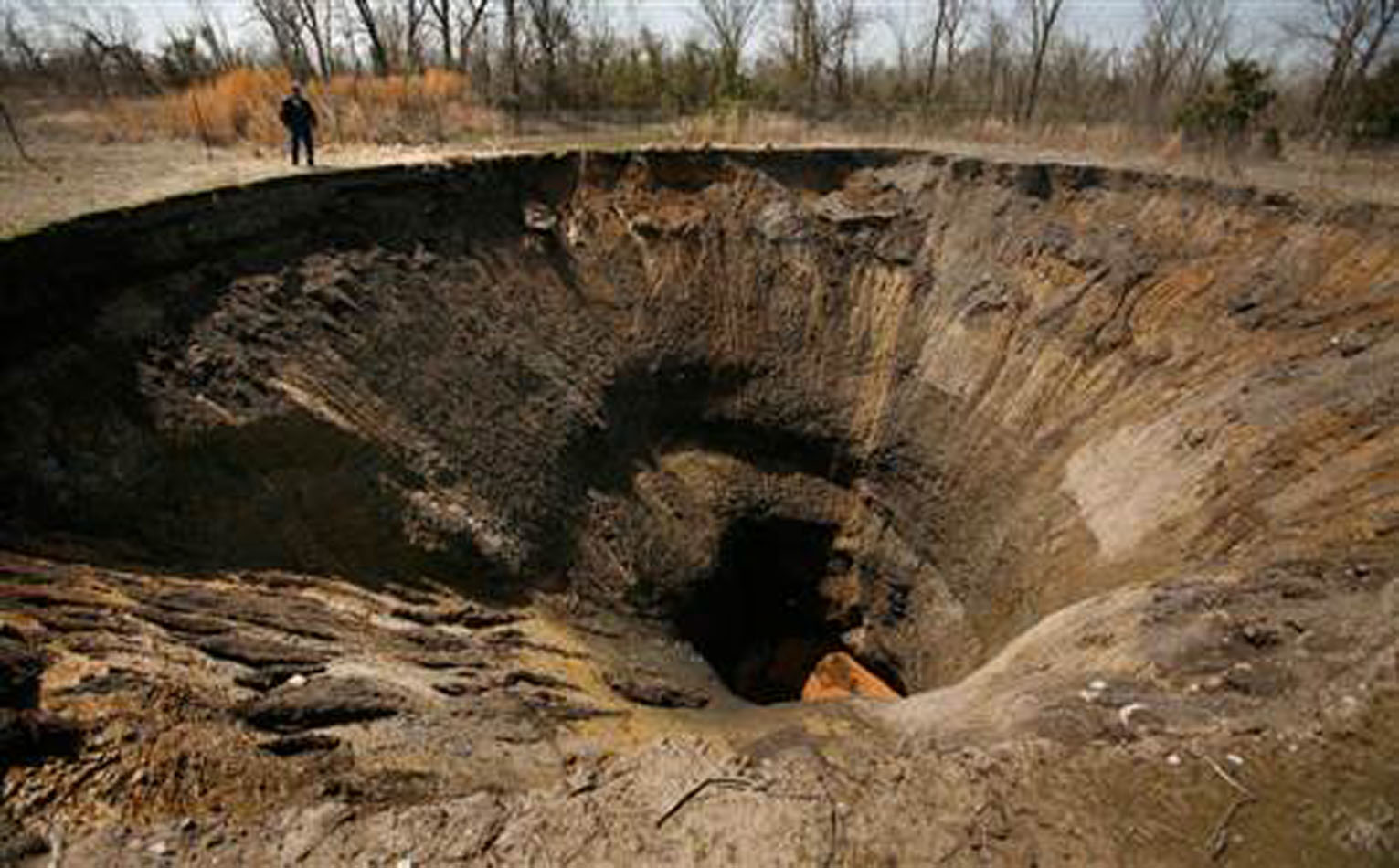
Wikipedia: “More than a century of unrestricted subsurface excavation dangerously undermined most of Picher’s town buildings and left giant piles of toxic metal-contaminated mine tailings (known as chat) heaped throughout the area. The discovery of the cave-in risks, groundwater contamination, and health effects associated with the chat piles and subsurface shafts resulted in the site being included in 1980 in the Tar Creek Superfund Site by the US Environmental Protection Agency. The state collaborated on mitigation and remediation measures, but a 1996 study found that 34% of the children in Picher suffered from lead poisoning due to these environmental effects, which could result in lifelong neurological problems. Eventually the EPA and the state of Oklahoma agreed to a mandatory evacuation and buyout of the entire township.”

080510-picher-bcol1-11a-grid-6x2
Collapsed mining pit near Picher

Naturally it was the Quapaw and other Native American tribes who suffered permanent damage from this exposure as well as the loss of lands. Even as recently as my school years in that region, it was a regular entertainment to hang out at the chat piles where guys would show off their skill with cars and motorcycles, stirring up clouds of dust as they scaled the steep inclines.

So it’s not enough that the original inhabitants of this continent were forced away from their homes and hunting grounds as white settlers took over. The insult and injury only deepened as we first gave them new lands with the promise they could be assured of controlling it for the rest of time. Less than eighty years later, Boomers, Sooners, and other massive in-migrations of white ownership swept in. And, as a bonus, left the tribes with irreversible damage to the land.

As a side note, this is similar to the standard practice of industry to locate their waste heaps and polluting processes in low-income and minority neighborhoods, both in the United States as well as Third World nations.

Which brings even more into focus the current stand-off in North Dakota over an oil pipeline. According to an Associated Press report, “the $3.8 billion, 1,172-mile project would carry nearly a half-million barrels of crude oil daily from North Dakota’s oil fields through South Dakota and Iowa to an existing pipeline in Patoka, Illinois, where shippers can access Midwest and Gulf Coast markets. Announced in 2014, supporters said the pipeline would create more markets and reduce truck and oil train traffic — the latter of which has been a growing concern after a spate of fiery derailments of trains carrying North Dakota crude.

“The Standing Rock Sioux’s lawsuit challenges the U.S. Army Corps of Engineers’ decision to grant permits at more than 200 water crossings. Filed on behalf of the tribe by environmental group Earthjustice, the suit says the project violates several federal laws, including the National Historic Preservation Act, and will disturb sacred sites outside of the 2.3-million acre reservation. A separate lawsuit filed Thursday by the Yankton Sioux tribe in South Dakota challenges the same thing.” The lawsuit alleges that the pipeline, which would be placed less than a mile upstream of the tribe’s reservation, could impact drinking water for more than 8,000 tribal members and millions who rely on it downstream.[4]

Dallas-based Energy Transfer Partners, the owners of the project, says the pipeline includes safeguards such as leak detection equipment, and workers monitoring the pipeline remotely in Texas could close block valves on it within three minutes if a breach is detected. Sounds good. Let’s ask the Quapaw how well those kinds of promises work out.

In a last ditch effort to stop the bulldozers, other Native American tribes and other supporters of the resistance have joined the Sioux in forming a human barrier to future work. Tribal leaders identified several sacred ceremonial sites and burial grounds which lie on private land in the path of the pipeline, citing these locations as even more reason to halt the project. The day after tribal officials identified these sites and added them to their lawsuit, pipeline crews bulldozed through them, an allegation which Energy Transfer Partners denies. This led to last Saturday’s clash between protesters and private security guards; law enforcement officials said four security guards and two guard dogs were injured, while a tribal spokesman said six people were bitten by the dogs and at least 30 people were pepper-sprayed.

animas_river_spill_2015-08-06There’s no end to the examples of white exploitation of resources discovered in supposedly guaranteed Indian lands. It’s an oft told tale of grab the money and run. The 2014 spill of a gold mine tailings pond in Colorado provided colorful images of a golden-colored stream as the pollution entered the Animas River. Workers accidentally destroyed the plug holding water trapped inside the mine, overflowing the pond and spilling three million gallons of mine waste water and tailings, including heavy metals such as cadmium and lead, and other toxic elements including arsenic, beryllium, zinc, iron and copper.[5] Downstream, the impact continues to be felt in three states most particularly in the Navaho Nation where they suffered damage to their crops, home gardens, and cattle herds. Arizona Senator John McCain has estimated that the tribe’s damages could exceed $335 million. So far, they’ve received $150,000.

Absurd that this kind of arrogance would occur time and time again. There is no excuse, no possible gain, that justifies more of the same. While this oil pipeline in North Dakota is not planned to cross Sioux land, any leak will compromise their water supply. There is no such thing as a foolproof technology. Sooner or later, the pipeline will fail.

It’s not just the Sioux who are fighting this pipeline. White landowners have gone to court and mounted protests as well. Conveniently and not surprisingly, laws of eminent domain may apply, forcing landowners to accept the pipeline’s passage whether they want it or not. As explained by attorneys, “existing South Dakota law allows for pipelines holding themselves out as ‘common carriers’ engaged in the sale of commodities, like crude oil, to utilize public condemnation when necessary.”[6]

At least when George Coleman set about raping Northeast Oklahoma, the residents got a nice vaudeville theater out of the deal. There is nothing anyone in the Dakotas or anywhere else in this pipeline’s route will gain other than a one-time payment for the easement rights. Somewhere down the line, the oil will out.

Want to help? Visit the resistance website for more information. http://sacredstonecamp.org/

raisedfist1

[1] http://www.colemantheatre.org/opening-weekend

[2] https://www.ok.gov/mines/Minerals_Program/Mineral_Information_by_Type/Lead_and_Zinc/

[3] https://www.thenation.com/article/secret-history-lead/

[4] http://bigstory.ap.org/article/c0db8074f3464835ab90b0400afaee71/ap-explains-whats-dakota-access-oil-pipeline

[5] https://en.wikipedia.org/wiki/2015_Gold_King_Mine_waste_water_spill

[6] http://www.lexenergy.net/pipeline-easements-a-fair-deal/

Class Reunion

banquet
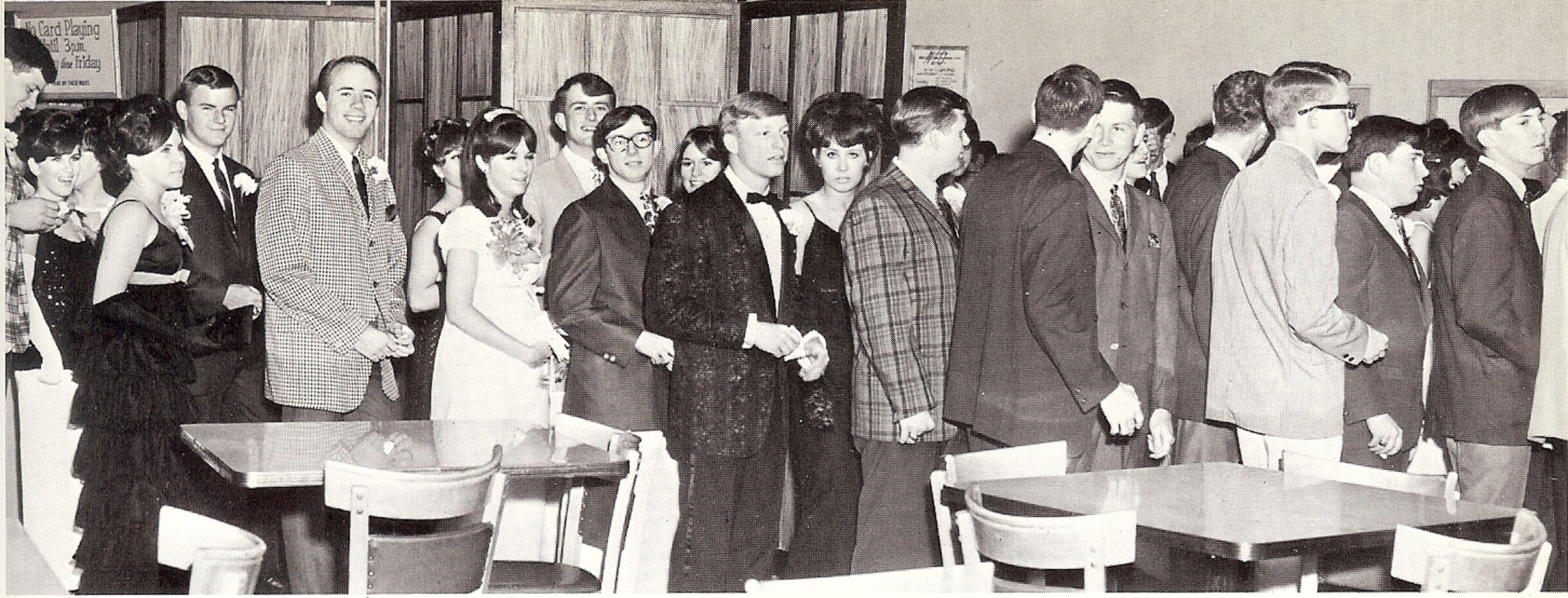
Senior Banquet 1966

Fifty minutes remains until the time arbitrarily assigned for my departure. Fifty minutes until I load the backpack I’ve borrowed from my daughter into my car. It contains the clothes and shoes I’ll wear tonight and the clothes I’ll wear tomorrow, along with toiletries and other items I may or may not need. Fifty minutes until I ease down my rain-rutted gravel drive and traverse the dusty dirt road to hit the county road and then the highway and then the route north.

I will drive for two and one half hours, hours to fidget in my seat as countless half-formed scenarios scroll through my head along with tentative smiles, greetings, and snatches of conversation I imagine making. Hours to panic further about this long anticipated event.

My fifty year class reunion.

Despite the cliché in all this, I’m not sure I’ll survive. But then of course I will, unless fate takes some kind of wicked glee in choosing this time and place to terminate my time on this earth. I’ve soothed my frayed nerves with the image of myself back home tomorrow night—not that far away—where I’ll sit on my familiar couch with my TV remote in my hand and try to let the static die away.

Forty-five minutes now. Mental checklist—underwear, toothpaste, my morning requirements of oolong tea in its strainer and a mango ready for my waking in a strange hotel room in a town I haven’t lived in for fifty years.

A town where so much of the tangled fabric of my life was woven in ways I, even now, have not untangled. It’s a place sadly diminished in the thirty years since its major industry closed up shop, yet signs of revival dot Main Street. Public housing covers the block where our venerable red brick school building once stood with its red-curtained stage, with its hallways that smelled faintly of janitorial chemicals and teenaged angst, with classrooms haunted by teachers we still hear explaining the details of osmosis and conjugation. Long dead.

This will be the fifth time I’ve returned. The first was for the funeral of a close friend when we were twenty-two. The rest of the visits have been class reunions. Since the 30th in 1996, I haven’t been back. Too much to stand in a room full of strangers knowing that once I could have called them by name. Too much to watch their faces as they read my name tag then glance at my face as if they too are staring at a stranger.

The fiftieth is different. People who’ve never been to a class reunion before are coming now. Fifty is a milestone. An arbitrary line in the sand. Those of us still living will step over it.

A half hour until I embark on this journey. I’ve tried to convince myself that it will be good to get out on the highway. It’s been too long since I set out on a road trip, let the wind blow my hair, watched the lines fly past on the pavement. I could be going anywhere.

A half hour to feel my stomach tighten even more. The first man I loved will be there. The cheerleaders will be there. The jocks. The money kids. The fellow nerds—members of the band, the choir, the thespians and class clowns. The girls who married young. The ones I didn’t really know. There were 235 of us.

Only a fraction will show up, maybe fifty or seventy. They will look old. They will look like that unrecognizable person who stares back at me in the mirror.

I think of prom and the formals I wore. I think of the shops I haunted on Main Street, the places that sold Vassarette lingerie and dyed to match satin high heels and Evening in Paris perfume, aisles I haunted in search of what it might mean to be a woman. I’ll revisit the drive-ins at either end of town where cars loaded with friends made the turn to once again ‘drag Main’ and remember the hours we spent forging our place in a world we hardly knew.

I don’t want to think of these things. I don’t want the tears that will undoubtedly sting my eyes as I look around the room tonight and see people who are like family in my memory and strangers to me now.

I’m on the road. A high sky of intense blue frames my journey. The land shifts from wooded hillsides to flat prairie. The town comes into view, the town where so much has changed and nothing has changed.

I wade into a room full of people I once knew. The dinner where we gather narrows and concentrates the experience as I try and fail to hold myself apart from the emotion. Hugs, laughter, squinting down to read name tags. Joy in reconnecting after so much time.

Hours pass as each in turn stands to tell of his or her life. How many children, grandchildren. Jobs, travels. Each one speaks on what defines them. Or what they thought everyone expected them to say. Or what they could remember of hastily gathered thoughts now scattered as the microphone shakes in their hands.

In my hotel room at midnight, I realize these hours will be forever reduced to an ephemeral moment in time.

The beauty of our youth transformed to the sags, lines, and the weight of adventures great and small, hopes fulfilled, dreams lost, loves too great to calculate, tragedies too terrible to remember. Burdened and enriched, we glance at each other from a vantage we’ve only just now gained.

These are our lives framed in this moment between where we face each other in this banquet room and the time we faced each other in caps and gowns. It’s a marking of the passage of time in a way more visceral than we anticipated, tears standing in our eyes as familiar young faces from our yearbook appear as big-screen images, a slow scroll of those who have died. Like we all will die, the reminder too close for comfort.

In this room, I see women where girls once stood, men in place of boys, our gaze reflecting our singular paths through time. The girl who played flute, the guy writing formulas at the chalk board. The intellectuals. The invisible ones. That’s not who they are now. And yet it is.

This man I loved when we were young—we’re still connected in ways beyond time. I value the time we spend together, catching up. Looking at the town, the places we thought we’d remember, but no, wait, wasn’t it another block down, that house where he once lived, another that once belonged to my family? He laughs and says Sonic chili dogs have lost none of their outrageous charm, he the transplant to the glittering northeast where that uniquely southern talent for perfect chili cheese dogs remains elusive.

All of us share this struggle to reacquaint ourselves with who we once were. We try to discover in each other’s faces what if anything it means about who we are now. Our eyes reflect our grief in the inexorable passage of time, a ticking clock quickly marking off this momentary memorial to our youth and all those years we saw each other day after day in class, across the gym at sock hops, at pep rallies and football games, in the cafeteria where even now, if ghosts still walked, the smell of yeasty rolls would lie heavy in the noontime air.

The essence of what we were then is what we are now. We are gentle with each other as we seek that affirmation.

Bittersweet thoughts rise and fall in the late afternoon sky that frames my journey home. Tattered white clouds drift across a faded azure dome. The road winds as I re-enter hill country. I’m tired. I want my own bed.

Overwhelming sadness edges in. The event has come and now gone. I doubt I’ll ever see most of these people again. There may be more reunions—a fifty-fifth, the sixtieth. When I took my mother to her seventy-third, no one else was there.

I am thankful to have shared a brief moment in time with others who remember the same teachers, the rattling locker doors and dim hallways, the same gossip and scandals. We shared a time in our lives when all things were possible, when everything seemed larger than life, rife with pivotal moments.

I have lingered too long in the past. Long ago when I left that town, I made a point to live without regret. I rushed out to embrace the adventure. What I knew then I know even more strongly now. I stand on all that came before. But life only moves forward.

A Comfortable Shirt

worn-out-shirt

Are so many Americans furious just because the rich keep getting richer and the rest of us are getting poorer?  That seems an amorphous target for such visceral rage. I think the anger roiling the masses also stems from a hundred small deceptions inflicted upon the public on a daily basis.

Take, for example, the shrinking product. Manufacturers, faced with rising costs of raw materials, labor, and transportation, have quietly reduced the content of your bag of chips. The subterfuge becomes apparent once you open the package. There, nestled in the bottom of the once-puffed up bag, is a notably smaller quantity of chips. Still sold for the same price, the lesser content sends a subtle message: You are being cheated.

Crackers come in geometrically reduced proportions. Toilet paper is narrower, less tightly rolled. There are only four gel pens in the package instead of five. All for the same price as before.

The true cost of food is most clearly displayed in the produce department where two pears will cost you a dollar-fifty. Or in the meat department where a pound of ground chuck has somehow crept up to the unbelievable price of $5.99. Yes, you can buy ground beef at a lower cost—but it’s suspiciously slick and off-scent and each mouthful yields little granules of gristle and other mysterious and disgusting bits.

Manufactured goods suffer a similar problem. While potato chips must still—for now at least—be made from potatoes, wooden picture frames can be made of plastic that won’t hold a screw. Wooden cabinets and furniture can be made of plastic or pressboard which, once broken, cannot be repaired. Toys and shoes fall apart.

world_fiber_production_polyester_cotton_wool_chartbuilderClothing once warmed us, comforted us, an ancient human invention to ameliorate the savages of raw nature. But what comfort comes in wearing synthetics manufactured from crude oil? Synthetics sit on the skin like plastic sheeting. Even the latest efforts to make this material more user friendly can never take away its basic petroleum nature.

Want cotton? Prepare to spend a lot more money than you ever imagined. A simple work shirt can run upwards of sixty dollars. If you can find one. Can’t afford it? Walk around all day in clothing that irritates your skin and contributes to the random outbreak of eczema. The aggravation becomes subliminal but ever present. Check your anger level as you rip off your clothing at the end of the day.

Recently my hard drive crashed and I was forced to upgrade my version of Windows. In the process, I lost the ability to interface with my laser printer—a new driver wasn’t available. I also lost my favorite word processing software, Word Perfect, since I could not afford to buy it new as well as Microsoft Word. For a writer, Microsoft Word is required so I had no choice about how to spend that money.

The financial hit started piling up. My version of Photoshop no longer worked. I lost use of clipart software that included over 10,000 images and there is nothing comparable available. I lost font software that included 1000 fonts. The fonts that came with the new system are essentially all the same—nothing fancy, scrolling, or ornate. New fonts are sold by the each. (Recently I’ve learned of a font source that sells fonts in bundles, but they’re still costly.)

The new email software (Windows Live Mail) that came with the new Windows—because of course my old Outlook Express no longer works—is full of fancy bells and whistles I don’t need but is haunted by a glitch that has cost me more than one friend. At random times, if I add an attachment to the email, the email will send and send but never show up in the sent folder. I discover the error if I happen to check the outbox and see it still sitting there happily sending the ten thousandth copy. One time I merely replied to a message with imbedded images and because of those images, the glitch sprang into action. That recipient got several hundred copies of my reply.

(Yes, I also use Gmail but my vast reserve of old info from Outlook was imported into Live Mail.)

Things get worse instead of better and it’s the certain knowledge of this, the personal daily acid drip of unexpected expenses and losses that eat away at your nerves. Admittedly, if we earned more, we might not stand in shock at the price tag on a cotton shirt or a bundle of fonts. However, until the day that we can drop sixty bucks on a comfortable shirt, we’re forced to shop at big box stores such as Walmart. And therein lies another wrathful screed.

(Yes, one can shop at second hand stores. Good luck finding what you want in your size. For me, shopping is akin to sitting in a red ant hill. Do it and get out.)

It’s not just the computer world that disregards and/or manipulates its buyers. In big box stores, nothing is where it was the last time you shopped. (Okay, slight exaggeration, but I’m ranting, so bear with me.) Driven by some junior executive concept of aggressive marketing, store managers are instructed to move key items from one place to another in order to encourage shoppers to explore new aisles. In theory, when we have to search for Band-Aids in a new location, we’ll find a new product to buy.

A similar strategy drives these bargain stores to make strategic shifts of entire departments. Too easy to place the paper, pens, and other office supplies in a convenient aisle near the grocery section. That made sense until the latest theory came into play. Now one must trudge a half mile to the farthest corner in order to purchase a note pad. This might not infuriate shoppers so much if there was an alternative retailer where a note pad might be found. But alas, along with the big box came the demise of the local stationary store, five and dime, and other potential competitor.

Let’s not forget the bait and switch method where a useful product appears on the shelf only to be replaced six months or a year later with an inferior clone.

Or how about the now-you-see-it, now-you-don’t ploy? Or the clerks (assuming you can find one) who have no idea what you’re talking about because they didn’t work there when that product was stocked. Or they did but they have no idea why there aren’t any now. Or a tired acknowledgement that no, trays that catch overflow under flower pots aren’t stocked in the fall or winter because that’s not the garden season. NEVERMIND that pots don’t need trays when they’re outside for the summer, they’re needed in the fall and winter.

For me, it’s this sense of being played in service to greed and ignorance that underlies my fury. It’s the paper checking account register that’s half the size it was in the days before online bill payments. They can’t sell enough checks now so you have to buy registers. It’s the Facebook newsfeed default setting that sends you back to their idea of your ‘top stories’ instead of allowing you to receive your friends’ posts permanently in chronological order.

Progress should means keeping what’s good and adding new good stuff. Instead, our progress seems to mean replacing the good stuff with cheaper shittier stuff while paying the same price. It’s not difficult to understand consumer outrage over corporate executives who rake in millions. The race to the bottom in quantity, quality or durability comes not because they can’t afford to offer more chips in the bag or software that works with my laser printer, but because the profit formula means that people at the top and their stockholders must make more money.

The profit formula dictates not only that the cost of production must be suppressed but that the consumer must be beguiled into the belief he is paying less. The details of this formula are all too familiar—jobs exported to Third World nations, lousy workmanship, poor quality contents. Rape and plunder of the earth’s remaining resources. Consumers confront the guilt of adding to the trade deficit by buying a shirt made in Bangladesh, of knowing they’re contributing to an industry that may employ child labor or which ignores workplace safety.

What lies within memory for perhaps the angriest Americans are times when most clothing was made from natural fibers, when a pound of ground chuck could be had for a buck ninety-nine, and the meat tasted good. We remember furniture that could be repaired with a larger screw and a bit of yellow glue. We remember stores that remembered us, familiar aisles where we could find another one of those things we bought last year.

Rationally, we know the government is not to blame. We know that the fundamental corporate mandate dictates the endless machinations by which its executives gain ever greater salaries and its consumers function as pawns in their capitalist game. We buy in because we’re not ready to stop using computers or stop buying chips. They’ve got us by the short and curlies.

The reason we’re angry with the government is that the government alone has the power to regulate the corporations. Only government can mitigate the capitalist prime directive and look out for the common man’s interests. When evidence supports the suspicion that corporations have infiltrated the government’s function, then it’s time to vote in a new Congress.

Then let them eat cake.

Straining on a Gnat

blob


In light of a recent update to federal regulation of commercial chemicals, pointed questions arise about laws governing controlled substances. Consider last week’s announcement of funding for a study of synthetic pot. The press release from the University of Arkansas for Medical Sciences emphasized the importance of knowing ‘what is safe.’ A federal grant of $2.7 million will fund research into K2 and Spice, a study to be led by Paul Prather, professor of pharmacology and toxicology.

“People who smoke K2 and Spice are basically playing Russian roulette,” Prather warned. “You’re injecting this compound that has literally never been tested.”

I had to laugh out loud. What are K2 and Spice compared to the 84,000 commercially used chemicals that have never been tested? What logic lies behind aggressive policing of intoxicants that a limited percentage of the population might voluntarily use periodically and the simultaneous abject failure to test chemicals that the entire population unwittingly touches, ingests, and inhales on a daily basis? Everything from dryer sheets to shampoo to spray sanitizers is loaded with mystery chemicals.

This lunacy fits perfectly with the hit-or-miss tradition of government policies rife with misinformation, driven by profiteering, and shrouded in hysteria and secret agendas instead of rational analysis of fact.

People who use K2 and Spice seek a legal alternative to marijuana.  Unlike these modern synthetics, however, marijuana has been in use as a medicine and intoxicant since pre-history. Archaeological evidence points to cannabis use in ancient China, ancient India, ancient Egypt, and by the Scythians contemporary to ancient Greece. If the criteria is ‘what is safe,’ then marijuana has long since exceeded the requirement.

If public policy were based on thoughtful analysis, marijuana would be legally sold like alcohol and this $2.7 million appropriated to study K2 would be spent on examination of why the U. S. has a higher rate of drug use and abuse than any other nation on earth (which goes hand in hand with our skyrocketing prison population).[1] The proportion of people in the United States who have used cocaine at some time during their lives is higher—by a factor of four—than in 16 other nations surveyed by the World Health Organization (WHO). The United States also leads in lifetime use of cannabis and tobacco.[2]

There’s a common misconception that drug laws are based on comprehensive scientific conclusions about the dangers of those drugs. Government funding to study drugs props up the fiction that our laws are based on ‘what is safe.’ This fantasy has been promoted by those with vested interests or a social agenda in mind. Drug laws have turned our local police departments into militaristic hit squads. Prisons are a growth industry. Selective enforcement of drug laws against immigrants, racial groups, the counter culture, and inner city poor places these potentially troublesome groups under government control.

Drug laws do nothing to stop addiction.

Consider the cautionary tale now unfolding about OxyContin. Blessed with extensive clinical testing and FDA approval, Oxy has been the darling of pain relief since the 1990s. Similarly, a century earlier Bayer Pharmaceutical introduced a new wonder drug named heroin.[3] “The sales pitch that created an instant market to American doctors and their morphine addicted patients was that heroin was a ‘safe, non-addictive’ substitute for morphine.”[4]

Now that OxyContin addiction rates have soared, a predictable crackdown has restricted supply. The result is a shift from oxy to black market heroin and rising overdose rates.

Drug warriors and doctors alike seem to be asking the wrong questions.

The more obvious right question: Why does the U.S. lead the world in substance abuse?

The less obvious: What role does our daily cocktail of manmade chemicals play in our mental and physical health, including addiction?

If the health and welfare of our citizenry were the force guiding federal and state policy, then why has it taken until June of this year for the federal government to authorize new provisions in the nation’s Toxic Substances Control Act? Originally passed in 1976, the TSCA allowed all 62,000 chemicals that were in commerce before that year to stay on the market unless the Environmental Protection Agency later found that they posed an “unreasonable risk.”

Now over 84,000 untested chemicals are in commercial use. In the intervening forty years, the EPA has required testing of only 250 chemicals and banned only nine, among them dioxin and hexavalent chromium. The new rules impose a mandatory requirement for the EPA to evaluate tens of thousands of in-use chemicals and establish risk-based safety standards along with requiring public transparency for chemical information. [5]

A day late and a dollar short. For decades, activists have pushed for laws more like those in Europe where substances generally can’t go to market unless manufacturers can provide data showing they’re safe.[6] Clearly we’ve got this backwards.

Before you start feeling reassured by this recent change in the U.S. regulation of chemicals, please note that

“The new law requires EPA to test tens of thousands of unregulated chemicals currently on the market, and the roughly 2,000 new chemicals introduced each year, but quite slowly. The EPA will review a minimum of 20 chemicals at a time, and each has a seven-year deadline. Industry may then have five years to comply after a new rule is made. At that pace it could take centuries for the agency to finish its review.”[7]

One gaping hole in our official ‘what is safe’ question is whether any of these chemicals might increase the risk of addiction. For example, the chemical Bisphenol A (BPA) is found in many products, including canned foods, plastics, and dental sealants, and is similar in structure to the hormone estrogen. Ask any woman whether hormones affect mood and attitude. Or any man, for that matter. Studies have linked BPA exposure with many health problems including obesity, early puberty, and miscarriage. Whether levels of BPA in the environment are harmful to people is still being studied.

Other chemical pollutants may affect mood, impair reproduction, and trigger cancer and other disease. Consider just one particular chemical, tributyltin, which is used as a wood preservative and glass coating among other things. In animal studies, it was found that exposure to tributyltin increased the number of fat cells, thus possibly setting into motion a genetic propensity at birth for obesity.  Some chemicals have been found to cause male frogs to become female.  It’s a long and terrifying list.

84,000.

Admittedly other factors in American life influence the rates of intoxicant abuse. As a multi-cultural society, we have few ties that bind. What are our rituals that serve as guideposts, rites of passage that help define a young person’s purpose or meaning? What shortcomings in Western medicine lead us to treat an ailment’s symptoms rather than dig out the cause? What ignorance and greed allows drug companies to saturate our media with ads that condition us to seek a pill for every ill?

Simultaneously, chemicals have become the modern savior for everything from bad odors to agriculture. We are routinely exposed to a smorgasbord of substances which may trigger our need for drugs or at least compromise us in myriad ways we hardly understand. While government awards contracts to study K2 which last year caused fifteen people to lose their lives, cause of death data from 2013 finds 29,000 deaths from alcohol, 18,893 deaths from prescription drugs, and 17,000 from all illegal drugs combined.

We can rest assured K2 will be proven harmful. Then what? Build more prisons?

Even those numbers pale in comparison to data from 2006 showing workers in chemical industries suffer more than 190,000 illnesses and 50,000 deaths annually related to chemical exposures. Workplace chemical exposures have been linked to cancers and other lung, kidney, skin, heart, stomach, brain, nerve, and reproductive diseases.

Consider the following abstract for a 2008 study by the National Institutes of Health:

“While proper brain function requires the complex interaction of chemicals perpetually occupied in purposeful biochemistry, it is well established that certain toxic substances have the potential to disrupt normal brain physiology and to impair neurological homeostasis. As well as headache, cognitive dysfunction, memory disturbance, and other neurological signs and symptoms, disruption of brain function may also manifest as subtle or overt alteration in thoughts, moods, or behaviors. Over the last four decades, there has been the unprecedented development and release of a swelling repertoire of potentially toxic chemicals which have the capability to inflict brain compromise.

“Although the ability of xenobiotics to induce clinical illness is well established, the expanding public health problem of widespread toxicant exposure in the general population is a relatively new phenomenon that has spawned escalating concern. The emerging area of clinical care involving the assessment and management of accrued toxic substances such as heavy metals, pesticides, plasticizers and other endocrine disrupting or neurotoxic compounds has not been fully appreciated by the medical community and has yet to be incorporated into the clinical practice of many consultants or primary care practitioners.”[8]

That pretty well says it all.

~~~ 

[1] http://www.cbsnews.com/news/us-leads-the-world-in-illegal-drug-use/

[2] https://www.drugabuse.gov/news-events/nida-notes/2009/11/united-states-ranks-first-in-lifetime-use-three-drugs

[3] https://en.wikipedia.org/wiki/Heroin

[4] http://www.narconon.org/drug-information/heroin-history.html

[5] https://www.epa.gov/assessing-and-managing-chemicals-under-tsca/frank-r-lautenberg-chemical-safety-21st-century-act

[6] https://www.washingtonpost.com/news/energy-environment/wp/2015/03/19/our-broken-congresss-latest-effort-to-fix-our-broken-toxic-chemicals-law/

[7] http://www.pbs.org/newshour/updates/it-could-take-centuries-for-epa-to-test-all-the-unregulated-chemicals-under-a-new-landmark-bill/

[8] http://www.ncbi.nlm.nih.gov/pubmed/18621076


Photo credit: https://www.flickr.com/photos/jurvetson/131023758/

An Ozark Interlude

snake

Yesterday, the pesky doe had circled the fenced yard all day, causing the dogs to bark incessantly. Nerves shot, at around 5 p.m. I decided to fire off a few rounds to scare her away. I grabbed my .22 rifle and stood on the porch at the west end of the house, which is my daughter’s apartment, and looked for the doe. From there a person can look downhill toward the ponds and pasture, normal doe hangout. Nowhere to be seen.

I returned to my dinner preparations, fed the dogs, fed the cats, and fed the goldfish. One cat of the four—Esmeralda—didn’t show up. I thought, okay, she followed me to the apartment. So I went back there and looked for her, called, nothing. Usually she is front and center demanding food at that point, so this was highly unusual.

Then the barking started again. I grabbed the .22 and went to the gate. There stood that stubborn doe not a hundred feet from the house.

Now let me say that this has been an ongoing war for multiple deer generations. Before we got these two hounds, the deer jumped over our yard fence and helped themselves to whatever they pleased—hosta, flower beds right by the porch, any tomatoes or other veggies I tried to grow in the raised beds. But for the last five years with hounds running free in the yard, the deer have decided discretion is the better part of valor, hosta notwithstanding.

But this doe has become quite clever at avoiding the hounds by jumping the fence in the wee hours of morning when the hounds are sacked out in the house. Consequently my tomato plants have been topped multiple times and the peppers probably won’t come back. This is after a second planting. So I really don’t care that it’s not deer season or that my .22 bullet wouldn’t be a clean kill.

In the winter, I would have opened the gate and let the hounds chase her off. But it’s tick season. Worse, the last time we let both hounds go at the same time, the younger one—Weezie—didn’t come back until well after dark. She was shaking and terrified and smelled of tobacco smoke. Someone had penned her up. So now when we let Weezie out, it’s without her big sister Cu. She usually bounds around chasing squirrels in the adjacent woodland, living dog ecstasy for ten or fifteen minutes before she’s ready to come back in the yard. Cu, on the other hand, will stay out much longer, baying as she tracks scent clear back to the canyon.

So I’m standing at the gate with my rifle and the dogs are going nuts. The deer is being coy, facing me with several large trees between us. I can’t get a clear shot. Plus I’m having pangs of conscience. The .22 can’t deliver a kill shot. She might have a fawn around here. I’m thinking, well, if I let Weezie out, she’ll put a good scare in that bitch and I won’t have to shoot her.

I’m juggling the rifle and Annoying Emma the mongrel terrier is underfoot. The minute my hand touches the gate latch, Emma lunges, Weezie lunges, I nearly drop the rifle, and all three dogs are out the gate. Damn it.

dogs
Look, that deer is right out there. Can we go out, please please?

Okay, calling them is worthless. In two seconds, two brown streaks are hurtling through the underbrush down by the pond. The doe bounds east and then south toward the canyon, dogs in fast pursuit. I go inside, put the rifle away, and eat my cold dinner.

This is worse than it sounds because Cu is my daughter’s dog. She’s housesitting this week and swamped with coursework for the two graduate level summer school classes she’s taking. Plus she’s seriously attached to Weezie. If she knew the dogs were out there dashing through the late afternoon heat harvesting ticks by the bucket and bound not to return for hours, she would be worried sick. So I decide not to tell her. Dinner goes down hard.

Then I remember I have a missing cat! Why? I could understand if she was preoccupied with her last stealth moves on a mouse or mole, but it’s been an hour. Something is wrong. I go back outside and stand by the gate. Emma goes out too, because she’s way too smart (and too old and too fat) to try to run with the hounds. As she exits the gate, which I’ve left open for the hounds’ return, she briefly sniffs the bed of ivy growing along the fence. She immediately jumps back.

ivyWhat fresh hell is this? I lean forward toward the ivy before I hear the unmistakable rattle. I can see nothing—the ivy is a green mass about five feet wide and ten feet long and at least a foot deep. But the sound is familiar.

Snake.

I go back and grab the .22. I’m holding the gun listening. Can’t see a thing. Rattling continues. I shoo Emma back because of course if I told her to, she’d jump into the ivy.

I aim and fire at the sound. The first round cracks out of the gun and the rattle continues. I give it my Shaolin concentration and fire again. The rattle stops and the ivy starts to move. I fire a couple more rounds.

I set down the gun and grab the hoe from the other side of the porch. I start hacking at the ivy, trying to pull that tenacious vine apart so I can see what I’m up against. I don’t want a coiled snake to suddenly strike, so I’m working incrementally from the edge inward. Finally I see a flash of color, that familiar brown-rust pattern of a copperhead. It’s coiling and turning as I expose part of it to view.

I’ve learned that lots of snakes rattle their tails. Once I thought about it, I remembered that rattlesnake rattles are higher pitched, a hissing sound like air escaping a tire. This rattle was lower pitched, a tail hitting leaves. Either way, I’m always thankful for the rattle.

Hack, hack, I drive the hoe down on its body. As it moves toward me, I realize I’m only hacking at the last six inches. I chop more vine. Finally, there’s the wedge-shaped head. I slam the hoe down but it has moved. Toward me.

I’m sweating and cursing and keep telling Emma to get back damn it. I rip more vines and finally I can see the whole snake. I’ve done a fairly decent job of smashing a place six inches from its tail, and now I can see a bullet hole I managed to send straight through its middle. From that point to its head, it seems unable to fully move. Maybe the shot injured its spine.

That doesn’t mean it can’t bite and send its load of venom into my ankle. Or Emma’s face. So I land the hoe behind its head. The ground under all that ivy is super soft. I’m just burying the snake in dirt.

I hook the hoe under the snake’s midsection and lift it out of the ivy. Once I’ve tossed it onto the driveway, a swift blow behind its head finishes it off. Of course it’s still moving and Emma still wants in the middle of it, so I leave the hoe blade sitting on its neck and step back.

I’m thinking this explains the missing cat. This area here between the gate and my car is a place she frequents. If she spotted the snake, she might do what lots of cats do, which is chase the snake. I once had a cat that specialized in chasing snakes. She’d herd them right out of the yard and away from the house. That’s when the kids were little and I always thought she knew exactly what she was doing, protecting our babies.

Of course, I also once had a cat that got bit. Twice. Old Reece’s Pieces was a slow learner or had a contract with death, I never could figure out which. I’ve written about him before. Once he burst through the pet door and ran down the back hallway. I found him my daughter’s closet, cowering in the corner. His right eye was swollen shut and the area around it bloody and turning purple. Trip to vet. Fangs hit his forehead and eyelid, barely missing the eyeball. Vet thought he’d lose the eye but he didn’t.

A year or so later, Reece’s didn’t show up for dinner, just like Esmeralda hadn’t shown up. I remembered what happened then, how I searched around the house for two days before I found him lying in tall weeds. I talked to him, wondering why he didn’t get up and come to me. He was less than twenty feet from the house. How I missed him before I’ll never know.

But he didn’t get up, just meowed weakly. So I picked him up and the hand I put under his belly came back bloody. He’d been snake bit in the stomach. In the two days he’d been laid up, the bite wound had spread about six inches in diameter, the hair had fallen off, and the skin was black and rotten. He was too weak to move.

The vet shook his head, shot him full of antibiotics, and sent him home to die. I kept him in my bedroom where he crawled under my bed. He wouldn’t eat. The next day, I sat nearby eating cantaloupe and he sniffed the air. I gave him some. He couldn’t eat enough.

Who knew? For the next several days, Reece’s Pieces ate mashed cantaloupe. Then he started eating regular food. Slowly he got well.

Is this what happened to Esmeralda? Was she lying in the grass somewhere or in the woods, paralyzed by copperhead poison?

I began searching, again touring the house, under the beds, my daughter’s apartment. Then outside—the flower beds, under the porch, under my car. The weeds. The underbrush, hoe in hand, because one snake is never the whole story.

Meanwhile, every fifteen minutes or so, I’m calling the dogs. I can hear them way down in the woods. Then even further, like they were down in the canyon now. Paying absolutely no attention to my calls, my demands that they get in the yard right now. They’re tracking, hollering as they go.

Which is, of course, what hounds do.

What about snakes?! They could easily stumble across a big rattler—years back, a neighbor shot a timber rattler that was nine feet long. I killed a velvet tail coiled up right by my car door after I thought I was getting a flat. I shot two bigger ones about six feet long and traveling across my yard. I regret killing them. They were beautiful and if the stupid little Pekinese I had at the time had left them alone, I wouldn’t have needed to shoot them.

If those hounds got snake bit out there in that rugged country, I’d never find them. I’d have to wait for the buzzards to start circling. Oh, damn, this is not going well.

I don’t find the cat. Anywhere.

cats2
Taco instructing Finnegan on cat rules.

I’ve never regretted killing a copperhead. I leave this one lying on the drive. Our old patriarch cat, Taco, comes by to sniff. Our two younger cats investigate, appropriately wary of the smell. There is a strong scent to poisonous snakes and cats have good instincts. Except the young male Finnegan, appropriately bold for a young king. He wants to pop it a couple of times. The snake is still writhing like they do after death. That thrills him. He stalks around it, hair standing up on his spine.

I try to watch television, springing up at every commercial to look again for Esmeralda. I imagine she’s dead or dying somewhere. I may never find her.

I call the dogs. It’s 7:30 p.m. I can’t hear them at all.

Light is fading. It’s 8:30. No dogs. No Esmeralda. I’m calling, calling. Go to the far end on my daughter’s porch and call some more.

Minutes tick by. I listen to the bullfrogs warming up at the pond. I hear lapping noises at the water bowl. I think it’s Emma. But it sounds like a big dog…

Yes! I step back inside her living room and there is Weezie lapping water like she’s dying of thirst and Cu spread out of the floor like she can’t move one more step. Both dogs panting as fast as they can.

I hurry through the house to close the yard gate before they decide to venture out again. They have no such intention. They’ve been running for three hours in this miserable heat. They follow me to the kitchen where they stretch out on the cool floor. Panting. Lots of panting.

esm
Esmeralda temporarily captive.

As I step back into the kitchen from closing the gate, there’s Esmeralda. What? Where did she come from? She’s all relaxed, doing her ballet stretches as I scold her. Then she’s all about her dinner.

The only thing I can figure out is that she was having a nap in the apartment and just wasn’t ready to respond when I was back there searching. Or whatever. She’s one of those Cats.

As for the dogs, they are too exhausted to move. Forty-five minutes elapsed before they stopped panting. Covered in ticks. Fortunately, their meds kills the ticks once they bite, so it wasn’t like they were going to be sucked dry. Still, I couldn’t stand it. I got about a dozen off each ear and that was all they’d let me look for. I’m so glad it’s not late July. That’s when the super tiny ticks start, the ones you can’t see that spread like dust by the thousands.

Today has been a vast improvement. The snake is in an old dishpan. It’s about two and a half feet long. Esmeralda is pursuing enigma. The dogs are napping. Once it cools off a little, I’ll walk down the driveway and toss the snake into the woods.

snake2

The Homeschool Plague

dreamstime_xs_6706052

Last week the Arkansas Department of Education announced a public comment period on the implementation of new rules regarding home schooled students. The comment period ends June 29. If you haven’t commented already, don’t worry. Your comment won’t make much difference. These rules are mere housekeeping details in the wake of legislation enacted over the last few years which remove any accountability in home schooling.

Previously the state paid for standardized testing to assess student progress at specified points along the educational path, including home schooled students. But the teeth were removed from that effort when the state failed to institute any meaningful follow-up if the student performed badly on those tests. Now even the testing will cease to exist.

Touted as a money saving measure, the legislation actually satisfies a long-sought goal of the religious right. That is, nobody is going to tell my kid we’re descended from monkeys. And so forth.

As recently attested in a Texas court case, “…A lower court ruling allowed for Texas homeschoolers to legally teach their children absolutely zilch if they believe their family is waiting to be raptured.” Texas counts over 300,000 homeschooled students. There, in a nutshell, is the problem with Texas.[1]

An Arkansas family wishing to home school is able to choose their own curricula, accredited or not, pursue the education at whatever pace they wish, and accept whatever outcome suits their personal whim. The Arkansas law still stands that a child between the ages of five and seventeen must be educated, but for homeschooling devotees, this is sidestepped very easily.  Parents must sign a form stating they will homeschool. Period.

Currently in Arkansas, over 18,000 students are homeschooled. Undoubtedly not all 18,000 homeschooled students are failed utterly by the state’s willful abandonment of oversight. Some parents have reasons other than fundamentalist religion to homeschool—a child’s disabilities, perhaps, or the conviction that non-traditional education better serves their parental goals. Many parents may work hard to ensure their homeschooled child gains skills needed to enter college and/or otherwise pursue a successful life. Many homeschooling parents choose standardized tests to measure their children’s progress.

Unfortunately for the future, recent surveys show that the “most important reason” parents give to homeschool is “a desire to provide religious or moral instruction (36%). Typically the religious belief being represented is evangelical Christian.”  In these homeschool situations, modern scientific knowledge—geologic age of the planet, for example—is disregarded. Math and critical thinking are not highly prized. The objective is that the child obtain minimal literacy so he or she can read the Bible.

Or, put another way, the Koran.

Arkansas students in public schools are regularly tested so that if they are failing to learn, their school can provide remediation. No such option exists for homeschooled students. If they are failing to learn, the state doesn’t know or care.

The problem is bigger than homeschooled students. Non-accredited private and parochial schools also escape state oversight. If a school is not receiving tax dollars, it does not have to meet state standards. Whatever they teach and whatever the students may know or not know at the point of ‘graduation’ is beyond the state’s purview.

All this irrational fear of compulsory state education feeds the rising plague of intentional ignorance. It undergirds the success of extremist conservative politics. These folks don’t believe in global warming because they have no comprehension of science. To them, state standards are part of a humanist conspiracy to stamp out religion.

If only.

As far back as Ancient Greece, leaders advocated for compulsory education that started kids learning at age six. By the 16th century, European church leaders enforced compulsory education to ensure that people could read the Scriptures. Colonial governments in early American settlements required education as well, a practice that spread with the growth of the nation. These were largely private, tuition supported efforts. As more immigrants arrived through the 19th century, support grew for tax-supported schools that could provide education for rich and poor alike. The last state to pass compulsory education laws was Mississippi (1919), a circumstance perhaps reflected even today in that state’s continuing struggle to move out of last place in just about everything.

Compulsory education was good while it lasted.

The first challenge arose in 1925 and the U.S. Supreme Court ruled that while the state had the right to enforce certain standards, it could not eliminate the right of parents to place their children in parochial or private schools. Generally, however, it was upheld through this and other legal actions that while states may grant exemptions for home schooling, that schooling must meet the standards required of public and state-accredited private schools.

This is no longer the case in Arkansas, one of fifteen states which require only notification of intent to preschool. As long as a parent signs that one form, they are free to home school in any way they desire. There is no follow-up, no checkpoint, no tests. Nobody looks in to see if the parents are teaching anything. There is no safety net.

While one might assume that parents want the best for their children and that any well-intentioned parent understands that education holds the key to a child’s successful future, one might be wrong. Some parents do not care and may select the homeschool route simply to avoid waking up early and getting the kid ready for school. Some parents may embark on homeschooling for vague reasons and fail utterly in selecting and teaching adequate curricula.

Worst of all are parents who intentionally subvert their child’s education in order to satisfy reactionary belief systems based on religious faith. Such parents are deluded with the idea that God is coming soon, or God tells them whatever they need to know, or that the holy scriptures are all the education anyone needs. (Feel free to substitute ‘Allah’ for ‘God’ in the preceding sentence.) The results are staggering: young adults unable to function even in minimum wage jobs, unable to reason through simple logical processes, and incapable of thinking past whatever dogma is imposed on them.

Which is—sadly—the objective.

That the State of Arkansas has disgraced itself by falling to such a low non-standard in its education of young people correlates exactly with the rise of extremist Republican government. It does not bode well for the state’s future. The greater the number of intentionally ignorant citizens, the higher the likelihood of more extremists being elected to public office. It’s difficult to imagine how far the state might fall.

But wait! We may not fall that far. We’re already damn near the bottom.

Surely there is legal remedy for this descent into religious lunacy. I propose that would-be voters be required to have obtained a GED or high school diploma. Literacy tests were ruled unconstitutional when used in southern states as a racial barrier, but if the standard were applied equally to all races, that objection would fail.

Democracy depends on reasoned political discourse and informed voters. It’s in the national interest that elections be conducted fairly. Neither bribes nor brainwashing nor willful ignorance should be allowed to subvert the democratic process.

We all suffer when young people aren’t taught to read, think, and process information in ways that are necessary in most types of employment. We suffer when people don’t understand and respect differences of race, ethnicity, or gender. We suffer when extremist religion dominates all other aspects of life.

We can see what the rule of extremist religion accomplishes for a nation by looking at the Middle East and even at the acts of extremists here at home. Fear is the first reaction in someone confronted with something he or she doesn’t understand. The next reaction after fear is hate. After hate comes violence.

With violence comes the downfall of civilization.

~~~

[1] Texas is one of nine states where parents are required to give no notice to the state as to their intention to homeschool. Arkansas is one of fifteen states where parents must only give notice of their intent. For a map showing all states and homeschool requirements, visit here.

Photo credit: Credit: ID 6706052 © Ron Sumners | Dreamstime.com

Summer Vacation

ink bottle

It was 1972. A wedding in Long Beach requested our presence, a friend in our tight-knit group to join with his true love in holy matrimony. So we embarked on a road trip to the West Coast, that fabled land of golden sunsets and salty air. A 1930s wedding theme had been announced, so for weeks prior to the trip, I had worked feverishly to sew a gangsta-style three-piece suit in pink gabardine for my husband Frank and a long-waisted light yellow dotted Swiss dress for me. Our friend Virginia, who provided her bright yellow VW bug convertible for the journey, got busy sewing her own pink vintage-style dress for the occasion.

We had plenty of fun planning the trip, gathering wide brimmed hats, Frank’s fedora, the gloves, the hand-held fans. Freshly inspired by Hunter S. Thompson’s Fear and Loathing book, we gathered the requisite pharmacy, tame in comparison to his. The itinerary grew with each passing day. On the way out there, we’d see the sights traveling in tandem with Jeff, Robert, and Franz in Robert’s shiny blue Karmann Ghia convertible.

The day arrived. We loaded up at Jeff’s house and then headed west, tops down and hair flying in the wind. In those days, Interstate 40 had not been completed. Especially in Oklahoma we found ourselves detoured through small dusty towns on the well-worn two lanes of old Route 66.

Long before Oklahoma City, we put up the ragtop to stop the torrent of wind tearing around us. Somewhere before that, my beautiful paisley turquoise silk headscarf disappeared into the landscape. Late that night, past Tucumcari and facing into a storm front that lit up the sky with magnificent lightning, the front hood flew open and the garment bag with our wedding clothes blew out. Frank steered to the shoulder, latched the hood, and backed up until we found the bag lying unharmed in the median.

More hours passed. We made the last curve around a dark mountain and Albuquerque spread out below like a bowl of lights. The garment bag fiasco separated us from the other car but we couldn’t go another mile. A cheap motel room felt like the Hilton.

gr canyon
l-r: Frank, Robert with Franz hidden behind him, Jeff tempting death.

The next morning, a quick drive through the Painted Desert and Petrified Forest renewed our wonder in the natural world. We made our rendezvous with the other car late the second night at the Grand Canyon. I spent a miserable night freezing in a too-short sleeping bag on rocky ground, probably no worse off than the rest of us. The next morning some of us dropped acid for a walkabout along the south rim. The Grand Canyon is mind-blowing on its own. With LSD, it became a second-by-second discovery of bizarre vegetation, rocks of every epoch, and the mystery of distance, time, and existence. Then we were on our way again.

ghost town
Me and Virginia at the Calico ghost town in the Mojave Desert

The wedding was complicated—people we didn’t know, extended family, a church and reception. Before and after, we wandered through L.A.’s farmers market, Hollywood, Venice Beach and other places along the seafront. With the happy couple off on their honeymoon and the Karmann Ghia headed home, we set off to the north. From Santa Barbara we followed Highway 1, that hair-raising winding roadway that clings to the cliffs along Big Sur. I don’t do well with heights. My knees start shaking at the third rung of a ladder. I alternated between sickening glances down at the waves smashing onto rocks and hiding my face in my hands.

frank at big sur
Frank and Virginia along Highway 1 at Big Sur. Arrow points to two people in the edge of the waves. Perspective.

Exhausted, we gave up just south of Monterey and parked at the side of the road for the night. Thanks to Frank’s heroic decision to sleep outside, Virginia took the front and I had the back. Neither of us could lie down since there was the matter of bucket seats and gearshift in the front and an ice chest and assorted miscellany in the back. As it turned out, we both had it better than Frank who woke us in the frigid pre-dawn fog desperate to get warm.

frank golden gate
Frank at the Golden Gate

Disheveled and bone tired, we toured San Francisco, a drive-by effort to see the Presidio, Golden Gate bridge, and Fisherman’s Wharf. We walked through downtown, gawking up at tall buildings, dodging cable cars, and musing over oddities like the man playing bagpipes across the street from Woolworths. We wandered around the fabulous Palace of Fine Arts, a preserved portion of the original 1915 exhibit for the Panama-Pacific Exposition.

temple
Palace of Fine Arts

bagpipes

At this point we had sixty-five dollars to get us back to Northwest Arkansas. There would be no more cheap motels or souvenirs and precious little food. Even with gas at 35 cents per gallon, we hardly had enough to get us home. Fortunately, Virginia had a Gulf credit card. We drove all night, white lines blurring down the pavement as we crossed the gray-white moonscape of Nevada. We hit Salt Lake City sometime the next morning and found a truck stop with showers and a buffet, all of which we could charge on her card.

After a brief gander at Mormon temples, we stuffed ourselves back into the increasingly crowded VW and dove into the Rockies. Up and down we drove, steep inclines, terrifying drop-offs, and legitimate worries about the VW’s clutch and brakes. Frank’s old friend John and his wife lived on the other side of all those snow-capped peaks at a little mining town called Leadville. He welcomed us with cocktails, grilled steaks, and a loft sleeping area in his mountainside chalet.

Oh the joy.

The next day, John took us sightseeing. Included in his agenda was an abandoned silver mine he’d discovered. What is commonly known as a road disappeared before we left the valley floor and soon we found ourselves clinging to the mountainside on a trail of sliding scree hardly wide enough for the Bronco’s wheel base. John was famous for his wild and crazy antics as a Kappa Sig in college, and he’d forged into Vietnam with the bravado only a lieutenant on point can respect. His patrol had walked into a land mine which nearly cost him his life, so when we neared the silver mine and the vehicle canted to a forty-five degree angle and he said ‘oh shit,’ it was truly an ‘oh shit’ moment.

bronco
After an hour of digging, Frank pushes uphill while John tries to pull out. Virginia watches.
slope
How far down is that?

We gingerly crawled out of the vehicle on the high side and while Virginia and I watched, John and Frank began digging out from under the wheels in an attempt to level the vehicle. We lost track of time out there in the thin air. The view was breathtaking. Unfortunately, my breath had already been taken by the vertical drop-off to the distant valley below where towering evergreens looked like matchsticks. I was sure we were all going to die.

bronco2
Success!

Over an hour later, John deemed the vehicle level enough that he dared climb inside to drive back up to level ground. With his success, I reluctantly re-entered the vehicle for the remaining terrifying jaunt to the mine. Scavengers had been here many times, but we wandered around thinking of the old timers who came up here with a mule and a pick to seek their fortunes.

mine shackGlittering chunks of ore scattered over the rocky ground. The old log structure wasn’t safe to walk in, but we nosed around in the scattered remains where I found a little Carter’s Ink bottle buried bottom up in the dirt. It had turned blue-green in the decades since its contents had been used to pen letters home or tally the proceeds of a day’s hard work. I tucked it in my pocket and braced for the slip-slide trek back down.

From Leadville we hurried south to hit our planned stops at Garden of the Gods and Royal Gorge before turning east for the last leg of the journey. If you’ve never crossed Kansas, be warned—it’s the original never-ending story. You drive and drive and you’re still in the same place. We had cleverly planned what seemed the shortest route but which turned out to be a maze of two lane roads to nowhere. It got dark, the gas gauge sat on empty, and we were in the middle of corn fields with lightning forking across the sky.

Somehow we found our way to a tiny town and waited until the local gas station opened. Later that afternoon, crammed into the back seat with relics of our journey towering in the seat beside me, claustrophobia got me by the throat and I had to get out of the car. We stopped while I walked in the gravel along the side of the road and said I could not get back in that car. Finally Frank convinced me to try the front seat and he squeezed into the back for the rest of the way home.

So many memories, so many emotions. Frank is no longer among the living, nor is Robert. The rest of us keep growing older. But when I think about that summer vacation, I’m lost in the past, my hair flying in the wind, our laughter ringing up the hillsides. I hold that ink bottle in my hand and I’m back in the hot sun smelling pine in cool air and breaking my fingernails as I dig it out of that hard packed ground.

We did things, went places, had adventures. We experienced profound wonder that never left us. We grew. I see now—that’s what vacations are for.

Ray: One Man’s Life

with M79


“Harley was standing out on the skids and opened with his M-60 as we made the assault. That was extra fire they weren’t expecting. They usually try to take out door gunners, but they weren’t expecting somebody out front on the skids. It’s a bumpy ride, coming in to an assault. The copter comes in fast and then slows down fast, and I don’t know how Harley hung on. That last bump is when you have to jump because we’re under fire.

“Fire is getting heavier. We’re starting to realize there’s a lot more NVA there than we realized. The valley floor has tall grass and holes the size of basketballs where they’re hiding to shoot at us. That’s why the valley is so scary. We’re starting to realize they’re above us and below us. They waited for us to get in there… I’m three feet from this guy that’s hit. I’m trying to find a place to lay my rifle so I could get ahold of it with both hands in case we started taking fire. This guy is screaming…”

Ray Mooney’s biography, Ray: One Man’s Life, is a new release making its debut this coming Saturday June 11. Join us if you can for his appearance at a book signing, 1 pm to 3 pm at Nightbird Books, 205 W. Dickson, Fayetteville, Arkansas.

“I’ve had my jaw broke three times, my nose broke five times to the point that the VA had to do the operation they do to boxers. My hand’s been broke and on fire once, enough that the skin was gone clear back to my wrist. I’ve fell off buildings, ladders, and mountains. Somehow I survived all that craziness.”

How Ray Mooney survived the incredible journey of his life is indeed a question for the ages. Polio, combat assault jumps from helicopters in Vietnam, and three children by three different wives didn’t kill him. Neither did the flagrant murder of his father by his father’s latest wife. But the traumas changed him, as they would change any man.

Told in his own words, Ray’s life story rushes from one shocking experience to the next and brings him to the last days as he faces end stage lung disease. Turkey killer, outlaw, entrepreneur, and disabled vet, this boy from the horse farms and tobacco fields of Kentucky relates his adventures with wry wit and breathtaking honesty.

 The paperback is available now through Amazon.

The Duggars

Michelle and Jim Bob Duggar at the time of their marriage, ages 17 and 19 respectively.

One year ago, the Duggar family’s oldest son Josh had his coming out party as a perv. News broke of his serial molestation of five young girls. Four were his sisters. Despite some local politics with the newspaper, Springdale police, and Arkansas Department of Human Services, most of the story finally gained a full airing. Shortly thereafter, TLC yanked the Duggar reality TV show “19 Kids and Counting” from the airwaves.

Thank you Jesus.

Attempts by Josh’s parents to smooth things over resulted in the revelation that church elders had experienced this in other families. (Who are these people?) Soon news broke about Josh’s pornography addiction and his two accounts at the ‘cheating’ website “Ashley Madison.” [Because…one wasn’t enough?] He entered a faith-based rehab facility at Rockford, Illinois, where he spent seven months begging the porn and sex addiction demons to leave him alone.

Most knowledgeable observers will tell you these kinds of programs are worthless. Like ‘gay conversion’ therapy. If you’re gay, you’re gay. If you’re a horn-dog, no amount of manual labor or prayer will suppress that drive. What might work is real therapy where the individual learns that control issues and other emotional and psychological motivators propel some people into compulsive behavior. But that’s science based, not faith based, and about as far from the Duggar lexicon as you can get.

Josh has returned to live near his parents at Tontitown, Arkansas, where he spends his days at the family home or the place of his father’s original business, a used car lot. Reportedly, he’s trying to sell off vehicles he collected while rolling in money from his share from the TV show and later from his ‘job’ for the Family Research Council for which, we guess, his credentials centered on name recognition. The sad fact is that for him and the rest of this Duggar overpopulation of ignorance, he doesn’t know how to do anything and, as one wag puts it, “none are well enough educated to get a fast food job.”

Now that his name recognition is a liability, the truth about the Duggar clan rises to the surface. Josh doesn’t have any job training. Like the rest of his siblings, he grew up learning to disrespect education. Anything beyond high school might have been a threat to this carefully cultivated climate of willful ignorance.  Some of this home-schooled bunch never bothered to get their GED.

Most recently, Bill Gothard, the Duggar’s former minister and founding father of their home-schooling curriculum, has been sued by five women who claim he oversaw decades of systematic sexual abuse.   This is who Josh’s parents brought in to counsel him when his sisters first ratted him out. Gothard’s standard teaching on sexual matters is that a victim of sexual abuse is partly responsible for that abuse. In other words, those young girls made him feel them up.

Compare that to extremist Islam which blames the female if she’s raped. “The laws of Islam came to protect women’s honor and modesty. Islam forbids women to wear clothes that are not modest and to travel without a mahram; it forbids a woman to shake hands with a non-mahram man. Islam encourages young men and women to marry early, and many other rulings which close the door to rape. Hence it comes as no surprise when we hear or read that most of these crimes occur in permissive societies…”

Rape cases in the strictly Islamic nation of Saudi Arabia in 1988 stood at 2.19 rapes per 100,000 population. Under Sharia law, generally enforced by Islamic states, punishment imposed by the court punishes the rape victim if she first entered the rapist’s company in violation of purdah. (Purdah takes two forms: physical segregation of the sexes and the requirement that women cover their bodies so as to hide their skin and conceal their form.) In those cases, the victim can be sentenced to even harsher punishment than the assailant. So maybe there’s a bit of under-reporting going on…

Both Christian and Islamic extremist religionists adhere to the idea that the female is responsible for tempting the male, as much or more than the male is responsible for keeping it in his pants. Just like Eve was responsible for the downfall of humanity, evidently some of Josh’s ‘sin’ was the result of too much exposure to his sisters. Hence their duty to forgive their molester.

In an effort to prevent the ‘spoiling’ of young girls by uncontrolled sexual desires, extremist church fathers advocate early marriage. In Islam, if they give consent, girls who have begun their periods are fair game, pretty much identical to the beliefs of the Duggars and others in the Quiverfull movement. It goes without saying that the more girls on the market, the fewer men will have to suffer restraint.

Recently stories emerged about the Quiverfull movement’s founder Vaughn Ohlman who believes that girls should be married off as soon as they’re “physically mature enough to handle” childbirth “without damage.” Ohlman was organizing a ‘convention’ in Kansas this summer “designed to help parents find suitable arranged marriage partners for girls in their teens so that they can start producing offspring.” Word got out and the campground rescinded its welcome. No doubt they’ll gather somewhere else to practice their unique form of white slavery.

Evidently nothing of the Duggar family’s public humiliation has caused them to rethink their beliefs. They have not repudiated their close ties to the Quiverfull movement or Bill Gothard. They continue to homeschool their children. They continue to adhere to a belief system that sets up young females to be abused and controlled by their fathers, brothers, pastors, and any other male authority figure.

The fallout for the Duggars is that like Josh, the daughters who are married along with their husbands depend on patriarch Jim Bob for support. One report alleges that “Jill and her lazy unemployed husband Derrick scammed for donations for a fake missionary trip and had to give donations back.” Another states that “Jessa lives rent free in her grandmother’s home. Her husband Ben is not employed outside [but does] odd jobs like mowing lawns for her dad.”

Jim Bob has worked hard trying to regain airtime—or any time in the public eye—that might produce an income. The result has been the recent TLC “Counting On” series starring Jill and Jessa, their spouses, and their children. According to one person close to the situation, the show was “supposed to be about what is going on with the girls, yet Jim Bob and Michelle found their way on tv in the very first episode.”

Further, Josh Duggar has recruited his wife Anna to “reach out to people like Dr. Phil and Megyn Kelly so he can have his mea culpa moment. If that goes well and people are sympathetic towards him, he is sure he can convince TLC to give him and Anna a spin-off – something to do with healing their marriage within the Christian faith.”

Thankfully for the rest of us, that might not happen. Sponsor rejections came fast and furious once the “Counting On” series began. “After the first episode of Counting On aired, seven advertisers publicly distanced themselves from the program after their advertisements were run during the episode. Those companies included Pure Michigan, Verizon Wireless, Mattress Firm, Cici’s Pizza, Choice Hotels, The UPS Store and Whitewave foods…It got worse during the second week.” Additional companies retreating from the Duggar family include RCN Corporation, Credit Karma, Gazelle, Ring.com, candy and gum giant Wrigley, and Combe Inc. Chattem, Inc. saw ads aired for its ACT Kids Batman Rinse and more during the program and are now stating those commercials aired “in error.”

(Such ad placements occur when companies buy air time and allow the network to place the ads where they want them. Questions about TLC’s programming decisions have put Nancy Daniels, general manager, on the hot seat.)

A depressing timelime of the Duggar family proliferation can be found here.

The greater issue concerning anyone even dimly cognizant of these goings-on is the failure of TLC or any religious organization to stand up and disavow not only the Duggars but everything they stand for. Unbelievably, the Duggars still enjoy a cult following.

In their isolated east/west coast lives, media mavens may see the Duggars, Honey Boo-Boo, Duck Dynasts, and other cultural deviants as entertainment. They make good money playing these folks to the rest of us. What the network people don’t understand is that by the mere presence of extremists on television, they encourage and inspire others to take up the same beliefs and behaviors.

At the least, TLC and advertisers for such programs should post a large disclaimer with each episode stating this is what NOT to do.

It is irresponsible, selfish, and arrogant to produce nineteen children in a world where too many children already live in desperate conditions. It is morally wrong to add to world suffering. If someone wants to have a houseful of kids, once you’ve replicated your gene pool three or four times, ADOPTION is the only decent route.

There are already too many under- and un-educated people struggling to find ways to make ends meet. EDUCATION should be the top priority of any responsible parent.

Too many women suffer abuse, abduction, assault, rape, marrying too young and/or yielding all autonomy to a male. EQUAL RIGHTS is about females having the same rights as males to be educated, hold gainful employment, refuse sex she doesn’t want, and otherwise be in control of her own body and life. Propagating any other viewpoint is criminal.

For all their pious beliefs, reproduction as practiced by the Duggars is animal behavior. Only animals blindly try to fertilize every egg that rolls down the tube because…predators. We have intellects, undeveloped as they may be in some cases, and have subdued our natural predators.

That leaves us duty bound as humans to think about what we’re doing.


Breaking News

Side profile of a journalist typing on a typewriter

I’ve had it with breaking news.

Remember the good old days when news was news? As in ‘new’? Doesn’t ‘news’ by definition mean new?

Definition of news according to Websters: new information or a report about something that has happened recently

New stories, new information. That’s news.

Back before the world lost its mind, the only time we heard the term ‘breaking’ was when a report came in that was so compelling, so urgent, that the news narrator literally ‘broke’ into the report he was reading in order to deliver the new news.

Now everything is ‘breaking.’ Same footage of the twister that’s aired for three days. Breaking.

Brain-dead obeisance to the blather issuing from the pursed lips of Donald Trump. Breaking.

Give me a break.

Along with the hype of ‘breaking’ news, as if the announcer’s announcement wasn’t enough, viewers get to see two lines of type along the bottom of the screen, one which runs with headlines and another larger one which says BREAKING. The combination of both lines serves to obscure the most relevant part of whatever image of breaking news appears on the screen. For example, with the tornado funnel tearing through hapless Oklahoma countryside, viewers see the clouds but not the actual point of impact. In that spot is the word “BREAKING.”

I don’t like being treated like a fool. Stop saying everything is breaking. It’s news. Period.

What is wrong with a man or woman sitting quietly behind a desk giving us the news? Remember, anyone who tunes in to watch the news wants the news. There’s no need to hype it with massive curved screens playing through incoherent imagery as the newsperson presents his/her report. Or with repetitive summaries of what they’re going to talk about later in the news cast, repeated each time they cut for commercials. This redundant table of contents eats up time which otherwise could allow for more News.

Remember, that’s why viewers are watching. They want news.

Local stations have been infected with this lunacy and other viral ailments slowly dragging them into irrelevance. I’m embarrassed for them. No longer do we get much about local events, community, or personalities. Instead, we get whatever scandal is hot off the regional police blotter and then the bulk of the half hour devolves into a rehash of national and international news. What about ‘Local’ do you not understand? If someone tunes in to watch local news, what makes you think we want to hear about Washington D.C. or India?

Oh, yes, I understand why. Local stations struggle for enough money to pay their staff and still line the pockets of station owners. The first disposable expense is real journalists who would circulate in their communities and develop stories with depth and meaning. Real journalists would have long term experience in these communities and be able to provide relevant background to the current efforts by county government to regulate free-roaming dogs in rural areas, for example.

Instead local stations attempt to fluff up their market share by hiring young female announcers who fit a certain Barbie look. They have zero institutional memory. Dogs? Huh? Their only job requirement other than speaking clearly (mostly) is to up their sex appeal with low-cut blouses, heavy eye makeup, and tousled hair styles that dip into the corners of their batting eyes.

Please.

The local weather is released in droplets meant to keep viewers hooked from start to finish of the broadcast. Oh, it’s sunny outside. Stay tuned for more. Oh, it might rain tonight. Stay tuned for more. Finally, five minutes before the end of the broadcast, the actual weather forecast is delivered in between cutesy remarks, giggles, and detours into whatever kiddy photo distraction serves as the human touch of the day.

And everything is breaking.

It’s a pathetic slide downhill from the days of David Brinkley or Chet Huntley, Walter Cronkite or even John Chancellor. No wonder Jon Stewart is so greatly mourned. He managed to convey more real news than all the current newscasts combined.

The truly sad thing about all this is that there’s more news than ever that needs to be heard. Donald Trump apparently will be the Republican candidate for President of the United States. If anything speaks to the growing ignorance of the electorate, that does. Where did journalism go off the rails?

What about an informed electorate do media moguls not understand?

According to Wikipedia, journalism is supposed to be “the work and distribution of reports on the interaction of events, facts, ideas, and people that are the “news of the day” and that informs society to at least some degree.”

Here’s some breaking news: journalism is suffering a tortured death.

(Okay, this isn’t breaking news. It’s been a growing cry for decades.)

While I’m venting, can I ask why announcers like Wolf Blitzer have to SHOUT?

I’m not the first to lament the shouting heads feeding off prejudice, hatred, and religious zealotry. Underneath the lack of real local news, the urgent ‘breaking’ of every newsstory, and the immoral stupidity rampant in broadcast ‘journalism’ lies the true agenda: money. Whatever it takes to gain and hold viewers so that more advertisers will pay more money is acceptable.

The nearest to old-school real news is available on the PBS NewsHour. Real actual news, nothing breaking. Reports that tell the whole story. No commercials.

But even here, the viewer data mavens have convinced PBS to create backdrops that move. So while trying to watch the announcer convey messages of vital importance about our political circus, the state of world affairs, and human progress in general, a distracting slow geometry shifts in the background. I assume this is supposed to appease our shrinking attention spans.

Why appease shrinking attention spans?

Why fall to the lowest common denominator?

Can’t we please just have the news?