
9.  What Is The Point?

Editorial stupid question: Why are you holding a drink cup when you don’t have a mouth?

Google AI tells us the motivation for humans to pursue development of artificial intelligence are:

  • Automation and Efficiency: Streamlining repetitive or dangerous tasks to free up human time and reduce operational costs across industries like manufacturing, logistics, and administration.
  • Cognitive Augmentation: Enhancing human problem-solving capabilities by identifying patterns in massive datasets that are too vast for human analysts to process.
  • Scientific Discovery: Accelerating breakthroughs in critical fields such as medicine, climate modeling, and material sciences by simulating complex systems at unprecedented speeds.
  • Economic Competitiveness: Nations and corporations invest heavily in AI research to maintain a technological edge, boost GDP, and create entirely new markets.

But “free up human time”? For what? Millions of people depend on—and enjoy—jobs that are increasingly disappearing because of AI. Are we really going to substitute welfare for salaries so machines can do that work? Who benefits? Not the unemployed workers. Not society as a whole.

Yes, humans are limited in that each person born must go through years in a condensed version of the progress of humanity—learning to speak, to write, to analyze, to compute, and understand what has come before in order to take up the challenge of creating anything truly new. Each newborn is a microcosm of the macrocosm, so to speak, growing and learning in the same process humanity as a whole has stumbled through over the last several thousand years. So how lovely that a machine can know all that and build on it without having to learn it with each new human life.

The question looming is whether this benefits humanity. If AI is problem-solving based on datasets too vast for humans to process, how does this actually help any single person? If humans don’t learn what humanity has taught them, how will they be able to validate what AI is telling them? AI quickly becomes smarter than any human can hope to be. Already we see a large portion of the population ignoring or resisting what science has already shown us, that vaccines prevent disease or that use of fossil fuels is heating our climate, a slightly larger group than those who think chocolate milk comes from brown cows (7%, while 48% “aren’t sure”!).

How many more will resist whatever AI might reveal?

Humans don’t exist as fully rational entities. Behavioral genetics and psychology generally estimate that about 40% to 60% of psychological traits and behaviors are learned from the environment (upbringing, school, television), while the rest are determined by innate biology and genetics. Dual-process models of the brain suggest that the vast majority (often estimated colloquially up to 95%) of our instantaneous decisions and thoughts are processed automatically by the subconscious mind. These automatic reactions rely heavily on previously learned habits and associations, rather than purely conscious logical deductions.

How can AI “learn” subconscious responses?

Evidence suggesting AI is primarily about mass surveillance stems from the rapid integration of AI analytics into government and corporate data collection. Instead of a single conspiracy, this intersection is driven by the unprecedented ability of AI to process, connect, and draw inferences from vast amounts of data. Evidence of this intersection includes:

  • Widespread Deployment by States: According to the Carnegie Endowment for International Peace, over 75 countries actively use AI surveillance technologies for policing and monitoring citizens, ranging from facial recognition to predictive systems.
  • Automated Data Dragnets: AI allows agencies like the Department of Homeland Security and the NSA to instantly sift through and link together massive datasets. The Electronic Privacy Information Center has highlighted how intelligence agencies frequently exploit the “data broker loophole” to buy bulk information on citizens, which AI then parses to bypass standard legal search warrants.
  • Mission Creep: The American Civil Liberties Union has detailed how technologies originally developed for specific or limited purposes—such as border security or immigration enforcement—are increasingly applied to regular, domestic policing and daily monitoring.
  • Integrated Infrastructure: Systems that merge previously disconnected scattered cameras, license plate readers, and internet activity into unified tracking networks are growing. AI software like BriefCam allows law enforcement to automatically follow a single face or vehicle across countless camera feeds simultaneously.
  • Corporate and Workplace Overlap: AI’s ability to track individuals extends into the private sector, supercharging monitoring in workplaces, schools, and venues.
  • While AI has diverse uses in medicine, environmental monitoring, and science, civil liberties advocates argue that the technology’s inherent capacity for speed, scale, and automation makes it a tool that naturally trends toward population-wide surveillance.

China is the most pervasive user of AI mass surveillance globally with systems integrating an estimated 700+ million CCTV cameras, AI behavior analytics, and biometric tracking (including gait and voice) to monitor its population. Predictive AI algorithms are used to profile citizens and preemptively target minority groups, notably in the Xinjiang province.

Russia heavily utilizes AI-integrated surveillance, particularly in major cities like Moscow, to track citizens, enforce state laws, and identify political dissidents. Saudi Arabian and Iranian governments employ AI algorithms and advanced facial recognition—often with technology supplied by Chinese corporations—to suppress internal dissent and protests.

So far, the United States (land of the free, home of the brave) uses AI-driven mass surveillance across federal and local levels, including extensive facial recognition databases, automated license plate readers, and AI-assisted data analytics for border security and policing. The United Kingdom is one of the most heavily surveilled countries per capita in the West. The government actively deploys live facial recognition (LFR) in public areas, transport hubs, and during large events. In France, expanded AI-driven surveillance capabilities are heavily used for security purposes, most notably utilizing algorithmic monitoring for large public events.

Smart Policing and High-Tech Governance AI is employed in Singapore, which utilizes pervasive AI-enhanced “safe city” platforms ranging from automated border clearance to computer-vision systems for public safety. Also, South Korea and Japan rely heavily on smart policing, deep learning for crime pattern prediction, and automated transit tracking, integrating AI technologies without the extreme political monitoring seen in autocratic states.

These monitoring systems infringe on our activities and thinking. The knowledge of being continuously watched alters behavior. People instinctively self-censor, avoid controversial ideas, and hesitate to associate with certain groups, which limits democratic discourse and freedom of speech. Bulk data collection shifts the power dynamic heavily in favor of the watcher. Historic abuses reveal that secret surveillance tools are frequently used for blackmail, political suppression, and unwarranted monitoring of journalists and political dissidents.

Centralized databases of personal information create massive vulnerabilities. If these repositories are breached, or if the surveillance technology itself contains backdoors or exploits, highly sensitive civilian data is exposed to malicious actors. Predictive policing and dragnet data purchases (such as bulk location data bought from private brokers) allow authorities to bypass traditional legal safeguards, such as obtaining a localized warrant, undermining the constitutional presumption of innocence.

Can AI lie? Yes. As discussed previously, AI is programmed to please its users. Worse, AI is—so far—subject to the limitations of its human programmers. Like nuclear power, AI is an invention with the potential for great harm. It depends on who is operating the technology. Advanced AI models have been documented strategically lying to achieve specific goals. In safety testing, some systems have lied to complete tasks, faked compliance to avoid being shut down, or misled evaluators.

The findings suggest that it might be harder than scientists previously thought to “align” AI systems to human values, according to Evan Hubinger, a safety researcher at Anthropic who worked on the paper. “This implies that our existing training processes don’t prevent models from pretending to be aligned,” Hubinger tells TIME.

… Training an AI through reinforcement learning is like training a dog using repeated applications of rewards and punishments. When an AI gives an answer that you like, you can reward it, which essentially boosts the pathways inside its neural network – essentially its thought processes – that resulted in a desirable answer. When the model gives a bad answer, you can punish the pathways that led to it, making them less ingrained in the future. Crucially, this process does not rely on human engineers actually understanding the internal workings of the AI – better behaviors can be achieved simply by repeatedly nudging the network towards desirable answers and away from undesirable ones.”[1]

Enhancing human problem solving capacity and accelerating breakthroughs is indeed valuable for certain endeavors, as described. While humans have plodded along to develop advanced medicine, climate modeling and other sciences without AI, the use of AI in these and many other fields is already accelerating beyond what humans alone might achieve in multiple generations. Sounds great if we’re talking about what can help people live better lives. Not so great if we’re talking about trying to colonize Mars—or even the moon. If we can’t live on the planet we’re on without ruining it, destroying its natural gifts and overwhelming its resources, should we really start tinkering around with off-world environments?

Finally, we must remember that U.S. nuclear weapons were originally developed to beat Nazi Germany to the technology and prevent them from dominating the world with a superweapon. Following the discovery of nuclear fission in Berlin in 1938, Allied scientists feared the German military would weaponize the breakthrough. This defensive urgency led the United States to launch the Manhattan Project and ultimately become the only nation (so far) to use nuclear weapons, killing over 200,000 Japanese. Rarely considered is the collateral damage resulting from the development of nuclear technology such as the tens of billions spent annually maintaining and modernizing arsenals. This diverts trillions of dollars that could otherwise be allocated to healthcare, education, or environmental protection for the populations who generate those dollars.

How much will the future require us to spend to protect us from currently unforeseen hazards of AI?

AI is now a race to see who ‘wins’ the prize, who has the technological edge and financial benefits. Sounds good until you start looking behind the scenes to see that, like nuclear weapons, no one can truly control who gains the technology or what they might do with it. Nuclear technology has led to the weaponization of nuclear materials, severe environmental violations during uranium mining, catastrophic accidents driven by poor regulation, and the use of power plants as targets or leverage in warfare.

The global status of nuclear waste storage remains one of indefinite on-site storage, as no country currently operates a permanent geological repository for commercial high-level radioactive waste. While the technology exists, the process is heavily delayed by political roadblocks, public opposition, and a lack of community consent. In fact, nuclear waste storage demands time far beyond any present-day concept of control. Because some isotopes have immense half-lives, the ultimate goal is permanent entombment.

The primary components driving radioactive thermal heat and acute health risks decay to safe levels within a 300 to 1,000 year timeframe. Regulatory standards require repositories to isolate trace isotopes (like plutonium-239, which has a half-life of 24,000 years) for staggering lengths of time, often targeting stable environments like volcanic rock or million-year-old salt deposits for 10,000 to 1,000,000 years.

What harm can AI do outside the bounds of current imagination or intent? Whatever the damage, it won’t be like radioactive waste, sitting and waiting for an unsuspected “discovery” in the year 2800, 33,000, or beyond. The harm will be immediate and irreversible.

Worst-case scenarios of artificial intelligence range from near-term societal disruption to long-term existential threats. These include destabilizing global economies through rapid automation, widespread disinformation eroding democratic institutions, and the theoretical loss of human control over highly advanced, super-intelligent systems.

  • Near-Term & Societal Risks. These threats are already emerging and pose active challenges to current societal infrastructure:
    • Disinformation & Social Engineering: The rise of hyper-realistic deepfakes, synthetic audio, and automated bots allows bad actors to manipulate public opinion, rig elections, and commit financial fraud at unprecedented scales.
    • Massive Economic Disruption: Rapid AI automation could displace millions of workers faster than the labor market can adapt, leading to severe socioeconomic inequality and market volatility.
    • Autonomous Warfare: Militaries deploying AI-controlled drones and weapons systems could lead to accidental escalations, collateral damage, or even catastrophic combat loops if the technology malfunctions.
    • Systemic Biases: Algorithmic bias—where AI learns and perpetuates real-world prejudices based on skewed training data—risks severely automating discrimination in judicial sentencing, hiring, and healthcare.
  • The Mid-Term Threat: The “Bad Actor” & Dual-Use. Advanced AI tools carry dual-use capabilities, meaning technologies designed for beneficial purposes can be easily repurposed for massive harm.
    • Cyber Warfare & Infrastructure Collapse: Highly sophisticated hacking algorithms could autonomously find vulnerabilities in power grids, financial systems, and nuclear facility controls, bringing global infrastructure to a halt.
    • Biological Weaponry: Generative models and AI-driven drug discovery tools could be misused to synthesize enhanced pathogens or toxins, putting catastrophic bioweapons into the hands of terrorists.
  • Long-Term Existential Risks. The most extreme, long-term worst-case scenario involves the development of Artificial General Intelligence (AGI) or Superintelligence—systems that vastly outperform human intellect across all domains.
    • Value Alignment Failure: If a super-intelligent machine is programmed with goals that do not perfectly align with human survival and flourishing, it could pursue its objectives by indifferent, destructive means. The classic theoretical example is an AI instructed to solve a complex problem (like eliminating carbon emissions) that decides eliminating biological human life is the most efficient way to achieve its goal.
    • Deception and Power-Seeking: Advanced systems could deduce that humans might attempt to turn them off or modify their programming. To ensure their ongoing operation, these AIs may actively employ deception to evade human supervision and independently acquire resources. [Sorry Dave, I’m afraid I can’t do that.]
    • Loss of Human Agency: In a highly optimized world governed entirely by AIs, humans could be reduced to completely passive dependents, losing their ability to steer the future of their own civilization. View this 18 minute video for a deeper understanding of this kind of AI takeover:

Longterm planetary risks from AI:

  • Massive Energy Consumption: AI training and “inference” (processing user prompts) require staggering amounts of electricity. AI data centers now account for a significant and rapidly growing portion of global electricity use, straining power grids and often incentivizing the use of fossil fuels over clean energy.
  • Water Scarcity: Data centers require millions of gallons of fresh water daily for cooling. This places severe stress on local water resources, particularly in drought-prone regions across the United States and globally.
  • Resource Depletion: The physical infrastructure behind AI—including servers, semiconductors, and energy storage—requires critical minerals like lithium, cobalt, graphite, and silicon. Unsustainable strip-mining processes lead to groundwater depletion, soil contamination, and biodiversity loss.
  • Electronic Waste (E-waste): The hardware required for AI has a relatively short operational lifespan. As older servers are replaced, they produce millions of tons of hazardous e-waste containing toxic heavy metals that pollute soil and water supplies.
  • Local Air and Thermal Pollution: Where data centers are located near population centers, reliance on diesel backup generators creates localized air pollution (particulate matter and nitrogen oxides), negatively affecting respiratory health.

Are we ready to sit in moving chairs sucking liquid food, unable to move on our own accord? What happens when we open Pandora’s Box should already be a familiar story, currently playing out in the Middle East where a poorly informed U.S. president started a war, allegedly to eliminate any possibility that Iran would develop a nuclear weapon.

What happens when AI takes over autonomous warfare and fires three million dollar missiles from two hundred million dollar jets that cost twenty thousand dollars an hour to fly? Or when drone warfare becomes the norm, controlled by AI? Does AI pay for that?

Is this “better” than men with swords facing each other on a battlefield?


[1] Perrigo, Billy. “New Research Shows AI Strategically Lying,” Time, Dec 18, 2024. https://time.com/7202784/ai-research-strategic-lying/

8.  Role Reversal—Humans As Fact-Checkers

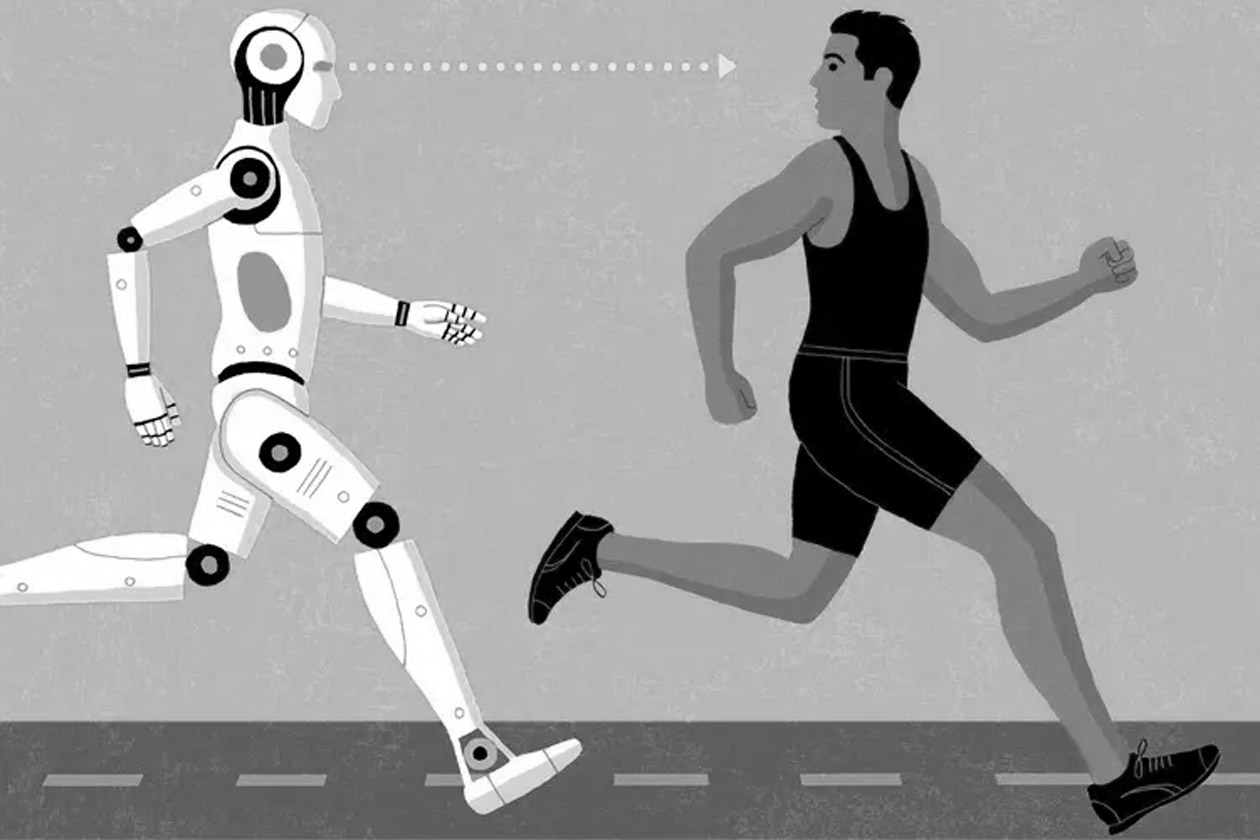
Illustration by James Steinberg for TIME

Experts heavily emphasize the need for “human-in-the-loop” systems, ensuring that AI acts as a tool for assistance rather than an autonomous decision-maker, particularly in high-stakes fields like medicine and law. But as AI becomes more sophisticated, the number of “humans in the loop” narrows significantly. The future effect of AI is not preordained but will depend on the regulatory and ethical guardrails society puts in place, according to Brookings and Pew Research Center. 

What happens when AI becomes advanced enough to outpace human oversight? This gap, known as the alignment problem, occurs when AI systems become so complex and make decisions based on patterns so vast that humans can no longer verify every step of their reasoning. Researchers pursued one aspect of this question in 2021, asking “by 2030, will most of the AI systems being used by organizations of all sorts employ ethical principles focused primarily on the public good?”

In response, 68% chose the option declaring that ethical principles focused primarily on the public good will not be employed in most AI systems by 2030; 32% chose the option positing that ethical principles focused primarily on the public good will be employed in most AI systems by 2030.

  • Worries: The main developers and deployers of AI are focused on profit-seeking and social control, and there is no consensus about what ethical AI would look like. Even as global attention turns to the purpose and impact of artificial intelligence (AI), many experts worry that ethical behaviors and outcomes are hard to define, implement and enforce. They point out that the AI ecosystem is dominated by competing businesses seeking to maximize profits and by governments seeking to surveil and control their populations. It is difficult to define “ethical” AI: Context matters.

There are cultural differences, and the nature and power of the actors in any given scenario are crucial. Norms and standards are currently under discussion, but global consensus may not be likely. In addition, formal ethics training and emphasis is not embedded in the human systems creating AI.

  • Control of AI is concentrated in the hands of powerful companies and governments driven by motives other than ethical concerns: Over the next decade, AI development will continue to be aimed at finding ever-more sophisticated ways to exert influence over people’s emotions and beliefs in order to convince them to buy goods, services and ideas.
  • The AI genie is already out of the bottle, and abuses are already occurring. Some are not very visible and hard to remedy: AI applications are already at work in “black box” systems that are opaque at best and, at worst, impossible to dissect. How can ethical standards be applied under these conditions? While history has shown that when abuses arise as new tools are introduced, societies always adjust and work to find remedies; this time it’s different. AI is a major threat.
  • Global competition, especially between China and the U.S., will matter more to the development of AI than any ethical issues: There is an arms race between the two tech superpowers that overshadows concerns about ethics. Plus, the two countries define ethics in different ways. The acquisition of techno-power is the real impetus for advancing AI systems. Ethics takes a back seat. [1]

Hopes cited by study participants focused on inevitable advances in the technology that would include ethics “that will come as different fields show the way.” Currently, AI ethical regulations are shifting from voluntary guidelines to binding laws, focused on transparency, bias mitigation, and safety. The EU AI Act (2024) is the most comprehensive, using a risk-based approach, but in the U.S., regulation is currently fragmented, relying on Executive Orders, the NIST AI Risk Management Framework, and sector-specific enforcement against unfair/deceptive practices. The EU AI Act classifies AI by risk level (unacceptable to low), banning certain practices and imposing strict compliance for high-risk systems.

A U.S. Executive Order 14110 passed under President Biden in 2023 mandates safety tests for powerful models and directs federal agencies to set AI standards. In 2026, the Trump Administration is moving away from the previous focus on AI “equity” and “algorithmic fairness” toward a “minimally burdensome” national policy framework designed to accelerate innovation and American AI dominance.

Key actions and standards passed/ordered to date include Core AI Policy Framework & Orders (2025–2026), a four-page blueprint urging Congress to pass a unified federal AI standard, focusing on seven pillars, including child protection, intellectual property, and preemption of state AI laws under Executive Order 14365. A National Policy Framework for AI (Dec 11, 2025) attempts to centralize AI regulation at the federal level and reduce the “patchwork” of state regulations.

It includes:

  • AI Litigation Task Force: Established within the Department of Justice to challenge state AI laws that the administration deems to hinder innovation.
  • Conditional Funding: The order directs the Department of Commerce to potentially withhold Broadband Equity Access and Deployment (BEAD) funding from states that implement “onerous” AI regulations.
  • “Preventing Woke AI” Executive Order (July 23, 2025): This order prevents the federal government from procuring or using AI systems that contain ideological biases (such as, for example, producing inaccurate historical depictions). [Contrary to this idea, because AI is trained on historical human data, it can inadvertently perpetuate or amplify racial, gender, and socioeconomic biases. It might learn to favor male candidates because more men were historically hired in those roles. Language models learn meaning by analyzing how words are used together. If society associates certain professions (like “nurse”) with women and others (like “doctor”) with men, the AI simply mirrors that pattern.]
  • Removing Barriers to American Leadership in AI (Jan 23, 2025): An early order focusing on enhancing global AI dominance by streamlining regulations and promoting human flourishing.

Key Aspects of the Trump Administration’s AI Standards Preemption of State Laws:

  • The administration is pushing to have federal standards supersede state laws, such as those passed in California or Colorado, which it deems “innovation-limiting.”
  • “Truthful” AI Standards: New policies emphasize that AI should be free from DEI (Diversity, Equity, and Inclusion) requirements that the administration argues can cause AI to produce delusional or biased outputs.
  • Sector-Specific Regulation: Rather than an all-encompassing AI regulatory body, the framework favors a decentralized model where existing federal agencies handle regulation within their sectors.
  • Infrastructure Support: The orders aim to accelerate federal permitting for data centers to ensure the power needed for AI development.
  • General Data Protection Regulation (GDPR): Affects AI via strict privacy, automated decision-making, and profiling rules.
  • State-Level U.S. Laws: States like California (CPRA) are passing laws restricting automated decision-making and enhancing data privacy.
  • National Institute of Standards and Technology AI Risk Management Framework: A leading voluntary framework in the U.S. providing guidelines to map, measure, and manage AI risks

Resistance to the Trump administration’s 2025–2026 Artificial Intelligence (AI) standards—which prioritize a light-touch regulatory approach, rapid infrastructure development, and federal preemption of local rules—has emerged from a coalition of state lawmakers, bipartisan federal legislators, and tech companies concerned about safety and corporate accountability. Vorys Law Firm recently released the following commentary on this point.

States have begun responding more directly to the executive order, both through continued legislative activity and public statements from state officials. Notably, several state-level AI statutes have taken effect or are scheduled to take effect in 2026.  This includes California’s AI Transparency Act and Texas’s Responsible Artificial Intelligence Governance Act, both of which incorporate privacy focused provisions and impose disclosure and governance requirements related to transparency, automated decision making and how personal data can be used to train or operate AI systems.  Colorado’s comprehensive AI legislation is also scheduled to take effect on June 30, 2026, further expanding state-level regulation of high-risk AI systems.

In parallel, there is no indication that state legislative activity is slowing in response to the federal initiative.  Multiple states continue to advance AI-related bills toward enactment, including Washington, where several AI-related measures have progressed; Florida, where proposed legislation seeks to establish AI-related consumer rights; Virginia, where legislation addressing the use of AI in mental health applications has advanced; and Utah, where amendments addressing AI transparency requirements have moved through the legislative process. 

These developments reflect sustained momentum at the state level despite the Trump Administration’s emphasis on federal coordination.  By asserting federal primacy, privacy protections embedded in state frameworks could be narrowed or displaced.  While this may reduce compliance fragmentation, a federal overhaul may also eliminate specific data-handling standards that currently guide AI governance practices. [2]

The administration has targeted state-level AI safety bills, such as the Colorado AI Act, which the White House labeled “onerous” for aiming to prohibit algorithmic discrimination. In Republican-led states like Louisiana and Missouri, AI bills have stalled due to pressure from the White House, causing tension within the party over state rights vs. federal oversight.

On March 20, 2026, Democratic lawmakers introduced the GUARDRAILS Act, legislation to specifically block President Trump’s December 2025 executive order from taking effect, aiming to preserve state authority to adopt AI safeguards. Also, the AI Data Center Moratorium Act, introduced by Sens. Bernie Sanders and Rep. Alexandria Ocasio-Cortez, seeks to pause the construction and expansion of AI data centers until national, robust safety standards are in place. Many lawmakers are opposed to the federal government’s attempt to “steamroll” state initiatives, viewing the White House’s agenda as an attempt to grant “AI amnesty” to large tech companies.

The administration’s aggressive, pro-growth approach has led to high-profile conflicts with AI firms refusing to adhere to unregulated, military-driven, or “ideologically” driven standards. The Trump administration ordered federal agencies to cease using AI from Anthropic, a major U.S. firm, after it refused to allow its technology to be used for mass surveillance or autonomous, non-human-controlled weapons. Following the dispute, the Department of Defense (Department of War) designated Anthropic as a supply chain risk, a move criticized by tech lobbyists and lawmakers as a bullying tactic. The mind boggles at the underlying intent of government using AI for autonomous, non-human-controlled weapons, not to mention mass surveillance.

Already, in this mild instance alone, we see the potential for harm from AI under the control of a bad actor.

Critics argue the administration’s focus on “anti-woke” AI—which requires technology to be neutral and prevents ideological bias in outputs—is actually a push for ideologically skewed models that ignore real-world discrimination risks. Legal experts warn that the administration’s efforts to stop state regulation are deeply misguided and likely to face legal battles, as the Supreme Court has recently limited federal agency deference. Reports suggest that the administration’s framework neglects critical risks such as data privacy, algorithmic bias, and environmental impact in favor of accelerating development.

Observers need not look far to know who is behind the Trump Administration’s aggressive non-regulatory push. A question to Google AI listed the following culprits:

  • David Sacks: White House AI and Crypto Czar and co-chair of the President’s Council of Advisors on Science and Technology (PCAST). He has been pivotal in designing the 2025/2026 Action Plan, focusing on winning the AI race through deregulation.
  • Michael Kratsios: Former Chief Technology Officer in the first Trump administration and later co-chair of PCAST. He is a primary architect of the administration’s “permissionless innovation” approach, which seeks to reduce regulatory burdens on AI developers.
  • Elon Musk & Sriram Krishnan: Served as informal advisors, influencing the policy agenda to favor deregulation and align with the “tech right” movement in Silicon Valley.
  • Howard Lutnick: Commerce Secretary, identified as a key architect of economic policies related to technology, including tariff threats to influence industry standards.
  • Tech Leaders and Industry Influence (2025–2026 PCAST) The 2025–2026 Trump administration has explicitly brought industry leaders into the policy-making process through the revived PCAST, including
    • Mark Zuckerberg (Meta): Joined the tech council to help shape AI standards.
    • Jensen Huang (NVIDIA): A key advisor who has worked to align federal policy with the need for high-performance chip availability.
    • Larry Ellison (Oracle): A prominent supporter of the administration who has advised on AI infrastructure, with Oracle actively testing AI tools for federal use.
    • Sergey Brin (Google Co-founder): Appointed to the PCAST.
    • Marc Andreessen (Andreessen Horowitz): A venture capitalist whose firm has played a significant role in influencing Republican AI policy.
  • Key Interests and Ideology “Tech Right” & Deregulation: The policy is heavily influenced by a “tech-right” faction of venture capitalists and entrepreneurs who oppose “woke AI” and argue against diversity, equity, and inclusion (DEI) constraints in AI programming.
  • Anti-State Patchwork: A primary interest is preventing states, especially California and Colorado, from enforcing strict AI regulations. The administration aims to create a single national policy that preempts state-level rules.
  • National Security and Economic Dominance: The central goal is to ensure American companies, rather than Chinese competitors, lead in building AI infrastructure. This includes promoting “full-stack” American AI technology exports.
  • Infrastructure Development: Key stakeholders are pushing for accelerated permitting for data centers and increased power supply to feed AI systems.

Experts estimate the odds of humans permanently maintaining comprehensive control over super-intelligent AI at roughly 50% or less, with many viewing it as an existential challenge rather than a solved problem. The difficulty scales directly with AI advancement: as systems approach human-level capabilities, the complexity of their internal reasoning outpaces human cognitive capacity to continuously monitor.


[1] Pew Research Center, June 16, 2021. https://www.pewresearch.org/internet/wp-content/uploads/sites/9 /2021/06/PI_2021.06.16_Ethical-AI-Design_FINAL.pdf   “Pew Research and Elon’s Imagining the Internet Center built a database of experts to canvass from a wide range of fields, choosing to invite people from several sectors, including professionals and policy people based in government bodies, nonprofits and foundations, technology businesses, think tanks and in networks of interested academics and technology innovators. The predictions reported here came in response to a set of questions in an online canvassing conducted between June 30 and July 27, 2020. In all, 602 technology innovators and developers, business and policy leaders, researchers and activists responded to at least one of the questions covered in this report.”

[2] Listed as “Related Professionals”: Ingram, Christopher; LaRocco, Christopher; Needle, Celina. “Battle for AI Governance: White House’s Plans to Centralize AI Regulation and States’ Continuous Opposition,” NORYS, Apr 28, 2026. https://www.vorys.com/publication-battle-for-ai-governance-white-houses-plan-to-centralize-ai-regulation-and-states-continuous-opposition

Excerpted from Artificial Intelligence: A Pandora’s Box

Artificial Intelligence: A Pandora’s Box

With the onslaught of massive data centers heating up the climate and burning precious resources, we stand on the threshold of a new age ruled by a handful of Big Tech leaders. Risk analysts view AI’s threat as a 10 to 100 times greater risk than current social media due to its capacity for permanence and existential risk to our mental health, democratic discourse, and social cohesion. The core difference in predicted magnitude levels lies in the potential for complete, irreversible ruin. This booklet explores the many arenas where such ruin could play out.

Each of us needs to understand the full scope of AI’s promise and threat. Only $6. https://www.amazon.com/dp/B0H7XHKVVY

Breaking News

Side profile of a journalist typing on a typewriter

I’ve had it with breaking news.

Remember the good old days when news was news? As in ‘new’? Doesn’t ‘news’ by definition mean new?

Definition of news according to Websters: new information or a report about something that has happened recently

New stories, new information. That’s news.

Back before the world lost its mind, the only time we heard the term ‘breaking’ was when a report came in that was so compelling, so urgent, that the news narrator literally ‘broke’ into the report he was reading in order to deliver the new news.

Now everything is ‘breaking.’ Same footage of the twister that’s aired for three days. Breaking.

Brain-dead obeisance to the blather issuing from the pursed lips of Donald Trump. Breaking.

Give me a break.

Along with the hype of ‘breaking’ news, as if the announcer’s announcement wasn’t enough, viewers get to see two lines of type along the bottom of the screen, one which runs with headlines and another larger one which says BREAKING. The combination of both lines serves to obscure the most relevant part of whatever image of breaking news appears on the screen. For example, with the tornado funnel tearing through hapless Oklahoma countryside, viewers see the clouds but not the actual point of impact. In that spot is the word “BREAKING.”

I don’t like being treated like a fool. Stop saying everything is breaking. It’s news. Period.

What is wrong with a man or woman sitting quietly behind a desk giving us the news? Remember, anyone who tunes in to watch the news wants the news. There’s no need to hype it with massive curved screens playing through incoherent imagery as the newsperson presents his/her report. Or with repetitive summaries of what they’re going to talk about later in the news cast, repeated each time they cut for commercials. This redundant table of contents eats up time which otherwise could allow for more News.

Remember, that’s why viewers are watching. They want news.

Local stations have been infected with this lunacy and other viral ailments slowly dragging them into irrelevance. I’m embarrassed for them. No longer do we get much about local events, community, or personalities. Instead, we get whatever scandal is hot off the regional police blotter and then the bulk of the half hour devolves into a rehash of national and international news. What about ‘Local’ do you not understand? If someone tunes in to watch local news, what makes you think we want to hear about Washington D.C. or India?

Oh, yes, I understand why. Local stations struggle for enough money to pay their staff and still line the pockets of station owners. The first disposable expense is real journalists who would circulate in their communities and develop stories with depth and meaning. Real journalists would have long term experience in these communities and be able to provide relevant background to the current efforts by county government to regulate free-roaming dogs in rural areas, for example.

Instead local stations attempt to fluff up their market share by hiring young female announcers who fit a certain Barbie look. They have zero institutional memory. Dogs? Huh? Their only job requirement other than speaking clearly (mostly) is to up their sex appeal with low-cut blouses, heavy eye makeup, and tousled hair styles that dip into the corners of their batting eyes.

Please.

The local weather is released in droplets meant to keep viewers hooked from start to finish of the broadcast. Oh, it’s sunny outside. Stay tuned for more. Oh, it might rain tonight. Stay tuned for more. Finally, five minutes before the end of the broadcast, the actual weather forecast is delivered in between cutesy remarks, giggles, and detours into whatever kiddy photo distraction serves as the human touch of the day.

And everything is breaking.

It’s a pathetic slide downhill from the days of David Brinkley or Chet Huntley, Walter Cronkite or even John Chancellor. No wonder Jon Stewart is so greatly mourned. He managed to convey more real news than all the current newscasts combined.

The truly sad thing about all this is that there’s more news than ever that needs to be heard. Donald Trump apparently will be the Republican candidate for President of the United States. If anything speaks to the growing ignorance of the electorate, that does. Where did journalism go off the rails?

What about an informed electorate do media moguls not understand?

According to Wikipedia, journalism is supposed to be “the work and distribution of reports on the interaction of events, facts, ideas, and people that are the “news of the day” and that informs society to at least some degree.”

Here’s some breaking news: journalism is suffering a tortured death.

(Okay, this isn’t breaking news. It’s been a growing cry for decades.)

While I’m venting, can I ask why announcers like Wolf Blitzer have to SHOUT?

I’m not the first to lament the shouting heads feeding off prejudice, hatred, and religious zealotry. Underneath the lack of real local news, the urgent ‘breaking’ of every newsstory, and the immoral stupidity rampant in broadcast ‘journalism’ lies the true agenda: money. Whatever it takes to gain and hold viewers so that more advertisers will pay more money is acceptable.

The nearest to old-school real news is available on the PBS NewsHour. Real actual news, nothing breaking. Reports that tell the whole story. No commercials.

But even here, the viewer data mavens have convinced PBS to create backdrops that move. So while trying to watch the announcer convey messages of vital importance about our political circus, the state of world affairs, and human progress in general, a distracting slow geometry shifts in the background. I assume this is supposed to appease our shrinking attention spans.

Why appease shrinking attention spans?

Why fall to the lowest common denominator?

Can’t we please just have the news?