Sidetracking traditional education and leaning into vocational training at an early age will only exacerbate cultural division in the U.S. Much of what currently upsets under-educated Americans is that they do not understand much of what they have to deal with on a daily basis. It’s not news that people fear the unknown.
The anti-vaxxers are a perfect example—people who know nothing about viruses or how they function in the human body or how vaccines work to provide a level of immunity. So there’s all this pressure from the educated (scientists, doctors) and the government (tasked with protected public health) for people to get vaccinated, and the anti-vaxxers just feel pushed around and outraged. Conspiracy theories substitute for knowledge, that health spokespeople are on the take, that they create the virus to make money, that it’s better to take horse wormer than listen to the doctors.
Meanwhile, the virus finds unprotected human bodies to infect and starts happily mutating, a standard activity of viruses and other invisible meanies. Pretty soon the old vaccine doesn’t work against the new variant, and the anti-vaxxers say, “Ha! See?” without realizing that they are the weak link in allowing the virus to gain the upper hand. If the virus has no hosts in which to breed and mutate, the virus dies.
And so it goes.
The know-nothings dismiss all journalism because they don’t know the difference between legitimate journalism and fake news from ‘announcers’ who could care less about the principles of professional journalism.
The know-nothing avidly embraces sensational claims of wannabe tough guys like Trump whose records clearly reveals his lifelong failure in business and his bankrupt character.
The know-nothing passionately puts forth ad hominem arguments without understanding the principles of legitimate fact-based debate.
The know-nothing votes only for president because it’s the most high profile without understanding that every level of political office is essential to healthy function of our government.
The know-nothing hoards arms and joins with likeminded know-things in fantasizing about civil war when they can get rid of the ‘enemy’ without having any awareness of the real tragedy of civil war.
Worst of all, the know-nothing is defenseless against propaganda.
Living in the modern world requires that people are educated not only in math (yes, even algebra, which is not so much about remembering theorems as it is training the brain in logic) and English (grammar, spelling, literature, and essay writing all contribute to a person’s ability to read and understand as well as his/her ability to communicate with others), but also in biology, speech, civics, and history. Our young people also need full access to learning in the arts whether music or visual arts; for some, these are the only pathways to a fruitful future. We must provide these many facets of a nourishing preparation for life.
So we need to be very careful about any ‘reforms’ to the education system or required curriculum. Yes, vocational skills are great for a significant portion of the population in terms of future jobs. There will always be a need for plumbers, electricians, carpenters, welders, car mechanics, and so forth, and these can be lucrative careers. But that alone does not equip the population to succeed in these times.
We do not need to make a choice, either/or, with our educational system. We must have both.
Religion got us here, all this chaos surrounding our government and the unmitigated shitshow of Donald Trump.
Religion, where believers must suspend disbelief in order to believe—perfect practice for falling for snake oil salesmen and political bullshit.
Knowing this, since at least the 1960s, the back rooms of the Republican Party have carried out a bold plan to enlist evangelical Christians in their pursuit of power. Hot button issues became hotter under their rhetoric—abortion isn’t just about women making medical choices about their bodies and lives, it’s killing babies. Even newborns!
It seems not to matter how absurd the argument when twisted to fit this agenda. True Believers fall for it every time. They surge out their doors on Election Day, ready and eager to vote. Otherwise, God won’t love them.
Well meaning, intelligent, even well-educated evangelical Christians can’t help themselves in the face of God’s wrath. And yes, there are such things, although the majority seems less than intelligent or educated. Do they love the country more than God? Do they love the Constitution more than God? No, they can’t. There’s a lake of fire and brimstone waiting just below their feet if they don’t love God the most.
Whatever God actually said, if anything, doesn’t matter. It’s what the puppet masters behind the Church and the Republican Party say that matters, their interpretation, spin, whatever you want to call it. Ever more outrageous, the lies keep coming.
Poor Donald, never did anything but exercise his free speech. He just wanted to make sure the vote count was accurate. He now suffers the slings and arrows of an ungrateful nation and misguided justice system because he stood up for ‘his’ people.
I wonder if Donald ever knew he was a token, a pawn used to stir up the perfect demographic to push him into office. Will he ever know?
It’s doubtful. The aspect of Donald that made/makes him a perfect pawn is his utter and complete hubris which allows him to believe he became president on his own merits. Yes, he submitted to being prayed over, signing Bibles left and right, giving the peasants the bread and circus they craved with his court appointments, his mouthing of the correct words. He probably saw/sees this evangelical fawning as yet more evidence of his personal greatness.
Yes, there were other factors. There was and remains a dedicated faction of racists among us, so fearfully enraged by darker skin that they would tear down the walls of government for the chance to (kill) take away all rights from anyone not lily white.
There was and is a dedicated faction of anarchists who salivate over the dream of no government, no laws, no rules, just each man for himself and the guy with the most guns wins.
Wasn’t it ever thus? A few malcontents and nihilists among the mobs of true believers eager to please whatever god(s) reigned supreme in that time and place? True believers, hands clasped in reverence, bow down to that man who stands before them claiming his special gift, to speak for the god, to lead the people to the god’s promises? The anointed one, showing the path to god’s love, god’s promised way of life, no matter the sacrifice. (Cue trumpets and drums, the rattling of swords against shields)
We have seen it and know it. This is the time when humanity must evolve beyond the tired hatred of religious fervor, the idea that god loves you but not me, that promise that god will send your soul to eternal torment if you don’t do what he says, what his pawn says he says.
It is time to strip away the false promises of religion, division of race or belief, and embrace each other. We are one world of one people.
When the wise men of this nation’s early years enacted policies that ensured education for all children, they had a specific rationale. Thomas Jefferson said “Above all things I hope the education of the common people will be attended to; convinced that on their good sense we may rely with the most security for the preservation of a due degree of liberty.”
Through much of the 1800s, the central role of public schools was to preserve the American democracy and inculcate democratic values. After all, an ignorant man can be persuaded by all kinds of rhetoric to vote one way or the other. Only the educated man has the ability to consider a multitude of facts and reason his way to a vote for the honorable candidate best qualified to lead the nation (town, county, state).
“Education” which teaches religion cares not for reason. In fact, reason is the enemy to religion. Among the many objectives of the nascent fascist force in the Republican arsenal is this awareness, thus their denigration of public education, their determination to replace it with religious ‘education’ so that they can recruit armies of dedicated zombies utterly devoid of logical reasoning.
Ironically, if the evangelicals and behind-the-scenes thugs of the Republican Party succeed in gutting the promise of our democracy, they will be heralding their own demise. Fundamentally, it is our very system of government, free from religious directives, which guarantees the right of each person to pursue his particular religious beliefs. But understanding this truth requires reasoning, and zombies don’t reason.
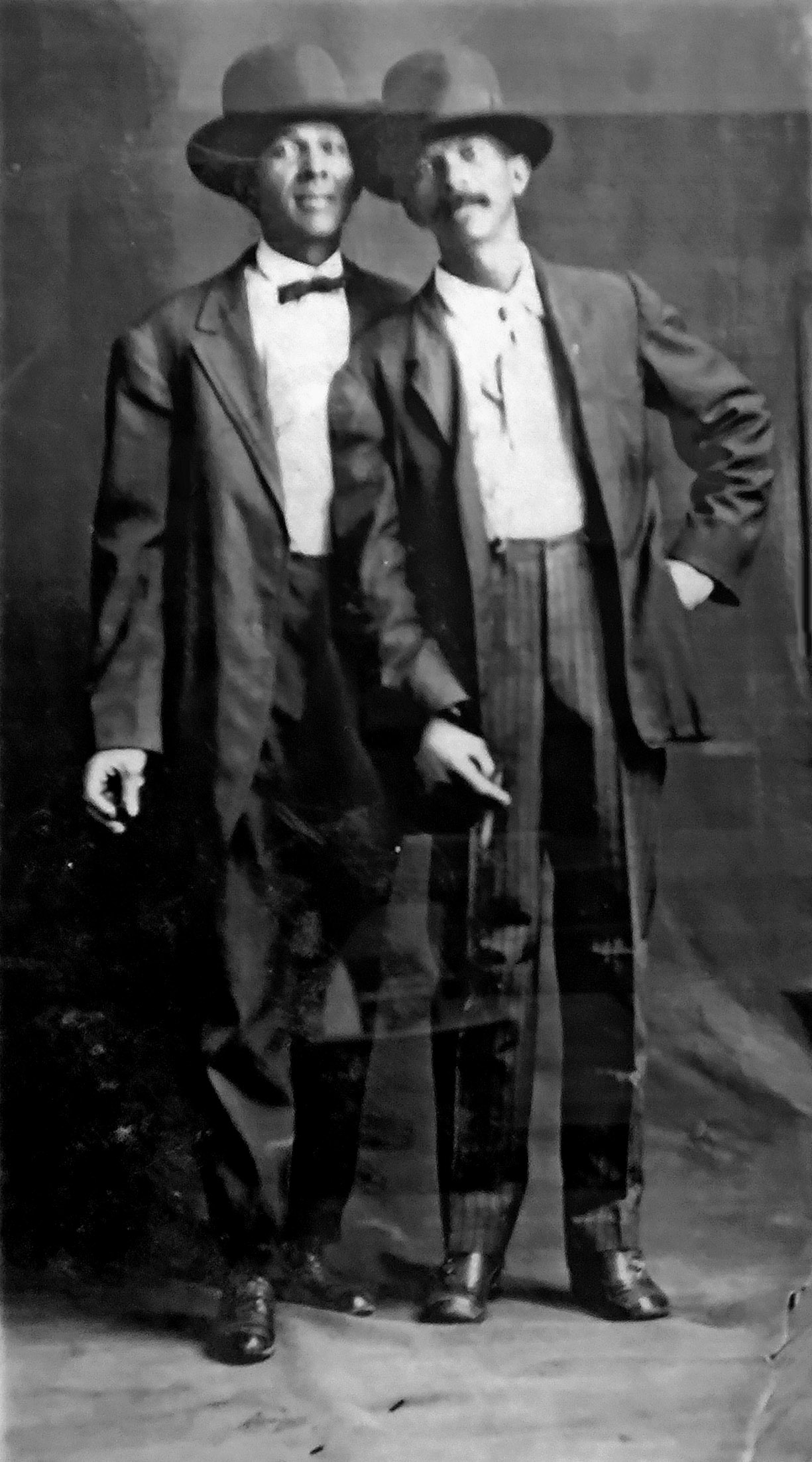
Believed to be a 1930s image of Embus Young and Odie Wright, this image hangs in the Fayetteville Public Library (Reference section) without attribution.
Jazz as a musical genre arose in the heart of Black America. Growing from so-called ‘plantation music,’ the style originally involved fiddle, five-string banjo, acoustic guitar, mandolin, upright bass and sometimes lap dulcimer.
“The music always had a strong ground beat, the rhythm of work, full of field hollers, forerunners of ‘the break,’ and insistent call and response patterns, blue notes, falsetto voices with melisma. …The plantation songs soon became drenched with the rhythms of the Southern churches, both offsprings of African drumming and went straight into Folk Blues and Country Music and Jazz…”[1]
Through touring vaudeville shows, widespread audiences came to love this exuberant musical style. And after Embus Young, a member of one of Fayetteville’s earliest Black families, performed with Al G. Field’s Minstrels, he spearheaded a local Black jazz group called the Black Diamond Orchestra. The group quickly came into wide demand, performing as early as 1903 at Monte Ne. Regular bookings continued through the 1920s and 1930s for all kinds of public and private events including sorority and fraternity dances at the University. Further commentary (1925) regarding benefit performances at the UA Peabody Hall and Leverett Elementary stated that “Colored programs are becoming quite the thing in Fayetteville, with an aroused interest in negro music and African folklore.”[2]
This investigation of Fayetteville’s Black Diamond Orchestra portrays the group’s members and their local family histories as well as affiliated performers like the Jubilee Singers and Half Pint Thompson. The spotlight of fame shining on Fayetteville’s Black community brings to life a neglected part of local history, the concluding chapter of The Music Men of Turn-of-the-Century Fayetteville, available at the Washington County Historical Society and at Amazon.com
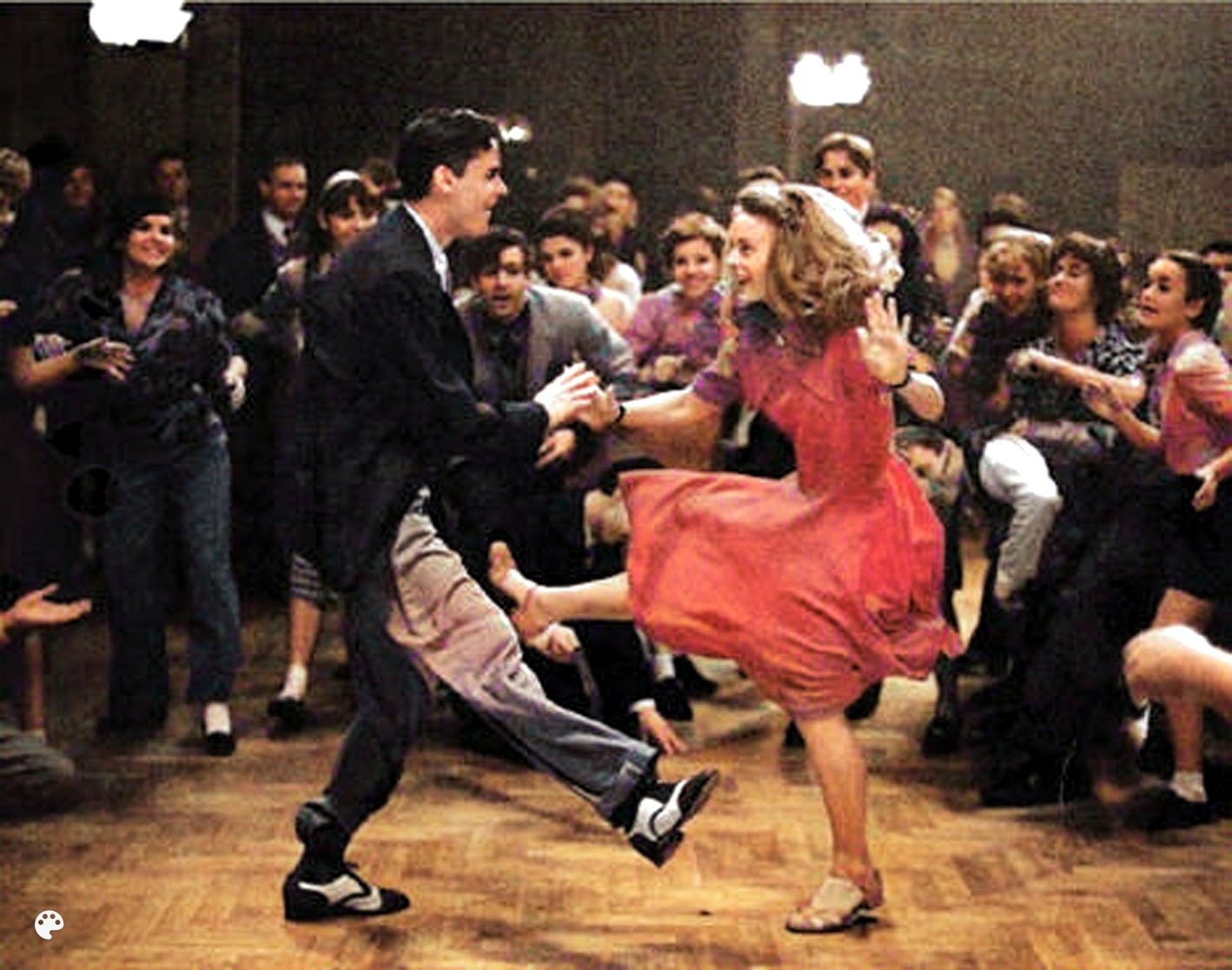
Unidentified dancers perform the Lindy Hop.
[1] “Plantation songs,” John P. Birchall Accessed Jun 1, 2022 @ https://www.themeister.co.uk/ dixie/plantation_songs. ‘Melisma’ is a musical style that allows several notes to be sung to one syllable of text.
Mitchell’s group ‘Arkansas Travelers,’ 1929 UA Yearbook. Mitchell seated at piano. Rex Perkins, violin, standing by piano
Owen Mitchell started teaching music when he was seven years old. A neighborhood boy wanted to learn to play piano so Owen shared what he knew. That was 1892. He would go on to become the first jazz band leader in Fayetteville.[1]
Owen Mitchell 1904, with Cadet Band
Mitchell didn’t start out with jazz. Upon entry to the University of Arkansas at Fayetteville in 1903, Mitchell pursued a degree in chemical engineering while continuing to follow his passion for music as a sideline. Mitchell graduated with a bachelor’s degree in chemistry in 1908 and for a time taught the subject at the University, probably as a graduate assistant. But he was never far from his love of music. Apparently something of a polymath in musical arts, described in one of many newspaper accounts of his performances as a “musician of unusual ability,” Mitchell played trombone, piano, and several other instruments. He understood music theory and composition, and served an important role in Frank Barr’s orchestra which performed at multiple social events around town.
During these early years, Mitchell traveled to St. Louis and Kansas City to experience what big city musicians had to offer, and he often accompanied Barr to help teach community bands in Cane Hill, Westville (Oklahoma), and other towns. [2] Eventually his love of music pulled him away from chemistry altogether, and he went on to lead Owen Mitchell’s Orchestra. The band was among the first to be heard on the new University radio station, KFMQ, in 1924. By January 1925, Mitchell’s radio programming split fifty-fifty between fox trots and waltzes. Within months, fox trot numbers filled two-thirds of the orchestra’s air time. Members of the group included violin, cello, and bass plus trumpet, clarinet, trombone, French horn, and drums. During summer months, the group played every evening at Riverside Park where a dance pavilion accommodated growing crowds.[3]
Other jazz groups quickly sprang up to meet public demand for popular new styles of jazz for community events, club gatherings, parties, and University dances. Through the 1920s and into the 1930s, Owen Mitchell kept ahead of the wave with music for dance fads like the Charleston, Black Bottom, and Lindy. Yet he maintained his ties to classical music both with University groups as well as teaching private piano lessons at his home on West Center. He traveled widely and advocated for the UA music department, making a plea in 1933 for better practice facilities. His leadership in innovative new musical styles fostered other jazz groups and informed a new generation of Fayetteville musicians.
The story of Mitchell’s contributions to Fayetteville’s music scene in the early 20th century is found in The Music Men of Turn-of-the-Century Fayetteville, available at the Washington County Historical Society and at Amazon.com
Swing dance remains a popular style and enjoys periodic revivals.
[1] “First” is not proven, since we do not know when he started his jazz group versus when the Black Diamond group started.
[2] The comment regarding his ability followed his solo piano performance of Grieg’s “Norwegian Bridal Procession.” Similar praise followed his performance of Grieg’s “Concerto in A Minor” the following month. FD Apr 3, 1914, p. 4. and Jun 9, p. 1.
[3] Riverside Park was a project of the Parker Brothers who operated a large nursery where the Fayetteville airport is now located. They first intended the park as a swimming spot and built bathhouses, restrooms, and other accommodations alongside the West Fork of White River.
Henry Tovey circa 1905, from his graduation at Knox University. The same image appears in the University of Arkansas Cardinal yearbook, 1910.
Who could have guessed, then or now, that in 1908, little old Fayetteville and the University of Arkansas would eagerly invite a gay man to their midst. Not that Henry Tovey advertised his sexual orientation or, perhaps, even acknowledged it to himself, much less others. But his role over the next 25 years as professor of piano and music as well as his larger-than-life presence in community, state, and even national arenas of music education could not help but reveal that he was not of the ‘traditional’ male ilk.
The fact is that homosexuality was widely tolerated and even admired in certain circles of American culture during that time period. As noted in a 2019 article, journalist Sarah Pruitt wrote:
On a Friday night in February 1926, a crowd of some 1,500 packed the Renaissance Casino in New York City’s Harlem neighborhood for the 58th masquerade and civil ball of Hamilton Lodge. Nearly half of those attending the event, reported the New York Age, appeared to be “men of the class generally known as ‘fairies,’ and many Bohemians from the Greenwich Village section who…in their gorgeous evening gowns, wigs and powdered faces were hard to distinguish from many of the women.” The tradition of masquerade and civil balls, more commonly known as drag balls, had begun back in 1869 within Hamilton Lodge, a black fraternal organization in Harlem. By the mid-1920s, at the height of the Prohibition era, they were attracting as many as 7,000 people of various races and social classes—gay, lesbian, bisexual, transgender and straight alike.[1]
Whether this broader scope of acceptance had managed to trickle down to Northwest Arkansas is debatable, but Tovey’s credentials fit two very important priorities for the university and community. For one, he had graduated from one of the finest music conservatories Illinois had to offer, studied abroad with acclaimed artists, and had gained acclaim in a brief tenure at Ouachita College in Arkadelphia, Arkansas, provoking critics to pronounce he held a “warm place in the hearts of our music lovers.”[2] Such expertise in the performing arts had become a priority to the university on the heels of the Gilded Age. Secondly, then as now, university professors and their families occupied an elevated position in Fayetteville, deriving mostly from far-flung origins and bringing with them not only higher education but also more sophisticated cultural characteristics than those possessed by the ‘locals.’
Tovey immediately became the darling of the town’s elite, invited to join fledgling social groups determined to open Fayetteville to the wider world. For example,
In November 1908, he joined Fayetteville’s Musical Coterie at its second meeting at the home of Mrs. F. O. Gully on Mont Nord, where the group declared “a most auspicious opening” for the beginning of the season. Their objective was to “arouse increased interest in the finest of all fine arts—music… We should have an annual Music Festival here every year… [which] would bring people from all parts of the state and from neighboring states to Fayetteville.”[3]
Henry Tovey 1928
Tovey was uniquely suited to the task before him, and he set about his destiny with great zeal. Not only did he help build a greater appreciation of classical music in Fayetteville and the rest of the state with his innovative teaching method utilizing the Victrola and recordings, a method soon adopted across the nation, he also promoted civic efforts to include town beautification, music education in the public schools, and the establishment of a country club and the Fayetteville Rotary Club. Perhaps most laudable was Tovey’s embrace of the rural people of Arkansas:
In a 1997 music journal article, Tovey is described as part of the Progressive effort to improve rural life with the use of music. “…[R]eformers focused on improving the economic and social conditions of rural people. Rural reformers expanded university offerings in music… In 1918, the Arkansas legislature voted to require music in the schools due largely to the efforts of Henry Doughty Tovey…
From his enormous musical talent to his elephant collection and regular hosting of delightful luncheons he prepared mostly for wives of prominent town and university notables and served at his home near campus, Tovey lived as a type of Renaissance Man. For example, one menu included “Bouillon * Toasted Wafers * Escalloped Oysters, Potatoes en Cream * French Peas * Chow Chow Pickle * Olives * Salt-rising Bread Sandwiches * Coffee * Tomato Aspic Moulded with Olives and Almonds * Mayonnaise Dressing * Cheese Sandwiches * Orange Parfait with Whipped Cream * Bon-Bons.”
The town and the state mourned his untimely end, but his contributions to his chosen community and state continue to resonate today. The story of this man and his amazing realm of accomplishments is part of The Music Men of Turn-of-the Century Fayetteville, available at the Washington County Historical Society, or from Amazon.com
Tovey with his bulldog Stubby MC 779 Lighton Family Papers, Box 28, Folder 7, Photograph 888, Digital Collections, Univ. ofAR, Fayetteville
Barr in the UA Cadet Band, 1897 UA Cardinal Yearbook
The question of when and how Frank Barr picked up a cornet and learned to play remains unanswered in the mists of time. Yet at the age of eighteen as a student at the University of Arkansas in 1892, this young man not only played but would soon become the bandleader for the University Cadet Band. He would go on to direct the University band for twenty years as well as recruiting youth for “Barr’s Boys Band” through the 1930s. But these were not Frank Barr’s only contribution to the community of Fayetteville and the surrounding region.
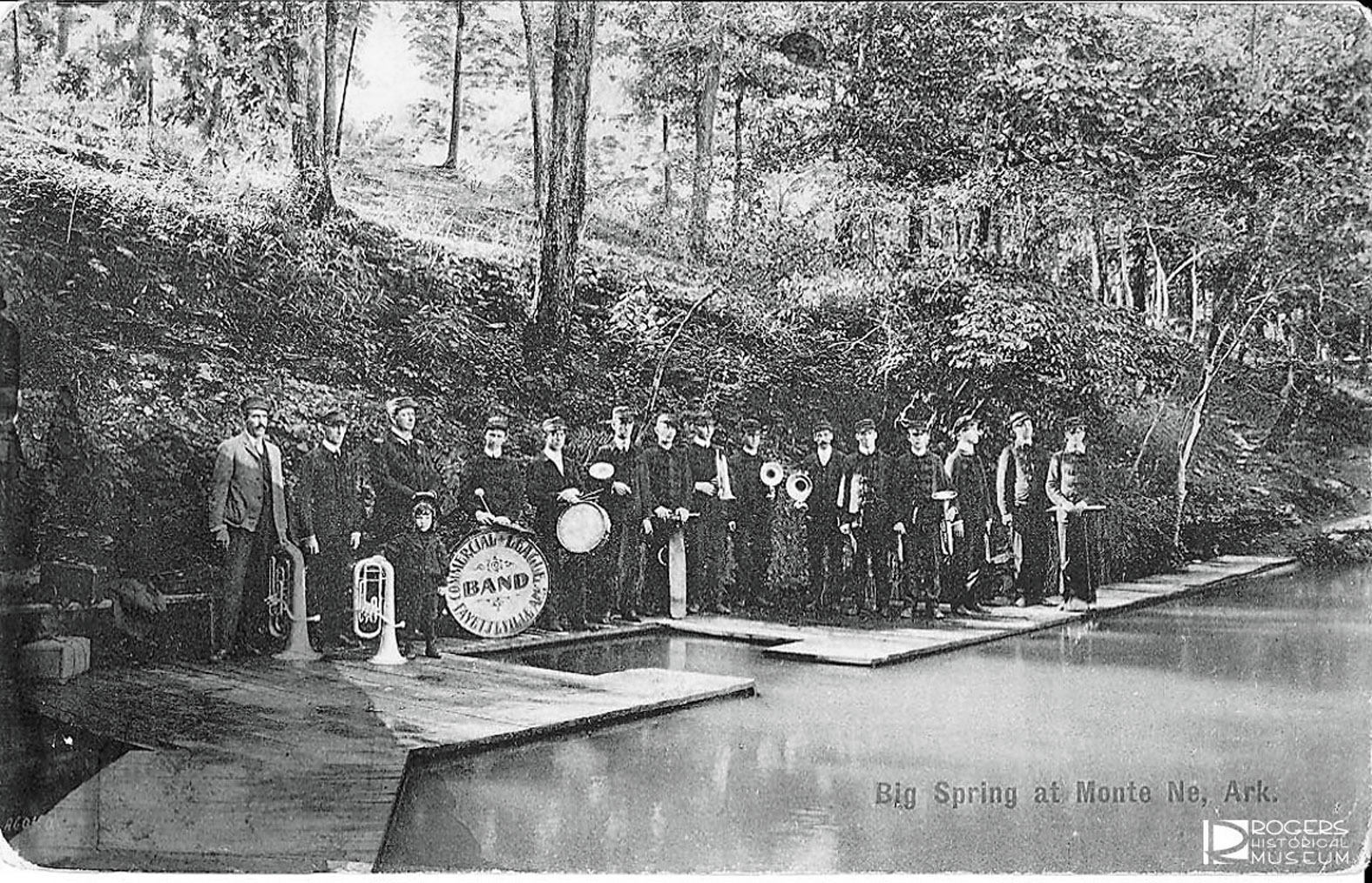
Ambitious and hard-working, Barr seemed to be in many places at once. He ventured throughout the region helping local community bands develop. He traveled in an ever larger arena to establish a string of silent movie theaters, perhaps because at that point in the media, music was expected to be performed while the movie reels rolled. He also prevailed upon Fayetteville town fathers to support a community band, to serve in various settings. The Commercial League Band went on to please multiple regional audiences.
Above: At Monte Ne. Frank Barr third from left with his son Clinton standing in front of him. Monte Ne’s creator William “Coin” Harvey always ensured that his resort guests stayed entertained during their visit. Whether it was by going to plays, listening to music or attending dances, his guests were assured to have a good time while at Monte Ne. This 1910 photo of the Commercial League Band from Fayetteville shows the ensemble standing in uniform on the wooden walkway around the edge of Big Spring.
Barr’s work with the Commercial League Band expanded to include playing at the skating rink as well as dances, the park, and open air concerts on the Square. In 1909, Barr took over a fledgling silent picture project that had operated briefly at the Ozark Opera House. He began showing the films, first in an open air setting at the corner of West and Dickson, then within months at 17 N. Block which he named Lyric Theater. He soon built a new theater at the northwest corner of Block and Meadow, tailored to the needs of an audience with its sloped floor and state of the art ventilation.
Alongside his growing responsibilities to the University, the community, and his various pursuits in promoting music, Frank and his wife Annie suddenly found themselves confronted with unthinkable. Their only child Clinton developed a serious medical condition, an ailment of his lungs. In August 1912, Frank and wife Annie took Clinton to Mayo Clinic in Rochester, Minnesota where two operations were performed. Another operation was performed in early January 1913, and before the end of the month, Annie asked Frank to come to Rochester as Clinton would require yet another operation. By June 1913, the situation with Clinton Barr had not improved. In a telegram to close friend Al Rife, Frank Barr described what his family faced.
“Necessary for another operation, could not live without it. Operation not so serious as before, lungs in far worse condition than ever, the x-ray locating nest of pockets, some the size of walnuts. Don’t know when can get in hospital. Opening made by previous operation will assist in this operation.”
The complicated and amazing story of Frank Barr reveals a man of vision and formidable emotional strength as he managed to keep up with the many demands before him. He and Annie mortgaged their properties to pay for Clinton’s medical expenses. He poured his energy into his Boys Band, playing in local parades and providing music for the new Lyric Theater. First reported in August 1912 when they were praised for their performance at the A.H.T.A. (Anti-Horse Thief Association) picnic at Elkins, the Boys Band was soon in demand around the region. In June 1913, they traveled to St. Paul to play for a three-day reunion. “The reunion people can rest assured that they will be furnished with good music,” the paper reported. “And besides, it will be quite a novelty to hear the Kids play. They always make a big hit wherever they go, and it will be a big drawing card for the Reunion.” The band performed so nicely that fall at the Washington County Fair that they were invited to perform at the state fair at Hot Springs.
Barr’s life is a fascinating testament to one man’s love of music and for his family. Read the whole story in The Music Men of Turn-of-the Century Fayetteville, available at the Headquarters House offices of the Washington County Historical Society, or from Amazon.com
Above, supporters of former President Donald Trump are seen protesting his indictment in Manhattan, New York, on Monday, April 3, 2023. KATHERINE FUNG / Newsweek 4.3.23
Others have said how, once a person has been duped, it is almost impossible to convince them they have been duped. They’ve bought in, hook, line and sinker. Never has this been more true than in the present day. Despite all our education and media and news report, our ‘advanced’ culture, nearly 40% of the U. S. population still holds a favorable view of Donald Trump.
Who are these people?
While they tasted the bait, times were glorious! They owned the world, vindicated in their every idea, belief, and prejudice. Racism wasn’t really racism while they tasted the bait, but rather the righteous validation of their belief in whiteness.
Thus it was for the role of women, made from Adam’s rib to be his helper. Subordinate. The weaker vessel, made to suffer the agony of childbirth to give man his offspring, a punishment for Eve’s original sin. Not to speak in the church of God Almighty—white male, of course.
It goes without saying that the homosexuals and transwhatever were scum of the earth. Hardly worth mentioning, not worthy of recognition much less any right to exist, work, marry, or enjoy life, liberty, and the pursuit of happiness.
Equally unworthy of mention were the heathen believers in Allah and other blasphemies, seeking to secretly infiltrate America with their insidious brown-skinned conspiracies to destroy the great God-given white nation we call America.
And so it continued for four glorious years as time after time Trump’s words and acts magnified and validated the prejudices. Never mind that God sent a plague, that over a million people died, under Trump’s watch. Never mind that he oversaw, indeed, implemented, a continuous scroll of misdeeds and treachery that threatened the very foundations of the U. S. Constitution. None of that mattered while the bait was ingested, while all the validations of hate surged through the hearts and minds of the true believers—the duped.
Now, with the efforts of honorable leaders eager to restore the nation to its solid foundations, its core philosophy that all of us were created equal, the duped refuse to accept the evidence. Refuse to read the indictments. Refuse to think that some, all, of the allegations might actually be true. No doubt even a trial and conviction will be denied by these folks.
Is this a matter of willful ignorance? Yes, but that’s not all.
In academic studies, subjects asked to distinguish truth from lies answer correctly, on average, only fifty-four per cent of the time. This is a result of several mitigating factors, not least of which is a sense of allegiance to the people and information sources we have already trusted. For example, in a Stanford University study,
A third type of bias comes from our existing political alignment, in the form of partisanship. When it comes to news and information generally, one’s identification as a Democrat or Republican, or one’s self-image of being liberal vs. conservative, has a big impact on what we readily believe or reject in the news, regardless of its truthfulness. As uncomfortable as this may be to accept, abundant research shows that people frequently reject news that’s inconsistent with their political ideology, and are prone to accept news that’s consonant with their political orientation. Like it or not, research demonstrated quite clearly that most politically-oriented fake news during the 2016 US election campaigns was consumed by conservatives, with Donald Trump supporters being especially likely to encounter and visit fake news sites. …Hillary Clinton supporters were more likely to visit fact-checking websites and less likely to visit fake news websites. Trump supporters were less likely to visit fact-checking websites and more likely to visit fake news websites.[1]
Similar conclusions have been confirmed in multiple studies. Lee McIntyre, research fellow at Boston University, has published several books on the conundrum of duped people.
One of the deepest roots of post-truth has been with us the longest, for it has been wired into our brains over the history of human evolution: cognitive bias. Psychologists for decades have been performing experiments that show that we are not quite as rational as we think. Some of this work bears directly on how we react in the face of unexpected or uncomfortable truths. A central concept of human psychology is that we strive to avoid psychic discomfort. It is not a pleasant thing to think badly of oneself. Some psychologists call this “ego defense” (after Freudian theory), but whether we frame it within this paradigm or not, the concept is clear. It just feels better for us to think that we are smart, well-informed, capable people than that we are not. What happens when we are confronted with information that suggests that something we believe is untrue? It creates psychological tension. How could I be an intelligent person yet believe a falsehood? Only the strongest egos can stand up very long under a withering assault of self-criticism: “What a fool I was! The answer was right there in front of me the whole time, but I never bothered to look. I must be an idiot.”[2]
Trump supporters are not the first group to suffer this terrible cognitive dysphoria. The Civil War is not over for many who cannot accept that what their ancestors fought and died for might have been wrong. In their multitude of righteous excuses for the Confederate cause, the war was not about slavery. Rather, the Lost Cause was based on six tenets:
Credit: Cook Collection, The Valentine Original Author: Unknown Created: ca. 1907 Medium: Photographic print Publisher: Valentine Richmond History Center
1. Secession, not slavery, caused the Civil War.
2. African Americans were “faithful slaves,” loyal to their masters and the Confederate cause and unprepared for the responsibilities of freedom.
3. The Confederacy was defeated militarily only because of the Union’s overwhelming advantages in men and resources.
4. Confederate soldiers were heroic and saintly.
5. The most heroic and saintly of all Confederates, perhaps of all Americans, was Robert E. Lee.
6. Southern women were loyal to the Confederate cause and sanctified by the sacrifice of their loved ones.[3]
The fundamental truth is that the war was about the South’s determination to continue its use of enslaved people to generate the bulk of its wealth. Tens of thousands of people of Southern heritage have bought into the falsehood of the Lost Cause, continuing to display the Confederate flag and nurse their invisible wounds.
Likewise, millions of people today are standing firm in their belief that Trump can do no wrong, that he was the legitimate winner of the 2020 election, and other similar dross. Don’t bother them with facts. Their minds are made up and their egos depend on it. One can only hope that enough of them will overcome the cognitive dissonance to accept that Trump was not sent by God Almighty to bestow an all-white conservative dispensation on the United States of America, but rather that he was and is a corrupt man clever enough to dupe 61,943,670 voters (2016 election).
Whether Twain actually said this remains an unproven irony.
Starving children in Budapest. But let’s have more!
Why would anyone want to force a woman to give birth to a child she doesn’t want? Don’t we have enough problems? It’s not like we’re running out of people. The U. S. population currently stands at 331.9 million and is expected to reach nearly 370 million in the next thirty years. Tired of traffic? Crowded city streets and sidewalks? Having to wait in line for what you need?
There is a direct correlation between population and pollution: more people, more trash, more car exhaust, more use of chemicals to produce food. There’s also the increase in taxes required to support social programs that keep people from starving. Homelessness isn’t a result only of mental illness or addiction, but also the need for affordable housing in a competitive culture where there aren’t enough houses for all the people. More population, more homelessness.
But wait! There’s more!
The global population growth rate is around .8% per year. That might not sound like much, but it translates in real numbers to an additional 67 million people PER YEAR, increasing by nearly 2 billion persons in the next 30 years, from the current 8 billion to 9.7 billion in 2050. And while we might feel briefly smug that this mostly isn’t happening in the United States, the fact is that it IS happening on our southern border.
It is only logical to acknowledge that an increase in the world’s population will cause additional strains on resources. More people means an increased demand for food, water, housing, energy, healthcare, transportation, and more. And all that consumption contributes to ecological degradation, increased conflicts, and a higher risk of large-scale disasters like pandemics.
Throw into that mix the effects of climate change.
Climate change is one of humanity’s most critical challenges. The warming of the planet threatens food security, freshwater supply, and human health. The effects of climate change, including sea level rise, droughts, floods, and extreme weather, will be more severe if actions are not taken to dramatically reduce emissions of greenhouse gases into the atmosphere. While the link between human action and the planet’s recent warming remains an almost unanimous scientific consensus, the links between population growth and climate change deserve further exploration.
USA Today
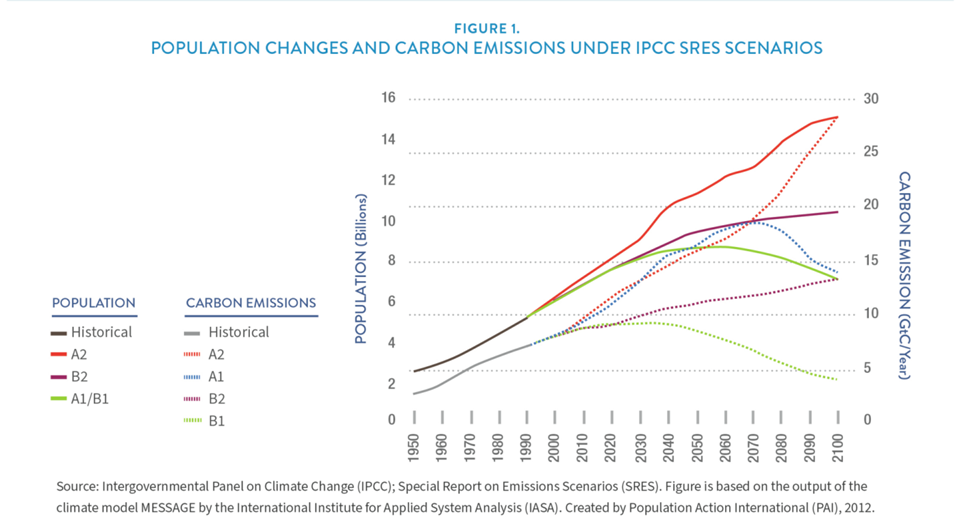
With 2 billion people to be added to our human ranks by 2050 and an additional 1 billion more by 2100, demographic trends and variables play an important role in understanding and confronting the world’s climate crisis. Population growth, along with increasing consumption, tends to increase emissions of climate-changing greenhouse gases. Rapid population growth worsens the impacts of climate change by straining resources and exposing more people to climate-related risks—especially in low-resource regions.
Including population dynamics in climate change-related education and advocacy can help clarify why access to reproductive health care, family planning options, girls’ education, and gender equity should be included in climate interventions. Increased investment in health and education, along with improvements in infrastructure and land use, would strengthen climate resilience and build adaptive capacity for people around the world.[1]
These facts are ignored in the evangelical push behind rightwing politics that have terminated U.S. efforts to promote birth control in Third World nations and continue to attempt to enact similarly restrictive laws in the U.S. After steadily declining for a decade, world hunger is on the rise, affecting nearly 10% of people globally. From 2019 to 2022, the number of undernourished people grew by as many as 150 million, a crisis driven largely by conflict, climate change, and the COVID-19 pandemic. Currently, the scale of the current global hunger and malnutrition crisis is enormous, with more than 345 million people facing high levels of food insecurity in 2023 – more than double the number in 2020.
And, the policy change backfired.
In countries that depend heavily on U.S. support for family planning and reproductive health programs, contraceptive use decreased 14 percent, pregnancies rose 12 percent, and abortions climbed 40 percent when the policy was in effect relative to countries less reliant on U.S. support. The evidence suggests that the policy leads to a reduction in contraceptive use and increased pregnancies and abortions.[2]
Wake up time! Despite FOX News propaganda, the crisis at our border is not created by drug cartels pushing fentanyl. It is about the same issues that have driven people to leave their homelands since prehistory: the need for opportunity to obtain food and safety. If economic conditions are unfavorable and appear to be deteriorating further, an increasing number of people will migrate to countries with a better outlook.
As noted in this 2022 report from the National Academy of Sciences:
Although family planning services are crucial for global health and achievement of the Sustainable Development Goals, their funding remains controversial. We document the health consequences of the “Mexico City Policy” (MCP), which restricts US funding for abortion-related activities worldwide. Since its enactment in 1985, the MCP has been enforced only under Republican administrations and quickly rescinded when a Democrat wins the presidency. Our analysis shows that the MCP makes it harder for women to get information on and support for reproductive health and is associated with higher maternal and child mortality rates and HIV rates worldwide. We estimate that reinstating the MCP between 2017 and 2021 resulted in approximately 108,000 maternal and child deaths and 360,000 new HIV infections.
Genius.
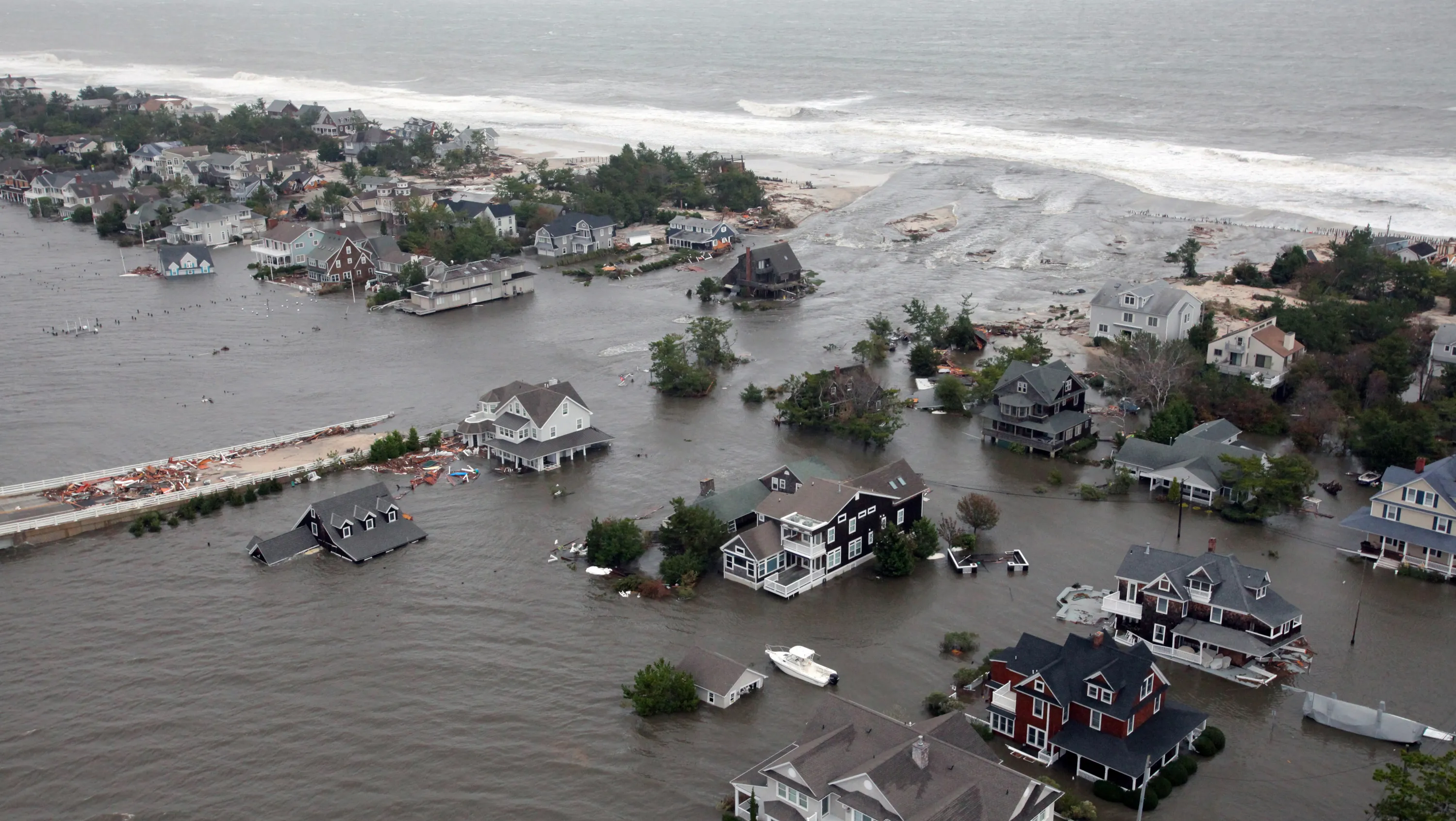
We have yet to hear a definitive solution from conservatives who seem to prefer an unlimited number of births even if such population growth exacerbates climate change and its many effects on humanity. What do they propose to do about people starving? Nothing? Just let them starve? What about people driven from their homes by rising sea levels? That is already a big problem in low-lying areas which are home to over 900 million people. What do we do about all those fetuses and babies, not to mention half-grown children, women and men?
The United Nations warns:
Between 250 and 400 million people will likely need new homes in new locations in fewer than 80 years, [the UN President] also warned of devastating impacts for the world’s “breadbaskets,” especially fertile deltas along the Nile, Mekong and other rivers.
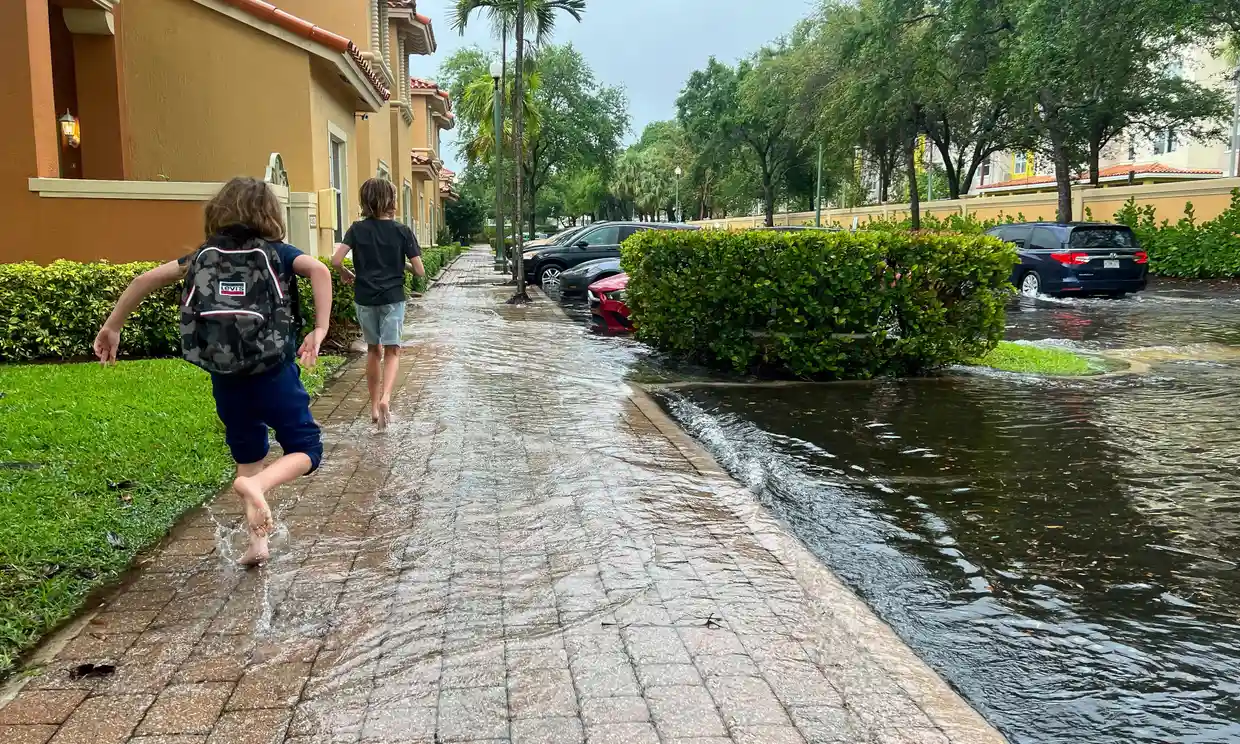
Apparently this won’t be a real problem until people can’t live in U.S. coastal cities. Oh, wait…
Flooding in Florida 2023 Photograph: Orit Ben-Ezzer/ZUMA Press Wire/Shutterstock
Look, we’ve already been through this. We went to a lot of trouble to adjust a biological form so that we could exist in it. A LOT of trouble.
Now, thanks to some of us, it looks like we’re headed back to a mechanical existence with Artificial Intelligence (AI), potentially ‘smarter’ than us embodied critters who struggle with the duality of animal/spirit existence. Sometimes the animal overrides our sense, our integrity, and bad things happen. Then there’s the annoying bit of bodily maintenance what with all the aches, pains, and annoyance of eating, sleeping, waking, walking, and cleaning up after ourselves. Then, as the saying goes, we die.
But we’ve forgotten why we went to all the trouble in the first place. We were BORED! What is the pleasure of existing forever in a form that can’t smell or taste bacon? What about the joy of standing outside after a rain and inhaling fresh moist air? The thrill of snow? What about splashing in a stream? Catching a fish? Digging in a garden? Holding a purring cat?
What about beholding the vista of distant snow-capped mountains? Or of the mighty sea as its lapping waves caress our feet?
What about meeting someone who triggers that amazing animal instinct called mating? Oh, the touching, kissing, the wondering and weeping, the throes of orgasm as we curl into our mate? The warmth of hugging, holding.
We seem to have forgotten the reasons we exist in this hybrid form, this animal with a mysterious intellect that can’t seem to fully elucidate itself. The animal gives our emotions, our senses of taste, smell, hearing, sight, and touch. The animal understands running, swimming, climbing. The animal creates its own future by reproducing adorable little versions of ourselves. The animal knows the overwhelming smack-you-in-the-forehead ecstasy of physical existence.
So now some smart asses are grabbing their claim to fame with their AI creation, mini-wannabe gods who will set us back a few million years to when we first started tinkering with the ape form in the hopes of taking a ride inside. Hasn’t their ilk done enough already, what with assault rifles and nuclear weapons?
I mean, okay, I enjoy running water, air conditioning, and supermarket shelves full of choices. I prefer using a motor vehicle to travel near and far rather than my feet or the horse. Television is nice and, admittedly, this communique comes to you via computer and the internet. But look where that has brought us!
So, in conclusion fellow hybrids, are really going to send ourselves out of our lovely bodies?
War still edges out climate change as the current greatest cause of starvation. It’s an ouroboros (snake eating itself, i.e. vicious cycle) wherein the more devastated a landscape becomes and the less food it can produce, the more people fight over it. Which leads to more conflict, etc. It is important to note that climate change alone has not been proven to increase the likelihood of discord; however, climate change compounded with challenging economic, political, or social conditions can heighten the risk of conflict.
Evidence links rise in temperature to a rise in civil war. Researchers at Princeton University and UC Berkeley found that a rise in average annual temperature by even 1° Celsius (1.8° Fahrenheit) leads to a 4.5% increase in civil war that year. There has been a global increase in the incidence of civil war following World War II, with civil wars even having a greater number of casualties than international wars. Civil wars are dangerous, and climate change is making them more common.[1]
In 2022, the five regions with the highest number of hungry people as a proportion of population included:
Middle Africa: 31.8%
East Africa: 28.1%
Western Africa: 18.7%
Caribbean: 16.1%
Southern Asia: 15.8%
The Sahel, located between Sudan and the Sahara (West Africa) and regarded as the most vulnerable area to climate change, is a semi-arid region comprising some of the world’s poorest and most fragile states (e.g. Mali, Niger, Burkina Faso, Chad, and Mauritania).[2]
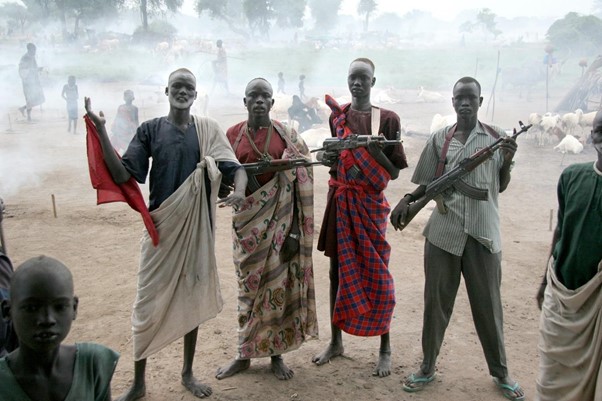
Darfur, a region in the Western part of Sudan, has been in a state of emergency since 2003. “…The general notion is that the decline in rainfall and land degradation increased and intensified already existing violent struggles over pastures, water and farmland, proportionally resulting in a large scale civil war.”[3]
Population growth, along with increasing consumption, tends to increase emissions of climate-changing greenhouse gases. Rapid population growth worsens the impacts of climate change by straining resources and exposing more people to climate-related risks—especially in low-resource regions. There has been a reluctance to integrate discussions of population into climate education and advocacy. Yet climate change is tightly linked to population growth.
Top 10 Countries with the Highest Fertility Rates (by births per woman) – World Bank 2021 (2019 data). If these country names look familiar, check the list above of nations with the greatest rates of starvation.
Niger – 6.8 (West Africa)
Somalia – 6.0 (East Africa)
Congo (Dem. Rep.) – 5.8 (tie) (Middle Africa)
Mali – 5.8 (tie) (West Africa)
Chad – 5.6 (Middle Africa)
Angola – 5.4 (West Africa)
Burundi – 5.3 (tie) (East Africa)
Nigeria – 5.3 (tie) (West Africa)
Gambia – 5.2 (West Africa)
Burkina Faso – 5.1 (West Africa)
As the U.K.-based charity Population Matters summarizes: “Every additional person increases carbon emissions—the rich far more than the poor—and increases the number of climate change victims—the poor far more than the rich.” At the national level, there is a clear relationship between income and per capita CO2 emissions, with average emissions for people living in industrialized countries and key oil producing nations topping the charts. High-consuming lifestyles and production practices in the highest income countries result in much higher emissions rates than in middle and low-income countries, where the majority of the world’s population lives.[4]
Sadly, the people suffering the most from climate change are those least responsible for the problem. For example, the United States represents just over 4% of the global population but accounts for 17% of the world’s energy use. Per person carbon emissions are among the highest in the world. People living in the United States, Australia, and Canada, have carbon footprints close to 200 times larger than people in some of the poorest and fastest-growing countries in sub-Saharan Africa—such as Chad, Niger, and the Central African Republic. In the middle of the spectrum are the middle-income economies, home to 75% of the world’s population. In these places, industrialization will increase standards of living and consumption patterns over the coming decades. Without changes to how economies tend to grow, carbon emissions will rise.[5]
As there is no panacea for combating climate change, a wide variety of options needs to be exercised. An integrated approach includes educating girls and empowering women to make their own decisions about reproduction.
While the United States is best equipped to address the issue of reproduction, Republican lawmakers have systematically gutted programs which offered reproductive health care to these places. President Ronald Reagan first enacted the global gag rule—also known as the Mexico City Policy—in 1984. Every president since Reagan has decided whether to enact or revoke the policy, making NGO funding vulnerable to political changes happening in the United States. The rule forces organizations to choose whether to provide comprehensive sexual and reproductive health care and education without U.S. funding, or comply with the policy in order to continue accepting U.S. funds.
Used by U.S. presidents since 1984 to signal their stance on abortion rights, the rule has been backed by Republicans – including Bush from 2001 to 2008 – and revoked by Democrats.
When the policy was in place in the Bush era, modern contraception use declined by 14% and pregnancy rates rose 12% in Sub-Saharan countries most reliant on U.S. family planning aid, a study found. When the policy was rescinded by Democratic President Barack Obama, the pattern reversed, with higher contraceptive use and fewer abortions.
Former President Donald Trump reinstated the rule in 2017. The evangelical-backed ban on funding for reproductive care extends beyond reproduction. Nearly 50 percent of global HIV and AIDS funding comes from the U.S. government. Under President Trump’s expanded global gag rule, the quality and availability of HIV services, including treatment, testing, and prevention, began suffering dramatically—more than previous iterations of the rule. The policy under Trump undid decades of work to integrate sexual and reproductive health services with HIV services. Vulnerable populations, and men who have sex with men in particular, began experiencing significant health service disruptions as a result of the global gag rule. Clearly, the evangelical-condoned ban isn’t about brotherly love.
Meanwhile, multiple studies have shown that the global gag rule has not decreased rates of abortions but instead has increased the number of unsafe abortions.
U.S. funding for family planning/reproductive health care is governed by several other legislative and policy requirements, including a legal ban on the direct use of U.S. funding overseas for abortion as a method of family planning (the Helms Amendment, which has been in place since 1973) and, when in effect, the Mexico City Policy (reinstated and expanded by President Trump as the “Protecting Life in Global Health Assistance” policy but rescinded by President Biden upon taking office).[6]
In the situation where Republicans routinely disrupt the best efforts of U.S. progressives to reduce human suffering around the world, we can expect more war, more starvation (especially for mothers and children) and much greater human suffering all around.
















 denelecampbell