

The absurdity is overwhelming. Here we are as Americans, all party to the White House’s illegal murder of over eighty (so far) men in boats on the premise they are bringing drugs to the United States. As well remarked elsewhere, there is no evidence these boats are carrying drugs and no credibility in the idea these small vessels with a fuel range of 100-200 miles are embarking on a thousand mile journey to the U.S.
But even more insane is the idea that a nation under any government can stamp out drug use/abuse by ‘interdicting’ drugs enroute to this country. We can’t even stamp out drugs manufactured in within the borders of this country. Anyone who believes such nonsense needs to have these words tattooed onto their forehead: Supply-Demand. If people want a product, no matter how potentially dangerous, there will ALWAYS be a supplier. Basic economic fact. Reducing supply only results in higher prices for said product, i.e. better profits, more incentive to supply.
So let’s get real about illegal drugs. First, “drug users” include people who depend on caffeine in their morning coffee, iced tea at lunch or other caffeinated beverages, persons who ‘must have’ their cigarettes or other tobacco products, and persons prescribed any of a multitude of pharmaceuticals which address any of a multitude of human conditions from depression to headache to cancer. Secondly, there is an enormous difference between the use of and the abuse of any drug. Prohibitionists prefer to consider all illegal drug use as ‘abuse’ in order to justify draconian laws punishing users. We must keep in mind the blurred line dividing legal and illegal drugs is primarily based on their regulatory status and whether their production, sale, and use are permitted by law. Theoretically, this status is determined by government authorities based on factors like medical utility, potential for abuse, and perceived harm to the individual and society. In other words, there is no truly ‘illegal’ drug.
This theory supporting the prohibition of certain drugs has been shown to be a fabrication serving other less savory objectives. The drug war is a tool used by government to carry out activities which are illegal. For example, one might wonder about the president’s single-minded assault on alleged drug smugglers from Venezuela when coca leaf is grown in three other Latin American countries: Peru, Bolivia and Colombia. Surely the fact that Venezuela possesses the world’s largest oil reserves has nothing to do with it. Surely.
Never mind the fact that cocaine is hardly relevant in drug abuse circles since fentanyl hit the streets. In 2023, there were approximately 72,776 overdose deaths involving fentanyl (synthetic opioids other than methadone) compared to about 29,449 deaths involving cocaine.

In order to better understand this absurdity, let’s go back more than a century to the country’s first ‘drug war’. The San Francisco Opium Den Ordinance of 1875 made it a misdemeanor to maintain or visit places where people smoked opium. These places were mainly in Chinese immigrant neighborhoods. Similar racially inflammatory state laws emerged. Soon after came the Chinese Exclusion Act of 1882, which barred Chinese laborers from entering the U.S., a ban expanded to all Chinese people in 1902 and not fully repealed until 1943. The first federal drug law, the 1909 Smoking Opium Exclusion Act, prohibited importing and using opium. It wasn’t that the government suddenly became concerned about opium use. In a nutshell, it was that the railroads powering the economic growth of that period were now built, and thousands of Chinese who had been welcomed to this country to do the backbreaking work of carving tunnels out of rock and laying steel track were no longer of use. Even worse, these immigrants, the primary users of opium, were inviting relatives to immigrate and their jobs were seen as threats to white workers.[1]
Then there was alcohol. After nearly a century of growing religious fervor stemming from massive evangelical movements, especially the “Second Great Awakening,” characterized by fiery camp meetings, frontier revivalism, and emotionally charged preaching, a rising cry against alcohol resulted in ‘prohibition,’ enacted on a federal basis in 1920 but in individual states as early as the 1880s.

“A wide coalition of mostly Protestants, prohibitionists first attempted to end the trade in alcoholic drinks during the 19th century. They aimed to heal what they saw as an ill society beset by alcohol-related problems such as alcoholism, domestic violence, and saloon-based political corruption.”[2]
Alcohol prohibition led to massive increases in organized crime (bootlegging, speakeasies), rampant corruption of officials, dangerous unregulated alcohol leading to sickness/death, huge losses in government tax revenue, and a general disrespect for the law, with little measurable public health benefit, ultimately proving a costly failure. Ultimately, prohibition led to the development of the Federal Bureau of Investigation (FBI), significantly expanding the role and authority of the FBI’s predecessor, the Bureau of Investigation (BOI), making it central to federal law enforcement by creating massive new criminal enterprises (bootlegging) that required federal intervention, strained resources, spurred corruption, and ultimately led to bigger federal crime-fighting roles and the rise of modern organized crime, impacting federal investigations for decades.

This powerful new agency could have drifted into irrelevance when alcohol was once again legal in 1932, but instead there is evidence that the federal official who spearheaded cannabis prohibition saw it as a way to maintain his department’s relevance and budget. Harry Anslinger, the head of the Federal Bureau of Narcotics (FBN), needed a new focus for his agency after alcohol prohibition was repealed. He launched a public campaign against cannabis (often using the “marihuana” spelling to associate it with Mexican immigrants), portraying it as a dangerous substance to justify his department’s continued existence. Anslinger’s rhetoric carried strong undercurrents of racial prejudice and xenophobia, targeting Mexican immigrants and Black jazz musicians.
Then as the ‘60s ended with massive marches in support of equal rights for minorities and women, against the Vietnam war, and in support of gay rights, President Richard Nixon officially launched the “War on Drugs” in the early 1970s, declaring drug abuse a public enemy and enacting significant federal legislation like the Controlled Substances Act to combat drug production, distribution, and use, though policies intensified under subsequent administrations.
One of Richard Nixon’s top advisers and a key figure in the Watergate scandal said the war on drugs was created as a political tool to fight blacks and hippies, according to a 22-year-old interview recently published in Harper’s Magazine.
“The Nixon campaign in 1968, and the Nixon White House after that, had two enemies: the antiwar left and black people,” former Nixon domestic policy chief John Ehrlichman told Harper’s writer Dan Baum for the April cover story published Tuesday.
“You understand what I’m saying? We knew we couldn’t make it illegal to be either against the war or black, but by getting the public to associate the hippies with marijuana and blacks with heroin and then criminalizing both heavily, we could disrupt those communities,” Ehrlichman said. “We could arrest their leaders, raid their homes, break up their meetings, and vilify them night after night on the evening news. Did we know we were lying about the drugs? Of course we did.”[3]
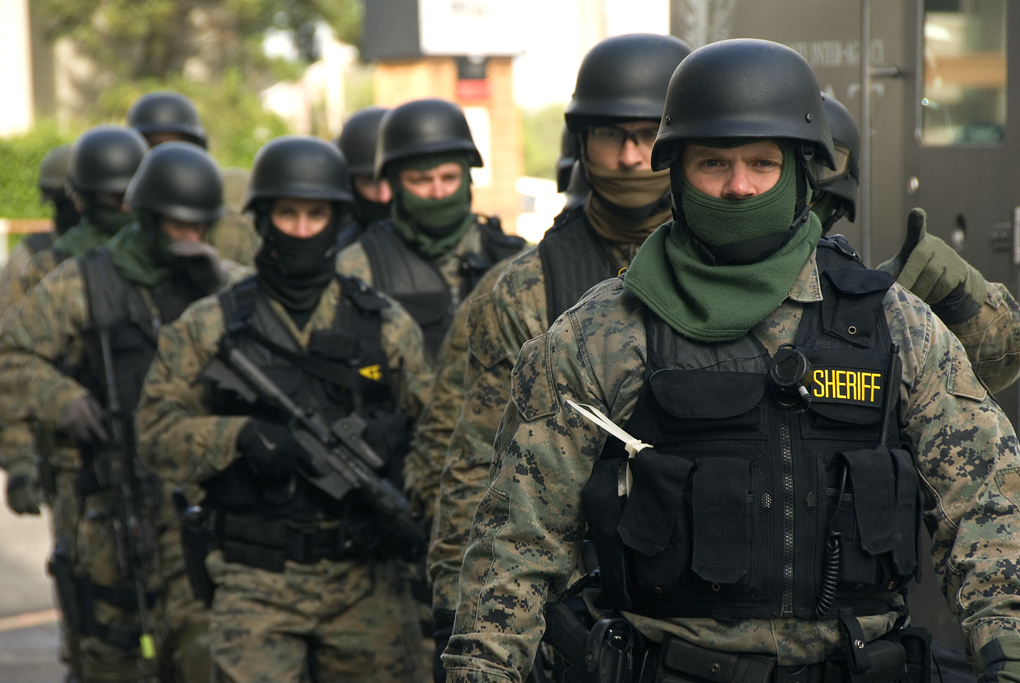
In the next administration, First Lady Nancy Reagan famously addressed the drug “problem” with her “Just Say No.” advice, unwittingly illustrating the parental role now assumed by government over the private, consensual behavior of drug users. Reagan’s successor, George H.W. Bush, took it a step further. He promoted the 1033 Program (Defense Logistics Agency (DLA) Disposition Services) in the early 1990s to transfer surplus military gear to local law enforcement for the “War on Drugs.” Nowhere in this rush to judgement did anyone point out that M16/AR-15 rifles, grenade launchers, armored vehicles (APCs, MRAPs), night vision, tactical robots, and “less-lethal” gear (beanbag/pepperball guns, flashbangs) have absolutely no effect on drugs. These weapons and the “war” in which they are being used are against PEOPLE—American citizens, most of whom simply preferered to toke a joint after work rather than drink an alcoholic beverage.
This despite the fact that in the 1970s and ‘80s, marijuana was by far the most widely used of illegal drugs, was found in multiple studies not to be addictive and also found not to be a ‘gateway’ to harder drugs, as so often alleged in government reports. Even today, with drugs like cocaine and even fentanyl in the headlines, according to the United Nations Office on Drugs and Crime (UNODC) World Drug Report 2024, the estimated number of people who used various drugs at least once in the prior twelve months was: Cannabis (Marijuana): 228 million users; Opioids: 60 million users; Amphetamines: 30 million users; Cocaine: 23 million users; Ecstasy: 20 million users.
All the while, the drug war of those decades provided cover for illegal U.S. government operations in Central and South America as those nations began to resist colonization by American corporations seeking to exploit natural resources like oil, minerals, and agricultural opportunities. Fertile land and cheap labor could produce crops such as coffee, bananas, and other foods requiring year-round growing seasons.
According to Tim Weiner, the Central Intelligence Agency “has been accused of forming alliances of convenience with drug traffickers around the world in the name of anti-Communism” since its creation in 1947.[4] The CIA has a long, controversial history in South America, primarily during the Cold War, involving covert operations like coups, political destabilization, and support for right-wing regimes (e.g., Operation Condor) to counter perceived communist influence, leading to significant human rights abuses and democratic declines, with operations continuing into recent times, such as those in Venezuela. Key actions included overthrowing governments (Chile, Ecuador, Brazil), supporting anti-communist forces (Contras in Nicaragua, a major scandal where in U.S. operatives sold guns to Iran between 1981 and 1986, facilitated by senior officials of the Ronald Reagan administration. The administration hoped to use the proceeds of the arms sale to fund the Contras, an anti-Sandinista rebel group in Nicaragua.), and involvement in conflicts like the Salvadoran Civil War, with consequences like suppressed democracy and economic impacts.
This kind of interference in the affairs of other nations more or less permeates American history. In the early 20th century, during the “Banana Republic” era of Latin American history, the U.S. launched several interventions and invasions in the region (known as the Banana Wars) in order to promote American business interests. During the Cold War (1950s-1980s), the CIA carried out coordinated campaigns to install South American dictatorships (Argentina, Chile, Brazil, etc.) to track, kidnap, torture, and kill left-wing dissidents, with CIA support and intelligence sharing. In Guatemala (1954), the CIA overthrew the democratically elected President Jacobo Árbenz, linking to U.S. corporate interests, using exile forces and propaganda. In Chile (1970s), CIA efforts undermined President Salvador Allende, paving the way for a military coup. Same idea for Brazil (1964): Supported a coup against President João Goulart, leading to a military dictatorship. Nicaragua (1980s): Funded and trained the right-wing Contra rebels fighting the socialist Sandinista government, with alleged links to cocaine trafficking. El Salvador (1980s): Trained and equipped military units involved in massacres during the civil war.
CIA interventions often resulted in the collapse of democratic institutions, reduced civil liberties, and economic hardship, despite justifications of promoting democracy or fighting communism, according to research. The support ‘troops’ for these political objectives has become de facto occupation of these nations with armed agents of the U.S. Drug Enforcement Agency, with 87 foreign offices in 67 countries. For example, in the so-called “Southern Cone,” (Brazil, Chile, Argentina, Paraguay, Peru and Uruguay), are considered to be transit zones for the movement of cocaine base, cocaine HCL, and heroin being shipped from Colombia and Peru to markets in the U.S. and Europe, or producers of coca leaves. The end result of these often violent interventions in the affairs of our neighbors is the current and ongoing flood of desperate people arriving at our borders.
Not only are drug laws used outside our nation’s borders as cover for extra-judicial interference in international relations, they also serve domestically to selectively target specific individuals and politically inconvenient groups or based on racism or other prejudices, most recently undocumented immigrants. This is a useful tool for xenophobes determined to turn the United States into a white patriarchal “Christian” nation. The current administration manipulates this demographic by playing up the drug war.
Public support for prohibition policies relies on judgments of morality, that becoming intoxicated is immoral, an echo of the early 1800s temperance movement which reached its zenith with alcohol prohibition, the Eighteenth Amendment to the United States Constitution. This same moral judgment about private consensual activity remains a strong current in the United States where prostitution, gambling, and drug use (other than legal drugs) fall under strong government control. While government cannot (yet) spy on the living rooms and bedrooms of its citizens, government agents find such laws useful in targeting specific types of people, as previously illustrated.
“Today, police make more than 1.5 million drug arrests each year, and about 550,000 of those are for cannabis offenses alone. Almost 500,000 people are incarcerated for nothing more than a drug law violation, and Black and brown people are disproportionately impacted by drug enforcement and sentencing practices. Rates of drug use and sales are similar across racial and ethnic lines, but Black and Latinx people are far more likely than white people to be stopped, searched, arrested, convicted, harshly sentenced, and saddled with a lifelong criminal record.
“The wide-ranging consequences of a drug law violation aren’t limited to senseless incarceration: people with low incomes are denied food stamps and public assistance for past drug convictions; states including Texas and Florida suspend driver’s licenses for drug offenses totally unrelated to driving; and numerous other policies deny child custody, voting rights, employment, loans, and financial aid to people with criminal records.”[5]
Despite apparent national political resolve to deal with the drug problem, inherent contradictions regularly appear between U.S. anti-drug policy and other national policy goals and concerns. Pursuit of drug control policies can sometimes affect foreign policy interests and bring political instability and economic dislocation to countries where narcotics production has become entrenched economically and socially. Drug supply interdiction programs and U.S. systems to facilitate the international movement of goods, people, and wealth are often at odds.[6]
- “We are still in the midst of the most devastating drug epidemic in U.S. history,” according to Vanda Felbab-Brown, senior fellow at the Center for Security, Strategy, and Technology at Brookings Institution. In 2020, overdose deaths in the United States exceeded 90,000, compared with 70,630 in 2019, according to research from the Commonwealth Fund. Yet, the federal government is spending more money than ever to enforce drug policies. In 1981, the federal budget for drug abuse prevention and control was just over a billion dollars. By 2020, that number had grown to $34.6 billion. When adjusted for inflation, CNBC found that it translates to a 1,090% increase in just 39 years.[7]
What if that money had instead been applied to individuals and programs that support individual ambitions and needs—tiny homes for the homeless, for example? What if the costs of our interference in foreign nations had instead been directed toward helping the people of those nations deal with loss of farmland to multinational corporations, climate-change induced drought and hurricane damage, and support for social programs, education, and entrepreneurship, thereby reducing the urgency of people in those countries to flood to U.S. borders in hope of better lives?
Without hot button issues like women’s reproductory rights and drugs, politicians would have to gain votes based on performance rather than propaganda. Stepping away from “government as nannies” and the idea of controlling private behavior would allow taxpayer dollars to support programs that help deter substance abuse in the same way that public education has helped reduce the use of cigarettes. No one knows better than addicts that they, individually, are the only ones who can control their addiction. Ultimately, as free people, we must claim the fundamental right to kill ourselves if we wish it. Most importantly, awareness of draconian drug policies as a cover for illegal objectives both in and outside our nation’s borders would forever eliminate travesties such as the murdering of likely-innocent people in boats leaving Venezuela.
And, in the case of the current administration, understanding the real agenda of the drug war could rightfully turn the public attention fully to the president’s dirty Epstein laundry.
[1] https://muse.jhu.edu/article/240064
[2] Wikipedia, https://en.wikipedia.org/wiki/Prohibition_in_the_United_States
[3] https://www.cnn.com/2016/03/23/politics/john-ehrlichman-richard-nixon-drug-war-blacks-hippie
[4] https://en.wikipedia.org/wiki/CIA_drug_trafficking_allegations
[5] https://www.vera.org/news/fifty-years-ago-today-president-nixon-declared-the-war-on-drugs
[6] https://www.everycrsreport.com/reports/RL33582.html
[7] https://www.cnbc.com/2021/06/17/the-us-has-spent-over-a-trillion-dollars-fighting-war-on-drugs.html




 denelecampbell