Those Evil Corporations!

I agree that corporations should not be allowed to make political contributions, and in that regard, they’re not ‘persons.’ That’s a step too far. But I’m here to defend the concept of corporations. Liberals need to get up to speed on corporate structures and why they exist. The long howling rant against corporations as a general concept discredits the progressive movement.

A corporation mostly isn’t a bad thing. There are non-profit corporations we rely on every day, and plenty of for-profit corporations that bring us everything from electricity to internet to vehicles. Corporations have been the construct by which new inventions in digital technology, medicine, and transportation have come to exist in the modern world.

The commercial incorporator has a specific objective—to streamline the business operation. Under the corporate umbrella, the business owner(s) can partner with other entrepreneurs, obtain materials, hire workers, own property, and produce goods and/or services from one checkbook, that is, the corporate checkbook, without having to do those things in his/her own name.

Likewise, the corporation can pay wages to the owner(s) and all employees and provide the corporation’s required contribution to Social Security and Medicare funds as well as unemployment  and disability insurance (required by law) and in many cases, health insurance—all without involving the owners’ private personal income and spending.

Whatever money the corporation holds in its bank accounts (and other investments) that is not spent on production/operations can be paid out in dividends to its stockholders. ‘Dividends’ is a simple concept: whoever put in money to help the company start and/or grow is paid a divided portion of the profits (usually quarterly) according to the amount paid in. If there are significant profits above and beyond operating expenses, the money paid in dividends can be an important income source for stockholders.

My disabled brother in law, for example, received big oil stocks as a gift from his father who had been at the leading edge of early oil exploration in Texas. Dividends from those stocks have made the difference for him and my sister in raising their family and surviving as they age. Even if we abhor the environmental degradation created by the oil industry, is there something evil about him receiving those dividends?

The concept of the ‘evil corporation’ is so ingrained that the term has its own entry in Wikipedia: “An evil corporation is a trope in popular culture that portrays a corporation as ignoring social responsibility in order to make money for its shareholders. …Evil corporations can be seen to represent the danger of combining capitalism with larger hubris.”

What is social responsibility then, that corporations may find easy to ignore? “Social responsibility is an ethical framework and suggests that an entity, be it an organization or individual, has an obligation to act for the benefit of society at large.”[1]

Walmart, for example, has tried to claim social responsibility by its efforts to reduce waste, streamline shipping, and provide better work conditions and wages. Their 2018 Global Responsibility Report highlighted collaboration “with industry experts, NGOs, suppliers and the company’s own research to address risks pertaining to social issues in the supply chain.”[2] In general, Walmart’s approach to “environmental, social and governance issues goes beyond minimizing our own footprint or mitigating risk. We take a more assertive approach: sparking collective action to transform the retail sector for environmental, social and economic stability.”[3]

While naming laudable goals for one of the world’s largest corporations, Walmart continues to reap massive profits for its shareholders and especially the Walton heirs. “Sam Walton’s descendants have a combined wealth of $163.2 billion, according to Bloomberg. This is more than Jeff Bezos, Bill Gates, and Warren Buffett, and nearly $70 billion more than the second-richest family in the United States, the Kochs.”[4]

Bernie Sanders has remarked that the Waltons earn more per minute than its employees earn in a year, and number crunchers have shown this is true (about $25,000 per minute). That imbalance would hardly decrease even if the company paid its 2.1 million employees $20 per hour. That would increase the total payroll by around $20 million, a drop in the bucket to the Walton heirs’ annual dividend payment of about $3.2 billion.  Such a wage increase would also go a long way to reducing employees’ need for social welfare support at taxpayer expense, currently estimated at $6.2 billion in public assistance including food stamps, Medicaid and subsidized housing.

This kind of inequity in profits versus salaries is one of the reasons corporations are seen as evil. And there’s no question that over the centuries as the corporation has matured as a legal entity, it has also maneuvered ways to embody self-serving benefits into law. It is this unfair advantage of a large, organized, well-financed behemoth versus the unorganized ‘little man’ citizen that drives much of the present-day fury toward corporations.

We can’t rely on corporate conscience to ensure fairness in its wages or environmental conduct, a lesson we’ve learned time and again. Just as environmental laws have reduced egregious corporate pollution, policy makers should pass laws that apportion CEO pay and stockholder dividends according to employee wages to ensure a livable wage. After all, without the employees, corporations would have nothing. Unions used to provide this balance, but right-to-works laws and the move to overseas production has pulled the rug out from under them.

Nevertheless, it’s wrong-headed to blame corporate structure in general for doing what anyone would do, which is to pursue advantages that benefit its goals and rewards. The problem is with those entrusted to make and uphold our laws and their vulnerability to highly paid lobbyists who sell corporate demands on the economic benefits of providing jobs and ignore inequities that place millions of workers in a form of wage slavery.

Local economies have also suffered in cases such as Walmart replacing local businesses supplying groceries, hardware, automobile supplies, clothing, shoes, stationery, and more. Grinding the point home is the fact that most of the profits made by Walmart don’t stay in the local economy but rather aggregate in Walton heirs’ pockets. Just as destructive is the arrival of a Walmart that lasts long enough to drive out  local drug stores, for example, then after a few years moves away, leaving the community without a pharmacy.

Yet enterprises like Walmart, Facebook, Google, Amazon, and massive financial corporations looming over today’s landscape provide jobs, goods, and services that we could not have any other way. Local grocers had no way to provide the assortment and quality of goods available at Walmart. Is it better to have bananas in January or a local grocer stocking a few essentials? These are problems facing a world in transition to a global economy.

Short of catastrophe and the accompanying deprivation it would bring, there’s no clear path to return to a village economy where local farmers are the primary source of food and local craftsmen fashion the only available light fixtures, for example (assuming electricity would be available). Whether we like it or not, we’re accustomed to a world-wide marketplace with advanced delivery systems.

As far as the current political mess in which the Citizens United ruling gave corporations the right of an individual in making political contributions, again we must look to our legislators to remedy the apparent lack of appropriate law. A constitutional amendment may be needed in order to refine the definition of a corporation other than as a ‘person’ with all the same rights as individual citizens.

Citizens United v. Federal Election Commission, 558 U.S. 310 (2010), is a landmark United States Supreme Court case concerning campaign finance. … The ruling effectively freed labor unions and corporations to spend money on electioneering communications and to directly advocate for the election or defeat of candidates.”

With the slow death of unions and other consumer/worker advocacy organizations, the political power of corporations has become an obscene force in politics. While the legal structure of corporations in and of itself is not evil, when large corporations spend obscene amounts to influence elections, there is no doubt that their actions are self-serving and not necessarily of benefit to the common man.

The hue and cry, then, must not be about ‘corporations’ but rather against the actions of corporations that undermine our system of government and its stated purpose to protect the rights of its people. The duty to oversee this Constitutional guarantee belongs to all of us as voters but in particular to our elected representatives. It’s past time for us to hold our legislators responsible for their action or inaction on this subject.

~~~

[1] https://en.wikipedia.org/wiki/Social_responsibility

[2] https://www.supplychaindive.com/news/walmart-corporate-social-responsibility-efforts/521961/

[3] https://www.energydigital.com/csr/walmarts-2018-csr-report-20mn-tonne-reduction-emissions-sustainable-sourcing-and-more

[4] https://www.businessinsider.com/how-the-waltons-spend-their-fortune-2017-7

We Need An Internet Court

Picture this. You’ve voiced your opinion on a bill before your state senate on a public forum. The forum is the internet site of a statewide newspaper and comments are flying hot and heavy. A particular interest group takes issue with your stated opinion but instead of continuing to argue the salient points of the proposed legislation, this group begins to attack you personally.

Back in the day, ad hominem attacks were considered tacky if not downright stupid, and always discredited the attacker.[1] Any issue worth debating would naturally draw fire from all sides, but the beauty of a free society is that such debate serves the important purpose of refining the issue down to its merits and drawbacks, and the stronger side wins the day. Anyone veering off to attack the person voicing those points was swiftly dismissed as unfair and unreasonable.

Reasoned debate is the foundation of any free society wherein public policy becomes the law of the land. Without reasoned debate, policy is achieved by mob rule or dictatorial fiat. We’ve crept dangerously close to both in recent years when personal attacks have become the norm. Not satisfied to excoriate you for stating an opinion that disagreed with their own, the interest group mounts a campaign of personal destruction. Hundreds of hateful posts to your Facebook page filled with profanity and threats result in hours spent deleting and blocking such posts. Not satisfied with doxing you personally, the rabid mob also directs its attention to your professional or business Facebook page where again they curse and threaten. Again, you must delete, block, and reconfigure the page to keep future haters from adding more comments.

Clever insightful remarks from the mob aren’t their forte:

  • You are a disgrace to humanity. Glad we have your address. I have shared your comments with literally thousands of people.
  • you’re a PIG Karen!
  • Hateful cunt!!!!

But wait, there’s more. It’s a fine thing that Facebook allows account holders to regulate their pages in this way, but there are many more ways you can be harmed on the internet. For an author (or artist, musician, restaurant, club … the possibilities are endless), the ratings system gives haters a perfect avenue to close in for the kill. One star reviews or ratings for books or products listed on Amazon.com or a café or sports shop can be a fatal wound because people make decisions based on ratings.

Same for the reader/author site Goodreads.com.

On Amazon, if a review violates their guidelines, the victim can report the review. Unfortunately, this is not a one-time effort. In my case where over 50 1-star reviews were posted to my twelve books in a space of five days, it took months of repeated requests before the monitors paid any attention to my request that these reviews be removed. When the review clearly had nothing to do with the book and used hate speech against the author, Amazon removed it. But in cases where the review was more generic, it was not removed.

For example, this review was given the green light: “The author’s incoherent ramblings made watching my dog look for a place to take a dump more entertaining than this read.” Or this: “Mediocre at best. Quite a boring book actually….”[2]

At Goodreads, the staff were even less interested in enforcing their guidelines which include the obvious expectation that the reviewer has read the book. And after six months of repeated requests, they did remove the more egregious 1-star reviews. But like Amazon, there’s a catch in their guidelines. While the wording of a review is undeniable and therefore vulnerable to analysis, a 1-star rating (without a review) has no such qualities. And sadly, like Amazon, if the employee doesn’t have pertinent instruction in the guidelines about how to analyze 1-star ratings, they are powerless to think beyond that box.

In the Goodreads case, a total of 62 1-star reviews/ratings were posted to my books. Ultimately, after no small amount of effort and sleepless nights on my part, the explicitly unrelated reviews were removed. But 21 1-star ratings remain, a result of a platform operating on guidelines and no common sense. One reviewer, for example, posted fifteen 1-star ratings all on one day. That alone should be a clear sign that these reviews/ratings have nothing to do with the books AND that the reviewers never read the books. (My book sales figures also are good evidence that none of these reviewers read the books, but that’s evidence for a court case, not pleas to employees bound to follow inadequate guidelines.)

That’s not all. Special interest groups determined to attack the messenger of any information they don’t want to hear can also mount a petition at Change.org. I have signed plenty of Change.org petitions in these last several years since it came into existence. Social justice is one of my passions and what got me into this situation in the first place. Imagine my surprise to learn that Change.org does not require any evidence of the veracity of the petitioner’s cause. Like the recently publicized flap over Mark Zuckerberg’s refusal to remove patently false advertising from Facebook pages, Change.org also refuses to remove petitions even when they are libelous or slanderous.

The interest group in my case worded their petition with false claims about what I said and what I believe. No one from Change.org contacted me to determine if these claims were true before allowing the petition to move forward. The petition went out, misinformed recipients signed it, and the petition resulted in my loss of a statewide award for an article I had written the previous year. (The article had nothing to do with the subject of this particular debate. The purpose of the petition was to harm me personally.) Despite their claim that they take legal issues like libel seriously, repeated requests to Change.org were met with silence.

If these same accusations had been published in my local newspaper, I could have filed suit. But local courts have no jurisdiction in other states, much less a multitude of other states and even internationally, as the internet exists. After visiting with several attorneys and taking my complaints to the local prosecuting attorney, nothing happened. One attorney admitted that this is a black hole in law. Pressing charges against a faceless entity like Change.org or Amazon requires enough money to hire legal representation in each state where a perpetrator of the libel can be identified. That is beyond virtually every person who would ever need this kind of help.

That’s why we need an internet court, a panel of legal professionals who would hear any and all petitions from persons like me who have a case to plead. Globally, such a panel would be needed for each nation with its specific language and laws to be enforced. Instead of relying on generic ‘guidelines’ that can never fully apply to countless unique and compelling situations, the internet court would assess each case on its evidence and render thoughtful decisions based on law.

Payment for internet court attorneys would be assessed to each platform whose members are subject to harm by special interests, hate groups, and other potential attackers. The assessment would be based on the number of members/followers those platforms embrace. The controlling entity would be ICANN, a nonprofit organization composed of stakeholders from government organizations, members of private companies, and internet users from all over the world. As of 2016, ICANN has direct control over the Internet Assigned Numbers Authority (IANA), the body that manages the web’s domain name system (DNS).

If you’re in my house and someone causes you harm, the onus falls to me to control the situation. If I allow people to occupy my house without me being present to provide such policing, I’m still responsible. I might leave a set of generic instructions to be followed by anyone who enters my house in my absence, but the responsibility to enforce those instructions remains on me. It’s my house.

Likewise, setting up a platform whether Change.org or Amazon.com and abandoning all direct supervision to a set of generic guidelines is a situation ripe for abuse. Enforcement of the guidelines by employees who have neither the training nor the authority to think beyond the guidelines is a joke. There will always be unique situations that require fact finding and direct analysis by a person with the appropriate skills to make a judgement call.

Internet court. It can’t come soon enough.

~~~

[1] Ad hominem (Latin for “to the person”), short for argumentum ad hominem, typically refers to a fallacious argumentative strategy whereby genuine discussion of the topic at hand is avoided by instead attacking the character, motive, or other attribute of the person making the argument, or persons associated with the argument, rather than attacking the substance of the argument itself

[2] Yes, you can sue. Maybe. https://www.howtogeek.com/352302/can-you-get-sued-for-leaving-a-bad-review/

Old Remedies Work!

First affected area under the left ear, about ten days in.

Follow-up on the ringworm nightmare with my kitten Hellion, who appeared from under my barn in early June, apparently yet another dumped animal on this rural road. She weighed two pounds at that point and the vet thought she was about two months old. Of course she was terrified and hungry, but not completely feral, and after a week or so with food and lots of cuddles, she was quick to purr when held and petted.

On September 11, I noticed a small raw spot under her left ear about the diameter of a pencil eraser. By Saturday 9/14, the spot had increased to the diameter of a half dollar. The surface area was raw and oozing clear liquid, her hair coming off as it continued to expand. On the 16th, I took her to the vet who wasn’t sure whether it was an injury or a fungus. He cleaned the area and gave her a shot of antibiotics.

The infected area continued to expand. On Friday Sept 20, I took her back to the vet. He said surely it was a fungus and gave Conzol, a topical anti-fungal spray, Ketoconazole as an oral, and anti-fungal shampoo. I was to bathe her at least 3 times a week.

Not happy that he had not recognized the problem at my first visit, I sought a second opinion the next day. The new vet said she could do a lab test, but it would take 7-10 days. The first vet had also suggested a lab test, but was dismissive of the idea because of the time required to get results. At this point, I wanted to know what we were dealing with, so the second vet took a skin sample and in response to my concerns about the ketoconazole suggested a less potent oral med in pill form.

Although this photo is of the original area, this is the type of open wound that spread over her shoulders, up the back of her neck, onto her ears, and around her right cheek and throat.

A week passed as the area continued to spread. The second vet called and suggested I return to the first vet for a long-term antibiotic shot to ward off secondary infections. I did that and asked if he had anything that would reduce her pain on the raw areas. He gave me Neo-Predef, a powder application for open wounds that anesthetized and clotted the clear ooze.

Hellion hated the pills and as any good cat will do, she became expert at holding the pill (actually ¼ of a pill) in her mouth until she could spit it out. Since the hiss of the Conzol spray freaked her out, I began applying the Conzol with a cotton ball. I also bathed her.

Once.

Let me just say that bathing a cat is never easy, but when you’re supposed to keep the shampoo on the cat for ten minutes before rinsing, it’s pretty much impossible. First, a wet, shampoo-slicked cat becomes a self-propelled torpedo in the hands. The only option was to hold her by the scruff of the neck, but this was precisely where the fungus had taken hold. She flew out of my hands more than once and after five minutes and a complete drenching with anti-fungal shampoo, I deemed it good enough.

No more baths!

So by now my sweet little kitty had started to fear me and it broke my heart to have to hold her down to treat the wounds and force the pill down her throat. We struggled along for another two weeks as the horror continued to spread, juicy with clear liquid and hair loss across her shoulders and around the other side of her head. The lab results finally came back – no one had clarified that 7-10 days meant working days. And I had to call the vet to get the information.

Ringworm.

Three days later, Hellion began throwing up her food and refusing to eat. By now I was researching alternate meds and learning that all oral meds for ringworm cause liver damage among other things. I also learned that the function of these meds was to reduce the proliferation of the fungal spores by making the hair less susceptible to host the spores. Talk about killing an ant with a hammer!

I stopped the oral meds immediately but continued applying the Conzol. The raw areas continued to spread over the next three days with some of the areas bleeding and forming large scabs. She was miserable, so I went the alternative route, reading my herbal remedies book and learning that 8-10 drops of tea tree oil in a pint of water made an effective topical treatment for ringworm. I stopped the Conzol entirely.

For a week, I used the tea tree oil solution. The spread of the raw areas decreased but the wounds weren’t healing. I continued to use the powder which soothed the raw areas, but she had begun scratching and several areas were bloody.

Then I remembered two things. In all my searching for information, I had run across the statement that ringworm is the same fungus as athlete’s foot. I also suddenly remembered that when my son was in his late teens and struggling with athlete’s foot, we tried a home remedy (after over-the-counter stuff didn’t work). He soaked his feet in apple cider vinegar and the athlete’s foot cleared up.

Almost healed from what was a bloody oozing mess two weeks ago.

So now I began using apple cider vinegar on Hellion’s wounds three times a day. This was Bragg brand Organic Apple Cider Vinegar (raw, unfiltered, ‘with the mother,’ unpasturized). The vinegar didn’t provoke a painful reaction on the raw places like I thought it would. Hellion seemed to actually like it. In THREE DAYS there were no new places and the wounds were healing. After another two days, I stopped applying the vinegar and in the ensuing week, there has been no recurrence, no new areas, and all the miserably wounded areas are almost healed.

Maybe this is an anomaly. Maybe vinegar wouldn’t cure all ringworm. But this experience has reminded me that modern chemistry and mainline physicians/vets would benefit from a little more knowledge about inexpensive, practical, traditional cures.

Hair starting to grow back, no open wounds.

The Phipps/Fulbright Mill and Arkansas Forests

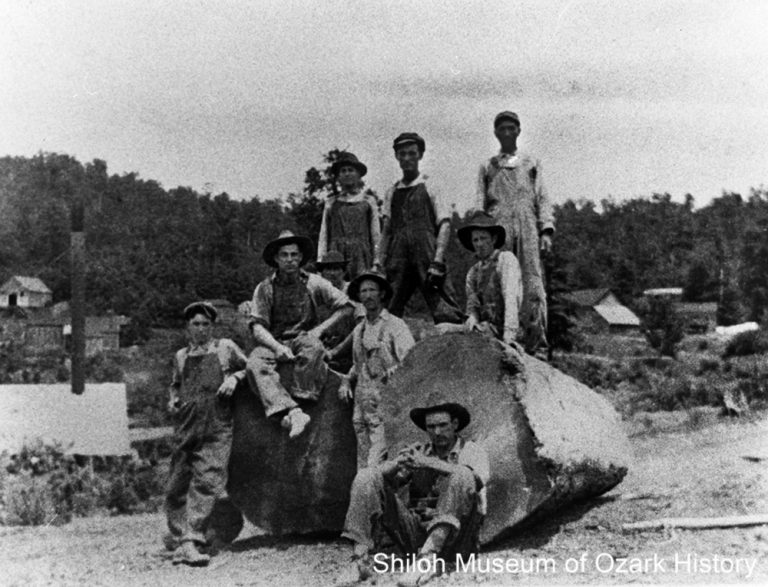
Albright sawmill workers, Red Star (Madison County), 1918–1920. The white-oak logs came from the Fitch place on Reeves Mountain. They were 12 feet long, 44 inches in diameter, and each produced over 1,200 board feet of lumber. The logs were so heavy they had to be brought to the sawmill on a heavy-duty boiler wagon. Back, from left: Nathan Ward, Virgil Holland, and Newt Ward. Front, from left: Squire Eaton, Bill Killian, Temps Ward (barely visible), Dave Samuels, Jim Eaton (seated on ground), and Lewis Samuels. Frank Eaton Collection (S-87-55-20)

The longest lived of Fayetteville’s mills—although not located at Fayette Junction nor as far as can be determined was it originally dedicated to producing wagon parts—was that of J. H. Phipps, who had established his milling operations in 1898.  Phipps Lumber Company occupied a prominent location on the west side of old Fayetteville on the original Prairie Grove Road, now the site of a Chick-fil-A, Sonic fast-food drive-in, and Arby’s at the southeast corner of 6th Street and Razorback Road.

C. M. Jones and Company, Pettigrew (Madison County), 1910s. Bob Besom Collection (S-82-213-53)

By 1915, Mr. Phipps saw the coming decline of timber harvest along the established railways. Thirty-five years of frenzied sawing had cleared the hillsides within reasonable distance from the rail lines. Not willing to stand by and watch the decline of his profitable enterprise, he began developing a plan to reach the vast forests southeast into Franklin County. He bought thousands of acres of forest land in Madison and Franklin counties. He brought together Ed. E. Jeter of Combs, Jesse Phipps of St. Paul, and J. M. Williams and W. J. Reynolds of Fayetteville as partners in the formation of the Black Mountain and Eastern Railroad. They built a line that joined the St. Paul track at Combs and plunged south into the mountains.

According to Clifton Hull’s Shortline Railways of Arkansas, “There were trestles which spanned gulches 125 feet deep. At the Cass end of the line, the grade was so steep the locomotive couldn’t pull a car of logs up the mountain, so the cars were snaked to the summit one at a time by a team of oxen. In May 1916, the name was changed from the Black Mountain and Eastern to the Combs, Cass, and Eastern. It was abandoned in 1924.”[1]

Another short-term tangent for hauling logs sprang from the Pettigrew terminus, a tram line called the “spoke plant tram.” Railroad historian Tom Duggan notes that this line ran from the Little Mulberry River to a point several miles south of Pettigrew called Campground.[2]

Phipps sold out to Jay Fulbright in 1920, and by the time of the plant’s demolition in the 1980s, it was commonly known as the Fulbright mill. As late as the 1970s, local residents could visit the mill where an accommodating workman in overalls would deftly replace the hardwood handle of the hoe, shovel, rake, or other metal implement in question.

Sawmill, Goshen (Washington County), 1900s–1910s. The men in front hold cant hooks (metal hooks on wood poles) to turn the log on the carriage. Attached to the upright headblocks on the carriage are “dogs” which hold the log in place. Ruth Flanagan Collection (S-84-234-6)

In 1928, the plant was reportedly the “biggest plant of its kind west of the Mississippi.”[3]  During World War II, Phipps Lumber Company under the guidance of Bill Fulbright bought out Springfield Wagon Company and brought with it to Fayetteville “over a dozen new families…a sizeable payroll and…a market for more Arkansas timber.”[4]

Timber remains an important industry in Arkansas. Evidence of individual logging operations on private and public lands can be found in Pettigrew, where stacks of logs awaiting transport accumulate in the same place where the old railroad roundhouse was located. The hardwood forests of the Arkansas Ozarks have been the focus of nearly fifty years of conflict between forest industry participants and conservationists who want public forests protected from indiscriminate and harmful harvesting techniques such as clear cutting. Wildlife habitat, watershed protection, and recreational uses have become equally as important as the benefits of timber harvest.

In other parts of the state, timber production is largely a corporate enterprise involving pine “plantations” where mature pine crops are mechanically harvested, hybrid seedlings are planted, and native vegetation is “suppressed” by use of herbicides.

In 1997 the Arkansas Educational Television Network produced “Out of the Woods,” a documentary that “takes an in-depth look at Arkansas’ timber industry.”

“The program shows that farming, the railroad industry, and a boom in logging have forever changed Arkansas’ forests. Through forestry research, careful land management and restoration efforts, however, new forests in the Natural State are thriving. In a study of forested land in the state from 1988 to 1995, each region showed an increase in the number of acres reforested.”

Conservationists would argue the term “reforested,” pointing out that a monoculture of fast-growing pine has been established where mixed hardwood forest had grown.

The thirty-minute AETN video “demonstrates that harvesting timber is the state’s biggest industry. Giant paper mills, plywood plants and saw mills pump $1.4 billion dollars into Arkansas’ economy ever year. Fifteen percent of the entire Arkansas work force is employed in the timber industry. The industry provides 40,000 jobs and an annual payroll of $938 million. In southern Arkansas, the business of harvesting trees has given birth – and continues to sustain – small towns throughout the pine belt.”[5]

As a result of the massive clear cuts and the environmental degradation wrought by the timber boom period and/or the extreme topography of some areas, the government ended up owner of thousands of acres of cut-over, nonproductive land. This is particularly true in the rugged landscape of south and southeastern Washington County, southern Madison County, and northern Franklin County, which became the western part of the Ozark National Forest.

A poem preserved at Shiloh Museum provides a slice of life from the Phipps Lumber Mill operation:

Who’s Who and What They Do At Phipps

There’s a hard-wood plant near our city

An industry of highest rank

Manufacturing buggy, plow and wagon stock

And all kinds of hardwood plank.

Lee Moore is our good superintendent

And he’s always on the hop

For to manage a business like this is

Takes a man that knows no stop.

Bill Swaney is the master mechanic

He’s built many mills here and there

He studies and schemes and sets up machines

And keeps them in good repair.

Emmet W. Lucas

Is foreman of the shop

He don’t get around like a whirlwind

Yet he knows what his men are about.

Sam Swaney is the engineer

He keeps the engine running good

And when he pulls the big whistle

She roars like a bull in the woods.

Jim Dixon runs the jointer

And also the ripsaw too

And with his helper daddy Dodd

They put the timber through.

Frank Osburn runs the bandsaw

At this Frank has no match

It makes no difference what the pattern may be

For he saws it to the scratch.

At the plainer is Billie Winkle

Dressing timber all the day

While his helper daddie Bogan

Is trucking it away.

Mose Osburn runs the shaper

With arms like the legs of a mule

If its light or heavy it matters not

Mose shapes it good and true.

And when they start the big tongue machine

Oh you ought to hear her hum

But when it comes to keeping steam

Well, the fireman most has to run.

It makes both the tongues and double-trees

And finishes them up just right

And whether you work at the front or the rear

You’ve got to go in “high”.

Harvey, Crossno, Graham, and Harper

At the turning lay this they work

Turning yokes and spokes and singletrees

And have no time to shirk.

Sang Brothers are the sanders

And theirs is no easy task

They sand all day on yokes and spokes

But they finish them smooth as glass.

Shorty Smith and Edward Bogan

In the finish shed you’ll find

Grading spokes and felloes

And tieing them up with twine.

The work on the yard sometimes is hard

And sometimes it’s easy too

But if you haven’t some sand in your craw

Toating tongues won’t appeal to you.

Claud Guist is the loading boss on the yard

He loads the cars to their brims

Sometimes axles sometimes tongues

And sometimes hickory rims.

Or it may be felloes or wagon spokes

And a lot of singletrees too

And this is the motto of this plant

“Direct from the stump to you.”

Bob Hannah is foreman of the bending plant

Where they bend plow handles and rims

Vernon Swaney is the engineer

John Grissom keeps the steam.

Add Baker runs the big bender

Bending rims and wagon hawns

Etter Hannah does the “nailing out”

Chas. Minn does the “knocking down.”

Taylor Jordan runs the moulder

Dressing handles all to size

Geo Moore and Guage do the bending

And stack them away to dry.

I am the company’s wood-hauler

I’ve hauled wood this city o’er

And when I drive up to a woodshed

There’s always a smile at the door.

For the wood is sound oak and hickory

With sometimes some ash and gum

And the housewife knows as she fills up her stove

Her cooking will soon be done.

And then when Tuesday rolls around

We all look for “Uncle Jay”

For he’s the man who has the stamps

And we always get our pay.

So we’re a jolly good bunch of “hardwooders”

Earning bread as best we know how

For it was spoken in the garden of Eden

Thou shalt live by the sweat of thy brow.

by B. W. Sivage

(Woodhauler)


Log train at J. H. Phipps Lumber Company, Fayetteville (Washington County), 1912. Burch Grabill, photographer. Robert Saunders Collection (S-96-2-452)

Photographs from the website of Shiloh Museum, https://shilohmuseum.org/project/timber/

~~~

[1] Hull

[2] Personal communication to the author, postcard dated February 2004.

[3] Campbell p 39

[4] Northwest Arkansas Times undated clip, front page; Box 20, file 13 WCHS vertical files, UA Special Collections

[5] See http://www.aetn.org/OOTW/

[Excerpted from Glimpses of Fayetteville’s Past, The History of Fayette Junction by Denele Campbell]

Dickson Street — Stayin’ Alive

Courtesy Fayetteville Visitor’s Bureau

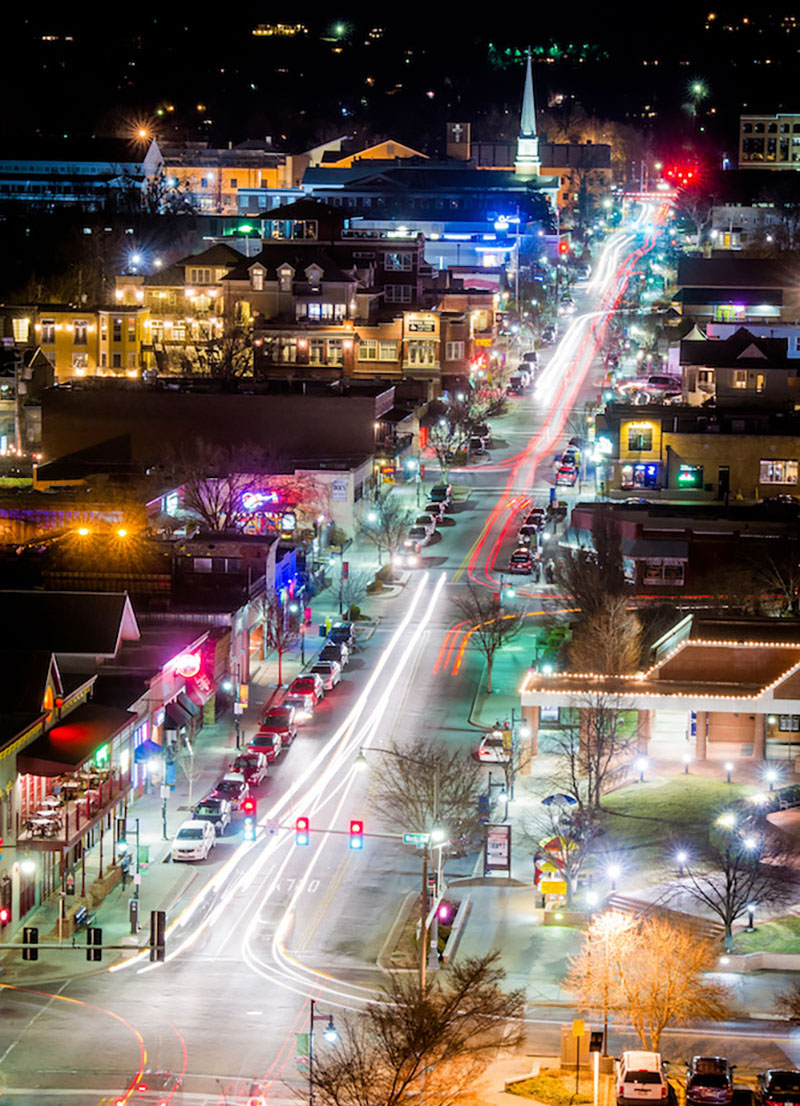
The heart of Dickson Street runs six blocks east from the southeast corner of Fayetteville’s University of Arkansas campus. After one hundred years of industrial and commercial development that came with the railroad, entertainment took over. By the 1970s, bars and nightclubs thrived in the run-down buildings alongside old school barber shops, pawn shops, artist studios, restaurants, and head shops. The sound of live music filled the night air. Patrons from all over the region flocked to the street to mingle with co-eds, quaff a few beers and cheer on the rock ‘n’ roll. The alternative community centered at the street; walking down the sidewalk meant seeing and greeting old friends and meeting new ones.

The 80s saw further decline and the emergence of tawdriness and then with the arrival of the Walton Arts Center in the 1990s and concurrent rising rent, the magic started to drip away like water through fingers. Depending on the point of view, Dickson Street is now either a thriving commercial mecca or a faint shadow of its former glory. In 2004, an article in the bi-monthly tabloid All About Town addressed the issue of Dickson Street and the decline of the music scene. And not for the first time.  The first such complaints appeared in an earlier tabloid, The Grapevine, in the 1980s and periodically become the focus of community consternation. Some of it has to do with changing demographics. The people who packed the live music venues in the 1970s were staying at home to raise families in the 1980s. Each generation enjoys its high points on the street then subsides into other activities as years pass.

Nevertheless, the article does a good job of peeling back the layers to discover some basic issues. From that, city leaders, musicians, club owners, and other interested fans of the street might derive some workable ideas of how to ensure that the Dickson Street scene never dies.

Five reasons were cited, which have been added to for this piece.

1. Club owners have to pay the bills. That includes ever increasing costs for rent, utilities, wages for employees, advertising, insurance, supplies like glassware and napkins, and inventory of alcohol and any other items served. Back in the day, rent on Dickson Street reflected the run-down nature of the real estate. Now with gentrification all around, rent has skyrocketed. Also, there’s increasing pressure to pay higher wages, utilities keep going up, and … well, it’s all about the money. The clubs count on alcohol sales to generate the profits they need to keep their heads above water. Some bands don’t attract people who like to drink. And people who like to drink have increasingly begun to patronize stand-up bars.

“Stand-up bars are easier to operate,” said Dave Bass, formerly of Dave’s on Dickson and later yielding to the inevitable by opening two stand-up bars, The Blue Parrot and 414. “It’s impossible to make live music work during the week, and you can’t be open two days a week and make a living.” He admitted losing money with his live music at Dave’s.

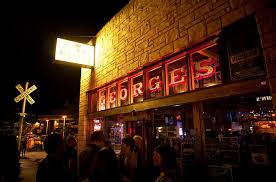
2. People don’t want to pay a cover charge. Many people don’t realize that a cover charge is the only way to pay a band to play. As veteran performer Jed Clampit pointed out, “You don’t get free drinks, but you want free music. Think about going to your job and working for free.” Owner/operator of George’s, Brian Crowne said “People will think nothing of paying $7 or $8 for a two-hour movie but gripe about paying $5 for live, professional entertainment for four hours.”

Another problem for club owners and bands is that many young people today prefer to float from place to place depending on where their friends might be. A friend might text and want to meet them at a specific location. A half hour later, the two friends might decide to go to a third location. Cover charges don’t work for that kind of activity where the objective is socializing, not watching a particular band perform.

3. There are too many clubs and too many bands. Bringing live music to a particular venue requires a lot of upfront investment in securing the band, promoting the event, and doing as much as possible to bring in a crowd. If multiple venues compete for the club-going public, there’s less to go around. That’s the basic math. But there’s no shortage of aspiring bands whose goal of wealth and fame requires building a local following first. Also, painful as it is to recognize, there’s a big disconnect between the many musicians who want to write original songs and audiences who want to hear familiar music. This particular problem is exacerbated by the fact that record deals and other important steps on the road to wealth and fame depend on original music. Nobody wants to record the 38th cover of “Proud Mary.”

Wade Ogle, veteran of the Fayetteville music scene, says the quality of new bands isn’t what it used to be. “With today’s technology, practically everyone can record a CD cheaply. While I think it’s a good thing, the downside is that way too many new bands are looking to play live before they’re really ready.”

So bands thread a narrow line, forced to invest in decent equipment and hours/months of practice until they can get booked to play and then play covers of popular music in their chosen genre while at the same time working on original songs that might be worthy of record label or promoter interest. If they manage to get booked into a club and they’re not ready, people who bother to show up are turned off to live music in general.

4. There aren’t enough fans. This wasn’t so much a problem in the ‘70s when the Baby Boomers came through en masse, the right age and right mindset to thrive on live music. You could almost say that live music was part of their religion. Alas, those days have passed. Somewhat smaller subsequent generations don’t necessarily take song lyrics as their personal anthems. Some might even allege that popular music today can’t hold a candle to the music being created in the ‘60s and ‘70s. With the rise of digital media, music suited to personal taste is available any day, any time, and any place. Free. Why go to a club and pay a cover charge when you can listen to what you like at home? One benefit of live music will never change, however, and that is the attraction of mingling in a crowd of enthusiastic fans, dancing to the same beat and being part of the ‘family.’

5. The town and Dickson Street itself have changed. Yes, this is a big factor. Fayetteville’s population has tripled since the 1970s, and University enrollment has increased from around 15,000 in 1980 to over 50,000 in 2019. More cars and the infill of properties near Dickson means much less parking plus much of the available parking is now metered. Clubs with occasional live music have sprung up along North College Avenue and near the Northwest Arkansas Mall, meaning competition for Dickson Street. Also, until recent years, Dickson Street was the place to party for the entire region. Now that Benton County allows alcohol to be served, clubs have sprung up there like dandelions in early spring. In particular, the Arkansas Music Pavilion (AMP) at Rogers has created a major performance venue for big name performers that in the past would have appeared only in Fayetteville.

Slogans like “Keep Fayetteville Funky” notwithstanding, times change. We change. It’s inconceivable to think that a day might come when Dickson Street would no longer vibrate with the heartbeat of live music and of people streaming through the doors to hear it, commune with each other, and let their hair down. But the world is, after all, what we individually and collectively make it, and it behooves us to not let such a good thing slip unnoticed into the shadows of the past. Dickson Street has been an institution as well as a collective of our entertainment experiences. We have to pay attention and do what we must to keep it that way.


~~~

“A brief history of why artists are no longer making a living making music,” by Ian Tamblyn

Our Job as Citizens

As a nation operating under the concept of self-rule, we the people have to talk coherently about the issues. Mass shootings doesn’t solve our problems, but rather exemplifies our current failures as citizens. How did we get to this point?

Does the 2nd Amendment really grant the right to assault rifles and 100-round ammo clips? No, it does not. Nor do gun hoarders constitute a “well regulated militia.”

A well regulated Militia, being necessary to the security of a free State, the right of the people to keep and bear Arms, shall not be infringed.

How did we not understand that waging a drug war against our own people would embed domestic violence in our society? Did we learn nothing from alcohol prohibition when, for fifteen years, underworld gangs selling illegal alcohol used their wealth to purchase weapons and political protection? How could Reagan and Congress think it was a good idea for “surplus” military weapons and equipment to be sold to our city police forces and used in commando tactics within our neighborhoods? How could we not see the horrible outcome of spending more money on prisons than education?

https://money.cnn.com/infographic/economy/education-vs-prison-costs/

We have to talk about immigration—what will stop the mass migration of people to our borders? For over a century, our corporations have been aided and abetted by our military to plunder Latin America for its natural resources and cheap labor. We have blood on our hands in the same tradition as Spain for its 300-year devastating occupation of the same lands. Doesn’t it make more sense to invest more heavily in helping solve problems in these countries so the people don’t have to leave home in order to have an economic future free from violence? What kind of future are we creating for ourselves by destroying Latino families and traumatizing innocent children?

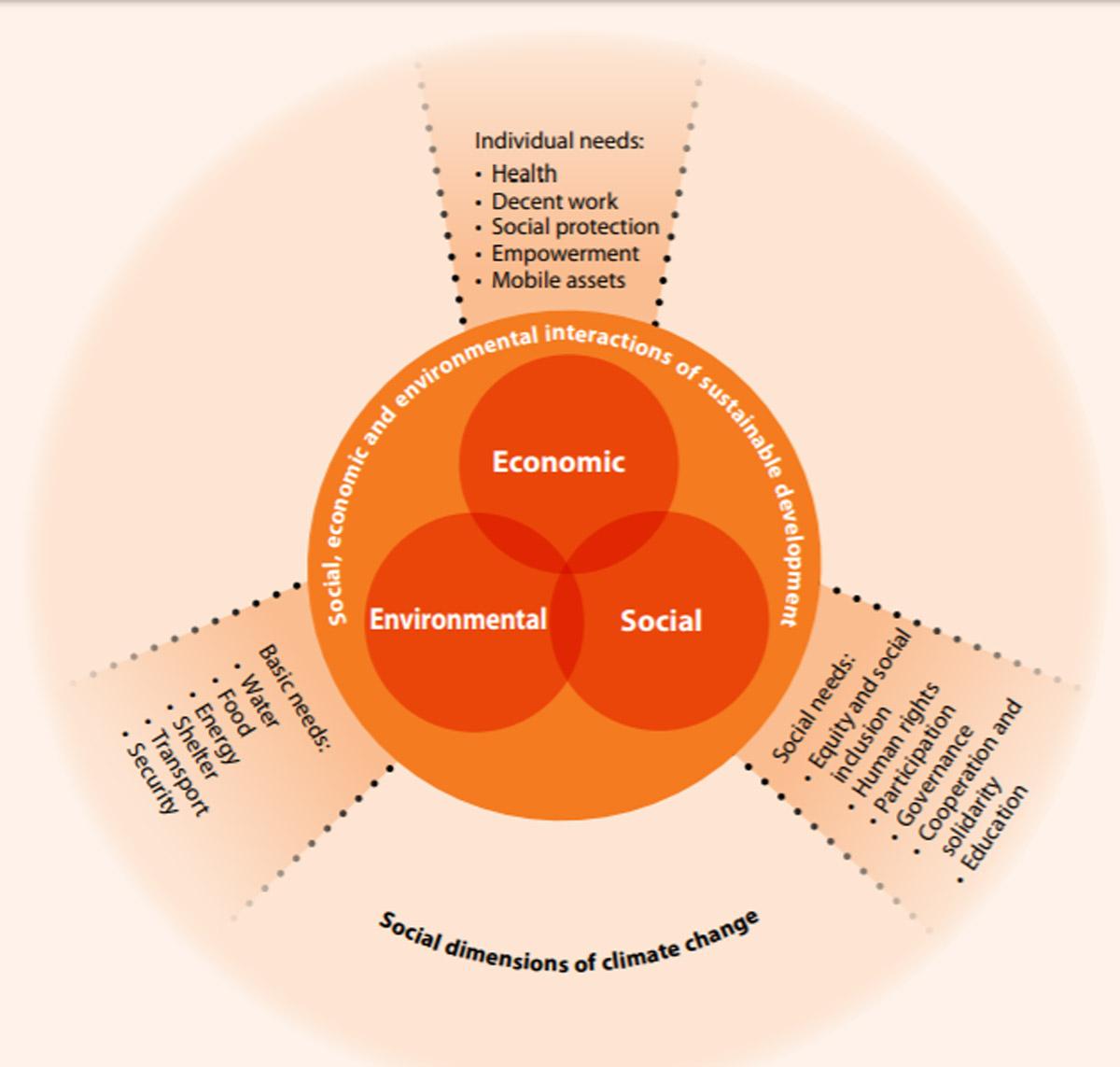
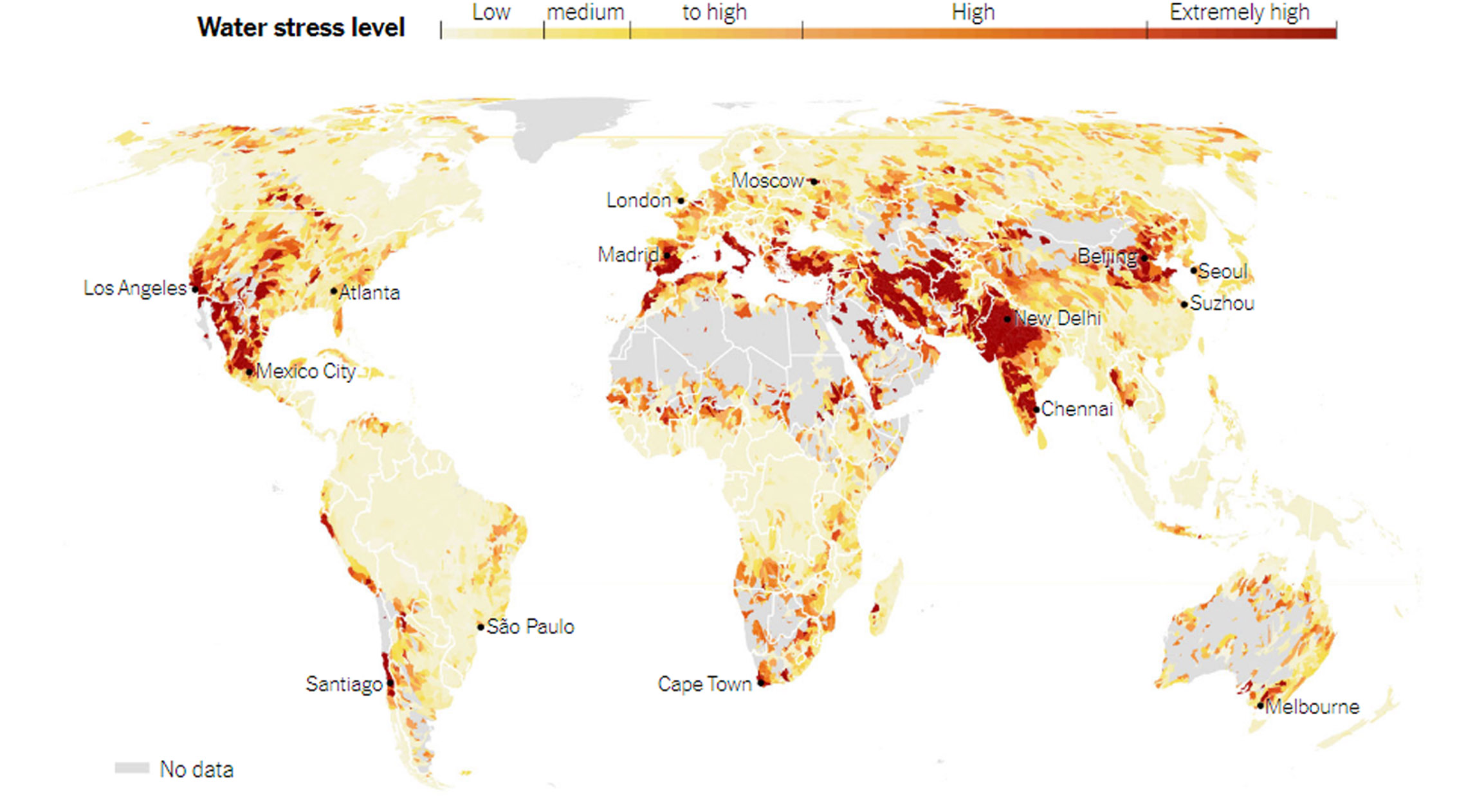
We have to talk about climate change. How can anyone still believe this is fake news? Are there truly so many people who don’t grasp the science of this issue that our entire nation’s public policy can get away with denying climate change exists? What happens when water supplies dry up, crops die on the ground, and there isn’t enough food?

https://www.who.int/globalchange/mediacentre/events/2011/social-dimensions-of-climate-change.pdf

The impacts of climate change will increasingly affect the daily lives of people everywhere in terms of employment and livelihoods, health, housing, water, food security and nutrition, and the realization of gender equality and other human rights. Impacts are expected to hit those living in poverty the hardest, partly due to their more prevalent dependency on the very natural resources affected by climate change and also because they have less capacity to protect themselves, adapt or recuperate losses.

New York Times: A Quarter of Humanity Faces Looming Water Crises By Somini Sengupta and Weiyi Cai Aug. 6, 2019

We have to talk about population—we can’t continue blindly producing more people who need food, jobs, and a place to live when all of those resources are simultaneously shrinking.

In 1950 there were 2.5 billion people on the planet. Now in 2019, there are 7.7 billion. By the end of the century the UN expects a global population of 11.2 billion.

In 2015, there were approximately 141 million births. In the same year, around 57 million people died. It’s clear why the global population is increasing: there are many more births each year than there are deaths. Around 2.5 times as many.

https://ourworldindata.org/world-population-growth

If we think we have an immigration problem now, just wait.

Each of us bears a responsibility to learn the facts on these and any other issues facing us as individuals, communities, and as a nation, engage in discussion with others with the goal of finding common ground, and then participate in the implementation of solutions through community action and voting.

Gem’s Gems

Excerpted from the book, Gem’s Gems — a memoir of my mother, Carmyn Gem [Morrow] Pitts.

[Her father Tom Morrow] ventured east into Madison County and ended up at St. Paul where the logging boom was in full steam. He brought his family to live first in a small house northwest of St. Paul before settling into the Casteel place, a two-story house with a bay window and porches upstairs and down, high upon a mountainside overlooking the White River Valley. They enjoyed a glorious summer in this scenic valley before cotton-picking time called them back to Texas.

Tom gathered his St. Paul crops and left Grandpa Clark in charge of the house and getting the sorghum cane to the mill. Left behind was the furniture—a wood burning cookstove, iron bedsteads and bedding, a rocking chair, table and benches, a marble-top round table, Sylvia’s “Princess” dresser with oval mirror, a small drop leaf desk, and a “matting” box with hinged lid Tom had built out of lathe for Sylvia’s quilts [Carmyn’s mother]. The family packed their “batchin’” equipment—a camp stove, a few quilts, feather bed, and feather bolsters, a white enamel bucket with plates, cups, and two serving bowls, the iron skillet, and a deep aluminum stewer Sylvia used to soak whole grain wheat overnight—into the beloved Baby Overland and headed south. Not left behind were the family cat Snowball and the German Shepherd dog “Lightnin’,” who rode on the fender.

On the journey, they stopped along the road each night and made campfires to cook supper. They would stop at a house to ask if they could get water at their spring and camp for the night. Mama made pallets for the younger children to sleep on in the truck and Papa, Durward, Douglas and Graydon slept on pallets on the ground under the truck. Once when they stopped at a house and asked to use the spring, the lady of the house brought them fresh buttermilk.

Littlefield Texas cotton-pickin’ shack. January 1929 L-R: Douglas with dog Trixie True, Graydon, Joy with cat Snowball, Tomazine “Sister,” Carmyn holding her doll Prudence, Una Mae in Durward’s lap

Upon arriving in Texas, they lived first in a cotton-picking shack at one of Sylvia’s sister’s place in Grayson County. After picking for two weeks, they moved on to another of Sylvia’s sister’s farms near Vera in Knox County where they stayed for four weeks. The shacks were crudely built one-room structures about twelve feet by fourteen feet with two windows and a door. Aunt Lillian fixed up their shack at Crosby County for her sister Sylvia and family to live in, scrubbed clean with curtains on the windows. She loaned them a coal-oil stove with an oven. They picked their cotton for three weeks and then finished the season in a shack near Morrison.

In the winter of 1928, the Tom and Sylvia Morrow family moved back to the Casteel place in St. Paul, Arkansas, but Grandpa Clark convinced Tom that the ground was too rocky for farming, so they rented a house together—the Greenway place—about 1.5 miles southwest of Springdale (near the present-day Wal-Mart). It was a temporary home for the two weeks it took Tom to find “Trouble’s End,” the name of the place in Springdale that was their first home with a bathroom and running water. Their seventh child Una May was born here. They had apples and strawberries, and were joined again by the grandparents, who again kept the house when Tom began preparing his family for another summer run back to Texas to pick cotton.

Austin Place, Springdale Arkansas August 1929 Tomazine and Una May

Tom traded the Baby Overland for a big truck, made a wooden box for the pet cat and a puppy to ride in, and the German Shepherd rode on the fender. On the journey, Sylvia and girls slept in the truck while Tom and the boys slept on pallets under the truck. Back in Texas, near Littlefield, they lived in a shack and picked cotton, but the kids all came down with whooping cough, so they couldn’t return to Arkansas until March 1929.

Back in Springdale, they discovered that Grandpa Clark had failed to pay rent at “Trouble’s End,” and had moved three miles east of Springdale to the Crane place. He had rented a nearby house, the Austin place, for Tom’s family, but it was only one bedroom. Tom closed in the breezeway to the smokehouse to provide more room, but that fall he found the Nix place with three bedrooms and a big corner porch. He moved the family there and went to Texas to haul grain from November until February 1930.

Tom Morrow with his mule team, baby on the wagon seat


Read the rest of Gem’s Gems! Available at Amazon.com

The Great Killing Time

The killing won’t stop anytime soon. A subclass of white men can’t find the means to adapt to a world where they are not dominant. They don’t know how to see themselves except as warriors striking down those they perceive as enemies.

The enemies are not just people of color. The “enemies” are thick in the world around these sad failures of evolution. Social change driven by modern science and technology has left them with no fields to plow or wilderness to conquer, no tribal fires. Those were skills living deep in their DNA. Vacant of all but amorphous anger, they sit on their couches, helpless against their sense of violation in a time that requires reasoning and acceptance of Other.

Christian Picciolini, a white nationalist who has stepped away from that way of thinking, remarks on the mind-set: “Typically what I found is, people hate other people because they hate something very specifically about themselves, or are very angry about a situation within their own environment, and that is then projected onto other people.”[1]

Whatever the symbols of Other, they will hate. Their hate will fester. Their testosterone drives them to act. What act will satisfy the hate, the need to eradicate the threat?

Murder.

But it’s not just a failure to evolve that drives the urge to kill. As a society, we’ve failed to address the impact of rapid technological and social change. Our schools should be teaching logic, debate and rhetoric, critical tools for rational humankind. Reasoning skills are required if we are to control our emotions and peaceably resolve conflict.

Logic: sensible rational thought and argument rather than ideas that are influenced by emotion or whim; the branch of philosophy that deals with the theory of deductive and inductive arguments and aims to distinguish good from bad reasoning.

Rhetoric: the ability to use language effectively, especially to persuade or influence people.

Debate:  to talk about something at length and in detail, especially as part of a formal exchange of opinion

Shamefully, today public policy discussed even in the U.S. Senate, the highest arena of government, disintegrates into personal attack. The public square, now virtual instead of physical, suffers the same: personal attack instead of reasoned debate.

Shout down anyone who doesn’t agree with you. Call them names. Unleash rage against the Other.

The more we engage in personal attacks, the less progress we achieve in achieving public policy that works for us all. This time will go down in history as the Great Killing. Whether it’s the unevolving who will die or those who reason is yet to be seen.

Can we look forward to a change in educational programs? Can we retrofit people by demanding they go through some kind of training? Can we require our elected officials to focus on the goal instead of wading into partisan squabbling?

The killing will continue.

~~~

[1] https://www.theatlantic.com/politics/archive/2019/08/conversation-christian-picciolini/595543

The Red-Headed Bug

The car kicked up a cloud of dust as I hurtled down the long driveway. In my rush, I turned onto the county road and traveled another half mile before I noticed the creature that held on furiously just outside my side window, some kind of small waspish fly, its bulbous eyes perched like wire-rimmed glasses on its orangey-maroon head, its tidy black veined wings tucked sleekly along the sides of its narrow black thorax. Its thin legs flexed and strained to remain anchored in spite of the force of the air stream as I sped along.

This was not a singular event. My rural wooded property hosts bugs of infinite variety, some of which end up resting on my car.  On any given trip to town, I might inadvertently transport tan walking sticks, red, yellow, or black wasps, skinny dirt-daubers, black, blue, or green flies, beetles of every conceivable shape and shade, spiders, ticks, bees, mosquitos, gallinippers, moths, ants of assorted size, and any other of so many multiple-legged beings that I suspect some of them have, to date, escaped scientific classification.

Notable creatures such as the saddle-backed, black stinkbug or the lime green praying mantis usually merit my immediate pull-over, where I carefully remove them to roadside vegetation wondering if they find any advantage in new territory. I’ve considered whether higher insect intelligences, like flies, might purposefully plan for such transport. One large green fly made it all the way to town, having carefully positioned himself in a joint of the windshield wiper, perhaps with a particular lady city-fly in mind.

I rarely see them as I load in my gear, back up, and drive away, not until I have picked up speed, until they begin to slide, inexorably, across the waxed paint of the car’s body or the smooth glass of the windshield. They ride in ignorance, misunderstanding the threat. From their egocentric viewpoint, the problem is not that they are unwitting passengers on the rides of their lives, but simply that a strong wind has sprung up.

The challenge is to hold fast.

On this particular morning, the red-headed fly had arrived at my parked car door, at what seemed a perfectly fine spot to rest, groom, and digest his latest meal. As I began driving and the sudden gale blustered around him, he braced himself, securing every foot firmly to the spot. He had no concepts through which to anticipate that his greatest risk came with hanging on to what seemed familiar surroundings, that ultimately he would be farther away from what he knew and desired than he would have been if he had simply let go.

As I cruised along the road, the tiny red and black fly gripped ever more frantically to maintain his hold. In order to offer the least wind resistance, his body bent and contorted, stretched and elongated, the severity of his effort betrayed by erratic flare-ups of his wing tips.  Staring at me through the side window glass, he seemed to question me in panicky stares.

I advised him based on my previous experience.

Some bugs come to a forty mile per hour realization, I said. While I’m still on this back road, in a serendipitous flash of insight, they let go.

I waited for his response. He tensely adjusted his wings and aimed his head more into the wind.

After some scary free fall, I continued, they find themselves in the thickets near Miller’s pond. We drove farther and his stance remained resolute.

Or in the rocky ditch, I said, or in the middle of Mr. Breedlove’s herd of Angus. Wherever you might find yourself, I’m sure you could optimize the situation—you know, discover a trove of aphids or a lonely female.

I glanced to see if he was listening. The red-black fly showed no hint of a high-speed epiphany but instead re-exerted his desperate clench.

Ignoring the urging of my more generous side, I accepted little ongoing responsibility as to the fly’s future well-being. It was, after all, an insect. And I was in a hurry.

The road merged onto the highway, and I accelerated. Listening to the radio, absorbed in anticipating my day’s schedule, and maneuvering through heavy traffic, I failed to notice when his tiny sticky foot pads ripped loose from the slick paint of my car door.

Halfway into town, I realized he was gone.

Briefly, I suffered anxiety on his behalf. Had he made his leap at the right moment, I wondered? Was his grip torn free in the surge of a passing truck, bringing him to join countless distant kinsmen already pasted to its front grill?

Had he ever understood the threat?

Had he understood and somehow just hadn’t figured out the best timing?

I narrowed my thoughts to more pressing considerations. The city lay ahead. In a continuing ethical quandary about my role in the greater scheme of things, I decided to believe that he knew what he was doing all along and got off right where he intended.

Excerpted from my book, I Met a Goat on the Road:

Ebook and Paperback available at your local bookstore or at Amazon.com


No Surprises

German citizens saluting Adolf Hitler at the opening of the 1936 Olympic Games. United States Holocaust Memorial Museum

Before the sun rose on Wednesday July 24, 2019, before the widely heralded appearance of Robert Mueller before committees of the U. S. House of Representatives, Donald Trump and his cohort had long since established their response. The game plan had been distributed to their colleagues in the Senate and to their buddies at FOX News. Most importantly, the plan had been well-rehearsed by Republican House committee members who would have a front row position from which to attempt to undermine the hearings.

There would be no outrage, no cry over the evidence presented. Republican committee members would discreetly and not so discreetly question Mueller’s competence and motivation. They would grandstand their outrage at the ongoing travesty against ‘their’ president. There would be no acknowledgement of any facts presented either about the collusion between the Trump campaign and Russian efforts to sway the vote or Trump’s various attempts to obstruct the investigation.

Afterwards, the tactic was to shrug off the hearings, ho hum, the Democrats beating a dead horse. Oh dear, how upset they must be after all this hoorah and still Mueller didn’t hand them a smoking gun. A big fat nothing.

In truth, the Democrats never expected a smoking gun from Mueller. Their strategy for Mueller’s testimony was to create a televised iteration of the Mueller report for all the Trump supporters out here in the countryside who never had and never would read the actual report. They wouldn’t even read news summaries of the report, instead willing—even eager—to take Trump’s word for it, whatever it said.

Trump had it right when he said he could shoot someone on 5th Avenue and no one would care. He took that to the bank. Get cozy with Russians endeavoring to subvert the election? No problem. Pretend it didn’t happen—they’ll believe it. Do everything possible to sidetrack the subsequent investigation? Whatever works. Nobody can prove it if Trump doesn’t talk and the testimony of key players like Don McGahn never sees the light of day.

Democrats should be credited for their effort to pull back the curtain on this shameful and arrogant corruption of American democracy. Their mistake, once again, is assuming that Trump supporters care about our nation more than they care about their boy. Trump legitimizes their ignorance with three-word sentences and double-speak. He shares their terror of “Other” whether other religion, other skin color, or other ethnicity, and they can’t chortle enough over their sense of ascendancy in a nation where religion, skin color, or ethnic background are not supposed to make a difference. A nation FOUNDED on the concept that all of us are created equal.

Democrats forgot that ignorance doesn’t recognize its own ignorance and isn’t eager to discover it.

The thread of idealism progressives have shared throughout our nation’s history has changed faces many times. It ran through the revolution even though many colonists clung to King George. It suffused the push to end slavery, to grant women the right to vote, and to form labor unions whose members sacrificed lives and livelihood to end child labor, gain a 40-hour work week, and ensure safe work environments. The same thread has continued through liberal ideas behind school integration, rights for the disabled, and a woman’s right to reproductive choice.

The same thread colors political discourse today, resisting the onslaught of racism and hate freed from its restraints by Donald Trump. It rises in the election of women, of people of color, to public office. It thrives in the hearts and minds of those who say “Vote Blue No Matter Who” as progressives seek to reclaim the dignity and honor of the presidency.

Trump and his horde of pitiful followers would rather risk the future of the nation than love their neighbors. They would rather spout hate speech than address the problems we face. There are solutions, and we can find them. Let’s keep our eye on the ball.