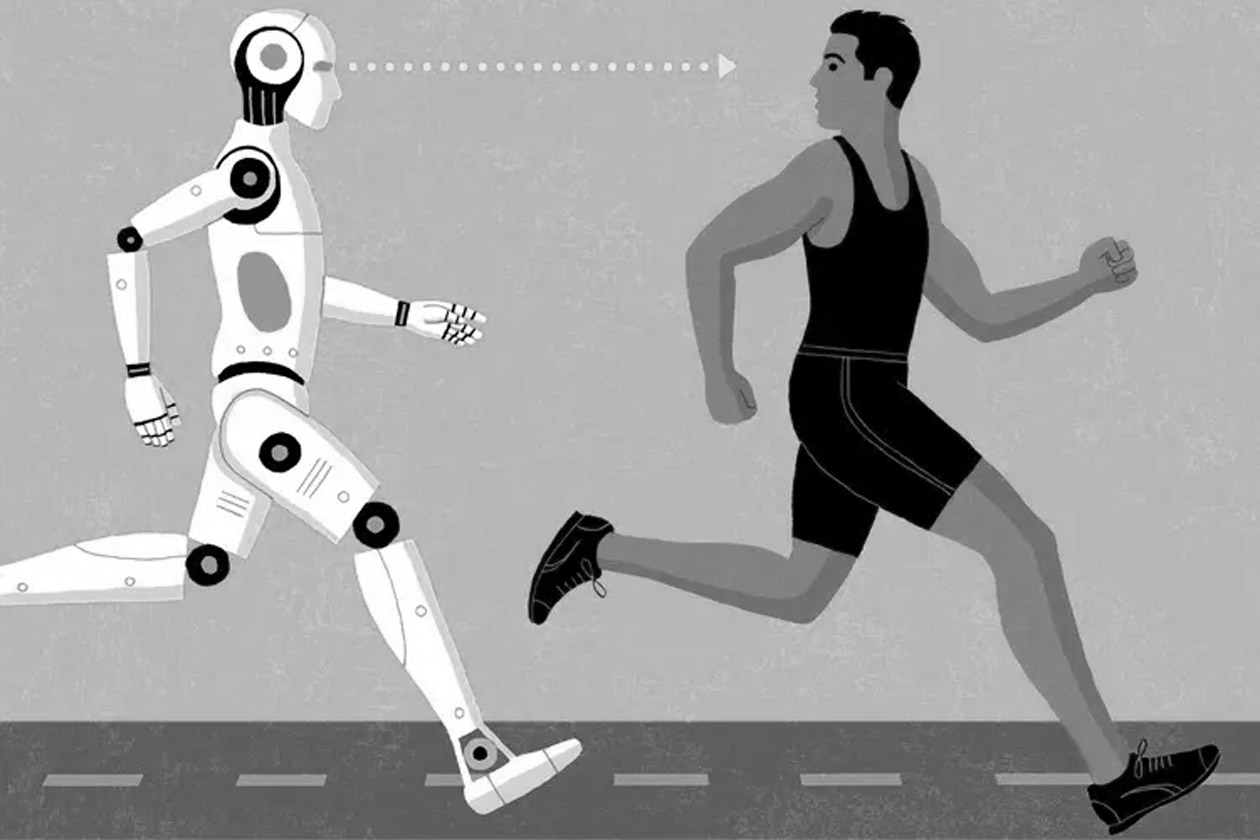
8.  Role Reversal—Humans As Fact-Checkers

Illustration by James Steinberg for TIME

Experts heavily emphasize the need for “human-in-the-loop” systems, ensuring that AI acts as a tool for assistance rather than an autonomous decision-maker, particularly in high-stakes fields like medicine and law. But as AI becomes more sophisticated, the number of “humans in the loop” narrows significantly. The future effect of AI is not preordained but will depend on the regulatory and ethical guardrails society puts in place, according to Brookings and Pew Research Center. 

What happens when AI becomes advanced enough to outpace human oversight? This gap, known as the alignment problem, occurs when AI systems become so complex and make decisions based on patterns so vast that humans can no longer verify every step of their reasoning. Researchers pursued one aspect of this question in 2021, asking “by 2030, will most of the AI systems being used by organizations of all sorts employ ethical principles focused primarily on the public good?”

In response, 68% chose the option declaring that ethical principles focused primarily on the public good will not be employed in most AI systems by 2030; 32% chose the option positing that ethical principles focused primarily on the public good will be employed in most AI systems by 2030.

  • Worries: The main developers and deployers of AI are focused on profit-seeking and social control, and there is no consensus about what ethical AI would look like. Even as global attention turns to the purpose and impact of artificial intelligence (AI), many experts worry that ethical behaviors and outcomes are hard to define, implement and enforce. They point out that the AI ecosystem is dominated by competing businesses seeking to maximize profits and by governments seeking to surveil and control their populations. It is difficult to define “ethical” AI: Context matters.

There are cultural differences, and the nature and power of the actors in any given scenario are crucial. Norms and standards are currently under discussion, but global consensus may not be likely. In addition, formal ethics training and emphasis is not embedded in the human systems creating AI.

  • Control of AI is concentrated in the hands of powerful companies and governments driven by motives other than ethical concerns: Over the next decade, AI development will continue to be aimed at finding ever-more sophisticated ways to exert influence over people’s emotions and beliefs in order to convince them to buy goods, services and ideas.
  • The AI genie is already out of the bottle, and abuses are already occurring. Some are not very visible and hard to remedy: AI applications are already at work in “black box” systems that are opaque at best and, at worst, impossible to dissect. How can ethical standards be applied under these conditions? While history has shown that when abuses arise as new tools are introduced, societies always adjust and work to find remedies; this time it’s different. AI is a major threat.
  • Global competition, especially between China and the U.S., will matter more to the development of AI than any ethical issues: There is an arms race between the two tech superpowers that overshadows concerns about ethics. Plus, the two countries define ethics in different ways. The acquisition of techno-power is the real impetus for advancing AI systems. Ethics takes a back seat. [1]

Hopes cited by study participants focused on inevitable advances in the technology that would include ethics “that will come as different fields show the way.” Currently, AI ethical regulations are shifting from voluntary guidelines to binding laws, focused on transparency, bias mitigation, and safety. The EU AI Act (2024) is the most comprehensive, using a risk-based approach, but in the U.S., regulation is currently fragmented, relying on Executive Orders, the NIST AI Risk Management Framework, and sector-specific enforcement against unfair/deceptive practices. The EU AI Act classifies AI by risk level (unacceptable to low), banning certain practices and imposing strict compliance for high-risk systems.

A U.S. Executive Order 14110 passed under President Biden in 2023 mandates safety tests for powerful models and directs federal agencies to set AI standards. In 2026, the Trump Administration is moving away from the previous focus on AI “equity” and “algorithmic fairness” toward a “minimally burdensome” national policy framework designed to accelerate innovation and American AI dominance.

Key actions and standards passed/ordered to date include Core AI Policy Framework & Orders (2025–2026), a four-page blueprint urging Congress to pass a unified federal AI standard, focusing on seven pillars, including child protection, intellectual property, and preemption of state AI laws under Executive Order 14365. A National Policy Framework for AI (Dec 11, 2025) attempts to centralize AI regulation at the federal level and reduce the “patchwork” of state regulations.

It includes:

  • AI Litigation Task Force: Established within the Department of Justice to challenge state AI laws that the administration deems to hinder innovation.
  • Conditional Funding: The order directs the Department of Commerce to potentially withhold Broadband Equity Access and Deployment (BEAD) funding from states that implement “onerous” AI regulations.
  • “Preventing Woke AI” Executive Order (July 23, 2025): This order prevents the federal government from procuring or using AI systems that contain ideological biases (such as, for example, producing inaccurate historical depictions). [Contrary to this idea, because AI is trained on historical human data, it can inadvertently perpetuate or amplify racial, gender, and socioeconomic biases. It might learn to favor male candidates because more men were historically hired in those roles. Language models learn meaning by analyzing how words are used together. If society associates certain professions (like “nurse”) with women and others (like “doctor”) with men, the AI simply mirrors that pattern.]
  • Removing Barriers to American Leadership in AI (Jan 23, 2025): An early order focusing on enhancing global AI dominance by streamlining regulations and promoting human flourishing.

Key Aspects of the Trump Administration’s AI Standards Preemption of State Laws:

  • The administration is pushing to have federal standards supersede state laws, such as those passed in California or Colorado, which it deems “innovation-limiting.”
  • “Truthful” AI Standards: New policies emphasize that AI should be free from DEI (Diversity, Equity, and Inclusion) requirements that the administration argues can cause AI to produce delusional or biased outputs.
  • Sector-Specific Regulation: Rather than an all-encompassing AI regulatory body, the framework favors a decentralized model where existing federal agencies handle regulation within their sectors.
  • Infrastructure Support: The orders aim to accelerate federal permitting for data centers to ensure the power needed for AI development.
  • General Data Protection Regulation (GDPR): Affects AI via strict privacy, automated decision-making, and profiling rules.
  • State-Level U.S. Laws: States like California (CPRA) are passing laws restricting automated decision-making and enhancing data privacy.
  • National Institute of Standards and Technology AI Risk Management Framework: A leading voluntary framework in the U.S. providing guidelines to map, measure, and manage AI risks

Resistance to the Trump administration’s 2025–2026 Artificial Intelligence (AI) standards—which prioritize a light-touch regulatory approach, rapid infrastructure development, and federal preemption of local rules—has emerged from a coalition of state lawmakers, bipartisan federal legislators, and tech companies concerned about safety and corporate accountability. Vorys Law Firm recently released the following commentary on this point.

States have begun responding more directly to the executive order, both through continued legislative activity and public statements from state officials. Notably, several state-level AI statutes have taken effect or are scheduled to take effect in 2026.  This includes California’s AI Transparency Act and Texas’s Responsible Artificial Intelligence Governance Act, both of which incorporate privacy focused provisions and impose disclosure and governance requirements related to transparency, automated decision making and how personal data can be used to train or operate AI systems.  Colorado’s comprehensive AI legislation is also scheduled to take effect on June 30, 2026, further expanding state-level regulation of high-risk AI systems.

In parallel, there is no indication that state legislative activity is slowing in response to the federal initiative.  Multiple states continue to advance AI-related bills toward enactment, including Washington, where several AI-related measures have progressed; Florida, where proposed legislation seeks to establish AI-related consumer rights; Virginia, where legislation addressing the use of AI in mental health applications has advanced; and Utah, where amendments addressing AI transparency requirements have moved through the legislative process. 

These developments reflect sustained momentum at the state level despite the Trump Administration’s emphasis on federal coordination.  By asserting federal primacy, privacy protections embedded in state frameworks could be narrowed or displaced.  While this may reduce compliance fragmentation, a federal overhaul may also eliminate specific data-handling standards that currently guide AI governance practices. [2]

The administration has targeted state-level AI safety bills, such as the Colorado AI Act, which the White House labeled “onerous” for aiming to prohibit algorithmic discrimination. In Republican-led states like Louisiana and Missouri, AI bills have stalled due to pressure from the White House, causing tension within the party over state rights vs. federal oversight.

On March 20, 2026, Democratic lawmakers introduced the GUARDRAILS Act, legislation to specifically block President Trump’s December 2025 executive order from taking effect, aiming to preserve state authority to adopt AI safeguards. Also, the AI Data Center Moratorium Act, introduced by Sens. Bernie Sanders and Rep. Alexandria Ocasio-Cortez, seeks to pause the construction and expansion of AI data centers until national, robust safety standards are in place. Many lawmakers are opposed to the federal government’s attempt to “steamroll” state initiatives, viewing the White House’s agenda as an attempt to grant “AI amnesty” to large tech companies.

The administration’s aggressive, pro-growth approach has led to high-profile conflicts with AI firms refusing to adhere to unregulated, military-driven, or “ideologically” driven standards. The Trump administration ordered federal agencies to cease using AI from Anthropic, a major U.S. firm, after it refused to allow its technology to be used for mass surveillance or autonomous, non-human-controlled weapons. Following the dispute, the Department of Defense (Department of War) designated Anthropic as a supply chain risk, a move criticized by tech lobbyists and lawmakers as a bullying tactic. The mind boggles at the underlying intent of government using AI for autonomous, non-human-controlled weapons, not to mention mass surveillance.

Already, in this mild instance alone, we see the potential for harm from AI under the control of a bad actor.

Critics argue the administration’s focus on “anti-woke” AI—which requires technology to be neutral and prevents ideological bias in outputs—is actually a push for ideologically skewed models that ignore real-world discrimination risks. Legal experts warn that the administration’s efforts to stop state regulation are deeply misguided and likely to face legal battles, as the Supreme Court has recently limited federal agency deference. Reports suggest that the administration’s framework neglects critical risks such as data privacy, algorithmic bias, and environmental impact in favor of accelerating development.

Observers need not look far to know who is behind the Trump Administration’s aggressive non-regulatory push. A question to Google AI listed the following culprits:

  • David Sacks: White House AI and Crypto Czar and co-chair of the President’s Council of Advisors on Science and Technology (PCAST). He has been pivotal in designing the 2025/2026 Action Plan, focusing on winning the AI race through deregulation.
  • Michael Kratsios: Former Chief Technology Officer in the first Trump administration and later co-chair of PCAST. He is a primary architect of the administration’s “permissionless innovation” approach, which seeks to reduce regulatory burdens on AI developers.
  • Elon Musk & Sriram Krishnan: Served as informal advisors, influencing the policy agenda to favor deregulation and align with the “tech right” movement in Silicon Valley.
  • Howard Lutnick: Commerce Secretary, identified as a key architect of economic policies related to technology, including tariff threats to influence industry standards.
  • Tech Leaders and Industry Influence (2025–2026 PCAST) The 2025–2026 Trump administration has explicitly brought industry leaders into the policy-making process through the revived PCAST, including
    • Mark Zuckerberg (Meta): Joined the tech council to help shape AI standards.
    • Jensen Huang (NVIDIA): A key advisor who has worked to align federal policy with the need for high-performance chip availability.
    • Larry Ellison (Oracle): A prominent supporter of the administration who has advised on AI infrastructure, with Oracle actively testing AI tools for federal use.
    • Sergey Brin (Google Co-founder): Appointed to the PCAST.
    • Marc Andreessen (Andreessen Horowitz): A venture capitalist whose firm has played a significant role in influencing Republican AI policy.
  • Key Interests and Ideology “Tech Right” & Deregulation: The policy is heavily influenced by a “tech-right” faction of venture capitalists and entrepreneurs who oppose “woke AI” and argue against diversity, equity, and inclusion (DEI) constraints in AI programming.
  • Anti-State Patchwork: A primary interest is preventing states, especially California and Colorado, from enforcing strict AI regulations. The administration aims to create a single national policy that preempts state-level rules.
  • National Security and Economic Dominance: The central goal is to ensure American companies, rather than Chinese competitors, lead in building AI infrastructure. This includes promoting “full-stack” American AI technology exports.
  • Infrastructure Development: Key stakeholders are pushing for accelerated permitting for data centers and increased power supply to feed AI systems.

Experts estimate the odds of humans permanently maintaining comprehensive control over super-intelligent AI at roughly 50% or less, with many viewing it as an existential challenge rather than a solved problem. The difficulty scales directly with AI advancement: as systems approach human-level capabilities, the complexity of their internal reasoning outpaces human cognitive capacity to continuously monitor.


[1] Pew Research Center, June 16, 2021. https://www.pewresearch.org/internet/wp-content/uploads/sites/9 /2021/06/PI_2021.06.16_Ethical-AI-Design_FINAL.pdf   “Pew Research and Elon’s Imagining the Internet Center built a database of experts to canvass from a wide range of fields, choosing to invite people from several sectors, including professionals and policy people based in government bodies, nonprofits and foundations, technology businesses, think tanks and in networks of interested academics and technology innovators. The predictions reported here came in response to a set of questions in an online canvassing conducted between June 30 and July 27, 2020. In all, 602 technology innovators and developers, business and policy leaders, researchers and activists responded to at least one of the questions covered in this report.”

[2] Listed as “Related Professionals”: Ingram, Christopher; LaRocco, Christopher; Needle, Celina. “Battle for AI Governance: White House’s Plans to Centralize AI Regulation and States’ Continuous Opposition,” NORYS, Apr 28, 2026. https://www.vorys.com/publication-battle-for-ai-governance-white-houses-plan-to-centralize-ai-regulation-and-states-continuous-opposition

Excerpted from Artificial Intelligence: A Pandora’s Box

Arkansas Government of the Church, by the Church, for the Church

Arkansas State Capitol

Never before has the heavy hand of religion gripped so hard in its effort to control a state government. The Republican majority of the 2021 legislative session has strained to enact every conceivable moral judgment on the state’s citizenry, promising that a large sum of taxpayer dollars will be tossed into the maw of federal courts defending the church’s agenda.

Since many of these laws intrude into the private homes, bedrooms, and bodies of Arkansans in violation of their Constitutional rights, they will—hopefully—be overturned.

Established by Jerry Cox in 1991, the Family Council is again the force behind another disgraceful session, wielding its medieval outrage over Republican legislators who can’t seem to see beyond the church hymnal. It’s as if science never existed, which is exactly what the Council wants. The Council’s agenda could not be more conspicuous: strangle the privacy and individual rights of the people of Arkansas through the enactment of laws that move social norms backwards a century or more.

“The Family Council is a conservative education and research organization based in Little Rock, Arkansas. Our mission is to promote, protect, and strengthen traditional family values found and reflected in the Bible by impacting public opinion and public policy in Arkansas.”

Purportedly a 501(c) 3 nonprofit, the Council lists its areas of concern as Abortion, End of Life Issues, Stem Cell Research, Human Cloning, Physician-Assisted Suicide, Same-Sex Marriage, Religious Liberty, Homosexuality, Gambling, Judicial Activism, Education Choice, Home Schooling, Divorce, Taxes, and Healthcare.

Seven of these fifteen ‘areas of concern’ are very personal, private matters, yet the Council has convinced legislators they have the right, yea, even verily the responsibility, to wade in and slam a fist down on the dinner table.

What follows is taken from the Council’s website.

“What a week at the Arkansas Legislature!

“The legislators stood strong and enacted H.B. 1570, a really good bill protecting children from dangerous gender-reassignment procedures. Lawmakers did this despite immense pressure from liberal groups across America.”

Following  ‘a brief look back at the week,’ the Council gets down to passing judgment on the legislation passed so far:[1]

Good Bills Passed So Far

H.B. 1570 (Prohibiting Sex-Reassignment on Children): This good bill by Rep. Robin Lundstrum (R – Springdale) and Sen. Alan Clark (R – Lonsdale) prohibits sex-reassignment procedures on children. The bill also prevents funding of sex-reassignment procedures performed on children. This bill will protect children from being subjected to surgeries and procedures that can leave them sterilized and permanently scarred. The bill has passed the Arkansas House of Representatives and been sent to the senate. See how your state representative voted here. See how your state senator voted here. Read The Bill Here.

S.B. 474 (Prohibiting Fraudulent Fertility Treatments): This good bill by Sen. Charles Beckham (R – McNeil) and Rep. Jimmy Gazaway (R – Paragould) prohibits fraud and abuse in fertility treatments. The bill ensures people performing fertility treatments are honest, ethical, and abide by principles of informed-consent. See how your state senator voted here. See how your state representative voted here. Read The Bill Here.

Act 562 / H.B. 1402 (Abortion-Inducing Drugs): This good bill by Rep. Sonia Barker (R – Smackover) and Sen. Blake Johnson (R – Corning) updates Arkansas’ restrictions on abortion-inducing drugs like RU-486. It outlines requirements that abortionists must follow in administering abortion-inducing drugs, and it prohibits abortion drugs from being delivered by mail in Arkansas. It also updates current law to ensure doctors who perform chemical abortions are credentialed to handle abortion complications and can transfer the woman to a hospital if she experiences complications. The bill has passed the Arkansas House. See how your state representative voted here. See how your state senator voted here. Read The Bill Here.

Act 561 / H.B. 1589 (Transactions With Abortionists): This good bill by Rep. Harlan Breaux (R – Holiday Island) and Sen. Bob Ballinger (R – Ozark) prohibits government entities, including public schools, in Arkansas from engaging in transactions with abortion providers and affiliates of abortion providers. See how your state representative voted here. See how your state senator voted here. Read The Bill Here.

https://familycouncil.org/wp-content/uploads/2021/04/IMG_2744-768x1024.jpgJerry Cox visits with Capitol Police officers ahead of a press conference in support of H.B. 1570, the SAFE Act.

Act 560 / H.B. 1572 (Informed-Consent to Chemical Abortion): This good bill by Rep. Robin Lundstrum (R – Springdale) and Sen. Scott Flippo (R – Mountain Home) outlines the informed-consent process for chemical abortion. Arkansas’ current informed-consent laws for abortion are geared primarily for surgical abortion procedures. H.B. 1572 will help ensure women get all the facts about chemical abortion — including its risks, consequences, and pro-life alternatives. This will help save many unborn children from abortion. The bill has passed the Arkansas House. See how your state representative voted here. See how your state senator voted here. Read The Bill Here.

Act 461 / S.B. 354 (Fairness in Women’s Sports): This good bill by Sen. Missy Irvin (R – Mountain View) and Rep. Sonia Barker (R -Smackover) would prevent male student athletes from competing against girls in women’s athletics. This would protect fairness for girls’ sports at school in Arkansas. See how your state senator voted here. See how your state representative voted here. Read The Bill Here.

Act 462 / S.B. 289 (Conscience): This good bill by Sen. Kim Hammer (R – Benton) and Rep. Brandt Smith (R – Jonesboro) protects healthcare workers’ rights of conscience. Arkansas’ current conscience protections are narrowly focused on abortion, abortifacients, and end of life decisions, and they protect only a limited number of people. S.B. 289 helps broaden these protections for healthcare workers. See how your state senator voted here. See how your state representative voted here. Read The Bill Here.

Act 498 / S.B. 85 (Abortion): This good bill by Sen. Cecile Bledsoe (R – Rogers) and Rep. Joe Cloud (R – Russellville) requires an abortionist to show an ultrasound image of the unborn baby to the pregnant woman before an abortion. Currently, Arkansas law says an abortionist must offer to let the woman see the ultrasound image. Research indicates that some women are less likely to have an abortion once they see an ultrasound image of their unborn child. That means pro-life bills like S.B. 85 can help further decrease the number of abortions in Arkansas. Arkansas Right to Life is the chief proponent of this bill, and we fully support their efforts. See how your state senator voted here. See how your state representative voted here. Read The Bill Here.

Act 309 / S.B. 6 (Prohibiting Abortion): This good law by Sen. Jason Rapert (R – Conway) and Rep. Mary Bentley (R – Perryville) prohibits abortion in Arkansas, except in cases when the mother’s life is in jeopardy. Family Council worked closely with Sen. Rapert to pass this good bill that could save the lives of thousands of children and give the courts an opportunity to overturn decades of bad, pro-abortion rulings. See how your state senator voted here. See how your state representative voted here. Read The Bill Here.

Act 358 / H.B. 1408 (Abortion): This good bill by Rep. Robin Lundstrum (R – Springdale) and Sen. Gary Stubblefield (R – Branch) helps prevent abortion providers and their affiliates in Arkansas from receiving Medicaid reimbursements from the state. The bill has passed the Arkansas House and Arkansas Senate. See how your state representative voted here. See how your state senator voted here. Read The Bill Here.

Act 94 / H.B. 1211 (Religion is Essential): This good law by Representative Mary Bentley (R – Perryville) and Senator Kim Hammer (R – Benton) recognizes that religion and religious organizations are essential in Arkansas. H.B. 1211 will protect churches and religious groups without hampering the government’s ability to respond during a pandemic. See how your state representative voted here. See how your state senator voted here. Read The Bill Here.

Act 90 / H.B. 1195 (Pro-Life): This good bill by Rep. Jim Dotson (R – Bentonville) and Sen. Bob Ballinger (R – Ozark) enacts legislation ensuring that women are offered information, assistance, and resources that could help them choose an option besides abortion. See how your state representative voted here. See how your state senator voted here. Read The Bill Here.

Act 226 / H.B. 1116 (Simon’s Law): This good bill by Rep. Jim Dotson (R – Bentonville) and Sen. Bart Hester (R – Cave Springs) is named in honor of an infant in Missouri who died after doctors put a Do Not Resuscitate order on his chart without his parent’s knowledge or permission. If passed, it would help protect children in Arkansas from being denied life support or having a DNR placed on their medical charts without parental consent. The bill has passed into law. See how your state representative voted here. See how your senator voted here. Read The Bill Here.

Act 392 / H.B. 1544 (Pro-Life Cities Resolution): This good bill by Rep. Kendon Underwood (R – Cave Springs) and Sen. Gary Stubblefield (R – Branch) affirms the right of municipalities in Arkansas to declare themselves pro-life. H.B. 1544 outlines some of the findings and language that cities can put in their pro-life resolution. The bill also clarifies that Pro-Life Cities can install signs or banners announcing that they are pro-life. The bill has passed the Arkansas House and the Senate City, County, and Local Affairs Committee. See how your state representative voted here. See how your state senator voted here. Read the Bill Here.

H.R. 1021 (Home School): This good resolution by Rep. Cameron Cooper (R – Romance) recognizes and celebrates 35 years of homeschooling in Arkansas. The resolution passed the Arkansas House on a voice vote. Read The Resolution

H.B. 1882 (Privacy): This good bill by Rep. Cindy Crawford (R – Fort Smith) and Sen. Gary Stubblefield (R – Branch) protects physical privacy and safety of Arkansans in showers, locker rooms, changing facilities, and restrooms on government property. Read The Bill Here.

S.B. 662 (Prayer): This good bill by Sen. Ricky Hill (R – Cabot) and Rep. Cameron Cooper (R – Romance) establishes a Day of Prayer for Arkansas Students annually on the last Wednesday of September. Read The Bill Here.

S.B. 388 (Abortion Facilities): This good bill by Sen. Dan Sullivan (R – Jonesboro), Rep. Joe Cloud (R – Russellville), and Rep. Robin Lundstrum (R – Springdale) requires any facility that performs abortions to be licensed by the Arkansas Department of Health as an abortion facility, and it prohibits abortions in hospitals except in cases of medical emergency. S.B. 388 will help ensure that every clinic that performs abortions follows all of Arkansas’ laws concerning abortion facilities. This has the potential to save many women and unborn children from abortion. See how your state senator voted here. Read The Bill Here.

S.B. 527 (Abortion Facilities): This good bill by Sen. Ben Gilmore (R – Crossett) and Rep. Mary Bentley (R – Perryville) requires abortion facilities to have transfer agreements with hospitals, and it fixes a flawed definition in a pro-life law passed in 2019. Read The Bill Here.

S.B. 463 (Abortion Facilities): This good bill by Sen. Blake Johnson (R – Corning) and Rep. Tony Furman (R – Benton) requires the State of Arkansas to report abortion data to the federal Centers for Disease Control. It also tightens Arkansas law concerning abortion facility inspections, and it requires abortionists to file certain documentation when the woman is a victim of rape or incest. The bill has passed the Arkansas Senate. See how your state senator voted here. Read The Bill Here.

H.B. 1830 (Religious Freedom): H.B. 1830 by Rep. Jim Dotson (R – Bentonville) protects the right of public school students to express a religious viewpoint in class assignments the same way they could appropriately express a secular viewpoint in an assignment. See how your state representative voted here. Read The Bill Here.

S.J.R.14 (Religious Freedom): S.J.R. 14 by Sen. Jason Rapert (R – Conway) and Rep. Jimmy Gazaway (R – Paragould) amends the Arkansas Constitution. It prevents the government from burdening a person’s free exercise of religion. The measure is similar to Arkansas’ state Religious Freedom Restoration Act. Family Council strongly supports this good amendment to the Arkansas Constitution. Read The Bill Here.

H.J.R.1024 (Religious Freedom): H.J.R. 1024 by Rep. Jimmy Gazaway (R – Paragould) and Sen. Jason Rapert (R – Conway) amends the Arkansas Constitution. It prevents the government from burdening a person’s free exercise of religion. The measure is similar to Arkansas’ state Religious Freedom Restoration Act. Family Council strongly supports this good amendment to the Arkansas Constitution. Read The Bill Here.

H.J.R.1025 (Life): H.J.R. 1025 by Rep. Jimmy Gazaway (R – Paragould) amends the Arkansas Constitution. It says that the sanctity of life is paramount to all other rights protected by the constitution. It states that Arkansas citizens, acting as jurors, have the sole authority to determine the amount of compensation or civil penalty imposed because of injuries resulting in death or resulting from acts that create a significant risk to life. H.J.R. 1025 will help prevent the State of Arkansas from placing a price tag on human life. Family Council strongly supports this good amendment. Read The Bill Here.

H.J.R.1010 (Casino Gambling): H.J.R. 1010 by Rep. Joe Cloud (R – Russellville) amends the Arkansas Constitution to remove authorization of a casino in Pope County. This is a good amendment that will help curtail casino gambling in Arkansas. Family Council supports H.J.R. 1010. Read The Bill Here.

H.J.R.1011 (Casino Gambling): H.J.R. 1011 by Rep. Joe Cloud (R – Russellville) amends the Arkansas Constitution. It changes the casino amendment that authorizes casino gambling in Pope, Jefferson, Garland, and Crittenden counties. Under H.J.R. 1011, the Arkansas Racing Commission would not issue a casino license in Pope County unless the voters of the county approve conducting casino gaming at a local election. Family Council supports H.J.R. 1011. Read The Bill Here.

S.J.R.16 (Boys and Girls Athletics): S.J.R. 16 by Sen. Alan Clark (R – Lonsdale) would amend the Arkansas Constitution to require public schools to designate their athletic teams as “male” or “female,” and require student athletes to compete according to their biological sex. This would prevent boys who claim to be girls from competing in girls’ sports at school — and vice versa. Family Council supports this measure. Read The Bill Here.

H.C.R. 1007 (Abortion): This good resolution by Rep. Jim Wooten (R – Beebe) and Sen. Jason Rapert (R – Conway) recognizes January 22 — the anniversary of the U.S. Supreme Court’s Roe v. Wade abortion decision — as “The Day of Tears” in Arkansas. The resolution acknowledges the 61 million of unborn babies killed in abortion in America over the past five decades, and encourages Arkansans to lower their flags to half-staff on January 22 to mourn the innocent children who have lost their lives. Read The Resolution Here.

H.B. 1429 (Home School): This good bill by Rep. Mark Lowery (R – Maumelle) and Sen. Ben Gilmore (R – Crossett) makes it easier for a student to withdraw from a public school to home school. The bill reduces the fourteen-day waiting period currently in Arkansas law for families wishing to transfer out of a public school. It also makes technical corrections to the home school law. Read The Bill Here.

[My note on Arkansas home schooling policies: There are no educational requirements for parents/guardians who provide a home school for their child(ren). The law does not give the Division of Elementary and Secondary Education or the school district the authority to review or monitor a home school student’s work. Home schools are not accredited by the state. There are no grades, credits, transcripts, or diplomas provided by the state, education service cooperative, or by the local school district for students enrolled in home school. Parents are not required to test their students.]

[Additional note: Home schooling allows parents to teach religious beliefs while leaving out those pesky topics like history, civics, and science.]

Bad Bills Filed So Far

S.B. 622 (Hate Crimes): This bad bill by Sen. Jimmy Hickey (R – Texarkana) and Rep. Matthew Shepherd (R – El Dorado), commonly being called a “hate crimes law,” outlines vague, protected classes in state law. This bill is so ambiguous that it’s impossible to know just how far-reaching this legislation may be. S.B. 622’s protections for religious liberty are not adequate. The bill does not contain sufficient safeguards to prevent cities and counties from enacting their own, more stringent hate crimes ordinances. It does not do enough to protect free speech or prevent thought-policing. Read The Bill Here.

H.B. 1685 (End-of-Life Care): This bad bill by Rep. Michelle Gray (R – Melbourne) and Sen. Breanne Davis (R – Russellville) guts the intent of the Arkansas Healthcare Decisions Act. It lets healthcare workers who are not physicians work through end-of-life decisions with patients and family members. It does not require healthcare workers making these decisions to have appropriate training in end-of-life care. It makes it easier to deny a dying person food or water. Family Council strongly opposes this bad bill. Read The Bill Here.

H.B. 1686 (End-of-Life Care): This bad bill by Rep. Michelle Gray (R – Melbourne) and Sen. Breanne Davis (R – Russellville) guts the intent of the Physician Order for Life-Sustaining Treatment Act. It lets healthcare workers who are not physicians complete Physician Order for Life-Sustaining Treatment (POLST) forms. It removes an important provision in state law that says a POLST form is not intended to replace an advance directive. It inadvertently prevents consulting physicians — such as palliative care physicians — from completing POLST forms with patients. Family Council strongly opposes this bad bill. Read The Bill Here.

S.B. 655 (Sex-Education): This bad bill by Sen. Greg Leding (D – Fayetteville) and Rep. Megan Godfrey (D – Springdale) implements Planned Parenthood-style comprehensive sex-education in public schools in Arkansas. Read The Bill Here.

H.B. 1869 (Gambling): This bad bill by Rep. Aaron Pilkington (R – Russellville) would legalize internet gambling and Keno under the Arkansas Lottery. Read The Bill Here.

S.B. 3 (Enacting Hate Crimes Legislation): This bad bill by Sen. Jim Hendren (I – Gravette) and Rep. Fred Love (D – Little Rock) enacts hate crimes legislation by enhancing penalties for crimes committed against certain protected classes of people listed in the bill. The bill is virtually identical to H.B. 1020. Family Council has opposed hate crimes legislation for more than 20 years, and we oppose this bill as well. Read The Bill Here.

H.B. 1020 (Enacting Hate Crimes Legislation): This bad bill by Rep. Fred Love (D – Little Rock) and Sen. Jim Hendren (I – Gravette) enacts hate crimes legislation by enhancing penalties for crimes committed against certain protected classes of people listed in the bill. The bill is virtually identical to S.B. 3. Family Council has opposed hate crimes legislation for more than 20 years, and we oppose this bill as well. Read The Bill Here.

H.J.R.1008 (Initiatives and Referenda): H.J.R. 1008 by Rep. DeAnn Vaught (R – Horatio) amends the Arkansas Constitution. It requires initiatives and referenda submitted to voters via petition drives to be approved by at least 60% of the votes cast on the measure in order to pass. However, it would not require constitutional amendments submitted by the General Assembly to be approved by 60% of the vote. Family Council opposes this measure. Read The Bill Here.

H.B. 1228 (Public Drinking): This bad bill by Rep. Lee Johnson (R – Greenwood) and Sen. Breanne Davis (R – Russellville) would let cities in dry counties approve public drinking in “entertainment districts” if the city contains a private club that serves alcohol. Under Arkansas’ “entertainment district” law, alcohol can be carried and consumed outdoors on city streets and sidewalks around bars and restaurants, if approved by the city council. The bill has passed the Arkansas House of Representatives, but has not been approved by the Arkansas Senate. See how your state representative voted here. See how your state senator voted here. Read The Bill Here.

H.B. 1066 (Alcohol): This bill by Rep. Aaron Pilkington (R – Clarksville) would let microbrewery operators ship beer directly to private residences anywhere in the state of Arkansas or to residences in other states that allow direct shipment of alcohol. The bill may not contain sufficient safeguards to prevent alcohol from being delivered to someone who is under 21. Read The Bill Here.

H.B. 1148 (Alcohol): This bill by Rep. Frances Cavenaugh (R – Walnut Ridge) and Sen. Missy Irvin (R – Mountain View) overhauls Arkansas’ local option election law concerning alcohol. The bill reduces the threshold for taking a county wet or dry via a petition drive. Liquor stores in wet counties would be able to continue operating even if the county voted to go dry. The bill would make it easier for some cities or towns in a dry county to be wet while the rest of the county is dry. Read The Bill Here.

S.B. 510 (LGBT Counseling): This bad bill by Sen. Greg Leding (D – Fayetteville) and Rep. Tippi McCullough (D – Little Rock) would prohibit healthcare professionals from helping children overcome unwanted same-sex attraction and gender confusion. However, the bill would permit pro-LGBT counseling that encourages children embrace a different sexual orientation or gender identity. This is a bad bill that hurts healthcare professionals and endangers the welfare of children. Read The Bill Here.

H.B. 1697 (No-Fault Divorce): This bad bill by Rep. Ashley Hudson (D – Little Rock) and Sen. Greg Leding (D – Fayetteville) permits no-fault divorce in Arkansas. Under current law, couples in Arkansas can divorces in cases such as infidelity, abuse, following a lengthy separation, and other circumstances. H.B. 1697 would permit divorce due to irreconcilable differences, discord, or conflict of personalities regardless of if the husband or wife is at fault. Read The Bill Here.

Other Legislation to Watch

H.B. 1069  (Contraceptives): This bill by Rep. Aaron Pilkington (R – Clarksville) and Sen. Breanne Davis (R – Russellville) lets pharmacists dispense oral contraceptives to women without a prescription from a doctor. Family Council previously opposed this bill. However, Rep. Pilkington has filed amendments to the bill. His amendments address objections Family Council raised against H.B. 1069. Family Council is neutral on this bill. Read The Bill Here.

S.B. 32 (Alcohol): This bill by Sen. Jane English (R – North Little Rock) and Rep. Karilyn Brown (R – Sherwood) would let retail liquor permit holders — such as liquor stores — deliver alcoholic beverages to private residences in the county where the store is located. The bill may not contain sufficient safeguards to prevent alcohol from being delivered to someone who is under 21. The bill has passed the Arkansas Senate and the Arkansas House. See how your senator voted here. See how your state representative voted here. Read The Bill Here.

S.B. 76 (Alcohol): This bill by Sen. Lance Eads (R – Springdale) and Rep. Robin Lundstrum (R – Springdale) lets “excursion trains” serve alcoholic beverages to passengers. It has passed the Arkansas Senate and the Arkansas House. See how your senator voted here. See how your representative voted here. Read The Bill Here.

H.B. 1341 (Alcohol): This bill by Rep. Karilyn Brown (R – Sherwood) and Sen. Jane English (R – North Little Rock) permits on-premises consumption of alcohol on Christmas Day. Currently, Arkansas law generally prohibits bars and liquor stores from selling alcohol on Christmas. This bill would allow alcohol to be sold for on-premises consumption in bars and restaurants on Christmas. It would not let liquor stores sell alcohol for off-premises consumption. Read The Bill Here.

H.B. 1522 (Marijuana Transportation and Possession): This bill by Rep. Robin Lundstrum (R – Springdale) and Sen. Cecile Bledsoe (R – Rogers) prohibits a person from being under the influence of marijuana in public or at a marijuana dispensary or marijuana cultivation facility. It clarifies that it is unlawful for a person to use marijuana by inhalation in a place where marijuana is prohibited by the Arkansas Medical Marijuana Amendment of 2016. It also imposes penalties for possessing more marijuana than Arkansas’ medical marijuana amendment allows. And it makes it a crime to transport medical marijuana into Arkansas from another state. See how your state representative voted here. See how your state senator voted here. Read The Bill Here.

S.B. 389 (Parental Review of Sex-Education): This bill by Sen. Bob Ballinger (R – Ozark) and Rep. Mary Bentley (R – Perryville) requires public schools to notify parents about sex-education material and give parents the option of opting their students out of the class or activity. See how your state senator voted here. Read The Bill Here.


[1] Some bills pertaining to non-personal/privacy concerns are excluded from this article.