
The Founding Fathers’ collective vision of education in a democratic republic reflected their profound understanding of education’s essential role in ensuring the sustainability and robustness of the new nation. We were fortunate that the wealthy early leadership of the nation—Thomas Jefferson, John Adams, James Madison, and George Washington—shared a common conviction: that education was indispensable for self-government and the preservation of liberty. Jefferson and Madison insisted on the widespread diffusion of knowledge as foundational to liberty. They were acutely aware that an ignorant populace could be easily manipulated, that education was the bulwark against tyranny and mob rule.
Today in the United States, secular education is seen as a threat to religious belief by about ten percent of the population, which to a thinking person would hint at a problem with their religious beliefs. But it seems this small portion of the population instead sees the outlier status of their beliefs as a badge of honor, somehow proving they are right and everyone else is wrong. Yet while most Christian extremists rely on the science behind cell phones, modern medicine, and public health standards governing water and air quality, they suffer cognitive dissonance between their religious mythology and the realities of scientific advancement. The fear of new information is so deeply ingrained that these religionists cannot escape it. This is the kind of ‘knowledge’ and ‘faith’ that Christian extremists seek to embed in the minds of their children, and not just theirs.
The intention is to force institutional ignorance onto the entire nation. For our own good, of course. Because otherwise their loving God will condemn us all to burn in hell for eternity.
We’ve seen this before, as elaborated in the first chapter, times when religious power brokers forced a population to adhere to specific doctrines and if refused, initiated imprisonment, torture, and death for the “infidels.” Christian Nationalist ideas of proper acceptance of authority are rooted in a belief that God holds supreme authority and has delegated power to specific earthly institutions—primarily the church, family, and state—to maintain order and enforce a Christian social hierarchy.
Adherents believe that specific leaders are chosen by God to “save the country,” as demonstrated by their continuing support of presidents such as Ronald Reagan, George H. W. Bush, George Bush, and now Donald Trump. A significant segment of Christian Nationalists and their supporters believe that Trump is a divinely ordained leader sent to save the United States, viewing him as a “warrior for Christ” tasked with restoring America to its perceived Christian roots. Because such leaders are seen as advancing a divine plan, supporters can overlook their breaches of democratic rules or norms as well as their personal immorality and perfidiousness, believing such actions are necessary to uphold a rightly ordered society.
It follows then that control over education and tax support for schools teaching these theories are a primary objective. But that was not the vision of the Founding Fathers or the visionary early 19th century government in establishing tax-support public schools. Fortunately, as science and other fields of study have advanced over the last 250 years, religious power over learning has diminished.
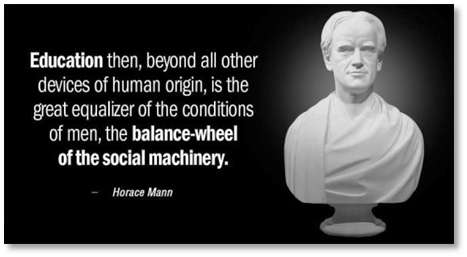
Leading us to this point has been the “common school,” established in the 1830s and 1840s in the new United States, comparable to today’s standardized public school. Considered the father of American education, Horace Mann envisioned common schools as institutions that were free and open to all students. In his role as Secretary of the Massachusetts State Board of Education (1837–1848), he established teacher training schools, improved school infrastructure, and raised educational standards. [1] He wanted those teachers to teach standardized curricula that instilled students with civic values. Catholic and other parochial schools in particular objected to Mann’s belief that schools should not adhere to any specific Christian sect, an argument that continues to the present day.
An obvious drawback of religious schools that is often overlooked is the inevitable assumption of such schools and their adherents that their beliefs are the only truth, that anything other than specific Christian dogma is a lie. Denial of science is the best example of this prejudice as scientific discoveries have slowly dismantled much of the institutionalized mythology enshrined by religion. As myth becomes ingrained in students of religious schools, their beliefs serve as a wedge between the people practicing that belief system and the needs of a nation to move forward in all areas such as advancing industry and the economy with new inventions based on new scientific discoveries and the acceptance of facts about human life previously not understood.
For the 68% of Americans who do not adhere or sympathize with the strict religious views of Christian extremists, the fundamentals of accepted education typically aligns with secular, pluralistic, and science-backed academic standards. These standards prioritize critical thinking and inclusivity rather than religious doctrine or rigid ideological frameworks. In fact, of the approximate 32% of Americans counted as Christian Nationalists, the actual adherents are only 11% while another 21% are considered sympathizers.[2]
The question of funding public schools boils down to what we expect our educational tax dollars to accomplish. Programs which teach narrow and exclusive religious doctrine are by definition not meant to support a cooperative relationship among persons of various cultural and religious backgrounds, but rather to hold up one belief system as the only truth. This becomes an impetus for authoritarian overreach and ultimately war, as history has long shown us.
While historically this conflict in the U.S. has been decided in favor of the constitutional standard not to mix church and state, the most compelling factor in the present day argument is that we all pay taxes and the majority of Americans do not agree that taxes should support the extreme Christian agenda. Tax support violates the First Amendment’s Establishment Clause by compelling taxpayers to fund the teaching of religious doctrines, essentially creating a government-sanctioned religion.
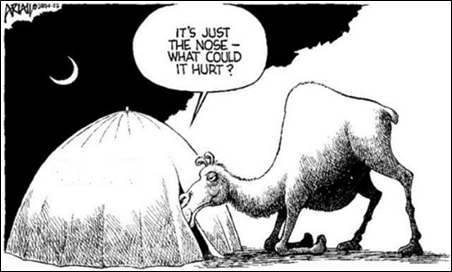
The slow but determined creep of Christian Nationalism shows every intention of overturning this Constitutional mandate. The camel’s nose is well under the edge of the tent. A 2024 investigation by The Washington Post found billions in tax dollars now pay tuition at private, mostly religious schools. For example, Florida’s voucher program is expected to exceed $3 billion, with over 80% of funds going to religious schools. Ohio is projected to spend nearly $1 billion, with 91% of voucher users attending religious institutions. Hundreds of thousands of students use these programs. The rise in funding is attributed to the expansion of voucher programs in Republican-led states, which now allow more or all families to qualify, shifting from programs once aimed only at low-income students.
Reduced funding for public education leads to layoffs, larger class sizes, and reduced individualized attention for students. Schools that serve the vast majority of students are forced to cut essential services, including arts, music, athletic programs, and after-school programming. There is less money for modern technology, up-to-date textbooks, and lab equipment. Meanwhile, private schools receiving public funds can exclude students based on religion, academic performance, disability, or sexual orientation, narrowing the educational options for those students. Vouchers can deepen racial and socioeconomic segregation by subsidizing tuition at private schools that often lack the diversity of public schools. Continued siphoning of funds can result in the closure of neighborhood public schools, particularly in rural areas where the school is a central community institution.
Long term erosion of financial support for public education puts the entire nation at risk, not only from prejudicial curricula in religious classrooms, but also from the inevitable schism between people educated in stringently oppositional systems. In a nation that has long pursued unity despite our different origins and beliefs, such divisive practices are a form of violence against the existing government.
The Supreme Court has said the Establishment Clause forbids, among other things, financial support of religious activity. Subsequent cases challenging the longstanding interpretation of the First Amendment have brought us to the Espinoza vs. Montana case, allowing tax dollars to flow to the parents/students of religious schools. This is by far not established law. While Espinoza reaffirmed that governments may not discriminate against beneficiaries solely on the basis of their religious character, it left open the possibility that governments might still be able to bar beneficiaries that would put public funds to religious uses.
The U.S. majority has become increasingly aware of the conflict between a religious agenda and our multicultural society. The percentage of Americans who say religion is “very important” has dropped from over 88%-95% in the 1960s to 47% in 2025. The latest Religious Landscape Study, fielded over seven months in 2023-24, finds that only 62% of U.S. adults identify as Christians. That is a decline of nine percentage points since 2014 and a 16-point drop since 2007. Within Christianity, 19% are Catholic, 3% are Mormon, Orthodox, Jehovah’s Witness, and other, and 42% are Protestant divided into Evangelical (23%), Mainline (14%),[3] and Historically Black Protestant (5%).
Projections indicate that by 2070, Christians could shrink from 64% (2020) to between 35% and 54% of Americans, while “Nones” (no religion) rise from 30% to over 50% in some scenarios. This shift drives religious zealots to push a movement which seeks to assert “dominion” over societal institutions, including government, education, and media, believing that Christian moral values should dictate law.
Growing concern within the U.S. public is slowly building into a response to Christian Nationalism, Dominionism, Christian Reconstructionism, and the New Apostolic Reformation (NAR) including tracking by civil rights organizations, legal challenges, and theological counter-movements from within Christianity. These initiatives aim to counter the rising influence of these new Puritan groups. Organizations like the Southern Poverty Law Center (SPLC) are actively documenting the spread of Dominionism,[4] profiling key leaders in the New Apostolic Reformation, and tracking associated hate groups. (This is directly connected to the Trump Administration’s May 2026 lawsuit against the SPLC in an effort to intimidate all civil rights organizations from speaking out and doing their work.)[5]
Scholars and progressive faith leaders are working to produce public-facing biblical interpretations that contradict Dominionist, coercive, and authoritarian interpretations of Scripture. Efforts are underway to inform the public and Christians about the anti-democratic nature of white Christian Nationalism and Dominionism to “inoculate” them against its appeal. The ACLU of North Dakota and other organizations actively fight against initiatives promoted by Dominionists, such as forcing religious prayer into public schools, banning books, and promoting anti-LGBTQ+ policies. Organizations like American Atheists oppose lobbying efforts to pass laws that violate the separation of church and state, such as those permitting discrimination under the guise of religious freedom. Researchers such as Dr. Matthew D. Taylor are working to expose the ties between modern charismatic prophets and the political, antidemocratic, and “spiritual warfare” approaches used to influence elections.
Defenders of the United States Constitution emphasize the importance of religious pluralism and the separation of church and state, arguing that Christian supremacy rejects these principles. Organized efforts underway to combat Christian supremacy include
- A grassroots movement launched by the Baptist Joint Committee for Religious Liberty (BJC). It unites Christians across the theological spectrum to speak out against the merging of Christian and American identities.
- Interfaith Alliance: A national, pro-democracy organization that mobilizes diverse faith communities to challenge Christian nationalism, protect civil rights, and uphold religious pluralism.
- State Ecumenical Groups: Various regional faith networks, such as the Wisconsin Council of Churches, that host educational campaigns, study groups, and sermons to counter nationalist theology.
- Americans United for Separation of Church and State: A leading organization dedicated to preserving the constitutional wall separating church and state. They actively litigate cases and advocate against policies that advance white Christian nationalism.
- Freedom From Religion Foundation (FFRF): A prominent secular organization working to defend the constitutional principle of separation of church and state, frequently challenging religious favoritism in the public and political spheres.
- Southern Poverty Law Center (SPLC): Monitors far-right and extremist movements. The SPLC identifies and exposes the ideologies and groups—including Christian supremacist and Dominionist networks—that threaten democratic institutions.
- Public Religion Research Institute (PRRI): While not an activist group, PRRI conducts rigorous data-driven research and polling on Christian nationalism. Their work tracks the demographics and organizations that resist these movements.
These efforts fight against the adoption of “biblical authoritarianism” and the idea that Christians are mandated to take over societal institutions.
[1] Little, Becky. “Who Invented Public School in America,” History, Sept 10, 2025. https://www.history.com/articles/public-school-america-horace-mann
[2] More than half of U.S. Republicans are either adherents (20%) or sympathizers (33%).
[3] a group of historically established, traditional Protestant denominations in North America, often associated with a theologically liberal, progressive, or moderate approach to Christianity
[4] Dominionism (or Dominion Theology) is the religious belief that Christians are divinely mandated to take control of secular political and cultural institutions to establish the Kingdom of God on Earth. It is smaller and more fringe than broad Christian nationalism, but it holds disproportionate sway in certain fundamentalist, charismatic, and Pentecostal factions. While closely related, Dominionism and Christian Nationalism differ in their ultimate goals, theological roots, and how they view the relationship between religion, government, and the end of the world. Apparently neither group is familiar with the writings attributed to John in 18:36 where Jesus clarifies the nature of his realm: “My kingdom is not of this world.”
[5] https://www.aljazeera.com/news/2026/4/21/trump-administration-sues-southern-poverty-law-center-on-fraud-charges
This is the 4th chapter in the booklet New Puritans and the U. S. Peerage: The Willful Destruction of Public Education
 denelecampbell